Be ready to lead one of twenty factions in a race for domination of the ancient Mediterranean.
https://www.youtube.com/watch?v=F1eiioZN5RE
Lead the mighty legions of Rome and expand its civilization with fire and steel. Establish a trading empire with Carthage across the Mediterranean, making it your Mare Nostrum. Rule one of the Successor Kingdoms and conquer a massive hellenistic empire, following on the footsteps of Alexander the Great. Take command of a young tribe, new to the world stage, and make older and decadent empires tremble.
The choice is yours. Aggressors: Ancient Rome is a historical turn-based 4x strategy game that lets you relive ancient history, putting you in the sandals of the great conquerors of those times.
Warfare, economy, diplomacy, trade, internal politics, technology, demography: you have many tools at your disposal to shape your empire and gain an edge over greedy and rapacious rivals. All at a level of depth never seen before in a game of this kind.
The developers from Kubat Software fine-tuned the gameplay for years, implementing mechanics which integrate seamlessly with each other, for a cohese and coherent experience that makes the world you play in feel alive and realistic.
Aggressors is all about customization and replayability. Thanks to the extremely flexible random world generator you'll be able to generate any kind of random map, setting all the parameters you need to completely customize your next campaign. No playthrough will ever be the same.
You can read more about the gameplay by reading the Dev Diaries.
With the in-game editor you will be able to create new maps and mods to your liking, then you can easily update them to Steam Workshop with the simple click of a button. Modding has never been easier! We are particularly proud of how modding is taking on in Aggressors: many beta testers already developed new mods and scenarios, and at launch you'll already find free scenarios and mods available for download from the Steam Workshop.
To celebrate this release, the game's producer Surtur will be playing Aggressors live on Twitch at 8 pm CEST on our channel. Come and stay with us to take part in the release party for Aggressors, as well as to ask whatever you would like to know about the game!
Last but not least: as usual we would love to hear your feedback, and it's great to gather all players in a single place to stimulate discussion and the exchange of ideas - the best places for that are our forum and the newly created Discord channel. They are also the places where you would be able to find advice and suggestions about the game.
We have something special coming: in sight of the release of Aggressors next week, the developers themselves are going to stream the game on Twitch live next Monday!
Don't miss it - it will be a very informative stream, with the lead designer speaking at length about Aggressors and answering all your questions in detail
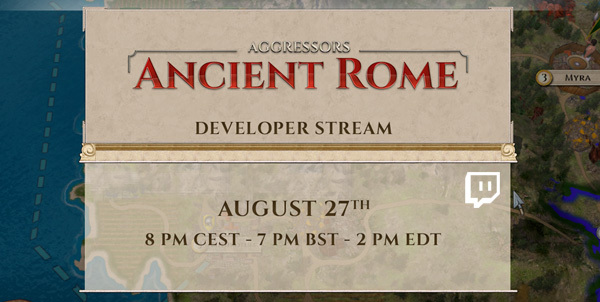
The stream will begin at 8 pm CEST on our Twitch channel on Monday August 27th.
Today we are publishing the last dev diary of Aggressors before its release next Thursday, but before we get to it, we would like to remind you that today DasTactic will be streaming Aggressors live on Twitch at 9 pm CEST, don’t miss it!
Now, on to the dev diary, and as usual I’ll leave word to Pavel Kubat, lead developer and designer for the game.
From recent videos and questions on forums it is quite clear that players are very interested in the Random Map Generator included in Aggressors.
To be quite honest, the Map Generator was not actually intended to be part of the vanilla release. Despite the fact that we use dynamic terrain even in the scenario setup (it is not a fixed map) as it gives much more flexibility, we didn’t consider this feature to be that interesting for players.
Moreover, the Map Generator would require a great deal of additional work and we had plenty of other things on top of our to-do list.
When alpha testing started and feedback and suggestions started flowing in, I was really taken aback by the staggering number of requests to add a custom Map Generator. I was expecting that players would prefer playing the historical scenario rather than a random map.
And so, as we had done so many times before, we re-thought our priorities and added this feature into our schedule. There was already a raw Map Generator partially implemented but it was a separate tool not incorporated into the game. It was also not that user-friendly and not modular enough to meet the standards we had in mind.
The first phase of the project was mapping out the games already out there. I was looking for the right way to do this, to find the key settings for the map generator and to identify pitfalls of other map generators and how to avoid them. After a couple of months of development the first version of the map generator was ready.
We used a number of standard settings such as map size (ranging from tiny to huge world), map type (ratio between water and land mass), climate type (hospitable to barren) or density of population (how crowded the world is and the distance between players). But that was just the beginning.
From my perspective the biggest issue in the majority of map generators for other games is the fact that they tend to force you to really long and boring early phases once you have begun playing. You have to hit "end turn" around fifty times to eventually get to develop some infrastructure and build a couple of units to be able to actually play and enjoy the game. This was a no-go for me. I decided early on that we needed to add a Development setting allowing players to choose if they want to start with a lonely nomad unit roaming the unknown world or if they would rather start as a crowned king of a state that stands on solid foundations like cities, roads, fields for farming and few trained military units to build upon.
There are five different options to satisfy everyone’s taste.
But soon enough we realized that the basic settings are not quite enough. The worlds we generated were great, some of the maps even surpassing our expectations but we needed more options to modify the gameplay itself.
Some were easy to implement, for example Resource abundance that allows the player to configure how many mines will be available on the map which affects the player’s ability to develop as well as how fast and tough the conflicts over resources will be. Hand in hand with this setting goes the Player’s resource abundance which sets the resources stockpiles the player has at the beginning of the game.
Similarly, the Diplomatic Relations setting defines how (un)friendly neighboring nations will be, and the Independent Cities setting determines the number of standalone independent neutral cities on the map.
Players can also specify which victory conditions they want in their game - overall victory, military superiority, technological dominance and country development.
All the above settings were added to the Map Generator in a natural process following the logic of any world creator. However, what makes every single game fun is the way it unfolds in a different direction every time and forces players to adjust their strategy to current conditions. Sometimes you get the upper hand, yet another time you struggle to keep up with other forces around you.
There are two settings that determine how fair the game will be, determining whether or not one between the player and AI opponents will start in a more powerful position.
The Game Balance setting adjusts starting conditions. Set to max, all players (human and AI) will have similar starting point in terms of number of military units, settlers and cities. Set to minimum, the development span will be quite big – some nations will be already large developed empires whereas others will have to make do with just a city-state.
However, this setting does not really say on which end you going to end up. For this, there is the Player Advantage setting which allows you to choose what kind advantage over all other players you will have. You can decide to create a new world with you leading a mighty and established empire surrounded by younger tribes, or you can take up the challenge and start as the very last runner in the conquest for supremacy. The choice is yours, you can be either Goliath or David.
That said, designing the Map Generator and all these settings was not the most difficult part. The challenge was in finding the right balance. We invested a huge amount of time into balancing so that even if you draw the shortest straw, you will be able to survive at least few dozens of turns to prove your worth.
Now back to the map: there is still one thing left to mention. The historical setup has a contour map that we created tile by tile to make the world feel real. But for the randomly generated map we had to come up with a different solution to have nice high mountain ranges, deep river valleys and open bays surrounded by beaches created automatically from the map.
We designed an algorithm that detects the different terrain types and then creates a sort of contour map based on these.
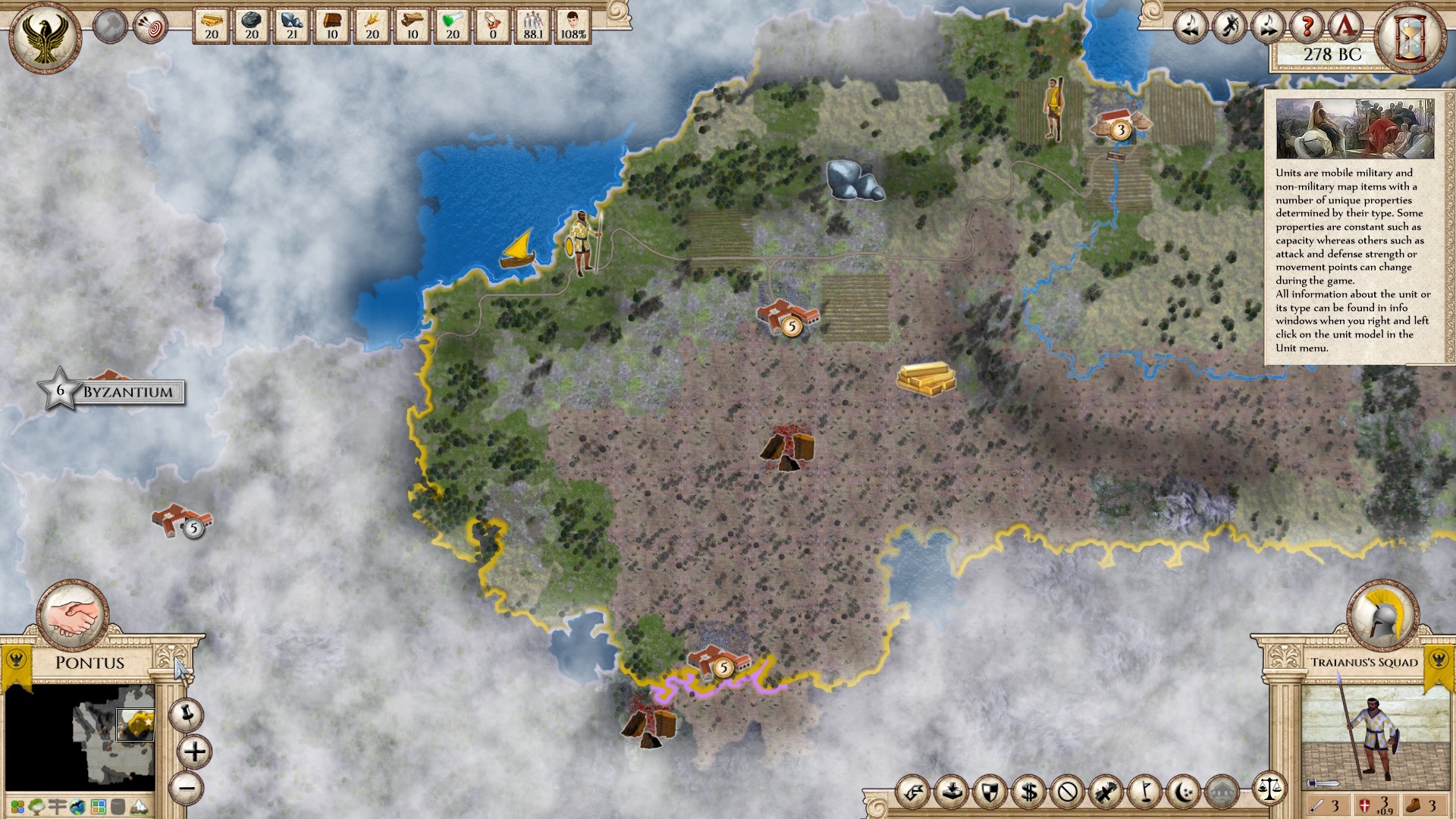
To tickle your fancy, I will show you couple of screenshots that we took during testing but to see what the map generator can do, you will need to try it on your own.
The release date is around the corner. I really enjoyed writing these diaries because I had an opportunity to look back and recollect our long journey. It was full of headaches, doubts and sleepless nights but on the other hand it has been an extremely enjoyable and intriguing ride.
I want to thank you for joining me in this nostalgia and I can only invite you to explore the depth of Aggressors on your own. What else can I say? I hope you’ll have as much fun playing Aggressors as I still have, even after 10 years of development!
We just published the first gameplay video for Aggressors: Ancient Rome. This video, the first of a series, is a good introduction to Aggressors and what the game is about.
https://www.youtube.com/watch?v=8D9QOb4IqMQ
We'll follow up with videos about specific aspects of the game. Stay tuned!
We have already covered most of the main game mechanics and features yet there is still one big question we want to discuss today. How to build up your empire and what to do in time of peace in Aggressors?
It might seem that antiquity was all about wars and conflicts, but people of those times mostly wanted to live in peace and prosperity like anyone else. Emperors might have had great ambitions and pushed the boundaries of their empires still further but at the same time they had to maintain and improve the state infrastructure to keep ahead of other nations.
I would like to say that I don’t really like micromanagement in most strategy games. I find it either too "micro" or too boring – it just requires me to stay focused on many minor details while I’d rather look at he bigger picture. Another thing worth mentioning is that I feel micromanagement in ancient times needs to be different compared to how it would feel in modern times or in a sci-fi setup for example.
In ancient times most of the time urban centers managed their own things; the natural life of cities was regulated by local situations and needed not to be managed through frequent orders from the capital. Cities, their population and resources were mobilized only during perilous times when necessary war preparations had to be made.
We followed this line of logic as well. The main function of cities is to generate wealth and to build and maintain units which deplete city capacities and resources. Leaving cities “idle” allows them to follow their natural growth and use their resources where needed. When you task the city with work, being either the constructions of improvements or the recruitment of new units, the resource production of the city is decreased. This principle reduced micromanagement from "this is what I have to do" to "this is what I can do" and it seems that beta testers appreciate it.
So you might ask: what to do in time of peace?
Let me first explain the concept of a city. Cities are the backbone of the state infrastructure concentrating large bodies of population and power in one place. Their size and position greatly affect its defense capabilities and its ability to harvest on the neighboring tiles.
Every city has a so called "range" which is basically a set of nearby tiles adjacent to it. This range expands with the size and the number of citizens living there (we covered population growth in one of our previous diaries). Food and wood are harvested on tiles lying within the city range which means that larger cities work larger areas and so produce more food and wood.
A city itself consumes resources while producing some others but production and usage of resources by the city depends on its size - the bigger the city, the higher the production and also consumption. For instance, a very small city produces very little knowledge because all its people are busy farming, mining, etc. As the city grows and with it its population, more and more people can have other occupations (philosophers and scholars) and so the output of knowledge in the city increases.
City size is nonlinear, meaning that having many small cities is not the same as having a few very large ones. E.g. two cities with a size 2 have together a smaller population (and therefore also production and consumption rates) than one city with a size 4.
However, city size also has a very important side effect. The larger the city, the stronger its defense, and it’ll be more difficult to conquer it for anyone. On the other hand, bigger cities give bigger loot once conquered.
As mentioned above, tiles within a city range are important for harvesting food and wood. Arable lands around cities can be cultivated by building fields and farms to multiply food yields from each tile depending on the technological development of the country. Sea tiles also provide food in abundance. Terrain which is not suitable for agriculture such as forest, swamp and jungle can be “transformed” by cutting down the woods or draining them. However, one has to be careful not to deplete precious sources. Clearing a forest means that you immediately gain relatively large quantities of timber and make more space for fields but you will not be able to harvest wood on that tile ever again. Romans cut down many of their forests and then had to import wood from far away provinces.
As with any centre, maintenance and upkeep are necessary. The concept of city improvements is similar to units improvements as discussed in a previous diary.
Cities can improve their infrastructure by building military (stockade, palisade, city walls), economic (trading centre, economical city), political (amphitheater, obedience, civil service), cultural (academy or schools) or urban improvements (hospital, sewers system) that can have a major effect on the defensive function, resource production, cultural and social life of the city. For example, improving cities with Sewage system protects them from the spreading of infections and diseases, while building Civil service reduces the risk of local revolts.
There are currently 16 city improvements and I am sure you don’t want me to spoil all the fun by revealing them all here.
Many 4X games treat cities as the "absolute centers" where all power and activity is concentrated. However, facilities outside of city walls often were of great strategic importance so we introduced the concept of "buildings" into the game. These are standalone facilities such as blacksmith, temple, shipyard, fort, defensive walls, patrol tower etc. that greatly affect the economic life as well as the military capacities of the state.
Another very important aspect of state management are good communication lines connecting all parts of the empire. There are two types of roads – dirt and paved roads and they have a great impact on the economic and military development of the country. Just like with anything else in the game, you will have to research them through technology.
Mines connected to cities and blacksmiths by roads significantly increase their resource production. Roads allow units to move faster over all types of terrains and their use also reduces the overhead costs of trade exchanges (you can find more about trade in the previous diary). Roads also allow you to provide constant flow of supplies to your armies. Units left in foreign lands without food, armaments and other necessities rebel and can cause trouble so you should plan your road network in advance to support future territorial expansion. Behind your advancing units should always come road builders to ensure sufficient flow of supplies.
When it comes to roads I should not forget to mention bridges. Rivers aren’t just a map feature but they have an important military dimension. They create a barrier which is not easy to traverse. Some unit types cannot cross rivers at all if the other bank is not already in their hands. Others can cross them but with a significant movement and defense penalty. That's why rivers have a great defensive potential.
You can mitigate all river penalties simply by building a bridge. Should you be forced to retreat, you can always destroy the structure and leave the hard choice to the opponent – either accepting the river as a new border between your states or crossing the wild stream without a bridge and risking a slaughter in an attempt to reach the opposite bank.
These are the most important parts of a micromanagement in Aggressors. I believe that gamers who like the “building” part of 4X games will enjoy the given options to improve their empire without being overwhelmed by repetitive tedious clicking and enjoying the game itself.
Initially this dev diary was planned to be the last one but we decided to give you a bonus one. I already look forward to it because next time I will show you our map generator and its possibilities.
Last but not least, tune in this evening at 8 pm CEST on our Twitch channel for a preview stream of Aggressors: the strategy master DasTactic himself is going to play!
Aggressors Dev Diary #8 - Trade Routes
One of the things which was pretty difficult to implement in Aggressors was the way the game handles resources.
Initially, the number and types of resources were hardcoded in the game's core and the only thing which could be changed (or modded) was the amount required for certain actions.
I didn’t like this approach. I knew that if there are mods focusing on different eras or genres, something like money or gold would not make sense anymore. And so I decided to define all resources externally in a modifiable file and connect them directly with unit actions that consume them, then the type of resource consumed and also the amount is entirely up to the externally-loaded rules.
Basically, every action in game, whatever you do, can cost you some resources. Building roads, bridges, settlements, irrigating lands, draining swamps, building improvements, healing... I could go on and on. It is entirely up to the rule creator (or modder) to set the resource costs for specific actions.
Aggressors: Ancient Rome itself comes with 10 different resources starting from gold, stone and coal through influence, knowledge and food to very special ones such as citizens and happiness.
Other mods might have a very different set of resources. For example: the Holland mod, the mod of one of our beta testers that we talked about few weeks ago, has two additional resources - cowhide and fish. Both are harvested in a different and very unique way.
But let’s focus on Aggressors: Ancient Rome only.
I already covered some of the special resources, their production and usage in previous dev diaries. I explained the use of Influence which is accumulated by cities and used on foreign towns to incite unrest. I also covered the citizens resource which is the main source of army recruits and the workforce and is therefore the backbone of the economy. Knowledge is another resource accumulated in cities, and is essential for research. But let’s not go into an exhaustive list of the resource types and instead talk about another aspect of the game – trade.
All the resources in-game are tradable. The only resource that cannot be exchanged is happiness. You can trade all mined or harvested resources as well as influence or citizens. And you can trade knowledge.
It sounds a bit artificial, but it is actually much closer to reality than it might seem on first sight.
I never liked the way technologies and inventions were traded in the Civilization series. The whole system of “I give you a Chariot technology and you give me Navigation" simply doesn’t make sense. Not only that such "technology-for-technology" deals are extremely rare even in modern history but I couldn’t find a single example in the ancient history. And I am not even talking about the fact that if you are good friends with a very civilized and technologically advanced nation, you could turn a barbarian tribe into a modern state in a few turns.
So, why do I think that the approach in Aggressors is better? Firstly, you don’t trade inventions but knowledge. You trade know-how of the scholars which can help you to understand the work of nature and progress faster to a new level of technological development.
Secondly, research of every technology requires a certain number of knowledge points. If you have excessive amounts of knowledge resource, you can even accelerate the time needed for research. The shorter the time, the higher the resource cost, of course.
Thirdly, even if there is a very generous player who is willing to give you a vast amount of "knowledge", you can accelerate the research process but you will not uncover technologies that are simply beyond your current stage of development. Minimum research time is set for every technology so you cannot just jump over several technologies in a turn. All this means that every player has to research every technology by his own means. The only exception is when you unite with another nation in a federation or you merge together. Then you naturally also get access to all the technologies of the partner player.
So, how does the actual trading work? It was really important for me to come up with such a system that would reflect the importance of trading for the life of all ancient nations.
As I said, you can trade all the resources except happiness. Trade exchanges are not one-off events but they lay foundations to long-lasting business relationships that can last for decades. No wonder that some negotiations can go on for several turns (years) as both parties need to set the right conditions.
How to start? You begin by establishing a trade route which is a path connecting your city with a city of the partner. Both partners need to have full visibility of one of partner’s cities meaning that they know where they are sending their merchants to.
The routes are calculated automatically so that the shortest and safest route is chosen. Depending on the length of the trade route, a so called "trade loss" is calculated which are basically overhead costs that will be deducted from the amount of traded goods.
Calculation of new trade routes is determined by many factors. It is not just the distance, but also the terrain types through which the traders will have to travel. If you build a dirt road between the trading cities (or at least connect some of the tiles of the trade route) you make the route safer and decrease the trade loss. Paved roads are even better, of course. If there are no roads, trading caravans usually use sea or river routes. It is indeed better to trade with a partner nearby with a good road connection (or secure sea paths) than with partner on the other side of the map. Sometimes the trade loss can go as high as 50% which you really need to consider before the trade is agreed upon.
With a trade route established, you decide what you want to sell and buy. You can either ask for a very specific deal or make a relatively open offer and give the partner room for negotiations. Another important point is that there is no "good" or "bad" deal. It is all about supply and demand.
The exchange starts when the deal is confirmed by both sides. And then the resources start flowing both ways every turn.
The trade routes might change over time, for example if an enemy blocks them. In such cases a new route is chosen (calculated) and when doing so the overhead costs might change as well, which could render the exchange unprofitable. As one of the trade conditions you can set a "trade stop loss" which defines what overhead costs you are willing to accept. If the trade loss exceeds this limit, the deal is automatically cancelled.
Of course, where there are resources (and money) involved, there are bandits and pirates who live off the loot they manage to get. There are two concepts of raiding in the game: independent raiders, who randomly attack the trading caravans and steal part of the traded goods; and state-controlled raiders, who take orders from their masters (other players) and their loot then goes to the resource deposits of their masters.
Bandits and pirates operate both on sea and land. All military units can turn into raiders when they are close to at least one active trade route. The more units you use as pirates and bandits, the higher the chance of success and larger loot. Of course, there is certain danger involved. Firstly if you use a unit for raiding, it is not fortified and has a reduced defense ability which makes it very vulnerable if attacked. Besides, raiding is perceived as a dirty practice and your diplomatic relations can deteriorate fast, not only with the victim, but with all other nations as well.
But you are free to choose your own path. After all, ancient history knows many examples of nations that survived solely by attacking traders and living off the loot.
Well, I hope I teased you enough to try all these aspects of the game yourself. Perhaps, pirates and thieves will rule the world under your command. Or maybe you will stand on the other side of the divide and be the one who frees the civilized world of all bandits on land and sea.
I have always loved to tweak games, looking for ways to change the look or even the rules and create something new. That is why modding and flexibility were a priority for Aggressors. We already covered modding in one of the previous diaries together with the experience of one of our testers, so we shall focus on flexibility.
Hand in hand with flexibility goes the degree of customization.
I wanted to have the freedom to change the game to my liking from the inside. It is not easy to make options of all kind (graphic, audio, visual and other) so flexible that every player can change the look of the game to suit his personal taste and have the feeling of “being at home” in the game.
We have come to a dead end several times during development. One tester likes one feature or game view, yet another wants exactly the opposite.
A typical example might be the preference of many old school strategy gamers to play in 2D game view rather than a full 3D. We wanted to have the game in 3D but we also wanted to make the "old-school" gamers happy. What to do? We introduced a so called "top-view" which is easily accessible with one click (or keyboard shortcut) which basically turns the closer 3D world look to a plain 2D but fully featured view. Player can simply stay in the top view the whole game without any necessity to get back to 3D. All information, hints, etc. are available in both views.
The list of preferences you can tweak is long. For example, when it comes to unexplored terrain, what’s your preference? Having invisible tiles covered by clouds or them just being dark, pitch black? We decided to implement both and let the player decide what he likes.
This is something I appreciate a lot in other games and so whenever it seemed that there are two (or even more!) groups with a distinct personal preferences, we tried to make settings customizable.
There is a great number of settings that can be customized from UI customization (like hiding various information panels, buttons and hints) through adjusting some eye candy effects (such as clouds, fog, trees, unit size, ambient animals or daylight).
For instance, you can change the saturation and brightness of terrain or the level of trees blending with terrain. We also introduced so called terrain "overlays" which allow you to look at the map with different filters to highlight certain information. There is a supply area highlight, player colour overlay highlighting the territories in the colour of the owner, or the terrain colour overlay that highlights types of terrains.
But even this level of customization was not enough. Even all these overlays can be further customized by setting the saturation of the coloured overlays from almost transparent to full opacity. You decide how much you want the terrain to blend in with the overlay. The default settings were chosen based on the feedback we received but still I am sure anyone will find the right configuration for them.
I realized that once you adjust the look of the game to your liking, many people start changing the world by adding their own bits and pieces to the game or even creating their own worlds. But you don’t do all this just for yourself; you want to share it with the community.
The community is what makes a game truly flourish. After all, we developed the game for you to play and we want to give our fellow players the chance to create and share their own content.
Steam Workshop was choice number one here. Where else would modders and scenario creators meet in such numbers? That's why we implemented a full in-game integration of the Steam workshop where you can not only download Aggressors items like saves, scenarios, generated worlds or even mods but also publish and republish your own items without the need to edit it further on the Steam website. Just one click in game and you can publish whatever you prefer on the Workshop. It should be easy for anyone who wants to share his work with others.
The other week I started an article about the tactical dimensions of Aggressors and the features that make it quite a deep tactical game. I would like to continue that today as there is still much ground to be covered.
In the previous diary I hinted at one of the very important features called general morale and I should now explain how it works.
In contrast to army morale, which is the same for all units facing a particular opponent, general morale is different for every unit. It is an indicator of how "happy" or "content" the unit is, which is closely related to its history. Has that unit been paid well and regularly, is it supplied sufficiently with food and where does its loyalty lie? All of these matter and general morale is one of the most important factors that can determine the battle outcome. Units with low general morale may not be reliable as their fighting abilities can be limited because they are more prone to desertions or leaving the battlefield without inflicting much damage to the enemy. But time and good treatment heals all previous grievances and if you take a good care of your men, they will once again proudly raise your banner before the next engagement.
General morale of cities is perhaps even more important. A City with low general morale can be easily influenced by other states, it might switch sides of its own accord, especially when there is no military garrison to maintain order.
Cities are the building blocks of the empire and losing one can hurt the state economy, i.e. its ability to recruit new units or to trade. City conquest is usually the most rewarding part of military campaigns as it brings in new resources and people and gives you another strongpoint for your offensive. But you do not always need to use brute force to get the city gates to open.
There is a very cool mechanic in the game called city siege. I already described the supply management in detail in a previous diary. Basically, all cities act as suppliers for military units around them. However, when you cut the city off by encircling it (taking all adjacent tiles) and leave one military unit to keep the blockade, the city will starve and its general moral drops radically with every passing turn. The enemy might try to break through your lines to the city or, if it is a coastal town, he can keep a ship near the port to open an access point. Otherwise the besieged city has only two options - to surrender or starve. This process can be slowed down if a military unit is stationed in the city as it maintains order for a bit longer but it cannot really change the situation, unless it tries to fight its way out of the city.
On the other hand, cities are great places for building a defensive line. Military unit held in the city dramatically increases the city’s defense strength. Additionally, you can build city improvements such as stockades, palisades or city walls to multiply the defense bonus. Build solid fortifications with a guard inside and you might just have a strongpoint that can blunt or even stop an enemy offensive.
But cities are too precious to risk that they will fall into the hands of the enemy. A good defense should not rely only on a few well-protected towns. You can also make use of special structures with both defensive and offensive characteristics that can be built outside of cities. For example, forts and defensive walls can create a solid line several tiles long. Even if only manned by a few guards, it is a barrier that could break the tide of the invading forces.
I can go on but I have already exceeded the planned length of the article, so I’ll describe the last 3 tactical concepts just briefly.
The first of them is unit experience which is gained in battles both won and lost (but more from successful campaigns) and with every improvement. On the other hand, healing damaged units and replenishing the ranks with newcomers naturally decreases the unit’s overall experience. Seasoned warriors are very precious, if you find yourself between a rock and a hard place you will wish to have a few experienced men to carry out your commands rather than a bunch of rookies.
Even though Aggressors is a turn-based strategy, we tried to create a kind of a "time flow" between the turns which can impact the defenses especially.
Defense readiness is a bonus received by a unit that has not yet moved in the current turn and so its men are fresh, prepared and ready for action. If you force your men to march long distance and they are attacked before they even have time grab their weapons, the chances that you will be beaten are logically higher.
Similarly, the fend-off attack penalty is applied if the unit is attacked more than once in one turn. The defending unit gives its full 100% strength to beat the aggressor and it is then tired and perhaps damaged from the fight. But if it is immediately afterwards attacked again, it does not have time to recover and cannot use its full strength for defense anymore. This penalty grows with every new attack the unit has to fend off in that turn.
So far, I have talked only about fighting and how to pit the strengths of one unit against the other but how to deal with damage? There are several ways how to repair and heal your units in different situations.
Every damaged unit automatically recovers a small fraction of its full strength every turn it is not attacked. There is no cost involved. The process is very slow but sometimes you simply cannot do much more than this.
If you need your men near the front, the unit can regain part of its strength out in the field which does not cost anything but the unit is exposed and its defense strength is drastically reduced during the process.
If the unit is not far from a city, you can replenish its strength by recruiting new men from the town which means that the unit heals twice as fast but you need to accept the costs – resources, perhaps also lower loyalty, general morale and reduced experience (depending on the city’s loyalty, general morale, etc.). The defense strength is again very limited during the healing process.
The best and fastest way to heal and repair your units is in the city (ideally with good loyalty and general morale) where you can quickly supply it with new men, weapons and armaments. It means that you need to move the men from the front and the further they have to go, the longer you have to hold the line without their support.
I would like to go into more details but there is simply no space to cover all the aspects of the tactical dimension of Aggressors. Things like city conquest and its implications, naval landings and its drawbacks, plundering cities and its impact on happiness and many others which I had to leave out this time.
Well, I guess you will need to try the game yourself and explore all the possibilities discover for yourself how deep tactical 4X strategy game Aggressors is when it releases on the 30th of August.
Aggressors is the upcoming 4X strategy game developed by Kubat Software and published by Slitherine. It is an incredibly deep game set in the ancient Mediterranean and it gives players complete freedom to manage their faction as they see fit.
Well, guys, we now have a release date! Aggressors: Ancient Rome will be out on August 30th!
We will keep publishing our Dev Diaries as we have lots to show still, but in case this is the first time you hear of Aggressors don’t forget to check out the old dev diaries.
But there is more: If you would like to watch Aggressors live for the first time ever then tune in next week on August 2nd at 7 pm BST on our Twitch channel – the game’s producer Surtur will be playing the game live while the developers will be in the chat to answer all your questions. Don’t miss it!
One thing I have never liked about 4X strategy games is the missing tactics. I never really understood why. Why cannot a game combine both – strategy and tactics? After all, quite a few generals became emperors!
Since the beginning, I planned to create a game that would be a mix of these two worlds. I didn’t want to go into low level tactics like the battles in Rome Total War but rather combine all the important aspects of battle tactics without the need to leave the strategic game map. No matter how grand and thought-out strategy you have, it is the actual battle that gets the adrenaline rushing through your body.
So, how did we go about it? First of all, you should get to know your army and those of your opponents. Find their strengths and weakness and use them to your best advantage.
There are 5 army types in the game: Roman, Greek, Persian, Carthaginian and Barbarian. Their basic characteristics have been already shown in the previous Infographics but to summarize, each army type has 3 infantry and 3 cavalry units. Naval, mechanical and non-military units are the same for players.
Each army type and every unit has a set of unique properties such as attack and defense strength, mobility, terrain adaptability, improvements, maintenance requirements, withdrawal probability, tenacity of fortification, and many others.
Let’s start with the terrain adaptability. Every unit type has a default attack and defense strength but its actual strength can be considerably increased or decreased depending on the terrain where they are forced to fight. Every unit type is suited for certain terrains where they can fully use their training, formations, battle style or arms. The terrain adaptability therefore can give a unit a great (dis)advantage considering that the terrain bonus/penalty span from +60% to -60%. And quite similarly the terrain affects the unit’s movement range.
To demonstrate the differences, we can use the example of Roman and Barbarian units. Barbarians are less disciplined and organized; their training forms strong individuals who excel in a man-to-man close combat in difficult terrains such as forests and hills. This environment is natural for them and they know how to behave and move around there.
On the other hand, the Romans are well trained, disciplined and loyal. The rigorous drill prepares them for perfectly coordinated maneuvers in close formations that are extremely difficult to break. But they need wide open plains to use such formations.
If the two armies meet on flat plains, the Barbarians will most likely be massacred as their wild even if strong attacks cannot break the solid wall of the Roman shields. Yet, if the two groups should meet in dense forests, the hit-and-run tactics of the Barbarians will have a clear advantage.
You should carefully choose the location for your battles. Sometimes it is better to take few more steps around to gain a decisive advantage than jumping at first opportunity to attack. And sometimes it is even better to build a line of defense in a suitable place and wait for the attackers. Set the conditions right and you can pick them one by one when they charge. Even seemingly weak unit can put up very effective defense and inflict serious damage if it can use the knowledge of the terrain.
Saying this, you should never fall in the trap of feeling safe! You can use some natural features of the terrain or the terrain itself to keep strong fall back positions. Rivers, hills, mountains, swamps and jungles are extremely difficult terrains that restrict mobility of units, compromise their fighting abilities and limit the chances of swift and surprising action. Positioning a fortified unit on such a tile means that the approaching enemy has to use extra force to break through which will cost him time and men and give you time to set the next trap.
As you can see, terrain can have a major impact on the outcome of the military engagements if not planned well. You have to build your success on the strengths of your units that create the core of your armies.
Every nation starts with unit(s) of one army type based on the military style they used. Romans start with Milites units and progress to Centurias and Legionaries. Barbarians start with Warriors and progress to Axemen and Elite Axemen. But you are not restricted to use units of your own army type only. If you conquer a city of another nation that uses different unit type, you will be able to incorporate these new units into your army as well. This way you can challenge your enemies on their own ground without losing advantage in unknown territories.
Yet, it is not all as easy as it might sound. Conquering a city rarely makes the people there happy, not mentioning their eagerness to join the ranks of your soldiers. I already mentioned how loyalty works in one of the previous Dev diaries but to give you a quick summary – units recruited in cities with low loyalty are also less loyal, their general morale is low and all this has a great negative impact on their fighting abilities. So, you need to think twice when and how to use these units.
This brings me to another game feature that I haven’t mentioned yet – improvements. There are currently more than 20 different military improvements that vary from the obligatory attack and defense strength improvements or those reducing terrain movement penalties, to some very special ones. Some of them can be gained only in a battle, others can be trained in cities which costs resources and time. It wouldn’t make sense to list all of them here but let’s just whet your appetite a bit.
For example, unit with “Petrifying” improvement scares all enemy units stationed nearby which reduces their strength. You cannot give a unit such a reputation that intimidates the opponent before the battle even starts, the unit has to prove its worth in a war to earn its name.
Another such improvement that you can gain only in a battle is “Homeland defender" which increases the defense abilities of a unit guarding a city or other populated places like blacksmith or temple.
One of those that can be trained in advance is “Discipline” that increases the unit’s resistance to starving or irregular pay which would otherwise cause decrease in morale. Or “Mountain movement” that allows the unit to cross mountains that are otherwise impassable. Although crossing mountain ranges leaves the unit weak and takes very long even with this improvement but it is not impossible!
You should always consider which improvements are needed for your military strategy and use specialized units in situations where you can maximize the benefit of their improvements.
There is still much more that I want to include in this topic but it would be a long reading and I would have to skip over some minor yet very interesting features which would be a pity. That’s why it would be better to split it to two parts and I will continue in the next Dev diary!