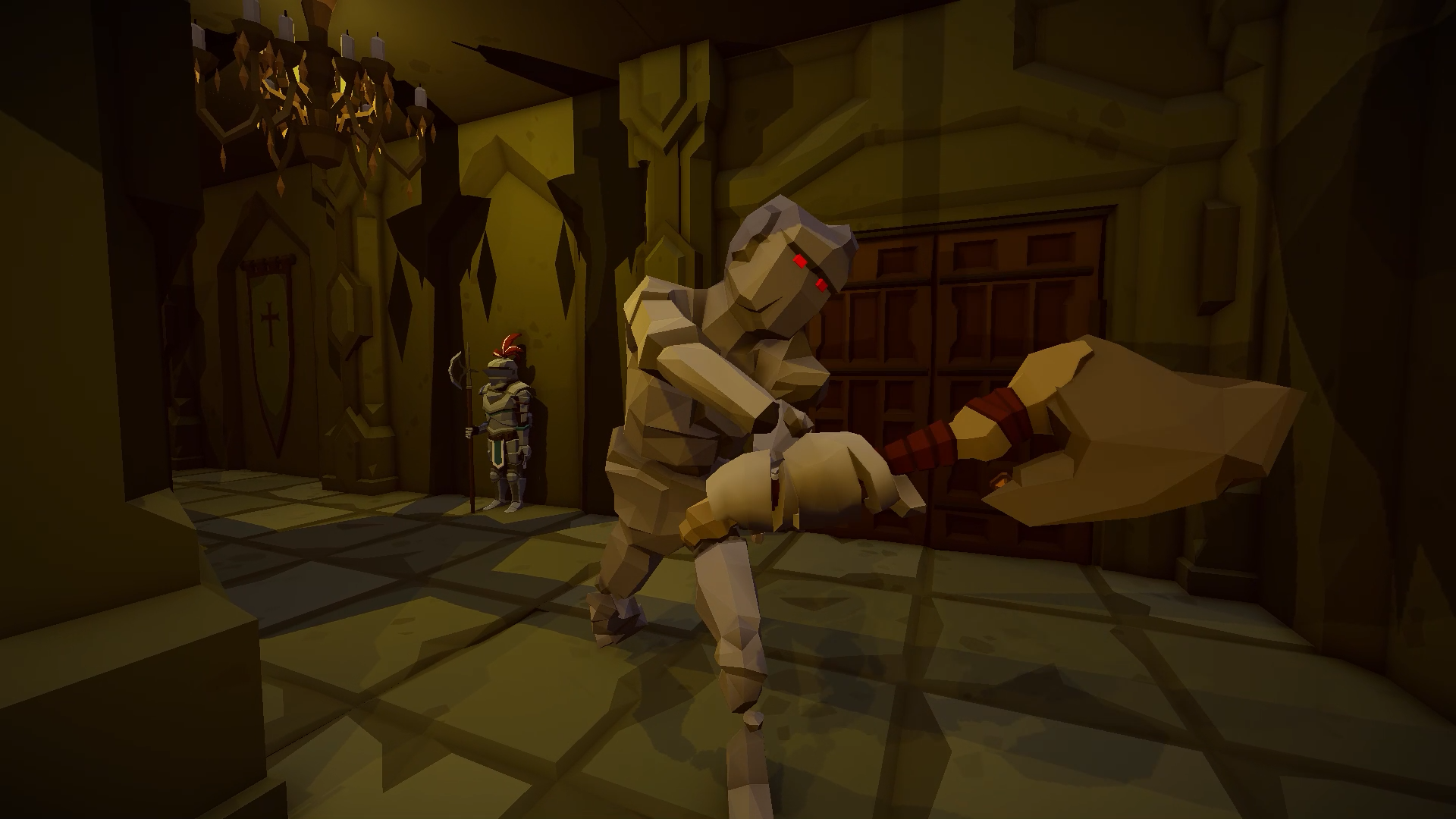
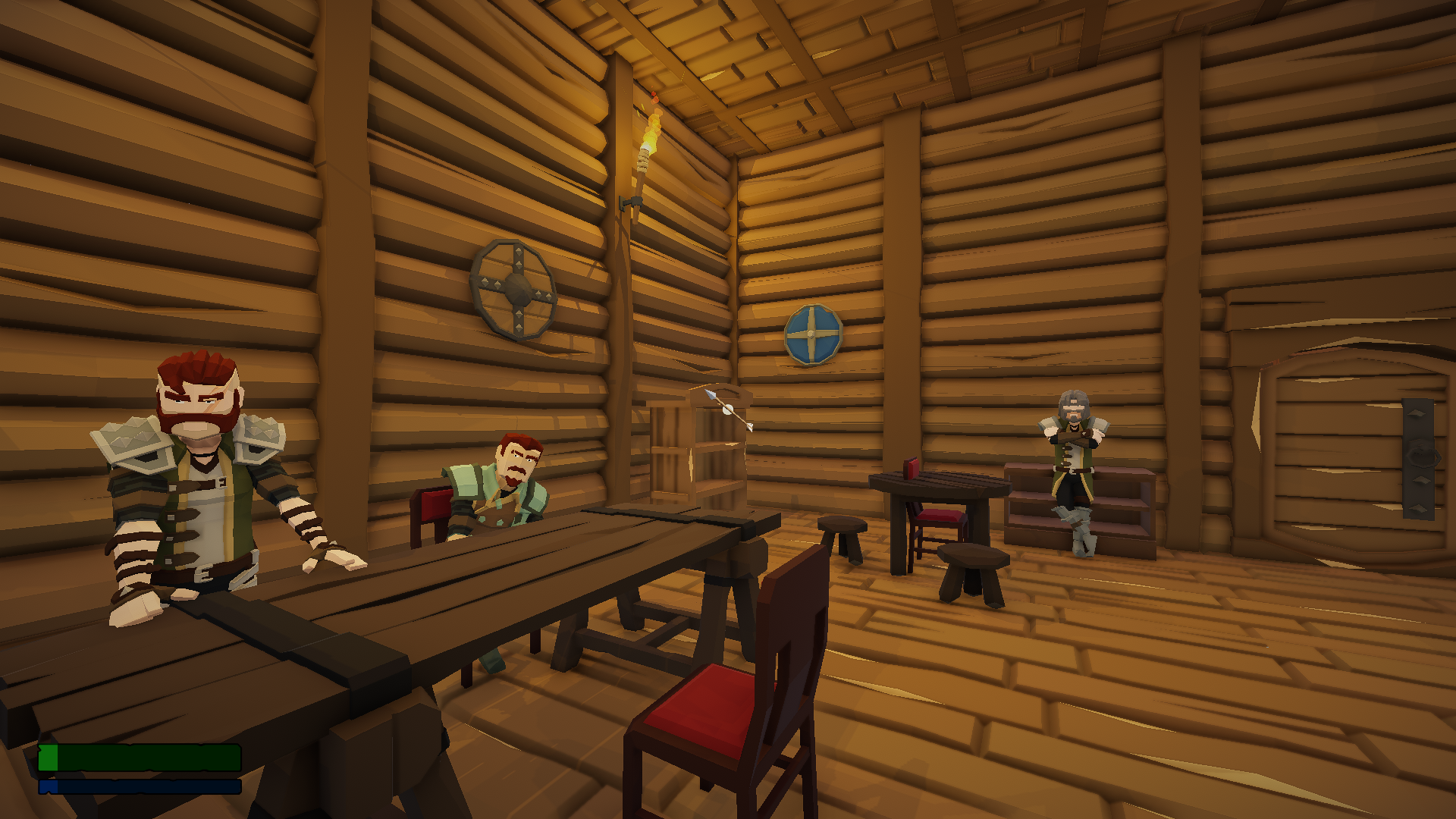
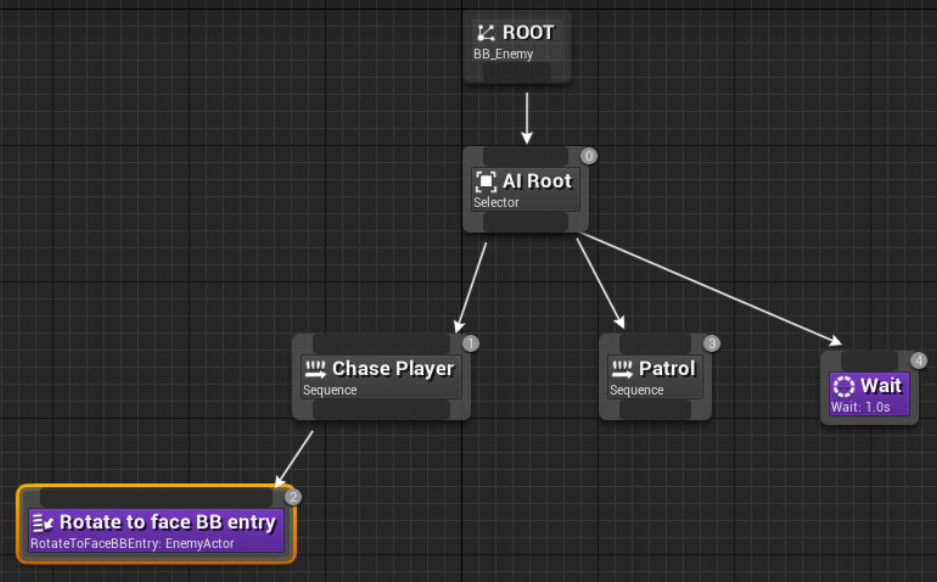
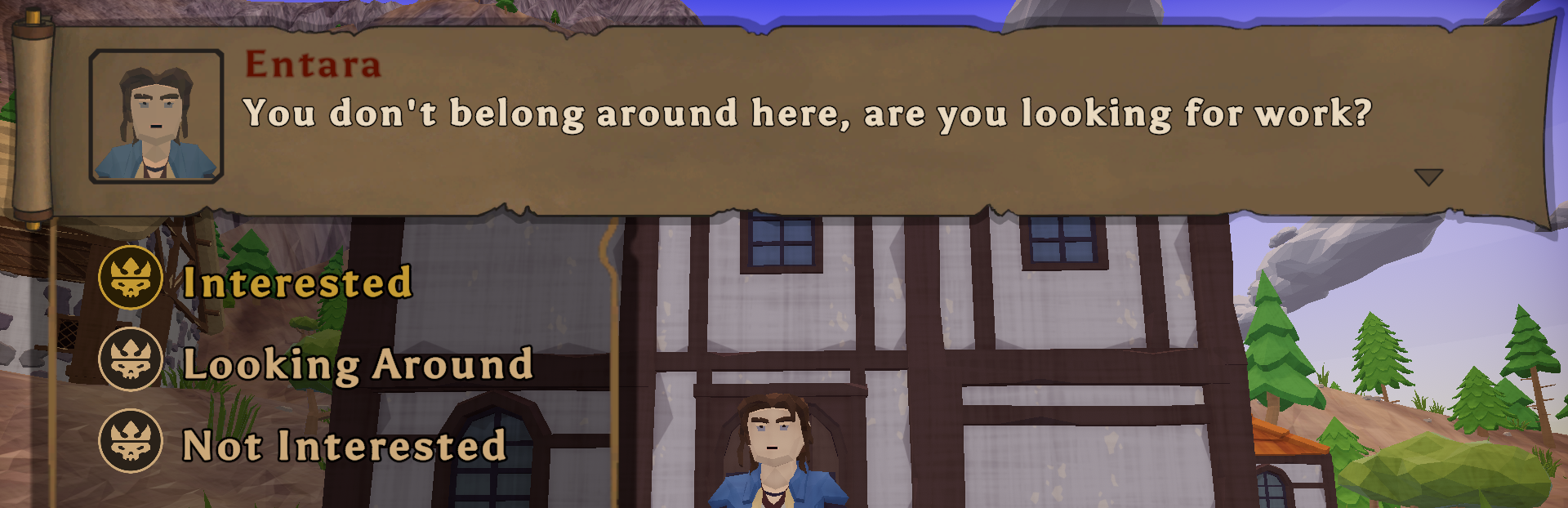
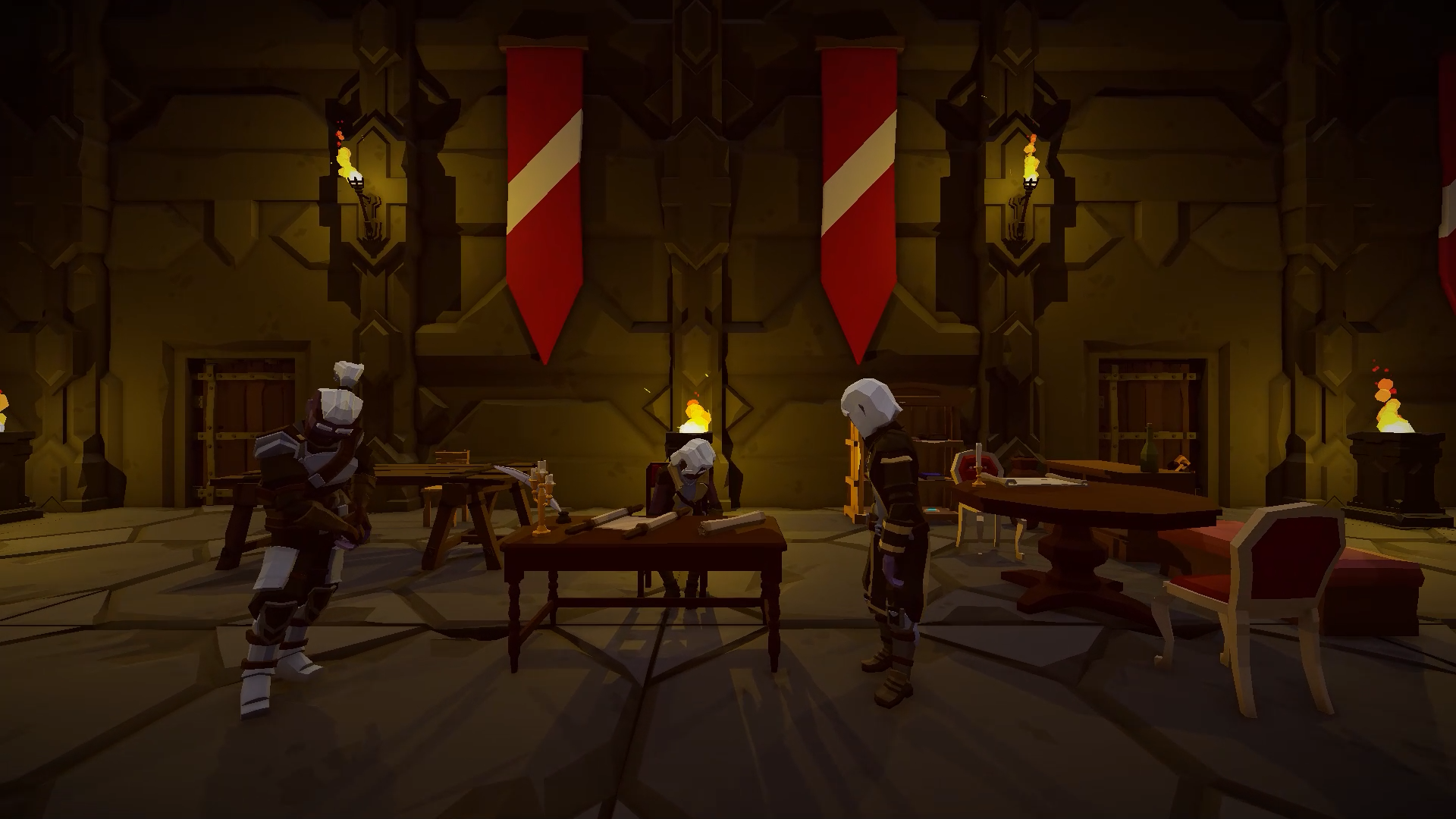
The power of the Scrolls-like platform is that there can be many levels of gameplay in a single game, and they fit together because of the world simulation, character customization, and narrative aspects work together to create a lot of possible experiences.
Because I’m building the game as a solo developer, I have the ability and responsibility to put all of the different experiences together into All Hail Temos. Here is how I am looking at the different kinds of experiences I want, and how I am going to introduce them into the game.
Progression Levels
First I will just list a sequence of progressions, as to how I design for the player experience to change throughout their playtime. Many of these will start simultaneously on a new game, but other come along later and are not immediately accessible to new players.
My design stack for experience is:
Explore and loot everything. Touch things that move. Environment interactivity.
Talk to people. Steal things in front of people. Social interactivity.
Engage in conversations and see if you can follow up, through going on the related adventures. Creates narrative, theme and meaning.
Combat and other obstacles to engage and overcome. Action skill building and resource management.
Progression. Improve at things, and determine new abilities for personalization.
A place to call home. Getting and improving a home, for utility and personalization.
Build an empire. Improve your holdings and position in the world. Widen your base.
A legacy. Do something worth being remembered for. A key event.
Making a difference. Impact on the world. A change that lasts.
Explore and loot everything
To start with, the world must have a basic level of interactivity. The environments can’t be things you can look at, and stand on but not touch. You need to be able to pick up things in the environment, and either use them or sell them, or learn from them, but the world has things in it that makes it worth exploring.
Things you take must have a purpose. The most basic purpose is that you can sell them, a higher purpose is that you might upgrade your gear with better or different style items, which may effect your playstyle. Other purposes include using things to help with your progression, such as leveling up.
In All Hail Temos, you can sacrifice items which destroys them, but allows you to upgrade your skills. An item that hasn’t been used before is worth less than an item you have used and “charged”, so collecting items, using them, and sacrificing them has an inherent purpose beyond just selling an item you don’t use anymore. Items can be sold for money, or sacrificed for progression.
This gives a reason to move around the world, find things and take or use them. A “Level 1” experience of a Scrolls-like game.
Talk, Bump, Threaten, Steal
The world must have people and creatures in it that you can interact with. You can talk with, getting near them, or taking your weapon out causes them to react to you. If you steal something in front of them, they call for the guards or demand you return the item.
There should be a sense of your actions having a reaction from the people in the world What happens when you equip your weapon, or take off your clothes, or dress like the enemy?
What happens if you cut down a merchant in a crowded area? Or a character walks into a room where you are standing with a dead body? How do they react?
This interactivity could be considered a “Level 2” experience of a Scrolls-like game. You now have living beings reacting to you, and you can interact with them.
Complete Adventures
Once you can talk with characters, next you will want to have complete interactions with them, such as solving a problem for them, or unlocking some requirement they had before they would talk more, etc. What is the result of this completed interaction?
Will you be paid in money? Information? Will it open up more adventures?
There should be a payoff for the completed interaction. An adventure has the promise of reward, and the promise should be kept.
In All Hail Temos, I prefer there to always be a reward with more story, and often opening up more adventures. Sometimes money will be paid, if it makes sense for that kind of situation, or an important or sentimental item will be received.
This reward could be considered a “Level 3” experience of a Scrolls-like game. You are getting meaning from your interactions, and they have an arc to them: a beginning, middle and end.
Combat and Obstacles
The order of these “levels” is not as important as the fact that they build on each other. The next level I am designing with is combat and other obstacles to exploring, so completing missions should provide reasonable difficulty.
Action and difficulty change up the slower pacing of a Scrolls-like, making an immediate goal of killing an enemy, or solving a puzzle. Scrolls-like games generally have a longer time between making new choices than many other games, because traveling between areas takes time, and there are usually many stacked goals that require resources or completing tasks before they can be worked on.
These sorts of immediate and blocking obstacles allow the player to switch focus from future goals to an immediate problem, and back again. Swapping between different styles of play is one of the things that makes the Scrolls-like platform appealing. You can improve at the action controls, and improve your character’s progression as well.
This can be considered a “Level 4” experience. For many games, this might be level 1, the introduction to the game. Enemies are around you, and you must survive, but for a Scrolls-like game, there are many areas that are safe and don’t require combat. Also, a player can choose to play a character that doesn’t fight, and that is also viable. They can sneak, bribe or talk their way through many situations.
Progression
After combat and navigating obstacles, there is the experience of improving your character. Improving stats, skills, learning new skills, getting better gear or improving existing gear, seeing how you are more effective against creatures you fought previously.
As you progress you also personalize your character, choosing the type of gear you like to play with, and the skills you like, which also means you are choosing not to upgrade different skills, making custom outcome. Being able to plan your upgrade path in advance is a big part of RPGs.
One reason games are fun is because you can see progression happen quickly. In real life, it might take 5-10 years or effort to be good at one skill, like playing guitar, or boxing. In an RPG you can start off unskilled and a few hours or days later you have a high level of skill. Making that change happen can be a lot of fun, if it has other supporting experiences to give it meaning.
The web game Cookie Clicker showed that just seeing numbers go up and progression occur from clicking on a cookie is interesting to people. But without other progression experience levels, it’s meaning doesn’t have weight.
The goal of improving and seeing the results can be considered a “Level 5” experience. You see the results of your efforts, and can accomplish things you could not do before.
A Place to Call Home
After you have started to progress your character, it would nice to have a home base. Somewhere you can store things, centralize any functions you might want, such as crafting, and personalize it so that it is to your liking.
Having your own base and improving it could be a “Level 6” experience. Now you have somewhere to hang trophies, and can tune it for your playstyle so coming home gives you many crafting or gear options.
Being able to have companions hang out in the home can also add another layer to their interactions giving an option for relaxing conversations or activities.
Build an Empire
Now that you have a home, and are progressing your skills, what else can you do? What can you achieve? Can you start a business, hire people, improve your holdings and position in the world?
Creating a system around yourself is possible in a Scrolls-like game, and while the initial release won’t have this content just due to constraints, it has always been in the design to be able to have employees, and set up trade deals for resources, and to use these in the adventures, in the same way as going to dungeons or talking with characters to solve problems.
This is a type of economic simulation, and while All Hail Temos is not a economic strategy game, so this is not the focus, I want to have some levels of this as it can add more play styles, and it makes the higher power levels more interesting.
Often, once you are personally powerful in a Scrolls-like game, many things become less interesting, because you are already the strongest person in the room. Once economics are brought into the picture, just being good with a sword, spell, light fingers or tongue may not get you into a specific adventure, but having a trade route secure for providing wood might.
This can be considered a “Level 7” experience, building on what you have done before, and making your place in the world more connected to the resources and characters of the world.
Bestow A Legacy
Having an empire, business or family allows for there to be the idea that “something can be left behind after you are done”. You have created something that moves outside of your own movements, and goes on working without you being directly involved.
This is a more conceptual experience than something like looting, combat or building an empire. This is the ability to think about how the characters you are employing are benefiting from this. Can you see the world working differently because of your actions?
This can be considered a “Level 8” experience, and goes beyond what you can actually do in the game, as there are enough systems in place that you can imagine what will happen with all those things without you.
Make a Change That Lasts
My last design experience is making a change that lasts. Will you be remembered for something? Have you made your mark?
Did you accomplish something epic that massively changed a situation?
This is similar to bestowing a legacy, but goes in a different direction. Instead of creating something that will last because you made it, this would be seeing change in the world rippling out from the actions you took.
Things that were not directly changed by you have been impacted by your actions and decisions, and now you are seeing people living in a different world.
This can be considered a “Level 9” experience, and one that I think many games build up to with their main quest, but in typical story fashion, it is best to build to a strong climax, and then end quickly.
In a Scrolls-like game, there is no reason to end once an adventure is complete, so you can see how things have changed after the adventure as well. The world and characters tell the story better than a single event can.
How will this affect gameplay?
At present the game is not complete, and so while I am designing for these experiences, they don’t exist yet. But, if I don’t design for them, I won’t be able to build them, so I feel it’s useful to both know what all the different experiences I want to provide are, and to be able to communicate them.
If I wrote a similar game to Flappy Bird, and then I wanted to add an experience of play like “Bestow a Legacy”, how would I do that?
It is a requirement to build the foundational layers of a game, so that it is possible to have a goal such as “Bestow a Legacy”, which would entail something like creating businesses that hired people that improved their community. Or, having a family that have children that also grow up and live and act in the world.
This is not current functionality, but it is an aspiration I have to build the foundation toward. A feature like that requires a number of ingredients to create, and my purpose now is to put all those ingredients together so that it is possible to start making “Bestow a Legacy” and all the other experiences occur in a satisfying way in All Hail Temos.
Conclusion
I wish I could get all of this into All Hail Temos on the initial release, but it is just too big of a goal to accomplish in one-shot. So instead, I will deliver up to the beginning of “Level 6”, having a place to call home, but there won’t be full base building or decoration until a post-release update, so I can focus on the previous 5 levels more.
If you would like to find out when All Hail Temos releases or get updates, please Wishlist and Follow on Steam.
Health, Potions & Food - Devlog #16
In thinking about the different systems and the ways I want players to interact with them, I have decided that health should only be curable by potions, or in specific locations. Typing this now, it basically sounds like Dark Souls flasks and bonfires, although that is not how I got to this decision.
I’ll talk a bit here about why I think this is the right decision for All Hail Temos, and how it can focus the gameplay.
What is Health?
To start with, let me just say that I think of Health as “the device that triggers a halt in the current play”. It is like a “Time Out” in a sport, where the teams stop playing until the timeout is over. Except in games, you often go back to a previous saved state.
In All Hail Temos, running out of health doesn’t halt your progress, it moves you into a new narrative position. If you were in a cave exploring, you get knocked out. Now you wake up in a prison, or at home, or in a makeshift camp in the cave. Whatever is going on will collect your unconscious self and move it to another place in the story, and some changes may occur in the previous story you were doing.
Maybe your companions finished the mission without you, or abandoned the mission to bring you back, or all of you were captured by an enemy. Since All Hail Temos is a narrative focused game, there will be a narrative waiting to take over. If no specific narrative exists, than one of the general ones will be used, so that the story moves forward.
A player’s health going to zero is what triggers this narrative progression.
Getting Healed
With this understanding of health, how do you get healed? There are only 2 solutions, through specific locations, such as shrines, or taking potions. Sleeping will not heal you. Sleeping gives a well-rested buff, so it is beneficial to sleep, but it will not heal your injuries.
The 2 main factors I am excluding here are: sleep and magic.
Magic is the reason I got to this position. All Hail Temos is a magical world, where magic is infused into everything, and everyone can perform magic.
The problem with this gameplay wise, is that healing spells effectively turn healing into stamina/time pools, after completing a fight, and used in combat are either instant heals or heal over time, and mean you are just kiting to stall for time while you heal, or using bursts of stamina you didn’t need in combat to use instant healing spells.
This is not the gameplay I want for All Hail Temos, as I don’t think it’s as engaging. Instead, there is the same time penalty for drinking a potion as performing an instant spell, the animation to drink/cast must be played, but the potion is based on items you possess, and items that are the best candidates for crafting (reason: used often), and whose ingredients can be found exploring.
By allowing casting healing spells, I am reducing the incentive to explore and craft, which are two fundamentals. Also, inside of crafting, there can be different ingredients that yield different effects. Healing may happen slower to faster. Healing may be able to keep healing you after 100%, so damage received after is still being healed before it runs out.
Also potions can provide other buffs besides healing, so having a reason to already collect potions, and possibly craft and explore to get the items (or explore to buy the items). This makes it more convenient to also craft or buy and use other potions, because potions are already part of the core gameplay.
Food and Potions
Food serves the purpose of granting buffs that last for a period of time. Eating food has a cool down period, so you can’t change these buffs immediately, but you can change them after a few minutes, which lends strategy for when to eat something. A potion can be used to clear the cool down, so you can eat quickly, but it will cost you resources and you have to keep that potion. More strategic play opportunities here.
The buffs you gain from eating will have different styles, and these styles will interact with potions differently. So you can eat food that increases the effectiveness of certain kinds of potions, which deepens the strategies of what to eat, based on what potions you have available.
This also gives a benefit to buying or crafting food, and engages with the possible ingredients there to improve the effectiveness of potions.
All of this also promotes farming as a crafting skill, to directly create the ingredients you want for food or potions.
This style of flow is how I want to tune the economy.
Tap, Store, Sink
There are 2 main patterns to an economy:
Tap (Faucet), Sink
Tap (Faucet), Store, Sink
Tap, Sink
A Tap/Sink system is one where a product is produced (Tap) and then used (Sink). You could also think of it like a number goes up, then down. Start with 0 apples, then tap or grow 10 apples, then eat 10 apples. The Tap was 10, and the Sink was 10.
This creates a type of ping-pong effect, where first you tap, then you use. There is no ability to store the item, it has a direct purpose. If a treasure chest is found, and the player takes the items, this is like a Tap/Sink.
This simple pattern is useful for simple loops, such as “loot items, and sell them”. Find potions, and drink them. We use this pattern all the time.
Tap, Store, Sink
Tap/Store/Stink adds a middle step, which is what creates the beginning of an economy.
10 apples are tapped. Then they are stored with a merchant. Then customers come and buy apples (sink).
This more complex pattern allows for hierarchy. We don’t just get an item and do something with it, it goes somewhere else, and can feed other loops that need that item or service.
Tap, Store, Sink Chains
A simple merchant is not that interesting, but where it gets interesting is in the chains of these elements.
For example, we have the Tap 10 apples, Store 10 apples, Sink 10 apples, with the merchant.
But now let’s add 2 crafters. 1 makes food, and another makes potions, and they both use apples. Now the Tap/Store/Sink is supplying 2 crafters, who tap (create) food and potions, and then can store them with merchants.
And so on, there can be layers of this, as in the raw materials needed to construct a building. And as these layers build up, a type of economy comes with it, where there are incentives to craft at each level, which the player can choose to get involved with.
How will this affect gameplay?
This design is all about improving the breadth of possible gameplay, and getting players to be using more rich systems, instead more poor systems, in terms of how they interact with other gameplay.
Being able to cast healing spells on yourself avoids all the other gameplay systems, after you have learned the skill, and the only interesting decision is use of stamina and time to cast the spells, but I think those are poor gameplay systems compared to the rich crafting, food, potion and economic system that removing healing spells encourages.
Conclusion
All of the systems in All Hail Temos are designed in this way. Trying to look at all the best things that have been done, and seeing how they will work brought together, or if there are ways to improve on them.
Utility AI in an RPG - Devlog #15
There are many types of AIs used in games. My two favorites are G.O.A.P. and Utility AI. In All Hail Temos, I use Utility AI as the primary decision maker. In this post I’ll explain why, as well as give some technical details on how I am implementing this. I will also include an improvement I made for scaling up to very large behavior sets.
Open Branching Narrative - Devlog #14
There have been games with branching narratives for a long time, such as Mass Effect which gave different endings, but also different details such as which of your companions survived, and would come back in sequels.
So, it can be said that while branching narratives are not common, they have been used for a long time.
I believe All Hail Temos is doing something newer in this area, which I am calling an “Open Branching Narrative”, which is much less common and you may not have seen before.
Previous branching narratives were still a linear story, but had different endings or details, and sometimes they were cut into different chunks of linear story and branching endings, but could be played in any order. We can also say branching narratives have “side effects” such as some characters dying, and not being available later, because it changes the total experience of the story, but doesn’t change any of the potential endings.
So if a linear story is just one chunk with one end, a branching narrative would be several chunks with different endings, that can be rearranged.
Open Branching Narrative has the same elements as a branching narrative, but also can be entered in different ways, entered at different progression of the narrative chunk.
What Is Open Branching
In a previous post, I wrote about the Shape of an Adventure, and showed how there can be multiple ways to end an adventure, but also multiple ways to enter an adventure, and that adventures could be entered in the beginning or middle of the adventure.
Why would you enter into the middle of an adventure? Because you had already changed the world in such a way that the beginning of that adventure had already progressed.
For example if you had an adventure about rescuing a captured person, and there are several ways of the learning about the captured person, but as you encounter them, you say “No, I don’t want to do this”, rejecting the adventure.
Then later, when you happen to find the captured person, you also find the group of people you rejected helping, and are now in the middle of that adventure, if you choose to engage with it. Later, you may hear about the end of that adventure, and how the ending changed the world, because you declined to engage with it, rejecting it through action or inaction. It’s not a timed quest, it is an adventure that progressed along because of choices you made during interactions presented to you.
You were the one who made that adventure move forward by first rejecting the adventure. Then when you found the prisoner area, the adventure progressed so that you met the people there who want to rescue them.
If you had met a different group of people initially, then different people would be trying to rescue them, or perhaps guarding them, because alternative branches of the story could be presented differently. The same adventure, but with different parties having different goals.
So, I think about it like this:
Having different endings means it is a branching narrative.
The amount of branching increases if these branching narratives stack together, so a branch in one changes the next narrative. This means there is “more branching”, compared to being “more linear”.
Next, if you allow different ways to start an adventure, and those different starts bring along new context to the adventure, this is now an “open branching narrative”.
If there are even more times to start (such as in the middle of the adventure), or there is stacking between other adventures, then this is “more open branching”.
In this way All Hail Temos strives to be a “more open branching” style of gameplay.
Breakdown
Linear
1 entrance to story
1 exit to story, 1 ending
No side effects from story
Branching Narrative
1 entrance to story
Multiple exits to story, multiple endings
Has side effects, that change future stories
Can do some in any order
Open Branching Narrative
Multiple entrances to story
Multiple entrances available, even after the story has progressed
Multiple exits to story, multiple endings
Has side effects, that change future stories
Can do any in any order
A more complex Open Branching Narrative adventure
When to Stop Open Branching
There is a time when I stop open branching being possible in All Hail Temos, and that is when you have entered an “Epic-Ending”. This is a final branching narrative section that leads to a multiple ending state and gives you the credits. The end.
The purpose for this is to still have big build ups and climaxes, even though it is normally an open branching game. This keeps some of the excitement of a normal Main Quest, even though All Hail Temos does not have a main quest.
At the time you reach the decision point to start an Epic Ending, you will be prompted to agree, once you start you can’t get out of the adventure, and it could end well or badly, but the end is coming once you agree. It won’t be timed, all the progression will be from things you do through dialogue or action.
After the skippable credits, you can continue playing and have many other adventures with Epic Endings, although for the initial release I will only have 1 Epic Ending to get things going.
How does this affect gameplay?
In a linear narrative, the adventure you go on is not gameplay, it is the theme and background to the gameplay, and provides context and meaning, but is not gameplay in itself. Because the story is linear, the player has no input to modify it.
In a branching narrative, the adventure you go on has gameplay at points along the story, and it can change how you play, making the narrative now a strategic and tactical gameplay tool.
In an open branching narrative, the adventure just has more ways that you can make choices, and the choices are more likely to have different outcomes that keep stacking more as you play. History accumulates from previous open branching decisions you made, which alter everything you see afterwards.
This means that the narrative is now gameplay more frequently, and that the topology of game-world (characters, story, scenery, the meaning behind actions), will change to become more and more unique as the game progresses.
Even selecting the starting adventures you take will start to change the later adventures, because there is context saved from each adventure, so the branching may have already started from the beginning.
At each moment of decision, there are only a few choices, but over time there will be a large number of inter-dependent choices creating a unique contextual situation for the player.
Conclusion
Hopefully this wasn’t too abstract, but I thought it was an interesting distinction. I am always trying to think about what I’m doing in All Hail Temos that I think is different or an important element that might be especially appealing.
AI Reactions - Devlog #13
One important aspect of having a first-person open world RPG, like All Hail Temos, is to have a good coverage of cases for how your NPCs will react to the player, and to other NPCs (allies and enemies).
In this post I am going to go over how I’m breaking down the work to cover a good set of cases for what an NPC needs to detect, and what they might do about it after they detected it.
Some of these will be determined by skill and narrative checks, all of them will take the context of the NPC involved into question to determine the action taken.
NPC Sense: Sight
Anything the NPC could see I will group under sight.
NPC sees the Player has their weapon drawn
- Call guards - Run to safety - Attack
NPC sees the Player attack a friendly NPC
- Call guards - Run to safety - Attack
NPC Sees Player Steal Item
- Call guards - Attack - Dialogue: Demand goods be returned or payment
NPC finds a dropped item
- Ask if anybody dropped it - Take it to the tavern, lost and found - Take it for themselves
NPC sees enemies are attacking
- Call guards - Run to safety - Attack
NPC sees an enemy, but is not seen yet
- Sneak to safety (quieter) - Sneak to guards (quieter) - Sneak to attack - Attack
NPC has the player stand next to them
- Look at them, and then away - Give them gestures based on mood, disposition, and rank.
NPC finds an unconscious body
- Call guards - Run to safety - Ready for attack
NPC sees an injured ally
- Heal them - Run for help healing them - Carry them to safety or healing
NPC Sense: Sound
One of the keys for having stealth implementations is the volume level of sounds, and what type of sounds that might be, as well as the proper amount of remembering and forgetting things so that guards are interesting, but gameable.
NPC hear a dangerous sound
- Run to safety
- Run to guards, calling for them
NPC on Guard hears a noise
- Check it out - Run to safety - Run to backup, without calling for them - Sneak to safety (quieter) - Sneak to get backup (quieter)
[H1]NPC Sense: Touch[/H1] Direct interaction with the NPC.
NPC is attacked by player
- Call guards - Run to safety - Attack - Dialogue: Contextual response
Player collides with force into the NPC
- Call guards
- Run to safety - Attack - Dialogue: Rebuke
NPC is hit by an object, without knowing where it came from
- Investigate where it came from - Call guards - Run to safety
NPC is afflicted with a negative status effect (ex: burning)
- Cure status effect - Run for help - Call for help
NPC Sense: Taste & Smell
In terms of gameplay, I’m not going to be implementing any AI features about taste and smell initially. Smell could become a sense in a later version of hunting or something like that. I’m not sure if taste can be implemented for any useful purpose in NPC AI.
NPC Sense: Self Evaluation
In terms of actual sensation, you might consider this proprioception, but it is also keeping track of their status and status of their equipment.
NPC is injured
- Heal - Run to safety - Call for help
NPC is out of ammunition
- Run to safety - Look for ammunition - Switch weapons
NPC regains consciousness, but has clothes looted
- Put on clothes inside inventory - Run home to get clothes - Ask teammates for clothes
NPC regains consciousness, but has no weapons
- Look for weapons - Ask teammates for weapons - Run home to get weapon
NPC Sense: Teamwork
- Teamwork would not normally be a sense, but it’s easier to put it through the same workflow as the senses, as they have sensors for what is going on with their teammates as part of their decision making process.
NPC is checking something out
- Call out to come together - Call out to spread out
NPC found their target
- Attack - Call for backup
How will this affect gameplay?
Having a good coverage of NPC behaviors should make the game more interesting, as the NPCs are configured to react to the player in a lot of different circumstances, and then will do something based on their stats and the context.
Conclusion
In the future I will go into more detail on the AI decision making system I’m using, and the pros and cons of how I have things set up. For now, this was an overview of how I’m thinking about AI reaction coverage.
If you’d like to know when the demo is released or find out more about All Hail Temos, please Wishlist and Follow on Steam.
An Enormous Scope - Devlog #12
Due to how frequently games are hyped up, and fail to deliver, or even fail to release, I think it’s important not oversell my game. My goal is to keep the messaging very small, because as a solo developer I am limited in what I can create in a given time frame.
I’ve been programming for 40 years now, and have made quite a lot of software, and a few games before, but every project has it’s own issues, and in All Hail Temos, that issue is having an enormous scope.
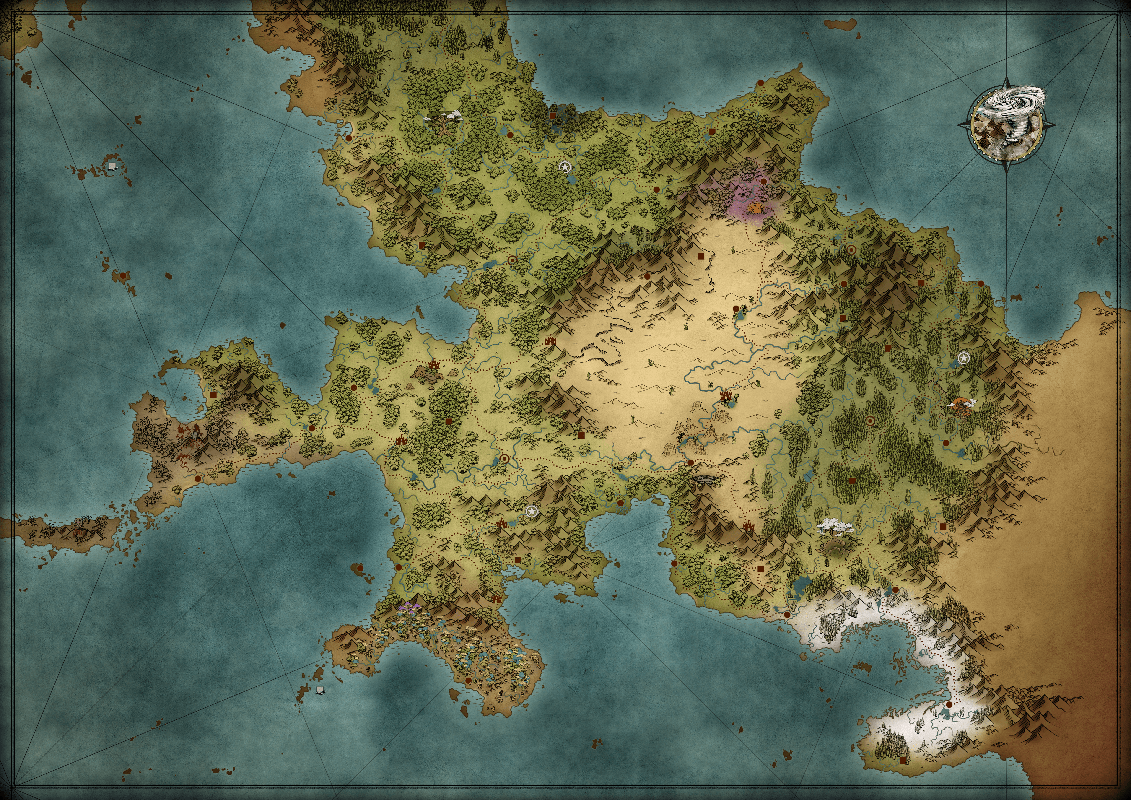
This is part of the world I am building.
A Small start to a Long Journey
To me, to be a “Scrolls-like” game, you must have:
A focus on world simulation. Areas are seamlessly connected directly or logically together.
A focus on object simulation. The objects in this world are not scenery.
A focus on character simulation. The people in the world have names, and their own behaviors. Most of them will have unique responses to you, or situational responses.
Non-directed narrative play. You can go almost anywhere you want, almost any time you want, and engage with the narrative that exists with the characters there.
There are many different abilities the player can use, but can’t use them all at once.
Different types of play: combat, riding animals, crafting, decorating your house
I will go into a full list important elements and more detail in a later post, but I think this gives a good overview.
There is a reason there are not a lot of Scrolls-like games, and that’s because creating the above software, and then making a fun game on top of that is an enormous endeavor and so only a few companies have done it.
So, how to approach such a endeavor?
Chapon Town
Starting with One Town: Chapon
Even though I have made all the terrain showed in the first map, set up the rivers, lakes, set up different climate zones, marked out the forests, and the major roads, set up the initial cities, villages and towns, it was still going to be an empty world narratively if I tried to release it at-scale.
So I changed my goal to focus on a single town, Chapon. This would be a mining town in the mountains, so it is fairly isolated and doesn’t do caravan commerce as it is not on a road, and is fairly far away from other settlements.
This allows intense focus to be on just this town to start, so I can work through all the core features and getting the narrative system working well in a smaller area, that is still a part of the bigger world. All the complexity of a spread out game, but in a single area.
Chapon’s location in the over world
Reducing the Initial Features
There are many things I want to be in the game, as I think the Scrolls-like genre has the ability to hold all kinds of different gameplay in a single game, due to it’s comprehensive format.
But, to start, I have to hold off on many things I want to add, such as:
Traveling the overworld. Constraining to 1 area means no fun overworld exploration.
Riding animals. A faster and sometimes more fun way to travel the overworld.
Flying. I specifically designed All Hail Temos to be able to allow flying in the game, which would normally break many games mechanics, and their world topology.
Lots of different fighting styles and abilities, more detailed crafting.
Base building. Personalizing.
Trying to do all of these things at once would result in a game that never releases, so I will balance out what I can get out initially, the core of the game that can’t be removed, from anything that can be cut to be deferred to a later release.
Features Planned for After Initial Release
Even with features that I am cutting for the initial release, the work has been done to put those features in place. Such as all the interiors of the buildings are already built using the base building feature, but making that usable in the game takes much longer than building it enough so that it’s working, but not yet usable in-game.
Example of interior build with in-game admin base building tool
One reason I spent 8 years working on this game’s development was create all the different sub-components, like riding animals, flying, and base building, so that I could get them all into the game. Often, if software is not created with large features in mind early on, it is hard to get them in properly later. So all of this difficult long-term stuff was done first as a prototype, then figuring out how to integrate them all together, to a slimmed down release where the features exist inside, but aren’t playable yet.
This allows them to be more rapidly added on, and keep them integrated with all the other features, because they were all designed to exist at the start.
What are the benefits?
Not getting things that are fun isn’t very exciting though. Any benefits? Yes!
Actually, by focusing all my attention to this single town, I can make it very detailed in terms of the characters and adventures that take place there.
When making 50 small towns at once, the pattern will follow with something like making 3 small quests per town, and add it as a pit-stop for 2 larger quests that travel through multiple towns. Having a pattern like this is necessary for repetitive work.
When focusing on only a single town at a time, the adventures present in that specific time and place can be explored. Each character can be explored to see what interesting things can come from them. It allows depth over breadth, which is something I would like All Hail Temos to keep as a tradition. Over time, I will add breadth, but I want each area to start with depth.
When this town is complete, I can start on a new town, and really fill out the characters and adventures in that town. And repeating 1 area at a time, connecting them together with new and continuing adventures as I go.
Conclusion
Cutting features and content is a necessity for releasing software, and games are one of the most complex and content heavy types of software that exist, and a Scrolls-like game is also heavy for a game on features and content.
So I will keep working hard to cut things back as much as I can, to focus on making the first release of content really comprehensive, but as minimally comprehensive as I can. I expect that these initial adventures will be less sophisticated than later adventures will be, once I get in the flow of putting them together and get more experience structuring them. But, that is all a part of the journey.
It is said “Rome wasn’t built in a day”, and unfortunately I can’t get in everything I want into my initial release. But, if there is a reasonable audience for the initial release, then I can continue to just keep putting in content and features to build out what my vision is: A magical world full of mystery and adventure.
If you would like to learn more about All Hail Temos and get notified when the demo is released, please Wishlist and Follow.
The Shape of Adventure - Devlog #11
In a previous blog, I wrote about how All Hail Temos would have “Many Adventures vs a Main Quest”. Now I want to show what some of these adventure structures look like.
All Hail Temos is a Scrolls-like first-person open world RPG that focuses on character and world-driven stories, versus a Chosen One or “Stop the End of the World” model used in many games.
In this entry I’ll show some of the shapes of the adventures I’m using, if you were to turn the stories into decision points.
The Simplest Example
The simplest example of the adventures in my demo has a shape like this. which I am labelling as “Protection”:
Your character enters the adventure, things happen, and ultimately there are 3 possible outcomes. The actual on-goings of the story may have several or many steps, but these are the decision points: Start, End 1, End 2, End 3.
There may be more decisions during the adventure than these final 3, but ultimately they will turn into 3 primary outcomes. Each of the decisions was still recorded and may affect future adventures, or personal relationships with the characters involved.
Winner and Loser
This adventure which I am labelling “Winner and Loser” has 2 outcomes, where ultimately your character is choosing a winner and a loser. There are 3 ways to enter into this adventure.
Having different ways to enter into the adventure gives a different context to the adventure, which is maintained throughout the adventure and ending, and can also affect future adventures when they reference the outcome of this adventure.
Power Struggle
When I wrote the outline for this adventure, I didn’t intend on it to look so symmetrical, but that’s the way this adventure turned out. There are 4 ways you can initially start the adventure, shown on top.
Later, there are 2 more ways you can get into the adventure in the middle. You may not have taken the entries on the top, and you can start the adventure in the middle instead here.
This creates 2 outcomes, and each of those 2 outcomes has 2 outcomes themselves.
Ultimately there are 4 conclusions to this adventure, but there are many different ways that you can get into the adventure. Each of those different methods is completely recorded as to the steps that were taken, and this can change future adventures if you have or haven’t done specific things in the past.
How will this affect gameplay?
In terms of the narrative gameplay, having adventures with several endings, but also several ways to start them gives many different ways that they can be played. Not only can different choices be made inside an adventure, but how you get to the adventure changes the context of it.
This can also add replayability if you want to see how you might have approached this differently. As more and more adventures are written, then these differences in choices and outcomes will stack to create more unique stories.
Conclusion
All Hail Temos is being created to provide action gameplay with branching narrative adventures, where you can choose how you want to approach things from different angles. The focus is on you creating a unique and fun adventure from characters and events in the world, as opposed to a strong central plot which everything else is revolving around.
If you would like to find out more, please Wishlist and Follow.
Skills and Skill Groups - Devlog #10
In a previous blog entry, I wrote about how to balance stats with skill groups, or how your stats map to groups of skills you can learn.
In this entry I will describe an overview of the initial set of skills in All Hail Temos.
Skill Groups
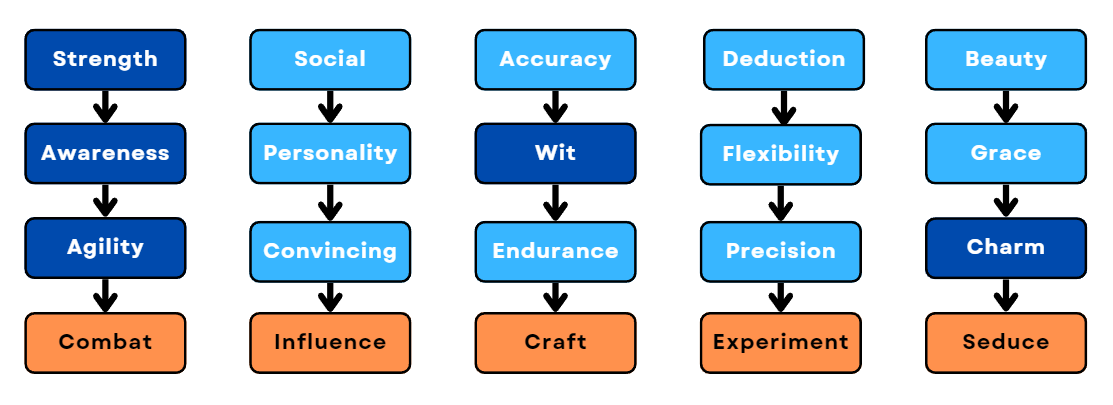
Skill Groups are groups of skills that use specific stats, which can be seen in this chart, showing the stats that feed into the 5 orange colored skill groups.
Skill Groups: Combat, Influence, Craft, Experiment and Seduce.
Each skill group actually has 2 different skill sets, which comprise 2 aspects of that skill group, yielding 10 skill sets:
Next I will go over each of the skill groups, and what skills are in the skill sets. The skills themselves have techniques which can be leveled up to get different results. Techniques are what you bind to keys or buttons to invoke the skill, or some could be invoked from a menu if they are can be triggered that way.
Combat
The Combat skill group is governed by the Strength, Awareness and Agility stats and has 2 skill sets: Offense and Defense.
Offense deals with attacking skills, and defense deals with defensive skills. These skills are meant to change how the game is played. The skills are groups of techniques, which are what you have bound to keys or buttons to use to attack, defend or do other actions.
Some skills are passive, and so are always or situationally activated.
I will describe the techniques in a later blog entry, but as an example, 2-Handed weapons have a different set of techniques than 1-Handed weapons because your character will move differently and have different offensive capabilities and drawbacks with a 2H vs 1H.
This will allow different weapon types to feel very different, because by their initial technique design, they are not operating under the same premise. Each skill gets new questions and conclusions as to when they are good to use, and how you could use different techniques with them.
Influence
The Influence skill group is governed by the Social, Personality and Convincing stats, and has the 2 skill sets: Trade and Animal Training.
The Trading skill set is about doing trade deals, setting up trade routes, hiring employees, having contracts, etc. This is the economic simulation aspect of the game, and links with the narrative aspect, but is not written as a story. Instead these components are dynamic. Adventures will still come from these dynamic elements, but they are not written adventures.
The Animal Training skill set is about training and riding animals, getting them to fight for you, and fighting while riding them.
Craft
The Craft skill group is governed by the Accuracy, Wit and Endurance stats, and has the 2 skill sets: Craft and Field.
The Craft skill set is as it sounds, about crafting with different kinds of elements: smithing, cooking, sewing, making paper, constructing buildings, etc.
The Field skill set is about exploration, camping, farming and other nature related activities.
Experiment
The Experiment skill group is governed by the Deduction, Flexibility and Precision stats, and has the 2 skill sets: Magic and Blessing.
The Magic skill set contains various types of magic that can be cast, actively or passively.
The Blessing skill set has to do with things that characters in Temos call “The Blessings of Temos” and have to do with your interactions with the sentient world of Temos, such as opening portals and rewinding time.
Seduce
The Seduce skill group is governed by the Beauty, Grace and Charm stats, and has the 2 skill sets: Movement and Stealth.
The Movement skill set has to do with various types of moving, such as on different terrains, like land, cliffs, water, or being able to have different abilities, such as sliding, wall running or wall jumps. Or flying.
The Stealth skill set has to do with being quiet, being unseen, attacking unseen, etc.
How will this affect gameplay?
Skills are a collection of techniques, which I will cover later, and techniques are the actual things you use to do things in the game, such as jumping, swinging a sword, or how quickly you run or swim.
I have designed All Hail Temos to have a connection between all the different game elements to help with balancing, and also to help with distribution of the type of play a character will be able to perform.
Your character will be able to disable or enable different skills, or bind different techniques to your keys or buttons, and this will allow you to play differently. There should be enough techniques, that even if you want to try them all, there is a lot of different ways they can be set up, because they are also impacted by your characters stats in a very clear way. If it is a little complex…
Conclusion
There is a long chain between the different components of All Hail Temos, but I hope to make playing the game fairly simple in terms of interacting with the systems. The complexity in mapping everything together is done to provide reasoning for why things are as they are, and then a platform for how to tune them to make a really fun experience.
If you would like to know more or be notified when the demo and game are released, please Wishlist and Follow.
Actions Taken in an RPG - Devlog #9
I previously wrote about how saving is actually rewinding time in All Hail Temos. When you play, the game is always keeping track of what you do, so that you can rewind it to any previous time, replay from there, and do not have to specifically make save points. You can even rewind back “into the future”, before you rewound time previously. The timeline is continuous no matter how much time rewinding and playing you do, you can go back to previous states.
I described the Checkpoint and Journal system before, but this time I will look at the Journal Items that are being saved, which are almost like “turn actions” you take in the game, but triggered by real-time play.
Actions Taken in an RPG
All Hail Temos is an Action RPG, a Scrolls-Like, and as such is not a turn-based game. But when the game saves a journal of all the actions you are taken, it ends up looking a little like a turn-based game, where only the most important actions are listed.
It’s interesting to me, because it boils down what is happening in the RPG to it’s most basic essence.
These are the actions I am currently supporting, or the basic verbs in the game. Some of them are quite versatile verbs, so there may be dozens of ways to use a single verb.
It’s a long list, but I will go over the groups of them after this. Printing all of them for people who want to read them in one place, but feel free to skip below as I will go over them in groups.
Player uses Door
Player Teleports
Story Set
Speech Player
Speech Actor
Item Get
Item Drop
Item Move
Trade Item
Knockout Player
Knockout Actor
Knockout Creature
Death Player
Death Actor
Death Creature
World Event
Add Experience to Actor
Add Skill to Actor
Add Familiarity to Actor
Add Trait to Actor
Remove Trait to Actor
Add Effect to Actor
Remove Effect to Actor
Disable Skill
Enable Skill
Craft Create
Craft Destroy
What do the actions do?
It’s a big list all together, so let’s break them down into what they do.
Movement: Player uses Door and Player Teleport are just denoting movement. If a player is walking around outside, I don’t really need to register this in the journal, until they go through a doorway or teleport to a different location. Otherwise the base “save where they are” will cover it. When you reload a save game, I will save 3 states that capture everything going on, which covers about 5 seconds. This allows fine granularity of reloading time, and keeping all the arrows flying around, or action. Otherwise I reload to the last time you went through a door or teleported, changing locations.
The Story Database: Story Set is the most versatile action in the game. It covers almost everything really, when you talk to someone, what you say, if you complete adventure objectives, or die, or kill someone. All of this is recorded into the Story Database, and Story Set does this work. In theory everything could be tracked with this single command, but it’s better to have specific actions saved to make it easier to rebuild the world and debug, than to put everything on the Story Database. Even though it ultimately houses a copy of nearly all the data, so it can be accessed in the dialogue and adventure systems.
Dialogue: Speech Player and Speech Actor simply record what other actors and your player character say in the game. It’s all recorded, so you can review what was said any time in your journal to remind you of things. Especially if you have rewound time, you may have forgotten the final state of the conversation, but it will be preserved here for you.
Items: You can pick up and drop items in the world, or inside containers, and Item Get and Item Drop track what item you got, how many of them, and where you got them from. This is like cryptocurrency blockchain, in that the game is auditing everything that happens. With Item Move you can also move items to a new location, and when you come back they will be in the new location, and if you rewind time, they will be in the previous location. Sounds like common sense, but making this work was a very large endeavor.
Trading: Trade Item is exchanging items with another actor. This might be buying or selling with a merchant, or trading freely with a companion, or looting a body of a knocked out enemy. If it’s moving items or money between actors, I save it as a trade with appropriate meta-information.
Combat Results: Knockout or Death of the Player, Actors, or Creatures are all recorded. These each are treated a little differently, so I track them all differently.
World Events: If you do something in the world, such as activate a location-based artifact, turn on a machine, or destroy a building, these will be recorded as world events, so you can see what happened in your journal, and the game knows to trigger that event on reload or time rewinding.
Add, Remove, Disable Attributes: XP, new skills, traits. You can add to these. You can disable or re-enable skills if you want to turn them off to tune your gameplay. You can add or remove traits, through advancing adventures around those. Tracking different types of progression.
Crafting: Finally, we have the ability to destroy and create items. Turning 3 iron into a sword will destroy the iron, but create a sword.
How will this affect gameplay?
Having a distinct set of actions is a part of all games, and so I don’t really consider it gameplay impacting. However, being able to rewind time very granularly in a narrative driven action RPG is fairly novel gameplay, and I am looking forward to seeing how players engage with this.
Will you use it differently than normal save and reload?
Having the gameplay turned into distinct units that can be saved and replayed does make it very clear to me, as the developer, when I am adding new functionality to the game, because I have to be able to explicitly save and replay it. This creates a very tight set of requirements for how the player is effecting the game world, which I also have a log of and can review to find problems or help balancing issues.
I considered making rewinding time a gameplay mechanic to some adventures, but I decided that the knowledge that you take back with you when you rewind time is the gameplay mechanic, so nothing extra would be as useful as that.
Conclusion
All Hail Temos was created to blend action RPG with world simulation, but focusing on the story narrative experience. All the details going into saving and restoring this data is to make the world feel more complete, and to allow trying out different story options easily, whenever you want to. So you can play out your own story, and try to get the conclusion you are looking for.
If you want to learn more about All Hail Temos, please Wishlist and Follow.
Many Adventures vs a Main Quest - Devlog #8
In the last post I wrote about how adventures are entered into from different potential paths, and then you get different results, based on how you got into it, but I only touched on the different thing I want to do with All Hail Temos from the standard RPG’s main quest & side quests formula.
The definitions I use below are my working definitions for doing game design on this game, and not meant to be universal.
Is it wrong to not have a main quest?
What is a Main quest?
The main quest of a game is typically the ending condition, you finish the game when you complete it. Maybe you can continue playing, but the game world was created around the main quest, and will often feel fairly empty when the main quest is over.
Games usually open with their main quest, so that you are given a reason to care about the world and your missions, and there are usually large stakes, often the fate of the world is at risk, unless a major problem is averted.
Also, the player is often given a special place in this story, as a Chosen One character, who was prophesized or has proven themselves to be the champion that will complete the main quest, and often the game world acknowledges that the player is this person at every opportunity.
This is good for many different reasons, as it keeps the player focused, it can help with the pacing of the story, and all the world supports this problem to keep the stakes high. With high stakes, the player can really care about the outcome, and everywhere they go, they will often see issues that are due to the main problem that must be solved, or villain that must be defeated.
Having a main villain is normally the focus, as you have someone to focus on, which is a specific person you can learn about. If the problem is more abstract such as “the moon will crash into the Earth”, there is less emotional investment. The player will not hate the moon for crashing into the earth, but they can hate a villain that has done villainous things, who they want to stop from doing even larger villainous things that threaten everyone.
This is a very good formula. A Hero’s Journey. It is proven to be entertaining again and again, as it speaks to the core of our emotional state.
But, I want to build the open world of All Hail Temos to be something different than singularly focused on this big problem, or having a central problem and few other big problems, and then many side quests.
Like the real world, there will be problems everywhere. Because there are characters everywhere, who want different things, and they are at odds with each other, and in their own struggle for survival. There is no central problem, and so no central adventures, but many adventures to be found.
Is an adventure a side quest?
If an “adventure” isn’t a main quest, is it a side quest? Not in All Hail Temos.
Side quests are typically very brief, and take the format of:
Talking to a quest giver, they ask you to do something: “Bring me 3 wolf pelts.”
You go kill 3 wolves, and bring the pelts. Or, acquire them another way, like buying, stealing or finding them.
You bring the items back to the quest giver and get rewarded in money, items or XP.
Maybe you get a follow up quest, or unlock information you need for a different quest.
Taking that apart, it can be seen as a transaction request and transaction fulfillment. You are asked to get X, you bring X and get paid Y.
But, there are more elements to it. The kind of quest tells you about the area, and maybe world history or current events. The character who asked you to go on the quest tells you about themselves and others in their area. The rewards move your progression forward, and you have accomplished something in-game.
There is both potential realism and gaming mechanics going on here as people really do need “3 wolf pelts” to do something regarding leather and fur. But, side quests can often seem like filler, and can be repetitive. So there are many ways to improve upon the standard side quest formula.
I believe it is important not to try to get rid of side quests, but to make them more contextual and optional.
Other benefits of side quests:
They encourage you to explore local areas, or travel to distant areas. You have a reason to go do it because the quest gives you that reason. You can find other new things along the way.
They allow you to switch to doing something else if you don’t feel like continuing with your last goal right now, or just finished something.
You can do them fairly quickly, so you can have some fun playing even if you don’t have a long time to play this session.
It gives you a reason to talk to new characters, because there will be many more opportunities for side quests than just going to shops and pursuing the main quest.
Of course, there are many negatives to avoid in side quests, such as too much repetition, not enough variety, with automatically generated quests often being too similar and feeling unrewarding. Also if the side quest is required for the main quest, but it doesn’t make sense, or it has harsh failure states it can make the game frustrating and potentially block finishing the game, because it’s a simple side quest, but you keep failing it, and can’t move the game forward.
So, while All Hail Temos won’t have a main quest, it will have side quests. But they will always be optional, and they will be based on the situations of the characters. I believe there is a place for this sort of a transactional short mission in an open world RPG, so I will keep them and try to put them to good use.
What is an Adventure?
Now that we’ve covered how I am thinking about main and side quests, I’ll explain my vision for what an adventure brings that is different.
To start with, an adventure must have high stakes for someone. There must be risk for some of the characters involved with the quest, which is why it will not just be a list of tasks to do or transactions to make, because it is important to characters in the world.
This gives a spectrum of importance and caring. An adventure might mean that a character is able to realize their dream and start on a career they’ve been blocked from. Or succeed in finding lost treasure, that they need to save a loved one. For that character, this may be a “world ending” event if they fail, but other parts of the world may not notice the change significantly either way.
Because some characters have a large stake in this adventure, you are given a reason to also care about it, to see what happens to the characters. To help them solve their problem.
There are also adventures specifically about the player’s goals, such as the player becoming a desired profession, or getting hired by a powerful person to work for them, getting more adventures and rewards. This may create or increase rivalries that create more adventures as they try to take what you have earned, or otherwise damage you or your employer. Maybe you want your own business, and they are direct rivals or in a different circle or faction.
All of these things have their own risks and rewards, that are not typically present in side quests, but are the bread and butter of the main quest.
However, with a main quest, it is very difficult to have any branching narrative, because that really does mean the content starts getting 9 times bigger, then 81 times bigger, and is just completely unmanageable by a team of any size. So branching must be mostly decorative, so there is a feeling of different actions, without actually having to take different actions and produce more content.
With adventures, it is possible to have branching which can block some adventures, because you chose a different path, and they are mutually exclusive. Or you can still take part in that adventure, but must find it from a different direction, because of your choices, and end up getting a different kind of result because you approached the quest from a different situation.
Several paths into an adventure, many possible outcomes back on your path in.
In an open world RPG, I think this is interesting. And I don’t think completing even a very long adventure means the world suddenly feels purposeless. In fact, as you create more history, there are more possibilities of adventures that build on your previous adventures results.
This feeling and narrative mechanic is what I want to create with All Hail Temos.
Without a Main Quest, does it end?
It’s good to finish things. Cathartic. Freeing. You can move on, with a sense of accomplishment.
Without a main quest, how will this happen?
This is a problem in all open world RPGs, because the main quest doesn’t define the end of the ability to play. You can keep playing side quests after the main quest is completed in some games, or maybe some other large quests in the game outside the main quest. You can potentially see how your actions have changed the world. But, it’s still good to get a nice ending.
In All Hail Temos, I will accomplish this by what I’m calling “Epic Endings”, as all adventures will have endings with a conclusion, and moving characters further in their arcs, and making changes to the world due your choices and actions.
Some adventures will have an Epic Ending, which you will have to confirm before you start it, that you are now moving into a more funneled narrative experience, that will go to the completion of this longer more substantial adventure, and lead to a big ending. Then you win!
But, of course you can keep playing. And you can get more endings, and play more.
For the initial demo and EA launch I am aiming for just a single Epic Ending and many adventures, but if the game is well received I will keep writing more adventures, and expanding them until they deserve their own Epic Ending.
How will this affect gameplay?
Stories, characters, theme and world building are part of what goes into making gameplay meaningful. In a game, there is a given set of mechanics, and there is a limit to how much the mechanics can be expanded on and changed in a meaningful way, and still remain coherent.
The meaning of the gameplay can be refreshed, if there are new characters or new stories being told, and you are learning more about the world. The gameplay becomes your ability to navigate and engage with these stories in a way beyond just listening and responding to dialogue.
This should hopefully help keep the game feeling fresh, while also adding more depth to what you already enjoy.
Of course, just having new stories doesn’t mean there shouldn’t also be adjustments to the mechanical gameplay requirements, new types of challenges, new environments, new combat patterns, but I believe there is a much larger space to keep a game fresh in story and characters than only in gameplay mechanics adjustments.
As I add content, I will aiming to improve both the narrative and gameplay variety for a free-choice-feeling role-playing experience.
Conclusion
I hope this illustrates some of my vision for providing a world with a lot of adventures, instead of focusing a world on a single world-ending scale problem. I think that the single-problem model is great, it can be very powerful and all the components in the game can support this problem and you resolving it: walking a hero’s path.
But, in an open world game, where you are free to pick the role you want to play, having a single major issue going on, the world-ending main quest, seems to go against the desire to explore and try to be who you want and approach things how you want.
If you want to see more about All Hail Temos, please Wishlist and Follow.