Great news! A free demo of Steel Shadows is now live. If you are curious about the game go ahead and give it a test drive. Let us know what you think in the forums.
Thank you for playing our games.
Unit Preview - Interceptor Light Fighter
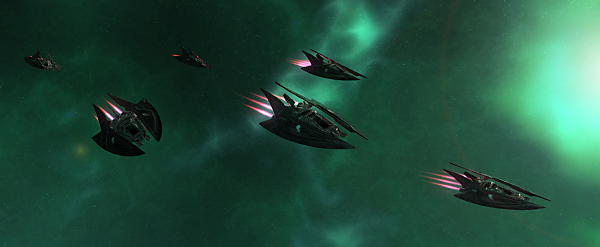
The Interceptor is a surprisingly high tech light fighter that is heavily deployed by pirates on the frontier. Ripper guns are short range high fire rate weapons that allow the Interceptor to take down fighters or escorts that might protect valuable merchant convoys. The Interceptor has good straight away speed but is not as agile as other light fighters. It can hold its own in a dogfight against enemy light and even heavy fighters.
The Interceptor fits perfectly with the design philosophy of most ships that make up the pirate fleet - it's fast and does damage. The Interceptor is capable of outputting significantly more damage than either the Federation Sabre or the civilian Explorer light fighter designs. It sports a bare bones shield system and the sleek design and sudden bursts of speed can make them very difficult to target. They won't win a race against the other light fighters, but can easily outpace civilian convoy and escort ships that they seek to ambush.
Lore:
It is unknown who produces the Interceptor for the Pirate fleets. What can be said for sure is that the design has only started to appear recently, and that it is very technologically advanced if not quite military grade. Unlike most light fighters that are primarily designed to scout and escape engagements, the Interceptor is clearly designed instead to be a combat machine.
A light fighter is a strange choice to be used as a combat craft as traditional wisdom is that such a chassis is too small to pose a serious threat. The only weapon system installed is a set of Ripper Guns. Ripper technology was developed on the Core Worlds, and is generally the highest tech weapon available to craft that don't have access to military grade lasers. Ripper guns are short range, high damage weapons that fire charged ammunition. They are very power efficient and do not suffer from the limitations of heavy ammo or jamming that can plague older autocannons.
The Interceptor was designed to make maximum use of its Rippers. This starts with the engine system that uses an incredible six engines on such a small craft, where as most other light fighters use only two or three. The engine feeds into the weapon system are extensive, ensuring that the guns are always charged and available to fire, even while the ship is engaged in high speed maneuvers that would tax most engines. This allows the pilot to both operate at full speed while continually firing all weapons with no loss to either system. The downside of this prioritization of the weapon power supply is that the Interceptor cannot maintain its high speed for as long as other light fighters, and instead it must rely on shorter bursts of speed.
The Interceptor also managed to install a targeting computer system. This makes the already deadly weaponry even more accurate in short bursts, and allows the Interceptor to reliably hit enemy light fighters. It is a marvel of engineering managing to craft a targeting computer system in a ship that is so small, and no doubt the technology alone justifies the cost of the chassis.
The rest of the design is clearly focused on survivability. The sleek wing construction gives the fighter a very flat profile, making it extremely hard to hit. The ship itself is covered in a dark sensor resistant coating which helps to hide the fighter from both visual and automated scanning systems. While not as capable of agile turns, the quirky, irregular speed boosts preferred by most pilots make the Interceptor very difficult to hit. The base design also comes with a very limited shield system, making the ship considerably more survivable than the Explorer class light fighters. This shield system is not as sophisticated as the military versions used by the Federation, but is still considered a welcome addition by pilots that use it.
The engine and weapon systems take up a lot of space on such a small, sleek vessel and so the Interceptor does not have a lot of armor. The ship is not designed to take hits, but is instead designed to kill its target quickly while dodging the few stray shots that come its way as it closes.
Interceptors are most likely seen in packs, often with many squadrons working together. They are very cheap to field as their fuel consumption is surprisingly good considering the heavy reliance on engines. The typical tactic is for all of the squads to overdrive their engines, gaining a terrifying burst of speed as they close on softer targets with their short range guns, and then shredding the opponent in a streaking blaze of ripper fire. The Interceptor understandably excels in these sorts of hit and run strikes, and Interceptors deal the highest damage of any light fighter found across the Frontier. The pilots of these craft generally are renowned for their daring and bravery as Interceptor squads don't hold up for long against dedicated anti-fighter weapons.
Variation:
The Interceptor is generally too new of a design to have seen much variation. That said an enterprising pirate or bounty hunter is always making slight tweaks to their gear. Interceptors have been seen with modifications to the shield system to make it more powerful. Others have disabled the safety restrictions on the engine systems, allowing for even more speed and agility. Some have been known to install additional targeting systems to increase the accuracy even further, making them especially deadly to other light fighters. A few have even been known to mount a dumbfire torpedo, although the extra weight and cost of this armament means that this is very rare.
Steel Shadows: The Interceptor is one of the first units available to purchase. The Interceptor has three equipment slots and a single pilot slot allowing you to make further small customizations to fit your playstyle.
Unit Preview - Smuggler Light Escort
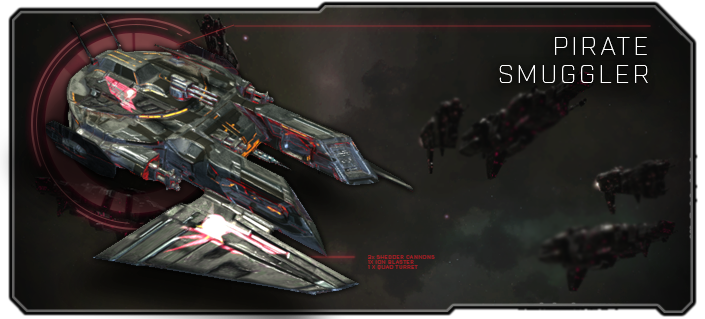
The Smuggler is well named, and often used for moving illicit cargo or breaking blockades. Surprisingly fast for her ship class the Smuggler is also well armed. Three Ripper guns allow her to quickly dispatch fighter patrols that may try and stop her, and ion cannons and short burst quad auto cannons make short work of escorts. Long range sensors allow her to pick her battles, and the Smuggler is likely to rely on her speed to outrun and avoid larger capital ships.
Smugglers are found in fair numbers in pirate fleets. The Smuggler is a versatile escort that can pose a threat to fighter squadrons or single escorts. Smugglers don't normally hold up well against capital ships, but they are fast with a good evasion ability for their ship class.
Lore:
The original origin of the Smuggler design is unknown, however the current version is produced by half a dozen different manufacturers on the Core Worlds. The Smuggler is an odd mix between combat craft and civilian vessel. While it won't win a gunfight with a military ship, or move as much cargo as a dedicated hauler, there is apparently a large market for pilots that would like to do a little of both.
The foundation of the Smuggler is built around its engine system and cargo space. Unlike other ships of a similar size the Smuggler is built to handle with extreme weight for her size, expecting large amounts of cargo to be stashed within. Because of this designers gave up on focusing on straight up speed. Instead, the decision was made to focus on agility, allowing the ship to avoid incoming fire while looking for a good place to hide or to make it to a nav beacon to jump out of a system.
The rear fuselage has a semi circular design, allowing the craft to make quick lateral movements at a moments notice. The weakness of the design is that the full engine power can never be focused in a single direction. This does give a fully loaded Smuggler which is overdriving its engines the agility of a fighter craft, making them exceptionally hard to hit and able to maneuver through very small spaces. A smuggler can still outrun a larger capital ships that might carry boarding marines.
The lack of incredible speed and only a modest shield system meant that the design needed to account for the many smaller and faster fighter craft and escort the Smuggler might encounter. The weapons systems needed to be designed to take out smaller escorts and fighters quickly, as these are the craft that could give it the most trouble if it tried to run. The main armament of the Smuggler is a trio of Ripper Cannons. Ripper technology is not as sophisticated as lasers, but it excels at dealing high amounts of accurate damage at very close range. Almost useless against capital ships, the Ripper Cannons can make quick work of enemy fighters.
The Ripper Cannons are backed up by a Quad Light Autocannon Turret. Light Autocannons specialize at taking out smaller escort craft, and do give the Smuggler at least one weapon option to hurt larger prey. Autocannon turrets are often unreliable and subject to jamming, so often can only be used in short bursts. Still, the sudden amount of focused firepower can often surprise and disable an enemy escort. With sparse and judicious use of the autocannon turrets a Smuggler can stretch its limited ammo capacity for some time without needing to resupply.
The final weapon system on a Smuggler is a pair of Ion Guns. Ion technology drains shields and can disrupt engine systems. This weapon is often used offensively, to drop the shields of a civilian ship before boarding it. It can really excel, however, in the primary role of taking out smaller craft, as it can not only quickly drain the feeble shield output of smaller ships, but it also disrupts their computers and engines reducing their ability to dodge, making the other two weapon systems even more effective.
While only effective at short range and for short engagements, the overall weapon loadout of the Smuggler works perfectly for most pilots. It deals high burst damage against smaller targets that can't be outrun. The weapons are not designed for fighting against larger ships, but against larger enemies the Smuggler's speed and agility let it escape from most encounters.
Finally, the Smuggler packs one final trick up her proverbial sleeve. Most Smugglers come equipped with a small supply of sensor drone probes. Along with superior radar technology that already gives the Smuggler a larger detection range than most ships, the sensor drones allow a Smuggler to get a really clear picture of their surroundings. Whether used as sentry drones to cover a flank, or used offensively to spy on shipping lanes, the Smuggler with its sensor probes will typically give its crew a great deal of information of what threats they are facing, letting them plan the best mode of attack or escape.
All this does not come without some cost, however. The Smuggler is notorious for the amount of fuel it consumes, and this is made even worse when it is hauling cargo. Pilots find that they often are forced to return to a station or trading hub to store up on ammunition and fuel in between cargo runs. Also, because of the large engine drive train and ample cargo space, most Smugglers run on a very small crew. This has the effect of reducing the overall survivability of the ship as in a tough firefight critical personnel might become injured.
Overall, despite its downsides and hybrid nature, the Smuggler has endured as a smaller civilian hauler, a scout, and an anti-fighter specialist. There is no doubt that there will continue to be high demand for this ship across the galaxy.
Variation: Where there is access to a sophisticated civilian docking yard, you will find as many variations of the Smuggler as there are pilots and weapon systems to go with them. The Smuggler is a highly customizable craft. The only pieces of the design that are difficult to remove or modify is the unique engine system and the central shield coil.
On the Core Worlds, therefore, it is fair to say that probably no two Smugglers a pilot encounters will be quite the same. Out on the fringes of space, like the Frontier, where there is little access to advanced weaponry or shipyards, the majority of the Smugglers found will meet the "stock" design parameters.
Steel Shadows: The Smuggler is one of the first units available to purchase. The Smuggler has three equipment slots and two crew slots allowing you to make further small customizations to fit your playstyle.
Unit Preview - Gunship Heavy Fighter
One of the oldest, toughest fighter models ever designed. The gunship has found its way into almost every civilian and mercenary force. Standard loadouts feature twin Light Autocannons for ranged engagement, a Mini-Gun for short range dogfights, and a light torpedo for area damage. Gunships lack in mobility but excel in reliability with good armor and easy maintenance.
The gunship is one of the most popular designs ever manufactured by Icarus Industries. Despite recent advancement in weapons and shield technology the gunship remains a reliable favorite across the Frontier. The diverse weapons loadout and offensive focus makes these fighters the perfect compliment for a commander that is looking for firepower over speed.
The gunship is especially deadly against Escort class vessels, making it the ideal counter to the more common system patrol boats. The port mounted torpedo tubes and high offensive output also allow the gunship to deal decent damage to larger capital ships. The gunship is more vulnerable to lightning quick hit and run tactics employed by lighter fighters.
Lore: The original heavy fighter designed in the space faring era was the Gemini heavy fighter. Produced on Mars and every Core World, the Gemini was the most available and cheapest combat unit available to any government or fleet. The fighter featured a dual cockpit design, with both forward mounted weapons and a single dorsal turret. This allowed one pilot to focus on navigation and the second to focus on the turret systems and fire control.
The Gemini performed well for its time. It did suffer from several problems, however. In many engagements the turret system was unnecessary. Also the two pilot requirement was seen as more of a burden than an advantage. If one pilot died the ship was often flown solo anyway. Finally, the older weapons used in the Gemini design had neither the range or hitting power of the newer naval based Autocannons.
With the eventual development of shield technology the weaknesses of the Gemini meant that it was just a matter of time before a rival design took its place. Icarus industries at the time had mostly made a name for itself creating merchant and colony ships, and the heads of the company were eager to dip into the military market to expand their reach. Icarus developed the Gunship heavy fighter, and it quickly became one of the most common ships across the galaxy.
The first change Icarus made was to drop the dual cockpit design, opting instead to use the extra space for an additional weapons system. The entire frame of the chassis was reinforced with extra ceramic and steel, giving the Gunship incredible survivability even when it had sustained heavy damage. Finally, and critically, Icarus incorporated a native shield generation system, which was a novel idea at the time.
The firepower was also enhanced. A naval light autocannon was considered too large a weapon to be mounted on a fighter, but Icarus found a way. By reducing the ammo capacity and reworking the feed mechanism Icarus was able to make a fighter sized version of the weapon. Autocannon's were becoming the standard for larger ship engagements, but often proved too slow to effectively deal with fighters. To account for this a pair of Miniguns were placed under the cockpit, allowing the Gunship to put out incredible amounts of short range firepower with the speed needed to track lighter fighters. Finally, the former cockpit bay was filled with a single fire torpedo tube. The chassis did not allow for more ammunition, but most pilots found a way to work with the single shot design.
The result was a fighter with unrivaled toughness and firepower. The shield system backed up by the increased armor made the Gunship as tough as some light escorts. There was a price to be paid for this, however. The mobility of the fighter was greatly hampered. Furthermore, the additional burden placed on the engines meant that the Gunship required a much larger engine housing even though it gained no agility. It was ultimately not possible to incorporate the same turret system that was standard with the previous Gemini.
Variation: With the Gunship design being well more than a century old, there has been plenty of time for variation. Maintenance on the ship is relatively simple, and over time different pilots have been known to make their own modifications.
Prime Pattern The main variation of the Gunship was an upgrade made with the development of newer targeting computers. The Gunship's original onboard computer systems proved compatible with the newer design, and while the extra gear made the cockpit more cramped, most pilots preferred the tradeoff for additional accuracy to the weapons.
With a targeting computer in place the standard light autocannon became even more effective. In addition, newer lighter torpedo systems meant that some gunships were able to mount a second or even a third torpedo, for surprise backup firepower. The shield system and Miniguns remained unchanged.
Mustang Pattern Torpedoes can ultimately be quite expensive, especially for merchant cartels that used Gunships as escorts. As such, more civilian forces ended up finding the torpedo mounting to be wasted space.
A common civilian configuration was to drop the torpedo pod completely and using the additional chassis space for booster rockets and a larger engine. This gave the gunship more maneuverability at the cost of firepower.
The variation did not catch on more widely, however. Even with the increased horsepower the Gunship was still painfully slow compared to other light fighters. Ultimately a little more speed for a slow ship was not worth the loss in torpedo firepower for most pilots.
Scorpion Pattern One of the newest variations of the Gunship is also one of the most rare and least versatile. With the new development of Rail Gun technology, some enterprising pilots found a way to mount a smaller version of the Rail Gun in place of the autocannon mounts.
The results have been decidedly mixed. To make room for the increased energy requirements of the weapon the torpedo mount also had to be converted. In addition, due to the size constraints of the fighter the reloading mechanism was surprisingly slow and subject to jamming.
This variation ultimately has only the Rail Gun with a long range but very slow rate of fire, and retains the two backup miniguns. While deadly in an alpha strike, especially in a group, this variation has led to more destroyed and captured Gunships than any other. Rare and unpopular except with the most gambling of pilots.
Outrigger Pattern The Outrigger engineers, as is often the case, have made the largest advances to Gunship design. The Outrigger variation has greatly upgraded the shield capacity of the fighter, as well installing a much more efficient converter system resulting in greater shield regen from the natural burn of the engines. In addition, upgrades to the core engine system allows for a much smaller fuel burn compared to other versions.
In addition the Outriggers have installed their own computer systems and sensor suites, resulting in much greater sensor range, including limited stealth detection. All of these upgrades have been made without any compromise to the basic firepower.
The result is a ship that is even tougher and able to operate independently away from a base for extended periods of time. Along with the increased sensor data, this variation is superior in almost every way. The Outriggers jealously guard their technological advances, however, and so this pattern can only be found used by their fleets.
Ion Pattern Used primarily by Pirate fleets, the Ion Pattern Gunship was popular for several decades but has since fallen out of use.
The main change of the Ion pattern was to replace the torpedo system with a primitive ion gun. The ion guns are especially good against shields, and allowed the gunship to easily strip the shielding of targets making the ships easier to board (or destroy outright). Ion cannons paired with autocannons were very deadly in a wide variety of combat situations.
The variation had problems. The static fields caused by the ion weapons would consistently short out the targeting computers. Given the small size of the fighter chassis, there was no way to adequately shield the computer systems from the destructive power of the ion weapons that were installed so closely. Because of this most pirate pilots would choose to drop the advanced sensor and targeting computers completely.
Ultimately the newer designed Pirate Raider fighter was designed with the limitations of the Ion weaponry in mind. Due to this the Raider proved to be the superior ion fighter, and pirates that continued to use the gunship mostly went back to the original loadout with a torpedo and autocannons. There are still a very small number of the Ion Pattern gunships in use.
Steel Shadows: The Gunship is one of the first units available to purchase. The player has access to the Prime Pattern, featuring one of the strongest loadouts with autocannons and a single shot torpedo, a significant amount of firepower for such a cheap ship. The Gunship also has three equipment slots allowing you to make further small customizations to fit your playstyle.