Once again, the time for a monthly update has arrived. Technically said time arrived yesterday, but spotty internet convinced me to just postpone it. My apologies. Without any further ado, let's get to the update.
Marriage negotiations, continued
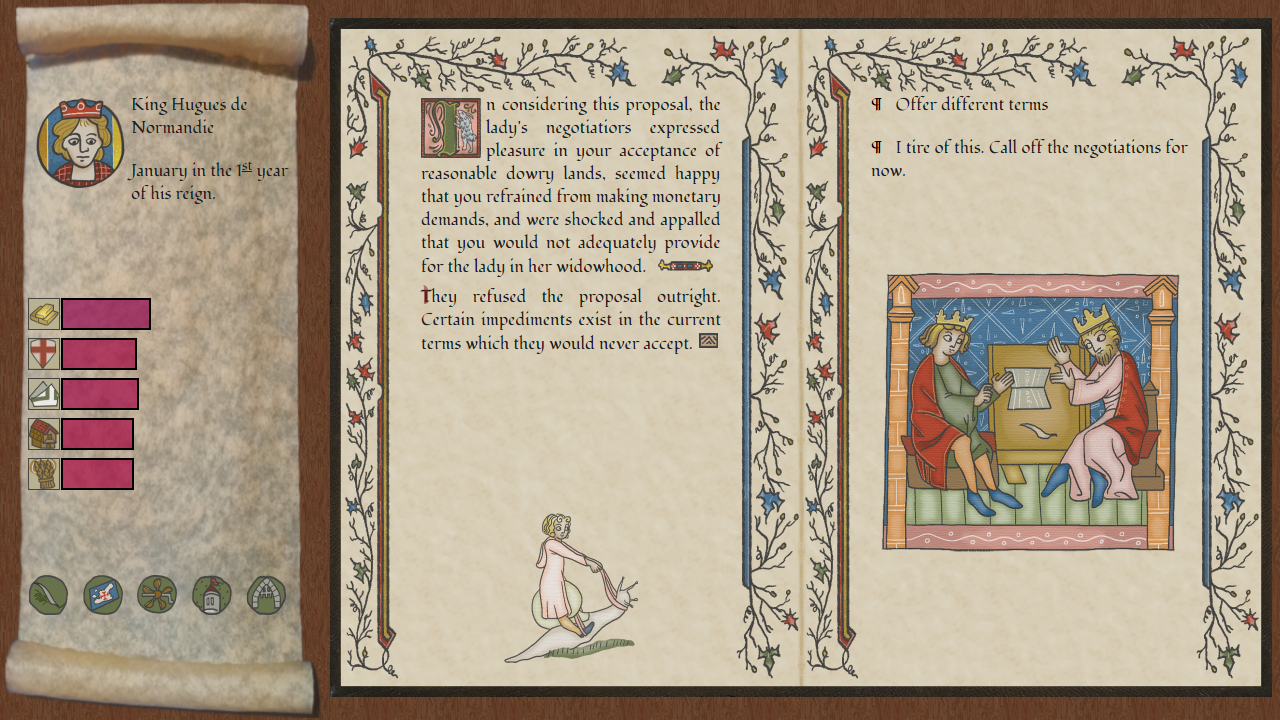
I wrote about this some in the last post. The counterproposals ended up being a bit thornier than anticipated. The good news however is that they, and all the other bits touching wedding negotiations, are finished.
Medieval wedding ceremonies in game
Royal weddings were important events. Rather than a minor footnote which might perhaps occasion collecting a feudal aid, these were times for feasting, processions, and much else.
And, yes, also raising a tax if you desire it.
The 12th century predates the Church's formal understanding of marriage as a sacrament. More on the historical aspect to follow. Despite this, it would have been shocking to not have any religious involvement in the marriage of a king. Bishops are, and were, a bigger deal than they are portrayed in many medieval games. There were only about a dozen in all of England and certainly far fewer than that in the fractured state of our timeline. Given their stature, it is fitting that a member of the episcopate performs the service.
Amusingly I managed to track down an edge case in which crashed the wedding (in several senses of the term) if no bishops were to be found in the kingdom. This required, as I mentioned on Twitter, some workarounds:
Regardless of what else happens, the wedding ends in the familiar feast hall. This is, for the more “standard” choices, perhaps the first opportunity to really get to know your wife.
Medieval wedding ceremonies in history
Many things about medieval wedding ceremonies are preserved in modern ceremonies. However there are many notable differences as well. As mentioned, there was not yet a requirement that the Church be involved for a wedding to be valid. Indeed, all that was required in those days was present consent of both parties and a witness. A priest makes a great witness, and naturally most people desired blessings for their new union, so a liturgy developed from a fairly early point to solemnize weddings, even if it was not strictly required to form them. Luckily for us, this was put down in the Use of Sarum, which would have been largely finished and coming into widespread use during the early parts of the game.
According to this, the service was performed in front of the church rather than inside it. Some of the wording is a bit different than a modern ceremony — “I will” rather than “I do” for example — but most things are at least analogous. A nuptial mass followed, where further prayers and benedictions followed for the couple.
Interestingly, Western Rite Orthodoxy still to this day follows the Use of Sarum. There are a few differences between this and a medieval wedding, for instance two rings are used in this service rather than just one for the bride as in medieval weddings, but this is as close as one can get to a medieval English wedding in the present era:
[previewyoutube="1UXIAGAniqc;full"]
If any part of a wedding in DGR feels unusual, consulting this video might help!
What's next
A few more matters, mostly behind the scenes to bring some of the terms of the wedding into effect. There is also some text left to write, as there are a great many traits that might prompt comment in the feast section.
More next time!
January Report
It's yet again time for a monthly update. There are some interesting — if a bit historically crunchy — details this time. Let's jump right in.
Marriage
One of the goals of Dei Gratia Rex's design is "hard historical fiction," in a similar sense as hard sci-fi. The game presents a fictitious scenario and will privilege gameplay over simulation. However where possible, things are kept as closely in line with the actual history as I can. With that in mind, the time had come to revisit marriage.
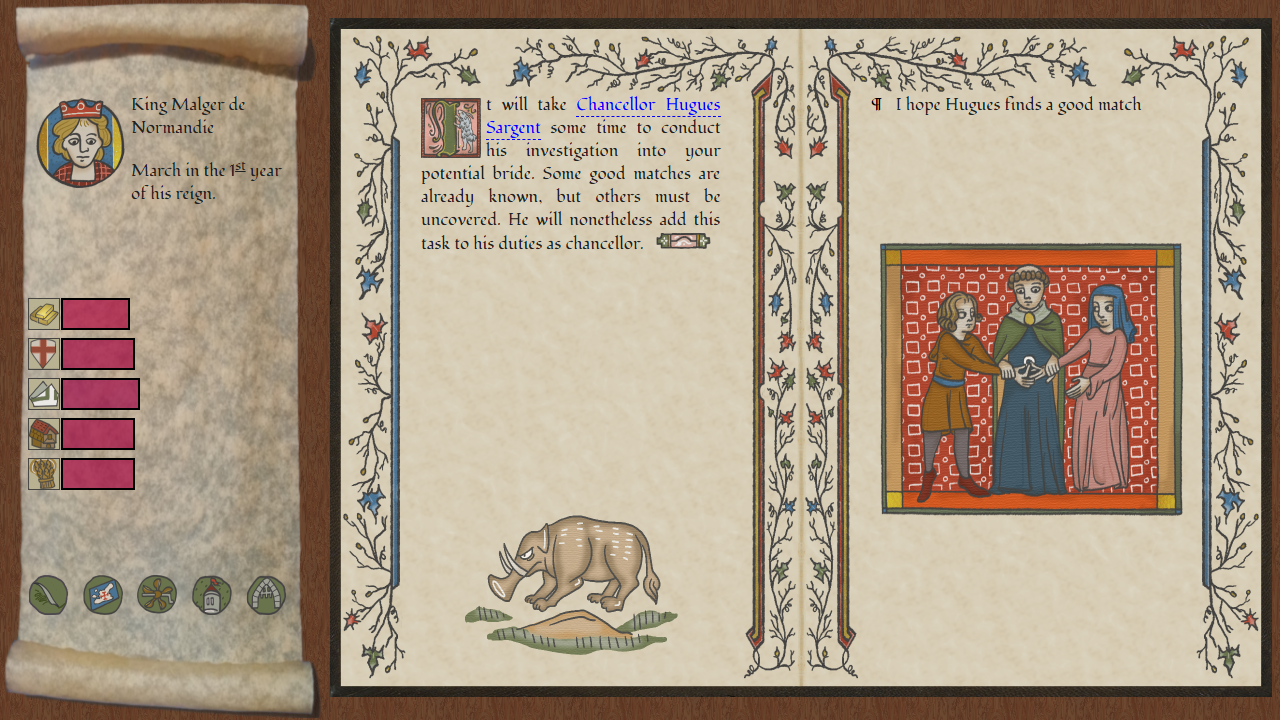
Medieval marriage was a complicated process. It wasn't as easy as, say, searching a database of every woman in the world, filtering it, scrolling until you found the one you wanted, and being married under a week later. Indeed, even knowing who you could marry wasn't straightforward. Sometimes you might meet a prospective spouse naturally, but that's not necessarily the best plan for a royal marriage. Luckily we have a chancellor.
Moreover, the marriage always required terms.
In particular, dowry — known also as marriage portion or in the primary sources maritagium — was extremely widespread in 12th century Anglo-Norman England. A century later, the practice was indeed nearly universal from the highest ranks of society to the humblest. To be very brief, this was property (more often lands or rents rather than chattels) given by the bride's family to her on her wedding, in the care of her husband. More on that last bit later.
For a royal wedding, matters of oaths, alliances, and monetary payments must also be sorted. Beyond that, there's also the matter of providing for the lady should she become a widow. Her dowry would be part of this most assuredly, but provision of a dower was also part of the marriage contract. These are lands held by the groom that are promised to the bride at the time of the groom's death. Dower lands were only held for a life term before reverting to the normal chain of inheritance.
Isn't medieval land tenure wonderful?
Enjoying the lands of others
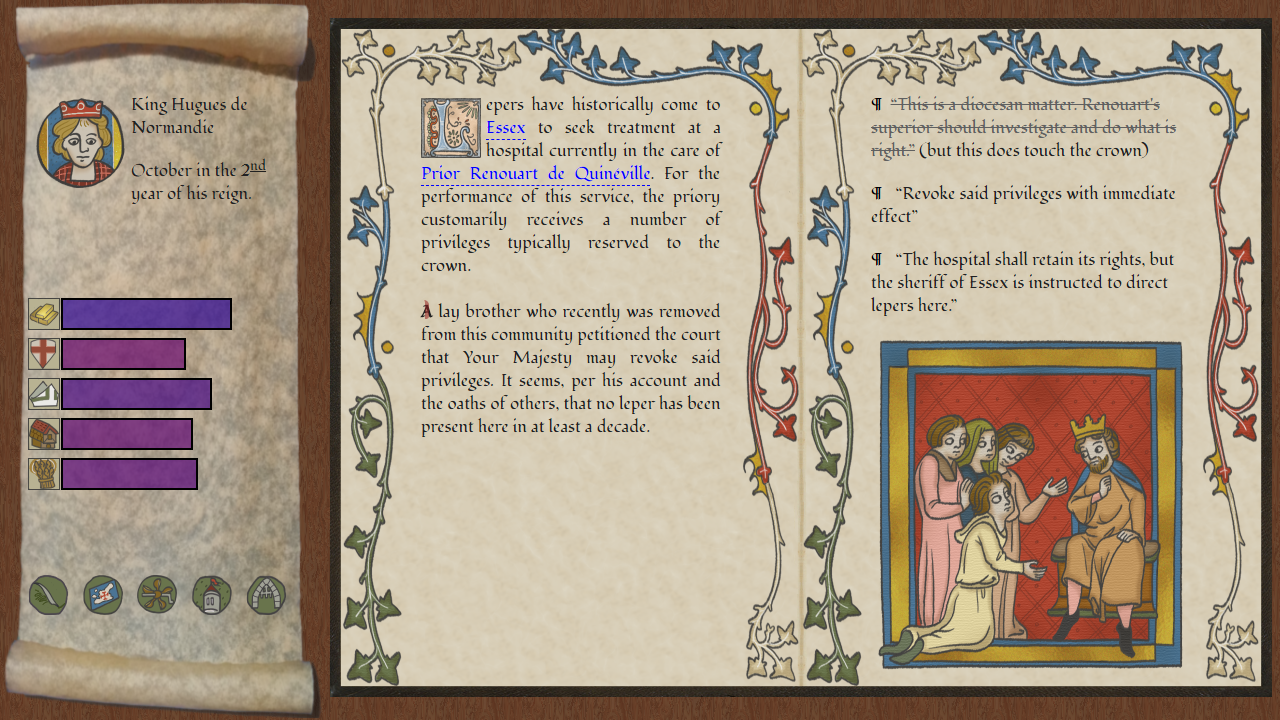
Here we see the maritagium in action. The title is clearly the lady's. However the befit of these lands belongs to her husband, who has not yet gained lands of his own. Her father, whose gift these lands were, owes the military service attached to those lands until such a time as his daughter's husband can provide it. This is a new feature that I wrote specifically to handle these lands given as dowries. However that's not the only place I'm using it.
A particularly thorny issue in the 12th century was the Investiture Controversy. Kings, as they had done for some time, thought they should choose who aught to be enthroned bishop within their kingdoms. The Pope on the other hand thought that he (or his delegates anyway) aught to be the one to choose. This matter was inflamed further by the practice of leaving sees vacant so that their wealthy estates could pay into the Exchequer. Using the new system, a king can enjoy these episcopal lands without holding the title.
Another historical case of this was wardships. If one of your direct vassals is a child, the same sort of thing applies. They will continue to hold their titles, but you, their lord, will enjoy the revenues until they reach the age of majority. On the other hand, they will not owe you knight service during that time. This is not fully implemented, so no screenshot just yet!
Finishing the marriage negotiations. Some work remains on that front. When that's finished, plugging in the wardships so that they use the new system. When that is done, some provisions for, shall we say, less than regular marriages.
More next time!
A New Year begins
The time for another update post is upon us. Actually that time was yesterday; I'll hope you forgive me for being a day late. Christmas was cancelled for us (COVID; I'm fine now but others somewhat less so), and I'm just now getting on top of things.
2021
Many exciting things happened this year. Perhaps most recognizable was the creation of some new art. The line-fillers and bas-de-page illustrations now give life to what were otherwise blank voids on the pages. Between the text, illuminations, marginalia, and glosses, medieval manuscripts rarely had much empty space, and I wanted to capture that. Here's a before and after for the same event:
The soundtrack was also completed this year. I've linked it before, but in case you've missed it:
[previewyoutube="Ls5OVqkauKg;full"]
I finished quite a lot of content as well. Events for tournaments, feasts, hunts, various other ways of interacting with your subjects, and more were written. All that totaled hundreds of events: I noticed some time ago that there were more events in some of DGR's subsystems than exist in other narrative games. This isn't a small game.
What I didn't do was launch. I tried to meet an external deadline in May. Missing that hurt financially, but too much was getting cut. I'm happy about not forcing it out the door then, but I am cognizant of the fact that this is taking far too long. My goal in the first part of the year is to "close the loop" so that whole-game testing can begin. All of the events are thoroughly debugged, but sometimes defects won't show up without the sort of interactions full gameplay provides.
Courtship
To that end, the biggest thing missing that is required to play a full game is marriage and family. Since we start with a quite young king, courtship is necessary as well. Love marriages among the nobility were incredibly rare, especially among high nobility. Love was of course an outcome that was pleasant and desirable, but it was not at all a precondition for matrimony. Thus when I say courtship, I largely mean the identification of good prospects, negotiations regarding the terms of the marriage, and so forth. Alliances, dowry, and other factors all must be taken into consideration. It also might also be prudent to ascertain the personality of the woman in question. She will play a large role in your life going forward, after all. Queens don't cease to exist when you get married — quite the opposite in fact — but more on that at a later date.
This has required a rather lot of work under the hood. Unfortunately this sort of work doesn't show off well in screenshots. A non-exhaustive list of things I've done to support this: added Ireland and more of Scotland to the simulation, ensured that land can be held outside of the realm without breaking things, vastly expanded the character templates used for women, and created family trees of particular special historical family should you wish to pursue a certain high-risk, high-reward marriage. Hopefully more details on this, with pictures, next time.
Thank you
While I'm here, I want to thank everyone for following along. I really do appreciate the support shown thus far.
I genuinely expected this to launch in late 2020 or early 2021, but here we are. I know how frustrating it can be to follow something for this long. I'm very focused on finishing the game at present. It still needs a few things before then, but I'm very motivated to get this launched.