There are four species including the Crownfish (grazing fish), Barratuna (predatory fish), Buffalope (grazing land mammal), and Liger (predatory land mammal).
The first three species are fictional but Ligers are actually real.
Ecology
Plants provide food for the herbivores.
Carnivores eat the herbivores.
An abundance of food can cause a population boom. Overpopulation can result in starvation and mass dieoffs.
DNA and evolution
Every animal has a “genome” (a list of 7 properties including size, speed, and color).
All automatically-spawned animals (the ones that appear around the edges of the map) have a default genome. Animals born from sexual reproduction inherit the genes of their parents along with random changes (mutations).
Certain genome values (like size and mate frequency) affect the ability of the animal to survive and to pass on its genes. This allows for a simple representation of natural selection to take place. For example, a fish might be born smaller and faster than its relatives and then survive to create a new population of fish that are better suited to their environment.
Animal color is purely cosmetic. It is passed on genetically but it doesn’t affect the animal’s ability to survive. It’s just an indicator to help the player visualize genetic changes in a population.
Human-animal interaction
Animals generally avoid humans, the one exception being starving carnivores (who will hunt humans and even cannibalize their own species).
Humans don’t actively hunt animals. They will attack any animal they randomly come across and Gatherers will harvest the meat if they kill it, but this doesn’t happen too often since animals run from them.
Animals are better optimized for game speed than humans are.
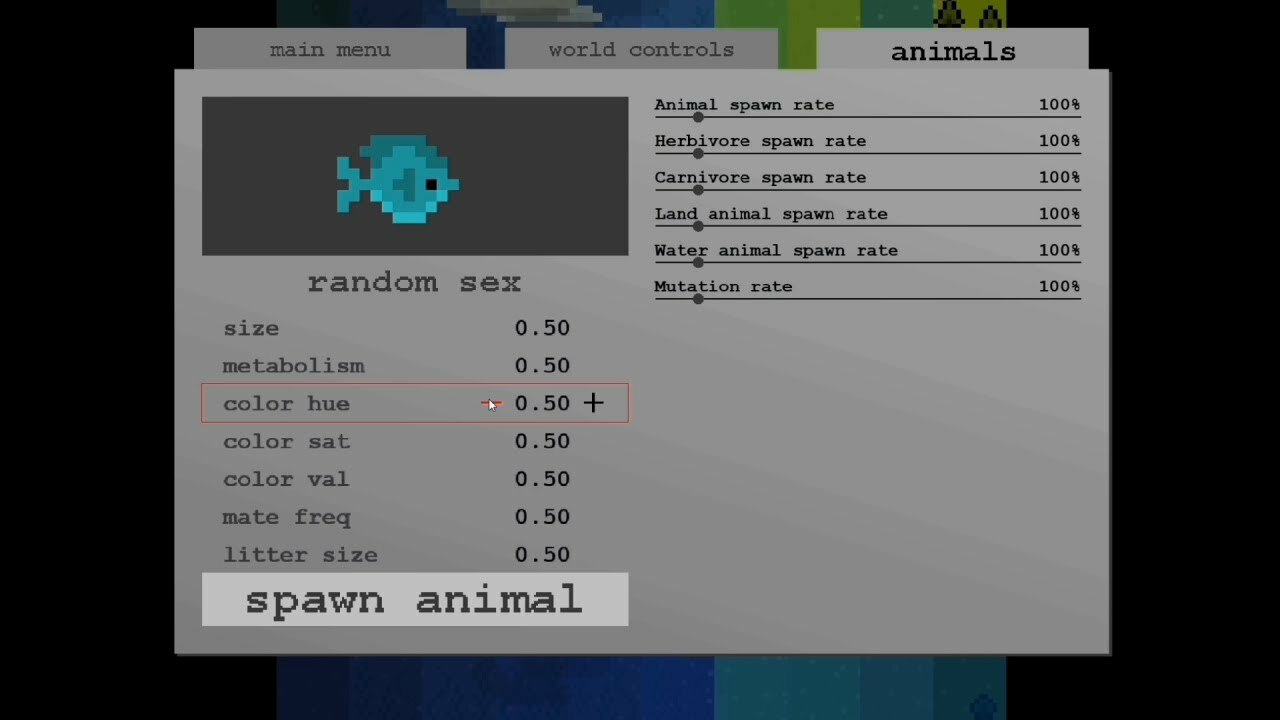
There is a new tab on the main menu devoted to animals. You can change settings like spawn rate and mutation chance as well as spawn animals with a custom genome.
1.40
1.4 is out now. This update adds animals.
There are four species including the Crownfish (grazing fish), Barratuna (predatory fish), Buffalope (grazing land mammal), and Liger (predatory land mammal).
The first three species are fictional but Ligers are actually real.
Ecology
Plants provide food for the herbivores.
Carnivores eat the herbivores.
An abundance of food can cause a population boom. Overpopulation can result in starvation and mass dieoffs.
DNA and evolution
Every animal has a “genome” (a list of 7 properties including size, speed, and color).
All automatically-spawned animals (the ones that appear around the edges of the map) have a default genome. Animals born from sexual reproduction inherit the genes of their parents along with random changes (mutations).
Certain genome values (like size and mate frequency) affect the ability of the animal to survive and to pass on its genes. This allows for a simple representation of natural selection to take place. For example, a fish might be born smaller and faster than its relatives and then survive to create a new population of fish that are better suited to their environment.
Animal color is purely cosmetic. It is passed on genetically but it doesn’t affect the animal’s ability to survive. It’s just an indicator to help the player visualize genetic changes in a population.
Human-animal interaction
Animals generally avoid humans, the one exception being starving carnivores (who will hunt humans and even cannibalize their own species).
Humans don’t actively hunt animals. They will attack any animal they randomly come across and Gatherers will harvest the meat if they kill it, but this doesn’t happen too often since animals run from them.
Animals are better optimized for game speed than humans are.
There is a new tab on the main menu devoted to animals. You can change settings like spawn rate and mutation chance as well as spawn animals with a custom genome.
1.32
Main menu
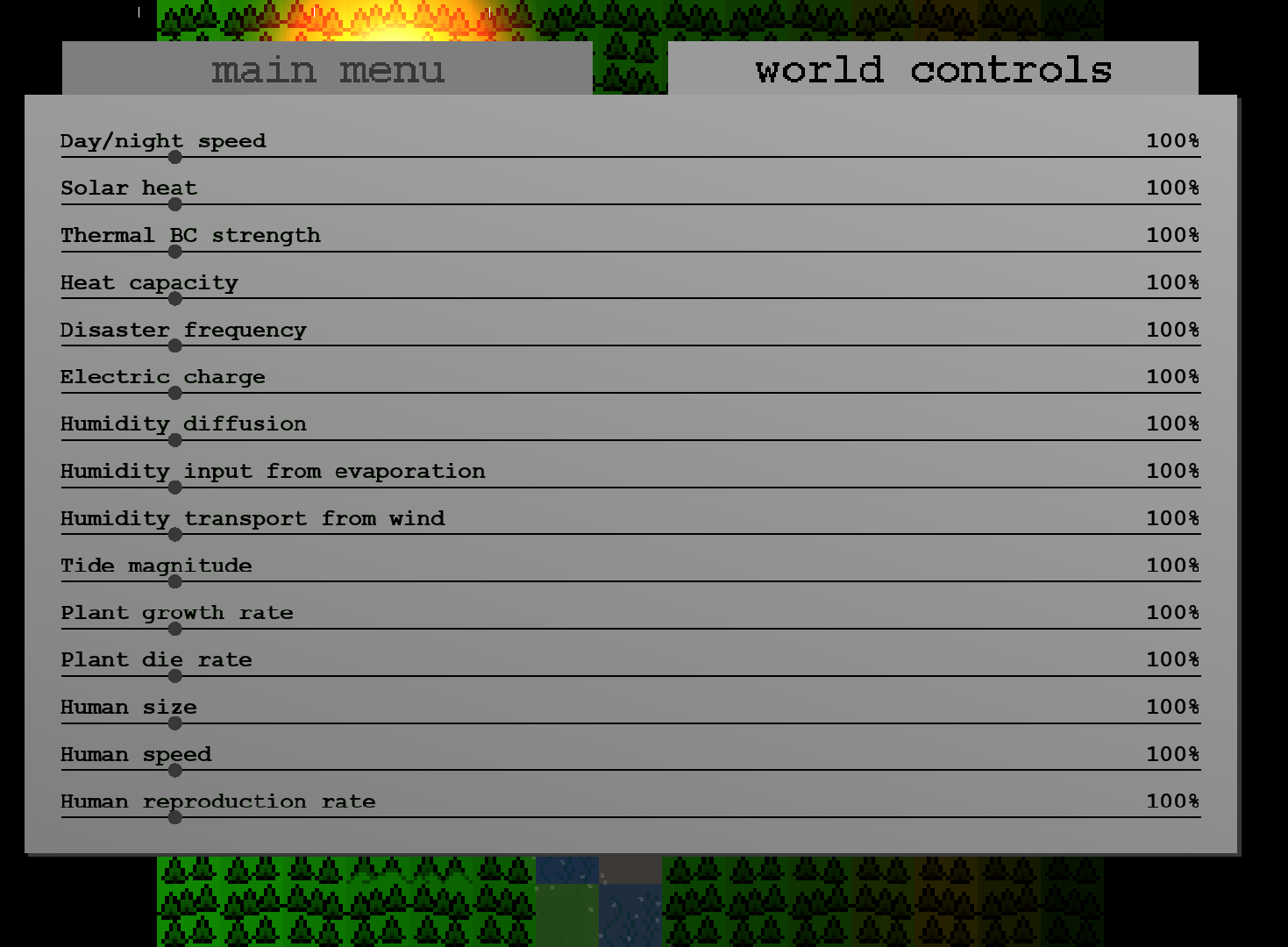
Added a new tab called “world controls”. This lets you tweak various aspects of the simulation including solar heat, day/night speed, plant growth rate, and more. Several people have suggested this and I wanted to get it done before 1.4 (animals) since that update will greatly benefit from more control.
Removed 6 buttons since their functionality has been integrated into the new tab
Removed the “zombie invasion” and “more clouds” buttons since I never used them and don’t think they were very interesting. Zombies still happen randomly.
Added a new button called “Snap”. If pressed it randomly eliminates half of all living people. Doesn’t affect zombies since they aren’t alive.
Added a new button that toggles displaying the sun and moon.
Changes to immortals
Increased the chance for a person who just died to resurrect as an immortal from 0.06% to 0.5%. This can trigger after any form of death excluding old age.
At the time of resurrection the new immortal gets a one-time heal to full HP, nutrition, and stamina; loses all negative health effects like drowning or being on fire; stops aging; and gains permanent immunity to disease and the zombie virus. Previously they only got full HP, so they’d often just die again from whatever killed them the first time.
Added a visual indicator in the form of a faint white glow. It goes away when they sleep but comes back when they wake up. It increases in size as long as they live. Thanks to Unifirst for the suggestion.
Minor simulation changes
Slowed down the day/night cycle by 30%
Reduced chance for natural disasters by 40%
Tried to make weather a little more dynamic to compensate for slower days and fewer random events
Ground water is now limited by elevation, ie a cliff beside a lake won’t receive as much ground water as land on the same level as the lake.
Dune formation is now affected by elevation and existing dunes. Previously dunes formed anywhere windy and dry. Now they tend to appear near existing dunes and in valleys
Various code optimizations resulting in about 2% performance increase
Changes to farm drawing
Got rid of the wheat sprite I was using to indicate crop progress. I think it was distracting and not obvious enough what it was.
Farms are now represented by rectangles (fields) that turn green as crops grow.
Save system
Lots of changes to how data is stored and retrieved. Save files are about 90% smaller but recreate saved maps more accurately. Now a normal save file is around 1 MB instead of 10 MB.
Unfortunately existing save files won’t load with the new system. I’m going to try very hard to maintain backwards compatibility from this point on. I want all future versions to be able to load save files starting here, at version 1.32.
1.310
Hello!
1.310 is out now. It's been 8 weeks since the last update. Progress has been slow but steady. This patch brings the save system I promised. This took so much longer than I thought it would. The short explanation is I didn’t plan for expansion when creating this game and it made implementing a save system 100x harder than I thought it would be.
But first, check this out:
Thanks to manvirarts for this beautiful design. Check out his work if you need a logo for your own project. I found him on Fiverr (https://www.fiverr.com/manvirarts/design-a-fantasy-rpg-cartoony-game-logo). You can also contact him at https://twitter.com/manvirarts or https://www.manvirarts.com/.
The save system is simple and functional. It lets you browse through Ardarium saves in the APPDATA folder and select files to delete or load. There is no limit to the number of save slots. Every time you save it creates a new file. You can load saved games from the launcher and save games from the main menu in-game.
This took a long time to make because I naively thought I could just slap something together using Gamemaker's built-in save function. This didn't work out. That function is old and apparently you're not even supposed to use it, so I had to make my own from the ground up. It was a good learning experience. It taught me a lot about things I should have done differently back at the beginning (like how to store data in a way that can be easily copied).
Imagine how fun it was to manually pass hundreds of individual variables into and out of a save/load process because you didn’t think to put them in arrays 2 years ago, and now the only path forward is either fundamentally reworking the way the game stores data or slogging through a mountain of tedium in order to make the old code work. Lessons were learned.
As always, this update includes countless minor changes with the goal of making the simulation more interesting and pretty.
That's it for this update
Thanks, Dan
Future updates:
1.311+: Bug fixes and other minor stuff that can’t wait for 1.4.
1.400: Animals. They will have properties like carnivorous/herbivorous/omnivorous and land/water. There will be around 10 basic species including fish, snakes, and lions. They will breed with their own kind and evolve according to selective pressures (available food, type of environment, temperature, etc). The evolution will affect color, size, metabolism, aggression, and other stats. Here is a screenshot showing the basic sprites. I’m hoping to release the animal update before the end of May. I think one major update every couple months is a nice cadence for me, considering this is just a hobby and not my full-time job.
2.000: Complete rebuild in Unity. The existing code is slow and hard to expand upon and Gamemaker is already a slow engine. I expect Ardarium 2.0 will run several times faster than the current version. The biggest map size (40x40) should run at a solid 30 fps with thousands of people rather than the 5 fps it barely manages now. I’m not sure on the timeline for this one. Unity should be a piece of cake for a novice game developer to just pick up right? Right?
1.306
1.306 is out now. This is a small update that mainly includes the addition of nameplates for civilizations. The next update after this one will be 1.310 and will include a saving/loading feature, but that's not in this one.
Changes:
Added nameplates for nations. The names change size, color, and location depending on the state of their team. They avoid overlapping each other by having smaller nameplates hide if they contact a larger one.
Changed the default nation borders to use a dotted line instead of a solid line. There are already a lot of solid lines in the game so I think this helps with clarity.
Balanced border calculations to encourage big civilizations while still giving small ones a chance to carve out their own territory.
Added some more detail to the way disease immunity works. Now whenever someone is born there is a 1% chance for them to have natural immunity for life (as opposed to gaining immunity by being sick, which has not changed). A parent with natural immunity has a 50% chance to pass it on to their kids. Natural immunity causes a 10% increase in energy use (meaning they need to sleep and eat more). The result is a selective pressure to produce naturally-immune individuals as well as an opposite selective pressure to conserve energy. This means that any continuously-reproducing population will approach an optimal level of collective immunity over time.
Changed the way disease spreads in order to prevent lag. Sometimes a large outbreak would cause a significant loss in fps due to the inefficient way it was spreading from person to person. Now it has a negligible impact on performance.
Humidity reduces fire chance more.
People are about 40% smaller. I felt like they were distracting, especially at high populations. Now they are big enough that you can see what they are doing but small enough that they don't hog all the attention from the player. There is also more variety to people size, with children and elders being smaller and younger adults being larger.
Reverted default map size from 25x14 back to 15x15. I decided that a wide aspect ratio doesn't necessarily improve the experience and does have drawbacks so it's best to keep the default as a square and let the player choose a wider map if they want.
Removed weevils entirely. They were distracting and confusing and didn't add much. I'll rethink weevils when I add animals in a future update.
Simplified farm sprites. Now it just shows the crops without the other details on the ground.
Slightly reduced music volume.
Minor color changes for water, dirt, grass, crops, roads, and camps/castles.
The new game screen now shows a description of the game as well as credits for me and the musical artist (36).
1.300
New features:
Music! Ardarium now features 12 tracks from UK ambient musical artist Dennis Huddleston, also known as "36". In my opinion this is the most important addition so far. The main idea of the game is that you are observing a world from an outside perspective. I imagine it would be a wondrous and lonely experience to look down on a planet and witness its natural drama through the ages. This music sets the mood exactly how I want it. I'm very happy to be able to improve the emotional impact of the game in a way that I couldn't achieve on my own.
You can now specify a world seed on the new game screen. A world seed is a 10-digit number that the game uses as the basis for all randomness. It affects terrain generation, natural disasters, ai decisions, and anything else where chance is involved. If you set the number yourself it's like choosing not only one map but one timeline out of infinite options. Be aware that any player interaction including mouse clicks affects the timeline downstream of that event. This means the only way to see the "true" sequence of events tied to any given world seed is to not interact with the game at all after clicking start.
There is now a button on the ESC menu called "Add chaos". If pressed there is general mayhem across the map including random weather, earthquakes, and extreme temperature fluctuations.
You can now control the intensity of solar heat, the speed at which the sun and the moon move across the sky, and the probability of random natural disasters.
There is now an alternate display option for nation borders that uses fill color and thicker lines.
Minor changes:
More color contrast dirt, plants, and water (dirt has less green and blue, plants have less red and blue, water has less red and green).
Darker dark
Colors update slightly faster with respect to changing light conditions
Rearranged ESC menu
Changed default map size from 15x15 to 25x14 to better fit a 16:9 display
Rebalanced probability of earthquakes, volcanos, and meteors
Meteors now only come from the right side of the screen aka the eastern sky
Added more definition to the three stages of human life in the game (child, adult, elder) by increasing the periods of time during which a person is considered to be a child or an elder and by making it so children may no longer start farms, build castles, lead armies, or participate in any fights except in self-defense.
Lower chance for fights to start
Higher chance for wars to end
People can now sleep while sailing without automatically drowning. Sleeping while swimming still causes drowning.
Fixed an incredibly uncommon crash that would happen if a female and a male are mating and the male becomes a zombie at the exact same time that the female becomes pregnant
1.203
1.203 is out.
Changes:
Fewer weevils
Fewer plagues
Fire burns through fuel faster
Larger plague infection range
People get more fatigue from sex
People are more likely to sleep when fatigued
Zombies decay faster
People get pushed away from the edge of the map more strongly
Castles cant build on sand or recently flooded land
1.202
1.202 is out now
New stuff:
Castles under construction now have scaffolding.
Changed the "Ageless" tag to "Highlander". This property means someone doesn't physically age.
The info window for people now includes "number of grandchildren" and "number of other Highlanders slain".
Minor changes:
Explosions cause larger tsunamis
Fire is more slowed by humidity
Fewer clouds in dry areas but more in wet area
More balancing of the water cycle in general
Less zombie chance to infect humans
Slower border expansion
Faster castle construction
Castles can build closer together
Now about 20% of nations will never try to farm or build castles and armies, instead only focusing on gathering and camps.