Genre: Real Time Strategy (RTS), Simulator, Strategy, Tactical
Armored Brigade
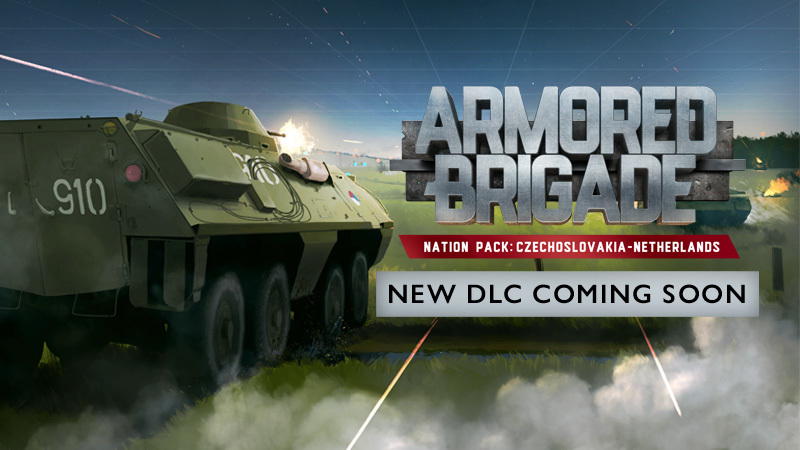
Armored Brigade Nation Pack: Czechoslovakia and Netherlands - Out Now
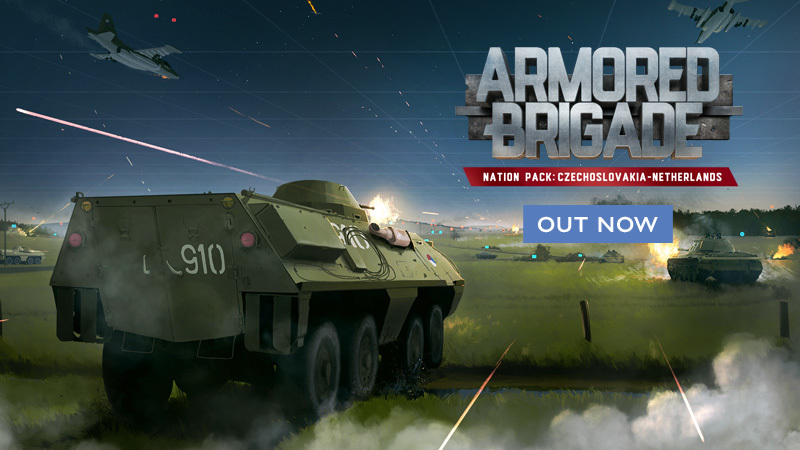
Armored Brigade Nation Pack: Czechoslovakia - Netherlands, the third DLC for the acclaimed wargame Armored Brigade, is now available.
Czechoslovakia and Netherlands are ready to join the conflict: the new playable factions introduced by this expansion have different army compositions and organizational structures, adding more tactical options and giving more complexity on the operational level with more than 200 new units and aircraft.
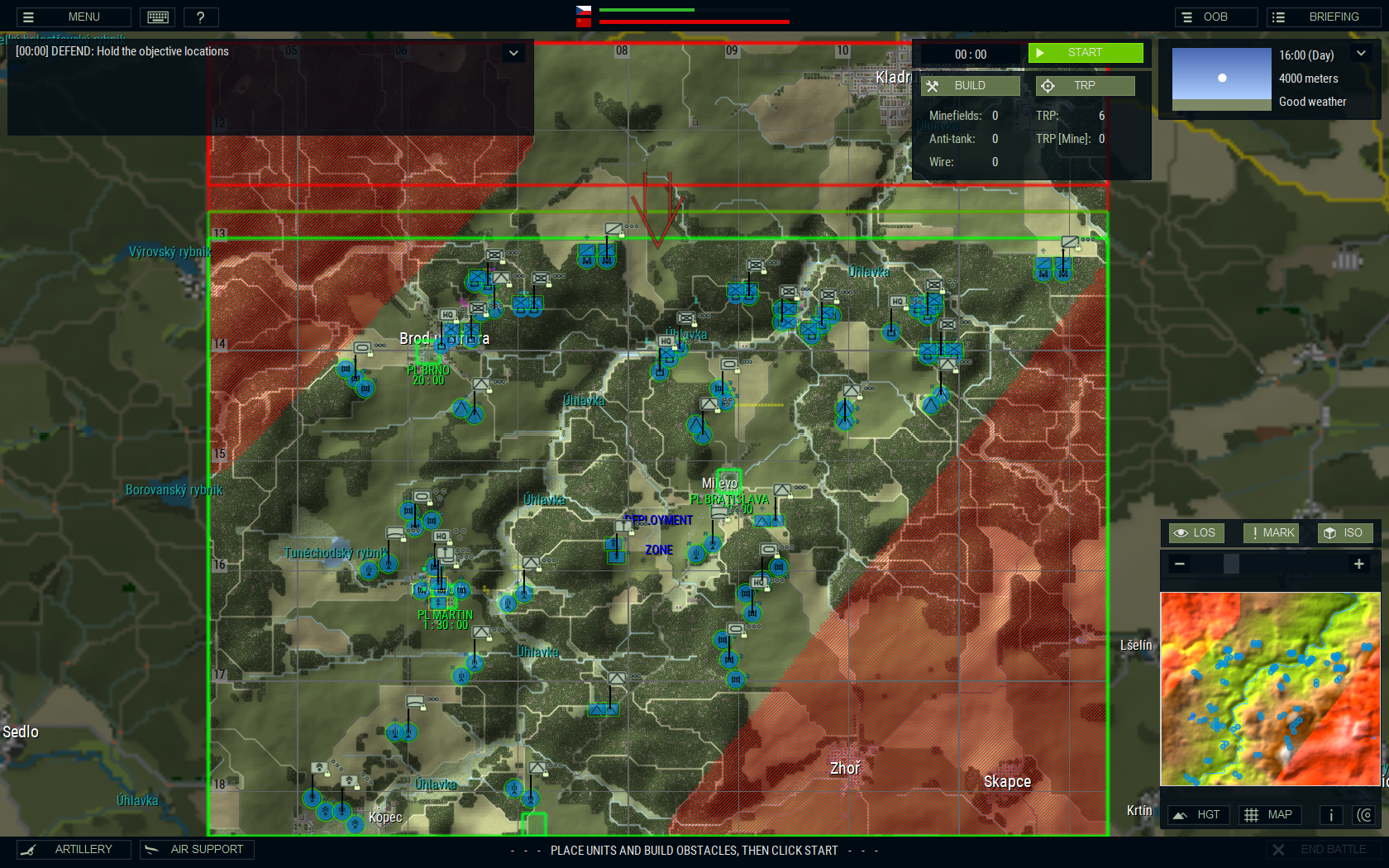
In addition, a new map located in the Plzeň Region (Czechoslovakia) and a linear campaign inspired by the events of the Prague Spring will be available.
Prior to the 1968 intervention Czechoslovak People's Army was well-regarded both in capability and reliability, and Czechoslovakia was the only Warsaw Pact member that did not have any Soviet forces stationed on its soil up to that point. Its 200,000 soldiers (in wartime, reservists would increase the number to over 700,000 troops) were trained to perform a sweep attack against the territory of West Germany.
Their combination of firepower, agility, striking power, protection and lethality make armoured forces particularly suited for decisive battle. They are capable both of operating across wide areas in offensive operations and of launching swift, powerful attacks on objectives at close range.
However, the armed forces underwent a political purge after the short period of political and military reforms in the late 1960s that culminated in an invasion by the armies of five other Warsaw Pact members. Large number of officers who had supported the reform movement either voluntarily resigned or were forced out. Western analysts disagreed about whether the Czechoslovak armed forces had ever recovered their pre-invasion size, quality, or morale by the late 1980s. Some questioned their reliability in a prolonged offensive war in Western Europe or in a war that was going badly for Warsaw Pact forces. Other outside analysts believed that the Czechoslovak armed forces were well trained, equipped, and motivated and that they were quite capable of carrying their share of Warsaw Pact operations, particularly in defense of their homeland.
Czechoslovakia imported one ZSU-57-2 for testing, but rejected it as trials indicated that the lighter and much cheaper M53/59 was just as effective. While anti-aircraft role is limited to daytime and good weather conditions, it is devastating as ground support weapon against unarmored or lightly armored targets.
While the tactical organization mostly followed the Soviet pattern, there was a degree of local variations and modifications rarely seen in other Warsaw Pact armies. Due to an extensive domestic industrial base predating the communist rule, most of the small arms, crew-served weapons and even vehicles used by the Czechoslovak forces were designed and manufactured locally, sometimes requiring slight changes from the Soviet norm of organization for small units.
Highly autonomous and flexible, the motor rifle troops are equipped to perform under the most rigorous conditions and conduct offense and defense in any terrain, weather or time.
Both kinds of Czechoslovak divisions were tank-heavy organizations. Motorized rifle divisions possessed 266 tanks; tank divisions possessed 335. In comparison, a United States armored division had 324 tanks, only 11 fewer than a Warsaw Pact tank division, but the American organization had about 7,300 more personnel. Offensive warfare was seen as the essential and principal form of combat and the chief instrument to achieve victory over the enemy. This was reflected in the first principle of the development of the Czechoslovak People’s Army: to build an army which, in addition to being able to handle other types of warfare, possesses primarily offensive capabilities.
The role and position of the Czechoslovak People’s Army in the defense system of the Warsaw Treaty were reflected in the second principle: the army has to be structured and built to be able to mount an independent front-sized operation. In the event of a surprise attack, the Czechoslovak army was required to conduct initial operations on its own for 10 to 12 days, until the next operational echelon would arrive and get deployed.
Royal Netherlands Army
During the Cold War, the Royal Netherlands Army (Koninklijke Landmacht) was committed to two main tasks in the NATO context: participation in the defense of West Germany against ground attacks across the North German Plain, known as “forward strategy”, and ensuring the territorial security of the Netherlands itself and vital lines of communication.
In the fulfillment of the first of these tasks, 1 (NL) Corps was assigned to the Northern Army Group (NORTHAG). This armour-heavy corps consisted of three mechanized divisions which included three armoured, six armoured infantry, and one infantry brigade for rear area security. Divisions were not fixed formations in wartime, as self-supporting brigades and corps level assets would be reallocated as the tactical situation dictated. The National Territorial Command had some active units and a large complement of reserves to provide for the security of the homeland.
The particular difficulty facing Dutch in case of conflict was their (mal)deployment: the vast majority of 1 (NL) Corps was based in the Netherlands and many units would have to drive over 300 kilometres to reach their fighting positions. To make matters worse, over two-thirds of the corps was made up of reservists who would need to be mobilised before deployment. The unique conscription system demonstrated Dutch ability to deploy the entire corps to fighting positions within 72 hours, but this fell well short of NATO’s target of 48 hours – a vulnerability that the Warsaw Pact would undoubtedly attempt to exploit.
For a long time, Dutch emphasised position defense or an area defense at the FEBA (Forward Edge of Battle Area). The limited reserve forces, by preference, were committed primarily to conduct limited offensive actions, such as surprise fire, counter-thrusts and counter-attacks. It was thought that such a counter-attack in all likelihood would require the release of tactical nuclear weapons in order to be successful. Then, in 1985 a new concept of operations came into force which prescribed a more fluid, terrain-oriented defence in depth. No longer was the enemy to be halted as far east as possible; he was now to be denied passage through the corps sector. Should this first stage of the main defensive battle fail then the defence would be continued deeper into the corps sector, further west.
During operations, battalion and company organisations within the brigades would usually be broken up to form combined-arms battle groups tailored to specific missions. Tank battalions and armoured infantry battalions would detach or exchange tank and armoured infantry companies, resulting in either reinforced or mixed battalions that were characterised as "tank-heavy", "armoured infantry-heavy" or "balanced". Within these battalions, companies would subsequently detach or exchange platoons to form company-sized combat teams, the main components being the tank platoons, armoured infantry platoons and armoured anti-tank platoons.
Armoured infantry forces alternate between mounted and dismounted combat, delivering both anti-personnel capability and employing anti-tank weapons, and Dutch mechanised forces are lavishly equipped with latter. In cooperation with armour, they maintain mobility and striking power, while abundant anti-tank resupply allows for protracted combat.
The Royal Netherlands Army, in final analysis and despite a few problems, was a modern, efficient, well-led and relatively large force seemingly capable of meeting its responsibilities once fully mobilized and deployed in its wartime locations. They operated a very interesting mix of equipment, ranging from the venerable Centurion tanks to modernized Leopard 1-Vs and state-of-the-art Leopard 2A4s, alongside reasonably advanced YPR-765 infantry fighting vehicle and unique YP-408 wheeled APCs, all supported by modern aircraft and artillery.
Swift and decisive victory on the battlefield hinge on fully synchronized combat forces. Weapons and units are more effective when they operate jointly than when they function separately. Dutch Armoured Engineers can clear minefields to facilitate rapid advance of friendly forces, or act as ersatz mechanized infantry in case of emergency.
Armored Brigade Nation Pack: Czechoslovakia Netherlands - Iconic Units
Czechoslovakia and Netherlands will be arriving on our stores and on Steam on February 25th as part of the third Nation Pack. Have a look at some of the most important units that will be under your direct control.
Centurion Mk 5
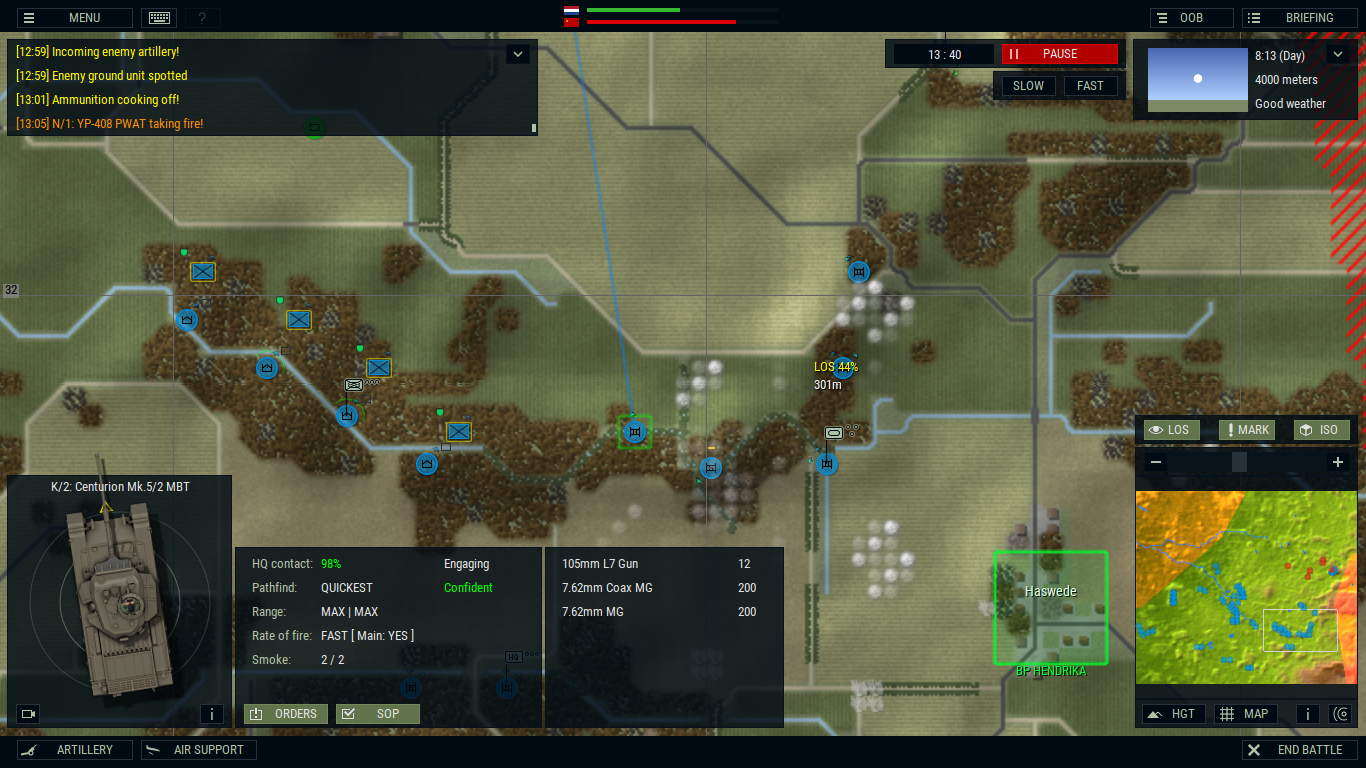
Few tank designs have been as significant, versatile and long-lived as the Centurion, earning a fearsome reputation in nearly every major conflict of the Cold War, from the arid climates of Africa and Middle East to the tropical jungles of Vietnam. The combination of fire-power, mobility, and armour protection ushered the era of the true "universal tank", capable of performing multiple roles on the battlefield. Mark 5/2 variant introduced the famed high-velocity rifled L7 105 mm gun, which was developed after the 1956 Hungarian Revolution - Hungarian insurgents delivered a Soviet T-54A to the British by literally driving it into their embassy. Created to counter the latest Soviet tank, the L7 gun became the mainstay armament of the Western MBTs, adopted by the United States, Germany, Japan, India, Israel and even China.
Leopard 2NL
Born out of the abortive MBT-70 collaboration with the United States, the Leopard 2 was developed by West Germany at the height of the Cold War. When it first entered service in 1979, it was indisputably the most advanced and potent tank in the world. This third-generation main battle tank owes its outstanding performance capability to an ideal symbiosis between vehicle crew and cutting-edge technology. During the last four decades it has undergone numerous upgrades and modifications to ensure this versatile superiority. Over 3,500 units are currently serving with the armies of eighteen nations, but it was the Dutch who became a first export client in 1981.
YP-408
Barely known outside the Netherlands, YP-408 was an unique and odd-looking 8x6 armoured personnel carrier. Designed in the late 1950s, it was one of the earliest examples of wheeled APC outside the Soviet BTR family. Born out of the initial requirement for a domestic armoured vehicle to replace modified M3A1 Scout Cars used to secure and evacuate the Royal Family, it was quickly realised it could be affordably converted into a battle-taxi to move the infantry quickly and safely on the battlefield. Being based on a rugged DAF YA-328 all-terrain truck allowed for part interchangeability, and it was easy to integrate into the existing military supply and maintenance system of the Dutch Army. It was also adopted for several other roles such as ambulance, anti-tank vehicle, ammunition, cargo and radar carrier.
M113 C&V
The M113 C&V (Commando & Verkenning) used by the Dutch reconnaissance troops has the same origins as the Canadian Lynx. By 1963, the US Army had adopted M114 ACRC to serve as a command and reconnaissance vehicle. However, the vehicle had proven troublesome in service and it elicited no interest for export. Seizing this opportunity, the FMC Corporation offered their own design sharing components with the proven M113A1 armored personnel carrier. The Dutch Army bought over 250 units, and beginning in 1974 fitted them with a 25mm Oerlikon gun armed turrets, providing a massive increase in firepower.
F-16A
For almost four decades, the F-16 Fighting Falcon has been one of the most significant and versatile weapon systems in the aerial fleets of many Western nations. It was initially built under an unusual agreement creating a consortium between the United States and four NATO countries: Belgium, Denmark, the Netherlands, and Norway. The F-16A that emerged from this development process was a neat, sleek, dartlike aircraft with swept wings and a degree of wing-body blending. With over 1,000 F-16s in service, the platform has been adapted to complete a number of missions, including air-to-air fighting, ground attack, and electronic warfare.
OT-65A Vydra Scout Car
In the early 1960s the Czechoslovak army was looking for a new, multi-role armored fighting vehicle to serve primarily in the reconnaissance role. As their own domestic light armored car failed to enter serial production, and Soviet BRDM wasn't available in numbers due to the limited production capacity, the only remaining alternative was the Hungarian FÚG. Even if the military was not overly satisfied with the Hungarian design, the basic vehicle served in reconnaissance, command, artillery forward observation, and NBC roles. But the most interesting variant was probably the heavy recon variant OT-65A Vydra (Otter). The turret from the OT-62 APC was installed, armed with an 82mm T21 Tarasnice recoilless gun. This additional firepower could engage more heavily armoured targets, although the odds of survival were certainly unfavorable.
T-55AM2
By the end of the 1970s, numerous T-54/55 formed the backbone of the Warsaw Pact armored forces but they were becoming increasingly obsolete. To increase their combat value and extend their service life, a new upgrade program was launched to improve the aging tank fleet for a fraction of the price. The first stage was the T-55AM1, focusing on considerable firepower improvement. Accuracy with a new Kladivo FCS was increased 6.4 times for static fire, and 3 times while on the move. The second stage, T-55AM2, appeared during the early 1980s to address the need for additional protection against man-portable anti-tank weapons by adding applique BDD plates to the upper frontal hull and turret. Furthermore, it had a more powerful engine and a smoke grenade launch system.
SD-152 Tank Destroyer (ISU-152)
The ISU-152 was a Soviet heavy self-propelled gun developed and used during World War II. Unofficially nicknamed Zveroboy (Зверобой; "beast killer"), it featured a 152mm gun with a multi-role purpose of knocking out heavy tanks, destroying enemy fortifications, and providing artillery support for more mobile units during offensive operations. As part of the USSR military assistance to friendly or pro-Soviet countries, ISU-152s were transferred to the Czechoslovak military after World War II. For several decades it was the heaviest armored vehicle in the Czechoslovak People's Army, and they were often used to test newly-developed anti-tank obstacles. Some were deployed with Border Guards between late 1960s to early 1970s.
OT-810 APC
Following World War II experience, the Czechoslovak army was deeply impressed with the concept of halftrack armored personnel carriers. In fact, the “standard” Czechoslovak APC from the late 1940s to mid-1950s was the German Sd.Kfz.251, captured in relatively large quantities. Using captured vehicles was a necessity for the newly re-established Czechoslovak army in 1945, but by the late 1950s, the halftracks were seriously worn-out and a replacement was required. By 1954, a program was underway in Czechoslovakia to develop two domestic variants of the future APC: one with tracks (OT-810) and one with wheels (OT-64). The requirements included mortar carriers and anti-tank variants (carrying an 82mm recoilless rifle) as well. OT-810, while based on Sd.Kfz.251, was a fully-enclosed half-track with different superstructure shape and air-cooled diesel engine. However, it kept predecessors' drawbacks as well: it was hard to steer, the troop compartment was cramped, and maintenance was demanding. It soon got a nickname “Hitler’s Revenge”. It was gradually replaced as troop transport by more modern vehicles, but in other roles it persisted longer and the last vehicles were withdrawn from reserve as late as 1995.
RM-51 MRLS
The RM-51 (Raketomet vz. 51) multiple rocket launcher was a Czechoslovak-made alternative to the Soviet BM-14 developed in the 1950s. It was an unarmoured truck-mounted 32-tube 130 mm MRL issued to infantry units at battalion or regimental level. It was designed to support ground troops by the destruction of surface targets, concentrated manpower, lightly armored equipment and field fortifications within a distance of 8.2km.
On February 25th is arriving on Steam the new Armored Brigade Nation Pack DLC which will include two new factions: Czechoslovakia and the Netherlands.
They will come with more than 200 new units and aircraft, a new map located in the Plzeň Region, Czechoslovakia and a linear campaign inspired by the events of the Prague Spring.
New scenario design possibilities!
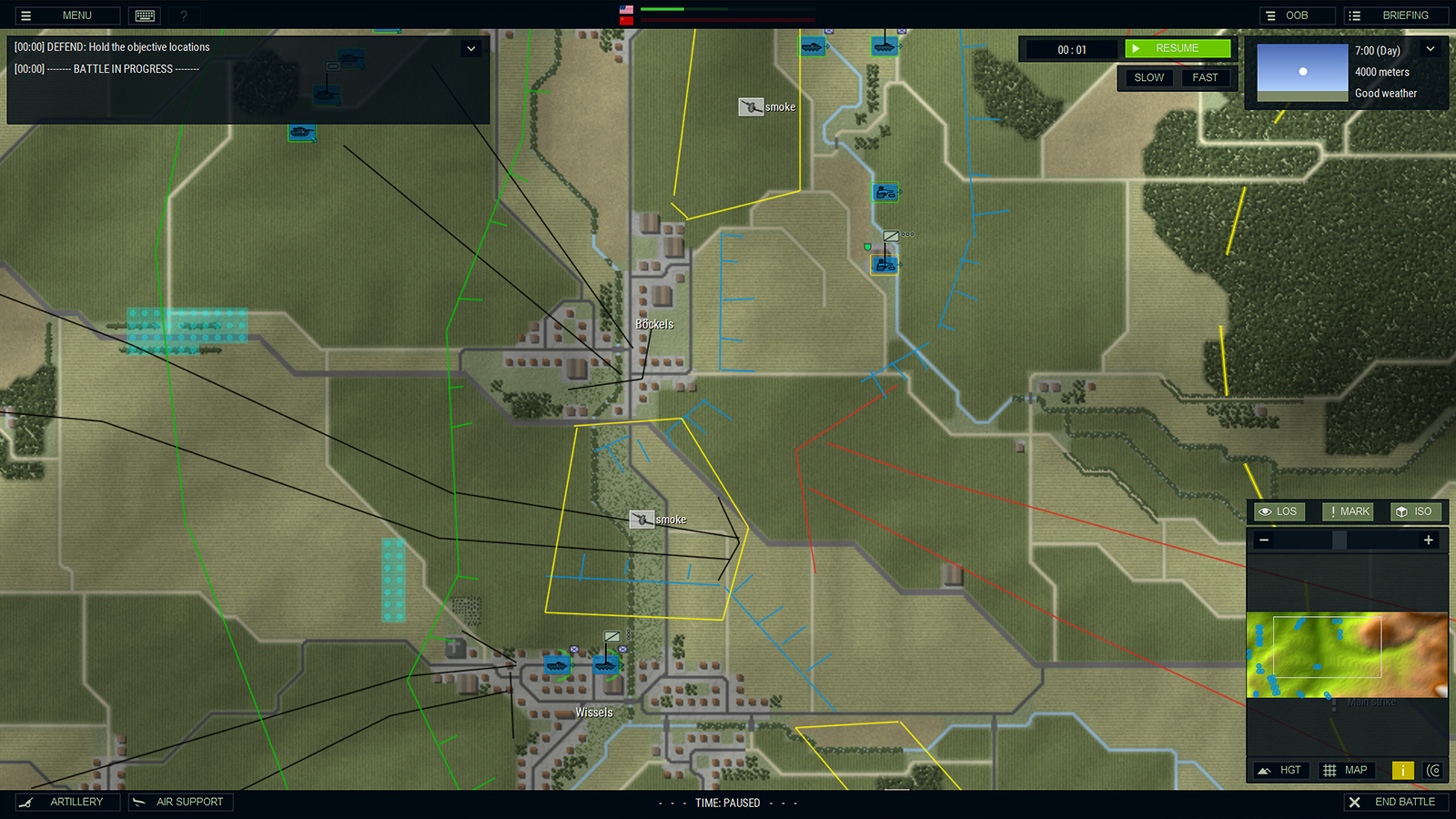
This update expands scenario design possibilities. The scenario designer can place the AI side formations, pillboxes, and obstacles in the Mission Editor.
The AI counter-attack aggressiveness can be adjusted for each scenario separately, allowing more customization over the opponent's behaviour. Two new scenarios are added to the base game to showcase these features. Also, the planning tools are improved, so the player can draw colored lines on the map and attach text to the map markers.
Version 1.056 Changelog
• Fix: The Mission Editor scenario list didn't scroll to the correct page after returning from an edit mode. • [engine] All AI formations, pillboxes, and obstacles can be placed and locked in the Mission Editor. Now it's possible for the scenario designer to plan the AI side defensive positions. • [engine] Mission objectives have an adjustable timer. An objective cannot be captured after it has timed out. • [engine] The AI counter-attack system has been tweaked. The counter-attacks are more aggressive than before, and the base chance can be adjusted for every scenario in the Mission Editor. • [scenarios] Add new scenarios: 'Battle of Inkeroinen' and 'Elastic Defence'. • [ui] Improved planning tools: The player can draw colored lines on the map and attach text to the map markers.
Nation Pack: France - Belgium - Gameplay Stream is now on Youtube
Armored Brigade Nation Pack: France - Belgium - Gameplay Stream, with XTRG - 30 October 2019
Did you miss the live stream? No worries, it is now on youtube!
Armored Brigade Nation Pack: France – Belgium is out
France and Belgium are ready to join the conflict with hundreds of new units and aircraft, on a completely new map centred around the Bastogne area.
To celebrate this important milestone, Armored Brigade (base game) and the first Nation Pack (Italy – Yugoslavia) are being discounted, you can get them at 30% off. This promotion will last an entire week, until November 8th.
In addition, you can get the Armored Brigade Complete Bundle – featuring all the Armored Brigade titles – 15% off.
If you are eager to see the new factions and map in action, then don't miss XTRG playing the game today on our official Twitch Channel! https://www.twitch.tv/slitherinegroup
The stream will start at 9 pm GMT – 5 PM EDT – 2 pm PDT
"Nation Pack: France - Belgium" Belgium General Strategy
In a few days the new DLC of Armored Brigade, Nation Pack: France - Belgium will be available: the release date is October 31st. In the meanwhile, discover the features of the Belgian Army by reading the thorough examination below. If you want, see also the French corps analysis here.
BELGIUM
The Belgian I Corps, with two mechanised divisions, was the southernmost corps of Northern Army Group, or NORTHAG. While the I Corps was permanently assigned to the forward defence role in Germany, supervision of the home territory was the responsibility of the Forces of Interior. Latter included not only the training and reserve cadres bolstered by local Gendarmerie, but also the elite and battle-hardened Para-Commando Regiment. While unfortunately not much is available regarding the Belgian tactical defence doctrine, the Belgian Army was generally rated by NATO as well prepared and with consistent high readiness, determined not to repeat the failure of 1940 war.
However, persistent issues with small defence budget meant that much of its equipment remained obsolescent; its main battle tank, the Leopard 1(BE) was of 1960s vintage and its M75 and AMX-13 Mod 56 APCs, as well as its Alouette II helicopters were almost museum-pieces from the 1950s. Despite the proven high proficiency of Belgian tank crews, the armoured “punch” had to be boosted from time to time by British tank formations. There was a modest rearmament program in 1975-1985 period, upgrading primarily APCs and artillery, increasing the numbers of ATGMs and replacing most of the Air Force’s fast jets with modern aircraft.
"People waxes and wanes according to the worth of its army: the army lives or dies on its infantry”. Such was the extreme point of view expressed in the German recruiting booklet Offizier im Grossdeutschen Heer (1942).
Hence, it is probably true that the centerpiece of Belgian Army in Armored Brigade are its (mechanized) infantry forces, strongly reaffirming the need for combined arms operations. While this lesson is true for any armed force, lack of technological advantage in pretty much any aspect over probable Soviet opponent in Belgian case imply that the combined coordinated action of infantry, armor and artillery is not only essential to success, but to survival itself.
However, the various obstructions provided by variations in terrain elevation, vegetation and built-up areas can block or inhibit the capacity and advantage of the enemy firepower. This opacity creates opportunities for cover and concealment. Exploiting terrain gives opportunities to mitigate the effects of enemy quantitative and firepower advantage through such techniques as using cover, camouflage and dispersal to reduce the ability of the enemy either to find targets or to apply combat power against them. Understanding and manipulating “ground” is often crucial to success in land warfare.
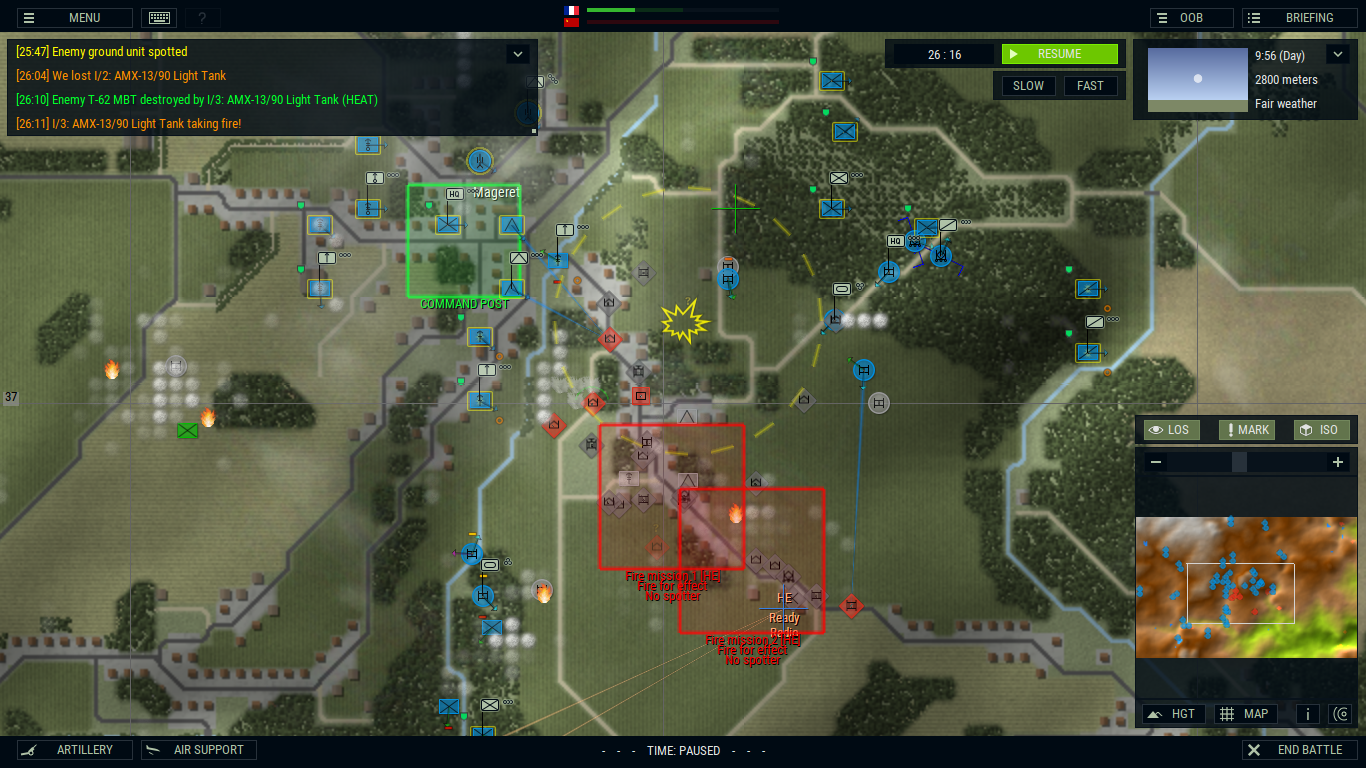
Since Belgians have slim chances of winning while fighting head-to-head against a quantitatively and qualitatively superior enemy on a battlefield of unprecedented lethality, intensity, and density, they must almost completely rely on combined arms, terrain and mobility. Here you can observe Belgian battalion using low hills as cover in meeting engagement with Soviet armoured force.
Mobility is not an absolute, but must be measured relative to the difficulty of the terrain and to the mobility of other friendly or enemy forces. For a combined arms team, the least mobile element may determine the mobility of the entire force. Without mobility, the principles of mass, maneuver, and offensive cannot be applied, and surprise becomes very difficult. Protection means both security against enemy surprise attack and capability to allow offensive maneuver or defense on the battlefield. This battlefield protection may be accomplished by using terrain defilade and defensive fortifications, or by employing artificial means such as smoke screens. Machine gun, mortar and SPG sections should be detailed to follow the leading companies, whenever infantry or armor.
Belgian Army gave particular care to reconnaissance, since 1975 organized and equipped according to British model. It was deemed vital, being planned, continuous and progressive, taking full advantage of concealment, defilade, and terrain.
"Nation Pack: France - Belgium" France General Strategy
Armored Brigade new DLC, Nation Pack: France - Belgium, will be released on October 31st. Below you'll find an in-depth analysis of the French army, looking closer to its strategies and features. The specs of Belgium will follow soon.
France
As mentioned previously, while the bloodletting of World War I has left the French military a firm believer in the prevalence of firepower over manoeuvre, so did France's defeat by Germany in 1940 led it to a similar swing in the direction of mobile warfare. Their Cold War tactics were tank-heavy and closer to US Armored Cavalry Regiments (or, indeed, their own pre-WW2 Division Légère Mécanique) in that their formations were not intended for holding ground. Like the DLM of 1940, the mechanized regiments were to operate like the earlier dragons portes, locating and delaying the enemy and preparing the situation for a counter strike by the tank regiments.
By the 1980s the French army had transitioned to small armored divisions and saw an increase in the proportion of infantry, though French “divisions” never amounted to much more than a brigade in real terms. These divisions were composed composed of task-organized combined arms regiments (essentially large battalions) which mixed tank and mechanized infantry companies on a permanent basis. The French doctrine saw these divisions operating on rather wide frontages, with uncovered flanks if necessary, and seeking to outflank the enemy rather than engage him head-on.
Here we can see dismounted block-force in the village laying ambush to the advancing Soviet armoured column, delaying them long enough so French light tanks and supporting paratroopers can organize to strike on flanks.
Backing up the draft-based armored and mechanized divisions of the Metropolitan Army were the expeditionary forces of the Force d'Action Rapide, a collection of volunteer-manned light armored, parachute, mountain, airmobile, and marine units. Although mainly intended for overseas use due to their all-volunteer manning, their capabilities would have been useful in an overall NATO-Warsaw Pact conflict.
“Boxing maneuver”. Deliberately lured deep into the French lines, Soviet unit is encircled and destroyed by weaker, yet more mobile French force. Head-on engagements were eschewed except as a way to fix the enemy for an enveloping maneuver, and fighting in built-up or wooded areas was similarly to be avoided due to the low infantry strength of French formations and the advantage the artillery-heavy Soviet Army would have in such grinding attritional battles. In this regard the French army differed from the Bundeswehr which, although also a maneuver-oriented force, intended to fight for every inch of the battlefield.
The deadly effect of grinding battle against Soviet Army in the urban area.
The weak point of the French ground forces was equipment. The French strategic nuclear deterrent took up such a large portion of the defense budget that in many respects French forces lagged behind other premier NATO armies in certain technical aspects. The most notable French weakness was the failure to field a modern main battle tank during the 1980s comparable to the Leopard 2, M1 Abrams, or even the rather less successful Challenger 1. The highly sophisticated Leclerc MBT finally entered service only in the 1990s. As a result of the French MBT lag, the French forces would have had to rely more heavily on anti-tank guided missiles, such as the MILAN, HOT and SS-11. Another quite noticeable weakness in-game terms is lack of stabilization on most of the French guns.
Speed and maneuver without stabilization will likely result in heavy casualties if “all guns blazing - on move” approach is applied. Player should rather use greater mobility of French forces to dictate the tempo of operations: quick redeployments should be used to set ambushes and flank attacks to inflict damage and then disengage before enemy can bring his firepower to bear.