We have a first update ready for you which will solve some major OpenXR compatibility issues across different headsets.
Added:
"Headset is disconnected" message
Hold menu or secondary button (Index Knuckles controllers) to open Quit menu
Changed:
Updated internal OpenXR 1.3.1
Aim pointer now on both hands to select menu items
Fixed:
Hand offset for Valve Index users with knuckles controllers, so hand pose feels natural
Screenspace Ambient Occlusion in Stereo mode
Application is now closing clean on disconnecting headset instead of freezing (unity bug fixed with OpenXR 1.3.1 Issue ID 1379929)
Player.log won't be spammed anymore with disconnected headset issues (unity bug fixed with OpenXR 1.3.1 Issue ID 1379929)
BIOLUM - OUT NOW
We are thrilled to announce the release of Biolum, the project we have put so much into and are so proud to share with you all today.
This VR experience is the brainchild of a group of passionate creators, developers, and producers who have painstakingly brought to life a story we hope you enjoy as much as we do!
You too can now experience the mysteries of the ocean depths by diving into the world of BIOLUM!
Give us your thoughts in the comments and don’t forget to leave us a review on the page! We are here for any issues or questions, so don’t hesitate to write to us in the community hub. We always love to hear from you :)
The BIOLUM Team
BIOLUM OFFICIAL RELEASE DATE: DECEMBER 2nd
Hello Biolum enthusiasts, are you as excited as we are for the release? It is just around the corner and we can't wait to share our experience with you.
The Biolum world plunges us into the depths of the deep ocean. Ordinarily pitch black, the Biolum universe is glowing with light and life. And so to get an idea of what this universe is like, we are sharing with you a part of this undersea adventure.
Click below for a pre-release sneak peak!
https://sketchfab.com/models/0f47d322bd69488bb2a10ce0aed5fddc/embed If Sketchfab does not load, please use this link:The World of BIOLUM
Explore and share with your friends. Dive into the cosmic unknown, you never know what you'll find…
And of course, we will be here next week on December 2nd at 9:00am PST for the official release!
AN INSIDE LOOK
Hello all bioluminescence enthusiasts! Are you ready to dive into the science of Biolum? Hold your breath because the ethereal beauty of earth’s lesser explored areas, bioluminescent flora and fauna are still a mystery to many.
You might not know this, but fireflies are an example of the bioluminescence we witness on land. They’re reputable for their synchronous light displays, a chemical reaction occurring within their bodies in order to attract a mate. They are often found in open fields or in forests near water and have long been a source of fascination for biologists, but they’re easier to access in comparison to other forms of bioluminescent life, those that exist in the depths of the deep sea.
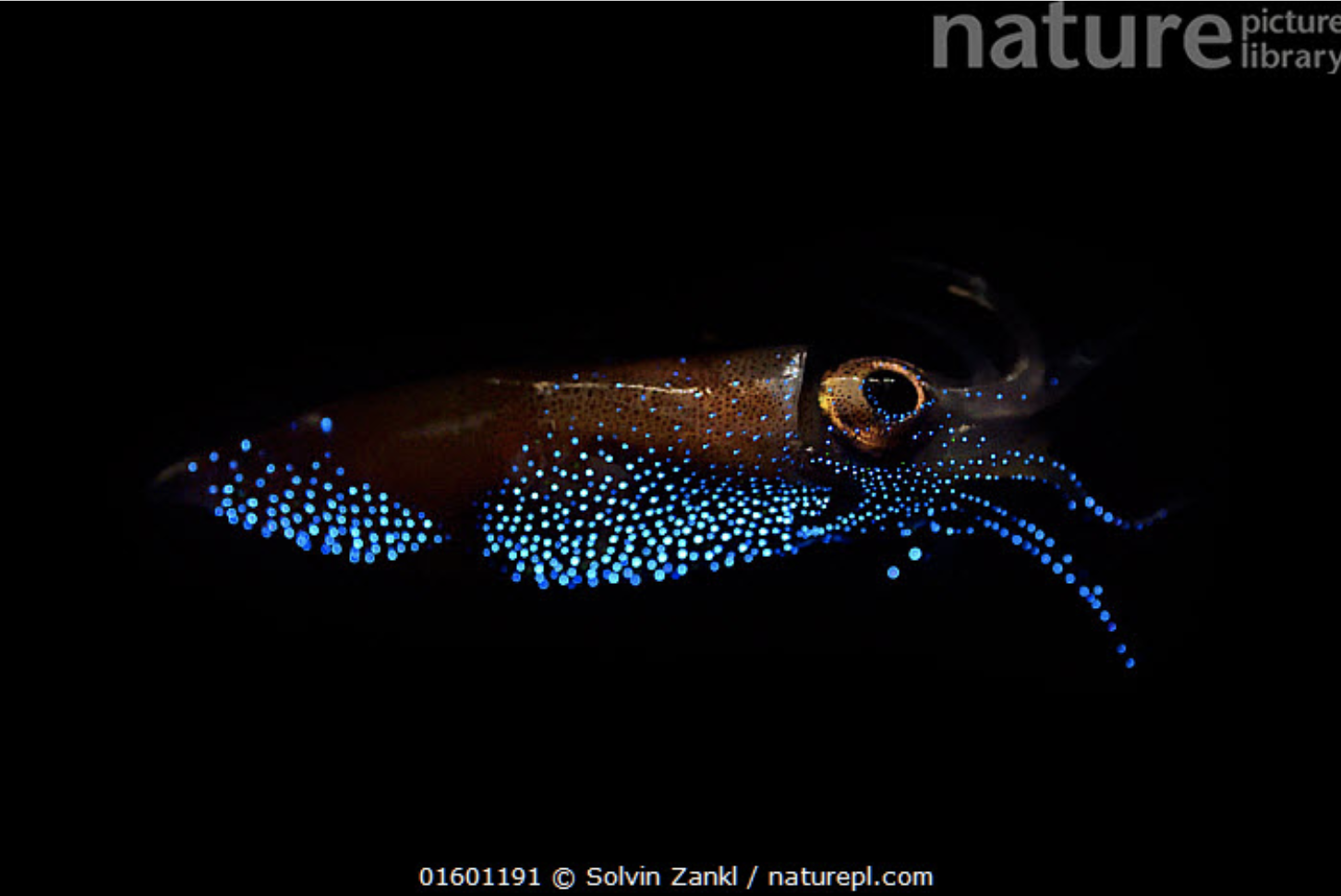
Down in the inky blackness of the ocean, where the light begins to dwindle, the underwater crannies and caves are home to a wealth of bioluminescent diversity that has been barely touched. Scientists have discovered a number of life forms that can only be described as magical, from The Firefly Squid (pictured above) which emits jewels of light from its underbelly, camouflaging its silhouette against the sea surface; to The Flashlight Fish, a badass looking creature that darts around the ocean with its eye-like luminous organs. These bioluminescent creatures are an example of nature’s beauty and bizarreness combined. The latter of the underwater organisms, pictured to the right, has organs under its eyes that contain a bioluminescent bacteria. The bacteria produces the dazzling light, and enables the fish to communicate with each other via the blink of an eye, just like a built-in headlamp! A fishy creature that would freak anyone out if they ran into one.
Whilst scientists have discovered an array of natural life, from fish to fungi, there is still fascination surrounding how and why this luminosity occurs. It is believed by many scientists to be a language of light, and since 76 percent of ocean animals are bioluminescent that would make it the most spoken language on earth! But studying the phenomenon has proven difficult, as access to the deep, dark depths of the ocean, where much of this nature thrives, is often impossible for humans. The renowned marine biologist, Edith Widder, said during a TED talk that “one of the things that’s frustrated me, as a deep-sea explorer, is how many animals there probably are in the ocean that we know nothing about because of the way we explore the ocean”, and she’s not wrong. Accessed either via nets on the back of ships, that drag through the ocean collecting such creatures in an undignified way, or submersibles and remote-operated vehicles, both of which often exhaust their bioluminescent ability when captured or the process damages their light producing organs.
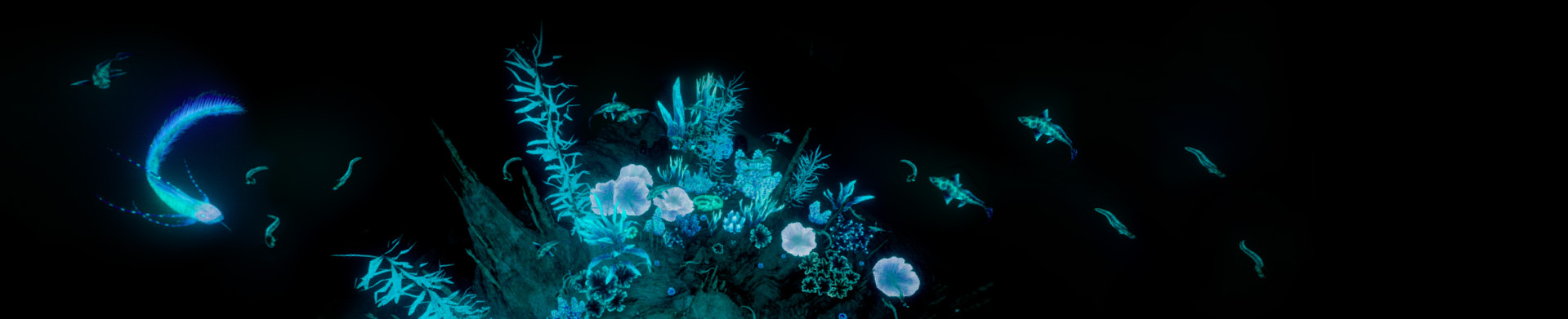
Creators Abel Kohen and John Rowe were inspired by the mystery of these bioluminescent creatures. In Biolum, we meet the Needlehead Worm. This creature infects individuals by passing up through the food chain and is the source of light that radiates throughout the underworld area being explored. An abundance of luminosity within a corner of the ocean, it’s a feast for the eyes. The captivating impact of virtual reality is achieved via a careful yet creative combination of many elements, including interactivity, visuals and audio. An underwater setting provides the perfect scene for these elements to be explored.
The recreation of bioluminescent nature is done in a bespoke way, and has allowed for prefrontal cortex to develop and apply effects, such as a complex lighting system, using procedural shaders and optimized real-time lights designed to replicate the luminescence of the creatures and vegetation (such as corals, kelp, and seagrass) that are featured. Biolum is an example of what can be achieved when you mix the intricacies of technology with an artistic idea, and combine biological fact with the imagination. And if that’s lit up your imagination, stick with us for the next article, when we’ll be chatting to indie dev, Paul Kirsten, about how he and the prefrontal cortex team, including lead technical artists, Felix Herbst and Tim Schuster, transformed the story idea into (virtual) reality.