Tactical Considerations - 23rd of January - Developer's Diary R8
Greetings, Captain!
Today's an exciting day for Boat Crew, as we will be talking about our new system to dynamically generate engagements, opposed landings, and last, but not least, the latest introduction to our unit roster! This marks a big milestone in the development of the Campaign as we have officially resolved the part of Boat Crew's design that we found to be most technically involved. We're excited to be talking about it, so without further ado, let's go ahead and talk about it!
Current Situation:
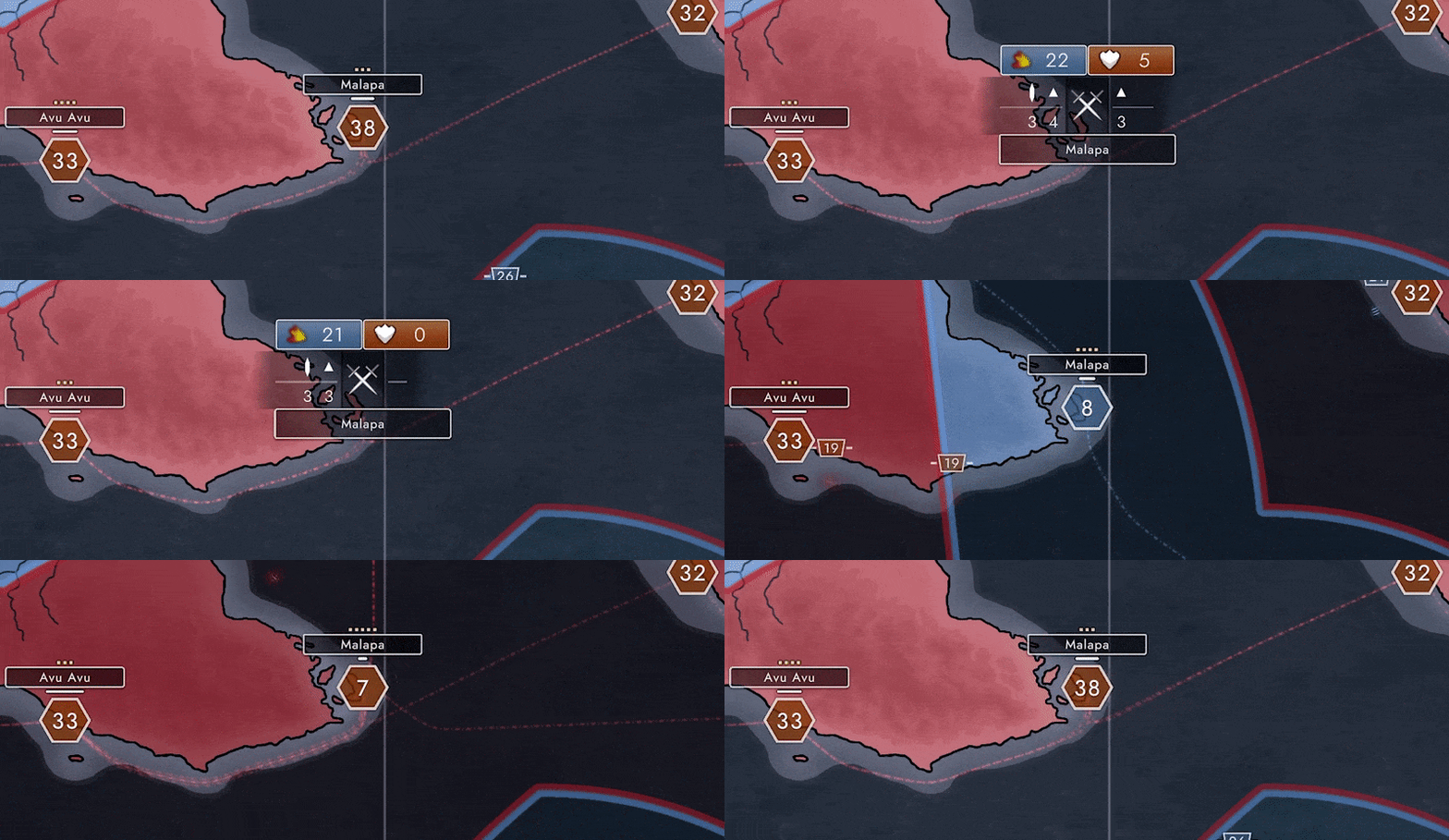
First of all, let's talk about an observation we have made after our most recent changes to Assault behavior. As you can see, an American force takes Malapa by assault, which ends up becoming a low strength American base. This apparent weakness does not escape the notice of the Imperial Japanese forces that were already building up at the other side of Guadalcanal, who mount an overwhelming attack on Malapa and take it back as quickly as it was lost. The 21 Strength force that was the leftovers of the assault on Malapa leave early and do not participate in a likely doomed defense.
Our takeaway from this is that the current Assault mechanics, fairly reliably and naturally, lead to counterattacks as well as give the player a way to reliably guide assaults simply by going to a base with a few good men and shooting it up. That sort of impartial and incomplete control is exactly what we wanted to achieve with Assaults, and so we are gratified to see that the game already responds in that manner.
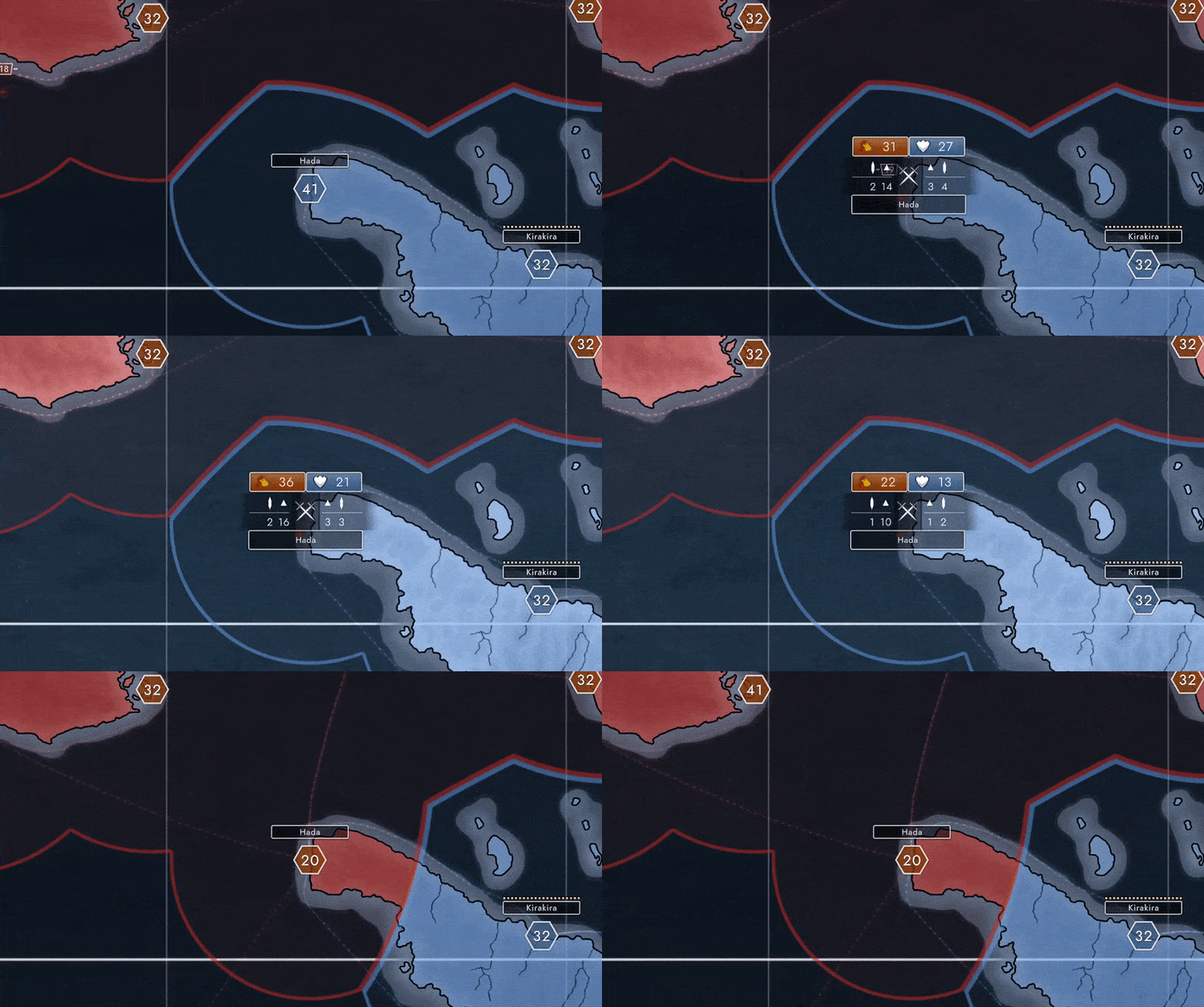
Of course, AI behavior is constantly being tweaked, and rest assured, the exhausted but still notable force that abandoned Malapa without a fight will be court martialed. Both because of the player factor and because of the inherent randomness that's a part of our auto-resolve system, we want the AI to be a little bolder in taking engagements that are close or even somewhat disadvantaged, dynamically generating occasions for the player to swoop in and save the day.
Now on to the most exciting part of this diary, dynamic map generation! This is an aspect of the game we've talked about having concerns about before, way back in the pre-reboot Developer's Diaries. We feel that we've finally had a satisfying resolution of this ongoing technical problem, and are happy to say that we can now generate chunks of the strategic map as a live combat map on the spot with reasonable load times!
The terrain of the generated area will match what it actually is in real life, within reason. These dynamically created maps have a fixed size and boundary distance, but they are large enough to allow for combat as well for escapes. The development of the system is of course ongoing, and we are sure there are improvements we can make. We're looking into having beachless coasts as many if not most coasts in the Solomons have the rain forests extending all the way to the sea. We'll see what the future brings on this front, but for now, we're happy to say that this problem is resolved and that we won't have to resort to our backup plan of making a grid of pre-made maps.
Next up are our bases, on which we can finally show some pictures! Most bases on the Solomons are little more than wooden piers connected to some sort of storage and a light garrison, which is what they will be in Boat Crew as well for the earlier stages of base development.
Of course, there will be more to show on this front and larger tiers of bases will get more elaborate and look more amenable to supporting large military operations, complete with paved surfaces and defensive installations powerful enough to deter all but the most daring PT Boat Captains.
Last but not least, we're happy to introduce the Type 2 Ka-Mi, the first Imperial Japanese amphibious tank. A light and somewhat weak enemy, large groups of Ka-Mi can nevertheless whittle you down with surprising haste.
Together with the playable base areas, they're the prelude to opposed landings we want to implement during Assaults. We'll go into more detail on that on future diaries, but for now, enjoy these little teasers!
That will be all for now, Captain! T.T.
A Beast of Any Other Name... - 9th of January - Developer's Diary R7
Greetings, Captain!
Campaign work has been going on in the background, but we wanted this diary to be one of the more visual ones. In the build-up to the Campaign Preview release, which is drawing ever closer, we'll be showcasing some new units that are expected to make it into the game with the Campaign Preview in addition to what you already see in our existing modes. Today, we are starting with a much needed make-over for the Fubuki-Class. Now let's get to it!
Current Situation:
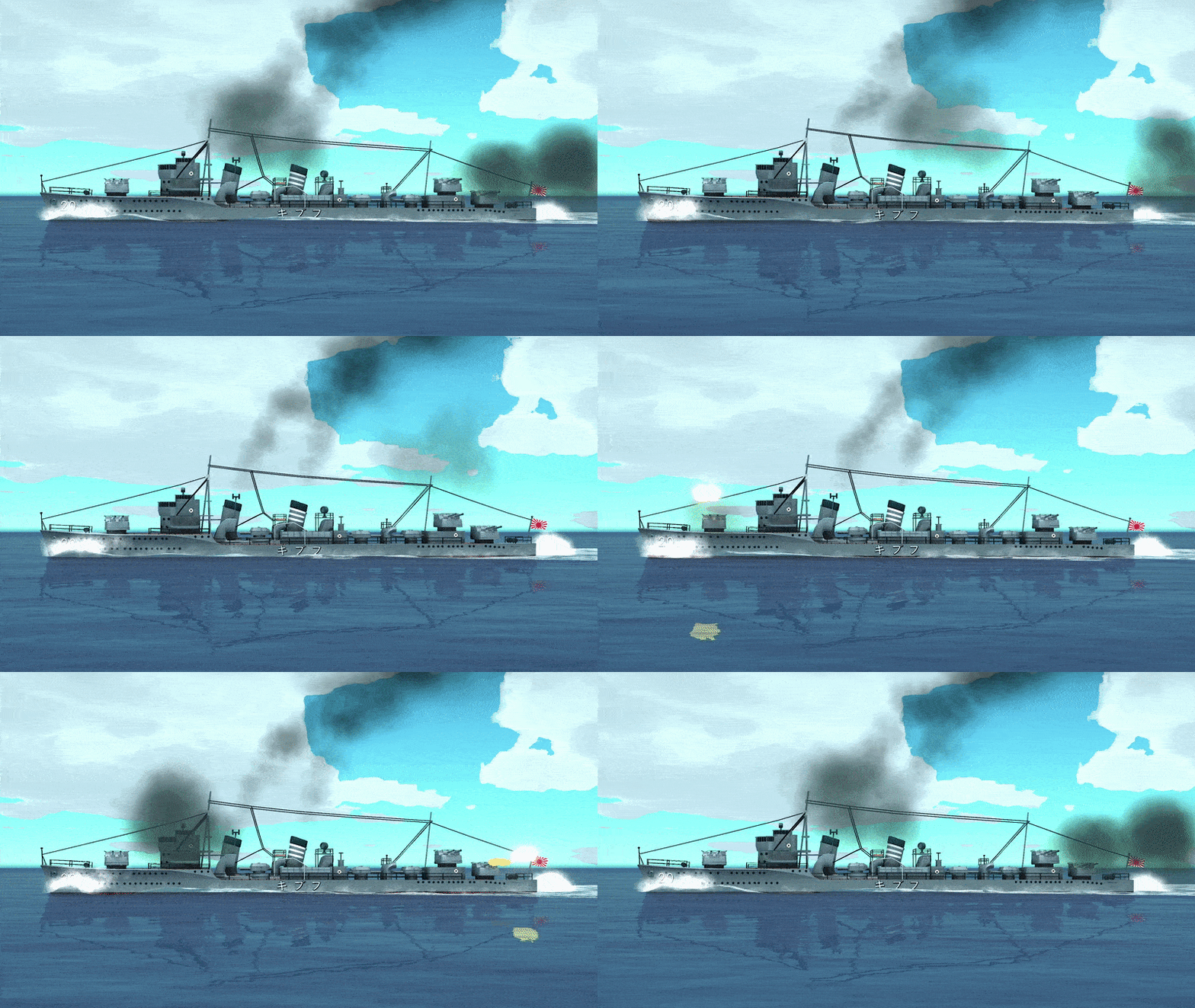
As might have been the first change you've noticed, the Fubuki has her name written out in bold white letters in the middle of the hull. This, along with the white stripes of varying numbers on the aft funnel, have historically featured in the liveries of the ships of the class.
Here, you see another ship of the class, with another name and a different number of stripes. The turrets are also different. Can you read her name?
In the Campaign, you'll have an action history (a feature we intend to pay a great deal of attention to, though in a later update), and to help with immersion, ship names will be picked from a pool of historical names. Ships that historically have their name written on the hull, such as those of the Fubuki-Class, will have their names written correctly on the hull.
The next thing to notice is, well, the third turret. Those of you who already have some experience wrangling angry Fubukis might have noticed that the version we have in game is a late 1944 variant with one of the aft turrets replaced by several AA guns. While technically out of the time period Boat Crew is covering, we feel that gameplay variety is a worthy cause for some creative license.
We also have two separate two-gun turrets, which will have different performance. It's up to you to find out which is which!
You can expect to see Fubuki-Class, and most likely other ships with different armaments in different contexts during the Campaign.
The point of such in-class variety is to encourage visual identification. While a glance at a Fubuki or even a report of one should be enough to let you know you aren't facing your average Soukoutei muppet, we wanted to encourage players to observe enemies and keep track of subtle differences in their appearance to have full understanding of what they are about to face.
Goals for the Next Cycle:
In the next cycle, we're going to keep testing the Campaign mechanics we already have implemented and discussed previously, and possibly move on talking about the player's interaction with the world. Either way, we'll most likely be back to one of those more mechanical talks next time around.
Fair winds, Captain! T.T.
Attack and Retreat - 26th of December - Developer's Diary R6
Greetings, Captain!
Since our recent update to Challenges, we have resumed work on the Campaign at full speed, and supply flow, patrols as well as Assaults are our next subjects to tackle. Much background work has happened on them in the last two weeks, but there remains a great deal of testing and implementation to be done. Given this is the Christmas update, we figured we would keep it short and sweet, and share our observations with the system so far, while keeping the full report to a later diary.
Now let's get into it!
Observations:
Firstly, we have noticed that the supply mechanics work fine if supply units drop a flat value to every place they visit, instead of taking expenditure into account. A detailed backflow calculation doesn't seem to be necessary either, greatly simplifying the flow calculation.
Now this does mean that we will have to give up on our initial conception of smart supply allocation rather than simply dumping the amount as decided by development, the effects of which we expect will be achieved by focusing on the way supply routes are formed. Between having multiple routes and reliable backflow, we expect that this reduced complexity in design won't actually affect the outcome.
We have also decided to standardize many actions to be activated on in-game time ticks for several reasons. Firstly, development and supply mechanics work better if done on a tick while draining supply rather than immediate usage of supply on docking. Repairs on bases work better with a supply draining tick as well. Overall, this is a fairly uncontroversial decision in the context of game design, but we figured there would be no harm in pointing out where this helps us specifically.
Moving on, Assaults often encounter supply groups, and will quite reliably kill inbound supply. So an Assault will effectively act as a blockade force. Population cap and spawn rate may have to be quite low for assault units for the player to have any impact in determining the fate of an Assault, though this is something that can also be regulated through the cost of units being mustered for an assault. Assaults are meant to be expensive, irregular affairs even if not rare ones, and they are the sledgehammer blows to your scalpel. As testing continues, we will investigate ways in which the player can meaningfully help the assault, both directly as a part of them, and indirectly through intercepting reinforcements and supplies.
Finally for this week, we have noticed that simulating a year actually takes quite a while. Our base speed is x20 real time; accelerating to x60 on top of that, it would take 7.3 hours to finish a year. About a year is probably how long the campaign should last, give or take a few months, so we can see that the timescale is on point.
Goals for the Next Cycle:
Being a Christmas diary, as well as one caught in the middle of a lot of background work that is difficult to present being done, this one has been a shorter diary. As a result, we hope to have one of those a lot more visual diaries next time, possibly having completed the work on Assaults.
Closing Remarks:
We wish you a Merry Christmas, and a Happy New Year in advance, Captain!
- Two new challenges. Night Stalker and Dawn Raid.
Features
- Torpedo targeting indicator, currently only useful for targets moving in straight lines. - Time warp controls and UI. F1, F2, F3, F4 hotkeys. - Skippable crew lineup on challenge score screens. - Improved AI rudder control and physics. - Vessels now circle around their last waypoint node before proceeding instead of fixating to a point.
Balance
- Extra target selection phase to help dive bombers focus on dive susceptible targets - Buffed Tender, sub chaser, and fletcher max speeds. - Rebalanced center of masses for most vessels. - Rebalanced torpedo physics. - Buffed acoustic guidance. - Nerfed enemy destroyer speeds.
Optimizations
- Ocean wave calculation is now done through Gerstner rather than FFT. - Crew task scoring vastly optimized though deck path caching, task update rate increased. - Threaded foliage render requests, Optimized cloud rendering. - Managed script update execution.
Bug Fixes
- Attempted another fix for some crew becoming unresponsive after periods of inactivity, requiring reassignment of their roles. - Torpedo smoke on boats that spawn again after tubes are is used. - Crew keep items in hand while using weapons. They now appear to be attached close to their belts instead. - Gunners don't leave seats on role change sometimes. - Manual pathing to weapons sometimes causing double occupancy per seat. - Some LOD issues for US ships and general deck decoration objects. - The Three Ducks wrong ending message, says Fubuki was sunk. - Pausing in torpedo mode won't prevent camera from rotating. - Submarine physics issues. - Acoustics torpedoes homing through terrain. - Fixed a long time bug where some spawned objects are counted twice which is occasionally game breaking.
Quick Hunters - 12th of December - Developer's Diary R5
Greetings, Captain!
Taking a break from our usual Campaign talk, we're going to talk instead about our upcoming additions to our existing modes! We realize that it's been quite a while since our last update, and it's important for us to not get carried away and forget about existing modes.
While the main update to Fleet Endurance and Challenges will come with v1.4.5, we figured we can sneak in a smaller update until then, due to arrive some time later this week. The goal is to freshen up the current state of the game and make the wait for the Campaign just a little bit easier. Now that you know the patch will happen, let's go into what will be in it!
Upcoming Update:
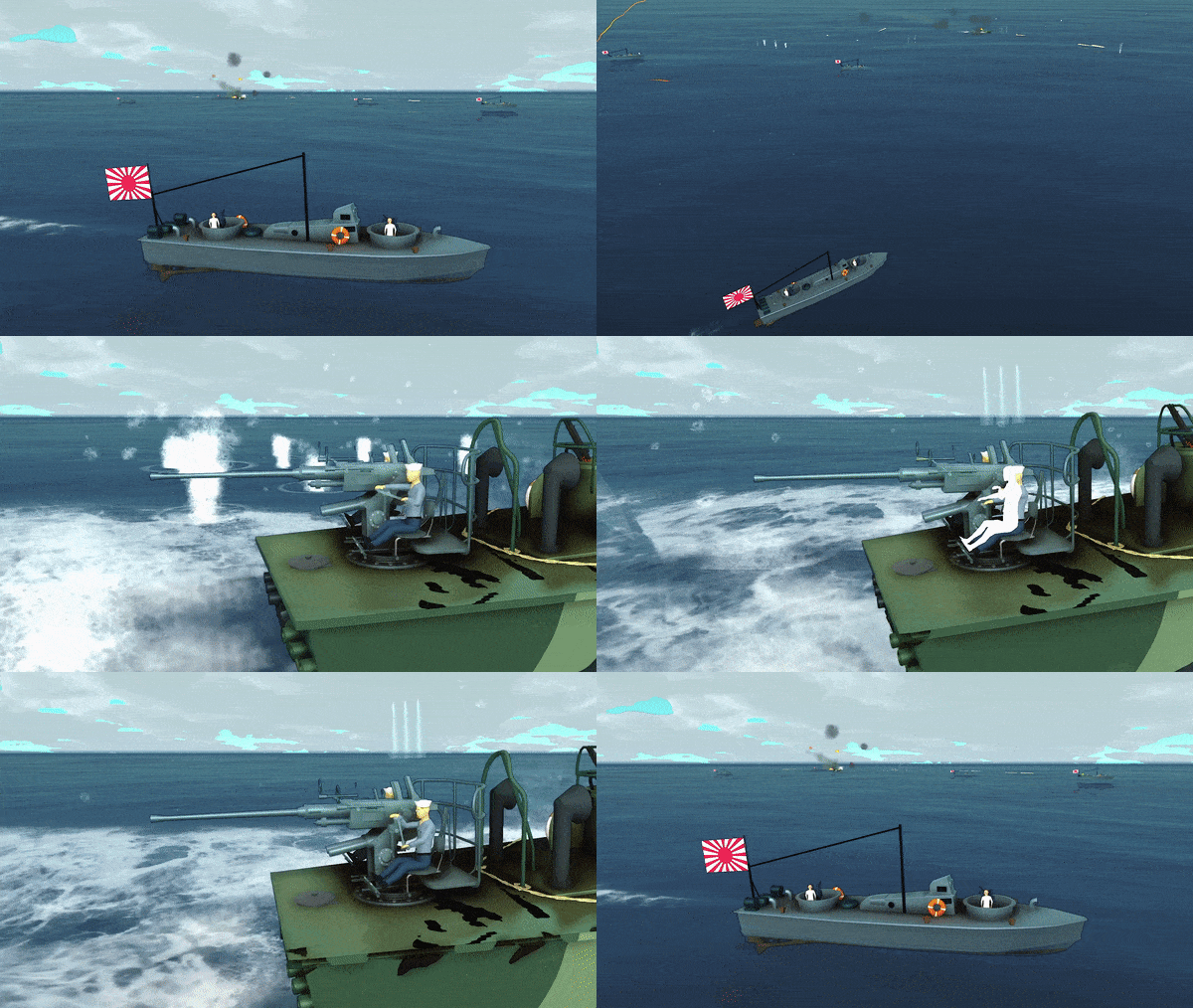
The Hayabusa H35 Motor Gunboat makes its way to the Pacific Front, as a somewhat rare and unique enemy type. The quintessential glass cannon, the H35 is unique for its ability to move faster than the player. Combined with their withering damage and tendency to operate in large, compact groups, groups of H35s will be quite formidable opponents that can force you to make a stand and not let you move out of reach of return fire as other boats would have. We intend packs of H35s to be sort of a "mini-boss" encounter, in contrast to the "boss" encounter a Fubuki would be.
In addition to appearing in Fleet Endurance, you can expect them to feature in Challenges in the future; perhaps even the ones prepared for the patch this week. They are relatively fragile, and concentrated fire or well placed shots at long distances will work wonders on them.
The second of our fleet-footed hard hitters is the D3A, the mainstay dive bomber of the naval aviation branch of the IJN. We've teased you with dive bombing before, specifically through the use of our Dauntless dive bombers on the allied side, helping you wrench victory from the jaws of certain defeat in the challenge Leviathan. Now, the enemy is gaining access to this unit type, with potentially disastrous consequences for your larger allies.
As you might have noticed, one clean bomb hit from the D3A is all it takes to sink an otherwise robust PC-461 Submarine Chaser, and even a Fletcher won't resist many more. Now, PT boats, nimble as they are, do not make good targets for diving, and so the enemy pilots will not attempt it on you and opt for a strafe instead, similar to light fighters. However, they are also far more likely to focus on big ships on side, which can make them very dangerous to your mission indeed. So you should make it a priority to shoot them down whenever you see them, which will be in Fleet Endurance, in some existing challenges (so make sure to go through them again!), and in an upcoming new challenge where you have to defend an armed patrol moving through a dense cluster of islands.
We intend to add two new challenges, in the form of the aforementioned escort mission, as well as a night mission where you can fight the Ki-45 outside Fleet Endurance for the first time. The details are sparse for now to avoid spoilers, but worry not, as it will not be long before you get to see for yourself.
Beyond these, we have a new Bofors model sharp eyes might have caught on as showcased in the first GIF, as well as assorted fixes and performance tweaks that should help the game run with smoother and reduced frametime for extra fluidity; and so, faster. Time-warp in real-time engagements has also been experimented with, with pleasing results, it should make it into this update.
The Soukou-Tei also gets its 57mm cannon, though it's quite the plinker in their hands given the boat's iconic nature as the starter enemy of Boat Crew. Still, in the hands of a veteran crew, there's no telling what horrors it could unleash against you, as 57mm is a rather respectable caliber and the largest gun mounted on light boats in the game. For now.
Goals for the Next Cycle:
The focus on this cycle was mostly on optimization, but Campaign work continued in the background as well. Following the update, our focus will once again be Campaign features specifically, so, depending on the timetable, we would like to move on to a discussion of either the resource system or the patrols next cycle.
Fair winds, Captain! T.T.
Tokyo Express - 28th of November - Developer's Diary R4
Greetings, Captain!
Today's update is going to be quite visual, as we do an annotated showcase of our recent graphical and mechanical work. So let's get right into it!
Current Situation:
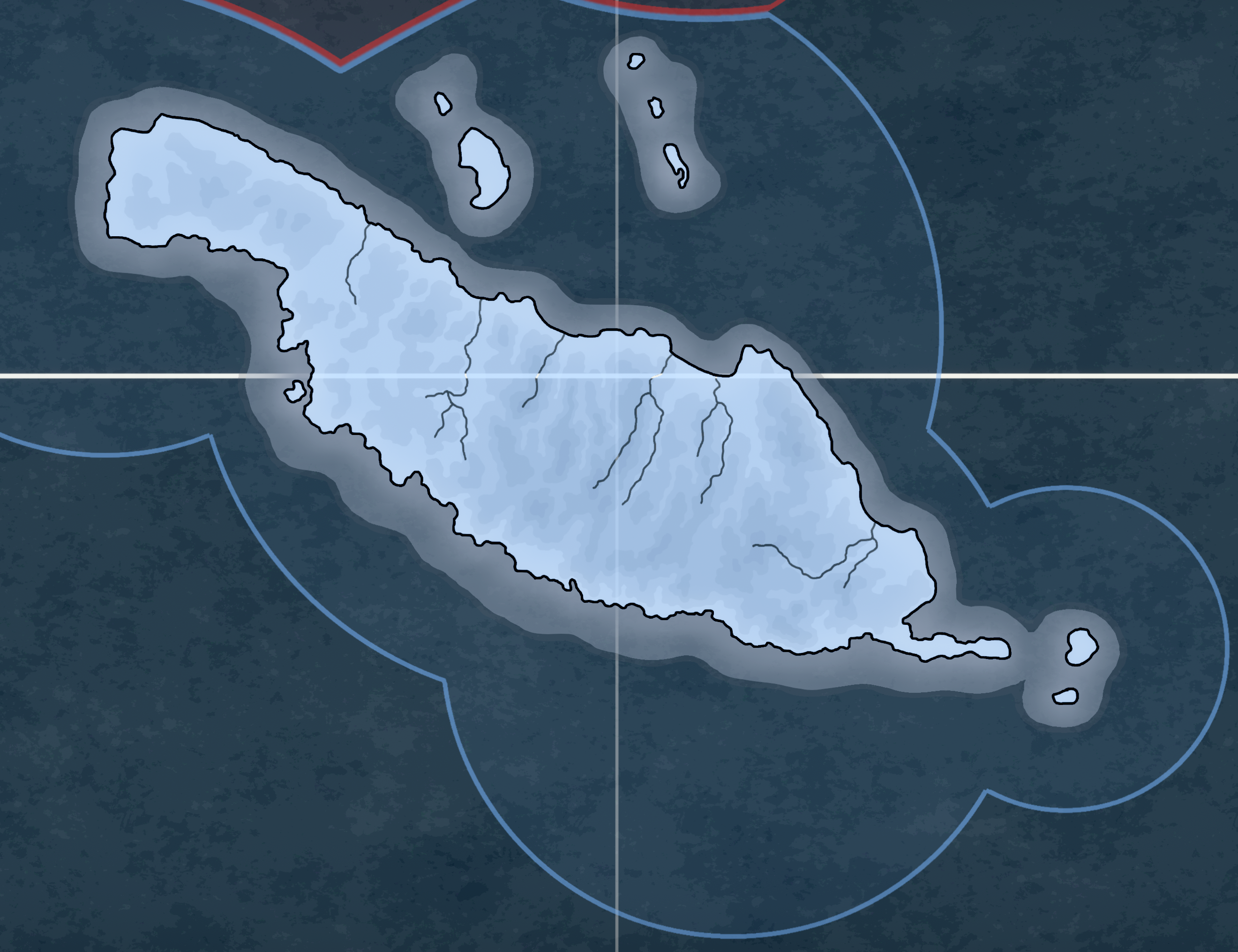
As you can see, the map has been further upgraded by including the topography, complete with rivers. The island you're seeing is Makira, or San Cristóbal, and it is the second southernmost major island in the gameplay region, as well as your starting point in the Campaign.
The map visual is made up of 1 Terrain base + 5 Topographical layers + 1 river + 1 coastline + 1 shallow water layer. Topographical data and rivers are encoded into the terrain layer, so all the chunks have 3 separate layers in final export for use by different shader passes in game.
As you can see, the new map has quite the increased complexity compared to the previous one, and has been the focus of our efforts for around a month as a result. We think that this effort was worthwhile and that this inclusion gives the map a more lifelike feeling, making the islands feel less like splotches of ink on the table. We hope you agree!
Those of you who have gone through our challenges know that there is already a day/night system in the game where lighting and visibility are adjusted accordingly, and so it shouldn't come across as a surprise that it has now been added to the Campaign map. The time of the day will be displayed as shading on the map and will directly be used in generated engagements as a result.
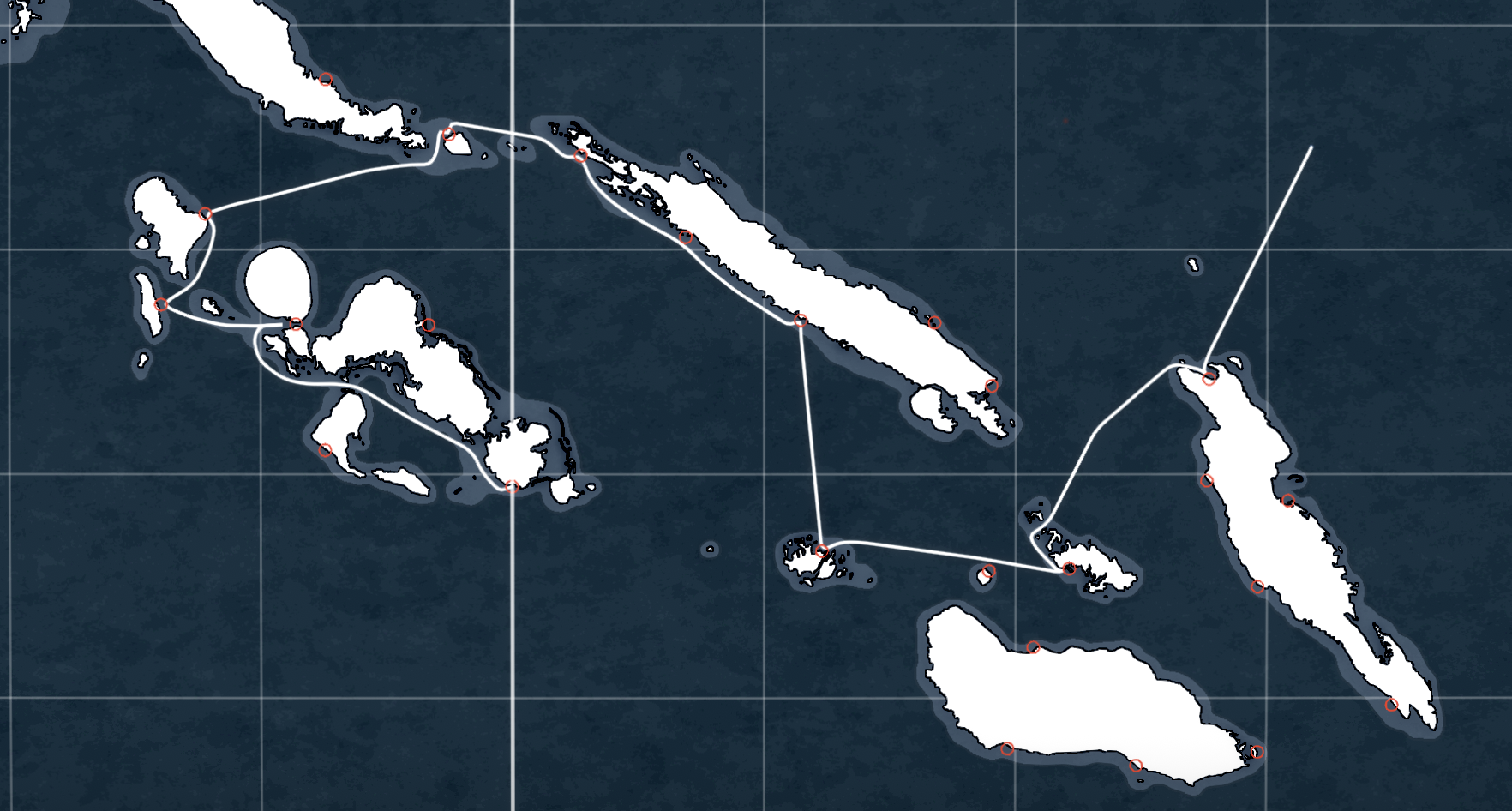
Here is our pathing tool, which is how you'll be moving around in the strategic display. Originally, the pathing tool used to detect obstacles on routes the player created by scanning the heightmap via the CPU, which was one of the reasons forcing us to keep the map resolution small (4096x2797).
The new map is made up of more than a dozen chunks and they're all quite high resolution; even a single chunk that contains Bougainville spans 5800x6724 pixels. We now detect the chunks that fall on a scan and then send them to the GPU, along with the scan vector, to be evaluated for obstacles. GPU threads are distributed on a line according to their indices and they check for terrain with a 3x3 kernel. This method gives near instantaneous results even when scanning through the entire map.
So, enabling faster and better pathing was yet another reason the map had to dramatically increase in quality.
You may have noticed that even at longer distances, the paths are still a straight line. We took this as a design decision given that the game area is relatively small and close to the equator, meaning that subtle curving would have added confusion and complexity to moving around without any gameplay benefit.
There is also no automated pathfinding for the player as of now, and you will have to chart a course yourself by hand. For long distance movement, this shouldn't be an issue, but for more natural shore patrols, or just shore tracing movement overall, so improvements to player navigation are definitely not out of question for the future.
Last but not least, let's talk about the namesake Tokyo Express of this diary. Historically, due to the overwhelming air superiority of the US in the region, transport by slow barges and cargo ships was impractical, resulting in dreadful losses whenever attempted. To make up for this shortcoming, Imperial Japanese Navy admirals came up with the idea of using Destroyers on daring night resupply runs, by filling up barrels with supplies and rolling them out to the sea, hoping they would wash ashore and hoping again that they would be found by their intended recipients.
To make the long story short, it was, strategically, a failure, given it caused unacceptable attrition in the precious Destroyer fleet, and only an estimated 20% of the supply that was put out to sea ever reached its target. Now of course, it would be sensible and plausible to just ignore this experimental misadventure and leave it as a footnote in history, but we realized we might have some fun with it yet!
From the point of view of realism, the Imperial Japanese supply chain should in no way be competitive with that of the US, but we've already the conceded that they should probably mirror the mechanics so as to not take away player agency by turning every Campaign into an inevitable victory by attrition. So, creative liberties are already taken to make the Campaign engaging and interesting, and that means we can salvage the idea behind the Tokyo Express as well and actually include it in the game as a genuine and credible tactic!
Therefore, Tokyo Express will be a part of the game in the form of small, mostly lonesome Destroyer patrols moving at night with a purpose, delivering small amounts of supply to target bases. While they won't make too big of a difference for the overall supply situation of a base, they will tilt the supply balance, absent player intervention, in the favor of the enemy, and also give you a high-risk high-reward target to engage at night. After all, they do have huge barrels of supplies, some of which you might be able to pick up for a nice little extra.
Goals for the Next Cycle:
For the next cycle, we would like to move on to the resource system, which we intended to do earlier before deciding to spend more time on the map and other associated mechanics to further refine and polish them. Patrols are also on the itinenary; we've made the battle ground, so it's about time to start populating it, don't you agree?
That will be all, Captain! T.T.
The Supply Must Flow - 14th of November - Developer's Diary R3
Greetings, Captain!
Line Rendering:
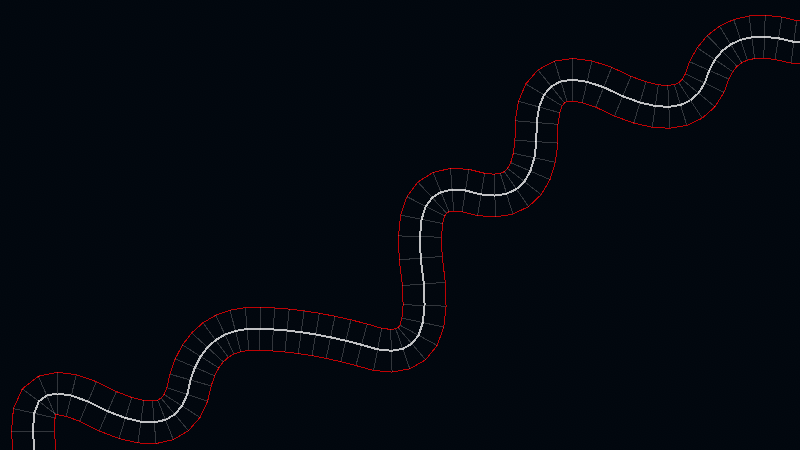
After a few attempts at trying to implement line rendering on the map, for routes or markers of any kind, an unfortunate discovery that tech that we are familiar with, provided by engine and/or extensions, were just too buggy or uncontrollable for our liking. We had to create a custom mesh based solution to make things look exactly the way we want, such as having access to fine tuning of bevel operations to corners. It took some isolated testing to refine but when it was dropped into the project it met our requirements perfectly. Here is a debug render of a row of points with random offset.
Route Generation:
In the last entry we shared an algorithmic method that involved generating a few thousands random routes and selecting the best scored 50 or so to use in game. To reduce cost and increase yield at the same time we added a post process operation to the routes that detects bases that are a 10-15 kilometers away yet weren't selected in the generation process. These bases are planted into the related route's base order and the routes have their pathfinding and scoring reevaluated. This is only done for the best routes.
Selection of Routes:
In the legacy Campaign design there was no need for any routes as the AI would "simply" assign an idle supply party from base to base according to a cost function that processed supply values and distances to find the best pairs for the party to transfer supply. The supply party would then keep asking the AI director on the next move every time it arrived somewhere.
This proved to be difficult to balance in terms of parameters due to the unpredictability of mass supply transfers draining one base and overflowing another, causing some parts of a faction's territory to lock up and be vulnerable to attacks. There were ways around problems like this but only through adding new parameters, complicating the system and making it more difficult to balance while also making it more difficult for a player to understand and thus make custom Campaign difficulties with it.
What we've been doing for the past couple of weeks was to design supply as its own, more or less isolated system with the persistence required to have a well functioning campaign. Now that are able to have some nicely generated routes, it's time they're utilized by the AI.
Every two weeks or so the AI factions select routes for their supply spawns to follow. The process for selecting these is quite simple. For example, to select 3 out of the 50 best routes out of thousands, one can run a few hundred random selections out of those 50 routes, then identify which trio visit the highest number of unique bases. According to our experiments this process commonly results in all the bases of a faction to be visited through those selected 3 routes. The randomness factor allows the map to warp into something else every now and then, while still maintaining structure and stability.
UI Design:
The increased quality of the map gave inspiration to redesign some the UI elements on the map. You may notice some changes in the gifs below. We already have more to show, however, it's best we present and explain them at once when they all come together. So for now, enjoy the teasers!
Map Visual:
Another thing we noticed after staring at this map for long periods of time is the lack of detail on land. Thankfully the map artisan had already provided layers for topographical details and rivers, though we haven't had the time to import them yet. Great measures in optimization was necessary to display the existing high resolution data. Recent developments have gotten us closer to have everything look nice and efficient so we should be able to import the extra layers soon.
Goals for the Next Cycle:
This was a pretty detailed rundown of the progress on the supply and development system, and you may have noticed that we've started writing shorter Developer's Diaries to make them more readable and digestable. Therefore, we are postponing the exposition on the resource system, hopefully to the next cycle. The supply system is almost complete, but there is still testing to be done, so we're giving it a bit more time before moving on.
That will be all, Captain! T.T.
Travelling Sailors - 31st of October - Developer's Diary R2
Greetings, Captain!
We're now three months into Boat Crew, and today's Developer's Diary will be of the short and sweet variety. The last two weeks have been mostly focused on working on the Supply System, which will form the backbone of the campaign. In the meantime, the map has also been expanded.
You may have noticed that the Roadmap is rather conspicuously missing; that's because we figured it would make more sense to post it only when a step has been advanced. In the meantime, you can check it at the original Roadmap post.
Now let's get down to it.
The Travelling Salesman Problem:
Those of you acquainted with Computer Science or programming may have heard of the Travelling Salesman Problem, which is essentially the question: Given N cities to visit, what is the shortest path the salesman can take to visit those N cities once each and make it back to his starting point? Our supply system, as we talked about in the previous Developer's Diary, is basically this problem, except we do not have the condition of returning to the initial point. The naive solution to the Travelling Salesman problem requires us to make N! calculations.
As of the current state of the Campaign map, we have 38 bases. Suppose that you captured just half of them; there would be 19 bases and thus 19! potential routes to evaluate, that is, roughly 121 quadrillion. If you felt adventurous and captured one more base, the number jumps up to 2 quintillion. And this is before we include that there are 3 inflow points per faction, and these calculations need to be done often. This is a complete non-starter, and while there are faster algorithms to solve the TSP, solving it to practically perfect accuracy is something we felt was a waste of developer time and a waste of player's time too as it would create long loading times just to calculate the perfect supply route.
So instead of this, we've decided on a simpler in-house approach that, in practice, should follow the 10 rules of supply line generation we talked about in the previous diary almost all of the time:
1. For each of the 3 inflow points of each faction, to the Solomons, 2000 routes are randomly generated.
2. Bases are sorted by distance to the inflow point, the first half of the bases are used for attempts.
3. A route is generated by attempting addition of random bases to the route, 2 * number of bases of attempts are made. Bases that already exist on the route or create a smaller than 45 degree angle on the route are not added on attempt.
4. Every addition causes a resorting of (all) bases by distance to the latest addition. Again first half (of all) are used for further attempts.
5. The route generations are sorted based on the number of bases they cover.
6. First half of those routes are used for the actual base to base pathfinding.
7. Pathfinding is done and the routes are again sorted by a formula:
(Distance of inflow point to first base + (sum of base to base vectors * .5) + total length of route) / (number of bases squared)
8. The best performing routes are randomly selected by the game, after evaluating in game conditions. The few routes that are selected at the same time maximize the number of bases visited in total.
Above is an example of a route we generated, though the line art itself is a placeholder. We will be testing and iterating on this approximation, but this methodology should create the optimal route or something very close to it most of the time.
Map Situation
Meanwhile, the maturation of the map continues. As said before, we now have 38 bases with the addition of the islands Bougainville and Choiseul, along with some name changes to the existing ones to be more related to history. The map pathfinding network was also recreated to have smoother route generation. Our commissioned map artist is currently working on New Britain, New Ireland, East New Guinea and some other assorted islands, so we'll have more on that soon as well!
Goals for the Next Cycle:
For the next cycle, we want to have wrapped up the supply system and moved on to the resource system for the player. We'll have more on the design of the resource system next week, so even if it's not finished by then, we'll be talking about it!
That will be all, Captain! T.T.
Some Campaign Chatter - 17th of October - Developer's Diary R1
Greetings, Captain!
As promised, here's our mid-cycle reboot of the Developer's Diary, now denoted by the index R1 as you may have noticed to tell that it's the first of the reboot series. Today, we'll be talking in detail about the Supply System in the Campaign, show off some of our progress with the map itself, and of course introduce the revised, version-based Roadmap, which will also be edited into the Early Access launch announcement "Roadmap and Buyer's Notice".
That was the summary, now let's take a deeper dive!
Roadmap:
(*) : We are here
Gathering Storm - Pre-Campaign Work (*)
- Tutorial - Challenges - Fleet Endurance and Basic Customization
v1.4 | Campaign Preview v1
Features:
- Campaign game mode - Permadeath of boats and characters in Fleet Endurance and Campaign - Crew enlistment management - Crew traits - Crew gear customization - Crew skill rebalance - Crew animation additions - Steam cloud save
v1.4.1 | Fire Support
- Focus on Call-ins and Call-in customization
v1.4.2 | Home Improvement
- Focus on Tech Tree fundamentals for usage on all sorts of upgrades and unlocks.
v1.4.3 | Thunder
- Rework and expansion of artillery based weapons - Weather mechanics on world map - Weather visual improvements in gameplay - Wind effect on crafts
v1.4.4 | Armory
- Implementation of variant and improvement systems for existing arms
- Campaign extension to New Britain and Eastern Papua New Guinea - Improved area presets for engagements to better resemble the world map - Squadron management - Replay system - Special Missions
v1.5.1 | Coordinated
- New AI features for units - Public level editor support - Workshop Integration
v1.6.x | Vast Distances
- Possible sidegrade to custom ocean from Crest - Public craft creation tools - Various reworks on unsatisfactory implementations
v1.7.x | Classified
- Classified
As you can see, the upcoming version has the longest to-do list of all the other versions, owing to our desire to have the Campaign be "mostly done" before being released for preview. Still, progress has been coming along nicely, and we're glad to be able to talk about at least some of it.
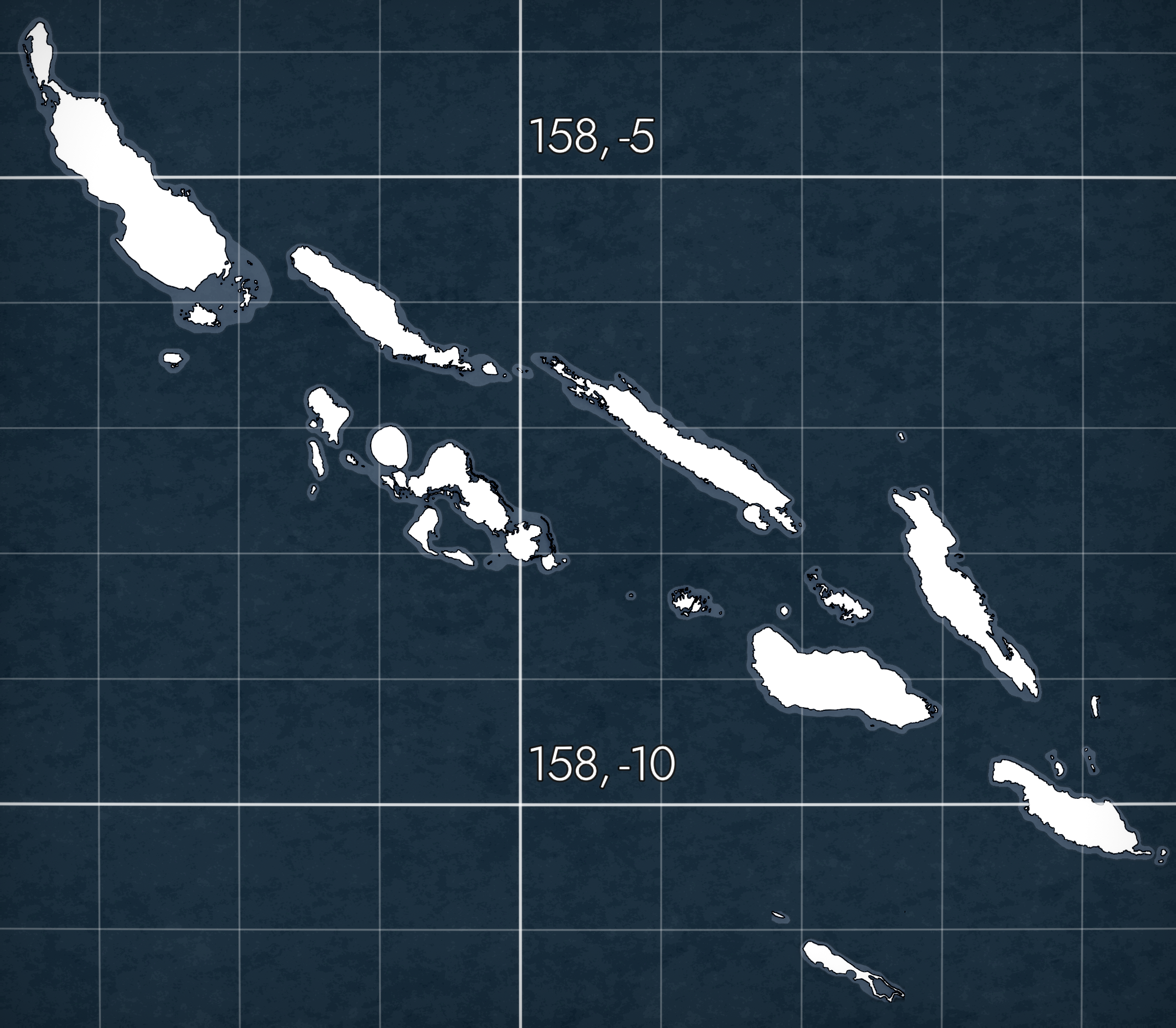
Our crisp new high quality map is complete, replacing the older one you currently have access to in Campaign Spectator, which is a downsampled version of a high resolution heightmap. The base heightmap was causing a few visual glitches along with very messy and unrealistic representations of the coastlines of the locations. Which, as you'll agree, is quite unacceptable for a map we expect you to be staring at for quite some time.
On a more subjective note, we also felt that the old style felt a bit disjointed with the rest of our UI design and thus acted as a creative block, and having an actual high quality map in place solves both of these problems, making it easier to visualize gameplay on top of just being pretty and nice to look at.
Here you can see the Patrol Nodes being placed by hand to create a Patrol Network. We already use a similar system for Challenges and Fleet Endurance to tell the AI the routes along which it will patrol, and the Campaign map counterpart will of the Patrol Network will be used for, you guessed it, patrols that spawn regularly from bases.
And finally, here's a sample of our map integration. The directory is pinged for Nggela and one of the many source .pngs with the related label, the coastline, is retrieved. The node is calibrated by hand, using the heightmap as a reference, so that the game can load all the high resolution pieces at the right places.
The result is the seamless fusion of the visible map and the gameplay element map behind the scenes. Now, of course, you may have noticed that our drawn map does not exactly match the heightmap, and that's because the heightmap is rather less than perfect, creating islands that aren't there in reality and removing those that are, which is why we enlisted the help of an artisan to draw the region true to life.
Supply System:
Next up, we wanted to talk about the Supply System, which will form the backbone of all operations in the Solomon Islands region for either side of the conflict. Bear in mind that the supply system is currently not implemented and is slated for this week, so this section will be lacking in pictures as all we have right now are our crudely hand drawn internal document diagrams. We hope to have a visual aid for this later on, but for now, enjoy the description of the design as it is fairly final.
Overview:
As we hinted earlier on, Supply is the abstracted flow of resources from one point to the next, discretized into periodically spawned Supply Convoys of varying size and cargo value. Supply is used for several things; it can be stockpiled, it can be consumed to spawn patrols, it can be used to develop bases, and will in fact be doing all of these simultaneously and automatically, according to game rules the player will have limited but meaningful ways of interacting with. It flows in from outside the map and chains between bases, forming a supply line, along which convoys will be automatically spawned and will have to be defended or raided. Multiple, unique supply lines can exist as the amount of supply lines is determined through gameplay.
Flow Rules:
Supply lines are automatically generated, and they are guided by a list of 10 rules:
1. Each node can have at most 1 input and 1 output. 2. Route connections may not overlap, meaning a supply line cannot cross over itself. 3. Maximum number of supply nodes, that is, bases, served is the priority. 4. Second priority is to minimize the total distance travelled. 5. All routes are curved and are never closer to a coastline than a given distance except when debarking and embarking in a port. 6. The number of supply routes are determined through Campaign parameters and through gameplay. 7. Supply routes may not be changed for up to two weeks once they are decided, or until their last supply convoy reaches its destination; whichever is later. 8. Convoys will stop for at minimum a day, scaling with the base supply value of the convoy. 9. Supply flow is discretized as convoys are spawned and sent underway; the player is given a daily average estimation and losses are reflected there. 10. Individual connections in a supply line may be blocked after sustaining heavy losses for a period of time.
To go briefly over the implications of these rules, the game will automatically always decide on the best supply route for you (and your enemy), and will even do limited damage mitigation on its own. Your direct involvement in the way supply lines are structured will be limited mostly to raiding and defending convoys, and later on assigning squadrons to do that. What's under the hood may be a relatively complicated system, but the part that concerns a PT Boat Captain is quite simple; sink the bad guys, and keep them from sinking the good guys.
Nevertheless, the sustained flow of supply is crucial to the operations in the area, so it's useful to know for what and in what manner they will be used, so let's move on to Bases.
Bases, Development and Outflow:
Bases are what we call each node on the supply network, which are pre-determined spots on the map deemed suitable for base construction. When the Campaign begins, most of these spots will be barely developed and/or under control of the enemy, so they don't necessarily represent full fledged bases, but each of them have the potential to be just that.
This on-going status of a base is called Development, and has several effects. Firstly and perhaps most interestingly, each base on the Allied side will pay a fraction of their development to you as RPs, the main currency of the Campaign. Development increases the supply consumption rate of a base as well as the strength and frequency of generated patrols.
Development is built and maintained with supply; bases will atrophy if the stockpiles run dry and the supply situation is still not fixed. Whenever a larger base consumes supply, it will generate a percentage of that in backflow in the opposite direction of a supply route.
A base will always first collect just enough supply to maintain its supply status plus a minimum reserve that will be adjustable through gameplay (say, lowered during an Assault as the rear bases are stripped for resources to fuel the main attack) and the base will again take a cut depending on its rules to use for development and/or further stockpiling, again in proportion depending on its rules. Then finally the remaining supply will be pushed forward, with a pushing bonus that depends on, you guessed it, the base's rules, and a distance based logarithmic decay modifier to simulate the additional fuel and escorts required to travel longer distances. Logarithmic decay means that small differences in shorter distances won't matter that much, while longer distances will give increasingly larger penalties.
To further help visualize, as an example, and assuming no stockpiling:
If 100 supply enters node with no storage and the rules: collect 10%, develop 40%, push bonus 10%, they take the 10, develop 4 with it and put the remaining 6 on the push pile to have a base of 96. Then, with the push bonus, this becomes 105.6 supply pushed to the next node.
Now finally, let's talk about the base types based on development that change the flow rules for that particular base. The base types we have are: Outposts, Supply Depots and Forward Bases, in increasing order of development.
Outposts are small emplacements with very limited amenities, and so can only spawn light patrols. They do not have any stockpiling whatsoever; whatever they collect, they will use for development. They take a smaller cut than larger bases from the supply line, and will pass the remaining supply onward with a boost scaling depending on their development. Outposts generate no backflow, and if they somehow receive some backflow, which generally shouldn't happen as bases upstream will generally be more developed, they will use all of it to further their development rapidly build up.
A sufficiently developed Outpost evolves into a Supply Depot, which is a medium tier facility that gives with one hand and takes with the other. Light and Medium patrols will be spawned from Supply Depots, while they will stockpile half of their cut and use the remainder to develop themselves further. They have limited stockpile that scales with development, meaning they will have occasional bursts of would-be stockpile getting used for development from the leftovers of arriving cargo. They will take a larger cut than outposts, and have the same push bonus as a maximum development Outpost.
Supply Depots will generate half to all of their consumption as backflow, scaling with their development. Given their position as mid-sized bases, they will also only consume 50% of the backflow that they receive, and will push the rest upstream (or downstream from the backflow's point of view).
Finally, a fully developed Supply Depot becomes a Forward Base, which is the final evolution of all bases capable of spawning Light, Medium and Heavy patrols. They will stockpile almost all of their collected supply, using very little for development. They also do not collect any backflow but instead pass it onward (backward?) to lesser bases in greater need, and will generate all of their collection as backflow themselves.
And finally, perhaps most importantly, Forward Bases are the only base type that can muster an Assault, which are the primary way of attacking and taking over new territory that we will be talking about in detail in a future Developer's Diary.
Overall, the system is designed to be self-balancing by distributing development everywhere while simultaneously encouraging the rapid buildup up bases furthest down the chain and therefore closest to the frontline. We'll be experimenting with it thoroughly after it is implemented and these experiments will be the topic of a future Developer's Diary, but for now, this is the detailed plan going forward.
Goals for the Next Cycle:
At the very least, we want to have implemented and tested the supply system. Associated gameplay modifiers will come after we have verified that the system is working as intended and producing the intended behavior. Beyond that, there are multiple things we can work on towards the Campaign goal, and so we will have to see where the natural flow of development takes our priorities by then.
Either way, our full focus will be on the Campaign and so adjustments to other modes are unlikely for the next two weeks unless pressing issues arise somehow.
Closing Remarks:
We hope this scratches the itch for Campaign details, especially if you feel particularly interested in the technical, under the hood aspects. That said, for the next diary, we hope to go back to having more visual stimulation, so to speak, and will be focusing on in-game demonstrations next time around.