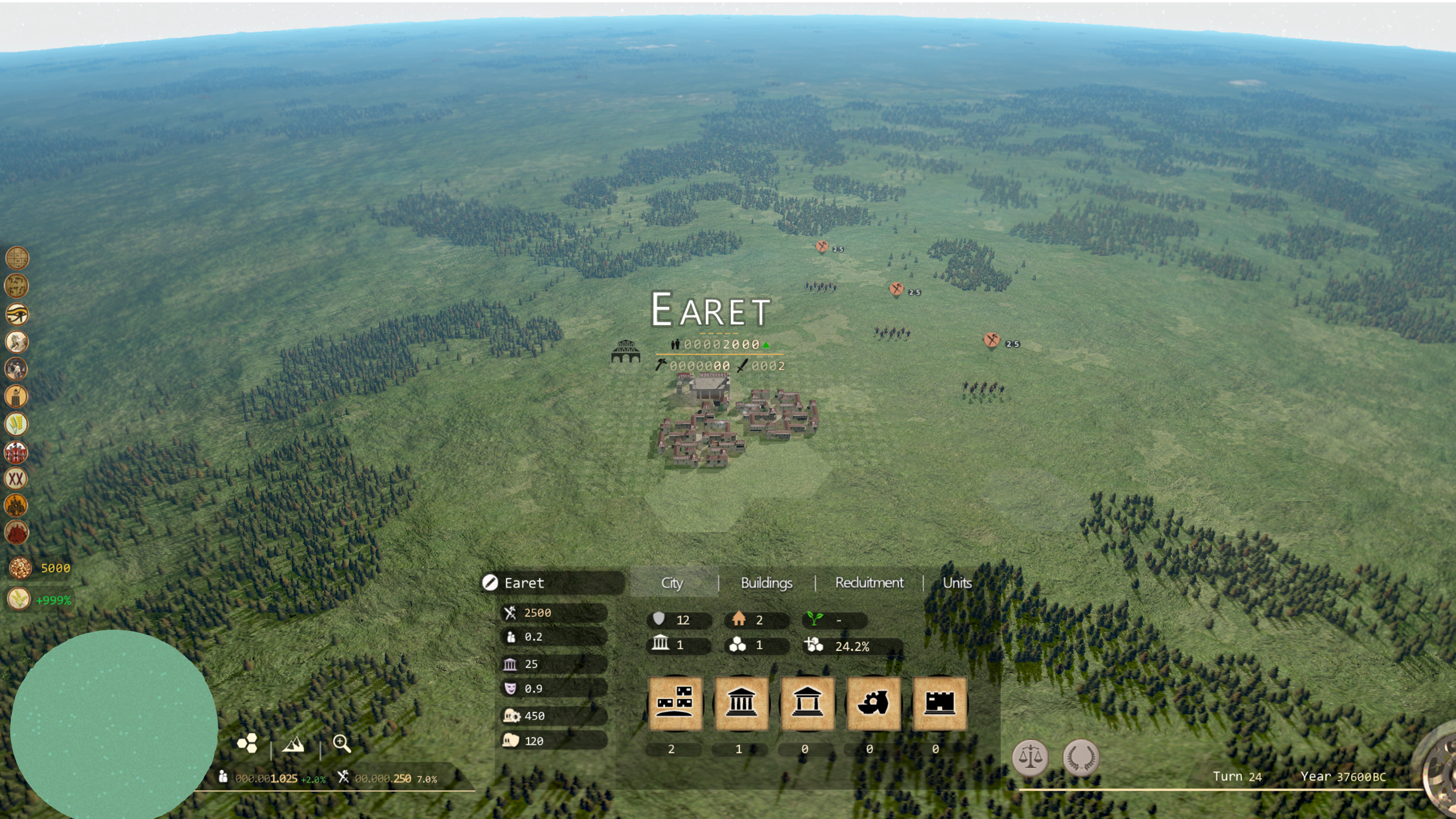
We're extremely excited to formally announce the game across the globe with a Teaser Reveal. This announcement showcases the core city building and expansion mechanics of Birth of Cultures.
Regular updates will upcoming as we push towards a Q4 2023 release date!
Units & Combat: stacking, types, subclasses, weapons set, reinforcements..
Units types, subclasses and stats
In BoC there are 3 types of units, that can be: Soldiers, Workers, or a mix between it, while soldiers only fight in combat, workers can do more things like hunt, build, harvest, or repair, mixed units like Hunters can hunt and combat and making them very helpful in the early and mid-game.
Aside from units types, there are also subclasses, reflecting the variety of different progression paths over history, each unit can allow up to 2 subclasses.
subclasses
The subclass bring more variety introducing a special behavior for each kind of unit, for example, nomads hunters are spearmen and tribal.
Currently planned subclasses list:
Tribal: 20% to reload movement points after the first movement of each turn.
Spearmen: +25% defese bonus when unit is on defensive position.
chivalry: +50% attack bonus versus melee units.
Tank: 35% to block 25% of total upcoming damage.
Guerrilla: Just on hist first movement, this unit have +350% movement point bonus (just occurs one time), this unit avoids his destruction and restores 40% of the total unit (just occurs one time).
Legion: 40% to avoid demoralizing effects.
Juggernauts: 60% to desmoralizing near units.
All of those subclasses can be improved with upgrades when players progress through new trait nodes, for example, Tank is designed to scale up to 65% to block 50% damage.
Stats
Each unit has its stats and those are: damage, defense, resistance, moral and movement points. Also, each unit have combat experience (recruit range for fresh recruits for example), and also combat formation, that can be: Disorderly or organized
Disorderly formation: just can stack up to 3 units on a tile (can be improved up to 4 units on a tile).
Organized formation: Can stack up to 5 units on a tile (can be improved up to 7 units on a tile).
N.B.: you can't stack or mix units with different combat formations.Usually, disorderly formations would be present in early and midgame, while organized formations require unlocking a lot of nodes from the progression system to allow it to be enabled.
Weapons and armor sets: looking at medium terms
Units on BoC can have weapons and armor, all units having their own default set. For example, Mesopotamian spearmen .. will have .. spear as a weapon (what a surprise xD), weapons and armors from units bring additional behavior to the unit, for example, the long spear will add +50 attack bonus versus mounted units, or light leather armor will add 10% to avoid an incoming attack (means that unit have more agility, others like heavy armors allow a percentage of damage reduction).
All of these bonuses are calculated unit-by-unit in combat. For example, if one unit has 25 soldiers, these modifiers will be calculated for each of them while in combat.
Allowed configuration:
Left hand
Right hand
Set
For EA release, it will be on the game because all units will have their default sets, but at the medium range, we want to introduce armories where the player can set his own equipment for each unit.
Stacking and reinforcement mechanics
Feel an army not just board pieces! Units in BoC can be stacked on a tile with others, you can mix different types of units to reach better combat on face different enemies, the unique limitation here is that you cant mix disorderly formation units with organized formation units, also, stacking your units will increase their possibilities to survive from incoming attacks, in BoC when combat is calculated there is an attribute called 'numerical superiority', that basically gives a resistance bonus when the unit has 50% more soldiers than his enemy.
Reinforcement area
Units have a reinforcement area, where if they attack or are being attacked, all friendly units inside the reinforcement area will join to fight (usually 1x1 area but it can be larger)
Supplies
Work in progress, will not be on EA release.
Units & Demograhic in BoC
The main feature in BoC is clear, you have a vast world, really a vast world! So, you will need a lot of units to conquer and defend your empire.. your kingdom... your little kingdom?.. maybe just your single city-state?.. okay probably just your little tribe? (being honest, that road will be really hard, don't expect to develop an empire without 1000h of previous experience, no, is not a joke).
In BoC you have population stats, so attending to demographics will be crucial to develop your army and civilization, because it will not be as easy as ordering a new swordsman unit in one of your cities and waiting for a few turns to have it, so on BoC you have the manpower stat that is a reference about how many people disposition you have to recruit new units, also your demographics are based on your food disponibility index and urbanization index (simplifying a bit: how much more food and urbanization districts do you will bring, more people do you will have).
So, as your farms are based on your local's climate attributes, your army could be easily decimated by famines based on how fast climate change is in your local region* for example, take care about that when you will settle! this is just a good reference about how demographics and climate simulation are on all sides of BoC.
*Some regions would be more exposed than others to fast climate transitions, just consider that 6000 years ago Mesopotamia region was most humid than today, but this still requires balanced after EA release and hear tons of feedback about.
But if we consider manpower stat, maybe it is still not enough, because unlike modern times all people (even child's) was supposed to be occupied on any task right? well, that is the reason behind manpower stat is a little deeper than a just measure of "people free to call to arms"
Manpower stat
In ancient times all people (even children) are occupied doing his task to survive one day more, so this stat means the people that you could recruit, BUT however much manpower you take away from the workforce and give to the army, less production do you will have, as a percentage and this percentage is global about your cities, so in summary: you could take 100% of available manpower but your production will low to 0! (work that you need to end building, units .. etc)
If you like the following news and discuss with developers to bring your feedback and ideas, follow us in our official community on Reddit!
Civilizations & progression system, full guide
Civilizations & Cultures: content and context
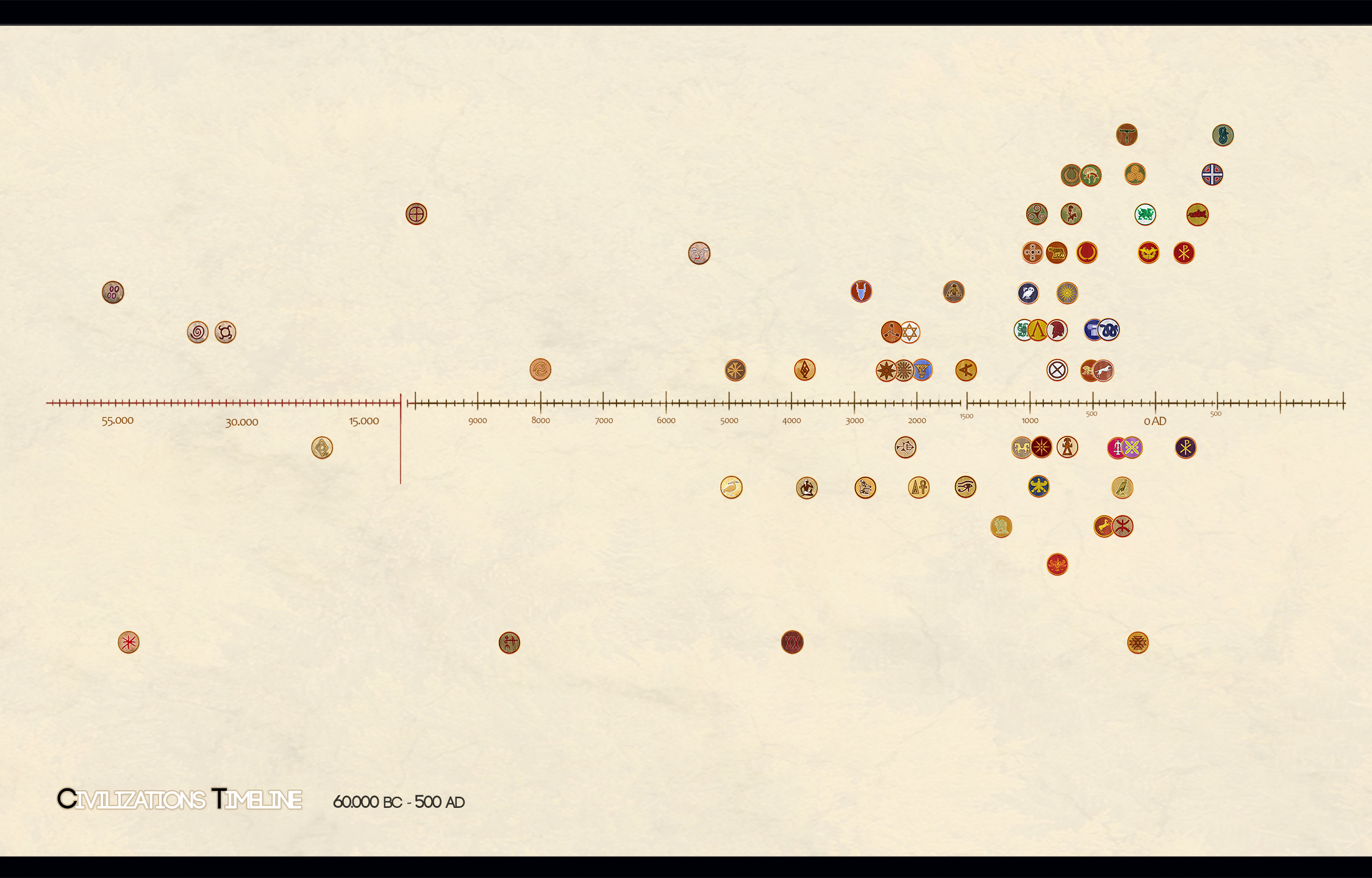
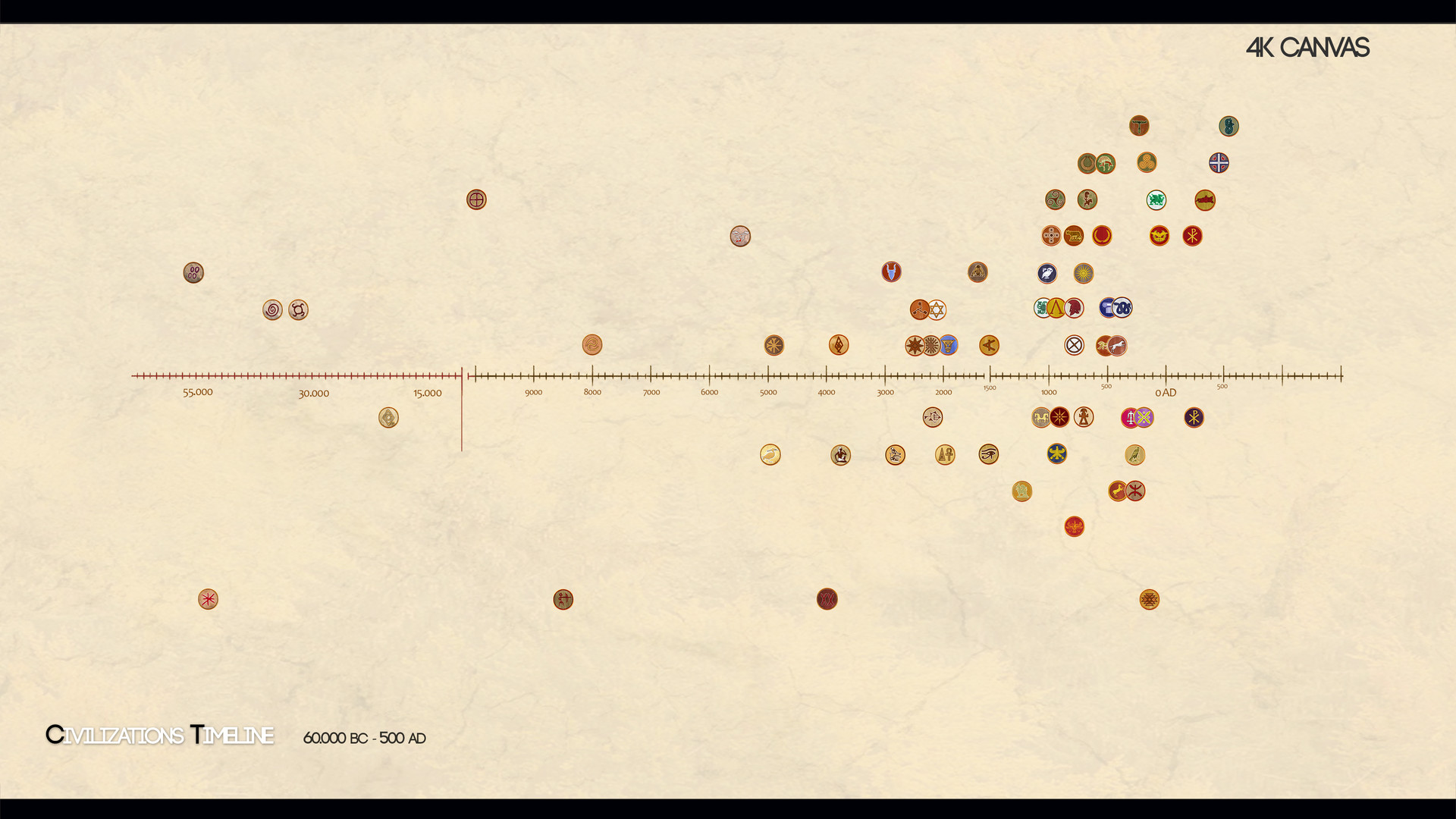
In BOC, progression system is based on civilization & cultures traits trees, you will progress from first prehistoric nomads tribes up to great ancient empires through civilizations and cultures time-line, but that progression is not linear, BOC takes to the table a non-linear progression system.
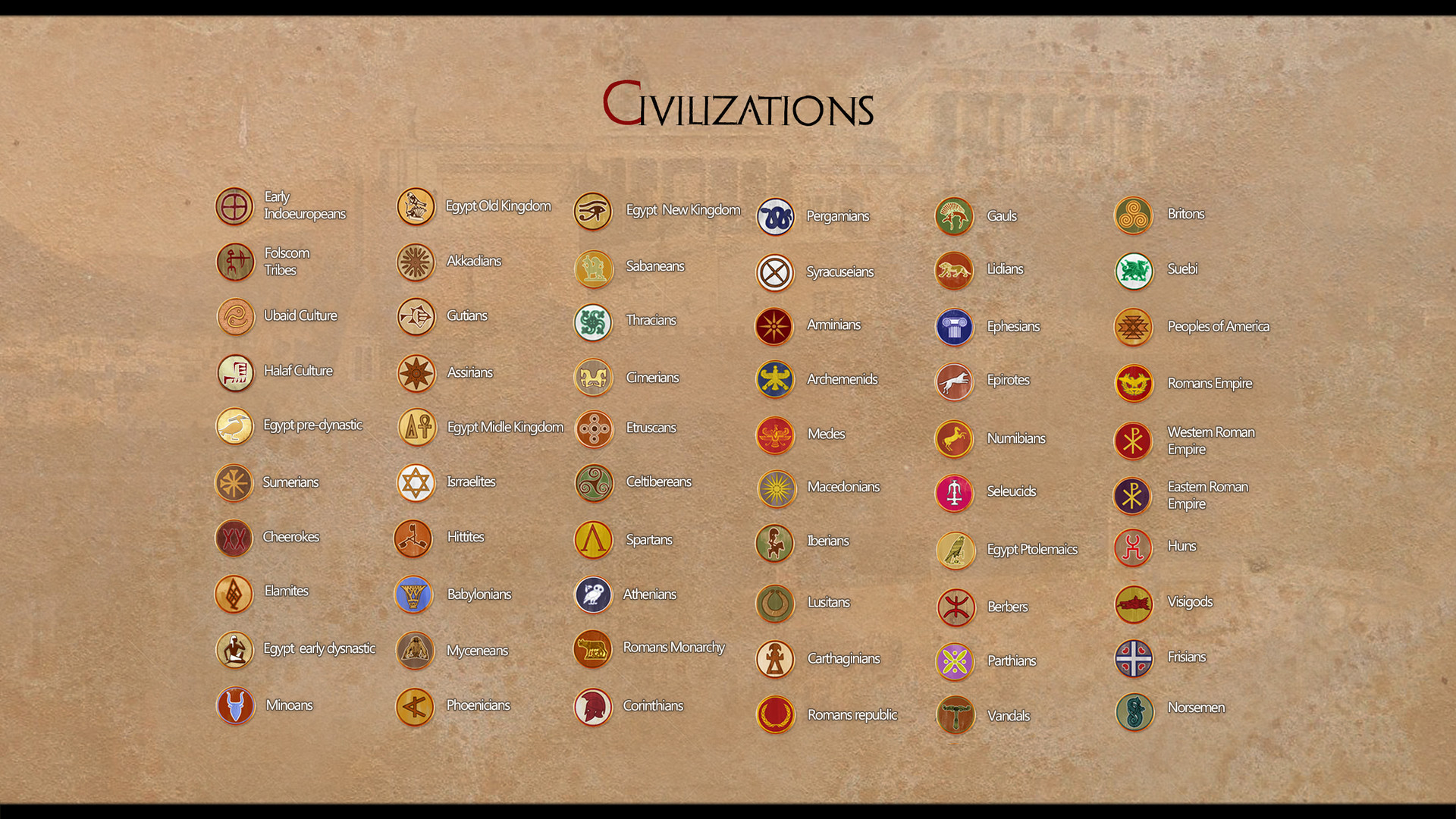
Unlike other strategy games where player chooses a particular faction, what we have is a sandbox-like combination of progression and cultures. At the beginning of the game, you will only have under your command a tiny nomadic tribe. This tribe are not Romans, nor Carthaginians, nor Persians nor Macedonians ... but depending on how you run them over the millennia, they may be one thing or another!
In BOC, as happened in the real world, it is the geography and the decisions that you make as a player what, with the passage of time, is shaping the culture and identity of your people.
We are working to offert more than 80 ancient Civilizations and cultures for the progression system at 1.0 release (including, planned oriental, and american cultures). At the first content for EA launch you can expect mesopotamian, early celtics and egypt cultures.
Gameplay mechanic: Full guide
Geographic weight as cultural factor
You can progress will freedom in the way that you choose through civilizations and culture traits, but there are some rules, each tree could have aclimatation requeriments or reestrictions, here you can see a conceptual distribution about that:
So, there are no reestriction about how direction that you can take, for example, you can take some traits nodes from Elamintes and after that maybe you will like to go to Egypt old-kingdom tree, as long as you accomplished the requirements of each tree -if exist-, in general terms always you can progress through trees that are reasonably closely, your faction can change passively his acclimatation based on where is placed over the world map, happens more faster at early game meanwhile you are nomad but still can change at midle or late game if you want to do.
Progression points
To unlock nodes from trait trees you need expend progression points, there are 3 different types of progression points: War, Growth and Myth points. -Originally was 9 types but along with the other mechanics of the game had thought that was an excess of design- are your decisions that you take, and at the end your way to play that give you progressions points, each node of each branch of each trait tree have is own progression points requeriments, is the branch specialization that defines how many and the combination of progression points that you will need.
To unlock new nodes from a particular tier requires have unlocked the same nodes than that tier row less one (simple formula: tier row -1) , that is like if you want to unlock nodes from tier 2 you need at least to have one node, or if you want to unlock any node from tier 5 you need to have at least 4 nodes of that branch.
Specialization branch agroup nodes with same background or purposes and are directly related with a famous definition of that historic civilization or culture.
Based on historic background each trait tree can allow one or more branchs, for example, above you are seeing Early indoeuropeans trait tree that is a single branch tree, now you can see Egypt pre-dynastic as a example of tree with multiple branchs:
Currently some civilization and cultures like Rome Republic have up to 5 branchs specializations, each branch can contain up to 5 tiers so that means up to 15 nodes per each branch, also each tree include tier bonuses if you unlock enough nodes like from picture of early indoeuropeans desing, that in this case unlocks an architectonic collection.
There are a limit about how many trait nodes player can unlock (arround 50), but still player can left previous trait nodes to allow new space for new ones, unlearn previous nodes also requires expend progression points multiply by 10.
In some special cases, (like egypt) you will require to complete some tier bonuses from previous egypts cultures, like it would be a tree chain, Rome and Babylons also have this requieriments.
Aside civilization and cultures timeline, there are knowledge system like as a tech tree that also requires the player to expened progression points, and currently still is a open mechanic development and It will expain in next steam news!
-we are doing our best to reach as soon as posible the content quality to release EA-
BOC worldbuilding options
[previewyoutube="3FCdZnu_ywA;full"]
BOC Worldbuilding options
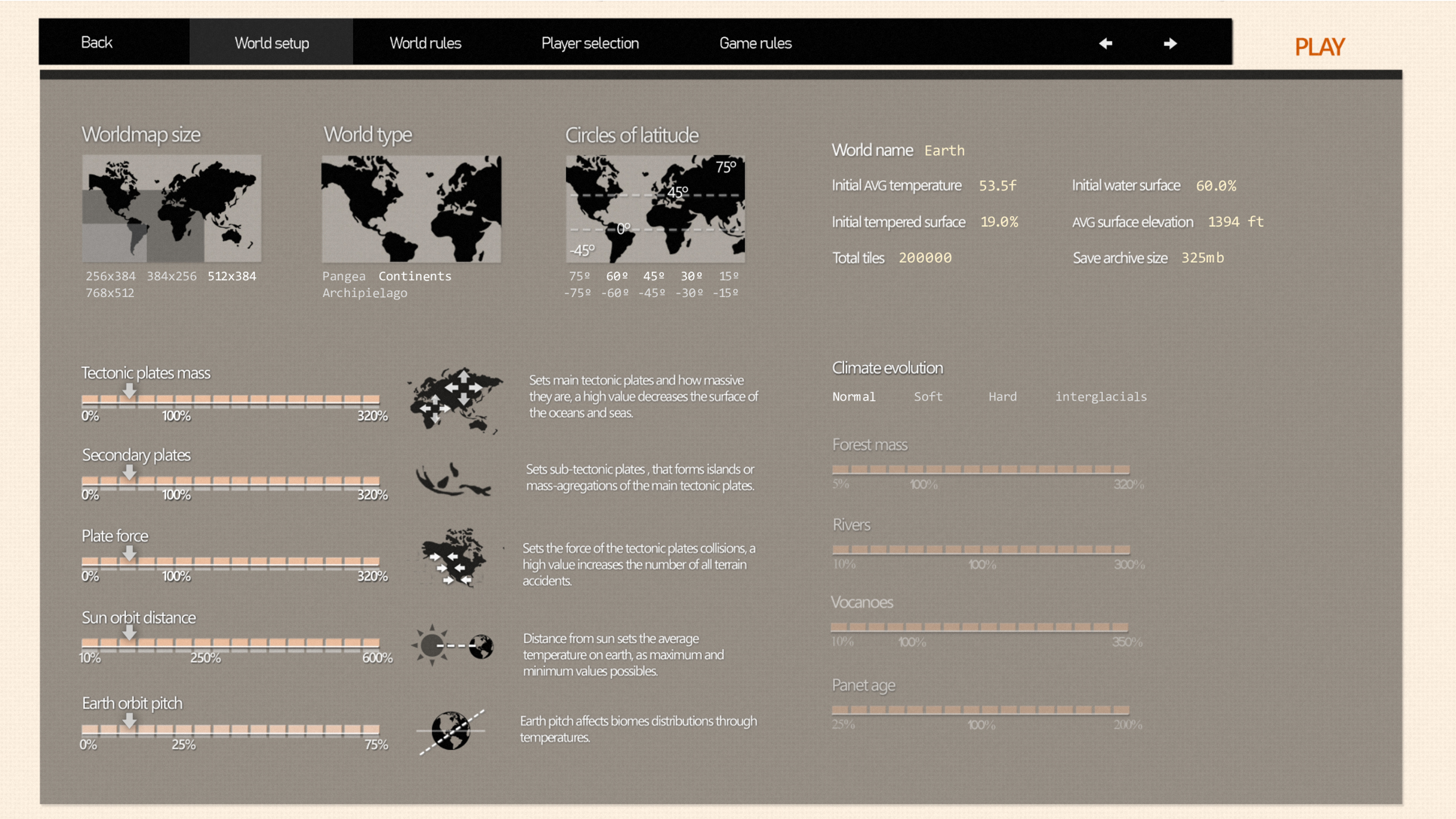
Since early access, BOC will bring powerful worldbuilding options, the goal is to bring access a completely different planets and strategies each time you set up a new world, most options affects in how climate is simulated and how it evolves over time.
For example, the standar configuration will emulate the end of last ice age period and historical ancient climate, meanwhile it evolves to most tempered, when the ice melts the sea level will rise and water will flood coast and creating islands and isolated regions from continents, in real world The British Islands are an the best example, Being part of the European continent during the Ice Age, only to be separated later when all of the ice melted, creating what is known today as The English Channel.
Worldmap options
World map size
Set up world-maps up to 512 x 384 size (width x height) more than 196.000 tiles in total, this means the most largue world-maps in strategy genre! and we are working to bring even more largue world (768 x 512).
World type
You can choose between differents procedural terrain shaping, like continental, or a world map filled with islands, we want include soon the option to select and specific scenario (like real world ... or the midle earth for example)
Circles of latitude
You can set the world maps with specific range of circles of latitude, this bring players excellent control over different biome ranges and how it spreads over the planet
Planet shaping
Tectonic plates mass
Set main tectonic plates and how masive they are, a high value increases the terrain surface meanwhile decreases the ocean & sea surface.
Secondary plates
Set sub-tectonic plates, that usually generates islands or little sub-continents.
Plate force
Set the force about tectonic plates collisions, a high value increase terrain surface accidents and will generate large and massive mountain chains or plateaus.
Rivers and forest mass
Currently we are working to add range values for rivers and forest mass to procedural generation engine, in early access release will be generated with default params.
Volcanoes
Working on! Most big volcanoes will be able to change climate and affects your strategy and developement.
Sun & Planet orbits
Sun orbit distance
Set the planet distance from Sun, it affecs directly in the averange temperature and the distribution of temperate biomes.
Planet orbit pitch
Set planet orbit pitch, it affects how biomes spreads, especially the most extremes (warm and Ice)
climate simulation
Aside of this, there are a option on this menu, Climate Evolution that can add special conditions, like more soft transition from the last ice age or the opposite, ... even you can set recurrent Ice Age cicles, brinding additional possible scenarios.
In the top right you can see your initial planet conditions, like the initial averange temperature or the initial sea level, all this params will evolve with the pasage of time, climate simulation is real and bring dinamic conditions: Sea flooding, biome changes, hunt migrations changes / hunt extinctions (Mammoths for eg)
When the coast changes or a biome changes, it affects in how base params like food or habitability are calculated, in BOC the terrain type, altitude, temperature and amount of sunlight are fundamental params in city building.
In BOC you can develop Towns and Cities through expansions (or districts) and buildings. Expansions and buildings are very similar kinds of upgrades, both give bonuses and improvements, and also usually both can be developed with upgrades, but meanwhile you can stack expansions, buildings are uniques.
Expansions (or districts)
Expansions bring new slots and unlock new buildings options, there are 5 types of Expansion for cities; Neighborhoods, Government, Religious, Artisan, and Military.
For example, while Neighborhoods bring new population capacity (aside other side bonuses) Artisans bring trade and crafting options and production capacity.
You can develop new expansions based on the availability of the free slots, cities unlock new slots through population increase.
Once you built an expansion, it can be upgraded, players cant do the upgrades directly, instead of that, expansions upgrades are managed Indirectly by player, based on city status, resources availability, and its own building chain requirements. So cities expansions can be upgrade based on how players manage the city and its faction.
Buildings
Based on the kind of expansions built, cities can allow unique buildings like Forums, Temples, or Barracks. For example, Forums are based on government expansions, and temples on religious.
Buildings are part of the building chain requirement, so, in the same way as expansions, they unlock new building options.
Unlike expansions, buildings can be upgraded directly by players. Buildings and Expansions have material and work requeriments to be finished or updated.
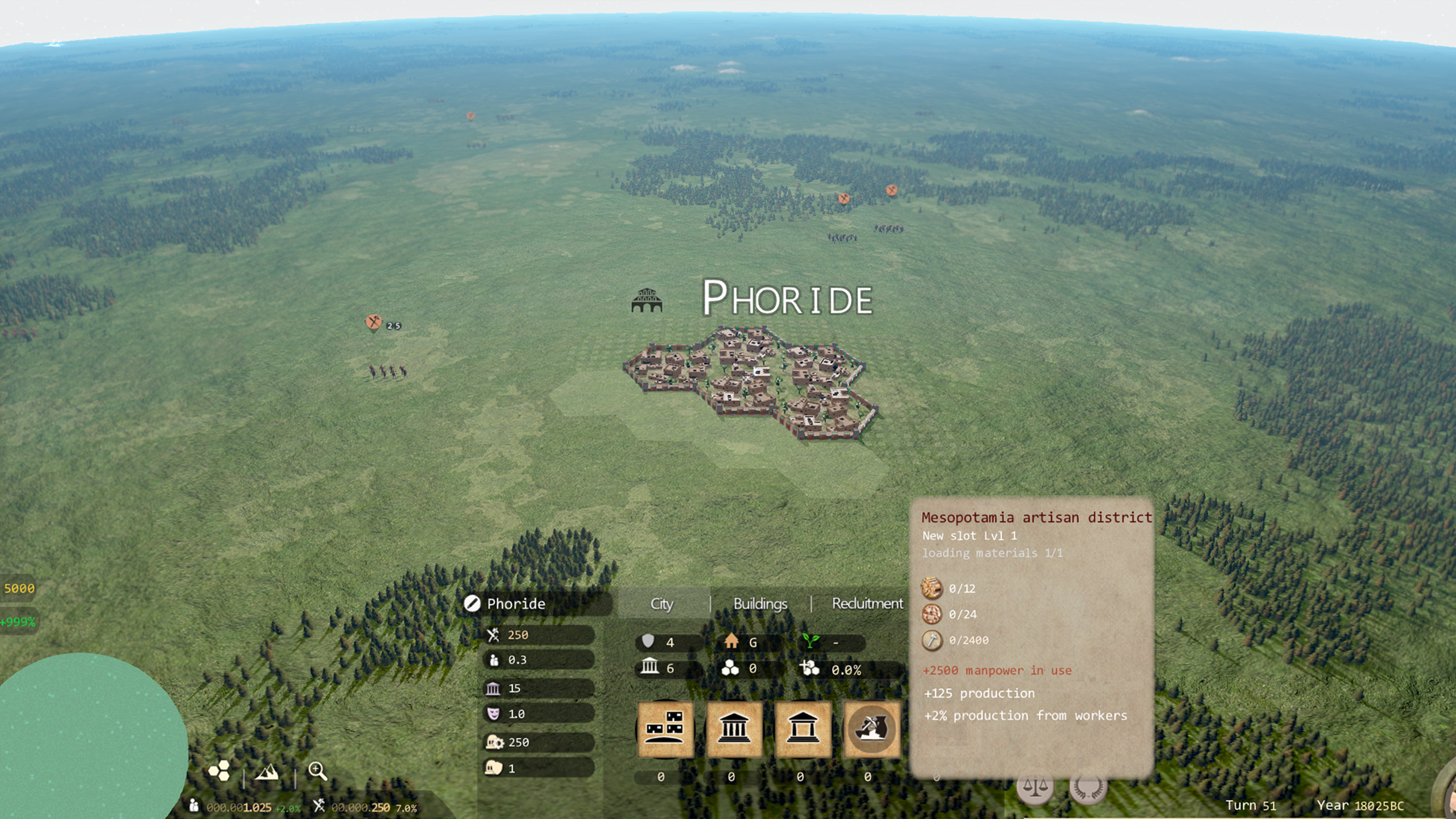
Construction process
In BOC there are two steps in the construction process, resource storing and work. The first one is when the production resources are storing up to supply the material requirements.
When the material requirements are full, the building process starts, where the amount of work is supplied by the production capability of the city.
Construction process requirements include:
Production resources, like wood, clay, or stone, each construction can allow up to 4 different. In BOC there is not a 'general' store of production resources, production resources just are stored in the construction process.
Amount of work, some kind of constructions like wonders could allow so large work amount like 100k.
Also, as extra requirements, could be:
building requeriment chains.
knowledge nodes.
Aside construction requirements. Bases (Camps, Towns, and Cities), expansions, and buildings are just available if the player gets access to it through Civs traits or knowledge nodes. So, there are many ways to complete the architectonic collection, based on player progression.
This was a glance through the different construction features over cities, in the next post I will write about recruitment and garrisons.
If you wish to follow the development and test the currently pre-alpha gameplay test, you can follow us on Reddit.
Cities #1
BOC Basebuilding, Cities #1
Currently, in BOC , there are 3 different base-building options: camps, towns, and cities. Camps are temporary bases (are not permanent), Towns allow for agriculture and farms as expansion slots, and Cities allow population to increase and production of units.
So, this is a series of posts where I will write about Cities features, that are the most important part of players' civilizations.
The most important part about cities is that allow an increase in population, also, when the player unlocks the cities means that the player civilization reached successfully agriculture and left nomadism, and enters in early mid-game.
Based on the player civilization traits progression, and in less way, by the knowledge progression, there are some big groups of architectonic collections, that will set the features of each city: Indoeuropean, Mesopotamian, and Hellenism (North African, Tribal American, Pre-Columbian and Asian are also in our roadmap), and also, each one allows sub-architectonic collections like Egyptians from Mesopotamians or Celtics from Indo-Europeans.
Each architectonic collection has its own bonuses and counter-bonus, by e.g, meanwhile, Mesopotamians can build with a relatively low requirement of materials and total work, Hellenism is so expensive about materials and works requirements. also, Mesopotamians are based fundamentally on clay material that is really easy to craft, and Hellenistic are based on stone and marble that are hardest to craft (especially marble)
For the start of the early access step, we will bring at least two architectonic collections (Mesopotamian and Indoeuropean)
The Cities are based on slots, you can expand a city through available terrain allowed, also cities allow buildings inside its built slots. There is no limit about the maximum slots that cities can allow, but usually when you expand a new city slot the population requirements increases (and also, increases the total available population) like food requirement.
Aside from the population, cities have 6 base params:
Manpower maintance: each city expansion and building have its own manpower requirement as permanent manpower in use.
Grow Percentage: shows the current growth percentage, and is based on others parameters like stability, Relevance, food ratio, or habitability.
Relevance: A ratio from 0 to 100, shows how important is the city, by e.g the old city of Rome clearly would be 100 score, which affects some player and city atributes.
Stability: Affects some other parameters, also, if a city reaches a low stability value may cause that unit or the same city leave the player's faction.
Production capacity: Shows the work capability for building, you need workers in your city to have production, also, some buildings increases the production capacity.
Combat Defense
The terrain atributes from a tile (based on geographics and climate params), set the city base bonuses when it's created: Defense and Habitability (Fertility is disabled for cities), also, inside BOC politic world divisions, each city have an impact over sub-regions and regions (provinces) like in the amount of the hunt and food-ratio availability inside of that province.
This was a global glance at cities, in the next post I will write more in deep about cities expansions and buildings.
If you wish to follow the development and test the currently pre-alpha gameplay test, you can follow us in Reddit.