Greetings! We’re back with a detailed dev blog on the upcoming scenario editor. This will be a long one, so if you want the short version, the scenario editor is coming soon and the map editor a bit further down the road.
Much of this blog will later become the foundation of a proper editor guide/manual, but now, let’s dive in!
Scenario Editor Features:
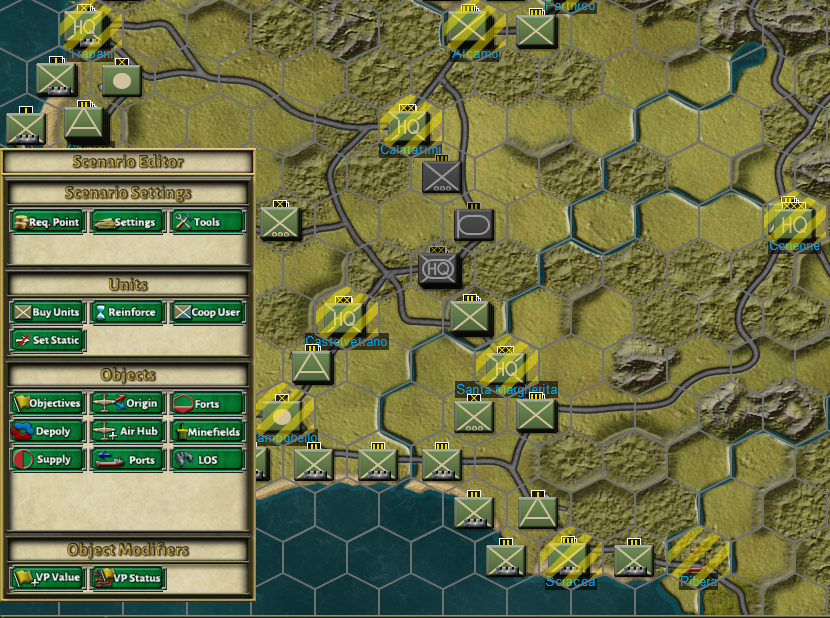
The scenario editor allows you to take any map and any OBs and make your own custom scenario. The editor uses a modified hotseat setup, so you can swap between the two sides and run the first turn as many times as you like without issue. Throughout your time in the scenario editor, the little bar on the left will be your friend, we have ensured it has plenty of space for future additions: For scenario editor release we are preparing a pair of model scenarios, a siege and two-way invasion, to make it easy to see custom scenarios in action and use them as a foundation for your own designs.
Let’s go through the sections in detail and see what you can do!
Scenario Settings:
Scenario settings deals with core scenario features like starting requisition points (if any), replacement/landing point schedules, paratroop drop availability, etc. All crucial elements to crafting a specific scenario experience for your players. For instance, you could create a siege scenario where one player never receives any requisition points and must make do with the forces they have, while their opponent gains regular reinforcements.
Req. Points Set starting requisition points.
Settings: This opens the settings notepad file associated with the scenario. In this file you can change virtually every relevant scenario setting. The requisition mode used, replacement and landing point schedules, lock out turn 1 orders, enable paratroop drops, toggle engineering order availability by type and nation, even the availability of the battlegroup feature by nation, and more.
Tools: Useful editor tools such as disabling fog of war and deleting units (which returns them to the unit pool as if refunded.)
Units:
The units section contains everything you need to buy units, set reinforcement dates, assign co-op unit ownership, and temporarily or permanently immobilize units.
Buy Units: Opens the unit pool to allow you to purchase units outside of a normal preturn.
Reinforce: Allows you to set a reinforcement arrival date for selected units. The units will appear in their current hex on the designated turn, even if that hex is inside the deployment box. Essential when you want to control precisely when and where a unit enters play either for historical simulation or scenario balance.
Co-op User: Designates which user (host or client) controls the selected unit(s) in co-op scenarios. Obviously has no effect on other scenario types.
Set Static: Immobilize selected units either temporarily or permanently. Temporarily immobile units become mobile at the start of the designated turn. Static units can never move, have 0 stacking value, and do not exert Zone of Control.
Objects:
Objects form the core of scenario creation. Use these tools to add custom objectives, modify air zones, place forts, create sadistic minefields, manipulate (or even entirely remove) deployment zones, create river ports, you can do A LOT here.
Also note that most of the features below can be used to remove as well as place items. For instance, if you do not want cities that already exist on the map to automatically project supply then you can use the supply tool to remove those pre-placed supply hubs just as easily as you add them.
Objectives: Place custom objectives. Do you want to make a random hex of desert a key objective? Be my guest. Want to add objectives to airfields? Go for it.
Origin: Set the origin hex from which a side’s airpower is projected. Changing origin hexes substantially impacts how the competing air zones spread across the map. Also note that while all current scenarios have air origins at map edges, you don’t have to adhere to that rule.
Forts: Place forts, even the formidable level 3 (Siegfried Line level) not used in any current CAOS scenario.
Deploy: Set deployment zones, you can make these temporary or even permanent. You could create a scenario where one side has deployment zones in cities in the middle of the map to represent forward mobilization zones or railheads.
Air Hub: Air hubs extend the air zone, they function like powerful, uncapturable, airfields. In historical scenarios we use air hubs to represent the influence of off map airfields, such as Malta in the Husky scenario.
Minefields: Place minefields. Simple, effective, destroys friendships when used excessively.
Supply: Place supply hubs. Great for representing major, immobile, logistics assets.
Ports: Place ports, potentially anywhere on the map, but intended to be used either for ports on rivers, or for coastal ports (not on landable beaches) that have obstructable entrances. Each port has a line of communication to the sea, and if enemy air zone or units occupy any point on their line of communication the port cannot function.
LOS: Place line of sight markers for either side, these markers always last 1 turn but you can set their line of sight radius to any value. You could use this to give a side total map vision during the first turn, or advanced vision of specific sections of front at the start of the game, as we do in historical scenarios.
Object Modifiers:
As their name suggests, object modifiers alter characteristics of existing objects, specifically victory points.
VP Value: Change the victory point value of a pre-placed objective, such as a city.
VP Status: Change the ownership of a pre-placed objective, such as a city. This can also be used to remove the yellow objective hashmarks or a pre-placed objective.
Putting it All Together:
Once you have completed your scenario, placed every unit, added your objectives, set your deployments, created your minefield maze, you can run as many turns as you want to create your scenario start save. When you run a turn in the editor after the turn completes the game still believes it’s turn 1, no matter how much has changed. Units can move, even be destroyed, but the new turn will still be turn 1. You don’t need to get everything perfectly right the first time, because the editor allows you to keep running turns until you have the starting situation you’re looking for.
Use this freedom to execute attacks so there are already combat markers on the map when the player starts the game, this will let them know they’re entering an in-progress battle. Need to alter starting line of sight? Reset those LOS markers and run it again. Did you build your whole scenario and forget to buy aircraft? No problem, open the unit pool, buy them, and run the turn again, you lose nothing. When you’re done save the scenario and your new creation is ready to play from the premade scenario list. Load it back up in the editor any time you want to make further edits.
Future plans:
The full map editor with the ability to place terrain and make fully custom maps is in the pipeline but it needs more time. Our old map creation tools used a separate program we created and finished maps were then imported into CAOS, tested, re-exported for bug fixes, and then the final product was finally playable. This process was unnecessarily complicated, time consuming, and a major production bottleneck. After completing the scenario editor we will finish porting the map creation functions into the new editor system. Support for custom armies is also planned, but those plans will be discussed at greater length during Operation Sealion expansion development.
Update 1.0.5.7
Greetings! We have a routine update today focused on refinements to the Crusader scenario, several historical improvements to the UK 1939/1940 OBs, implementing the new Polish and Czech national color schemes, a new system to preview the exact impact of terrain on unit combat values, and other improvements.
This update is not save game compatible with saves from 1.0.5.2.
Operation Crusader Scenario Updated:
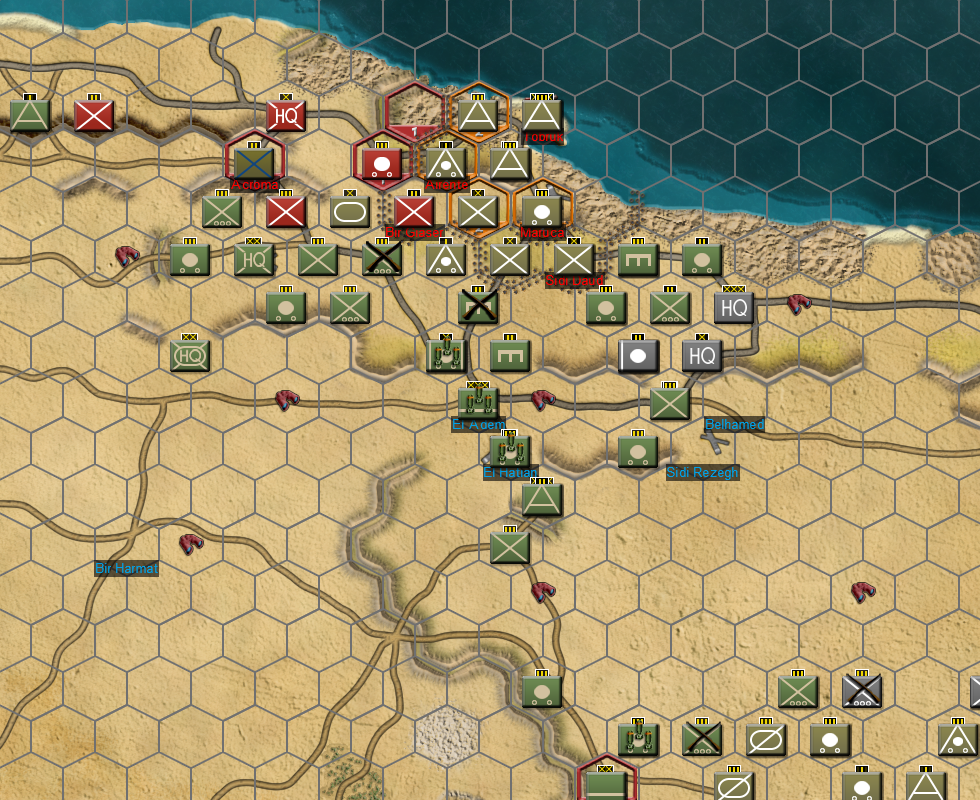
Experience revealed our 1.0 Operation Crusader scenario biased too heavily in favor of the Axis because we provided them unrealistic flexibility. Due to incomplete intelligence and ongoing preparations for their planned assault on Tobruk, Axis commanders did not appreciate the full scope of the Commonwealth offensive when it first launched. Considering this fact, we have introduced several temporary movement restrictions to prevent the Axis player from conducting a historically nonsensical, perfect defensive plan, while still preserving player freedom. We have introduced similar limitations for Allied units inside Tobruk, reflecting the fact that the garrison was not prepared for offensive operations on November 19. Additionally, we have made a few minor morale tweaks for both sides and limited the mobility of rear-area anti-aircraft units. The result is a more fun scenario that better captures the chaotic bloodbath that was Operation Crusader.
Crusader Changes:
All Allied units inside the Tobruk fortress are immobilized until turn 3 (November 21) as they reorganize due to heavy rains and preparations for their counterattack.
Removed erroneous 4th rifle company from South African infantry battalions.
Increased morale of all attachments of 7th Armoured Brigade by 1 level. This takes the units up to Veteran/Experienced, depending on battalion.
Increased morale of 4th Royal Horse Artillery regiment from experienced to veteran.
Reduced morale of most 15th Panzer Division units from Crack to Veteran.
Elements of 132. Armored Division (Italian) inside Bir el Gobi immobilized until turn 2 (November 20).
104. Schutzen Regiment and 39 Panzerjager Abteilung are immobile until turn 2 (November 20) due to fuel shortages.
Most defenses of Bardia are immobile until turn 3 (November 21)
Units in the Sollum line defenses are immobile until turn 6 (November 23). Units in immediate reserve behind the line are only immobile until turn 2 or 3.
Various harbor defense artillery units on both sides set to static. Some rear area AA immobilized for upwards of 10 turns.
UK 1939/1940 Improvements:
UK 1940:
1st Armoured Division updated to its late April order of battle, including the 30th Infantry Brigade (motorized).
Added 2nd RTR as an independent unit. 2RTR is a cruiser tank battalion technically attached to 1st Armoured Division, but not deployed to France.
Added 27th and 98th Field Regiments (18/25pdr Mk. Is), as independent artillery units.
2nd (27/28th) battery of the 7th Medium Regiment re-armed with 6" Howitzer Mk. Is, to reflect its March upgrade.
Added the 43rd (Wessex) Infantry Division in its 2nd line, May 31 organization.
Added 58th Anti-Tank Regiment (at half strength) as an independent unit.
Added the (vastly under strength) artillery of the 12th (Eastern) Infantry Division, that was historically left behind in Britain when the rest of the division departed for France.
9th and 15th Infantry Divisions reorganized to reflect their May 31 OB. They are now 3rd line divisions with insufficient training and severe equipment shortages.
52nd (Lowland) Infantry Division reorganized to reflect its May 31 OB. It is now a 2nd line division suffering from incomplete training and severe equipment shortages.
UK 1939:
Added the 60th Field Regiment (18pdr Mk. IVs), as an independent artillery unit.
Reorganized the 9th, 15th, 51st, and 52nd, Infantry divisions to reflect their understrength, November 15, OBs.
Replaced 59th Medium Regiment with the 67th Medium Regiment (iron-tyred 6" Howitzer Mk. Is), deployed to France in October.
Replaced 12th Field Regiment (in Scotland) with the 97th Field Regiment (18pdr Mk. IVs), a territorial unit deployed to France in October.
Replaced 38th (Welsh) Division with the 5th Infantry division in its December 29 order of battle.
Replaced 2nd Heavy Regiment with the 1st Heavy Regiment in its September OB, including 6" Mk. IXs guns, 6" Mk. I howitzers, and a single battery of 9.2" siege howitzers.
2nd Medium Regiment re-armed with 60pdr howitzers to reflect its September OB.
2nd Royal Horse Artillery re-armed with 3.7" Mk. I howitzers to reflect its September OB.
Both 1939 and 1940:
Reduced movement speed of motorized artillery units using wood or iron tyred guns to 12.
Added proper battery numbers to artillery and anti-tank regiments instead of generic 1/X Regiment format.
Added 1st and 2nd Anti-Aircraft brigades.
14th Anti-Tank regiment 2pdrs replaced with 25mm Hotchkiss Mk. Is.
Removed 61st Anti-Tank and 64th Anti-Tank Regiments from UK 1939 and 1940 OBs due to the regiments possessing less than 1 battery of guns.
General Improvements:
Polish and Czech exile units in Commonwealth orders of battle now use their own national color schemes.
All commando squads gain level 1 combat engineering. This makes commandos very powerful tools against fortifications.
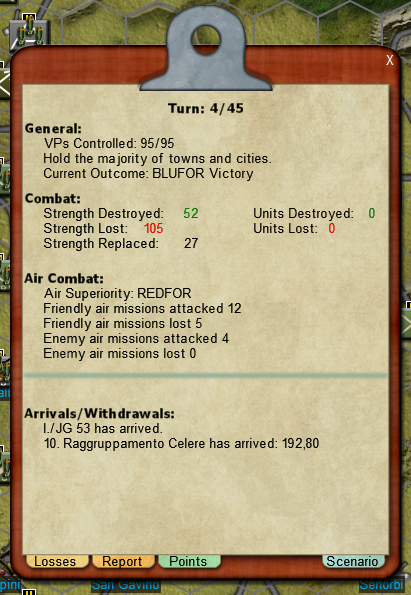
Points screen in intel clip board now displays estimated requisition, replacement, and landing point income throughout the entire game.
Removed several duplicate OBs intended exclusively for use in the scenario editor.
Added divisional AT and artillery batteries historically used during Fall Gelb to 7. Fleiger-Division.
Replaced 1943 Soviet 2nd Guards Mechanized Corps with 1st Guards Mechanized Corps in its Kursk OB, which is stronger and has more 'exotic' attachments.
Fixed some UI quirks related to the save game screen.
Fixed a crash that could occur when both sides had identically named HQs.
Various stability improvements related to battlegrouping.
Checking combat modifiers from afar:
No more guesswork needed to predict the precise impact of terrain modifiers on your units’ combat and AT values, you can see exact values at the push of a button now.
How it Works: Hold Ctrl with a unit or stack selected to view its combat and AT values as modified by terrain. Click and drag between hexes to view the impact of hex-side terrain like rivers. This preview works with any hex, near or far.
Modifier Preview in Action: Let’s see some examples. Above we have the mighty 130. Panzer Lehr and a standard grenadier regiment from late summer, 1944. Baseline at the top, modified in a forest in the center, and in a marsh, across a river, at the bottom.
Moving Forward:
We have a series of routine content updates in the pipeline intended to polish up older OBs, add new units, and set the stage for some as-yet unannounced features in the coming expansion. These updates will primarily focus on the early war years, but later war years will also be improved. For example, the Soviet 1943-1945 OBs will be receiving some love soon. In more pressing news we expect to have the scenario editor ready for at least a public beta release late this month, details will follow an editor dev blog when it's ready.
Feel free to let us known your thoughts on the feedback thread linked below, or on our Discord: https://steamcommunity.com/app/1466610/discussions/0/3833171785692351870/
Update 1.0.5.5 (Experimental)
Greetings! We have a routine experimental branch update today focused on refinements to the Crusader scenario, several historical improvements to the UK 1939/1940 OBs, implementing the new Polish and Czech national color schemes, and a new system to preview the exact impact of terrain on unit combat values.
This update is not save game compatible with saves from 1.0.5.2.
Operation Crusader Scenario Updated:
Experience revealed our 1.0 Operation Crusader scenario biased too heavily in favor of the Axis because we provided them unrealistic flexibility. Due to incomplete intelligence, heavy rains grounding recon aircraft, and the pressing matter of planning the upcoming assault on Tobruk, Axis commanders did not appreciate the full scope of the Allied offensive when it first launched. Considering this fact, we have introduced several temporary movement restrictions to prevent the Axis player from conducting a historically nonsensical, perfect defensive plan, while still preserving player freedom. We have introduced similar limitations for Allied units inside Tobruk reflecting the fact that the garrison was not prepared for offensive operations on November 19. Additionally, we have made a few minor morale tweaks for both sides and limited the mobility of rear-area anti-aircraft units. The result is a better balanced, more fun, and more historically accurate scenario that captures the chaotic bloodbath that was Operation Crusader.
Crusader Changes:
All Allied units inside the Tobruk fortress are immobilized until turn 3 (November 21) as they reorganize due to heavy rains and preparations for their counterattack.
Removed erroneous 4th rifle company from South African infantry battalions.
Increased morale of all attachments of 7th Armoured Brigade by 1 level. This takes the units up to Veteran/Experienced, depending on battalion.
Increased morale of 4th Royal Horse Artillery regiment from experienced to veteran.
Reduced morale of most 15th Panzer Division units from Crack to Veteran.
Elements of 132. Armored Division (Italian) inside Bir el Gobi immobilized until turn 2 (November 20).
104. Schutzen Regiment and 39 Panzerjager Abteilung are immobile until turn 2 (November 20) due to fuel shortages.
Most defenses of Bardia are immobile until turn 3 (November 21)
Units in the Sollum line defenses are immobile until turn 5 (November 23). Units in immediate reserve behind the line are only immobile until turn 2 or 3.
Various harbor defense artillery units on both sides set to static. Some rear area AA immobilized for upwards of 10 turns.
UK 1939/1940 Improvements:
UK 1940:
1st Armoured Division updated to its late April order of battle, including the 30th Infantry Brigade (motorized).
Added 2nd RTR as an independent unit. 2RTR is a cruiser tank battalion technically attached to 1st Armoured Division, but not deployed to France.
Added 27th and 98th Field Regiments (18/25pdr Mk. Is), as independent artillery units.
2nd (27/28th) battery of the 7th Medium Regiment re-armed with 6" Howitzer Mk. Is, to reflect its March upgrade.
Field regiments of the 15th Scottish Division reduced to their Spring 1940 strengths according to the "Julius Caesar" national defense plan.
UK 1939:
Added the 60th Field Regiment (18pdr Mk. IVs), as an independent artillery unit.
Replaced 59th Medium Regiment with the 67th Medium Regiment (iron-tyred 6" Howitzer Mk. Is), deployed to France in October.
Replaced 12th Field Regiment (in Scotland) with the 97th Field Regiment (18pdr Mk. IVs), a territorial unit deployed to France in October.
Replaced 38th (Welsh) Division with the 5th Infantry division in its December 29, 1939 order of battle.
Replaced 2nd Heavy Regiment with the 1st Heavy Regiment in its September OB, including 6" Mk. IXs guns, 6" Mk. I howitzers, and a single battery of 9.2" siege howitzers.
2nd Medium Regiment re-armed with 60pdr howitzers to reflect its September OB.
2nd Royal Horse Artillery re-armed with 3.7" Mk. I howitzers to reflect its September OB.
Both 1939 and 1940:
De-motorized some artillery regiments that still had wood or iron tyred guns. These regiments still had mechanized transport assigned, but wood/iron tyred guns limited their speed. We will likely compromise and assign these units the intermediate 12 point movement speed before full update release.
Added proper battery numbers to artillery and anti-tank regiments instead of generic 1/X Regiment format.
14th Anti-Tank regiment 2pdrs replaced with 25mm Hotchkiss Mk. Is.
Removed 61st Anti-Tank and 64th Anti-Tank Regiments from UK 1939 and 1940 OBs due to the regiments possessing less than 1 battery of guns.
General Improvements:
Polish and Czech exile units in Commonwealth orders of battle now use their own national color schemes.
All commando squads gain level 1 combat engineering. This makes commandos very powerful tools against fortifications.
Points screen in intel clip board now displays estimated requisition, replacement, and landing point income throughout the entire game. (The current text alignment is a placeholder, it will be more aesthetically aligned for full update release).
Added divisional AT and artillery batteries historically used during Fall Gelb to 7. Fleiger-Division.
Fixed a crash that could occur when both sides had identically named HQs.
Various stability improvements related to battlegrouping.
Checking combat modifiers from afar:
No more guesswork needed to predict the precise impact of terrain modifiers on your units’ combat values, you can see exact values at the push of a button now. The modified Anti-Tank value is also listed, although it only displays modified AT from the attacker's perspective currently, due to UI constraints.
How it Works: Hold Ctrl with a unit or stack selected to view its combat value as modified by terrain. Click and drag between hexes to view the impact of hex-side terrain like rivers. This preview works with any hex, hear or far.
Modifier Preview in Action: Let’s see some examples, here’s the mighty 130. Panzer Lehr and a standard grenadier regiment from summer, 1944. Baseline at the top, modified in a forest in the center, and in a marsh, across a river, at the bottom.
Moving Forward:
There are still a few outstanding issues we're working on before update 1.0.5.5 is ready for full release. We still have interface polish left to complete on the new points intel screen, AT listed in the terrain modifier preview sometimes displays inaccurately, and the build is still undergoing stability testing, although no outstanding crash bugs have been detected.
Feel free to let us known your thoughts on the feedback thread linked below, or on our Discord: https://steamcommunity.com/app/1466610/discussions/0/3833171785692351870/
Update 1.0.5.2
Greetings! We have a brief update today focused on key improvements to the new automated replacement system and a few multiplayer stability fixes. We have an Operation Crusader focused update planned next week, but we want to get the replacement and stability improvements out now.
Centralized Replacement Management:
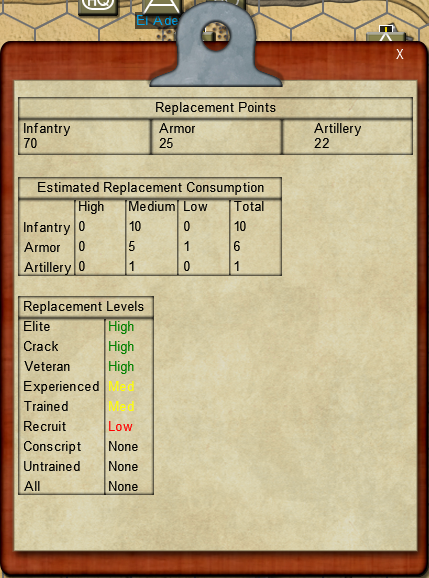
Opening Replacement Management: Left-clicking anywhere on the replacement pool at the top of the user interface now opens up the replacement management screen.
What it does: The new replacement management screen centralizes everything you need to know about the flow of replacements in your army in one place. The screen lists:
Your current replacement pool.
Estimated replacement expenditure by priority bracket for the next turn.
Most importantly, you can change replacement priorities by training level across your entire army at the click of a button in the Replacement Levels section.
How to use it: The ability to manage army-wide replacement priorities by training level provides substantial control over replacement allocation without ever needing to micromanage individual units unless you want to. For instance, if you're playing the Axis in Operation Husky you can change replacement priority for conscript and recruit units to None with 2 quick clicks and your army will never waste a single replacement point on militia units during the entire game. Likewise, you can just as easily disable replacements to your entire army to conserve points for a future offensive or reserve replacements exclusively for your best units. The new system is quick and painless, enjoy!
Other Gameplay/Stability Improvements:
Artillery replacement costs reduced by a further 10-15% across all years.
Fixed a bug that could cause client crashes in co-op games when automated air command was enabled.
Fixed a bug that caused client replacement priority changes in co-op games to fail to apply.
Update 1.0.5.1: Combat Overhaul 1
Greetings! We are ready to release Combat Overhaul 1! If you have been playing the experimental branch this release is fairly similar to what you've been playing with for the last 2 weeks with a couple major changes. Notably the addition of the revised Gazala scenario and reversion of changes to combat movement cost. If you haven't played the experimental branch then get ready to enjoy automated replacement and some fun changes to combat that open up new tactical opportunities.
System Improvements:
Automated Replacement
Units now automatically draw replacements from the global pool while connected to the supply network. Percent of total strength drawn per turn varies according to the following conditions:
Units in supply and in contact with enemy zone of control replace up to 1% of total unit strength per turn.
Units not in contact with enemy zone of control replace up to 2% of total unit strength per turn.
Units in Rest and refit replace up to 7% of total unit strength per turn.
Replacement priority can be set on a per-unit basis with the priorities being: High, Medium, Low, None. Units Veteran and above default to high. Experienced and Trained units default to medium. Recruit units default to low, and Conscript or below units to none.
Note: Replacements drawn do not increase cohesion, so even in cases where daily strength loss can be replaced, cohesion loss will still degrade a unit’s combat capability.
Anti-Tank Combined Arms Suppression:
Suppressing over 50% of enemy armor in a combat reduces their armor contribution to the combined arms modifier proportionally. Massing substantial AT capabilities is FAR more important now. Moreover, somewhat gamey strategies of using a single company of armored cars to gain armored combined arms will now only work against opponents with very poor AT.
Combat order changes:
During this update's experimental phase we tested increasing movement cost to initiate combat but we have reverted this change for the moment. Increasing combat movement cost produced the desired results of slowing down combat for armor/mechanized combat in flat terrain. However, the effect was excessive on maps with rougher terrain and caused mixed stacks of armor and infantry to become de-synchronized and attack on alternating impulses without supporting each other far too often.
Attack orders now impact a 3-hex arc, instead of the former 6-hex circle.
Updated Gazala Line Scenario:
We have updated the Gazala Line scenario with new order of battle details provided by community member and prolific historical researcher, Brad Hunter, and further revisions of our own.
Axis:
Added Kampfgruppe Burkhardt, a Fallschirmjager battlegroup stationed at Martuba airfield for a planned aerial assault that was never launched. The unit remains static for the entire game and will play a more crucial role in a future expanded scenario variant.
Added Kampfstaffel des DAK assets to Afrika Korps HQ.
Added various German rear-area AA units.
Added additional 5cm PaK 38 and 2.8cm PaK 41 AT guns to German Schutzen battalions that were previously omitted.
Revised Kampfgruppe Hecker and Kiehl organizations to completely account for captured equipment operated by the battlegroups.
Revised German Brandenburg commando organization at the battle. In practice this replaces 4 commando squads per company with pioneers and adds 2.8cm PaK 41s.
Moved Kampfgruppe Hecker to its historical staging zone for amphibious landings across the Gulf of Bomba that were never carried out. The unit remains immobile for 3 turns to represent the historical confusion the Kampfgruppe experienced due to receiving repeated orders to embark and unload before being committed as a ground asset.
Removed erroneous extra rifle platoon in Italian AS.42 pattern Infantry/Bersaglieri units.
Added L3/35 Lf flame tank companies to Italian Guastatori assault engineer battalions.
Revised OB of Italian 133rd Armored Division Littorio to include additional elements of the division committed to the battle, including its armored recon that was previously omitted.
Allies:
Increased morale of British 201st Guards Motor Brigade and 22nd Armoured Brigade from trained to Experienced.
Dissolved the 1st Armoured Brigade into replacement points, as was historically done. The brigade will return as a combat unit in a future expanded scenario variant.
Removed 4th rifle company from South African infantry battalions.
Reduced 2nd Free French Brigade to cadre strength and set it temporarily immobile for 10 turns to represent its historical status as a depot unit for the 1st Free French Brigade at the time.
Added the Jewish Battalion, a light infantry battalion tasked with tending the minefields at Bir el Harmat.
4th Royal Tank Regiment now starts the game at the Capuzzo Railhead, where it had historically just disembarked when the operation began.
11th Indian Brigade and 25th Field Regiment Royal Artillery now begin the game at Sollum, instead of arriving as reinforcements.
Various historical immersion improvements, such as identifying specific historical British AA, AT, and artillery batteries, instead of using generic 1/X Regiment format.
All Allied units behind minefields along the Line of Contact are now temporarily immobile during turn 1.
Rear area AA units for both sides are temporarily immobile for between 3 and 15 turns.
Gameplay Improvements/Bug Fixes:
Updated Axis and Allied Gazala OBs available in custom scenarios as well. See above for a before and after comparison 15th Panzer Division and Afrika Korps assets.
German 1941 minor OB corrections such as replacing 5cm PaK 38s with 3.7cm PaK 36s in SS regimental support companies in accordance with relevant KStNs for June 1941. Corrected LSSAH and Großdeutschland rifle battalion organizations, which were erroneously using 4 squad per platoon organizations instead of 3 squad per platoon with double MGs per squad organization they should have.
German 1939/1940 OB updates to better reflect differences in equipment and organization between infantry division waves and MG allocation in motorized battalions of the different panzer divisions.
Italian 1942 OB updates and corrections, AS.42 pattern infantry battalions had an erroneous extra rifle platoon per company for instance. Added MG-armed M13/40 and M14/41 command vehicles to Italian tank regiments and battalions.
Replaced Lee tanks with Grant tanks in all UK order of battle years, as the Grant was the primary variant of the vehicle operated by Commonwealth forces. The Grant also features superior protection on the forward turret face, increasing its armor defense from 4.6 to 4.9.
Reduced the cost of replacements by 60% on average across all years and replacement types. Also a quick reminder that holding shift while buying replacements buys 10 at a time.
Fixed a rare bug that could cause AI artillery units to stack with human player's units.
AI Improvements:
AI will now sometimes hold landing markers back to make secondary landings later in the game in invasion scenarios.
Interface Improvements:
Added drop down menu overlay option to clear combat markers.
Improved readability on text for all overlay modes.
Barrage orders now display impulse on unit card at bottom of HUD
Moving Forward:
With Combat Overhaul 1 in the bag our focus moves on to the scenario editor's public release and immersive turn resolution. We also have a developer head to head let's play for the updated Gazala scenario in-editting now, so we'll be back soon. We hope to make this a very special June for CAOS!
Update 1.0.4.9 (Experimental)
Greetings! We are excited to roll out the experimental branch for the Combat Overhaul 1 update. We are particularly interested in feedback on the main combat and replacement changes. Feel free to let us know your thoughts either in the Update 1.0.4.9 discussion thread on the forums, or on discord.
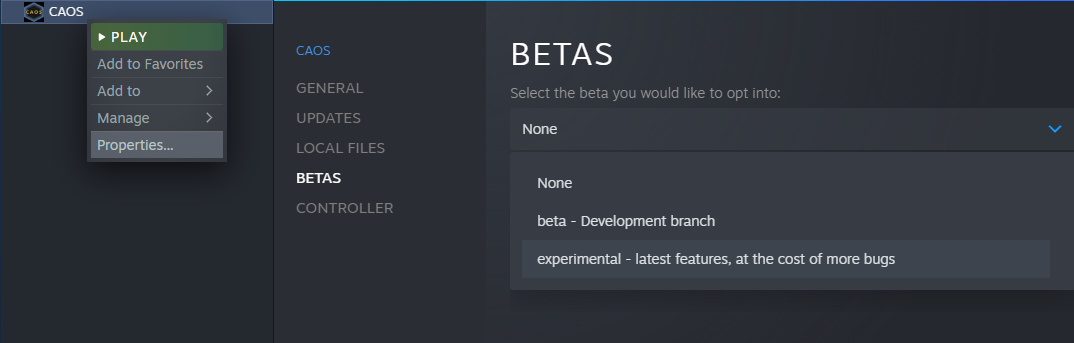
See the picture below for information on how to opt-in to the Experimental build if you’re interested in playing new updates early.
System Improvements:
Automated Replacement
Units now automatically draw replacements from the global pool while connected to the supply network. Percent of total strength drawn per turn varies according to the following conditions:
Units in supply and in contact with enemy zone of control replace up to 2% of total unit strength per turn.
Units not in contact with enemy zone of control replace up to 3% of total unit strength per turn.
Units in Rest and refit replace up to 7% of total unit strength per turn.
Replacement priority can be set on a per-unit basis with the priorities being: High, Medium, Low, None. Units Veteran and above default to high. Experienced and Trained units default to medium. Recruit units default to low, and Conscript or below units to none.
Note: Replacements drawn do not increase cohesion, so even in cases where daily strength loss can be replaced, cohesion loss will still degrade a unit’s combat capability.
Anti-Tank Combined Arms Suppression:
Suppressing over 50% of enemy armor in a combat reduces their armor contribution to the combined arms modifier proportionally. Massing substantial AT capabilities is FAR more important now. Moreover, somewhat gamey strategies of using a single company of armored cars to gain armored combined arms will now only work against opponents with very poor AT.
Combat order changes:
The changes to combat orders in this update are highly experimental, and we desire extensive player feedback on these changes. We aim to make using Attack orders more desirable while simultaneously slightly slowing down mobile combat. In general these changes slow down the speed of combat and make battles bloodier by increasing reliance on the decisive attack order. In internal testing these changes feel really good in the historical desert scenarios and in many custom scenarios, but we are concerned they may slow down combat too much in scenarios with rough terrain and large numbers of units such as Operation Husky. We look forward to hearing your thoughts as well.
Attack orders now impact a 3-hex arc, instead of the former 6-hex circle.
Movement cost to initiate march combat increased from 2 to 2.5. Under most circumstances this reduces the maximum number of march combats motorized units can initiate from 7 to 6, and infantry units from 4 to 3. Terrain, barrage, air attack, etc. can rapidly decrease this further.
Gameplay Improvements/Bug Fixes:
Axis Gazala OB update featuring new data provided by Brad Hunter (currently only affects the Axis Gazala OB in custom scenarios, these improvements will be added to the historical scenario for the full update release, after the British revisions are implemented). See the screenshot above for a side-by-side comparison of the old versus new 15th Panzer Division and some army/corps level assets.
German 1941 minor OB corrections such as replacing 5cm PaK 38s with 3.7cm PaK 36s in SS regimental support companies in accordance with relevant KStNs for June 1941. Corrected LSSAH and Großdeutschland rifle battalion organizations, which were erroneously using 4 squad per platoon organizations instead of 3 squad per platoon with double MGs per squad organization they should have.
German 1939/1940 OB updates to better reflect differences in equipment and organization between infantry division waves and MG allocation in motorized battalions of the different panzer divisions.
Italian 1942 OB updates and corrections, AS.42 pattern infantry battalions had an erroneous extra rifle platoon per company for instance. Added MG-armed M13/40 and M14/41 command vehicles to Italian tank regiments and battalions.
Replaced Lee tanks with Grant tanks in all UK order of battle years, as the Grant was the primary variant of the vehicle operated by Commonwealth forces. The Grant also features superior protection on the forward turret face, increasing its armor defense from 4.6 to 4.9.
Reduced the cost of replacements by 60% on average across all years and replacement types. Also a quick reminder that holding shift while buying replacements buys 10 at a time.
Added a series of experimental fixes for display bugs on wider resolution screens.
Fixed a bug that could cause a crash after opening the cohesion overlay.
AI Improvements:
AI will now sometimes hold landing markers back to make secondary landings later in the game in invasion scenarios.
Interface Improvements:
Added drop down menu overlay option to clear combat markers.
Improved readability on text for all overlay modes.
Barrage orders now display impulse on unit card at bottom of HUD
Moving Forward:
We aim to run this experimental branch for about a week before moving the update to full release. The full release version will also include an updated Gazala Line scenario, incorporating OB updates kindly provided by community member and prolific order of battle researcher, Brad Hunter. For now we look forward to hearing your thoughts on the new systems and we'll be back soon!
Roadmap to the Future
The completion of the Gazala to Husky release cycle lends us a perfect opportunity to tackle game system and interface additions or improvements, as well as making the scenario editor ready for public release. This Combat Overhaul release cycle will bridge the gap between Husky and our first, as yet unannounced paid expansion, intended for release later this year.
The objectives outlined in this roadmap are naturally subject to change, and they are not exhaustive. For instance, there are plenty of in-development AI improvements that don't appear on the roadmap. This roadmap serves as a general guide to the direction of development leading up to the first expansion later this year.
Combat Overhaul 1
Focus: Combat Overhaul 1 focuses on making Attack orders more useful, making concentrated anti-tank even more effective, and eliminating the tedium of replacement management through an automated replacement system
Game System Update:
Automated replacement system: replacements will be automatically pulled from pool and dispersed to units in the field. Units outside of enemy zone of control, and units in Rest and Refit will be able to absorb more replacements per turn.
Gameplay changes:
Slow down combat by increasing move cost to initiate March combat.
Make Attack orders impact a 3-hex arc, instead of the current 6-hex circle.
Make armor suppression over 75% reduce armor combined arms bonus.
Air order automation options.
Combat Overhaul 2
Update Focus: Combat overhaul 2 focuses on better communicating how turns unfold to players.
Game System Updates:
Immersive Turn Resolution: Immersive turn resolution will function like an evolved version of turn replays. At the start of each turn players will watch the turn unfold, impulse by impulse, as units move, and fight, joined by visual aids such as translucent pop-up messages above each combat showing casualties as the turn unfolds. The objective of immersive turn resolution is to show the player exactly how the battle unfolded to eliminate the need to open every combat report to understand what went down and how at the start of a new turn.
Initiative system: The current initiative system is based on training level, cohesion, movement speed, and a bit of randomization, and is unexplained to players within the game. The new initiative system will assign an initiative stat to each weapon type, based on the availability of radios to that weapon type (per vehicle, per platoon, per company, etc.) modified by training, cohesion, slight randomization, and weapon type. For instance, recon units will inherently possess higher initiative than line infantry. This new system will not only allow players to accurately predict which units will move first during resolution impulses, but also create custom battlegroups designed to move before larger, more ponderous enemies can catch them.
Gameplay changes:
Revisit artillery/air attack pinning. Pinning units is currently too easy and effective.
Reduce the effectiveness of bombers by giving bombing mission a circular error probability, meaning they may hit adjacent hexes instead of the target.
CAOS editor
Update Focus: Prepare the scenario editor for community use. Making the scenario editor ready for player use requires three key efforts:
Producing the graphical user interface to make the editor usable to non-developers.
Automating or changing a number of the more tedious aspects of the scenario creation process, such as scenario creation and scenario configuration files that currently take place out of game, and need to be incorporated inside the in-game editor for player convenience.
Linking scenario creation to steam workshop so players can easily upload their creations for the rest of the community to play.
Future Expansion
It is too early to reveal the subject of our first paid expansion, but at this point we will say it is located in the European Theater and it involves one of the greatest operations of World War 2…that was cancelled.
Operation Husky Release (v. 1.0.4.7)
Operation Husky's full release, update 1.0.4.7, is here! Husky features several new scenarios, a tutorial, and numerous gameplay, AI, or interface improvements, and much faster turn resolution speeds. Dive into the largest update to CAOS since launch!
New Scenarios:
Operation Husky and Variants:
Recreate the first decisive blow against fortress Europe in Operation Husky and explore two hypothetical variants of the scenario for increased replayability!
Operation Husky (Historical) The straight historical scenario with turn-1 Allied invasion beaches and paradrop landing zones pre-selected and units adhere to their historical arrival dates. Operation Husky+ A variant of historical Operation Husky where the Allied invader can freely select their initial invasion beaches anywhere from Alcamo-Partinico in the northwest to Avola-Cassibile in the southeast. Operation Husky Expanded A hypothetical, expanded variant of Operation Husky that assumes the Axis had one month’s advanced warning to prepare for the invasion of Sicily. Axis forces on the island and reinforcements enroute are more numerous by drawing on reserves from mainland Italy and Greece. Additionally, the Allies gain access to 7th and 8th Army’s full reserves, including the balance of the 82nd Airborne Division, 46th Infantry Division (UK), and 1st Parachute Division. Expect a tougher fight from both sides.
Operation Brimstone July/September Variants:
Operation Brimstone was a series of proposed Allied invasions of Sardinia between May and September, 1943. Historically, Operation Brimstone was never enacted and planning for the invasion was abandoned following the success of Operation Husky. In CAOS we have modeled two Brimstone scenarios. First, the most realistic, September Brimstone plan, and a second, higher intensity July variant assuming Operation Husky was directed against Sardinia.
Operation Brimstone (September) Hypothetical scenario based on Allied proposals to invade Sardinia using US V Army in September 1943. To bring September Brimstone to life in CAOS we combine the proposed V Army order of battle for Operation Brimstone with the carrier air cover afforded to Operation Avalanche. Initial Axis defenses mirror their historical September 8 levels, joined by limited reinforcements from Corsica and Southern France after the invasion commences. In terms of playstyle, September Brimstone strikes a balance between the grinding attrition battles of Operation Husky and the maneuver centric warfare that dominates our Desert scenarios. Operation Brimstone (July) Hypothetical scenario using Operation Husky’s Allied order of battle against Sardinia. To compensate for overwhelming Allied strength, the Axis defenders receive substantial reinforcement from Corsica and mainland Italy. In July Brimstone the Allies must quickly seize ports to bring their vast forces ashore before Axis reinforcements can consolidate their positions further north and force a stalemate. July Brimstone starts off with rapid maneuvers as the Allies move off the beach and then transitions to a grinding battle of attrition as Axis reinforcements enter the fray.
Operation Firebrand:
Hypothetical scenario inspired by Allied proposals to launch a French-led liberation of Corsica in autumn 1943, as a sequel to a successful invasion of Sardinia. Historically, as the Mussolini regime collapsed following the invasion of Sicily, the invasions of Sardinia and Corsica were never enacted. To bring Operation Firebrand to life in CAOS we assume the invasion of Sardinia was a success, Mussolini remains in power, and the Corps Expéditionnaire Français was activated early to liberate Corsica in October 1943.
Tutorial Scenario
CAOS is also receiving a much-needed tutorial scenario that walks players through combat orders, artillery orders, game systems such as Zone of Control, and air system, before turning the player loose to hone their abilities in a hypothetical siege of Sassari scenario.
Interface Improvements:
Movement speed now displayed on unit HUD card.
Static and temporarily immobile status now displayed on unit HUD card.
AI Improvements
AI planning optimization makes turn resolution 30-60% faster, depending upon map.
Improved AI invasion landing logic.
Improved AI logic to defend and attack static supply dumps.
AI is no longer excessively deterred by level one fortifications.
Improved AI logic to assess strength of enemy defenses and their relevance to AI battleplans.
Improvements to AI air command logic to better preserve force and support ground forces when hopelessly outmatched by enemy air superiority.
Improved attacking AI deployment logic to better account for terrain, predict likely paths to secondary objectives, and generally reduce rear area traffic jams.
Gameplay Improvements/Bug Fixes:
Paradrop Air bridging. Paradrops onto friendly airfields inside friendly air space inflict minimum cohesion loss and do not suffer from drop dispersion. You can now safely air bridge paratroop reinforcements to the front with good air control.
Paradrops enabled for both attackers and defenders in ALL custom Attack and Invasion scenarios.
Air command automation option. The administrative side of the air command can be automated to reduce the tedium of managing massive air rosters. Air command automation is automatically enabled in historical scenarios.
Air Interdiction can now only be conducted inside friendly air zone.
Static units no longer have stacking value or exert Zone of Control.
US Order of battle updated to better reflect organization and readiness of cavalry divisions 1939-1941.
Moving Forward:
In the immediate future we'll be working on full air order automation, to complement the air command automation introduced with Husky. Adding a back button to the tutorial, which is much needed and ironically more complex to add than you’d expect for such a simple feature, given how our tutorial message pop up system triggers, but we are working on it. And additional AI improvements, with a particular focus on improving defensive AI performance.
Beyond our near-term goals, the updated development roadmap detailing our plans to tackle the combat and systemic overhauls we have discussed over the last few updates is scheduled to go live next Tuesday. We are also working on creating the proper graphical user interface and documentation to make our editor tools player accessible.
For now storm the beaches, enjoy Husky, and feel free to let us know your thoughts on the new scenarios and features in the dedicated Husky feedback thread on the forum or on discord!
Update 1.0.4.5 (Experimental)
Greetings! Update 1.0.4.5. brings the Operation Brimstone scenarios and paradrops in all attack/invasion scenarios to the experimental branch. This is our last planned major experimental build before Operation Husky update full release.
See the picture below for information on how to opt-in to the Experimental build if you’re interested in playing new updates early.
New Scenarios:
Operation Brimstone July/September Variants:
Operation Brimstone was a series of proposed Allied invasions of Sardinia between May and September, 1943. Historically, Operation Brimstone was never enacted and planning for the invasion was abandoned following the success of Operation Husky. In CAOS model two Brimstone scenarios. First, the most realistic, September Brimstone plan, and a second, higher intensity July variant assuming Operation Husky was directed against Sardinia.
Operation Brimstone (September) Hypothetical scenario based on Allied proposals to invade Sardinia using US V Army in September 1943. To bring September Brimstone to life in CAOS we combine the proposed V Army order of battle for Operation Brimstone with the carrier air cover afforded to Operation Avalanche. Initial Axis defenses mirror their historical September 8 levels, joined by limited reinforcements from Corsica and Southern France after the invasion commences. In terms of playstyle, September Brimstone strikes a balance between the grinding attrition battles of Operation Husky and the maneuver centric warfare that dominates our Desert scenarios.
Operation Brimstone (July) Hypothetical scenario using Operation Husky’s Allied order of battle against Sardinia. To compensate for overwhelming Allied strength, the Axis defenders receive substantial reinforcement from Corsica and mainland Italy. In July Brimstone the Allies must quickly seize ports to bring their vast forces ashore before Axis reinforcements can consolidate their positions further north and force a stalemate. July Brimstone starts off with rapid maneuvers as the Allies move off the beach and then transitions to a grinding battle of attrition as Axis reinforcements enter the fray.
AI Planning Improvements
We have extensively optimized the AI planning process and turn resolution times are notably improved. Operation Crusader resolution times are 60% faster, and Operation Husky or Gazala resolution times are 30% faster on average.
Gameplay Improvements/Bug Fixes:
Paradrops enabled for both attackers and defenders in ALL custom Attack and Invasion scenarios.
Static units no longer have stacking value or exert Zone of Control.
Added missing German Flak Battalion in Palermo at the start of Operation Husky.
Corrected Allied turn 1 air control in Operation Husky Expanded, it erroneously excluded Gela.
Order of battle updates to better reflect organization and readiness of US cavalry divisions 1939-1941.
Fixed a bug that caused the requisition menu to appear in Premade scenarios in hotseat games.
Fixed a bug that allowed players to see enemy reinforcements in the deployment box. (This still occasionally happens to turn 1 paratroopers, but should not affect other unit types.)
Outstanding issues before Update Full Release:
Before the Husky update is ready for its full release there are still a few content, feature additions, and bug fixes left outstanding.
Air command automation controls. To give players the option to automate the administrative side of the air command to reduce the tedium of managing massive air rosters.
Axis withdrawal mechanic for Operations Husky, Firebrand, and Brimstone.
Back button for tutorial prompts.
Update 1.0.4.4 Hotfix
Fixed a bug that allowed the AI to re-deploy units from their historical landing zones in Operation Husky.
Fixed a bug that prevented interdiction missions from working in historical scenarios.
Fixed a bug that caused the message notifying the player mods are out of date to become unclosable.
Fixed a bug that caused some reinforcement units to forget their parents/detachments in historical scenarios (will not affect in-progress games).