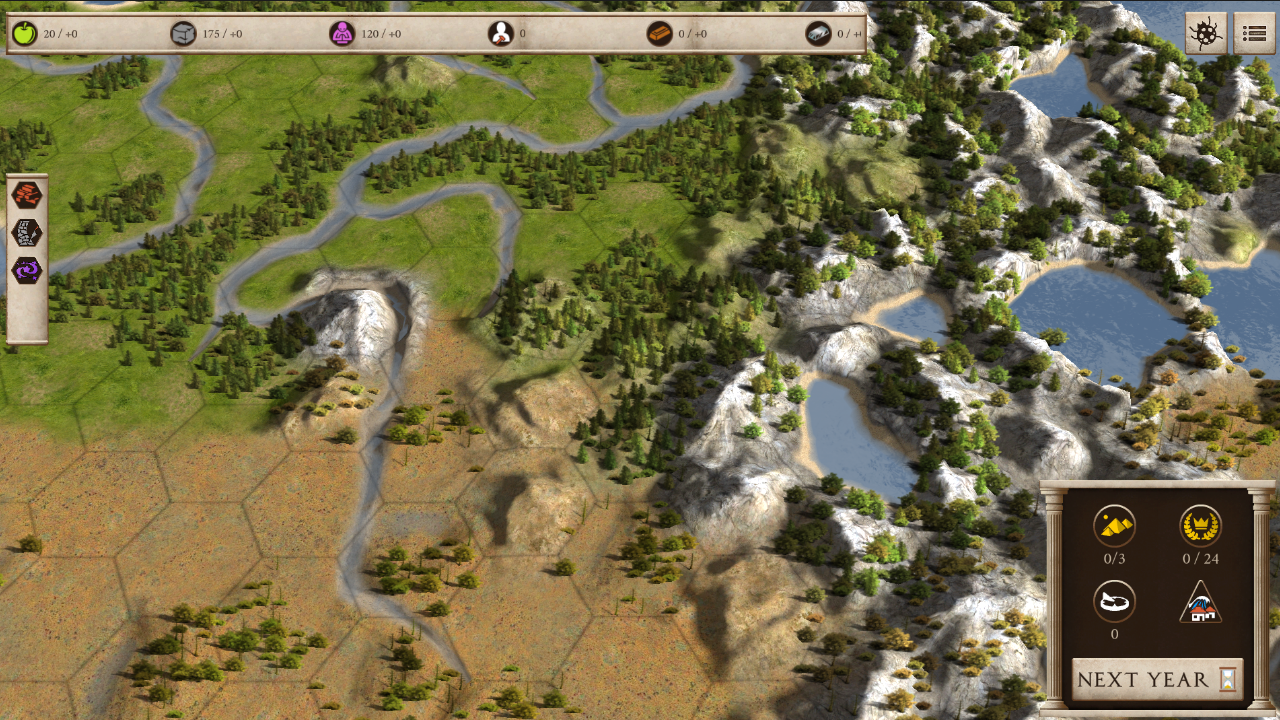
Throughout the game's life, the disasters in Critias Empire have been limited to earthquakes and the terrain shifting they induced. As cool as they are, it's time to add in more different disaster types, which is the focus of this update.
Eerie Silence
It's important that the player knows when a disaster is imminent. Not only so they can prepare, but just as importantly, to give them a sense of tension and anticipation. Already in the turn before a disaster, the music changes from baroque/romantic classical music to an eerie ambient background track. But that can be easy to miss if music volume is turned down, as can other signals such as the disaster countdown turning red.
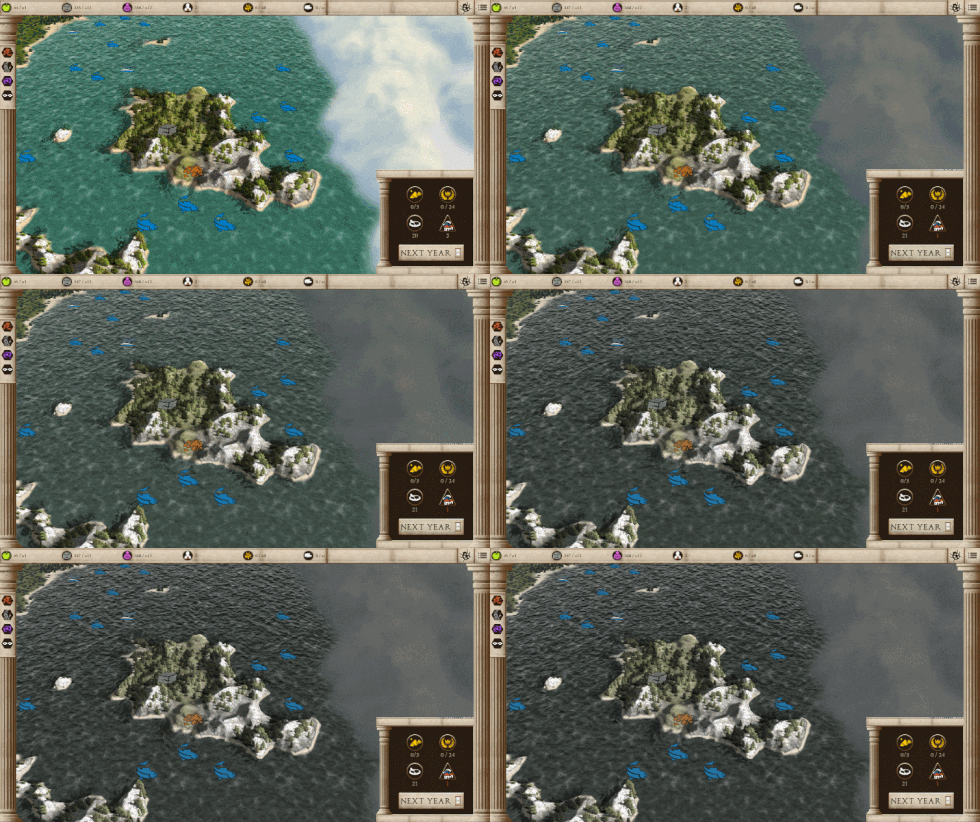
To fix this and add extra immersion, the map now gains a grey pall, the seas turn a stormy grey and the clouds that fringe the game map turn to brooding thunderclouds. All in the turn before disaster strikes.
In the turn immediately after a disaster, the clouds and seas remain dark, while the lighting intensifies to reflect that the world is suffering the aftermath of disaster.
Then Boom!
Nothing says disaster like a volcano. Especially when we have the very real historical eruption of Mount Vesuvius, that famously destroyed Pompeii and Herculaneum, as dark inspiration. Ironically that eruption helped preserve and inform much of what we know about the ancient Mediterranean world today.
In fact, the cover image of this update is of a later (probably fictionalised) eruption of Vesuvius, by painter Joseph Wright of Derby, which matches the broadly Romantic art movement style of much of the art of Critias Empire!
In terms of how volcanoes affect the game, clearly anything in the path of the volcano or the lava streams it sends are going to get destroyed without intercession of the Gods. I.e. spending prayer points to relocate those land uses and buildings in the turn immediately after the disaster. Just as how it currently works with earthquakes that leave cities, farms, mines etc underwater.
I would like to at some point make separate shield and stratovolcano disasters. The latter would rain down ash and send out pyroclastic flows, rather than flood the land with lava streams. However that will have to wait for later.
What's Next?
For the time being, I'm going to concentrate on updating the steam store page screenshots and making a new trailer. There's also still a bit of tidying up the volcano code to do.
I'm also going to stop making predictions about when a demo or the game will be released. This month I was hoping to work on Critias Empire much more than I was eventually able. Suffice to say, there will be a demo at the point where I feel the experience can really shine and give an authentic flavour of what the final game will be like.
To that end, I also aim to begin a new round of balancing before the end of May, and will most likely be more of a fine tuning of the existing balance rather than anything radical.
As always, if you have any feedback or thoughts on the game's progress, do get in contact or leave a comment!
Devlog 7: Waves of Change
Looking Better
Improving the user experience and look of the game with both big and subtle changes has been the focus of recent work on Critias Empire, the details of which are covered in this update.
Water World
The water graphics in Critias Empire were created many many years ago, to the point that some people were commenting that the game has a retro feel. Whilst the game was never going to compete with the latest AAA graphics, the visuals of the game were not supposed to look that old!
Rather than reinvent the wheel, I decided any one of the many water graphics packs that are available off-the-shelf would be a significant improvement on what was being used before. After some experimenting, I eventually found one such water plugin that I liked (and works with the technical limitations of the game).
Are You Experienced?
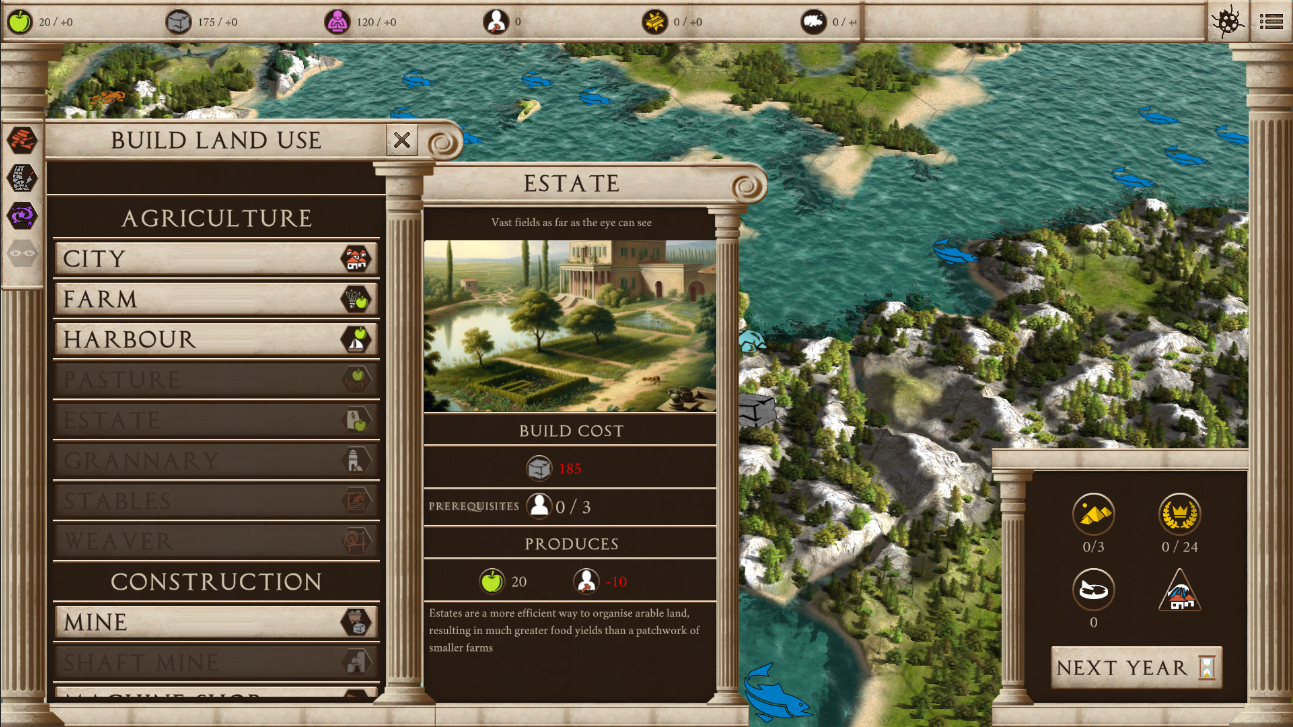
The UI is finally starting to improve in line with the plans I've had going back months. The visual upgrade is nice but, more important are the user-experience "UX" changes. No longer does the game try to bombard you with every single stat it can at every opportunity.
Instead, the game is more streamlined in its approach to information - giving you just the important "headline" stats that you need for making the decision immediately before you. The detailed stat breakdowns are still there for advanced players, and I've been careful not to hide away access to them too deep into the UI. They're just no longer clogging up screenspace when they're not needed.
What's Next?
The UI / UX revamp still has some way to go, but already the game is looking and more importantly, feeling much nicer to play. It's also having a nice side effect of making it obvious where there are balance issues.
Looking further ahead, the trailer and screenshots on the Steam Store page are now more than a year old. I want to update them to show off all the progress made since then. The plan is to do this to coincide with (finally) releasing a demo, which I anticipate will be around early to mid May.
Devlog 6: Exploration
What Lies There
With the global bonus system implemented, focus has shifted to balancing other parts of the game, and the implementation of a long-planned feature - exploration!
But how does exploration work in a game with no units and the map already revealed? All will be... revealed...
Hidden Riches
Like many resource management games, Critias Empire has advanced resource types that can only be made by combining or changing more basic resources. For example, to make bronze, copper and tin must be combined in a Forge type building.
Some of these basic resources have infinite supply. A mine will never run out of stone and a farm will always produce food. But copper and tin only occur in certain places on the map and in limited quantities.
However it would suck for the player if they were trying to build the Colossus, only to find out there wasn't quite enough copper and tin on the map. Or that they had used some precious bronze for something else and now they were short.
This is where disasters come in. Disasters need some positive benefits to the player to outweigh their potentially large negative impact. In the case of some disasters like earthquakes or volcanoes, that might come in the form of new land to expand into. But that won't always be the case.
Disasters however, bring another benefit - they refresh the resources on the tiles affected. Now there's a chance any player waiting for more copper or tin might find a new ore vein appearing on the map.
To make this a bit more exciting, the player must "explore" the areas affected by disaster to reveal certain resources. It also makes sense thematically - if a new island appears out of the ocean all of a sudden, it will be obvious, even from a distance, that island has mountains, forests etc. But not that it has copper, or where those deposits might be.
Expedition-Style
Since Critias Empire does not have units, there must be some other way to explore. My initial idea would be that players send an expedition to an area, and that some years/turns later, the expedition returns with its results. The better equipped the expedition, the more likely they were to survive and return with some useful information.
However, in Critias Empire, players can build anywhere on the map. It doesn't make sense to send an expedition out, in the meantime built a city, farms, mines etc in the expedition area, only for the expedition to come back later as a failure.
It would also be annoying if players wanted to use the turn immediately after a disaster to move their sunken cities, mines, farms etc to a newly appeared island, only to find that it is unexplored and sending an expedition will take many years/turns that they just don't have.
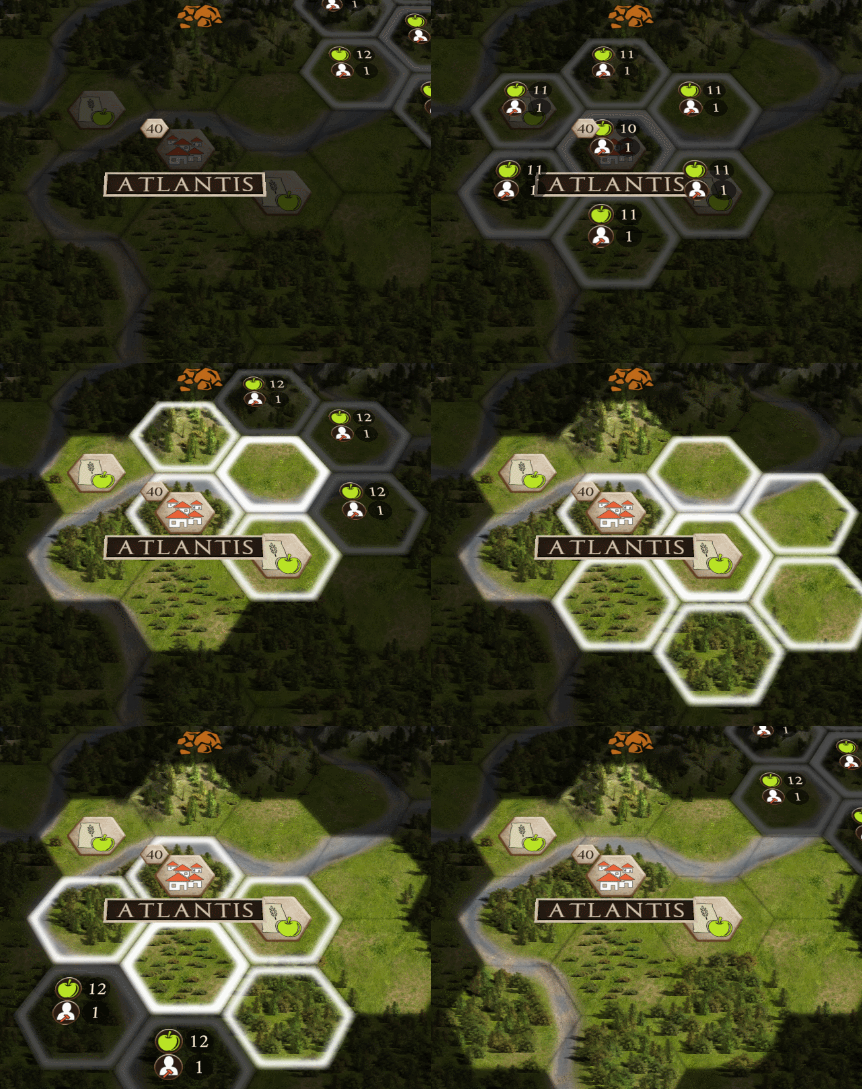
Therefore, I've implemented something a bit simpler. Players select an area to explore, and it is instantly revealed. The costs for exploration however, try to simulate the sentiment behind the expedition idea. Explore an area far from any city and it will cost more. Explore a larger area or explore multiple different areas in a single year/turn and it will cost more.
Exploration costs are in food and workers, so it makes sense that to do more exploration, increasingly more people and (food) supplies are needed.
[center][/center]
I am in the process of implementing exploration at the moment. You can see a preview of how it works above.
Onward
This update is nearly a month late, due to contract work commitments, but I've still managed to squeeze plenty of other things into Critias Empire since the start of the year:
The global bonus system is finally finished! Though I still need to apply it to wonders and balance them.
UI revamp has been designed, though it will only be implemented as part of the UX overhaul. Especially with building Construction and Details screens, I know what I want them to do, just need to find time to do it.
AI generated art is now mostly polished, photoshopped to get rid of those crazy seven fingers, and put in-game. There are a few images that still need touching up. As well, the preview images for different map types are still in the todo column.
The core loop balancing was simplified. Some of the chains of resources made into other resources were overly complicated.
Population and workers also got a mini-rework. I multiplied all the population amounts by x10. Now rather than a city having a population of 5, and so able to supply 5 mines or 5 farms with the 1 worker they each need, instead a city might have a population of 50, with each mine or farm needing 10 workers.
This means city growth is no longer just about having exactly enough food. Instead having a bit more of a surplus might be just enough to get that extra 1 population/worker, which in turn makes the difference between having just enough workers to run that extra mine or farm.
As well, it means when balancing the game, I can add more subtlety into the amounts of workers each land use (building) needs. A hypothetical example, mines only need 7 workers, while farms need a full 10, but an upgraded mine needs 20 workers, whereas an upgraded farm needs just 15. This adds an extra level of decision making and depth for advanced players, while not overly complicating things for players who don't care so much.
Surveying the Horizon
I've also been keen to find out what people actually expect of Critias Empire. Whether the (admittedly slightly out of date) screenshots and trailer give an accurate impression of what the game actually is. Or whether people are looking at Critias Empire and expecting something quite different from what I'm actually making.
With that in mind, I prepared a survey. I would be very appreciative if you could fill it out. Or if you have any other feedback on the game, I'm very keen to hear it in the comments below!
Finishing off exploration is the immediate priority, followed by actually implementing the UI / UX revamp. Beyond that, it continues to be just balancing, balancing, balancing. That said, just like with exploration, there'll likely be other things within the balancing process that get implemented or fixed along the way. Such as the prophecy, festivals and transport/roads features.
As well, I still want to get a demo out sooner rather than later, which will require polishing some aspects of the game. But this will come when I'm happy that the different elements of the game all mesh together in a fun, enjoyable way.
Devlog 5: Enter the Gods
Global Good
As the end of the year rolls in, development of Critias Empire continues to progress apace. The global bonus system foundations have been implemented, along with about half the planned bonus types. While I didn't (yet) start on to the UI improvements mentioned last blog, the game did receive some new art, which I'm very excited about.
Wondrous
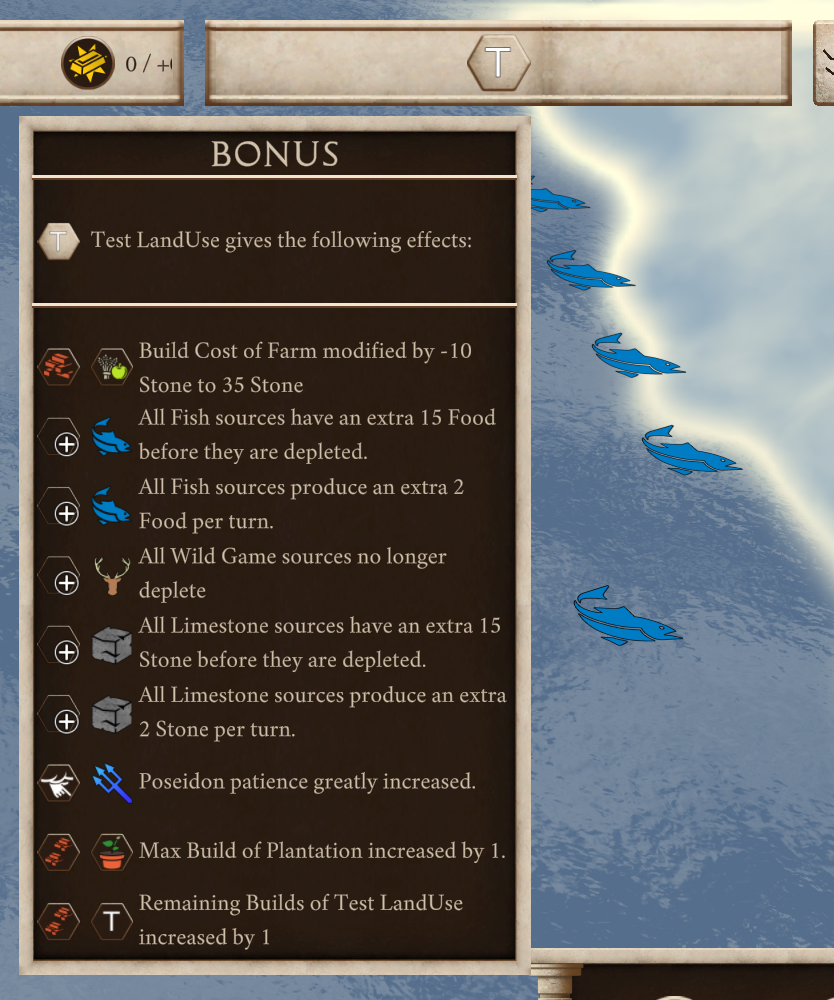
The global bonus system gives the player bonuses (or penalties) right across their empire, rather than being limited to specific land uses (buildings). Amazingly, I've worked on the game for years without ever actually needing such a system, at least until now. However, it's now key to make wonders... well, wondrous!
[center][/center]
To give you a flavour of what this means by way of example, the Temple of Artemis wonder provides a bonus to certain special resources: All "Fish" now get an extra 15 food added to their reserves, meaning they last longer before expiring and produce more over their whole lifetime.
There are still a few more bonus types to add, after which I need to balance and test which wonders give what bonuses. But I'm excited as I think not only will this make wonders a really powerful, interesting part of the game. And the global bonus system can be used for other things as well.
Specifically, there is a feature called "Festivals" on the roadmap, which is ideally suited to use the global bonus system. As well, many strategy games have quest systems and random events systems, which if I ever decide to put into Critias Empire, could tie into and use the global bonus system also.
March of the Gods
Much of the art in Critias Empire is public domain, simply because when I started making the game, I didn't have the money to hire an artist, nor the skills to make the art myself. This however, has proved incredibly limiting, as I often can't quite get the art the game needs, especially if I want to keep the style at least somewhat consistent.
The arrival of AI generated art has left me somewhat torn, as it's clearly going to make a lot of artists, many of whom are my friends and colleagues, either unemployed or relegated to the far less creative work of touching up and fixing AI generated images.
However, ultimately I need art for my game, and the 18th-19th century oil on canvas styles I've been using so far in my game are all from long-dead artists. The results from my experiments with AI generation are scarily good so far. I've been able to generate portrait images for all the Gods in Critias Empire in a fraction of the time and cost that would have been needed otherwise.
Nevertheless, it's a controversial topic, so I want to be as open as possible, and respect anyone who does not want to support the game for this reason.
That said, there is still quite a lot of work to do on each image to bring it to the quality I'm aiming for. I've been using Midjourney so far and it does love to make shirtless greek Gods have far too many muscles. And when it comes to fingers, just about every God so far has had either a horrendous accident with a food blender, or spent a bit too long hanging out at the local nuclear power plant, with the 6 fingers and 7 toes mutations that come with it.
These problems though, are all fixable with a bit of time and my rudimentary photoshop skills. I'll also find out soon how well the AI algorithm handles tsunamis and forest fires.
What's Next?
While wonders still need yet more time, I'm confident they are on course to be an intriguing and integral part of the game.
UI polish is the next area of focus after that, with the first part being the experiments I've already started with AI generated art. This will fill in the holes, and make the game more visually appealing, before I move onto UX improvements and all the gloriously fiddly aspects of perfecting the game's UI.
The prophecy/oracle feature, as well as sea-routes to connect road networks on different islands are also both still (still...) near the top of the todo list.
All of which is aimed at making the game as fun and shiny as possible for the planned upcoming demo. I decided to drop out of the upcoming February edition of Steam NextFest simply because there is too much marketing and promotion work to do between now and then to make the most of it. This way I can concentrate on just making the demo and the game in general, the best it can be.
Devlog 3: New Worlds
Land Ho!
A number of people have mentioned disappointment when looking at the Critias Empire store page that the game only seems to have island type maps.
Well be disappointed no more! The game now supports multiple map types. So far I have re-implemented the "Islands" map type, and also added a "Coast" map type.
New Range
For both the new map types, I took a different approach to topology, with the map gen algorithm creating either areas of uplift or long chains of mountains. These are then surrounded by foothills that gently slope down to plains below.
This gives the terrain a much more natural feel than the somewhat random distribution used before.
A Wide World
I also implemented configurable map size, but in the end, I concluded that a much bigger map gave the feel I was looking for: Something on a grander scale than a city builder, but not the globe spanning scale of games like Civilization.
Strange Places
In the course of making the Coast map type, I didn't quite get the effect I was looking for first time. But I liked the results so much I kept them as a new map type, before continuing with fixing the Coast type algorithm.
This happy accident happened not once, but twice, meaning the game now has an additional two map types:
The "Bays" map type has a shattered coast type feel of inlets, bays and lagoons along a narrow stretch of coast.
Meanwhile, the "Straights" map type is a variation on the Coast map type, with land on two sides of a narrow sea channel. Think something like the Bosphorus, or the famous Pillars of Herecles as mentioned in the legend of Atlantis (today known as the Straights of Gibraltar).
What's Next?
There is still some tidy up to do on the maps. Currently, the whole map is surrounded by sea, but some map types should have some impenetrable hinterland beyond their playable borders. The Straights screenshot above is one such example of where I still need to implement this.
As well, there are two more map types I plan to make before launch - "Peninsula" which should be self-explanatory, and "Inland sea", which will feature a small sea surrounded by land on all sides, akin to the Black Sea or Caspian Sea.
In the short term though, I will work on balancing production and construction costs of various land uses (buildings like farms, mines etc). After that, I plan to do a lot of bug fixing and polishing in preparation for making a playable demo. If all goes to plan, this will be available in December, or at the latest by Steam NextFest in February.
Devlog 2: Sands of Time
Time Marches
It's August! In fact, nearly the end of August, and this month, my provisional penciled-in date for when the game would be released has been and gone. While disappointing for all, it's not a bad thing in the long term. In this update, I'll explain why, and how development and the road to release has changed.
First off, what has been done on the game since the last update in June?
Balancing data spreadsheets have been massively improved.
Buildings (Land Uses) have a whole suite of new variables that affect them.
The city / population growth algorithm has been changed
UIs have been tweaked and improved.
Lost in the Details
Most of the code changes to the game of late have been about giving myself as many possible tools and techniques to balance the game. For example, I added construction timers to buildings. I added restrictions to where buildings can be placed. I added build costs, depending on the underlying terrain. And lots of other similar small things.
All of which I eventually realised was just glorified procrastination. The game might not even need these features, and with each, I was adding complexity to the task of balancing.
However, that's not the only procrastinating-like thing I've been doing. Recently, I've done a lot more research on other similar games, mostly in the 4x genre, but also a bit with colony sims and city builders. Only instead of playing these games myself, I've been watching let's play videos, to see how others play them.
Theory Craft
Turns out, there are two types of player who enjoy 4x and similar games. Those like me, who jump in, play by ear, and from the chaos formulate a strategy for victory. And those who like to craft a strategy beforehand, and then try to execute it in-game.
For both, the starting of a new game and looking at the map for the first time is very important, as it sets the tone for how the game will play out. In the last update, I talked about changes I made to the map generation / disaster algorithm, and unfortunately the way I wrote it starts the player off on one small puny island. The island then expands and changes over a number of disaster cycles in order to give the player a feeling of progress.
This may have ticked all the game design boxes, but it doesn't have the same magic of say a city builder, where players are given a wide open map - a tabula rasa, onto which they can start etching their dreams or grand designs. Likewise with 4x games, starting on one small island means no exploration and no real choice where to build that all important first city. It takes away an important, exciting early decision for the player.
This became especially apparent after playing the neolithic era in Humankind, in which the opening part of that game is all about exploration and getting a feel for your surroundings, with the game rewarding, rather than punishing players taking the time to find a good first spot for an outpost/city.
Get the Feels
If the current map generation algorithm in Critias Empire lacks that buzz of similar games, then what other feelings should the game give?
"One More Turn" Every turn should give the player a feeling of progress, and a decision to make. This is really the signature feel of most strategy games, and definitely something I want for Critias Empire.
"Sandcastles" Building sandcastles on a beach comes with the inevitability that the tide will eventually come in. This is the feeling I want when disasters hit your empire: Preparing as best you can for the waves. Seeing which parts of your sandcastle unexpectedly crumble. Reacting to protect as much of your sandcastle as you can. And finally rebuild back your sandcastle even better!
New Balance
With that in mind, I've made a framework for how to balance the game. The map generation algorithm will have to be re-written yet again, and this will most likely take some weeks. However, I now have a much clearer vision of how to proceed after that.
This has also made me rethink the roadmap. Instead of trying to tick off features from a list, I am now going to wait until the game is giving the right vibes, then polish and expand from there. This means skipping Early Access, with the full launch now happening in early 2023.
Page Turner
With a clearer vision of the game, at least in my mind, I've been experimenting with the Steam Store Page to better get that across. Over the next few weeks, you may see some parts of the store change, from the artwork to the descriptions and roadmap. Don't worry, the game is not fundamentally changing, and no features are getting cut, even if the order in which I do things is changing.
What's Next
As already mentioned, the map generation algorithm, tied in with the disasters, needs rewriting. As well I will finally be rebalancing the stats for buildings and resources. And I still need to think of some ways to make Wonders more interesting and varied. Expect to hear about all that, hopefully with some screenshots of it all in action, in the next update.
Update 2: Sands of Time
Time Marches
It's August! In fact, nearly the end of August, and this month, my provisional penciled-in date for when the game would be released has been and gone. While disappointing for all, it's not a bad thing in the long term. In this update, I'll explain why, and how development and the road to release has changed.
First off, what has been done on the game since the last update in June?
Balancing data spreadsheets have been massively improved.
Buildings (Land Uses) have a whole suite of new variables that affect them.
The city / population growth algorithm has been changed
UIs have been tweaked and improved.
Lost in the Details
Most of the code changes to the game of late have been about giving myself as many possible tools and techniques to balance the game. For example, I added construction timers to buildings. I added restrictions to where buildings can be placed. I added build costs, depending on the underlying terrain. And lots of other similar small things.
All of which I eventually realised was just glorified procrastination. The game might not even need these features, and with each, I was adding complexity to the task of balancing.
However, that's not the only procrastinating-like thing I've been doing. Recently, I've done a lot more research on other similar games, mostly in the 4x genre, but also a bit with colony sims and city builders. Only instead of playing these games myself, I've been watching let's play videos, to see how others play them.
Theory Craft
Turns out, there are two types of player who enjoy 4x and similar games. Those like me, who jump in, play by ear, and from the chaos formulate a strategy for victory. And those who like to craft a strategy beforehand, and then try to execute it in-game.
For both, the starting of a new game and looking at the map for the first time is very important, as it sets the tone for how the game will play out. In the last update, I talked about changes I made to the map generation / disaster algorithm, and unfortunately the way I wrote it starts the player off on one small puny island. The island then expands and changes over a number of disaster cycles in order to give the player a feeling of progress.
This may have ticked all the game design boxes, but it doesn't have the same magic of say a city builder, where players are given a wide open map - a tabula rasa, onto which they can start etching their dreams or grand designs. Likewise with 4x games, starting on one small island means no exploration and no real choice where to build that all important first city. It takes away an important, exciting early decision for the player.
This became especially apparent after playing the neolithic era in Humankind, in which the opening part of that game is all about exploration and getting a feel for your surroundings, with the game rewarding, rather than punishing players taking the time to find a good first spot for an outpost/city.
Get the Feels
If the current map generation algorithm in Critias Empire lacks that buzz of similar games, then what other feelings should the game give?
"One More Turn" Every turn should give the player a feeling of progress, and a decision to make. This is really the signature feel of most strategy games, and definitely something I want for Critias Empire.
"Sandcastles" Building sandcastles on a beach comes with the inevitability that the tide will eventually come in. This is the feeling I want when disasters hit your empire: Preparing as best you can for the waves. Seeing which parts of your sandcastle unexpectedly crumble. Reacting to protect as much of your sandcastle as you can. And finally rebuild back your sandcastle even better!
New Balance
With that in mind, I've made a framework for how to balance the game. The map generation algorithm will have to be re-written yet again, and this will most likely take some weeks. However, I now have a much clearer vision of how to proceed after that.
This has also made me rethink the roadmap. Instead of trying to tick off features from a list, I am now going to wait until the game is giving the right vibes, then polish and expand from there. This means skipping Early Access, with the full launch now happening in early 2023.
Page Turner
With a clearer vision of the game, at least in my mind, I've been experimenting with the Steam Store Page to better get that across. Over the next few weeks, you may see some parts of the store change, from the artwork to the descriptions and roadmap. Don't worry, the game is not fundamentally changing, and no features are getting cut, even if the order in which I do things is changing.
What's Next
As already mentioned, the map generation algorithm, tied in with the disasters, needs rewriting. As well I will finally be rebalancing the stats for buildings and resources. And I still need to think of some ways to make Wonders more interesting and varied. Expect to hear about all that, hopefully with some screenshots of it all in action, in the next update.
Update 1: Shifting Grounds
Rebalance, Replay
Back in April, Critias Empire was looking in pretty good shape. It felt polished and robust. I knew the game needed rebalancing, but I also had a nagging feeling this meant more than just adjusting the numbers. A round of intensive internal testing confirmed a number of my suspicions:
Disasters were a bit too random / arbitrary
Spamming quarries/pastures made the game too easy
The shrines next to wonders winning strategy removed the late-game challenge of keeping wonders alive
Population growth/decline was unintuitive and opaque
Wonders were not very wonderous. They didn't do anything
Moreover, these things contributed to the game being overall less replayable than I had hoped. To tackle this, I decided to take each problem on one at a time. The biggest was the disaster randomness and that's the subject for today's update. As you may have guessed by the title and the fact it's now the start of June, this took a looooong time and spawned multiple side quests along the way.
Terrain Regeneration
I was quite pleased with the old Critias Empire terrain generation algorithm. Every time there was a disaster, it would pick a new origin point somewhere near the centre of the map, then randomly calculate the likelihood of any tile/hex being land based on how far it was from that origin tile. The probability was non-linear - closer in, there would be a high chance of land, then medium distance out would be very low, followed by a decent chance furthest out towards the edge of the map. On top of this I laid a perlin noise pattern to add some randomness.
This generated an aesthetically pleasing effect - both the distribution of the land and the land rising and falling during disasters. However, whenever disaster struck, potentially every tile/hex could change, making it hard for players to plan. Equally no consideration was given to the balance of grassland vs mountains, and the distribution of bonus resources. In short, the randomness was the arbitrary, bad kind of randomness.
A New Land
I won't say how this was solved exactly (as that would give the game away!). But the new terrain regeneration algorithm balances risk and reward for the player much better than before. Areas of the map that are more or less stable offer different bonus resources and so different decisions about what to build, where and when.
The new algorithm also reduces the difficulty early in the game, while ramping it up later on. This should give the game a less "survivalist" feel - as though the player is just hanging on until the one unlucky disaster pushes them over the edge into extinction - and instead give the player a feeling the Gods are toying with them, and that their patience has a limit!
Hot and Cold
Previously, mountain = mines = stone, and grassland = farms = food, and sea was death. And that was about it. Whilst there was an elegant simplicity to the rock-paper-scissors of the three basic resources, (stone/food/prayers), and three basic terrain types (sea/mountain/grassland), it didn't lead to much variety, nor interesting decisions on where and what to build.
Rewriting the terrain algorithm threw up a chance to add in more terrain types. In particular, I wanted forests on tiles to be more than just aesthetic, and to actually have some meaning. Especially since they look different, and so players might expect them to act differently. As well, the map is awfully green and verdant for a game set in the ancient Mediterranean.
The result was something more subtle than I anticipated - Tiles now have an underlying terrain, plus a climate zone (alpine/temperate/arid) and vegetation zone (scrub/forest).
This not only makes the game look a bit more visually varied, but gives an extra axis to consider when deciding where to build - both between individual tiles, and more generally, to build north (cooler alpine) or south (arid, warmer).
Rivers of Tears
The terrain plugin used for rendering the hexes/tiles in the game, while excellent in many ways, was not designed with the idea of parts or the whole map changing throughout the game. This is especially so when it comes to rivers. Since the plugin already had a river module that produced nice looking rivers, I wanted to keep rivers in the game just for aesthetic reasons. But like with the forests, players would not be unreasonable if they assumed the rivers affected gameplay as well. therefore I wanted to also rivers give bonuses or penalties, and so add further variety to the map.
Digging into the terrain plugin code and making rivers persist between disasters was not easy to say the least. Not helped by the many edge cases encountered along the way (what if the old river mouth becomes land after the disaster? Or the start point becomes sea?)
Fortunately I was able to work through these issues, but dealing with rivers alone took me many, many (....) many days.
Bronze Chains
I also wanted to make building and production a bit more interesting, especially when it came to wonders. It had already been theoretically possible to make more complex production chains, but with the planned rebalancing I wanted to actually try this out and make sure it worked as expected.
Thus three new products were added to the game - Copper, Tin and Bronze - with the latter only being produced from the former two in a new "forge" type building. While I don't know if these will make it into the final game, I at least proved the idea (and code) worked for the future.
Spreadsheet Surprise
In the course of rewriting the terrain algorithm and making the new resources, it also became clear I needed a better way to load balancing data into the game. Especially if I wanted to rapidly iterate ideas, requiring custom tools or making a new build of the game each time something needed changing and testing proved incredibly cumbersome.
So I took the chance to clean up the balancing spreadsheets and make them refreshable from inside the game. This could also represent the foundation needed to make the game moddable, though for now I don't want to invest too much more time going down that path.
What's Next?
The shrines and spamming quarries problems should be relatively easy to fix. I will also re-write population growth/decline - population decline is how players lose the game, so it should at least be easy to understand! I will also need to get creative/inventive with wonders. Looking forward to trying out a bunch of ideas with them. Expect to hear all about the results of that, and more, in the next update!
Devlog 1: Shifting Grounds
Rebalance, Replay
Back in April, Critias Empire was looking in pretty good shape. It felt polished and robust. I knew the game needed rebalancing, but I also had a nagging feeling this meant more than just adjusting the numbers. A round of intensive internal testing confirmed a number of my suspicions:
Disasters were a bit too random / arbitrary
Spamming quarries/pastures made the game too easy
The shrines next to wonders winning strategy removed the late-game challenge of keeping wonders alive
Population growth/decline was unintuitive and opaque
Wonders were not very wonderous. They didn't do anything
Moreover, these things contributed to the game being overall less replayable than I had hoped. To tackle this, I decided to take each problem on one at a time. The biggest was the disaster randomness and that's the subject for today's update. As you may have guessed by the title and the fact it's now the start of June, this took a looooong time and spawned multiple side quests along the way.
Terrain Regeneration
I was quite pleased with the old Critias Empire terrain generation algorithm. Every time there was a disaster, it would pick a new origin point somewhere near the centre of the map, then randomly calculate the likelihood of any tile/hex being land based on how far it was from that origin tile. The probability was non-linear - closer in, there would be a high chance of land, then medium distance out would be very low, followed by a decent chance furthest out towards the edge of the map. On top of this I laid a perlin noise pattern to add some randomness.
This generated an aesthetically pleasing effect - both the distribution of the land and the land rising and falling during disasters. However, whenever disaster struck, potentially every tile/hex could change, making it hard for players to plan. Equally no consideration was given to the balance of grassland vs mountains, and the distribution of bonus resources. In short, the randomness was the arbitrary, bad kind of randomness.
A New Land
I won't say how this was solved exactly (as that would give the game away!). But the new terrain regeneration algorithm balances risk and reward for the player much better than before. Areas of the map that are more or less stable offer different bonus resources and so different decisions about what to build, where and when.
The new algorithm also reduces the difficulty early in the game, while ramping it up later on. This should give the game a less "survivalist" feel - as though the player is just hanging on until the one unlucky disaster pushes them over the edge into extinction - and instead give the player a feeling the Gods are toying with them, and that their patience has a limit!
Hot and Cold
Previously, mountain = mines = stone, and grassland = farms = food, and sea was death. And that was about it. Whilst there was an elegant simplicity to the rock-paper-scissors of the three basic resources, (stone/food/prayers), and three basic terrain types (sea/mountain/grassland), it didn't lead to much variety, nor interesting decisions on where and what to build.
Rewriting the terrain algorithm threw up a chance to add in more terrain types. In particular, I wanted forests on tiles to be more than just aesthetic, and to actually have some meaning. Especially since they look different, and so players might expect them to act differently. As well, the map is awfully green and verdant for a game set in the ancient Mediterranean.
The result was something more subtle than I anticipated - Tiles now have an underlying terrain, plus a climate zone (alpine/temperate/arid) and vegetation zone (scrub/forest).
This not only makes the game look a bit more visually varied, but gives an extra axis to consider when deciding where to build - both between individual tiles, and more generally, to build north (cooler alpine) or south (arid, warmer).
Rivers of Tears
The terrain plugin used for rendering the hexes/tiles in the game, while excellent in many ways, was not designed with the idea of parts or the whole map changing throughout the game. This is especially so when it comes to rivers. Since the plugin already had a river module that produced nice looking rivers, I wanted to keep rivers in the game just for aesthetic reasons. But like with the forests, players would not be unreasonable if they assumed the rivers affected gameplay as well. therefore I wanted to also rivers give bonuses or penalties, and so add further variety to the map.
Digging into the terrain plugin code and making rivers persist between disasters was not easy to say the least. Not helped by the many edge cases encountered along the way (what if the old river mouth becomes land after the disaster? Or the start point becomes sea?)
Fortunately I was able to work through these issues, but dealing with rivers alone took me many, many (....) many days.
Bronze Chains
I also wanted to make building and production a bit more interesting, especially when it came to wonders. It had already been theoretically possible to make more complex production chains, but with the planned rebalancing I wanted to actually try this out and make sure it worked as expected.
Thus three new products were added to the game - Copper, Tin and Bronze - with the latter only being produced from the former two in a new "forge" type building. While I don't know if these will make it into the final game, I at least proved the idea (and code) worked for the future.
Spreadsheet Surprise
In the course of rewriting the terrain algorithm and making the new resources, it also became clear I needed a better way to load balancing data into the game. Especially if I wanted to rapidly iterate ideas, requiring custom tools or making a new build of the game each time something needed changing and testing proved incredibly cumbersome.
So I took the chance to clean up the balancing spreadsheets and make them refreshable from inside the game. This could also represent the foundation needed to make the game moddable, though for now I don't want to invest too much more time going down that path.
What's Next?
The shrines and spamming quarries problems should be relatively easy to fix. I will also re-write population growth/decline - population decline is how players lose the game, so it should at least be easy to understand! I will also need to get creative/inventive with wonders. Looking forward to trying out a bunch of ideas with them. Expect to hear all about the results of that, and more, in the next update!



 [/center]
 [/center]