Mark Hamill To Host ‘Thunderful World’ Digital Showcase on November 10th
Hey friends,
we have some awesome news, which we can finally share with you today: We - that's Thunderful Games - welcome all of you to the premiere of our very first digital games showcase ‘Thunderful World’! ːsteamhappyː
Find out more in the following press release:
Gothenburg, Sweden - October 28th, 2021 - International developer and publisher Thunderful Games, creator of the multi-award winning and multi-million selling SteamWorld franchise, is welcoming everyone to a new digital games showcase, ‘Thunderful World’. The event will be taking place on November 10th at 11am PT / 2pm ET / 7pm GMT / 8pm CET, hosted by Hollywood and pop culture icon Mark Hamill. Tune in to the livestream on Twitch, YouTube and the thunderful.world website.
Tune in to see Mark delight us with a ton of exciting new game reveals and announcements from Thunderful. The event will deliver updates on exciting upcoming titles including the surprise indie hit of Summer Game Fest, Planet of Lana. There will also be more news on Thunderful titles like Firegirl, Cursed to Golf, Source of Madness, Tinkertown and White Shadows.
Alongside Mark’s headline hosting role, the event will also feature appearances from Thunderful Group CEO Brjánn Sigurgeirsson, Corporate Vice President at Xbox Sarah Bond, plus a few other surprise industry partners.
Thunderful is proud to be partnering with Xbox and The MIX for Thunderful World. To sign up for the event and be the first to know all the important information ahead of the show on November 10th, head over to thunderful.world. As your one stop shop for all things Thunderful World, the website will be updated with new announcements and reveals as the event unfolds.
Stay tuned and tune in on Nov 10th - see you all in the event! Your Thunderful Games-Team
Spooky new content: Get ready to fight the "Seven Deadly Sins"!
Hey there,
Lock and load and get ready for the brand new "Seven Deadly Sins" update spooking from today on in Dead End Job! Grab your plasma blaster and your trusty vacuum pack and fight the seven deadly sins in blasting battles and unleash new powerful perks and incredible items.
Check out:
8 new enemies!
7 new perks!
7 new pickups!
Thank you all very much for your ongoing feedback and support!
Hey there, it’s Tony from Ant Workshop again! We've prepared the first update to Dead End Job which fixes several issues you've brought up since the launch of the game. Our goal is to provide the best possible experience so all feedback is appreciated!
This update has a bunch of improvements and fixes:
The Music Man achievement triggers correctly
Linux players can watch the intro sequence now
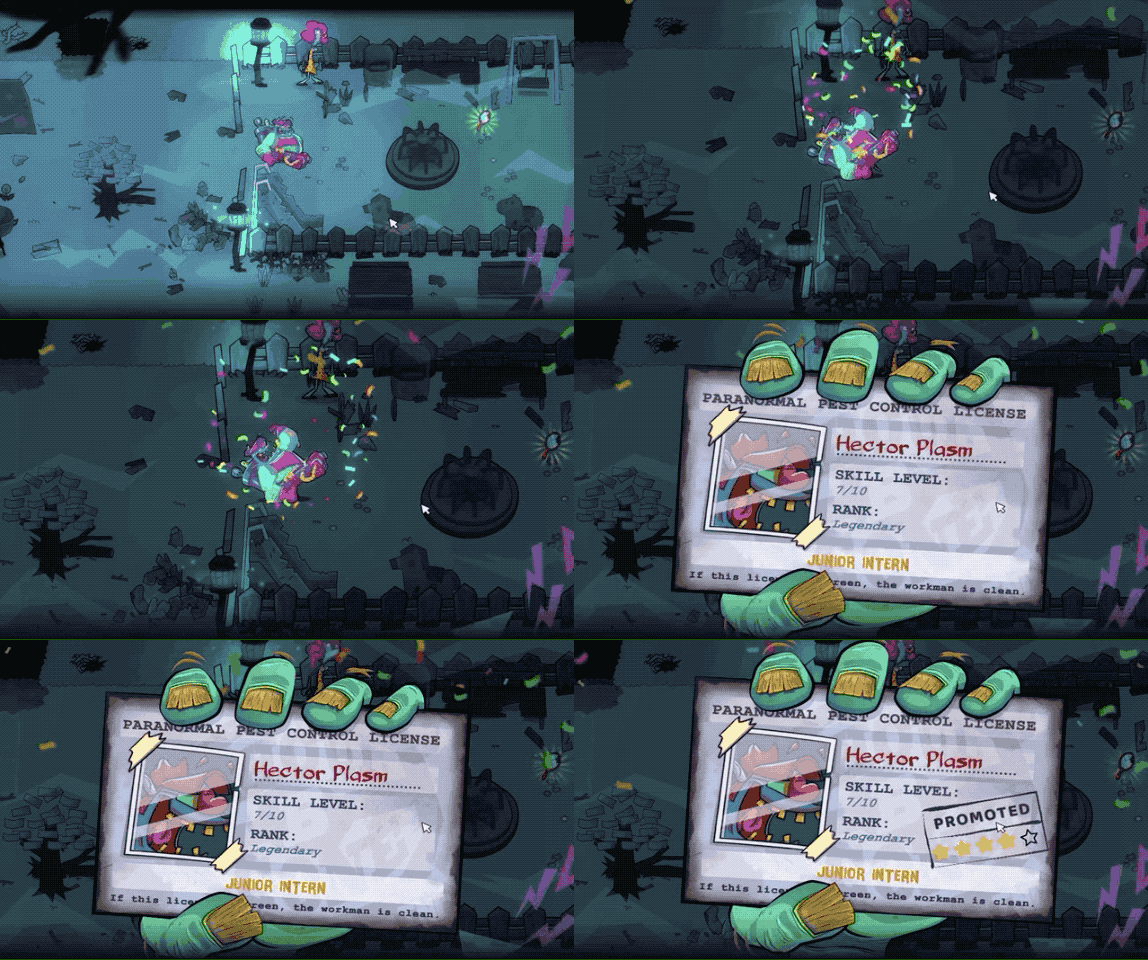
Fixed being able to double trigger promotions
Fixed the Knife Knight from turtling a lot in certain circumstances
You can adjust the sensitivity of aim assist, and it defaults to off
You have to option to replay tutorial messages, in case you forget how to bust ghosts
Some really boring minor tweaks to some kitchen furniture
To stop the patch just being a load of dull bugfixes we've also added 10 new items to the game in what we're calling the "Snacks & Attacks" update! This is a bunch of new stuff to eat and blast ghosts with, like a Chocolate Biscuit, Boxing Gloves and Toy Gun. But hey, I don't want to spoil too much here so update the game and find out for yourself. ːsteamhappyː
Thank you all very much for your ongoing feedback and support!
Hey there, it’s Tony from Ant Workshop again! I have some pretty bad news for all you ghosts out there (but great news for everybody else): Dead End Job is available on Steam right here and right now! ːsteamhappyː
Take on the role of Hector Plasm and get yourself into a madcap, Ren & Stimpy-esque world to bust up ghosts. Dead End Job is a procedurally generated, couch co-op, twin-stick shooter that straps a vacuum pack to your back and puts a plasma blaster in your hand!
Wanna see some ghost blastin' action? Take a look on top of the Steam page and watch Colesy [Twitch|Twitter] playing Dead End Job LIVE. Or get on eye (or two) an our brand new Launch trailer:
https://www.youtube.com/watch?v=m-O0F5Ic59M See you all on your first day at Ghoul-B-Gone!
Makin' A Dead End Job 06: "May the Powerup be with you!"
Hello dear reader, and welcome to the last weekly developer article. I wanted to spend this update writing about the ways that you can make your life easier in Dead End Job, and some of the fun trinkets you can find lying around the locations you bust ghosts.
Just like in real life, the main way that you can make things easier for yourself is by getting promoted, and in Dead End Job this happens whenever you catch enough ghosts. Along with your new job title a promotion also brings the opportunity to pick one of three randomly chosen perks. We didn’t want to show players a big skill tree and allow them to have total choice over how their character build progresses, for two reasons. First, in that situation people will usually figure out an optimal configuration and a whole lot of options will get ignored from that point forward. And secondly, looking through all of the options and making the choices would slow the game down, whereas showing just three choices keeps things nice and snappy.
So this method encourages playing with different power ups, while still allowing you some choice over your build. Some perks also lock out others from being available - for example poison shots & cold shots can’t be chosen on the same build. We found that some combinations, like bouncy shots and multiple shots, were very funny but totally broke the game with how overpowered they were!
Not all perks affect your guns, and some of my favourites affect the game in other ways.
For example, Verbal Warning gets you a free pass from HR, so you get to keep all of your other perks if you happen to get demoted. This is a super useful one!
King of Combo gives an increasing bonus for capturing ghosts within a short space of time, and Occult Catching Dividend gives you a bonus for capturing the ghosts in a room in the order the game tells you to.
Speed Demon (which gives an extra reward for completing jobs as quickly as possible) combined with the Cash Converter (which gives you less frequent promotions, but more money per ghost) is a very good combination for speed runners hoping to complete the month as quickly as possible.
And then there’s Supercharged Vacuum which allows you to use the vacuum to suck up the ectoplasm that ghosts shoot, quickly switching between attack and defence.
Our sense of humour is kind of the core thing running through the whole game, and I think that’s most clear in the selection of weird items that you find lying around. We wanted one hundred of them (because arbitrary large numbers make me feel like I’m earning my wages), and we had a crazy amount of fun thinking of stupid things, and what they might do.
Items are spread across different rarity bands from “Common” at the bottom, all the way up to “It Belongs In A Museum” and this affects how likely you are to stumble across an item on any particular job, and how well guarded they might be (rarer items tend to be further from the entrance room, and are sometimes even coated in a slime shell - so you’ll have to clear the room to collect them).
Common items can often be discovered by smashing up furniture as well - Though remember that Hector only has two pockets, so don’t be stingy about using anything you find!
Obviously as the game’s developed in Scotland, we had to put in some bagpipes that blast out a jaunty jig that hurts the ears of every ghost nearby. (Tony note: did we actually have to include them? Should probably check with legal on this. They really do sound bloody awful.)
You can make Hector radioactive, or shrink him down tiny, or make his head huge, or how about just turning him in to a magical unicorn, leaving a trail of rainbows?
There are a selection of weapon items, and these are all useful because as well as firing in a different way to your usual plasma blaster, they also don’t cause any heat buildup. The railgun is particularly powerful, but tricky to master as it has a short charge-up time before blasting energy straight through enemies and scenery alike.
And so, the last(?) “Makin' A Dead End Job” article comes to an end. I really hope you’ve enjoyed reading these weekly looks behind the scenes at the team and how the game came together. I’ve really enjoyed writing them, even though there’s still so much I could still write about - more items, weird enemies, silly jokes and daft scenes, not to mention the Twitch and Mixer interactivity! And if you’ve still got a thirst for even more concept art, there’s a gallery within the game with thirty unlockable pieces.
Dead End Job launches on Friday 13th December (wooOOoo spooky), hope you enjoy it!
Thanks again, Tony xxx
PS: Here is an artist’s impression of me getting a phone call from Valve about how many copies we’ve sold – please help make it come true!
Makin' A Dead End Job 05: "Caught in the Dead End Loop!"
“Ok so now I know about the devs, how you came up with the idea, the art style and the characters, but what do I actually do in Dead End Job?” I hear you ask, ”Is it a dating simulator, or a match 3 game, or a kart racer?”
No, friend, it is none of those things (but a kart game where you date 3 matching ghosts at the same time sounds pretty good doesn’t it?). Dead End Job is a game where you shoot ghosts and then catch them, to try and earn as much money as you can - basically a very realistic job simulator, then.
You work for Ghoul-B-Gone, the self-styled “number one experts in paranormal pest control”, and this lovely map shows where customers all across the city are having an outbreak of ghosts. So pick a job and get to it!
Alright, now you’re in an office (or park. Or restaurant. Or … ) and it’s full of ghosts. Pop quiz, hotshot - what are you going to do? You’ve got two goals on every job. Firstly, you need to rescue all of the stupid idiots innocent civilians who have been slimed and trapped by the ghosts. You do that by capturing all of the spooks in that room. Easy.
“But how do I catch ghosts, Tony?” eurgh, so many questions today! Dead End Job’s combat happens in two steps. First of all you wear down an enemy’s health with your plasma blaster. So far, so standard shooter. Once a phantom’s taken enough damage they become stunned, and this is your chance to rush in and vacuum them up while they can’t fight back.
We went this route because it means that players have to get right in close to the combat, and can’t just sit across the other side of the room taking pot-shots. If there’s a group of enemies you need to keep on the move and try and use their behaviour to split them up so that you can get in and capture stunned ghosts without taking damage yourself, because if you leave a stunned enemy for too long they’ll recover and get angry. And you wouldn’t like an angry ghost, believe me.
Your second goal on a job is to make as much money as possible. Just like in real life. Every ghoul you bust and person you rescue gets added to your client invoice (along with a few extras, such as equipment wear-and-tear, biscuit tax, cups of tea, and the like), and you’ll also find plenty of loose change to hoover up. Top tip: sometimes you might have to “encourage” money to “fall” out of furniture by shooting it repeatedly with a plasma blaster. (Don’t worry about damaging things in the process of getting rid of the ghosts - the clients agree to an extensive damage and liability waiver as part of Ghoul-B-Gone’s terms of service.)
Catching ghosts also has another benefit, as it fills up your promotion bar. And what happens when you fill up your promotion bar at work? That’s right, you get promoted. A new job title, increased respect from your co-workers, and most importantly a sweet employee perk. You get three to choose from, and these make your weapons more powerful, improve Hector’s abilities, or generally give you some other useful side effect. Perks are persistent between jobs, you only lose them if you get demoted (unless you have the “Verbal Warning” perk - then HR just gives you a telling off).
Long term in Dead End Job you’re trying to save Beryl’s soul, of course. You have 30 jobs to earn enough money to … well I don’t want to give away any spoilers, but it’s pretty big. You’ve also got Hector’s scrapbook to fill up, it keeps track of every ghost you’ve defeated, and all of the weird items you’ve picked up and used.
We also have a challenge system, where you can earn extra cash by completing really arbitrary goals. And not just cash - this is how you earn tokens to spend at the art gallery, and unlock wonderful behind-the-scenes concept art to look at.
So that’s a kind of breakdown of how Dead End Job all fits together. A lot of the gameplay comes from my frustration with being a bit bad at action roguelikes, and getting annoyed when I lose two hours of game progress to a boss fight I couldn’t practice. So I wanted to make something that you could play in smaller chunks and that would keep better track of your progress, while still giving you plenty of stuff to do and variety of things to see. I think we’ve struck ka pretty great balance, and I hope when you play on the 13th of December you feel that way too!
Makin' A Dead End Job 04: "Proudly Presenting Ghoul-B-Gone"
Hey, welcome back - this week I’m going to be writing about the workers of Ghoul-B-Gone, and some of the ghosts they fight.
We set out to create a cast of characters based at a blue collar job. I didn’t want a typical hero and felt that making a world where ghost catching would be as glamorous as any other pest control was a nice twist. None of the people you rescue are afraid of ghosts, they’re just annoyed at the inconvenience to their day.
There’s comedy in contrasting the whole weird supernatural aspect of the game with the mundanity of office life, and I felt like this would make it easier for people to jump in and instantly understand the characters and the relationships between them (since everyone’s worked a job with a terrible penny-pinching boss, an over-eager young trainee, terrible ungrateful customers, etc).
At the same time I wanted to keep the cast pretty small for production and script reasons - it feels pretty odd if you have these characters floating around on the sidelines that don’t really get involved in any meaningful way.
So who have we got, then?
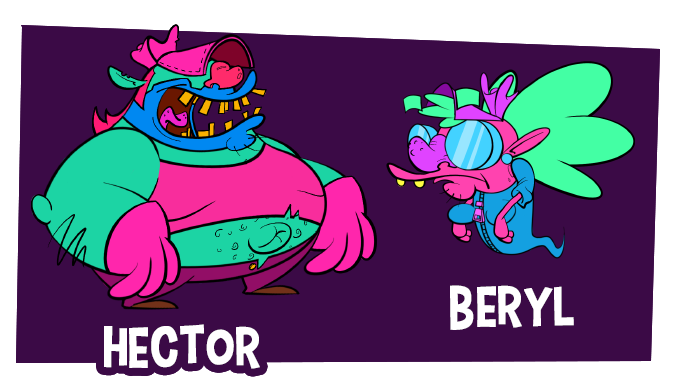
Hector - mentioned last week, as soon as I saw the big lad on one of Joe’s early sketches, I knew he was our main character. Personality-wise he’s a mix of Spongebob and Dan Goodman from Arachnophobia, he absolutely loves his job and approaches it with huge enthusiasm no matter what gets thrown at him. At the same time we were careful not to infantalise him and he’s not an idiot; I didn’t want to go the Homer Simpson route as I didn’t want any kind of implication that only a stupid person could enjoy this kind of work.
Beryl - Hector’s mentor. Originally the idea for the game was that you’d be earning money and competing with the other staff to become “employee of the week” (a basically worthless accolade), but this felt a bit selfish and not a very good motivation for Hector. After shuffling things around we came up with the idea of saving this legendary (but recently deceased) ghost hunter’s soul before she became trapped forever. Beryl’s seen it all, and her world-weariness works as a contrast to Hector’s enthusiasm.
Mr Theodore Mann - the stereotypical money-grabbing mean spirited boss, as seen in Mr Crabbs, Scrooge, Mr Burns, etc. Also yes, Hector is literally working for “T. Mann”.
Louise - we needed someone who could actually move the plot along and help Hector in his quest by creating a device that would let him access the ghost dimension, and for gameplay reasons we wanted this to cost a tonne of money. The idea of Louise buying spare parts with the cash and then taking the company’s ghost storage (Apparition Containment Unit and Linen Laundering Tool, or ACULLT for short) so that she can rebuild it as an unstable portal just felt nice, and allowed us a slight nod to Ghostbusters (I know, ok. I know) with the ghost containment being a pivotal device.
Lex Orcist - pour one out for poor Lex who was originally going to be Hector’s rival for employee of the week, a young whippersnapper of a kid keen to go places. I think the character brief was something along the lines of “like the youngest and most annoyingly enthusiastic salespeople at a mobile phone shop”. But ultimately once the story was re-written to be more about Beryl and Hector’s attempts to rescue her soul, there wasn’t really room for him in the game - he was only in a couple of cutscenes and it was confusing to keep him around. Who knows, maybe he’ll turn up again at some point in the future? I kinda like the spotty little kid.
So that’s our line-up of the heroic-ish staff of Ghoul-B-Gone. But we also needed a whole raft of crazy ghouls for you to fight!
We really wanted to go crazy with these and nothing was off the table. The main thing was that we wanted them to feel like spirits, rather than dead people, so there are no zombies and though some have accessories and backstories that hint to a human past you really don’t feel like you’re zapping folks. Enemy ideas came from a mix of just bad jokes and things that we thought would be visually funny - these are a few of my favourites.
The Poultrygeist was one of the very first ghost ideas, as well as a very strong pun name, I was in love with the idea of this wandering around bum-first, dragging its snapped neck behind it, and firing eggs at you.
For a while there was an idea that the ghosts could appear from scenery, rather than spawning in, and they could be disguised to surprise you. The ZX Spectre (another excellent pun, and Joe’s work) would sit on a table amongst other computers, before coming to un-life. In the end it was too easy to tell them apart, and the idea of camouflaged enemies was dropped. But we kept this computerised menace.
When we were brainstorming things in an office that people would love to shoot, the Office AssistHaunt (less strong pun) was pretty high on that list. It was also the first enemy designed as a kind of mini-boss, which would take more of a beating than usual, and would have a few attack patterns based on the different shapes it could twist itself into.
Finally, I think the Horrorse was the first enemy that we came up with for the park. These weird wobbly pieces of play equipment felt perfect for a good possession, and exactly the sort of thing that would bounce around chasing after you with cold menace in their evil eyes. No, I actually had a very happy childhood, why do you ask?
That’s all for this update - Hope to see you again next week when I’ll be writing about what Hector’s Dead End Job actually is!
Makin' A Dead End Job 03: "The Art & Style of Ghost Busting"
Hey there, it’s Tony again! How has your week been? Oh no, your boiler’s broken? That’s always a pain, especially going in to Winter.
Anyway, in this update I wanted to write a bit about the thing that probably first drew your attention to Dead End Job - the lovely art. As I mentioned in an earlier article, I realised that my art “skills” wouldn’t be anywhere near good enough to do the game justice (if you want to know the extent of my art ability - the main characters in our first game were a pair of circles).
I would like to say that I searched high and low to find someone who could bring the vision to life, but it’s not true - at this point I didn’t really have a vision of what I thought the game should look like, and I also knew Joe from hanging out with mutual friends at a developer conference, and enjoyed his squishy deforming animation style, so I quickly got him on board.
Now, not being an artist, I don’t want to get in the way of “the talent” that much, so there were only two bits in the art direction I gave Joe:
No pixel art
Has to be eye catching
Not that I have anything against some well done pixel art, and there are some gorgeous games out there that do it amazingly, but at the time I felt like the other games we’d be compared to were Enter the Gungeon, Binding of Isaac, and Nuclear Throne. Since they’re all pixel art, I wanted Dead End Job to stand out from them.
He got to work finding references of brightly coloured cartoons and artwork, and bunging them together in to mood boards. You can see a progression in ideas from the flat colours in the first board, through much punchier contrast in the second, and on to the cartoon style we eventually found.
From this he did some quick initial character sketches as a colour test - what I still find amazing about this picture is that Hector was pretty much nailed from day 1, though originally Joe thought of the big guy as being more of the mentor with you playing as the skinny kid in the bottom left. As soon as I saw him I knew he had to be the lead, he’s just so full of enthusiasm and character.
The final step for the main visuals was to make a mockup screenshot, so that we had something to aim towards as we put art in to the prototype, as we needed to get a feel for how the characters would sit in a typical level, how big they’d be, and how easy they would be to visually tell apart from the backgrounds.
This update’s already a lot of words and I haven’t even talked about the title sequence yet! Once we knew we were going for the 90’s cartoon look, I was dead set on having an animated intro sequence to the game, with a theme tune. For me, the bit above everything else that sticks in my head about cartoons like Animaniacs, Spongebob, Taz-Mania, and my all-time favourite Freakazoid, was the 30 second sequence and song that rapidly introduces you to all of the characters and the set up of the show.
You could watch any episode and these action-packed tunes get you quickly up to speed. For an action game I think it’s a brilliant idea as well - I’ve played a lot of games that have fast paced arcadey gameplay, but that spend a long time at the start introducing the characters and telling you what you’re doing. I wanted Dead End Job to basically take 30 seconds to say “here’s everyone, you’re rescuing Beryl, but also now forget about all of that, it’s not really important”.
I guess the last thing to talk about art-wise is the variety of art styles in the game. The cartoon references we’d picked used occasional cut aways to close ups with really gross amount of detail, or to live action segments and still, or just something weird to give it an extra surreal moment. To us, this meant we really had free reign to mix it up a bit depending on the context.
So for example we wanted the cutscenes to use a style that emulate cel animation a little bit better than the in-game graphics do (with no lighting, and characters drawn bolder against softer background colours). There are also a couple of points in these scenes were we use cutaways to real world stuff - the sequence where you first see Hector’s handbook in particular still makes me laugh now.
]
Right, I think that’s plenty for this week? Since I’ve talked so much about Hector and Beryl, I think next week it would be a good idea to give you a proper introduction to the rag-tag staff of Ghoul-B-Gone, and some of the ghosts you’ll be fighting.
See you next week (and I hope you get your boiler fixed by then)!
Makin' A Dead End Job 02: "A Shooter Without Killing"
Hello, it’s Tony again! After last week’s post with the team behind Dead End Job, I wanted to write about how the game itself came to be.
The very core of it came from asking the question “how would you make a twin stick shooter without any shooting?” I really enjoy playing games like Enter the Gungeon, Binding of Isaac, Nuclear Throne, and Tesla vs Lovecraft (though I am usually quite bad at them - more on that a different week, I think!) and wanted to make something along those lines, but at the same time they all focus pretty heavily on killing things, and I wanted to try and approach the genre from a slightly different direction.
A few ideas came to mind. One was being a firefighter, spraying your hose and trying to rescue people from a building (the idea of rescuing people survived to Dead End Job, but ultimately fire and hoses seemed like a bit like one-note combat that would get repetitive quite quickly). Another was going in to messy hotel rooms and vacuuming up all of the rubbish (I’m pretty sure that a couple of games have since done this).
That second idea reminded me of Luigi’s Mansion and Ghostbusters (one of my all time favourite movies - pretty much the entire “you’re pest control billing clients” element of Dead End Job comes from it) and so I stuck some ghosts in it. Ghosts make everything better. We ended up with a very ugly gameplay prototype (I was deliberately keeping to abstract coder art at this point) where you went room to room sucking up ghosts with a vacuum and a kind of tug-of-war mechanic.
Unfortunately I found that it wasn’t very satisfying with lots of enemies on screen, as the tug-of-war kind of locked you in to fighting one enemy at a time, and the others would break you out of it. And after getting other people to play I realised that it was really hard to judge where the vacuum was, and what they could reach (a problem you don’t have with shooting - you can always see where your projectiles are going) so players were either getting frustrated because they were standing too far away, or because enemies were breaking out of the sides of the “funnel”.
I went back to the drawing board a bit, and thought more about Ghostbusters (this is a recurring theme in the game’s development). I realised that they shoot the ghosts and trap them to weaken them with a very visible weapon before the capture happens. It took just half a day to quickly hack in a system where you fired energy balls and had to shoot ghosts enough first to weaken them before you could suck them up, and it felt massively better. It just clicked with everyone we handed it to.
A few things in the game have been developed like that: the damage to the places you go is another example. Originally you didn’t cause any destruction at all, which was ok (shooting ghosts was still fun) but something felt a little off. Then one night I was re-watching Ghostbusters for the 100th time (I told you this was a theme) and I realised that making a huge mess, and then billing the client just the same is satisfying and funny!
Over the course of the development we’ve spent a lot of time taking the game to shows and events and then tweaking things. It’s really great seeing how people play and what the expect to happen, and then being able to adjust the game so it’s less frustrating. It’s helped the controls massively as we saw that some people just try to use one joystick to move and aim, whereas some people are very familiar with twin sticks.
An early version of the game kind of worked like a side-scroller, with you unable to shoot straight up or down (think something like Streets of Rage), but we saw pretty quickly that it was too unusual and went against how people expected the game to work (though some of this still exists in the final version - ghosts very rarely attack straight up or down, so get above or underneath them and you’ll be a bit safer. Top tip!)
Players helping us find what we'd done wrong
So that’s how Dead End Job came to be a “thing”. Come back next week when I’ll write a bit about how it looks as lovely and cartoony as it does!
Hello! I’m Tony and Ant Workshop, the developers of Dead End Job, is my company. So I guess I’m probably the best person to tell you all about us and how this crazy ghost-filled shooter came to exist. Which I will do, over the coming weeks. It’ll be exciting, waiting for the next instalment. Like TV in the old days!
Ant Workshop’s based in Edinburgh, Scotland (which is a lovely city that is exactly the right size and that has a brilliant fringe festival every year), and was a one-person indie company.
“One person,” you might be thinking, “one person made Dead End Job?” Blimey. Well, reader dear, I have been in the games industry for quite a while. I graduated university in 2000 and went straight in to my first games dev job, based off the back of a whole load of Half-Life and Counter-Strike (1.6 - old school!) levels I’d been making in my spare time, and sometimes instead of doing my actual university work.
From there I got jobs working for Rockstar (on all of the handheld GTA games, as well as Red Dead Redemption) and later Activision (we made a fun Call of Duty that was half first person, and half top-down tactics). I’ve worked at a bunch of other places as well, and eventually decided to go indie in 2015.
But no, obviously a game as brillo as Dead End Job needs more than one person to make it. And I was lucky enough to be able to find a whole bunch of amazing freelancers who have the same Saturday-morning-cartoon-infused sense of humour as me. So ultimately a core team of five people (3 artists, a designer, and me) brought the game to life:
Joe was the first, and is the lead artist. I knew early on that the art style would be key to the game’s vibe, and when I saw that his website had a banner image that was basically a little cartoon version of himself dancing away, butt naked, I had to get him on-board. Joe’s own art style is squishy and stretchy and brilliantly cartoony, and was a perfect fit for what I had in mind.
Searra was the next to join, and has done all of the game’s UI and enemy introductions (so any time you see Hector’s hand close up and it makes you feel a bit queasy, that’s her!)
Ewan did all of the graphics of the locations you get called to, to bust up some ghosts and rescue some fools. He also made the Ghoul-B-Gone office, which is probably quite close to how our own office would look if we had one (because the team are all freelance, everyone works from their own homes - which is very nice and convenient and also means that I know what all of their bedrooms look like, which I guess is slightly weird).
The last to join was Val, who brought Ewan’s environments and Joe’s ghosts to life and made it so that enemies were fun to fight against and didn’t all just do the same thing, and that “accidentally” shooting stuff would often make it explode and sometimes give you money, which is the hallmark of a great game in my humble opinion.
But that’s just the core team! There were so many other talented wonderful people involved as well. Will who did the audio (including singing the theme tune), Xalavier who wrote the script (including writing the theme tune), Korina who did the marketing (and was not involved in the theme tune), Steve who came up with the game’s ghostly logo, a handful of coders who each popped on to do little bits and bobs that I am not clever enough to write myself, and a bunch of artists who gave our milk cap collection the variety of styles it needed.
And then there are all the ace people at our publisher, Headup, who laugh at all our dumb jokes and gave us lots of support and amazing advice about bits to tweak and add based on their frankly scary amount of Binding of Isaac knowledge (Tony’s note: I did write this, they didn’t edit it in after I sent them the text. Honest.)
Anyway, that’s a lot of words about the wonderful people (and me) that are behind Dead End Job, so I think we’ll wrap it up there. Thanks for reading, and hopefully you’ll come back next week when I write about how the idea for the game came about in the first place.










 ]
]


