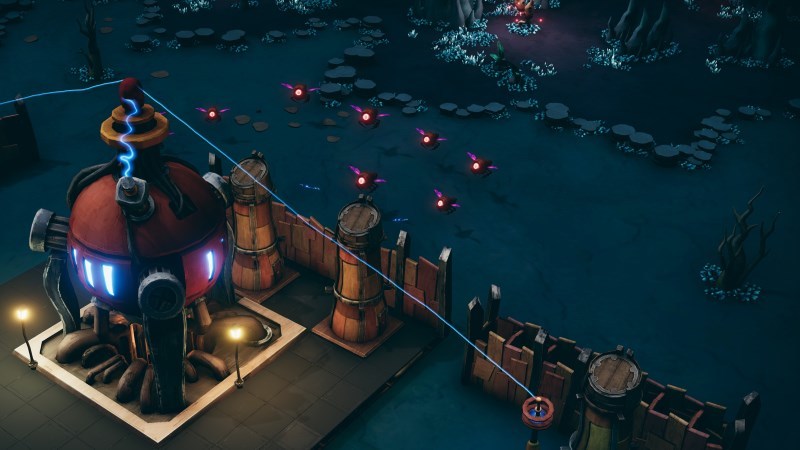
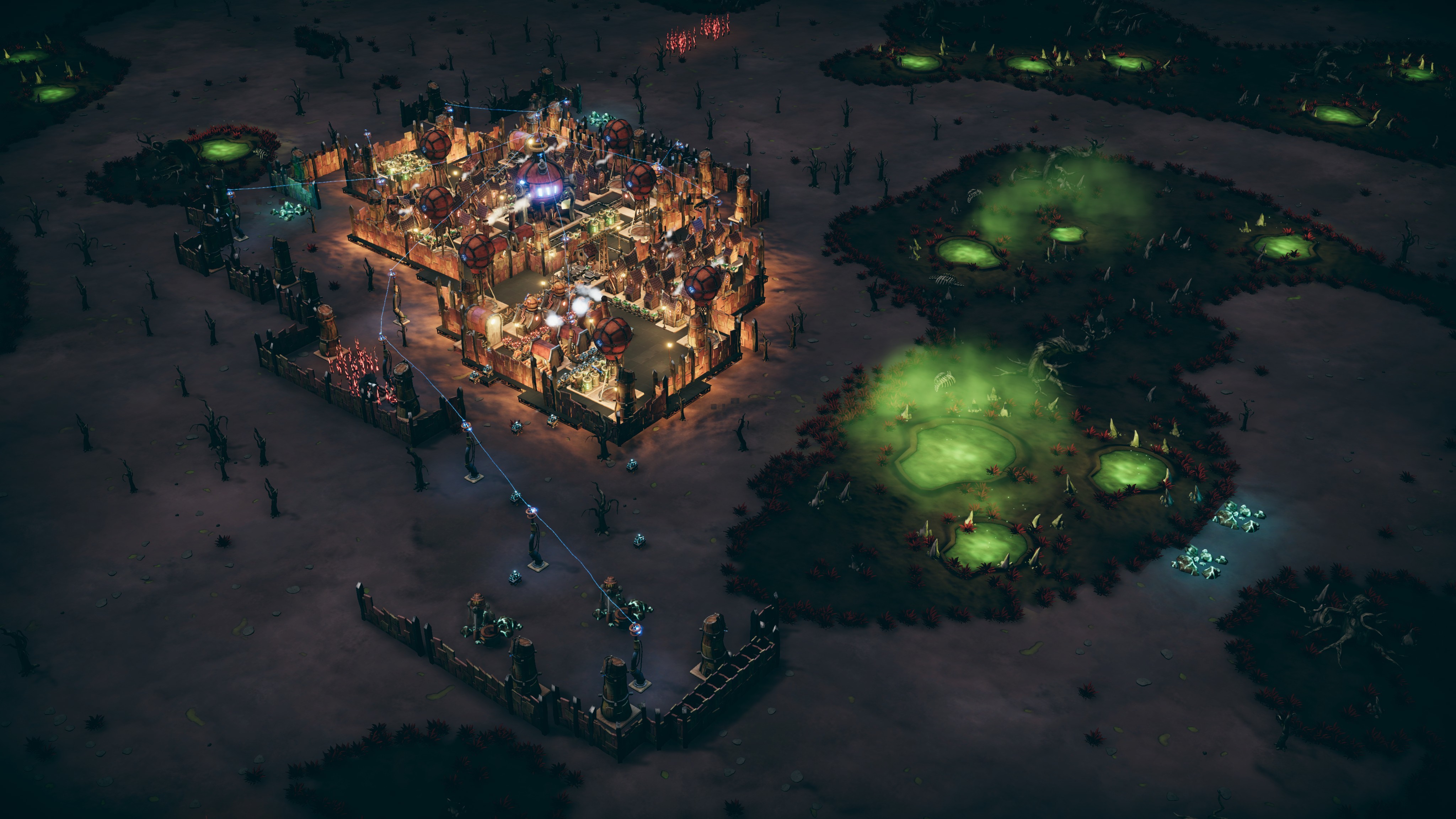
Dream Engines: Nomad Cities - Outskirts update is live
Overseers,
The outskirts update is a significant change in how you play the game. It was mainly directly influenced by feedback we got from alpha players, that there's too much focus on walking around and fighting with your character, while not enough city building. I consider dream engines primarily a city-building game, above the action and exploration aspects, so I spent a hefty amount of time trying to analyze and figure out how we got here, and what can be done about it.
The outskirts is a step in the right direction. The main idea is that you can now build most of the buildings, including your industry, outside of the city (the 'outskirts'), and that you are now able to and even encouraged to take over additional areas of the map, build there, and defend those areas. The main difficulty we faced in that aspect is that every time you fly, you are forced to abandon a good portion of your buildings, which are built outside. So I had to re-balance the entire economy, making basic buildings much cheaper and easier to build, and made map stays longer, to make it worthwhile building outside, temporarily enjoying a stronger economy, and then scrapping some of these buildings before leaving.
This change also puts more emphasis on the need to balance between short-term, cheap constructions outside the city, which you benefit greatly from, but only for a short time, and building within your city or expanding it, for slower, but longer-term bonuses that stay with you forever. It was always our intention for you to make these kinds of meaningful choices, but it was somewhat diminished along the way, and I am happy that it is now much more significant.
As always, I'd like to thank all our early supporters and all of you who sent us feedback. If you haven't joined our alpha yet, check out our supporters page to find out more.
Below is a list of the most significant changes in this update. You can see the full list of changes in this link.
Note: Since the change is so significant, saves from previous alpha versions are not supported. If you wish to continue your old games, you can still play the older version by selecting Alpha 1 or 2 from the betas tab on Steam.
The outskirts - building outside the city
To make the city-building aspect of the game more meaningful and a part you focus more on, we needed to add more building space, and make the environment you build in have more impact on how you build, otherwise every game can turn out the same. Since the main city area is pretty much static, we turned to the outskirts - building outside your main city platform.
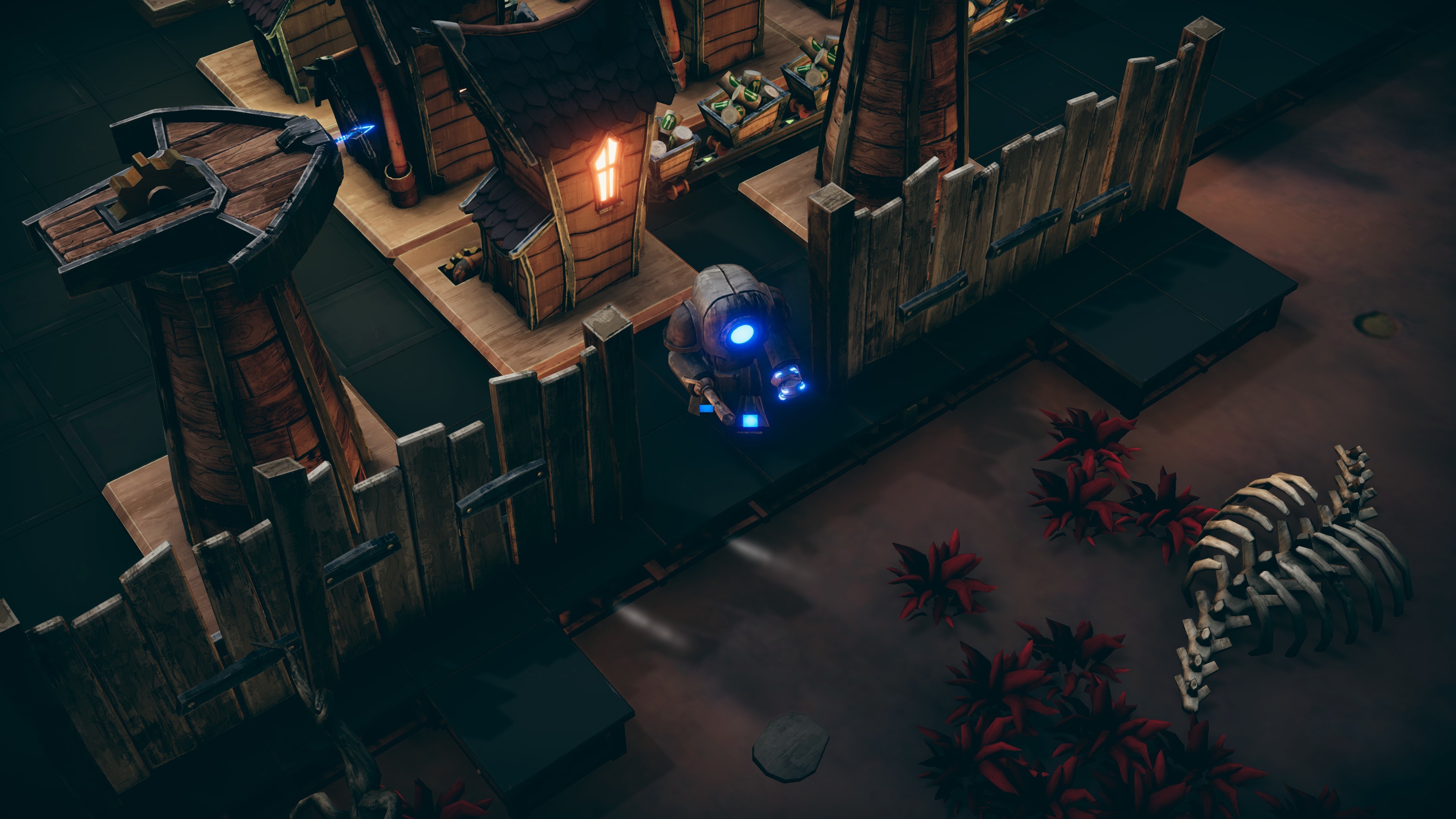
Almost all buildings and infrastructure (like rails) can now be built outside the city. The starting city area is now much smaller, each section you add is also smaller, but also less expensive and available earlier in the game, so long-term you can still achieve large city sizes and take more buildings with you, if you choose to spend your resources on that. Choosing which buildings to take with you when you leave is now a real dilemma, but you can move almost all buildings at any time, including moving them inside or outside your city, so your decisions are not permanent.
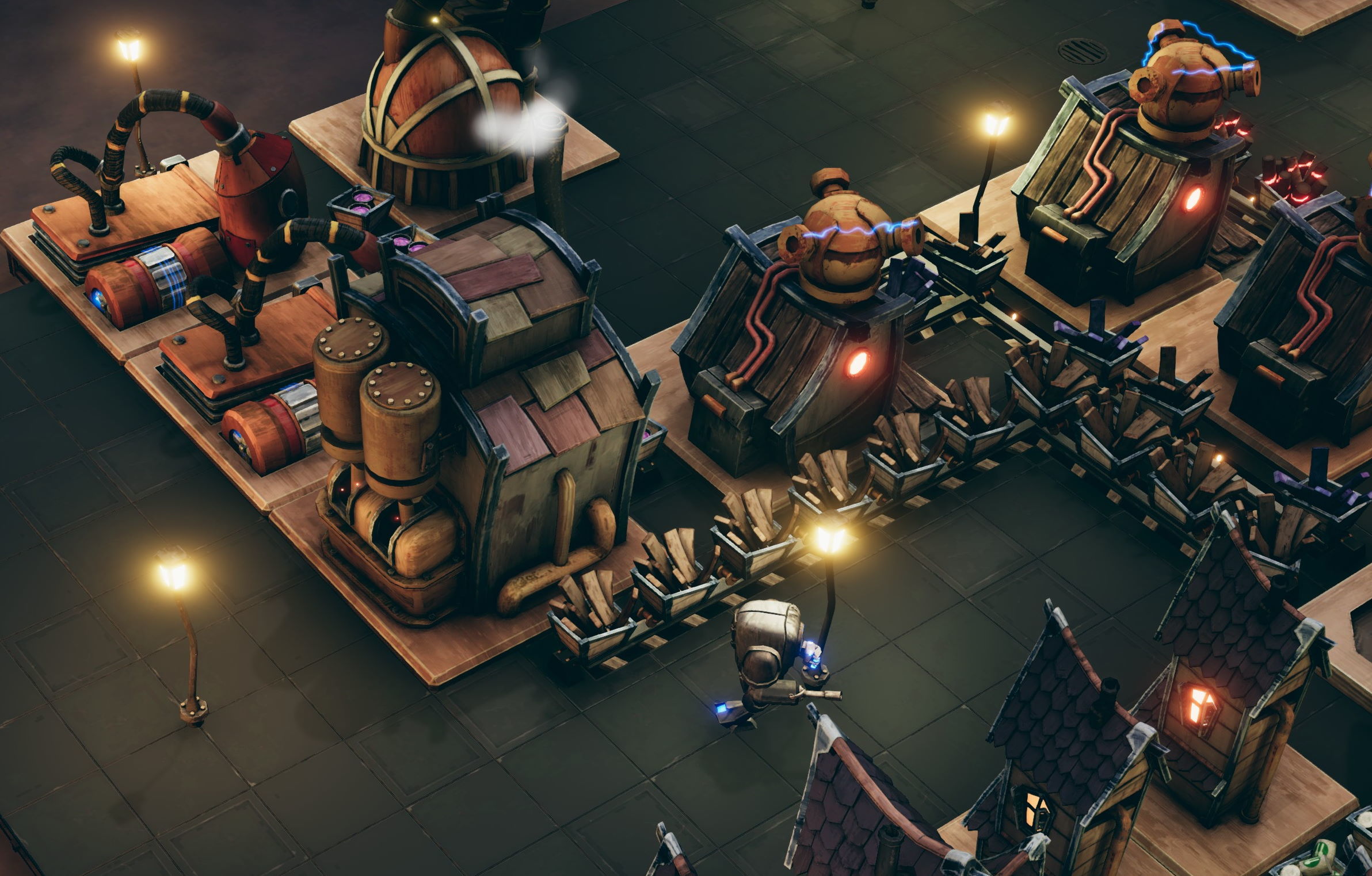
To support this change in gameplay, encouraging you to build more without having to feel too bad about leaving things behind (though you can scrap them and get 50% of the building materials back), we had to significantly reduce both the costs and effectiveness of production buildings. The basic production buildings such as wood-warpers, farms, flux vats and power generators are now much cheaper to build and to maintain, but also produce less (without upgrades). This encourages you to build and optimize the area outside your city, and take over & defend new areas to expand. Defense costs have also been reduced accordingly to make it easier to defend larger areas of the map.
Raids and threat levels
Our previous balancing was high-pressure & short-time, always giving you the feeling that you need to do something or be left behind. This created two problems with our new gameplay. One, you couldn't afford to spend a lot of time in the city building, planning and re-organizing, because you were always under pressure to explore and gather more resources. The other was that if your stay in each map is so short, then you aren't able to enjoy the benefits of what you build outside before you have to abandon it, and you can't exploit much of the map.
So, while we kept some of this pressure, and you still need to progress fast enough or be unable to handle the swarms of Drep (except in relaxed mode) - we did mellow it down significantly. We increased the amount of time that you can spend in every map before you have to leave. We replaced the 4-threat-levels and the extreme threat stage (which basically meant you had to go or die horribly no matter how strong you were).
Instead, threat levels are now a numeric value, starting at 0, and increasing as long as you stay in the same map. The higher the threat level, the stronger the raids on your city, but there is no hard limit in which you must leave, as long as you still have stuff to do on the map and the defensive capabilities to survive, you can stay. Once you fly away and land in a new map, the threat level will reset according to the new map's difficulty level.
Resource Harvesters
You can now build harvesters from the start, and they are the only way to collect resources from the larger nodes, no more running around punching huge resource nodes. You can still destroy the smaller nodes for some extra resources.
Other than that, you can now build rails to send resources from the harvesters to your industry. Resource nodes also have a much larger yield, so they will last for a longer time, and once they are depleted, they still continue to generate resources, but at a much lower pace.
The resource elevator (renamed to resource drop-off) can still be unlocked to automate delivery of resources from harvesters to your industrial area, without having to build long winding rail tracks from faraway resources. It can now be built outside the city, or you could still build it on the edge of your city if you prefer.
Procedural Map Generation
The map generation algorithm has been slightly changed, making most clearings smaller and having less exits. This means you will need to capture more areas in order to expand (since each area has limited construction space), but also makes them easier to defend. Resources are now also distributed a bit more evenly, and there are less of them (but they lost longer as mentioned before).
Refining
In the outskirts update, you can no longer carry raw resources with you when they fly (they are too heavy or volatile). So just exploring and collecting resources will not do you much good, you must have a strong economy to support a massive industry, and refine as many of these resources before you leave. Currently there is no storage limit, so the more resources you refine the more you can take with you when you fly away.
These include purptatoes, raw copper, bloodwood logs, and raw featherstone (which you can now refine).
Building Add-ons
Building add-ons are a new mechanic. They work somewhat similar to upgrading building levels, but they are not linear and their effect is usually more significant than just increasing production.
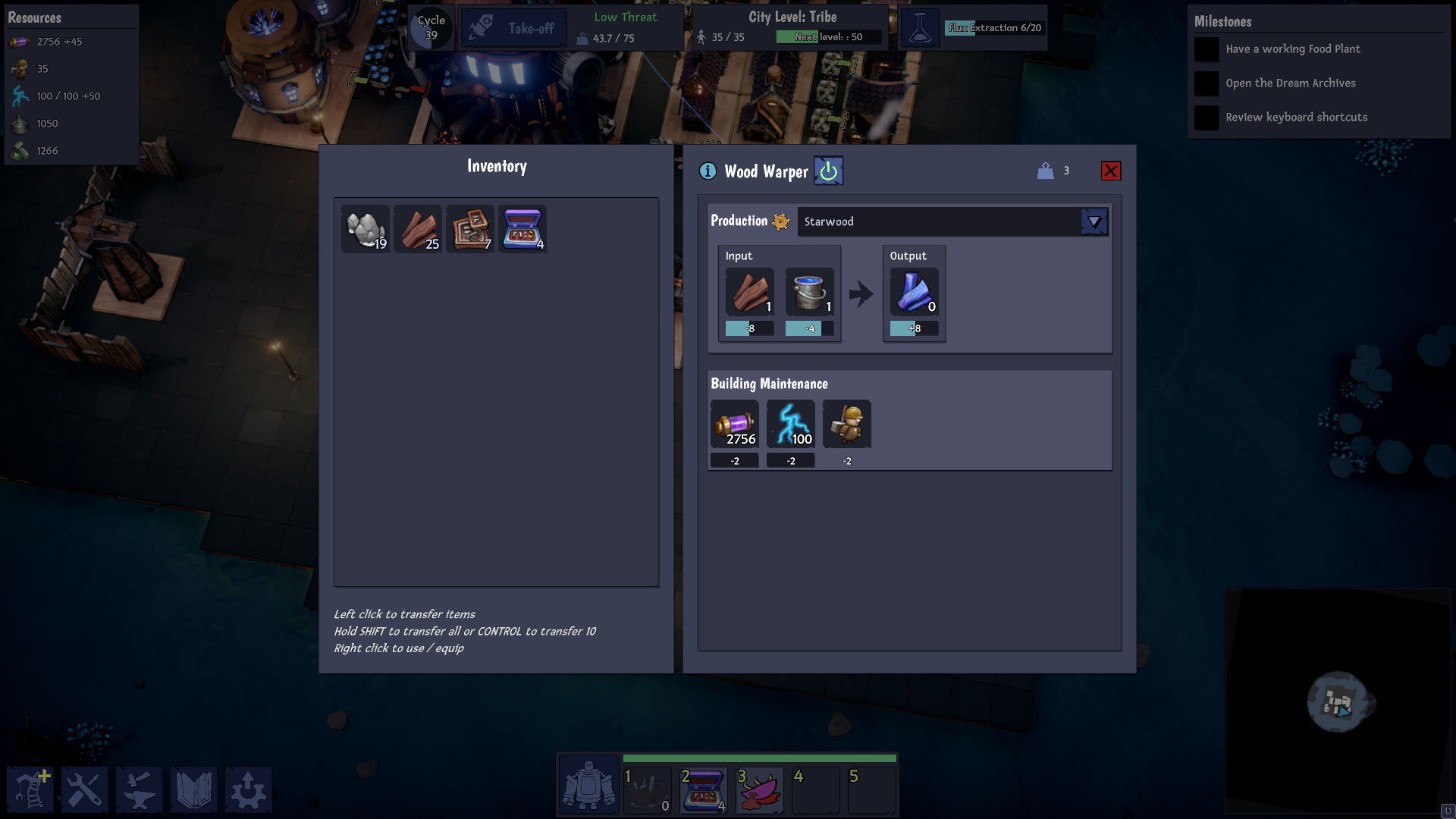
The flux vats and power generator are now very cheap to build and produce a much smaller amount of flux/power, but their basic recipe no longer requires any raw materials, so you can just build as many of them as you can afford outside the city. In the long-term, however, you want more productive buildings to take with you, that use less space in your limited city area. So both the flux vats and power generators have add-ons that you can unlock with research, which allow you to use more advanced recipes (using Star-Tar and other new resources) for much higher productivity.
These add-ons are much more expensive than the base building, so they are more suitable for long-term factories that you build in the city and take with you.
New Content
We've added a few new buildings, such as the Stone Worker to process featherstone, and the Atmospheric Condenser that generates a gel substance from smoke, and can be used in more advanced power and research recipes. There's a new long-range power hub, which generates a power area around it, allowing you to build outposts without having to connect them to your main city via a vulnerable line of tesla towers.
Another new addition is a building repair kit, a consumable that lets you repair all buildings around your character, useful in a tough fight.
Remember you can see the full list of changes on our website.
If you have any questions, join our discord and chat with the team!
Dream Engines: Nomad Cities - Ruins Update is live
Overseers,
The ruins update is our first major update since releasing the alpha of Dream Engines two months ago. In this update our focus was to address the main issues we identified in all the feedback our alpha players sent.
I'd like to once again thank all our early supporters and all of you who sent us feedback. It has been invaluable for improving the game, and I hope you enjoy this new build. If you haven't joined our alpha yet, check out our supporters page to find out more.
Below is a list of the most significant changes in this update. You can see the full list of changes in this link.
Note: Saves from alpha 1 are no longer supported. If you wish to continue your old games, you can still play the older version by selecting Alpha 1 from the betas tab on Steam.
Ruins, debris, and new content
The largest change in this update is the addition of ancient ruins that you can find around the map. These ruins hold ancient machinery that can be used to craft unique equipment that can't be researched or crafted otherwise, or you can scrap the ruins for resources. Every map has one main ruins building, and every such building has a different selection of items, randomly chosen depending on the map difficulty and the type of ruins. There are 3 ruins types, and you can see which one will appear in each map in the destination selection window. You can only craft one item per ruins building (2 at higher difficulty maps), so you must choose carefully.
To craft items at these ruins, you'll need various resources, including the new "Old-world Scraps" resource. These scraps can be found in debris that we added for you to destroy all around the map, by destroying the smaller ruins around the main ruins building, or by scrapping the main building instead of crafting in it.
Some of the items that can be crafted at the ruins are unique and can have a significant impact on your game. This improves the game's replay value, by adding a random element that has significant effect on your game, yet is "nice to have", so you won't win or lose just because the gods of chance chose to give you this or that item. Some of these items include melee weapons that deal AOE damage, different variations of the starwood and copper armor that don't affect movement speed, and a repeating crossbow that has a very long range.
The more interesting items include "Modules" that can be installed in the character screen, but only one of each type can be active at any time. There are two types, one for the mech that provide combat or exploration bonuses (such as speed boost, beserker module, tank module, and a module that turns your ranged attacks to AOE), the other for the city (such as a module that reduces the rate at which the threat level increases, or makes your refineries "green" producing resources slower but using up less raw materials).
There are also special utility items, such as one that gives you extra infrastructure points (without increasing the upgrade parts cost of future upgrades), one that lets you expand your city area even before you research the relevant tech (and also doesn't increase the cost of the next expansion), a consumable that lets you place small turrets anywhere, and a construction kit that lets you build Tarbomb turrets - AOE turrets to protect your city.
Avoiding enemy shots
Originally we aimed to make the combat more dependant on your equipment, abilities and stats rather than skill. However, we heard your feedback, almost everyone that played the game complained to the fact that ranged enemy attacks always hit even if you moved away. So now you can avoid enemy shots.
This has some balancing implications. Ranged enemies now have faster rate of fire (and also a small penalty in damage but overall their DPS is higher), and we also increased the walls health to make up for it (walls can't avoid shots). Your steambot's melee attacks now deal significantly more damage than ranged attacks, to make up for the inability to evade shots at melee range. Melee enemies now have faster attack animations and a lower attack range, so they always hit if you enter their range.
Fuel, glow honey, the cauldron
Fuel now becomes a more meaningful element of your economy. Instead of just crafting it from Flux, you now need to find a new resource (Glow Honey) after researching the correct tech, in order to produce fuel at a new building called The Cauldron.
Glow honey, unlike other resources, can only be collected through a harvester that you need to research, so you can't just punch it to collect. It also never runs out, so once you find a node and build a harvester, the longer you can protect it and stay in the map, the more of it you can collect. On the other hand, glow honey is harvested much slower than other resources, so you do need to find it early and collect as much of it as you can. Fuel crafting is also very slow, much slower than collecting glow honey, so your cauldrons will continue working even when you are unable to collect the resource.
Glow honey only appears at difficulty levels 3 or higher, so you need to keep an eye on your fuel reserves before you are advanced enough to survive in those levels. When relaxed mode is on, you start with more fuel, so you can explore more landing locations before having to reach level 3 to get fuel, and you can also find fuel in some ruins to stretch that even longer.
All in all, fuel is now a more significant resource, and it will become even more significant once we implement the explorable world map system in later updates.
Difficulty customization, scoring, and Ironman mode
We received a lot of feedback on the game's difficulty, and not all of it was the same. Some thought that it was good as it was, others felt it was too hard and preferred a bit less of a challenge when they're just getting started. A few even felt it was too easy. So it seemed there was no one size fits all solution to this - the best option was to let you choose how you want to experience the game.
From now, when starting a new game, there are many options to customize the difficulty level. These include control of the map size (larger maps are considered harder because they take more time to explore and have more empty areas), the amount of enemies you will face, how fast the threat level increases, how fast the global infestation level increases (including the relaxed mode which means that global infestation does not increase over time), and a very important Ironman mode which is on by default.
Each difficulty setting will affect your score multiplier, and at the end of every game, win or lose, you will be scored according to you achievements in the game, and that score will be multiplied by the difficulty multiplier.
The new Ironman mode will be on by default, this is how the game was meant to be played. It means that you have a single save file per game, which is automatically overwritten every time you exit the game. If you lose, the save file is deleted. Still, for those of you who prefer to have the option to save, try something, then reload if it fails - you can turn this mode off in the new game difficulty settings.
Intersections and resource controls
There are two important additions to your resource management options. One is intersections - whenever you build two rail sections so that they cross each other, an intersection will be created to allow carts from these two sections to cross one another without creating a traffic jam. Two carts can move in the intersection tile at the same time from different directions, and this allows for much better rail system planning.
The other addition grants you the ability to determine how much of a certain resource needs to be available in the storage building before it is sent out to a specific output slot. For example, you can create an output that sends bloodwood planks to the workshop for the production of upgrade parts, only if you have at least 50 planks remaining in storage. That way you always make sure you have at least 50 planks for building walls and turrets. You can then add another output slot for planks for producing Starwood, and this time set the limit to 60. That means that if there is a shortage of planks, they will be used for upgrade parts first, and only then turned to starwood.
Tesla cells & acid shards
Tesla cells are no longer crafted from Livewire (dropped by tier 2 cable snake enemies). Instead, they are produced in the workshop, and use a large amount of power plus some acid shards. Tesla cells were also made a more significant part of the economy, used not only to craft a weapon or two, but instead they are used in several building upgrades, equipment, and equipment upgrades.
Since Tesla cells are now produced from Acid Shards, and are now more widely used, we also added an acid shard harvester building to automate gathering this resource and increase the yield of each node.
Since Livewire is no longer used to craft Tesla cells, we had to find new uses for it, so we added more advanced crafting recipes for the Remote Surge AOE attack consumable, and for starwood & copper repair kits. These advanced versions cost livewire in addition to the regular resources, and deal / heal more damage. There is also a new crafting recipe to process Drep parts for flux, that uses livewire to enhance its efficiency.
Materializer
This new building allows production of featherstone and bloodwood logs directly in the city, without having to search for resoruce nodes. It only uses renewable resources such as flux, tar and purptatoes - however it is expensive to build and maintain. If your economy is strong enough, this building can significantly reduce the time you have to spend exploring and harvesting these resources.
Moving towers?
You can now move defensive towers between raids. As long as there is no active raid or upcoming raid marker on the map, you can move these towers and re-organize your city.
Got questions?
Remember to check the full list of changes on our website.
If you have any questions, join our discord and chat with the team!
Dream Engines alpha is here with a new gameplay trailer!
Citizens,
We’re very excited to announce that Dream Engines is finally entering its alpha phase! Head on to our website or discord to find out more about the alpha and how to participate. All alpha participants will get a steam key.
Official Steam Release
We changed our release date on Steam according to our updated plan: to continue with the alpha phase - polishing the game, adding more content, and new systems based on alpha players’ feedback - for about 4 months and then release the game on Steam early access around March 2021. These plans may change depending on what we see in the alpha.
Dream Engines dev update - research tree, victory conditions, city inhabitants
Citizens,
Welcome to the last dev update before we start our alpha phase, more on that in the next couple of weeks. Don't forget to sign up to our newsletter so you can hear about it first.
Other than all the development efforts, some of which we'll describe below, since our last update we've also been working hard on preparations for the alpha phase. That includes a new gameplay trailer (which is ready and waiting to be released!) and other marketing related activities, such as preparing press lists, posts, a website, and so on.
Here are some of the main development updates since our previous post.
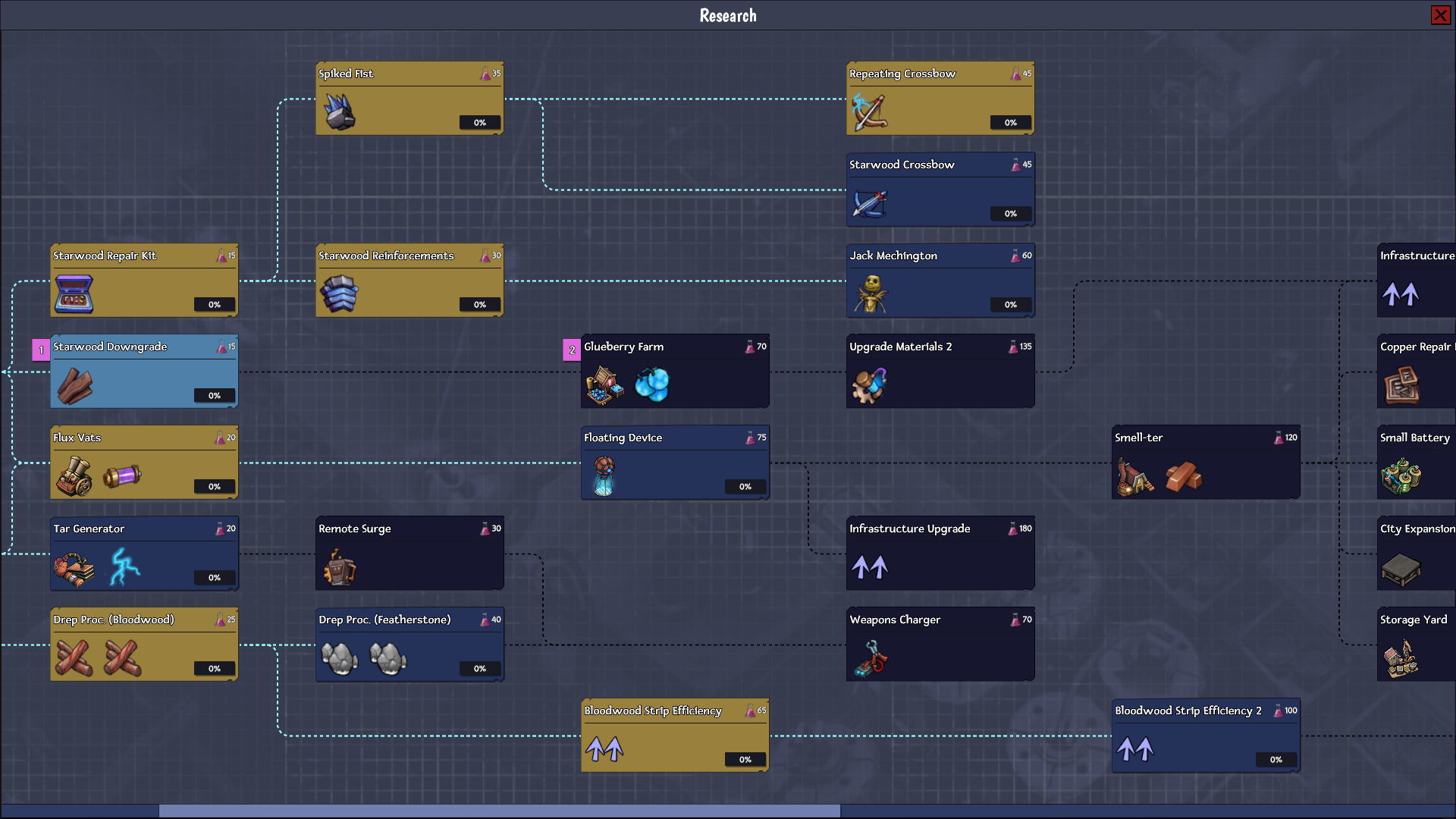
Research Screen
There were several options I considered for implementing the research screen. One was a simple list of research subjects with new topics added/removed as you progress, then there were different types of graphs and trees, and I also considered dividing research to categories like we did in Judgment.
One of my favorite options was that instead of researching "Subjects", you would research specific items. So you'd research a "Power Plant" building, or a "Cannon" crafting recipe. I really liked the simplicity of this idea, and it would be nice on the eyes - a tree of simple icons, each representing something that you can unlock.
Unfortunately, I found that it wasn't a perfect match for our needs. Sometimes it didn't make sense to have separate researches for separate items (like wall & gate), and it made it that much harder to build a graph with reasonable dependencies when each node in the graph could only be one item, and every single item in the game (except those you start with) required their own node.
I did manage to maintain the idea for the most part. The idea I went with is a horizontal scrolling graph, a bit like in Civilization 5 & 6 - but for the most part, each research subject unlocks a single entity. However, many of these entities include a "companion" entity. For example, when you unlock the Smelter building, you also unlock the Copper Ingot production recipe.
The Dream Nullifier
While I do love sandbox games with a lot of freedom, I usually prefer that this freedom be accompanied by some sort of end goal, that you can actually win the game. Even if it's a sandbox sort of victory - Civilization is a good example for this kind of victory - you can theoretically continue playing forever, but there are several goals that you can reach to achieve different types of victory.
So, in the pre-release version of Dream Engines, we added one such victory condition - the Dream Nullifier building. This building is at the end of the tech tree, expensive to build and to upkeep, weighs a lot, and takes quite some time to activate - while having to defend it from enemy raids. But once it is built and activated and fully charged - it will create a safe zone in which you and your people can find safety. You no longer have to fly from place to place.
Later down the road we're also thinking of adding different starting scenarios - leader skills, clan selection, and other things you can unlock between games - so that even after winning the game you will still have new challenges ahead of you in the form of starting over under different circumstances and gameplay changes.
City Inhabitants
In the visuals area, the main element that gave life to the city were the transport carts that were constantly hauling resources from one building to another. This gave it a factory feel, which is great for a steampunk industrial flying city, but it was a bit lacking in the "city" part of the aesthetics. So we added inhabitants walking around.
These little people help liven up and add some color to the city, as well as provide a better sense of scale. Almost all the elements in the game are oversized (like the transport carts that are the size of a small truck), but it wasn't obvious enough. With the small people walking around, the scale of everything is a bit more prominent.
Other changes
Other changes include many tweaks to balance, difficulty and progress speed, but we also added quite a few changes that improved the general feel of the game. Foremost among these, we added combat sound effects to all buildings and enemies, and three new music scores. Loot from destroying enemies and resources is now scattered on the floor when destroying the asset, which you can pick up by simply moving next to it (before it went straight to your inventory).
We also added some animated tutorials, and a "Strategic View" which when toggled on switches to a top-down view and shows the levels of each building, allowing you to quickly upgrade them without having to walk and interact with them directly. We'll expand this mode in the future to include other common operations and different information layers.
There's also a new Milestones system now. This system appears when you finish the tutorial (or at the start if the tutorial is disabled), and it provides several different objectives for you to achieve (the next 3 are displayed at any given time). These objectives help guide you and teach you some of the more advanced mechanics of the game, without behaving like an actual "do this, do that" tutorial. You can choose to follow these objectives or not (you'll likely achieve many of them even if you don't follow them specifically), they're completely optional, but they do help figuring out how the game works.
Last but not least, we modified the appearance of the enemies in the game, to go for a bit of a darker, more grim look. We considered pitch-dark with glowing elements at first (shadow enemies), but that was a bit too limiting and made it hard for players to recognize which enemy they are facing, so we ended up going with darkish but still visible.
What's next
What's next? Dream Engines alpha, and then Early Access. We actually meant to start the alpha phase already, but then the Steam Game Festival came along and shuffled all the cards, so we had to adjust our plans. This will be the last dev update before the alpha, so stay tuned and in the next couple of weeks expect an announcement.
If you'd like to take part, please sign up to our newsletter, that will be the best way to remain appraised of developments in this area.
Thank you for your time, I hope you enjoyed this update, and as always, I'm happy to read your comments or chat with you on Discord.
Dream Engines dev update - active abilities, new user interface, raids
Citizens,
Gather around, we have a few new stories to show and tell, from our latest work on Dream Engines. Remember to sign up to our newsletter so you can be the first to hear when we start alpha testing.
Since our last update, we took some significant steps in the visuals department, getting ready to produce our first gameplay trailer as we prepare to start an alpha period. We also, as always, continue balancing, tweaking, and adding new content and systems. Keep reading to hear more about some of the larger changes and challenges we faced recently.
Publisher or not?
Ever since we announced Dream Engines, we have been contacted by a fair share of publishers and investors, some large and famous, others small and boutique, asking whether we were interested in working with them. Some of these offers seemed like both sides could benefit from a partnership, and we seriously considered these options.
Being able to focus on development and having to worry less about marketing and business development would have been very nice, but as everything in life, it comes with a price. Not just a monetary price tag, but also some loss of flexibility and control over what goes on with our game, among other things.
In the end, after serious considerations and discussions, we've decided we'll be self-publishing Dream Engines like we did with our previous game, Judgment. We'll probably need to hire some help with marketing, but I believe this is the right course for us, given all considerations and offers on the table.
Not exactly an update on the game development, but this is something that I've been spending quite some time and mental resources on lately, so I decided to share. This also served as a motivating factor for us, because many of the organizations we've been in touch with received a build of the game and liked it enough to want to invest in it, which is a good sign that the gameplay, though far from final, meets the expectations.
Mech appearance
Designing a mech that would serve as your main character was a struggle. As a small team, our resources are limited, so we wanted something that would be visually appealing, but not require too many resources to manage and animate. We also wanted it to support our wacky, steampunkish style. This is what we eventually came up with.
This design allows us to replace the mech's arms, according to the weapons you have equipped, and it allows for whimsical movement animations. I hope you like it, let us know what you think.
Active abilities
To make combat and character building a bit more interesting, we added a new system for active character abilities, abilities that you can trigger manually when you choose to. In addition to the repair kits (aka med-kits) that we had from the start, we now added a system that lets us add any kind of active ability, each with its own audio, visual effects, and gameplay mechanics.
Teleport to city
There are currently two ways to gain active abilities. One is through consumable items that you craft or find, and that you then spend to activate the ability. Repair kits are a great example, but we also have a decoy to attract enemy fire, an AOE attack, and more. The second option is to acquire abilities through our infrastructure upgrades (similar to a skill tree in RPGs).
Both types have a cooldown, and I am still considering whether to add a way to limit the latter through some kind of mana-like mechanic - an energy bar that charges over time and is required to use abilities. This limitation can help balance but also add some interest into character-building and lead to interesting ability-based builds.
Surge AOE attack
User interface design
Up until now our user interface was something temporary that was quickly designed internally. While we have two talented artists in our team, none of them specializes in user interfaces, so we kept it minimal and functional. This is the main reason we rarely shared user-interface elements in our screenshots and videos.
In the past month we've worked with a graphic designer that is experienced in user interface design, who finally helped us achieve a properly designed UI - both functional and visually appealing, and we can finally share it in our screenshots.
We're also changing the way our research tree works, replacing the list of currently available techs with a proper tree, so stay tuned for some more updates on that soon.
Making raids more interesting
One of the gameplay / balancing challenges that we've been facing is how to make attacks on your city interesting and tense without becoming too much of a chore. We want to keep players on-edge, we want you to worry about the safety of your city, but we also don't want you to have to micro-manage and manually defend the city with your mech character.
We took several steps to improve this aspect of the game. First, we removed the progress bar that previously showed exactly when an attack would happen. Adding some uncertainty encourages players to make sure their city is always defended. There is still some advance notice so you can prepare, but you don't know exactly when it will happen.
Second, we reduced the amount of attacks, but made them more meaningful. Each attack will now consist of several waves one after another, instead of a single group. Just making the attack stronger would break the balance, but making it stronger while also spread over a longer period of time makes the attacks more meaningful without breaking the balance. If your defenses are too weak, the damage you will suffer will be more significant, because the first few enemies will weaken them and the second wave will wreck havoc. On the other hand, if your defenses are powerful enough to handle attacks without taking too much damage, then additional waves will not make them more likely to fall.
Last, we worked on balancing and tweaking the defenses. Mainly, we made them a little less expensive and decreased their weight, allowing you to build more of them in the city that would move with you as you fly.
Enemy AI
We're keeping the enemy AI fairly simple, but we did make some significant improvements. Before, the enemies raiding your city would follow the path towards the city core, and attack anything that enters their attack range. You could attack them from outside their range and they would just move on. Now, enemies will move as a group, slowly, towards your city so the fast enemies won't arrive before all the others. In addition, they have an "aggro range", and if a target (building or unit) moves into it, they will break up, chase, and attack that target. This also adds the need to defend any resource collectors that happen to be on near the raiders' path.
We also added some additional tweaks and improvements, including many performance enhancements so we can support more enemy units on the map, and improved the behavior of the wandering enemies. There's still more we can do and plan to do with the AI, but we aim to keep them fairly simple for the most part, with predictable behavior that you can learn and adapt to. The challenge comes mainly in their numbers.
What's next
This covers some of our more significant changes and challenges we faced since the last update. Of coruse there's plenty more that we've done in the past two months, but this post is already long enough.
As for what's next - stay tuned, and in the next few weeks we'll let you know of our plans to start alpha testing. If you'd like to take part, please sign up to our newsletter, that will be the best way to remain appraised of developments in this area.
Dream Engines dev update: upgrade tree, new content
Citizens,
I hope everyone is safe and healthy. I'd like to tell you about some of the stuff we've been working on lately, and invite you to sign up to our newsletter so you can be the first to hear when we start alpha testing. It's not far, I'm already happy with our latest internal build that provides many hours of fun.
What we've been up to lately
A lot of our recent work is testing, tweaking, balancing, and changing stuff to make sure the game is more and more fun with every iteration. That's hard work, and not a lot to show for it. But there are other bigger things that we've been working on, that are a bit more interesting to show and tell.
Infrastructure upgrades - our version of a skill tree
Skill trees are a great tool in RPGs that allow players to customize and optimize the game to make the most of their preferred play style. Some strategy games have it too, in the form of an upgrade tree, and we decided that Dream Engines, combining both strategy and player-controlled combat, could greatly benefit from one.
So, how do we do this? We decided not to have you grinding for XP by killing enemies or doing repetitive quests. Instead, you will need to build and optimize your city's industry, and produce components that allow you to upgrade your infrastructure. In other words, to level up, you need to build your city and choose to spend resources on infrastructure production.
Every time you upgrade your infrastructure, your level will increase, you will get a point to spend, and the cost in parts for the next upgrade increases. You can then spend those points in one of several infrastructure areas, such as resource gathering, economy, your mech's combat capabilities, and survival.
Every point you spend on infrastructure provides passive bonuses in that area. Once you've spent enough points in an area, you can then choose to unlock powerful perks that give more significant and unique advantages.
Building upgrades
An option to upgrade buildings to higher levels was added. Upgrading is more expensive and requires more advanced resources, compared to just building more of the same. However, upgraded buildings are much more efficient, don't waste any more space in your city, and upgrading a building adds much less weight than building another one.
Fuel and weight
We finally got to adding fuel and weight management. If things get too dangerous, you can pack up and fly away whenever you want, so there's nothing to worry about and you can't lose. Or can you?
We've added weight management, so whenever you build something in the city, it adds to the weight that you need to lift when flying away to a new location. Turrets and walls are especially heavy, so you may have to choose between building them in the city so you can take them with you when you leave, or save space and fuel by building them outside, abandoning them when you leave.
You can also build more engines to carry the extra weight, but those also increase the fuel costs of taking off. Oh yeah, we've also added fuel. Fuel can be produced from rare Acid Shards, if you manage to find some, or alternatively by spending Flux (the most basic resource, kinda like money in most city-building games). But it won't be cheap, so you can't really just fly from place to place, you'll have to stand your ground and defend your city for a while, searching for resources and allowing your economy to generate the resources you need.
New content
While I'm working on mechanics, balancing, and game systems, our hard-working art team is constantly creating new content. We have new enemies, defensive turrets, resources, production facilities, and a brand new biome - the desert biome.
Here are a few images of the new content we've added.
New Enemy - Beeclops:
New Resource - Acid Shards:
New Building - Workshop:
New Desert Biome:
What's Next
As we prepare for our alpha phase, we need to work a lot on UX and polish. Make sure that the players get all the information they need, and understand how to do what they want to do. We also need to make sure there's good balance and plenty of content for them to play with.
I'll post some more of what we've been up to in the near future, and show some more of our progress.
Interact with the world through a player-controlled mech
Citizens, I have some interesting news for you. After a lot of deliberation we made a big decision - Dream Engines will feature a player-controlled character (a steampunkish mech, actually).
This decision brings some significant changes to our vision for the game, and I'd like to tell you a bit more about what it means, and why we came to conclude this is the best option for us.
I would really like to hear what you think, so after reading, please post a comment and share your thoughts with us.
What does this mean?
The main change to the game is in how you players interact with the world. Instead of having a free-roaming camera that you can move wherever you want in an instant, you will interact with the world through a single character. A good reference for such a control scheme is Factorio. The camera angle will remain strategic from above.
The main emphasis remains on building and defending your flying city, but this change adds a whole new set of systems and another purpose for you city's economic and industrial infrastructure - mech customization and progression. You'll need a strong economy to support all the weapons, armor, and upgrade modules your mech needs to survive and further your goals. There's a new crafting system (in addition to the automated resource-production in the city), consumables, active and passive abilities, and much more.
So what's new?
Read below to find out a bit more about some of the changes and new stuff we've added since my last update. It's been a while since that update, so there's a lot of new stuff. I'll only write about some of it in this post, and post additional updates in the coming weeks.
City building & economy
City building and economy remain a main focus of the game. There will be no significant changes here, except for the way you interact with the buildings (you approach them instead of clicking on them).
Now, however, the city's economy and production capabilities will have an additional objective - produce mateials to support your mech's growing demands, and in turn your mech will defend the city and acquire the resources it needs to survive and expand.
Exploration and resource gathering
This part of the game will benefit most from the new control scheme. Instead of right clicking and waiting for your units to move, you will be in the shoes of the explorer, you will experience every new discovery as soon as it is discovered, and you will have hands-on control over the movement and survival of your explorer.
We will also be able to add more stuff in the world you can interact with such as scavenging ancient ruins and raiding monster nests.
For now, we've added small resources that you can manually gather, and resource drops when you kill enemies with your mech. The larger resource nodes can be collected by building harvester buildings, but you'll have to guard them while they work, as they attract enemy creatures and will be attacked.
Later down the road you unlock slower, automated harvesters that yield more resources and will deliver them directly to the city. These do not attract enemy attention so you can build them and move on.
Crafting
With the player character having its own inventory, it made sense to add a crafting mechanic, which is more fitting for crafting items in small amounts than the automated production-line of the city. Setting up conveyor-belt-style transportation to produce a single copy of a weapon just doesn't make sense.
So now, city production lines are used mostly to refine resources, ammunition, supplying your citizen needs, energy, research, and other stuff that require continuous production. Consumables & equipment are created through the crafting system using resources from the player character's inventory.
(User interface design will probably change)
Upgrade Modules
The mech (and later on maybe the city core) will have slots where you can install upgrade modules for unique bonuses. Customize your equipment and modules to fit your play-style. For example, the beserker module increases melee damage by 50% but also increases damage taken by 75%. This module will allow you to explore and clear enemies much faster, at the cost of taking more damage.
Player-controlled Units
This is one of the significant changes due to the new control scheme - there will no longer be player-controlled units (maybe we will add some autonomous units later down the road). You will still be able to build static defenses to protect your city, but you won't have mobile combat units. Instead, your mech will do all the exploration and offensive fighting.
Pacing
With the new control scheme, we reduced the pacing a bit. Attacks on your base will be a bit less frequent (at least at first, until you are able to set up your defenses), and you will have more time on each map before you are overwhelmed and need to move on. The difficulty increase will also be slower, allowing for more breathing space and more time to get your city in order.
What kind of combat?
This is far from final, we're testing and tweaking and fine-tuning and may completely change it. But, for now, we've decided to have a more survival-feeling, thoughtful combat system, and not hack-n-slash. Player skill and how you fight should play a part, but more in a strategic/tactical way than agility and quick reflexes. We want the combat to be very much dependent on how you prepare, your mech build, and your choices in combat, and less focused on pressing the dodge button at exactly the right moment (so far we didn't even add a dodge button).
Correct use of active abilities, having the right setup for the enemies that you are facing - these should be the main factors. We don't want a player with starter gear to be able to defeat high-tier enemies just because they are super-skilled with lightning reflexes.
Why make this change?
Before I finish with this update, I'd like to share a little of what brought us to the decision of adding a player-controlled character.
The main reason, if I'm honest, was that I was having significant difficulties in getting the main game loop to flow smoothly and feel interesting enough. One of the major advantages of having a mobile city is that you always have new areas to explore, new resources to find, new locations to scavenge. But it also has the drawback of limiting the city's interaction with the environment - your city-building is mostly separate from the map, since the map keeps changing.
So we need to make the most of our advantage, and, unfortunately, an RTS-style control scheme is not the best suited for this. Exploration and scavenging is much more interesting when you control your movement directly, always seeing the new areas that are uncovered, than it is when you just right-click to send a group of units and wait for them to reach.
That was the main driver for this decision, but there were more. Having an upgradable mech adds a lot of interesting choices on how to spend those resources, a significant incentive to make your city more efficient and productive, and a lot of personalization and customization options. You get to directly feel every small improvement you make.
(User interface design will probably change)
And last but not least, this control scheme opens the game up for the possibility of co-op multiplayer and console porting. Multiple players, each with their own mech, their own inventory, all working together to build and defend the biggest, most powerful flying city out there. Please note that we are not currently working on or planning to launch with multiplayer, but controlling a character definitely makes it easier and more likely down the road. No promises.
What's next
In the next update I will talk about some of the other stuff that we've added, but this post is already very long. These include building upgrades, skills, a new biome, many new enemy creatures, the research system, and more.
Once again, thank you for reading, and I'd really like to hear your thoughts. Post some comments.
Making survival mode fun - October dev diary
Loyal citizens, hi there and welcome.
Another month went by since our previous post in which I described Dream Engines' gameplay in more detail. Let me share some of what we’ve been up to since then. In this post I’ll tell you about some of what we’ve been doing and also share some insights into our thought process and reasoning behind some important design decisions.
My main goal this past month was to reach a point in which a collection of mechanics and interfaces ceases to be just that, and starts feeling like a game that is actually fun to play. I needed the game to become challenging, and allow players to create intrinsic goals (objectives that you set for yourselves, such as researching a certain key technology).
If you have any more questions, Feel free to ask in the discussions page or in our discord, and I’ll answer as best I can. And if you haven't yet, please wishlist & follow us to stay in touch!
Survival mode
For our first Early Access release, the main gameplay mode will be Survival mode.
In survival mode your goal is to survive, expand, and progress, playing in a different random generated world each time. While this mode will be mostly sandbox-style without a story to guide you, we plan to have one or more victory conditions which you can achieve to win the game. We plan to allow for different difficulty levels and perhaps other “modifiers” that affect how you play the game each time.
This mode makes most sense for the earlier versions of the game, since it has limited scope, is fairly easy to change, and provides a lot of replay value.
Pacing
Most of the game plays on a “local map” that is randomly generated every time the city lands, until the player decides to take off and travel to a new location. One of the biggest questions we’ve had since the start of the project was “how long will players play on each map” before moving on?
This simple question shapes a lot of the game. Can players take their time, and move at their own pace? Explore a map and exploit all its resources before moving to a new one? Or should they be pressed for time, dealing with increasing threats, and always being on the move?
We finally came to a conclusion that the best way to create a feeling of threat and survival is through faster pacing. A faster pace also allows for quicker games, and more willingness to start over after losing, which is important for the game to be replayable.
Therefore each landing will have a very limited time window (10-15 minutes real-time) in which the player will race to exploit as many resources as possible, before being pounded by massive waves of powerful enemies. Every time the city travels, the game gets harder and harder, and if the city’s progress is too slow, it will very likely be annihilated before long.
Note that the game will still feature active-pause, so the faster pace doesn’t mean you can’t stop and think. It just means you have to be efficient and make wise choices.
Map generation
One super important element in both making the game fun and in providing replay value is generating interesting maps. The map is one of the most critical random elements, and when not generated correctly, all playthroughs may feel similar to one another and replayability is lost.
This is a mistake I made in our previous game, Judgment, and am keen on avoiding now. While there are random maps in Judgment, they don’t really matter enough to affect your choices. Luckily we have other more interesting elements such as random survivors that make up for it.
So, I spent a lot of time this month in researching and testing new map generation methods. I needed both interesting shapes - providing interesting tactical choices - and smart distribution of enemies/resources - random enough to make playthroughs different from each other, but also making sure it’s always fair and balanced. Tough challenge.
The best solution I found was to build a map made of many interconnected “islands” of open territory, surrounded by blocked areas. This creates an interesting open-air dungeon-like map in which larger areas have limited access points that the player can defend or explore.
The way the resources are distributed on islands makes the map much more interesting and more uniform than our previous topography-based map. Players don’t just randomly move units anymore, there are now clear “paths” to explore, and points of interest guarded by enemies.
Guards vs raiders
Before, the enemies that were scattered around the world and those that raided your city were there same. These enemies were fairly strong (as strong as 2 of your units, more or less), fast, and had relatively long attack range. These made for interesting raids, especially later in the game, because the enemy waves reached the city quickly and delivered a suitable challenge for the city’s stationary defences.
These enemies, however, made poor mobs on the map. They were so strong that the players had to send all their units in one big group to minimize loss. That made for slow-paced exploration, exploring areas one by one with a lot of dead time. Moreover, they were so strong that we had to keep their numbers small, and then a lot of the map was just empty.
Instead, we now have new types of enemies for spawning around the map (we don't have their art yet, so no screenshots here). These are much slower and short ranged. You can send smaller groups to explore several areas at once, and only send larger forces to clear areas that are strategically important. These enemies will damage and destroy your units in large numbers, but in smaller numbers all they do is delay and hinder your exploration.
Entry level defenses
A month ago, early-game attack waves were repelled using your mobile units, and you didn’t need to (actually couldn’t) build walls or turrets until later on. That did not work so well.
For one, you had to recall your exploring units to base whenever you were attacked, or leave your city defenseless. This added a lot of dead time in which you just watched your units traveling from their faraway locations to the city and back.
There was also a huge jump in your defensive capabilities when unlocking stationary defenses. It was very hard to balance attack waves around this, they were either too easy once you built defenses, or too hard before you did so.
So I added lower tier defenses that are unlocked from the start. They are also cheap enough so that you feel comfortable building them outside, protecting choke points leading to the city, and abandoning them when you take off.
Ancient Ruins
On the art side, our artists Yoni and Peter made a lot of improvements and performance optimizations to our visuals, and are always creating new content for future use. Here’s some concept art of ancient ruins that we’ll be adding to the game. These will provide important benefits to those able to exploit them.
What’s next?
I now feel that we are finally there, and when playing Dream Engines actually feels like a real game - it keeps me interested and I no longer just play because I have to, I actually enjoy the challenge. Finally!
Now we will build on top of that, add content and features that will expand on the base that we have built, add more flavor and increase the enjoyment. This is definitely a big step in the right direction, but there’s still much work to be done.
I really hope to start external playtesting soon, we’ll be sure to let you all know when you can apply. If you’re interested in more frequent updates and peeks into our progress, you can join our discord and follow us on Twitter.
- Tomer and the Suncrash team
So, what is this game really about?
Ahoy, citizens!
I know you've been waiting for an update for a long time, my apologies for that. It's a real challenge for me to to take a step back from the millions of development tasks and find the time to write updates, but I'll try to do it more often.
My goal with this post is for you to better understand what Dream Engines is really about and how it plays. After reading you should be able to better imagine what it will be like to play the game, and hopefully you’ll get even more hyped about it! I’ll also explain our current state of development, and give a very rough timeline for the future.
Please do keep in mind that we’re not even in alpha yet, so everything may change. We are putting quality and your enjoyment above all else, so if we see something is not working out or find a better way of doing things, we’ll change them - nothing is set in stone.
If you have any more questions, Feel free to ask in the discussions page or in our discord, and I’ll answer as best I can. And if you haven't yet, please wishlist & follow us to stay in touch!
So, what is Dream Engines about?
It’s a game about building a flying city in order to survive in a hostile world.
Sounds simple enough, but survival in Dream Engines will be far from simple. You will often find yourselves with no other choice except to retreat and fly away with your entire city to stay ahead of the swarms that want to destroy you, and surviving with a nomadic lifestyle in a dark, dangerous world is a tough challenge.
Gameplay
Dream engines, at its base, is a city-building & real-time strategy game (with pause). For most of the game your city will be on the ground. That’s when you’ll be able to expand it and build new structures. You’ll train units to explore the surrounding areas, searching for and collecting raw materials, and fighting nightmare-born creatures. You’ll build and manage your city’s industry, research new technologies, and tend to your citizens’ needs. All this, while defending your city from attacks.
Unlike many similar games, however, you will never be able to get too comfortable. The more you stay in the same place, the harder it will get - until you are forced to fly away. You will be pressed for time, and need to get things done in the most efficient way possible. You’ll need your wit and nerves of steel to successfully lead a Nomad City.
Surviving
Enemies will come banging at your door, and the longer you stay in the same place, the stronger they will get, until your turrets and walls will no longer be able to stop them. Nearby raw materials will deplete and you will have to venture further and further away, struggling to keep your people fed and your industry running. Weather and disasters will threaten to devastate your city.
Eventually, you will be left with no choice other than to pack your things and leave - launch your city into the skies and fly in search of greener pastures.
Biomes and travel
But in the world of Dream Engines, there is no such thing as greener pastures. There are many different biomes, each darker than the other. Everywhere you go, you will meet new challenges, but also opportunities to find rare resources, forgotten mysteries, and ancient technologies.
When traveling, you’ll be able to choose your destination from a world map, taking into consideration the risks and opportunities in each area, the different biomes, distance, and available fuel. Every time you land, a new random map will be generated, and you’ll be able to explore it in search of resources and special locations such as ruins of ancient civilizations, trading partners, and mysteries to uncover.
Resources, Production & Automation
After landing, you will have a limited amount of time to search and gather raw materials. There are many different resources that undergo elaborate production chains before they can be used to expand your city, train units and research new technologies.
Gathered resources are sent back to your city, where you set-up automatic transport networks to move them between storage, factories and consumers. You will have full control of transportation by placing conveyor-belt style rail networks, on which automated minecarts will travel and deliver resources. Weight is an issue and space is limited in the flying cities, so efficient construction will be a priority.
Difficult Decisions
The city’s flying ability, however, is not unlimited. Heavier cities need stronger engines which have to be researched and use more fuel. You will always face hard choices in balancing between long-term and short-term benefits. Will you spend more resources to expand your city and manage the extra weight, or will you build outside, knowing full well that those buildings will soon be left behind?
Pacing
We’re planning a fairly fast pace to the game, but which will also include an active-pause system, so you can always stop time to think things through and give commands. The goal is to challenge your wit, not your reflexes, but we do plan it so the game will not have “slow periods” where you just want time to pass faster - and so no speed controls other than the active-pause.
You will always be exploring the area around you, controlling units in battle, defending your city, managing your industry, your resources, and making other life-or-death decisions.
World and Lore
The history and lore of the Dream Engines universe is something I am particularly excited about. As you play, you will discover new information and hints about the history of the world. It is an original world, fictional, dark and wacky, inspired by Tim Burton’s works among other things.
The game takes place many centuries after the destruction of the ancient civilizations by the nightmares that now infest the world, and all that remains are small wandering tribes, struggling to live another day. You’ll play the leader of the world’s first Nomad City - an entire mobile city that is also your last, best hope for survival.
I’ll elaborate more on the world’s lore in a future post, we’re still thinking much of it through, and some of it will only be revealed as you discover it in the game..
Development Progress
Now that you know a little more about the game, here’s a small update on the state of development. We’ve been working on Dream Engines almost exclusively since we released the full version of Judgment in May 2018. While progress is fairly good, the scope of this project is large, and we are a very small team (of 3).
At this point we do have a playable demo, but not fun enough to be called a “game”. All the systems such as production, transportation, upkeep, and construction are there. Procedural generation, exploration, combat, unit control - all these are in place. We already have a lot of visual assets ready, including two biomes, several units, and many different buildings and resources. We’re a bit behind with enemy design, as we only have one enemy creature so far.
For the moment, our main focus is to balance the early game content so that the first few hours of gameplay are a fun and thrilling experience. In order to get there, we started doing some very small-scale internal playtesting sessions where we physically stood behind players and watched them play.
Unfortunately, we discovered that before we can get meaningful insights from playtesting, we need to work on usability. We tried focusing on gameplay and fun before UX, but we found that players were unable to properly experience the gameplay when they were too distracted with struggling against controls they did not understand.
And so, we turned our attention to UX and teaching players how to play. We’ve just completed a basic and short standalone tutorial that explains the most important aspects of the game - namely how to build your industry and transport network - a crucial part of the game that is also the most non-trivial. We also added a hints & tips network that will explain more advanced aspects of the game, improved our UI, and added tons of in-game indicators and tooltips.
We now believe that new players will be able to quickly understand the basics and we hope we will now be able to get more insights about the gameplay itself and the balancing. We have another playtesting session in the next couple of weeks.
Our mid-term goal is to begin closed pre-alpha playtesting with you guys. We still haven’t decided how we will organize this, but if you’d like to be considered for these tests, don’t forget to join our discord and sign up to our newsletter. We hope to start this in the next few months and are preparing for an Early Access launch in 2020 - but our highest priority is quality, and we will only launch when we feel the game is ready and polished enough to be enjoyed by you guys in EA.
I hope you liked this update and better understand what the game is about. If you’re interested in more frequent updates and peeks into our progress, you can join our discord and follow us on Twitter.