

Earthbreakers
Earthbreakers 2021 Update
Developer Diary #8
The demo classes were what we could call the minimum possible to play the game. That is, they can move around, fire a weapon, kill other players and die. While the main weapons themselves have to be fun to play with, they aren't the whole vision for the classes we expect to have in the final game. We want to give each class a suite of abilities that define that class' role and give you a lot of options for reacting to everything happening in the game.
Across the board, we are putting a lot of effort into getting our gunplay right. There was a good amount of feedback on this issue and we heard it loud and clear. We've got our recoil and headshots working and did a lot of work on the sniper and assault rifles since those seemed to get the most complaints. All of the primary weapons have had some work, and will likely change more as we continue to flesh out the content for each class.
From a high level, we want each class to have the following aspects: a main weapon, a secondary weapon, a minor ability and a choice between two major abilities. Since we talked a bit about the engineer previously and gave some of that class' future abilities away, lets use that class as the example here. Remember, all of this is subject to change so consider this just an example.
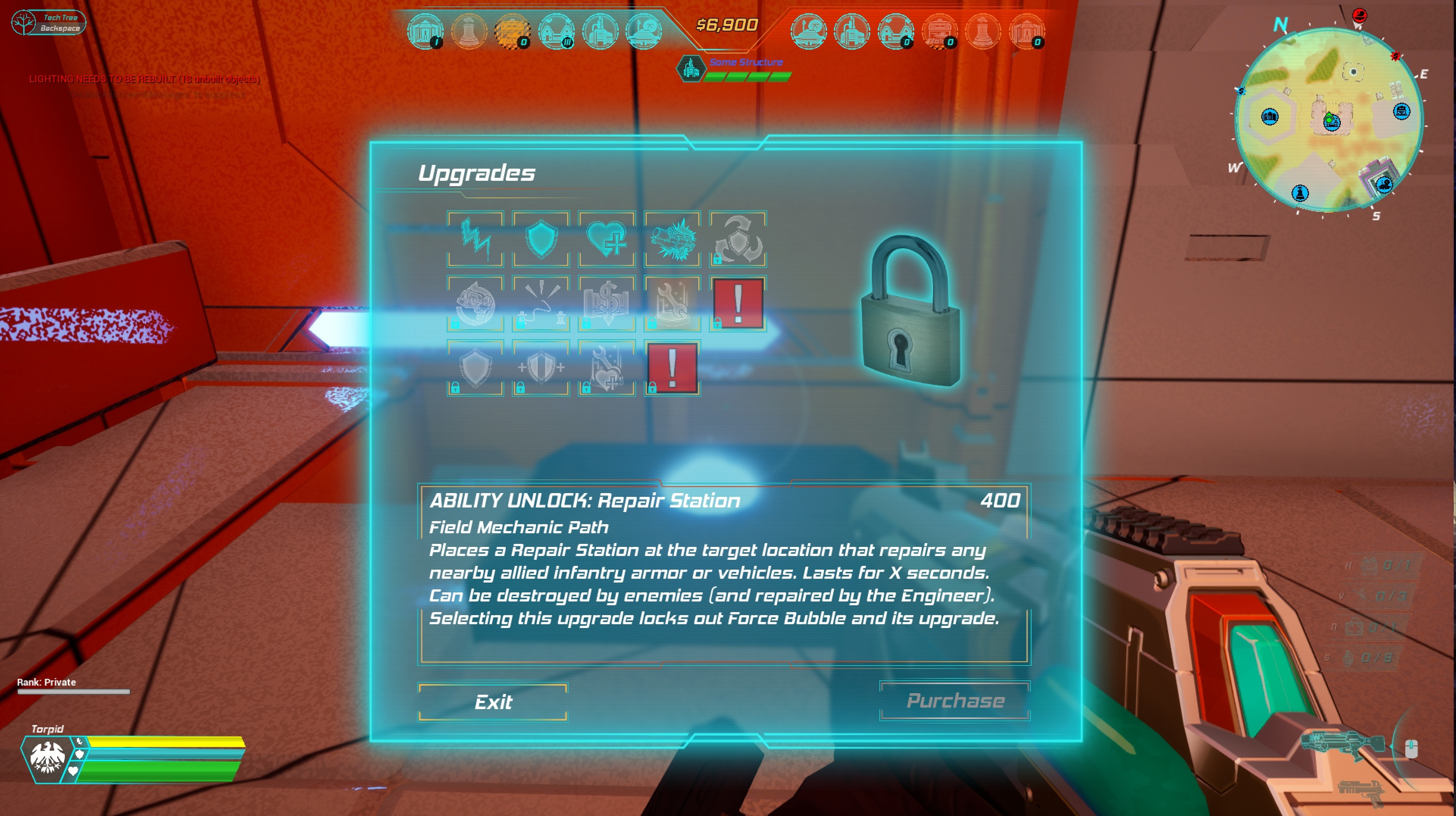
Our Engineer begins with the Repair Gun and Pistol, filling out the primary and secondary weapon aspects. For his minor ability, the Engineer gains proximity bomb: these are small sticky mines that can be placed on surfaces and explode when enemy infantry get near. For his primary abilities, he has a choice between the Repair Station we mentioned in a previous diary (a place-able object that repairs in a radius) or the Force Bubble ability, which creates a force field around an infantry, turret or Control Core (the structure weak points mentioned last time). You can only pick one of the major abilities, so choose wisely.

In addition, each class will gain the combat bonuses you saw in the demo (additional health, armor, damage, etc.) as well as modifiers to the abilities mentioned above and to his main weapon. For example, one upgrade reflects the repair beam back at the engineer when he repairs infantry, repairing himself as well. Another upgrades the Repair Station to repair health as well as armor.
All of the abilities and bonuses unlock over time and are added just like the stat upgrades that were available in the demo. This means that each class gains not just power but play options as the game progresses. To give you an idea of the amount of new options we are planning, the original tech tree had 24 entries; the new one has 102 (so far). Of course, not all of these are class upgrades, but then we'll talk more about that in the next design diary.
Developer Diary #7
Game development is an iterative process. For Earthbreakers, we break the design into sections and then try to layer in systems as we go. For example, the demo had base-building and classes, but it wasn't the full experience we know we want to end up with at launch. Going forward, we are breaking down the game into three basic sections: the base, the classes, and depth. Bases revolve around anything to do with base building and all of the things base building controls like the flow of power progression and tech. Classes include everything class and combat-related, including new abilities, alternate fire modes for weapons, upgrades, etc. Depth includes adding layers on top of the previous two sections - upgrades for base structures and turrets, branching upgrade paths for classes, new vehicles, capture points, map design, etc.
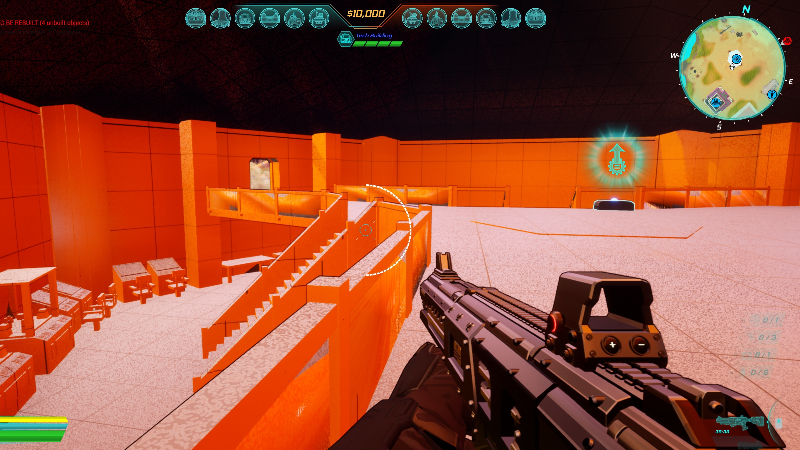
(inside our work-in-progress monochrome 3D model Tech Center)
Today we will talk about the first of those sections: base building. We wanted to add in the WHOLE base, not just half of it. We don't need to have all of the structures fully functional, but we did need them in place such that they could be built and destroyed and had the correct basic functionality. This also includes breaking the build order and tech tree up into the real version we envisioned, where the barracks controls infantry classes, the factory controls vehicles and the tech building controls team upgrades and features.
Of course this means that our demo map needed to be expanded. One of the issues with base layout is travel time; since (for example) engineers tend to quickly move between structures to keep them healthy, we needed to look at how long it takes to get from structure to structure. Tied to this was another feedback item we are working on - movement speeds. It was pretty much universally stated in feedback that our movement was too fast. We like having a more arcade-y feeling game, but at the same time we don't want it so fast that players have difficulty using their weapons. Because of this change, travel times on maps went up, so structures needed to be closer together to make sure engineers can defend and players don't have to run too far for their upgrades.

(An early look at a couple new placeholder structures to test gameplay)
Part of base building is economy. A lot of feedback referred to the difficulty of paying for some upgrades and rebuilding structures. While we want losing a structure to be a major blow to a base, we don't want the rebuilding process to be frustrating. Fortunately, some of those high prices were a placeholder balance-wise to keep the progression at a steady pace within the limited content we had for the demo. Now that different structures handle different upgrades and there are more buildings to build, we don't have to lock things economically to compensate for time. Structure rebuilding will use the same donation system you use when building structures the first time, and many of the upgrades have been drastically reduced in price.
All of this, of course, ties into the other two sections (class and depth) to some extent - no part of a game exists in a vacuum, and pulling one lever can move something you never intended. But we'll save more in depth coverage of the classes and depth for a later date :)