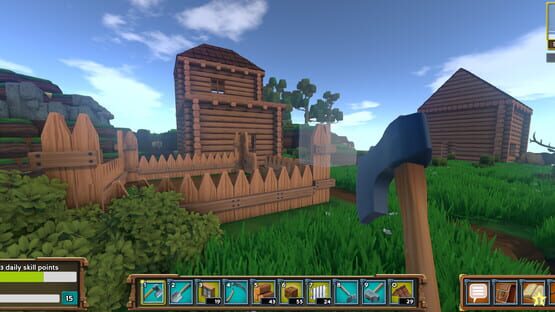
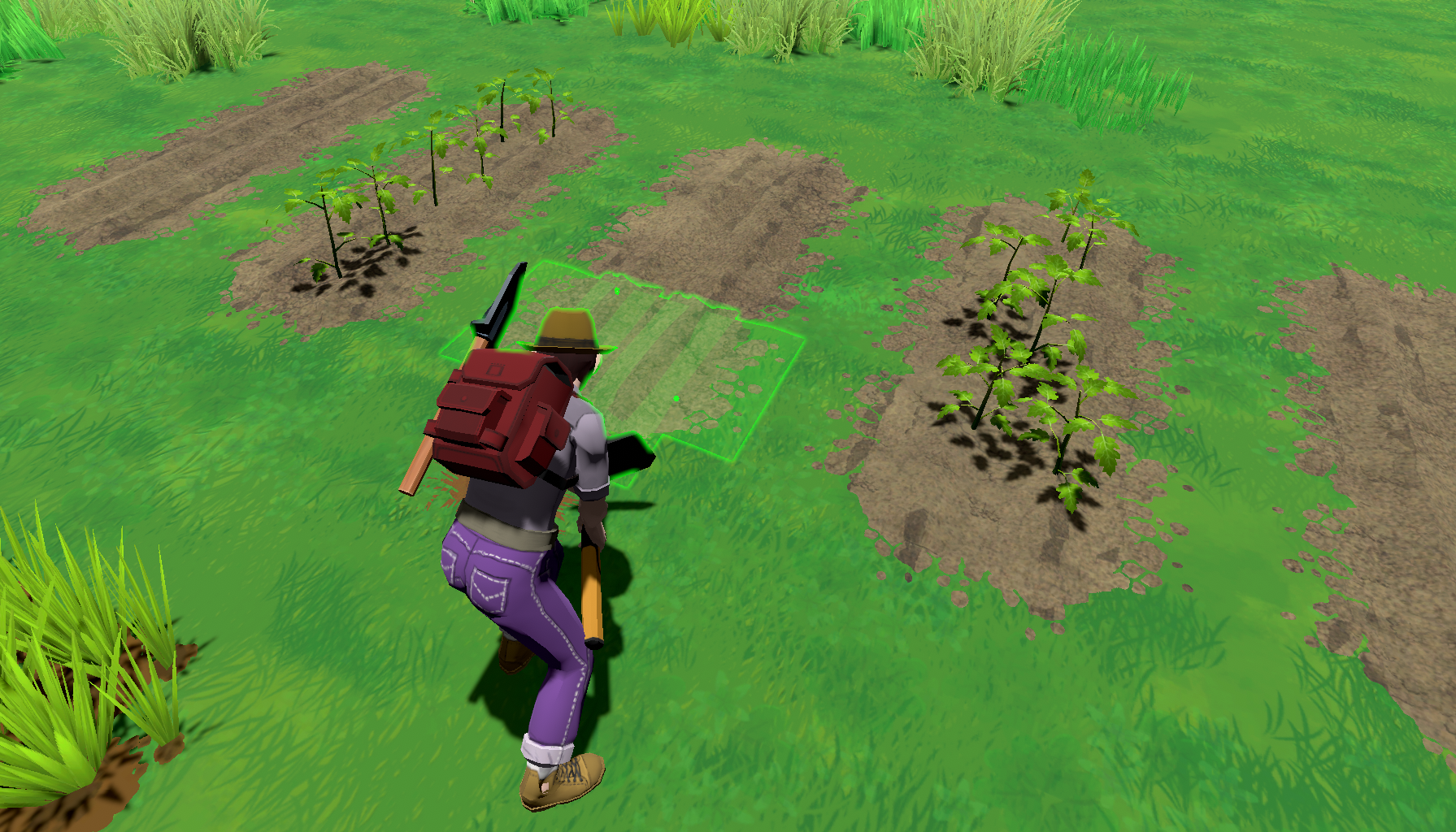
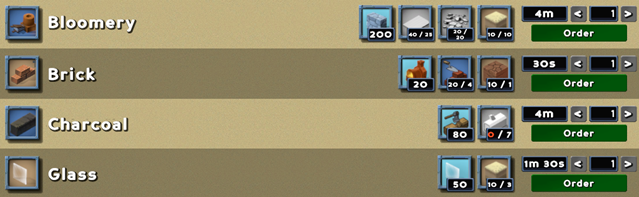
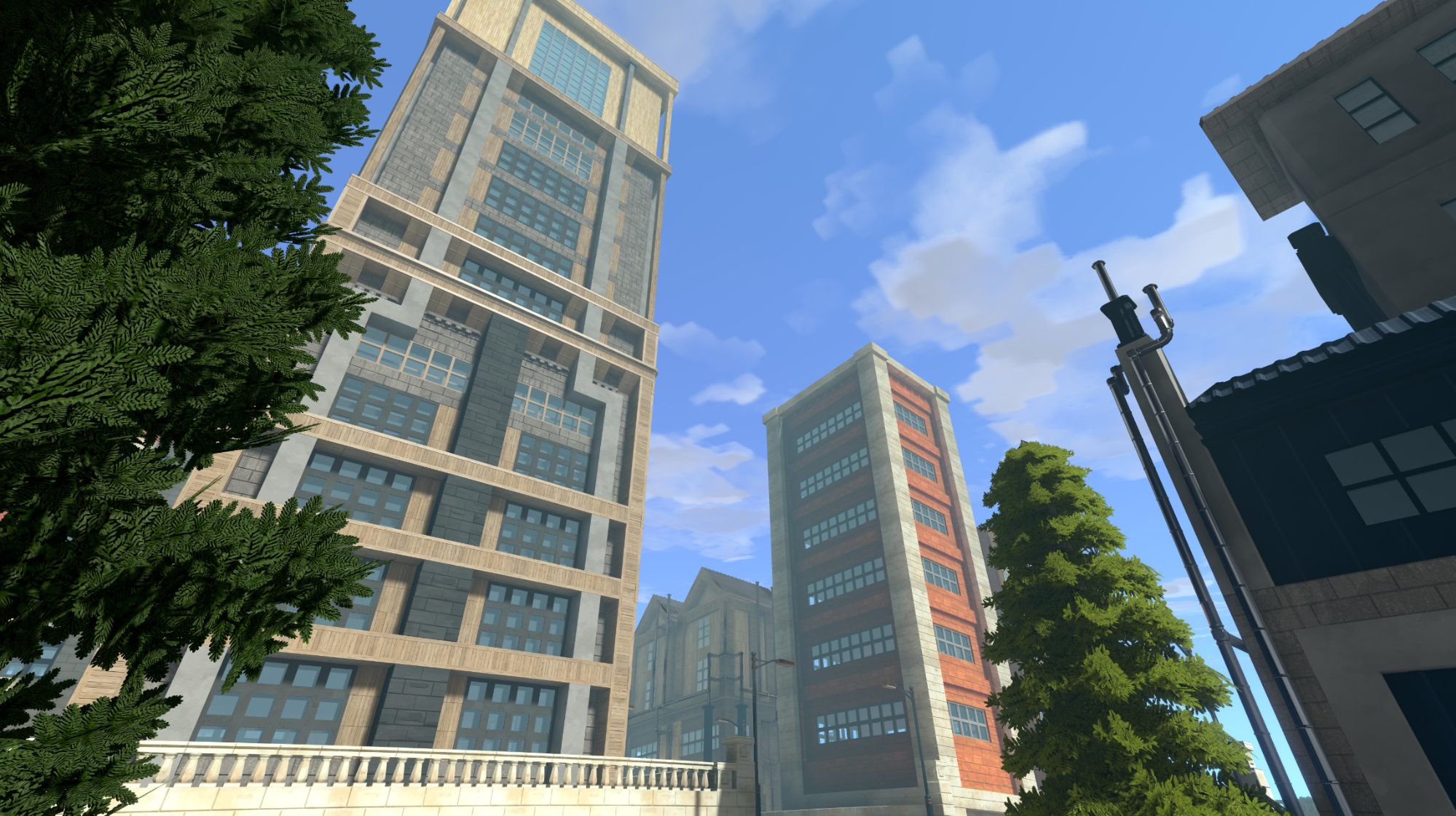
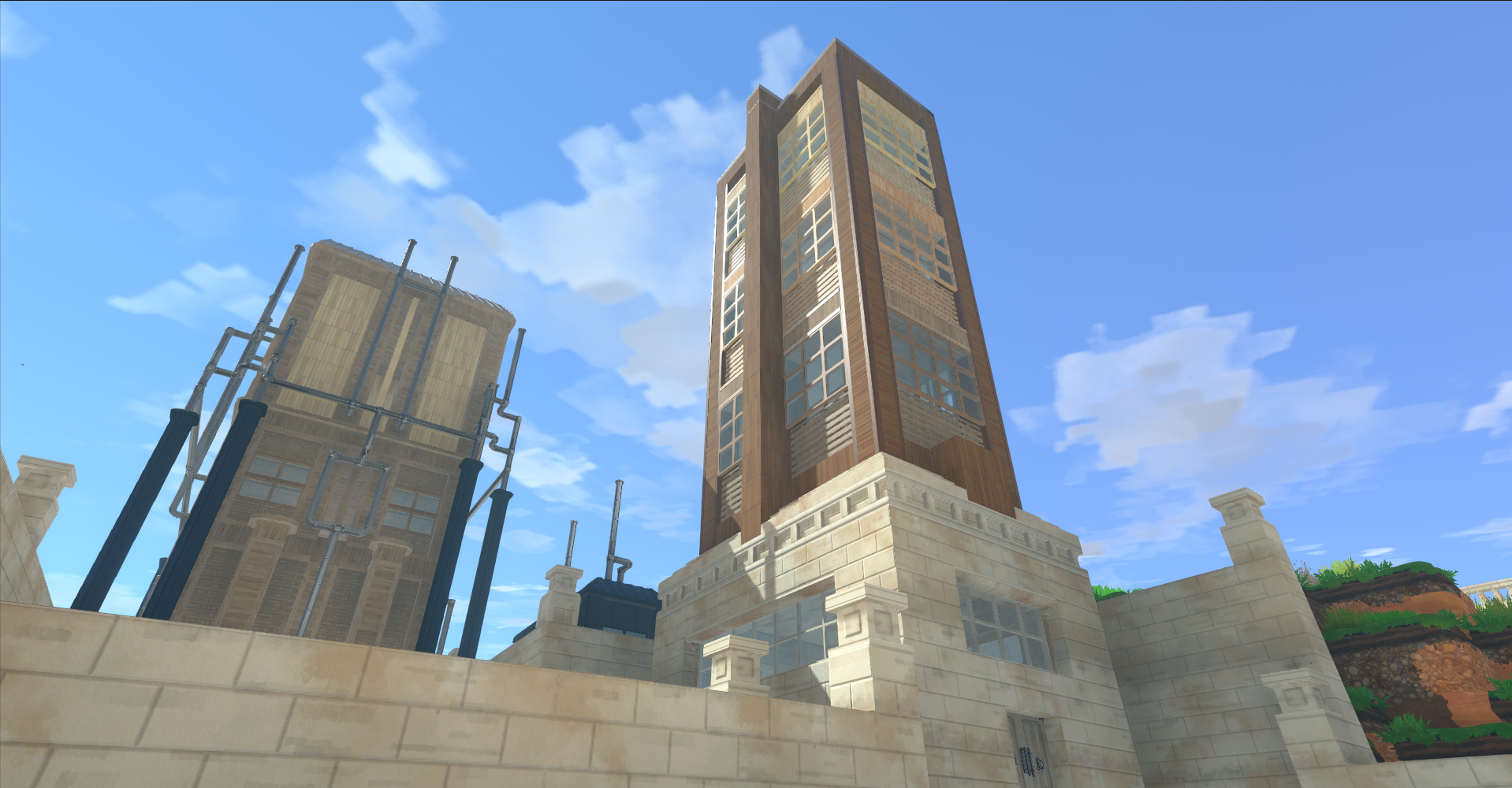
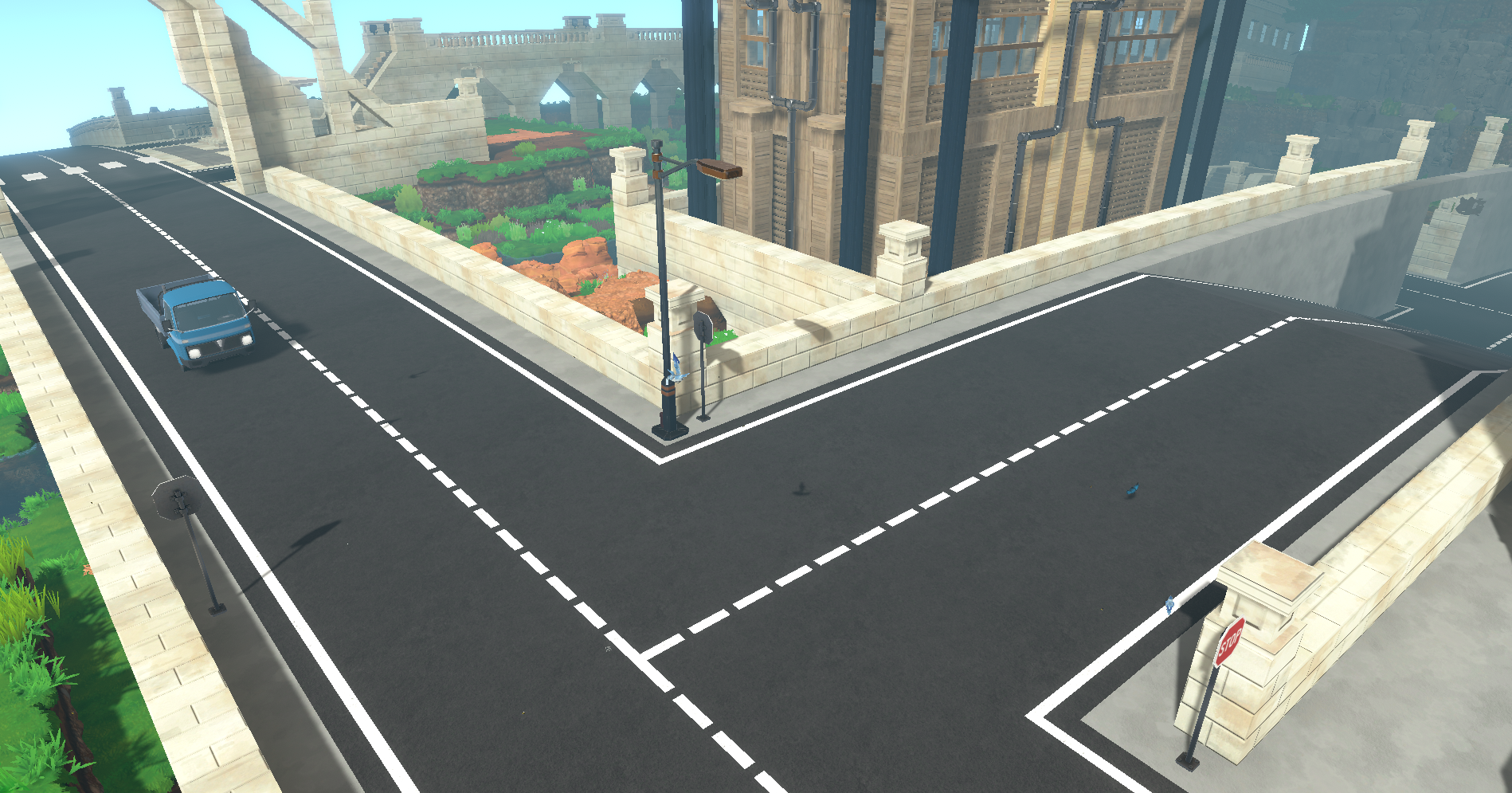
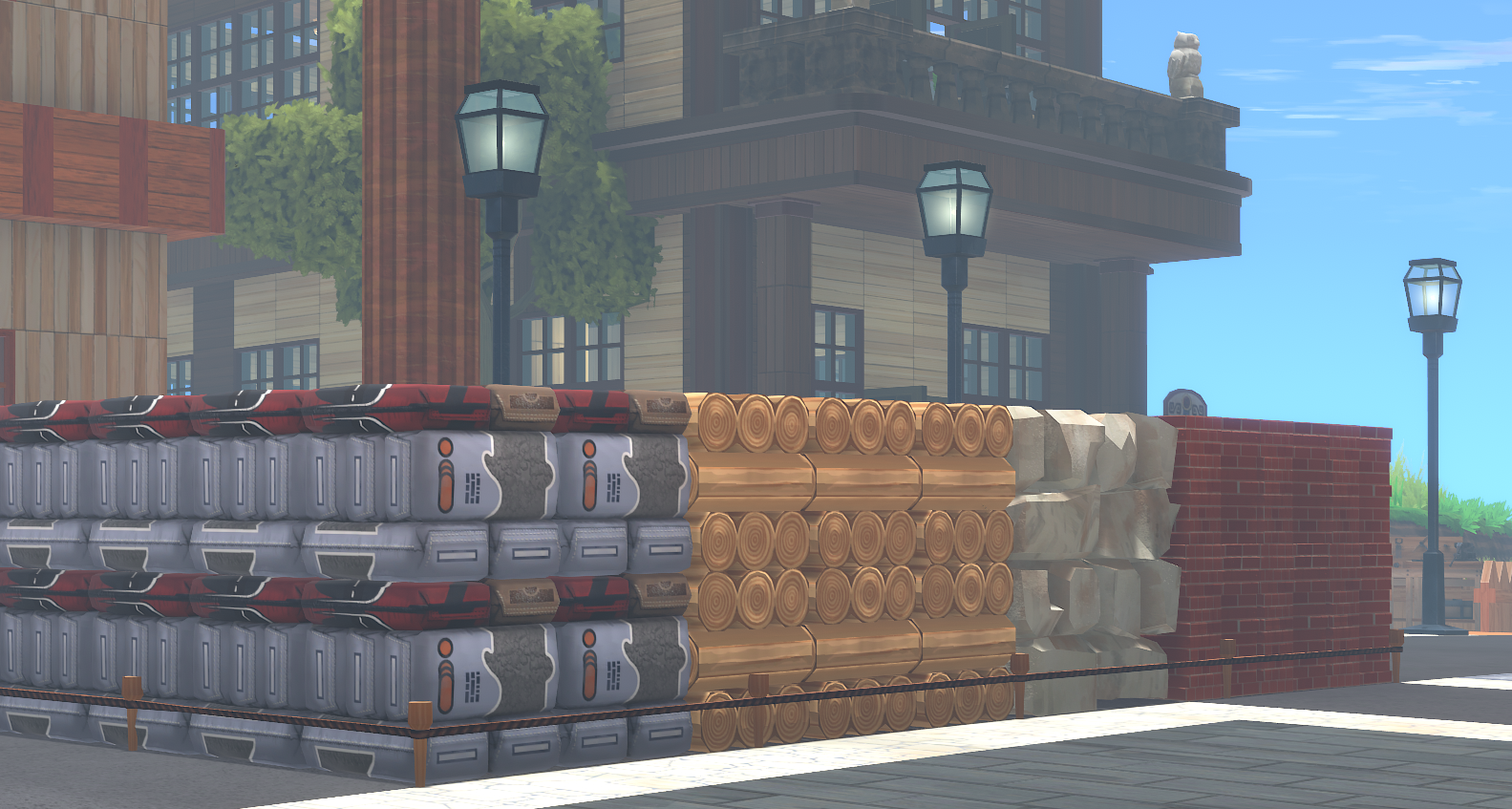
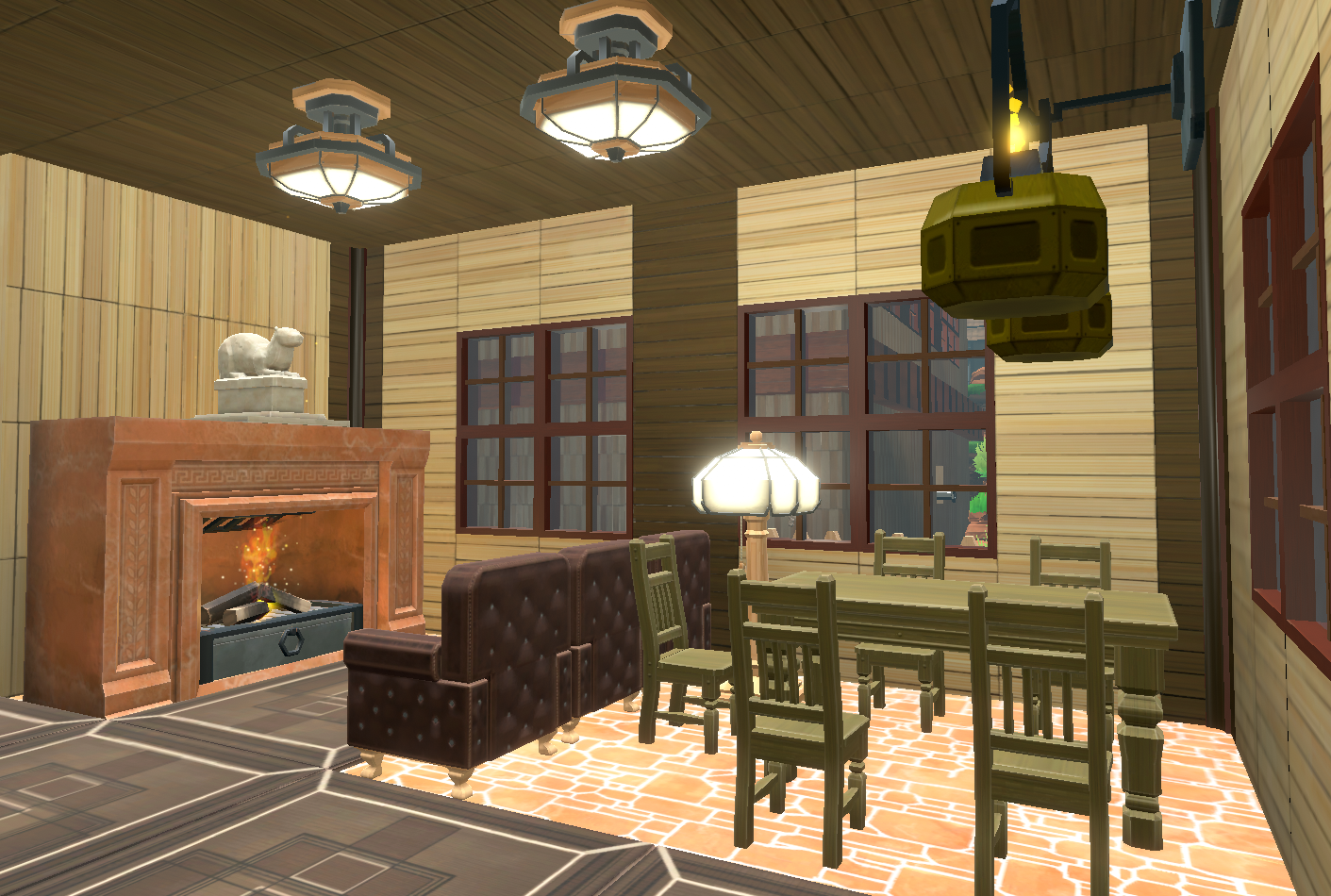
Hi everyone, my name is Milenko and I am the Art Director of ECO. Since I speak here rarely, before I start talking about UI, I would like to let you know where the art production is at and share a bit of an artist experience from our work so far.
Firstly, the Art team is working really hard at bringing more visual content to the game and we never stop. Many new assets are waiting in the cue to be plugged into the game. However, priority now is working through the latest increment, making it stable and making sure it runs smoothly. So while the engineering team is fixing and polishing the .9 update, the art team is assisting in anything we can help with, putting polish on as much art as possible without causing any issues ourselves and preparing assets for the versions to come.
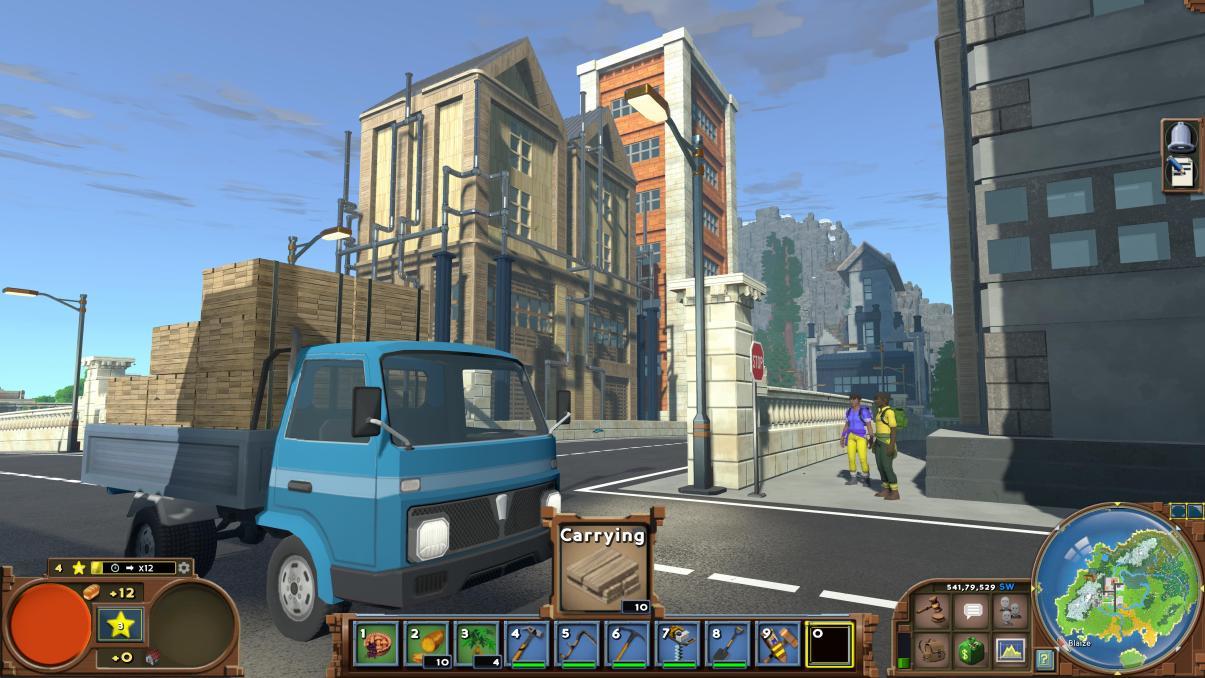
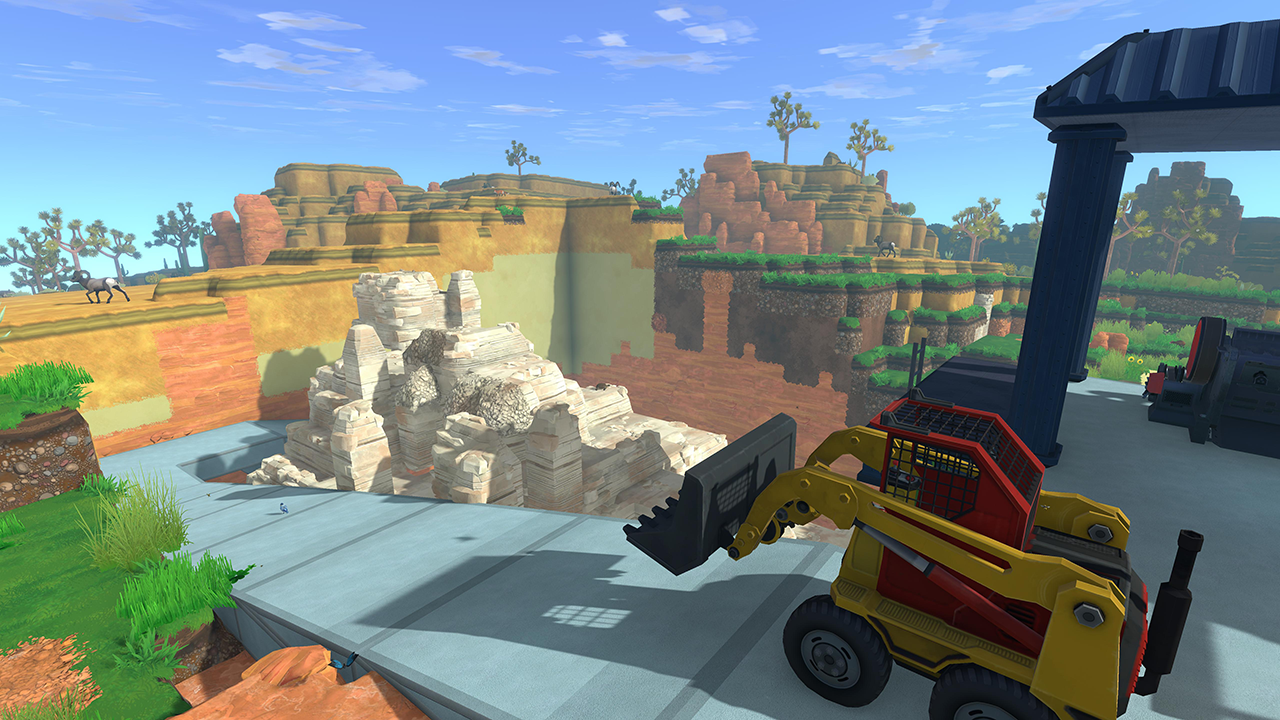
Game systems are getting more intricate, vision more focused and complex and the game itself is getting more depth than before. As the technology improves, we, the art team, are getting the opportunity to make our game prettier and more appealing to the player. For me personally, making art for ECO is the biggest challenge I have had in my career so far, I am learning a lot and had to change my perspective and opinions about the game art compared to any previous experience I had.
With the world being procedurally generated and the amount of control given to the players, it is very hard for the art team to oversee and control the final look of the game we are creating. It is still possible to a sufficient extent, but the ways to do it are very different from the ones we as artists are used to. So it requires a bit of change in the way we think about how we do things. Regardless of difficulties, it is a nice challenge and keeps us sharp and on our toes at all times. And that is a good thing.
I will try to write up a specific, longer blog post about art evolution on the game at some point soon. In regards to the User Interface, revisiting everything was a process that took months to bring it to the current stage. It took a lot of sketching, prototyping and many, many new art bits and the ways that they needed to be put together.
With ECO growing as an experience and reaching the stage where it is ready to move into the next phase of development, there was a need to revise most aspects of the existing User Interface so that the game becomes more streamlined, features more clear and obvious, player interactions easier to understand and the game overall easier to use.
In the course of past months, with a lot of hard work, game design has progressed and evolved and the game-play has become much more intricate with new features and more complexity. Prior to 9.0, the User interface was mostly in the prototype phase and was often built on the spot in order to make a new feature functional.
So we wanted to make it more organized, prettier and overall more appealing. It meant breaking many old things and rebuilding them from scratch, coming up with the new common themes and overall unifying it as much as possible visually while making it easier for players to use. In the course of the game development, and with many new features,new, specific, UI groups and functions unique to each other started to become necessary.
Thankfully, the current iteration has become faster and more responsive allowing the player to interact with the world and the game with fewer clicks. We came up with different themes for different interfaces, figured out how they work with each other, figured out the way we want to put them together and tried to make sure they work thematically with each other so the overall look still follows the same theme, and fits with the overall game style. Some animations and movement have also been introduced to help with the experience overall. Following are some examples of the look for the new interfaces being built:
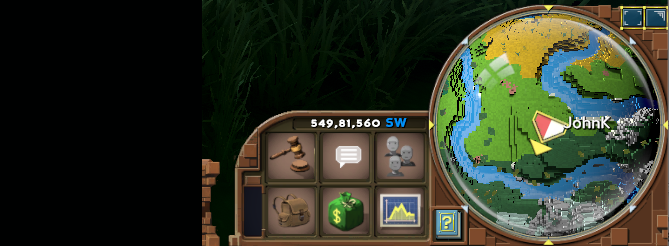
There is a main on-screen interface which is a redesign of the existing one allowing the player to keep tabs on main aspects of the gameplay.
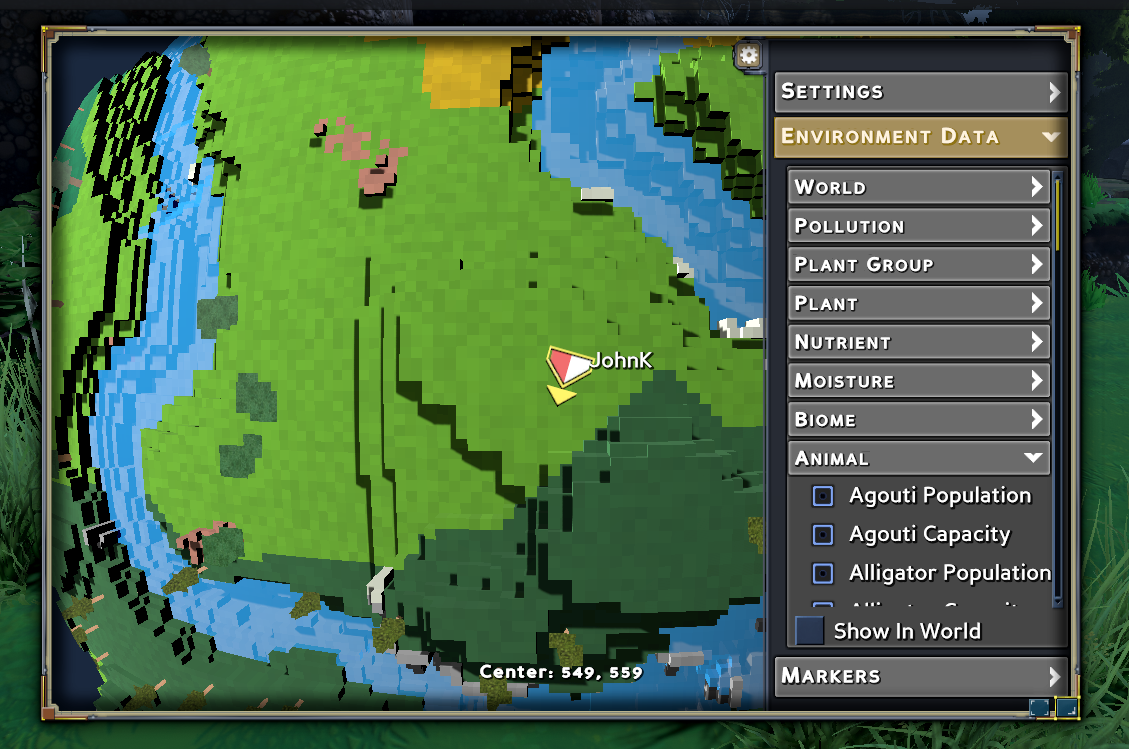
Mini map got its own category, with minimized, popup and full screen versions, giving the players different options they can use based on their play. It is always visible now and adds to the game a lot.
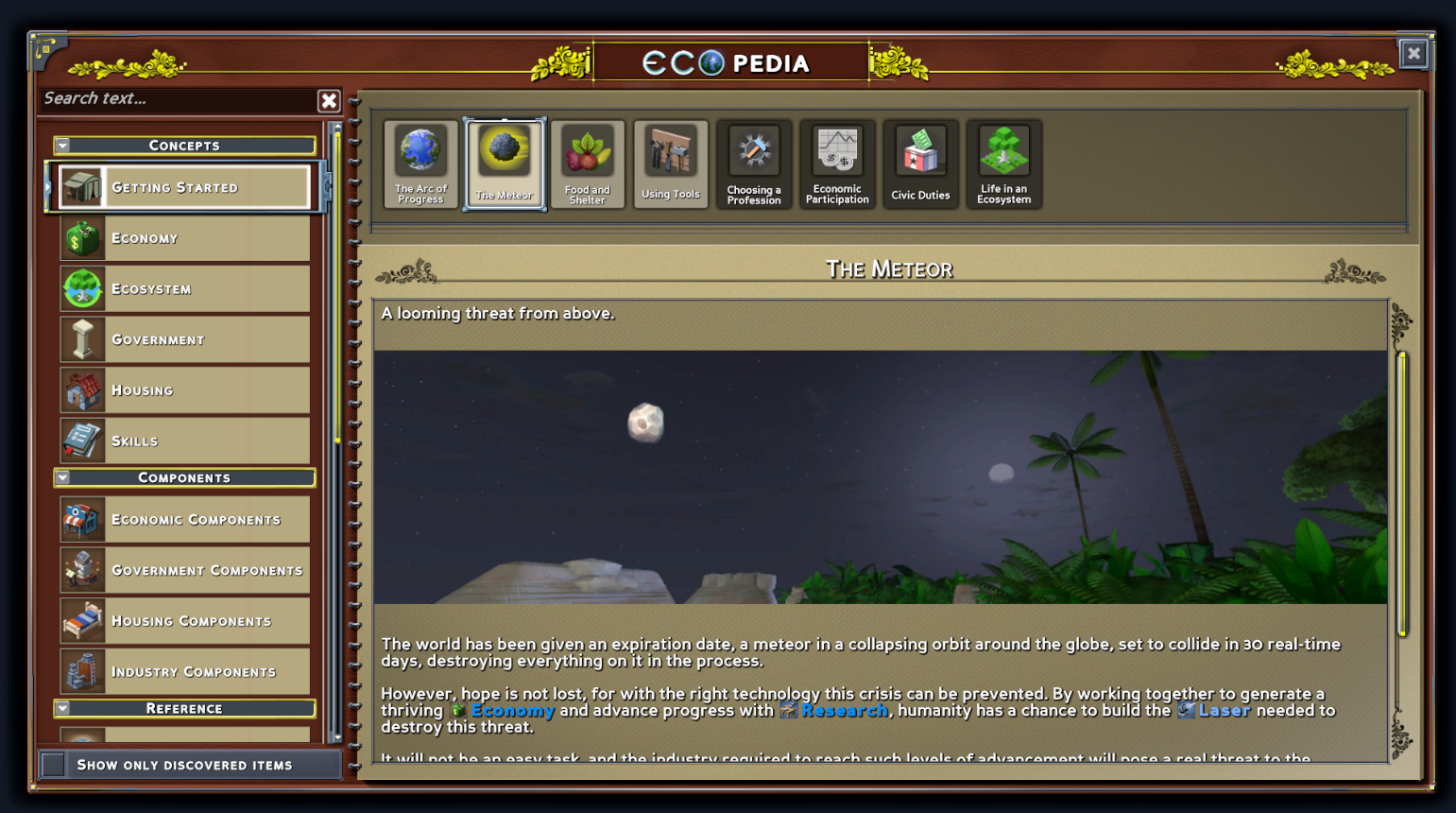
There is a massive and complex Ecopedia UI, designed to assist players in understanding many aspects of the game. throughout the rest of the interface it can be accessed and should help in clarifying different game segments.
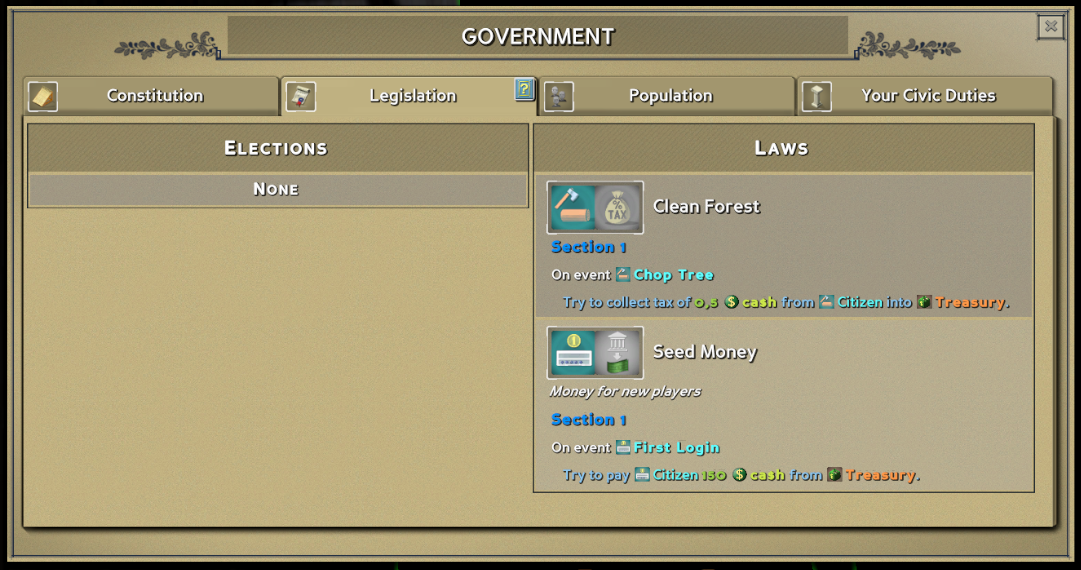
Laws interface allows players to craft civic and legal aspects of the game, helpful in organizing society and managing players' interactions with the world as well as each other.
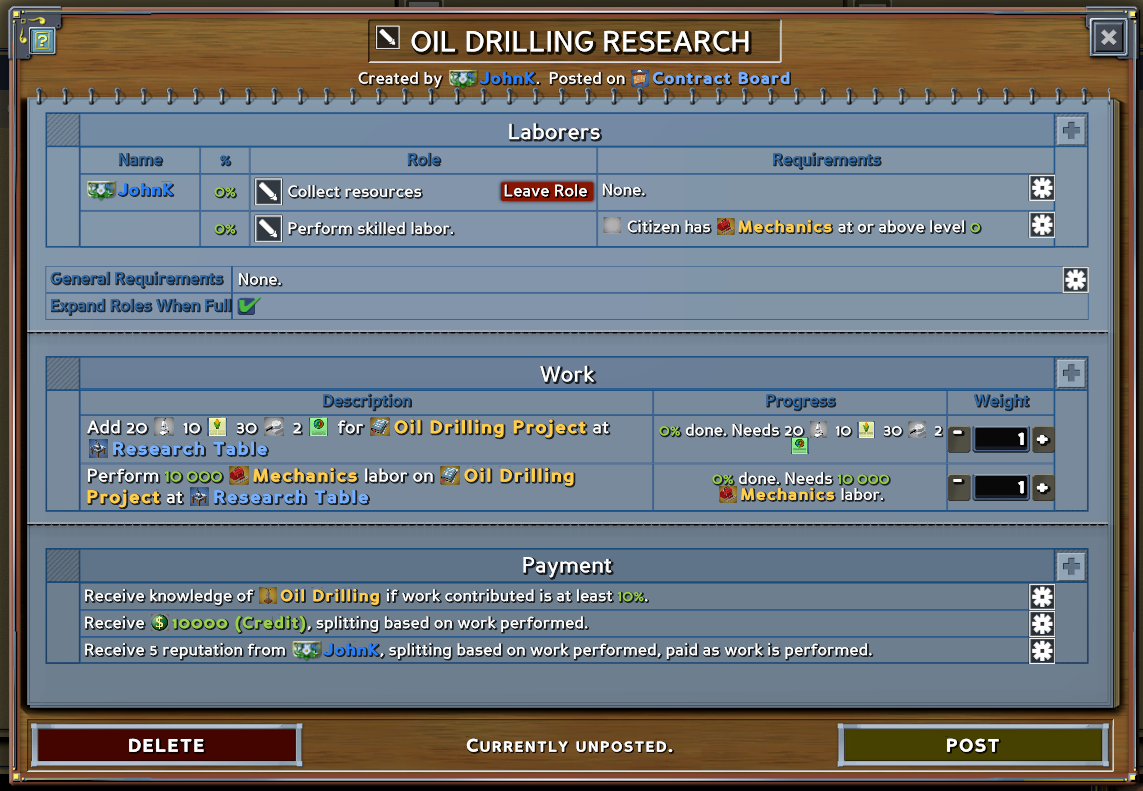
Work parties interface is there for assisting in organizing and following various tasks throughout the game.
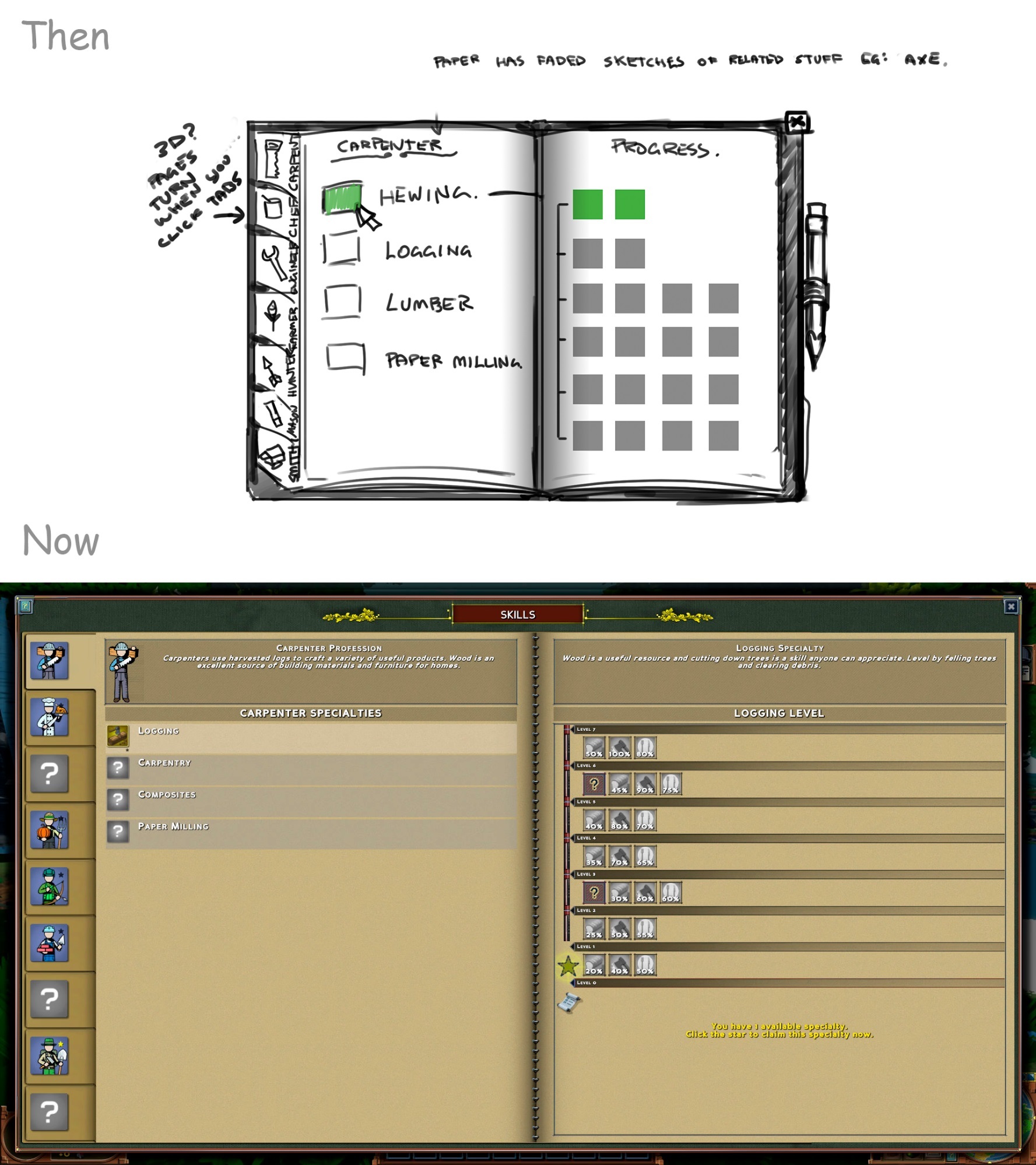
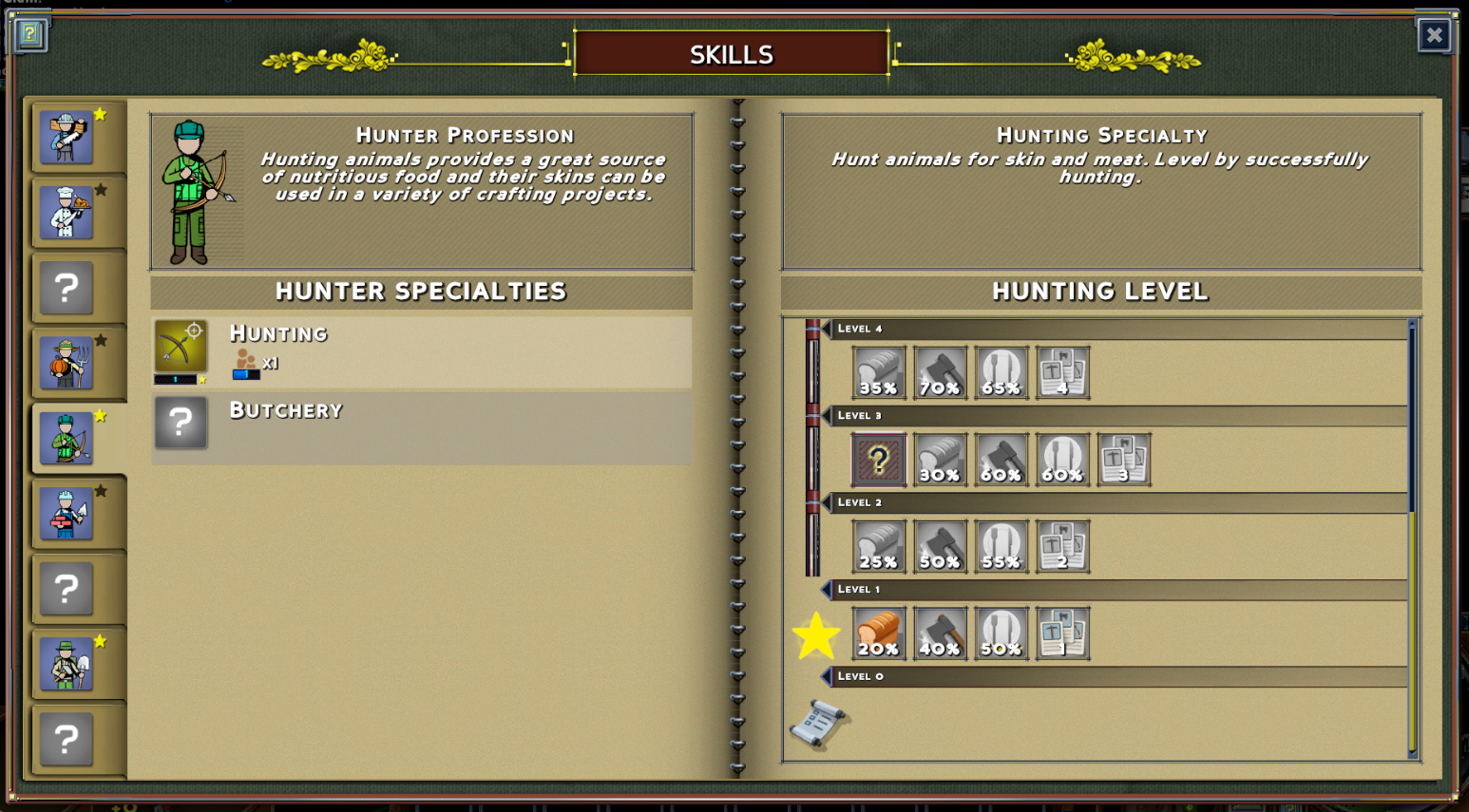
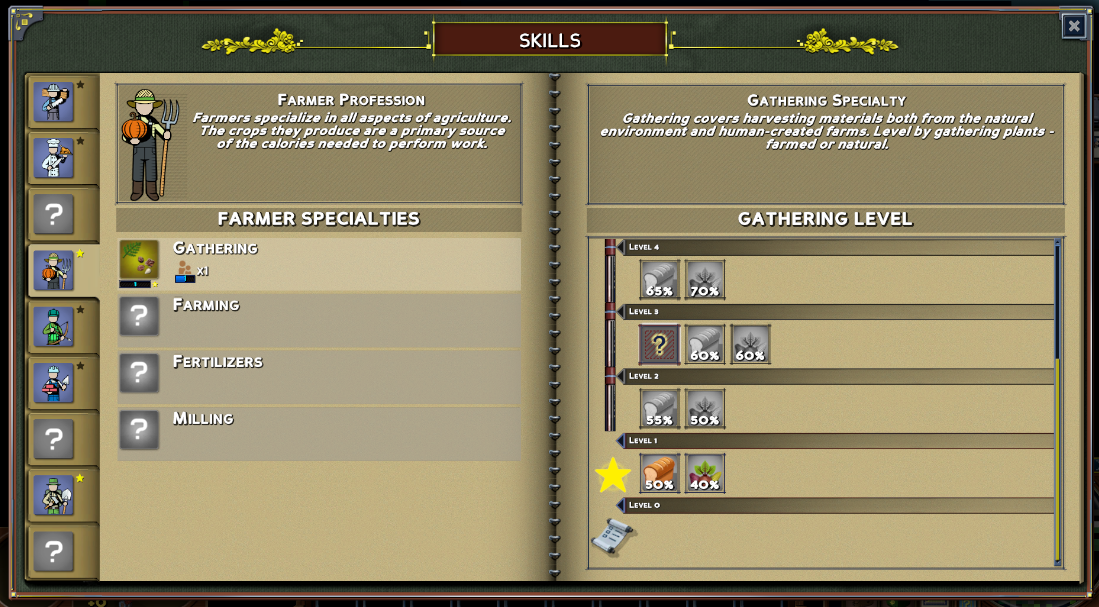
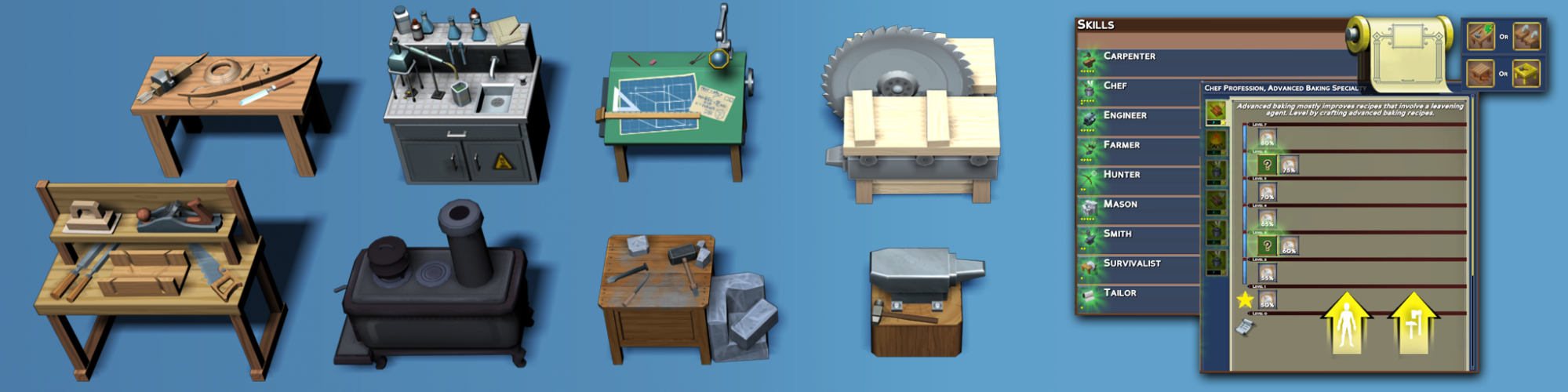
Skills interface is allowing the player to follow their progress and learn about different professions development.
Improvements go on and returning players will hopefully find them enhancing their previous experience and new players will find the overall interactions with the game easy and unobtrusive.
Final Note
Of course, everything is still work in progress and the art style, features and visual functionality are developing and evolving together with the game itself. So the current state is an improved and more organised version of the previous one, and as the game development progresses visuals and style will change to adapt to the needs of the project.
The livestream covering this blog will be hosted on Sunday, May 31 at midnight PST / 9am CEST. We're aware this isn't optimal but due to me working from Australia it's the best slot we could get.
- Milenko Tunjic, Art Director, Strange Loop Games
Developer Blog: Labor System
Greetings Eco citizens! Todd here to present this week’s development blog focusing on our new Labor system for crafting. Labor introduces an exciting new layer to the economy which allows for a variety of new interactions between players.
In update 9.0, all crafting projects will require calories to be expended in the form of labor. When designing labor, we had a few key goals in mind:
Encourage more collaboration through the new labor market
Increase food demand during the modern eras of technology
Create a need for dedicated crafters to consume calories
Maintaining Food Demand
One of the design pillars of Eco is to balance the needs of society with the impact on the environment. Part of this is the need to dedicate large areas of cleared land to agriculture. To make this possible, a steady demand for food is needed.
Prior to the labor mechanic, as technology progressed and specialists became more proficient, the need for calories began to slowly decrease over time. Though resource gathering always consumed resources, many of the major industries had minimal calorie requirements. As a result, the market price for food tended to dip once larger farms were developed.
With the new labor system, progressively larger farms will be needed to supply the calories required for production. Advanced technologies will still increase the efficiency of resources use, but extra labor will be needed to keep up with the increased production.
Farmer using the new AoE Modern Hoe.
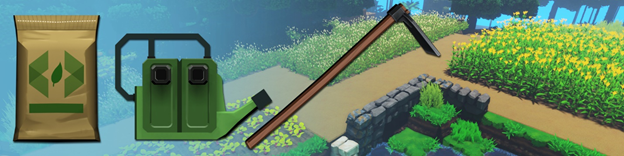
The labor market especially benefits farmers, hunters, and chefs. A constant flow of calories will be required to keep the economy running smoothly. To help keep up with this extra demand, we are introducing a variety of new bows and advanced farming tools (see tech tree blog). In addition, we are adding new food recipes for chefs that can accept a larger variety of ingredients.
Labor as a Resource
Crafting in the real world requires work to be performed as part of the production chain. In 8.3, crafting simply required the necessary ingredients and an active crafting table. Some crafting tables had an additional power cost while operating, but otherwise players could operate near limitless crafting tables placed around the globe without needing much interaction. Update 9.0 addresses this by adding labor as an additional cost to recipes to represent the human component.
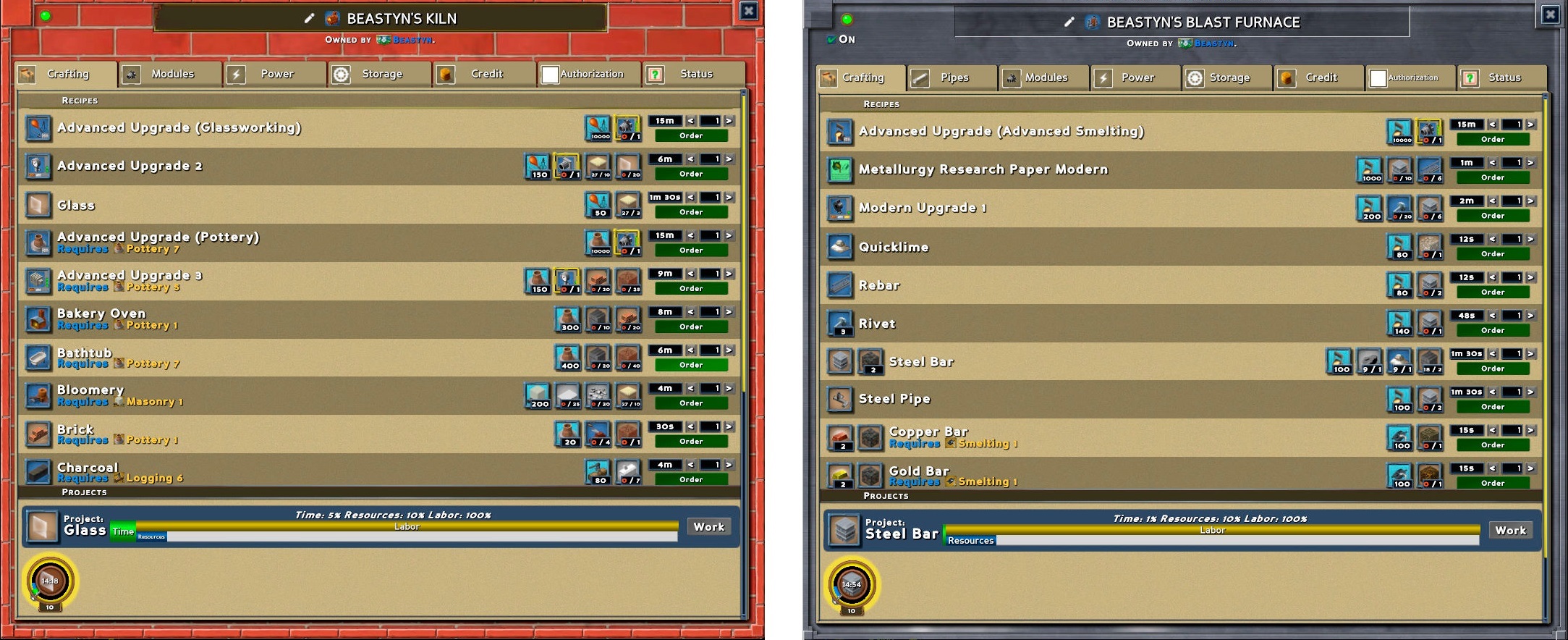
Crafting UI showing four different types of skilled labor costs.
All citizens can perform the basic labor needed for the early starter recipes to establish themselves. Beyond this, most recipes require skilled labor. To craft these recipes, labor must be provided by a citizen who has specialized in the related skill. More experienced specialists will be able to expend less calories while performing labor and help craft more advanced recipes.
Work order in progress with option to add labor.
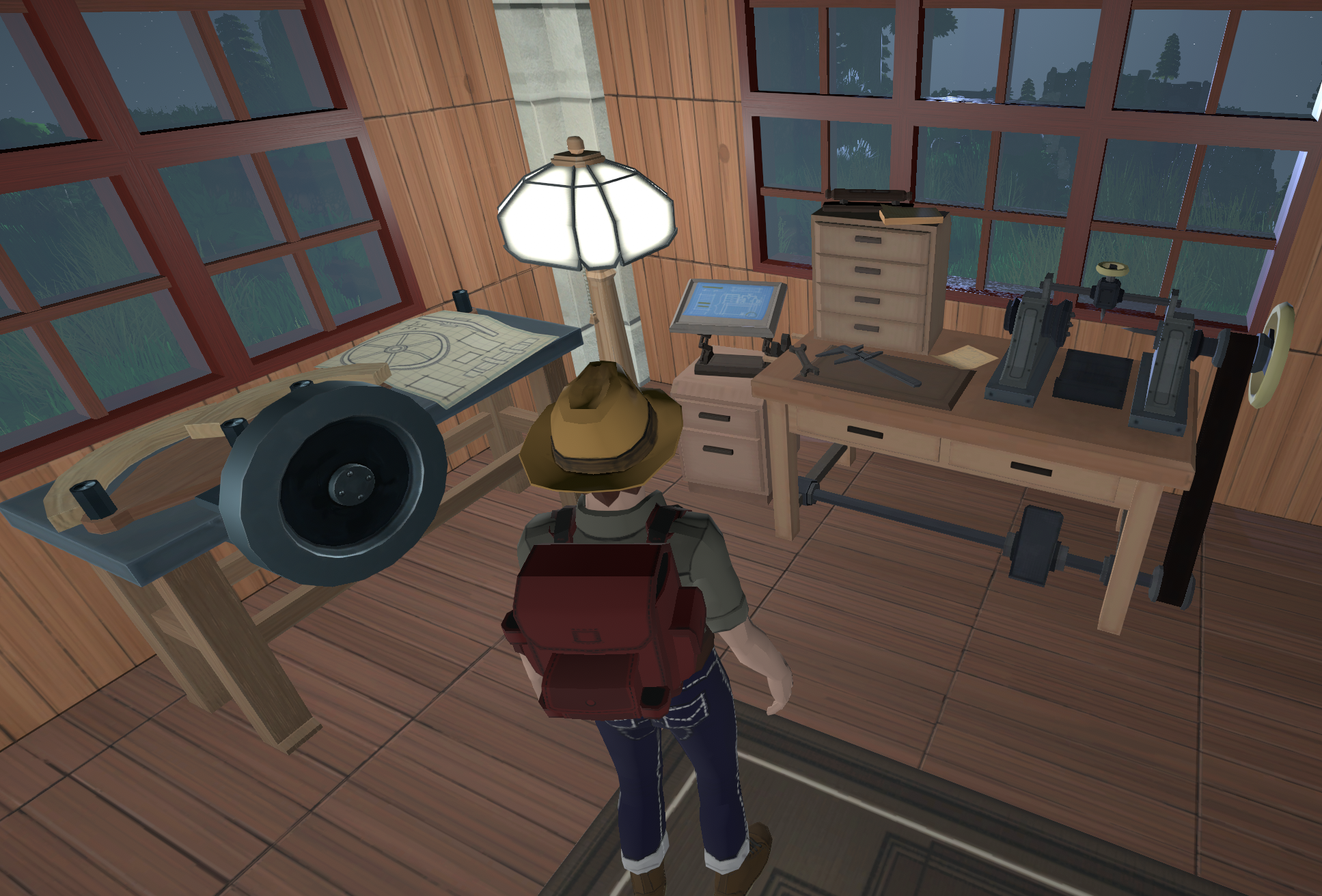
Both resources and labor must be added before work on a project will begin. Labor can be added directly from the Crafting UI or by interacting with a placed crafting table. This encourages crafters to stay in closer proximity to crafting tables. While a work order is in progress, players will still be free to explore the world and interact with their surroundings, but work orders will occasionally need more labor added as new resources are acquired.
With this change, small producers will be able to find a role supplying towns with a local supply of resources. Large producers will have incentive to hire other specialists to perform the labor needed to keep their expansion stores stocked with inventory. Both scenarios make it easier for multiple players who share a specialty to contribute to society in their own way.
Labor and Collaboration
A major benefit of the labor mechanic is the addition of a labor market to encourage collaboration. Previously, we showcased how players can hire skilled laborers to contribute to their crafting projects (see work parties blog). We also previewed how new players will have an alternate route to progression by gaining experience while providing labor (see upgrade module blog). These are just some of the ways that labor will promote more interaction.
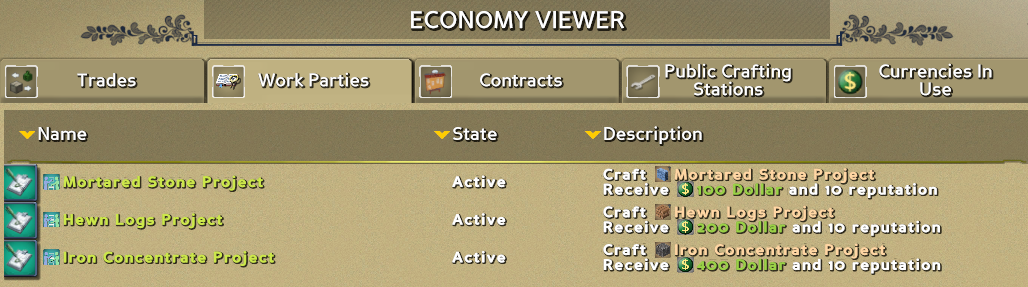
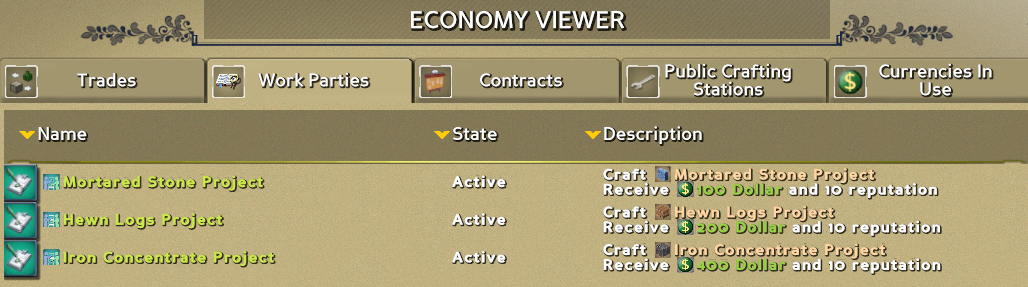
Economy Viewer showing different work parties available in the world.
Large scale projects, like researching new technologies and crafting new government buildings, require large amounts of labor and resources to be contributed. For big jobs like these that benefit the public good, there is incentive to have multiple citizens contributing labor to a single project. When collaborating on research projects, a work party can be created so all citizens that contributed will have access to the technology once completed.
Something we want to expand on in Eco in the future is the ability for players to form companies and act as a single corporation. Skilled labor, along with the new wage and work party systems, are important steps in this process. We are excited to see how players will use these new tools while establishing an economy.
Summary
With this blog we will be wrapping up our preview of the new crafting system for 9.0, but we still have plenty of content to showcase in our upcoming blogs. I hope you have enjoyed this look at the new labor system and I look forward to sharing more during this week’s stream.
- Todd Glenn, Developer, Strange Loop Games
Developer Blog: Building and the Hammer
Hello everyone! I’m Keegan, an artist, designer, and developer on Eco. My best wishes go out to everyone right now and I hope you are staying safe as best you can. Our team is keeping busy with giving Eco 9.0 the polish it needs and are eager to get it out into the world for all of you to experience! 9.0 has some big updates to building which I’m excited to share with you here.
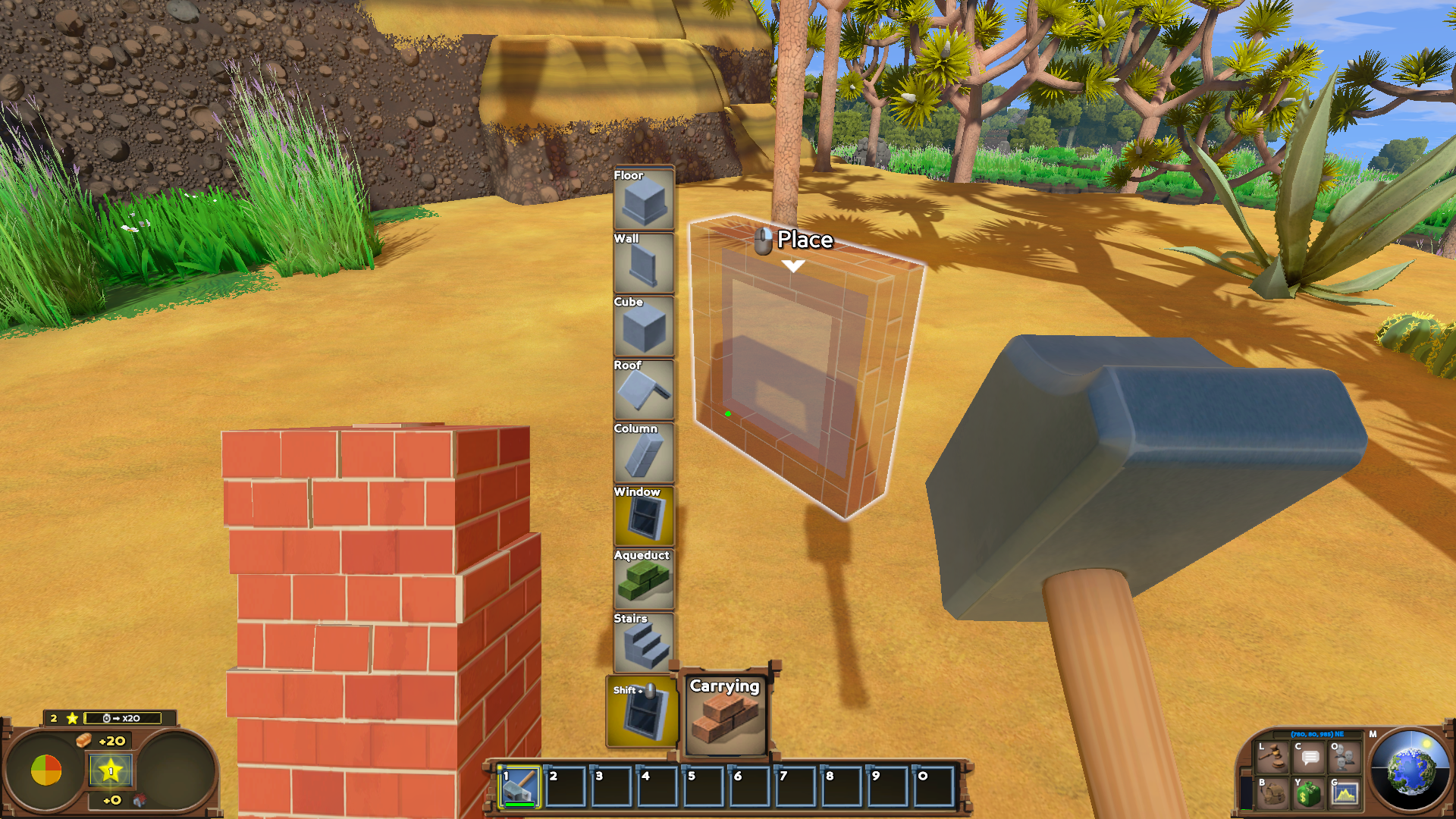
In the previous version of Eco, we added a list of forms to choose from for each building material. This was just the beginning of our plans for player building, and in 9.0 we have greatly expanded this functionality.
‘Hammer menu Before’ in current version of Eco.
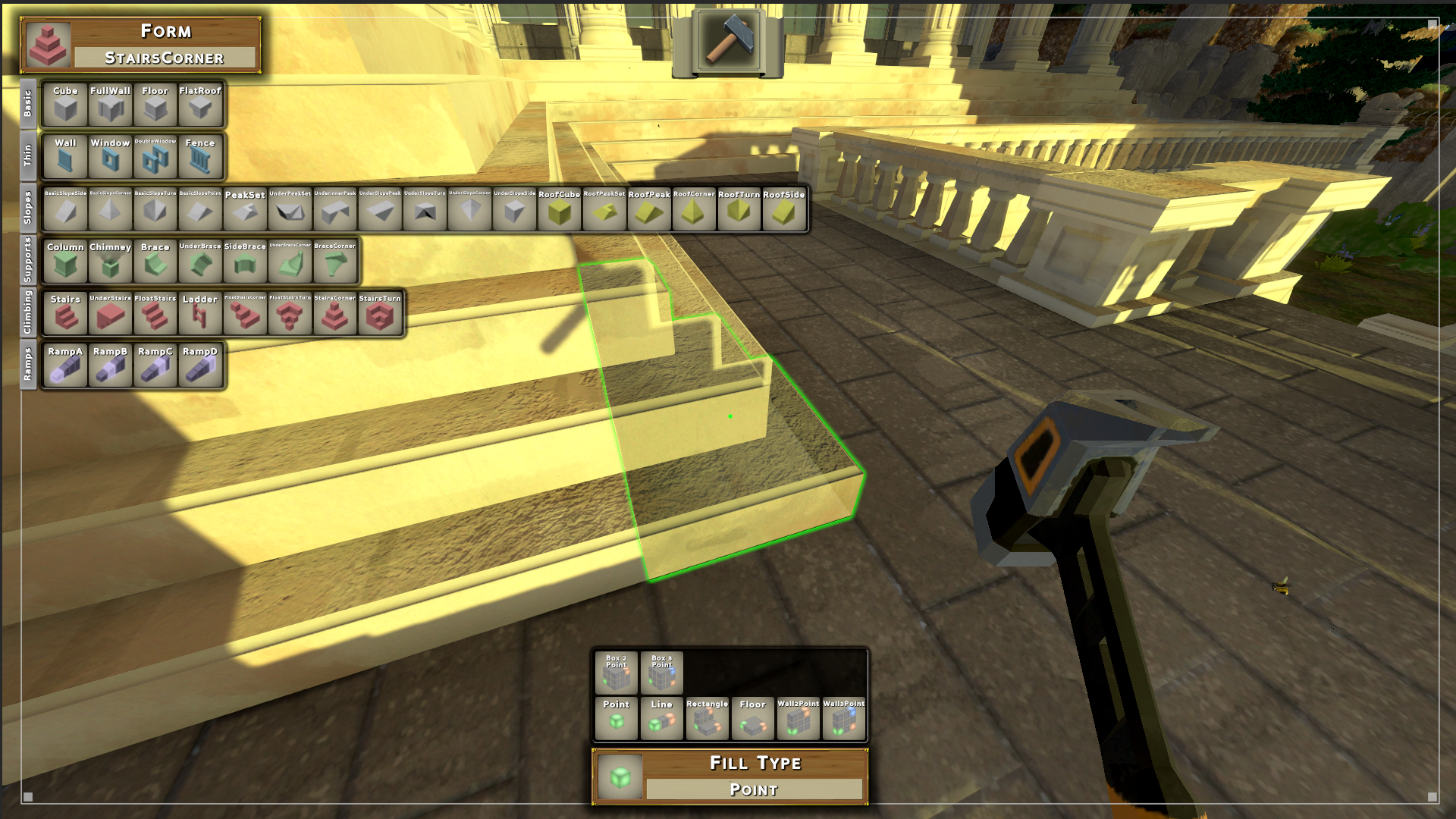
We have refactored the UI and UX to allow for many more forms per material which are categorized and color coded. This is to support adding much more content, variety, and possibilities to building. Expanding the ways in which players can be creative is a primary goal with building in Eco, and we are by no means done yet with core building features to empower players.
‘Hammer menu After’ in new version of Eco, 9.0.
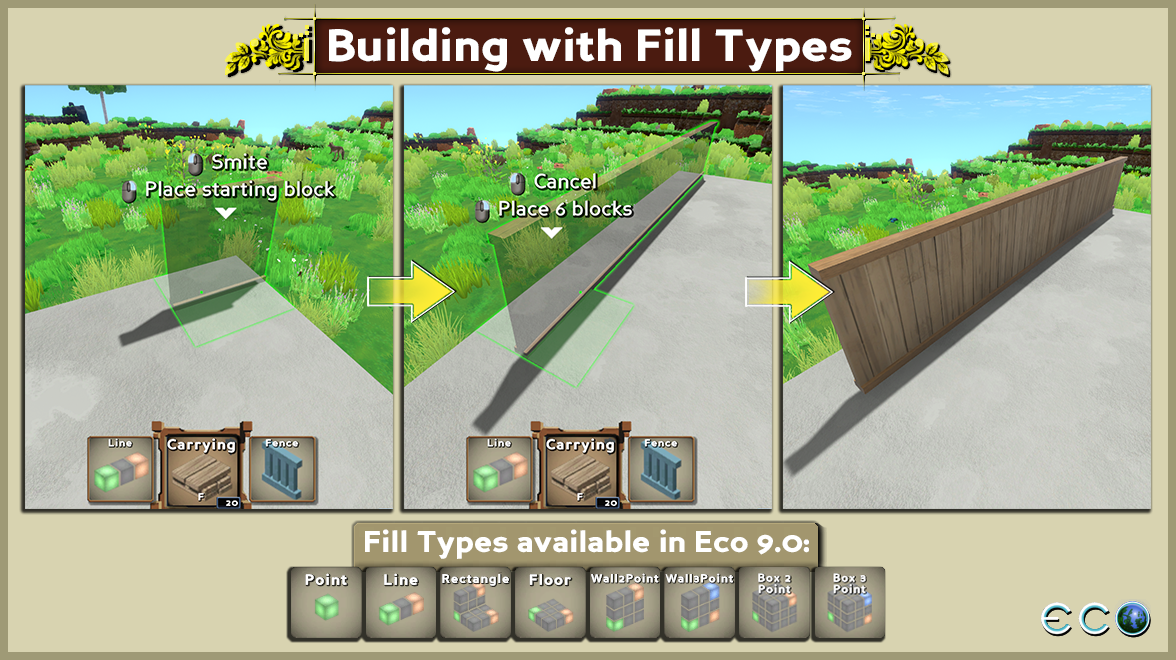
The first of these new building features we are adding to Eco with 9.0 is a new function on the hammer: Fill Types. As you can see, fill types can be selected in their own section of the UI when you are selecting a form to build. Fill types allow the player to define starting and end points for larger shapes that fill in with blocks. For instance, to put down a long line of fence blocks, you would select the ‘Fence’ form and then the ‘Line’ fill type. Then in world you would right click once to set the start point of the line, and a second time for the end point.
The upgraded Hammer in Eco 9.0 supports building multiple blocks at once.
Fill Types are the first step towards having more robust placement abilities for building in Eco. Before 9.0, players had to place blocks one by one. Now, with Fill Types, players will be able to create bigger structures by laying down swaths of blocks all at once. For now, inventory restrictions still apply so most materials will allow you to place down up to 20 blocks at once. In the future, we look forward to implementing more powerful building tools that take advantage of these new systems and allow material switching on the fly and many more than 20 blocks to be placed at once. The plan right now is to implement those kinds of powers (along with more fill types) with a total revamp of the Crane vehicle. To get a feel for and preview of this power, players in 9.0 can try out building with admin tools and commands on their own server, using the /give devtool and the /fly commands.
If providing creativity is the first priority with the building systems, the second is grounding that creativity in the unique world of Eco and its finite resources. In 9.0, to follow up the massive expansion of the biomes in 8.0, the building materials we focused on first are the ones that come most directly from the environment.
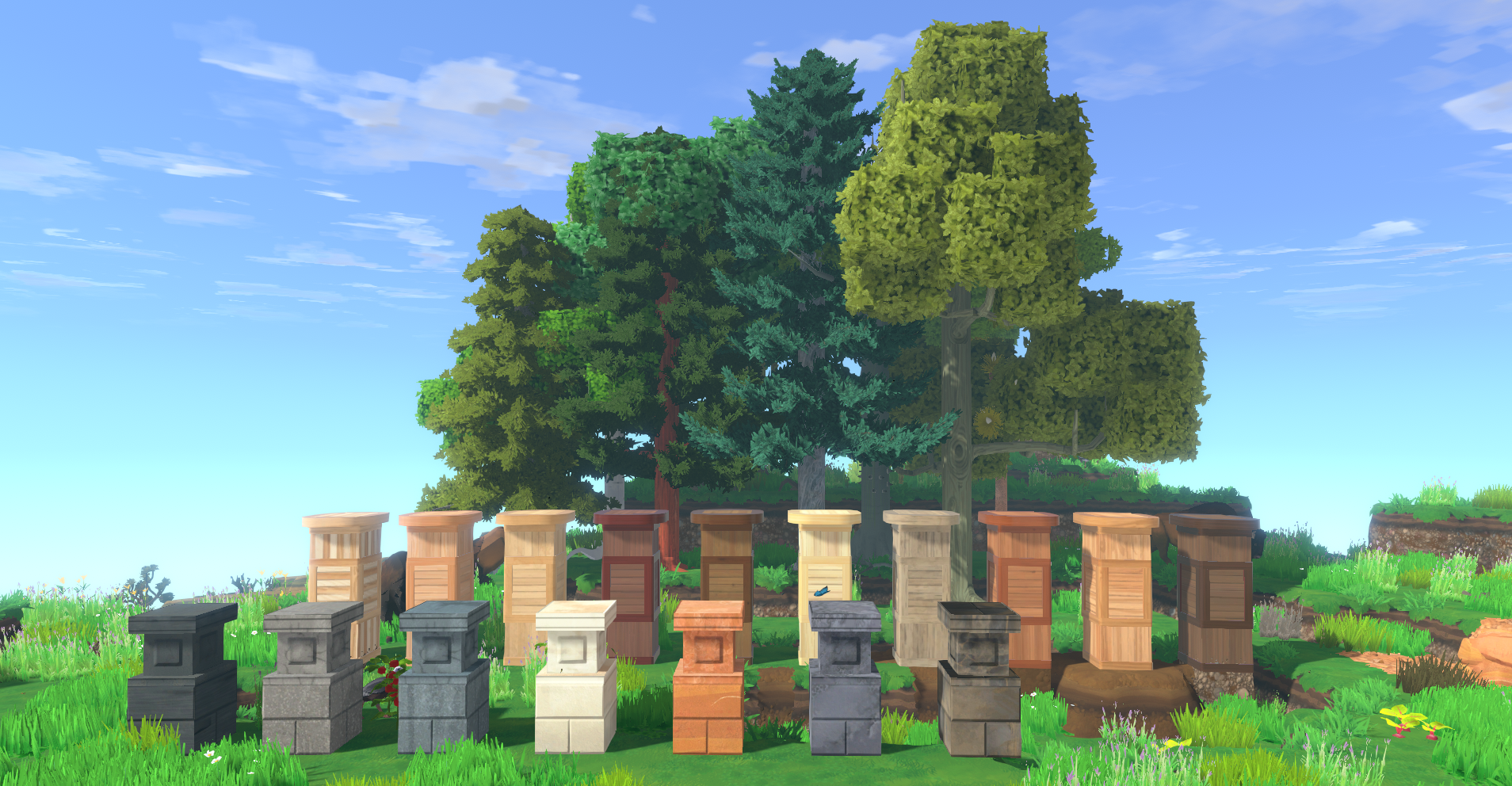
The two new building materials are Ashlar Stone, and Composite Lumber. These two materials actually have variations for every type of tree and every type of rock in the game-- so your buildings made from Shale will look different than those made from Granite or Sandstone, and your buildings made from Cedar trees will look different than those made from Spruce. Though we have a long way to go to flesh out the end-game building material content in Eco, I am happy we tackled these materials now so that players will be able to build cities that exhibit and celebrate the sources of their materials.
The next steps for Eco as far as materials goes is to continue forward in this same manner with fully modern and industrial materials such as reinforced concrete, glass, and steel. We also will be updating older building materials to have many more forms like the new materials do. While we will prioritize end-game building materials to maximize the possibilities of high tier buildings, we do have plans for early building material improvements as well such as peat roofs and adobe.
One update in 9.0 that will be continued as part of the upgrades to high tier building materials is for asphalt concrete, which previously had no forms but now has several, and a much improved look. We look forward to adding many new forms as we go from here on out, and now that we have the UI and UX to allow this, I am confident Eco’s building system will continue to expand in unique and exciting ways.
- Keegan O’Rourke, Lead Artist Eco, Strange Loop Games
Developer Blog: Upgrade Modules
Greetings Eco citizens! Todd here to present this week's development blog on Eco 9, focusing on the new upgrade module system which will significantly boost your production.
When designing upgrades we had two main goals in mind: create demand for a skilled labor market and increase the significance of technological advancements.
What are Upgrade Modules?
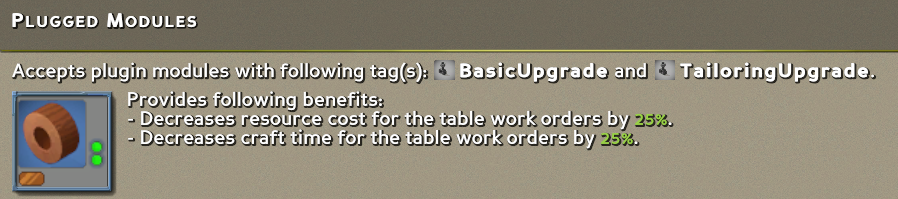
In short, upgrade modules are our new system for improving crafting efficiency. Crafting tables will have modules in which upgrades can be plugged-in to reduce the resource cost and crafting time for projects on that table. All work orders started on an upgraded crafting table will have the same cost reductions, regardless of the skill of the citizen who starts the order.
This last point is especially important because it moves the bonus you get off of your skill and onto this module, which means that new players can have much more of an impact if they make use of an upgraded table.
An upgrade module for the tailoring table.
Upgrades and Technological Progression
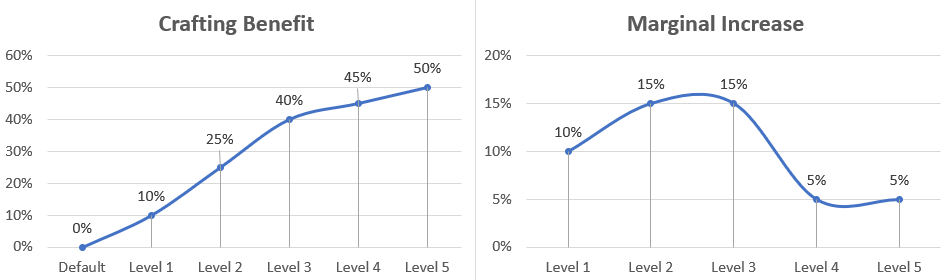
When designing the benefits for upgrades, we used the concept of mature technology. As new technologies are invented and introduced to the market, there is a period of rapid advancement. As most of the initial flaws in the technology are worked out, improvement is still possible but the marginal benefits of each advancement in technology decreases. Eventually a new technology will be invented, making the old technology obsolete.
In Eco, this will be seen in the increased benefits provided by progressively higher levels of upgrades. Upgrades come in five different quality levels, each providing an additional cost reduction. Initially the benefits of upgrades increase rapidly, while higher level upgrades start to have diminishing returns.
Mining upgrades of different quality for each era of technology.
Crafting tables accept different tiers of upgrades, each corresponding to a different era of technology. For example, early stone age crafting tables can accept a “Basic Upgrade” while advanced crafting tables, like the Electronics Assembly, require a “Modern Upgrade”.
New Possibilitites for New Players
With our new skill system, our goal is that players will have an alternative route to establish themselves in an existing economy. Previously all experience for crafting went to the citizen who started the project, regardless of who contributed the resources. Now, experience is gained when players add skilled labor, while adding ingredients provides no experience. Experience for the project will be split amongst all citizens who contribute skilled labor, relative to the amount of labor each contributed.
Upgrade modules, along with work parties (see blog), encourage this exchange of labor on a large scale. Citizens who own upgraded crafting tables will have incentive to hire laborers to work on their projects to maximize production. Specialists of all skill levels will be able to contribute to the same project without affecting the crafting time or the amount of resources needed. This will help create a healthy labor market.
The economy viewer showing work parties available in the world.
Future Plans for Upgrades
Now that we have the core system of upgrades implemented, we have a variety of plans to expand them in the future. A few of these ideas include:
Specific upgrades for different crafting tables (For example, different quality saw blades for a sawmill)
Upgrades that can store labor to help automation
Upgrades that unlock unique crafting recipes
Summary
We hope you have enjoyed this look at the new upgrade modules. From our initial playtesting, upgrades appear to add a lot to the game. Thanks for reading and we look forward to everyone getting a chance to try them out for themselves.
Our next livestream will take place this Thursday, 11am PST / 20:00 CEST on our Twitch and YouTube channels, on Facebook and on Steam. Save the date!
Developer Blog: Demographics and Wages
Hello Eco citizens, today I’m going to talk about the super-fun world of Demographics.
I bet you didn’t know that demographics are fun. It sounds like a really boring word, probably. One of my favorite things about Eco though is that it connects things you think are boring to a wider system you’re engaged in, and suddenly they become fun. Taxes, for example, probably one of the least fun things there is, is one of our most interesting features. I once saw a server even implement parking tickets, which to me sounds incredibly fun.
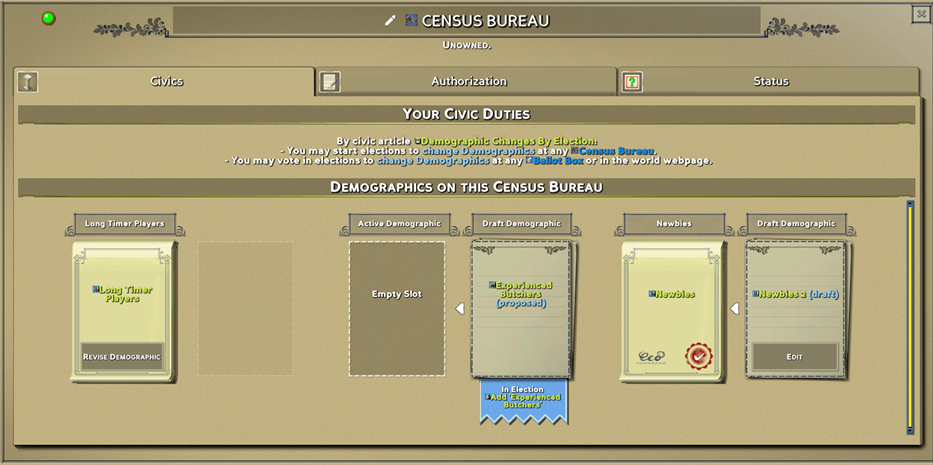
So what is a demographic anyway? It’s a division of people. IE, ‘People who have played more than 5 hours in the last week’, or ‘People who have more than 500 Eco Bucks currency’ or ‘People who have butchery skill greater than 5’. Turns out these ways of automatically dividing up a populace are really useful for organizing, and we’re expanding a lot on this feature for the 9.0 update. You can setup demographics at the new Census Bureau object:
Each Census Bureau lets you create up to three demographics:
Like all new civics objects, your civic duties and abilities when it comes to demographics are determined by the constitution (see our Constitution blog). In this case, all changes to demographics must be passed via election (see Election blog), so changes are something that citizens must agree on (unless they install a dictatorship of some kind, of course).
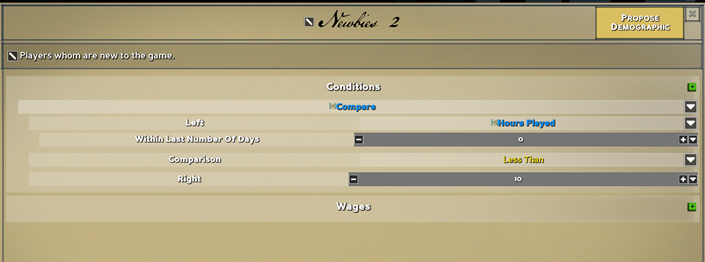
Let’s take a look at some things you can do with demographics. Say we want to have a ‘new player bonus’ that goes to citizens just joining a world. First, we can define who is in that group with a demographic:
Here we’ve compared two values: the number of hours played (over the last 0 number of days, which means ALL days), and 10. If hours played is less than 10, they’re a newbie.
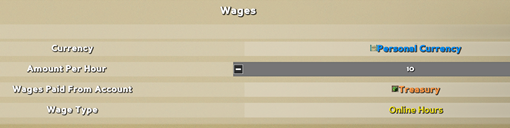
From there we can define wages, which is a new addition with 9.0 This will pay them out every civics tick with the value specified. We’ll keep it simple and pay out 10 per hour, counting online hours only:
On a server that has been around for awhile and has a lot of rich players, this can be a good way to give new users a legup. You could do it in a more complex way, too; perhaps incentivizing certain skills that are needed on the world.
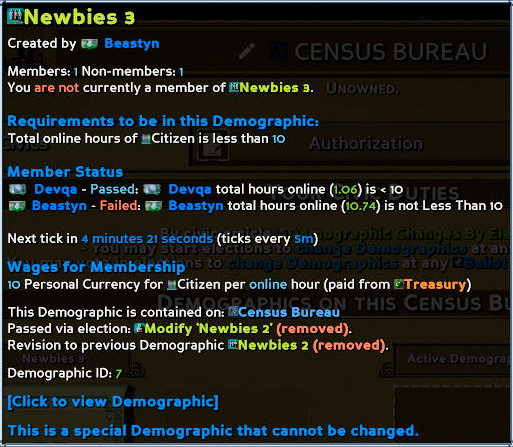
Here’s what the demographic looks like when you mouse over:
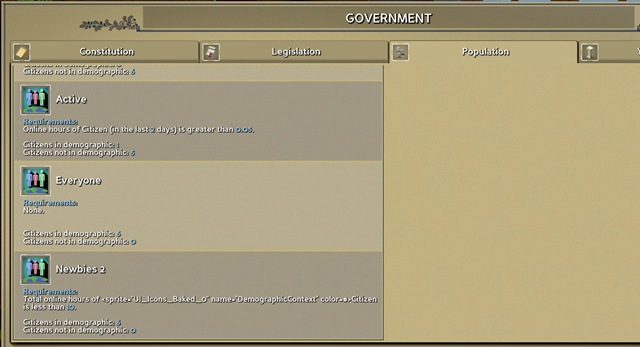
And you can see the list of active demographics in the government viewer under ‘Population’.
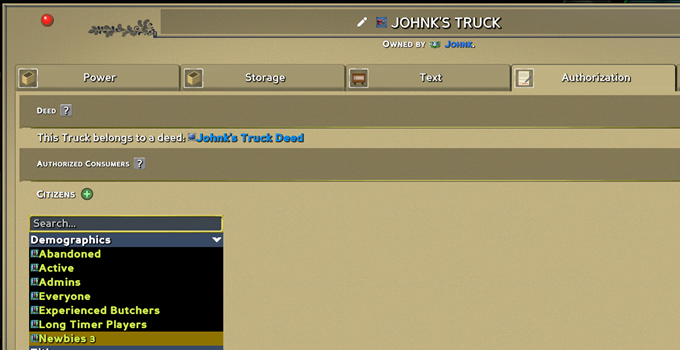
You can also use this demographic anywhere you specify a person, and it will take that group instead. You could set property rights on a truck to be shared among all newbies, for example, making a village vehicle that newbies can use for a period of time:
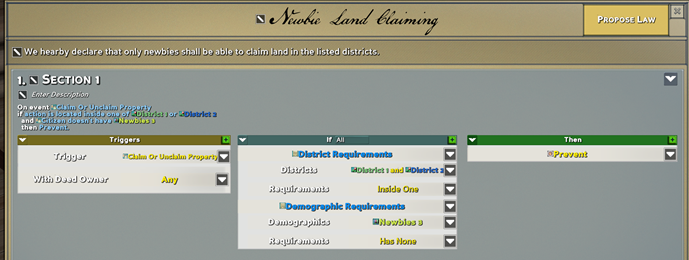
You can specify it in laws, perhaps designating a certain district to only allow newbies to claim land (see District blog).
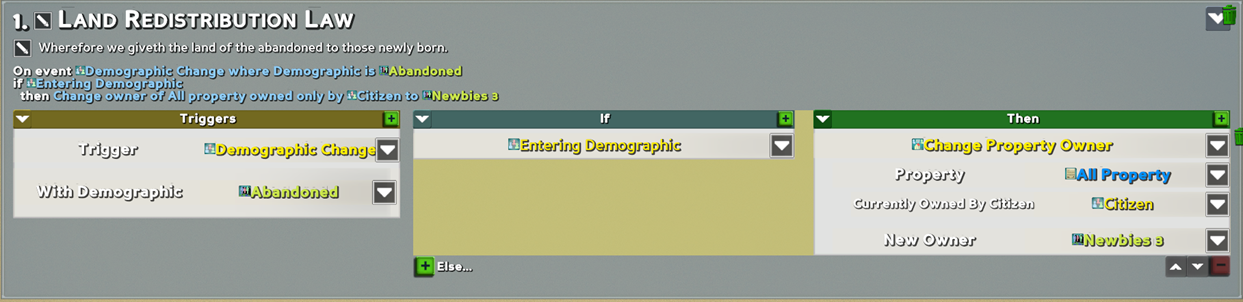
You also may have noticed the auto-generated demographics that each world starts with, Active, Admins, and Abandoned. ‘Active’ is defined by server properties, defaulting to players who have played more than .05 hours (3 minutes) in the last two days. ‘Abandoned’ contains citizens who haven’t logged in for several days. These are great for dealing with the usual eb-and-flow of citizens coming in and out of your world, handling what happens to their property when they leave, and giving them special privileges when they’re active. In fact, you can detect via laws when a user enters or leaves a demographic. For example, we could make this law that reclaims all property when a user enters the ‘Abandoned’ demographic:
Here the law detects the demographic change event, and reassigns all the property of the abandoned citizen to be owned by ‘Newbies’, the demographic we specified earlier! That means that newbies will be able to get a legup by choosing property from abandoned players, which will be given special permission only to them during their first 10 hours of play. Recycling for the win.
This is of course just one example of how you can design your government in Eco 9, and since we have a dynamic programmable system with lots of connections to the game there are TONS of interesting things that can come out of this, plenty we have not anticipated I’m sure, that’s the fun of it. Will be really interesting to see the kinds of societies players create, and how well they allow them to organize labor and progress to stop the meteor without destroying the ecosystem.
Thanks for following us as always, I’ll do a live stream (John K) this weekend 11am Sunday PST where I’ll demo this for folks that would like to check it out and ask any questions. And as always ping us on discord or me on twitter if you have feedback. Thanks to the awesome community supporting the game as we build out this huge update!
- John K, Eco Designer, CEO Strange Loop Games
Eco: Unlearned Lessons
The russian website mmozg.net released an (extremely) long article where it shows off our game in much detail, trying to answer the following five major questions:
What is Eco?
What was done good?
What was done bad?
What will be improved?
What won't be changed?
The authors did not only investigate and describe the game very in-depth, they also collected a lot of questions from the community and provided answers for them while also gathering and publishing opinions from several of our Eco developers.
In result they created an article that is a very recommendable read for new players, returning players and players actively playing right now that took lots of efforts to delve deep into our game.
Unfortunately we do not have a english translation at the moment, so the article is available in russian only for now.
(If you speak both languages and would like to help us with a translation, feel free to reach out to us, we'd love to make this article available for everyone!)
Developer Blog: New Tech Tree
Greetings all Eco citizens! This week’s blog will be presented by Eco dev Todd Glenn who works on game balance and helps with some of the design aspects of Eco. We will be focusing on updates to the technology tree, which is the progression of items in the game that players get through research and technology. We’ve added a ton of content with 9.0 with a few goals in mind: encourage more interaction between the professions, make advances in technological advancement feel more impactful, and expand on our end game content.
We have a huge collection of new craftable items for each profession, fleshing out the many professions in the game and adding depth and interesting choices to be made for each.
These include:
New food recipes for expert chefs
Fancy high-end furniture for carpenters and masons
End game Tier 4 building materials
Advanced tools to aid in large scale resource gathering
New crafting ingredients to promote more trade between professions
We will go over all of the new building materials and styles in a dedicated blog, but here is a quick peek at the new content:
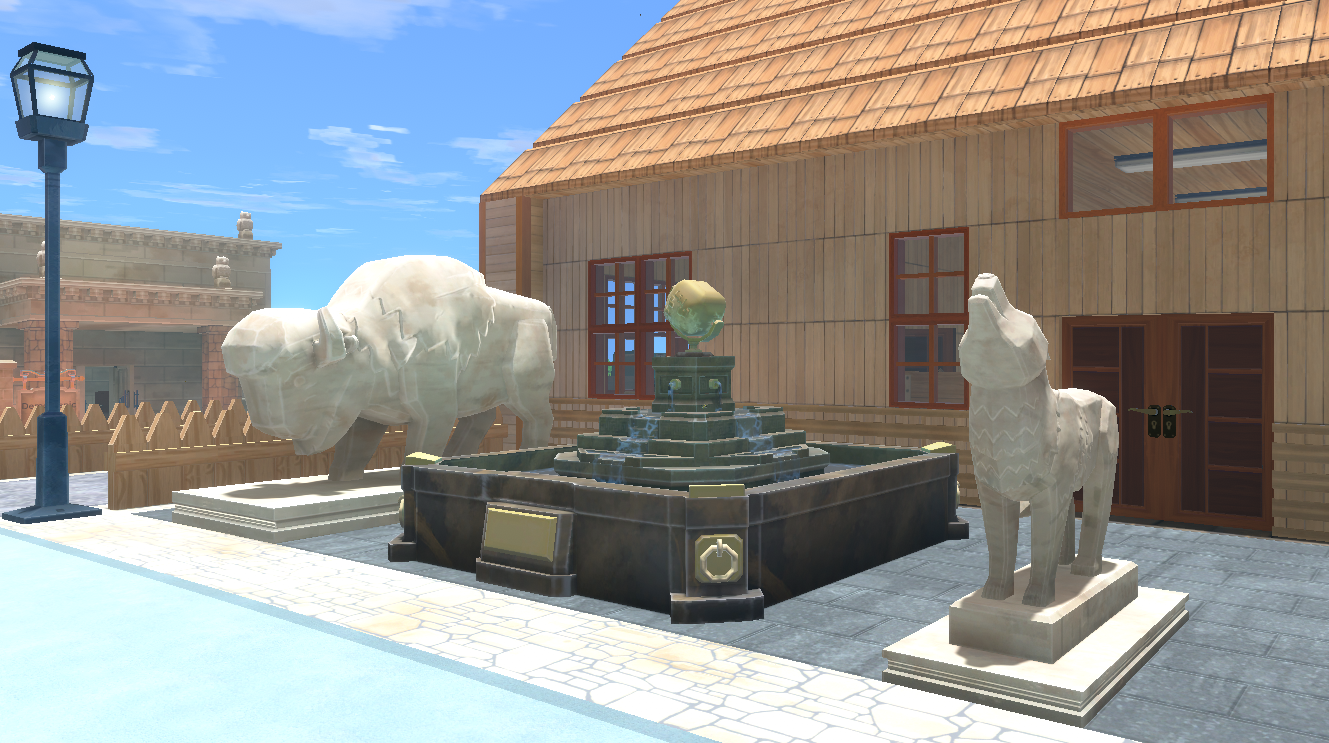
As technology progresses, we want players to continue to upgrade their homes with higher quality furniture to increase the experience bonus from having a high housing score. We will be adding new lighting objects, fireplaces, and a variety of household appliances. Part of this change will be lowering the experience bonus for more primitive housing objects. Instead there will be plenty of new ways to continue to improve homes at all stages of the game. We are also adding some outdoor features like fountains and statues, though these can be placed indoors as well.
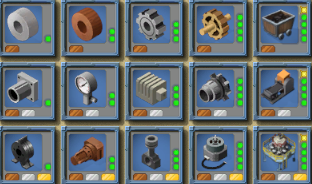
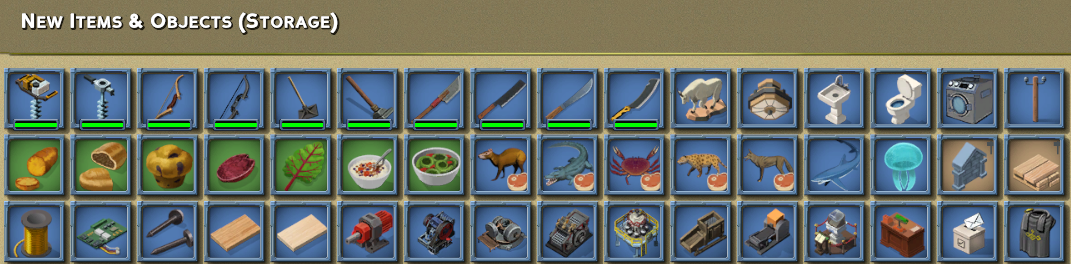
In addition to the items listed above, we will be adding new crafting tables, animals, and utility objects like the transmission pole. There are too many items to go over each individually, but here is a look at some of the new icons so you can get an idea of some of the new content being added.
Tool Improvements
One of the focuses of Eco 9 is increasing your power-progression through the arc of the game. As your civilization gains in technology, your ability to amass large amounts of resources should increase in tandem, as will your environmental impact. To support that, we’ve added new area of effect tools, as well as some altogether new tools.
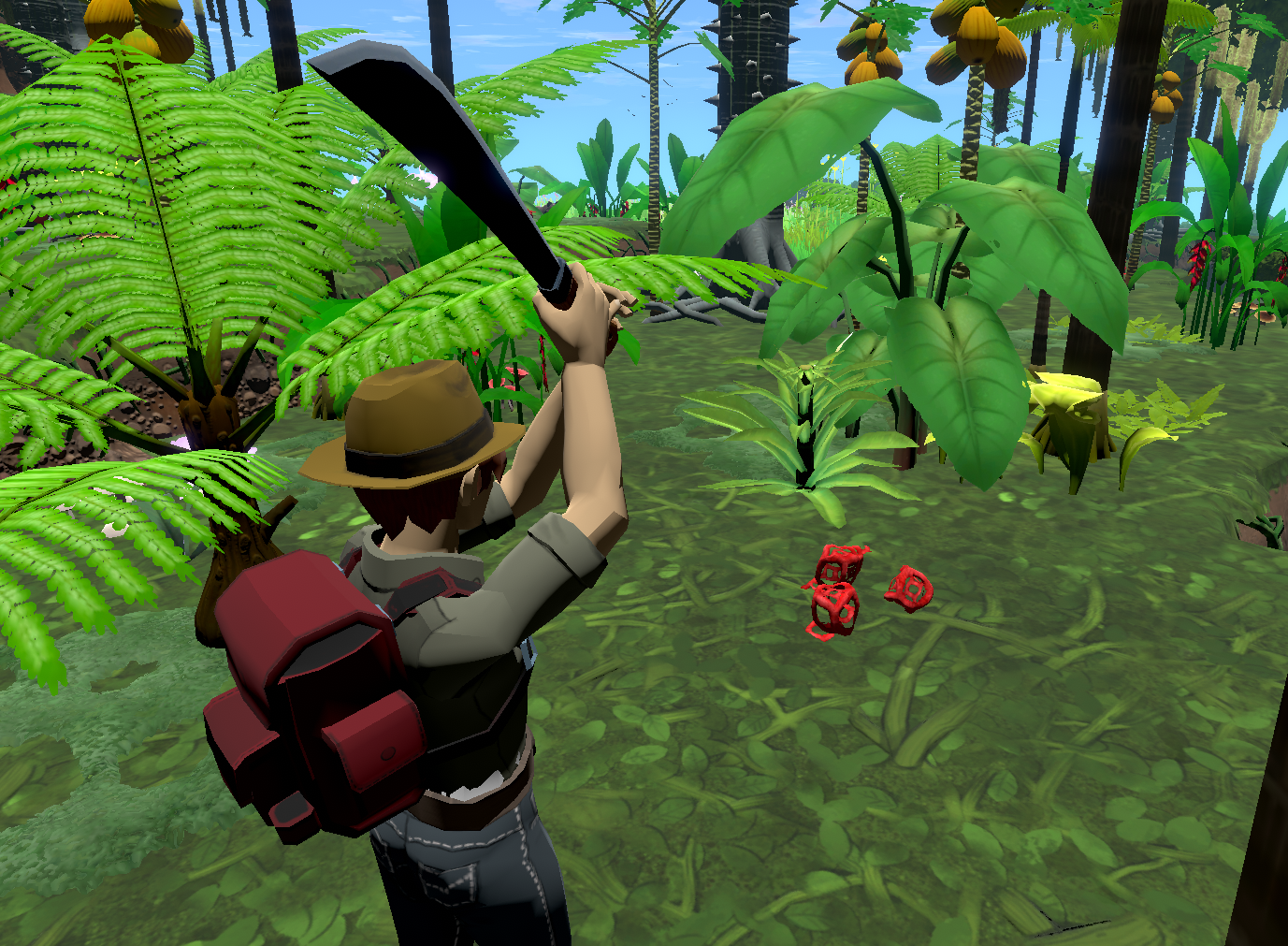
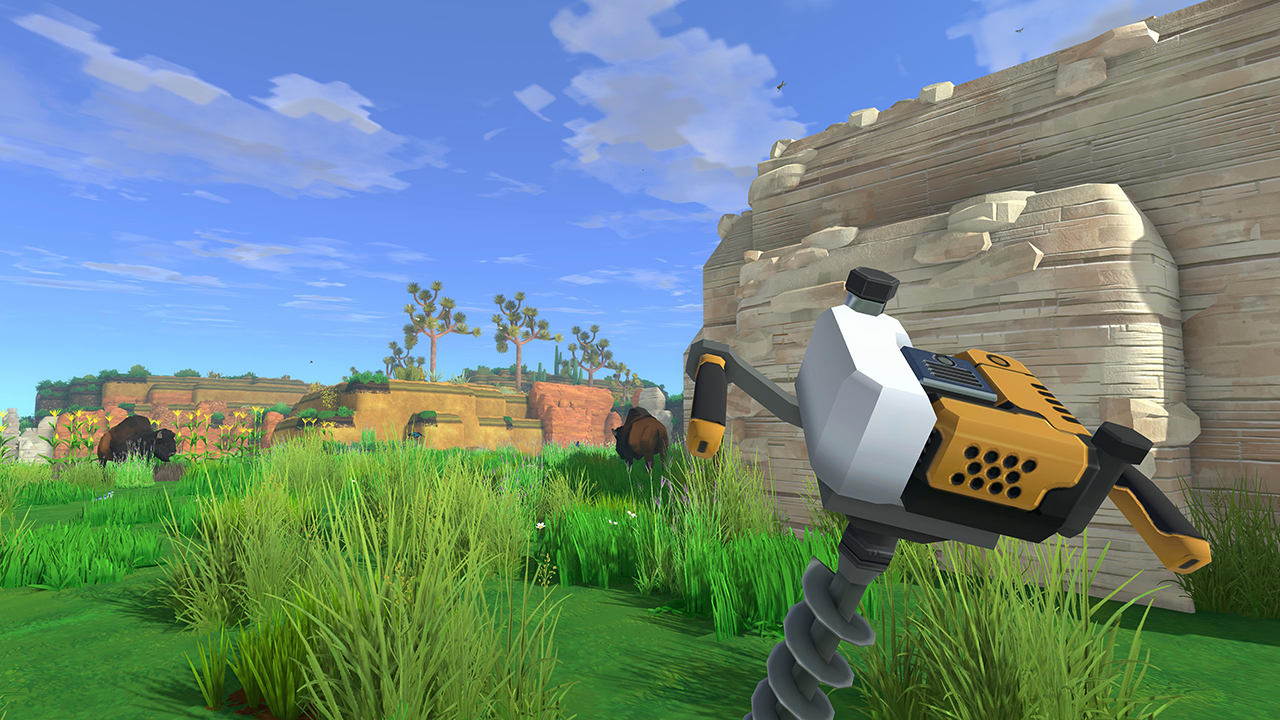
In our previous blog we showcased the prospecting drill, but another new tool is the machete.
The machete is used to quickly clear plants from an area, tearing a hole through the jungle that lets you move about much more easily, but at an environmental cost. Though wild plants provide numerous benefits to an ecosystem, their presence can sometimes be a burden when growing next to a developing town, either by hindering transportation or encroaching on agriculture. The machete allows players to quickly clear all plants with one tool, removing the need to switch between various tools or clearing plants by hand.
The modern hoe, pictured above, is one example of a tool with an area of effect. It tills large rows of fields at once with each swing. These crops can be quickly harvested using another area of effect tool, the modern scythe, which can harvest large sections of field at once. When combined, these tools enable farmers to more easily create the large scale farms needed to supply the extra food required for a well-established society to function.
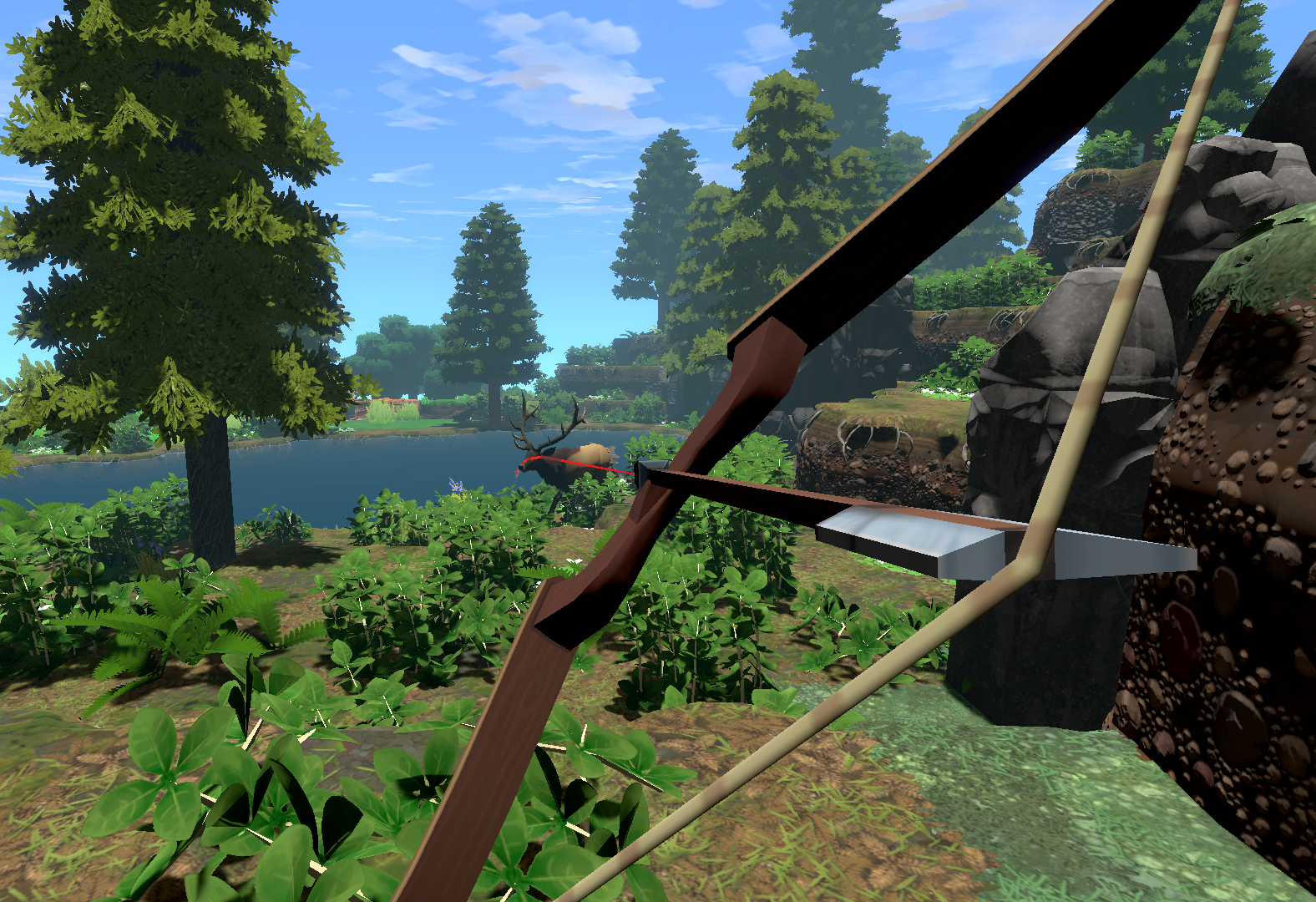
Advanced bows will be added that are more accurate, fire faster, and do more damage than a traditional wooden bow. The recurve bow, pictured above, has significantly less firing arc. To help accommodate these upgraded bows and to make the hunting specialty more useful, we have increased hunting difficulty when using a wooden bow without specialization.
Crafting Updates
We have several quality of life improvements to our crafting system that allow for a smoother experience when dealing with similar groups of recipes. One of these changes is the option to have “tagged ingredients”:
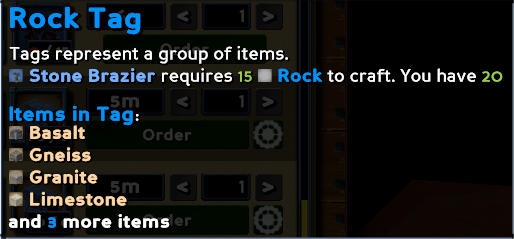
In 8.3, recipes that needed stone required the different types of stone to be processed into a generic stone type before they could be used as ingredients. In 9.0, these recipes will simply have a tagged ingredient “Rock” that accepts any type of stone without a need to create a separate work order for each type. Tagged ingredients will appear in a variety of recipes, for example a fruit muffin recipe that can use any type of fruit.
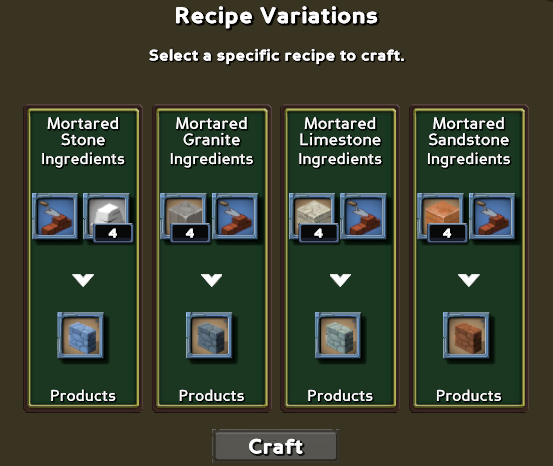
In addition, some recipes with tagged ingredients have multiple variations that use a specific ingredient to create a similar but distinct product. For example, when crafting Mortared Stone a generic type can quickly be crafted using the Rock tag, or a variation can be selected that accepts a specific type of stone. Previously players had to scroll through a list of all recipes to find the variations, but now they are all contained under one parent recipe.
Skill System Revamp
With our new work party and labor features, players are encouraged to hire skilled laborers to help with large scale crafting projects (see our previous blog on Work Parties). We have updated our skill system with two goals in mind: allow players with the same specialty to collaborate on the same project and encourage more frequent interactions between different specialties.
One of the most significant changes is the introduction of the upgrade module system. Reductions to the amount of ingredients needed for recipes are now caused by having an upgraded crafting table. All work orders performed at an upgraded table will have the same cost reduction, regardless of skill. We will explain upgrades in more detail in the upcoming efficiency redesign blog.
The new bonus for leveling up is that progressively less calories are required when contributing skilled labor. Players of various skill levels will be able to contribute to the same project without changing the amount of resources needed for the project. Almost all recipes will require skilled labor to be performed before they can be crafted, so it will no longer be as easy to be a jack-of-all trades.
Specialty Additions & Changes
We will be adding two new endgame specialties capable of using wood or stone to produce the highest quality building material. These specialties, Advanced Masonry and Composites, will help carpenters and masons serve an essential role as society advances to the modern age.
A main function of the Basic Engineer in Eco has always been to help contribute to the transport infrastructure. We are expanding on this role by having them responsible for producing all the different types of roads. In addition, Basic Engineers will receive a calorie reduction when using road tools to allow them to fill the role as the early road builders.
In 8.3, the specialties Logging & Mining had nice benefits for gathering resources, but some players reported the specialties felt lackluster compared to other specialties with unique crafting recipes. Logging will now be responsible for producing hewn logs, which are an essential building material throughout the carpentry profession. Players with Mining will now need to crush and process ore before it can be smelted into metal bars by a smith.
Summary
We hope you enjoyed this look at some of the upcoming updates to the tech tree. We have more updates than could be covered in this blog, but we are very excited for everyone to see and experience the upcoming changes for themselves.
Our next livestream will take place on Friday, noon (12:00) PST / 9pm CEST (21:00). Todd will be showing off all the content of this blog live on our Twitch and Youtube channels as well as on Facebook.
Developer Blog: Geology Generation and Rock Drill Tool
Hi folks, this week's Eco update will be presented by Eco artist and dev Keegan O'Rourke. We're going to get a close look at all the changes to mining and drilling, which is a way to let you prospect and find new places to mine.
In Eco as in real life, many of the most important resources for a civilization come from the ground. The largest efforts to extract resources from our planet center around what we can use that is locked underground in rock.
In our 9.0 update, we are improving and expanding our representation of these resources and their use in industry. We have also improved the procedural generation of the world in Eco to better control how and where these resources are located. We are laying the groundwork with 9.0 to keep evolving what mining is in Eco and how it impacts both players and the environment. I think our players will be excited by some of the changes, let's take a look:
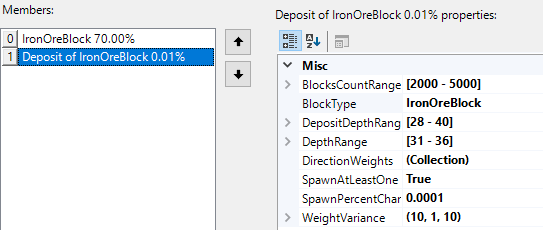
Prior to 9.0, we had in place a layer system that allowed us to generate different layers of rock in the environment, and assign these layers to different biomes. With this we could begin thematically creating a diverse world of different types of rock and ore located in different places. But biomes can be large, and ore deposits are not all shaped like layers. To combat that, we've created a new ore deposit module in our generation:
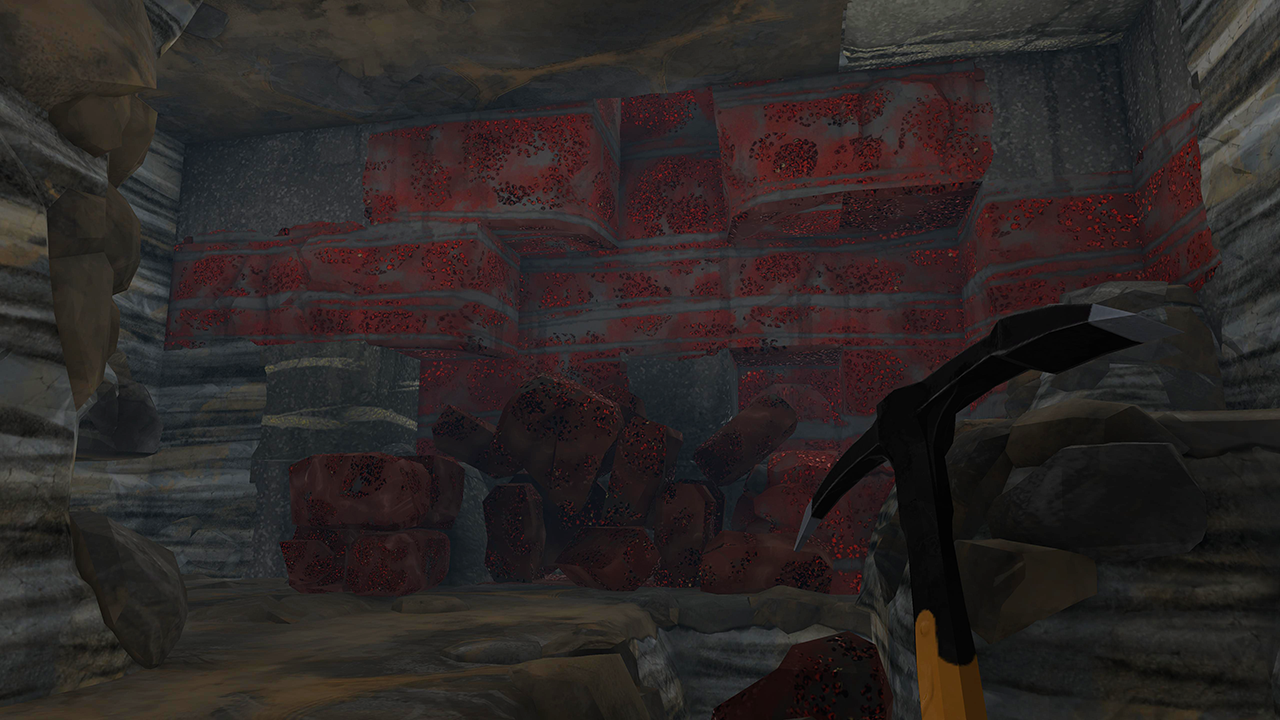
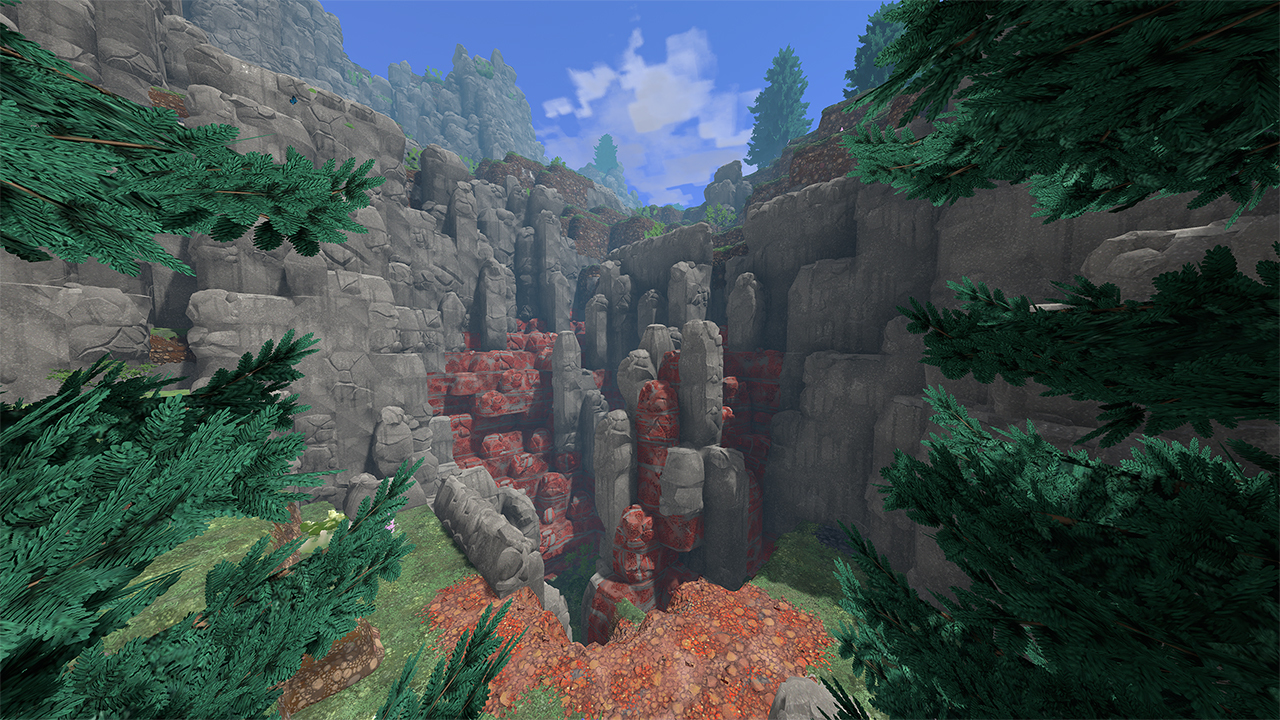
One of the biggest improvements to this is that in 9.0 we have an ‘ore deposit module’ in our world generation system that allows us to insert ore bodies into the layers which have their own definable shape and likelihood of appearing. We can also locate these at any level we want in the layers, and define size ranges for them. With this, we finally are generating a set of earth resources that works much more like the real world. These improvements will have a good impact on how mining feels. Players will likely get a bigger sense of reward for finding a deposit, and have much more to think about when it comes to efficient extraction and the shape of their mines.
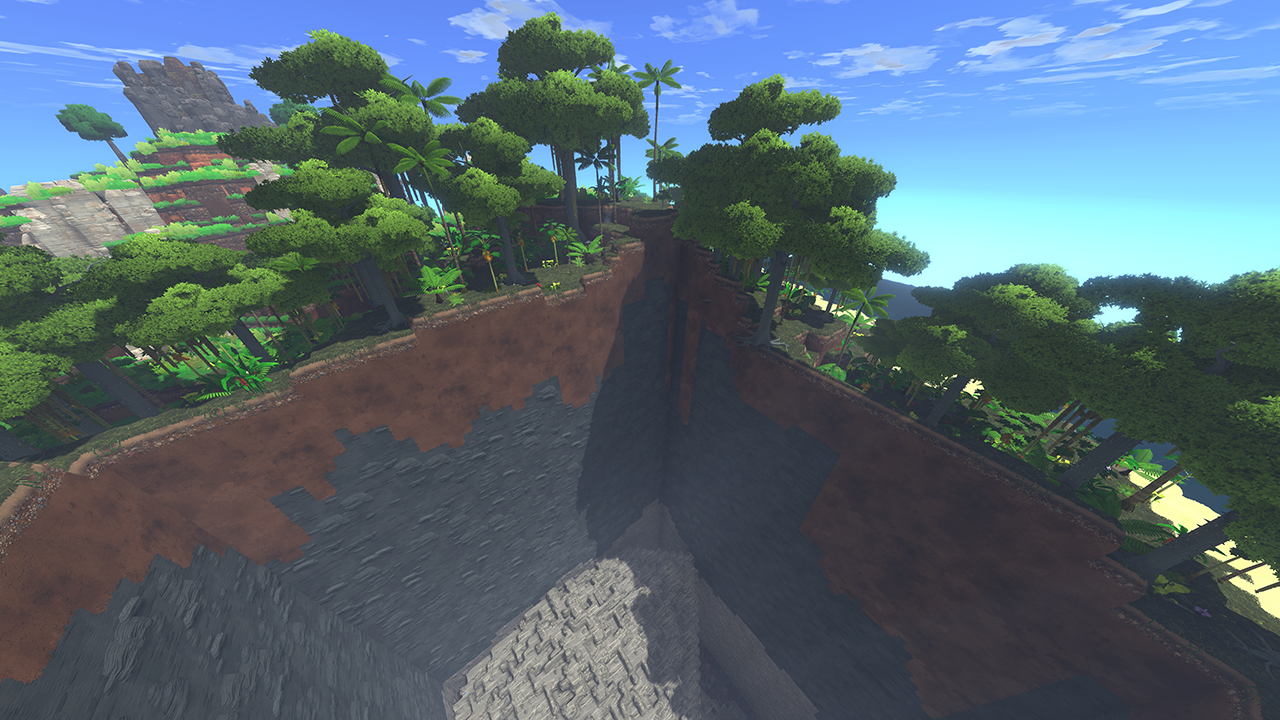
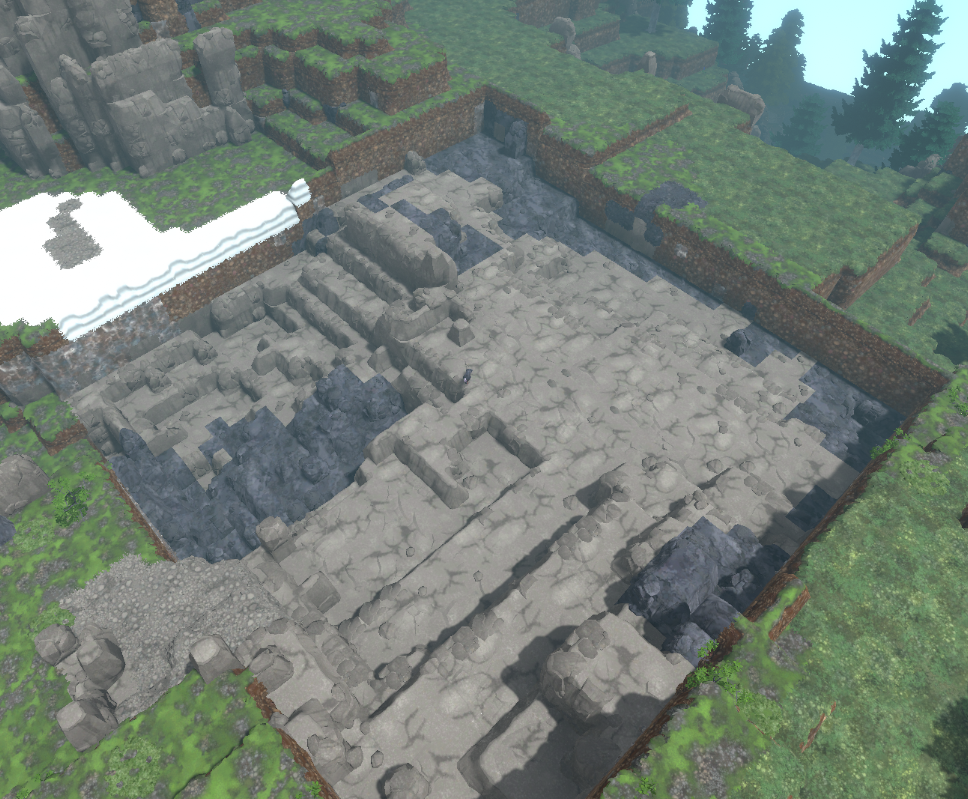
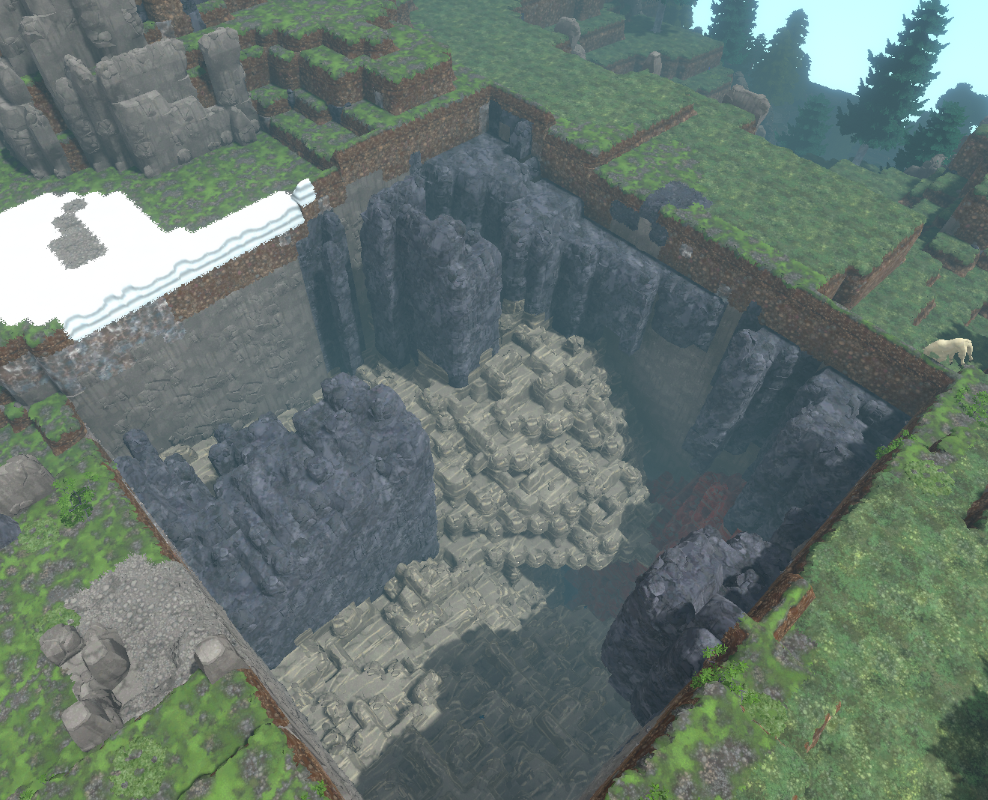
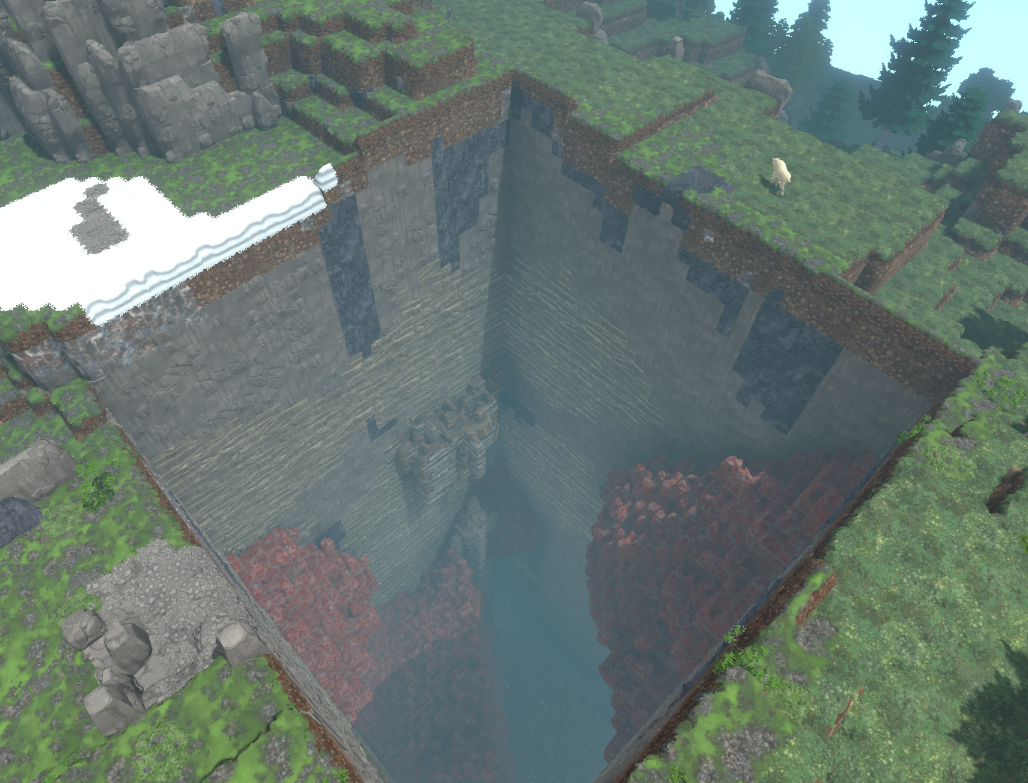
Here's a series of cutaways using a new admin command we added to debug ore generation. In the first shot, all the soil has been removed. In the second, the bedrock granite has been removed to reveal bedrock basalt and gold ore. In the third all rock and ore has been removed except copper ore
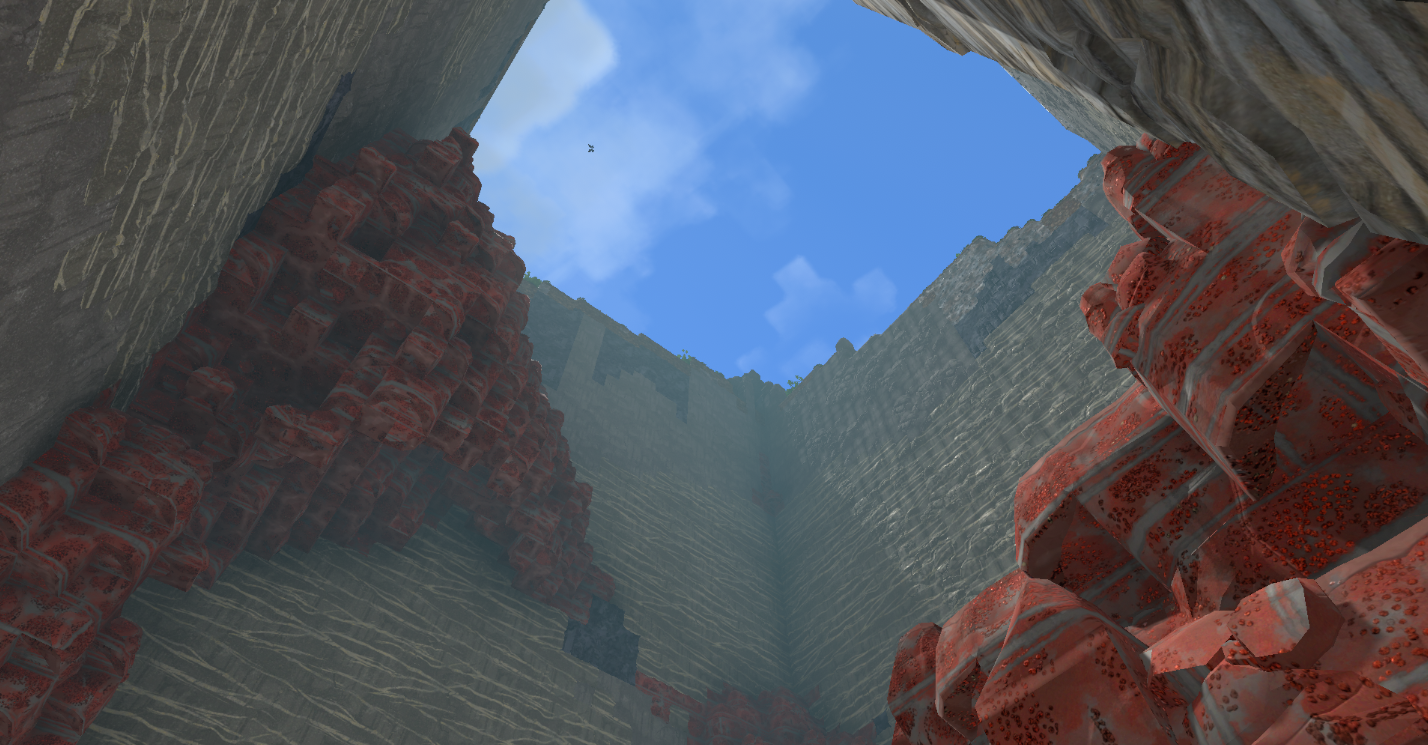
And here is a view from the bottom up, where you can see some of the copper ore deposits that have formed deep below the surface.
Since ore deposits have massively concentrated where resources like metal ore and coal are located, players will have more incentive to create efficient infrastructure to link a successful mine to other parts of their civilization. Mining towns will grow around these deposits, supplying miners with the tools and resources they need to extract the resources. It also means that players will have to explore for earth resources much more, since where deposits are located in particular biomes will be different for every different world.
Introducing the Drill
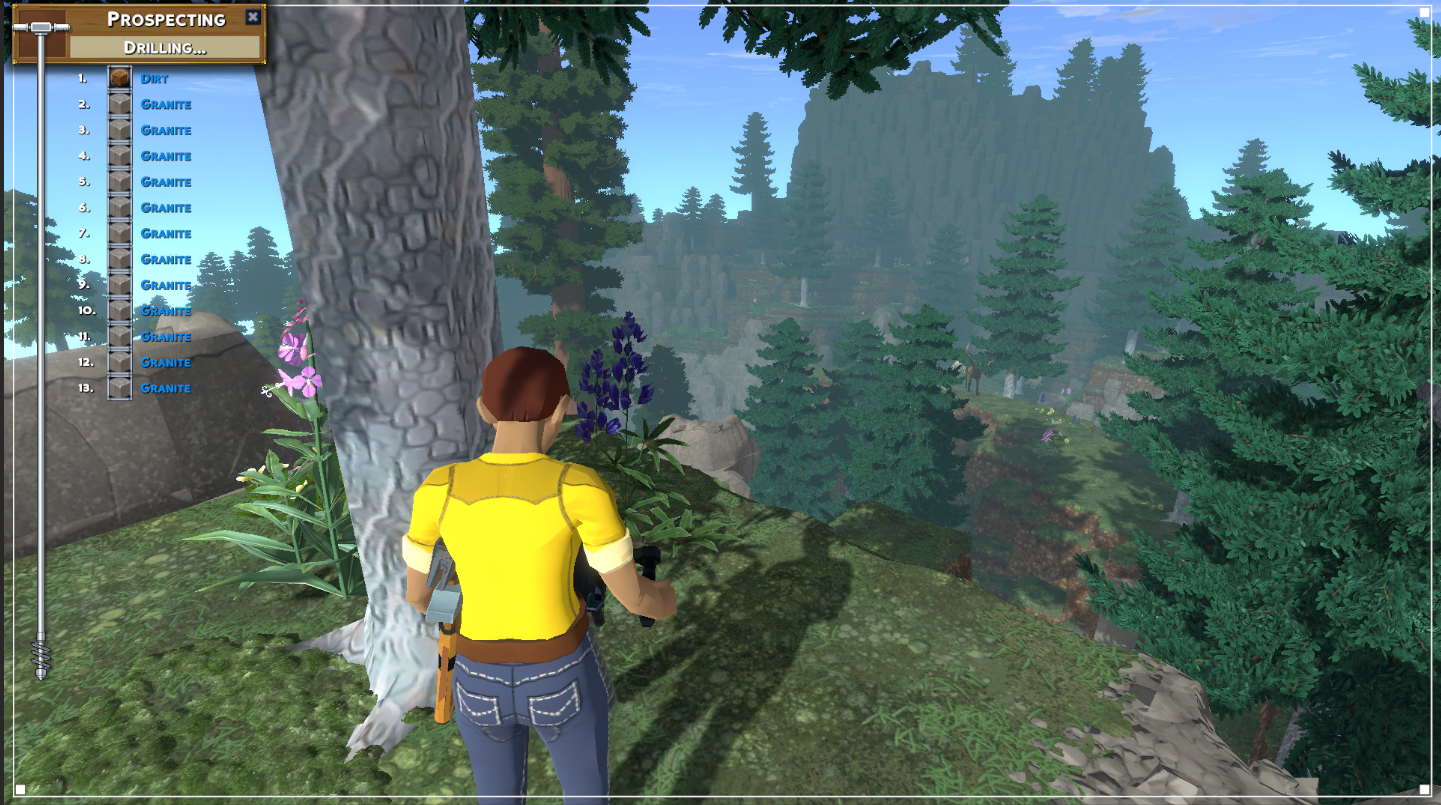
To aid in this process and to lay the groundwork for a powerful future mining tool in Eco, we have added a new Rock Drill tool to the game. This tool will let players find out what blocks are beneath them much more quickly than shoveling up all the earth in the way. As players get a feel for where deposits show up in the biomes, they will be able to learn to search intelligently for them using the drill.
To use the drill, you can aim it in any direction at a landmass and activate it. Based on the tier of the tool, it will inform you what is buried beneath the surface to a given depth. You'll be able to easily mark these positions in space with world markers.
With this addition, exploration and prospecting will become an important first step to every mining operation.
Adding Crushed Ore and Rock
One cool new addition is that because all rock and ore have crushed varieties that fit into other improvements to mineral processing in Eco 9.0, we are also able to use crushed rock and ore to begin to simulate natural erosion of rock and ore in the world.
As part of this update, all of the layers which contain ore and other resources like clay and sand have been revamped and improved with an eye both towards balance and future improvements coming to mining and industry in Eco. Mineral processing has been deeply expanded in 9.0 to more realistically break down rock and ore and create the correct byproducts from the right processes, which will be detailed in another update!
We are in the process of big updates to the balance of different ores with regards to their byproducts, so with all these factors changing we are being generous with ore quantity to start. We are excited that as far as what’s waiting under their feet, players will have a brand new world to explore in 9.0.
Our next livestream will take place on Thursday, noon (12:00) PST / 9pm CEST (21:00). I will be showing off all the content of this blog live on our Twitch and Youtube channels as well as on Facebook.
- Keegan O'Rourke, Eco Lead Artist, Strange Loop Games
Developer Blog: Districts
Hello all, hope youre enjoying your quarantining around the world and getting lots of gaming time in, stay safe and get your socializing in virtually. Our update today is on the new Districts system we’ve added for Eco 9. Here’s the current lineup:
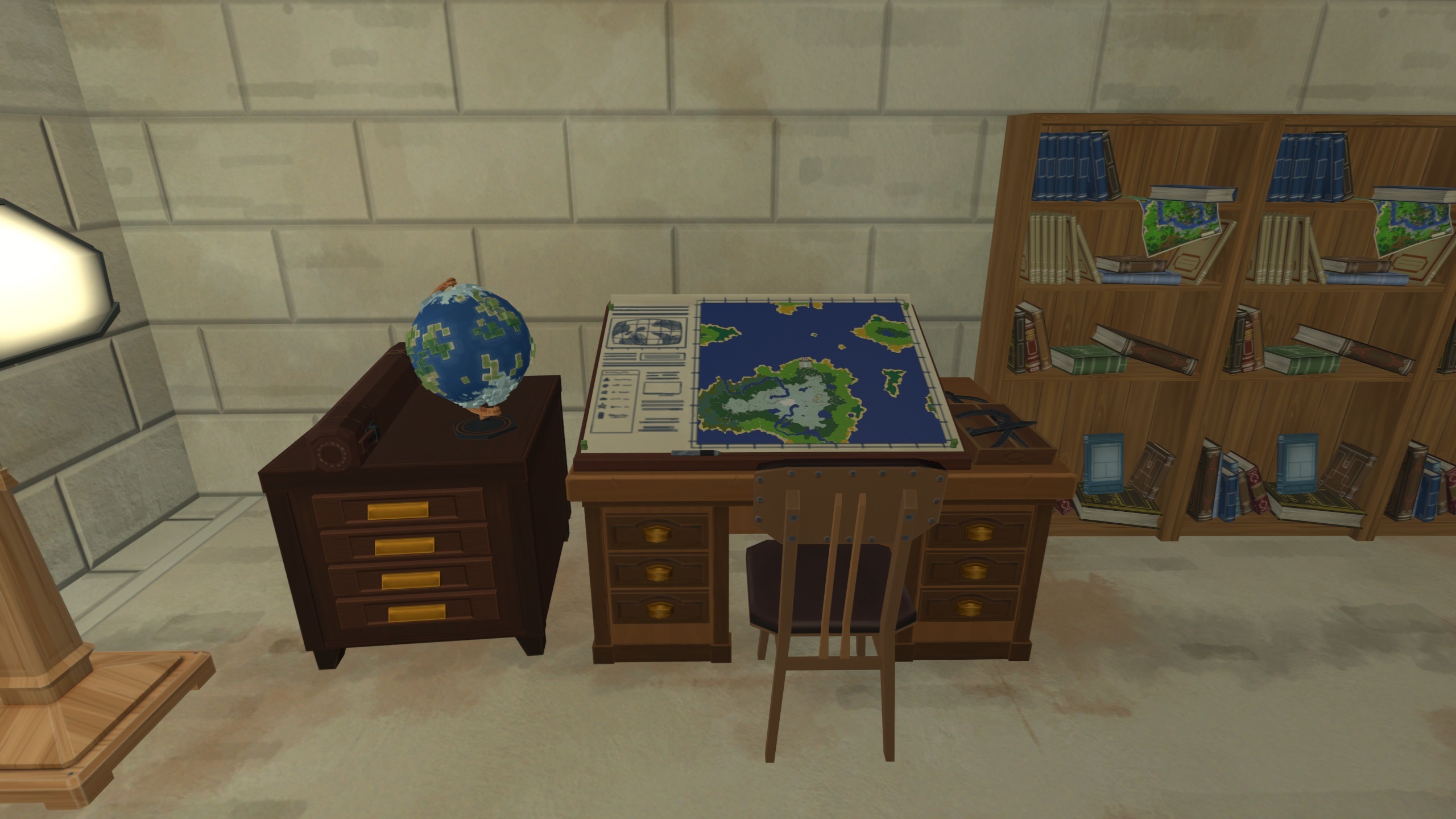
The purpose of districts in Eco is to define specific rules for various areas of the map. We’ve had this for awhile, but with Eco 9 it’s getting a big upgrade. To start, districts are now set in-game and are contained in the new Zoning Office object.
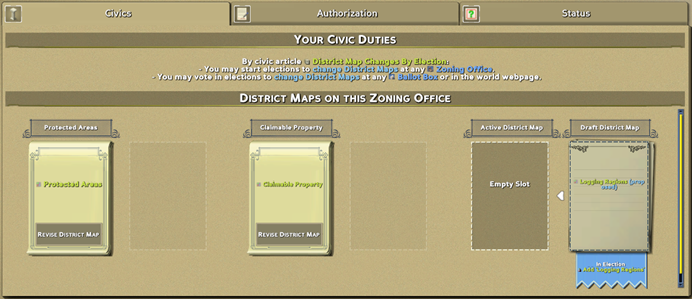
You can now have multiple District Maps, each containing a set of districts defining an area. Each map is totally independent, meaning maps can overlap other maps. In the Zoning Office is this UI:
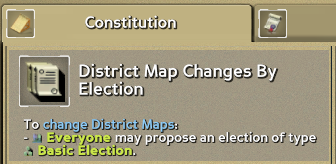
Each Zoning Office lets you define three maps, and as normal civic objects the Constitution defines who can modify them, what kind of election is required, etc. You can see on this map, the Constitution defines that districts can be changed only by election:
(Check out the Constitution blog for more info on how that works).
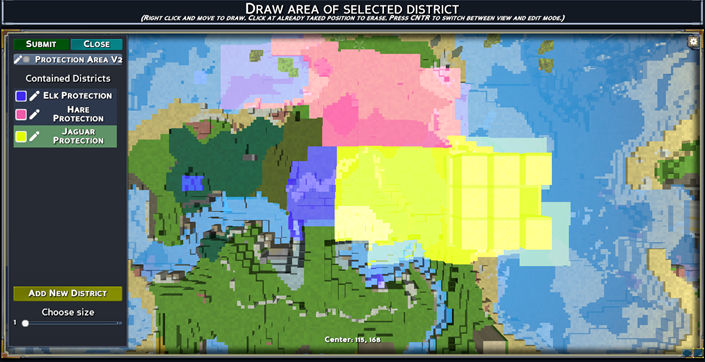
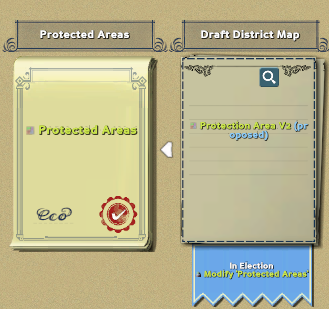
In this Zoning Office, there are two district maps active, Protected Areas and Claimable Property, and one under election, Logging Regions. Let’s revise the protected areas.
In the editor that appears, you can paint on the different areas of the map, revising any previous map that was already there. You can add and remove districts and make any changes you want. When you submit, it will go to election (if that’s what the constitution requires):
This election then occurs like any other election, defined by the election process (check out the Elections blog for details on how that works). Once the election passes, it will apply the changes.
Any law that referenced a previous district will be updated to the new district, automatically propagating the change to anything referencing these districts. You can start to see how all these systems work together; since district maps are a regular civics object (like laws, elected titles, demographics, etc), they automatically get all the features like revisions, error testing, reference updating (when they get modified), tracking of state (draft, proposed, active, removed).
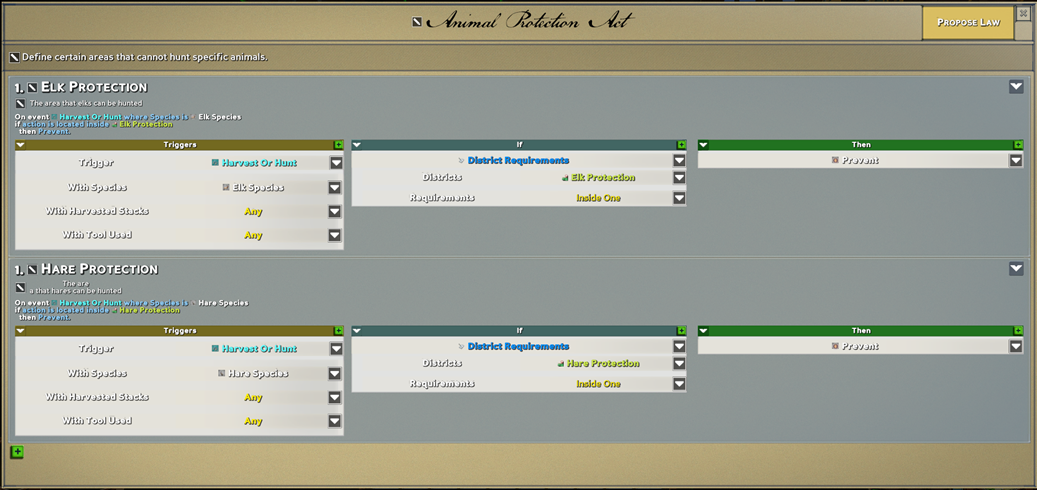
So now lets make use of one of these districts, in a law.
We’ll go over in detail how laws work in a later blog, but for now you can get an idea how it works. The trigger (hunting a specific species) with restriction (inside a given protection region) will be prevented.
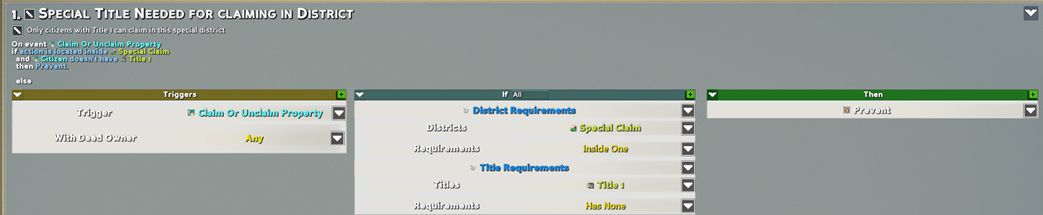
Tons of flexibility is allowed here, say we want to make a special area where only certain citizens can claim land:
Only citizens possessing ‘Title 1’ can claim land in this district now. Title 1 could be defined in many ways: it could be an elected position, it could be a title assigned by players, it could be a title gained by completing a work party (see Work Party blog).
Summary
With this new districts feature, the ability for citizens to define the use of land becomes greatly expanded, connected to all the other parts of the civics system. In a game about ecosystems and the resources from land and the pollution put upon them, this can be extremely important for the success of your world. Defining how resources are used, and how citizens may use them, is a key element in finding a harmony with your environment and solving the tragedy of the commons.
Lots more to come, stay tuned for more Eco 9 updates and the release (on a date to be announced).
- John K, Eco Designer, CEO Strange Loop Games
Developer Blog: Work Parties
Hey Citizens, hope everyone is staying safe with the global pandemic going around, here at Strange Loop we’re a remote team already so there’s no interruption in our development (if anything an acceleration as we all become shut-ins). Stay safe and take care of yourselves and those you care for. Our small contribution is providing a game world where you can socialize remotely and slow down the spread.
Today I want to debut our latest update on what’s coming for 9.0, with one of the new features I’m most excited about: Work Parties.
One of the biggest factors behind designing the economy of Eco is that I wanted there to be a very rich market for both goods and services. That means a labor market that easy to use, super-helpful for the success in the game, and fun to boot. They should be the game’s quests, but unlike typical quests in game, they are not artificial (added by designers for NPCs to give endlessly), but actually arise from other citizens with real needs in the game.
Let’s take a look at how they work.
Work Parties
Work Parties are similar to contracts (which already exist in Eco) but are expanded in a lot of ways to make them fit the game better (eventually, contracts and work parties will likely be merged together, but for 9.0 they’ll both exist).
A work party can accept any number of workers, paying based on how much they contribute.
Payment can take many forms.
‘Research’ (crafting skill books) has special support to share the gained knowledge.
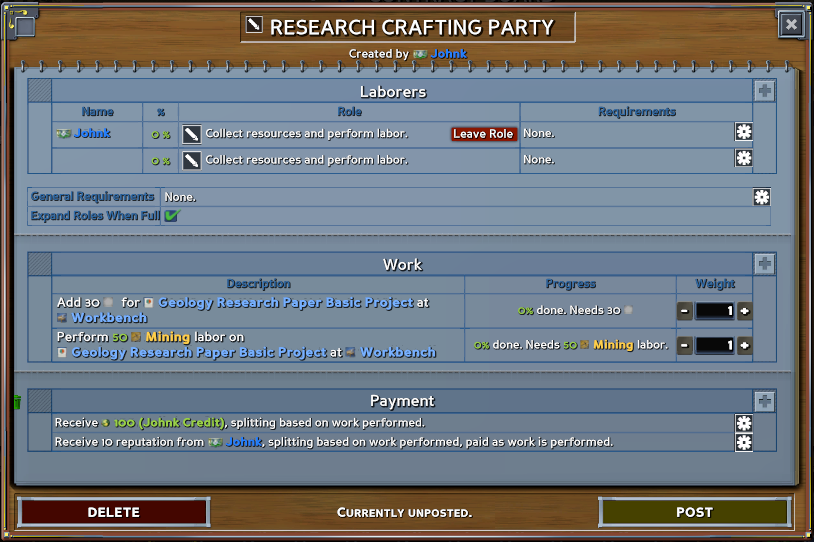
To use them, first start some work orders you want help with, and then post a Work Party. The work needed will automatically be populated:
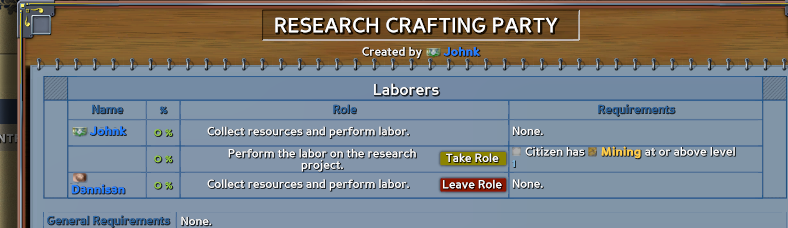
Here on the Work Party you can see clearly everything in three sections: the laborers attached to the party (currently just me), the work to be done, and the payment that will be given.
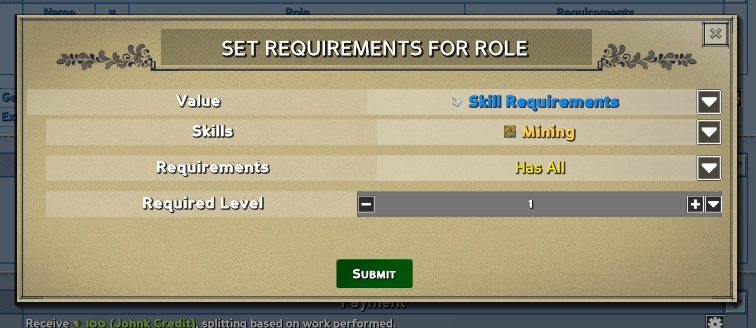
Before posting you can customize this if you want. Because I checked the setting ‘expand slots when full’, extra open slots will become available as people join. We can also make slots for a limited group if that’s preferred. Let’s make a special slot for workers who have the mining skill, since that’s needed to perform the labor:
This restriction could be anything: members of a demographic, holders of a title, non-admins, people who have chopped 5 trees in the last week, whatever. It uses the same logic system we created for laws, so there’s tons of flexibility there to design who can join your team.
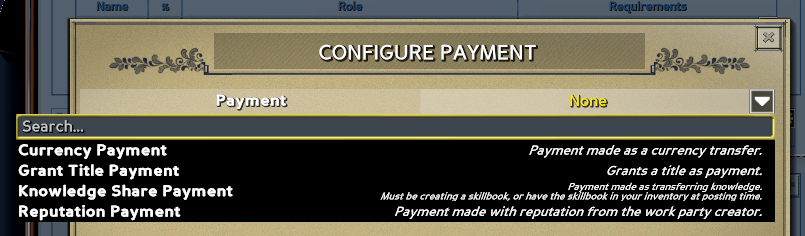
Down in the payment section, it defaults to 100 of my currency, and 10 reputation from me. We can have other types of payment too:
Payment can grant a title to a user upon performing some percentage of work, or grant knowledge as well.
Granting knowledge is especially useful, as a citizen can setup a project to create a skillbook and then get contributions from the whole village, and when the skillbook is complete they will automatically receive the knowledge.
Note that you can grant knowledge of either a skillbook in your possession, or a skillbook that is being crafted. This can become a really powerful work-for-knowledge tradeoff that will let newer players work for older players in a meaningful exchange.
Once set, you can post the work order, locking its settings into place. Any work party you’ve joined will show on the right side of the screen in a pull out menu:
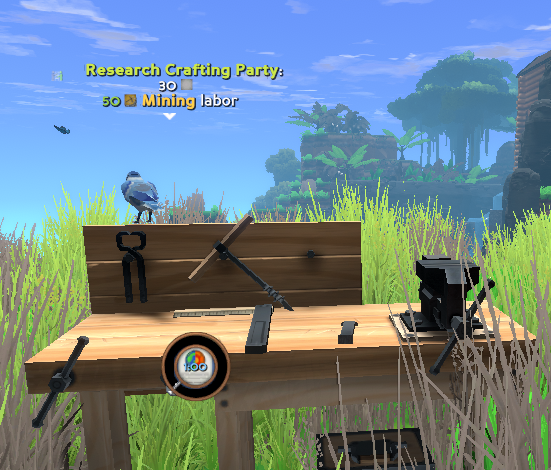
This gives a quick reference as to the work left to be done and who the other laborers are. A world marker is also created in game showing what you need to do:
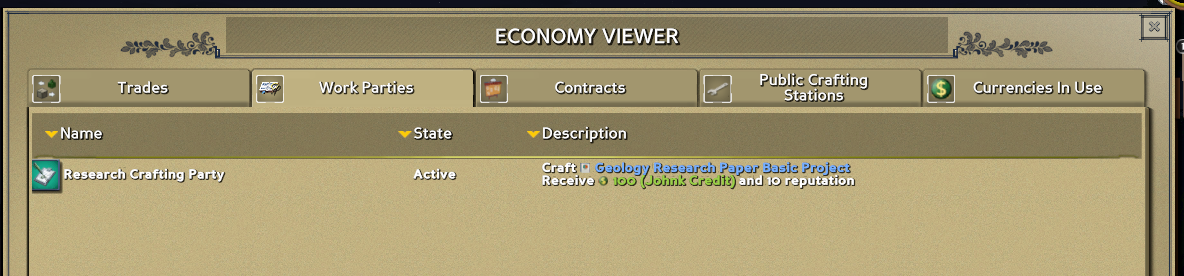
If another player comes along they can see this work party in the economy viewer, and if they travel to the contract board join the team, even if I’m not online.
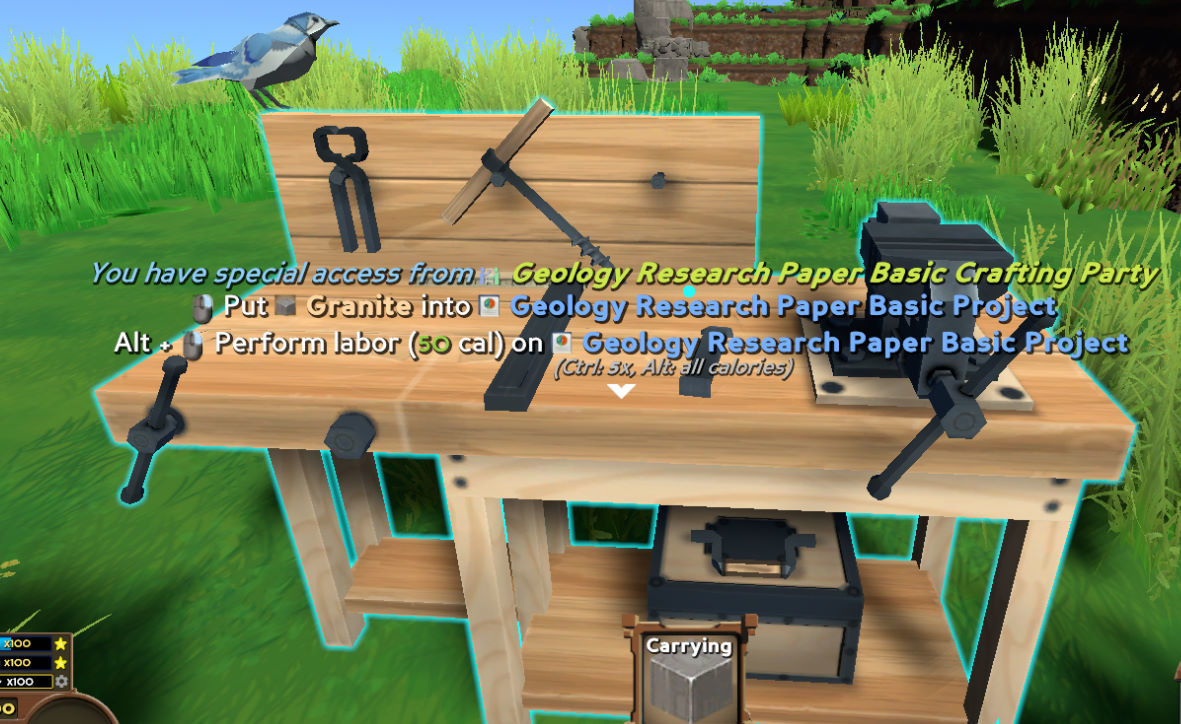
Being part of the work party, they’ll get special access to contribute to the project even if they don’t have permissions on the object:
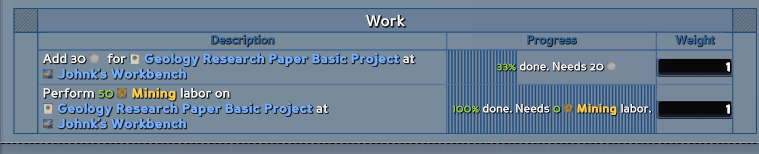
Then as they contribute to the work party, it will increase their percentage worked:
Notice the weights along the right, this lets you designate some jobs as more important than others and give them higher rate of pay.
Once all the work items are satisfied, payment is disbursed based on how much work each person did:
Here Dennis did 100% of the work so he gets 100% of the rewards. Nice job Dennis. You can also configure it to pay as-you-work, instead of a lump sum at the end.
And now I’ve got some nice Geology Research Papers to enjoy, waiting for me when I come back:
Using Work Parties
One of the cool things about this system is how it interacts with our new labor system which I’ll be talking about in a future blog. Basically, many craft recipes will now require specialized labor, and the citizen performing them will have to possess the specialty to do it. This means that having the ingredients isn’t enough, you’ll also need someone skilled to do to the work, and this will create a great need for other people’s help. One can imagine a top level laborer coming online and traveling around the world taking jobs for labor they can perform, collecting payment, and then using that payment to setup work parties of their own for ingredients and specialized labor they don’t have. The citizens and economy both grow richer, and an interesting game dynamic is added.
Work Parties can also work quite well with the government system, allowing for government contractors. Say a village has collected a lot of money in taxes, and wants to put it to good use. They can create work parties that pay out of the town coffers to fund research that will benefit all citizens, and citizens from around the globe (inside the town and out) will be drawn to help contribute by the prize.
This is the first iteration of Work Parties, and we’re planning to expand it to many other types of work: building roads, farming, constructing houses, mining, and basically everything else you could want to hire people for in your world.
Thanks to our community playtesters who have been putting this through the ringer and looking forward to seeing what kinds of cool projects your citizens and governments will fund. I’ll give a live stream demo of this on Tuesday, drop by our Discord to get details if you’d like to watch.
Cheers and as always thanks for the support from our awesome community, one of the most positive and helpful communities I’ve seen in an online game! Keep the feedback coming and thanks for your support.