Dev Update #21: Custom Games, New Race, Gameplay Changes
Build 0.13.0 is out on Steam! I managed to add several important quality-of-life fixes as well as a couple of major gameplay changes to it. Let’s dive right in!
Custom Games
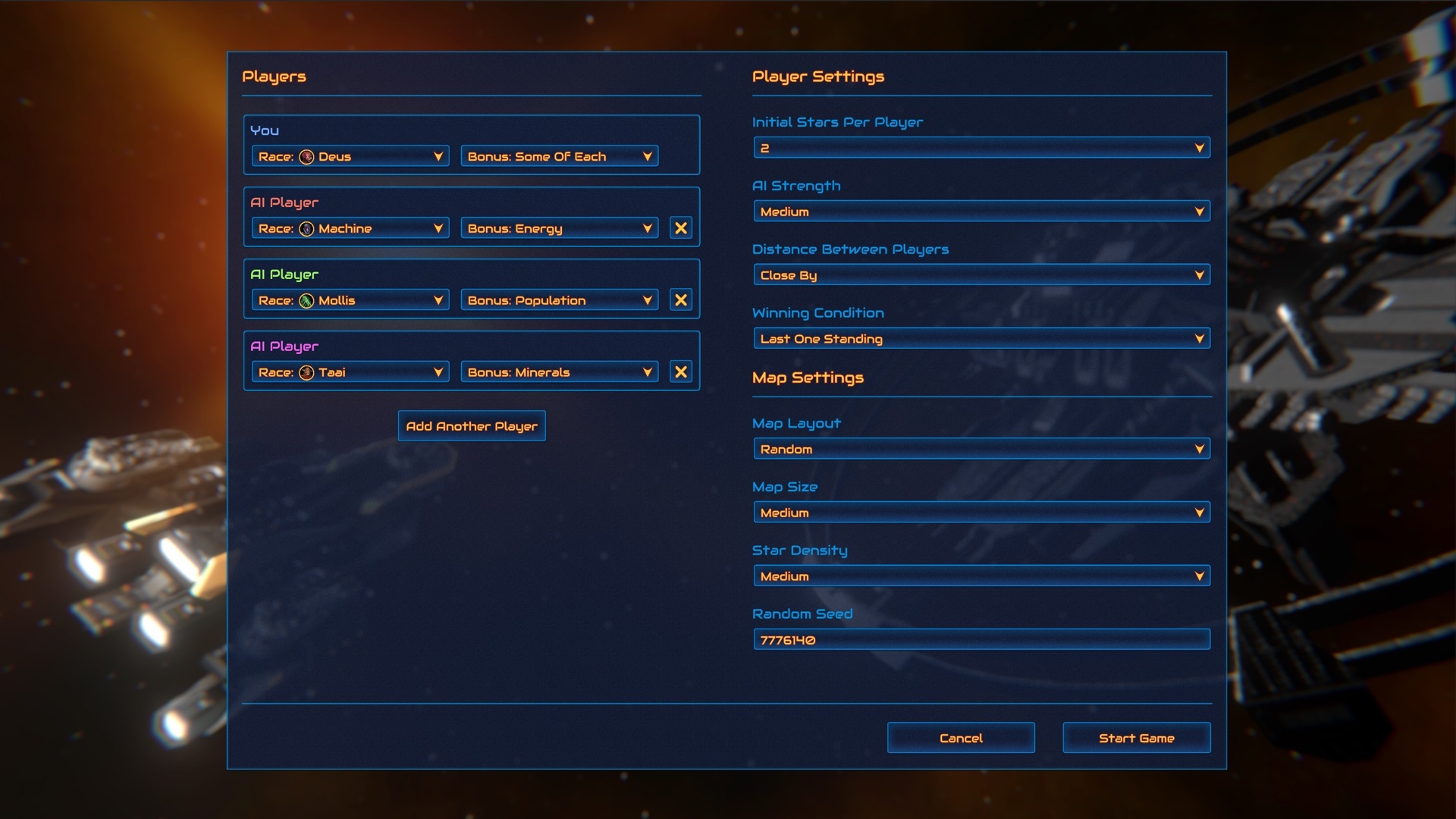
I reorganized the custom game screen where you can now add and remove AI players and customize their races and initial bonuses (more on that later). I also removed several settings that weren’t used by anyone.
Another new feature that was added to this screen is the random seed that the game engine uses to generate the map. It gets reset every game but you can now change it to whatever you want. For example, if you liked a specific map setup then you can set the same seed for your next game and essentially play the same game but may be try different strategies and initial conditions.
New Race
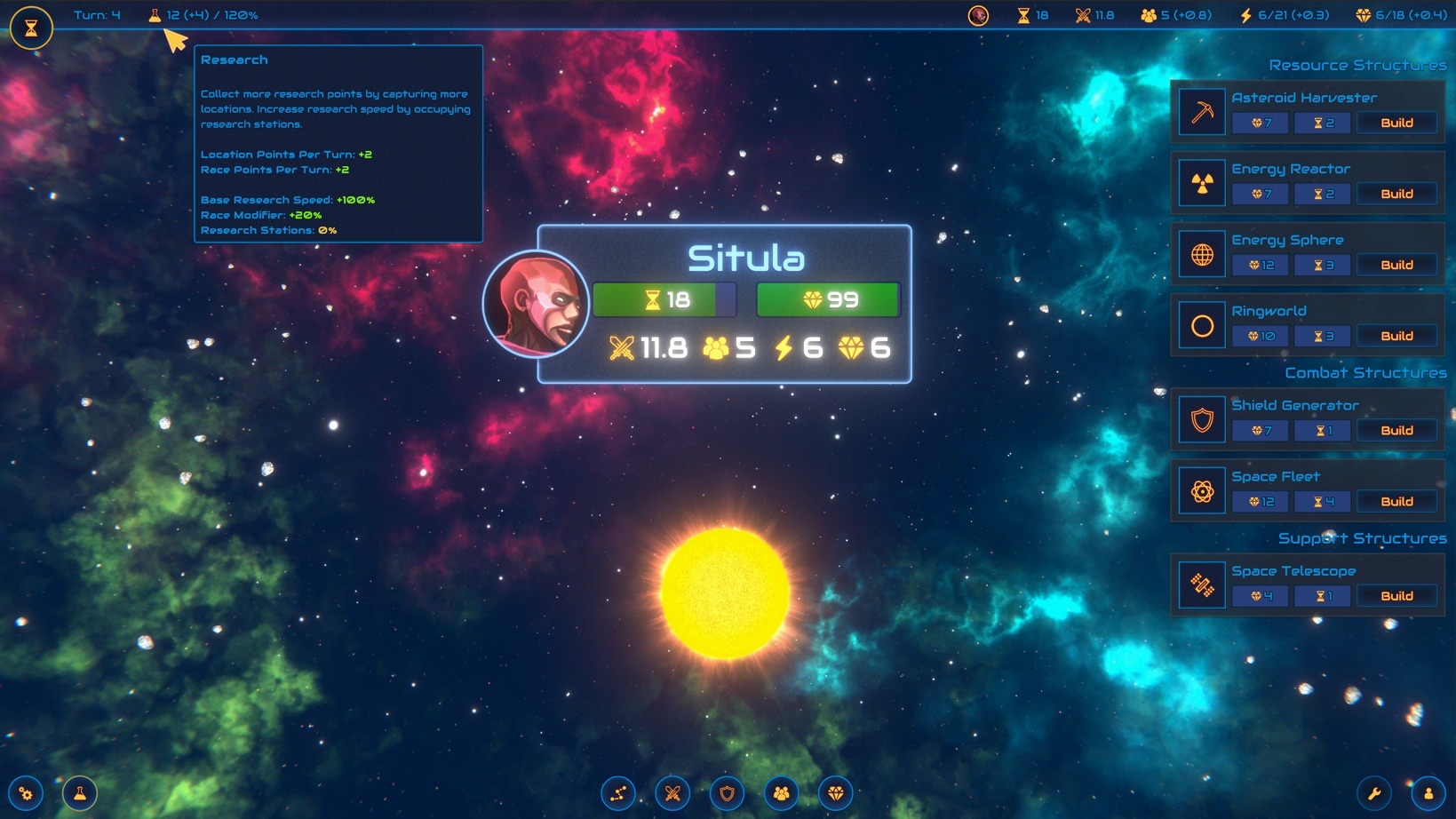
I added the 5th race—called deus—to the roster. Deus represent enhanced beings that branched off from humans many millennia ago. They live and breath technology and science, so every location occupied by deus increases your research speed and research points.
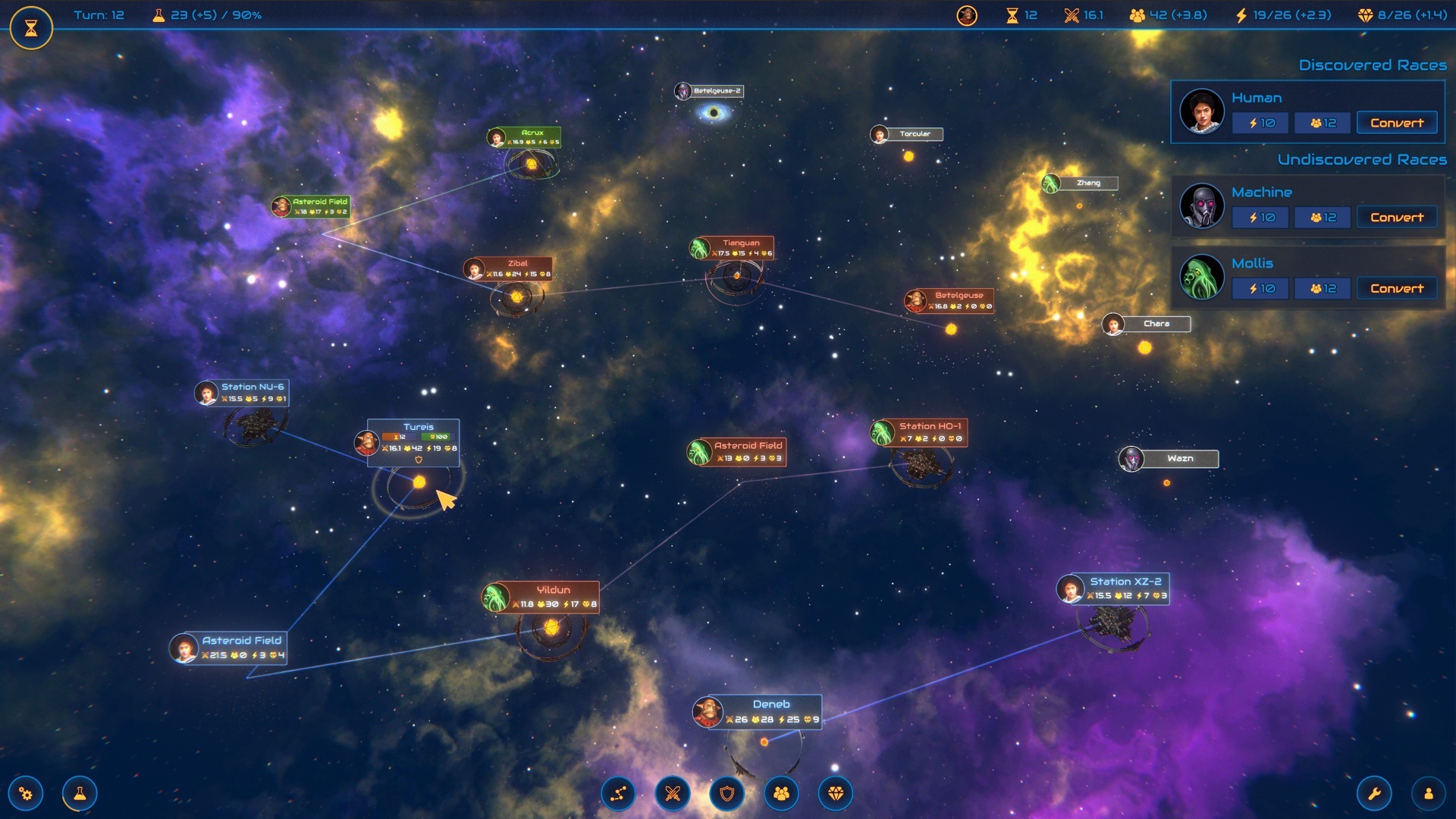
Since there’re five races now I decided to add two combat bonuses per race against two other races. Combat bonuses work the same way Rock, Paper, Scissors, Lizard, Spock outcomes work. Let’s see if this system creates more interesting and fun battles.
Gameplay Changes
Many beta testers felt frustrated with negative effects of races and research that come hand in hand with bonuses. I understand the frustration, so I decided to try a version of research and races without any negative effects. Let’s see if that works!
Any game now begins with an initial bonus that can be set in the settings. Currently there are only four different bonuses: extra population, minerals, energy, or a little bit of everything. Depending on the bonus and the initial race combination, early game becomes very exciting and every time players face a different puzzle of how to approach growing their economy.
Finally, I added a change to how research points are collected. Before, they were based on the number of locations. I changed it, so research points are just another property that can be increased through various means (on top of the number of occupied locations). For now, this property was added to the new deus race but I expect it to be added to structures and research in the future.
Build 0.12.0 is out on Steam! This update has lots of little changes that dramatically improve gaming experience. It also just dawned on me that I’ve been sharing public Eons of War updates for 20 weeks now. I think it’s the longest streak of writing I’ve ever done. Kind of neat :)
Better Races
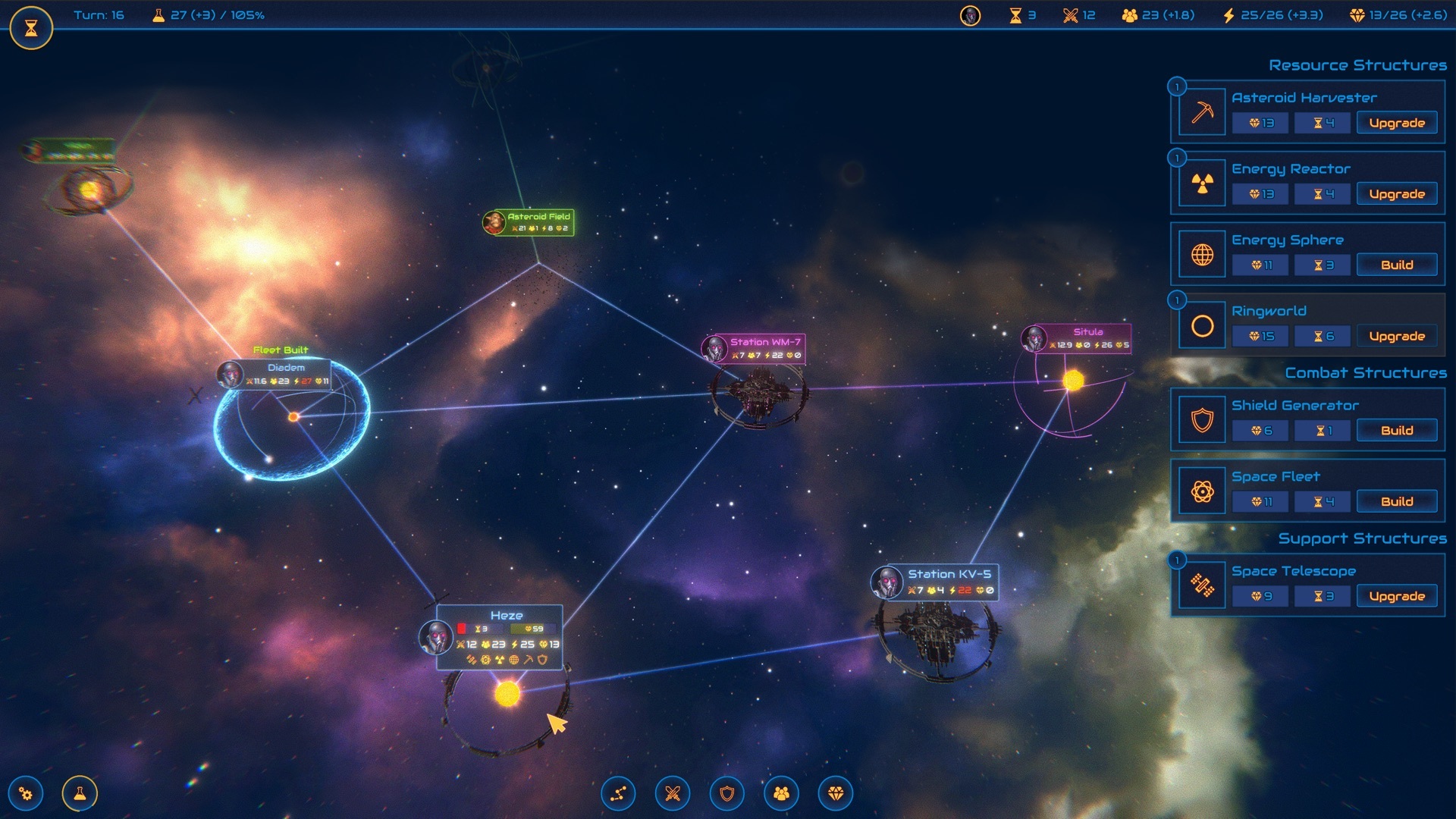
Last update introduced population races and this update brings this mechanic a few steps further. Now, after the player captures a location, the population race stays the same. In order to change the race at a given location, you’ll have to go to the population manager (which is another new feature) and manually convert it to a new race. This process comes at a cost: some amount of energy is required during the conversion and you only end up with 70% of the original population at the end.
Players don’t have access to all races at the beginning of the game—you’ll have to discover them by capturing locations with different races.
If two locations have different races then you can’t transfer population as easily between those two locations. Every such transfer comes with a 50% population cut. For example, if you want to transfer 10 population to a location with a different race, the target location will only receive 5 population.
Finally, I added another race called Mollis. Mollises are great at harvesting minerals but all of their construction takes extra time. They also have a combat bonus against humans. With this addition the game is at four races that force the player to use different strategies during the game. The plan is to add two more races in the coming months.
Better AI
With new mechanics being added, game AI quality has been deteriorating, so it needed an overhaul. The game is at the early stage of AI 2.0, if you will, but it already comes with some real improvements.
One of the bigger changes has to do with AI being aware of the supernovae. Gone are the battles when an AI player would transfer population to a blue giant a couple of turns away from exploding.
AI has gotten a lot better at transferring minerals. There’s still a lot to tune but now all locations that are in dire need of minerals have a better chance of receiving them from neighbors. This is particularly important for space stations that can’t generate minerals.
Other Changes
[UI] I added a new popup over the turn count that shows what the goal of the current game is.
[GRAPHICS] I tuned some post-processing and brightness effects for a better look.
[GAMEPLAY] Rate effects during random events are more severe now.
[MUSIC] I added four more beautiful tracks to the soundtrack.
Build 0.11.0 is out on Steam! This update introduces races and several other more minor improvements. Let’s dive right in!
Races
Races is a brand new game mechanic in the world of Eons of War. Now every occupied location in the game has a race of sapient beings. At the beginning of each game, initial locations are populated by the race set in the game settings. As the game progresses, locations become inhabited during colonization.
Each race has a set of traits that directly affect construction, resource production, and research. Also, each race has a combat strength bonus against some other race. This adds another strategic layer to gameplay.
If the player wins an attack against another location with a different race they will be presented with an option to assimilate attacking population, which effectively keeps the newly conquered location’s race the same. It comes at a price of a one time population reduction but it could be very beneficial if the player is looking to add more races to their empire.
The initial version of this mechanic includes three races (more are coming in future builds): humans, machines, and baloghs. Humans get to build structures on the cheap but their population doesn’t grow as fast. Machines collect extra energy at the expense of the minerals. And baloghs are trueborn warriors with increased combat strength but reduced research speed.
Other Changes
[GAMEPLAY] Negative resource rates are now allowed.
[GAMEPLAY] Structures were changed to have the maximum level of 3 instead of 5.
[UI] Location panels are now highlighted with color of the player occupying them. Also, we cleaned them up to show less content by default. Hover over your locations with a cursor to see more details.
[UI] Structures are now organized by category and name.
[UI] Action properties now have tooltips explaining all bonuses and handicaps.
[BUGFIX] Fog of war now renders correctly on all OpenGL setups.
Build 0.10.0 is out on Steam! This update contains two major changes: the stellar evolution mechanic and the wormhole mechanic. Both add new ways to strategize during all phases of the game but the endgame is particularly affected by those mechanics in a good way :)
Stellar Evolution
I built Eons of War around the idea of every turn taking a very long stretch of time—an eon. Over many turns stars’ luminosity goes up and they loose more and more mass until they either collapse or go supernova. This update introduces star phases that match real-world stellar evolution.
New stars start out as contracting disks of gas—or protostars. Depending on the initial mass, protostars evolve into red or yellow dwarfs. Red dwarfs are small and cool stars that can sometimes exist for trillions of years. In the game they are one of the final star phases and never collapse or go supernova.
Yellow dwarfs are stars like our Sun that evolve into red giants, which, depending on their mass, collapse into white dwarfs or evolve into blue giants. Red and blue giants are very bright active stars, so it’s easy to extract lot of energy from them with energy spheres. The downside of the giants is lower base population growth rate and more expensive construction.
All dwarf stars have a high base population rate and low construction costs.
Finally, blue giants are the only stars that go supernova that later collapse into black holes. Supernova “resets” minerals in the asteroid field, so black holes become very desirable locations in the late game with a high base population rate and cheap construction.
Black holes can also be used as wormholes and completely change how the endgame is played.
Wormholes
Wormholes in Eons of War represent an invisible network between black holes. This mechanic introduces another way to attack and transport population and minerals between locations. Wormholes behave just like hyperlanes, except there is no distance or mass energy cost when you use them to perform an action.
If you occupy at least one black hole all other black holes become visible on the map. To start using a black hole as a wormhole you have to build a wormhole portal that allows you to initiate actions to other black holes.
As the time goes by, more stars collapse into black holes, which leaves the back of your empire more vulnerable. Suddenly, you have to not only worry about hyperlanes but also about wormholes. This is an exciting dynamic that adds spice in the endgame.
Other Changes
[GAMEPLAY] Renamed hyperspace tunnels to hyperlanes.
[GAMEPLAY] Now initial minerals don’t depend on the star type.
[GAMEPLAY] Construction mineral cost is now inversely proportional to luminosity.
[GAMEPLAY] Base population rate is now inversely proportional to luminosity.
[GAMEPLAY] Updated action cost modifiers to be incremental instead of percentage-based.
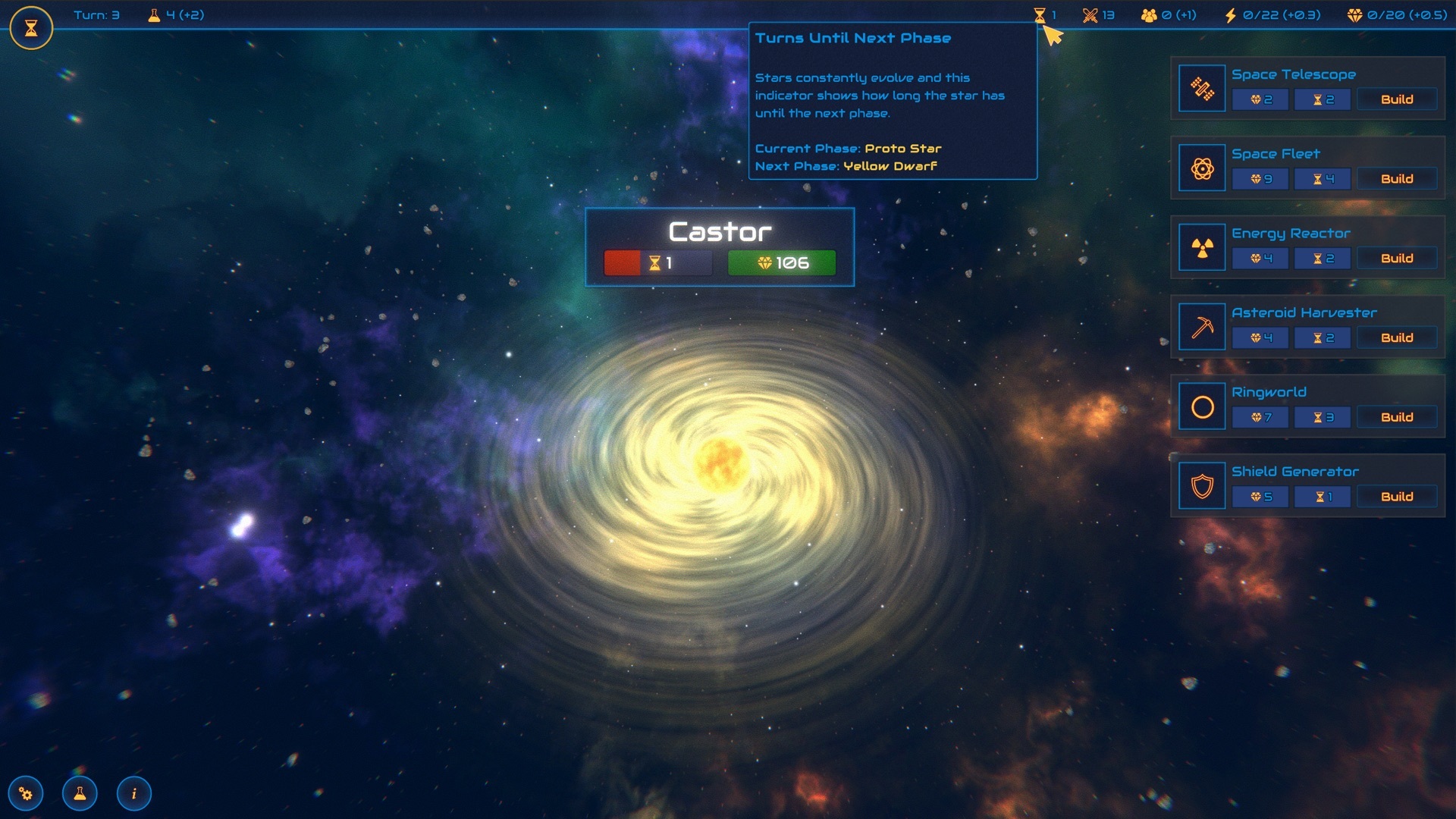
[UI] Added a turn countdown to the resources bar with a tooltip containing information about the current phase and the next phase of the stellar lifecycle.
[UI] Added more information to the minerals tooltip about the total amount of minerals left to harvest.
Dev Update #17: Improved Research, New Launch Date, Beta
Build 0.9.0 is out on Steam for beta players to test. It doesn’t contain as many changes as I have planned last week though. The whole stellar lifecycle mechanic is taking longer than expected because I had to completely re-write the part of the game logic that’s responsible for processing stars every turn.
This build mainly includes research updates and some minor bug fixes:
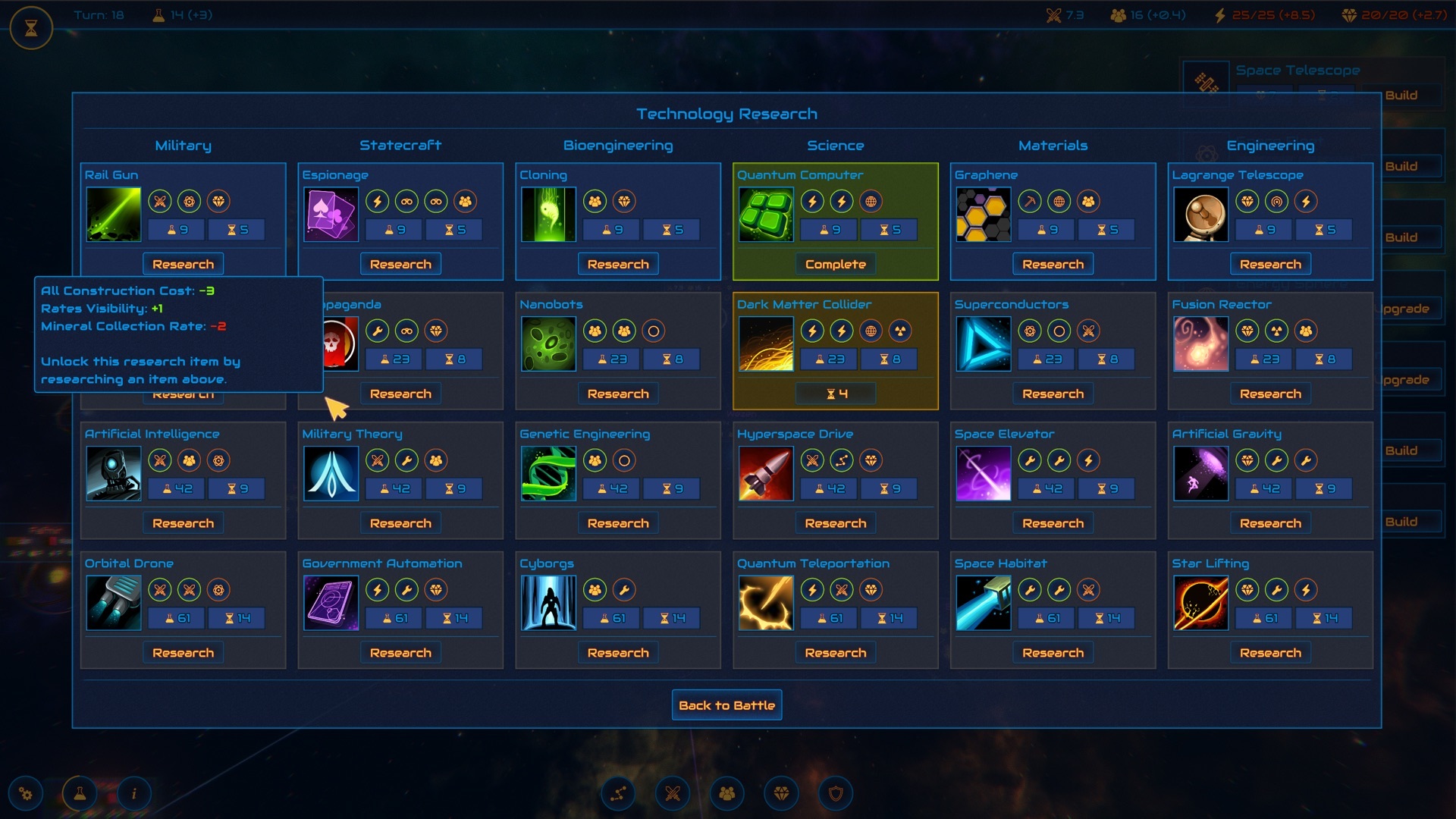
Now, research costs depend on how large the map is. It’s really neat because the static cost system that we had before didn’t make sense for large and dense maps when the player ended up with 15+ stars in midgame and most research done before endgame. Now, it’s more balanced and fun.
All research items now support the new incremental resource modifier system (it used to be percentage-based before 0.8.0).
All research items were re-evaluated to be more in line with different in-game points of focus: military superiority, mineral harvesting, population growth, energy generation, and construction speed and cost.
All research item properties are now shown in one tooltip.
All structure mineral and turn costs now include clear modifier breakdowns that can be seen in the tooltips.
New Launch Date
We are moving the launch date to the second half of September 2019. That was a tough decision to make but it’s definitely for the better. I want the game to be the best it can be and it would’ve been tough to achieve that without going into a major crunch for at least two months before the original launch date in May (been there, done that: it’s not good). I want the game to be enjoyable in single player and multiplayer modes and the latter is hard to get right on the first attempt.
We are still working on adding core game mechanics like stellar evolution, population races, leaders, and super weapons. The plan is to be done with those by the end of March and then focus on polishing, balancing, and adding content.
Private Beta Update
I received tons of great feedback from the beta testers over the past two months and I’m still processing it. I will be doing the second round of private beta staring in April but you can sign up for it now. Everyone who signed up before today and who hasn’t received a beta key yet will receive it in the next two weeks as promised :)
Build 0.8.0 is out on Steam for beta players to test. It includes lots of overdue improvements that I’ve been wanting to work on since December. It also includes several gameplay changes proposed by beta players. This is a pretty important release that consolidates and streamlines several mechanics. I also refactored some game components, which should save development time in the future.
The biggest visible change in this update is an improved UI. Lots of folks weren’t happy with how UI elements scale on smaller screens, so it’s fixed now and nothing should look small anymore.
Another UI change introduces structure panels instead of just buttons. This provides players with a much better view of the construction progress. Panels include mineral and time costs as well as the structure name. Panel tooltips show rate and limit changes. Since panels take up more space than buttons I moved them to the right of the screen. This forced me to move action buttons and panels to the bottom center of the screen. I think it’s a good change that will result in less mouse movements during the game.
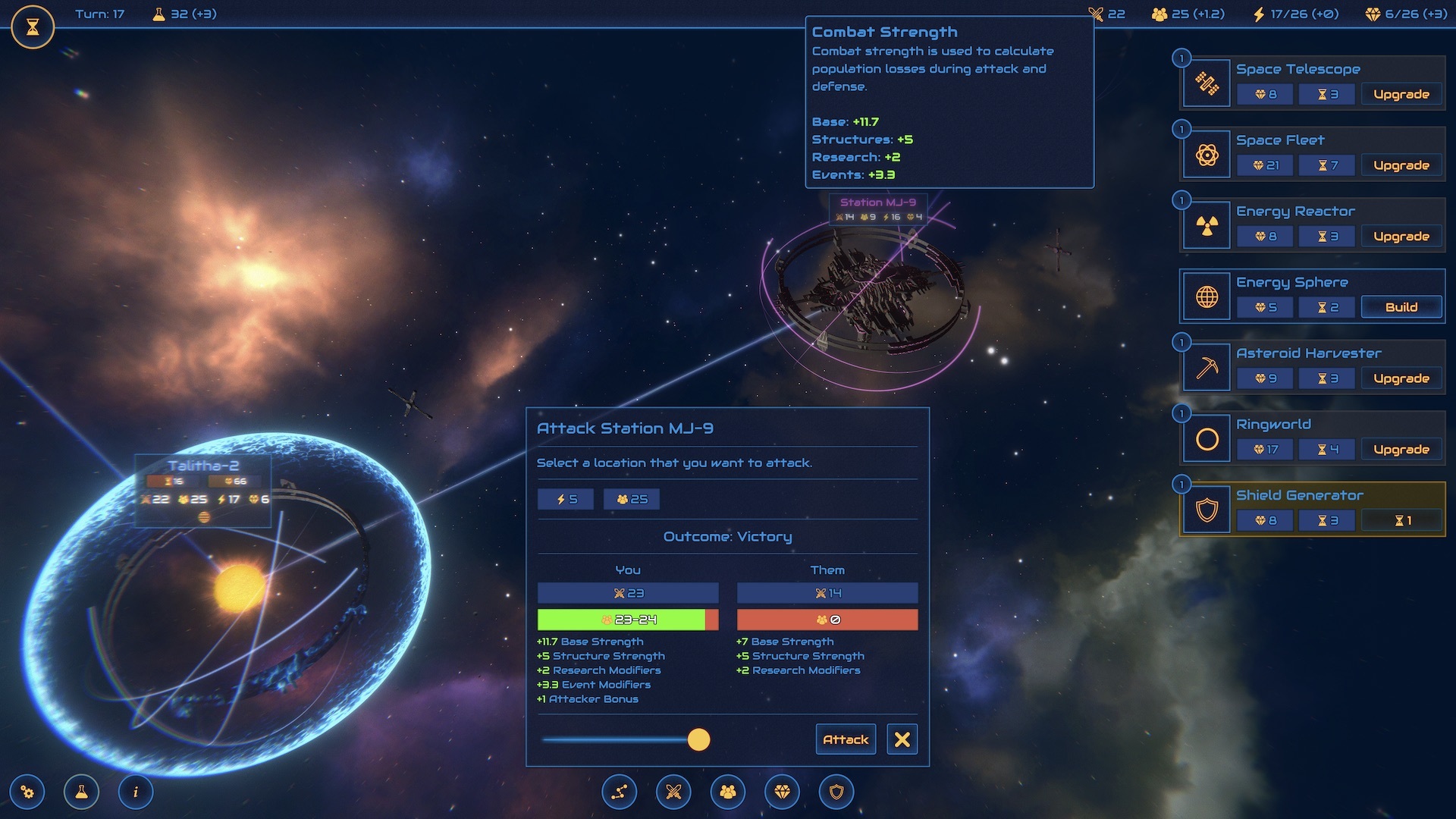
Another big change in this update has to do with consolidating all resource properties under one umbrella and removing percentage changes from research and events. Each resource property now consists of four components: base, structures, research, and events. If you move the cursor over any resource the tooltip will show a much more clear breakdown of what contributes to a specific property. By removing percentage modifiers in favor of number increments (and decrements) I was able to solve the ambiguity that many players weren’t happy with. It’s especially useful when making decisions about research and events.
Other Changes
[GAMEPLAY] Hyperspace tunnels now have a distance limit. Even if you have enough energy, you can’t build a tunnel to a far away location. This change stops tunnel craziness in the end game and makes locations more strategic.
[GAMEPLAY] Hyperspace tunnel cost is now linear instead of exponential (just like all other actions). It still costs more to build a tunnel than any other action. As a reminder, each action has two cost components: distance to and the mass of the target.
[GAMEPLAY] When the star goes supernova all connected hyperspace tunnels get destroyed. This adds an interesting twist to the end game and also protects vulnerable post-supernova stars from immediate attacks.
[GAMEPLAY] I dropped population limit on research stations since it doesn’t contribute to gameplay meaningfully.
[GAMEPLAY] The map generation density setting logic was updated for better gameplay experience.
[AI] Tunnel building logic now takes different contexts (like proximity to enemies and the relative level of energy) into account for more realistic AI behavior.
[BUGFIX] The “far apart” option for the player proximity setting in the battle setup panel now works correctly.
Next Week
Over the next week I’ll be working on introducing new game mechanics focused on stellar life cycles. It will include proto stars, star evolution from an orange dwarf to a red giant, and a few others.
This past week was pretty busy running the beta but I still managed to finish an important gameplay feature: energy shield.
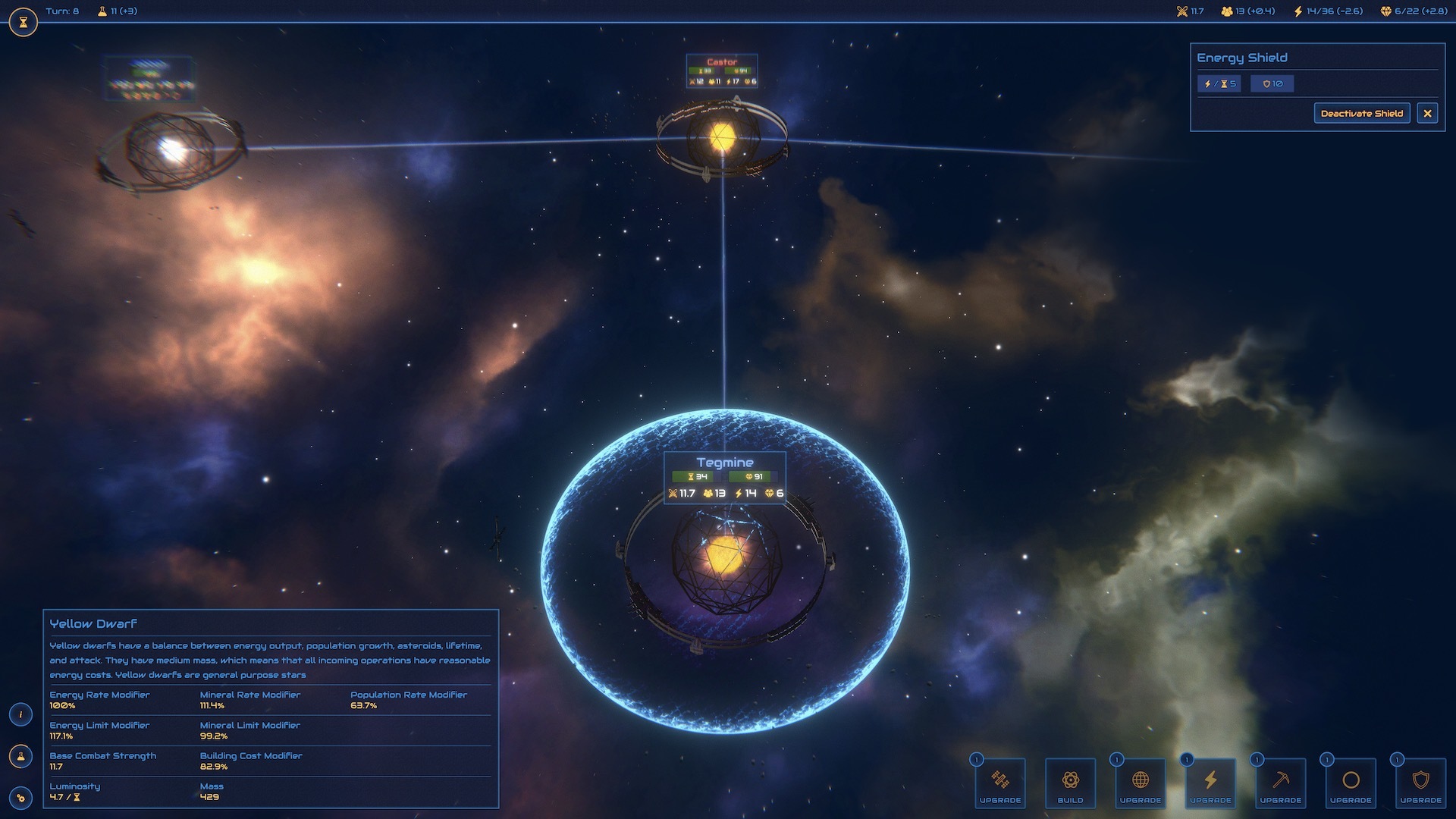
Energy shields are protective mechanisms that consume energy every turn once they are activated. When the enemy attacks a location with an energy shield up, some, or all, damage gets absorbed by that shield, which consumes energy. Depending on how efficient the shield is, it could quickly drain your location energy. For example, if the shield efficiency is at 70% and the location has 10 energy then the shield can absorb up to 7 damage units (equivalent to 7 population units). If the defending location has any population, then the attacker will receive the same amount of damage that they would if there was no shield.
I also added a new structure called shield generator that unlocks the energy shield action. Shield generators can be upgraded to lower energy the shield cost and to increase its efficiency.
Energy shield is a new type of game mechanic that only uses energy in order to achieve player goals. Sure, attacks and transfers consume energy but it’s just an enabling secondary resource since population still reigns supreme during direct attacks. That’s a pretty important development because it enables another high-level strategy for players—energy harvesting—that complements two other general strategies: population growth and combat focus.
There are a few more energy-based mechanics that will be coming out in the next weeks. Exciting!
Other Changes
[GAMEPLAY] Higher combat strength will result in more damage dealt to the defender. Now players can rationalize investing into military more.
[GAMEPLAY] All combat strength modifiers were increased by a factor of 10.
[GAMEPLAY] Supernovae now last only one turn. It’s more realistic since real supernovae only last up to several months, so it doesn’t make sense for them to last for several turns (one turn takes a million years in Eons of War). Another reason for the change is that players didn’t like how their locations became disabled for several turns during active supernovae.
[GAMEPLAY] In-game event choices that change resources were changed to be based on the relative value of the resource instead of a generic value.
[UI] I added a special location notification that lets the player know that their star is about to go supernova next turn.
Build 0.7.0 that contains all of those changes was just uploaded to Steam for beta players to try.
Next Week
Over the next seven days I’ll be focusing on a list of improvements that’ve been long overdue. Most of them have to do with fixing certain game mechanics, improving UI, and addressing player experience issues that beta testers brought up. I’m also planning on refactoring some of the game internals to get ready for massive features that are scheduled to be added in February.
Happy New Year! I took a few days off from development enjoying winter in the mountains and still managed to work on a few long overdue improvements.
I just pushed build 0.6.0 to Steam that includes the following updates:
[AI] AI players learned how to upgrade structures around their locations.
[AI] AI players became aware of asteroid fields and research stations and can build tunnels and attack them.
[AI] AI players learned how to transport populations and minerals between their locations. This is huge! Now AI can actually execute more meaningful strategies and adapt to changes on the battlefield.
[GAMEPLAY] Event probability now depends on when the last event occurred: first turn after an event has the probability of a new event happening at 0% and seventh turn at 100%. Turns in between have a linearly increasing probability.
[GAMEPLAY] Players can now set the initial proximity to other players in the battle settings panel.
[GAMEPLAY] Stars go supernovae faster that before.
[GAMEPLAY] Maximum mass of blue giants was increased, which affects incoming action costs.
[UI] Location details panel now includes the combat strength value.
As you can see, most improvements in this update are related to AI, which should make battles way more exciting. There are still quite a few things that AI doesn’t do well (for example, avoiding supernova losses) but I’ll be improving it incrementally with every new update.
Next Week
Over the next seven days I’ll be focusing on:
Adding more actions like fortifying and bombing locations without involving populations.
Welp, apparently I’m not good at counting calendar days and update #12 from last Tuesday was not the final update of 2018 after all. This one most definitely is! :)
It took me longer than I thought to get the new events system to the point where it generated meaningful random events. For now it only has eight high-level event types with outcomes that affect population, mineral, and energy limits and collection rates as well as combat strength modifiers. In the future updates I’ll be adding more outcomes and event types.
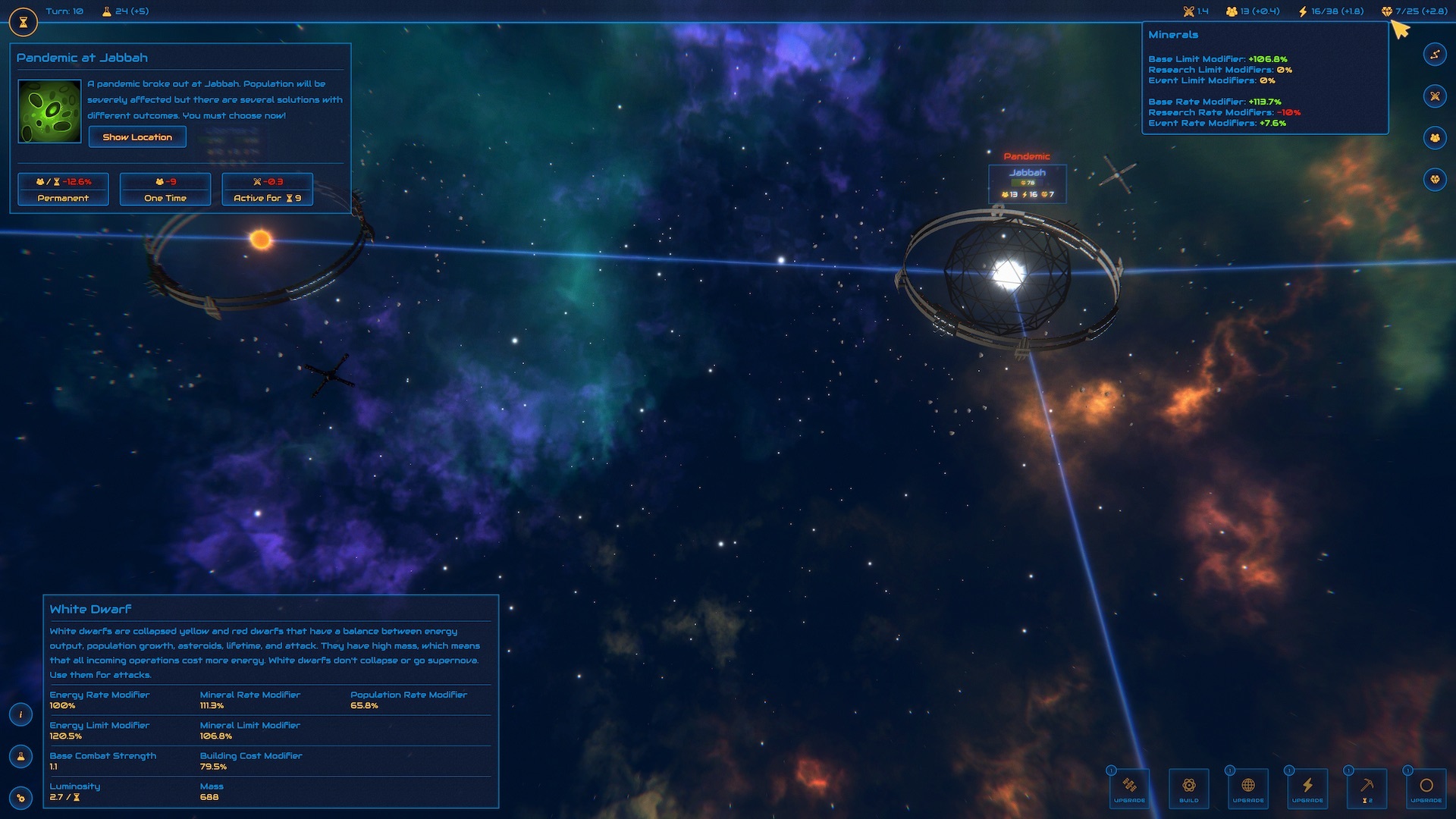
An event is something that randomly happens at a specific star or globally across all of your stars. It could be a positive event, like a scientific breakthrough, or negative, like a pandemic. Any event has three levels of severity (minor, normal, and major) that determine the outcomes. The outcomes are 2-3 different options affecting your economy and military might that you must choose from.
Events generate a constant stream of trade-offs that significantly change the gameplay for the better. Here’s a screenshot with a pandemic event that provides the player with three outcomes to choose from:
This screenshot also gives you a glimpse into the new tooltip system that lists all rate and limit modifiers from the star, events, and research. This is helpful when you make decisions about attacks, transportation, and event outcomes.
Build 0.5.0 on Steam that I pushed moments ago has both of these changes as well as the following minor changes:
[GAMEPLAY] Set initial rates for population, minerals, and energy back to zero.
[GAMEPLAY] Changed combat strength to a number instead of a percentage.
[AI] Updated AI players to follow specific research paths instead of randomly selecting available research items.
[GRAPHICS] Increased camera field of view for a more 3D-like look of the battlefield.
[GRAPHICS] Updated the background generator to include more realistic nebulae.
Next Week
I’m finally taking a few days off for the first time since July, so I won’t be working much on the actual game. I still expect to brainstorm a few things and come up with a more solid roadmap for 2019.
Happy New Year, everyone! Thanks so much for your support and I’ll catch you on the flip side!
It’s hard for me to believe that it’s almost 2019. Last year was great on so many levels and I know that next year will be even better! Happy holidays and enjoy the last few days of this year! I’m going to keep cranking for another week and then take a few days off to recharge and brainstorm new ideas.
I started working on Eons of War in early August and officially announced it on October 1. Since then the game has been improved dramatically and I collected lots of really good feedback (thank you, players!). The private beta started less than a month ago, on December 3, and more than 50 people played the game already. I’m truly humbled and also excited about all the interest from the community!
Last week was a bit slow in terms of progress but I’m happy to push version 0.4.0 on Steam today. It mostly addresses several bugs and has a few minor improvements. What I’ve been really focusing on is the new events system (to be released in 0.5.0). The events system generates random global and location-specific events that can be both good and bad (for example, a scientific breakthrough or a virus epidemic). For each event you’ll have to make a choice between rewards (for good events) and setbacks (for bad events). I truly believe that it will spice up the game and contribute something special to the genre. Stay tuned for the updates!
Here’s a list of bug fixes and new features in version 0.4.0:
[GAMEPLAY] Added a new map mode “random grid.” In this mode location positions are generated based on a random grid, which resolves several oddities with completely random maps and makes battles slightly more predictable.
[BUGFIX] Fix victory condition checks, so the game doesn’t stall when there’re no more enemy locations left.
[BUGFIX] Several location details panel fixes.
[BUGFIX] Add correct player color highlights to the ringworld and space station models.
[BUGFIX] Fix incorrect battle populations after the attack when the player chooses attack population with a slider.
Next Week
Next few days are expected to be hectic with all the holiday bustle abound but I am determined to finish the events system and may be address a few other issues.
Again, enjoy the next week and thank you for everything!