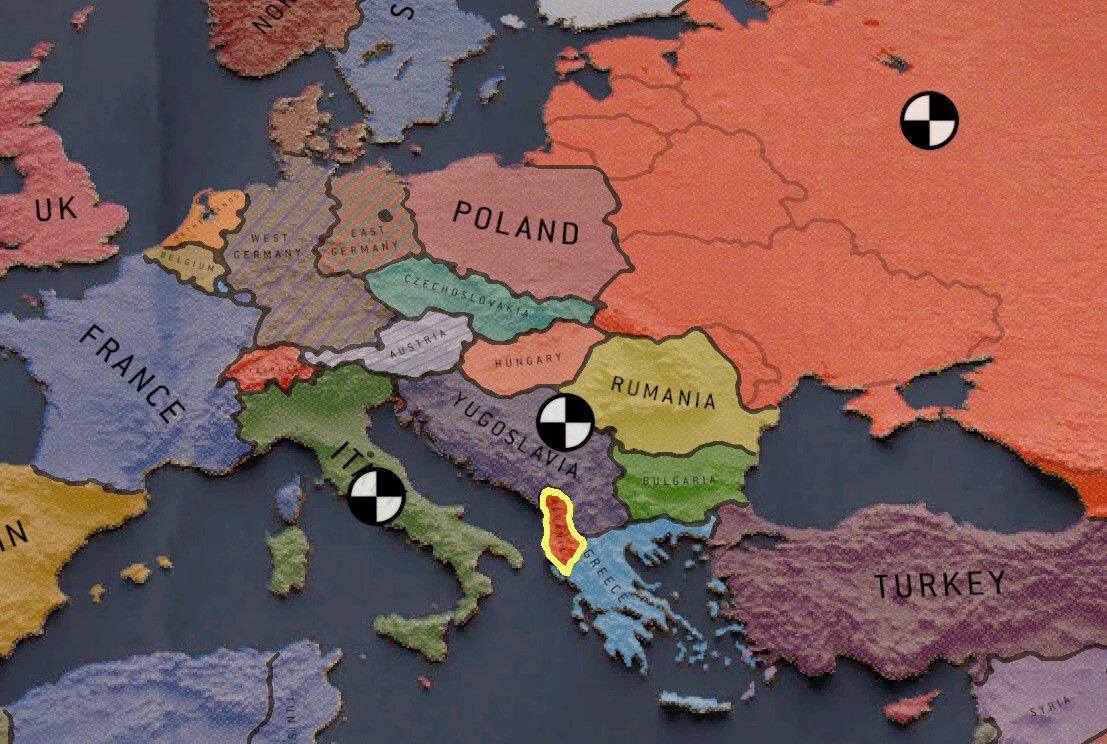
What's happening / TLDR: Developer diaries introduce details of Espiocracy - Cold War strategy game in which you play as an intelligence agency. You can catch up with the most important dev diary (The Vision) and find out more on Steam page.
As we finish the fourth year of development of Espiocracy -- the main game build with working map and buttons was compiled for the first time in June 2021 -- we are at the stage of implementing deeper scenarios, fleshing out mechanics, and looking for last 10xer features (10xing two pillars of the game: strategy & immersion). Today we'll take a look at such a feature.
Main Character
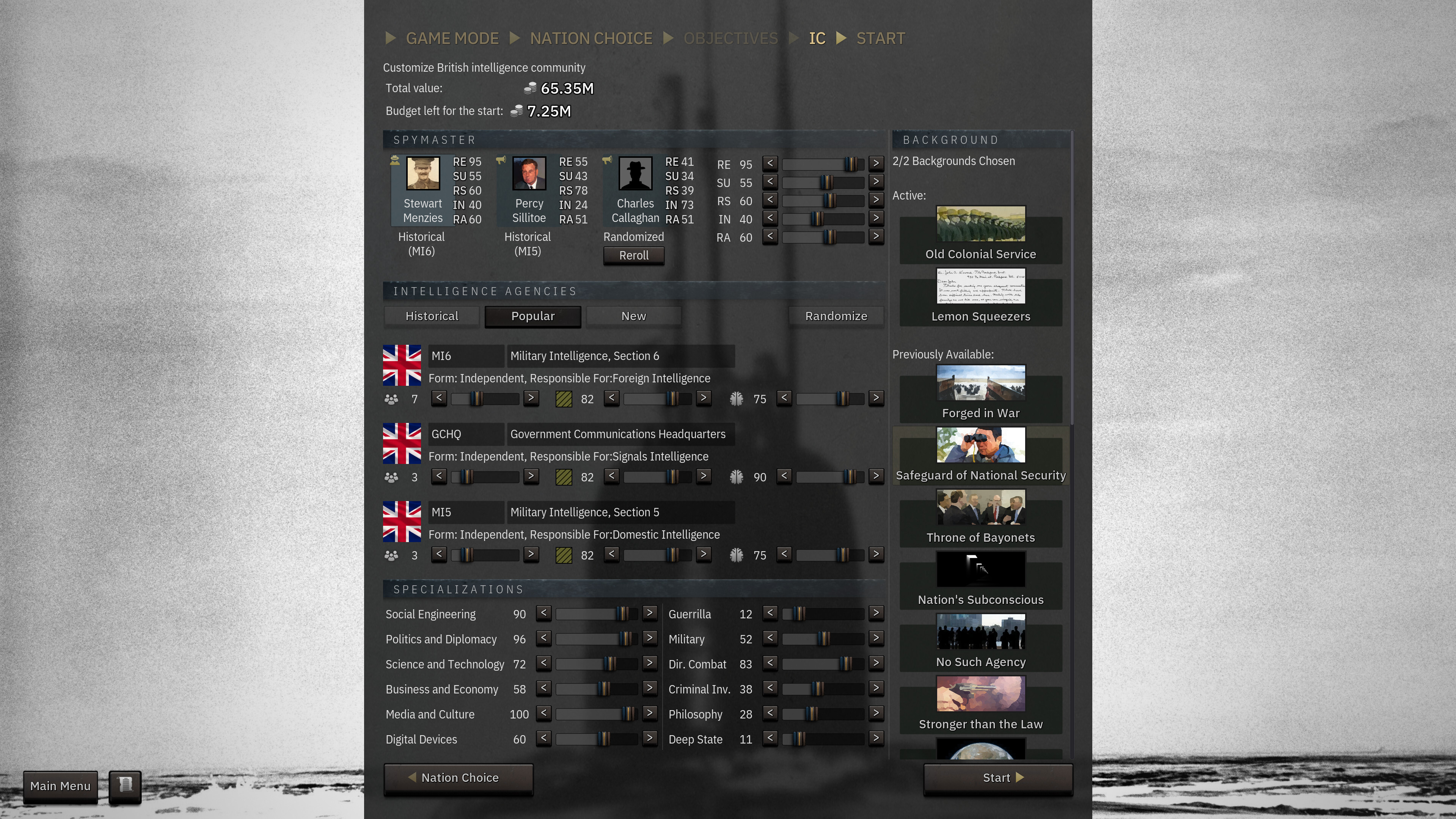
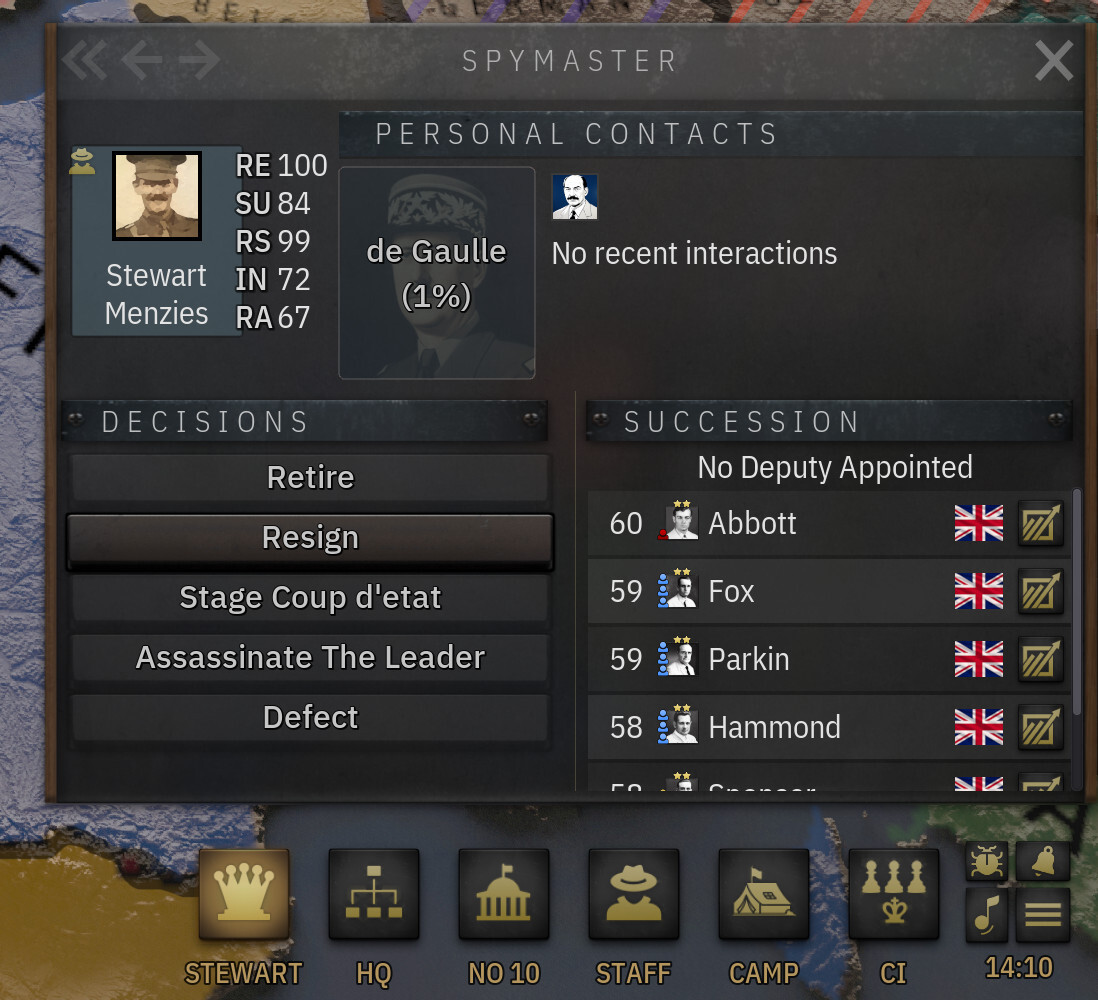
Every player in Espiocracy is now, first and foremost, represented by the spymaster.
From many playtests, it became clear that the game lacks something critical in the middle of its complex mix of espionage and the Cold War. The obvious answer would be a director/chief but a few various implementations failed to solve this issue, and failed even to contribute meaningfully to gameplay. DD#53 referred attempts (as of May 2024) as either too weak or too overwhelming. Since then, however, the n-th approach with careful real-life-inspired design hit the Goldilocks zone, thanks to a few elegant implementations.
Real world position of de jure director of the intelligence community - if it even exists - is often politicized, short-lived, and not really interesting. In Espiocracy, instead, you play as the spymaster: an officer who is de facto most influential in the intelligence community. It may be the chief of leading foreign intelligence agency (historical inspirations: William Donovan, Stewart Menzies, Markus Wolf, Allen Dulles), powerful chief of any larger agency (Yuri Andropov, Wilhelm Canaris, J. Edgar Hoover, Erich Mielke), or outstanding leader of a smaller unit (Arisue Seizo, Zhou Enlai).
From this perspective, on surface, it is a strategy game like any other - you send orders, receive feedback, react to changes - but in a few critical situations, you are just a person facing the wind of history. In domestic civil war, you may decide to switch sides to the rebels, taking loyal officers with you. Upon discovering a domestic coup plot, you may decide to join it (or even to stage it from the first step). You may be directly targeted by an assassin or become one (like the chief of KCIA who personally assassinated his president). When releasing, dissolving, or separating a new country, you may decide to form new intelligence community in the new country. And obviously you will take direct personal responsibility for failures and transgressions, that may end up in forced retirement, resignation, or even arrest and trial.
Succession
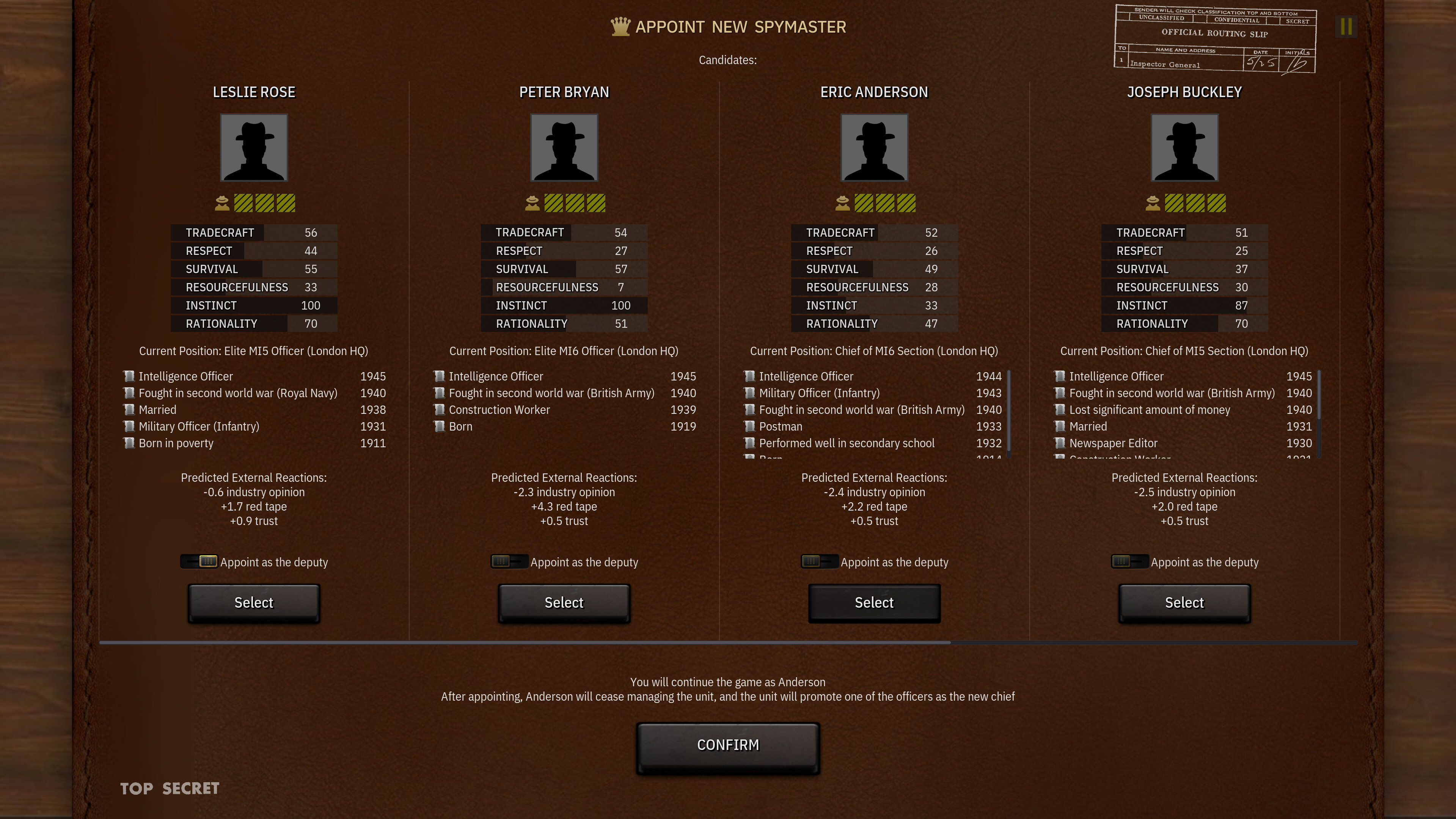
These personal consequences, however, usually* don't cause the end of the game. You lose current main character, along with their advantages & achievements, but you can continue as the next spymaster:
Traits of every candidate are defined by three processes.
First, personal history, which is rooted in wider historical events, stemming from a database of events reaching 19th century that is also expanded during gameplay (eg. if your country fights Vietnam War, you may become a Vietnam-War-veteran spymaster - like Stansfield Turner, CIA director in 1977-81).
Second, intelligence service: potential future spymasters take part in operations you order, manage stations, handle spies, and execute other espionage activities. Among notable consequences, a spymaster may "have no face" (like Markus Wolf - which significantly lowers personal risks) or be publicly known. The latter state may be caused for instance by leaked/publicized/gone-wrong operations (famous real life example: Gina Haspel, CIA director in 2018-21).
Third, ties to previous spymaster. As a spymaster, you can appoint a deputy, which guarantees higher pace of increasing attributes over time (and rare special development opportunities). However, it is double-edged sword during succession. If you retired as respected officer, it will be a supporting factor - but you resigned, were fired, or even arrested, it will be a damaging factor, introducing adverse external reactions (eg. lowering government's trust). In worst cases, it may even make such a deputy unavailable during succession due to too close ties to previous disgraced spymaster.
* - Death/loss of the spymaster can end the game if it is your last officer in the world (for instance after the nuclear war...) or when it is caused by conviction in high treason trial (this game over condition can be turned off in game rules).
Personal Contacts
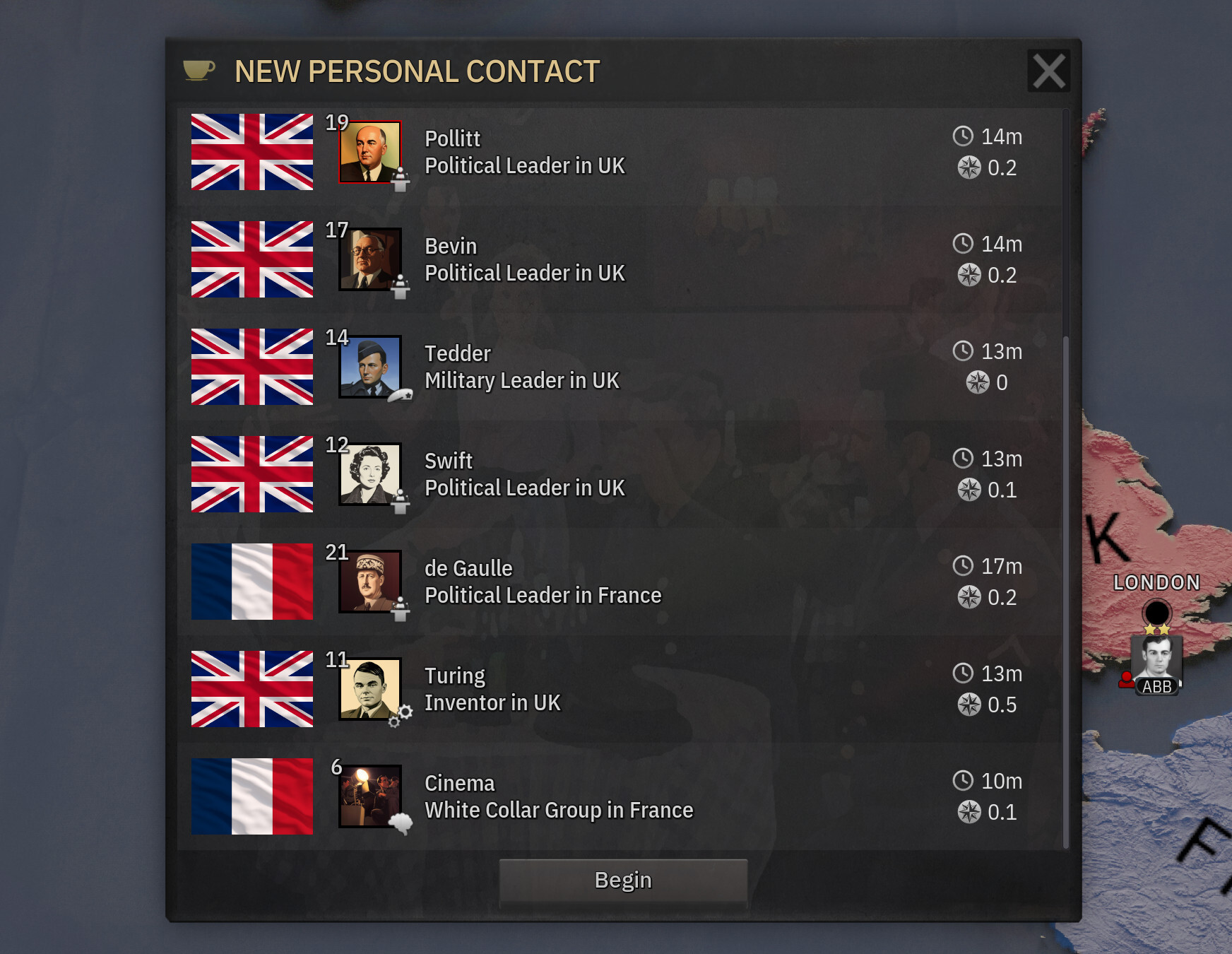
As the most influential officer in the intelligence community, you can regularly develop and exploit personal contacts with significant actors.
Availability of particular targets depends on personal traits and widely calculated proximity between you as the spymaster and the target (differences between personal influence, countries, cultures, ideologies, languages, geographical distance etc). More valuable contacts require longer development time (eg. above 17 months for De Gaulle vs 10 months for French Cinema), which is critical as you can develop only one contact a time, and your career as a spymaster can be as short as a few years.
Once personal contact is developed, as the spymaster you regularly meet the contact and exploit the relation: collect intelligence, enable operations, support spies, influence actions, act as a backchannel for diplomacy, acquire funds and other resources (for instance iron-clad cover tied to highly influential personal contact).
This is a two-sided relation, in which the target will sometimes ask for intelligence, resource, or another favor. Over time, it may become stronger or weaker (to the point of losing contact), and naturally all the contacts are lost when spymaster exits the service - all except for the contact with top actor in the government, as this is a personal contact that exists for every spymaster.
Attributes
A spymaster is characterized by five 0-100 attributes which gently influence many mechanics:
Respect - Primary factor guiding availability and quality of personal contacts. In addition, affects government's trust, vulnerability to failures of the intelligence community, and negotiations with foreign spymasters.
Survival - Directly correlates with possible years on the position of spymaster, on the span from one year (lowest survival) to full Cold War (highest survival, Markus Wolf has 100 here). Influences ability to handle failures, shift or take blame, and personal vulnerability to assassination.
Resourcefulness - Influences income, costs, length of intelligence programs, and quality of additional schemes (such money laundering).
Instinct - Increases prospective outcome of risky operations, handling high-value spies, supports counterintelligence investigations, in rare cases can fast-track intelligence discoveries.
Rationality - High rationality lowers operational costs and improves intelligence collection related to national interests. Low rationality makes the officer more susceptible to gaining negative traits, damaging personal contacts, and also allows defection (which may be useful in very rare cases: nuclear option against intelligence community, leading to large purges and reform, and against current government, potentially causing its collapse... obviously with all the disadvantages, such as revealing treasure trove of intelligence to the receiving player; famous historical example: chief of Romanian intelligence services defected to the USA in 1978)
Final Remarks
The next dev diary will be posted on the first Friday of the next month: July 4th.
If you're not already wishlisting Espiocracy, consider doing it
There is also a small community around Espiocracy:
--- "January 24, 1946: At lunch today in the White House, with only members of the Staff present, RAdm. Sidney Souers and I were presented [by President Truman] with black cloaks, black hats, and wooden daggers, and the President read an amusing directive to us outlining some of our duties in the Central Intelligence Agency, Cloak and Dagger Group of Snoopers" - Office diary of William D. Leahy, Truman's military adviser
Dev Diary #62 - Economy
What's happening / TLDR: Developer diaries introduce details of Espiocracy - Cold War strategy game in which you play as an intelligence agency. You can catch up with the most important dev diary (The Vision) and find out more on Steam page.
Grand strategy games (GSG) can be described as a deep/wide exploration of three main aspects of statehood: military, diplomacy, and economy.
Espiocracy, as a GSG-like, puts these through the lens of the Cold War and espionage, arriving at fairly limited military aspect (due to the coldness of the Cold War, replaced obviously by espionage, and also by guerrilla warfare and nuclear brinkmanship) and deeper take on diplomacy (DD#51, and ubiquitous manipulation of actors from behind the curtain). What about economy?
It's very basic. Since the player as an intelligence agency cannot really interact with economy directly (aside from small industrial espionage gameplay and microeconomic angles such as funneling laundered money), since the topic is so complex that it can be identified as a contributor to failures of other attempts at creating a good indie GSG, and since we have to pick our battles where our strengths lie (knowledge about economics is definitely not one of them) - it is kept reasonably simple.
The backbone of material comparisons between countries in the game is State Power Index, described in DD#16. It takes into account all the mentioned statehood sectors and a few others (such as nuclear capabilities or cultural influence). Economy is the most significant (25% weight) part of this index, and as such (and as fundamental part of statehood and GSGs), it receives its own layer of depth, which we will explore below.
GNP
Espiocracy takes Gross National Product (GDP + international factors) as the main parameter to define the state of economy of a country. Its calculation resembles real world GNP calculation but it is adjusted for gameplay purposes. In-game GNP is a sum of:
goods, services, food industry - multiplied by population (private consumption)
factories, heavy industry, bank groups (investment)
income from colonies and foreign state-controlled enterprises, access to global economy, access to oil (international factors)
government spending
Absolute values are derived from actions, national resources (formerly known as national assets, DD#33) and entities in the world (eg. Anglo-Persian Oil Company, contributing to GNP of the UK). For instance, "services" is a percentage value from 0 to 100+, while "factories" is a number of active factories within the country. This, naturally, defines how GNPs increase in the game: through growing population, industrialization, investment, international expansion, and so on.
This GNP-like value, in turn, defines budget available to the government: 20% for capitalist systems, 30% for mixed systems, 40% for planned economy. Such budget is spent, as was shown in numerous diaries in the past, on domestic projects, foreign activities, and player's intelligence community.
Capitalist, Mixed, Planned Economy
Countries in the game implement one of the three economic systems. The choice is defined by local constitution (DD#28) and emergencies. The latter factor is important in early game: after the world war, many countries maintained rationing and state planning programs for some time. For instance, the USA begins the game in March 1946 as mixed economy due to emergency laws - eg. the Office of Price Administration which was active until 1947 - until it rescinds them and switches back to capitalist economy.
While countries generally converge towards mixed system over time (aside from a few notable exceptions, especially two superpowers) which hits optimal middle ground, the two other contrasting systems offer their own significant advantages.
Capitalist countries in the game can achieve highest year-to-year GNP growth (following historical comparison of West and East Germany), significant non-state contributions to national resources and critical sectors (such as mentioned services - but also, for instance, locally mastering new scientific and technological paradigms without involvement of the state), higher number and influence of business actors, and substantial international expansion.
Planned economy, on the other hand, favors larger military, ICBM/space/nuclear programs, rebuilding after the war, and naturally all the state-funded projects (anything from state-built housing to public healthcare). From the perspective of the player, it offers also tighter counterintelligence environment (for instance, inability to establish front companies by other intelligence agencies). However, following the history, planned economies in the game are bound to fail sooner or later, ending in a crisis that forces the government to, at least, switch to mixed economy (and at most, contributing to the collapse of the country - for instance, dissolution of the USSR).
Beyond these systems, there's also fourth "economic system" in the game: informal economy - which relies on barter, illicit activities, unofficial transactions, and general lack of state authorities. It dominates countries ravaged by wars (for instance, occupied Germany at the start of the game), including nuclear wars, and/or failed states. This situation very practically changes espionage on the ground, making money irrelevant as a motivation (eg. no "fund X" operations), and elevating importance of other methods (such as "supply" operations).
Oil
In addition to simplistic GNP-based economies, we explore one - important for the Cold War - resource: crude oil (petroleum). Governments were overthrown, wars were launched, and whole alliances were forged just to secure access to this critical material. Espiocracy reflects this by introducing simple demand-supply situation: a sufficiently developed country has to import (or use domestically extracted) quantities of crude oil proportional to its GNP. If this demand is not met, its GNP will suffer.
On the supply side, oil reserves have defined positions on the map (which can be scrambled by pre-game randomization), some of which are hidden until discovery through lengthy exploration process. At the beginning of the game, extraction is fairly timid, as the world produces roughly 8 million barrels per day. With further discoveries (including discoveries of "elephants" - giant oil fields) and build up of oil wells and offshore rigs, in an average campaign the extraction exceeds historical level of 40 million barrels per day in 1970s. This huge increase prompts petroleum exporters in the game to establish OPEC and leads to increase of global price of crude oil which, in turn, lends significant international influence to relevant countries (mainly in the Middle East), and gives them powerful international tool in the form of an oil embargo (historically activated in response to 1973 Yom Kippur war).
International Economy
Crude oil is a significant part of wider international economy in the game, which includes also:
Widely understood access to global economy (established through standard economic development, limited by isolating actions such as embargoes, with high isolation severely limiting economy, see Cuba or North Korea)
Trade between countries with established relations (therefore, limited by lower recognition and severed relations)
Strategic trade deals (for instance, Cuban-Soviet deals, aimed at countering American-led economic blockade of Cuba)
Economic cooperation programs (eg. Marshall plan - but also EU's European Economic Area)
Exploitation (client/satellite/dependent states, also war spoils and war reparations) and neocolonialism (non-state-level influence in former dependencies)
Economic migration (to neighbors with significantly higher GNP per capita)
Currency strength (while the game does not explicitly model individual currencies, it stores their relative strengths - with dollar as the strongest currency - and their evolution, which then influences practical value of bribes, funds, and other expenses during espionage activities)
Final Remarks
The next dev diary will be posted on the first Friday of the next month: June 6th.
If you're not already wishlisting Espiocracy, consider doing it
There is also a small community around Espiocracy:
--- Main image attribution: Rama, CC-BY-SA-3.0, render of project Cybersyn (the project does have a single flavor event in the game)
--- "Our banks and financial services may collapse, our economy may be going through the floor, our road and rail system may be a catastrophe, our Millennium Dome a laughingstock, the cost of fuel, energy, and water rising by the week, but our spies are immune to all of it" - John le Carré
Dev Diary #61 - Geopolitical Features
What's happening / TLDR: Developer diaries introduce details of Espiocracy - Cold War strategy game in which you play as an intelligence agency. You can catch up with the most important dev diary (The Vision) and find out more on Steam page.
Espiocracy is a map game: the map is the primary interface, present almost always on your screen, and in development receives a lot of care. It's also unusual in comparison to other map games (primarily grand strategy games) because it is not limited by a specific engine, and instead it can be as bespoke as we want it to be.
In DD#35 we talked about the visual approach: prerendered 2.5D relief map which hosts countries defined by flexible point-by-point borders. Today we'll explore further data layers on the map that influence gameplay.
The Grid
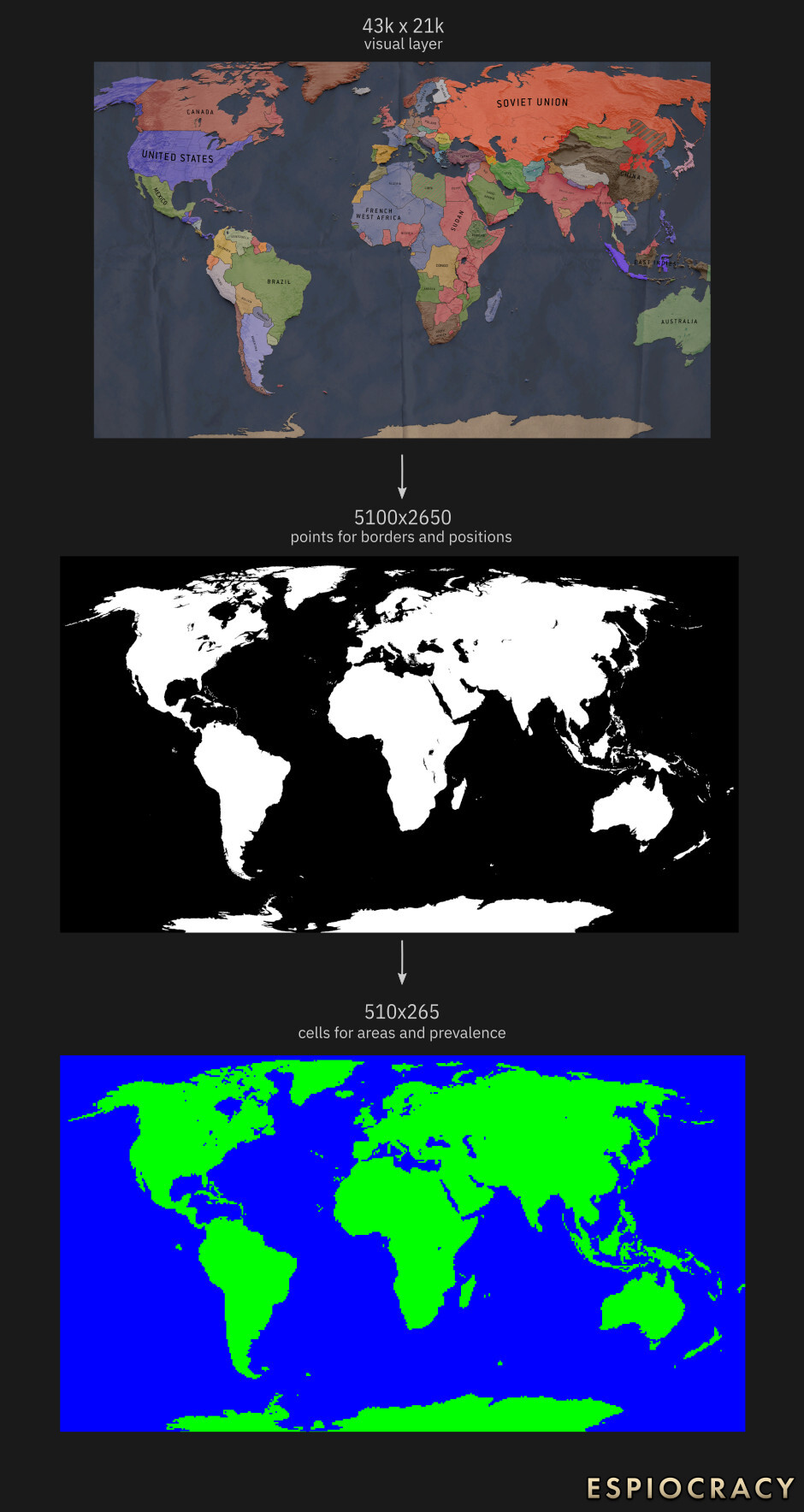
Instead of dividing the world into provinces, Espiocracy uses two levels of grid-based maps. Higher-precision grid (5100x2650, 1 point equals roughly 5.8km^2) defines borders and positions of discrete objects such as cities, officers, or battles. Lower-precision grid (510x265, 1 cell equals 58km^2) is used for areas and prevalence, which is a technical trade off between good enough precision and computation/memory/data collection. While at first glance this distinction may seem unnecessary, we are primarily worried about areas. Cell grid has area of 135k while point grid has area of 13.5 million - 100x more!
Naturally, the first and foremost use of (lower-precision) cells is terrain.
Terrain cells define local kind of land or sea, from standard (eg. forests or mountains) to more unusual kinds (eg. deep sea, farmland plains, usable coast). Some of them may be slightly modified - for instance, defoliating jungle through herbicide warfare (historically: Malayan Emergency and Vietnam War) or costly projects making coastline more/less usable (the latter for defensive purposes).
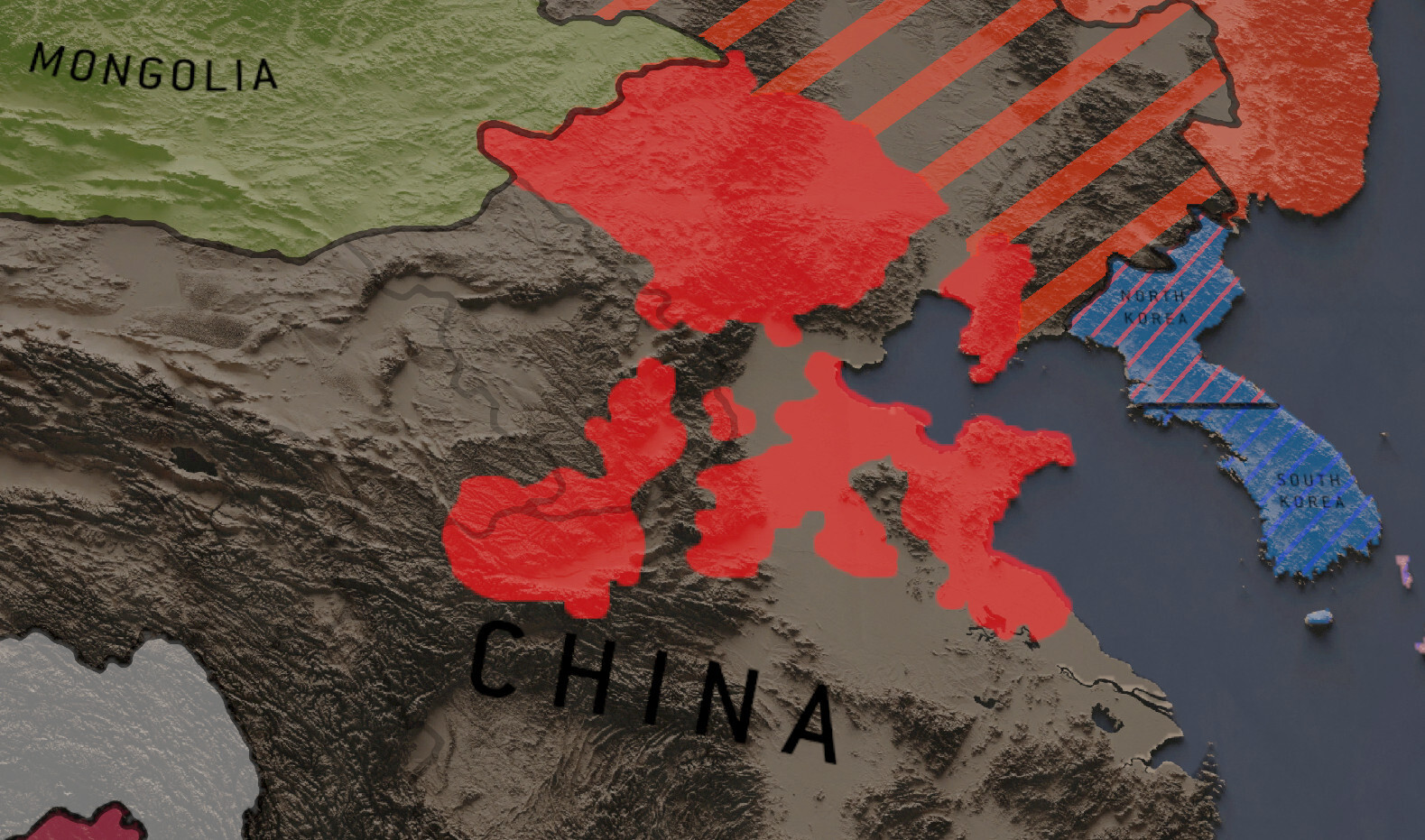
Conflicts rely on cells to define areas controlled or contested by belligerents. Their display, as you could see in many previous dev diaries, is rounded on the main map to make it more palatable visually:
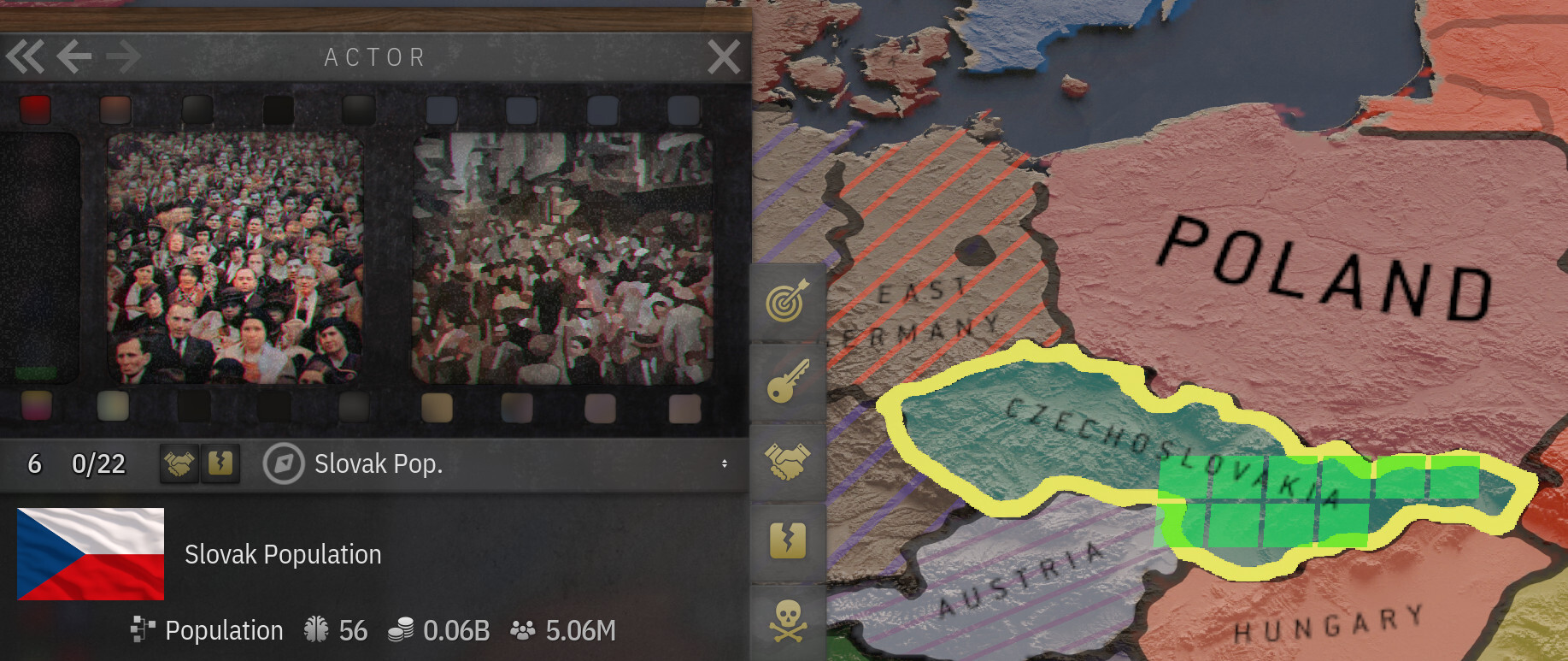
Other entities in the game world that use cells to define area include deposits, postnuclear fallout, populations...
...and some of the strategic locations.
Strategic Locations
The map is enriched by:
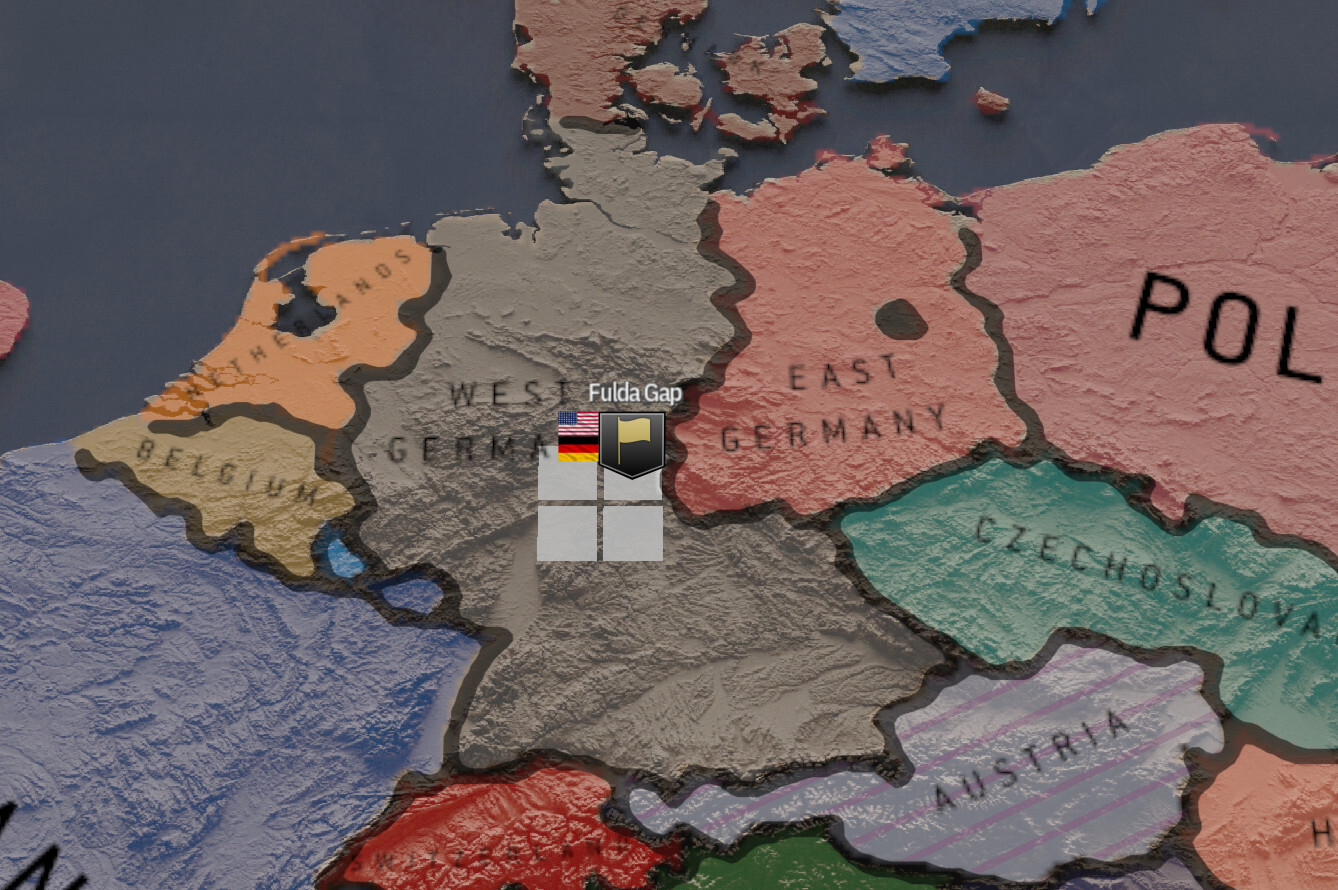
Strategic Gaps (eg. Fulda Gap in West Germany, also GIUK Gap)
Gates (eg. Focsani Gate in Romania)
Corridors (eg. Wakhan Corridor in Afghanistan)
Major Mountain Passes (eg. Brenner Pass in the Alps)
Natural Harbors, Straits, Canals
These strategic locations can be controlled by particular nations (not necessarily by the host nation), fortified (including nuclear minefields, as was the case in the Fulda Gap), contested, and become one of the strategic targets during conventional wars (DD#29). They are also an environment for espionage, especially military espionage, where getting spies on the ground may significantly assist eventual future push to conquer the location.
Peripheries
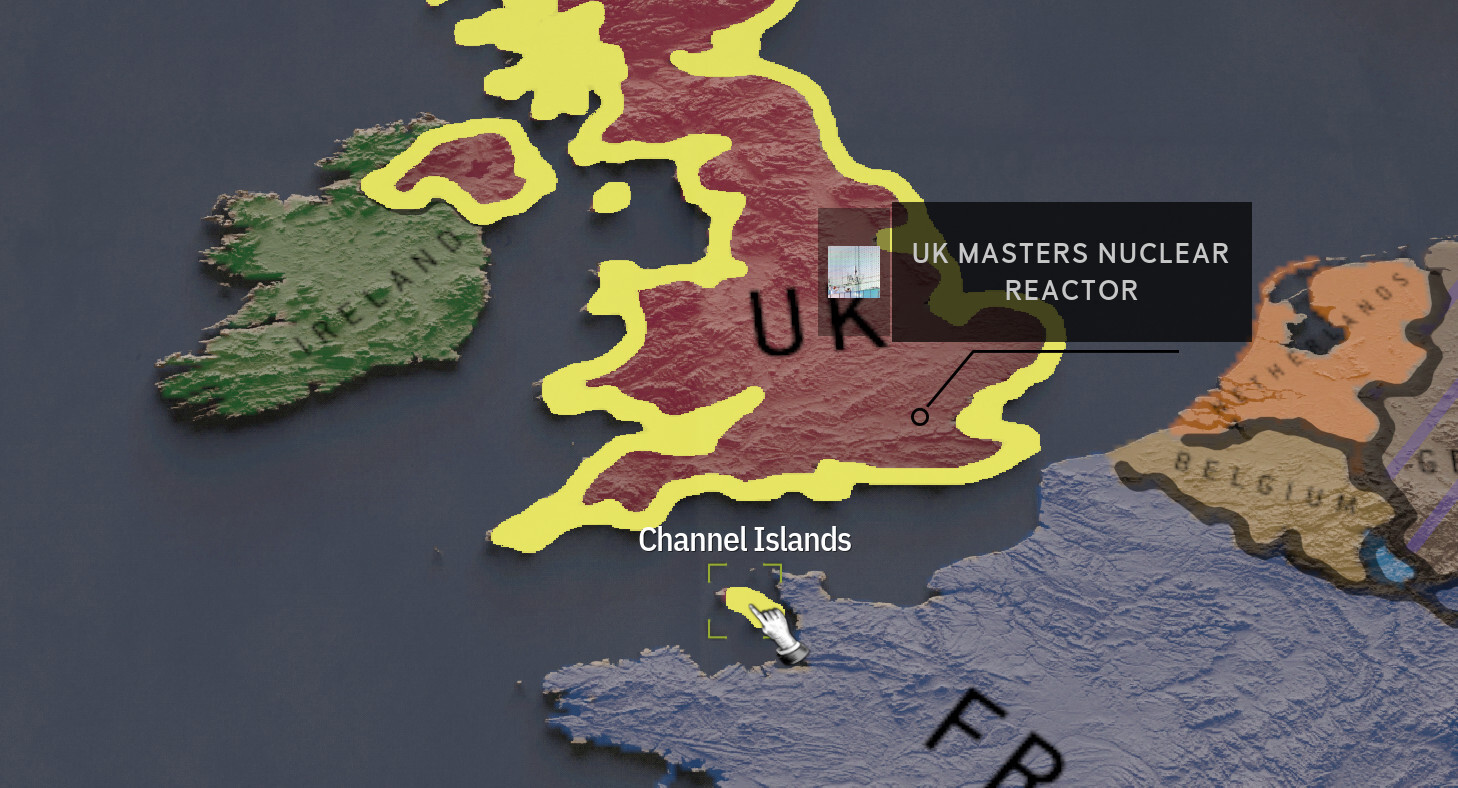
Islands, due to important role as intelligence outposts and military bases, are abundant in the game.
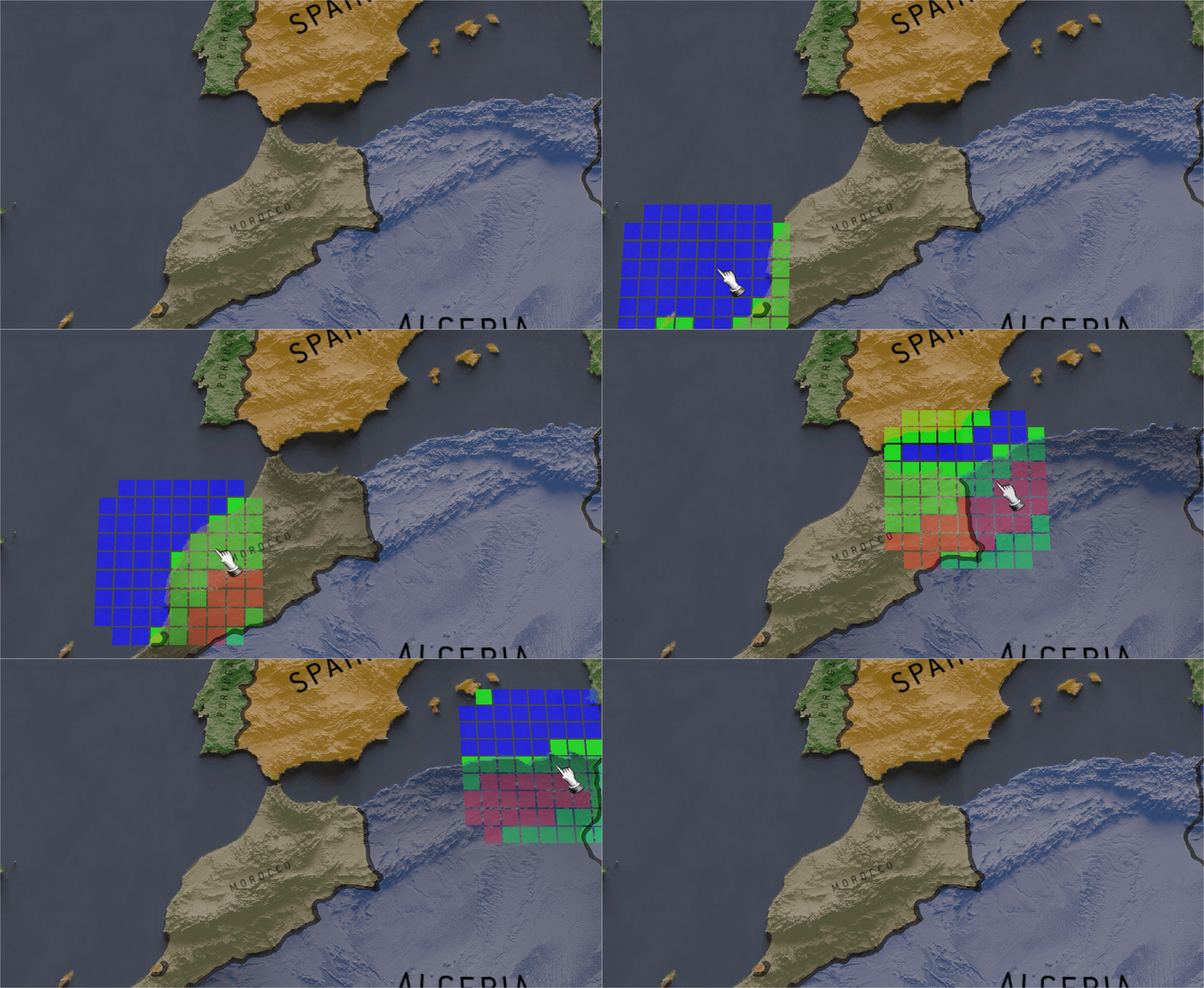
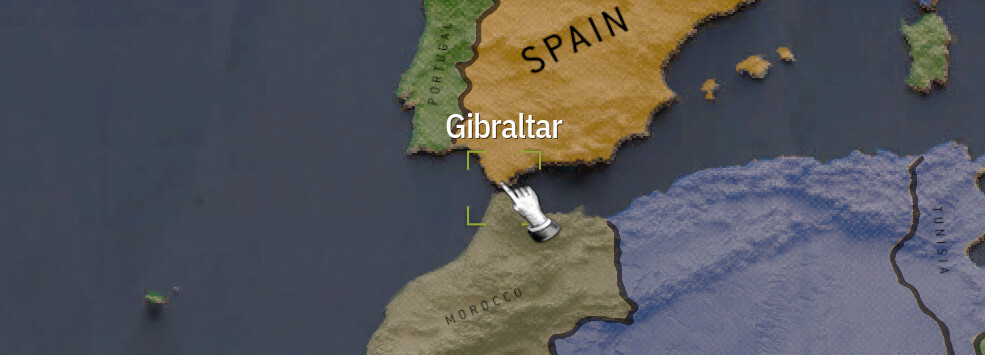
Such islands may have different size, supply lines ("remoteness"), and levels of autonomy in connection to the mainland. With high enough autonomy, they may enter the category of territories. These are not limited to islands, as they can include also enclaves and exclaves, such as Gibraltar. Note that the size of such tiny geographical features is kept fairly faithful (Gibraltar is just one point on 5100x2650 grid!) - but they are still selectable from the main map thanks to an algorithm that establishes larger hitboxes for mouse clicks.
Some territories were established through leases, for instance American base in Guantanamo Bay. New leases may be arranged during the gameplay. They may be limited in time, eg. British lease for Hong Kong will expire in the game in 1997. Leases can also cover canals.
Inner Features
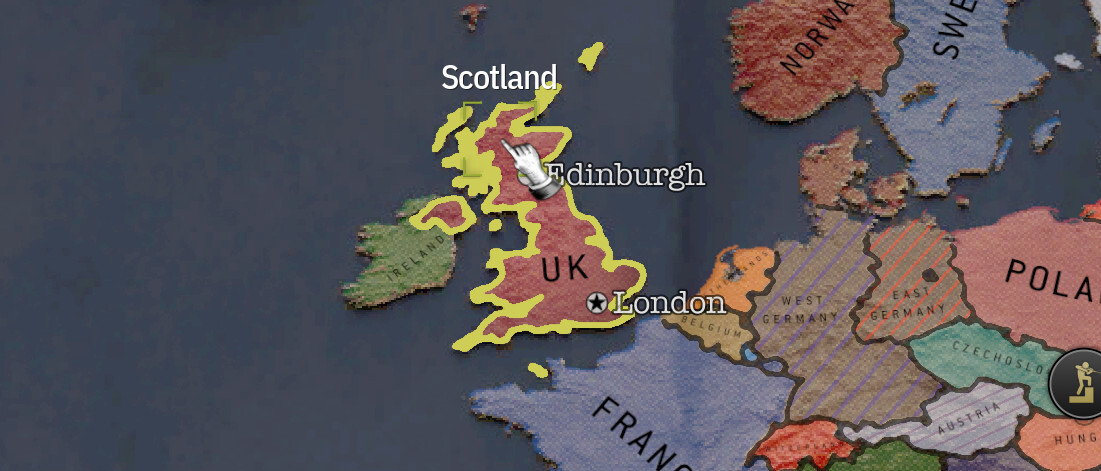
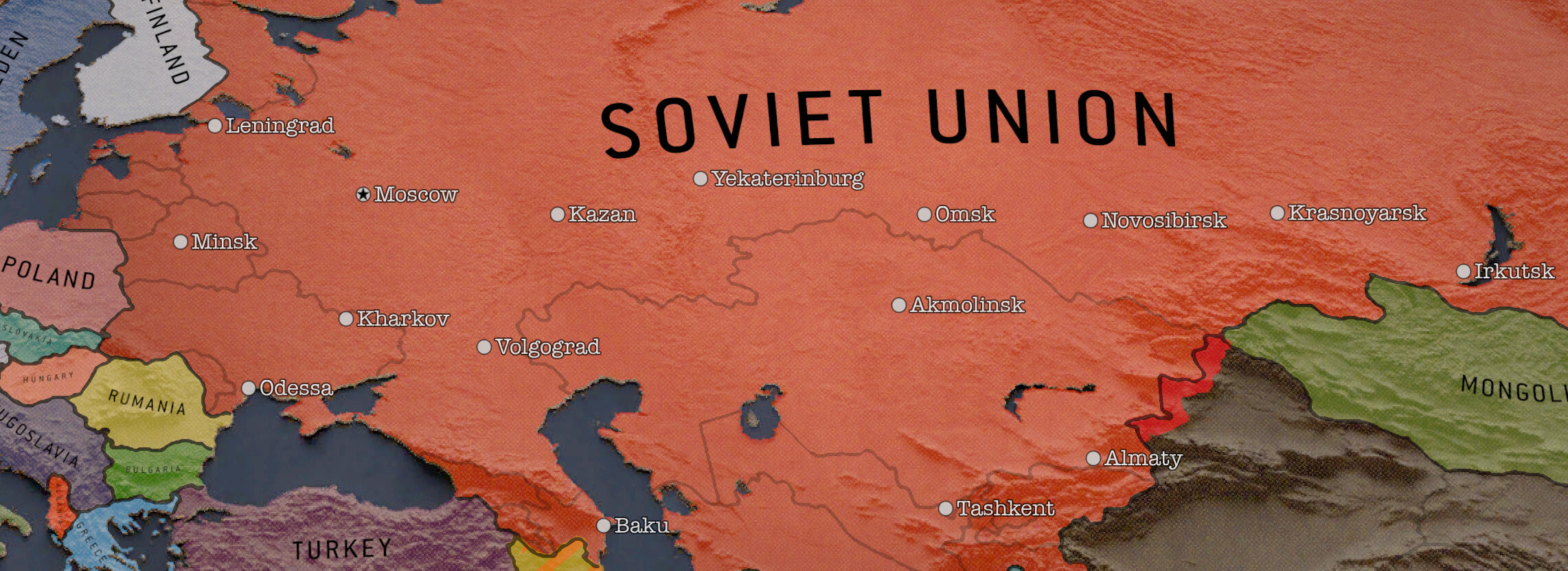
Espiocracy features province-like regions for most important subnational areas in the world: states in the USA, republics in the USSR, countries of the United Kingdom, and potentially separatist areas such as Basque Country. Regions have defined autonomy, regularly decreased or increased, in the latter case even to the point of attempting a separatist political change (eg. a referendum).
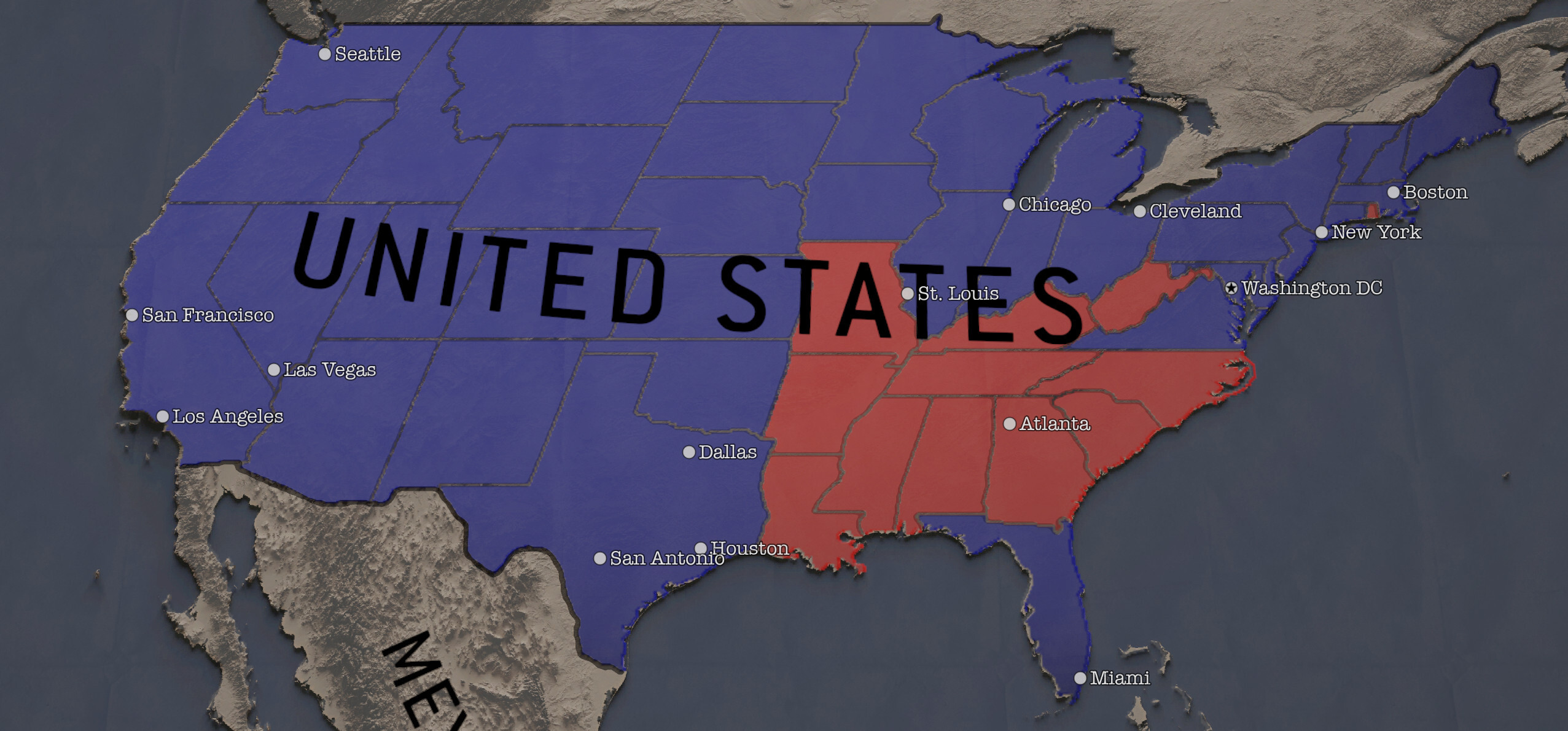
In the case of the USA, states play significant role in the election. The United States begin the game with 48 states (and 48-star flag), with potential to christen Hawaii and Alaska as 49th and 50th state in 1950s.
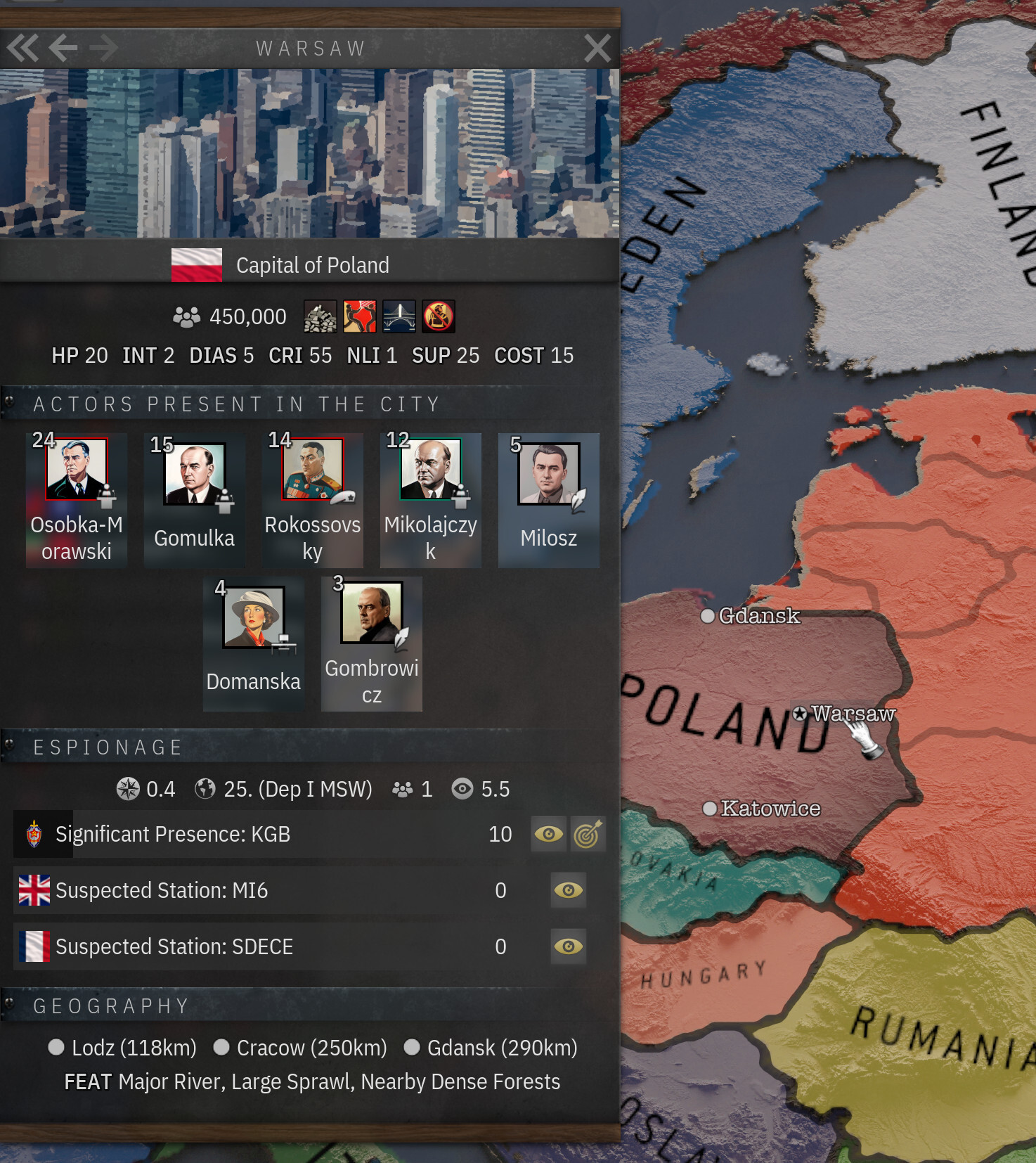
Every country, naturally, has cities. The game currently focuses on major cities - with population exceeding 0.5M (it's a general guideline, broken for countries without such a city or when it's useful for gameplay to feature more cities in particular place).
Cities play important role in Espiocracy. They are the primary battleground for espionage - this is where stations are located, where spies are recruited, where propaganda is distributed, and money laundered. Therefore, players can expect detailed cities: various types, traits, parameters, populations, connections, special requirements, changes in time, and so on.
Current shape of cities, visible above, will be certainly further fleshed out in development before and after the release of the game. In a way, cities for Espiocracy could be compared to planets in space 4X games, with interesting corollaries that follow from this comparison.
Geopolitical Espionage
Last but not least, let's look at two distinct espionage features on the geopolitical landscape of the game.
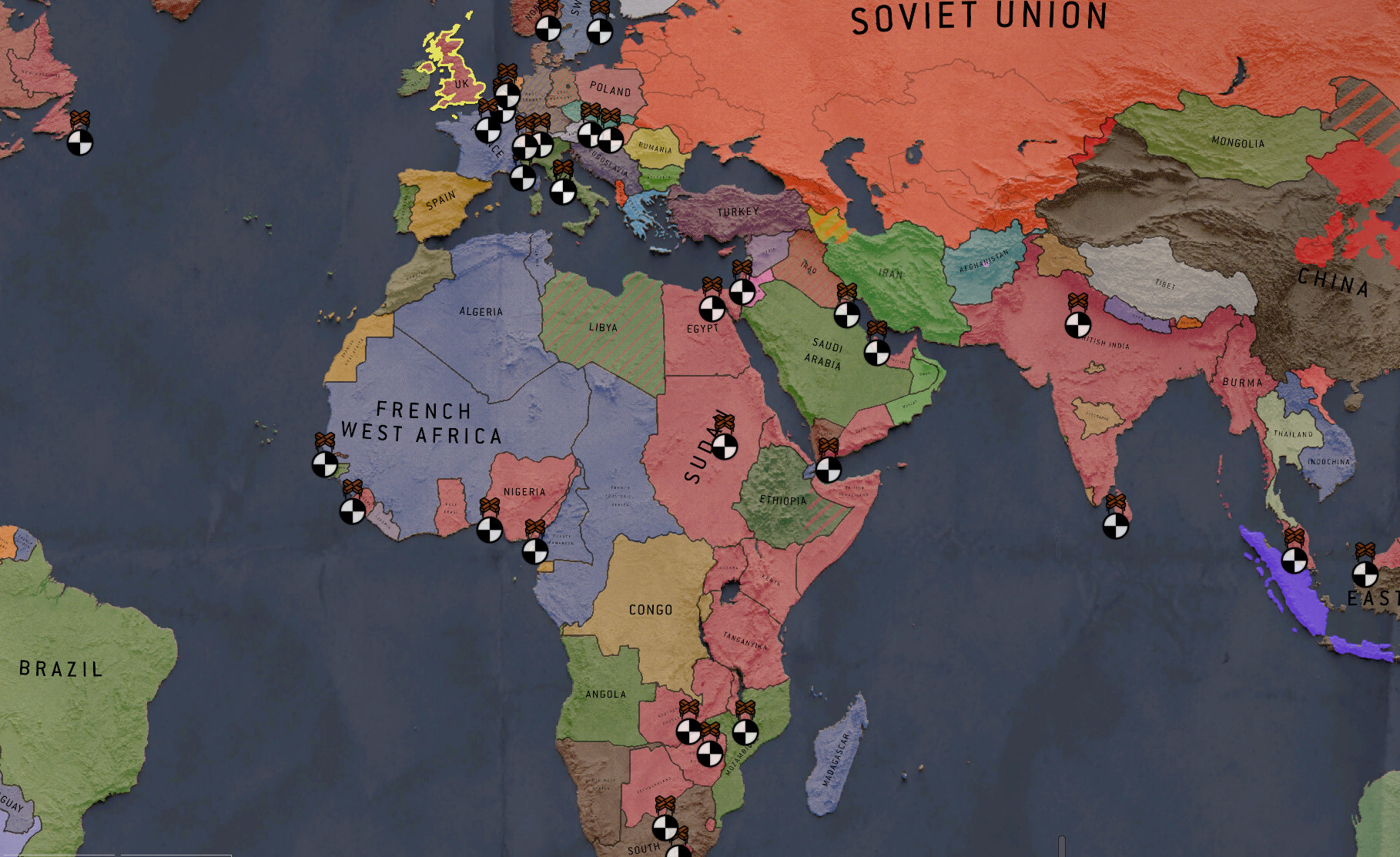
"Centers of gravity" were mentioned before (DD#52). To reiterate and expand, they represent deep connections between countries that transcend distance on the map: empires and their colonies, superpowers and their spheres of influence, long-term alliances, linguistic and cultural connections. The game starts with many of them in place but they are also subject to further changes during gameplay. Players can tap into these connections and, for instance, spy on Nigeria from London instead of flying to Lagos. A few examples below:
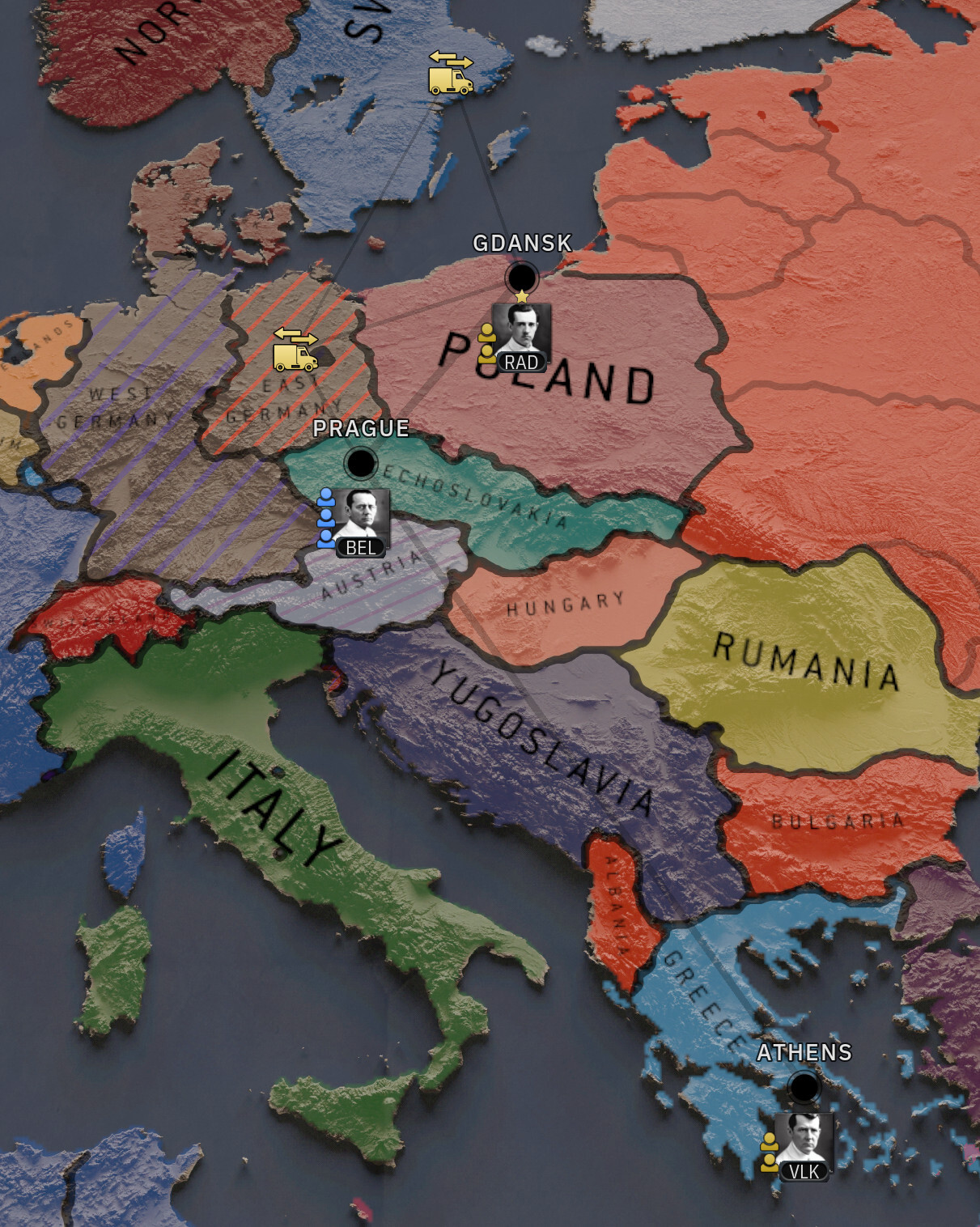
(Black and white circle is a universal symbol of center of gravity. In the game, large circle marks another country as a center for the selected country, while small circle under puppet control bar is displayed over countries for which selected country is a center. Note "a" instead of "the" - a country can have many centers and can be a center for many countries.)
In addition, intelligence structures on the map form now a real network where connections represent intelligence couriers, reliable routes, stable communication between stations and other nodes:
(Work in progress, we'll return to this in the future)
More Geopolitical Features
As with most parts of data & content in the game, geopolitical features are moddable and designed to be easily extended during development. Beyond what was already shown on screenshots above, backlog of future geopolitical features is so rich that it deserves sharing an excerpt. Further future features in works: railroad junctions, entertainment centers, tripoints, artificial islands, modern fortified lines, peninsulas controlling nearby waterways, air corridor to exclaves, oil and gas pipelines...
Final Remarks
The next dev diary will be posted on the first Friday of the next month: May 2nd.
If you're not already wishlisting Espiocracy, consider doing it
There is also a small community around Espiocracy:
--- "OSS Map Division delivered some three thousand maps weighing more than seven hundred pounds" - Douglas Waller about American WW2 intelligence agency
Dev Diary #60 - Nuclear Program
What's happening / TLDR: Developer diaries introduce details of Espiocracy - Cold War strategy game in which you play as an intelligence agency. You can catch up with the most important dev diary (The Vision) and find out more on Steam page.
Welcome to the second nuclear diary of Espiocracy. Once again, to quote the first installment from late 2022, we meet at a very strange time in world history.
DD#30 told the story of nuclear conflicts from a psychological perspective. Today, in DD#60, we'll look at more physical, down-to-earth aspects of the nuclear world in the game.
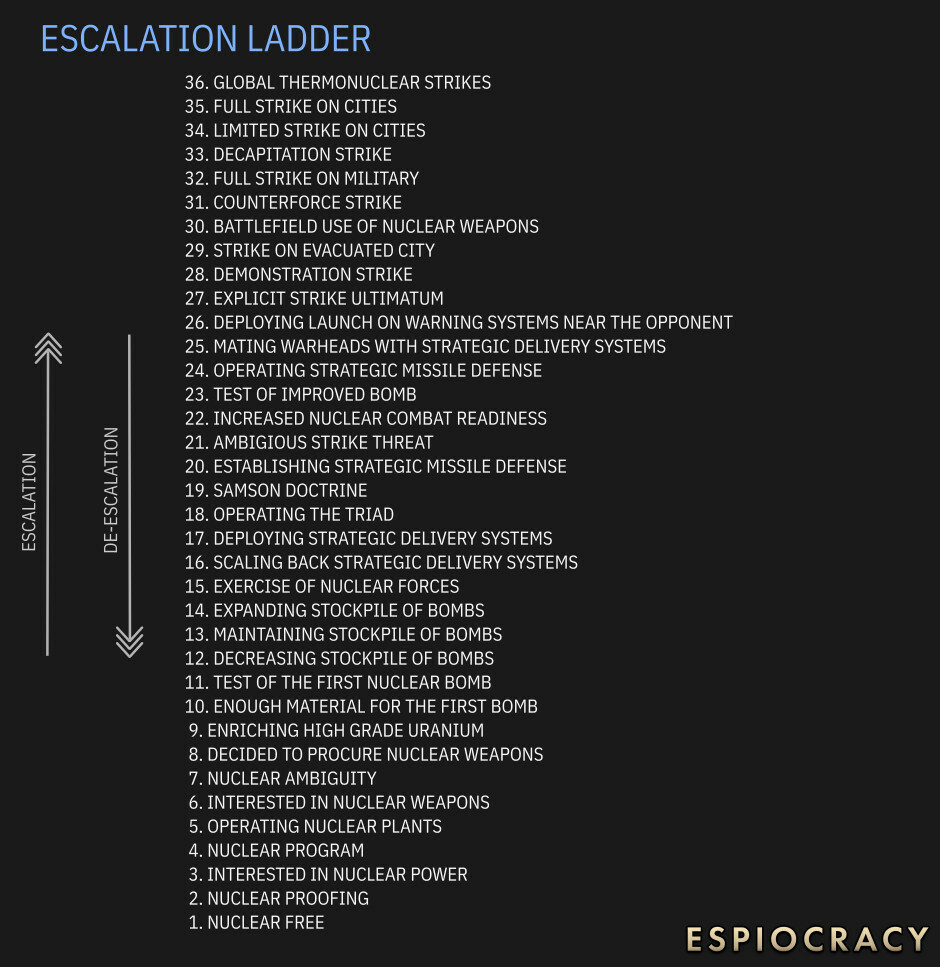
Quick recap of the key term from DD#30, central to everything nuclear in Espiocracy: escalation ladder defines possible nuclear positions for all countries in the game world.
The ladder has slightly evolved since 2022.
Every nation has a public and a real position on the ladder. Anything we do within the nuclear program or with nuclear forces can lead to changes in these positions, that is escalation or de-escalation, which can trigger fundamental reactions globally ("fundamental" meaning even up to the ignition of nuclear war!).
"Anything we do" is not a figure of speech - as the player (an intelligence community), you are fully in charge of your nation's nuclear interests. Let's dive straight into step one.
Pre-Nuclear States
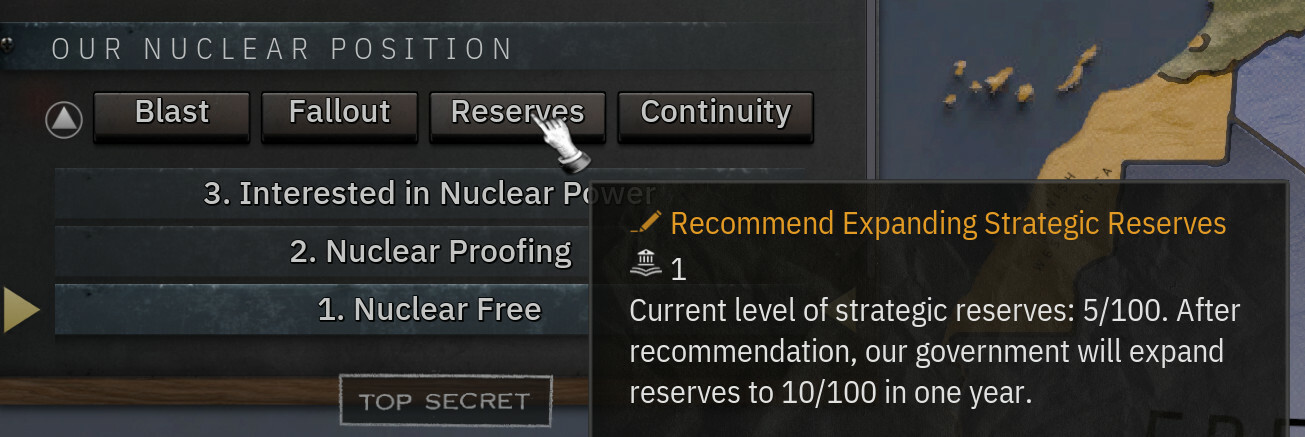
At the most basic level, any country in the game can invest in nuclear proofing: building blast shelters, fallout shelters, stockpiling strategic reserves, and securing government continuity. These structures can partially weather the effects of nuclear war. In some cases, other countries may interpret this buildup as a slight but meaningful escalation - a sign that we have plans known to us but hidden from other actors. This is particularly relevant for superpowers and their allies (historically, intense civil defense programs in the USA during the 1950s instilled fear in the Soviet Politburo, who suspected that the Americans might be preparing a first strike).
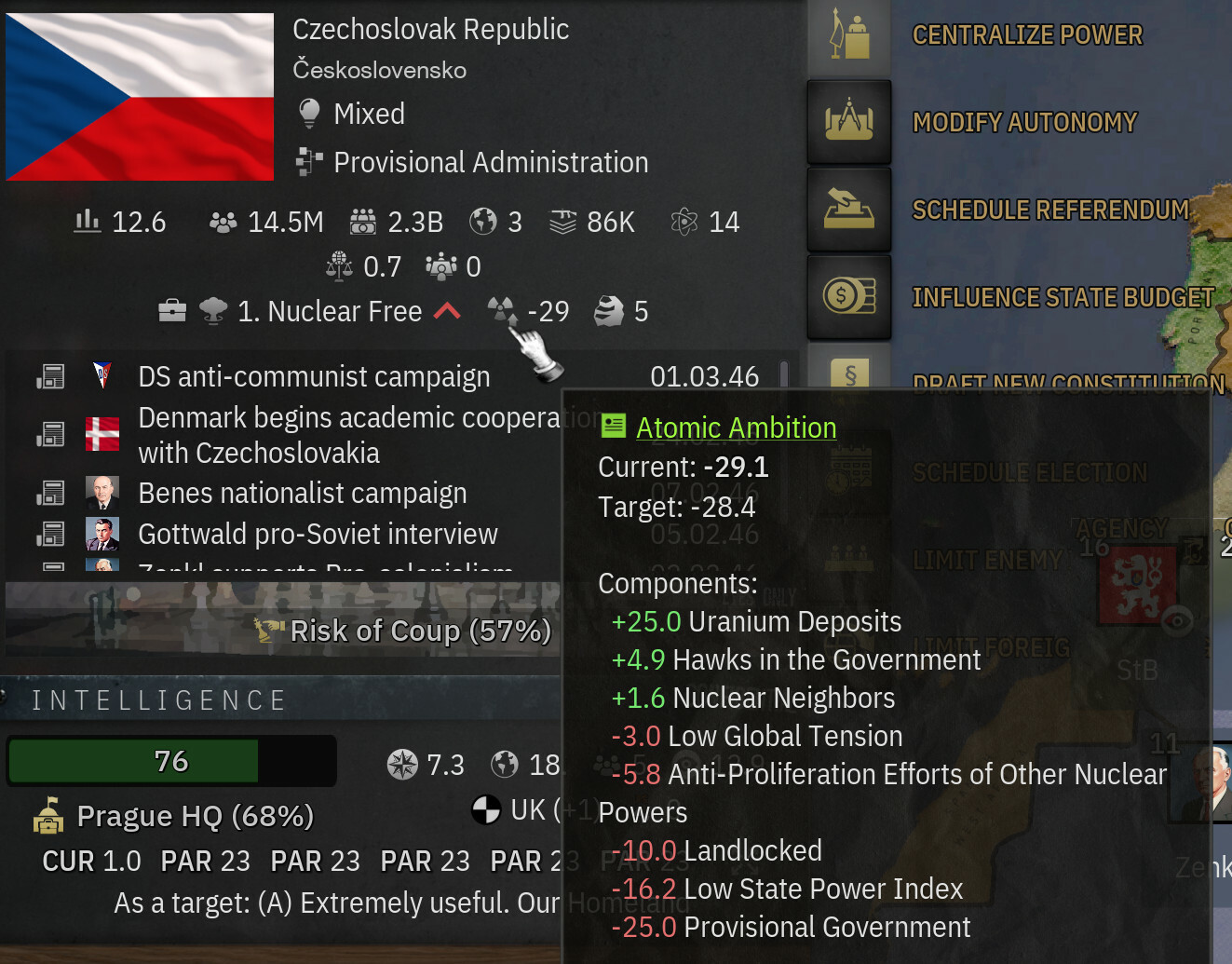
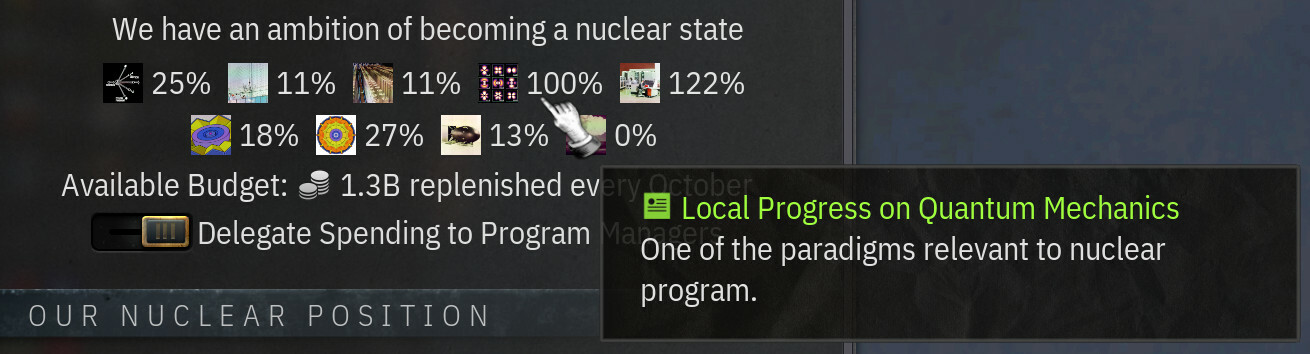
For actual nuclearization, its feasibility in non-nuclear nations is measured by atomic ambition:
Once it reaches 100, the local player can launch the nuclear program.
This parameter is primarily influenced by the State Power Index (DD#16) and can thus be mainly increased by improving the country's general position. Additionally, it can be directly influenced by (relatively slow) propaganda operations, either pro-nuclear or anti-nuclear - for instance, in a typical game campaign, both superpowers will conduct anti-proliferation campaigns to subvert the atomic ambitions of key opposing countries.
Atomic ambition, along with nuclear position and eventual nuclear programs, is also a diplomatic playfield. Countries with sufficiently high atomic ambition can engage in diplomatic cooperation or conflicts over nuclear proliferation. These enable international actions such as supporting or subverting ambitions, constructing nuclear plants, imposing nuclear sanctions, and even declaring a nuclear casus belli. On a wider scale, usually facilitated by the UN, governments worldwide may agree to international treaties banning atmospheric nuclear tests, prohibiting nuclear weapons in space, and curtailing proliferation (which then establishes the International Atomic Energy Agency as a global actor and reduces atomic ambition of all the remaining non-nuclear states).
The final stretch toward 100 can be achieved by convincing the government to declare interest in nuclear power. Such a decision, however, also increases the ambition of neighboring countries (eg. the nuclear race between Brazil and Argentina in the late 1970s), is perceived as significant escalation (intended essentially to hasten the launch of a nuclear program), can lead to diplomatic discord, and might even contribute to military conflict.
Going Nuclear
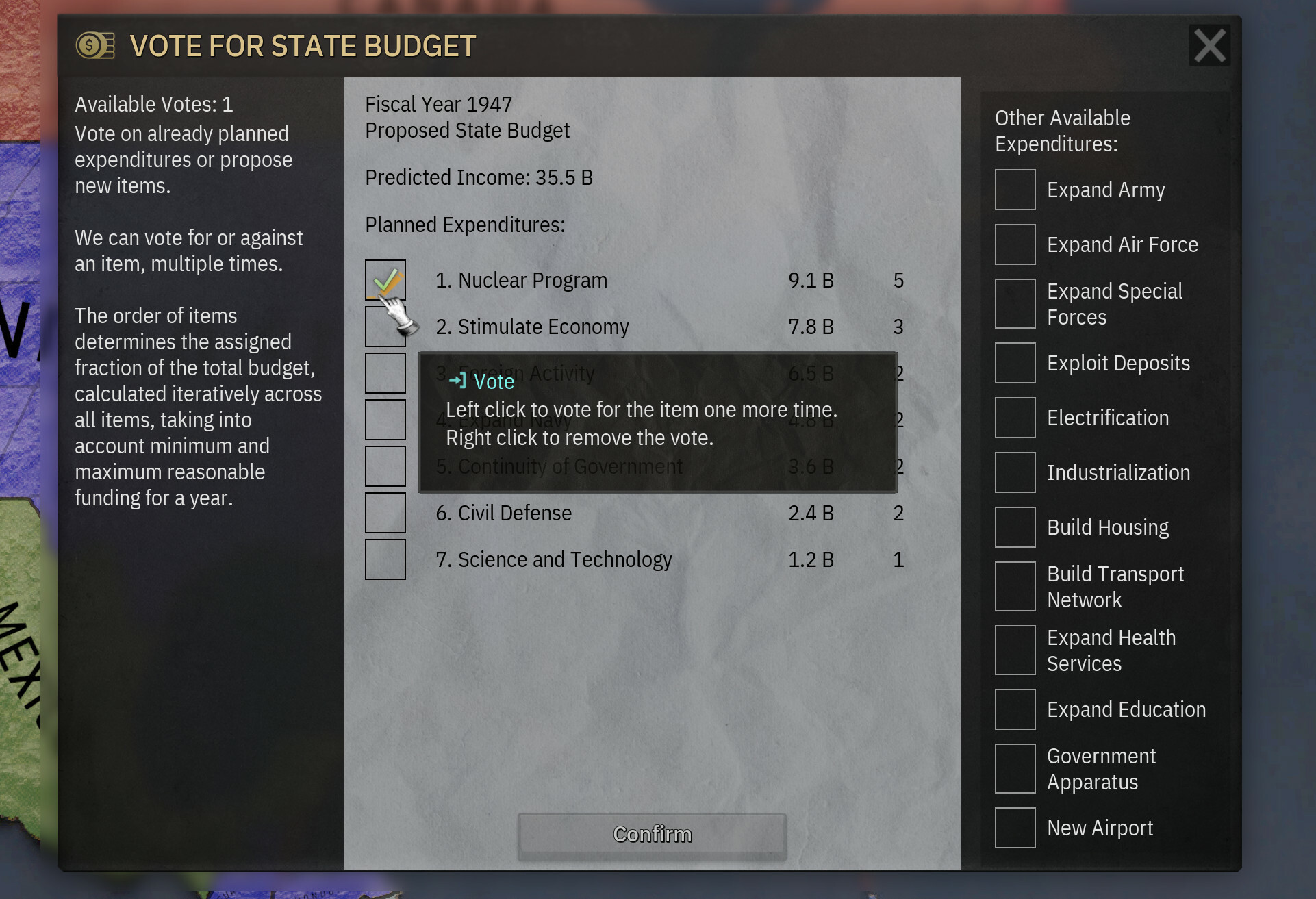
A nuclear program begins with a budget, initially assigned ad hoc (proportional to the entire government budget and to the month of fiscal year), and then using the same framework as other national expenditures.
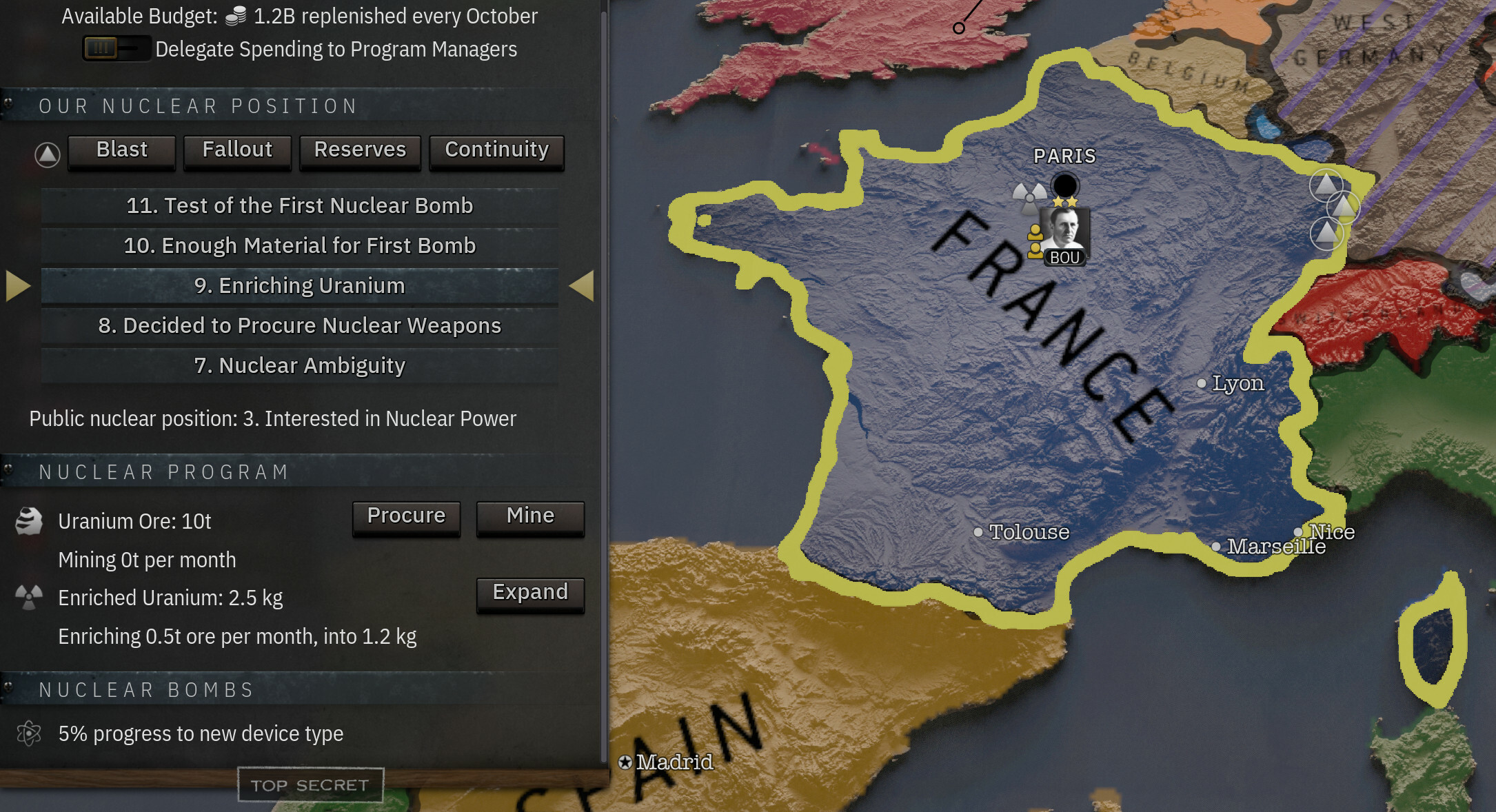
The player fully controls this budget, allocating it to monthly progress and discrete actions: procuring uranium ore, exploiting uranium deposits, building nuclear power reactors, and establishing enrichment facilities.
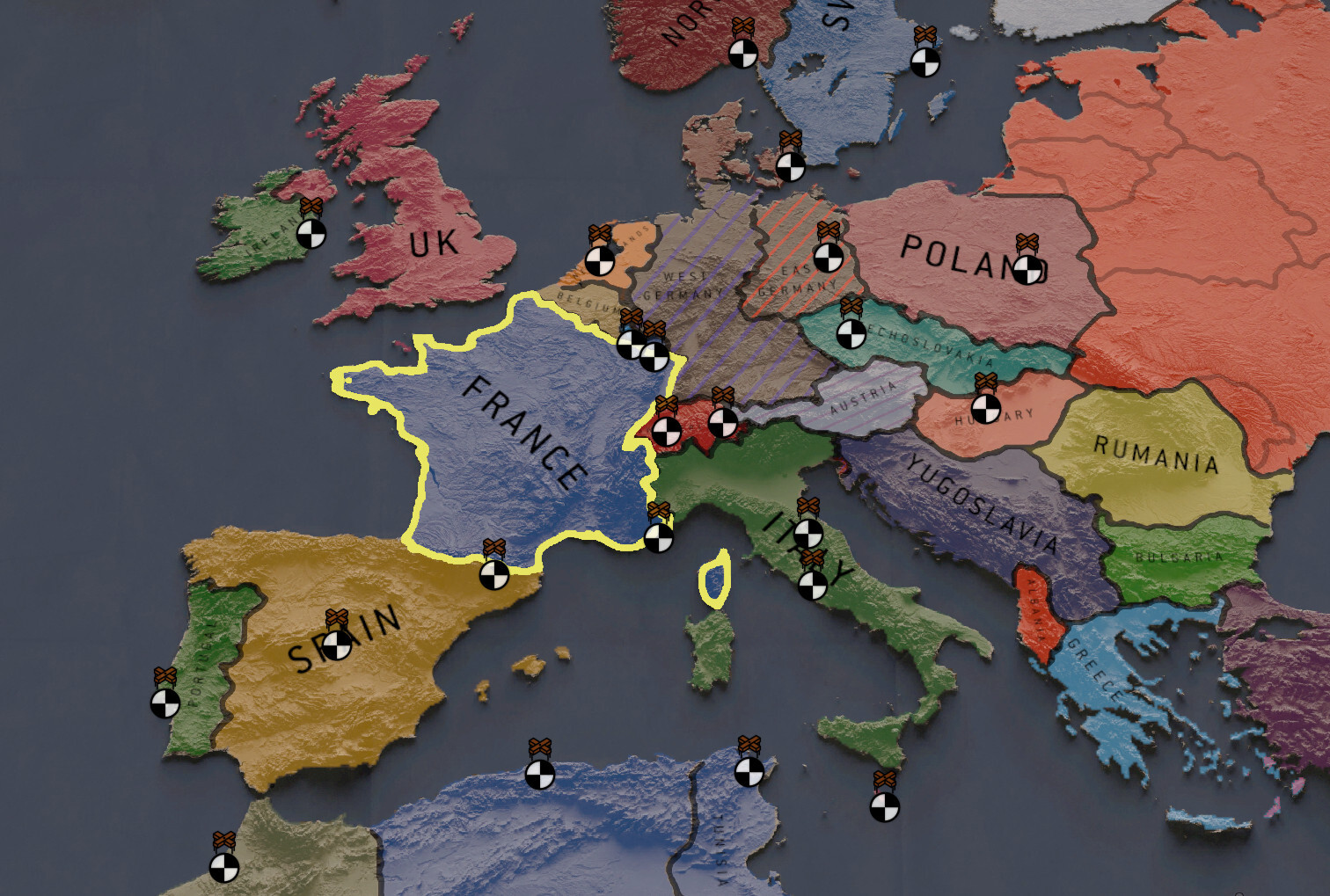
Work in progress. Program management is highly contextual. For instance, nuclear power options are absent above since it's 1946. Note the icons in the Maginot Line which was partially repurposed by the French player for nuclear civil defense.
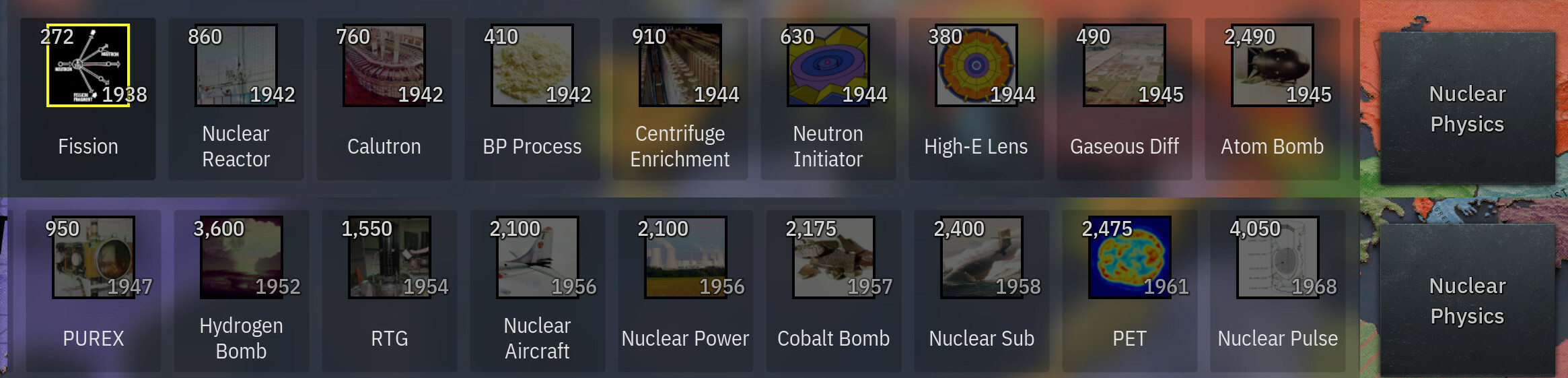
Progress within the nuclear program relies on science and technology pursued through various mechanics (DD#20: governmental contracts, scitech actors, reverse engineering, big science projects, technology transfer, scitech espionage). Five primary paradigms influence nuclear programs: nuclear fission, nuclear reactors, centrifuge enrichment, quantum mechanics, and digital computers - plus four paradigms specific to nuclear weapons: neutron initiators, high-explosive lenses, atomic bombs, and hydrogen bombs.
These paradigms enable relevant actions and define the efficiency of nuclear efforts. Additionally, there are optional/specialized scientific and technological paradigms within nuclear physics.
Once humanity achieves viable nuclear power plant technology (a paradigm shift), nuclear programs can be directed exclusively or additionally toward peaceful electrification. However, during the early Cold War or by explicit player choice, nuclear programs can aim for weaponization through the concert of scientific and technological progress, securing uranium (including special operations like Mossad's Plumbat), and enriching enough high-grade fissile material.
Nuclear Weapons
Developing the first nuclear bomb is non-trivial - especially during the early Cold War without extensive test knowledge, nuclear physics experience, and advanced computing - but the main historical obstacle is producing enough enriched fissile material, which may require years of costly facility operations. Once sufficient material is available (currently the game assumes 30 kg of highly enriched uranium), the first nuclear detonation of a test device can be prepared.
Preparation includes selecting a test site and ensuring its secrecy. This is straightforward for large countries (eg. China or Russia) or colonial empires (eg. French nuclear tests in Algeria), but can be more challenging for smaller nations. They may rely on international cooperation (eg. alleged Israeli test near South African territories, Vela incident) or build costly underground facilities (eg. late nuclear states such as North Korea).
No test remains perfectly clandestine. Even secluded tests within police states were detectable in the early Cold War by air sampling aircraft (as with Joe-1/RDS-1). Players can initiate nuclear detection programs (intelligence programs, DD#41) to acquire real and useful data on foreign tests.
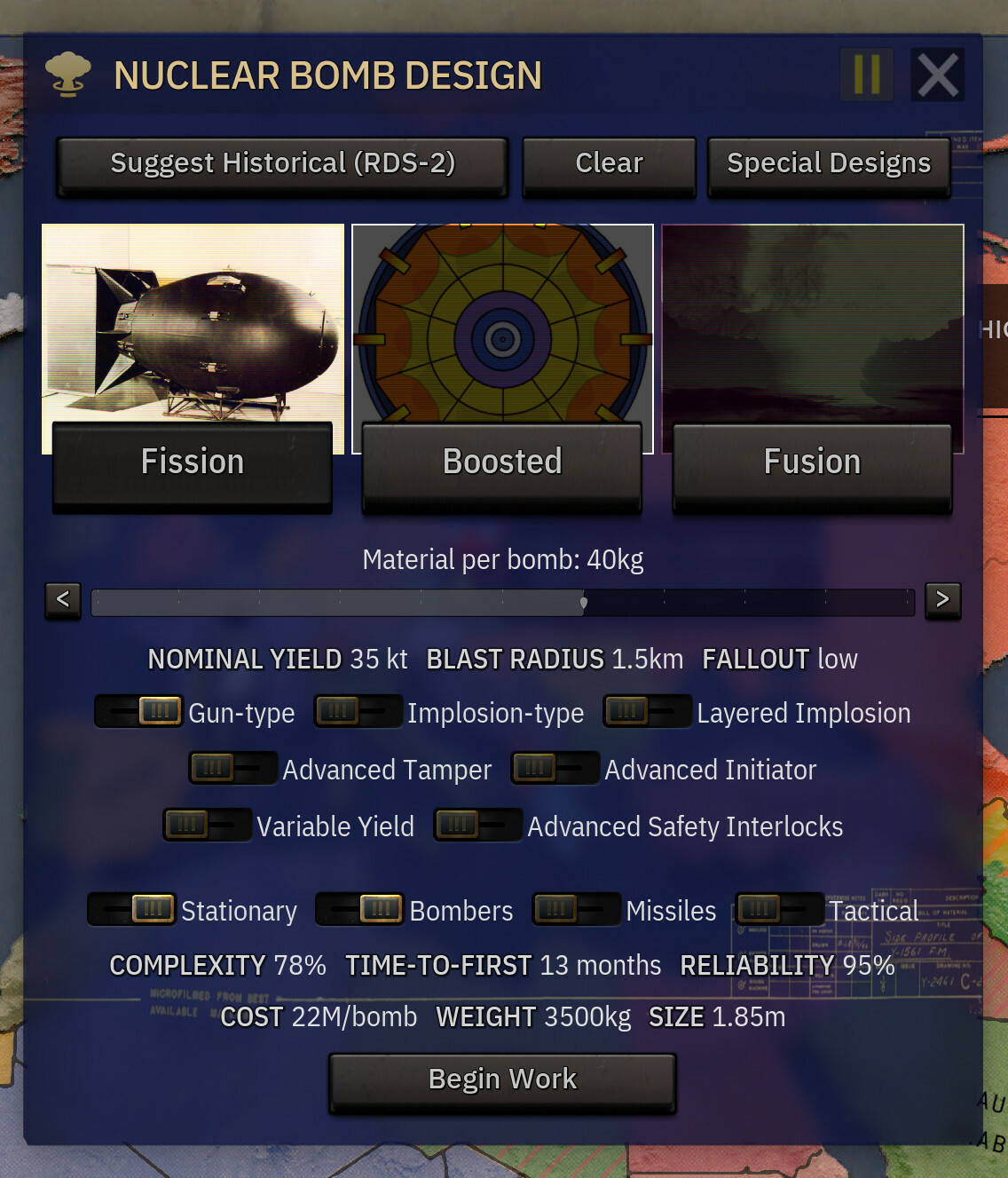
After the first successful detonation (not guaranteed, as devices can fizzle), the nuclear program advances to the next phase: developing nuclear forces. Players can establish production lines for cyclically design improved nuclear device types (or use historical templates), balancing tactical and strategic trade-offs, fissile material usage, yield, weight, and delivery feasibility.
Early work in progress
Delivery
Nuclear forces require not only warheads but also delivery methods:
Bombers - default delivery method during the Cold War, medium or strategic range, superseded by missiles in late-game
Missiles - medium-range/intercontinental, ballistic/cruise, stationary (silos)/transportable (TEL)/submarine-based, single warhead/MIRVed
Stationary - doomsday devices (eg. cobalt bombs), atomic bomb ships (a surprisingly common fear of the early 1950s, Eastern bloc ships were inspected for atom bombs before docking to American ports), mines (eg. in the Fulda Gap).
Much like bombs, these delivery methods rely on specific scitech paradigms, consume nuclear budget, and affect nuclear ladder positions. Paradoxically, intelligence assessments of their existence, quantity, and deployment are more challenging than with nuclear weapons themselves, leading to historical misjudgments like the bomber or missile gaps. We'll explore these topics in greater depth in future nuclear diaries.
Final Remarks
The next dev diary will be posted on the first Friday of the next month: April 4th.
If you're not already wishlisting Espiocracy, consider doing it
There is also a small community around Espiocracy:
--- "In March 1950, an official from the Atomic Energy Commission — then the guardian of US nuclear secrets — oversaw the burning of thousands of copies of the magazine Scientific American. The contention? They contained information so secret that its publication could jeopardize the free world" - Alex Wellerstein
Dev Diary #59 - Terrorism
What's happening / TLDR: Developer diaries introduce details of Espiocracy - Cold War strategy game in which you play as an intelligence agency. You can catch up with the most important dev diary (The Vision) and find out more on Steam page.
(Disclaimer: Naturally, the topic, and therefore this diary, is controversial. Do note that it's all about a game, not the real world. Interpret every sentence as if it ended with "in the game". Minor second disclaimer: Since this is a game and not a historical treatise, events that happened "arguably" and "allegedly" are good enough to inspire a part of game world.)
There are more than 250 academic definitions of terrorism (according to Wikipedia). Espiocracy, rather than inventing the 251st or choosing one in particular, tries to capture this variety and uncertainty in its quest to fit the complexities of real world onto your screen.
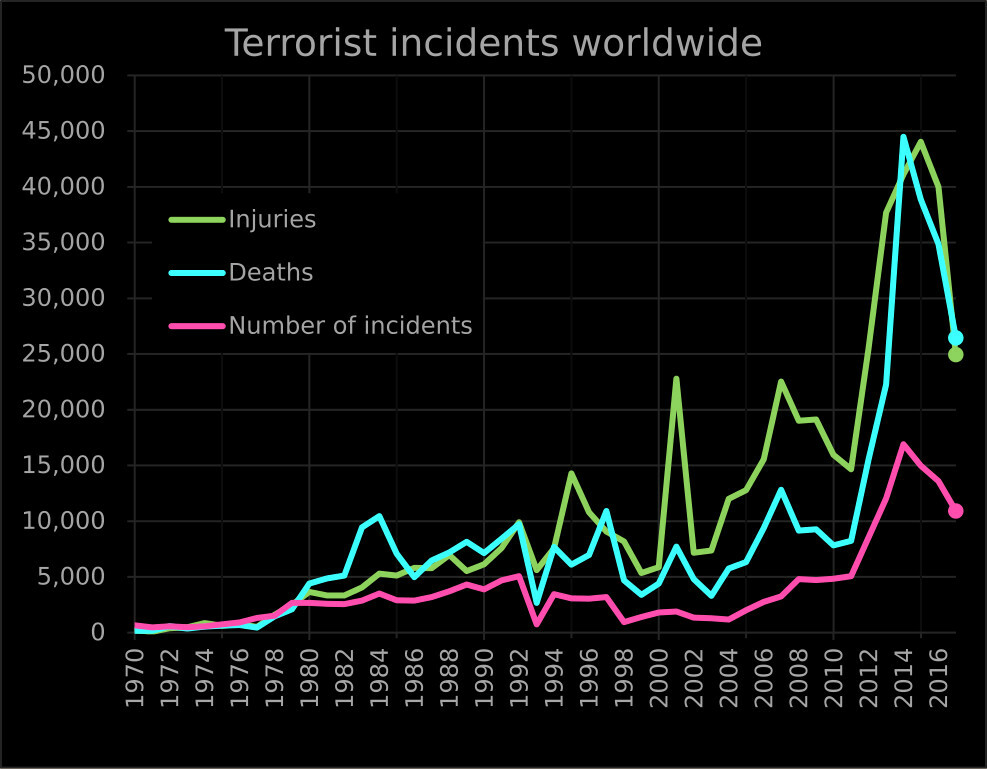
The boundary between "savage terrorists and freedom fighters" fluctuates, nations and intelligence agencies become both state sponsors of terrorism and counterterrorist combatants, and terrorist methods significantly evolve over time. After decades of such evolution, terrorists in the game world usually converge on highly organized, suicidal, serial campaigns that pose...
(Chart by Phoenix7777)
...the late-game challenge, to which players can respond by launching the war on terror - and gain a second (post-Cold-War) life for their intelligence agencies.
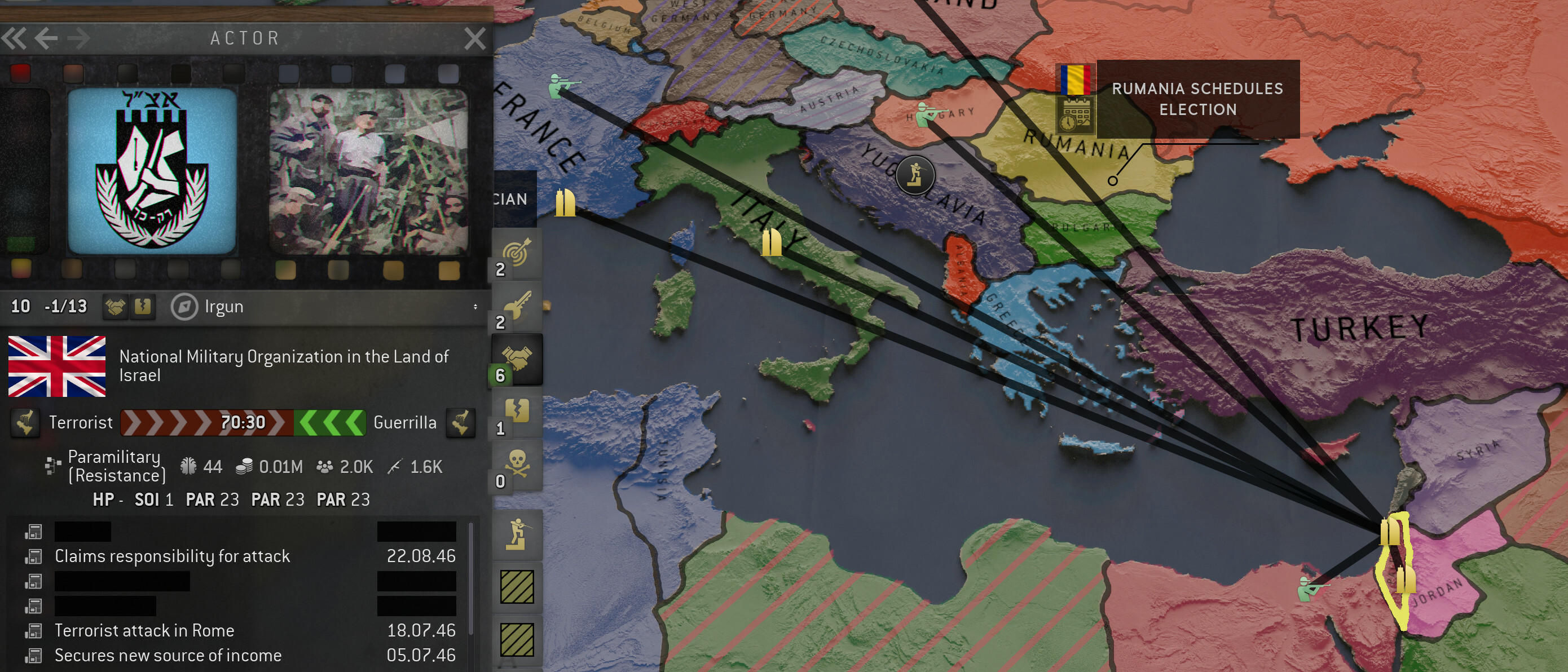
However, far from being limited to the 21st century, terrorism is present and relevant for the entire period of the gameplay. Even the first year in Espiocracy, 1946, has historically seen a series of bombings - as Irgun bombed British targets in Rome and Jerusalem - that usually happen also in the game. In fact, terrorists start to plot their attacks even before the player unpauses for the first time. Why do they begin their plots? What makes one pursue terrorism? How does terrorism arise in the game?
Motivation
Actors pursue - or create other entities to pursue - terrorist methods in association with severe religious conflicts, some ideological conflicts, and/or extreme views. These are enablers of terrorism, which on their own do not lead to terrorism. The final motivational spark comes from the inherently political (and rather desperate) desire to influence decisions of opponents, their supporters, and relevant population groups.
A common example of such internal logic in the game is an attempt to instigate casualties so shocking and hopeless that the event leads the opponent to cut losses and to back away. Even the very first example mentioned in this diary, Irgun, partially (arguably) achieved this goal and caused the British to leave Mandatory Palestine faster than they planned.
Terrorists may aim to influence decisions also in more subtle ways. The intended result may be mental departure (for instance giving up on pro-X activities), causing outrage back home (which then pressures the opponent not necessarily in decision-making process but for instance by contributing to their loss in the next election), polarizing factions and groups, turning world's attention towards relevant cause, or simply wasting resources of opponents who now have to retaliate, increase security, and chase down involved individuals.
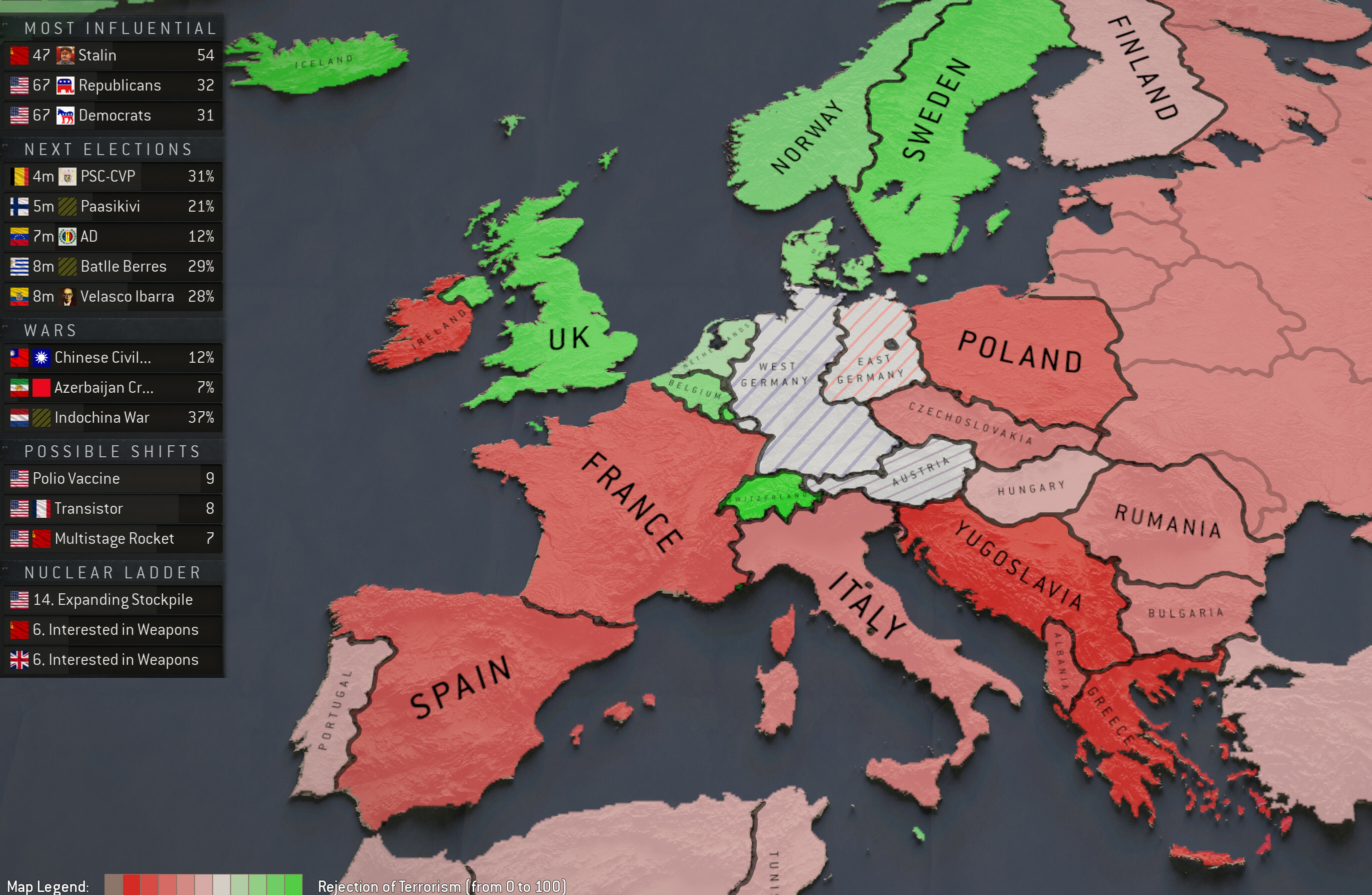
On the opposite side of the motivational spectrum, there are significant inhibitors that stop most entities from ever using terrorist methods. Some entities in the game unconditionally reject terrorism, most notably Vatican and associated actors. For others, there are grades of rejection among local populations:
This parameter influences the difficulty of pursuing terrorist methods, how much of a taboo (a secret, DD#23) it would be for an actor to become a terrorist, and how outraged the population will be after a terrorist attack. Its value evolves over time, affected by local situation, events, views, and propaganda. Standard examples of such changes in most campaigns are radicalization under occupation (eg. Afghan mujahideen) and deradicalization during prosperity (eg. Ireland in 21st century).
Terrorist Plots
Once the decision to launch an attack has been made, the plot begins. Perpetrators prepare an attack in stages:
Gathering funding
Planning
Recruitment
Training
Positioning
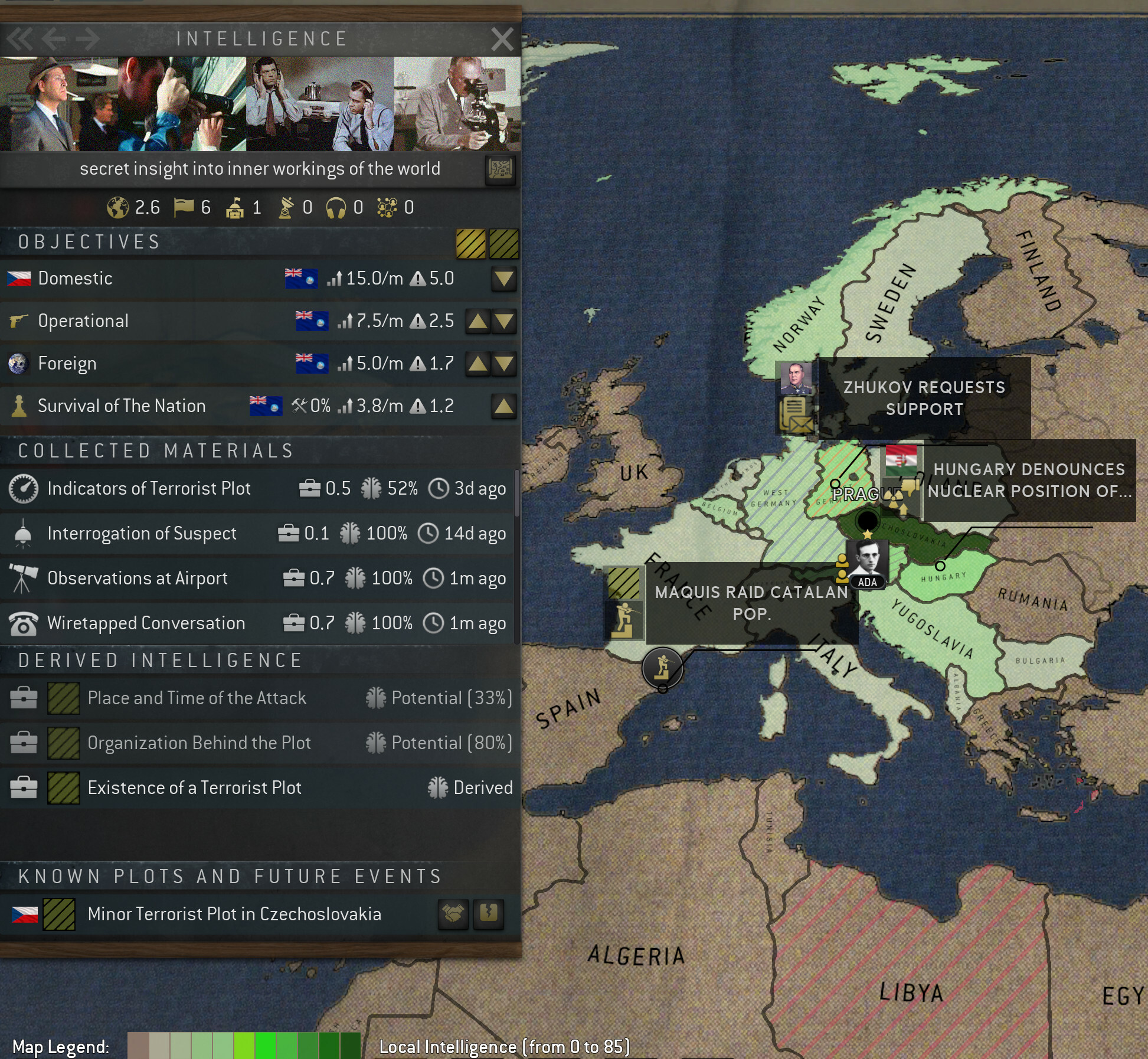
Every stage is executed in the game world, often internationally (for instance: recruiting volunteers from other countries), and leaves numerous intelligence traces that can be discovered by intelligence agencies.
The quality and number of such traces depend on the perpetrators' countercounterintelligence efforts, which include isolated cells, intelligence tradecraft, redundant plans, coordination, saturation, and in some cases even direct countercounter protection by another intelligence agency.
The plot is essentially a race between the executing organization and intelligence agencies determined to disrupt it. An intercepting player - usually local to the location of the planned attack - struggles to gather just enough intelligence to dismantle the plot before it concludes, all without knowing exactly when that conclusion will occur. Often, this means following the classic advice of Robert Watson-Watt: "Give them the third-best to go on with; the second-best comes too late; the best never comes."
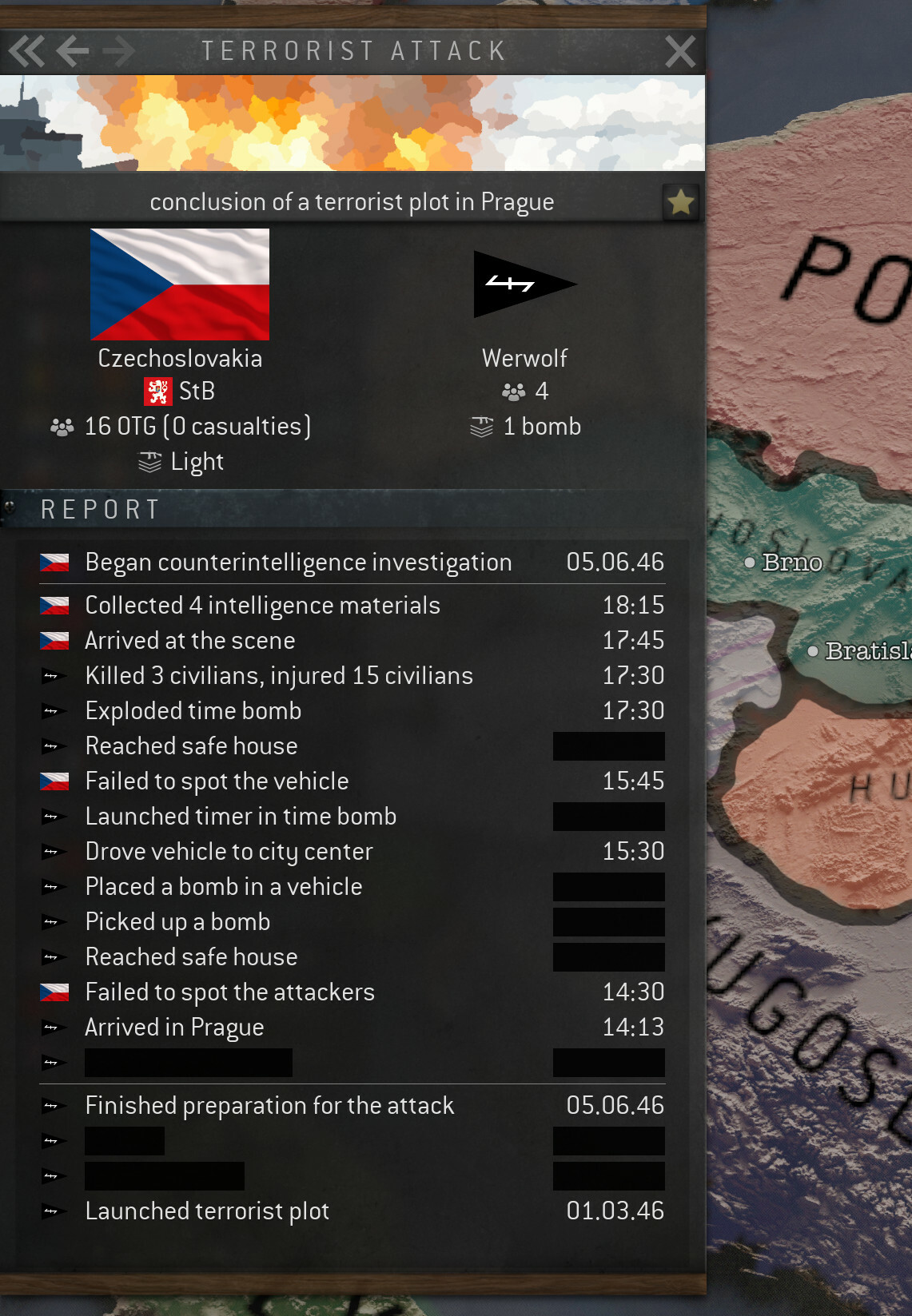
Conclusion of the plot, the day of a terrorist attack, is simulated step by step. Simulation defines plot's success, the extent, collateral damage, escape of perpetrators (if attempted), and the evidence left on the scene. In later decades, it also includes the reaction of counterterrorist units.
Initially, an attack is often anonymous (with obvious exceptions, eg. kidnappers reveal their affiliation). It sparks outrage among actors, alters views of affected population groups (including introduction/increase of fear, after which terrorism bears the name), and changes the calculus for local intelligence agency (lowers trust after the failure to prevent the attack, and increases the need to mobilize against future attacks).
Next, authors of the attack may claim the responsibility and/or local player may blame an entity. The former depends on methods, goals, and results of the attack (for instance, IRA won't claim attacks that collaterally killed catholics). The latter is a useful tool in hands of an intelligence agency - though false accusations may be quickly exposed by the perpetrators and sometimes even by other intelligence agencies that have been following the plot.
Either way, connecting the attack and the attacker opens a new set of reactions: directed outrage, anti-attacker views, retaliations, counterterrorist campaigns. At the same time, however, this also may influence decision-making processes in the way that terrorists originally aimed for (eg. Mumbai attacks, where attribution to Pakistani-based Lashkar-e-Taiba halted the recovery of Pakistani-Indian diplomacy and increased anti-Pakistan views).
Consequences may be more complex than any side imagined. A terrorist attack is a match that can ignite various fires: launch or contribute to a wave of local terror (eg. years of lead in Italy), cause opposite reactions instead of one that was intended by terrorists (eg. the opponent launches an invasion instead of backing down), change popular views in unusual ways (eg. after Red Army Faction attacks, the public became more sceptical towards counterculture), or even inspire opposite terrorist attacks (eg. IRA and UVF).
Evolution of Terrorism
Terrorist methods evolve over time:
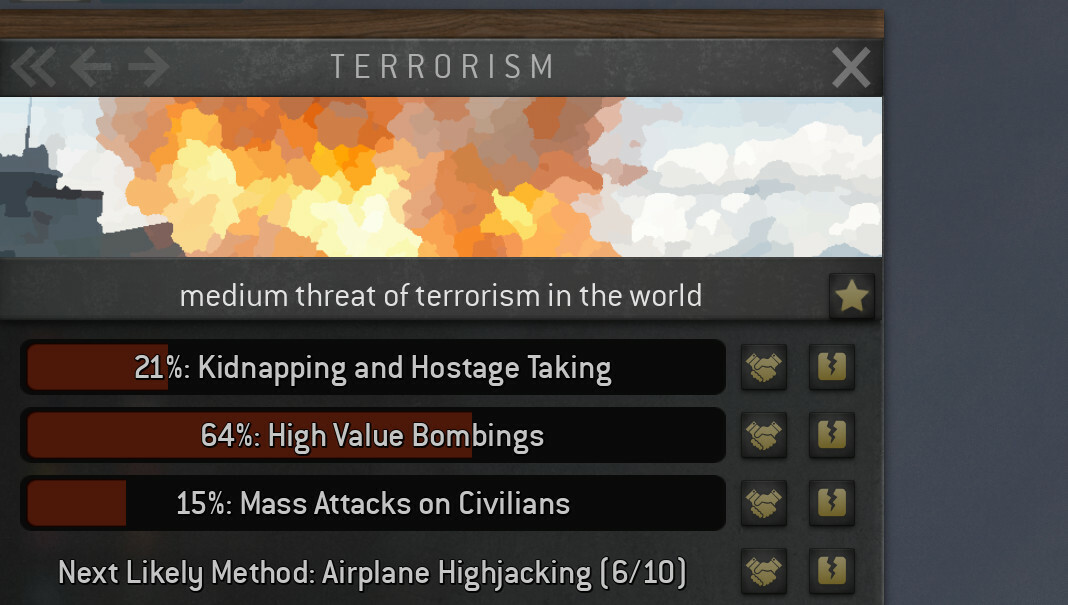
Methods fluctuate roughly along historical lines. In addition, their global prevalence may be partially influenced by intelligence agencies - usually subverting them, for instance, by pushing for stricter airport security (although support for particular methods is also possible, as the history of Iranian intelligence services suggests).
As mentioned in the introduction, methods typically combine into the most dangerous set by the end of the 20th century, capable of changing the course of superpower history (for example, September 11th: hijacking airplanes + suicide attacks + highly coordinated attacks + mass attacks on civilians), with the potential to overwhelm any intelligence agency (eg. ISIS plotted 8 attacks in France in 2015, of which local services managed to stop 6).
This, as is usually the case in the intelligence world, is not only a huge danger but also a huge opportunity. Nations suffering from the most severe, complex attacks can launch the war on terror - a special international decision (a policy, DD#51) that grants intelligence agencies much larger funds, enables projects such as a drone assassination program, and leads to advanced deployments near the perpetrators (all the way to establishing a casus belli and a full invasion).
Shades of Gray
Paramilitary organizations that use terrorist methods - as the Irgun screenshot above suggests - can be perceived globally on a spectrum ranging from "terrorists" to "guerrillas". Their position is affected by their own actions, by players controlling the narrative (through propaganda, DD#56), and by operations that directly frame the target as belonging to one side or the other. This perception, naturally, influences local population support, the ease of operations, and how severely the organization is hunted worldwide.
To make matters even more ambiguous, not all terrorist attacks are real terrorist attacks. Intelligence agencies can carry out false flag operations, in which an event is manufactured (even if real casualties occur) and then used to pin the blame on a chosen target. Obviously, such operations are prone to backfiring and require highly skilled officers, but the CIA in the game can usually execute an equivalent of Operation Northwoods (false flag attacks that would have been pinned on Cubans, as historically proposed in 1962).
Staying in the realm of direct player involvement, intelligence agencies can become state sponsors, control, or even establish paramilitary organizations. Attacks can be fueled with all the tools of espionage - especially smuggling and financial networks. Depending on the local rejection of terrorism as well as the local political system (eg. authoritarian vs. democratic), this may be a tool that is either rejected or encouraged (for example, agencies of communist satellite states commonly supported terrorist organizations around the world). However, for most players in the world, it will remain a grave secret, and working against terrorists is usually much more profitable (for instance, some of the aforementioned communist agencies immediately turned against terrorists after the fall of the USSR).
Last but not least, the player can also find themselves on the receiving end of terrorism. High-profile agencies can be directly targeted by terrorist attacks, with embassies and officers taken hostage, bombings affecting agents in the field, kidnappings of station chiefs, and even attacks on headquarters (eg. the 1993 attack in Langley).
Final Remarks
The next dev diary will be posted on the first Friday of the next month: March 7th.
---
If you're not already wishlisting Espiocracy, consider doing it
There is also a small community around Espiocracy:
--- "International Counter-Terrorism: 64%, Northern Ireland-related terrorism: 18%" - Top two budget items of MI5 in 2016
Teaser: Christmas Special
What's happening / TLDR: This is a small developer diary, a teaser, about Espiocracy - Cold War strategy game in which you play as an intelligence agency. You can catch up with the most important dev diary (The Vision) and find out more on Steam page.
Short intro: after 58 developer diaries (longer than an average book!), standard format of mechanics-describing posts got a little bit stale. We already started experimenting with other approaches such as AARs. Today, on Christmas Eve, we'll try another approach: a teaser - quick look into gameplay through a few never-seen-before detailed screenshots, nothing more, nothing less. In a way, it's a polar opposite of thousand-word dev diaries with almost no visuals. Do not be deceived by the shortness of the diary, however, as screenshots tell the story and reveal new details about the game and its gameplay.
Merry Christmas! The next dev diary will be posted after winter break, on February 7th!
Dev Diary #58 - Management
What's happening / TLDR: Developer diaries introduce details of Espiocracy - Cold War strategy game in which you play as an intelligence agency. You can catch up with the most important dev diary (The Vision) and find out more on Steam page.
Between two parts of Vietnam after-action-report, we'll make a small detour. As I reviewed the previous diary and prepared the next part, I realized that we mostly skipped management and expansion - which influences significant parts of the hot civil war in Vietnam. Additionally, as Espiocracy's core management & expansion substantially evolved during development (and even since the last dev diary), it will be useful to explore its current shape before continuing the campaign. This dev diary could be named "Agencies 4.0" but, as always, it's not a new version with patch notes, just a full independent diary. Welcome and enjoy!
In the intimidating world of espionage and the Cold War - which the game tries to recreate in the full possible complexity - the main tool is simple: you can order units to conduct activities around the world.
Usually, these orders establish (build) intelligence structures, such as:
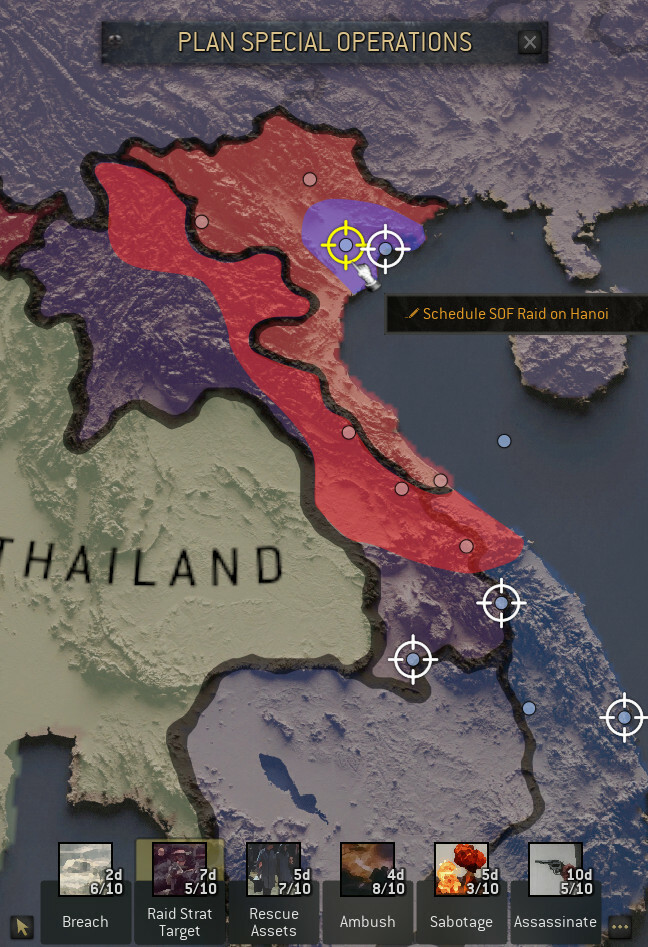
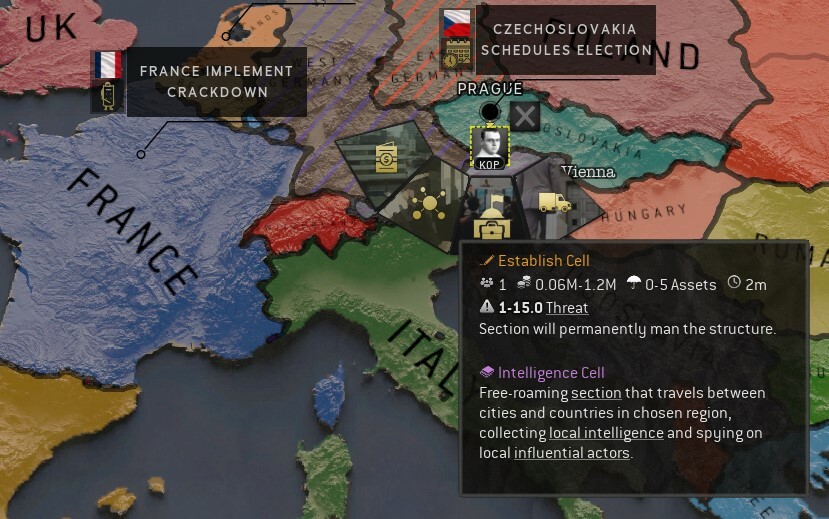
Cells (visible in the example above) - which can for instance roam a warzone to collect military intelligence
Stations - which organize and conduct a full suite of espionage activities in their range
Nodes of smuggling, propaganda, financial networks - which are used in all kinds of operations and activities
Special structures - black sites, radars, export companies, stay-behinds, illegals, and so on
This is where it gets more complex: orders depend on player's units, intelligence community, resources, and local environment (including counterintelligence efforts of other players).
Officers
Officers in the game are now organized into three kinds of units:
Elite Officer - a single officer with relatively high skills
Section - a group of usually 8 officers divided into analysis, operations, and technical roles
Branch - a few dozen or more officers, encompassing a wider range of roles and experts
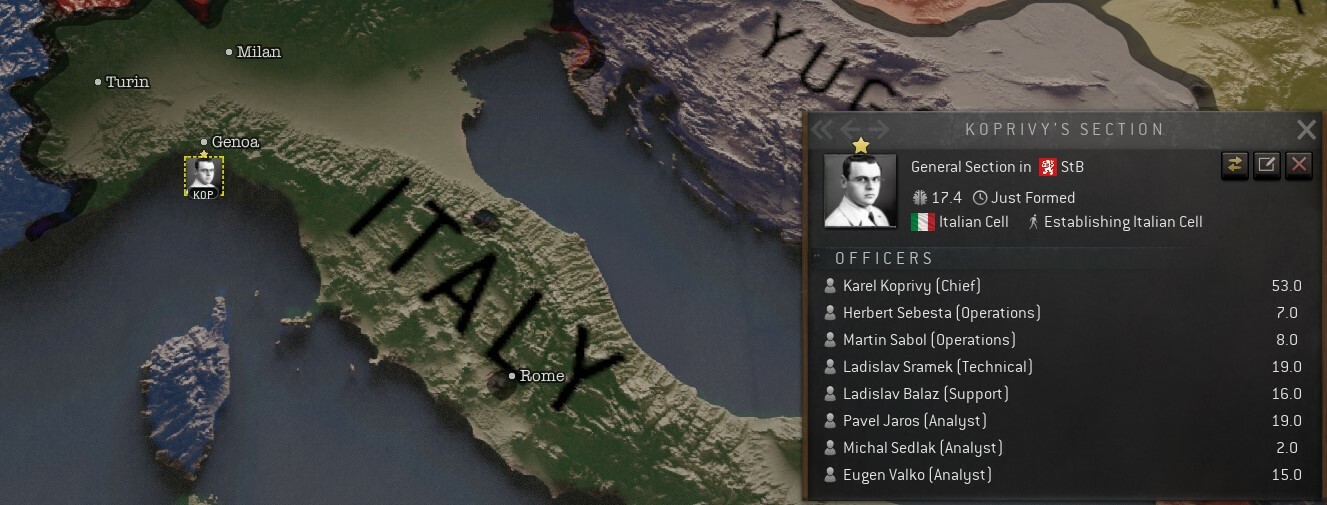
The main intuitive difference is the size. In principle, any unit can be downscaled or enlarged. Then, the size influences how it can implement orders, with a plethora of associated trade-offs. On the most basic level, a cell can be formed only by smaller units (an elite officer or a section), while a station can be manned only by larger units (a section or a branch). Differences compound in more advanced orders. For instance, an elite officer can execute an assassination but cannot handle a large propaganda campaign - while a branch can be active in the entire continent but spies from this continent will have a much easier time penetrating it. Sections, the middle universal ground, can implement most tasks with average efficiency but they are most valuable when specialized - into special, counterterrorist, paramilitary, and other kinds of forces.
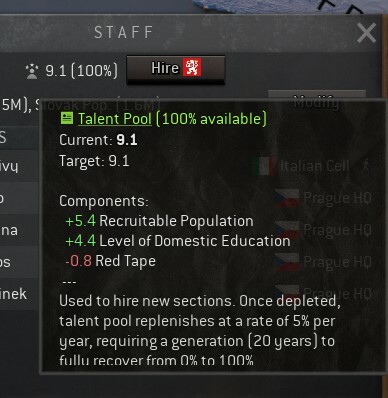
To enlarge or create a new unit, you can tap into precious talent pool...
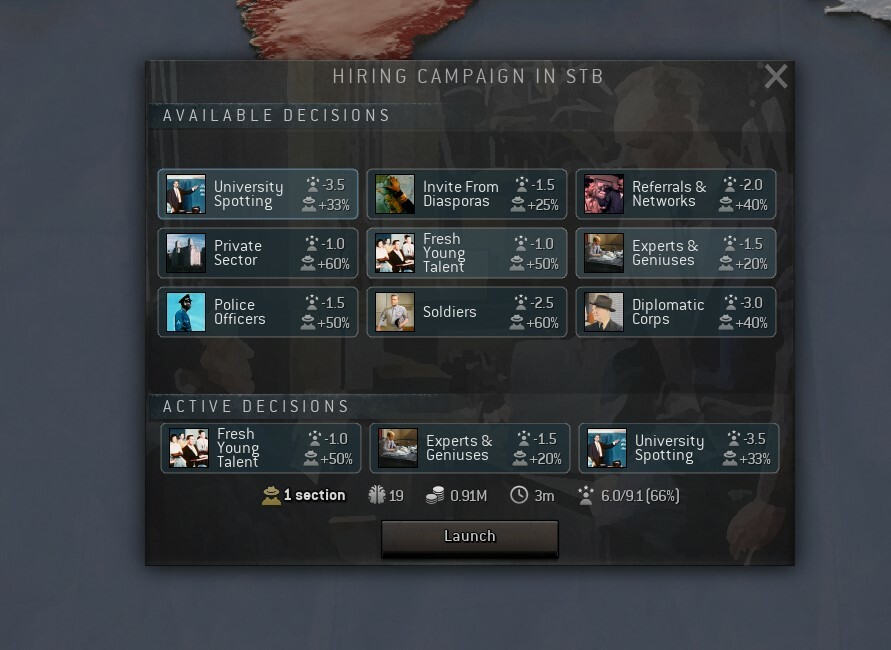
...by launching hiring campaigns:
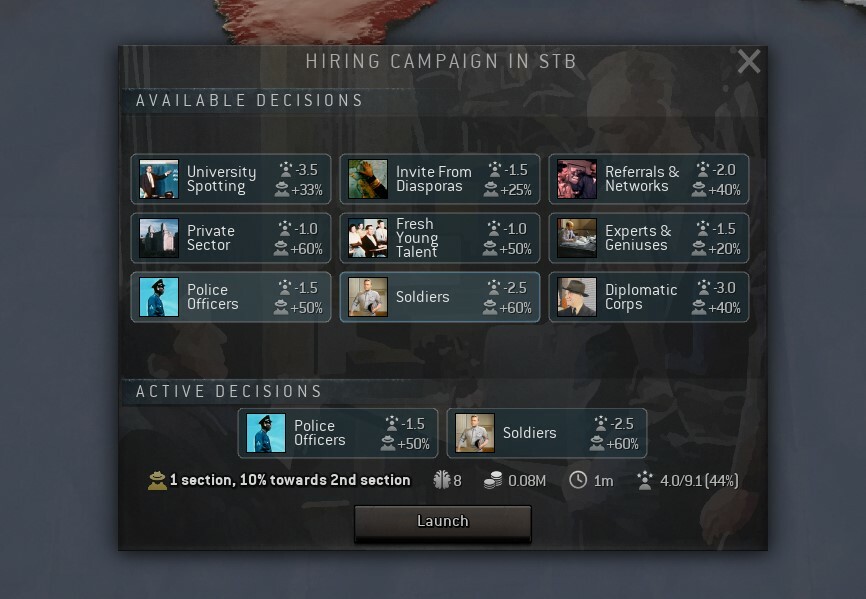
Every campaign differs in features (mainly sources of new officers). Their availability depends on the local environment and intelligence community. Decisions here influence the new unit, spending, and even tertiary effects - for instance, hiring from diasporas brings in local intelligence on countries from which new hires came in. In the example above, we focused on hiring a mix of young and highly skilled candidates, which costs a lot and quickly depletes the talent pool. In contrast, focusing for instance only on police officers and soldiers is much cheaper but the new unit will be substantially weaker:
Tradecraft
General prowess in intelligence activities - tradecraft (also known as the craft) - permeates many levels of the game. Every officer, every unit, and then the entire intelligence community has a tradecraft level from 0 to 100. These values define the availability and value of all espionage tools.
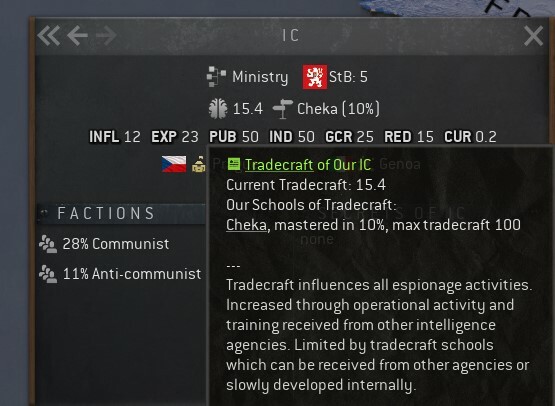
On the most general level (intelligence community, player-wide), the game introduces tradecraft schools - not literal school buildings but instead schools of thought Every player pursues one or more schools (they can be mixed). In 1946, the world begins with the following schools:
Amateur
Police
Guerrilla
War Veteran
Cabinet Noir
Commonwealth
Cheka
They influence almost all angles of expansion in the game: possible max tradecraft, contributions to operation types and specialization, availability of intelligence programs, hiring decisions, intelligence structures, laws, and so on. As names suggest, there are two groups - acquired environmentally (eg. war veteran, after participating in larger war) or belonging to particular countries. The latter group is much more valuable and can be acquired only by receiving training from players that mastered this school, for instance, cabinet noir school through training provided by the French player. Players can also develop new schools (you can usually expect the quick emergence of CIA or Mossad tradecraft schools in most campaigns) but it is an expensive and painful process that requires many risky activities in difficult situations.
To summarize tradecraft schools in one sentence, now progression is more varied between countries and players have one more very valuable interaction (training) with other players.
Specializations, Programs, Laws, Budget
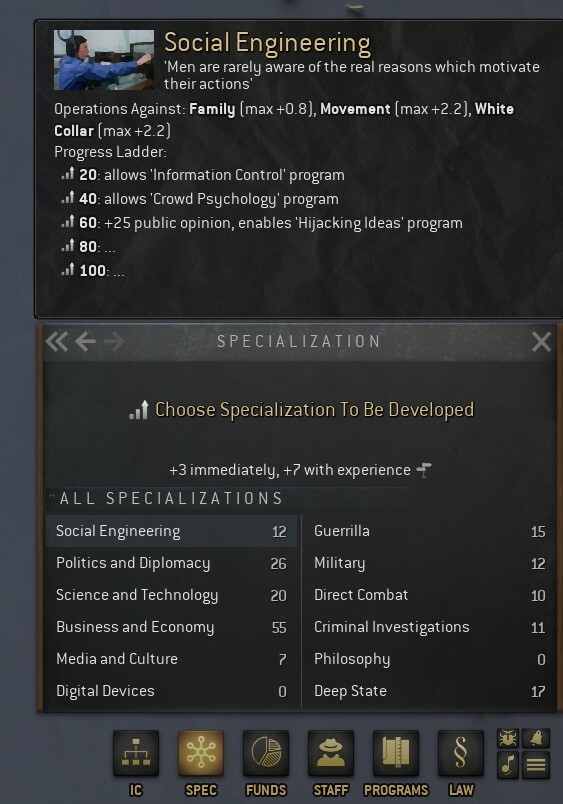
You can pursue 12 kinds of specializations. While nothing changed from their introduction in previous diaries, we can look at an example of one specialization:
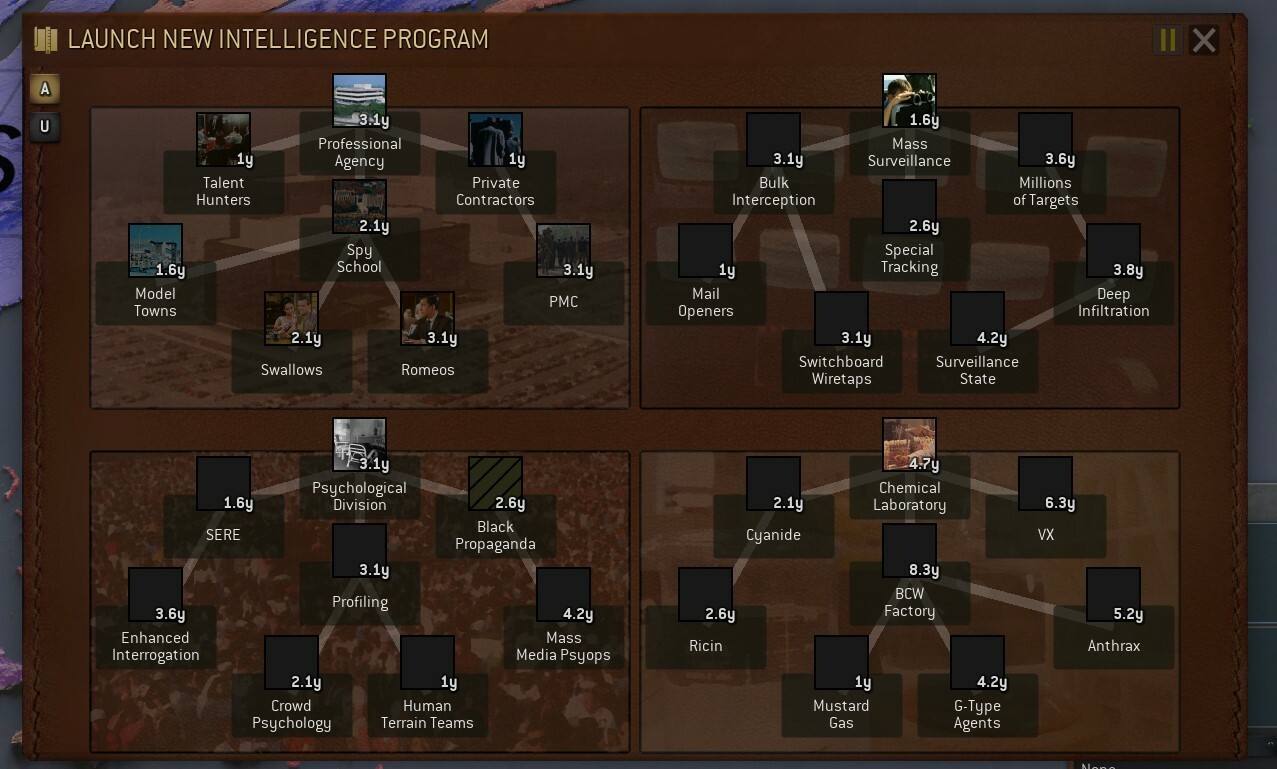
You can also regularly launch intelligence programs which now take the shape of multiple small trees:
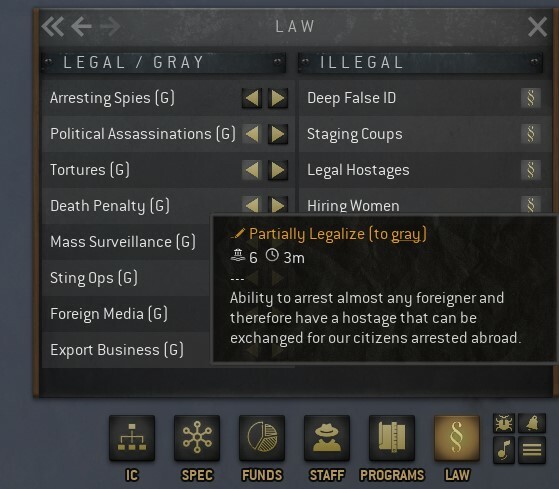
The legal environment around intelligence agencies is defined by laws and policies:
Various actions can be illegal (executing this action incurs a secret), remain in a gray legal area (not delegalized = legal, but at any point government may delegalize it, which may destroy for instance long-term investments), or be fully legal (giving strong protection from whims of changing governments and sometimes even from failures near relevant actions). By using political favors, you can move up actions to higher legal status.
Also, last but not least, budget calculations now include upkeep:
Now, armed in various units, schools, programs, we will progress to the second part of Vietnam AAR on Christmas Eve, December 24th!
If you're not already wishlisting Espiocracy, consider doing it
There is also a small community around Espiocracy:
Dev Diary #57 - Vietnam AAR I
What's happening / TLDR: Developer diaries introduce details of Espiocracy - Cold War strategy game in which you play as an intelligence agency. You can catch up with the most important dev diary (The Vision) and find out more on Steam page.
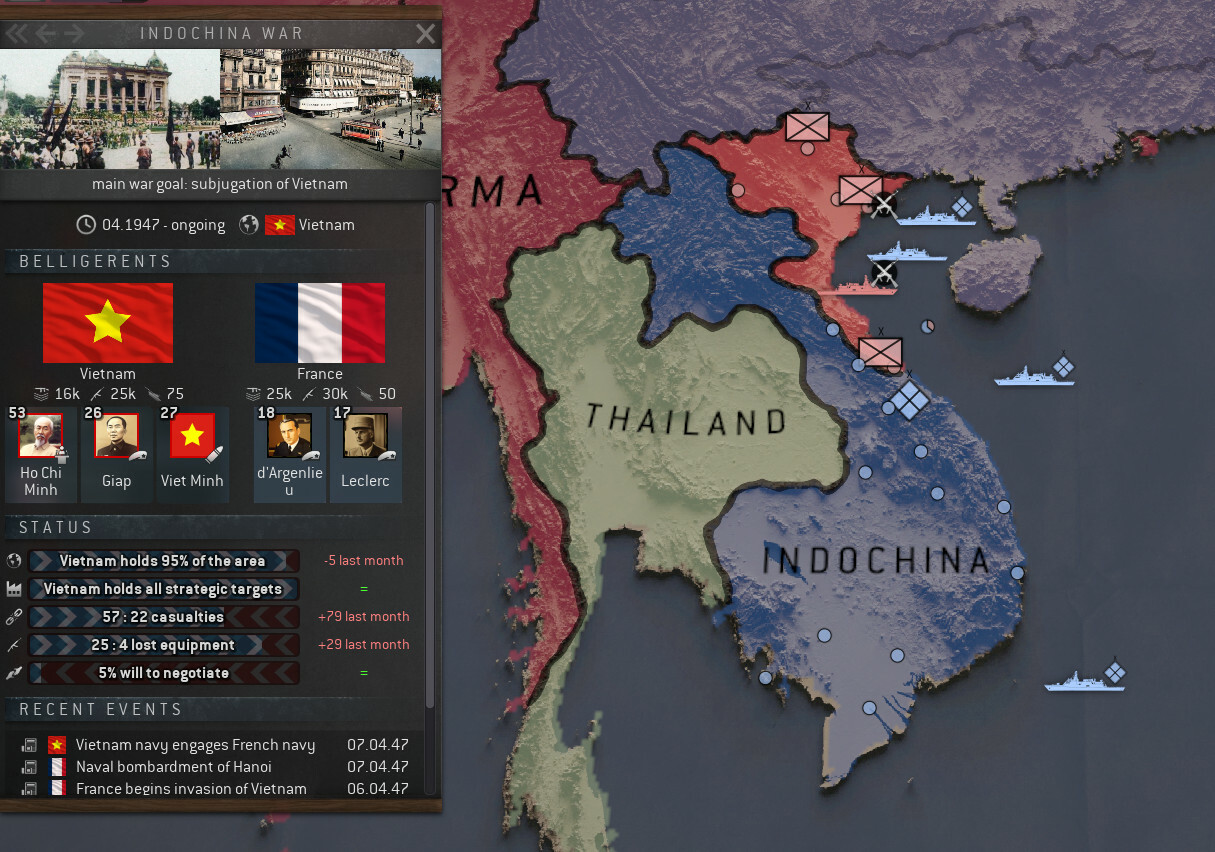
Today, we'll dive into gameplay - in the form an AAR, after action report - of the nation chosen by votes on the Espiocracy discord server (invite link at the end).
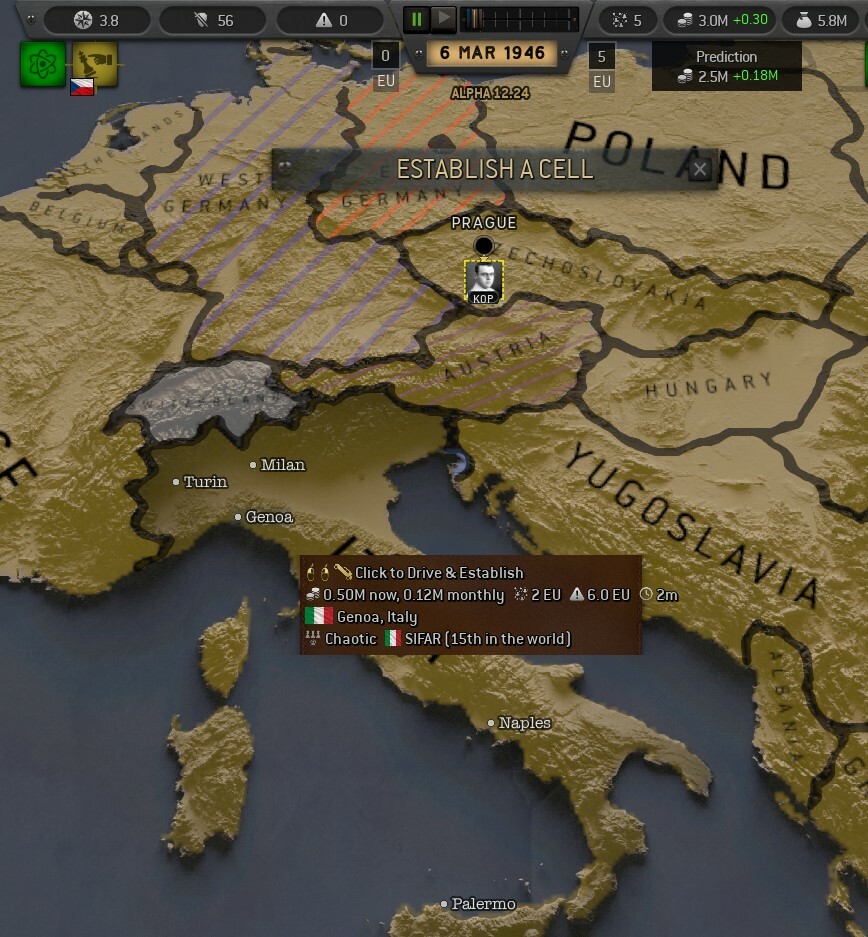
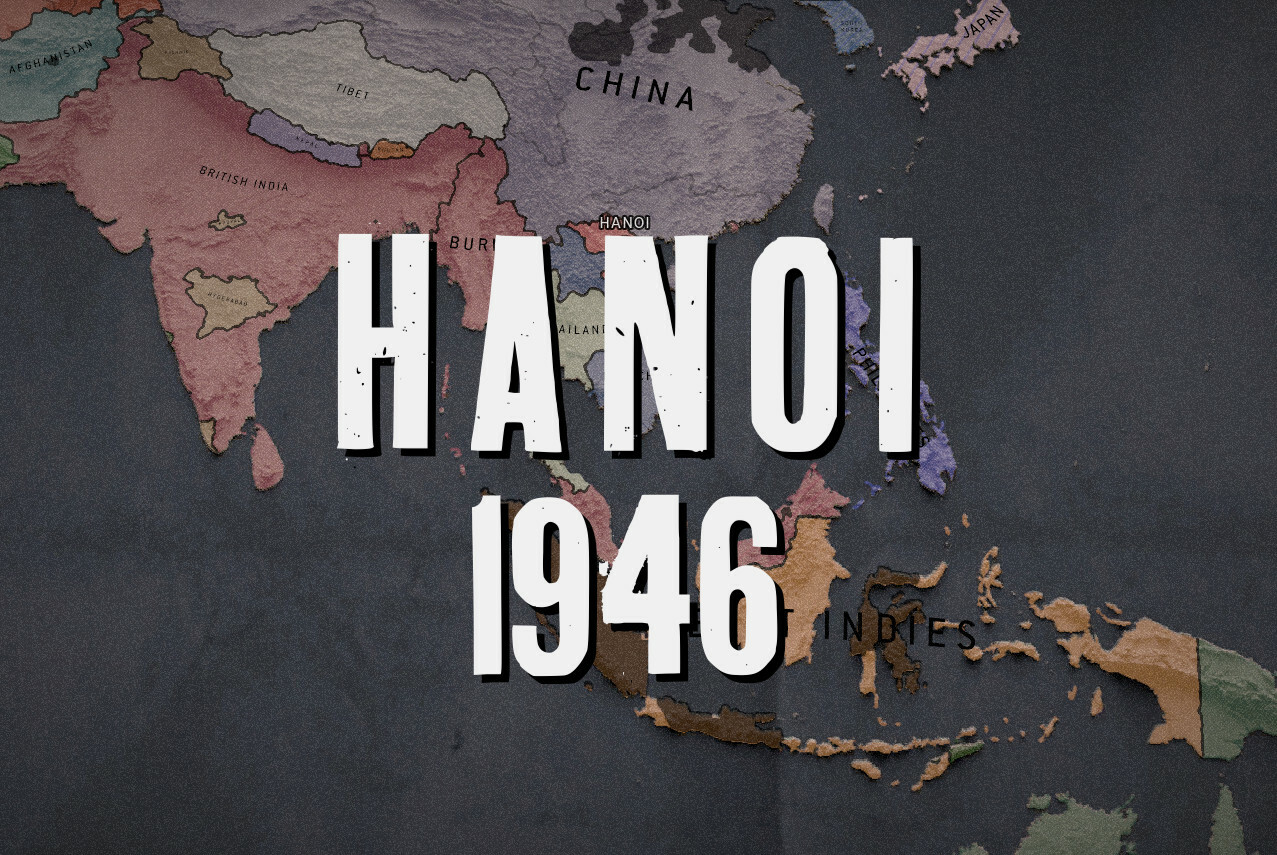
Welcome to Hanoi, the capital of Democratic Republic of Vietnam. It's March 6th, 1946.
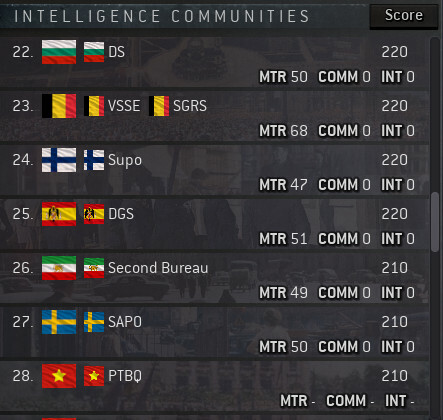
We are playing as the PTBQ - Military Intelligence Department within Vietnam People's Army. Years of French repressions, followed by harsh Japanese occupation, and short cooperation with American OSS, honed our intelligence community into decently sized and skilled force, ranked 28th in the world.
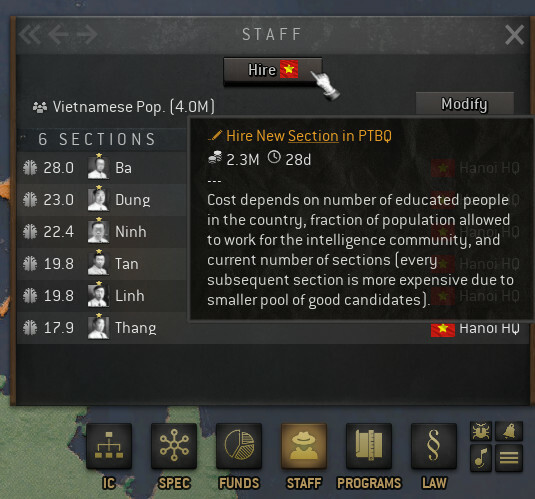
Initial state must be sufficient for now. In a small ravaged country, we won't be able to embark on significant recruitment campaigns. Any arrests (or worse) will be painful - and as a largely unrecognized country, we don't have diplomatic immunity to protect our officers!
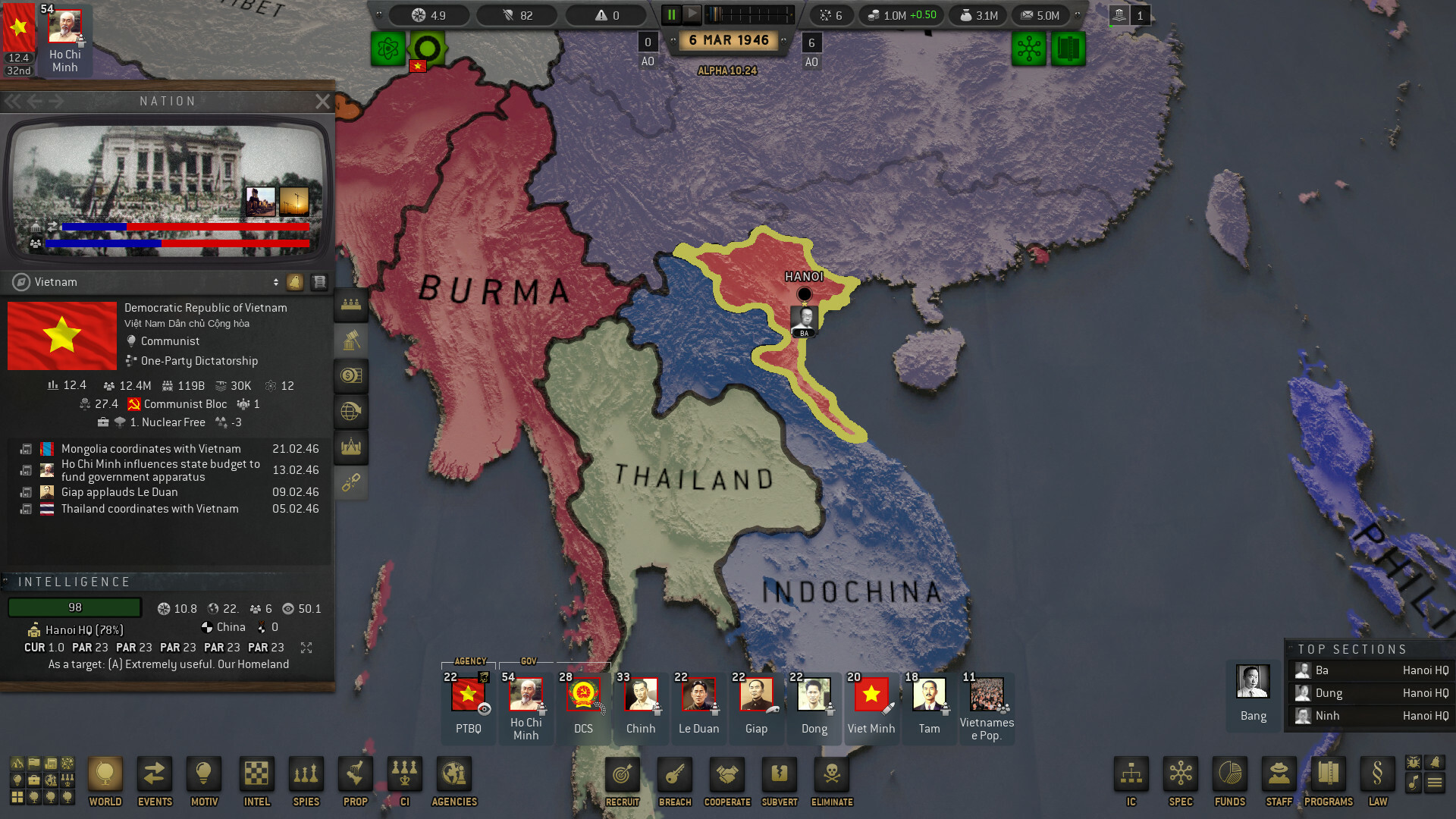
This is our homeland:
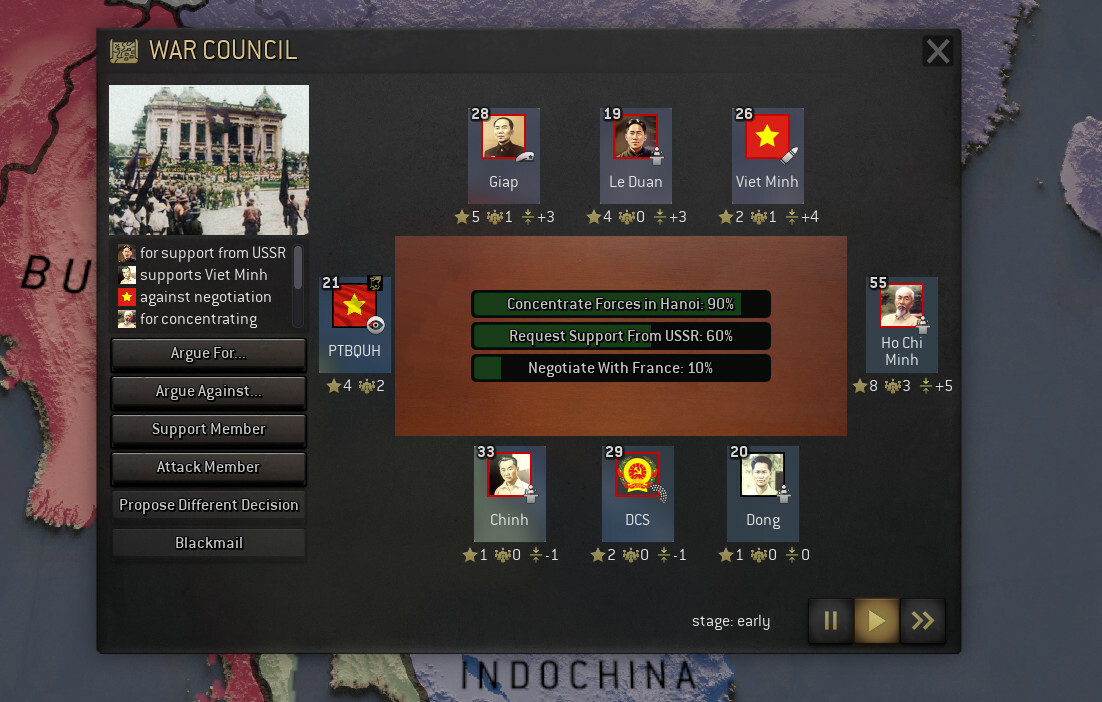
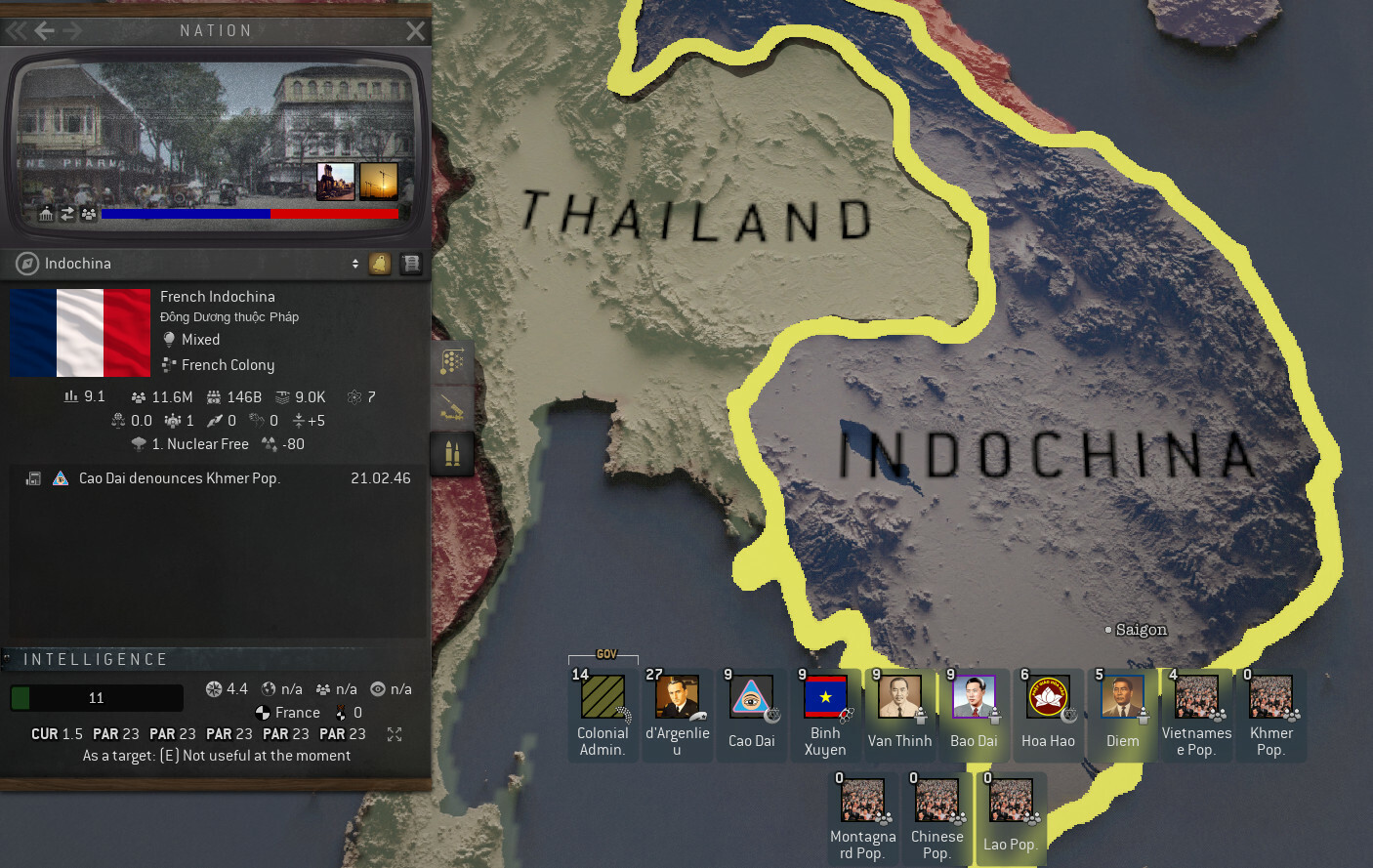
Between Japanese withdrawal and return of French colonial forces, we were able to forge fragile independence, unified under the authority of Ho Chi Minh. Internally, the landscape is characteristic for new nations with guerrilla warfare and military uprising DNA: strong guerrillas-turned-politicians, famous military leader, still important guerrilla organization, and population with fairly significant influence (due to recent mass participation in warfare). Internationally, we are aligned with the communist bloc but that doesn't mean much in 1946. The USSR licks its wounds, neighboring China is buried in bloody civil war, and colonialist empires from the capitalist bloc have far too large armies to have them sit idly in Europe. Ho Chi Minh, aware of the danger, currently negotiates terms of independence in Paris. He will return either with nothing (and French invasion) or with partial loss of independence. The latter scenario, however, seems incompatible with honest belief in communism of almost all our significant actors. We can see relevant examples inside the colony that we recently separated from.
No recent activity inside Indochina is no coincidence. French administration and military controls public life, keeps actors and their influence low, with the only slightly influential actors sourcing their influence either from religion (Cao Dai and Hoa Hao), from organized crime (Binh Xuyen), or from Paris (the rest). Our entry point will be 6 million of Vietnamese waiting for liberation - but they have to wait until we solidify our existence in the north. To achieve that, we have to aim straight at France.
Naturally, it won't be easy.
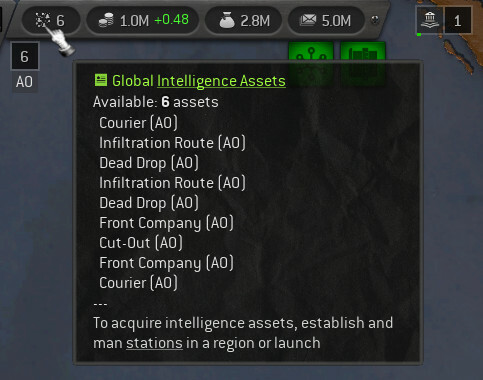
Intelligence operations on this hostile ground are not possible at the moment. We lack infrastructure, local intelligence, funds, resources. Speaking of which, let's quickly review current (current for this AAR and for this game build) state of main resources visible in the top bar, which evolved since it was described in previous dev diaries.
From left to right, the player deals in:
Intelligence Assets - small regional infrastructure established autonomously by officers, used mostly in operations
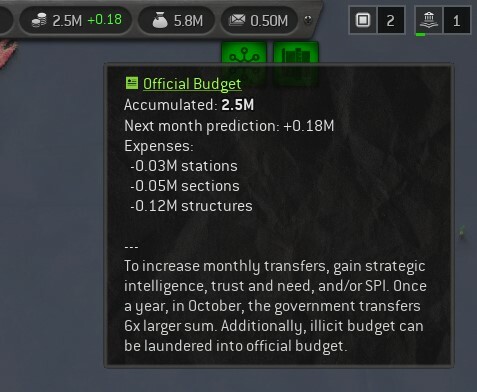
Official Budget - monthly subsidies from the government, spent on legal and not-completely-secret activities, such as stations or most operations
Black Budget - governmental account with money that can be transferred to other organizations
Illicit Budget - acquired through various illegal means, used for bribes, extremely secret, or quasi-legal activities (and can be laundered back into official budget)
Various small discrete resources, here it is 1 political connection that can be used in domestic lobbying or managing fallout from failed operations
In addition to resources, main parameters - measures of success - also evolved.
From left to right:
Strategic Intelligence - quantified value derived from collected intelligence materials, relevant to national interests (our main national interest is very simple: "survival of the nation"), with higher value directly contributing to governmental decisions (their choice and success) and to State Power Index (we're currently sitting at 12.4 which is 32nd SPI in the world)
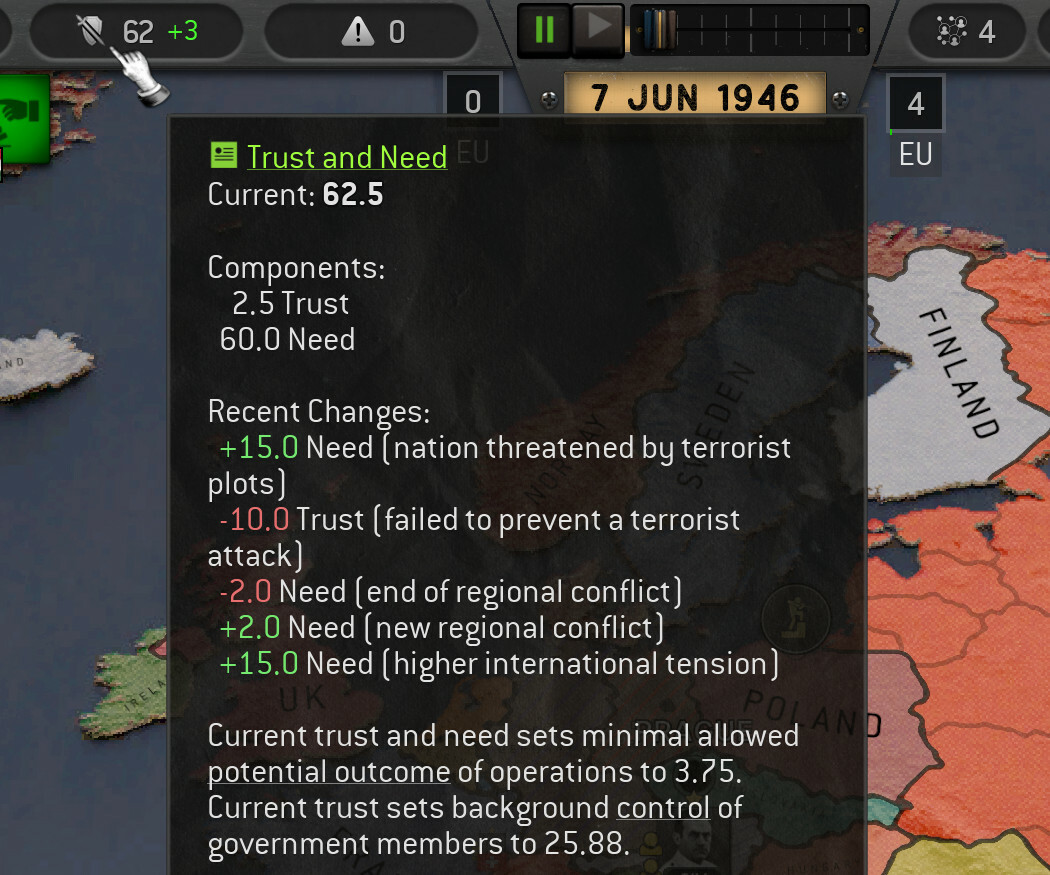
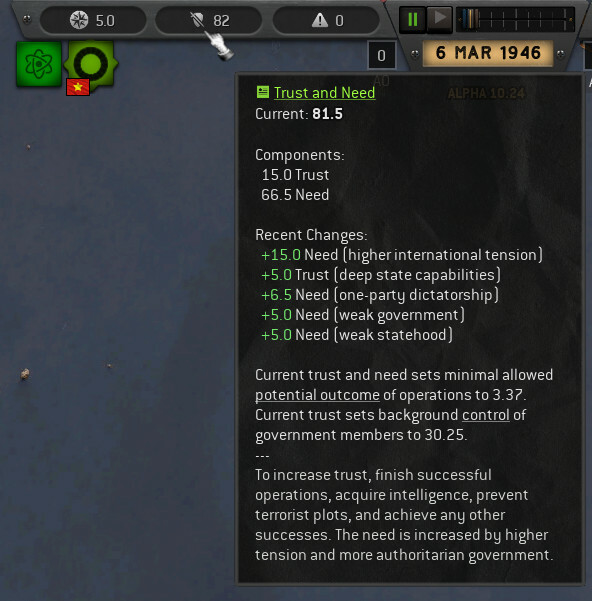
Trust and Need - two critical angles through which the government views our intelligence community, affect anything from budget, operations, purges, recommendations, all the way to background control of government members (!)
Threat - incurred globally and regionally during espionage activities and decreasing over time, higher regional threat makes it more difficult to operate in the region, while higher global threat may lead to purges in the intelligence agency, interest from global press, and even terrorist attacks aimed directly at our officers
There are many more small resources and parameters affecting intelligence activities (for instance: relative currency strength), which will remain for you to explore further.
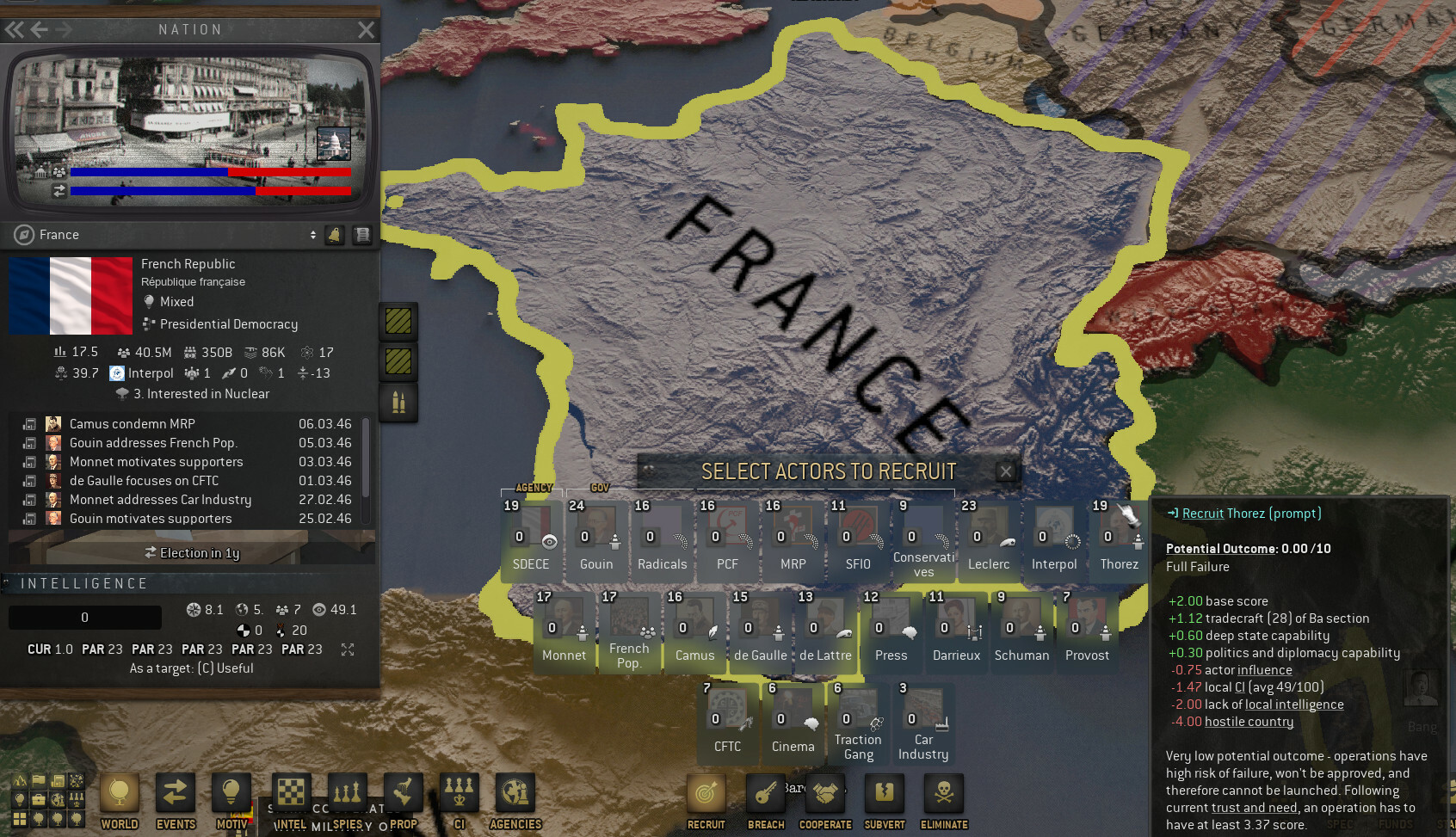
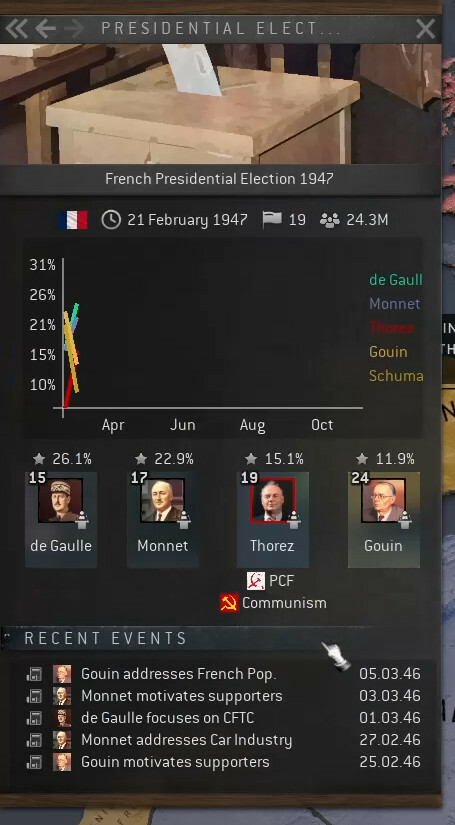
Back to France, one useful angle could be pushing the country over to communist bloc in the incoming elections. The name: Maurice Thorez.
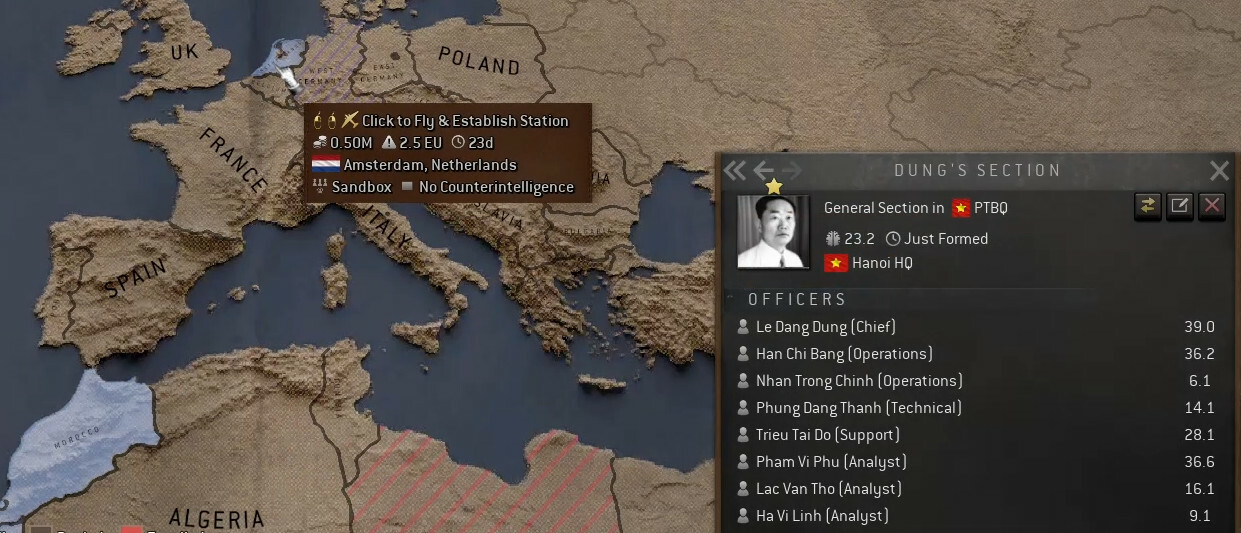
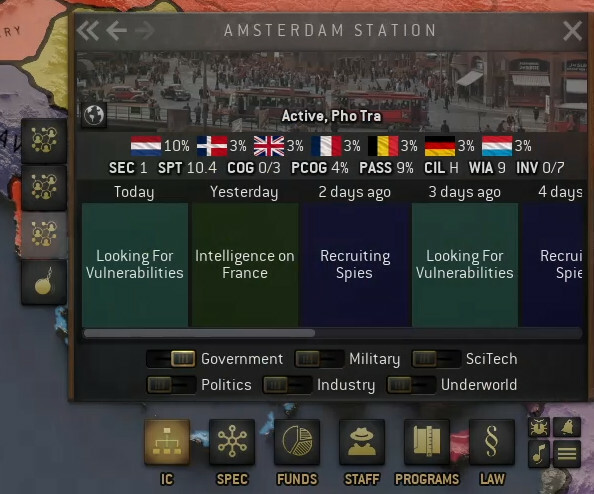
Operations, as previously mentioned, are not yet possible here. We need an anchor in Europe. Due to local destruction and ongoing governmental issues, the Netherlands seems to struggle with establishing proper security services. In terms of counterintelligence environment, it's a sandbox - we can do anything we want and it will be cheap, at least right now. We send Le Dang Dung's section there.
Meanwhile, an interesting target arose in the region.
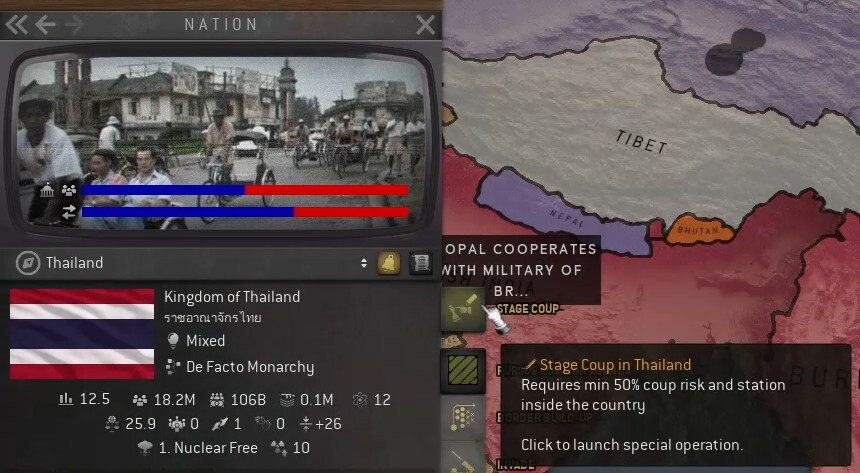
Thailand, currently, wants to keep neutral status quo. With their complex recent history, which includes Japanese-supported invasion of Indochina, population larger than Indochina, and relatively large army, they could be a very useful ally in the inevitably incoming war for survival. Hence, we send our most skilled operatives - Ho Trong Ba's section - to establish an intelligence station in Bangkok and then scramble to exploit local political environment.
A month later, we spring into action.
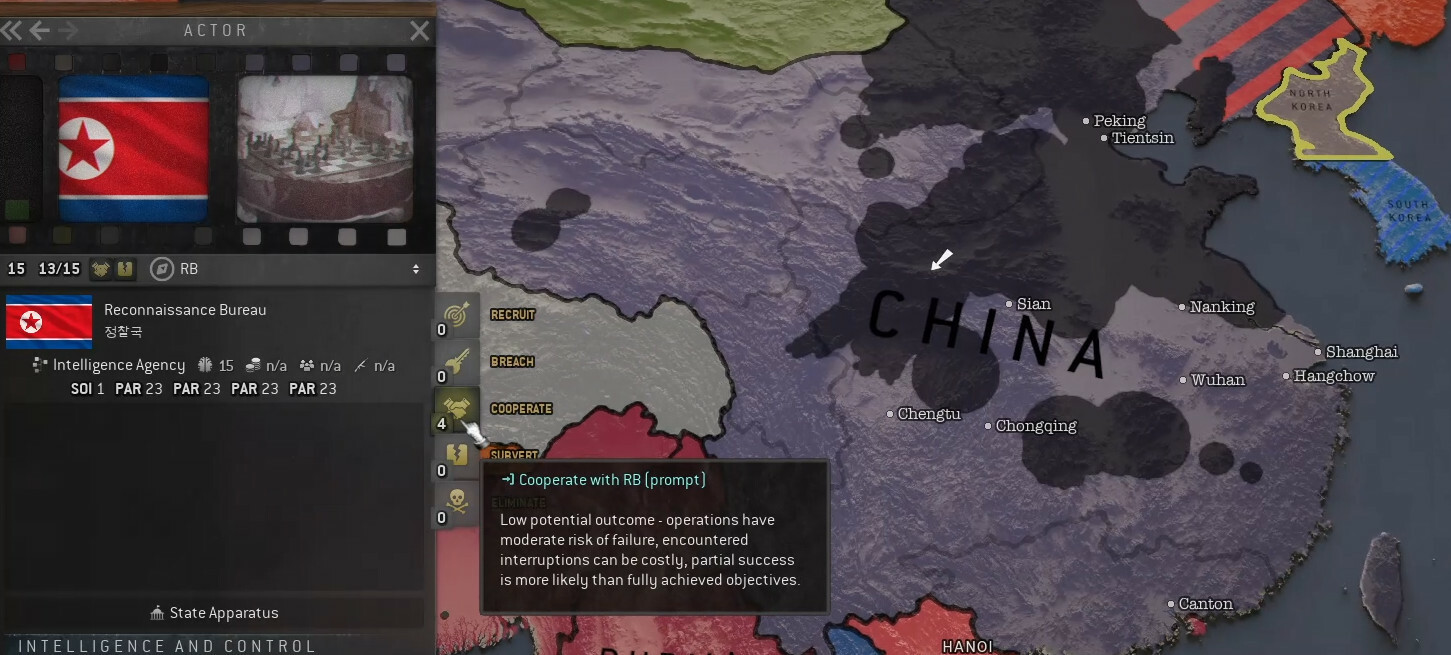
In the meantime, Soviet troops declare the end of occupation zone in the northern half of Korean peninsula. This is a good opportunity to seek cooperation with fellow communist intelligence agency.
It seems that the Chinese communist forces are making progress as well - approaching critical cities, controlling larger area, expanding to Manchuria. They are too far away from our border to establish direct connection on land, to provide them support or to receive support from them. Let's hope that they will close in sooner than later.
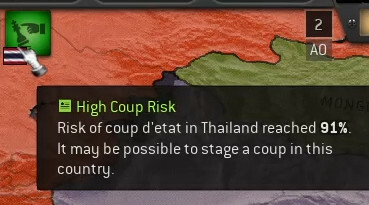
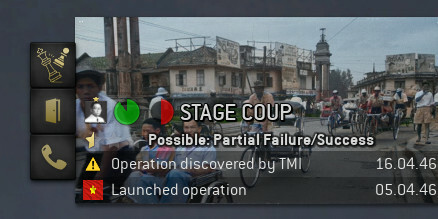
Coup operation is in progress, which is a good opportunity to take a look at refreshed operational mechanics.
An intelligence operation now is more direct race in time between attacking and defending intelligence agency (green and red pie above). Attacking player, through operatives preparing the ground and implementing simulated steps, enables better possible outcome over time (stars and "possible" label above). However, in parallel, counterintelligence service works towards achieving chosen goal against this operation (anywhere from observing to... murdering officers). Once minimal positive outcome is possible, a player can order execution of the final step of the operation (top left button). Obviously, rushing minimal outcome isn't really useful, and there are large gains with every better outcome. Many operations become micro-wars of nerves.
In this case, Thai counterintelligence was more aggressive and faster. It isn't surprising, given the grave nature of the operation, and our haste in launching it before settling properly in Thailand. A few officers from the section were arrested, relations with Thailand damaged, and now we have to negotiate way out for our valuable officers...
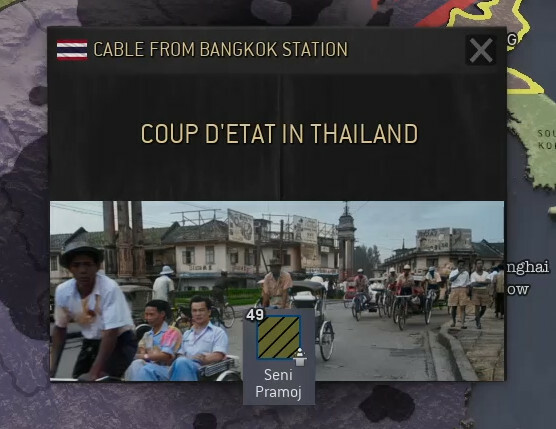
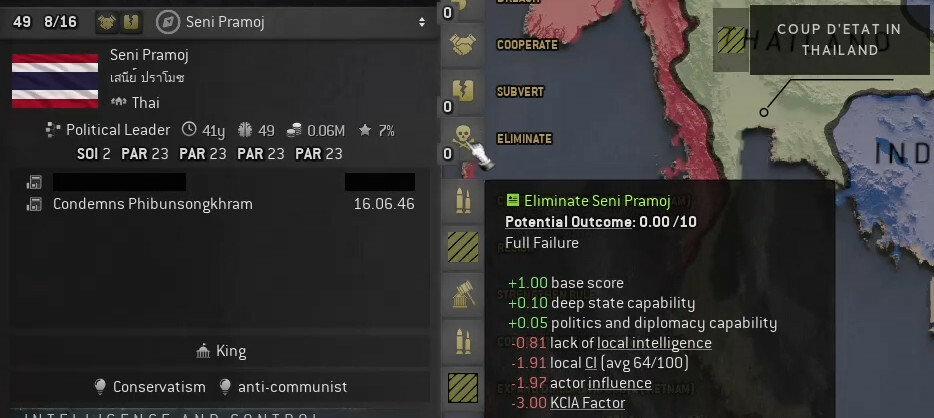
...and then it gets worse. We were trying to stage a coup while another plot was already in progress, executed by Seni Pramoj.
And it's disastrous news for us. Instead of turning Thailand from neutral to more supportive, we missed a plot of an anti-communist leader!
Due quickly incurred losses in Thailand, our chances of acting against him are negative. Thailand, for now, won't be useful and we will have to apply pressure through other tools to at least stop them from allying with France against communist Vietnam.
Perhaps the European angle fares better.
Indeed, station in Amsterdam continues work in the region, preparing the ground for French operations. However, it is slower than expected and we are still far from successfully approaching Maurice Thorez. Having learned from mistakes in Thailand, we shouldn't rush into this direction. After all, we are relatively safe in the Netherlands even in the case of hot war.
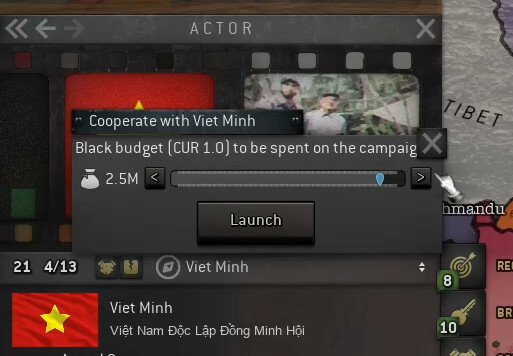
Returning to the homeland and preparation before the war, we'll transfer black budget to Viet Minh. After the collapse of Thai direction and slower progress in Europe, this is the best choice as we approach 1947.
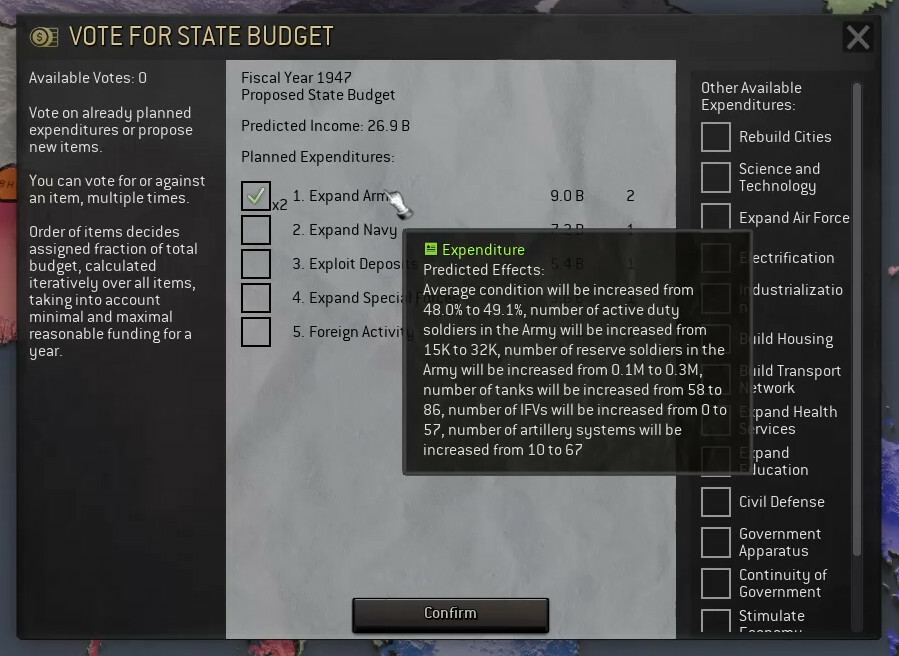
In September, we can define state budget, together with other members of the government. Naturally, professionalization of the army from guerrilla to conventional force should be the priority.
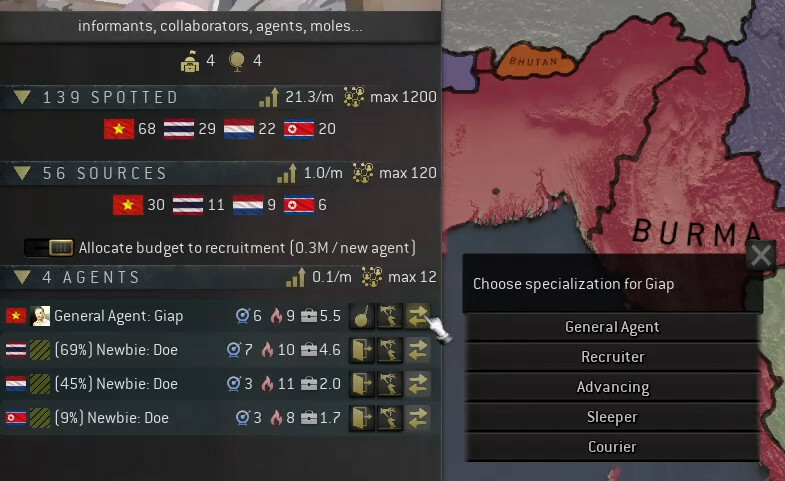
On the front of spies and intelligence, our operatives recruited four agents.
One of them, agent Giap near Vietnamese politician Truong Chinh, is ready for specialized training. Since we are well aligned with Chinh and we don't need special roles inside the country (these are implemented by domestic sections), we'll just direct Giap to advance the career ladder, in anticipation of future service.
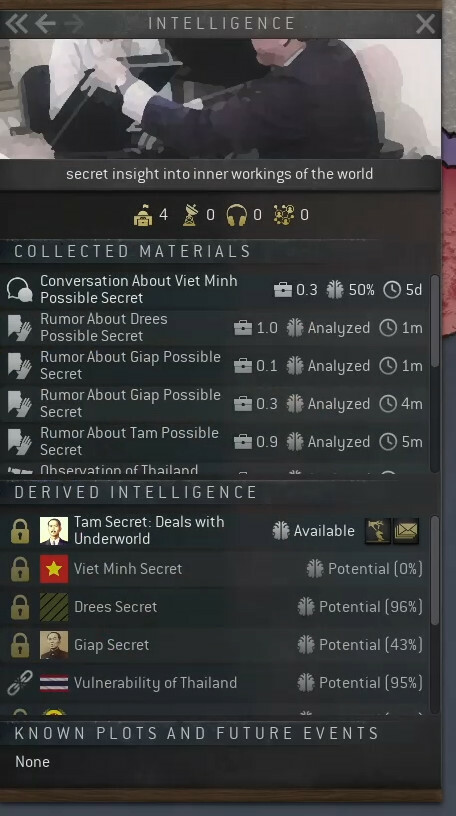
In terms of intelligence, stations, exchange with North Korean RB, various operations brought useful results but not critical for current situation.
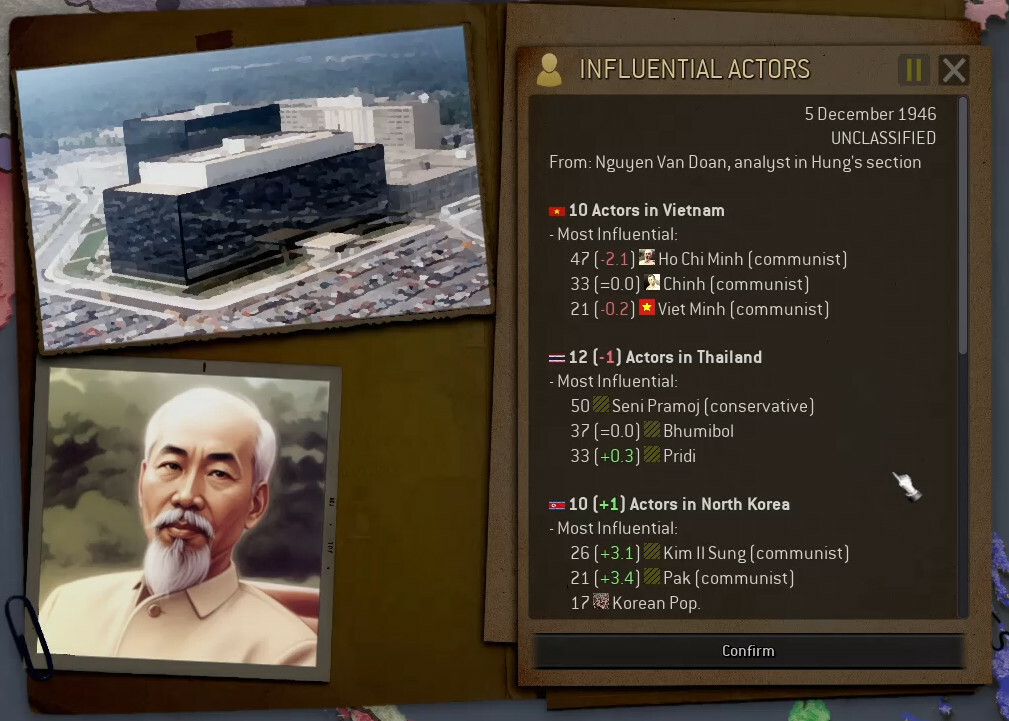
As the year ends, we receive report about evolution of influential actors in relevant places.
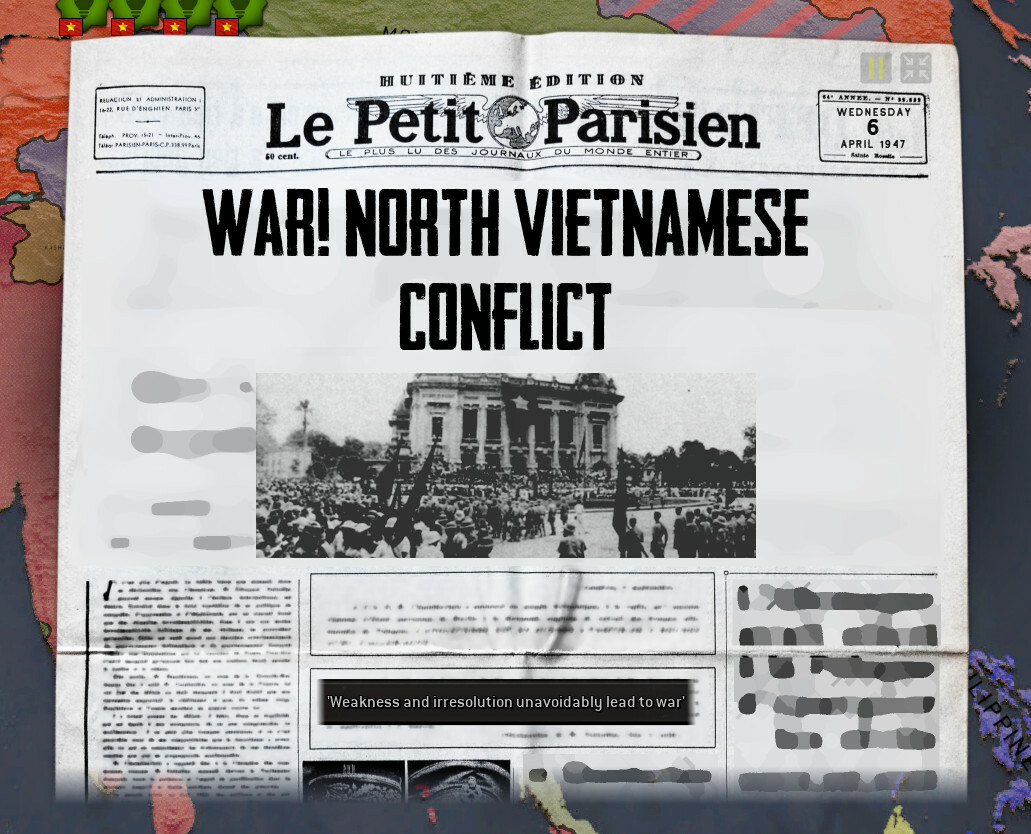
And then, after a few months of further operations, expansion, and preparations...
We will continue this save in the next dev diary.
See you on December 6th!
If you're not already wishlisting Espiocracy, consider doing it
There is also a small community around Espiocracy:
Dev Diary #56 - Propaganda
What's happening / TLDR: Developer diaries introduce details of Espiocracy - Cold War strategy game in which you play as an intelligence agency. You can catch up with the most important dev diary (The Vision) and find out more on Steam page.
---
Many topics near the Cold War and espionage deserve a full separate game. Espiocracy, out of sheer necessity, has to narrow down such topics into a single main angle. That was the case for conventional wars (angle: special forces), diplomacy (international structures), or science and technology (paradigms). Propaganda is another such large topic.
The main angle of propaganda in Espiocracy? Controlling the narrative.
Views, Causes, Major Events
As you can recall from the earliest dev diaries, views (eg. pro-Soviet sentiment or fear of nuclear war) form the backbone of human psychology in the game, giving people memory, motivation, alignment, and so on. In the most naive approach to propaganda, you can just select any view in the game, and then task your assets with promoting or undermining it.
This method, however, merely addresses a view as a black box. It is used in the game as a secondary cheap tool (chosen perhaps by smaller intelligence agencies). Actual impactful propaganda begins a little bit further: with manipulation of the inner workings of views.
Views in the game connect causes with effects - for instance, Germany unleashed WW2 which led to widespread anti-German sentiment at the beginning of the game in 1946. Many other major events before and during the game can create and/or modify views.
Naturally, this doesn't happen instantly, and instead, such events need time to propagate through media, become topics of debates, or reach books and movies. Main propaganda tools in Espiocracy focus on this twilight zone. Players can modify the "how" of the view-making and view-modifying process - they can control the narrative.
The Narrative
When a major event happens in the game (invasion, terrorist attack, political change, international crisis, large accident, and so on), players begin a battle over controlling the narrative around this event.
In simplest terms, "control" is a set of 0-100 parameters, one global, and a few for participating/relevant/superpower nations. Details, such as the initial level of control, are highly dependent on the event and its details. For instance, the story of the Sputnik launch starts as fully controlled by the USSR, and the only thing that the American player can do is slightly subtract Soviet control domestically - whereas the assassination of JFK is more or less carte blanche in terms of control, difficult to take over, prone to be never fully controlled by any party, and then be lost to dozens of conspiracy theories (not only from players but also from other actors in the game).
Between the onset of the event and highly variable moment of people moving on (which, again, depends on many details, other events, and even forms of media), players vie for control by:
Using geographically and culturally positioned radio stations, newspapers, bribed journalists, partially controlled actors, spies, front organizations, and anything else that can potentially influence the masses
Acquiring related intelligence, documents, recordings, witness reports
Leaking chosen parts to the press, surfacing the event to the government, and further, modifying details
Enforcing censorship (including jamming stations), diverting the attention by popularizing another significant event, supplying strong rebuttals
Directly attacking other parties trying to manipulate the event
Once one of the players controls the majority (51+) of the narrative, they can launch propaganda campaigns that exploit the story, modify its perception, and accomplish various small feats along the way.
Campaigns
A propaganda campaign in the game is a kind of intelligence operation that uses propaganda assets (mentioned above, radio stations, and others) to primarily either amplify or suppress the controlled event.
While the main goal is usually obvious (eg. Soviets suppressing the Chernobyl disaster or Americans amplifying Khrushchev's "secret speech"), details and consequences - defined by available assets as well as direct configuration of the campaign plan - forge campaigns into unique adventures that:
Shift new views in terms of direction (eg. revert pro-X to anti-X), subject (eg. assign blame/merit to another entity), emotional load (eg. from anti-X to hatred of X), and spread
Ignite reactions from actors and nations, eg. smear campaign causing targeted political leader to resign
Lead to new events, eg. Red Scare
Use white / grey / black propaganda methods, utilize totalitarian / free environment, use assets from publishing houses to smuggled samizdat machines
Choose between resonating with one or another set of nations, for instance appealing to Latin American nations while repelling African nations
Associate concept A with B, eg. NATO with Nazis (a common theme in Soviet propaganda)
Have various trade-offs, for instance between simplicity and spread, between costs and vulnerability to counter-propaganda, between exposing own propaganda assets and strength of the campaign, between domestic effect and abroad, and so on
Affect control over this event and potentially over other events
Such campaigns, launched to manipulate fresh controlled events, form the majority of propaganda machine in the game - but there are more variants of them and adjacent details.
Variants and Corollaries
Some major events are active for a long time (for instance: wars). In these cases, the battle for control over the event is also a long-term affair where it can frequently change hands, influenced by the evolution of the event, campaigns, and so on.
Manufactured or even false flag events can also become a basis for propaganda. Their main downside, naturally, is the cost of preparing them and much higher vulnerability to counter-propaganda.
Speaking of which, following standard mechanics of intelligence operations, players can launch counterintelligence (in this case: counter-propaganda) operations upon detecting foreign campaigns reaching their soil. Usually, it takes very much a counterintelligence form, with arrests of relevant journalists, infiltrating outlets suspected of being under foreign control or surveilling participating actors to identify their handlers.
In addition to working fresh major events, there are two more special types of campaigns. Future events, such as an invasion of another country, can be preceded by a campaign that engineers consent. Past events, for instance, a past alliance with a universally hated nation, can be modified by campaigns that rewrite history both domestically and abroad.
Outside of controlling the narrative, nations have a set of psychological parameters modifiable through player actions. Some of them were mentioned before (eg. diplomatic weight), others are experimental (eg. atomic ambition), while some are largely integrated with the propaganda tools described above. One parameter from the last category is soft power, developed by international contributions (sometimes unusual, for instance in real history North Korea acquired soft power in Africa by sending... mass gymnastics instructors - an action also available in the game), which then supports battle for control and subsequent campaigns.
Final Remarks
The next dev diary will be posted on September 6th!
---
If you're not already wishlisting Espiocracy, consider doing it
There is also a small community around Espiocracy:
--- "Anyone can believe a convincing lie; we’ve all fallen for a few. But the blatant lie does some useful things. It reveals the skeptics, or at least the skeptics who open their mouths. It forces the supporters deeper into the web of lies. They have to accept this, knowing it is a lie, and dig themselves deeper. It’s brainwashing, making them choose to accept the propaganda rather than the evidence before them" - author and year unknown
Dev Diary #55 - Interactions Between Players
What's happening / TLDR: Developer diaries introduce details of Espiocracy - Cold War strategy game in which you play as an intelligence agency. You can catch up with the most important dev diary (The Vision) and find out more on Steam page.
---
There are two layers of diplomacy in Espiocracy: between countries and between intelligence agencies.
Nominal diplomacy has been described in DD#51 and you may remember it as an intricate hierarchy of mostly formal structures. Summits, treaties, policies, doctrines. Secondary diplomacy between players - between intelligence agencies and communities - is nothing like that!
Implicit Messages
Instead, the game assumes "actions over words" as the central idea behind contacts between Stasi, MI6, and others. When KGB tried to insult and threaten CIA officers in Moscow, they didn't send strongly worded letters - they beat them up in the dark alleys and smeared their cars with feaces. In Espiocracy terms, KGB sent an implicit message to the CIA.
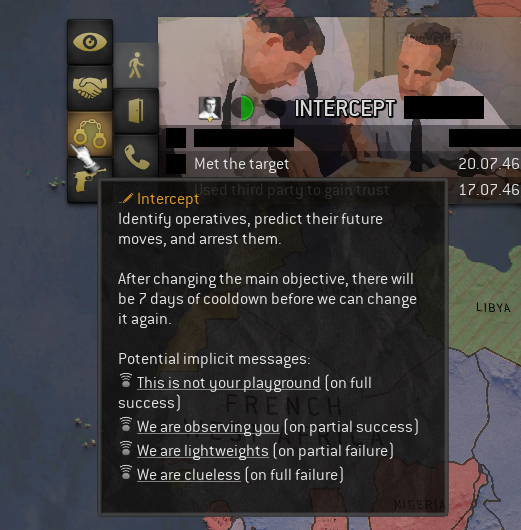
Many actions in the game send such messages. Usually, they are more subtle, happen along the way, and depend on the results. For instance, an attempt to intercept an intelligence operation can send one of four possible implicit messages:
A message may also be non-deterministic or even detrimental to the sender. British intelligence community in WW2 famously cracked the Enigma code but no less effort was put in efficiently using gained intelligence in a way that does not reveal that Enigma has been broken. The game implements this fascinating psychological conundrum partially also through implicit messages.
In one more psychologically inspired implementation, some actions may send a few potential implicit messages, out of which the receiving player chooses one of them - essentially, the player is interpreting the action.
And this is where we arrive at the receiving side. What such a message actually changes in game mechanics?
A message mainly expands agency of the receiving player. It is always associated with a set of new available decisions. When KGB foils too many British agents and MI5 finally deciphers it as a penetration of the network, the British player now has critical new knowledge that opens new reactions:
(Funky paper scrap UI is obviously work in progress.)
Sets of reactions depend on some details (situational, level of tradecraft, levels of capabilities) but they are generally known by all players, easily inspectable through tooltips, and in that way they slightly gamify mind reading, with an espionage twist. Through actions and attached messages, you can force the hand of another player, broadcast your intentions, bluff in ten different ways, gain or lose trust, begin further contacts, and so on.
More Direct Interactions
While implicit messages can always be sent, more advanced forms of contact are tied to two bilateral parameters which are calculated from background situation (such as relations between countries) and further modified by players (including implicit messages).
Mistrust - Always positive value, increased by players through anything from chaotic operations to defectors, lowered by various gestures of goodwill. Defines degree of general contacts, between third-party mediators (very high mistrust) to borrowing/lending operatives (very low mistrust).
Communication Channels - Developed by players during any interactions (including hostile ones) and structures (eg. an intelligence station in another player's country), lost over time through lack of interactions. Defines quality and theoretical availability of contacts, which may in some (usually very tense) situations transcend any level of mistrust.
These two contribute to the plethora of inter-player actions. In addition to a few hinted at above, they include spy swaps, defusing espionage scandals, increasing embassy staff quotas, exchanging intelligence, informal non-interference deals, joint operations, training and know-how transfer, larger alliances such as Five Eyes, and so on. (The list still evolves but it is mostly situational so obvious enough, as far as diplomatic options in strategy games go, that it was initially described in the 8th dev diary.)
Black Market
Last and probably least, the game tries to further expand interactions between players by enabling covert trading through third-party (underworld) entities. In one of the previous AARs, the existence of black market has been hinted at. Here's how it looks currently:
In short, intelligence can be sold on the regional black market to another player - both sides do not know their identities and the transaction has therefore an indirect unpredictable cost of handing over intelligence to another player in the game (eg. trading a secret of domestic politician allows someone else to blackmail said politician). Details are subject to further evolution, probably towards the participation of private entities (history is full of available inspirations: paper mills, private eyes, journalists, info brokers, hacked databases etc).
Behind The Scenes
► Yes, the game has a button for roughing up CIA officers in Moscow (and any other officers in any other city)
► True BTS: "It's year YYYY, I'm A in B, what do I do?" is usually the first question I ask during game development, followed up by finding answers as close to real life as possible (eg. for A = Allen Dulles and B = CIA there's full autobiography available). Implicit messages are one of many direct results of such an approach. Sometimes mechanics ultimately evolve far from original answers, usually to follow better gameplay, but their historical roots still usually enrich mechanics. For instance, CIA obviously did not sell intelligence to other agencies on any kind of black market but... they did buy a lot of materials from, what they called in the 50s, "intelligence peddlers" and "paper mills" which in turn partially acquired and smuggled materials from intelligence officers behind the Iron Curtain. This contributed to the "through underworld" part of the black market in the game.
Final Remarks
The next dev diary will be posted on August 2nd!
---
If you're not already wishlisting Espiocracy, consider doing it
There is also a small community around Espiocracy:
--- "In subsequent negotiations, SIS proposed a mass PNGing [persona non grata-ing, expelling] of Soviet intelligence personnel in the UK. (...) We cannot consider any such proposal because of the obvious and certain retaliatory steps which will be taken by Soviet authorities" - CIA report in 1962, edited for clarity