Field of Glory: Empires Challenge #2 Ranking and Videos
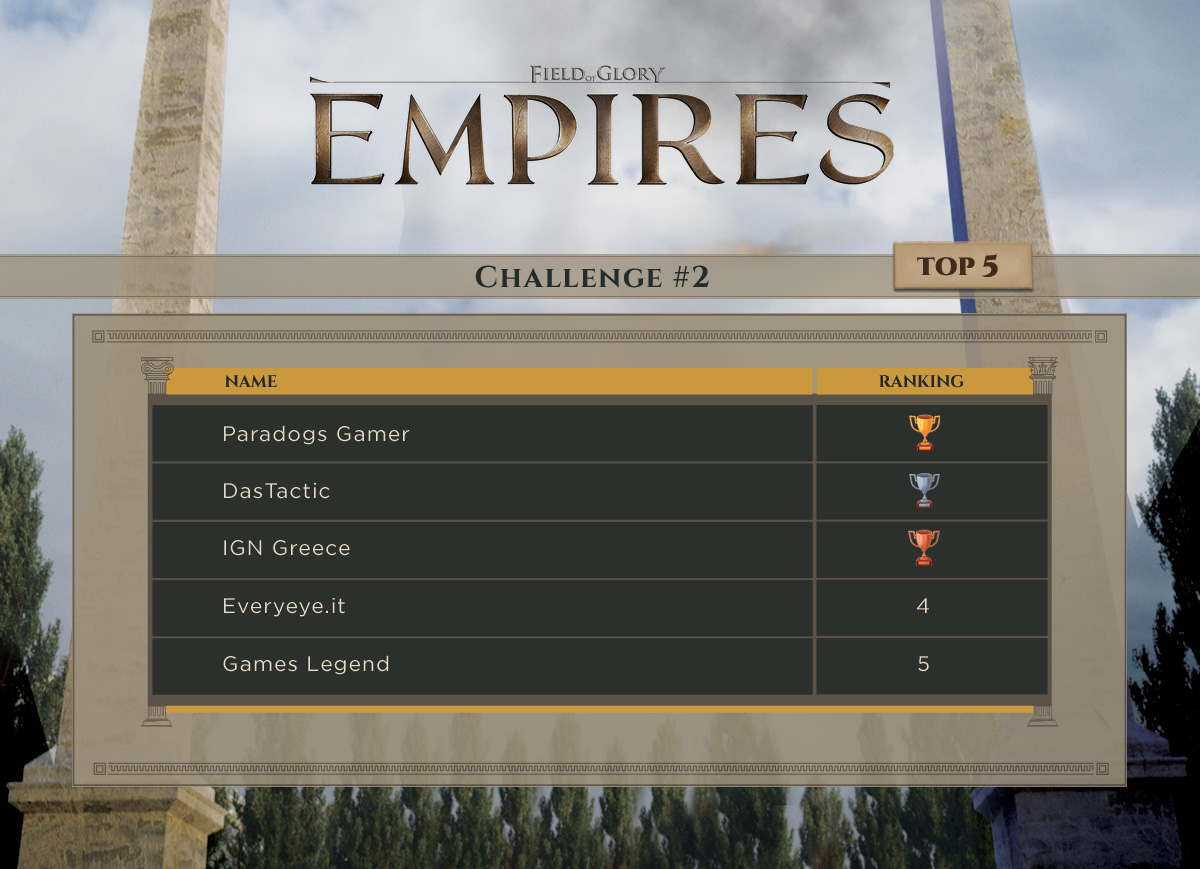
We have the final list of the participants who completed the Challenge #2 – Amass 7500 money in your treasury while reaching at least 20 regions in less than 50 turns and avoiding to be in the last tier in the progress & decadence chart.
Carthage was not an easy faction to play, with scattered regions to protect and surrounded by powerful neighbours. Players had to carefully plan ahead their moves and outsmart their opponents. It was very interesting to see the different strategies employed and the different pay-offs!
This is the final ranking, kudos to all the participants!
We will announce soon the Challenge #3, its setting and task. Stay tuned!
Here’s below a taste of the videos published so far, including the ones completing the challenge:
Dev Diary #9 Addendum - Playing Empires Battles in FOG2
Playing Empires Battles in Fog2 by Richard Bodley Scott
From an early stage in development it was planned that, in addition to the in-game battle resolution system, Empires would also have the option to fight out battles in FOG2 if the player so chooses.
The main objectives were:
1) That Empires battles fought out in FOG2 should be varied and fun. (Number one priority!)
2) That the armies of each nation should be represented by the correct FOG2 units for their nation.
3) That general skill and traits, unit experience, unit effectiveness, hit points etc. from Empires should carry over into the FOG2 battles.
4) That terrain should be representative of the terrain in the region where the battle takes place.
5) That there should be no adjustments to make the battles more “even”, and no adjustments to take into account the FOG2 difficulty setting. The situation should be as per the campaign situation.
6) That the export/import process and switching between the games should be as automated a process as possible.
How does the game decide which FOG2 unit type to convert an Empires unit to? Empires has a database specifying which FOG2 unit type each Empires unit type maps to, with a quality adjustment for some. The mapping is different depending on the national archetype. This information is passed in the export file, along with various other factors affecting the conversion.
The Empires system potentially gives "Heavy Foot, Warriors, Mercenary Foot, Urban Militia etc." to every nation. The FOG2 conversion system attempts to convert each nation's forces to FOG2 units that are appropriate to their historical prototype. So for example "Warriors" in a Gallic Army will translate to FOG2 Warbands, but those in an Italian army will translate to FOG2 Italian Foot. This means that Empires "Heavy Foot", for example, may translate to FOG2 Medium Foot for some nations, if the nation never actually had any troops that FOG2 would rate as Heavy Foot.
Also some units translate to a mixture of FOG2 units, because this leads to more historically realistic armies. Pre-Marian Roman legionary units translate to a mixture of hastati/principes and triarii units, in approximately a 2:1 ratio. Horse archer units, if present in large numbers, translate to a mixture of Light Horse and Cavalry.
How does the game decide how many FOG2 units each Empires unit maps to? The Empires : FOG2 unit conversion ratio depends on the unit type, because it is points based. This is because the difference in effectiveness between various Empires units is often significantly greater than the difference between the effectiveness of their FOG2 equivalents. To get the same relative effectiveness as in Empires-resolved battles, the more expensive (and more effective) Empires units translate to more FOG2 units than the cheaper ones. Some of the cheaper Empires units may only map to 1 FOG2 unit, but some of the more expensive ones could potentially map to as many as 4 or 5 (cheap) FOG2 units in armies of nations that historically did not possess powerful units like Pike phalanxes or legions. Most units will have a conversion ratio somewhere between these two extremes.
For example, because Italian Foot in FOG2 are cheaper (and less effective) than Warbands, the unit conversion ratio for Empires Warriors > FOG2 Italian Foot will be higher than the unit conversion rate for Empires Warriors > FOG2 Warbands. Also, where different Empires unit types convert to the same FOG2 unit type, the quality of the FOG2 units may be adjusted depending on which Empires unit type they come from. (Thus, for example, Urban Militia in some national archetypes may be extremely low quality versions of the standard units. They will also have a lower unit conversion ratio as they are much lower rated in Empires points).
Because the points value ratios do not match up to an exact number of FOG2 units, there is a random element. For example, if the points system means that an Empires unit is equivalent to 1.37 FOG2 units, the system will generate at least one FOG2 unit, with a 37% chance of another one. So usually it will generate 1 unit, but 37% of the time it will generate 2.
A damping system on the chances of selecting subsequent "partial" units is used to ensure that the overall strength of the army does not vary excessively (about 3% in tests), and a unique random number generator seed number for each exported battle ensures that if you play the same battle (from the same export file) in FOG2 multiple times, the OOBs (and map) will be the same each time. (Unless you go back to the pre-battle Empires save and re-export it, in which case there will be a different seed number each time).
How does the conversion take into account Empires general skill and traits, unit experience, effectiveness and hit points etc.? Unit Experience and Effectiveness affect FOG2 unit Experience and Elan respectively. FOG2 unit Quality is the average of those ratings.
Empires Hit Points represent current strength compared with full paper strength, so affects the unit conversion ratio.
Generals use their Empires skill rating for attack or defence depending on which side counts as attacking in Empires. General traits applicable in the regional terrain add their modifiers to those skill ratings. If there is an overall difference between the skill ratings of the opposing generals, then usually an adjustment is made to the quality of the opposing units, representing the effects on morale, physical condition and state of preparedness of the troops resulting from the better general's more skilful pre-battle manoeuvres. Sometimes, instead of a quality adjustment, the lower skilled general will have some of his troops arrive late at the battle.
Unit traits are not explicitly taken into account in the conversion process, because FOG2 already takes into account the different effectiveness of different troop types in different terrain.
Frontage Empires units convert to an average of 2 to 3 FOG2 units, some more, some less.
We decided not to artificially constrain the frontage in FOG2 battles because it would severely restrict the tactical options – which would rather defeat the point of playing the battle in FOG2. We did not think it would be fun.
Also, as FOG2 battles take some time to play out, we wanted a decisive result, so wanted all of the troops present to be able to take part.
Therefore, the normal FOG2 map generation is used, based on the prevailing terrain in the Empires province. Hence a mountainous, forest or swamp province will result in a mountainous, forested or marshy map, which may result in choke points, but isn’t guaranteed to do so.
This does mean that playing Empires with FOG2 battles will have strategic implications, meaning that the game will play out somewhat differently depending on whether you play all the battles in Empires or not. Personally, I resolve very one-sided battles in Empires and play the rest in FOG2.
Siege assaults are left to the Empires system and cannot be exported to FOG2
Field of Glory: Empires Challenge #2 – Carthage
With the Challenge #1, you have witnessed the birth of Rome and its military power in Italy. Now, it’s time to see what one of its first mortal enemies can do, on a bigger scale.
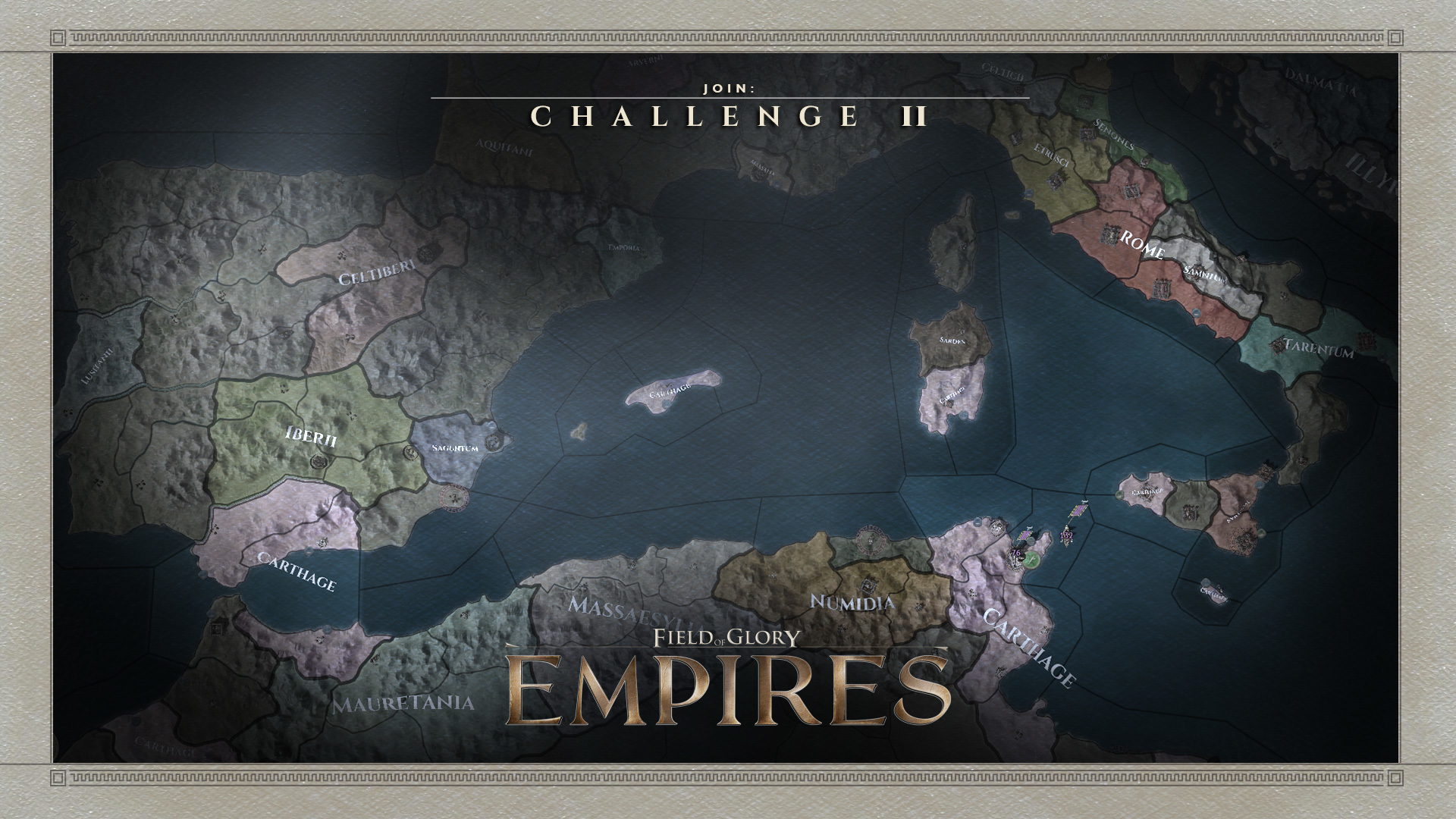
Welcome to the Challenge #2 – Carthage!
This time the Challenge goal will be different. While in the first one you had to focus mostly on the military aspect of the game, this challenge adds a new layer of complexity (and fun!).
Carthage was renown to be a very wealthy civilization, establishing colonies in many Mediterranean regions and creating a successful trade network. Its defense was guaranteed by a powerful navy and a semi-standing mercenary army.
To better reflect this historical situation, the Challenge #2 is shaped more on the economic element of the game.
Challenge #2:Try to amass 7500 money in your treasury while reaching at least 20 regions in less than 50 turns and avoiding to be in the last tier in the progress & decadence chart.
Nation Available: Carthage
Turns: 50
Map: All playable
Mechanics and features: All active
Progress and Decadence: Stay in the 1st and 2nd Tier
Field of Glory: Empires Dev Diary #9 Battle System
Warfare in Empires
One of the major components of Empires is waging wars. Ultimately, you will win if you gain more Legacy than any other nation, but conquering your objectives and holding rich regions, some with world wonders, is definitely the most straightforward way to achieve that.
Once you have defined the objectives for your military campaigns, you’ll have to assemble your units into armies. And this process is not something to do at random, because, as you all know, battles are often won before they are actually fought.
This was one of our design goals in Empires. To have the players enjoy a bit of ‘theory crafting’, by thinking what the force composition is needed to secure your goals as efficiently as possible. We tried hard, and we believe have succeeded for the most part, in having no unit that excels at everything. Sure, if your economy is ten time as strong as your opponent, then you can probably drown him under the sheer number of your legions, to cite one of the best units of the game. But even legions have weaknesses, like not fighting that well in forests and mountains, and being pretty costly, both to recruit and maintain.
So how does it work, in a situation where you have a decent economy, but need to recruit a powerful force to defeat your enemy? You’ll have first to identify if your opponent’s strongholds are in difficult terrain or not. If yes, then the heavier units might not fight much better than the lighter ones, while being much more costly (so if you are not careful you may end up using an expensive, inefficient, army that is outnumbered, and out-classed by your opponent’s cheaper troops). If he has large walled cities, then again, some units will perform much better. You’ll also want to combine your powerful melee units with support units, as these weaker units are essential when the actual battle starts. For example, your army might be cut into shred by weaker infantry, if they benefit from skirmishers or archers in the support line and you lack these lighter troops. Then you have cavalry units. On the strategic map, they are very fast and will allow you to do all sort of things, like acting as a fire brigade, or snatching an enemy region then pillaging it. In the tactical battle, some cavalry on the flanks (or in reserve) will go a long way in winning a battle, and if this does happen then their ability to pursue will greatly inflate the losses of your defeated opponent.
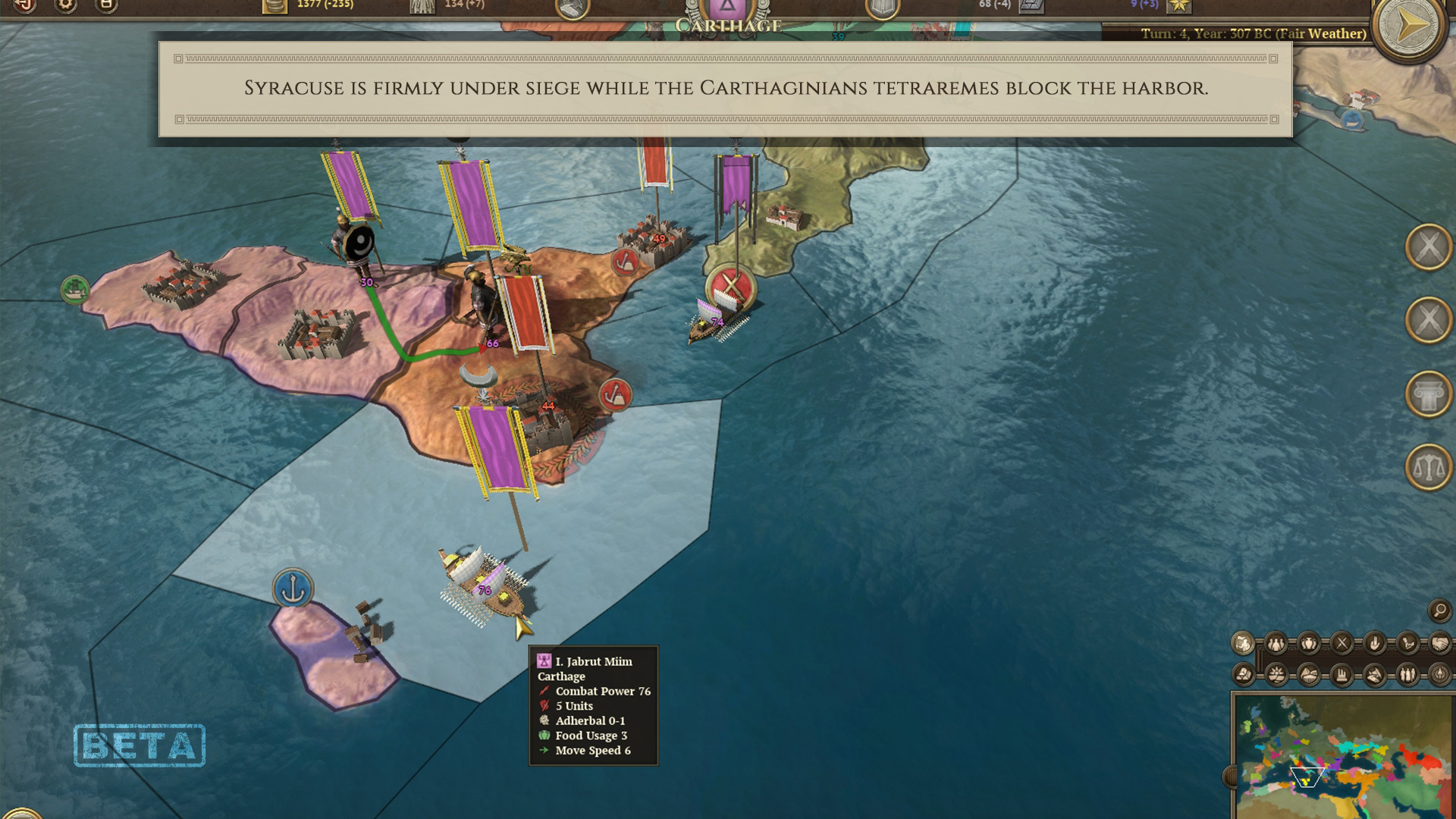
Then there is the matter of the navy. Never move unescorted your units through a sea, as this is a sure recipe for a disaster if they are intercepted. Losing precious and costly phalanxes, when their transports are sunk by humble light warships really is a waste of good men. Ships will also be almost mandatory to conduct successful sieges against cities with harbors. Don’t think you can starve a garrison that has the backup of an unblockaded harbor.
It is also said that an army marches on it’s stomach. This is quite true in Empires. Supply will be given automatically to units from adjacent friendly regions, but beyond that, if you don’t maintain your supply lines, then your units will weaken over time and will be of no use. Equally a large army in a poor region, or where the land is already pillaged, will suffer supply shortages.
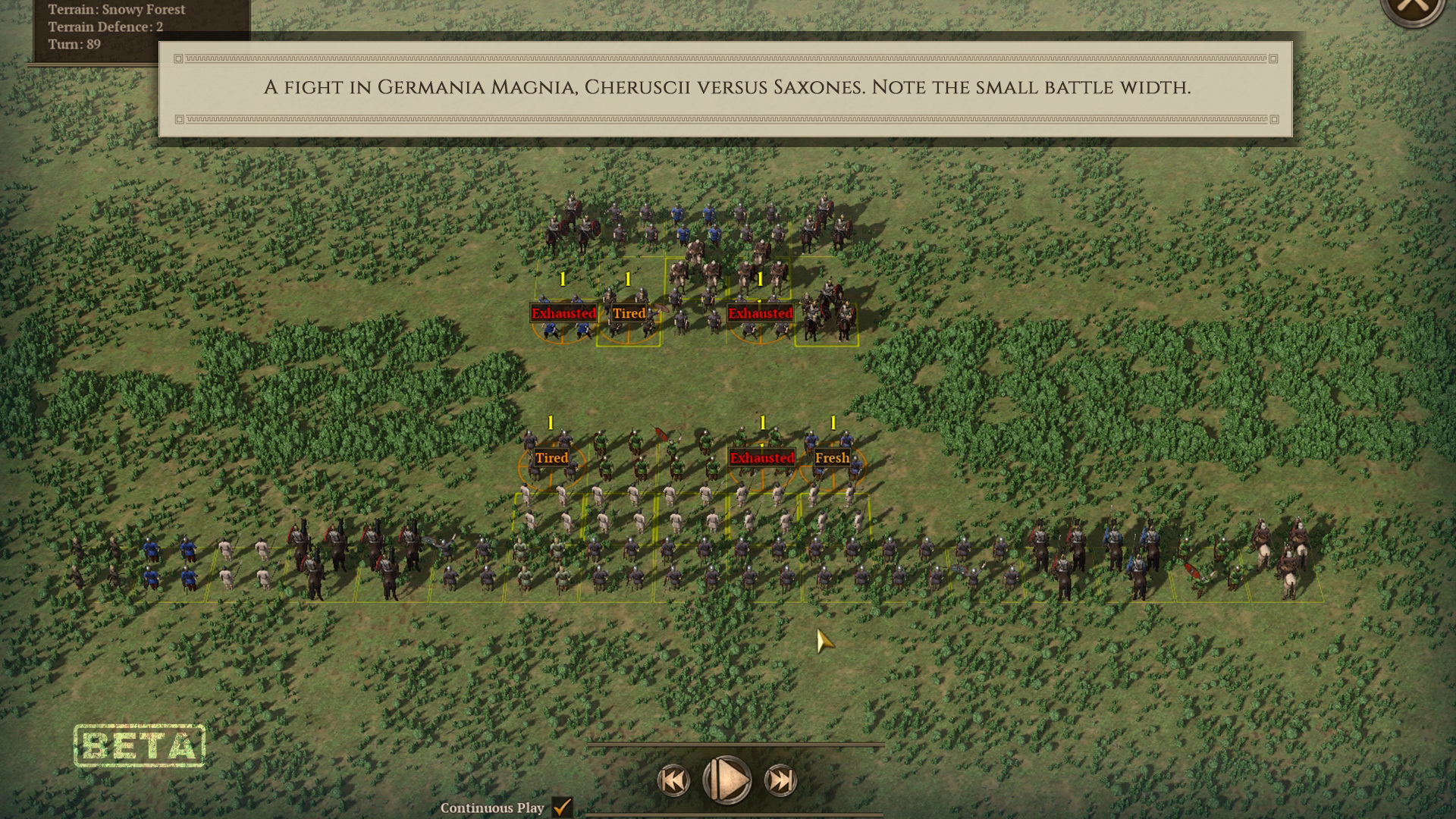
But without further ado, on to battle! Once two enemy armies meet in a given region, a battle will ensue, unless if one side has retreated behind the walls of a city (in this case there will be a siege, with a possible assault, at the besieger’s initiative). The first important factor is the terrain. Terrain has two main effects in battles: how much they provide in defense, simulating that the defender had some time to set up and prepare positions; and, what is the frontage, or battle width for the following combat. Frontage is a concept known by veterans of the AGEOD games and is very important in battles. Depending if you have enough troops to fill the battleline or not, the battle will shape very differently. For example if you are fighting in a forest, then the frontage is 6 in fair weather and 5 in harsh weather. If your army has 12 or more units, then your deployment will be optimal, as 6 can fill the front rank and 6 will provide support to the melee.
Now imagine you get caught in the open field, like a plain, a steppe. Frontage here is 12. Your army of 12 units will deploy in its entirety in the frontline! Imagine your archers and slingers to the front having to fight a melee with better equipped troops … Chances are that, unless the opponent is not too numerous, you’ll be beaten.
But frontage provides another interesting benefit to how the game plays. It really reduces the effect of ‘death stacks’, i.e. stacks that can overwhelm their enemy through sheer numbers. Because once you have filled your battle line, the rest of your army will be in reserve, and will only fight if there is a draw when they can replace weakened units in a subsequent round. Otherwise, they will do nothing (apart from cost you money and supplies). Think of the Thermopylae battle in 480 BCE as the perfect illustration of a very low frontage situation…
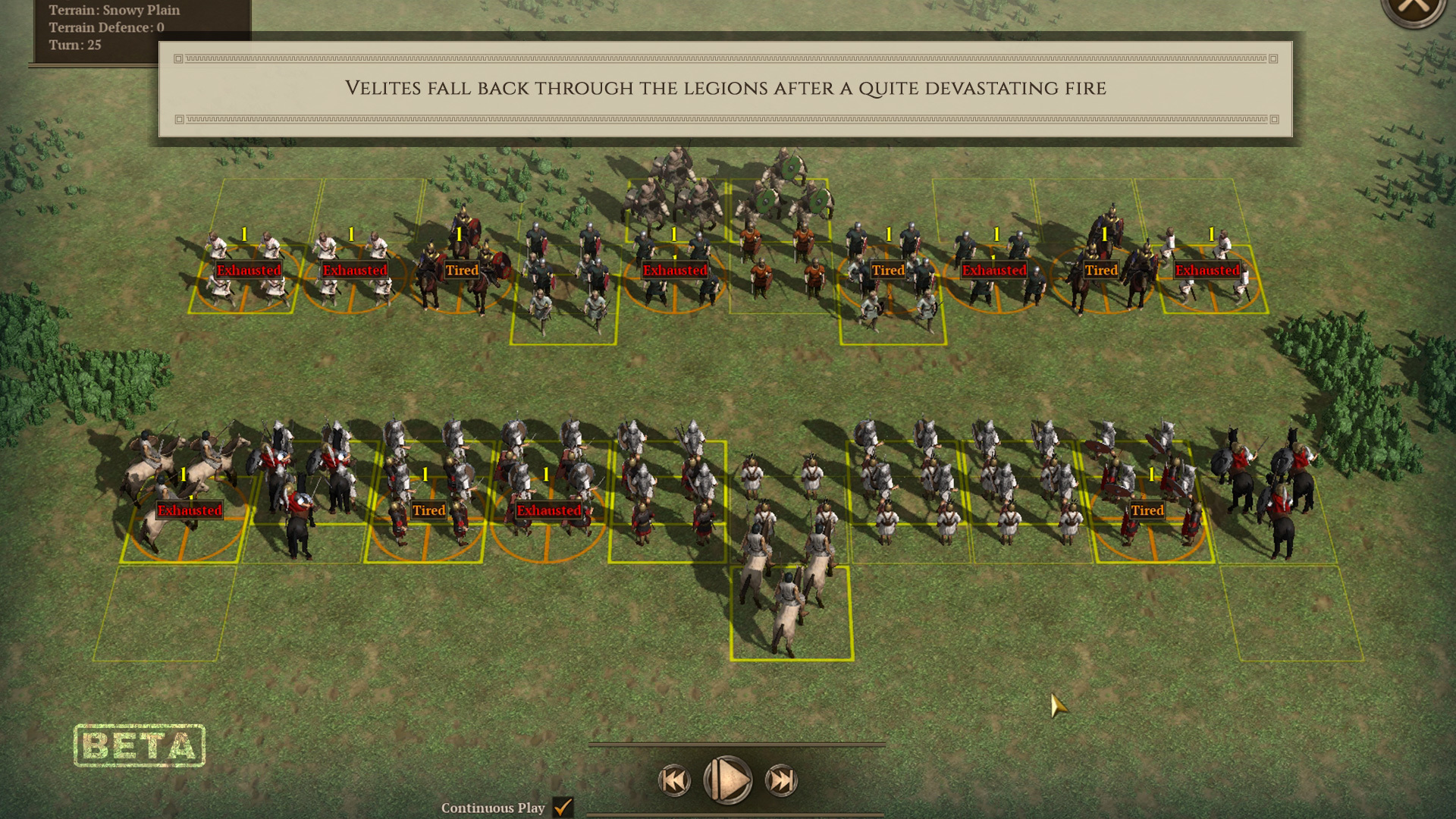
So our armies are setup, with melee units to the front and supporting units behind them. The very first phase of battle will be the ranged phase, where each unit capable of ranged attack will do so (the others will only throw insults at the other side). As a cosmetic enhancement, the skirmishers will appear to the front of the melee units, perform their attack and then retreat through the frontline to their final position at the back. That’s cosmetic, but it’s nice to watch! Seeing a line of legionnaires throwing their pilum, while the Velites to their front harass the enemy, and then fall back through the cohorts, is quite pleasing for the would-be Imperator.
hen the main phase will begin, the melee phase. There will be a series of duels, between each melee combatant of each side. If one side has extra units (because he is more numerous than the opponent), then flanking attacks happen to the unlucky wing of the enemy.
The battle system is an example of the Triangle Rule. The Triangle Rule is the very core design element of all battles. We thought hard to have a system where winning was not simply the matter of maximizing a given parameter and forcing your way to victory by exploiting this aspect. It had to be subtler. We want the player to balance and consider three things at once (so the Triangle Rule…):
How powerful a unit is;
How experienced and what is its current fighting condition; and,
How good is the general in charge
For us, it was very important that none of these 3 aspects outweigh the others. Said differently, you must design your armies and conduct war in such way that each of these 3 criteria are the best possible, knowing that having ‘only’ one of them as very good will not compensate for the others.
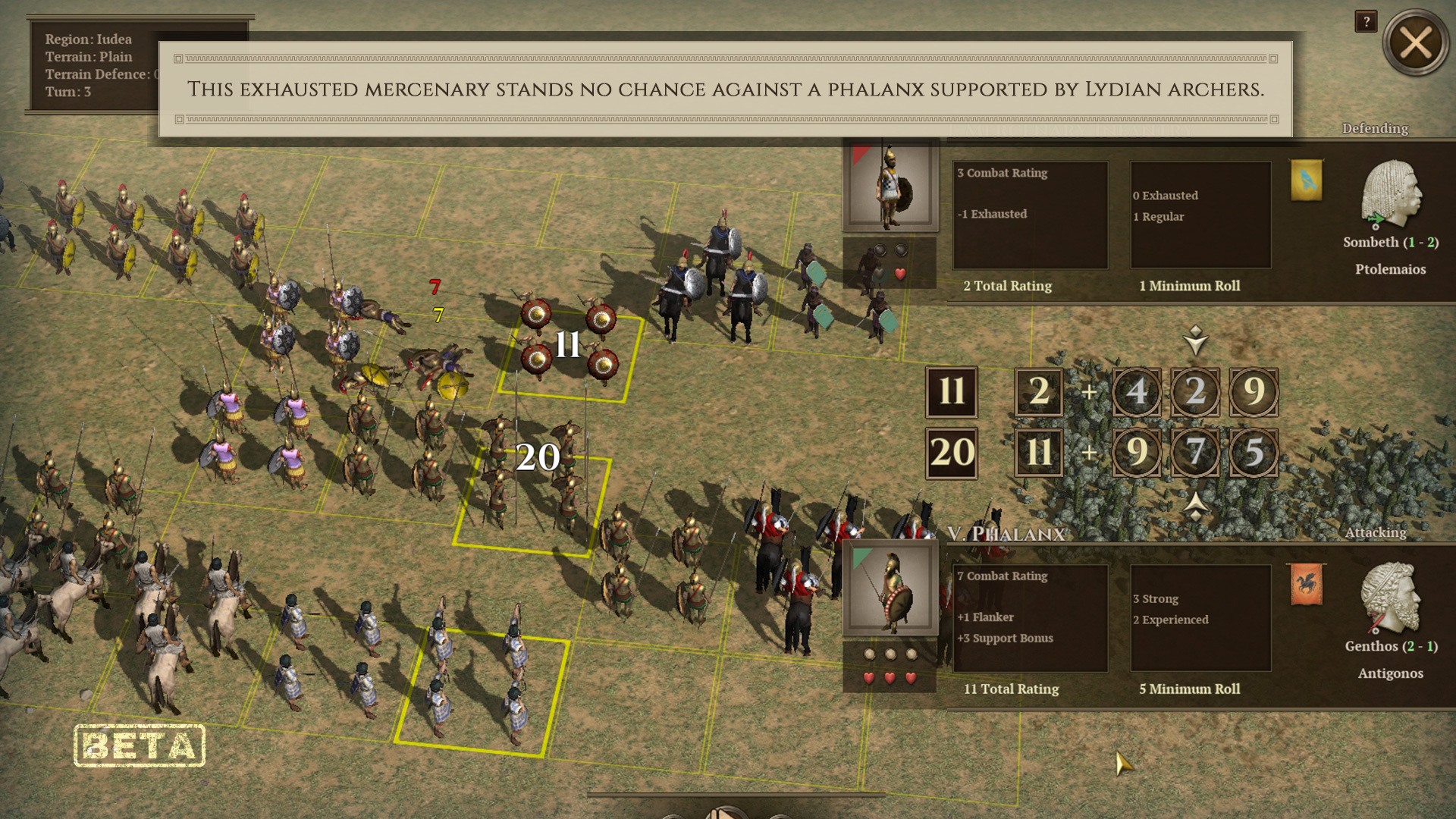
So back to our duels. The aim is to achieve the highest possible duel score. This score comes from two things: the total combat value of the unit, and the dice rolled.
The total combat value of the unit is made of the base combat strength of the unit. For example, a medium warband will have 3, a legion 5 (well, there are 3 generations of legion, so I’m speaking of the pre-Marian one here), and a phalanx 7 in attack but only 5 in defense (most units behave differently in attack and defense). Note also that this value by itself might have been modified by the terrain. A legion fighting in wood would be worth only 3, like, for example, a mundane medium infantry.
To this value is added the support value, between 1 and 3. The best support units are the Archers (but they are rare for most nations, costly and have no extra abilities). Many skirmishers will provide a value of 2, and the simple fact of having another friendly unit as a support (even another melee unit) will provide a 1. So, as you see, having superior numbers is important, but having a similar ratio of melee and support units is more important (although the melee units are more likely to be lost in combat so you need some replacements for them, even if you are victorious).
This combination of factors will tend to produce a value between 2 to 8, in most cases. Now for the second part, the dice rolls. That’s where the two other sides of our ‘Triangle’ kick-in…
Each unit will add up his best dice (ten-sided dice) to his combat value. And a unit will get one dice roll plus one per rating of the general in charge. This rating varies from 0 to 2 (again generals have attack and defence scores and will use this is appropriate if they are leading the attacking or defending army). So the best general would be a 2-2 general, with this possibly modified by an appropriate trait (many Generals are better – or worse – in certain circumstances …). Now there is an added twist to the formula, and this is where unit experience and effectiveness (a combination of fatigue and morale) comes in to play, the third and last facet of our Triangle rule.
From all the dice you roll, between one and three depending, each one is re-rolled until at least a minimum value is reached. And this minimum value is given by the sum of your experience and effectiveness! Let’s take an example. A veteran German warband has level 2 of experience and has an effectiveness of 3. It means that you are guaranteed that each of your dice roll is at least a 5! If now you have a good general, like a rating 2 general, then you get to roll 3 die, and you take the best. Chances are that the ‘random part’ of the duel will be from 8 to 10 reliably! Then this random part is added to our final combat value, and you get our final duel score.
And that’s how you can end up with Germanic warbands fighting in forest with a competent general soundly beating Imperial Legions led by a complacent and not that skilled Consul.
Although this appears to be an extreme case, be assured that if you understand and play with the system, you’ll be able to achieve your goals much more easily, and with much less resources committed. And sometimes, in single player against the AI or in PBEM against live opponents, this will definitely be the difference between victory and defeat.
There are others features for battles that play an important role too. For example flanking units, if your opponent is unable to fill out (or if you have destroyed some of his units in the early duels) all the line will play a significant role. Skirmishers will fatigue their opponent, even if they get defeated. Cavalry can evade some damage if they fight slower units. Now combine several traits in one, and you end up with units like Horse Archers, in the Parthian or Nomad style, that add insult to injury by hitting you with arrows while avoiding most damage in return. So your powerful legions are vulnerable to particular opponents in the terrain where they, this time, have all the advantages.
We think, and our beta testers do too, that Empire’s battles are quite fun while being involved, with some real thinking to do if you like to fine tune your armies (and if not, that’s ok too, but it will be prudent to play against an easy AI until you learn the ropes of the system, as the AI can be quite relentless). But there is more, as you probably know. Most of the battles of Empires can be alternatively played in Field of Glory II, as fully developed tactical battles and the result will be ported back into Empires once you are done. And there is no need for any DLC from FOG2 to get all the possible units from Empires. So … best of both worlds?
Field of Glory: Empires - Ranking and videos
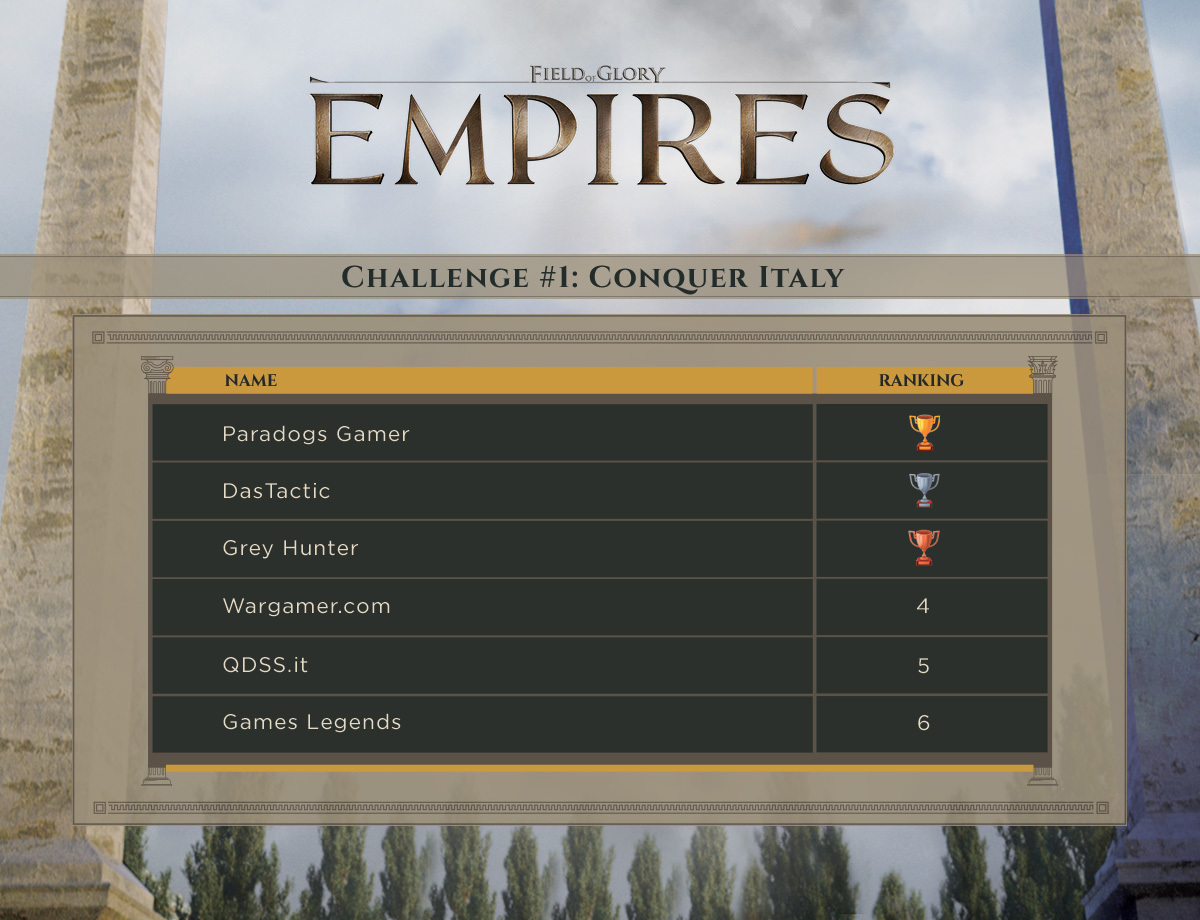
We have the final list of the participants who completed the Challenge #1 – Conquer Italy playing as Rome in as few turns as possible.
It was a bitter fight and many valorous soldiers have died trying. But what are they compared to the sempiternal glory of Rome?
This is the final ranking, kudos to all the participants!
Field of Glory: Empires - The Challenge has been accepted
Field of Glory: Empires is a very ambitious project. It’s perfect combination between empire management and grand-strategy, united to a set of unique mechanics, will set a new standard for strategy games.
To better introduce players to this upcoming masterpiece, we have launched a great Challenge series of events, inviting influencers and media members.
We have gathered in a playlist the main efforts played so far, so you can have a look at first hand how the game unfolds, even in more strict environment.
Field of Glory: Empires - Challenge 1 with DasTactic
Watch DasTactic playing Challenge #1 of Field of Glory: Empires!
www.youtube.com/watch?v=1sSomUSZgrs&t=14s
Here are the rules:
- Conquer Italy playing as Rome in as few turns as possible
-The map is locked to the Italian Peninsula and its closest surroundings.
- All mechanics and features are active
Who can join?
Influencers and media members. The participation is mainly by invitation, but if you think you qualify to compete, write to us at challenge@slitherine.co.uk, with your name/nickname and your channel/media.
If you want more info please visit http://www.slitherine.com/FogE_Challenge
Field of Glory: Empires Dev Diary #8 - Legacy
Winning the Game
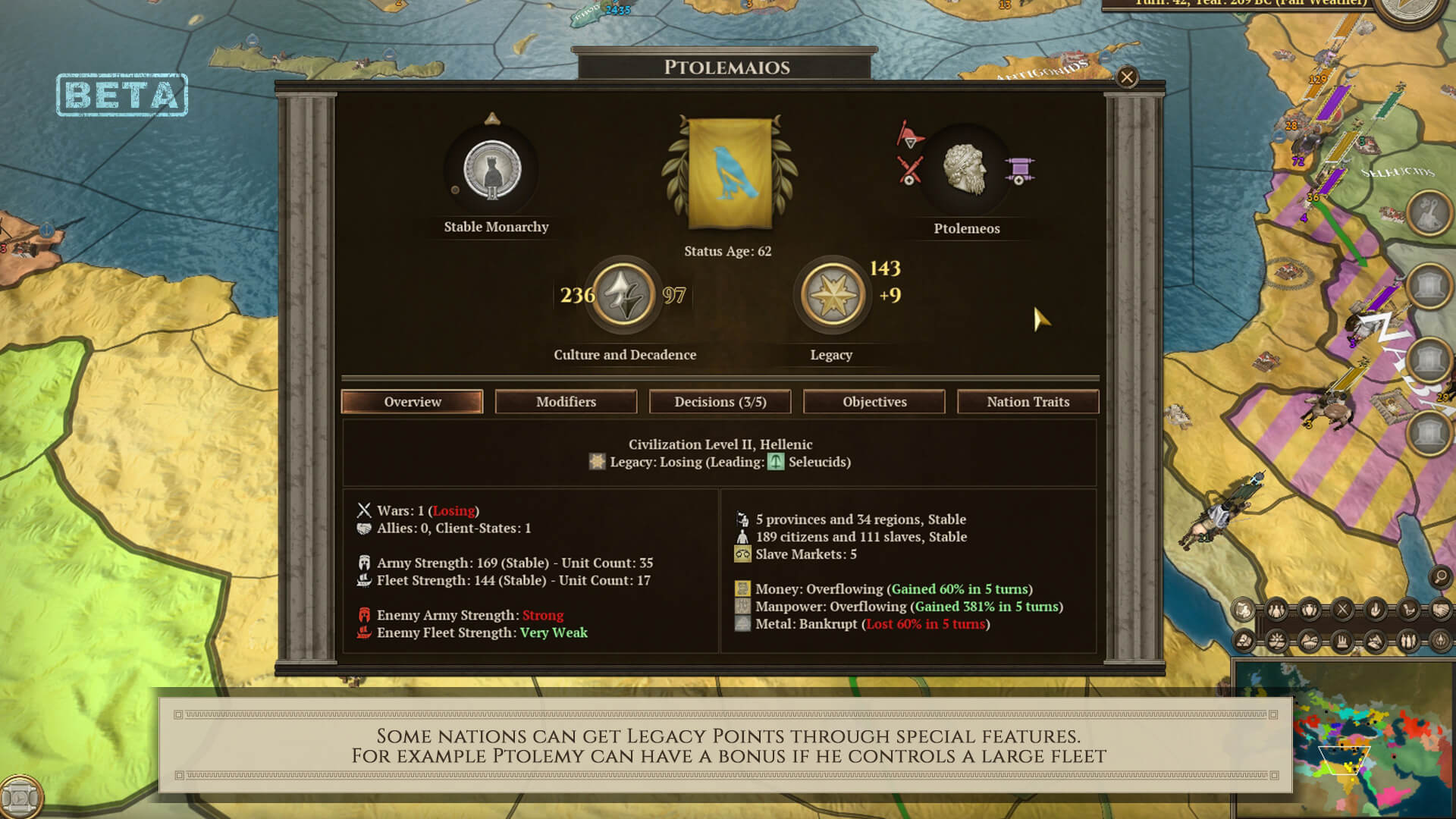
In Empires, you are building your nation so that it endures the passage of time, and your achievement is measured through the legacy you’ll leave, even if in the end, your nation is no more.
There are several ways to achieve this goal of being first in Legacy. It’s not just something to be only achieved by conquering part of the map, although that approach remains a possibility, rest assured.
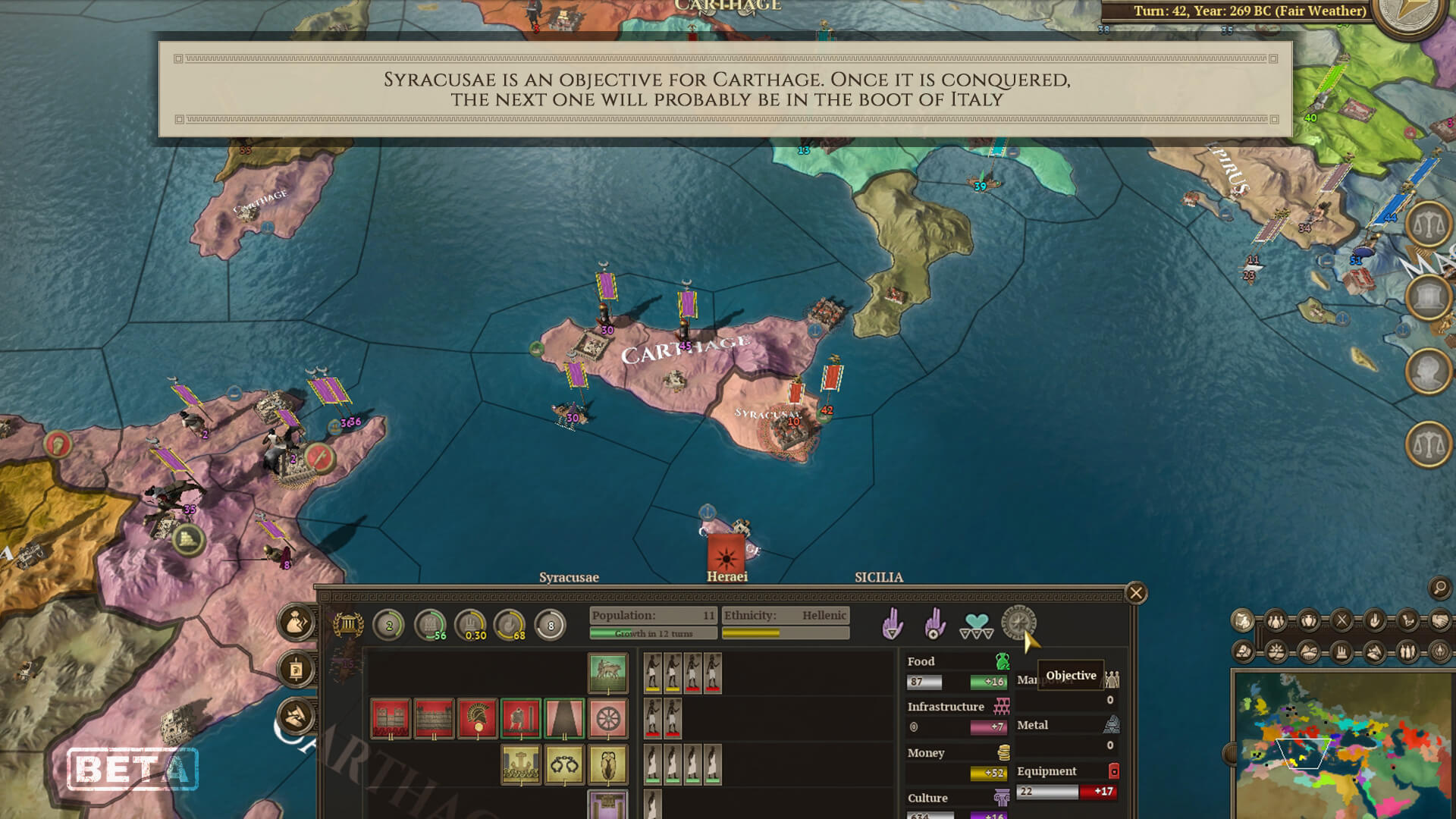
If you take a military approach, then you’ll want to plan your campaigns so that you conquer and hold your objective regions. These regions are set for each nation and represent loosely their historical progress or areas of interest. Some nations will have objectives set in a concentric way, around their capital, so they will expand outward in each direction.
Other nations have several possible ‘tracks’ to follow, and when they get an objective in one of the tracks, then they are provided with another.
For example, Rome has a track that represents its progress against Carthage, including Spain and Africa. Another track will let the Republic fight Epirus, Macedon and then go to Asia Minor, and so on.
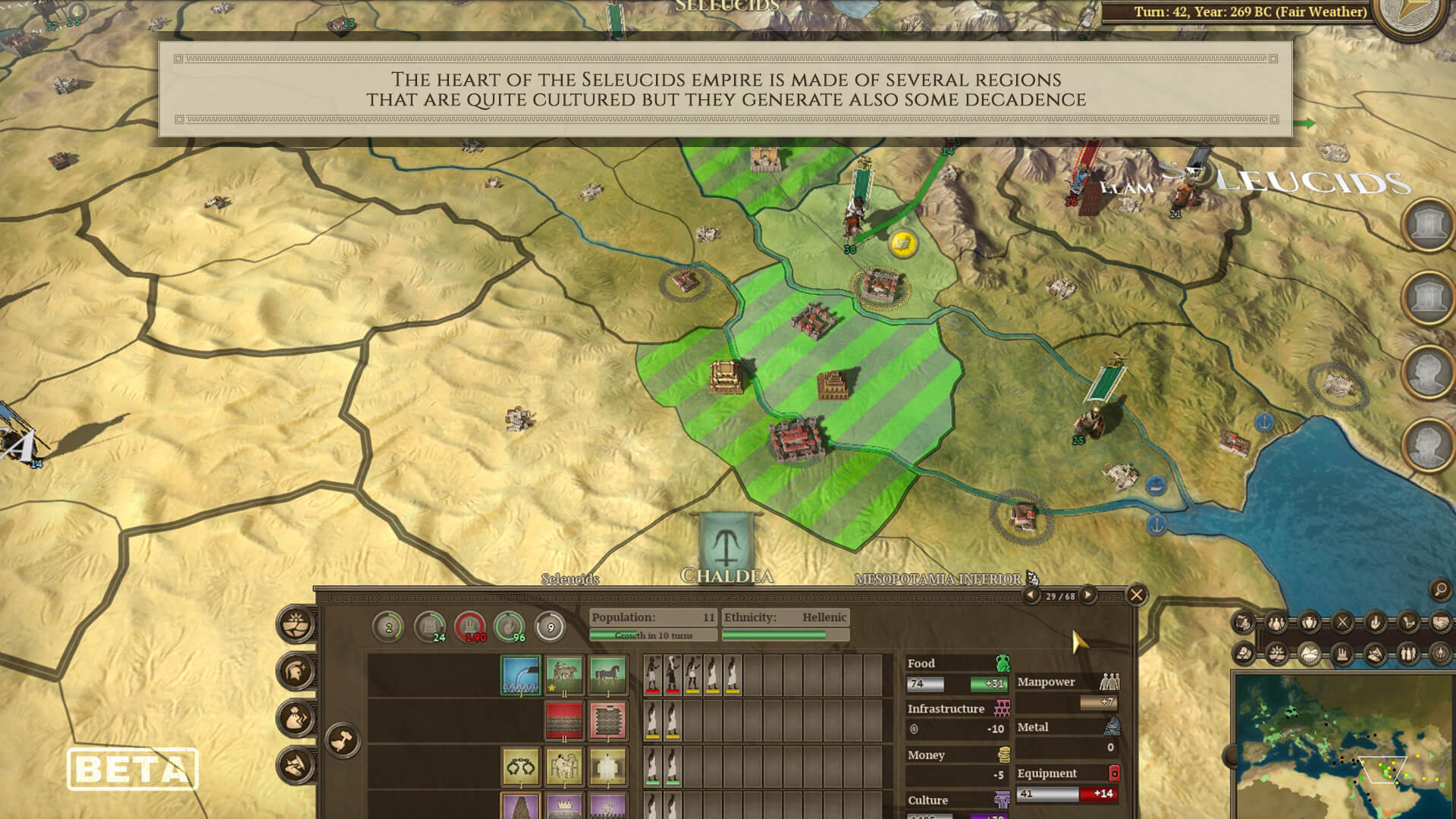
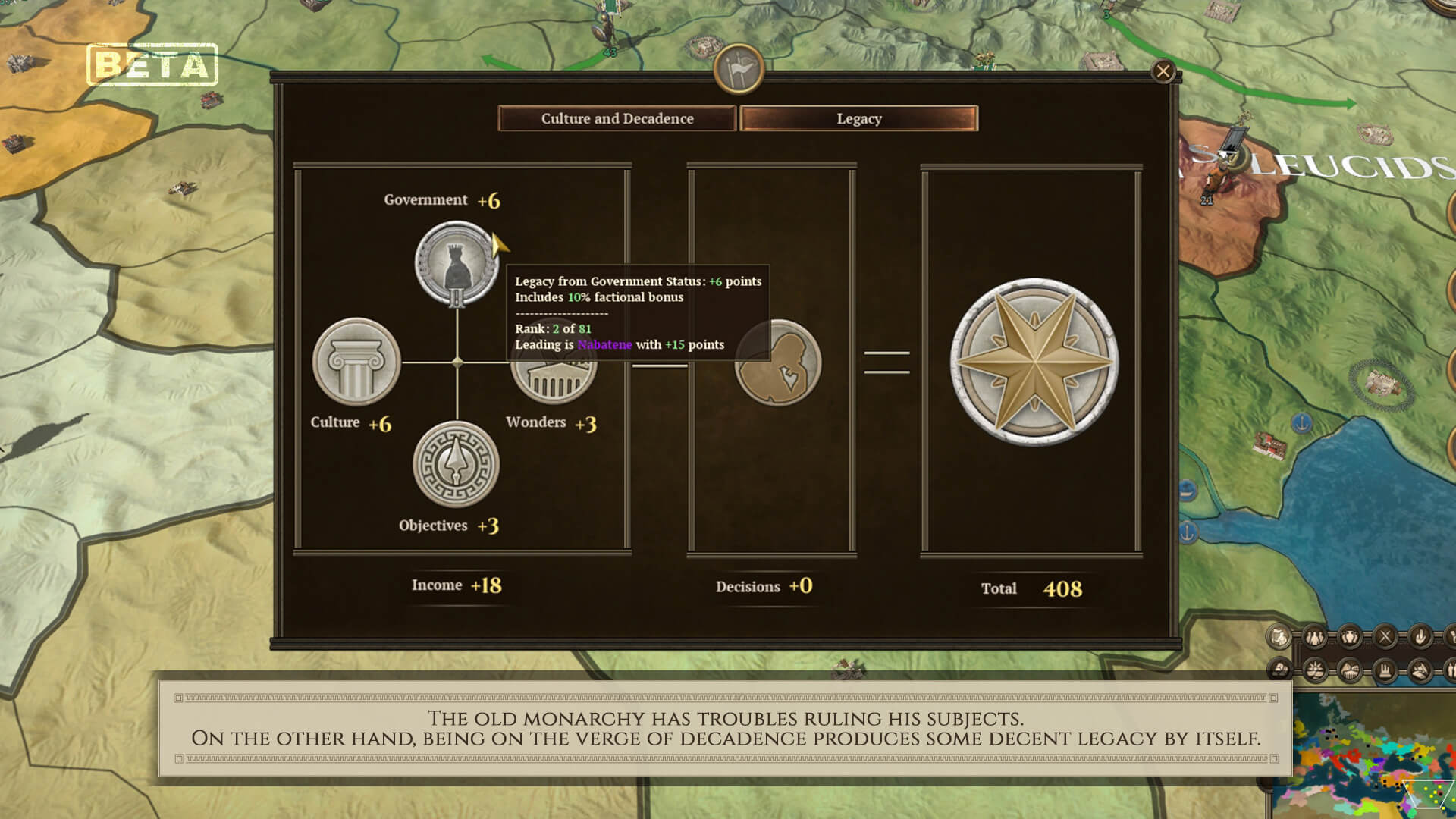
Another possible approach to gaining Legacy is to make your regions very cultured, so that they produce legacy points by themselves. There are two levels here, and both demand substantial investment in the right buildings and decisions with the second level being quite a challenge to achieve. But if you devote your nation to the creation of prestigious buildings, it’s a possibility.
Yet another option is to pursue actively those national decisions that provide Legacy Points. These can include domestic reforms, or mounting a far away expedition to the border of the known world.
A final way to generate legacy is to try enduring the difficulty of managing a nation past its glory. Like Sparta perhaps, that clung to life for centuries well beyond its climax. This has no doubt left a lasting impression to the future generations, as few people know nothing about Sparta, even nowadays. Practically speaking, when your government is old or decadent, each turn you manage to survive the vicissitudes happening to your nation, then a significant amount of Legacy Points will be given.
If you can build, and sustain, a substantial legacy lead it is possible to win the game before its actual end-date of 190 CE. This might reward a high risk strategy where you try to gain legacy quickly and accept the inevitable problems such a focus will bring. A modern equivalent of the traditional Spartan instruction to ‘return with your shield or on it’? Equally possessing substantial amounts of legacy will help you during the game as there are a number of rewards to being seen as an impressive state by your contemporaries.
So the game is much more about painting the map in your color. Even if in the end all nations are trying to generate more legacy than their rivals, you can still get these points from different approaches, although admittedly it is probably better to try a balanced approach perhaps with a focus on one.
Field of Glory: Empires - The Challenge
Fied of Glory Empires is surely a very ambitious project, aiming to bring to life the ancient world and its civilizations and to recreate the cultural intricacies of that time.
To better explain the complexity an the scope of the game, we started writing a series of dev diaries covering the most crucial points around which Field of Glory: Empires is designed.
Today we would like to expand this experience further. Welcome to the Challenge!
The Challenges
These are a series of events focused on special versions of the game. They are designed to explore step by step the game's mechanics but with a twist. These versions have certain areas and features locked, while others are allowed.
But what kind of challenge are we talking about and who can participate?
There is no better way to explain them than having a look at the first one:
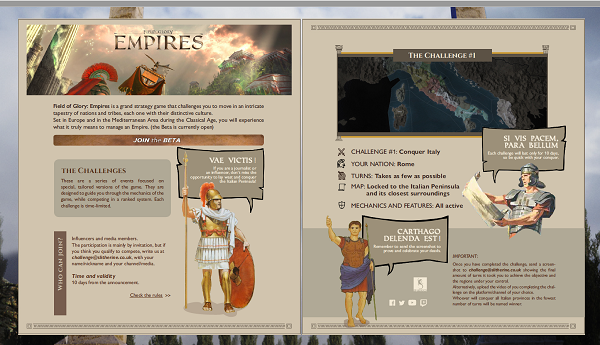
Challenge #1: Conquer Italy playing as Rome in as few turns as possible
Nation available: Rome
Turns: takes as few as possible
Map: Locked to the Italian Peninsula and its closest surroundings.
Mechanics and features: All active
In this race against time, there is room for only one winner.
Who can join?
Influencers and media members. The participation is mainly by invitation, but if you think you qualify to compete, write to us at challenge@slitherine.co.uk, with your name/nickname and your channel/media.
Time and validity
10 days from the announcement.
In the 10 days of validity, we will gather the videos or the screenshots proving the completion of the challenge and will assign the scores. After all the Challenges have been played, we will declare the final winner by calculating the cumulative points gained in all the episodes.
Check all the rules here: http://www.slitherine.com/FogE_Challenge
Are you eager to see the Challenge in action? Then don't miss DasTactic tomorrow April, 9th attempting it on our official Twitch Channel at 6 pm BST / 1 pm EDT / 10 am PDT
Dev Diary #7 Provinces
Scaling up your Empire: Provinces
One of the common issues for strategy games is moving from a small nation with a handful of things to do per turn to a bigger one with dozens of decisions to make. What was fun and thrilling in the early game, like deciding if you want to build a cattle ranch or a sawmill becomes more mundane. And yet, sometimes for specific reasons, you still want to check, as the wise ruler you are, what’s going on in a precise location.
Many games try to create tools for this reduction in micro-management. But most if not all adopt a ‘forced approach’, where at some point the game tries very hard to make you do things in a very specific way. In Empires we decided that you can eat your cake and sell it too … with Provinces!
Provinces are a grouping of regions, the basic geographical unit in the game. You can create a province when you have at least 51% of the regions belonging to the same provincial area. These are fixed on purpose, because they are grouped logically and historically. Plus, there are a few perks attached to them, like a regional unit. For example, the Sicilia province is made of 5 regions, the ones making up Sicily plus Melita (Malta). In our case, having 3 of these 5 regions allows you to create the province.
At this point many of you will think: “I don’t want to create a province and have my precious regions handled by the AI”. And some might add say, “by the stupid AI”
So let’s talk about eating your cake, and selling it. Twice! First, we adopted a reverse approach to how other games try to reduce micro-management. Creating a province provides bonuses. Not creating provinces mean you don’t get bonuses, but you don’t suffer any penalty. If you don’t want to create any province, then that’s fine, have it your way. But you’ll want to create them, believe us.
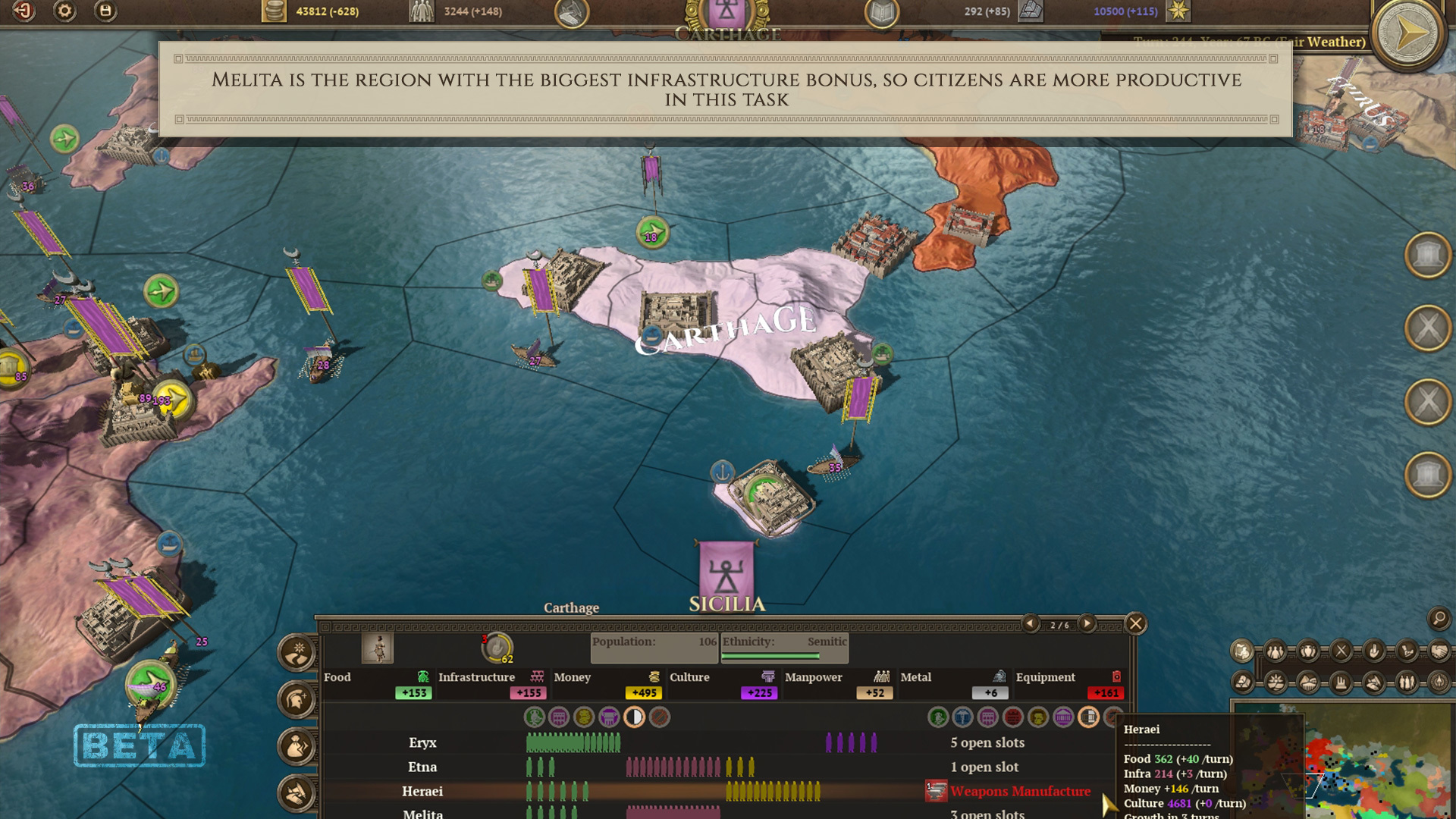
One of the reasons is that when regions are handled at the province level there is no mandatory automation. A region, as part of a province, can still be accessed and have all his population reshuffled to your liking, and you can order the buildings it should construct as before. But should you don’t want to do that, then you can use the Province panel to decide what the governor AI should do. For population and for buildings (one set of options for each), you can decide that the focus should be on a job (like producing more money, or constructing extra agriculture buildings). You can also decide to have the governor try to balance production with the needs. Here, the not-that-stupid AI will take into consideration the need at the region level, for each region, and at the national level. So for example if you have a severe lack of money, then clicking on balancing will result in more population than usual put into the money-making job.
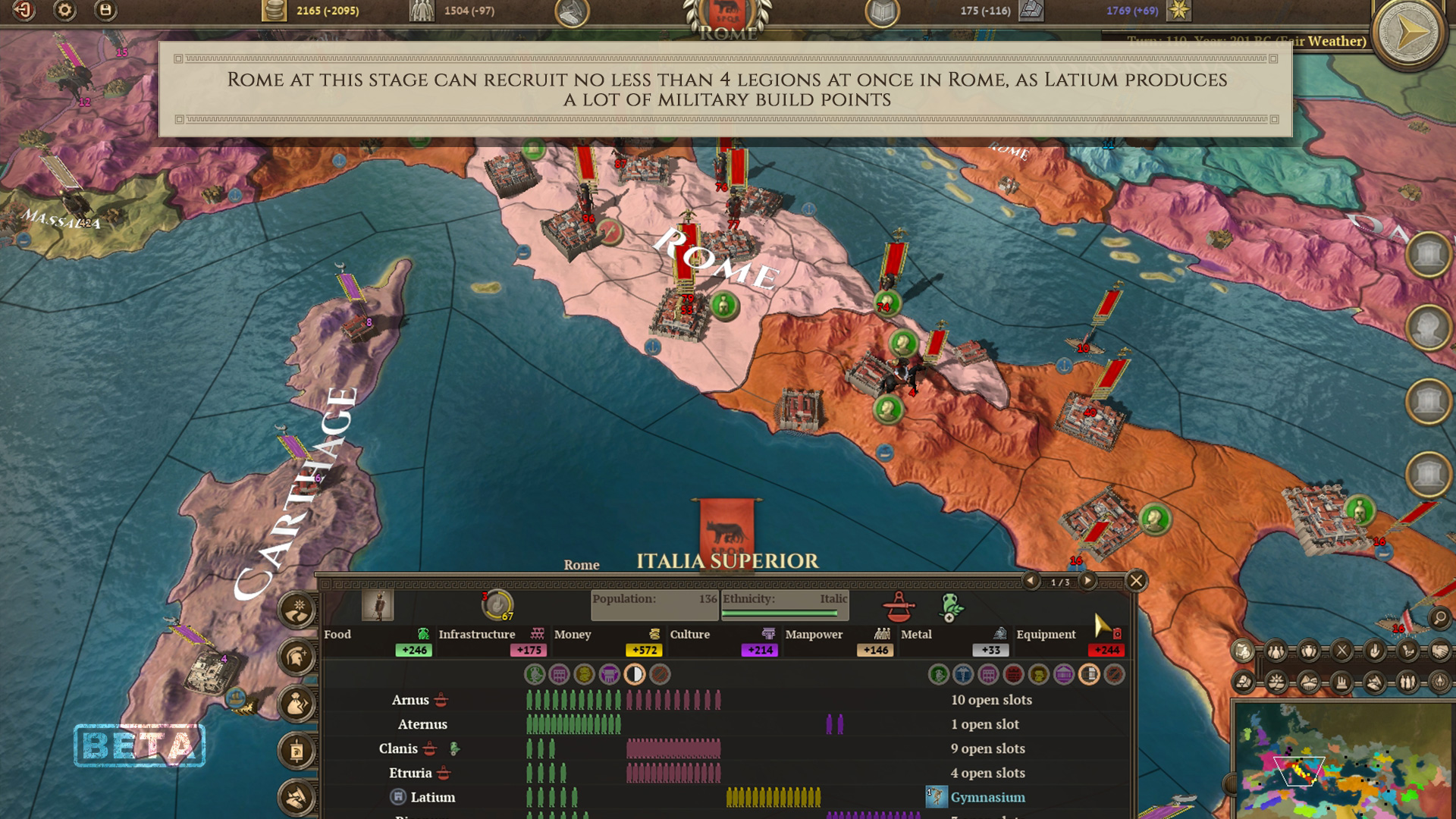
The AI will also check your upkeep, so as not to overbuild structures that you would have trouble maintaining. It is even capable of checking which of the regions have particular bonuses and have them focus on something specifically. If you look at this screenshot, I have requested a balancing of production for Sicilia. And yet you see we are far from having the population split evenly within each region. For example, Melita has a lot of people in infrastructure. If you checked Melita specifically, you would see that the region is the one with the biggest Infrastructure bonus within the whole province!
So all in all, we believe these AI governors do quite a decent job. We will be honest (sometime it pays off ), the AI is not equal to a veteran player who can fine tune everything each turn. But it plays like a competent opponent…
As you see, Province management has never been so easy. You can automate in different ways, including handling everything manually. But there is more. There are province-specific bonuses.
A Province pools some of its resources and then redistributes them either equally (for food), or where it is needed (for infrastructure). So for food, it means that regions with poor land (like a mountain or an underdeveloped forest region) will benefit from the food sent by other regions, within the province, helping them grow. Also, if you have large body of troops, it might be difficult sometimes to sustain them from a single region. With a province, supply will arrive from several regions, easing the logistic challenge of feeding your army.
As for infrastructure, all regions can help the process of creating new buildings, so you end up with your structures built much faster, in a more focused way. And again, you might use this trick to funnel infrastructure from powerful regions to a poor one, helping it develop much faster.
Recruitment is also handled at the provincial level. Each province has a provincial palace, and this is the place where all units are recruited. And each province has its own special ‘provincial unit’ that you would not have access too otherwise. For example the Africa province (centered around Carthago) would provide African War Elephants, to any nation holding it. Or Crete will allow the famous Cretan slingers…
All in all, we have tried with provinces to provide you the tools so that your games scale up well when your empire grows, while staying as discreet and unobtrusive as possible, for people who like to micro-manage. We hope that you’ll come to appreciate our Province system as much as we do!