Genre: Role-playing (RPG), Hack and slash/Beat 'em up, Adventure, Indie
Greedventory
Greedventory at the Steam NEXT FEST!
Greetings, adventurers!
The time has come! Steam NEXT fest is upon us, and so, we are providing you, the player, with the chance of playing a demo version of Greedventory, before the game launches on April 20th.
Alongside the demo, our very own developer Kate will be playing the game, fighting nasty foes, explaining some mechanics and telling some stories about the development of Greedventory!
We are very excited to take part in this event and get you a chance to experience the game!
We hope you enjoy what we have in store for you!
--The Greedventory Team
Greedventory Developer Gameplay Stream!
Come watch one of our developers Kate play Greedventory!
Greedventory Release Date Reveal!
Greetings, adventurers!
We are buzzing with rightheus joy to unveil the release date for Greedventory, along with a brand new trailer, showcasing new gameplay, mechanics, and evildoers to slay!
So, put your weapons away for two minutes, and feast your eyes on this:
https://www.youtube.com/watch?v=2svFoE8zlcU
And we hope to see you in Greedfort on April 20th, 2023!
-- The Greedventory Team
Greedventory Devlog #3: Art
Art of Greedventory
Greetings, heroes! Welcome to the latest Greedventory devlog, this time focusing on art, animation, and other effects we used to make the world of Greedventory come alive.
As you probably already noticed, Greedventory is a very art-intensive project. Everything here is done in high-detail pixel art and since the game is combat-oriented, we encountered a lot of challenges for implementation and organising the work processes.
Both of these reasons led us over time to creating rather complicated art pipelines, which went through lots of iterations and transformations before the current state. Pipelines are key in gamedev overall, all your planning and estimates and the very possibility of delivering the game can easily be put into question until you find the right workflow process, and also many problems are solved through them.
We can say with a lot of pride that we have a small but magnificent team of artists working on the game, so let's take a dive into some of WHAT they do and HOW they actually do it.
Animations
When it comes to pixelart, especially the very detailed kind we're drawing here, one could never overemphasise the amount of work done by hand. When it comes to ANIMATED pixelart - and your only option here is frame-by-frame animation - this workload grows exponentially. Especially with the large enemies and bosses - there is SO MUCH TO DRAW.
But then again, the game is about combat, so the attack timing, the wind-ups, the subtle expressions and feel of it all should be perfect. So when we used a more standard pipeline - concept, drawing, then assembling in the game, and then balancing - all the tweaks were made after drawing all those large spritesheets, so it was a huge pain for the whole team to figure out.
Over time we've tried a lot of tricks, workarounds and just overall learned to streamline and improve this process, and the last version of it is what worked best, so, here goes:
First, of course, come the concepts.We come up with an idea of who the character will be, what they will look like, what weapons they will use, and then the process of finding references, drafts and iterative detail improvements. And a lot of emotional hand-waving over video-calls between the CEO (who happens to also be the game director and visionary) and the Lead Artist. Things get heated sometimes which is really fun to observe as a side viewer :)
When the concept is ready, what we actually have is one sprite (or an idle animation) of the character, so to make him able to fight vigorously we still have lots to do.
Here’s what happens next:
Firstly, the new enemy (or boss) attacks are designed in a special Dummy tool. No visuals here for now, the attacks are displayed with knives, and the game designer has ability to change and tune attack patterns. This helps to understand the timing and dynamics and variety of the attacks.
After that comes the concept of animation - only stick figures, nothing is drawn in pixel art for now. This stage defines the animation dynamic, and serves as the draft, the skeleton on which the actual flesh will be drawn after. This step undergoes lots of reviews and discussions and after everybody is happy, we can move on to the next phase.
Well, and now goes the actual sweat and blood - the process of hand-drawing all the frames one by one. (Personally the author of this log still doesn't have a clue how the guys can handle this ;) ). Of course, each move is reviewed during this step and some changes can still occur, but the main accent points of the attacks, the timing and the movements are already defined by the previous stages, this is the factor that helps us tremendously.
Backgrounds
Another huge undertaking is backgrounds. While not animated they are still incredibly LARGE and are the primary mood setter in a given location. We've got layered and parallaxed backgrounds here (and some are actually foreground layers :) ). The pipeline here is more conventional - concept and references first, then drawing and tweaking. Still, there are a lot of tricks used and hidden pitfalls which at some point we've fallen into, as well as lessons learned along the way that were used while developing the game further.
For example, when we got to camera shakes and large arenas it appeared that we'd drawn not enough - while shaken vigorously the camera caught the areas around the existing pictures, so we had to expand those on all of the locations we thought were already completed. Oops
One more thing to note: the parallax is a rather complex undertaking and with our artists being somewhat pedantic, there were often clashes with the programming team on the way the backgrounds are implemented into the game. So we had to give them tooling to be able to assemble the location references in the game engine themselves! Our work then is to expand those into the actual levels, connect everything and make them work. And, of course, to stay vigilant and not mess up the layers! :)
Dynamic Lighting
While we go to great lengths to make sure the art looks great, there are some factors that interact with it that may distort the way we intended it to be seen, like lighting. For example, what happens when some light shines on our pixel-art? A poorly done lightning job might ruin everything the art designers worked on for a long time. So we've put A LOT of hours into technical art too. First of all, to make something able to be dynamically lit you should draw normal maps (so yeah, one more shout out to the pixel guys). And this goes not only for the backgrounds, but for characters and decorations.
And then you have to have a true technomagician who can write clever shaders, which will make this work. Those are really fancy as they can do backlighting and combine lots of light sources.
And there you go, just add lights to your scenes and watch the magic happen.
Also you can try to add a light source on your weapon when it's charmed.
Volumetric Lighting
One more trick in the technical art palette are the Volumetrics. They can add so much atmosphere and feeling to the scene, that once you see them you can never go back to living without them. Check out the difference and judge for yourself:
Before After
FXs and post processing
Okay, so we've got the setup, the atmosphere and actual fights, but what makes them _REALLY JUICY_ and enjoyable? Yeah, the visual effects of course. We use all flavors here - particle systems, shader effects and drawn sprite animations - all of that combined gives us the juiciness of combat and the ability to improve and push it to the needed level.
3D
It's funny to find this out while working on a completely 2D game, but we use 3D a LOT in the working process. Our artists use a handful of tricks with that. For example, some backgrounds can be modelled first to outline the space, the viewing angle, the light, and only then (after conversations and reviews, of course) redrawn by hand into a game sprite based on those reference models. It's still a complex process and unfortunately, you cannot just outline a screenshot with pixels and get a nice result, but it saves time as the main search is done before the pixels are started and brings the overall quality an extra notch up.
Along with that it helps with understanding complex motion, so the objects are often modelled first.
That’s it for this devlog, we hope you had fun getting an inside look into Greedventory’s art processes!
Thank you for tuning time, and we hope to see you in Greedventory very soon! 🙂
–The Greedventory Team
Greedventory at The Eastern European Game Showcase!
Join us in the Eastern European Game Showcase Celebration Stream!
Greedventory Devlog #2: The World And Its Inhabitants
The World of Greedventory and Its inhabitants
The world of Greedventory has a long and tragic history, though most of it has been lost to the ages, forgotten by most. While there is not much known about the early centuries, there is one thing nobody dares to forget - the cataclysmic event that almost ended the world - known to the inhabitants only as the Great Roll.
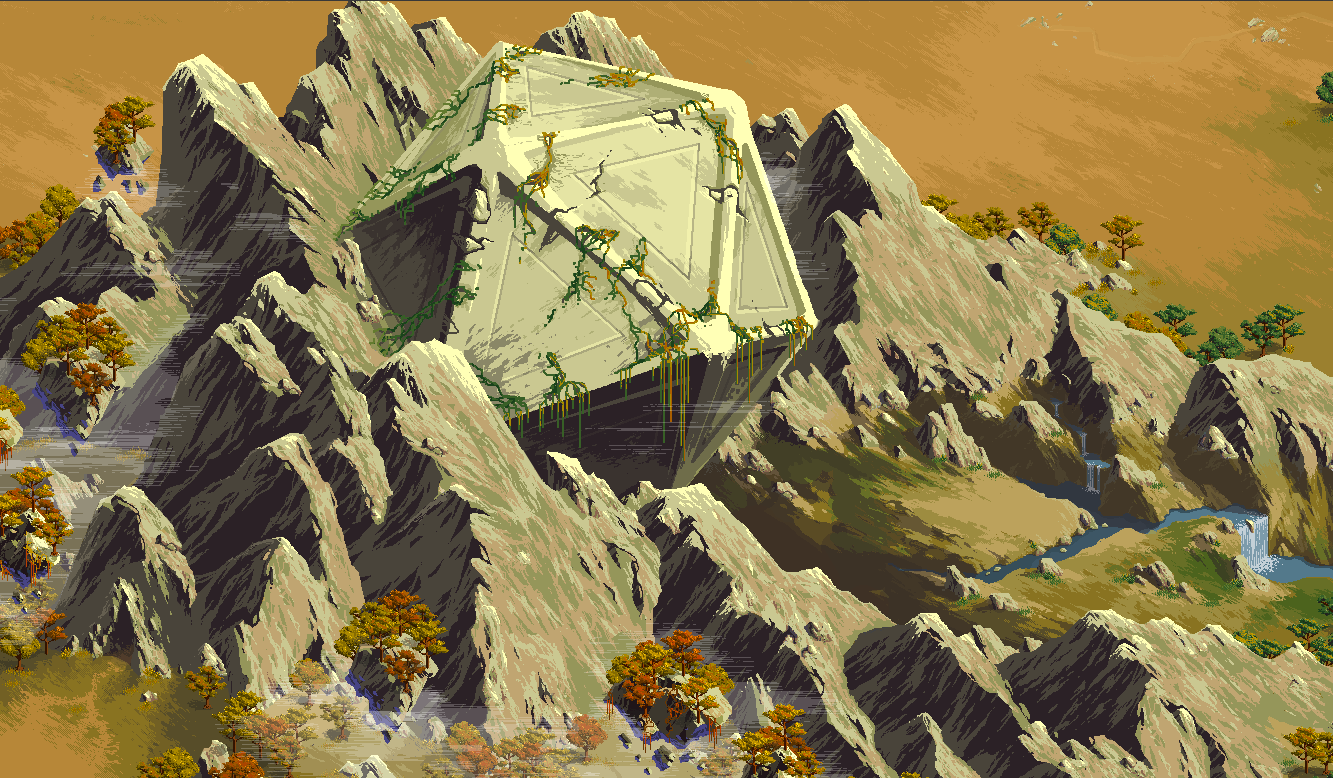
The surviving records only state about a great celestial body of an unknown nature, colliding with great force into the world of Greedventory. Now, just like mountains, it’s been accepted by nature, and lures explorers, scholars and adventure seekers with the promise of riches, power, and knowledge. Now, no-one knows what the object may or may not contain, but people, being people, assume there’s untold riches to be discovered, and are willing to forego their own safety in pursuit of the unknown.
Sages worked tirelessly trying to gather any knowledge about the object for ages now, but it seems that all of their efforts have been in vain, as basically nothing has been discovered. Along with its mysteries, It radiates magical and magnetic fields - proving fatal for those daring to approach it - so no mortal has ever been able to get inside.
To put it into more modern terms, It's more of an exclusion zone now, dangerous, and mostly abandoned.
Still the research goes on. It used to go a lot more effectively before the creation of the Igneous Sigil Brotherhood, a not-so-secret society hell-bent on acquiring all the magic in the world and keeping its power to themselves. To further their goals, they suppressed or exiled most of the magical institutes of the world.
The Great Roll, in its wake, covered the world in foul and dangerous beasts, magical vessels of power called Artefacts, and, of course, villains, seduced by the promise of uncontrollable power.
And, naturally, after a while these conditions produced an opposing force, an antithesis of the roaming evil: heroes and brave adventurers whose destiny was to free the lands, slay the monsters, and bring the power back to the people.
That marked a time of heroism and adventure. A lot of heroes were doing their heroic deeds defeating villains and evil creatures all over the realm while also ‘taking their cut’ of powerful artefacts, magic, and gold.
True and successful heroes, however, were not travelling alone. They were accompanied by the Imps - creatures of unknown origin and age who somehow possessed heaps of knowledge about heroic quests and hideous villain lairs. Some say that they have an invisible connection to the celestial Object but they've never shared this knowledge to anyone - neither mages nor their fellow heroes.
And there was one - the mightiest and most glorious of all heroes, whose legends about saved lands, slain villains and monsters were much greater and MUCH more glorious than tales told about the lesser heroes. Legends called him the First Hero. He has spent decades among his brethren on a heroic path but after some time came to a realisation that common people, mages and even heroes themselves are stockpiling huge amounts of dangerous magical (and not-so-magical) items. And knowing people, they will use and abuse such items to inflict harm to themselves, as well as others.
His new quest to protect the common folk not only from monsters, but dangerous monsters, and most importantly, themselves.The Hero quickly found many like minded allies and followers on his travels.
The Igneous Sigil Brotherhood was born - right upon the gaping throat of a monstrous volcano - where righteous flames were used to destroy magical sources of corruption. The Brotherhood's power grew swiftly and by now they have assumed control of almost every side of life in our unnamed kingdom - they control trade, their troops reside in every town, and their bureaucrats constantly decrease the 'allowed' level of power for magical items.
The wizards as owners and researchers of magic were declared dangerous and were persecuted. Some mages bowed to the order - for example, Mandrik, being himself a skilled sorcerer - is a warden for the Uwor Prison, where less compliant were sent. The prison was designed by Mandrik in the bowels of an enormous sea creature Uwor which is eternally bound to the seabed and forever slumbers near the coastline as a lonely inaccessible island.
Some, such as the ancient and mystic Old Mill university still exist but there are whispers around town that some deal was inked to ensure the university’s survival. The Mill is completely shut for supplicants or new apprentices, unlike the old times when the Master of the Mill and his students were providing aid with crops, herds and fisherman's catch. No more lucky charms or storm-binding incantations for Fishermen Village people.
Most heroes were declared redundant and have been exiled or chose to retire on their own volition, and in both cases, forgotten.
Also the halflings, who previously were countless and known for their indirect usage of the world's magic to create delicate and sophisticated mechanisms are being seen less and less.
And yet, the folk continue to survive, barely as it is, with the Brotherhoods’ taxes, certificates and the foul stench of bureaucracy, with no more wizards around to help them out. What can one do?
Thank you for reading the newest installment of our devlog! We hope you had a blast reading through it and familiarising yourself with the cruel and unusual world of Greedventory.
And if you want to see more of Greedventory, you can visit us here: Discord
We hope to see you exploring the world of Greedventory and its many treasures very, very soon! :)
-The Greedventory Team
Greedventory Devlog #1: Combat
Greetings adventurer, and welcome, to the first devlog of Greedventory!
You click with you mouse in different games a lot, right? Well, that's basically what your mouse is built for. This action is all over the place, but you usually don't think much about it. But what if we expand on this particular mechanic, put it front and center of the action and add as many fun additions to it as we possibly can?
There are casual clicker games, right, but what if we build a complex and reactive combat system based on mouse actions and make it work in a hardcore game?
These questions kept us awake at night, and the culmination of several years of brainstorming and designing the combat, surrounding the player in a merciless and inherently selfish world and introducing them to the villains they’ll love to hate resulted in what we now know as Greedventory!
This entire ‘emphasized mouse combat’ thing puts, mildly put, A METRIC CRAP TON of restrictions on how you have to look at things from a design perspective, but as someone smart (god I hope they were smart) once said, ‘restrictions are the heart of innovation’.
Well, let’s see how things turned out. The basics are actually pretty simple.
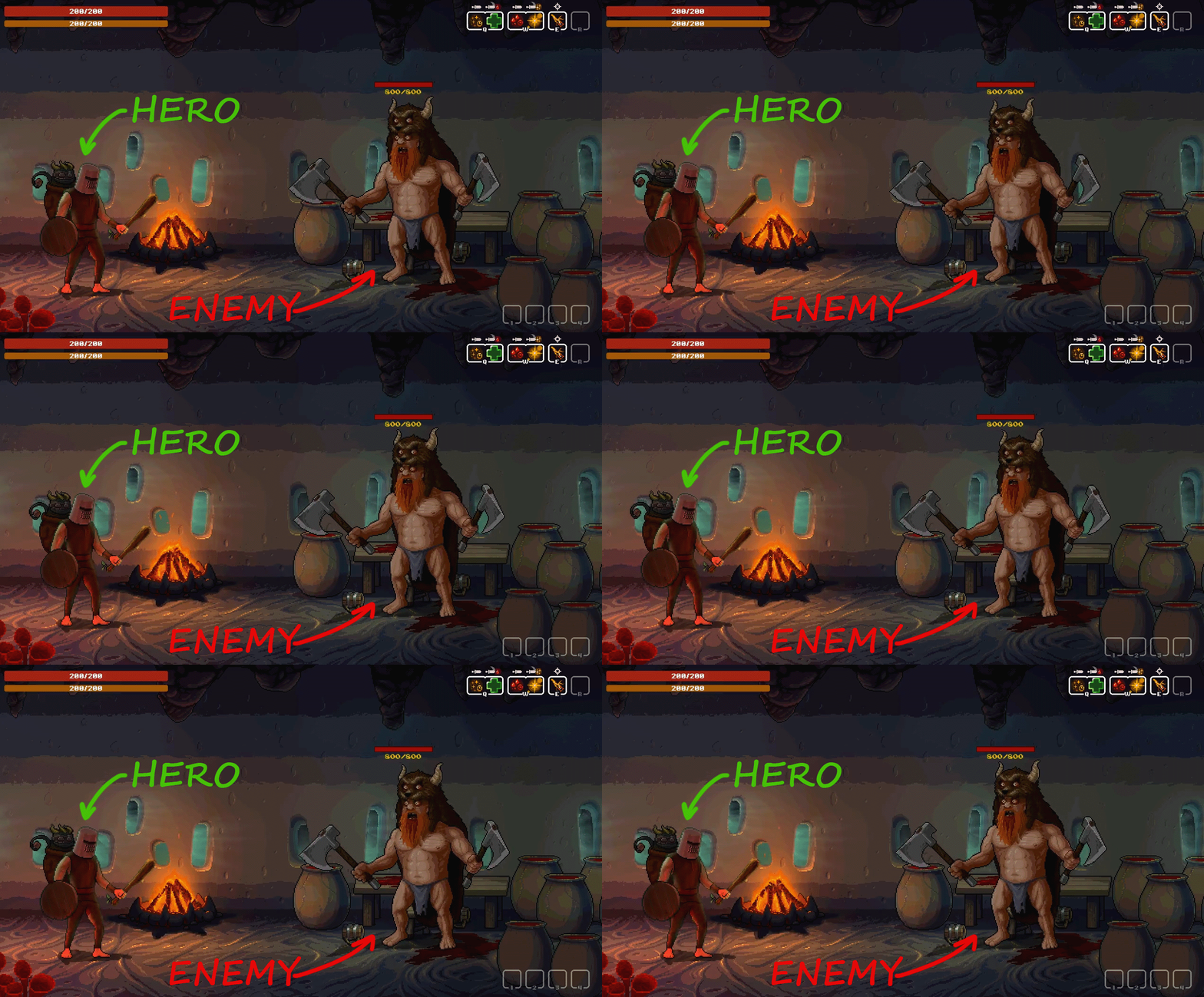
Here is our Hero (a pair of them actually, we'll cover that in later devlogs) and the enemy:
Yeah yeah, I know what you’re thinking: ‘is this another damn turn-based game?’ Nah, it ain’t. Keep focused.
The main ‘swift’ strike, my grandma would know this one, left mouse clickkk:
a briefly held left mouse click will execute a stronger attack, but at the cost of more stamina, and less time to react to enemy attacks:
Since enemies are not going to just take your attacks lying down, you’ll need a way to protect yourself against their inevitable fighting back:
Block! Hold right mouse button, although be careful, blocking also costs stamina!
Now that you know the basic fighting techniques, we suppose we’ll have to show you how to use them effectively.
Your enemies aren’t dumb (yeah right lol – editor’s note), but they will mix their attacks to the point that you’re always kept on your toes.
Enemies rarely strike the same place twice, and you’ll always need to keep an eye on where they are aiming to slash you next. Search for the indicators on where they’re about to strike, and hold up your shield over that area.
But wait, there’s more!
We love souls-likes and Sekiro in particular with the way it does repel (or 'parry') mechanics. It makes an almost perfect action and then reaction feel, like a good dance with your enemy. We are but mere adepts of FROM's mastery and the inspiration they cast. So naturally we have 'parry' here!
A well timed shield raise will not only block the attack, but will even deplete some of the enemies’ stamina, which will come in handy later 😉
When we finished implementing the parry mechanic and got around to testing it, it felt soo right we just had to add more to it!
Of course, after a skillful parry, when the enemy is down and you can even FEEL him begging for mercy, what you want most is a satisfying execution, something to complete the fight and make you feel like the warrior you are.
Here you go: remember what we said about the enemy stamina? Here’s where it goes from insane to bat**** crazy: when the enemy's stamina is depleted by your parries the enemy gets staggered and it is the moment when you can send him back to the cesspool from whence he came by performing a riposte.
Make a strong attack on a staggered enemy and reap the fruits of your hard work:
Okay, so you can attack, block and even parry in this game but what about a Souls must have - a dodge? Ripped Magician's cape to the rescue! Just hit SPACE at the right moment:
Now, while some enemies are weaklings and only have a few attack patterns that are easy to learn, there are some, that may, uhhh, absolutely destroy you. If you’re not prepared, that is.
Some enemies not only have access to melee weapons, but also some of the more sophisticated weaponry and equipment: bombs, healing flasks, knifes, etc.
So now you may be wondering: how the **** do I…
Yeah, yeah. I get it. You need something help you stay calm and not rage quit over every single thrown bomb, ye?
If you’re as good a gamer as you think you are, you just MIGHT be able to use that little block ability you have to maybe… uhh… throw the bombs back at them? Idk:
If you’re strapped for time, you can just block the bomb, or try hitting it (what’s the worst that can happen lmao)
After some iterations and internal playtesting of all these little combat mechanics we came to the conclusion that you CAN make something interesting with this idea of mouse-based hardcore combat.
But we didn't stop there. I've always wanted a spell system woven tightly with the attacks. And we tried in that in Greedventory. We'll cover vibrance spells in the next portion of this devlogs!
So, watch closely for the enemy attacks, react accordingly to his moves with blocks, parries and dodges and hit the living hell out of him with your strikes and ripostes.