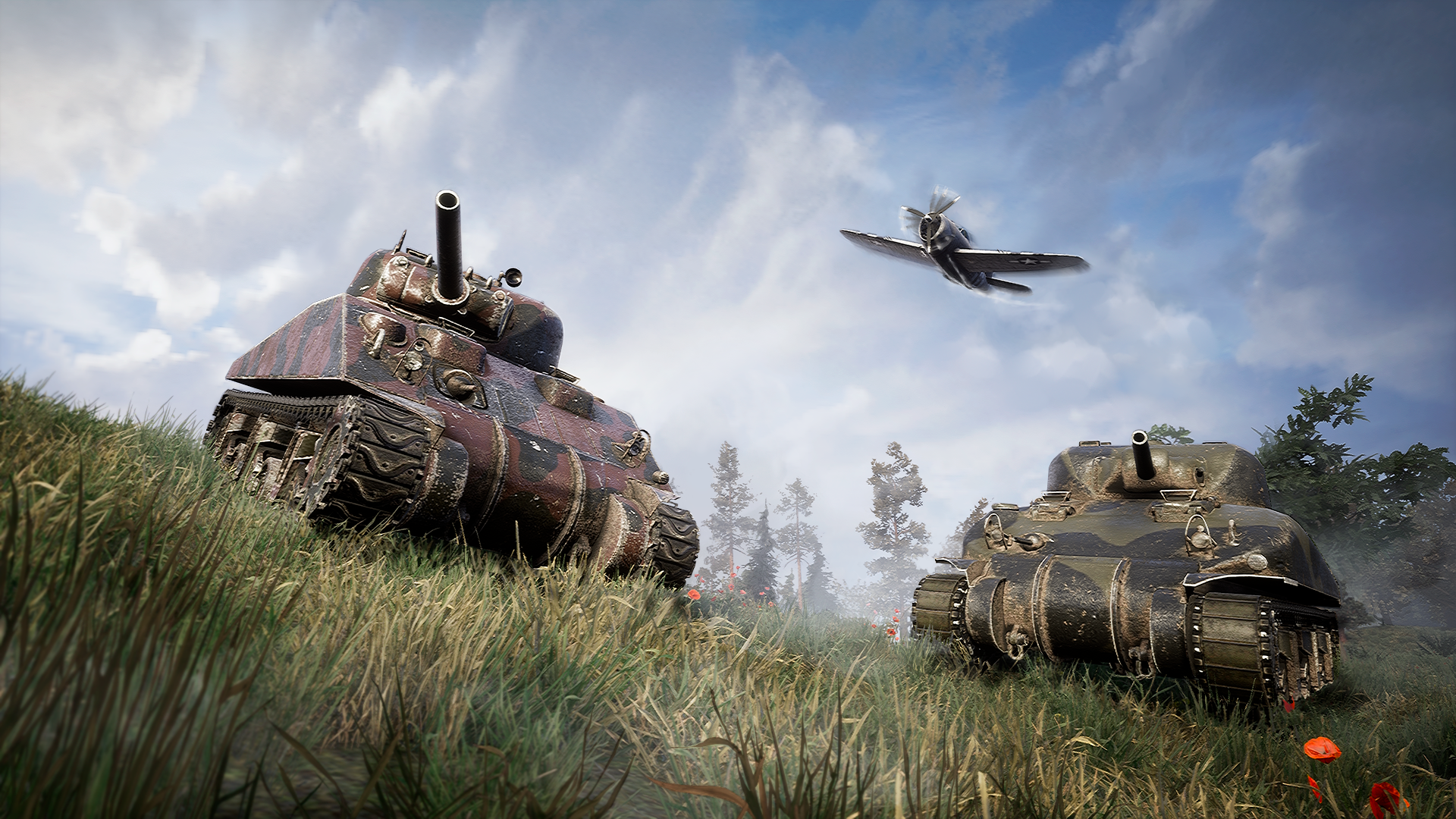
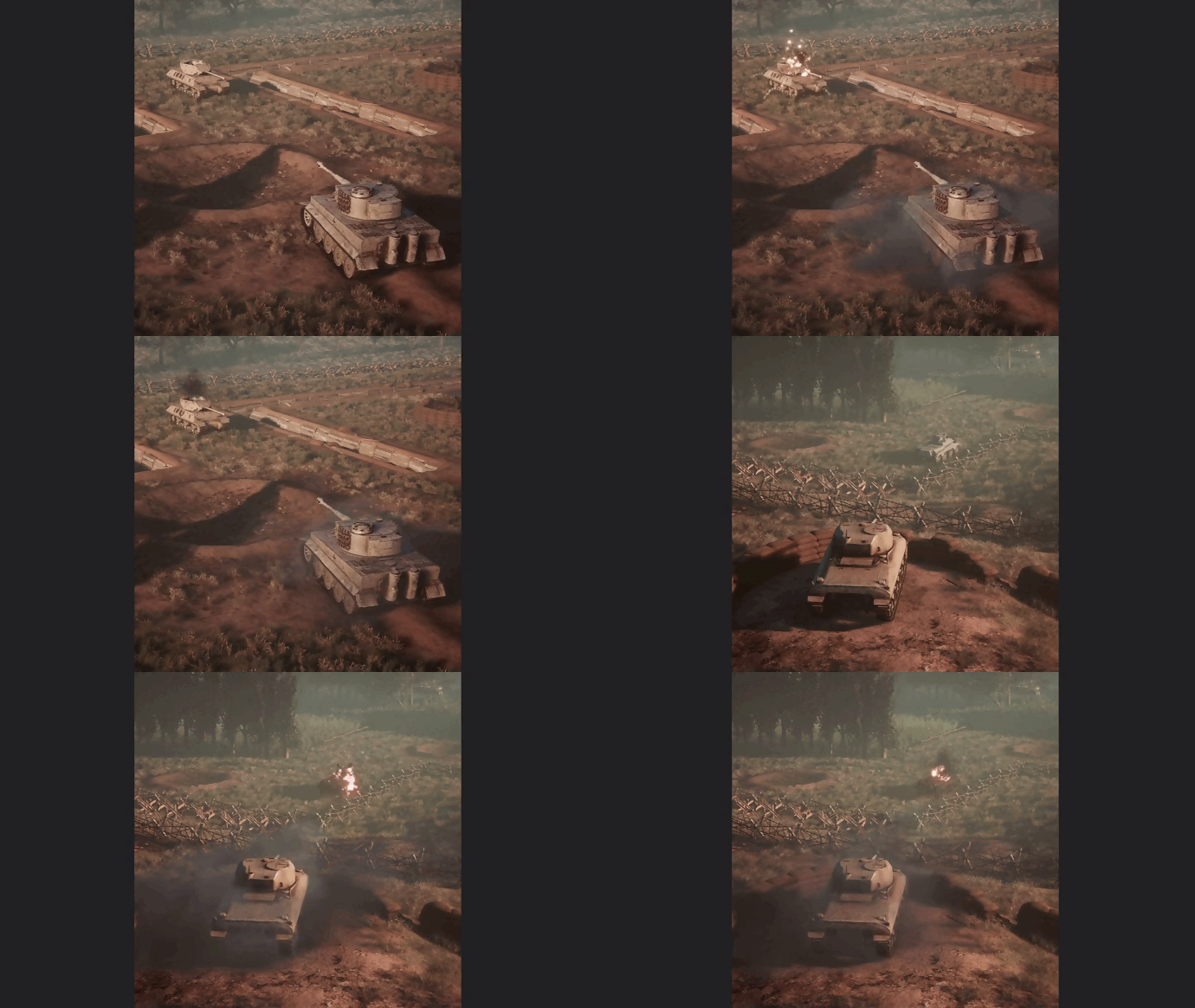
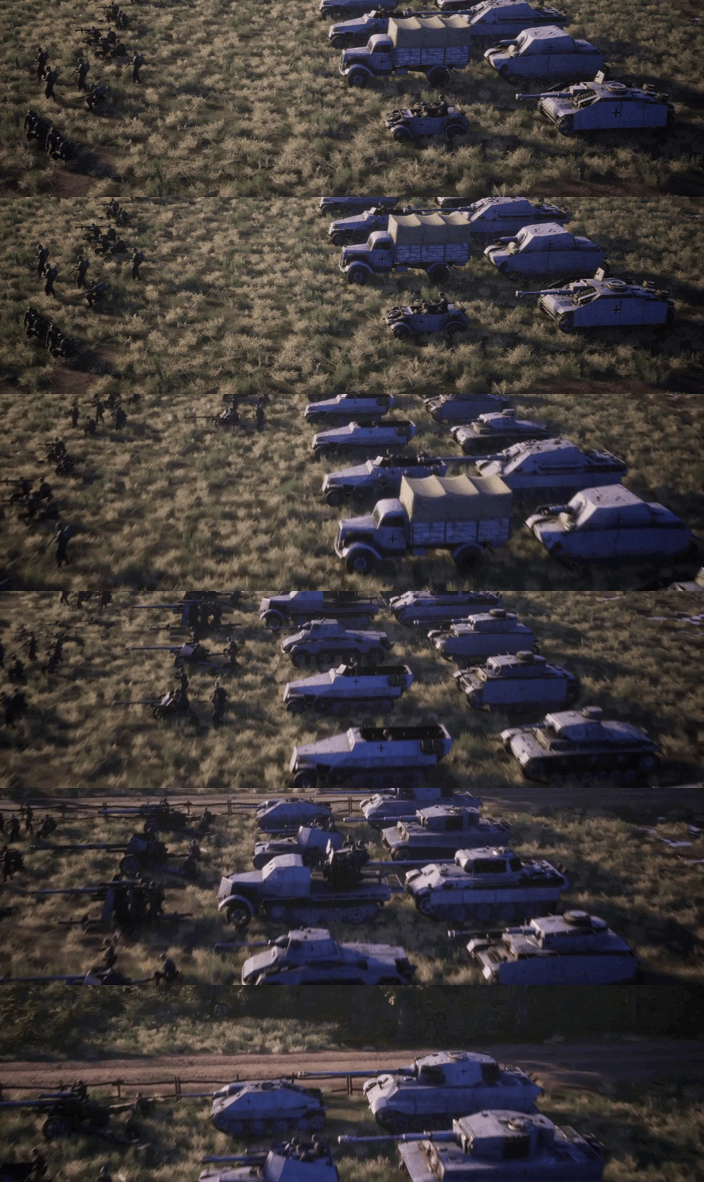
Brace yourselves for the debut of Headquarters: World War II at Steam Next Fest
Starting on February 5th at 10:00 AM Pacific time, the battlefield awaits, and we've prepared a special demo just for you. It will run until February 12th, so mark it on your calendar.
In the demo, you will access the tutorial mission and experience the gripping First Battle of the German campaign. Can you hold your ground against the Allied landing on D-Day?
Get ready to dive into the heart of the action Steam is the place to be on February 5th!
Dev Log #9 - Headquarters: World War II Closed Beta results and takeaways
Hello!
It is Oleksandr from Starni Games with the new Dev log entry. We held two rounds of closed Beta last year, with the second round of Beta still ongoing. Today, I want to summarise how the closed Betas went and update you on the overall development progress.
Closed Beta 1
First of all, I would like to thank all the people who participated in the Beta and shared their reports, suggestions, and evaluations of the game with us. Your feedback is truly invaluable for the Dev team.
We studied all feedback closely on the dedicated Slitherine forum (available only to Beta participants), the special Discord section, and the Google form we asked the players to fill in. If you are wondering how to become a closed Beta player - I will leave all the key information below. (We plan to keep Beta 2 running for a longer period of time, so it is not too late to join in.)
Sign up for closed Beta access: here Join Headquarters’ Discord: here
Now that we know that the Beta players are not some mythical beings, but people who followed the project and signed up - we can dive into the actual reception and feedback. I will start with how the Beta helped the Dev team and then share some of the feedback we accumulated through Google Forms.
We received a lot of very detailed accounts of what was good in the game, what was bad or confusing, and what could be improved. We studied all of the problems and discussed with the team what potential solutions we could have. Sometimes a minor change could have a great impact on the gameplay. For example, the most popular request in Beta 1 was actually the following: players could not tell which unit type was in the transport and that was super inconvenient.
Before:
Full Screen:
Individual Icons:
After:
Full Screen:
Individual Icons:
So, we redesigned the UI elements to indicate the exact type of unit that is inside the transport. It may sound like a really obvious thing, but when you start thinking about not making UI too cluttered or some other considerations, it may be difficult to get the optimal solution from the get-go. That is why the players' feedback is so important to us.
A very useful suggestion example would be the following: we have a customization tool in the game that allows you to paint all sorts of camouflage and symbols on your units. However, every time you start a new campaign or match you will have to set it anew. So, the players suggested adding a camouflage presets feature to save your favorite setups and be able to instantly apply them to your units in future campaigns or multiplayer battles. We decided to implement not only that, but also add various historical camo presets approved by the Dev team, so that you have some presets to start with, and then you can add your own ones to the pool.
This is just one of the hundreds of useful ideas and quality of life improvements that were suggested. We are now working hard to implement as many of them as realistically possible.
Before:
After (Work in progress):
Now, apart from the very useful bug reports, suggestions, and ideas for improvement, it was also very important for our team to know how the game “feels” in general - is it interesting to play? And to know more about the overall impression of the current technical state of the game for a wider audience than the internal testing team.
I want to avoid having my subjective evaluation involved in this part, so I will resort to some of the numbers we have gotten so far in Beta 1 and Beta 2 Google form questionnaires. (We have asked more questions, including ones where you could enter your text/suggestion, but for brevity, I will only share a few.)
We are very happy to see that overall players were quite happy with what they saw in the Beta, and we hope that the reviews at the game release would be even better. At the same time, there were some critical issues pointed out to us, like the need to improve the AI behavior in Skirmish and Multiplayer battles.
So, we feel inspired by your kind words to keep up the hard work and determined to address all the critical issues we found thanks to your reports.
Sometimes players' feedback is hard to read. For example, we had sections asking “What element of the game you liked the most (it could be anything)?” and “What element of the game you disliked the most (it could be anything)?”. And in some cases, we would get the same thing in both categories from different people. So, sometimes we get directly contradictory, even polar, feedback on the same things, which could be a bit confusing, but the answer is quite simple - all people are different and have their unique preferences and ideas of how everything should be. Our goal is to make an interesting, enjoyable, and, ultimately, fun game to play. We will do our best to deliver you a good game and keep improving and supporting it over the coming years.
You can help us do that by joining the Beta right now.
Stay tuned for more news about Headquarters: WWII as there is one more way to get your hands on the game even before the full release coming up very soon!
Most common queries and some helpful answers - part II
Do I command the whole divisions, or smaller units, like a single tank?
Headquarters is a tactical-level strategy game, where you command small units: one unit does not represent an entire division, but a single tank, artillery piece, truck, or Infantry squad. You are tasked with local objectives such as capturing a crossroads, a bridge, etc. You can also use HQ skills to call for artillery or aviation support “off the map”. An example of an operation would be to capture a hill, take fortified positions, and repel the enemy's attempt to retake the hill.
Would it be a problem if I lost half of my units in one battle, but won? Would I be able to keep playing the campaign, or do I need to restart the campaign and keep all units alive?
Not at all. In Headquarters: World War II we aimed at minimizing the so-called “snowball effect” where losing a lot of units in one battle leads to all future battles being untenable and forcing the player to restart and replay the entire campaign. So, here it is different: at the end of every battle you get replacements for all lost Core units, and there are no severe penalties for losing units, apart from the fact that you cannot win a battle if you have no units left. So, your objective is to complete all primary objectives of the operation no matter what the cost. The game could be quite deadly for each individual unit - even the strongest tanks with the hero attached could die in one turn if the enemy manages to flank them or otherwise catches them out of position. So, we did not want to further penalize the player for losing units to such eventualities of war. A war is deadly, and losing units is the way things are at the forefront.
What game modes can we expect?
The game will feature 3 narrative-driven campaigns: US, UK, and German. You will go through 9 operations that have country and urban terrain, day and night operations, defensive and offensive tasks, areas untouched by the war and fully devastated ones. There will be skirmishes and multiplayer with a shared system for flexible game setup that allows you to choose: victory conditions, starting prestige, and income per turn per flag your control (allowing you to acquire new units during the game, or use only the starting force), enabling HQ skills and heroes, starting level for all units, and so on. You can play multiplayer in both LIVE and PBEM modes with various setups of up to 4 players (1x1, 1x1x1, 1x1x1x1, 2x2, etc.). Additionally, a Hotseat mode is also available.
What is the current development progress?
The game is now in the final phase of development - all content is ready, and what we are doing right now is: finalizing all the texts, sending materials for voice overs, preparing all final texts for localization to other languages, and making various bug fixes, quality of life improvements and additional balancing. That is why the closed Betas are very important for us right now. We have gathered tons of useful feedback from Beta 1 and plan to start Beta 2 very soon to gather additional feedback. We got a lot of requests to add voice overs for the characters during Beta 1 and we want to put everyone at ease and tell you that there will be proper English voiceovers in the final version of the game, so you should not be worried about it. This is something we are working on right now.
What types of units are there? How many units for each faction? (Factions, units, unit types, …)
Right now there are 3 playable countries planned in the game: the US, the UK, and Germany. Each faction in the game has a full set of units of various types (internally we have 23 different unit classes) - various Infantry units (including Mortar teams, AT Rocket launcher crews, Machine gunners, Flamethrower teams, Snipers, Scouts, and so on), towed and self-propelled artillery pieces (AA, AT, and field Artillery), Tanks (Light, Medium, Heavy) and other armored vehicles (APCs, Assault Guns, Armored cars). You can load Infantry units and towed artillery into trucks and APCs for fast transportation.
Will there be a Map Editor?
Yes, there will be a user-friendly Map Editor for skirmish and multiplayer maps. Additionally, there will be a random generation tool - where you can set up various parameters and generate new maps for Skirmish and Multiplayer games. On top of that, you could combine both tools and create a randomly generated map, then open it in the Editor and make some tweaks to it before playing it with your friends.
Take a look at Headquarters: World War II here:
Most common queries and some helpful answers - part I
The setting of Headquarters: World War II is one where strategy, history, and comradery all come together. For every eager commander and inquisitive recruit, we've gathered your most pressing queries and delved deeply into the inner workings of the game to provide you the answers you've been looking for.
Does Headquarters take inspiration from the Battle Academy series? What are the main differences between the two? Many of the old-school Slitherine community members are calling the game a Battle Academy sequel, and they are not too far from the truth. Headquarters: World War II has definitely been inspired by the Battle Academy series. Yet, it is not a direct sequel. We think the best way to easily describe it would be a “Battle Academy spin-off”. The key idea behind the Headquarters: World War II game is to keep the overall gameplay experience quite similar to the old Battle Academy titles, but also try new things. We want to make sure that the game would have enough complexity and depth for grognards, but at the same time have a lighter touch and be more attractive to the new players. It has a bigger emphasis on a fast-paced turn-based strategy experience and management of your units throughout the campaign. We want you to feel like you have dragged these troops, your band of brothers, through hell and back to achieve victory... and you stand tall at the end of a grueling campaign!
Is it an easy game to learn? We have designed the game with the 'easy to learn, hard to master' approach in mind, offering a rewarding learning curve for players. - meaning that you can start playing quite easily, but as you play you will keep noticing new mechanics and things to learn about the game that would make you a better tactician as you progress through the game. This means you can start playing single-player without much trouble (still, playing a short tutorial is highly recommended), but you will have to learn the game for some time before you can start beating more experienced players in multiplayer modes. It would not take too long to learn the game, but it could take a while to master it, which is an exciting experience in itself - devising new unit setups, finding new synergies between units, and devising new surprise tactics for multiplayer - it is all really fun.
Why the name Headquarters? How does it relate to the game mechanics? We wanted to highlight the importance of tactics and planning in the game, hence the name Headquarters. Although, you should not think of it as a Commander-in-Chief HQ, but rather as a Field HQ of a small military unit. As a commanding officer, you will be tasked with tactical objectives such as capturing a small village, crossing a river, holding defensive positions on a hill, etc. So, you will have to cope with the tactical level objectives with a small force, progressing from one engagement with the enemy to another. In terms of game mechanics, we have HQ skills that allow you to call for artillery support, air reconnaissance, naval bombardment, and so on. Another example would be the Officer skills mechanic that represents special tactical advantages your officer can learn and teach to your troops between battles. Last but not least, in skirmish and multiplayer modes you start at an HQ location where new units can be deployed. You can then try to beat other players, or even capture their HQs.
What should I expect from the game? You can expect a reasonable tactical challenge with in-depth combat mechanics, various types of units, beautiful and realistic graphics with a destructible environment, narrative-driven gameplay in 3 campaigns, and very flexible skirmish/multiplayer setups that allow you to play the game in a number of different ways. The game is set during the Normandy landings, so everything happens in France during the summer of 1944 with 3 playable factions: the UK, US, and Germany. Apart from campaigns, you could play skirmish and multiplayer with up to 4 players both Live and PBEM, and even participate in PBEM tournaments. And the most important thing - you can expect lots of fun time playing the game! In addition to all these features, there's also a powerful Editor tool that lets you create your own custom scenarios.
Thanks for joining us with this first part. We're excited to let you know that a follow-up article will delve more deeply into game mechanics. Our community is driven by your thoughts and inquiries, so if you have anything further to ask or share, please do so, we’ll try to answer in the next article.
Most common queries and some helpful answers - part I:Let’s start from the basis
The setting of Headquarters: World War II is one where strategy, history, and comradery all come together. For every eager commander and inquisitive recruit, we've gathered your most pressing queries and delved deeply into the inner workings of the game to provide you the answers you've been looking for.
Does Headquarters take inspiration from the Battle Academy series? What are the main differences between the two? Many of the old-school Slitherine community members are calling the game a Battle Academy sequel, and they are not too far from the truth. Headquarters: World War II has definitely been inspired by the Battle Academy series. Yet, it is not a direct sequel. We think the best way to easily describe it would be a “Battle Academy spin-off”. The key idea behind the Headquarters: World War II game is to keep the overall gameplay experience quite similar to the old Battle Academy titles, but also try new things. We want to make sure that the game would have enough complexity and depth for grognards, but at the same time have a lighter touch and be more attractive to the new players. It has a bigger emphasis on a fast-paced turn-based strategy experience and management of your units throughout the campaign. We want you to feel like you have dragged these troops, your band of brothers, through hell and back to achieve victory... and you stand tall at the end of a grueling campaign!
Is it an easy game to learn? We have designed the game with the 'easy to learn, hard to master' approach in mind, offering a rewarding learning curve for players. - meaning that you can start playing quite easily, but as you play you will keep noticing new mechanics and things to learn about the game that would make you a better tactician as you progress through the game. This means you can start playing single-player without much trouble (still, playing a short tutorial is highly recommended), but you will have to learn the game for some time before you can start beating more experienced players in multiplayer modes. It would not take too long to learn the game, but it could take a while to master it, which is an exciting experience in itself - devising new unit setups, finding new synergies between units, and devising new surprise tactics for multiplayer - it is all really fun.
Why the name Headquarters? How does it relate to the game mechanics? We wanted to highlight the importance of tactics and planning in the game, hence the name Headquarters. Although, you should not think of it as a Commander-in-Chief HQ, but rather as a Field HQ of a small military unit. As a commanding officer, you will be tasked with tactical objectives such as capturing a small village, crossing a river, holding defensive positions on a hill, etc. So, you will have to cope with the tactical level objectives with a small force, progressing from one engagement with the enemy to another. In terms of game mechanics, we have HQ skills that allow you to call for artillery support, air reconnaissance, naval bombardment, and so on. Another example would be the Officer skills mechanic that represents special tactical advantages your officer can learn and teach to your troops between battles. Last but not least, in skirmish and multiplayer modes you start at an HQ location where new units can be deployed. You can then try to beat other players, or even capture their HQs.
What should I expect from the game? You can expect a reasonable tactical challenge with in-depth combat mechanics, various types of units, beautiful and realistic graphics with a destructible environment, narrative-driven gameplay in 3 campaigns, and very flexible skirmish/multiplayer setups that allow you to play the game in a number of different ways. The game is set during the Normandy landings, so everything happens in France during the summer of 1944 with 3 playable factions: the UK, US, and Germany. Apart from campaigns, you could play skirmish and multiplayer with up to 4 players both Live and PBEM, and even participate in PBEM tournaments. And the most important thing - you can expect lots of fun time playing the game! In addition to all these features, there's also a powerful Editor tool that lets you create your own custom scenarios.
Thanks for joining us with this first part. We're excited to let you know that a follow-up article will delve more deeply into game mechanics. Our community is driven by your thoughts and inquiries, so if you have anything further to ask or share, please do so, we’ll try to answer in the next article.
Dev log #8 - Infantry units in Headquarters: World War II
Hello!
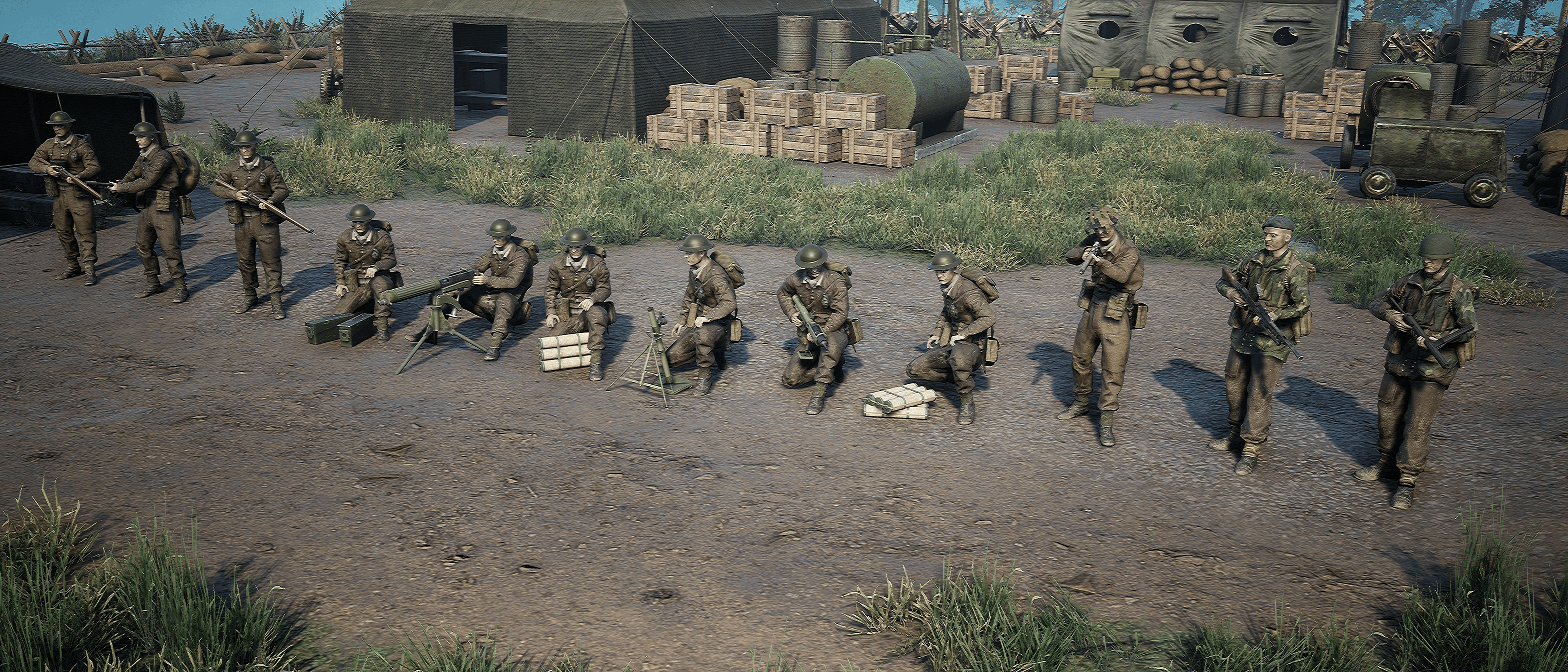
It is Oleksandr from Starni Games with the new Dev log entry. This time around I will tell you about the various Infantry units in Headquarters: World War II. This includes regular infantry, scouts, snipers, assault units, and heavy weapons squads, such as anti-tank units, mortar crews, and machine gunners. The infantry played a crucial role in all World War II battles, and it is no different in Headquarters.
First of all, let us have a quick look at all countries' lineups and then discuss all the unit types in detail.
British Infantry
US Infantry
German Infantry
Now let us have a closer look at each class. We will use the units of different countries as illustrations, but every country has all of the classes.
Riflemen
The regular units that comprise the backbone of the WWII armies - brave soldiers with their time-tested rifles risking their lives capturing the enemy positions or holding the line against the enemy advance. They are an all-round unit with good mobility, capable of attacking armored units only in close combat.
Scouts
Scouts have better spotting capabilities, have special skills that help them locate enemy units, and are better at not giving away their position. The downside is the lack of any way to deal with the enemy armor. So, one of your options when meeting the enemy armored unit is to throw smoke grenades to cover your retreat and quickly change position, leaving the enemy troops clueless as to where your scouts have gone.
Assault Infantry
Elite Infantry units have better storming capabilities and higher morale, which makes them better at withstanding the enemy bombardment. You can use them to assault the enemy fortified positions in close combat, or even make an ambush for the enemy armor. It is a very versatile and capable unit on the battlefield.
Flamethrower team
Flamethrower units have a very short range of attack, but they cannot miss and they deal high damage even to enemies inside fortifications, making them ideal units for storming the heavily fortified enemy positions. The drawback is that they could become an easy target for the enemy troops while they try to get close to the enemy.
Paratroopers
In many ways similar to the regular Riflemen, paratroopers are better at hiding their location, allowing them to operate more freely in the enemy's rear or flanking him.
Snipers
The most fragile and the most deadly Infantry unit on the battlefield - snipers are the masters of camouflage and sneaky movement. They can attack the enemy from a solid range, but they also need to have a clear line of sight to their target. This means dense city districts could complicate the targeting for the sniper, but at the same time, they provide him with lots of hiding places and great cover.
Machine gunners
The Infantry unit with the most firepower (except flamethrowers ;) ) and a solid range of attack. The downside is limited mobility. This makes Machine gunners the ideal unit for holding fortified positions and stopping unarmoured enemy attacks. Machine guns are capable of damaging lightly armored units, but they are obviously ineffective against any half-decent armoring.
Mortar teams
Last but certainly not least come the Mortar teams. The mortar team is the only infantry unit capable of indirect fire which makes it a very powerful and versatile asset. You can use this capability to harass the enemy units disabling their overwatch or lowering their morale before storming their positions with other units. Mortars are quite powerful against the unarmored targets, but have very limited capabilities against the enemy armor. Additionally, they are not capable of overwatch and cannot attack the adjacent tiles. So, you have to keep them at a safe distance from the advanced enemy units.
Anti-tank teams
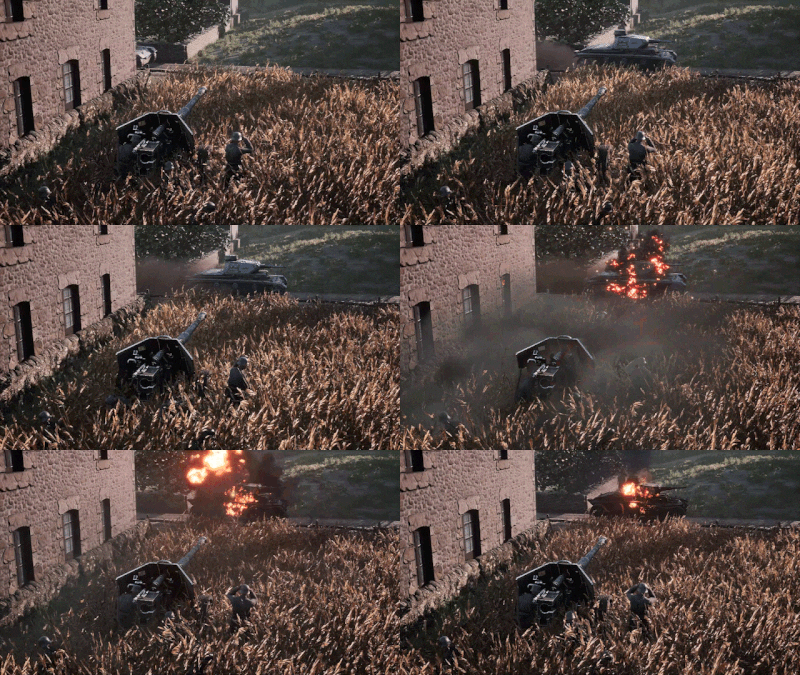
The hand-held rocket launchers are devastating anti-tank weapons at closer range. Combine that with the high mobility and low profile of the Infantry squads, and you will see why city or forest terrain was extremely deadly for the armored units. This is exactly what happens in Headquarters: World War II as well. Anti-tank teams have a short range of attack, but if you can ambush the enemy from a forest or a building - that does not matter, and the enemy tank has very slim chances of living through that encounter. While regular AT guns can keep the enemy tanks at bay from afar, Anti-tank Infantry can certainly hold their ground in close-range fights.
This wraps up a series of Dev logs dedicated to various units available in Headquarters: World War II, but it is not the last Dev log you see. Next time we will touch on an entirely different topic that I hope you will find very interesting.
Also, I would like to take this chance to thank all the closed Beta 1 players - we have gotten lots of useful feedback that we are now working on. We plan to run the closed Beta 2 soon with more features available to players, so please keep an eye on the upcoming announcements to make sure you do not miss it.
See you next time!
New wallpapers: celebrate with us at the Ukrainian Games Festival 2023
We are thrilled to announce the release of brand new wallpapers for Headquarters: World War II, and what better way to celebrate than by joining us at the Ukrainian Games Festival 2023! Immerse yourself in the gripping world of World War II with these stunning wallpapers, available now for download here.
Step into the vibrant world of Ukrainian game development. This year's event showcases an incredible array of games developed by Ukrainian talents, ranging from large AAA studios to Indie devs, including Headquarters: World War II - developed by the Starni Games team based in Kyiv, Ukraine. The team does its best to bring a new perspective to the wargame genre with Headquarters: WWII being both tactically challenging and visually appealing.
Get ready to show your support for Ukrainian game developers and make your desktop shine with the spirit of Headquarters: World War II. Thank you for being a part of our journey.
Headquarters: World War II - Dev log #7 - Tank killers
It is Oleksandr from Starni Games with the new Dev log entry. Last time we discussed tanks, so now I want to tell about things that are capable of stopping the enemy tanks in Headquarters: World War II. Today we will be having an in-depth look at such units as the Anti-tank guns, Anti-Aircraft guns, and Recon vehicles.
What anti-tank weapons are available?
Headquarters: World War II will be focusing on the Normandy landings, so the list of available units is limited to what was operated during that time. The key tank killers in the game (apart from other tanks) are AT guns and AA guns, while Recon cars could be useful to scout the enemy armor in advance. It is worth noting that Infantry could also be very deadly against tanks, especially in difficult terrain, but we would discuss that in the next Dev log, where we will have an in-depth look at all Infantry units.
So, here is the list of available anti-tank units and their preview:
Towed Anti-tank guns: 50 mm Pak. 38 (GER) 75 mm Pak. 40 (GER) 88 mm Pak. 43 (GER) 57 mm Ordnance QF 6-pounder (UK) 57 mm Gun M1 (US) 76 mm Ordnance QF 17-pounder (UK)
Towed Anti-aircraft guns: 88 mm Flak (GER) QF 3.7-inch AA gun (UK) 90 mm gun M2
Self-propelled Anti-aircraft guns: Sd.Kfz. 7/1 (GER) Crusader III AA Mk.I (UK) M16 MGMC
Recon vechicles: Type 82 Kübelwagen (GER) Sd.Kfz. 234 2 - Puma (GER) Willys MB (US, UK) Daimler Armoured Car Mk II (UK) M8 Greyhound (US)
How are the anti-tank guns implemented in the game?
The smaller caliber towed guns can move a small distance without a truck, while bigger guns have to be moved via transport vehicles. This makes Self-propelled guns much more mobile and versatile tools, able to move fast and maneuver to the best firing position and destroy enemy tanks. While towed guns are good for stationary positions and ambushes, they are quite very vulnerable but pack a solid punch.
How effective are the AA guns versus tanks?
While self-propelled AA units listed above are not very effective and can penetrate only lightly armored targets, the towed large caliber AA guns can be very effective against enemy armor, same as large caliber AT guns. They can be used for setting up ambushes and dealing with the heavily armored units of the enemy.
What do recon cars have to do with anti-tank warfare?
While not technically anti-tank weapons, light cars, such as Type 82 Kübelwagen or Willys MB are good means to spot the enemy armored units before they locate your troops and prepare an ambush. You can also quickly retreat, covering yourself with smoke grenades, if spotted by the enemy armor, cutting the enemy’s line of fire. At the same time, more advanced recon vehicles, such as Sd.Kfz. 234 2 - Puma, Daimler Armoured Car Mk II, or M8 Greyhound could be used to outflank and destroy enemy armor, attacking them from the rear, as they have pretty decent AT guns, that can be quite effective if you manage to sneak up on the enemy armor from the rear.
I know you would probably want to know much more about the game - so ask me any questions you have and I will do my best to answer these questions on forums, or in the next Dev logs. Next time I will tell you more about numerous types of Infantry units in Headquarters: World War II, including the anti-tank squads, so please, stay tuned.
See you next time!
Headquarters: World War II - Dev log #6 - Tanks
Hello!
It is Oleksandr from Starni Games with the new Dev log entry. Some of you have been asking about the list of available units in the game - and today we will discuss the topic that is exciting for many - tanks in Headquarters: World War II. I will present to you all models we plan to have at launch and we will discuss what are the strengths and weaknesses of each playable country. If you would like to know more - please follow the link below to access the full Dev log article.
What tanks are available?
Headquarters: World War II will be focusing on the Normandy landings, so the list of available units is limited to what was operated during that time. Some units appear closer to the end of single-player campaigns, or even available only in multiplayer as they arrived a bit late for the historical operations featured in the game.
So, here is the list of available tank units and their preview:
Light tanks: M3 Stuart (US, UK)
Medium tanks: Cromwell (UK) Sherman M4A1 (US, UK) Sherman Rhino (US, UK) Sherman M4A1 76(W) (US) Sherman Firefly (UK) Sherman M4A1 Flamethrower (US) Panzer IIIE (GER)* Panzer IIIN (GER)* Panzer IVH (GER) Panzer III Fl (Flamethrower) (GER)
*way outdated by 1944, various Panzer III models still fought in Normandy historically, although in small numbers. It may seem a bit far-fetched historically, but it would also be not fully accurate if the German troops were to field only Tigers and Panthers, so we had to include some older tank models as well.
Heavy tanks: Churchill Mk VII (UK) Churchill Crocodile (Flamethrower) (UK) Sherman M4A3E2(76)W (Jumbo) (US) Panther (GER) Tiger (GER) Tiger II (Koenigstiger) (GER)
What is the right camo for the tank? It is your choice.
We have heard a lot of questions about the authenticity of the camo of the German units. In many screenshots, you could see the German units in grey camo which had been used in 1939-1943 but was outdated by the time of the Normandy landings. We use it as a default camo, but there is a powerful customization tool in the game that allows you to customize every unit’s camo and special signs as you think would be most appropriate.
We know that camo is an important part of WW2 history. However, it changed depending on the time and war theater. That is why we have one default camo that makes it easy to differentiate between countries - olive color for the US, sand color for the UK, and grey color for Germany. The camo that is right for each operation can be easily set by every player to make sure it is correct and give the right feel about what is happening on screen.
Our goal was to create a flexible tool that allows the creation of various scenarios and set-ups including battles in different periods of WWII and on different fronts, allowing you to use the correct camo for every situation and not just keep it Normandy-specific.
I will share more information about the customization of units in one of the future Dev log entries.
What are the key differences between countries in terms of tanks?
If we speak about the summer of 1944, German troops had the strongest armor if we compare individual vehicles. That is reflected in the game and German troops may seem imbalanced at first glance. However, the difference is not too steep and the right tactics are much more important than certain vehicles being better. German troops are also more expensive in multiplayer, so losing them is much more impactful. You could use less armored, but mobile AT vehicles to outmaneuver German armor and destroy powerful but less numerous enemies.
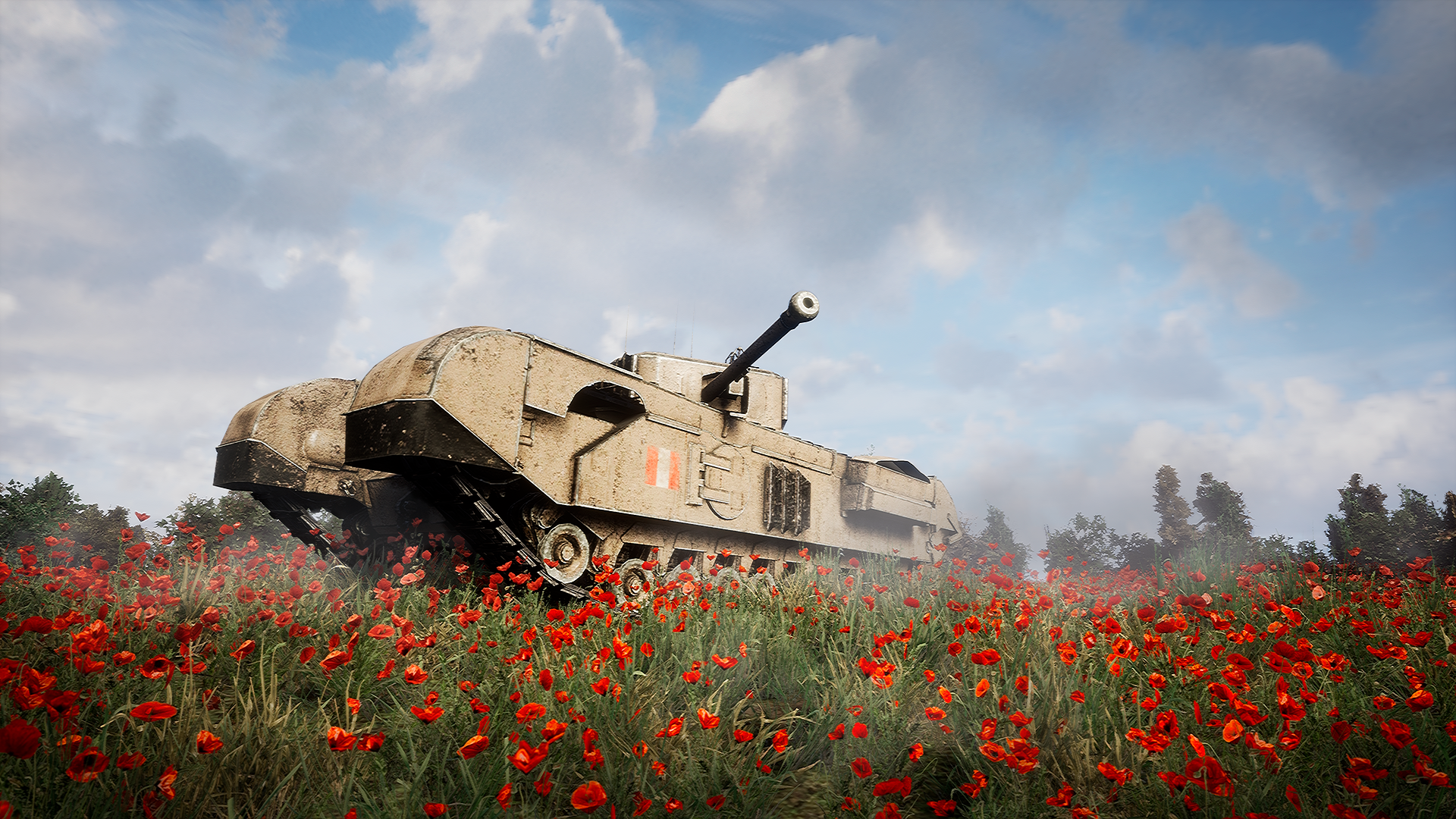
The British troops can fight tank battles quite effectively, thanks to the Sherman Firefly tanks, which have guns comparable with the best German tanks, but much weaker armor. Still, if combined with the right tactics they can be quite fearsome on the battlefield. Other fascinating vehicles are Churchill tanks - which have very strong armor but might lack the firepower to punch through the best enemy tanks. Still, they may be very hard for the enemy to take down.
The US troops struggle to win tank battles face-to-face with the best German tanks (Sherman M4A1 vs Tiger), so they have to be smart about it. US troops have good mobile AT capabilities (which we will touch on in the next Dev log in more detail) allowing them to flank and destroy the German armor with powerful guns that have little protection but are cheaper than the German tanks they could destroy. Another way to do it would be to use more advanced Sherman modifications, such as Sherman Jumbo with a 76 mm gun, which arrived too late for the campaign but can be used in multiplayer games. It combines powerful armor with quite a decent gun.
Right now we are happy with how tank combat works, but to truly understand how the game balance works you will have to take all types of units into consideration, especially Infantry which could be very lethal to vehicles in ambushes and close-quarters combat.
I know you would probably want to know much more about the game - so ask me any questions you have and I will do my best to answer these questions on forums, or in the next Dev logs. Next time I will tell you more about one of the ways to deal with the enemy armor, namely AT guns and Recon vehicles, so please, stay tuned.
See you next time!
Dev log #5 - Units in Headquarters: World War II
Hello!
It is Oleksandr from Starni Games with the new Dev log entry. Today, I will tell you about the different unit types you can deploy in Headquarters: World War II. I will also explain how we designed various units and balanced their parameters taking into account all the real-life data. If you would like to know more - please follow the link below to access the full Dev log article.
How do we choose which units to have in Headquarters: World War II?
There are several things we kept in mind when making a list of units that are available in the game. First of all, the events of the game cover Operation Overlord (6 June – 30 August 1944), so we have to look for the models that were more or less widely used on the European front during that period. Secondly, we look at how well they fit together and what role every unit could fulfill.
It is quite complicated, because many units that would have been very useful become available later during the war and so on.
How do we set the parameters for each unit?
First and foremost, we do in-depth research of all the real data on unit parameters - which is often not as easy a task as it could seem at first glance. That is because many sources of information provide different data on the same parameters, and some parameters are very hard to find. So, in-depth research is required to make sense of all the different and often contradictory sources.
Doing the correct research and its educated interpretation is only the beginning though. We cannot just throw all the historical data into the game and make it work. We have to choose which parameters the in-game units will have and how real-life parameters translate into the in-game values. That is very tricky since we want the game to be both historical and balanced, while most units were not truly balanced historically.
This is where it becomes more art than science, but we follow one simple rule at all times: if A is better than B in real life, then A is better than B in the game. So, if a gun has a better armour penetration historically, it will have a higher AP attack value in the game. If unit A had better frontal armour in real life than unit B - it will have a higher front armour value in the game, and so on.
A couple of examples to see why estimating real-life parameters is hard: you can easily look up the data on armour thickness, but there is also the armoring angle that plays a crucial role. Additionally, there could be different materials and casting used at different times/models. So, in the end, it is really hard to take all of that into account.
Another example would be the guns, which have two key parameters used to determine their armour penetration capabilities - the caliber (76mm) and the barrel length in calibers (L40). That is not the end though, as you have to check the armour penetration values from the real tests at different distances using different types of ammo, and so on. That is the only way to see how guns truly compare to each other.
What types of units do we have in the game?
All units are split into categories (or classes), and since life is complicated we ended up having a lot of them. So, here is how we grouped the units:
Armored car Light tank Medium tank Heavy tank Assault gun Self-propelled AT gun Self-propelled AA gun Self-propelled Artillery Armored Personnel Carriers Trucks
What countries do we have in the game?
Currently, we have three major factions playable in both campaign and multiplayer - US, UK, and Germany. Additionally, we have smaller unit lineups for Polish and Canadian troops, which occasionally appear in the campaigns.
Where can I see the full list of units?
I will share with you all the unit models currently in the game in the next Dev logs where we will have a closer look at how different countries compare in terms of units in various categories. The next one will be dedicated to tank units across all nations. So, please, stay tuned.