Hello everyone. It's been quite a long time since we played the Hellas campaign in the Age of Alexander, time to jump in again, what do you think? We will stream the tenth episode on Wednesday 20th at 9PM CEST (12PM PDT - 8PM BST) so set a reminder and join us:)
Many things changed in the last episode. If you didn't see it, you can watch it here: Here is a recap of the main events:
At the beginning of the last episode we set a few objectives. We wanted to take over Corsica, which was mostly controlled by Persia at the time, we also wanted to expand into the Balkans from our domains in Italy and take some of the independent cities on the way, but foremost in our plans was to try and take control of Crete away from the Spartans, this was where all our attempts resulted in a total and utter failure.
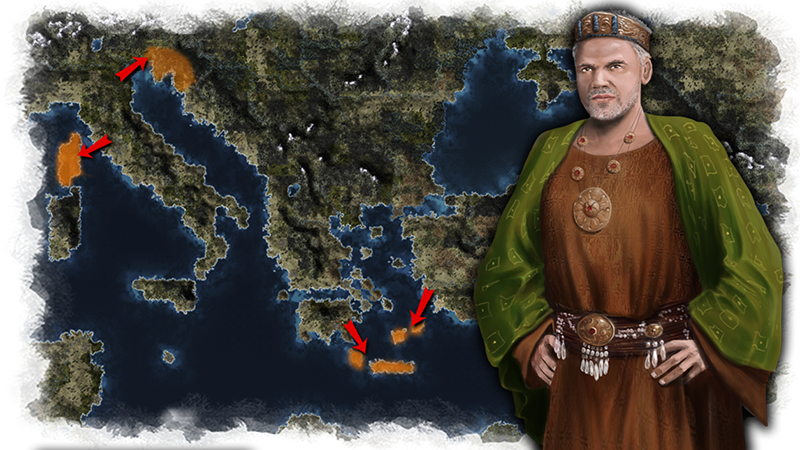
The operation on Corsica went quite well. We landed two legions, the Persians did not have enough troops posted there and their remaining forces fortified themselves in the city of Kanelate in the north of the island. Kanelate was protected by city walls and it required several attempts to defeat the defenders and we took a considerable number of casualties. The city and most of the island are now in our hands.
The Crete theatre looked a bit worse. The war over the island has been raging for several years and the resistance of Spartan defenders was really tough. They even managed to take back some of the territory we had previously conquered and pushed our forces into a small region on the coast around Itanos. Luckily for us, we had fortified the city with a palisade and we had brought in reinforcements to replace the exhausted units. We landed troops on the opposite side of the island in an attempt to attack the Spartans from two sides. This strategy paid off when we took the city of Gortyn. Nevertheless, the war against Sparta is not yet over. They still possess the island of Naxos with their capital, a goal for the next episode.
Tergeste, a city near our border in Italy was also conquered, so all three of our objectives were met!
The last "hot border" was the Persian battlefront where our progress has slowed down. We were able to conquer the inland cities of Tyana, Peion and Amaseia and Side on the Mediterranean coast, but the Persians pushed us back and reconquered Side and nearby territories. Both sides are tired and the armies are damaged and weak. On the other hand, we have some reinforcements on the way but it is hard to say if they would be able to make any progress. In any case, we need them to rotate the tired units in order to keep the border stable and safe.
Aside from expansion, we concentrated our efforts on improving our economy. We started building paved roads across the empire that make transportation of goods and units much faster. New resource refineries in blacksmiths made production in the affected mines more efficient. Last but not least, we settled on Rhodos and built a new town called Gulussa there.
As for our foreign relations, the most cordial relationship is with Carthage. Thanks to the emissary Brygos who is stationed in Carthago and who lobbies our cause, it seems that Carthage will not meddle in our affairs on the opposite side of the Mediterranean Sea leaving the way for further expansion open.
So far it all sounds great, right? But here come the surprising events.
Scythia sent a federation proposal that we accepted (their own superstate controls Thrakia and Bosporan Kingdom). This had several important consequences: The first was an increase in expenditure as we started to restructure the Scythian economy in an attempt to make it more efficient. Repositioning temples and blacksmiths, building better connections, improving cities, all in all it cost us quite a lot. On the other hand, the condition of their own federation was quite good enough to be considered a developed state.
By accepting the federation proposal, a new battlefront on the east coast of Pontus Euxinus (Black Sea) has opened. Probably one of the reasons why they wanted to create a federation with us was the fact that we shared the same arch enemy, Persia. They had been embroiled in a war with them for some time. Our initial optimism was however quite premature, we made some critical mistakes that caused us considerable losses in this area. We underestimated the strength of the Persian forces in the region and in a couple of turns we lost most of our units on this battlefront turning this territory into a weak spot of our border defense.
Through Thrakia who is a member of our great federation, we controlled pretty much 100% of the Illyrian border which should make it quite easy to conquer them. Control of the Illyrian territory would win us more victory points bringing the final victory into sight. At least that was the plan. Unfortunately, it did not go as planned. Thrakia decided to leave the federation, luckily they did not want to go against us and they signed a brothers-in-arms pact with us.
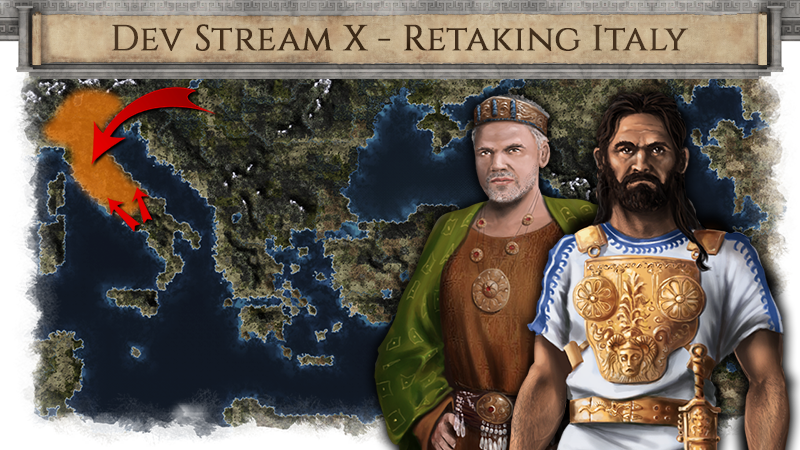
Now comes the biggest let down of the last episode. When we joined a federation with the Roman Republic, the loyalty in some of the northern Italian cities was quite low. Entering into the new federation with Scythia resulted in an open revolt and a declaration of independence in the region. The new state is called Sabella and they control most of the northern Italian cities. The rest of the Roman Republic however stands still firmly by our side. Luckily, none of our military units joined the rebels which makes Sabella quite a weak opponent if we can pacify the civil war quickly. Bringing Italy back into our hands is a goal for the next episode.
The restructuring of the Scythian economy and the rebuild of the damaged cities in Italy and Anatolia drained our stone resources entirely. Some parts of the empire badly need repairs but our stone reserves are gone. We can only hope that this will not lead to unrest or even a civil war.
Let's play together on Wednesday 20th on our Twitch channel and find out. As always, Pavel will be happy to answer your questions during the stream so please join in on our Twitch channel. See you there!
Yours, Kube Games team.
P.S. Here is the episode in case you missed it.
Spotlight - Historical Events
It is time for another part of our Spotlight series, today focused on Historical Events. This new mechanic that will be introduced in the upcoming Imperiums: Rome vs Carthage DLC will enhance the feeling of historical authenticity and will bring interesting, yet realistic twists into the game flow.
As soon as you start your rule you will be inundated with reports and news from all corners of your empire, everybody will try to get your attention. As always, they all find their own problems to be the most pressing and acute, thus requiring the immediate attention of the ruler. In such situation, seemingly unimportant events might go unnoticed or pushed low on the list of priorities. You should learn to be sensitive to the signs and small manifestations that warn you of potential major changes on the horizon. What precautions can be taken to prepare for the unexpected?
Reports of barbarian groups living in the forests beyond the river border come every once in a while. Of course, they could be a peaceful people, but ignoring their existence completely might be a grave mistake. Perhaps a small garrison positioned on a lookout over the river is a sufficient precaution, one that might save the day should they decide to cross the river en mass, with sharp axes and battle cries.
Pavel will give you a more detailed insight into how this mechanic works:
It was our ambition from the beginning to make Imperiums historically authentic and believable. Once you enter the game, your actions and decisions create an alternative history, however, the initial setup is carefully designed to illustrate historical reality as faithfully as possible. To this end, we undertake a thorough AI balancing and tweaking to make the AI behavior logical and realistic, or at least historically plausible during the first dozens of turns.
The new mechanic called Historical Events should further increase immersion and enhance the feeling of a true historical setting. We have selected several key events that shaped this historical period and have slotted them into the new campaign Rome vs Carthage. Therefore you might experience some history-changing events that are not triggered as a consequence of the developments in the game but have been implemented externally.
They do not occur accidentally, nothing ever does in Imperiums games:). We have taken extra care to define the trigger conditions in such a way, that these events fit logically into the game situation. Often, their occurrence is preceded by „signs“ that you can observe directly in the game. A small spoiler now, examples of such events are, the intrusion of the Sarmatians into the Black Sea region leading to the destabilization of the whole area, the migration of the Germanic tribes towards Pannonia and the Danube river and the unrest in Bithynia that set off a number of other events that affected the whole of Asia Minor.
The conditioning of the historical events is flexible, so they can be triggered anytime during the game and their effects can differ greatly depending on the current situation. Moreover, you will be informed about the potential dangers and the likelihood of their occurrence. It will then be up to you to analyze the situation and take whatever precautions you deem necessary.
The selection and implementation of the historical events was tailored to the Rome vs Carthage campaign, however, we are aware that many players prefer custom maps to the historical scenarios. We wanted them to enjoy this new mechanic as well but the implementation is more difficult here. Not only do the settings vary greatly but also the map itself is not „known“ in advance. Here, the historical events will be of different nature than in the historical campaign, more generic, to fit the many different courses in which the game can develop. We believe that the extensive testing has been worth it. You can expect events such as the division of an empire between the sons of a deceased king, internal collapse caused by the decadence of the empire or annexation based on the historical affinity of particular regions.
This mechanic is in many aspects a continuation of our previous efforts to make the game more immersive and the gaming experience as authentic as possible. We hope and believe that the selection and implementation of these events will increase player engagement and intensify the feeling of a true historical setting, as your game tells a believable story that could easily pass into the history books.
To weigh up the importance of all that is happening within the empire as well as outside of it, is one more aspect of the leadership skills that distinguish a good leader from a great one. Expect the unexpected and whenever possible apply measures that could prevent a catastrophe. Bad luck can befall you at any time and often it is a minor precaution taken some time in the past, perhaps long forgotten, that can change the outcome.
Today, we will introduce you to another interesting region in the upcoming Imperiums: Rome vs Carthage DLC. The eastern Mediterranean is the main stage for the wars of the generals of Alexander the Great, the Diadochi, who fight for the remnants of his vast empire.
Alexander’s Empire disintegrated soon after his death and left his generals fighting for power. The desire to become the next Alexander pitted former friends against each other, all memories of past adventures erased and replaced with covert or open hostility.
The arch enemy seems to be the Antigonids who rule in most of Anatole. Adamant in their dealings with the other Diadochi, they hope to win the loyalty of the Greek cities and with their help take the throne of Macedon. They can rely on a strong economy and rich cities, but they are surrounded by treachery on all sides and trust is not something they give lightly.
Seleucus who controls the lands from Syria to Babylon is just as ambitious but a much bigger empire makes it almost impossible to focus all his armies and energy in one place. The smaller kingdoms of Armenia and Cappadocia more or less accept his suzerainty but the Antigonid kingdom in the west is a direct threat to his power and Anatole must be taken if he is ever to sleep well.
Ptolemy in Egypt is relatively far away and thus safe from the endless backstabbing of his former comrades, but even he nurtures great ambitions. He controls the outlying island of Cyprus and southern Anatole and both these territories give him a strategic advantage for his immediate expansion plans towards Syria. Above that, many smaller nations hold Egypt in high esteem and if he could convert their affinity into a pledge of loyalty, it would give him a definite political advantage over the others.
As often happens, power and war lust has clouded the minds of former friends and anyone who accepts a seat of power in this region will face formidable and merciless enemies.
Hello everyone. It has been more than two months since the last update, time is just flying :) We have had our hands full getting the upcoming DLC Imperiums: Rome vs Carthage ready for beta and doing some prep work for the new project, and in the meantime improving the current game core. It is now time to upgrade all your instances to a new version 1.2.5.!
The update 1.2.5. has the code name "Difficulty matters" as the most important change is related to the selected game difficulty. It also brings a number of improvements and changes based on your feedback, wishes and bug reports. Your feedback does matter to us. Please, keep sharing your thoughts, ideas and suggestions with us and let us know whenever you experience a bug, we too want to make Imperiums perfect!
So what's new in "your" update?
The initial setup can now vary depending on selected game difficulty. In all of the official scenarios (Greek Wars, Alexander, Peloponnese and Troy campaigns) you will be granted additional starting resources and bonus units if you start on lower difficulty levels (noob, beginner, easy and partially medium). Higher difficulty levels are not affected by this change. This should allow newcomers to do "more" in the first turns while giving them a "bigger buffer" for mistakes.
The raiding event was reimplemented into the vanilla campaign. Early warning system will send you a report about the Celtic raiding parties well in advance with an approximation where they shall appear.
The attitude of new factions towards existing nations has been tweaked. So far, when a new faction appears, it's attitude towards others has always been neutral. Now, it will range from friendly to hostile to make it more variable and natural. We plan to build on this further in the following updates.
Pending diplomatic proposals have been added to the tooltip in the political map, when you hover over a particular banner or cameo (thanks to gripley and his suggestion).
The odds of a tile changing affiliation when applying influence on it were added to the tooltip (thanks to Hector of Troy and his suggestion).
AI will focus more on the destruction of enemy suppliers that support attacking units. This should make the AI tactical plans for actual battlefronts more cunning.
"AI player difficulty" was renamed to "AI proficiency". The term has caused already a lot of confusion, making some players quite unhappy (again thanks to gripley and his note).
The production modifier, when a state is in a "transformation period" (going through a change of government), was tweaked to have a less devastating impact on the economy during this process.
Changes in the trading mechanic were implemented. Until now, the majority of the traded food was spoiled before it was used. Now, the demand of the units, cities and other objects is deducted from the stockpile BEFORE the amount of spoiled food is calculated and deducted (thank to MiyabiSFG and our discussion on Discord).
A Tooltip stating current local birth grant was added to the panel showing the actual size of the city (in the lower right corner of the Unit menu). Clicking on the panel opens the Birth rate window where you can manage the birth rate support.
An issue with "City foundations" being removed when wood was chopped on the city tile, was fixed.
Couple of weird terrain issues were fixed (thanks to PLierMagic and his cooperation).
Game running in Proton now supports all languages.
Number of improvements were implemented in Proton (based on cooperation with MasterionX).
An issue with resetting game settings back to default values after restarting the game was fixed.
Performance of AI turns was improved.
All languages have been updated.
Couple of rare CTDs were fixed.
Some issues in Japanese localization were fixed (thanks to Airscape and his reports).
We would like to wish you a nice summer! Get some tan before the Rome vs Carthage DLC is out, you won't get much sunlight then :) Believe me, I know what I am talking about. As always, if you haven't yet done so, please wishlist the upcoming DLC and spread the word :) Your support is vital and we are grateful for every single wishlist!
Yours, Kube Games team.
Spotlight - Floods
After introducing Plague and Social unrest as new multi-turn events, today’s Spotlight will be dedicated to Floods, a new mechanic representing the destructive power of nature in the upcoming Imperiums: Rome vs Carthage DLC.
Water gives life, but people in antiquity were also aware of its dark side. It can turn violent within hours and destroy lives and livelihoods, in the long term it can even threaten whole populations. The failure of crops means hunger and social upheavals.
With an empty stomach your soldiers will lose strength and morale, your cities will dwindle as people start to leave. Luckily, nature often has ways of healing its own wounds over time.
Let’s hear from Pavel to explain the mechanic in detail:
It comes as no surprise, particularly for the regular players, when I say that keeping substantial resources in reserve, is key in any strategy game and it applies even more so to Imperiums. Relying on the regular income received in previous turn(s) when replenishing depleted reserves, may not be a smart decision. The lack of essential resources, especially Food, is felt immediately.
The new Floods mechanic puts the decision to keep sufficient Food in reserve, into a new perspective. Floods and other natural disasters in human history had an immense impact on the available food resources. As a good strategist, you should keep such an eventuality in mind and have contingency plans ready.
Floods cannot be predicted. The conditions under which they occur are clear, their occurrence is sudden and it is impossible to stop the great flood of water once it comes.
Floods occur in one river basin (not on all of them at the same time), the water floods the nearby fields, both the river tiles and the tiles alongside the river channel. Huge areas can be affected, particularly in flat regions, floods in one place can quite often mean floods occurring elsewhere at similar time.
What form of destruction do the floods take?
Terrains such as plains, grassland, forests and woodlands are converted to swamps. This applies to all affected tiles and can destroy fields and farms along the river.
Bridges on the flooded rivers can be damaged, so when the floods recede, it is good policy to check the state of bridges on that particular river(s).
All fields and farms built on flooded tiles are destroyed.
None of this can be prevented, which only makes the damage control even more important!
Flooded tiles will dry out over time as the water recedes. Naturally, tiles furthest from the river dry out first.
Sooner or later the swamps created on flooded tiles will return to the original terrain type. The only exception is when the terrain has been transformed by the player himself (e.g. draining swamp action).
As soon as the tiles are dry again (either drained by the player or through the gradual retreat of the flood water), it is possible to build new fields and farms on plains and grassland as usual.
Bridges damaged during floods can be repaired immediately. Keep in mind that any movement through swamps even when roads are built, is very slow. Keeping the road network and water crossings in good order is therefore very important.
Sooner or later the flood water disappears, but its consequences might be felt for many years. Check the damages, pay special attention to the ruined fields and farms, determine how your food production has been affected. Start rebuilding and repairing the infrastructure as fast as possible to prevent any secondary disasters, such as famine.
Pray to the gods that they keep a protective hand over your land and its people. If a disaster strikes and the fields full of green sprouts turns to muddy pools, act fast. Trade the surplus of other resources for food, make certain that your people do not starve. Plans always change with circumstances, this is another challenge that will test your worthiness as a leader.
It's been a while since we published the last "What's in the Kube" article, not because there was nothing important to report, indeed the opposite, we've been extremely busy. A lot has happened with Imperiums as well as in our private lives. Most of the game related news has been covered in the articles about the upcoming DLC and the game updates, "What's in the Kube" focuses on major news and announcements, so here it is.
Firstly, an apology to all those players waiting for the new Imperiums: Rome vs Carthage DLC. The initial release was planned for this Spring and this is still "doable", however, we have decided to push back the launch date a bit. The truth is, this DLC is huge, the map is much bigger and is occupied by more factions (playable and dormant) than in the Age of Alexander expansion pack. The DLC is already functional, the scenario setup and the assets are ready and almost all of the mechanics are implemented, but the balancing and testing of such a big world as this requires a good portion of time. We don't want to deliver an undercooked game, as always, we strive for a flawless, deeply immersive and fun gaming experience, while maintaining a high degree of historical authenticity and that simply requires more time.
We have decided to push the release to Q3. We hope and believe that this postponement will be compensated for by a great DLC. We can tell you already, that based on the internal testing runs this is shaping up to be the best Imperiums campaign so far!
Now to the good news :) We have started planning and preparing our next project. Don't worry, we are not going to throw Imperiums overboard, we want to build on and expand the Imperiums brand.
We want to create a new game focused on a different historical era, one that is quite underrated in strategy games and in our opinion offers an interesting setting that deserves more attention. We are still discussing the details within the team and once the pillars of the game are clearly established, we will lay our cards out on the table to hear your opinions.
We can already reveal that the game will be ported to the Unity engine. This will solve several technical glitches with the current engine and allow us to consider releasing the game to more platforms, it should also improve the overall performance. The map grid will turn into hexagons, making the map more pleasant to the eye and satisfying our more tactical focused players. All of the assets, from the 3D models, to the illustrations, sounds and music will be completely new. We also plan to redo the UI taking into account the lessons we have learned from Aggressors and Imperiums.
It is a huge step and a big investment for us, but we are resolved to move our games to a new level. We are blessed to have a great community around us and if we may we would like to ask for your support. Please follow our channel(s), talk to friends about our current games, write a review, buy the game as a gift to your Steam friends. Any kind of support is greatly appreciated and makes our work easier. We are considering running a crowdfunding campaign, however we have to carefully weigh the pros and cons before committing to this option.
We want to assure you that our support for Imperiums: Greek Wars will not stop! We love the game as much as you do and we will continue to support and improve it. As proof, we can now tell you that another expansion pack after Rome vs Carthage is already cooking:) It will be a smaller scenario, more suitable for shorter games and ideal for multiplayer games. It will be set in an extremely interesting period and we are already looking forward to starting full-time work on it. Just a small hint, this corner of the world is not covered in either the Age of Alexander or Rome vs Carthage DLCs. Depending on sales, we have several ideas for other potential expansion pack, but that's a bit too far ahead yet.
And that's it. We hope that the good news overcomes any disappointment from the delayed release of Rome vs Carthage. Let us know what you think, where do you see the Imperiums game in a year or two?:) More details about our future plans will follow soon, so stay with us!
Yours, Kube Games team.
Faction Highlights – Diadochi in Europe
The realm of the Imperiums games has always been centered around Greece, the cradle of ancient Mediterranean civilization. This region will continue to play a prominent role in the upcoming expansion Imperiums: Rome vs Carthage as well.
Hellas laid political and cultural foundations which the great Macedonian Empire was then built on. Together, they formed the heartland of the empire of Alexander the Great. Now, the region is once again full of animosities that hinder any hopes for a lasting peace.
Hellenic cities as well as Sparta no longer play a dominant role in the political affairs of the eastern Mediterranean. Their power has diminished but their strategic position, economic infrastructure and military traditions still make them valuable allies who could tip the scales in the raging wars of the Diadochi.
Cassander, the king of Macedon, and Lysimachus, king of Thrace, once fought together under Alexander's banner but there is no cordiality between them anymore. Macedon is a prized trophy, the throne in Pella and the crown of Alexander too big an enticement. Both Cassander and Lysimachus are embroiled in the conflict with and against each other and their former comrades Antigonid, Seleucus and Ptolemy.
Riding high on this all consuming hostility is Pyrrhus of Epirus. Enjoying relatively good relations with Hellas, supporting the claims of Antigonid on the Macedonian throne and himself in a good position to march over the Macedonian border, he could rise to dominance if he plays his cards well.
Getting an upper hand in this conflict will be a gargantuan task, with all of the general animosity and unyielding ambitions.
The Spotlight series will continue today with another new mechanic in the upcoming Imperiums: Rome vs Carthage DLC we call Social unrest. This will introduce a new multi-turn event into the game, offering a more realistic setting for social upheavals.
Powerful men often tend to ignore the aches and pains of the plebs. They fight their great wars, changing the world order and the history of millions, but have no time to care about the petty troubles of the lower classes. But the masses are a powerful force and a small spark of unrest can easily ignite a fire that could burn even the greatest of kings.
A wise ruler should keep his subjects happy, or at least content. Small spends here and there to improve roads or urban infrastructure, stationing military close to border towns to provide safety, after all, not that much that is needed to maintain order. What if the rebelling voices do start to rise from the crowds? Call in your army immediately, make whatever promises required to appease the local citizenry and suppress any revolt before it can gain momentum.
As always, Pavel will provide more detailed description of the new mechanic.
The existing mechanic managing the occurrences of social unrest was based on triggering one-turn events that were activated when a number of predefined conditions were met in at least one city. The following rebellion always left behind damages (large or small) to be repaired later. In certain cases it could even trigger a civil war, which would lead to the division of the country and the rise of a new faction. In any case, social unrest always meant troubles.
There were several flaws:
The player was not forewarned directly. Although he received regular reports, the outbreak of social unrest happened suddenly, seemingly out of the blue.
There were no tools the player could actively use to further prevent the spread of the rebellion to other places. He could take some precautions in the form of city improvements but these only lowered the risk of social revolt, they didn’t prevent it totally. Also the player could not check that the measures put in place were actually working (if they did, the revolt simply didn´t occur).
The event itself had no development, no interaction with the player. He only had to deal with its destructive effects as a sort of punishment for ignoring the decreasing morale in his cities.
All these flaws were considered when designing the new mechanic. It will still make life hard for the player who ignores the wishes of his people but it will be more immersive and much more fun.
Rebellion can occur in one or more centers, usually the least happy cities in the whole country and it can spread from there to other parts of the empire in the following turns. The actions of the player will directly influence the way the revolt spreads or is halted. In this sense, it will add another tactical layer to the game instead of just tedious damage repairs. No more rebelling masses ruining what they can in one turn and disappearing in the next. So what are the rules of the new mechanic?
Revolts cannot be predicted with certainty, but they can be expected based on the situation in the cities and in this sense they can also be prevented by the remedial actions of the player. The major factors that contribute to the outbreak of a revolt are:
Local happiness in the cities is the key to social order. You can prevent any signs of unrest by keeping local happiness at least at 100% and if this is not possible garrison units should be kept in the most unhappy cities.
Equally important is to pay attention to any damages to the infrastructure. Leaving cities damaged without repair for a longer period of time leads to low morale and unhappiness. Repairing cities should be always made a priority.
Regional centers tend to be more rebellious and you should keep these cities happier than any other.
The same applies to former capitals.
Building the Civil service improvement in cities where the signs of revolt are strongest is an important preventive measure against outbreaks of unrest.
Calling a city council (state decision) is a part of crisis management that can be used to suppress unrest in cities where the Civil service improvement hasn’t been built yet, but only in cases when the rebellion has already started to spread to other centers. Once activated, it increases happiness and it will simulate the effects of the Civil service improvement for several turns. On the other hand, it completely stops production in the affected cities (production on surrounding tiles remains intact) and as usual certain resources are necessary for activation.
Declaring martial law (state decision) is also an effective measure but it can create secondary problems so it should only be used in times of extreme need.
The spreading of unrest happens organically from one city to another. All the above-mentioned factors that affect the occurrence of unrest also apply to the way it spreads. There are however additional factors that should be taken into account:
When the revolt reaches a city that is already very unhappy, the rebellious moods get even stronger.
As the revolt spreads to more cities, its force diminishes. There is one important exception as described above with a city with already angered population. This could have the opposite effect and the rebellion can get a new breath of life.
The chances of revolt spreading to other cities is also related to the distance between the cities and how accessible the terrain between them is.
Loyalty and General Morale of rebelling cities decreases every turn.
Garrisons in rebelling cities are not immune to the mood in the city and their Morale is also negatively affected every turn. Therefore, if you use garrisons to suppress unrest, it is good to replace them with fresh men after a while.
If the revolt reaches a certain threshold, it can cause a decrease in the population in the rebelling cities and damages to infrastructure that will need extensive repairs.
Activating the City council state decision can greatly diminish the force of the revolt and its capacity to spread to other cities (this state decision is only available in cities without a Civil service improvement).
Declaring martial law will have the same effect.
Theoretically, unrest can spread beyond your borders, however, this is rather an exceptional case. If it happens, these two rebellions will be independent movements not affecting each other.
Unrest can have destructive effects, causing great damages to the cities and infrastructure and in the worst case it can even result in splitting the country in two. It is therefore important to prevent its outbreak and in cases where it occurs to act swiftly and with force, as any procrastination can only worsen the situation.
As a newcomer to the throne, you will have to deal with many pressing issues at home and abroad in setting a new course for your country. You can easily forget or perhaps not see as important the small signs of discontent among your subjects, but take the reports from within your country seriously. There is only a thin line between grumpy talk in a local inn and turning pitchforks and tools into weapons.
Will you succeed in leaving behind a legacy worthy of one of the most beloved kings in history?
I hope you can finally enjoy the first days of spring and the warm sun outside. I will continue our campaign playing Hellas in the Age of Alexander scenario and I would be happy if you join me on my expedition. It is already the ninth episode and we start again this Wednesday at 9PM CEST (12PM PDT - 8PM BST) time.
The last episode was really interesting and quite surprising at the same time.
On the Persian front, we finally resumed our advance after a Persian counterattack that stopped our progress. We besieged Gordion and even though the siege was broken by Persian cavalry, we were eventually able to conquer the city and hold it. We also took the cities Pessinus and Amastris on the coast of the Black Sea but the latter conquest was a mistake. The battlefront was severely weakened as a result. Although it was guarded by our best hoplite unit, it was extremely damaged from the previous turns and this proved to be fatal - our beloved Antimachos army was entirely destroyed. This was without any exaggeration the biggest loss from the start of the game. Despite some partial successes, the whole advance stopped again and turned into a stalemate. The Persians brought several fresh units to the front including Kardakes which exhausted our armies and we had to stop all planned operations. The Persian economy started growing considerably and the whole campaign might now turn to war of attrition which would not be in our favor. That's one of the reasons for transforming Anatolia into a regular part of the republic by building the economic infrastructure with a new blacksmith and number of city facilities.
The biggest surprise and disappointment was the planned conquest of Sparta or what remains from their holdings. They hold only two islands. One of them being Crete and that was our first target. We disembarked and were able to conquer half of the island. Nevertheless, the stronghold on the island was not only well fortified but three melee units were hiding inside which was totally unexpected. After several unsuccessful attempts to conquer the city, the army morale of the Spartan units started to grow considerably and they made a number of counterattacks. They destroyed two of our hoplite armies, considerably damaged another one and if we didn't have an axemen fortified on a position, we would have had to abandon Crete altogether. We didn't give up though and started to prepare for a longer conflict. We founded a new town called Itanos on our side of the island and improved it immediately with a stockade. We sent General Kios to Crete to improve the morale of our units. We had to transport a hoplite unit (initially a planned reinforcement for Anatolia) to Crete to be able to hold the town. So far, we have lost two experienced units without achieving any tangible results.
In the rear, all seems to go well. Particularly big changes are taking place in Italy, where we recently established a federation with the Romans and started building up the economy. We built new cities around the Alps, a new blacksmith in the Po valley and we improved a number of cities by building new facilities. Our Sage Seleucus founded a philosophy school in Sipontum. We focus our efforts on the former Roman army; we try to upgrade all the milites units to principes in the hope that the stronger units will be able to secure the northern border and slowly advance further. We finally met the Illyrians from the Italian side at the city of Tergeste, where we both tried to assert control. Tergeste however is a tough nut to crack. Taking over the city will be one of the goals of the next episode. Illyria proposed a confederation to us and it seemed a rational decision. We share a very long border in the south and east and now also in the west. They probably know that we are much stronger and should we go to war, we would be pulling the longer straw. Nevertheless, we rejected the offer for now because it would considerably worsen our relationships with other factions. We hope that they will come back with an offer of federation, and we will be able to accept it this time.
Apart from Italy, we keep improving our economy on the mainland. Blacksmiths are being improved; in Korinth, our capital, Sage Bion built a philosophy school. On the other hand, war with Persia (and now also with Sparta) and the military reforms in Italy are getting quite expensive. Our gold reserves went down about 90% which means we will not be able to recruit new units anymore. Our economy desperately needs more slaves. We try to cover this demand by trading but it is too slow. We hope that more slaves could be obtained from the independent cities in the north of Italy and in (hopefully) newly conquered cities in Persia.
Carthago is quite idle but that is in our favor. We have sent a newly hired emissary Brygos to Carthago to keep the good relationships. Events are taking an interesting course on Corsica. Kanelae, a Persian stronghold on the island, is slowly taking control of the island from Carthage, its city Alia being surrounded. It could be used as a pretext for a military expedition, an ideal task for the new Roman principes!
The goals of the next episode are quite clear. We shall defeat Spartans for good, take over Corsica and the independent city of Tergeste. If there are no unexpected surprises on the Persian front, we will try to push forward but I am a bit skeptical that any significant progress can be made, at least for now.
As always, Pavel will be happy to answer your questions during the stream so please join in Wednesday 20th on our Twitch channel. See you there!
Yours, Kube Games team.
P.S. Here is the last episode in case you missed it.
Faction Highlights – Wild North
Today, we venture to the realm of migrating tribes. These inhospitable regions have the potential to become lively, booming and prosperous, it only needs someone to assert a firm hold on the vast territories and their riches. Here is a glimpse of what awaits you in Imperiums: Rome vs Carthage DLC far in the north.
[previewyoutube="FpY3vIaAtew;full"] The regions beyond the Alps and north of Danube are wilderness, only sparsely inhabited by nomadic and warrior tribes, making it a very interesting setting in comparison to any of the Mediterranean civilizations.
The vast empty lands offer a great opportunity for expansion. The harsh climate, dense forests, dangerous swamps, impassable mountains and rivers, all create great natural barriers protecting the core of the state. Consolidating such a large territory into a functional state and guarding the entry routes will require defensible strongholds to be built and manned by trained warriors. However, at some point, either other tribes of the north will enter this peaceful realm or the player’s own curiosity will lead him to cross the protective borders of his lands and move south towards the rich and booming Mediterranean cities.
The Gauls of the west are attracted by the warm and fertile southern regions and regularly make attempts to establish permanent settlements along the river Pados. The ongoing conflict among the Latin tribes plays into their hands and choosing the right side to support in this tribal war could make their position in northern Italy much stronger.
Celts occupying the far north keep to themselves, not venturing south but rather focusing on building their own kingdom.
Further east is the home of the Dacians. They must walk carefully between their dangerous neighbors, Lysimachus in the south and the Scythian riders in the north.
Many smaller tribes roam the vast lands, among them the fearless Germanic warriors. Their incursions south bring chaos and disruption.
Can you survive the unforgiving harsh conditions and build a lasting empire to humble the great powers of the Mediterranean?