The reviews are in... and we're blown away by the kind words. The feeling when someone gets what you have spent years of your life trying to encode into a piece of software is something special. We're so excited to share this wondrous story with the rest of the world and can't wait to see what you discover in the beautiful oceans of Gliese 667Cc. Until the big day tomorrow (!), have a look at what others have been saying:
"In Other Waters pulled me through fields of alien fauna, caverns filled with glowing acid pools, through powerful currents that could sweep me away, and to the dark depths of the ocean's lower floors. In moments, it captures both the beauty and terror of the ocean. That coupled with the detailed ecosystem and the mystery of Minae's secret work had me spellbound until the end."-PC Gamer, 80/100
"Hypnotic art, otherworldly audio and captivating writing meet in an undersea exploration game that wants you to take your time." -Eurogamer, Recommended
"The writing in the game is fantastic. Each waypoint and description are only a sentence or two long, yet they perfectly conjure and invoke incredible images and truly alien landscapes and creatures within the player." -Wccftech, 9.5/10
"...a mindset of peaceful underwater exploration, and a story that moved me to tears whilst I simply navigated a dot on the screen to go from one triangle to another. What a wondrous gift In Other Waters is." -fingerguns, 10/10
"Beyond the magnificent interface, the world of In Other Waters is thoughtful in a way few other games can claim." -Slant Magazine, 3.5/5
"An early game of the year contender." -Get Indie Gaming Video Review
Discover the Xenobiologist Edition Tomorrow
Immerse yourself in the wonders of Gliese 667Cc, home to humanity's first encounter with extraterrestrial life. The Xenobiologist Edition includes three core parts of In Other Waters:
The Game, where you explore and study an alien ocean alongside Dr. Ellery Vas
The Companion Book, which acts as an epilogue and xenobiological catalog
The Original Soundtrack by Kingdom series composer Amos Roddy.
Together they tell the story of the exoplanet Gliese 667Cc. From interpreting signals and discovering sunken secrets in the game, to flicking through beautiful paintings of alien life in the book, the elements of the Xenobiologist Edition work together to encourage and inspire the player's imagination and provide a space of refuge and reflection on how we relate to the world around us at times of ecological crisis.
One of the ideas at the core of In Other Waters is symbiosis. It’s a term you’ve probably heard before, one that refers to a mutually beneficial relationship between two or more organisms. We are often given the example of clownfish, who gain protection by making their homes among stinging anemones, and in return the clownfish keep the anemone clean and scare away smaller grazers. But symbiosis is far more widespread and central to life itself than this example suggests. In the 1990’s evolutionary biologist Lynn Margulis proposed the (now accepted) theory that it was symbiotically linked bacteria that allowed the formation of the first multicellular life.
The truth is that our own bodies (and the bodies of all lifeforms) are the result of many interlocking relationships, built on symbiosis. As Margulis put it in her book Symbiotic Planet “life is an incredibly complex interdependence of matter and energy among millions of species beyond (and within) our own skin”. In Other Waters leaps off from this idea, offering an alien world defined by symbiosis, and an experience which is all about taking the role of an AI acting in symbiosis with your human companion. This game explores, through its central human and non-human relationships and through its ecosystem, Margulis’s idea that “our symbiotic, interactive, interdependent past is connected through animated waters.”
Climate Crisis
We are currently living in an unprecedented time of climate crisis. Humanity’s own acceleration of climate change through our ceaseless industrial expansion, as well as our pollution and acidification of Earth’s oceans have fundamentally changed life on this planet, and continue to do so at an increasing rate. In Other Waters is set in a future at the end of that extrapolated curve, where Earth’s oceans have succumbed to the pressure and most of their life is isolated to vast reserves where they are artificially preserved for tourists.
As In Other Waters is set on Gliese 667Cc, not Earth, In Other Waters deals with the aftershock of catastrophic ecological collapse through your human companion Dr. Ellery Vas. Her experiences growing up on Earth, and working as biologist have been shaped by being a central witness to the death of the ecology she wanted to study. Just as we currently stand on a precipice in relation to the condition of our oceans, with a fast approaching 2 degree rise in water temperatures threatening the existence of thousands of species, so In Other Waters sits on the other side of that gap, allowing us to look back and critically reflect on where we might be going as a species.
Marine Biology Live!
While we may be looking at a crisis across all of Earth’s oceans over the next decade, we are also in an unprecedented era of access to marine biology. If you had told me as a child that projects like Okeanos Explorer or Nautilus Live would be live-streaming deep sea exploration on youtube, for anyone to watch around the world, I would have never have believed you. These multi-hour streams, manned by an ever-changing set of scientists, have been a constant fixture during the development of In Other Waters, keeping me company during late nights of solo development.
Crafting Dr. Ellery Vas and the world she explores is a response to these incredible streams and the selfless people that run, maintain and appear on them. I wanted to depict scientists as more than the often austere and cliched stereotypes we see in the media, and instead show them for the passionate and intelligent humans they are. Dr. Ellery Vas takes from the mosaic of PhD students, biologists and pilots that have kept me company through development, and provided me with a constant stream of facts and discoveries to fuel the creation of the game’s ecosystem.
Galapagos Hydrothermal Expedition
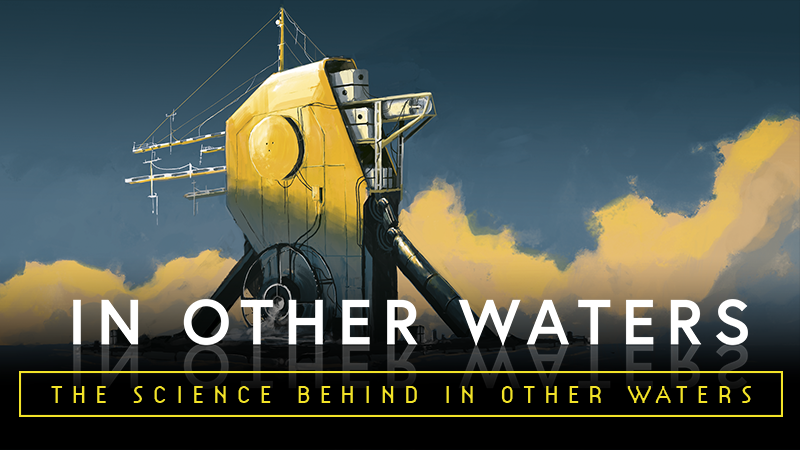
The creation of a planet-worth of life definitely takes some research. And, in my hours of reading there’s one single scientific event that I have kept coming back to. It’s one so significant that it should be up there in people’s imaginations with the moon landing, and yet because deep sea exploration is so under-funded and under-taught it remains unknown to so many. In 1977, the geologists Jack Corliss and Tjeerd van Andel, along with pilot Jack Donnelly, descended 2.5 kilometres down to a site off the coast of the Galapagos in search of hydrothermal vents in the submarine Alvin. They found the vents, a phenomenon theorised but never previously witnessed by a living human, but they also found something even more significant. “Isn’t the deep ocean supposed to be like a desert?” Corliss radioed back up to the support ship R/V Lulu “...there’s all these animals down here”. Despite not having a single biologist on board, they had made one of the most important biological discoveries of the century—an entire ecosystem that lived without a single ray of sunlight, subsisting instead on the toxic chemicals and symbiotic bacteria of the deep sea volcanic vents. This is the closest we have ever come to discovering life on another planet, and listening to the squeaky recordings of Corliss and van Andel describing what they saw has been a huge influence on In Other Waters.
While this may be a game set on another planet, I would like to make sure it reflects back on our own relationship with this planet, and our incredible oceans. I hope those who play the game will return from Gliese 667Cc with a renewed sense of wonder for the diversity and strangeness of life in its many forms, and an appreciation for the scientists who pursue it, just as if they had been aboard Alvin on that day in 1977.
Dive into "In Other Waters" April 3rd
Guide a stranded xenobiologist through a beautiful and strange alien ocean. What will you discover together?
https://www.youtube.com/watch?v=c8yIitSP-ZI
Welcome to Gliese 677Cc: a world of wonder, fear and vulnerability. Unravel the history and ecology of this impossible planet together with Ellery, a stranded xenobiologist searching for her missing partner. As Ellery's suit AI, it's your job to keep her safe as you dive deeper into this unknown alien landscape.
Survey shimmering reefs and inky depths. Discover strange creatures and stunning environments. Help Ellery catalogue this new ecosystem by observing alien species, scanning, and taking samples.
Please consult this user manual thoroughly before attempting any dive. Failure to comply with Baikal policy will nullify your contract with immediate effect. Note that Baikal is not responsible for any personnel damages attributed to user malfunction. In the event of property or equipment damages, Baikal reserves the right to indemnify the suit's owner to the full extent of the law.
Remember that your role is to assess the presence of life in the assigned exoplanet environment in order to comply with the protections detailed in the 2082 Exoplanet Exploitation Charter. Baikal equipment is not to be used for personal or academic research.
// SYSTEM FUNCTIONS
Your Baikal suit comes equipped with all the systems necessary for a successful exoplanet survey. To assist with your responsibilities, each suit comes with a specially programmed Operator Persona. These personas respond to pilot commands via voice activation. Use your Operator program to rapidly log and process the data collected during dives.
Please note, Operator Personas are not true intelligences, and any malfunctioning or erratic Operator should be immediately reported to your dive engineer for immediate decommissioning.
// UTILITIES
Baikal’s utility panel can be outfitted and customized with a variety of modular installations. Exoplanet environments are diverse, so select your utilities accordingly. We have developed a robust Sampling and Sample Storage mod to cater to our xenobiologists.
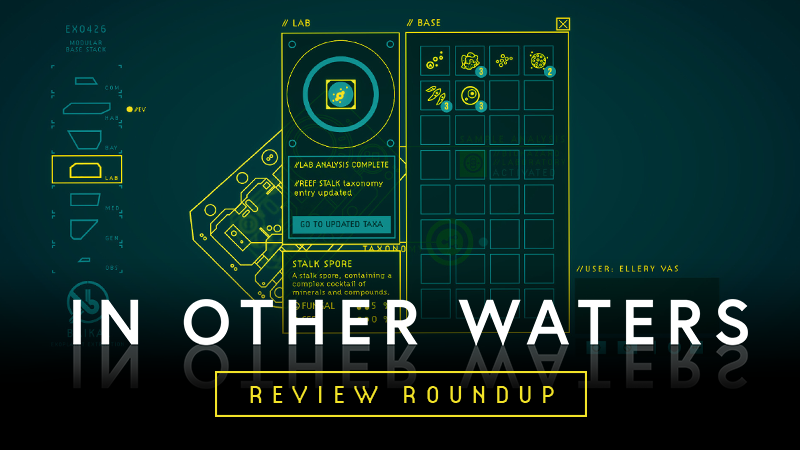
Our Sampling utility allows you to easily collect samples while out in the field. If you would like to bring your samples back into the lab for further analysis and logging, they can be placed in your Sample Storage. If necessary, your suit can also be utilized to deploy any sample inventory back into the field, even during a dive.
You can use the Terminal utility after connecting to a Waystation, Base or other Baikal hardware via your suit’s access port. Upon successful authorization and syncing to the pilot’s console, you can ping your base’s retrieval drone for pickup and access any existing data within your clearance level. Some Waystations come equipped with necessary supplies so you can stay out in the field longer: you can use the terminal to top off your oxygen reserves or recharge your suit’s power.
// POWER
The innovative power system is a vital part of our dive suit. Thanks to Baikal’s proprietary system and next-generation technology, our suits guarantee long lasting power reserves and quick-charge batteries. This ensures that users can spend more time out in the field on a dive.
Your dive suit also comes equipped with an emergency fuel catalyst. In a pinch, you can convert organic samples into precious power. Please note that Baikal is not responsible for any personnel damage as a result of reckless dive plans.
// OXYGEN
Baikal’s oxygen system adapts to your exoplanet’s unique environments to properly allocate reserves accordingly. If you’re in an oxygen rich area, your system will automatically adjust your rate of oxygen for longer use, utilising the rebreather to supply a constant supply or breathable air. Conversely, when you need external oxygen, your suit will begin to utilize your reserves more heavily, which should be closely monitored.
Always keep a close eye on your oxygen supply. If you begin to feel faint, start seeing spots, notice an inability to follow directions, or failure to complete complex survey tasks, you may be experiencing oxygen deprivation. In emergencies, your suit can convert organic material into oxygen necessary to complete your assignment.
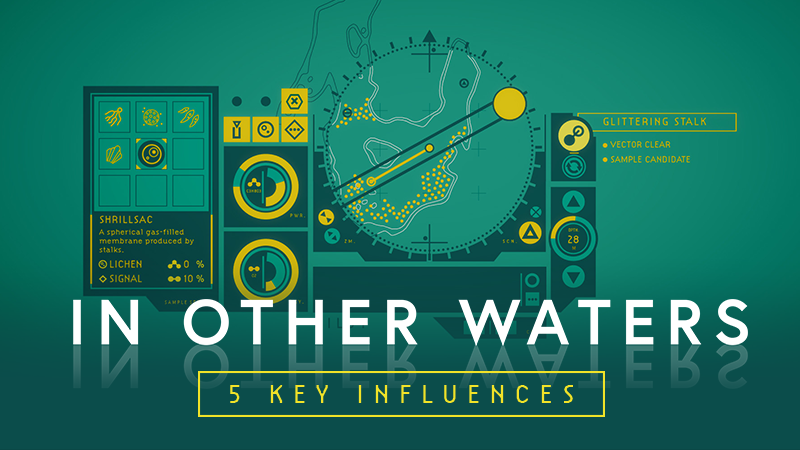
Almost two decades ago, when Metroid Prime released, its scan visor felt like a revelation, a way to ask questions about anything you saw in the world, to study and uncover the world entirely at your own pace. I fell in love with it back then, along with the elegant way the planet of Talon IV unfolded, and it has been in the back of my mind ever since. So when I sat down to make a game, the scan visor was one of the first things that jumped back into my mind as an idea I wanted to develop. In Other Waters could be thought of as a Metroid game where you play as a scientist, an unfolding world that for you to study and learn to understand, not just cut a path through. The “metroidvania” is a busy genre nowadays, but In Other Waters is something else—a game inspired by Metroid, but one that takes a distinctly different path, one that suggests another way of relating to the environment around us.
Annihilation - Jeff VanderMeer
For me, the best science fiction is about scientists. Those who ask the questions in worlds where the strange and the normal become inseparably mixed. VanderMeer’s novel (and the Alex Garland film adaptation that brilliantly mashes it up with J. G Ballard’s The Crystal World) is exactly this, a blending of the everyday and the impossibly surreal, presenting an expanse of wilderness where things, and people, become something else. Annihilation gives us mysteries without easy solutions, as a group of scientists mount a ragged expedition into strange territory. But the beauty of the book lies in its exploration of our relationship to the natural world, and its capacity to change and challenge us. In Other Waters traces the same path through its own strange territory, one that touches on what it means to be human (or non-human) in an era of environmental collapse and crisis.
Capsule - Adam Saltsman
There’s a single moment in Adam Saltsman’s and Robin Artnott’s lesser-known submarine game that feels like it has a key role in the inception of In Other Waters. Tasking the player with piloting a submarine through mine-infested depths via a grubby interface, Capsule’s best tricks involve giving dots names and sounds and letting you fill in the rest. The first time I encountered a Therium and it blurted out a whale-like call before rumbling along the side of my capsule I took my hands off the keyboard and just waited. It was incredible to see such a moment created with just audio and a dot. In Other Waters is that moment expanded out into a full game, where the gaps between signals, sketches and sound are yours to fill in.
Cougar No7 RF-877 - Panasonic
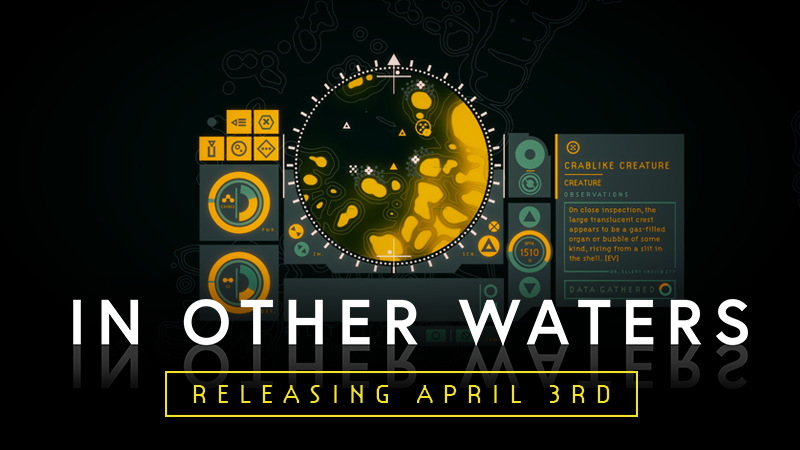
The Cougar No7 is a thing of beauty. This 1973 portable radio looks like something straight out of a Star Wars or Alien sequel, all radial dials and plastic plating. When I sat down to design In Other Waters I wanted to get away from the now tired aesthetic of pale blue holographic interfaces layered with thin lines and too-much-data. So I turned to the industrial design of iconic objects like the Cougar No7 as well as the bold interfaces of 1990’s animes like Neon Genesis Evangelion and Mobile Suit Gundam Wing. The result is a UI that is bold and colourful, while still being tactile and chunky, with an asymmetry that is more industrial dashboard than Apple design award. I still have a little model of a Cougar No7 on my desk, to remind me of the humble origins of the game’s visual design.
Expedition - Wayne Douglas Barlowe
First printed back in 1990, and now out of print, in his book Expedition, Wayne Douglas Barlowe imagines himself to be the “artist in residence” for humanity’s first trip to an inhabited alien planet. Filled with beautiful sketches and paintings of impossible life imagined by Barlowe himself, the book feels like an incredible artifact from another reality. Expedition, and books like it, fascinated me as a teenager, and In Other Waters is my attempt to pay those experiences forward, by creating my own world of impossible life and strange creatures to uncover. Fed by two years of research and reading, I hope the ocean of Gliese 667Cc can sit alongside Barlowe’s Darwin IV as a chance to peek at another world, where things might be different to our own.
LudoNarraCon, the free digital convention on Steam celebrating narrative games, will take place April 24-27. There will be more than 30 narrative games exhibiting and a main theater airing 12 hours of live panels, all available free to you on Steam.
We'll be exhibiting at LudoNarraCon: visit our store page during the event where we will be livestreaming behind-the-scenes content, gameplay, and more! Learn more at www.ludonarracon.com!
Last year LudoNarraCon was a fun way to show off more of In Other Waters and offer a peek behind the scenes for fans. This year we want to go deeper, both in our exploration of this alien ocean and in opening up the processes behind the game.
We’ll announce the details of our stream closer to April, but expect prototypes, paintings and plenty of xenobiology.
As an AI operator, guide a stranded xenobiologist as they explore and study a beautiful and strange alien ocean.
When Ellery is called to planet Gliese 677Cc by Minae Nomura, only to arrive at an abandoned base, she finds herself adrift in an ocean of secrets, with little more than a malfunctioning diving suit and a strange AI to guide her. You are this AI.
Guide Ellery—and keep her safe—as you dive deeper and explore an underwater alien landscape. The planet’s unique life, and its dark history, are yours to uncover and the bond between you and Ellery will be tested by the secrets you learn. Through this shifting narrative, In Other Waters asks questions about the nature of “natural” and “artificial” life, and investigates what it means to be a human in an epoch of extreme environmental destruction. For life to continue, it must change.
Explore an alien ocean
Move freely in each location, discovering new areas off the beaten path. Discoveries lead to upgrades and samples unlock new areas in previously visited locations, additional side quests, and unique conversations with Ellery.
See life through an AI lens
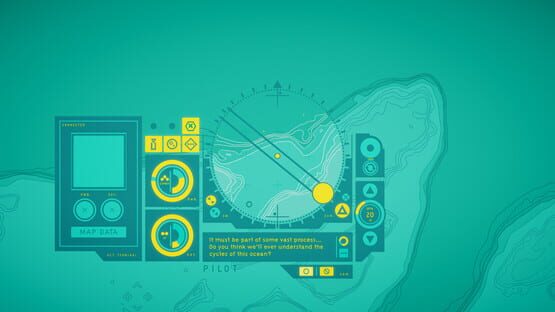
Navigate an elegant, intuitive UI via touch or mouse controls. Interpret signals, set headings, and map the ocean through experimentation and intuition.
Become a xenobiologist
Discover and catalogue species through observation, scanning, taking samples, and interacting with alien life. Read Ellery’s notes, look at her sketches, and help her classify an entirely new ecosystem.
THANK YOU for coming the to first #LudoNarraCon! 💖😍
This was a great experience for our team, and we were thrilled to share it with you. We hope you enjoyed it -- we did! And if you didn't get to see any of the panels from the main stage, you can now view them all on YouTube!
Demo Feedback!
Hi Everyone,
I’m Gareth Damian Martin, developer of In Other Waters. With our demo live this werkend for LudoNarraCon I wanted to give you all a chance to give feedback on what you play. There’s still a lot of development to be done on the game, so every bit of feedback is genuinely helpful. We’ve already had 1k downloads and I’d love to gather as much feedback as possible.
If you have thoughts to share just head to the google form below. All feedback is anonymous and you don’t need to give your name or email: