Devblog #42 - The German Rifleman and his equipment
Hello soldiers,
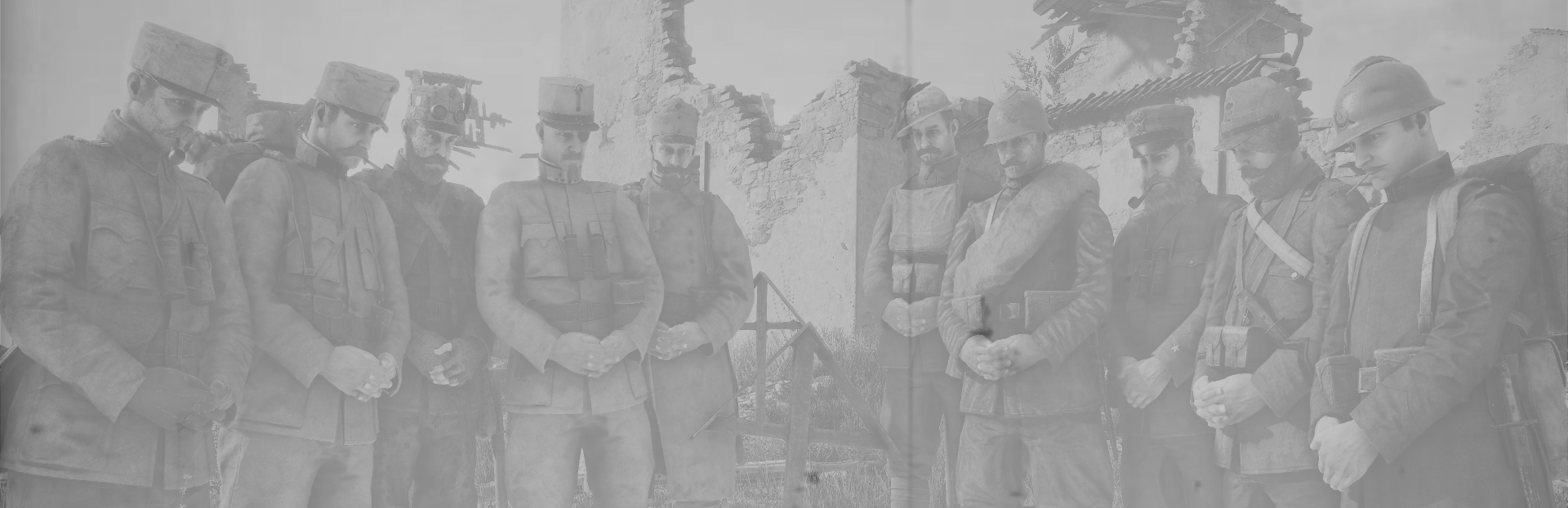
Today is November 11th - Remembrance Day. Also known as Poppy Day, this memorial day is observed by Commonwealth members since the end of World War One. A special day to remember those who have fallen in their line of duty. Other non-Commonwealth countries started to follow this tradition and have their Remembrance Day on November 11th.
In Isonzo (and our other games), you’re able to participate in 2 minutes of silence and be rewarded with a special medal afterwards. Additionally we have enabled Film Memoir mode for all for a limited time.
Lest We Forget
The German Rifleman
The Rifleman is a familiar class in Isonzo already. With the introduction of the German faction as a playable country, they will fill a similar role to the riflemen of both the Italian and Austro-Hungarian factions. The differences here will of course be equipment/uniforms, and the weapons with which they will be armed with.
On top
Like the other nations, Germany did not enter the Great War with a metal helmet.
The German soldiers would usually be seen wearing either a, nowadays, famous Pickelhaube or Feldmütze – a soft cap. The Feldmütze of 1910 had a large red band and piping. Later models of this cap had these removed, as many nations throughout the course of the war thought bright colours don’t work well with modern warfare. Before the 1917 pea green Einheitfeldmütze – a band of canvas was introduced, with a view to masking the bright red colour of the Feldmütze. Other versions of this cap were also available for specialist troops like Jaeger and Pioneer troops – these having different colour piping/bands. The caps had 2 roundels (Kokarden) one being the Imperial roundel and the other roundel signifying which German state the soldier belonged to.
Different versions of the Feldmütze in Isonzo
Another famous headgear of the German army is the Stahlhelm. Germany followed the French and swiftly adopted a metal helmet to try to combat the horrors of trench warfare. Although expensive to produce, they were superior to the Entente helmets, as they provided a thicker shell thanks to the stamping process. The helmet came with several aspects, such as a soft liner and strap to keep the helmet in place, and vent holes to deal with heat. During World War One, several variants were produced, combined with different color schemes. In 1918 a formal way of camouflaging the Stahlhelm was applied and introduced, though it wasn’t unlikely to see soldiers trying to mask their helmet with mud and clay on the field.The Stahlhelm would gain infamy throughout the Great War and beyond. Germany would recycle many of their WW1 items of equipment or create new variants based on these, as the world headed towards the Second World War.
With the introduction of chemical warfare in WW1, a gas mask was of great importance for any soldier. The German soldiers were equipped with the 1917 Lederschutzemaske. This was an improved variant of the previous German gas mask (Gummimaske), which saw issues in both material shortages and performance against newer gas types. The leather mask was superior in protection but unfortunately not as efficient in its fit, especially problematic for soldiers with beards. This gasmask would be carried in the M1916 gas mask canister (Bereitschaftsbüchsen), which contained spare lenses and filters. This can commonly be seen worn on the back or front of German troops, with the Lederschutzemaske also being worn in an alert position if a gas threat was imminent.
The belt equipment
As with most military uniforms throughout history, the belt plays a pivotal role in a soldier’s equipment. May it be for carrying spare ammunition, bladed weapons, rations, the Great War saw soldiers of all nations carry several pieces of vital equipment on their belts.
The German belt famously had a depiction of the Imperial crown with the slogan “GOTT MIT UNS” (God with us) though other variants of this were produced depending on the soldier's regional origin or his rank.
Common items that the German troops carried on their belt are the following:
Ammunition pouches or “Patronentaschen”. The model 1909 cartridge pouch was standard issue to the German army. The leather was often blackened, and the pouch would take 20 rounds (4 x 5 round G98 clips) in each compartment. The soldier would typically sport two off these pouches, one left and one right, providing a total of 120 rounds of ammunition.
Bread Bag (Brotbeutel ) and Flask (Feldflasche ). Worn on his right hip, this is where a soldier would keep his rations and other personal equipment. The bag itself was made of canvas and attached to the belt using canvas straps. Additionally, the flask could be attached to the bread bag. The bread bag also had a set of straps which troops often used in place of the Tornister straps to hook to each cartridge pouch.
Shovel/carrier (Spaten mit Spatentasche) & Bayonet (M.1898/05 Seitengewehr). This short handled entrenching tool was carried on the belt as part of a combined piece along with the bayonet. This provided a relatively easy to access point from which the shovel could be drawn and the bayonet was immediately at the soldiers waist. An offshoot of the traditional sword knot the Troddel would often be found knotted around the bayonet frog. This knot could have different meanings; which company a soldier belongs to, his rank, as well as his state (for example, Prussian non-commissioned officers would have their own knot style).
On the back
German soldiers wore two main styles of pack throughout the Great War. A Tornister, complicated and not best suited to trench warfare, and a simplified Assault Pack (Sturmgepack) – which forfeited capacity for simplicity. The Tornister M1895 was made from calf skin or horsehide, and was standard issue at the outbreak of the war. It would see use throughout the war but would be slowly outdated, with later versions of this pack being made from Ersatz (a substitute/replacement) materials. It contained equipment that didn’t fit into the bread bag, for example tent accessories, ankle boots and other everyday items. Usually, the Mantel (greatcoat) was wrapped around the pack itself and the Mess Tin (Kochsgeschirr) is commonly seen being attached to the pack as well.
The two different kinds of packs
The Assault Pack (Sturmgepack), became a popular replacement to the Tornister and full marching order loadout. It contained far fewer pieces than the Tornister, mostly consisting of the greatcoat, a shelter tarp/blanket and the mess tin, wrapped tightly and held in place with straps. This was a popular setup for assault troops or troops not expecting to see prolonged frontline activity.
German Weaponry
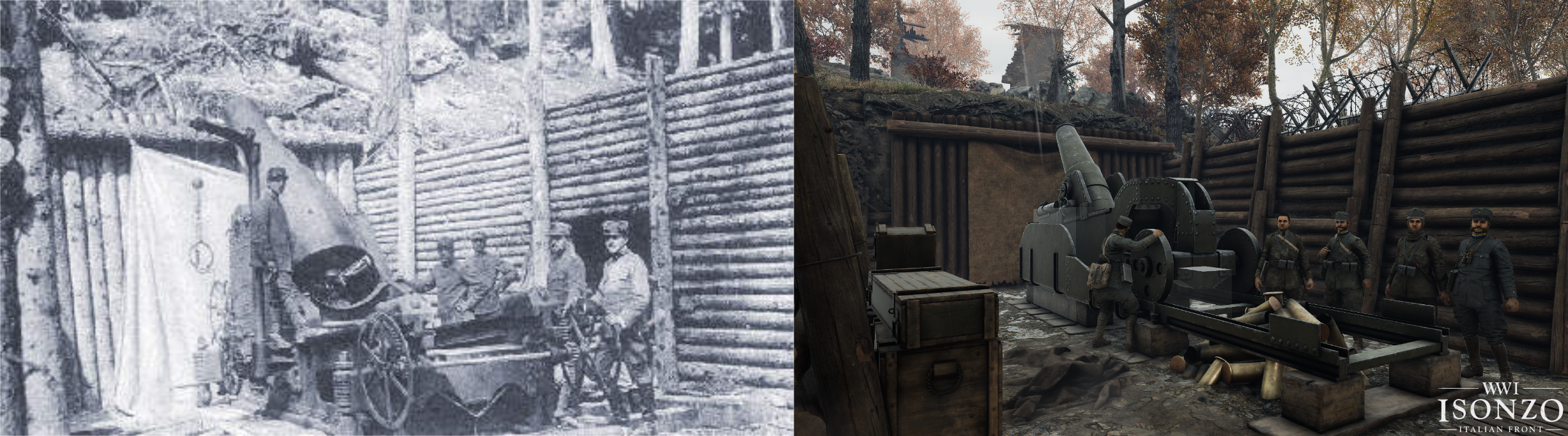
During WW1, each nation participating invested heavily in trench mortars. Some were small enough to be hosted easily within the trenches themselves. Others were situated behind the front lines and lobbed obscenely sized shells. Arms manufacturer Rheinmatall designed the infamous 7.58cm Minenwerfer in 1909, after the mortar's successful resurgence during the Russo-Japanese war of 1905.
The Minenwerfer, literally meaning ‘mine thrower’, was a rifled muzzle loading mortar design , having dual hydraulic cylinders at either side of the barrel to help absorb recoil. Originally limited in its flexibility, the 1916 model n.A (neuer Art) had a 360 degree range of fire and a better range of elevation. A well-practised crew could fire up to 45 rounds per minute with a trained mortar crew.
The Minenwerfer will fulfil a comparative role to the Lanciabombe Bettica and 9cm M14 Minenwerfer of the other Italian and Austro-Hungarian forces.
Caporetto teaser
As you can tell, we’re working hard on the Germans and the Caporetto map! Its release is getting closer! We can’t share any release date with you, for now, so be sure to keep an eye out for our announcements here, in the Discord and social media for when we do (alongside other news).
Deep trenches
And here’s the full image of last week’s guessing game ! They are concrete fireport shields, which you’ll see in Isonzo as well!
See you next week soldiers
Lest We Forget
Today is November 11th - Remembrance Day. Also known as Poppy Day, this memorial day is observed by Commonwealth members since the end of World War One. A special day to remember those who have fallen in their line of duty. Other non-Commonwealth countries started to follow this tradition and have their Remembrance Day on November 11th.
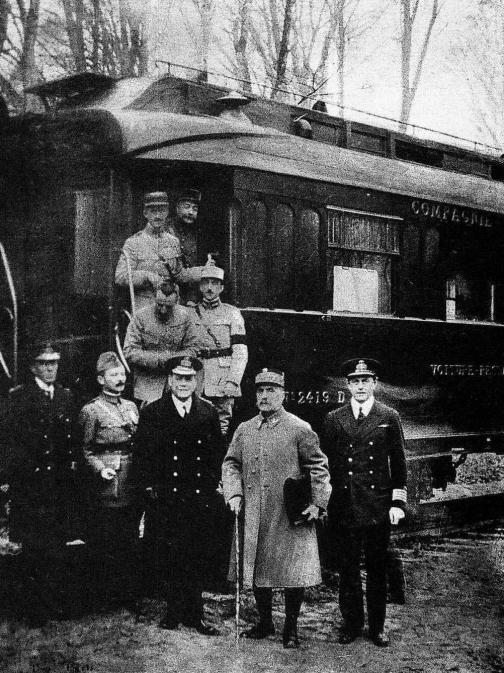
This tradition grew out of Armistice Day, which marks the signing of the armistice being signed between the Allies and Germany.
In the United States, this day is better known as Veterans Day. The common British, Canadian, South African, and ANZAC tradition includes a one- or two-minute silence at the eleventh hour of the eleventh day of the eleventh month (11:00 am, 11 November), as that marks the time when the armistice took effect (EU time).
The signing of the Armistice
As stated previously, this day is also known as Poppy Day. The poppy flower is a common symbol of Remembrance Day. It became the symbol of the Royal British Legion, a veterans’ organisation. They sell paper Poppy flowers which one can wear on their clothing, in memory of those who’ve fallen. The proceeds will go towards supporting war victims and families who’ve lost a family member during war.
Remember together with the WW1 Game Series
In our games, you’ll be able to remember those who have fallen as well. There's 2 minutes of silence when you start up the game, just like the IRL tradition. If you choose to participate, you’ll receive a Remembrance medal afterwards. Furthermore, we’ve also enabled the Film Memoir mode for everyone for a timely period. You can turn this on my going into settings -> graphics
Remember with the community
Additionally, we have a special poppy flower emote in our Discord , specially for this day. Feel free to use it in your Discord bio, status and share with others. If you want to, you can share with us as well who and/or how you remember on this day in our dedicated armistice channel.
Lest We Forget
Game update v357.40523
This update for Isonzo addresses many visual issues, but also raises player height to hopefully improve sightlines and make it more intuitive to see who can see you, and fixes team mates looking like enemies and therefore being susceptible to friendly fire.
The update weighs in at 1.4 GB. It increases the network version, so take care to update in order to play with the majority of players!
Patch notes:
New and improved:
Improved animations for the Fiat Revelli
New first person bashing animation variants for pistols
New first person stabbing animation variants for bayonets
Improved speed and animation timing for melee attacks in first person
Player is now slightly higher in first person
Split Player tags and World tags visibility settings
Improvements to mortar aiming visibility
Improved info panels for mortar and overview map
Linux performance improvements
Fixes:
Fixed players sometimes appearing like they are from the wrong team and therefore could be killed by teammates
Bots no longer use Static weapons if enemies are too far away
Headgear no longer clips through the gas mask
Fixed Villar Perosa sound or muzzle flash sometimes missing in third person
Fixed LMGs continuing to auto-fire while crawling
Fixed full-auto firing animations not always playing in sync with fire rate
Fixed animation snapping at the end of bayonet stab and revolver bash
Fix for field guns animation snapping when first deploying to one on a slope
Fixed fingers clipping through binoculars when looking through them
Fixed Werndl cocking bone not setting when interrupting reloads
Fixed bridge explosions replaying after switching graphics settings
Corrected size of some pistols and flareguns
Fixed Allow voice chat option not resetting to default
Fixed incorrect names for Gorizia and Sabotino Capzones
Sector outlines are now red when in cooldown
Known issues:
Wrong marksman perk localization for some languages
Ghost players
Voice keybinds are sometimes not remembered on the spawn map
Devblog #41 - German Weaponry in Isonzo
Hello soldiers !
We see you’re enjoying the teaser for the upcoming Caporetto update, so how about some more? As stated before, we’re aiming to release it this year, but that’s all the info we can share for now. Please enjoy Isonzo and look forward to the updates and expansions! As always, if you want to chat with fellow soldiers, you can join our Discord . Here you can also report any issues you encounter in the game!
Italian Remembrance Day
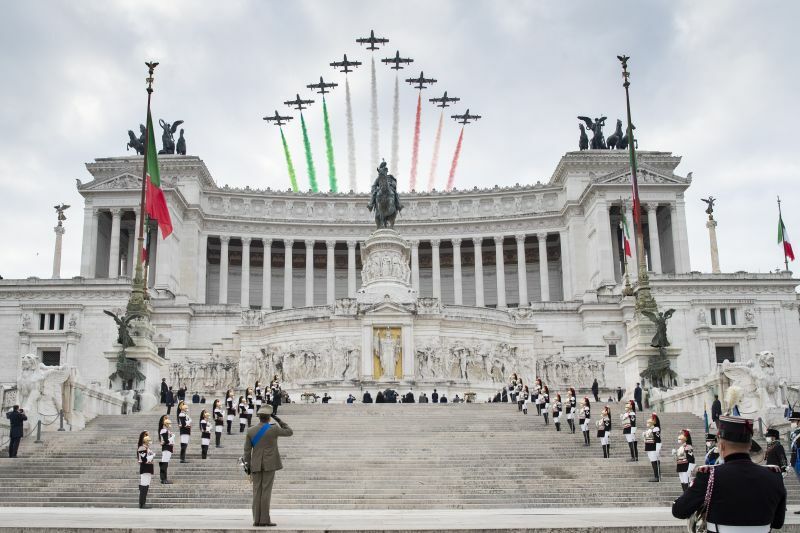
Today is National Unity & Armed Forces Day in Italy. On this day, the Italians commemorate the victory in WW1, an event that they consider the completion of the process of an unified Italy. The most important people in the Republic pay homage to the Italian Unknown Soldier and the Redipuglia War Memorial, where over 100.000 Italian soldiers found their final resting place.
The Unknown Soldier
The body of Italy's Unknown Soldier was chosen from among 11 coffins containing the unidentified remains of fallen Italian soldiers who fought, retrieved from various areas of the Italian front of WW1. Maria Bergamas, the mother of Italian soldier Antonio Bergamas whose body was never recovered, made the difficult choice in the Basilica of Aquileia on 28 October 1921. Reaching the 10th coffin in the line, she slumped to the floor and screamed her son's name. This was the body chosen.
The Italian Army Forces open their barracks to the public, showing exhibitions of The Great War, often combined with sport demonstrations by soldiers. On squares in big Italian cities, concerts are held by military bands.
German Gewehre
Now on to this week's devblog, taking a look at some more weaponry you'll see in Isonzo with the Caporetto Expansion.
Gewehr 88/05 Commission Rifle
First up, we have the Gewehr 88/05 Commission Rifle. Prior to its debut, the German Army found itself on the backfoot with the introduction of the Lebel 1886 combined with the new smokeless cartridge 8mm Lebel. This resulted in something of an arms race within Germany itself. They needed to produce a design which would replace the ,now obsolete, black powder Mauser model 1871. Borrowing from a series of prototype and submitted designs, eventually the pattern of the Gewehr 1888 would be ironed out. This weapon would see a 5-round capacity, a rimless 8mm cartridge, barrel jacket and enbloc design akin to that of the Mannlicher system. However the G88 enbloc could be loaded both ways. Far from perfect, these rifles would be the mainstay of the German army until the adoption of the Gewehr 98 later. Overall, just shy of 3 million were produced for Germany and its allies.
While the Mauser production was well under way for the Gewehr 98, it was noticed that a widespread conflict in Europe would eat up large numbers of arms, prior to the outbreak of World War One. In 1905 the Gew88 was revisited, and many of the rifles were converted to take the new 7.92 ‘Spitzgeschoß’ (pointed projectile) spitzer bullet. This conversation made several changes to the weapon: the addition of a clip bridge for the stripper clip system in use with the new ammunition, rechambering of the barrel, a feed interrupter, and loading made easier with cuts to the chamber and receiver wall. The hole from which the enbloc would fall out was typically sealed too. Our model in game reflects the iconic and rather viscous looking Seitengewehr 1871 bayonet.
The Germans had around 500,000 of these converted rifles by the outbreak of war in 1914, which was extremely useful in a war of attrition. These rifles could use the same ammunition stocks as the Gewehr 98 and in issuing these rifles to rear line troops ,or soldiers less likely to see combat, it allowed for the superior Gewehr 98 to be given priority where they were needed.We’ve covered this weapon in our game series previously; this antiquated rifle played an important part in the Great War.
Kar88
With the adoption of the Gewehr 1888 to replace the outdated black powder rifles, a carbine version of the main battle rifle would often be made as well with large armament changes. The Gewehr 1888 was no exception here. The Kar88 was designed with cavalry use in mind. It used the same ammunition and had the same mechanism, but it was a slimmed down version. Some features like the bolt handle were changed to reduce snagging. The overall idea was that the weapon should be light, small, and handy.
The rifle would be issued with cavalry and a version would be introduced for foot artillery use in 1891 – the only difference between these rifles is the addition of a stacking hook. The Kar88, like other carbines, would also often be issued to light infantry and non-frontline units, making its way to the frontlines in many parts of the conflict. This model lacked the ability to attach a bayonet and were primarily produced by none-state arms manufacturers CG Haenel and VC Schilling.
About 225,000 of these carbines were made, at the arsenal in Erfurt made a batch of around 25,00 carbines in 1891, our model reflects this unique little batch. Again, no stranger to the game series, this short rifle should offer a nice parallel to the carbines of the Italian and Austro-Hungarian forces.
Was ist das?
To end this week’s devblog, we got a little guessing game for you! Do you know what this is? Be sure to reply with your answers
See you next week soldiers!
Devblog #40 - The Battle of Caporetto
Hello soldiers !
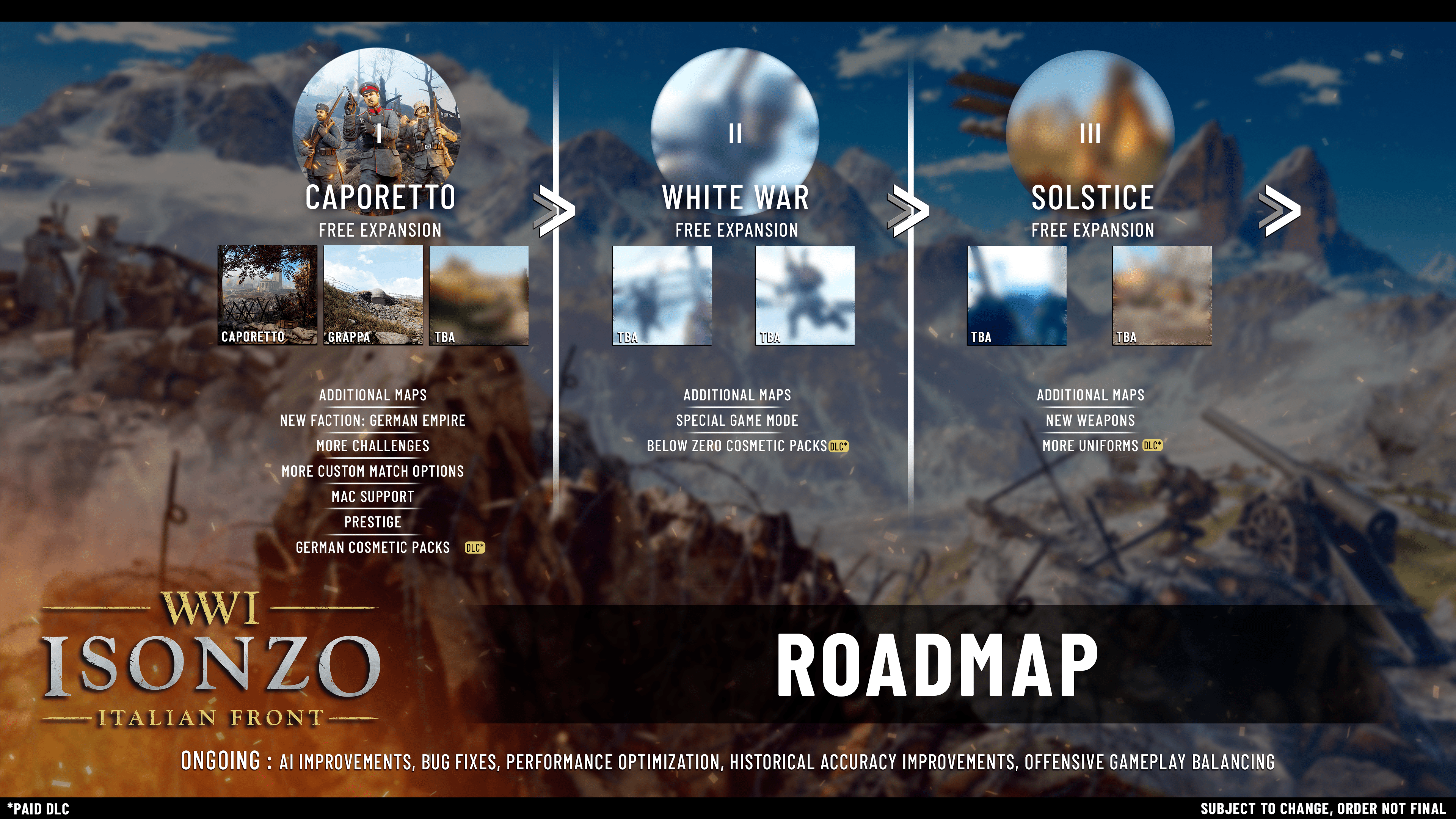
We know you’re all excited for our upcoming, free update for Isonzo: the Caporetto Expansion! This update will include 3 new maps, the addition of the German Empire Faction and many other things ! In case you’ve forgotten, here’s our roadmap overview
For the release date, we can’t say anything for now, but we’re aiming to release it this year! Besides the expansion, we continue to work on further improving and fixing issues you encounter in the game. Thank you for your reports and patience. We recently released a new patch , be sure to update your game !
For now, let’s learn a bit about the Battle of Caporetto. But first, here's a screenshot that shows a bit of the Caporetto map in Isonzo
The final battle
The Battle of Caporetto, also known as the 12th Battle of the Isonzo, was one of the most significant battles of World War I along the Italian Front. This battle was fought between the Italians and the Central Powers, between October 24 - November 19, 1917.
When autumn arrived in 1917, Luigi Cadorna’s strategy of continuous offensives near the Isonzo River ,11 Italian attacks since May 1915, had cost the Italians heavy casualties for an advance of less than a few kilometers, only one third of the way towards their preliminary objective, the city of Trieste on the Adriatic Sea. However, the wave of Italian attacks had also taken a serious toll on Austro-Hungarian resources in the region. Indeed, in the wake of the Eleventh Battle of the Isonzo in August 1917, their positions around the city of Gorizia were dangerously close to collapse. As a result, the German Supreme Command, led by Paul von Hindenburg and Erich Ludendorff, determined with Arz von Straussenberg that they would launch a counter assault on the Italians mid-September.
To prepare for this, the German army transported seven divisions of troops to reinforce the upper banks of the Isonzo. Cadorna, learning by aerial reconnaissance of the Austro-German movements, pushed back his own army’s scheduled September offensive, so he would be able to prepare for the defensive positions to prepare defensive positions. However due to unfavorable weather, this resulted in the plans being pushed back, and by the time Germany and Austria-Hungary were ready to attack, they were able to catch the Italians by surprise.
The early morning of October 24, the battle began when the Austro-Hungarians and Germans carried out a series of poisonous gas attacks against the Italian trenches, meaning that the Italian soldiers had to retreat. Followed by these gas attacks was a heavy ‘Stormtrooper’ assault by both parties, including the usage of flamethrowers, grenades, machine guns and mortars.
German assault troops
The Italian 2nd Army commander Luigi Capello was bedridden with fever. Recognizing that his forces were ill-prepared for this attack and were being routed, Capello requested permission to withdraw to the Tagliamento. Cadorna, who believed the Italian force could regroup and hold out, denied the request. Finally on October 30th, the majority of the Italian force were ordered to retreat to the other side of the Tagliamento river.
It took the Italians four full days to cross the river, and by this time the German and Austro-Hungarian forces were closing in on them, the Italians being ambushed as they tried to cross the river. These ambushes would become known as the Battle of Pozzuolo.
The rapid success of the Austro-Hungarians and Germans pushing the Italians back, caught up with them. Their supply lines were stretched to the breaking point and unable to launch another attack to isolate a part of the Italian army against the Adriatic. Cadorna was able to retreat further and by 10 November had established a position on the Piave river and Monte Grappa.
Italian trenches along the Piave River
Italian casualties during the Battle of Caporetto were almost 700,000—40,000 killed/wounded, 280,000 captured and another 350,000 deserted. In the wake of the battle, violent anti-war protests reached a peak in Italy, as Cadorna was forced to resign his command. His successor, General Armando Diaz, would oversee a new Italian strategy, going for a more defensive approach. He remained in charge during the remainder of the war, including a greater reliance on the resources of the stronger Allied powers.
Fun fact, nowadays the term “Caporetto” is used by Italians to refer to a ‘ terrible defeat’. For example, the failed General Strike of 1922 by the socialists was referred to by Mussolini as the "Caporetto of Italian Socialism".
Another Caporetto teaser
A pistol that needs little introduction, and you might've spotted it already in the screenshot previously. One of the most iconic firearms in history, the Luger P08 was the German Army’s primary side-arm during the Great War. Replacing the Reichsrevolver family or firearms, Germany found itself going from an antiquated and poorly thought-out revolver to something that could at the time be considered truly modern. A weapon that would offer up capacity and speed the likes of which the service revolvers of Entente nations simply could not match.
Designed by Georg Luger in the latter years of the 1890’s, the Luger is a toggle-lock, recoil operated pistol that improved on the design of the Borchardt C-93. Developed with Lugers’ own 9mm “Parabellum“ cartridge in mind, it would enter service first with the Swiss Army in 1900, and in 1908 for the German Army ( though earlier adoption had been made by the German Navy). Multiple variants were issued throughout the course of the war, including variants with butt-stocks, longer barrels, and drum magazines. Around 2 million Luger pistols would see use during the Great War.
Eventually to be officially replaced by the Walther P38 in 1938, the Luger saw major use in both world wars. A desired war trophy, the impact this pistol had can not be underestimated. Even if in time the Luger action would eventually become obsolete - the pistol cartridge itself is one of the most, if not the most, popular handgun and submachine gun cartridges.
A familiar sight to the game series, the Lugers media appearances are widespread and it can be spotted in the original All Quiet on the Western Front, the television series Band of Brothers, and in Hollywood blockbusters including Indiana Jones.
Community Screenshot
To end this devblog, we share a screenshot from player, showing off some firey action ;)
This Isonzo update reverts TAA back to its initial settings, adds an option for autobalancing to Custom Matches (with advanced options), fixes numerous audiovisual issues and offers some quality of life fixes in the UI and gameplay departments.
We are working on artillery balancing and effectiveness, as well as on voice chat not behaving as it should. You can expect improvements for this in upcoming updates. We are also investigating the issues with players turning invincible.
This update raises the network version, therefore you need to update to play online with the majority of players! It is a ~600 MB download.
Patch overview
New features
Team balancing can now be turned off for Advanced Custom Matches
Audio and graphics
TAA effects restored to initial values
Improved tree shadow popping on some maps
Fixed several objects disappearing when a player is close
Fixed "Shaken, not stirred" achievement tracking
Bandaging in quick succession no longer stops bandaging animation from playing
Further improvements to going prone sound playing while not actually switching stances
Improvements to Bomber Squadron call-in sound
Fixed Enemy on the left and right voice lines being reversed
Fixed Follow Me voice line being triggered instead of an Attack one
Fixed wrong bayonet attachment for Vetterli-Vitali in progression view
Fixed stuttering when going up or down some stair types
Improvements to the first person Schwarzlose firing animation
Various weapon animation improvements
UI
Unobtainable medals are no longer counted in Profile Medal Progress
Joining Private matches from the friends list now also requires password input
Fixed not being able to join matches through Play now (GameSetupReady signal error)
Fixed Custom matches sometimes not starting when Create button is pressed
Player and objective tag fading can now be turned off in Settings
Fixed missing Offensive progression info in the After Action Report if the section was skipped
Gameplay
Added grace time to interrupting Rifle Grenade loading and unloading animations
Fixed resupplying Rifle Grenades sometimes resulting in losing grenades instead of gaining them
Fixed not being able to bolt while sprinting if Manual Bolting setting was on
Fixed sprinting sometimes being cancelled because of bolting
Improved collision of HMGs (Players using them are now harder to hit)
Known issues
End match screen does not pan across the map
Tutorials don't automatically cycle
New settings do not have translations yet
Scroll wheel doesn't always work on Linux
Devblog #39 - Alpine Units Pack Highlight
Hello soldiers!
Another week, another dev blog! Meanwhile, we’re working hard on the upcoming Caporetto update and of course, monitoring issues you’re encountering with the game and releasing patches! Don’t forget to check if your game is updated; we recently released a new patch that addresses several aspects. You can reach all the patch notes here.
Now as the days are getting colder and we're (hopefully) going to be seeing some snow, it’s time we take a closer historical look at the Alpine Pack!
Staying warm in the icy cold
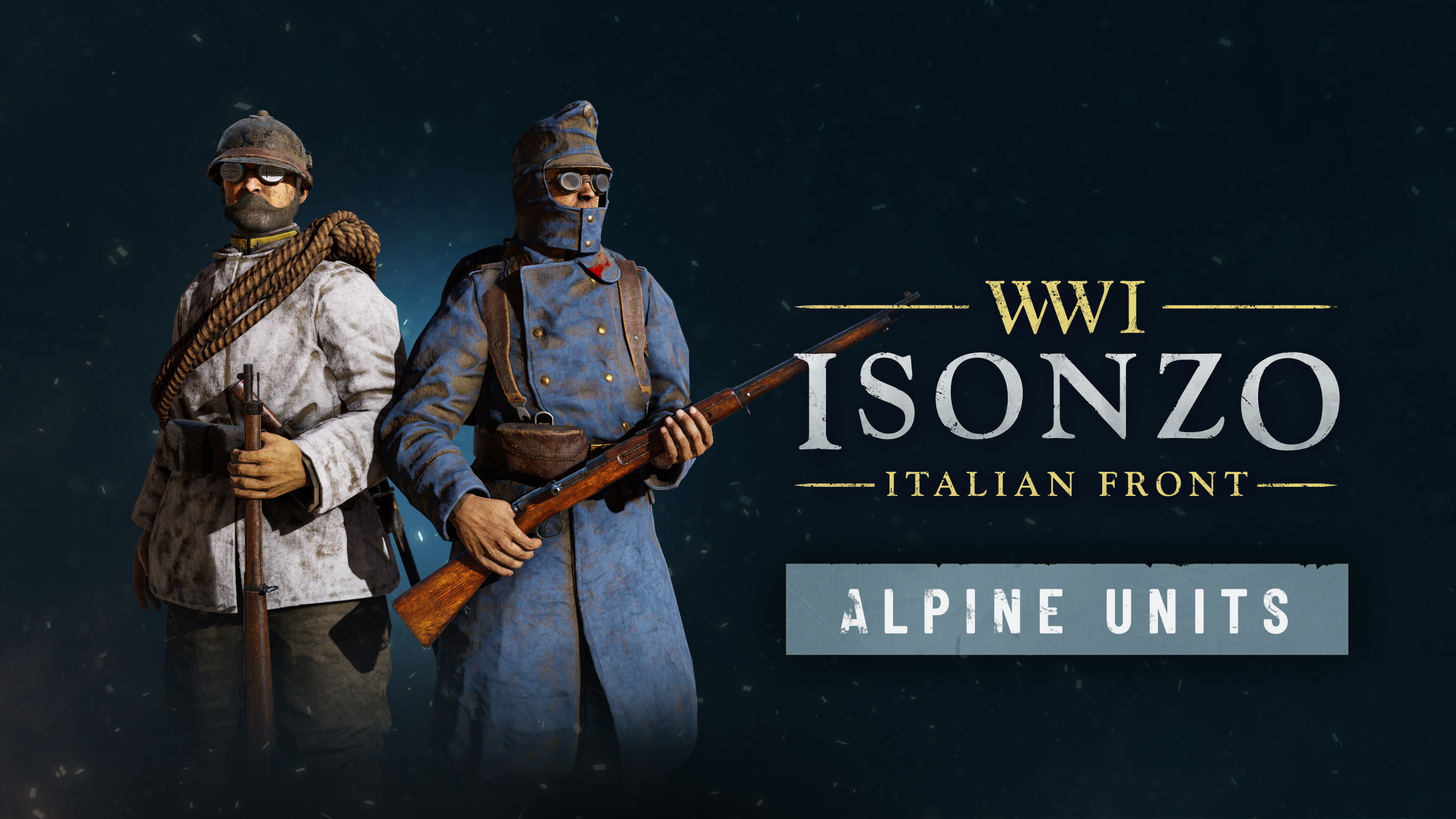
When fighting on the cold Alpine mountains, you better dress for the occasion. The Alpine Units Pack contains uniforms and gear worn by units in the winter, combined with facial hair, which would also help a bit against the cold winds. Each troop has 6 uniforms, combined with the respective headgear, facial items and moustaches/beards.
Overview of items included in this pack
The Alpini
Formed in 1872, 11 years after the unification of Italy, the Alpini were brought together to protect the peninsula’s mountainous borders and are the oldest active mountain infantry in the world.
Recruitment for the Alpini went through Italy's mountain valleys locals and organized them into a special corps. As they possessed superior knowledge of mountain territory and greatest adaptability to Alpine conditions, this was a great (and obvious) idea. At the beginning, the mountain regions were divided into seven military districts, each commanded by an Officer and home to at least two Alpini companies, each consisting of 120 members.
During World War One, which was for the Alpini also known as the "War in snow and ice", had a frontline of 600 km, running straight through mountains and glaciers of the Alps. Many soldiers lost their lives during the harsh terrain, such as avalanches. To survive on these icy cold mountains, massive underground bases were drilled and dug into the mountainsides and into the ice of glaciers. Guns had to be dragged up the mountain by hundreds of troops. going as high as 3,890 m (12,760 feet). Besides these bases roads, cable cars, mountain railroads and walkways were built as well. Many of these walkways and roads are still visible today, and many are maintained as Via Ferrata. In addition, along the former frontline it is still possible to see what is left of hundreds of kilometers of barbed wire.
Alpini soldiers climbing up the mountain terrain
Nowadays, the Alpini are known for their assistance with earthquake and avalanche recovery, particularly in Central Italy along the Apennines. Furthermore, they’ve also been deployed to countries such as Afghanistan and Kosovo, where they are able to use their expertise navigating mountainous terrain.
Keeping a watchful eye high up on the snowy mountain required a clothing to match the high altitudes. Instead of the green-ish looks of the Italian uniforms, the Alpini here are wearing white overgarments. It might stand out on lower ground battles, but this was the perfect fit for those up on the Alps.
One of the headgear you can wear is the M1909 'Berreto' Cap. This is a soft-topped cap, made of grey-green cloth with a rigid peak & adjustable chinstrap of black leather. To the front of the cap is sewn a patch made of similar coloured material with a Crown above the respective regimental number.
The Italian Army adopted the grey-green uniform (grigio-verde) officially in 1909 although it had been trialed and accepted in 1908.
The version in the game with the Alpine Units Pack will include the goggles! Also separately available so you can wear them on your face instead of your cap. ;)
Gebirgstruppe
The Imperial-Royal Mountain Troops, in German Kaiserlich-königliche Gebirgstruppe, were founded in 1906 as part of the Austrian Landwehr, the territorial army of the Cisleithanian part of the Austro-Hungarian Empire. Because of this, the abbreviation ‘k.k’ - kaiserlich österreichisch, königlich böhmisch (meaning Imperial Austrian, Royal Bohemian) was used and not "k.u.k." ("Imperial and Royal") which would have implied a connection with the Hungarian half of the Empire.
Conrad von Hötzendorf was the one who proposed the establishment and in February 1906 the War Ministry in Vienna convened a session on Alpine border security. Field Marshal Tunk agreed with him and put forward a concept, the fundamentals of which were then carried out.
The already existing state rifle regiments were to be trained as mountain troops and, together with the Landsturm border patrol companies and gendarmerie departmenta, they were responsible for the territorial defense force. Combined with the local knowledge on the border of Tyrol, they were seen as the backbone of the defense.
One of the headgears you can find in this pack is the Stahlhelm. Meaning ‘steel helmet', this helmet is of German origin, and was mainly produced and worn to provide protection against shrapnel and fragments of grenades. The term Stahlhelm refers both to a generic steel helmet and more specifically to the distinctive German military design.
During World War One, many European countries introduced this type of helmet to their own army. Around 1916, the Pickelhaube ('spiked helmet') was being replaced with the Stahlhelm.
Austria-Hungary Empire purchased about 416,000 German helmets from November 1916 until the end of the war. Additionally, they started to produce their own licensed production around May 1917.
The Austrian M17 helmet was similar to the German M16 but was coloured golden-brown (known as Isonzo-braun), had a cloth chinstrap and had the chinstrap rivet located higher up on the steel shell.
Closely looking at the Austrian M17 was the Hungarian M18 variant. They shared a similar design, but the chinstrap rivet was smaller in size and located even higher up than the Austrian version. It had a similar Isonzo-braun colour.
You can find these items, and many more, in the Alpine Unit Expansion pack right here!
As stated in our roadmap, our first big free expansion will be the Caporetto expansion, which brings many new things, but most importantly , The German Empire! We can’t give you an exact date (for now) as to when this expansion will be available, but know that we’ll share the exciting news as soon as we know!
When Germany entered the war, as with many other nations, it found it was lacking the modern sidearms it required to outfit its army. This resulted in the common practice of reissuing older firearm designs to fill gaps left by prioritising more modern weaponry for frontline use. This is where the Reichsrevolver, specifically our model 1883, saw a second life.
A common sight until the Reichsrevolver family was replaced by the Luger in 1908, these single action 6 shot revolvers sported a powerful 10.6mm cartridge, but really did not stand up to revolvers of the period. Compared to the M1879 Reichsrevolver, the M1883 model sported a shorter 4.6-inch barrel, changes to the cylinder, a smaller grip and lanyard ring, and a smaller safety mechanism (though the design is often criticised for this).
In its function, the M1883 model is identical to the M1879 model, and again it suffered from the same loading issues experienced with the latter. Cartridge removal wasn’t something that was well planned for the M1879, and the revolvers were issued with an easily lost ejection rod. The M1883 wasn’t even given this privilege. Subsequently – and as replicated in game – users of the Reichsrevolver most likely resorted to a handy twig or stick!
Old, antiquated, obsolete. This revolver holds a special place in the WW1 Game Series arsenal and can be a bit of a toughie to master!
See you next week soldiers!
Game update v355.40062
This update potentially improves issues with players being outside of a faction and therefore unkillable. It also addresses issues with periscopes, some UI improvements and a fix for the esteemed achievement "Sacro Egoismo".
This update raises the network version, therefore it is necessary to update to play with the majority of players. It should be an ~80 MB download.
Improvements:
Gameplay and graphics:
Potential improvements to players being stuck without a faction and unkillable/unable to play (further fixes may follow depending on feedback)
Fixed players sometimes becoming invisible after spawn
Fixed periscopes sometimes not being visible
Fixed players teleporting to a different periscope when using one
Fixed Lanciabombe Bettica not being shown as unloaded in third person
Fixed planes flying into cliffs on Dolomiti
Return to previous stance option now actually returns the player to the correct stance
Improvements to health/bandaging stability
UI:
Fixed Squad menu list showing empty squads or players that are not there
Fixed Squad menu not always showing correct uniforms for squadmates
Fixed "Sacro Egoismo" achievement
Fixed slow scrolling on the After Action Report Medals screen
After Action Report Medals screen is now scrollable with a controller
Devblog #38 - Veteran Units Pack Highlight
Hello soldiers !
How have you been enjoying Isonzo so far! We enjoy watching the clips of your gameplay and screenshots you share with us on social media and in our Discord, keep it up! Of course, we’re also monitoring issues you encounter with the game and we keep on fixing these and further improving the game! Don’t forget to check if your game is updated; we recently released a new big patch that addresses several aspects. You can reach all the patch notes here.
Now for this week’s devblog, we’re taking a closer look at one of the cosmetic DLC packs for Isonzo: the Veteran Units Pack and its historical background.
Battle-worn Gear
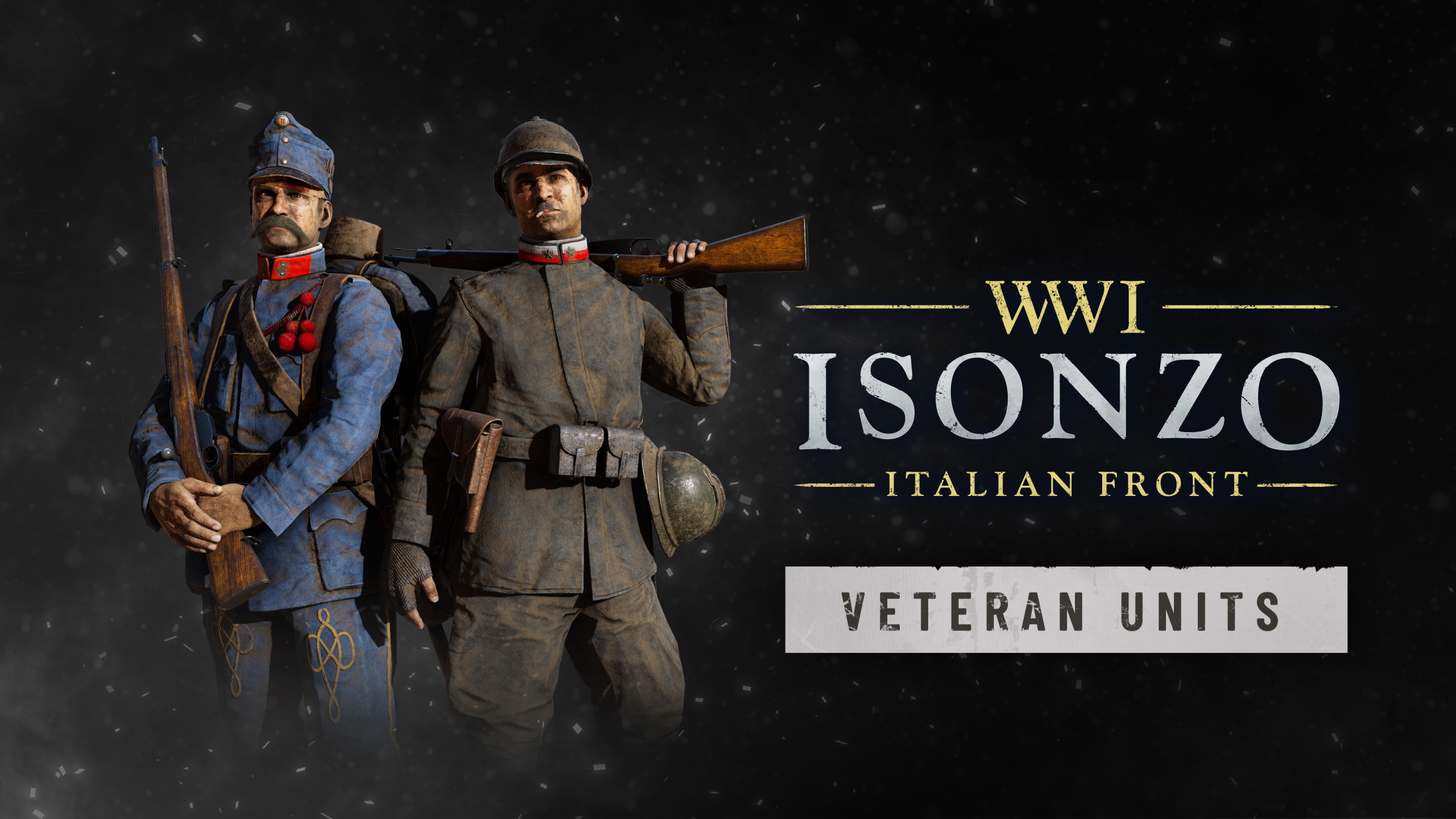
As the name suggests, this pack contains battle-worn uniforms, for those veteran soldiers who’ve seen a lot of battles. Containing uniforms from some of the most iconic units from both sides on the Italian Front - the Italian Sardinian brigade and Bersaglieri to the Austro-Hungarian Honved. Alongside the uniforms and their respective headgear, this pack also includes 5 mustaches and 2 faces (1 per faction) and 4 facial accessories.
An overview of all the items included
Sassari Brigade
The Italian uniforms include the famous "Sassari" brigade (Sardinians), who were deployed in some of the most bitterly contested battles of the war. In addition the Italian officer and mountaineer get the distinctive Italian Royal Army capes.
During Italy’s general mobilization in preparation for entering World War I, the Italian Army assembled the Sassari Infantry Brigade on the island Sardinia on 1 March 1915. It was the 151st Infantry Regiment in Sinnai and the 152nd Infantry Regiment in Tempio Pausania.
Unlike other Italian infantry brigades, the Sassari recruited only Sardinians, hence their nickname. However, the highest-ranking officers were from the Italian Mainland.
The brigade had their first battle during the First Battle of the Isonzo and distinguished itself in the Second Battle of the Isonzo. In May 1916, they aided in Italy’s effort to stop the Austro-Hungarian’s Spring Offensive. Later that same year in June, they seized Monte Fior, Monte Castelgomberto, Monte Spil, Monte Miela and Monte Zebio.For these actions both regiments of the brigade were awarded a Gold Medal of Military Valor.
In both images, you can see the Sassari brigade wearing the Adrian helmet. Originally produced by the French Army in 1915, it was the first modern steel helmet, which later became a basic helmet of many armies into the 1930’s. The helmet was designed for French troops who were fighting in the trenches. Prior to the Adrian helmet, soldiers wore a kepi cap, which left the soldiers open for injury as it provided no protection whatsoever.
Seeing how effective the helmet was and the fact it was easily (and cheap) produced, the helmet was quickly added by other countries, including Italy, who had their own license-built version.
Honvéd - Defenders of the Homeland
The Royal Hungarian Honvéd, generally known as Honvéd (literally meaning ‘Defender of the Homeland’) was one of the 4 armed forces of Austria-Hungary from 1867-1918. The term first appeared during the 1848 revolutions, and was given to the volunteers who joined battles for several weeks or ‘ until victory’ .
Like the Austrian Landwehr, the Hungarian Honvéd began in 1867 as a militia charged with secondary security duties. During the negotiations that created the Dual Monarchy, the Hungarians demanded that the Imperial Army should be divided between Vienna and Budapest. There needed to be a separate Hungarian army command and Ministry of War, and the Hungarian Army would wear its own uniforms, march under its own banners and respond only to Magyarul as the language of command.
During World War One, 8 Honvéd infantry divisions and the Honvéd cavalry division marched to war in August 1914 alongside the Common Army, fighting on all fronts. Like the Common Army, the Honvédség expanded during the war. However, the Common Army, Landwehr and Honvédség were not mixed in the ad hoc divisions and brigades formed at the front, even during crises at the front. Also the “official ad hoc” infantry divisions that briefly served on the Italian front were not mixed.
Worn by the soldiers is the feldkappe. This cap was worn by the Austro-Hungarian army prior to 1907 and continued into World War One. More known is the Austrian version with the brass saying ‘FJI’ (Franz Joseph I) whereas here in our game it reads ‘IFJ’ (I. Ferenc Józef) in Hungarian.
Additionally, you can see Cap Badges as well. Known as ”Kappenabzeichen” in German and „Sapkajelvények” in Hungarian, these badges were made to represent several things such as; the portrait of the emperor, military commanders, commemorated armies & regiments, battles & campaigns, military hospitals and the Red Cross.
To end this section, we share a screenshot from a player who made a Hungarian squad with this pack! Looking great!
With the same Mauser action and 5 round capacity of the Gewehr 98 rifle, the Kar98az ultimately managed to fix several of the Gewehr 98s faults. The German Empire realized the need for a shorter carbine for cavalry use in the early years of the 20th century, with designs being submitted and produced between 1902 and 1908.
The Kar98az was adopted in 1908, a model which resolved most of the earlier carbine model production problems. Adapted for infantry use “az” here refers to “ Aufpflanz-und-Zusammensetzvorrichtung” ( with bayonet and stacking rod). Initially issued to light infantry and mountain troops, it was quickly pushed into front line infantry use, and became synonymous with the famous StormTroopers.
A shorter rifle with a turned down bolt handle was more befitting of trench warfare, and the improved sight picture was a welcomed change. As many as 1.5million Kar98az rifles were produced by the war's end in 1918.
This is another familiar face to fans of the WW1 Game Series.
See you next week soldiers!
Hotfix v354.39911
Fixes some issues present after the last patch:
Fixed issues with spawning as Assault class
Fixed challenge progression showing 0 while the challenge is already completed
Fixed some Post Processing options resetting or not working