In May 1916, Austria-Hungary launched a large offensive operation attacking across the Vicentine Alps into the Autonomous Province of Trento (known as Trentino). Despite their German allies refusing to assist with the attack - and even going so far as trying to dissuade General von Hötzendorf from carrying out the plan - the Austro-Hungarians massed thousands of guns and hundreds of thousands of men. If they managed to break through they would be in a position to outflank all the Italian troops fighting along the Isonzo river. This was called the Strafexpedition - punitive expedition - intended to punish the Italians for their betrayal of the Central Powers when they went against an earlier defensive agreement to join the Entente instead.
Facing them was the Italian First Army. Low on manpower and lumbered with some poor quality officers, the Italian defenders did not see the attack coming. The Strafexpedition did not come as a surprise to everyone though! The Italians did have intelligence suggesting a major offensive aimed at Trentino was in the works a month ahead… but General Luigi Cadorna refused to consider the possibility since it went against his own thinking.
Many WW1 generals get sometimes unfair criticism for their performance when you consider the unprecedented scale of the war and the new technologies used. Luigi Cadorna… was not one of them, and can be criticized for a great number of things.
In Isonzo the Strafexpedition is a two map offensive, of which Fior is the second map, named after the mountain which is the focus of the attack. The final objective is the Fior Peak, which stands at 1824m high (5984ft). An interesting feature of the area is the unusual limestone formations called the Città di Roccia (or ‘city of rock’). The Austro-Hungarian attackers will need to fight their way through these to reach their final objective at the peak of the mountain. But climbing a mountain takes time, and before they get anywhere near the Città di Roccia there are two other defensive lines to break…
Photograph of the Città di Roccia today.
The Austro-Hungarian attackers must first storm a forest to sabotage a gun position and capture a command post. The attackers begin sheltered in a treeline, but will need to force their way across a road and strip of grass before they can reach the shelter of more trees. Fortunately (for some) a convoy has been ambushed and destroyed on the road, providing useful cover in addition to the low stone walls running along the road.
The devastated convoy - the attackers are coming from the left side of this view.
Trenches and barbed wire positions lie throughout the forest on the other side of the road - some are proper dugouts with weapon emplacements and forward spawn points, while others are little more than rows of sandbags piled atop banks of dirt. The forest and undergrowth present on Fior mean it’s important to understand the distinction between cover and concealment: rocks, sandbags and fallen logs provide cover that will protect you from bullets, while the tree leaves and plants will conceal you from the enemy but not save you from gunfire or shrapnel.
Some of the Italian defensive positions in the forest.
One objective calls for the Austro-Hungarians to sabotage one of those forest defensive positions, but the other is a capture objective set among a trio of houses on the wooded slopes. The houses and stone walls are potentially a major challenge for the attackers, especially since the buildings are intact and will offer good shelter from artillery and aviation call-ins.
The hillside houses - the one on the right contains the command post.
However, should the attackers gain a foothold it may not be easy for the Italian defenders to counterattack. The main house has two stories, with the top story including windows facing towards the Italian positions - an excellent spot for an LMG! Additionally defending reinforcements are forced to route around the side of the house, or go down a narrow set of steps which could easily be blocked by wire or become a killing zone if a few enemies are watching it.
Viewed from above - you can see the narrow stairway down between the two closest houses.
The second defensive line also has one sabotage and one capture objective. Before reaching those is more forest, much of it heavily shelled and devastated (including a ruined building) and a series of forward spawn points. As always, it’s up to you and your team how much effort you want to put into dominating the forward spawn points - if the defenders are putting too much manpower into holding their forward spawn point, you might be able to sneak past and hit the main objectives while facing less resistance!
Defensive positions overlooking a shelled area of the forest.
If the Austro-Hungarians conquer the first two lines, before them lie those distinctive limestone cliffs, the Città di Roccia. We’ll get to them along with the final two defensive lines in our next blog post, and you can see them at the end of this first half of our Fior Flyover video!
Isonzo goes to Germany
One more thing this week - we’re happy to announce that the WW1 Game Series team will be attending Gamescom in Cologne, Germany! This will be our final big event before Isonzo’s release so it’s going to be extra exciting for us! This time, we’re highlighting Isonzo especially for the press/media and content creators - so if you’re attending Gamescom on business related matters, be sure to come find us at the Netherlands Pavilion | 4.1 A021g - B030g.
Furthermore, we'll showcase something special at Gamescom besides of our first hands-on for the press, so be sure to keep an eye out for the Gamescom live streams and our social media!
Don’t forget that Isonzo is available for wishlisting ahead of the September 13th release!
Bayonet charges are a staple image associated with the First World War, and while they rarely took the form of wild unsupported charges over No-Man’s-Land, melee combat remained a key element of WW1 combat until the end of the war. It was partly a holdover from older military doctrine that had bayonet drill as a basic skill for soldiers, but also still proved useful even in the age of artillery and the machine gun.
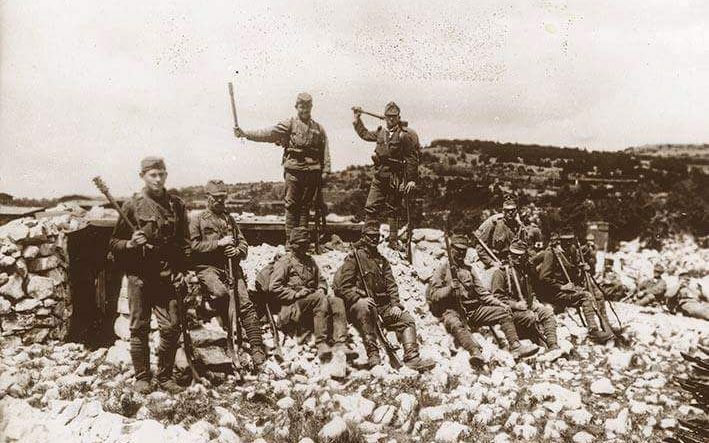
Soldiers showing off trench clubs.
Close combat was so important that many soldiers carried or improvised dedicated melee weapons. Raiding parties,and later specially trained stormtroopers, would use melee weapons (alongside guns and grenades) when infiltrating enemy lines both to stay quiet as long as possible and because it was practical in the close confines of the trenches. When your only gun is a long and heavy rifle with just five shots before you need to reload - not to mention working the bolt between each shot - you can see the appeal of a dedicated melee weapon if you’re planning to assault and enter an enemy trench.
Melee Weapons in Isonzo
The melee options in Isonzo can be broken down into about four rough categories…
Bayonets
Many rifles in Isonzo are fitted with bayonets, making it easy to alternate between shooting and stabbing. The length of the rifle gives bayonets good range, and those bayonet drills we mentioned above mean that soldiers are handy enough with them for the initial stab attack to be very quick. However, pulling back afterwards is slower, so if you’re facing more than one enemy you might be in trouble. It also makes it important to gauge your distance well - you want to use the range of the bayonet, but if you're too far away you've wasted your good chance!
Soldier with rifle and bayonet.
Melee Weapons
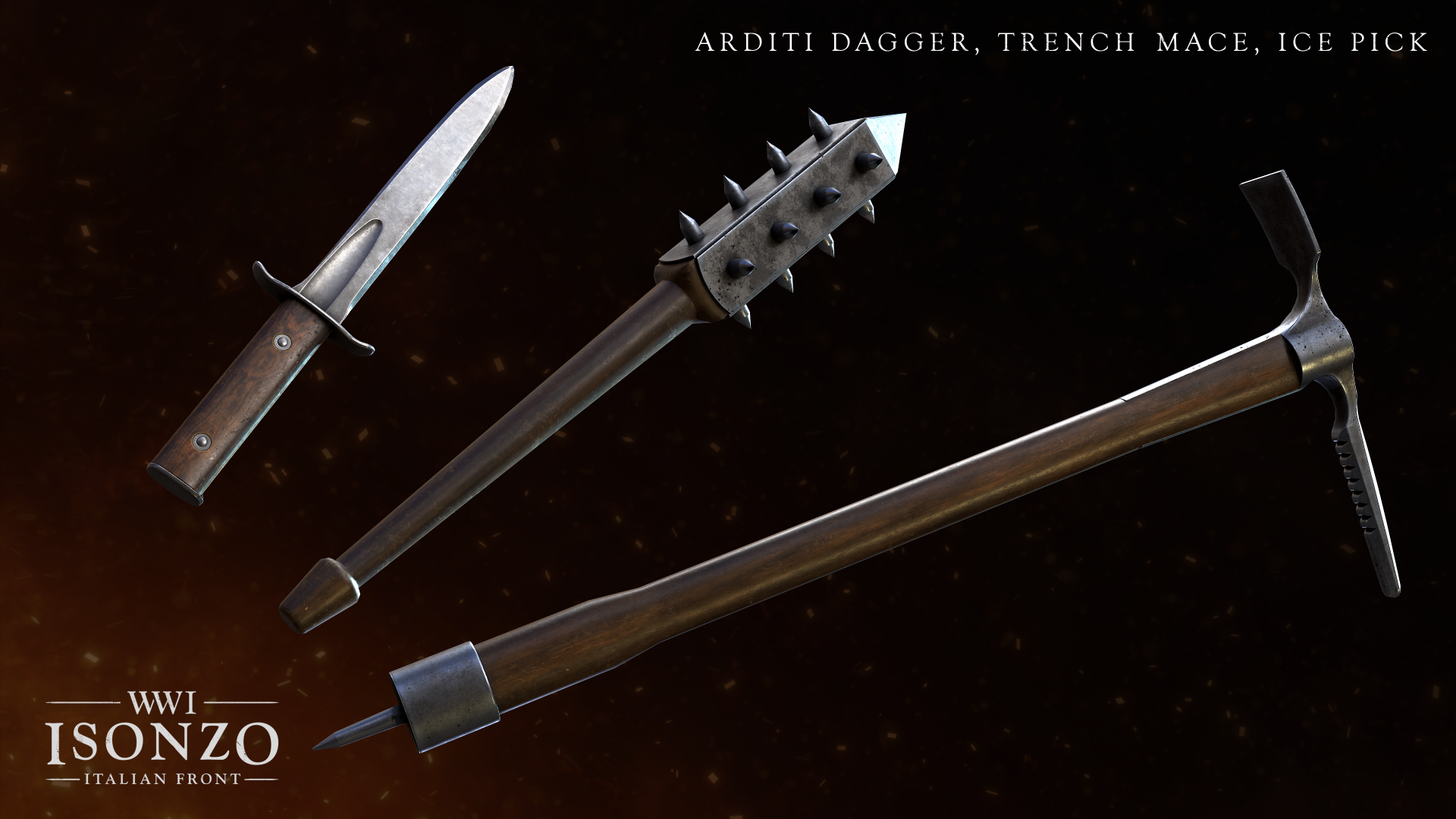
Dedicated melee weapons in Isonzo include the Mountaineer class’s ice pick, Arditi daggers, and trench clubs. They are secondary equipment slot items (so taking one means not having other support items or weapons) and only available for the Mountaineer and Assault classes, but the payoff is deadly melee capabilities. Fast and lethal, if you can catch your opponents by surprise you're almost guaranteed victory.
Dedicated melee weapons.
Entrenching Tools
During the war entrenching shovels were common weapons. They’re small enough to be easily wielded in one hand, with a sharp edge meant for cutting roots and similar impediments to entrenchment… but equally good at cutting people. In Isonzo every soldier now carries an entrenching shovel for construction purposes, but they can also be used as weapons. They are slower to attack than bayonets and melee weapons, but they are guaranteed one shot kills. If you don’t have another weapon or a bayonet, they’re a solid alternative - and of course if you’re jumped by an enemy while building something you’ll already have it in hand!
The Italian engineer on the left is using an entrenching tool for its intended purpose!
...Everything Else
You can still melee attack even when you aren’t holding a weapon. Get surprised by an enemy while scoping out enemy positions with your binoculars? By all means take a swing at them, just don’t expect it to be super effective. Still, you know what they say: a decent plan executed right now is better than a perfect plan executed too late!
What's next?
We'll end today's dev diary with a teaser for the next map we'll be revealing… enjoy!
Isonzo is available for wishlisting ahead of the September 13th release!
Dev Blog #29 - Advanced Gunplay and Weapon Handling
Gunplay in Isonzo
We’ve always worked hard to make guns feel authentic in the WW1 Game Series, not just in creating accurate 3D models and using sound effects recorded to actual guns where possible, but also in how they function in-game. We wanted to take it to the next level with Isonzo. First up is a greater connection with the world around you…
Animations and the Environment
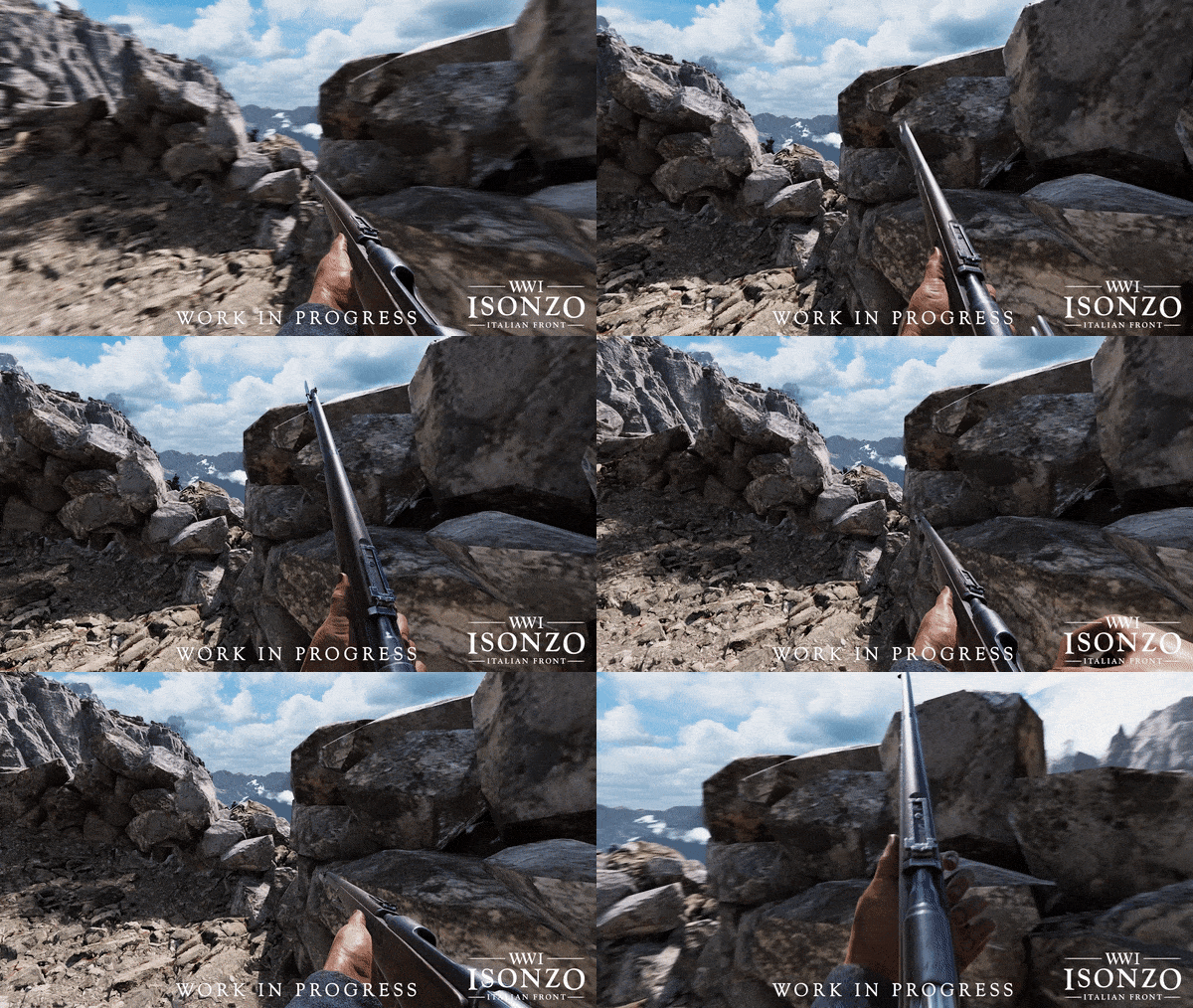
For Isonzo we decided to take a new approach with how the player's weapons animate on screen. One main goal has been to keep the weapon looking consistent in world space and prevent sudden snapping between animations. You’ll probably notice this most when you’re close up against some part of the environment, be it a wall or a cliffside, where you’ll now see your weapon lifted out of the way rather than potentially clipping through. But we go a step further, and ensure animations (like reloading) work with this dynamic weapon positioning, so reloading up against a wall can use the same animation as reloading in an open field and it still looks natural.
To achieve a smooth effect when handing your guns we mix partial-animations on the gun itself, some other tech tricks, and overlaid procedural animations on top to account for other influences such as recoil or movement. The player's arms are driven by Inverse-Kinematics which ensure they remain correctly positioned, no matter where the weapon is currently on-screen.
This also has the effect of making things look more fluid when you combine weapon usage with other systems like movement. For instance, going into a sprint while still bolting your rifle, or aiming down sights from sprinting. These situations with multiple animations in quick succession will be smoother now.
Reloading
In Isonzo we’ve built on the complex reload and weapon clip state systems of the previous games. We already modeled weapon quirks such as guns which couldn’t reload until empty, weapons that reload differently when you add individual rounds instead of a full clip, very slow revolver reloads where individual rounds need to be expelled one at a time, and more. We even keep track of whether you’ve worked the bolt on a rifle - sometimes in the heat of battle you might fire and then use your bayonet before bolting, for instance. These details matter in combat, where that extra half-second to work a bolt could be the difference between life and death…
Taking cover while using a rifle.
In Isonzo we’re building on this with even more reload states for various weapons. Weapons with visible bullets in their clips update in accordance with your ammo count, chamber states on certain weapons remain open if the weapon is not closed, cocking pins respond to the firing state, and weapons that have their magazine reloading interrupted will find their mag slot is left empty until they complete the reload!
This really comes into play with some of the more idiosyncratic WW1 weapons like the Villar Perosa. This LMG (originally an aircraft mounted machine gun) has two magazines which are reloaded separately - therefore the gun can have a variety of states of reload and interrupted reload. The Villar Perosa alone has three different reload animations relating to these various states. As well as more accurately recreating how these guns worked, it also gives you more gameplay flexibility in combat by making it less punishing to cancel reloads with these weapons.
After hip-firing the Villar Perosa, only one magazine will need replacement.
LMG Deployment
On the subject of the deployable machine guns like the Villar Perosa, we have completely reworked the system we used in Verdun and Tannenberg for deploying to be far less rigid, and more fluidly integrated with gameplay. You can now auto-deploy an LMG on any valid surface in front of you if it’s the right height, which then provides greatly increased accuracy and stability (and in the case of the Villar Perosa, the use of its second barrel). You can of course still hip fire LMGs in an emergency, but doing so comes at the cost of greatly reduced accuracy.
The new auto-deploy system with the Madsen.
Weapon Sway
Another influential part of the weapon handling which has got some love is weapon sway! The new more tactile weapon sway better mimics how actual breathing affects your body. But more than that, it affects your shooting more precisely now - bullets come from the barrel of the gun, which is affected by the new more natural weapon sway. Therefore there's no need for randomness on the bullet itself to simulate other factors affecting accuracy.
Weapon sway.
...and more!
Bullet drop is also a factor in Isonzo, but given typical engagement ranges and the high muzzle velocities for most of the weapons in the game, you likely won't notice it very often. For you snipers at the back of the map, you may need to adjust your sights to hit the perfect headshots over long distances!
In addition to these ‘big ticket items’, we’re also paying attention to the small stuff! We’ve gone the extra mile to distinguish weapons with different muzzle flash FX, more animations in general, and more. All of these details come together to create a more immersive experience that better captures the feel of First World War combat.
An army is nothing without weapons, and while we’ve looked at individual guns here and there throughout our previous blogs, we thought it would be valuable to bring them all together in a single post. Today we’re going to look over a number of the Austro-Hungarian weapons that will feature in Isonzo, with a few new images and gifs added for good measure!
Rifles
The workhorse of military conflict for a long time, rifles are the most common weapons in Isonzo and you’d do well to acquaint yourself with their strengths and weaknesses.
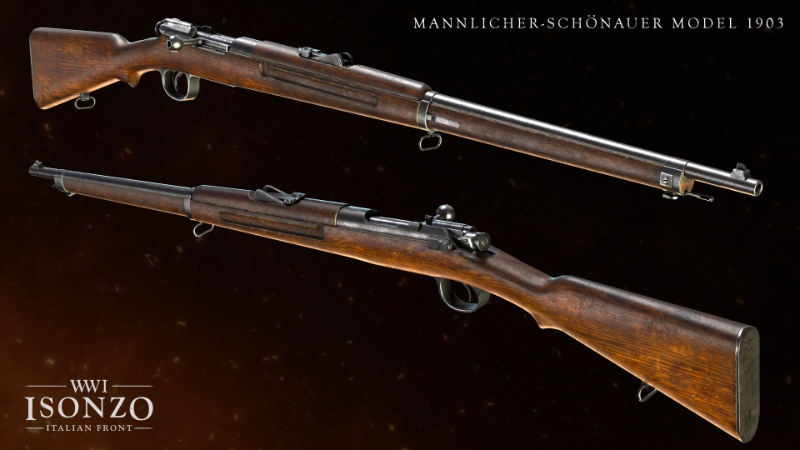
Mannlicher–Schönauer Model 1903 The fury of war always consumes a huge amount of material and equipment, and certainly during the First World War no army had an easy time finding enough of anything, even basic items like rifles. This led to situations like these Mannlicher–Schönauer rifles built for export to the Greek army being pressed into service with Austro-Hungarian forces.
A conventional looking rifle hiding an unusual magazine…
It was a very well made and reliable weapon, but that made it expensive to produce. The 6.5mm cartridges were an unusual choice which may also have made it less appealing. Nonetheless, production went ahead for the Greeks, with more than 100,000 supplied before 1914 - rifles ordered afterwards were diverted to the Austro-Hungarian armed forces.
Mannlicher–Schönauer in use assaulting the Solkan church.
The Mannlicher–Schönauer had one other interesting feature - a rotating spool magazine. This part was designed by Schönauer, hence the name of the rifle. While the rifle was fed by stripper clips, inside was a rotating system, as you can see in the diagram below. While uncommon, rotating spool magazines are still in use with some weapons today!
Diagram showing the rotating spool magazine.
Steyr-Mannlicher M95 with C.Reichert Scope This is the standard issue Austro-Hungarian rifle fitted with Viennese made optics by C. Reichert - a company who also made microscopes.
The Steyr-Mannlicher M95 was a very effective rifle with an unusual straight-pull bolt action, meaning the user would pull it back then push it straight forward again, saving two motions compared to more typical bolt actions where the user had to go up-back-forward-down. This gave the M95 a very solid 20-25 rounds per minute rate of fire. Austro-Hungarian soldiers nicknamed it the ‘Ruck-Zuck’ rifle (meaning ‘back and forth’ rifle).
M95 with scope.
M1867 Werndl–Holub The Werndl is a reserve rifle - a perfectly serviceable single-shot breechloader… but no match for the fire rate of modern guns. As such they were never intended for use by frontline troops.
The reliable but elderly Werndl, in elderly but reliable hands.
They were issued to some rear-echelon forces so that more modern weapons could be concentrated where combat was expected. As with the Italian soldiers issued old Vetterli rifles, the troops given the Werndl did sometimes find themselves in combat with their decades old firearms. If you can make every bullet count and avoid chaotic situations where you need more than one shot at a time, the Werndl can be a very satisfying weapon to master.
Reloading the Werndl.
Revolvers and Pistols
Handguns are much lighter than rifles and often offer quicker reaction times in close combat situations, but in turn have shorter ranges and less stopping power. However, during WW1 handguns often had as many (or even more) shots available before needing to reload than rifles did. Some classes (like Officers) can carry handguns as a primary weapon, while others can take them as a sidearm to complement a rifle.
Rast & Gasser Model 1898
The Rast & Gasser Model 1898 was an Austro-Hungarian service revolver, produced by an Austrian firm based in Vienna. It was a well made and reliable firearm, but some of the design choices were already outdated when the gun was first put into production.
180,000 of these were built from 1898 to 1912, and by the time of WW1 they were in the process of being replaced with semi-automatic pistols - Steyr M1912s for the infantry and Roth–Steyr M1907s for the cavalry. But since production of these newer weapons wasn’t sufficient to fully equip the Austro-Hungarian armed forces, the Rast & Gasser 1898 would remain in use throughout the war.
One of the big drawbacks you’ll experience in-game is the loading-gate through which individual cartridges are loaded, and extracted individually by an extractor rod. This means rather than being able to empty all spent cartridges at once, you have to open the cylinder, use the rod to expel one round and put in a new one, rotate the cylinder, then repeat that process. Eight times! Use your shots carefully with this one, because you really don’t want to have to reload when you’re in the thick of the action! On the flip side, eight shots before needing to reload is better than any rifle in the game offers…
The Rast & Gasser in action!
Roth-Steyr Model 1907 The Steyr Mannlicher AG is a 157 year old Austrian arms company, which was at the forefront of auto-loading pistol technology in the early 20th century. The Austro-Hungarian military made use of several Steyr firearms, including the two we’re going to look at today: the Roth-Steyr Model 1907, and the Steyr-Hahn 1912. The Roth-Steyr was the first semi-auto pistol adopted by the land army of a major power: it was issued to the Austro-Hungarian cavalry. Because of this, it has a heavy trigger pull to prevent accidental discharge - you don’t want a hair trigger on a pistol to be used by mounted cavalry!
Steyr-Hahn 1912 The Steyr-Hahn is based on the mechanism used by the Roth-Steyr. It was initially issued to the Austrian Landwehr (remember that Austria-Hungary had effectively three armies - the Austrian Landwehr, the Hungarian Honvéd and the Common Army - with the Austrian and Hungarian armies generally being better equipped than the Common Army).
The Steyr-Hahn was a popular enough weapon that Germany would place orders for 10,000 during WW1, and years later the Wehrmacht would order 60,000 after annexing Austria in 1938. Incidentally, these aren’t the only weapons manufactured by Steyr Mannlicher AG that feature in Isonzo.
Reloading the Steyr-Han stripper clip.
Equipment and Heavy Weapons
We don’t just model specific weapons for each faction - different armies made use of different supporting gear as well, including things like canteens and binoculars. While they function the same in-game - no need to worry about imbalance in canteen drinking speed ;) - we wanted to get these details right and remind people of the diversity in equipment used.
This particular pair of binoculars was made by the German CP Goerz company, a leading manufacturer of military optics. In 1908 they opened a branch in the Hungarian city of Pozsony, which is where the Goerz Wien M8 binoculars would have been produced. The M8 is a reference to the year this model was introduced.
An Austro-Hungarian soldier in the barracks with the M.14 Canteen ‘Werke 1914’.
Drinking from the flask going into an assault.
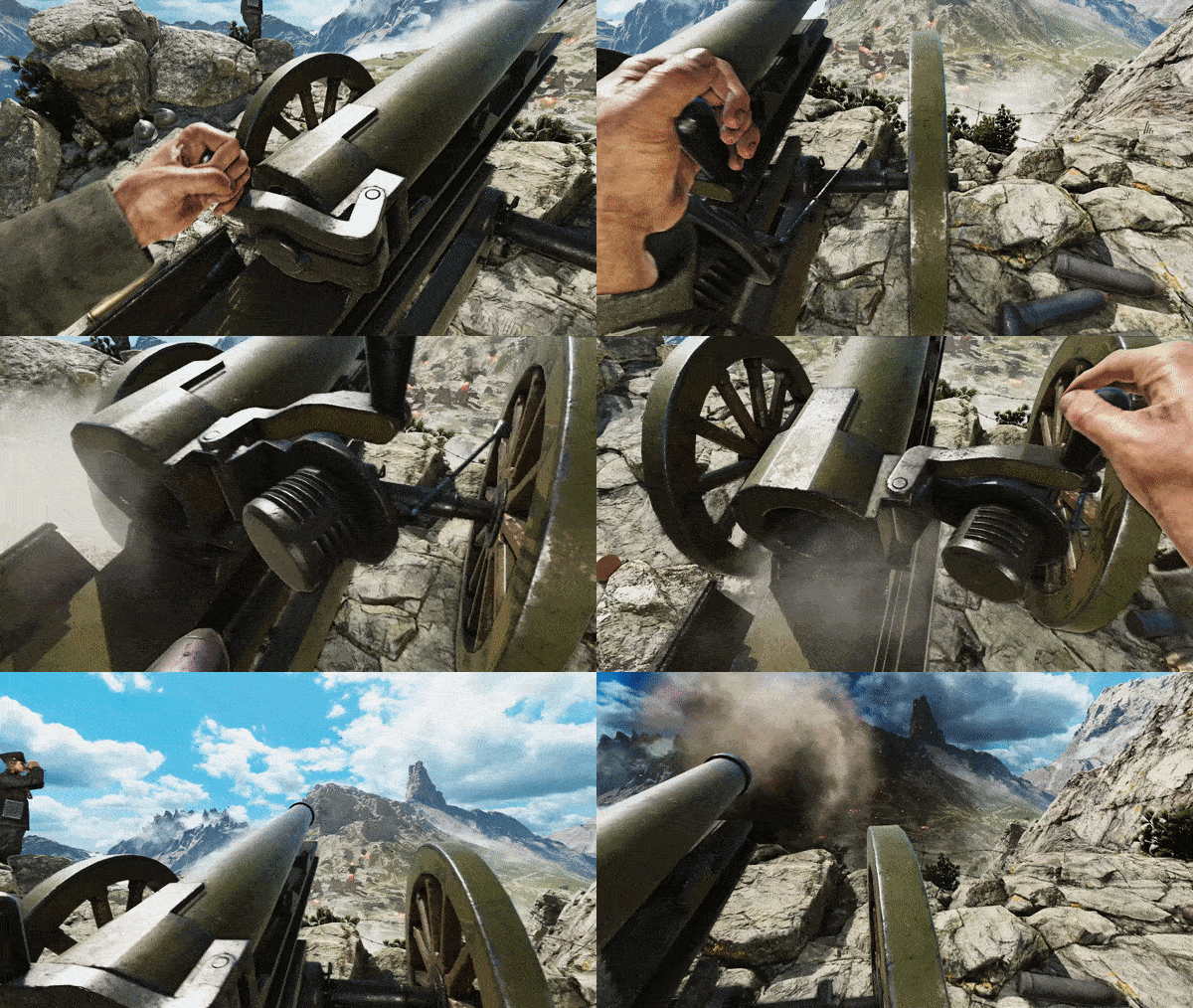
Minenwerfer M14 The 9 cm Minenwerfer M14 is the mortar used by Austro-Hungarian forces in Isonzo. The M14 is loaded from the back, allowing you the opportunity to keep your eyes on the field in front of you. Designed under time pressure by an army committee, it was intended to serve as a much needed light mortar (in contrast to heavier mortars, which in Isonzo are represented by the Officer call-ins).
While it did that job, there were flaws: it was awkward to rotate for aiming, a black powder propellant that could be very smoky, and bomb fuzes that were unreliable and could lead to duds. Many of these problems were fixed in later versions of the mortar, but ultimately it was decided to purchase and use German made mortars from 1917 onwards.
M14 mortar reloading.
Experience the Great War in black & white
Currently, both Verdun & Tannenberg are on sale with 75% off and we enabled the Film Memoir mode for all to use for free even without owning a Supporter Edition DLC! Experience the game and the war in a new way.
That’s it for now!
As always, don’t forget that you can wishlist Isonzo if you didn’t already. We’re looking forward to everyone trying out these weapons when Isonzo releases on September 13th!
Mountain guns are specifically designed to be more portable than regular artillery pieces for use in areas where it isn’t practical to tow an entire gun. They can usually be broken down into smaller pieces that can be carried by mules, horses, or people. They take their name from mountains - the prime example of difficult terrain - though they’re also called pack guns or pack howitzers because they can be ‘packed up’. Nowadays there are standard artillery pieces light enough to be transported by helicopter which removes the need for dedicated mountain guns - not to mention the variety of other weapons which can serve the same purpose as artillery.
Italian troops manning a Cannone da 65 near the Sass di Mezdi.
In-game engineers can construct them at preset locations, like mortars and heavy machine guns. Once built, they are used to provide direct fire support - they’re too long ranged to be used in an indirect fire role on Isonzo’s battlefields, but that’s what you have mortars for! They pack more punch than mortars, and when aimed carefully their splash damage can hit enemies in cover that would be impossible to hit with machine guns. Just make sure to have a rifleman or two with ammo box equipment to keep them supplied, because they have a relatively high rate of fire!
Italian Cannone da 65 Model 13
Beginning service with the Italian army a year before the war started in 1913, it was used throughout the First World War by mountain troops. Firing 65mm shells, the Cannone da 65 could be broken down into five loads, or moved by horse with the simple trailing arm.
It was also used in the Fiat 2000 heavy tank (only two of which were made), and was given to regular infantry when the mountaineers got new guns after the war. It was popular thanks to being lightweight and reliable.
Austro-Hungarian Gebirgskanone Model 1915
This Austro-Hungarian artillery piece had a somewhat troubled beginning. Originally designed by the Skoda company before the First World War began to fill a request to standardize and replace existing mountain guns, it was found to be the best candidate available… but it didn’t quite meet one of the design specifications. It broke down into six pieces rather than five, and so Skoda were asked to produce a lighter 7cm version instead of their initial 7.5cm design.
They did this, but testing indicated that their new 7cm design was inferior to the 7.5cm version. At that point Austro-Hungarian command decided to go ahead with the original design (after all, six versus five pieces didn’t make that much difference). Because of this delay, the first Gebirgskanone Model 1915s started to arrive in April 1915, a whole year later than they were first planned to be delivered! Although perhaps a little physically fragile, the Gebirgskanone Model 1915 was a capable gun and earlier production would have been beneficial for the Austro-Hungarians.
Enlist to fight on the Italian Front!
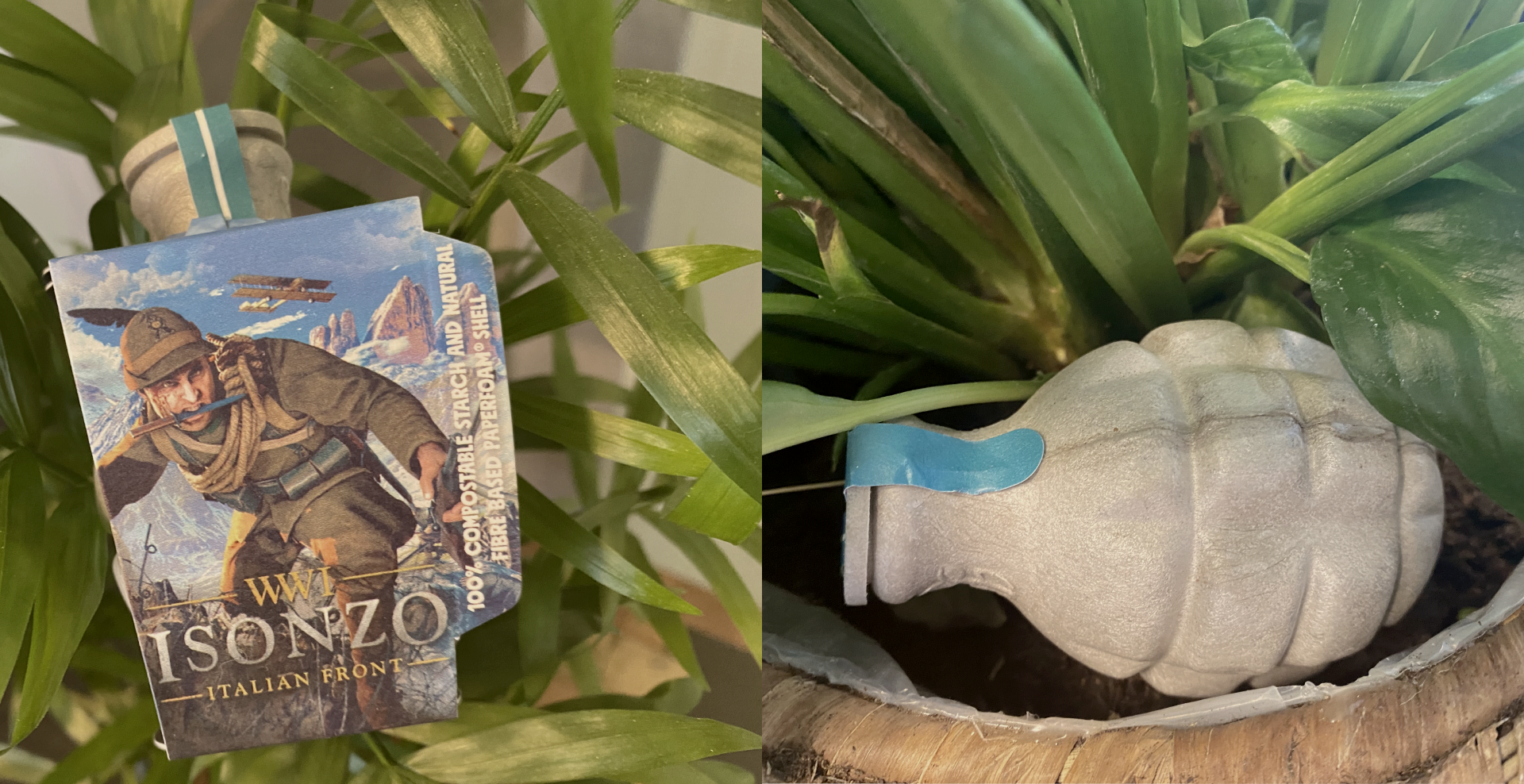
Before we start our recon of the upcoming dev blogs, we wanted to share a new competition to celebrate the announcement! You can win a game key and other Isonzo goodies by entering our raffle - all you have to do is sign up for the WW1 Game Series newsletter on our website to enter the raffle and get all the latest news from the development frontlines! Who knows... maybe one of you’ll be the lucky soldier who’ll be receiving an Isonzo goodie pack, including one of the first Isonzo game keys and a special Isonzo poppy grenade!
You'll also find WW1 inspired Isonzo propaganda posters! You can download them and use them as your wallpaper, banner or even print them out and hang them up!
More dev blogs to come before launch day!
Isonzo is releasing on September 13th, and you can already wishlist it. Until then we have plenty more dev blogs lined up, including another map, melee weapons, and more!
As we’ve explained before, Isonzo has a different progression system to our previous games. In Verdun and Tannenberg you gained points as you fought which could be used to unlock new loadouts for any role or squad. So how does it work in the new Isonzoclass system?
The Barracks
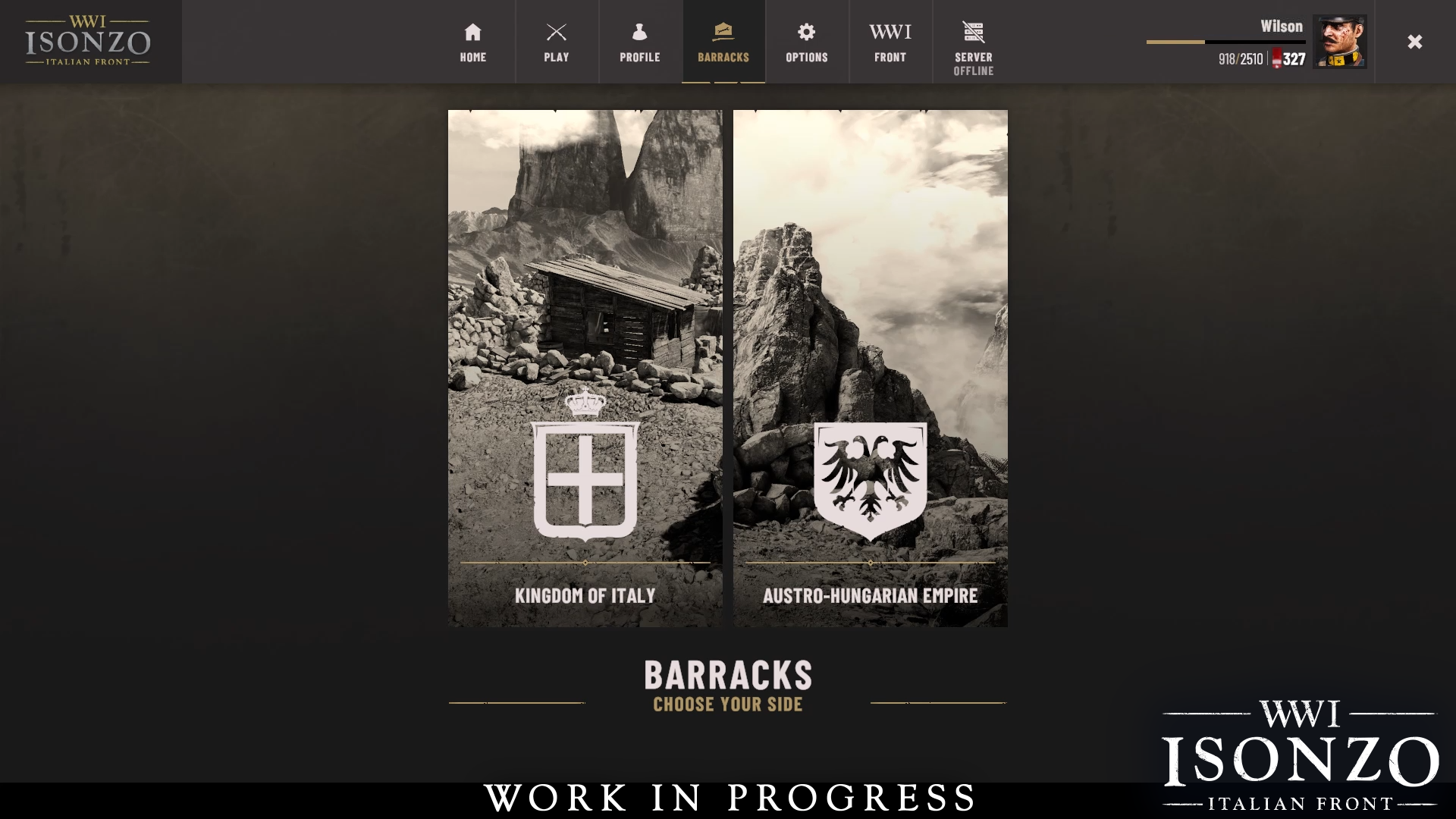
From the main menu (and during battles) you can visit the barracks to choose how to visually customize each of your classes, see your level per class, and track your progression through the challenges for each class. These challenges are how you unlock new weapons, equipment and perks, while leveling up means new challenges become available.
Switching between classes in the Barracks.
Unlocking More Choices
In Isonzo, you unlock new class options by leveling up through battle experience, then completing class challenges. These challenges teach players how to use the strengths of their class, e.g. Engineers have challenges relating to construction, heavy weapons, and sabotage objectives, while Officers need to use their flares, call in support, and issue orders. Completing these challenges will unlock new weapons, equipment, and perks for the class. You unlock weapons for both factions regardless of which side you’ve been playing most - the challenges are class based, not faction based.
Here’s a WIP view of the Mountaineer class’s first set of challenge rewards. Since they haven’t reached level two, the challenge isn’t yet active.
You will also still earn experience points and ranks as you play, up to rank 20. Challenges are unlocked when you reach certain levels. For instance in the current design the first challenge for each class is unlocked once you reach level two. As we said above, the challenges are designed to encourage people to play the classes in ways that make use of their unique advantages and benefit their team, so they also take on something of a tutorial role and are paced with that in mind.
The Rifleman As an example, when playing as a Rifleman you’ll first need to gain a level. You do this by simply playing the game - almost everything you can do will gain you some XP. Once you reach level two, the first challenge will unlock: Combat Experience I, which simply requires you to kill 10 enemies and participate in capturing or recapturing an objective. That challenge will unlock the ammo box equipment along with two rifles, one Italian and one Austro-Hungarian. Further down the line, another challenge will require you to use that newly unlocked ammo box to resupply your comrades.
The rifleman’s level 10 challenge screen. When completed, Grenadier I will unlock rifle grenades!
A later challenge unlocks grenades as secondary weapons, which leads on to the next challenge where you must make use of those grenades to achieve Grenadier I, which calls for you to kill 20 enemies with grenades and 20 enemies with the bayonet. You can see how this can help new players learn by doing - as they go to complete the challenges, they’ll come to understand the tools at their disposal. As a final treat, players who reach level 20 with a class will unlock late war uniforms for that class!
The late war Italian Marksman uniform unlocked at level 20.
Isonzo will release September 13th
Launch day is drawing closer! Remember that you can already wishlist Isonzo:
Today we’re looking at the third set of support options available to officers in Isonzo: the Aviation Corps! We explained artillery support available and the Chemical Regiment options for gas and smoke in previous dev blogs. The Aviation Corps has the same format of five options, with each tier being relatively more powerful but also having a longer cooldown before it becomes available. Let’s jump in!
Recon
The Recon flight is a staple WW1 Game Series aviation call-in since Verdun, and for good reason. The early aircraft used in WW1 simply didn’t have the ability to carry a large quantity of explosive ordinance, and so had much more impact by performing reconnaissance missions. In particular the ability of aircraft to spot for artillery batteries could allow more accurate artillery fire at greater distances, though communication between the aircraft and the batteries was a problem.
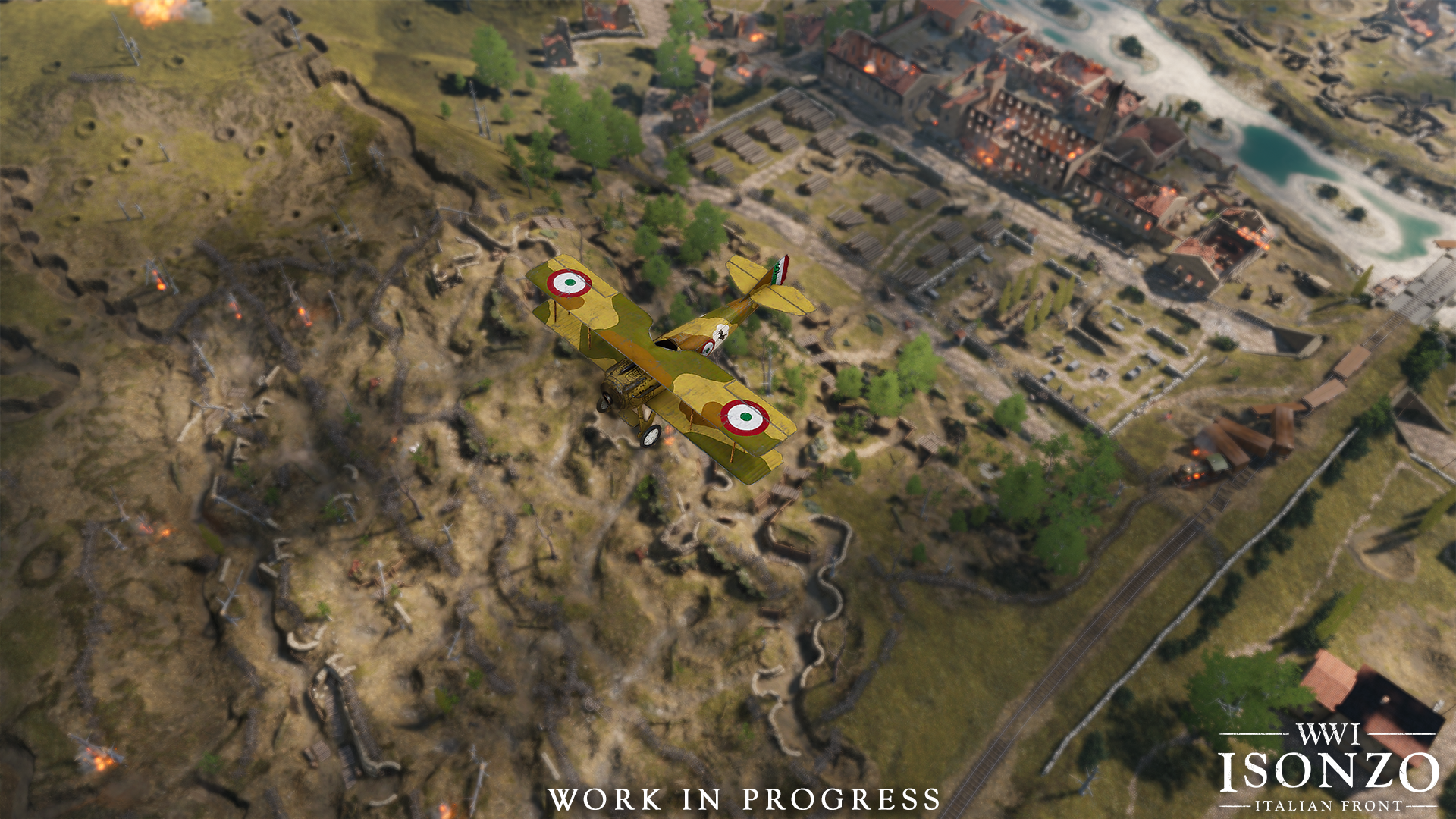
Italian SPAD VI Recon over Monte Calvario, 1917.
In Isonzo as in our earlier games, recon flights identify enemy positions, highlighting enemy infantry on your minimap. This information is useful for everyone, whether they’re a rifleman assaulting a trench, an officer deciding where to call for artillery support, or a sniper looking for targets. The recon flight has the fastest cooldown of the aviation powers, so can be used plentifully. However, if you have good officers or mountaineers who are using their ability to spot enemies, you’d do better to hold off until more direct impact call-ins are available…
Strafing Run
The third of the five options is the Strafing Run. A fighter will strafe in a line from the target point, direction chosen by the officer making the support call. These bullets don’t have the raw firepower of the heavy artillery which is the third artillery call-in option, but the strafing run is the lowest tier call-in which targets a line! If you place your flares right, this makes it lethal for hitting straight trench lines. Place a flare at one end of the line, then call a strafing run to go all the way along the trench. Given that a lot of the trenches in Isonzo lack much in the way of roofing, enemies in a targeted trench won’t be able to avoid the attack.
Italian aircraft strafed enemy positions in late December, 1917 - a young Erwin Rommel reported it as such in his diaries, during the fighting for Grappa: “Enemy air formations drop down to a few meters above the ground and strafe our positions and those of the contiguous units.”
Bombing
As we said before, early WW1 aircraft weren’t very effective bombers. Technology advanced rapidly though, and in Isonzo we got to represent some of the huge biplane bombers like the Italian Caproni! Compared to modern bombers their bomb load was a little lacklustre, but they made a big impact on public and military opinion at the time, and used right could still influence battles.
Austro-Hungarian Hansa I bomber - those cross markings might appear German, but they are ‘cross pattées’, which were used by Germany but also other countries at various points in history. This includes the Austro-Hungarians, from 1916 onwards - in part because aircraft supplied from German factories came with it already applied!
In fact, Italy was something of a pioneer in military aviation, having used aircraft in combat during a war with the Ottoman Empire in 1911. The Italian Corpo Aeronautico Militare conducted a large number of ground attack missions, with the aforementioned Caproni bombers starting raids on Austro-Hungarian cities in 1915. During 1916 some of the Capronis were diverted to supporting frontline troops in the Battle of Caporetto since there was such demand from Italian infantry for close air support. While the imprecision of this bombing (no modern bomb sights, for instance) limited the real damage done, an Austro-Hungarian officer’s diary described the sight of planes flying so low that bombs could be seen dropping from the fuselage as having a significant impact on morale!
The first bombing option available is the second tier: a small area bombing, where a fighter biplane will drop 10 bombs in an area. This is effectively a slightly more accurate and concentrated area attack than the low tier artillery call-ins, but with less total firepower. Useful if your artillery is still on cooldown or you want to knock out specific points like heavy machine guns.
An Italian Caproni Ca. 3 dropping bombs.
Heavy Bombers At tiers four and five though, you get access to the heavy bombers. Tier four is a single bomber targeting a line, and tier five is a three aircraft bomber squadron which does the same thing with more firepower and a wider spread. The single bomber is again an earlier line targeting call-in you can get earlier than the creeping barrage, but both bombing runs distinguish themselves from the artillery by producing a faster series of explosions. While the creeping barrage is designed to allow infantry to advance behind it and so moves slowly, bombing runs are intended to deal as much damage as possible before enemies can react. Of course, you can also combine call-ins from different categories - lead with a bombing run to clear an enemy frontline trench, then have the creeping barrage start behind it to destroy enemy reinforcements while your allies advance!
Support roster complete
That’s all the support options in Isonzo explained! Officers will have access to all three categories of support, and since they each have independent cooldowns it’s vital to make use of them all. Which call-ins are you most excited to try out when Isonzo launches this September 13th?
As we explained last week, the Dolomites map officially has two defensive lines, each with a single capture point objective. In reality, however, the attacking Italians will need to break through more than just two lines of defense - they just don’t all have objective points. To illustrate, the first thing attackers will see on leaving their jump-off points is a strip of barbed wire along the length of the rocky hillside ahead of them. They’ll need to cut the wire and climb the slope while under fire from the Austro-Hungarian defenders.
The first line of wire the Italians must breach.
If they make it up there, they’ll find a second line of wire and another steep and rocky hillside to scale. It’s at the top of this slope that the first capture objective lies: the Dreizinne Hutte refuge. The ruins of it, anyway…
Some of the trenches that must be conquered.
There are multiple heavy machine gun positions amidst the remains of the refuge, and enough of the building is still standing to provide a little cover from artillery. It is also used by officers to call in support - first the Austro-Hungarians, then the Italians once they take control. As you can see from the gif above, there are multiple routes up to the objective: you should avoid getting tunnel vision and only attacking or defending one route. The strongest defensive position can crumble when attacked from an unexpected angle.
The Dreizinne Hutte is a capture objective, so the Italians will need to take and then hold it for some time, while taking fire and facing counter attacks from the Austro-Hungarian positions higher up the mountain. The good news is the slope doesn’t offer a lot of cover for such counter attacks. The bad news is, as the attackers you’ll have to be crossing that dangerous slope on your way to…
The Dreizinne Hutte - the capture zone is in the main cluster of ruins.
The Sasso di Sesto
The second and final objective is the command post at the peak of the mountain. To get there, the Italians have to make another uphill assault on a rocky trenchline overlooking the Dreizinne Hutte refuge.
Looking down on the Dreizinne Hutte at advancing Italian infantry.
Both sides can construct forward spawning points in these trenches so they’ll be hotly contested. There’s a lot of scope for engineers to place wire and sandbags to hinder enemy movement, while the Assault class and their grenades will also be able to do a lot of damage. To support their attack, the Italians can build a mountain gun just outside the Dreizinne Hutte, but depending on how organized the Austro-Hungarians are it might be wise to wait for their Officers to prepare intense fire support from creeping barrages, smoke screens, and/or bombing runs (more on those in a future dev blog!) before starting their attack.
The peak of the Sasso di Sesto.
Once they reach the top, the Italians still need to evict the Austro-Hungarians from the collection of wooden lodges serving as barracks and command post. A combination of rocky outcrops, stone walls, and the buildings themselves mean that there aren’t a lot of long sight-lines, so sniper rifles and light machine guns are probably less useful than bayonets and pistols. Enemies can appear from almost all sides so you’ll have to trust your teammates to have your back.
Fighting on the peak.
Some of the hut interiors.
Don't forget to enlist
We called for your help on the Italian Front by enlisting for the war last week. You enlist by signing up for the WW1 Game Series newsletter on our website to enter the raffle and get all the latest news from the development frontlines! You can win a game key and other Isonzo goodies by entering our raffle. Who knows... maybe one of you’ll be the lucky soldier who’ll be receiving an Isonzo goodie pack, including one of the first Isonzo game keys and a special Isonzo poppy grenade!
That’s all for today!
Don’t forget that Isonzo will be released on September 13th! We'll close out with the complete Dolomites flyover video! There's plenty more dev blogs on the way before the release, so watch this space!
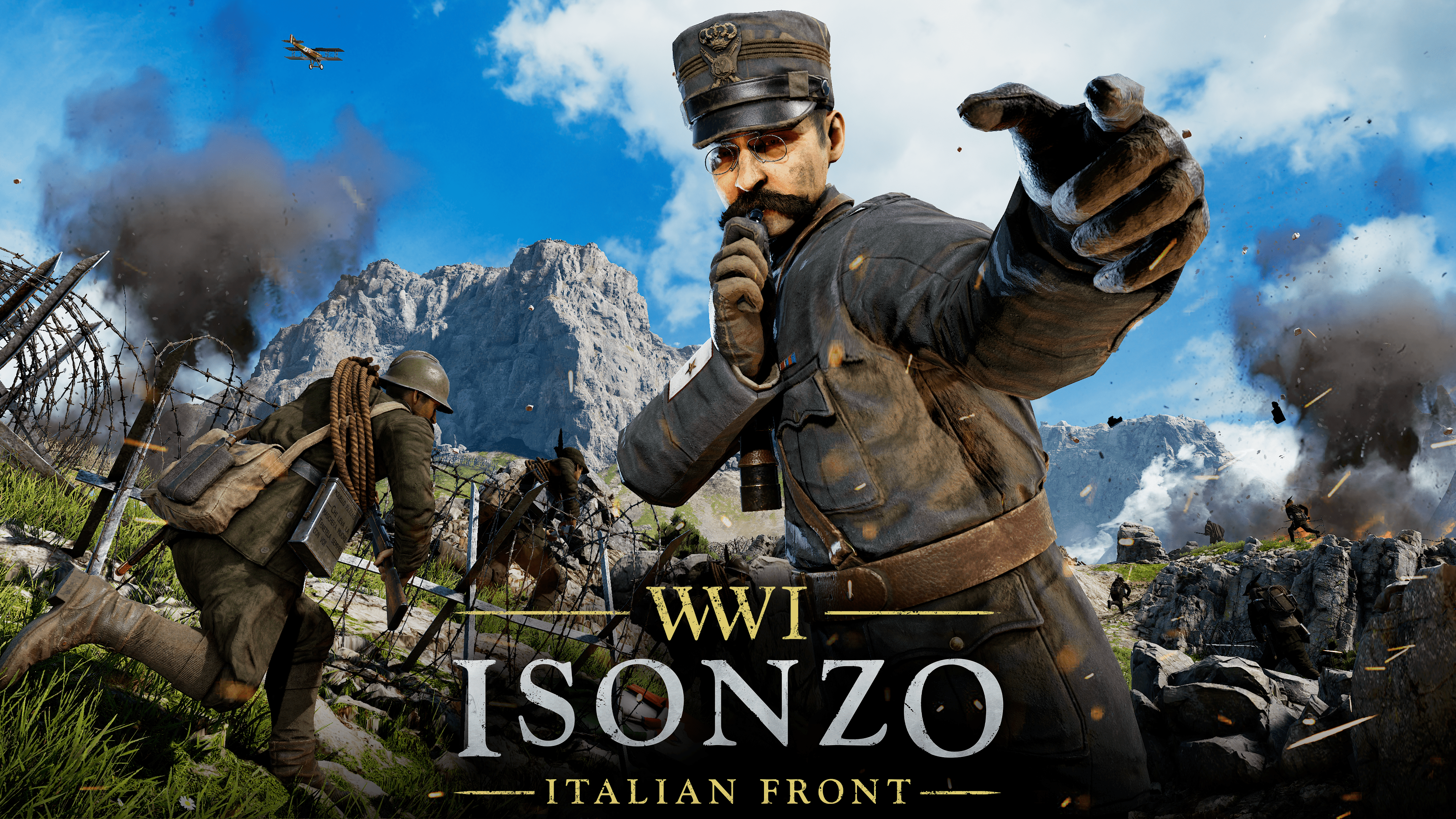
Following Isonzo's release date announcement yesterday (the battle begins on September 13th!) we wanted to share more about the map featured in the trailer: the Dolomites! Here's the trailer again if you missed it...
Enlist to fight on the Italian Front!
Before we start our recon of the new map, we wanted to share a new competition to celebrate the announcement! You can win a game key and other Isonzo goodies by entering our raffle - all you have to do is sign up for the WW1 Game Series newsletter on our website to enter the raffle and get all the latest news from the development frontlines! Who knows... maybe one of you’ll be the lucky soldier who’ll be receiving an Isonzo goodie pack, including one of the first Isonzo game keys and a special Isonzo poppy grenade!
It'll look something like this...
Propaganda Posters
We've also created some WW1 style propaganda posters if you'd like to help us spread the word about Isonzo! Some of you might’ve seen them at our expo visits in April this year - we’ve created some amazing looking propaganda posters! Feel free to share these images, online and offline. We can always use more soldiers at the front!
The Dolomites
We’ve seen some literal uphill battles in previous dev blogs (see the hill outside the city of Gorizia and the first few defensive lines on Sabotino) but the Dolomites are on a whole different level. Historically the Italians attacked early in the war during August 1915 aiming to take control of Torre di Toblin: a rocky tower dominating the area. They got as far as capturing the Sasso di Sesto, where they established a base which would remain until the end of the war despite Austro-Hungarian assaults - particularly one in 1917 where tunnels and a night time raid led to the recapture of the Sasso di Sesto… for a short time. The Italians counterattacked in the morning and retook the peak. In Isonzo it’s the initial Italian capture of the Sasso di Sesto in 1915 which you will experience.
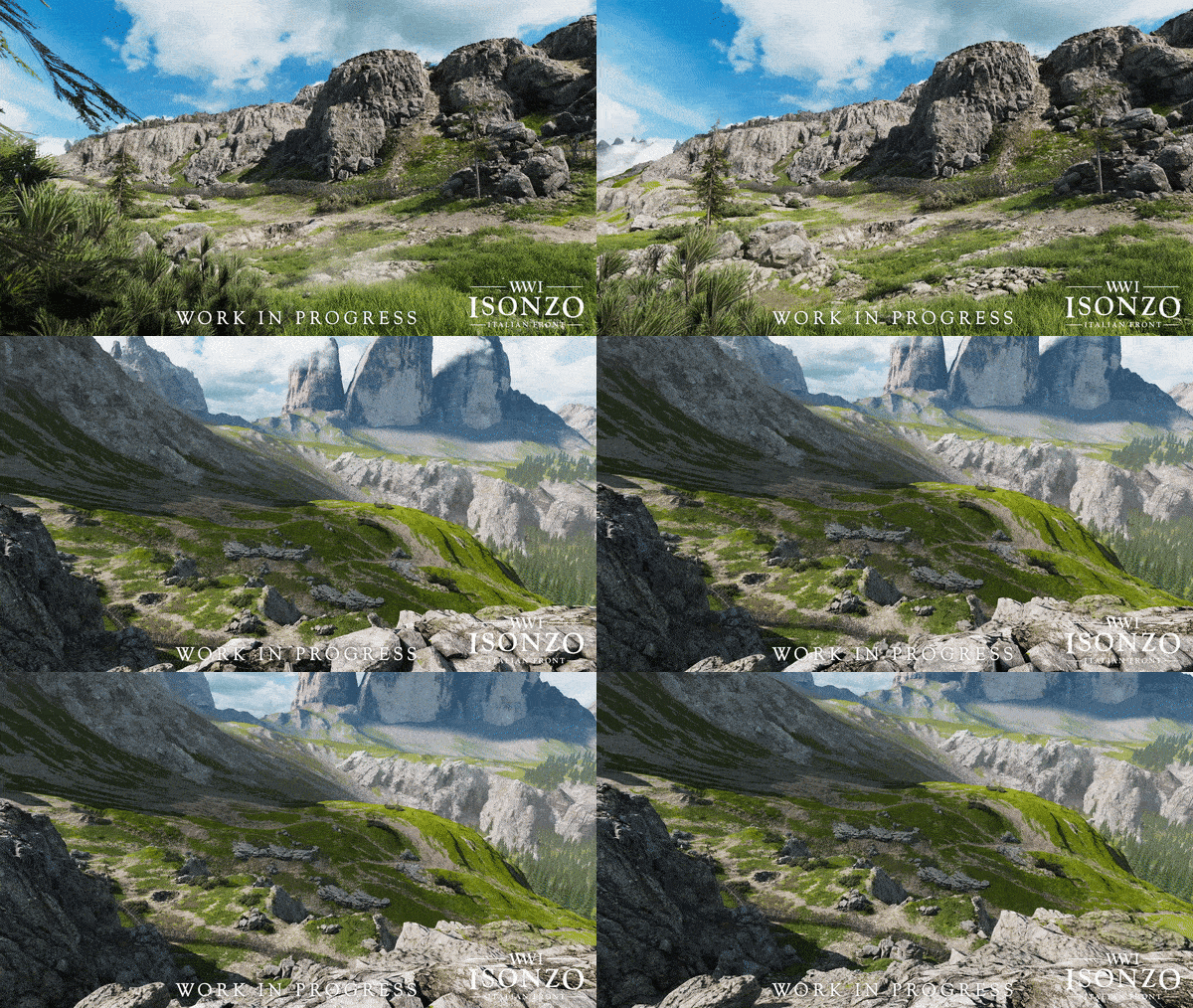
Comparison images, with photo on the left and in-game on the right! In both the Sasso di Sesto is in the foreground on the left, with the Torre di Toblin looming over it.
Italian troops advancing under fire.
Although the Sasso di Sesto is not that high (for a mountain) the paths leading up to it are very steep. This mountaintop battlefield also has some incredible scenery - in the background are the stunning Tre Cime di Lavaredo, also called the Drei Zinnen, known in English as the Three Peaks of Lavaredo. As you climb higher the views only get more impressive!
The Tre Cime di Lavaredo as seen in real life and in-game.
In-game there are two defensive lines, each line with a single capture objective. First up is the Dreizinne Hutte refuge, and after that is the Sasso di Sesto itself. Don’t be fooled into thinking that makes things simple though! The attackers have an extremely steep mountainside to climb that poses some unique challenges.
One of the routes up the mountain.
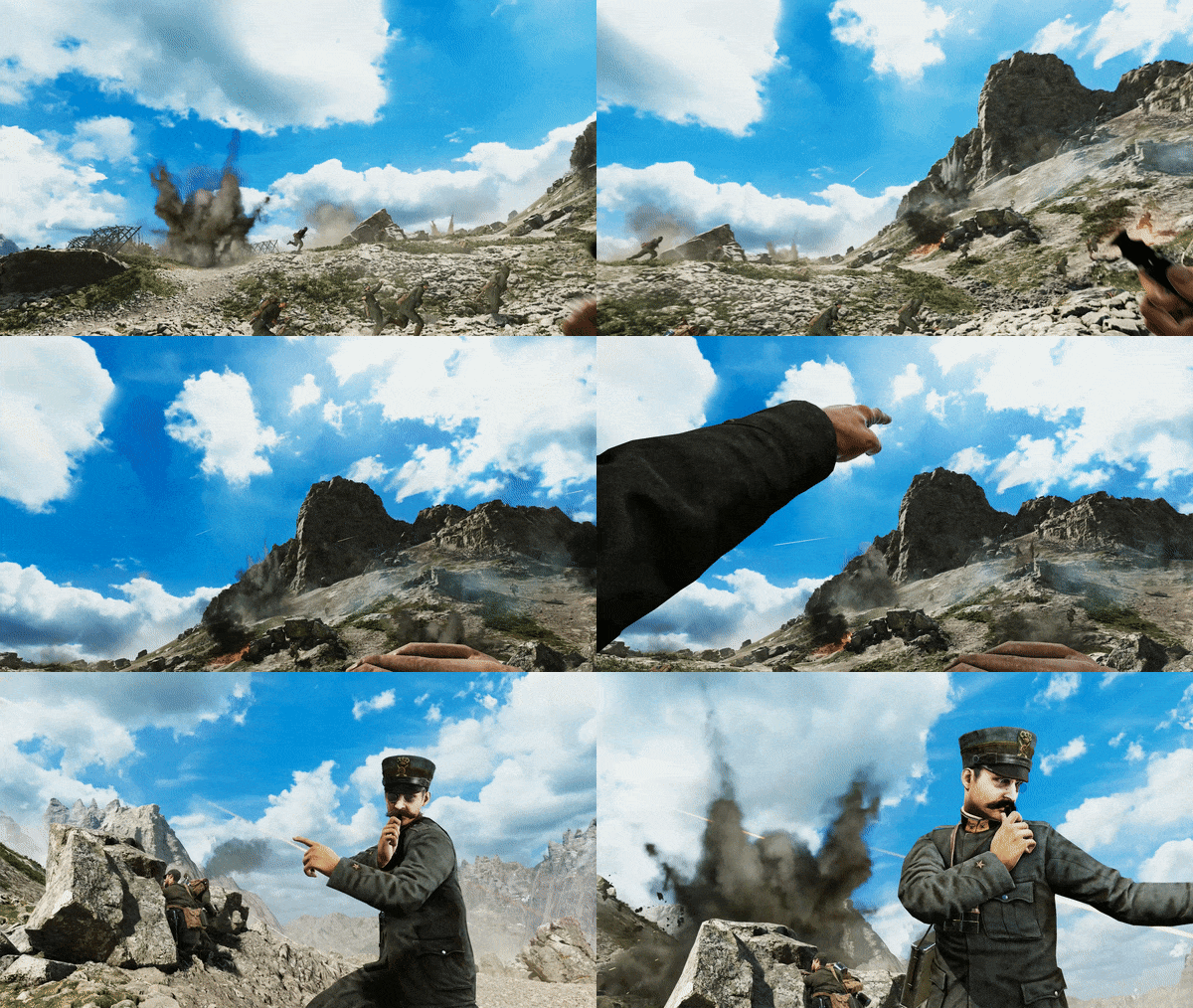
Italian officers will need to be bold if they want to get flares past the very frontlines of the battlefield - because while you can normally use a shallow angle on your flare gun to cover a large distance, here the mountain is so steep that you’ll need to be quite far forward or your flares will hit the mountainside rather than getting up above the enemy positions! Naturally the Austro-Hungarians will have no such trouble, and their commanding height advantage will enable them to easily place flare markers anywhere they choose from relative safety.
When attacking you’ll need to be careful with grenades since they could end up sliding back down the hill at you - this influences the defenders too though since they’ll need to cook off their grenades or risk them sliding down past their targets.
Close quarters action assaulting a trench line.
We’ll return to the Dolomites to cover each objective in more detail. Don't forget you can already wishlist Isonzo ahead of the September 13 release!
We’re happy to share with you all that our 3rd game Isonzo will be released on September 13 ! On this day, you’ll be able to fight on the Italian Front – up in the mountains, alongside the Isonzo river and in rural areas! Luckily you won’t have to fight these battles with a vast group of players, since each map will have room for 48 PC players (in total).
Along with the release date, we’re revealing the 4th map you’ll be able to play on in Isonzo; the Dolomites! During World War One, the frontline ran right through these mountains. Will you be able to conquer the mountain along with your fellow Italians? Or will you stand high and mighty on the top as an Austro-Hungarian?
This new trailer shows off the Dolomites map! You’ve seen a bit in the trailer, and now you can read all about it in tomorrow’s dev blog !
Wishlist & fight on the Italian Front later this summer!
We have more exciting news besides the upcoming Isonzo Intel! For now, please make sure you've wishlisted Isonzo !