Get ready to rock! The Ascent event is live until April 24th.
Ascent is live now!
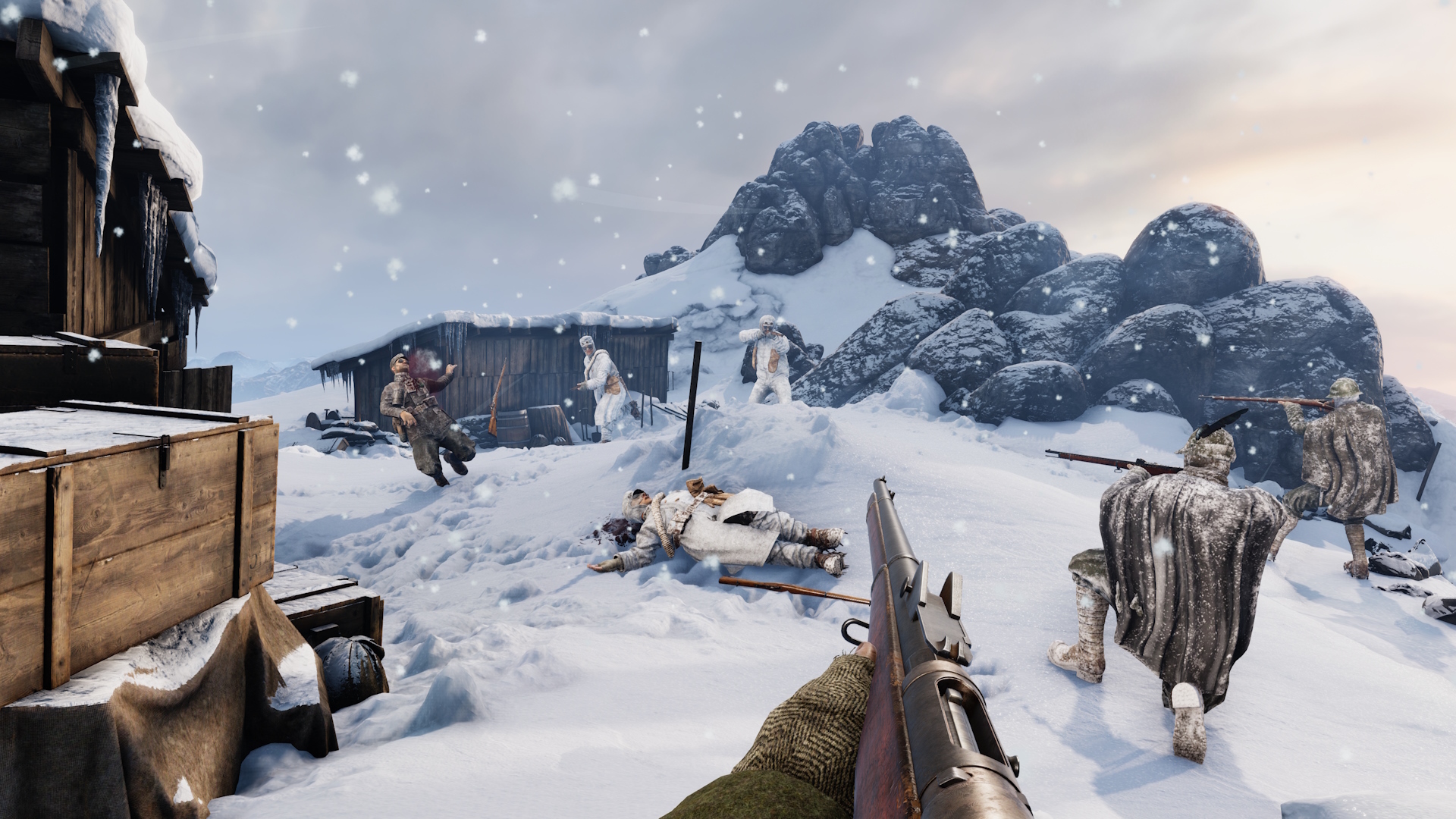
Jump into Isonzo and either assault or defend the sheer rockface of the Marmolada mountain. 16 brave Italian mountaineers attempt to scale the Marmolada mountain on a new map, while 16 Austro-Hungarian defenders do their best to stop them.
As you can see from the trailer, Isonzo has come a long way in the years since it was first released. The Ascent mode is a highlight for sure, but we're still not done yet!
Climb for your life!
For the Italian mountaineers, climbing is freeform as long as you stay within the boundaries of the combat zone, and use common sense to avoid overly steep overhangs. No yellow paint to mark the only route here!
On your way up, consider establishing your own 'via ferrata' - this means a protected climbing route, generally including steel fixtures such as handholds or cables to make climbing safer or easier. Nothing is going to make this climb significantly safer, but if leading climbers can place pitons with ropes as they go it will greatly speed up other soldiers following along the same route. Your allies will thank you for it!
Kings of the hill?
Things aren't quite as easy for the Austro-Hungarian defenders as you might think. Limited room to maneuver means you need to keep your wits about you to avoid getting picked off by Italian rifle fire or stabbed at close range by an Alpini who snuck up onto your ledge. Those ice picks are wickedly sharp.
Thick wool coats, wicker wrapped footwear, ski suits and hoods - there's a lot of stand out items in our latest cosmetic DLC pack! Just the thing for combat on Marmolada - whether you're scaling cliff faces in Ascent or engaging in close combat through the frozen tunnels of the Ice City!
Remember, Ascent is live for two weeks until April 24th. Good luck out there, you'll need it...
Climb for Victory!
We'll see you on the cliff face, soldiers.
Update v51629
We released a small patch fixing a number of issues across the game.
Adjusted challenge requirements After player feedback, we decided to adjust the requirements of some of the more grindy challenges to better fall in line with the others. This only affects players who have not completed these challenges yet.
Other fixes:
Fixed game crashing on Quit
Fixes to joining the game through Steam invites
Various map fixes
Fixed not being able to kick/ban players as a custom match Admin
Various medal tracking fixes
Fixed scores in the After Action Report not being properly calculated if player switched tabs
Fixed the game sometimes incorrectly triggering the drowning mechanic in water
The download size is expected to be around 296 mb.
Climb for victory on April 10th!
Scale a mountain in the Ascent game mode, coming to Isonzo from April 10th until April 24th!
All about the Ascent event - climb for victory from April 10th!
We'll start with our trailer for the new game mode...
All about Ascent
Today's blog will explain the gameplay systems of Ascent and the new map - how does a game mode about climbing actually work? You'll be able to play from April 10th until April 24th, and earn a special Ascent medal for taking part - if you have more questions about the event itself, check out the FAQ here. For gameplay, you're already in the right place - let's get into it!
The Objective
The Ascent map only has one objective - a capture point at the top of the mountain where the Austro-Hungarians have established a command post in a few snow blasted wooden huts. However, it's really more about the journey than the destination this time - there are 10 forward spawn points for the Italians scattered across the various ledges on the Marmolada cliffside, and the Austro-Hungarians have almost as many.
Combat around the command post. It doesn't look like much, but the strategic value is enormous.
A rush to the top won't work - the Italians need to advance ledge by ledge, destroying the Austro-Hungarian forward spawn points and establishing their own. The final step is getting a foothold on the top of the mountain with one or both of the two forward spawn points up there, and finally storming the command post. How hard can it be?
Climbing
Scaling the mountain is the only way up for the Italians. Hand over hand, clinging to the unforgiving rock of the cliff face. There are no alternate routes or clever shortcuts.
The mechanics of climbing are not too complicated - approach the cliff and press the button to switch from regular movement to climbing. A prompt will show up when you're close enough, in the same way you get prompts for mounting heavy weapons or cutting wire.
Alpini reaching the top and preparing to assault the command post - there's a long way up before you get here though!
Once you're on the cliff, you move the same way as usual, except that forward takes you up, backwards brings you down, and left/right will trigger a sideways hop. This kind of sideways movement isn't especially quick, so it's highly recommended to plan your routes to minimize how much sideways shuffling you're doing - but sometimes it's the only way to navigate an overhang or stay out of sight.
And you will want to stay out of sight, with 16 angry Austro-Hungarians shooting or throwing rocks down at you. There's no yellow paint highlighting the best routes, so take a moment to scope out the mountainside, and experiment with different paths.
Pitons and Ropes
Luckily, you can improve the odds - at least for people following you. While climbing, you can place pitons into the cliff. During the First World War, pitons were actually still a relatively new technology, originally used only to aid a descent!
Pitons and ropes in-game.
In Ascent, if you place multiple pitons close enough together they will be linked by ropes. Once that's done, climbers following the same route will get a boost to their climbing speed. There's no need to attach yourself to ropes or anything like that - just stay reasonably close to the ropes and you'll move faster.
Do be careful about where you place pitons or which ropes you follow! You might be faster while following a rope, but you're a long way from being able to outclimb bullets. A lovely straight path with pitons and ropes is nothing more than a deathtrap if the Austro-Hungarians have good lines of sight to it.
A historical aside
Did you know that Marmolada was a key site for some of the earliest use of pitons in climbing? In 1901, expert climber Beatrice Tomasson was the first to ascend the 'South Wall of Marmolata', which was the biggest vertical wall ever climbed at the time - more than 600m/2000ft.
It's not an April Fool's joke, the rock (not that one) will be a lethal weapon in Ascent!
Rocks fall into the category of 'easy to learn, hard to master'. The basics are: find rock pile, take rock, throw rock at enemy. If you avoid throwing it directly up above your head you'll be fine!
But once you're in battle, you'll find there's more nuance to it. Rocks are physics objects, and will bounce on their way down the mountain. You can adjust the power of your throw by holding down the fire button, to allow you to target climbers who aren't directly below you. It also means you can stay away from the edge if you want - depending on how sharp eyed the Italians below you are, it might be dangerous to silhouette yourself against the cliff edge while aiming a rifle downwards.
These piles are where you can draw new rocks from.
Heroic climbs!
Ascent is inspired by the many daring climbs made during the war in the Alps - both the recorded ones and the ones done by soldiers whose names are lost to history. We also shouldn't forget that climbing itself is dangerous, all the more so back then when much modern safety gear wasn't yet invented or in widespread use. It takes bravery to scale any mountain, even if you're not actively being shot at.
Two names we do know are Ugo Vallepiana and Giuseppe Gaspard, Alpini veterans who made a series of climbs during the war. One of their most dangerous was during the Italian operation to capture the Castelletto, a strategically important piece of high ground. Vallepiana and Gaspard planned to climb past the enemy positions on the Castelletto and occupy a ledge 10s of meters above them, from which they could shoot down.
Their journey was not an easy one - a slip of his foot would have killed Gaspard, except he had the incredible luck to land in a snowbank thick enough to cushion his fall. Further along, the Austro-Hungarian occupants of the Castelletto spotted them and a sniper shot Gaspard in the arm. When that didn't stop them artillery was fired into the mountain they were climbing, sending shrapnel and rock fragments through the air around them. Somehow they still reached their ledge, and were able to haul up some heavier weaponry!
As often happens in war, their heroic achievement was sadly not as decisive as hoped, and the defenders of the Castelletto remained well dug-in. Ultimately the Alpini would dig into the rock below the Austro-Hungarians and detonate a mine - you can read about that in our previous blog!
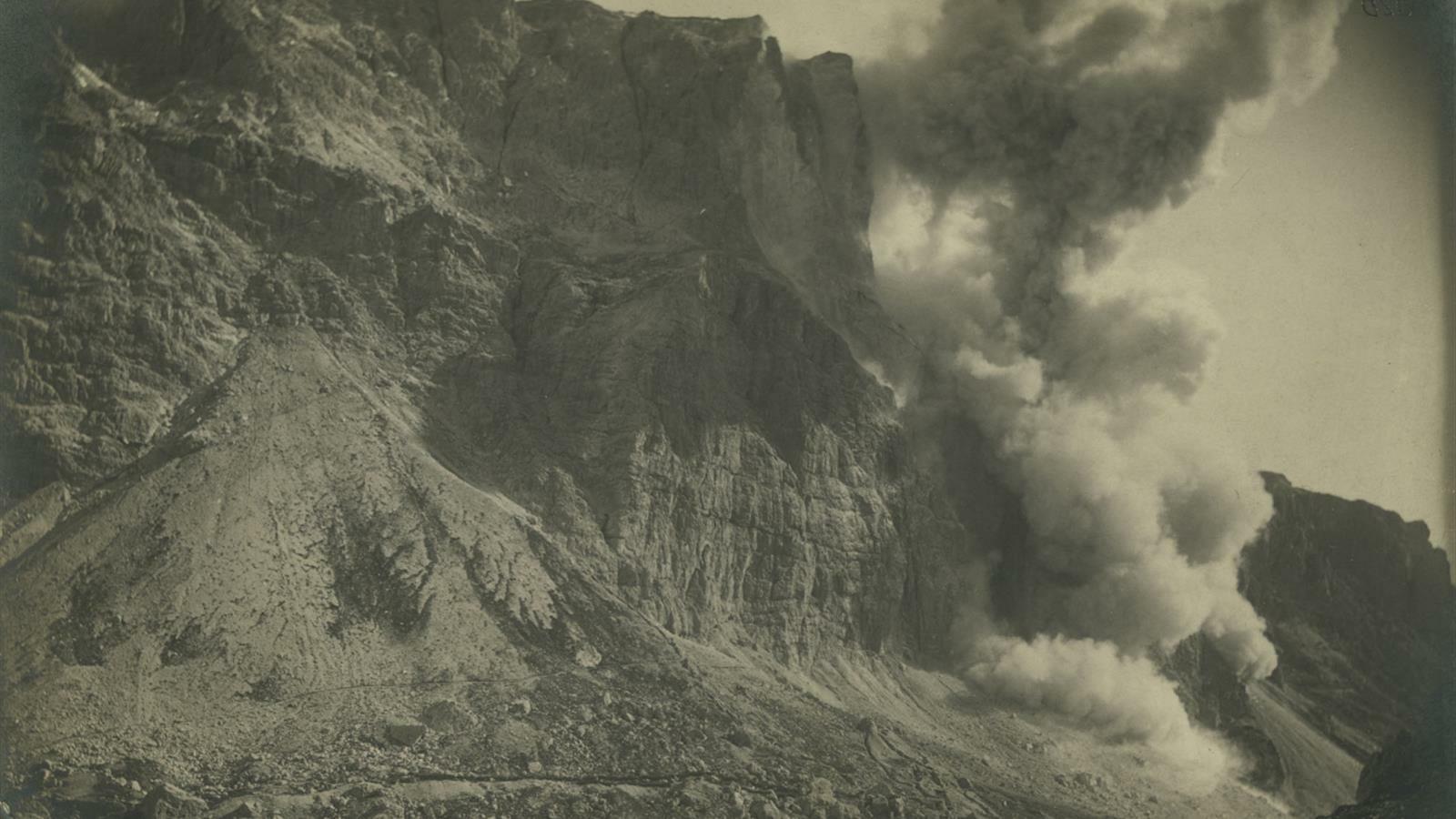
An image from the other blog post, taken from Itinerari Della Grande Guerra. As noted there, it's included with an article about the Castelletto, but seems more likely to be an Austro-Hungarian mine at Monte Lagazuoi.
The Altitude Units Pack will arrive with Ascent
You can already wishlist our upcoming cosmetic DLC, which is full of cold weather clothing that will suit any of our colder maps, including the vertical cliff face of Marmolada in Ascent!
The assault begins on the 10th and will run until the 24th of April. Get your ice picks and rocks ready...
Update v51260
This update includes the following fixes and improvements:
Improvements for disconnect issues
Voice chat fixes
Fixed jittery weapon movement after player dies on an HMG
Fixed Officer whistle abilities sometimes not being usable
Internal logging
The download is expected to be around 117 mb and will require some patching.
Weapons across the three fronts of the WW1 Game Series
It’s a very special day today, as we mark the anniversary of the start of the Battle of Verdun. Our very first game in the WW1 Game Series was named after this massive clash between the French and German armies, and it can certainly be considered one of the most significant battles of the war.
As well as looking back at the Battle of Verdun, we also have a new campaign event with the possibility to win a teaser reveal, another image from the upcoming Isonzo cosmetic DLC, and we compare the types of weapons you can use in each WW1 Game Series title. Off we go!
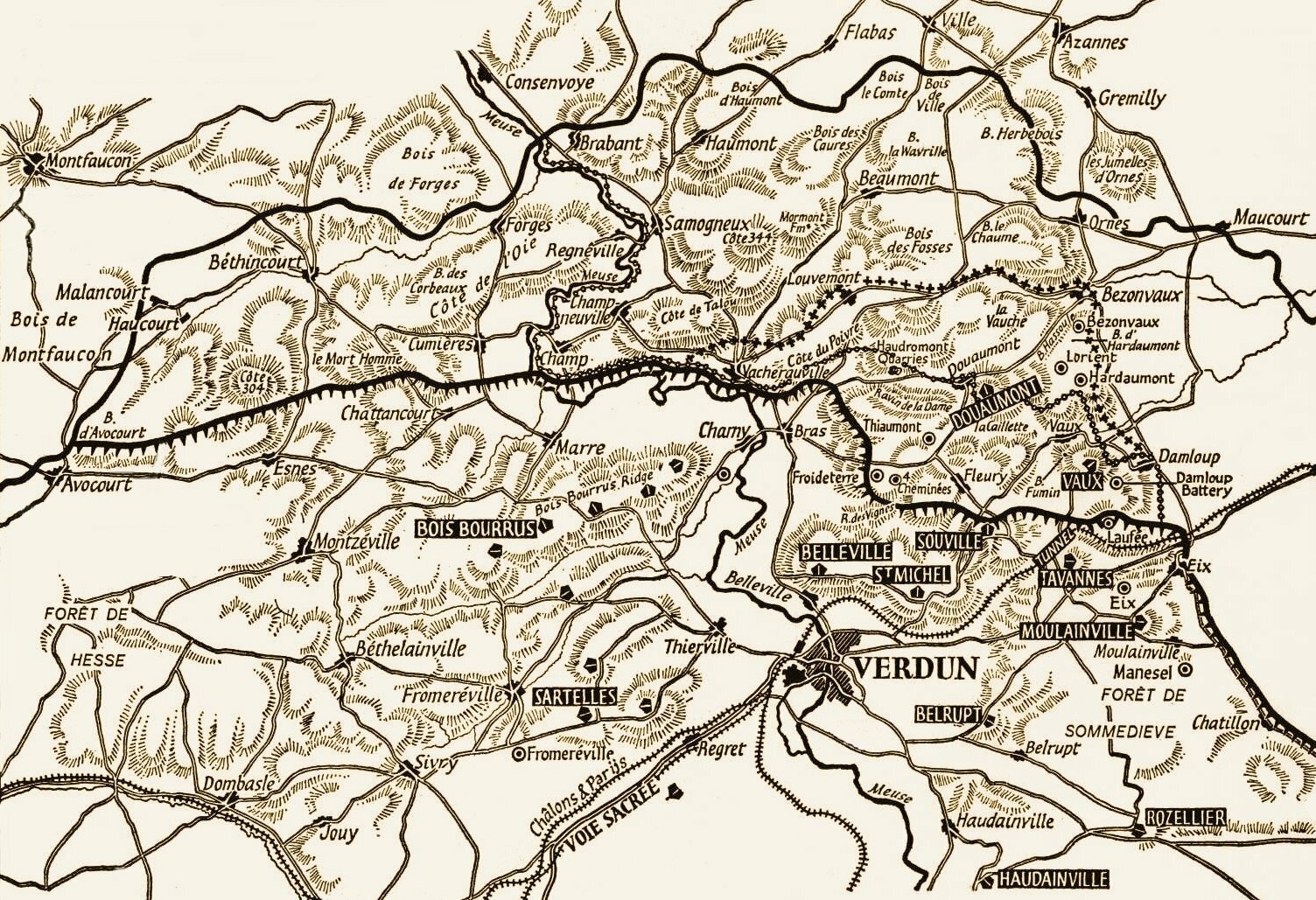
A map of the Verdun area.
The Battle of Verdun
The Battle of Verdun began on this day 108 years ago, on February 21st 1916. It was the longest battle of the war and one of the longest in history. The German plan was to capture strategic defensive positions from the French and then destroy their reserves when they tried to counter-attack.
It began well for the Germans with the stunning capture of Fort Douaumont without a shot being fired. French commanders had ordered the fortress almost entirely emptied of men after Belgian forts were destroyed early in the war, and small German patrols were able to climb inside through (unoccupied) firing slots intended for machine gunners. Once in German hands the extent of the mistake by French command became clear – Douaumont was a more modern fortress, and proved entirely capable of withstanding the kind of heavy artillery that had devastated the Belgian positions.
Fort Douaumont in Verdun.
However the attack soon bogged down, and French reinforcements organized a strong defense. French General Nivelle gave the famous ‘On ne passe pas’! declaration which can be translated as ‘they shall not pass.’ In the event of German advances immediate counter-attacks were to be organized. This might seem to be exactly what the Germans had hoped for, but they had not established the impenetrable defensive positions they hoped for. Instead, by late March French artillery was pounding their positions and causing heavy losses.
Fierce fighting continued even as both sides pulled troops away from Verdun in July to support the Battle of the Somme. The Germans gradually reduced their commitment further, until in September and December the French were able to recapture most of the ground lost earlier in the battle. It officially ended on December 18th, almost four months after it began.
Change history, win a teaser in our new campaign event
For those who haven’t fought before, our campaign events are special multi-game battles where every kill is tallied up, and the side which manages to lose the least troops wins. You can earn a medal for participating in the campaign, with a shinier medal for fighting on multiple fronts. The Battle of Verdun Weekend Campaign will run from Friday February 23 through (surprise!) the weekend, and end on Monday.
Did you know that the Central Powers haven’t been able to secure a win so far? To give them a bit of a boost, let’s up the stakes a little this time around: if the Central Powers manage to come out on top, we’ll give you the first big teaser for the upcoming new game mode in Isonzo!
We’ve been working on a grand map showing every battlefield in the series – here’s the Western Front part, with a bit of the Italian Front.
Can you change history and see the Central Powers win the battle for attrition as planned for Verdun? Or will they once again be unable to pass?
Guns Across the Fronts
Every game in the WW1 Game Series so far features rifles, bayonets, pistols and grenades. But if you want a shotgun, you’ll need Verdun. Sabre? Tannenberg. Rifle grenades are only in Isonzo. Why the differences?
Verdun
Our first game has quite the variety of weapons, and this is a function both of gameplay design choices and the setting: the Western Front saw some of the greatest weapon variety in the war. With some of the largest and most heavily industrialized countries gradually moving to a total war footing, all kinds of weapons were tested, improved, and invented.
Unique weapons to Verdun include the Winchester Model 1897 ‘trench gun’, the MP 18 submachine gun, flamethrowers, and even an anti-tank rifle, albeit only in the Attrition and Team Deathmatch game modes.
One notable omission is the heavy machine gun. On the sometimes narrow maps of Verdun there can be a fine line between places where an HMG would be overpowered and places where they would just be useless. In any case, the LMGs available to specific squads can provide weight of fire when needed. Heavy machine guns would become part of the WW1 Game Series though, with the release of...
Tannenberg
Yes, heavy machine guns made their debut in Tannenberg, where more open maps and freedom of movement for players allowed for both better fields of fire and more flanking routes. They were part of a number of new map features alongside things like command posts for calling in support, and ammunition crates. Also new to the series were swords, used by specific members of specific squads and offering unrivalled close combat power.
A number of the more advanced or unusual weapons were not present in Tannenberg, like the flamethrower and light machine guns. While these did see use on the Eastern Front historically, they were less common than in the west. It was also an intentional design choice to increase the importance of maneuver and positioning rather than having special weapons breaking gaps in defensive lines as you sometimes saw in Verdun.
Isonzo
Which brings us to the present day and Isonzo, which in many ways is the best of both worlds. Light machine guns and sniper rifles share the battlefield with heavy machine guns and the newly added mortars and field guns. One major factor was the new class / loadout system in Isonzo, where instead of players choosing squads and each squad having different roles each with different loadouts, you simply pick a class and a suitable loadout. The key difference is that class limits can be set as part of the map design – in Verdun there was nothing to stop every German squad going Landser and having their MG-Schütze take an LMG. In Isonzo the number of potential LMGs and snipers can be limited to prevent them getting out of hand.
There were also new utility weapons and equipment added, from the flare guns used by officers to target support call-ins to the canteens and instruments used for buffing yourself or others. Of course the bulk of the fighting is still done with trusty rifles, pistols, grenades and bayonets – but the more specialist weapons and map based heavy weapons can make all the difference if used right.
The Warming Continues
We’ll round off with a few more teasers from the upcoming cosmetic DLC, full of extreme cold weather clothing. You enjoyed last week’s Sgt. Chungus Italian engineer, and we hope you’ll be as enthusiastic for this pair of Austro-Hungarian assault troops and their impeccable mustaches.
Both men have goggles ready in case of blinding sunlight off the snow, and the man on the left is wearing a ski suit and shoes.
Good luck with the campaign soldiers!
Let’s see if you can earn that teaser…
Guns, garments and groundwork
The team is hard at work on the new special game mode right now, and we’re hoping to share more about it with you as soon as possible! Alongside that release will be some new weapons and a new cosmetic DLC pack – and we do have a teaser about that. Of course, all our cosmetic DLCs use real uniforms and equipment which we strive to reproduce accurately, the same as our weaponry and battlefields – but how do you properly recreate a setting from more than 100 years ago?
We’ve talked before about how we use references and try to walk the line between making realistic content which is also fun to play – for instance our second ever Isonzo Dev Blog from before the game was even released!
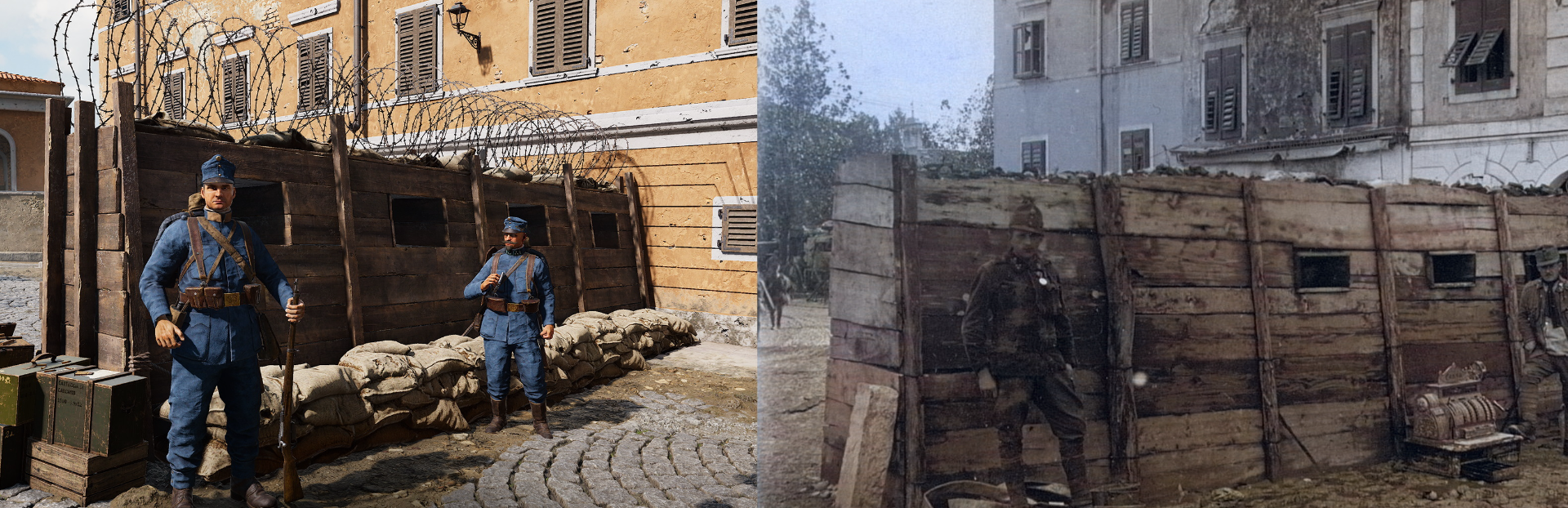
Here’s a comparison image from our blog about the creation of the Gorizia map. Things like trenches, barbed wire, and constructions like those seen here might seem less exciting than big-ticket items like the train station that serves as an objective… but they’re much more common and getting them right is vital to establishing an authentic atmosphere.
And here’s the aforementioned train station alongside a reference photo. You can see there have been some adjustments made to the in-game version to support better gameplay (e.g. trains and wagons provide cover along with added visual interest, and the station isn’t quite so long.
When it comes to getting the lay of the land, photographs are helpful but usually not enough. Especially with the rough terrain in Isonzo, even a series of photographs is unlikely to capture every ditch and rocky ridge, or clearly identify what’s a safe mountainside path versus a mere goat trail.
Luckily we can often find trench maps from the exact battles we’re working with! It’s also possible to use modern satellite imagery… but you have to be careful, because places change over time, sometimes much more than you might think. For instance, the GIF below shows just such a change in the landscape.
Distinguished Firearms
We never went in-depth on the blog about the new weapons released in the free White War update – time to remedy that for anyone who doesn’t follow our social media.
Gewehr 71/84
The Mauser name will be familiar to most people with an interest in WW1 or WW2 history, or weaponry in general. Renowned as accurate and reliable, Mauser rifles are still popular with hunters and collectors today. And it all started with the Gewehr 71 (or Mauser Model 1871), a bolt-action rifle adopted by (most of) the German Empire in 1871.
In Isonzo you won’t find that original single-shot Mauser, but instead the updated 1884 version which incorporated an 8 round tubular magazine (an integrated magazine where the bullets are inserted one by one and sit end-to-end in a kind of tube, hence the name).
You should bear in mind that even this 1884 version is still using black powder cartridges as opposed to modern smokeless ammo. While it’ll still shoot just fine, you do leave a noticeable puff of smoke with every pull of the trigger. Not ideal if you want to play a more stealthy mountaineer role!
Peter Paul Mauser, who handled most of the design for their weapons while his brother Wilhelm focused on the business side of things.
Vetterli Model 1870
There are several versions of the Swiss designed Vetterli rifle in Isonzo, but this is the oldest, and like the Gewehr 71/84 above it also still fires black powder cartridges! However this Vetterli is single-shot… at the request of the Italians themselves. The version used by the Swiss army at the time of adoption had a 12 round tubular magazine, and you could have another round in the cartridge elevator.
The Italians would instead take a roundabout route to magazines by using a conversion designed by Italian artillery captain G. Vitali to convert Model 1870s into M1780/87s, which had a four round box magazine. During the First World War some of these M1780/87 rifles would then be converted again into M1870/87/15s that could use the same ammunition as the standard issue Carcano rifle being used by the Italian Army at the time. They also had six round magazines instead of four. None of the Vetterli rifles (all of which are represented in Isonzo) were intended for frontline combat during World War One since they were very outdated. However, with the pressures and uncertainties of war they did end up seeing some action.
Repetier-Gewehr M.14
The most modern of these three rifles, the Repetier-Gewehr M.14 was an Austro-Hungarian made version of the Gewehr 98, which was the standard issue rifle for the German Empire during WW1… made by Mauser! This version had some minor adjustments compared to the regular Mauser, and was produced for export rather than local use.
In particular a lot of Repetier-Gewehr M.14s were used during the Mexican Revolution of 1910-1920. They were primarily used by the Mexican Federal Army (the Federales) from 1913 onwards until they were defeated and replaced by the new Constitutional Army in 1914. These rifles would have been some of the more modern weapons in use at the time, especially compared to the elderly Winchesters of 1886 and 1894 vintage that were common among the Zapatistas – just one of the many groups that fought against the government.
With the outbreak of the First World War, the Austro-Hungarian government would make use of thousands of these export model rifles, with almost 67,000 Mexican-contract rifles, 43,000 Chilean rifles, and a number of Columbian rifles seeing action in Europe.
Dress Up Warm
We’re excited to reveal a first look at the new cosmetic DLC which is on the way! Expect clothing for the worst Alpine weather conditions – as the war progressed, both sides adapted to the freezing temperatures and blinding snow with more and thicker layers. There are some very interesting uniforms and bits of facial gear coming with this one. Expect more teasers in the coming weeks.
An Italian engineer - very well wrapped up!
Returning to our reference theme, it’s best to use multiple references where possible. For instance, for one of the uniforms in the upcoming new DLC, we were able to find both a photograph and an illustration. The illustration includes extra details that aren’t clear in the photograph, such as the kind of boots that might be worn along with such a warm coat.
That said, it’s possible that the illustrator of the left-hand image was using this same photograph as a reference, so every reference needs to be checked individually to make sure they’re as reliable as possible. It’s possible for historical misinformation to be spread unintentionally in this way, where one person uses an inaccurate reference, and then their work serves to spread the original inaccuracy further!
Marmolada in-game and in-reference
We’ll close out today’s blog with some comparison shots from our most recent release: the Marmolada map!
Until next time, soldiers!
Words of War from the Alpine Front
Photographs and drawings from the First World War might catch the eye, but the letters and diaries of the participants can give a far more detailed understanding of how it felt to actually fight under the grim conditions of 1914-1918. Letters and diaries allow us to reconstruct battles like the fighting for the ‘Castelletto’ – a fortified Austro-Hungarian position with a commanding position over strategically important supply routes. Despite the strength of the position, it was exposed and Austro-Hungarian commanders felt it was only a matter of time before the Italians took it.
Following multiple failed attacks, the Italian Alpini resorted to mining into the mountain below the Austro-Hungarian positions, first using picks and eventually pneumatic drills. The Austro-Hungarian commander of the Castelletto at the time was a 19-year-old given the posting because he was young with no family. Hans Schneeberger wrote letters describing the fighting around the position. Eventually the Italians finished their tunnel, which the Austro-Hungarians learnt about from an intercepted transmission. Schneeberger wrote: “Everything is like yesterday, except that another 24 hours have passed and we are 24 hours closer to death.”
A mine detonated beneath a mountain position, from Itinerari Della Grande Guerra. They include it with an article about the Castelletto, but it seems more likely to be an Austro-Hungarian mine at Monte Lagazuoi.
Miraculously, Schneeberger would survive having 35 tons of explosions set off beneath him while he slept in the Austro-Hungarian barracks on the Castelletto, fight off an Italian assault, and then eventually withdraw under cover of night. War diaries like those of Erwin Rommel, who was a young officer during WW1 and fought on the Italian Front, often go into great depth about the challenges of battle in the mountains.
An Italian assault on Austro-Hungarian positions on the Marmolada map in Isonzo.
Weight of Words
Almost 4 billion letters and cards were sent to and from Italian soldiers during the First World War – this compares to around 10 and 30 billion items sent by the larger armies of France and Germany respectively. But another factor to consider is that alongside having less total soldiers mobilized, Italy also had a rather low literacy rate: at the outbreak of war there were perhaps 40% of the population who couldn’t read or write.
With no other way to communicate with their loved ones, or sometimes just to express themselves and find an escape from the experience of the war, illiterate men would either learn or get help writing from their comrades or military chaplains. The Italian military issued a large number of postcards, many in a format designed to be easy for less literate soldiers to fill out, with some preprinted text, clear spaces for addresses. However, these cards may have had a dual purpose: in giving such a limited space for actual writing, it would prevent soldiers writing too much about their experiences, controlling the amount of information getting out to the civilian population and making the job of the mail censors easier. Mail censorship was common during the First World War, and means that a lot of letters and cards are more vague and less expressive than they might otherwise have been.
This Italian postcard from the front was written in 1917, and uploaded by a Wikipedia user. Note the purple stamp indicating that’s it’s been checked by a censor – and are all those flags really necessary...
Along with descriptions of the usual machine guns, artillery, and poison gas are the unique dangers of high altitude combat. Boulders rolled down the steep slopes and cliff faces, avalanches triggered by shell fire, and simply cutting ropes or ladders – Schneeberger recollects his sergeant cutting a rope ladder being climbed by Alpini and laughing as they fell to their deaths.
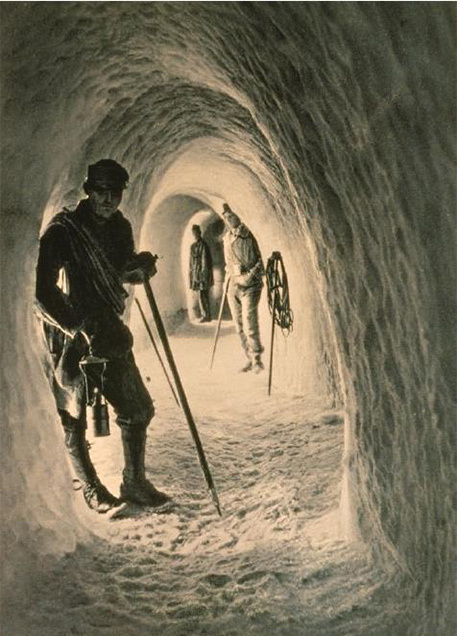
Fighting through the ice tunnels of Marmolada.
You might not have to worry about avalanches when fighting in the mountains of Isonzo’s higher altitude maps, but where available tunnels will provide cover from artillery and aircraft, while you will need to watch your step on some narrow cliffside paths – well worth the risk for the chance to take your enemies by surprise.
Dress for Alpine Warfare with the fittingly named Alpine Units Pack, featuring uniforms from mountaineer units alongside winter clothing for regular soldiers and a range of accessories.
It’s 1916. The Austrian troops have occupied what they called Forcella Vu. It’s the most strategic position, right at the top of Marmolada’s glacier with a connection to the nearby bastion of Height 3153. However, the only supply route was being watched by the Italian troops situated in the Serauta bastion. Braving the trip to Forcella Vu would mean you had to not only watch out for the regular avalanches and snow storms, but also the hail of Italian lead. However, that summer Lieutenant Leo Handl had an idea. If you can’t go over, why not go under?
The City of Ice
Thus, construction of a tunnel began. No one actually knew how well this was going to work. They had to test the materials, few explosives and technologies they had on hand. After all, no one had done this before! There was a lot of trial and error involved, but eventually they dug their tunnel.
However, the tunnel ended up being surprisingly pleasant. You don’t have to worry about avalanches, snow storms can’t reach you and the icy walls insulated the tunnel to a relatively comfortable 0 °C. Functionally, it became a big, subterranean igloo. The protection from avalanches was particularly salient given the disaster of White Friday on December 13, 1916. Heavy snows and unusually warm temperatures (for the mountain top, so still very cold!) led to perfect avalanche conditions. Both sides exacerbated the situation by firing artillery to try and collapse snow onto their foes. Thousands of soldiers would be killed by avalanches that December, but the worst might be the destruction of the Austro-Hungarian barracks atop Gran Poz, which saw 270 soldiers buried alive beneath the snow.
Additional offshoots were dug out the sides of the initial tunnel. These offshoots became hallways as rooms were created. The rooms got purposes: everything from barracks, toilets and provisions & ammunition storage to a kitchen, field hospital, chapel and various gun emplacements for machineguns and even artillery. Ultimately, the Ice City took 10 months of heavy labor to be created and could house and provide for more than 200 soldiers in its 12 kilometers-worth of tunnels.
The Italians already began their counter-mining works, but accelerated their efforts upon being shelled by artillery from the subterranean city. Thanks to drilling machines, they rather quickly dug their way below the city and destroyed several key positions with explosives, including artillery emplacements.
With the superior supply line of the Italians, the Austro-Hungarians found themselves on the defensive and had to continue digging more and more to counteract the movement of the Italians. The mining and countermining from both sides continued until the Italians surrendered their positions following the Battle of Caporetto in late 1917.
The fate of the city
As the Italians backed off, the Ice City lost its purpose. It was abandoned by the Austro-Hungarians and ended up in disrepair. As the glacier started to melt, the city was destroyed and little evidence of the city’s very existence remains to this day, though sections of the various structures continue to re-emerge.
If you’d like to learn more about the Ice City, as well as Marmolada as a whole, be sure to give the Museum of the Great War in Marmolada a visit. They have many exhibitions about the Ice City, including items they've recovered from the City's remains. This blog is for a large portion based on their documentation. Find out more about the museum through their website.
You can explore our rendition of the Ice City on Marmolada, the latest map added to Isonzo as part of the free White War expansion. Get lost in the tunnels, fight over the bridges and gain or keep control over the supply line!
Want a more authentic Marmolada experience? Be sure to check out the Glacial Units Pack and dress up for the cold!
It's been a great year for the WW1 Game Series, with special Christmas Truce and Wolf Truce events in Verdun and Tannenberg, and Verdun appearing in a French museum exhibit. The series also celebrated our 10 year anniversary, since Verdun entered Early Access!
Isonzo especially has had a good year - starting off by winning the IndieDB Indie of the Year 2022 award, thanks to your generous votes!
For our part, we made sure to implement masses of new content. From our first big expansion with the Piave map all the way to a snowy end to the year with the White War release, the game has grown substantially!
- 4 Huge New Maps! - 8 New Weapons! - 2 Cosmetic DLC Packs! - Mac Support! - Much more!
If you haven't yet felt the crunch of Alpine snow beneath your boots, Isonzo is currently 67% off with DLC up to 30% off until January 4th.
Four New Battlefields for Isonzo!
Piave - Caporetto Offensive
Grappa - Caporetto Offensive
Piana - Mountain War Offensive
Marmolada - White War Offensive
Upwards and onwards!
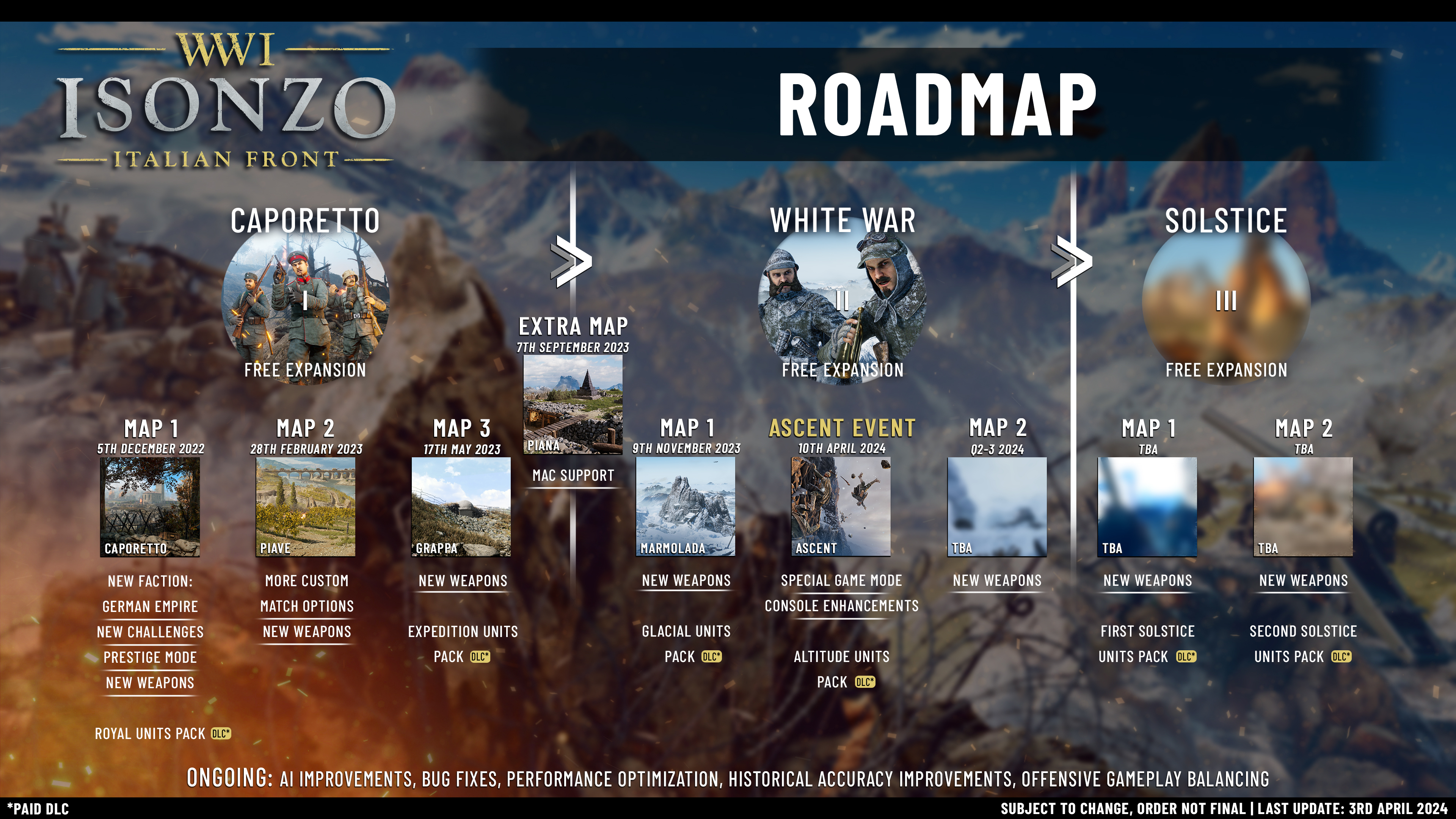
We completed a lot of our roadmap milestones in 2023 just as planned, and there are plenty more coming in 2024!
There'll be a new map, more weapons, additional cosmetic DLC packs... and a special game mode! We're maintaining radio silence about the new game mode for now, but keep your ears to the ground and you might pick up some teasers.
Marmolada Video Dev Blog
Go behind the scenes with map designer Kian as he discusses the creation of Marmolada in this YouTube video - including almost 1000 reference images!
Verdun at the Museum
In the aisles of the History Center of the Notre-Dame-de-Lorette Memorial'14-18 you’ll be able to find a special exhibition! The War games. Playing with History exhibit allows visitors to immerse themselves into WW1 history, by having 10 games available to play. We’re very pleased that Verdun is one of those games!
The exhibit runs until May 2024, and entry to the museum and exhibition are both free. If you’re in the area, check it out!
Christmas Truce
The Christmas Truce is live once again in Verdun, and you’re able to participate in multiple activities together with other soldiers who joined the Christmas Truce. Join a friendly match of football, have a snowball fight or just take a nice relaxing stroll and enjoy the winter scenery.
In October, the wolves returned to the forests of Tannenberg, asking the question: would you cease fire with your human foes to battle a new enemy? Some of you will have managed to hold a successful truce to fight off the canine aggressors, and others, not so much.
We're extremely grateful for all the support from our great community this year, and it's been wonderful to see people enjoying themselves with our games. We can't wait to show you what we have planned for 2024! On that note, we'll end with a little WIP image...