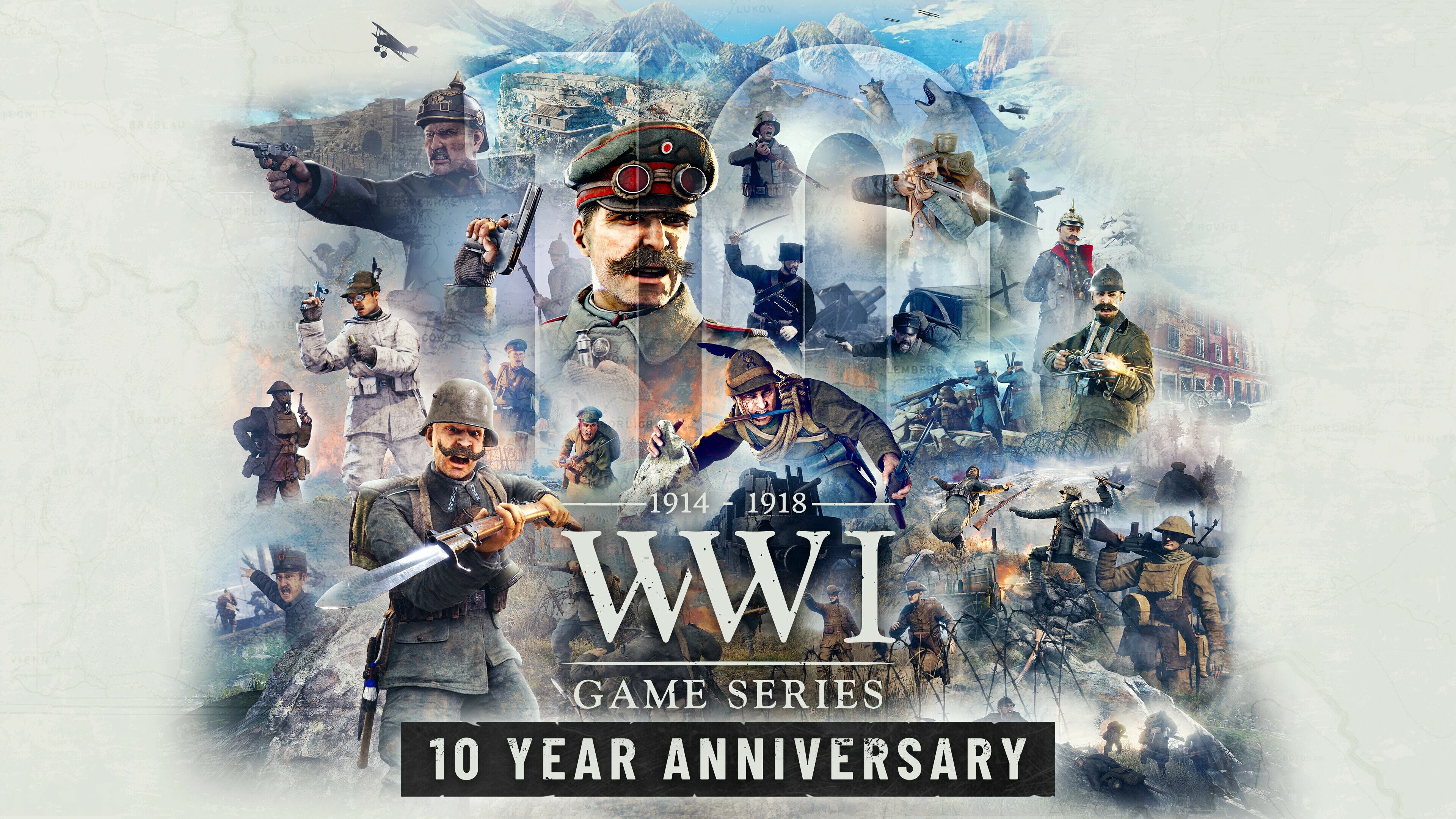
Today marks the anniversary of the WW1GameSeries, as today Verdun went into Early Access 10 years ago!
We want to thank all our soldiers who have joined the fronts over the years. Did you make your way from the Western Front, towards the Eastern one and ended up high in the mountains in Isonzo? Or are you a new recruit who recently joined any of the fronts?
No matter what, we thank you for playing our games!
Here are some fun facts for each games, that you might not know.
The first ideas and concepts for Verdun were made back in August 2006, 17 years ago!
For Tannenberg, the team considered for a long time to make a Cossacks soldier the main promo banner character
Isonzo's well beloved OST 'Rinascereme Insieme' wasn't planned at the beginning, but more a place holder song. It really grew on the team and they decided to make it into a full song that you now know and love today
Combined, the games have 29 maps. Here they are from west to east, north to south:
It’s time to join the Italian Front once again and fight on Monte Piana! The map is now available for everyone & for free!
It’s been almost 1 year since Isonzo’s release. We’ve released 4 additional maps, the German Empire as a playable faction, numerous weapons & consistent bugs and optimization patches.
Thank you all for playing our game. We still have a lot more in store for you on the Italian Front, as we’re already hard at work for a special event, similar to what you might know from Verdun & Tannenberg!
Dress up to fight the cold
Speaking of the special event, here is our upcoming cosmetic DLC that comes along with it, which might give you a hint ;)
That’s right, you can now already wishlist the Glacial Units Pack. Like our previous DLC’s, this is purely cosmetic and won’t give you any in-game advantages (buffs, perks etc.). We’ll follow up on this DLC pack with an in-depth devblog (at some point) like we’ve done with previous ones.
First Wave of DLC
Additionally you can now find the First Wave of Isonzo DLC in one bundle and its discounted at the moment as well! It includes
Speaking of discounts, Isonzo & WW1 Game Series are now part of the Focus Publisher Sale!
Final call for survey
A big thank you to all who've already filled in our survey! This is our final call to you all who haven't yet. If you got time (about 10 +/- min) to share your opinion with us, that would help a lot! Also, you're joining our giveaway by participating as well! Click HERE to be redirected to the survey. Thank you in advance.
Patch Notes
New
New map in the Mountain War offensive - Piana!
Mac support - check the store page for specs
Partial reloading is now possible for en bloc rifles
Full body aiming animations
Adjusted Grappa last sector capzone objective size
New splash screen - woooo
Fixed
Spawning improvements
Fixed achievements not triggering when they are supposed to do
Improved bot objective prioritization
Improved defender bot distribution
Fixed bots sometimes walking too slowly
Fixed bots sometimes not being able to interact with bridges or pontoons
Improved bot interactions with static weapons
Fixed bots sometimes getting stuck healing themselves
Fixed bots not dying from gas
Fix for Radial Menus swapping selection rapidly when using a controller
Fixed UI elements that were not being toggled off/hidden by their associated settings
Added an option where all warning messages can now be now turned off
Players can now cancel joining a match in some situations
Fixed the message of player being healed getting stuck sometimes
Fix for players not being able to build locations where it should be possible
Fixed Austro Hungarian loadouts not saving
Increased periscope interaction range
Fixed periscopes and static weapons sometimes not usable
Fixed sleeve movement when using a Madsen and switching to canteen and back
Fixed player's character head showing during spawning transition
Fixed Beretta 1917 scale and VFX
Fixed some missing footstep and impact sounds
Improved audio timing for the M95 Stutzen, M88-90, Vetterlis and the M90 Carbine
Fixed Albini binocs dealing less melee damage in comparison to others
Fixed Forward Posts sometimes being too dark
Resupplying with Ammo Box now shows faction specific bullet models
Fixed visual issues in last Defender Spawning Sector of Sabotino
FSR 2.2 general improvements
Improved scope visuals when using FSR 2.2
Main menu performance optimization
General optimization
Known
Squad UI shows up in Spawn Overview when a player joins/leaves the squad
Bots sometimes vault/mantle too abruptly
Good luck on Monte Piana soldiers o7
Devblog #60 - Upcoming Piana Map
Hello everyone!
We’re excited to share the Piana map release date with you all! Next week, September 7, you’ll be able to play on this new map!
As stated in our roadmap, this update will also come with Mac Support!
Want to know a little bit more about the historical events of the map? Be sure to read our devblog about it! https://steamcommunity.com/games/1556790/announcements/detail/3667672110007215603?snr=2_9_100000_
Piana Map
Back to the two original factions, this map features the Italians and the Austro-Hungarians. With the Italians on the attacking side, they first need to make their way through No Mans Land, where you can find a crashed aircraft.
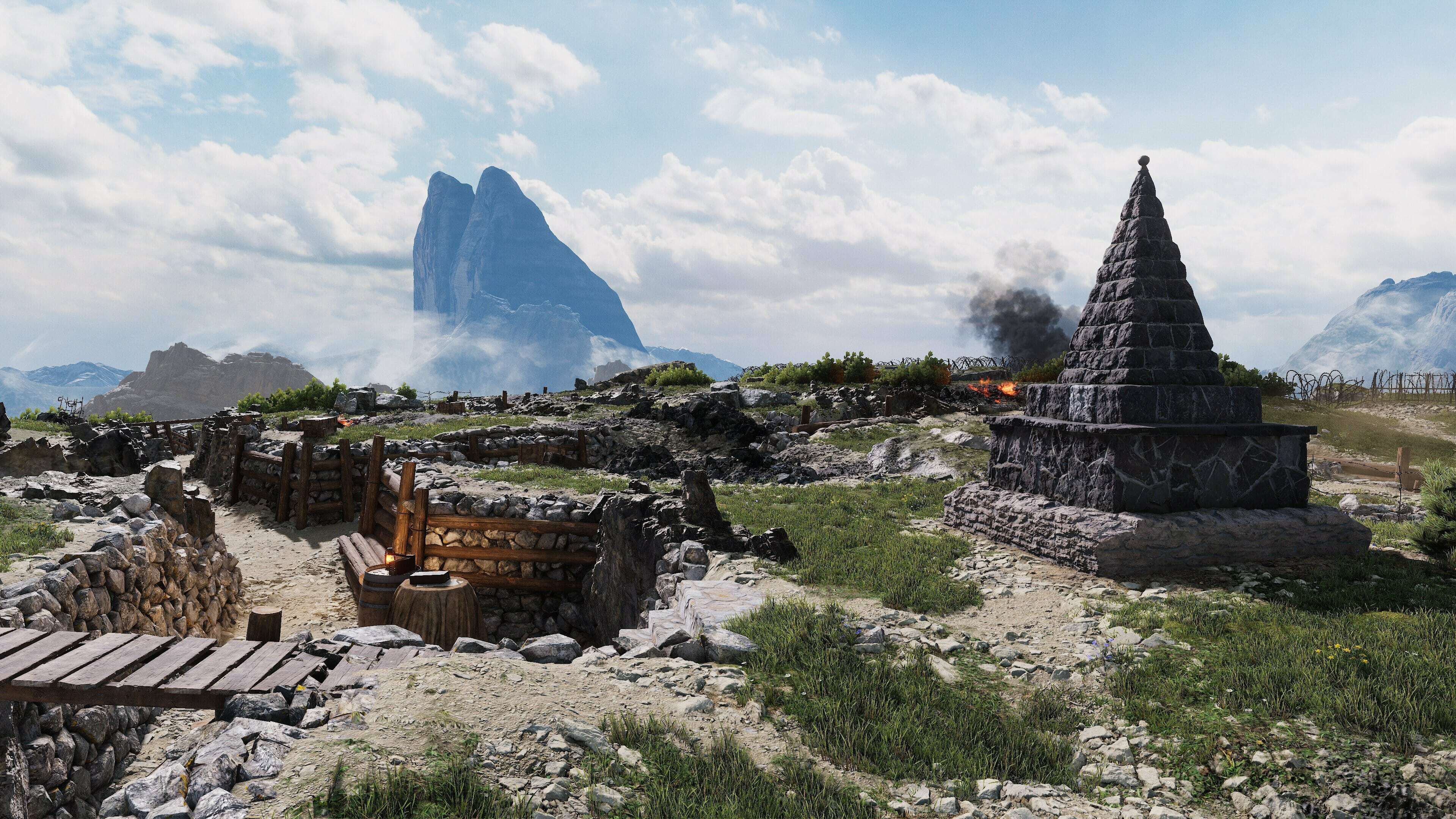
The first section, Monte Piana, only has one objective; capture the area around the Piramide Carducci, the stone pyramid. The objective lies deeper into the section towards the left side (from the Italian POV), making it accessible from different sides. There are many paths, trenches and cabins connected that can offer you some guidance and help to help you get there, may you be defending or attacking. Don’t forget that you’re on a mountain, so there are different types of altitude combined with stairs and buildings that might provide the flank or cover you are looking for.
Once the Italians are successful in capturing their objective, the match moves to the second section. Again, a No Mans Land area must be crossed, which sees a significant drop in height before making it towards the new objectives. This area is called Forcella dei Castrati.
This new section, Monte Piano, has two objectives; another point cap and destruction. The point-cap objective is towards the side of the mountain, where several cabins are built alongside the ridges and connected through wooden stairs and planks. It’s easy to get lost here, friends and foes can come from multiple sides. Before you can claim the side as your own, you have to be sure that no one from the opposite team is there, which might be a tricky part. Who knows who might be hiding around the corner in a cabin. And the walls won’t protect you from potential gas attacks that might be sent your way…
On the other side, there will be a canon that needs to be destroyed (or defended). A trench will be leading your way towards this objective, alongside other pathways that provide less cover. Be sure to hold your ground, as this could be your final objective of the map and give you the victory! Will you celebrate victory with a bang or will you go out with a blast?
We hope you all look forward to this new map! The team also continues to work on the upcoming bigger expansions, so prepare your snow boots for the upcoming updates!
See you next week at Monte Piana soldiers!
Devblog #59 - The Battle of Monte Piana
Hello soldiers!
It’s time for another devblog! The release of our Monte Piana map is getting closer. We can’t share the release date with you all just yet, but don't worry, your wait will be over soon enough.
Before we get into the historical background of the map, we would like you to ask you all once again to fill out our player survey. This is to make sure that we’re putting our development focus in the right areas, and to keep our fingers on the pulse of the WW1 Game Series community.
Many of you have already done so, thank you very much! This is a reminder for the people who might’ve missed it (or forgot it). You can click here to be redirected to the survey.
We’ve heard some of you struggling to fill in the survey due to the Google login requirements. This is a safety precaution. We’ll look into other alternatives for future surveys.
Now, let’s take a look at the Battle of Monte Piana.
Preparations
Before the actual commence of the battle, both sides (the Austro-Hungarians & Italians) made adjustments of their positions. On 8 June 1915, the Austrio-Hungarians began to dig deep trenches, which were accompanied with barbed wire a day later. On the Italian side however, two infantry battalions (Marches brigade) relieved the Alpini and resisted the daily Austrian attacks (Schaumann). A few days prior, the 55th Marche had been alerted to move to Monte Piana.
The two lines faced each other at a short distance, and the Austro-Hungarians adopted a singular strategy to impede the Italian patrolling actions: every evening around 11pm they sent 50 to 60 men to take up positions behind the barracks less than 100 metres from the Italian line who fired shots rifle in order to keep the Italian troops still.
On 9 June, the Italian artillery targeted the northern plateau with the new 149 pieces causing numerous losses: after a few hours the damage was so serious that a partial Austrian retreat from the advanced trenches was necessary. In the night between 9 and 10 June the Austro-Hungarian shock troops were replaced by a company of Landesschützen.
An image of Monte Piana before the war
Towards the end of the month, the Italians expected the medium- and large calibre batteries (infantry) to be available. General Ragni Ottavio issued the order for an operation, which focused on the barriers of Landro and Sesto. Several areas were targeted such as; the North of Cortina, Passo Tre Croci, Val Padola and more.
On July 9th 1915, the Austro-Hungarians almost completely expelled the Italians from the mountain, but didn’t put in the final blow in their attack, resulting in the stay of their enemy. This allowed them to plan a counter attack.
The counter attack
In the early morning of July 15th, the Italians started their counter attack. Their goal was to recapture Monte Piana.
They started firing with artillery fire; about 40 pieces of various calibres including the 280 and 305 of Federavecchia, their targets were the trenches on Monte Piana and the Pyramid Carducci. Around 9am, a rocket launched from Villa Loero gave the signal for the infantry to fire.
“And here we are lying under the last scree*. We look in amazement at the valley of death. An old captain comes out of a boulder. He has a sheet in his hand, he shakes it convulsively. Someone murmurs: 'He's drunk, poor captain'. A bullet hits him and he falls into a flood of dust. He shouts: 'I'm hurt!' He gets up. He staggers. He turns his back to the enemy who riddles him. And the grapeshot continues without interruption. Two generous men from the Red Cross approach on all fours to take him away. One is injured. They flatten themselves behind the boulders. It seems to see the projection of a flickering film. " - Infantryman Brusatin
*A Scree is a collection of broken rock fragments at the base of a cliff.
At the end, the battle turned into two years without any progress on both sides. In the months October & November 1917, the Italians were forced to abandon their post in order to move towards Monte Grappa, where they needed to withstand the Austro-Hungarian’s Caporetto Offensive.
That’s it for now!
We’ll post a more in-depth devblog of the actual map as well, so be sure to keep an eye out for that!
Until next time soldiers o7
Deveblog #59 - The Battle of Monte Piana
Hello soldiers!
It’s time for another devblog! The release of our Monte Piana map is getting closer. We can’t share the release date with you all just yet, but don't worry, your wait will be over soon enough.
Before we get into the historical background of the map, we would like you to ask you all once again to fill out our player survey. This is to make sure that we’re putting our development focus in the right areas, and to keep our fingers on the pulse of the WW1 Game Series community.
Many of you have already done so, thank you very much! This is a reminder for the people who might’ve missed it (or forgot it). You can click here to be redirected to the survey.
We’ve heard some of you struggling to fill in the survey due to the Google login requirements. This is a safety precaution. We’ll look into other alternatives for future surveys.
Now, let’s take a look at the Battle of Monte Piana.
Preparations
Before the actual commence of the battle, both sides (the Austro-Hungarians & Italians) made adjustments of their positions. On 8 June 1915, the Austrio-Hungarians began to dig deep trenches, which were accompanied with barbed wire a day later. On the Italian side however, two infantry battalions (Marches brigade) relieved the Alpini and resisted the daily Austrian attacks (Schaumann). A few days prior, the 55th Marche had been alerted to move to Monte Piana.
The two lines faced each other at a short distance, and the Austro-Hungarians adopted a singular strategy to impede the Italian patrolling actions: every evening around 11pm they sent 50 to 60 men to take up positions behind the barracks less than 100 metres from the Italian line who fired shots rifle in order to keep the Italian troops still.
On 9 June, the Italian artillery targeted the northern plateau with the new 149 pieces causing numerous losses: after a few hours the damage was so serious that a partial Austrian retreat from the advanced trenches was necessary. In the night between 9 and 10 June the Austro-Hungarian shock troops were replaced by a company of Landesschützen.
An image of Monte Piana before the war
Towards the end of the month, the Italians expected the medium- and large calibre batteries (infantry) to be available. General Ragni Ottavio issued the order for an operation, which focused on the barriers of Landro and Sesto. Several areas were targeted such as; the North of Cortina, Passo Tre Croci, Val Padola and more.
On July 9th 1915, the Austro-Hungarians almost completely expelled the Italians from the mountain, but didn’t put in the final blow in their attack, resulting in the stay of their enemy. This allowed them to plan a counter attack.
The counter attack
In the early morning of July 15th, the Italians started their counter attack. Their goal was to recapture Monte Piana.
They started firing with artillery fire; about 40 pieces of various calibres including the 280 and 305 of Federavecchia, their targets were the trenches on Monte Piana and the Pyramid Carducci. Around 9am, a rocket launched from Villa Loero gave the signal for the infantry to fire.
“And here we are lying under the last scree*. We look in amazement at the valley of death. An old captain comes out of a boulder. He has a sheet in his hand, he shakes it convulsively. Someone murmurs: 'He's drunk, poor captain'. A bullet hits him and he falls into a flood of dust. He shouts: 'I'm hurt!' He gets up. He staggers. He turns his back to the enemy who riddles him. And the grapeshot continues without interruption. Two generous men from the Red Cross approach on all fours to take him away. One is injured. They flatten themselves behind the boulders. It seems to see the projection of a flickering film. " - Infantryman Brusatin
*A Scree is a collection of broken rock fragments at the base of a cliff.
At the end, the battle turned into two years without any progress on both sides. In the months October & November 1917, the Italians were forced to abandon their post in order to move towards Monte Grappa, where they needed to withstand the Austro-Hungarian’s Caporetto Offensive.
That’s it for now!
We’ll post a more in-depth devblog of the actual map as well, so be sure to keep an eye out for that!
Until next time soldiers o7
Patch v45949: Falling through ground fix
We have a small patch today with hopefully big changes! We have a fix for the falling-through-ground issues that eliminated the issue entirely in our internal and community tests. The root cause is still elusive (and thus we can't promise a 100% fix) but we managed to prevent the consequence of falling infinitely.
Again, please let us know if you still experience the issue after this patch.
Other than this, the patch provides major improvements to our FSR implementation, which should improve the picture quality in the cases mentioned below!
General
Potential but very hopeful fix for falling through ground
FSR 2.2:
Scope sight quality improvementgs
(PS4 + XB1S) Scope render target size increase to 512x512
Improved foliage rendering
(PS4 + XB1S) Improved skybox quality
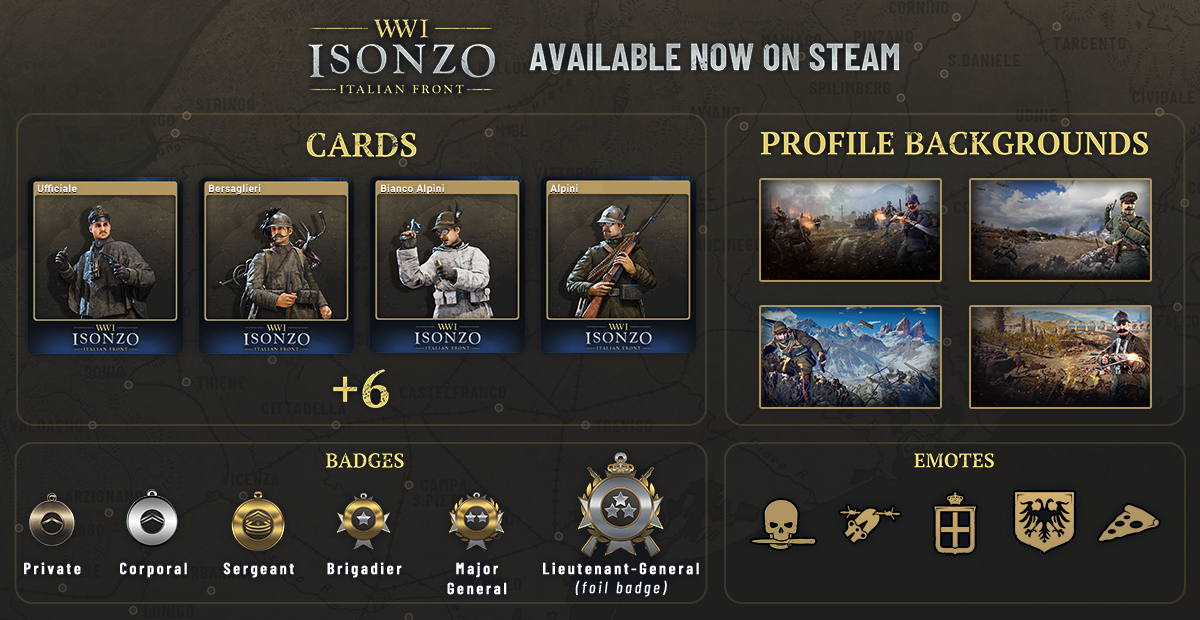
Isonzo Trading Cards & Point Shop Items!
Hello soldiers!
As you might’ve read in our latest devblog, we now have Isonzo Steam Trading Cards & Point Shop Items!
We saw in our Discord that there was some general confusion of what the cards do, how you can get certain items etc. so here’s a little overview!
How do I get these cards?
If you purchase and play a game, you’re automatically awarded a number of cards. For Isonzo, the max number of cards you can obtain by playing is 5. In total there are 10 cards. Once you have all 10 of them, you can craft a badge (see the image above).
You can find the cards you have in your Inventory, which you can find on your Steam profile. To view your badge progress, you can simply click on an Isonzo card you own and click the button ‘view badge progress’
If you own all 10 cards, you’ll be able to craft your Isonzo badge. If you do not, you’ll be able to purchase the remaining cards from the Steam Market by clicking on ‘buy remaining cards on the Market’.
If your Steam friends own a card that you’re missing, you’ll also be able to ask them to trade on this screen. Just scroll further down.
What happens when I craft a badge?
Crafting a badge will reward you with some xp for your overall Steam profile/account. Additionally, you can enable the badge to be visible on your profile & you're able to gain some of the other items, like the backgrounds.
What do the different kinds of badges mean?
Each time you craft a badge, the badge will become visually more impressive and reward you with more xp. Crafting a badge each time means that you’ll need the 10 different Isonzo Trading Cards each time as well.
The special foil badge can only be crafted with special foil cards. Like the other cards, these are randomly distributed.
If other players put them on sale on the Market place, you’ll be able to purchase them, similar to the normal cards. You can find the Steam Market simply under the Community Tab (a menu will appear when you hover over it), or by clicking here. Simply type 'Isonzo' in the searchbar to see what items are available for purchase.
Please note that we're not responsible for the prices. These are put up by the sellers themselves.
What are the Point Shop Items?
The Point Shop is a special shop, specifically for Steam Profile & chat items (stickers, emotes). You’re rewarded Steam Points by simply purchasing games on Steam, so we’re sure you got some ;) Here you’re able to exchange your Steam Points for profile backgrounds and emoticons. Find the Isonzo Items here.
Will you add animated backgrounds, profile pictures etc.?
This is definitely something we want to look into in the future!
Hope this helps!
ːpizzonzoː
Devblog #58 - Meet the Dev 04
Hello soldiers!
The devblog is arriving early this time! And besides meeting another member of the devteam, we have exciting news!
Yes that’s right, Isonzo now has Steam Trading Cards & Point Shop Items! We know many of you have been asking for it, and we’re happy to finally share this with you. Time to Isonzo-fy your Steam profile!
Survey Reminder
In the previous devblog, we’ve asked you all to fill in our player survey. This is to make sure that we’re putting our development focus in the right areas, and to keep our fingers on the pulse of the WW1 Game Series community.
Many of you have already done so, thank you very much! This is a reminder for the people who might’ve missed it (or forgot it). You can click here to be redirected to the survey.
We’ve heard some of you struggling to fill in the survey due to the Google login requirements. This is a safety precaution. We’ll look into other alternatives for future surveys.
Now let’s meet another programmer in our team!
Meet the Dev
Hello! Could you introduce yourself
Hi, my name is Nico, I’m 39 years of age and I live in Utrecht, right in the middle of The Netherlands. I studied Computer Science at the University of Groningen and moved here to Utrecht in 2012 to work at a game company. After moving back and forth between different fields of software development for a few years, in late 2015 I decided to start a freelance career.
I was introduced to the WW1 team on literally the first day of being a freelancer, and worked with them on Verdun for a few months initially. I didn’t become a full-fledged member of the team until the end of 2017 though, when Tannenberg was in development.
What is your role in BlackMill Games and for the games?
“Officially”, I’m no longer a member of the BlackMill team! I left at the end of last year and rejoined on a consultancy basis to work on the FidelityFX Super Resolution 2.2 (FSR2) implementation and to help out in other areas that I have knowledge of.
Before that though, I was primarily responsible for the console ports of the WW1 games. This started with just technical work: integrating various console features, optimization work and producing builds. Over the years, I’ve taken on more responsibilities including QA, release management and managing communications with Sony and Microsoft.
Where did your passion come from?
From playing games as a kid back in the ‘90s, as trite as it may sound. I was an impressionable child and anytime I saw someone make or do something cool, I’d be like “I wanna do that too!”. Computers, games and programming are what stuck around long enough to become a career and I can’t complain about it. If I had pursued a career in music, comic book drawing or operating drawbridges, I probably would have struggled a lot more in life.
Playing other people’s games and seeing how they were made is what made me passionate about creating games myself. Fortunately, I had a knack for programming and I learned a lot from modding existing games while still in middle school. Throughout my studies, I kept up-to-date with what was happening in graphics technology, worked on hobby game projects of my own, and tried to make choices with the idea of someday working in game development in mind. I’m glad that that worked out in the end, even if it took me a while to get there.
What was the first thing you made in Isonzo?
The first thing I did for Isonzo was to make it run on the Xbox One console. This was shortly after the console release of Tannenberg in mid-2020, so the production of Isonzo was already well underway by then. It was not a pretty sight. The game ran at barely 10 fps on the Xbox One X and that was despite the maps still being very basic and missing a lot of the details that made it into the final release. A lot of work has been done to whip the game into shape since then.
What is a memorable moment in the development of Isonzo?
Very recently, the moment FSR 2.2 first started working in Isonzo and I could see the potential of what it would bring to the game. It felt like I was looking at an offline render, rather than something that was being drawn in real-time. Everything looked sharp with clean edges, distant objects were displayed with perfect clarity and details popped like never before. It was at that moment that I knew my gamble to work on this research project had paid off.
Of course, a still shot like this is a bit flattering and there were plenty of problems yet to solve once things started moving around, but this gave me the motivation to promote the feature to the team and to really push for its inclusion in the game. Fortunately, it was not too hard to convince them of its value and I’m very happy with the way they supported me to get FSR2 across the finish line.
Another memorable moment is an older one, when I was first testing builds of Isonzo on PS5. That console is quite a bit different from the Windows and DirectX environments that we’re so used to, so it often has a lot of unique issues that crop up. Initially, all of the shaders were completely broken, causing all sorts of bogus pixel values to be drawn and together with bloom and other post-processing effects, it made the entire map light up like a Christmas tree. I affectionately called this glitch ‘Disco Isonzo.’
In general, I look back fondly at the last few months of development before release and witnessing the game gradually come together thanks to the hard work from everyone on the team. Getting Isonzo to run, look and play decently well on consoles felt like an impossible task at times and I would not have been able to do that on my own without everyone pulling together and making it work.
Can you show off some of your work process and tell us what you’re doing?
A lot of my time is spent looking at code, which is not the most visually exciting thing to be showing off. Lately though, I have been doing a lot of performance analysis and bug fixing using GPU profilers, so I can show some of that. Below is a GPU timing snapshot of a typical single frame on Xbox One S
When I first ran tests of FSR 2.2 on Xbox One, I was very sceptical whether it was going to be worth it. 6 milliseconds of GPU time to run FSR2 on a budget of 33 ms (to hit 30 fps), with nearly 8 ms spent on post-processing in total. No way would that ever be compensated by rendering the game at a lower resolution internally.
But I was wrong. In fact, the game ran considerably better with FSR2 enabled, even on the least capable consoles. On some maps, for example Fior, the frame rate jumped from the mid-20’s to the low 40’s while walking around in the forest. Not only that, using FSR2 also helped to smooth out the performance spikes in more graphically demanding areas. It was a true game changer!
Just a few weeks before we were going to launch FSR 2.2 on consoles, I received a report that players were able to see ghost images of each other through walls on PS5. It was pretty bad.
This was clearly an issue with motion vector rendering, and it’s something that had plagued us before, but we never figured out what caused it. I was mindful of this problem when I worked on FSR2 and specifically checked for it, but as it turns out, it only happens on PS5 and Xbox Series X|S and nowhere else.
It’s crucial for FSR 2.2 that motion vectors are correct, so this time I had to really dig into this problem and find out why it was happening. A GPU capture confirmed that indeed, all was not well with the motion vectors:
The color buffer on the left is perfectly fine: the other player is obscured by the rock and not drawn, as you would expect. However, the motion vector buffer on the right clearly shows the other player. This causes FSR2’s image reconstruction to think those pixels should be moving, and so it will make a ghost image appear on the rock.
It took me almost a full day and a lot of pouring through GPU data to finally figure out that Unity was for some reason adding an arbitrary offset to meshes when drawing motion vectors for moving objects, which drew them closer to the camera. In this case, close enough that the player model was considered to be in front of the rock and its motion vectors were drawn. Just a small change to the motion vector shader code fixed this and FSR2 was good to go again.
At the moment I am still working on further refining and improving our FSR 2.2 implementation. One often-heard complaint is that scopes have become blurry and smeary, making them hard to use. This is because the scope’s zoomed-in view isn’t a proper part of the main scene, and so FSR2 doesn’t really know what to do with it. The correct solution for this problem isn’t super obvious, so it took us a while to understand what we needed to do here.
What you want in this case is for the scope image to be composited into the scene, that is, for it to just get glued into the final picture without any further modifications. Fortunately for this, FSR2 has the ability to take a composition mask as an input, which tells it which pixels should be left alone. So, the challenge for us was to isolate the scope lens and draw it to a separate composition mask. The above image shows the result of that. We’re also doing the same for water surfaces as those too are animated texture effects and require special treatment by FSR2.
Which other game dev/studio inspires you?
Historically, id Software has been a great source of inspiration for me. They were always at the forefront of PC gaming technology. Their Doom and Quake games allowed me to get a start in modding and game programming. Their generous open sourcing of their engines allowed millions of aspiring game developers, myself included, to learn and understand how games work under the hood. Without them, I don’t think I would be working in game development today.
A bit closer to home, I’ve always had a deep respect for Nixxes and the quality of the conversion work they’re doing. From all the way back in the Dreamcast days up until today, whenever Nixxes ports a game to another platform you know that a lot of care and attention will have been put into it. I look at their work as a reference for the quality I should be striving for.
Favourite game atm?
The last two years I have been captivated by Soulsborne games. I keep coming back to Dark Souls, Bloodborne and Dark Souls III. Last year’s Elden Ring was an amazing experience. Lies of P which comes out later this year is looking very promising too.
Whenever I want to hang out and chat with my friends, PUBG is still my game of choice. Paradoxically, despite being a rather hardcore and deeply unforgiving game, it offers a lot of quiet moments too where you can just chill and have fun together.
While everyone else is being hyped by the shiny new Final Fantasy XVI right now, I’ve been intrigued by the Pixel Remasters of the classic Final Fantasy titles. Currently I’m playing through Final Fantasy V for the first time and I’m thoroughly enjoying it.
Finally, recently me and my friends discovered Placid Plastic Duck Simulator which is extremely silly, as you’re literally doing nothing but watching rubber ducks bob around in a pool. However, it is strangely fascinating and I’ve already spent way more hours on it than is sensible.
Anything else you want to share?
For anyone who may be dreaming of working in game development someday, the best I can say is: be proactive, be curious, and make things! Even if you’re repeating what someone else has already done before you, the best way to learn is by doing and then showing other people what you’re capable of. Never stop being curious. Thank you everyone for reading and I hope you found it interesting to see some of what went on behind the scenes on the console side of Isonzo and what we’ve been doing lately to further improve the game.
Film Memoir
Don’t forget that the Film Memoir mode is available for free until August 4 for all our games. You can enable this by going to Settings -> Graphics. We hope you enjoy this special feature and create some fun & interesting footage.
Additionally, Verdun & Isonzo are currently both discounted.
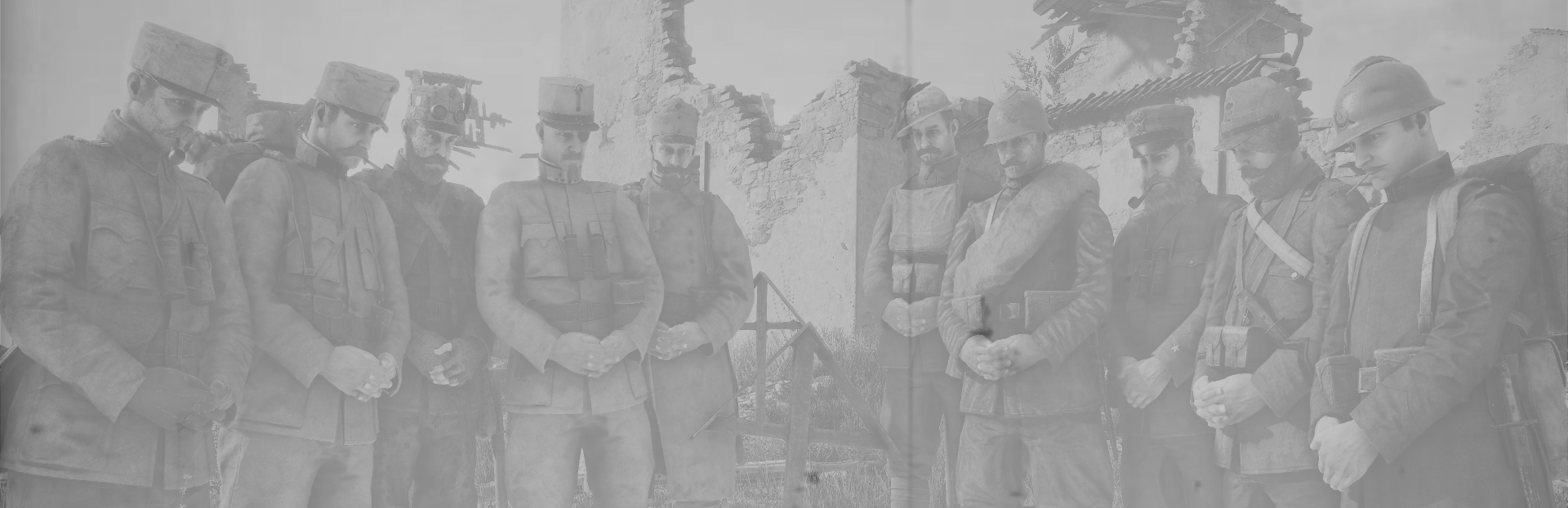
On this day in 1914, World War One had officially begun. What many initially thought as a 'short' conflict, turned into an international battlefield for 4 years and changed the world forever. To commemorate this, we've enabled the Film Memoir mode for you all to experience for free, even if you don't own the Digital Goods. This provides a new experience in the game, so be sure to check it out! You can use this feature for free until August 4th. You can enable the feature by going to Options > Graphics.
You can share your screenshots and video clips with us in our Discord or on our social media when using the filter!
Other ways to remember
Additionally, we’ve arranged a list of activities you could do remember this important day in history.
Visit a memorial monument Depending on where you live, there might be a WW1 memorial monument nearby. See if you could visit and pay your respects.
Visit a museum with a WW1 exposition Again, this is depending on where you live, but potentially worth going there. Visit a museum with a WW1 exposition brings you a little closer to the events that took place. There might be even a special tour regarding this important day in history.
Read a book regarding the Great War Books can be important means of media to remember history, but they can also be used for entertainment purposes. Fiction or non-fiction, there are many books regarding the subject of WW1. Here are a few you could read on this day. - A Mad Catastrophe: The Outbreak of World War I and the Collapse of the Habsburg Empire by Geoffrey Wawro. Delving into the “dark heart” of Vienna, Wawro shows how it goaded Serbia and Russia into war, before tracing the wavering fortunes of the Royal and Imperial Army as it faced off against two strong opponents and, ultimately, nearly collapsed after just three months of fighting. - The White War: Life and Death on the Italian Front, 1915-1919 by Mark Thompson. Featuring many well-known characters of the Italian front such as General Luigi Cadorna, Ernest Hemingway and Gabriele D’Annunzio, it shows us what happened when Italy joined the First World War and fought so hard for a victory that was, in the end, a “mutilated” one that would poison her body politic for generations. - Death of a Hero by Richard Aldington. Semi based on the author’s own experience during World War One, the story follows George Winterbourne, who enlists in the British Expeditionary Army during the Great War and gets sent to France. After a rash of casualties leads to his promotion through the ranks, he grows increasingly cynical about the war and disillusioned by the hypocrisies of British society.
Watch a movie/series centering WW1 You might not have much free time to read a book or visit a place. Movies/series are also a great media to remember what happened and experience stories of what (could’ve) happened. Here are a few recommendations: - All Quiet on the Western Front (1930/1979/2022). All based on the novel with the same title by Erich Maria Remarque, it’s for many a must-watch if you’re interested in history and World War One. You might’ve only seen one movie adaptation. Now is a good time to give others a chance too!
- 1917 (2019), directed by Sam Mendes. You follow the story of Blake & Schofield. The date is April 6th, 1917 and an infantry battalion assembles to wage war deep in enemy territory. It’s up to them to deliver a message that will stop 1,600 men from walking straight into a deadly trap. - Apocalypse la 1ère Guerre mondiale (2014). Originally a French, mini documentary tv series, it is highly acclaimed as it doesn’t solely focuses on the the relatively known Flanders and France battles, but also the generally unknown Italian-Austrian, German-Polish-Russian, Japanese-German, Ottoman Empire- Allied and African German Colonies, and other unknown or forgotten fronts and battles. Later translated into English for international audiences as ‘World War 1: The Apocalypse’.
Play a World War One game Fully immerse yourself and experience World War One (to a certain extent of course)! Join the Western-, Eastern and/or Italian Front in our games. Hold a moment of silence before you start the battle with your fellow soldiers* in a match. And of course, can always play another WW1-inspired game in your library that you might have.
*this not referring to a moment of silence that’s triggered by the game, more a suggestion of what you can do as players yourself.
Anniversary Sale
Additionally to the free Film Memoir mode, you can find Verdun discounted with 75% off & Isonzo’s Veteran- & Reverse Units DLC on sale as well.