Now that the first testing phase is approaching, we thought it was a good time to give you all a look behind the scenes, providing insight into how a case in a Jury Trial can be constructed. We use the term 'can be made' because, as you will see, the Case Editor does not impose a specific structure; instead, it provides broad boundaries within which you can work.
While we won't delve into every detail of what the Case Creator has to offer today, our goal is to provide you with a comprehensive overview of its possibilities. This information will serve as a solid foundation for those interested in testing the game, offering insights into how the game functions behind the scenes. It's important to note that the Case Editor is still in development and won't be available in the upcoming testing phase. The Editor will undergo its testing phase separately, and as a result, it is currently in an unpolished state.
General Information
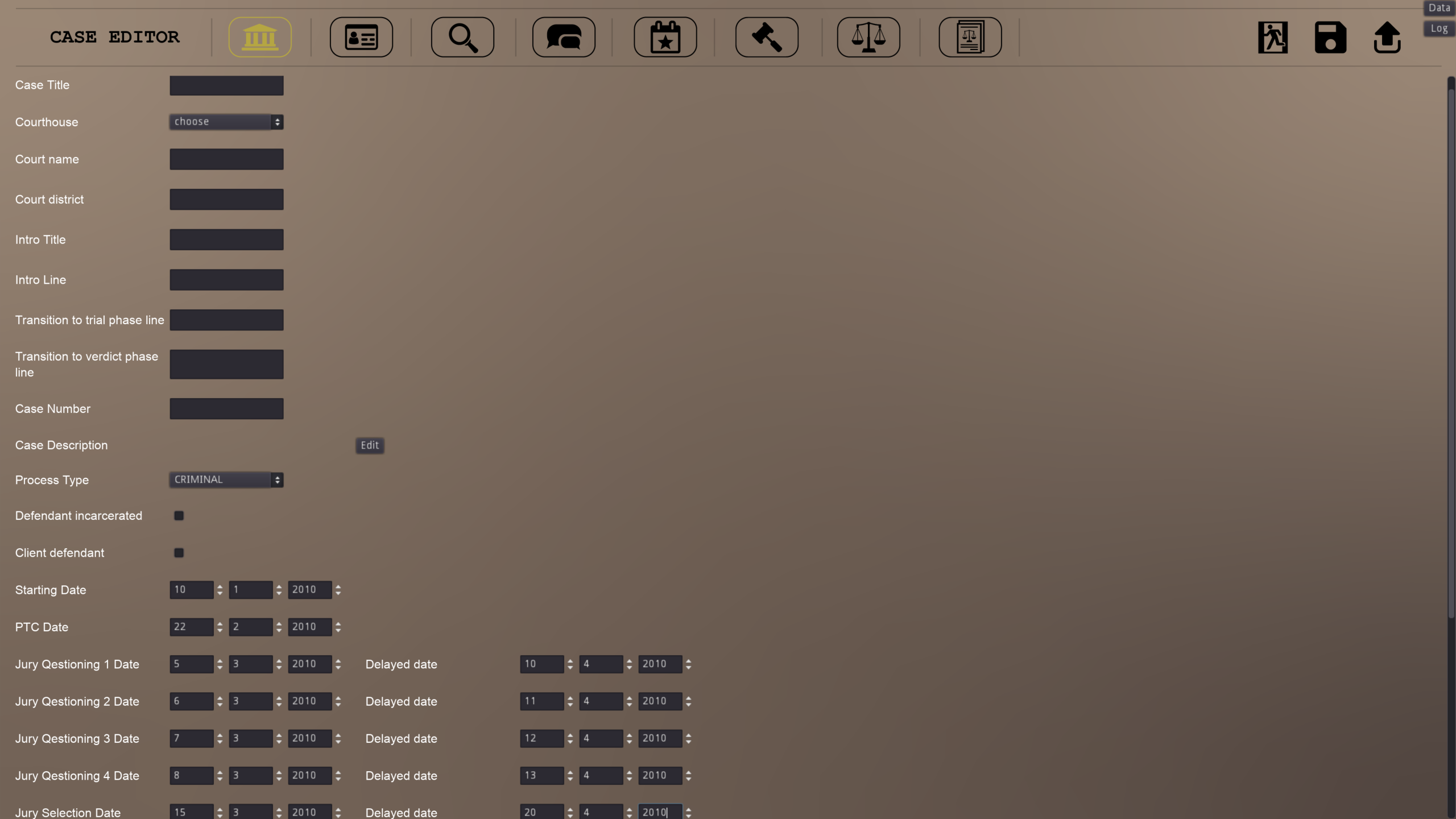
The first tab you'll encounter in the Case Editor, after assigning a working title to your project, is the general information tab. Here, you can input essential details such as the case name, pre-trial phase scheduling, trial type (civil / criminal), and among other factors, the situation of the player's client.
While not visible in the screenshot, you also have the option to set up fixed meetings for your player and craft custom messages that the player will receive throughout the trial. These messages can be scheduled for a specific date of your choosing or triggered by the player unlocking a particular piece of evidence. The purpose of these messages is entirely up to you. You can use them to guide the player, enhance your storytelling, or even conceal crucial evidence that the player can uncover by highlighting a text passage within your narrative.
Persons
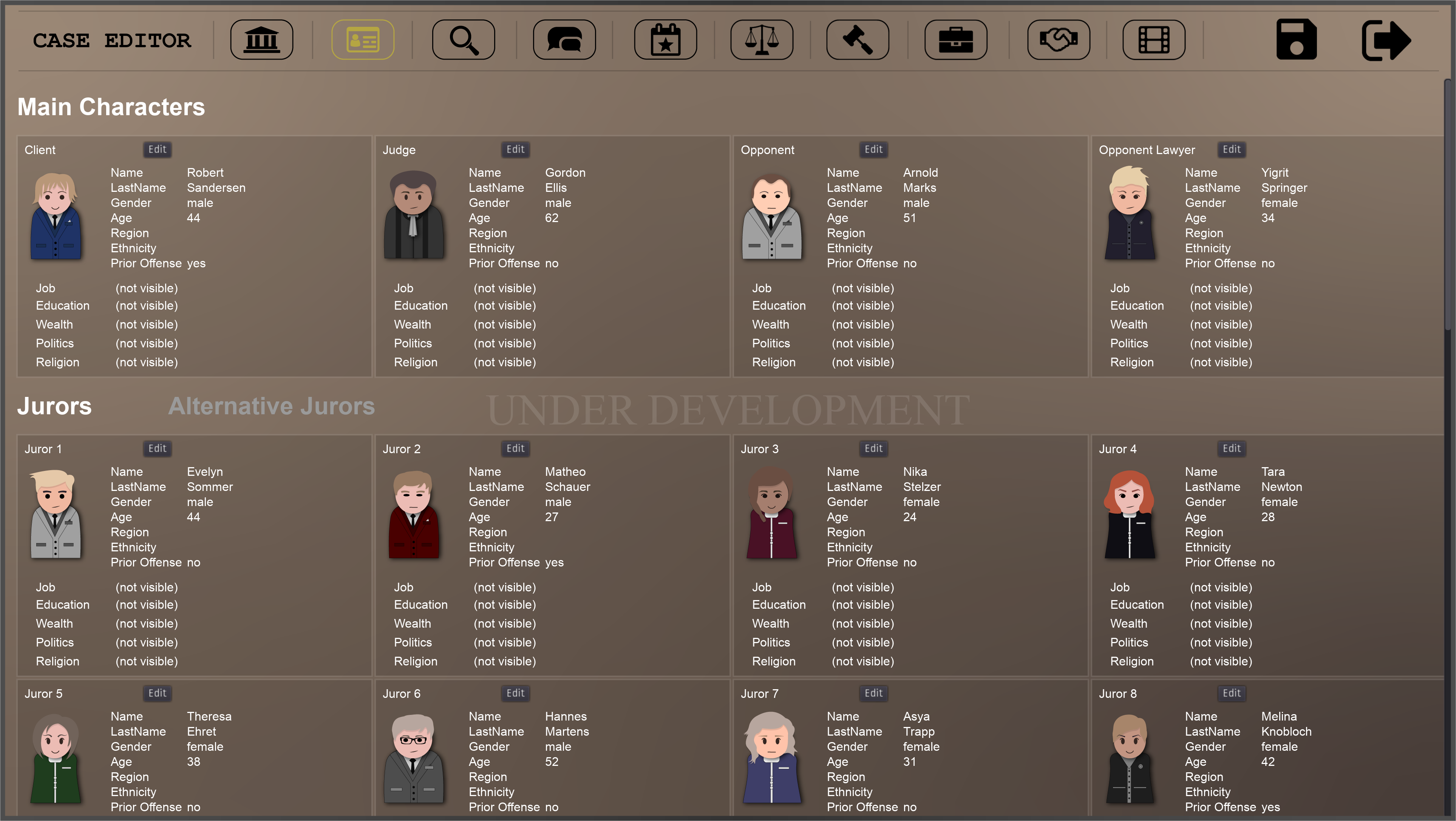
The next tab is the person tab, where you establish all the individuals involved in your case. This includes protagonists (plaintiff, defendant, judge, opponent counsel), the jury pool, witnesses, and experts. If you choose to incorporate options such as dismissing the judge or filing a change of venue motion in your case, you will be prompted to create an alternative judge and jury pool.
In addition to providing general information, appearance, and traits for each character, you also have the ability to establish a default meeting for every person you create. Each character can have a default meeting, allowing the player to interact with the NPC outside of the courtroom with a separate dialogue. These meetings offer a high degree of customization:
You can control the availability of meetings (lock & unlock) throughout the trial, specify a maximum number of possible meetings, and craft a custom denial message for the player when the NPC declines a meeting for the first time and more.
Evidence
Evidence brings your case to life, and the Case Editor allows you to decide what kind of evidence your case features. Evidence is divided into normal evidence and evidence material (e.g., a police report) where the player can highlight text passages to unlock further evidence. The evidence material system has undergone a recent rework, allowing for the addition of as many templates as needed. The evidence is used in various places within Jury Trial, with its most prominent role being in dialogue.
Dialog
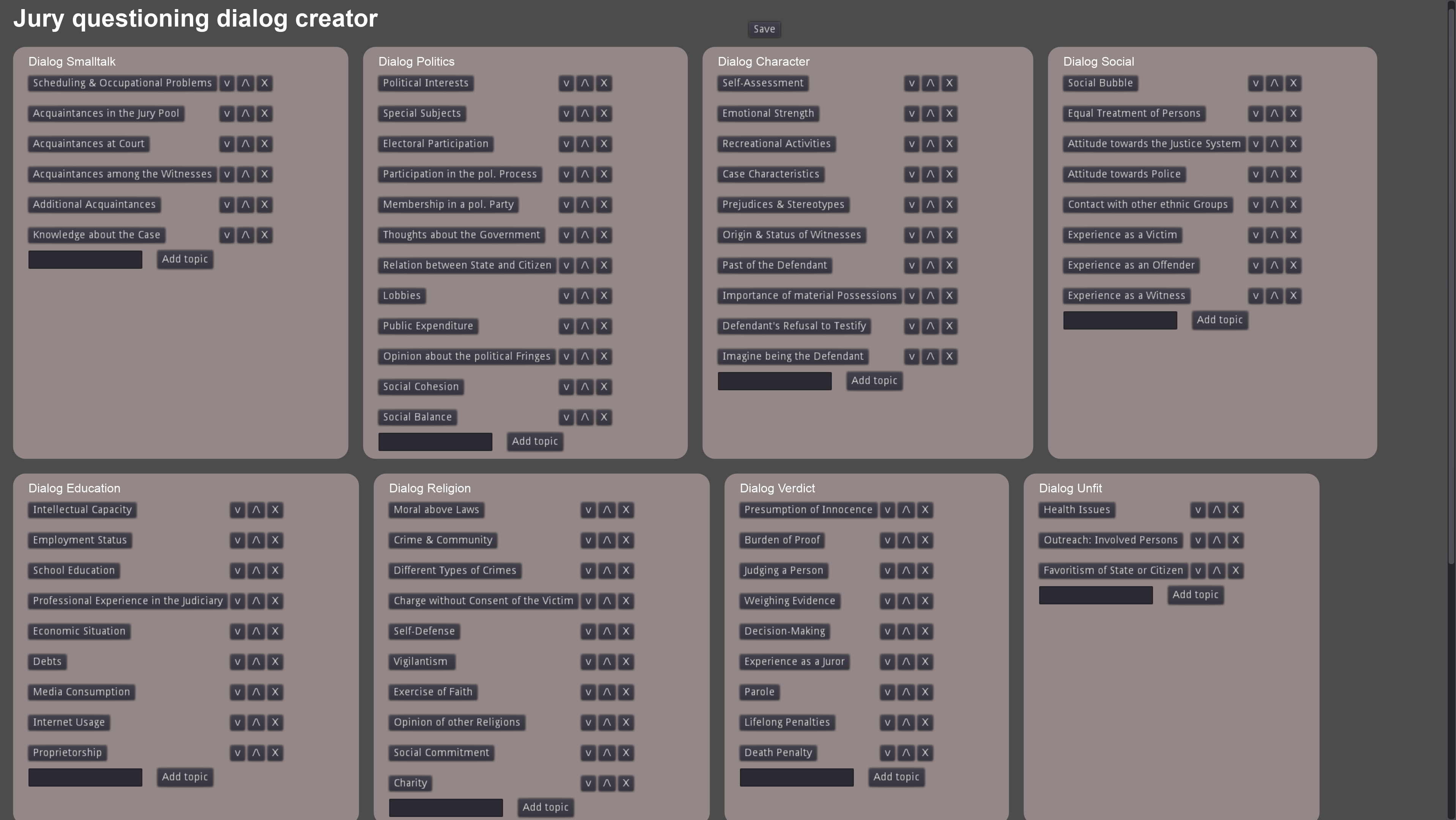
Whether it's meetings, the pre-trial conference, or the trial itself, the Case Editor offers extensive customization options for your dialogue, providing a wide array of choices. All the dialogue for your case is crafted by you, except for the Jury Questioning dialogue. If you would like to learn more about Jury Questioning, you can find the link to our latest update here.
As shown in the screenshot, questions and answers offer a variety of options, including GUI optimizations, visibility settings, and the ability to influence the jurors' opinions. Each question can have as many answers as you like, leading to as many subsequent questions as you desire. The extent to which you want to branch out in your case is entirely up to you.
If you're curious about the small number in front of each answer, that's the roll range. When an NPC provides an answer, the system rolls a one-hundred-sided die, determining which answer the NPC will give. If you wish to introduce randomness into your trial, this is the way to go.
Trial Days
Each trial day may come with its unique dialogue. For every day, you can create a custom intro (before and after the jurors enter the courtroom) and an outro. Alongside this storytelling mechanic, you have the option to craft dialogue between the judge, the NPC opponent and the player. In this optional dialogue, you could, for example, let the parties and the player argue about something that happened in your case and whether or not it should be brought to the attention of the jurors.
In addition to that, you determine the date for each trial day, including an alternate date in case the trial is delayed. You also decide which witnesses are heard, who starts the interrogation, and whether or not the player can influence the order of witnesses. Controlling whether or not the player's witnesses will be added to the next trial day with an available spot gives you another way to shape the narrative and provides more control over how a case may play out.
Events
To add excitement to your cases, it's possible for you to incorporate custom events. Each case is unique, and thus, a set of fixed events could never accommodate the multitude of possibilities. Consequently, you can manually craft your own events, infusing them with different outcomes and numerous options.
Events may occur on a fixed date or be triggered by developments in your case. In this context, randomness is also possible. As seen in the screenshot, similar to the dialogue, events and their outcomes are associated with two roll ranges: one determining if the event happens at all and another deciding which outcome will occur if you choose to include more than one possibility. Each outcome can be customized to unlock various elements or manipulate your case, the jury and more.
Counts and Laws
However, a trial hardly exists without its foundation: laws. Similar to events, a fixed set of laws would never suit the multitude of possible cases, ranging from recreating real cases to fictional or even quirky scenarios.
Therefore, it's up to you to determine why a defendant got indicted and on the basis of which law. Counts, for example, come in two forms. A count can either be an individual count or, as highlighted in blue in the screenshot, a group count. Counts grouped together will be decided by the jury based on their order. Once the jury reaches a guilty verdict for a group count, all subsequent counts will be ignored. For instance, if the jury reaches a three-quarter majority for the count of murder, there's no need to reach a decision for the count of manslaughter.
Laws are divided into two categories (pro-conviction / contra-conviction) and in a form of tactics. Especially when the player takes on the role of a defense attorney, they may prefer to base their defense on a tactic rather than focusing on a specific law to prove the innocence of their client. Therefore, the Case Editor allows you to create your own custom laws and tactics, including compulsory arguments, and add evidence that you've created as supporting arguments.
In summary, you can see that the Case Editor provides numerous options for how you want to structure and play out your case. There are multiple approaches, and we are genuinely excited to see what the community will come up with.
For the upcoming test phase, the case you will play is crafted with an approach that places the player’s decisions and ability to find evidence at the center. The dialogue options in the opening argument, for instance, depend on how much evidence the player gathered during the pre-trial phase. While there is overall little randomness within the dialogue, as we focused on the player choosing the right question, the Case Editor easily allows, as you know now, for any other approach.
More details on the upcoming test phase will be in our next post, which will come once we have taken care of the remaining tickets. In it, we will outline the entire process of the test phase and explain how you can apply to be a part of the early testing. Rest assured, even if you don’t get selected right away, the demo will be released for everyone to play once it has been properly tried and tested.
Thank you so much for your interest and ongoing support. If you would like more frequent updates or want to have a chat, here’s our discord.
Development Update - The Jury Questioning
Greetings Counselors,
It has been a while since our last update, and if you haven't joined our Discord server yet, you're probably wondering what we have been up to. I can assure you that we have been very busy. In addition to working on various tasks, our main focus has been creating the content for the Jury Questioning, which is the topic of today's post.
Before we delve into the specifics, let's recap what the Jury Questioning is all about. The Jury Questioning spans four days, during which you will meet up to five potential jurors each day. The goal is to find jurors who align with your client and increase your chances of achieving the desired verdict. You have the opportunity to question each juror once, gaining insight into their opinions, beliefs, and defining traits.
Each juror possesses a political affiliation (ranging from extreme left to extreme right), a level of education (none, poorly educated, educated, highly educated), wealth (ranging from destitute to wealthy), a religion, and six additional defining traits. In total, a juror can have up to 99 different traits.
The more similar a juror is to your client, the less likely they are to convict. Therefore, having enough "friendly" jurors on the bench significantly increases your chances of winning the case. However, what if there are no similar or sympathetic jurors available? Fear not, because you can also influence the jury's perception through witnesses. The more similarity between a juror and a witness, the more the juror will believe the witness's testimony. So, even if the Jury Pool lacks sympathy for your client, you can still turn the tide by selecting witnesses that resonate with the jurors.
When a juror enters the courtroom, the judge asks them to introduce themselves, sharing their name, age, and place of residence. In their introduction, it’s possible that the juror might drop a hint of one of their six special traits. After that, it's up to you to get to know your potential jurors and uncover their hidden traits. Overall, the Jury Questioning offers 293 questions across 66 topics for you to explore.
Jurors will answer questions either neutrally or based on their specific traits. The system ensures that their responses are evenly distributed among the jurors, giving you a fair chance to discover them all. However, be aware that jurors may become offended or dislike certain questions. In a Jury Trial, it's up to the juror to decide how long you can question them. If a juror is particularly unresponsive, it may be better to let them go, as a strike-out might leave a negative impression and could harm your case.
To avoid cluttering your desk with sticky notes containing potential and excluded traits, the game provides a handy interface where you can make notes for each juror. These notes will play a key role once the day of questioning concludes. After each day, you will have the opportunity to assess the five jurors you've met and select the ten traits you believe each juror carries. If you identify enough traits correctly, you will gain an overall opinion bonus applied to all jurors at the end of the Jury Selection process.
Writing trait-specific answers for 99 different traits has been both challenging and rewarding. It has been fascinating to explore questions from so many different angles. Just to give you an idea, it takes approximately 8 hours to come up with 500 answers, including research and spell-checking. Currently, the game includes 1,723 neutral and 23,214 trait-specific answers. We remain committed to adding more throughout the development process because the more answers and perspectives we include, the more interesting and challenging the Jury Questioning will become. We also plan to give the community the chance to propose new topics, questions, and answers once you've all had the opportunity to test the game.
So, that's the basic rundown of how the Jury Questioning works. Now, you might be wondering what's next for Jury Trial. The work never truly stops, and since we've invested a significant amount of time into the Jury Questioning, there are a few loose ends we still need to tie up. Once those tasks are completed, our focus will shift to creating a demo case for you to play and provide us with much-needed feedback. Rest assured that even if you don't make it into the closed testing phase, the demo case will be released on the store page for everyone to enjoy! We'll share more details about the entire process in a future post, so stay tuned for that.
As always, we're delighted to answer any questions you may have. Feel free to head over to the Community Section, leave a reply below, or chat with us on Discord.
Thank you so much for your ongoing support.
Development update & well wishes!
Greetings Counselors,
Today we would like to give you a quick update on what we have been up to since our last post but most of all wish you a happy new year, especially success, happiness and health in 2023!
Over the past year Jury Trial has grown so much that we’re nearly feature complete. Beside working on sound and Steam integration, we’ll now enter a phase of polishing and adding additional motions, event chains and other items to enrich the cases. Our workload will shift from mechanics and systems to content production.
As you might know, we’ve orientated the development process along the flow of the game. We’ve started with the prerequisites followed by the Pre-Trial and Trial Phase. At the end of our last post, we announced the beginning of the verdict phase which is about to be completed. If you missed the last updates or like to revisit them, here’s and here’s the link.
Just like last time, we can’t explain every mechanic and system in detail without going beyond the scope of this post. We’ll do that in due time but if you have questions, feel free to leave a reply on this post, use the Steam boards or have a chat with us over on discord. So without further ado, here are the highlights of what has been added to the game and is fully utilizable in the Case Editor:
dismiss the judge from the case and create an alternative
create fully customizable opening and closing statements for the player and NPC opponent
the date for the closing arguments is determined dynamically in case the trial is prolonged / delayed
added the “written argument” (before the Jury goes into deliberation the player hands in a written argument. In this document scene the player creates arguments by choosing a law / tactic and facts of the case. If the arguments line up with the solution of the case creator, the player gains some bonus points with the jurors)
create pro and contra conviction arguments and tactics including compulsory and supporting arguments. The arguments will be shown on the legal option tab to guide the player and give him possible routes for the case
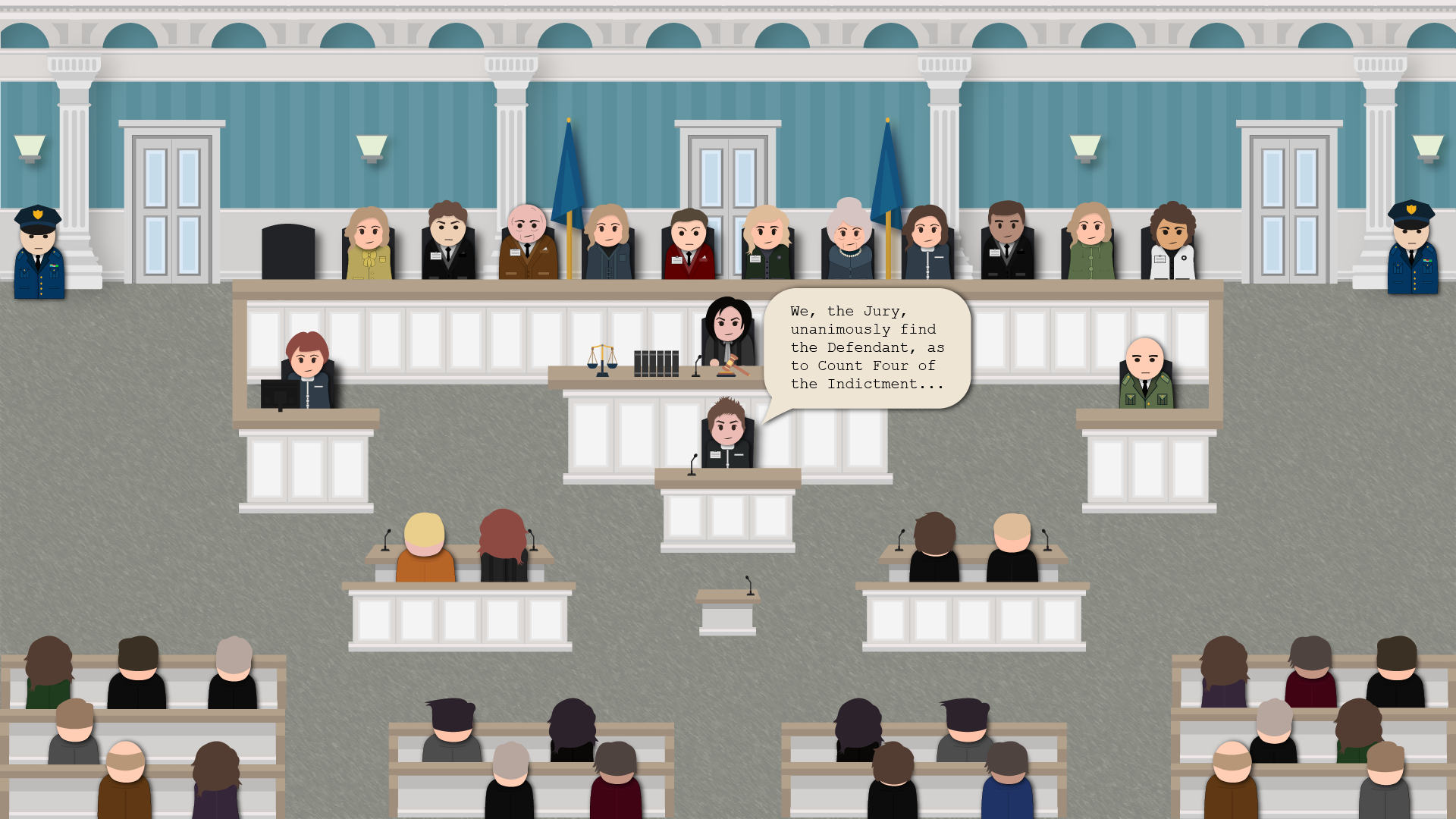
create fully customizable (multiple) indictments including the possibility to put them into a sequence (e.g. murder, voluntary manslaughter, involuntary manslaughter. The jurors will cast their vote according to the sequence until they reach a guilty verdict or until the defendant was declared not guilty on all counts)
determine the necessary guilty votes for each indictment (unanimous, three-quarter, majority and quorum (case creator decides how many guilty votes it takes to convict))
created a link between dialogue and indictments. It’s now possible to put points on answers that modify the jurors opinion for a certain indictment
created a link between events and indictments. It’s now possible to manipulate the opinions of the jurors through events (all jurors flat, specific groups (e.g. an age group / jurors of a specific political belief etc.) or a specific juror))
introduced a matching value between all protagonists (the matching value determines the opinion of a person to another person by matching all traits (e.g. rich vs poor, political left vs political right) and creates a value. This value is used in different ways e.g. the initial value for each indictment (matching value between defendant and each juror. The similar both persons are the lower is the chance of conviction))
introduced a credibility mechanic for witnesses and experts (matching value between witness vs each juror)
created seven different types of additional traits that manipulate the opinion of the jurors in three categories : chance to convict points, gained through dialogue & credibility
implemented the election of the foreperson. Both player and NPC opponent nominate a juror as foreperson. The other jurors cast their vote along the matching value
implemented the verdict roll (chance to convict = matching value juror vs defendant modified by traits, events and dialogue). In case of a tie (6-6 in a “majority indictment”) the vote of the foreperson decides the outcome
We hope that this overview gives you an idea of what Jury Trial is going to offer. We couldn’t put every change or last detail into the list. But as we’ve said before, if you have any questions do not hesitate to ask, we’re always glad to be of assistance.
Last but not least, we’d like to thank you for your support, questions and encouragement over the last year. It really helps us to tackle this tremendous project and we hope that you will continue to do so. Thank you.
Cheers to 2023!
State of the Game
Greetings Counselors,
Today we would like to give you a quick update on what we have been up to since our last post and what is up next on our agenda. But before we start, a quick reminder and a link to our discord server.
Not every aspect of game development is newsworthy and fits a Steam Announcement, so If you’re interested in more frequent updates or want to have a chat, feel free to click on the banner below to join the server.
As you might know we split the development in phases according to the flow of the game. We started with all the prerequisites like the core mechanics and the GUI. Once that was done we moved along the flow and started with the Pre-Trial Phase. If you missed our last update here’s a link. Up next was the Trial Phase and we’re happy to report that its development is coming to an end.
Just like last time, we can’t explain every mechanic and system in detail without going beyond the scope of this post. We’ll do that in due time but if you have questions, feel free to leave a reply on this post, use the Steam boards or have a chat with us over on discord. So without further ado, here’s an overview of what has been added to the game and is fully utilizable in the Case Editor:
schedule the trial dates and alternative dates if the case gets delayed
create custom intros and outros for each trial day
create optional conversations between the judge and both parties before the jury enters the courtroom (e.g. if a certain piece of evidence should be brought in front of the jury) for each trial day
determine when a witness is heard and which side starts the interrogation
manipulate the schedule through events created by the case creator (summon, uninvite, disappear and dismiss from case)
manipulate the schedule by the player by filing a motion (summon and dismiss from case)
put your client on the stand
If a trial day is fully booked a new one is created automatically. After the last trial day a grace period starts in which both parties are able to summon witnesses. This period restarts each time a new trial date is created. When both parties are satisfied the hearing of evidence ends
create dialog for the questioning of witnesses, experts, plaintiff and defendant for both parties
dismiss jurors from the case by filing a motion or through events. A substitute will be chosen either from the jury pool or if it’s depleted a new juror will be created
dismiss evidence through filing a motion
dismiss or let evidence disappear / reappear through events
fully customizable objections. the case creator determines the possibility, the reasons for the player to choose from, their chance modificator and if successful an alternative question for the npc opponent moving the dialogue into a different branch
additional courtrooms and scenes
We hope that his overview gives you an idea of what Jury Trial is going to offer. We couldn’t put every change or last detail into the list. But in case you asked yourself “What if the player simply objects to every question?” or “What if an NPC is summoned to court that has no visible dialogue because a certain piece of evidence wasn’t discovered yet?”. Don’t worry we got it covered:
For each unsuccessful objection the player gains a strike from the judge. The case creator determines a range how many the player may receive before he’s locked out of objecting for the rest of the day in court
“Empty” trial days won’t be a thing, because the system checks if there’s dialogue before an NPC is put in the schedule. If there isn’t, events will be skipped and the motion of the player will be denied by the judge
Finding answers to questions like this is also what we have been working on for the past weeks. We’re at a point where a lot of systems are fused together and we have to make sure that there are solutions and safety nets for all kinds of use cases. And since we’re pushing the versatility of the game pretty much to the limit, we had quite a few of them.
So what’s next for Jury Trial? We’ll be dealing with the last few remaining tickets of the trial phase. Most prominent on that list are the opening and closing arguments. Once that’s done we will transition to the verdict phase. There are no updates in terms of a possible release window yet. As you know, we’re a team of two who are creating this game as a passion project without a budget in our free time. So we have to tackle one subject after the other and once we’re sure about a release date, we’ll let you know right away.
Q1 has flown by and it has been an incredibly busy one. There is no precise release date as of now but a lot has been introduced into the game over the past weeks and today we’d like to give you a peek behind the scenes.
While explaining every mechanic & system in detail, which we will do in due time, would go beyond the scope of this post, today we would like to give you an overview of what is already implemented and also utilizable in the Case Editor:
name the case, court and court district and much more
write numerous descriptions for storytelling purposes
create a short introduction sequence for the case
choose between criminal or civil case
pick from multiple courtrooms
determine the date for the starting point, the pre-trial conference and the jury questioning including alternative dates if the trial gets delayed
create every involved npc from scratch: name, sprite, attributes, descriptions, visibility and much more
utilize the entire dialogue system (discoveries,objections, strikes, breakdowns, anchor points etc.)
create meeting scenes, both forced and optional for the player with the possibility to use unique dialog per meeting in different locations
create evidence and evidence materials (police reports, invoices, transcripts) which can be visible by default or unlocked via the dialogue system or by highlighting text passages in the folder or within materials
create press conferences and interviews in different scenes for both player and client using unique dialog (forced & optional)
create the Pre-Trial Conference where the player and the NPC opponent argue the most important trial motions (bail, delay trial, change venue, sequestering) in front of the judge including all dialogue (intro, arguments, decisions, outro)
create fully customizable events: probability, name, description, trigger, choices, different dependencies (defendant incarcerated, sequestering, delayed trial and more) including multiple outcomes with results per outcome (discovery and disappearance of persons, evidence and materials, changing the incarceration status and more)
question jurors in four rounds (20 jurors, 5 per day) and take notes in a UI about possible attributes
select the jury against the NPC opponent in court including challenges
The Case Editor combines every system and mechanic of Jury Trial in a convenient and easy way to create compelling stories. It’s always been our design philosophy to give you the same toolkit we use and let you decide which mechanics you want to use. The depth of the cases is entirely up to you as the creator.
Everything created in the editor is loadable into the game, which means that a fair amount of testing is already taking place while implementing more and more mechanics.
We know there’s a lot to unpack in this post. So don’t worry, as mentioned above, everything will be explained in detail in upcoming posts. But we’re always glad to answer any question you might have. Just head over to the Community Section, leave a reply below or have a chat with us over on Discord.
Thank you so much for your ongoing support,
Happy New Year from Loge Games!
Greetings Counselor,
We would like to wish you a happy new year! May the New Year bring you and your family happiness, peace, and most of all health!
While it sadly wasn’t feasible for us to release Jury Trial last year, we would like to thank you for your support and encouragement throughout 2021. As a team of only two, who try to realize a passion project in their free time without a budget, your interest, ideas and well wishes really helped us along the way.
Over the last year we put nearly every free minute we had into the game and we’re now at a point where we put all the systems, mechanics and features together into the Case Editor. The ingame Case Editor is the main tool for us and in the end for you as well, to create what it’s all about: Trials in the court of law in front of a (hopefully) sympathetic jury.
Once we’re done with the Editor we’ll be finally able to give you more information about the game and of course when you might have the chance to test and subsequently play the game. In the meantime we’re always glad to answer your questions here on Steam or have a chat over on Discord. Also, take a look at the Case Section of our community boards. Even with information being sparse, there are already people sharing their ideas for workshop content. Thank you so much for this!
Cheers to the New Year! May 2022 be an extraordinary one.