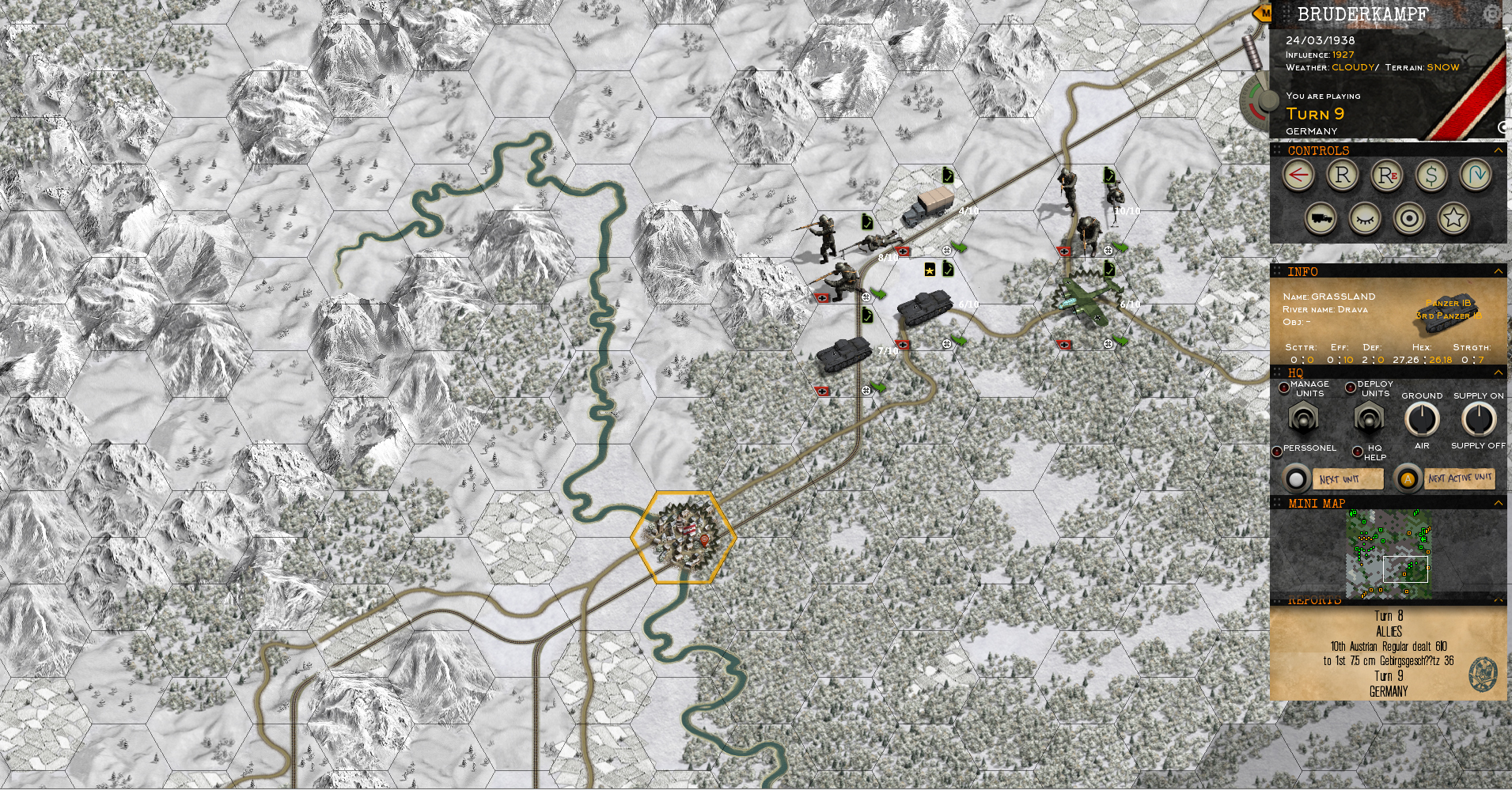
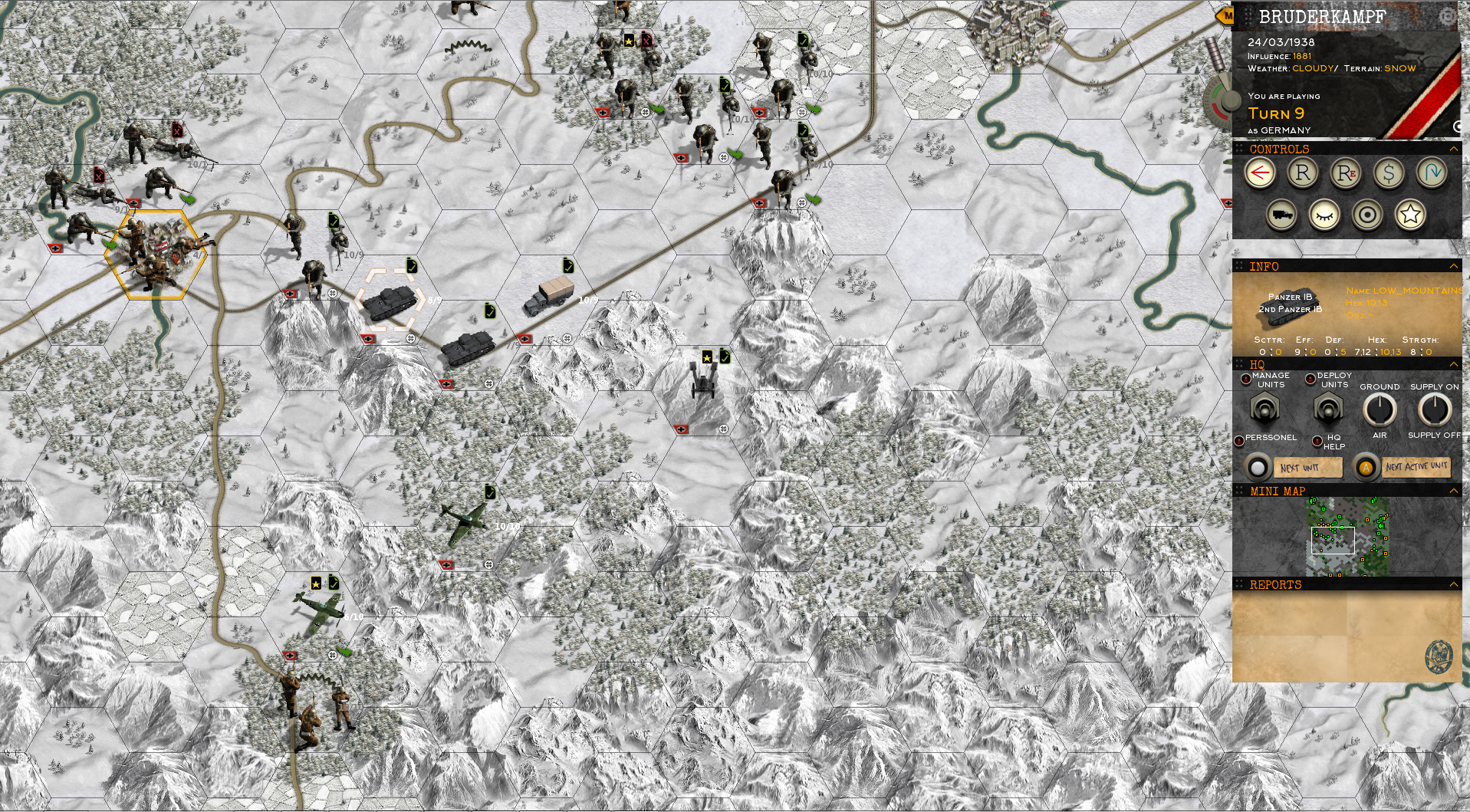
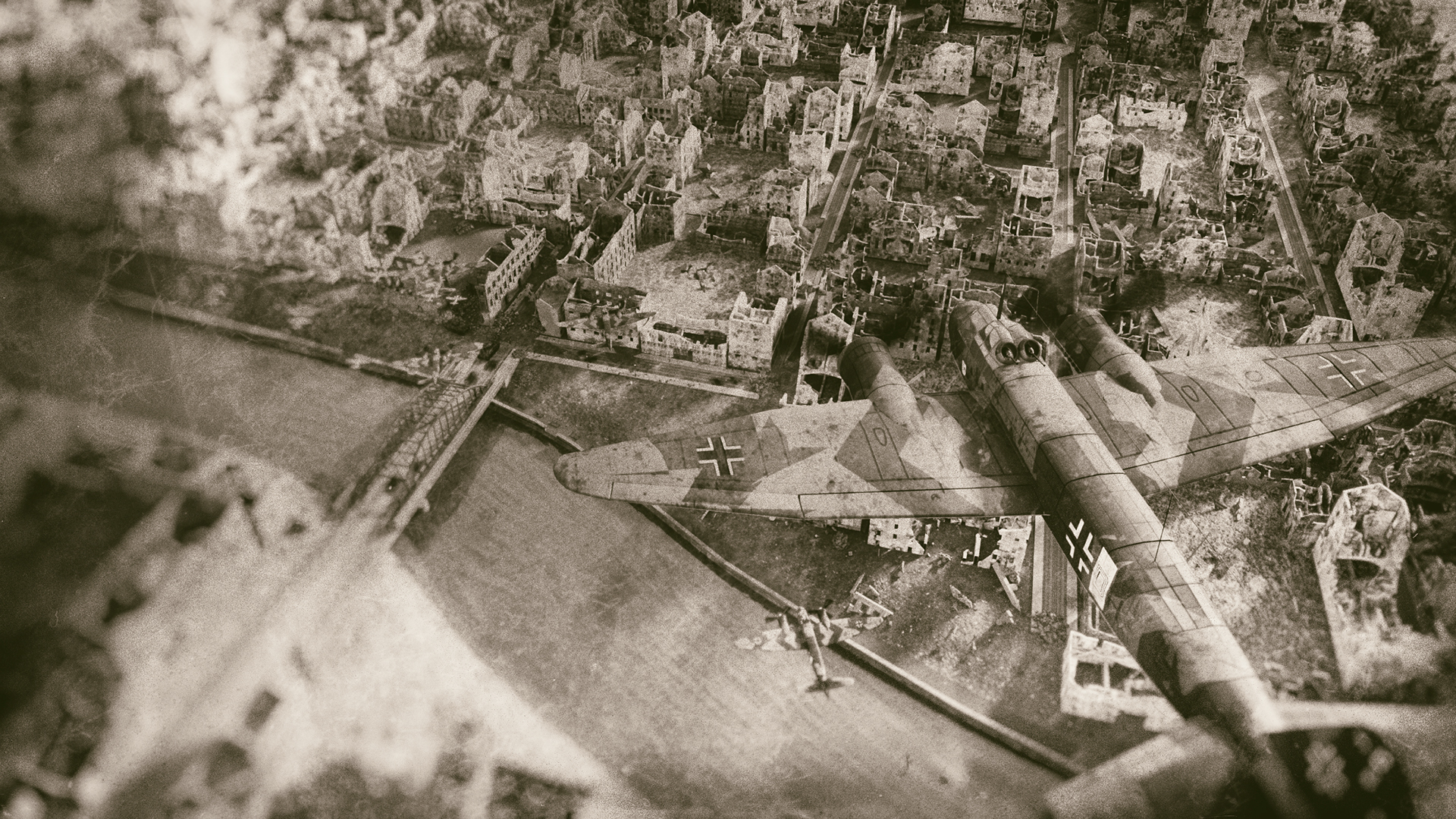
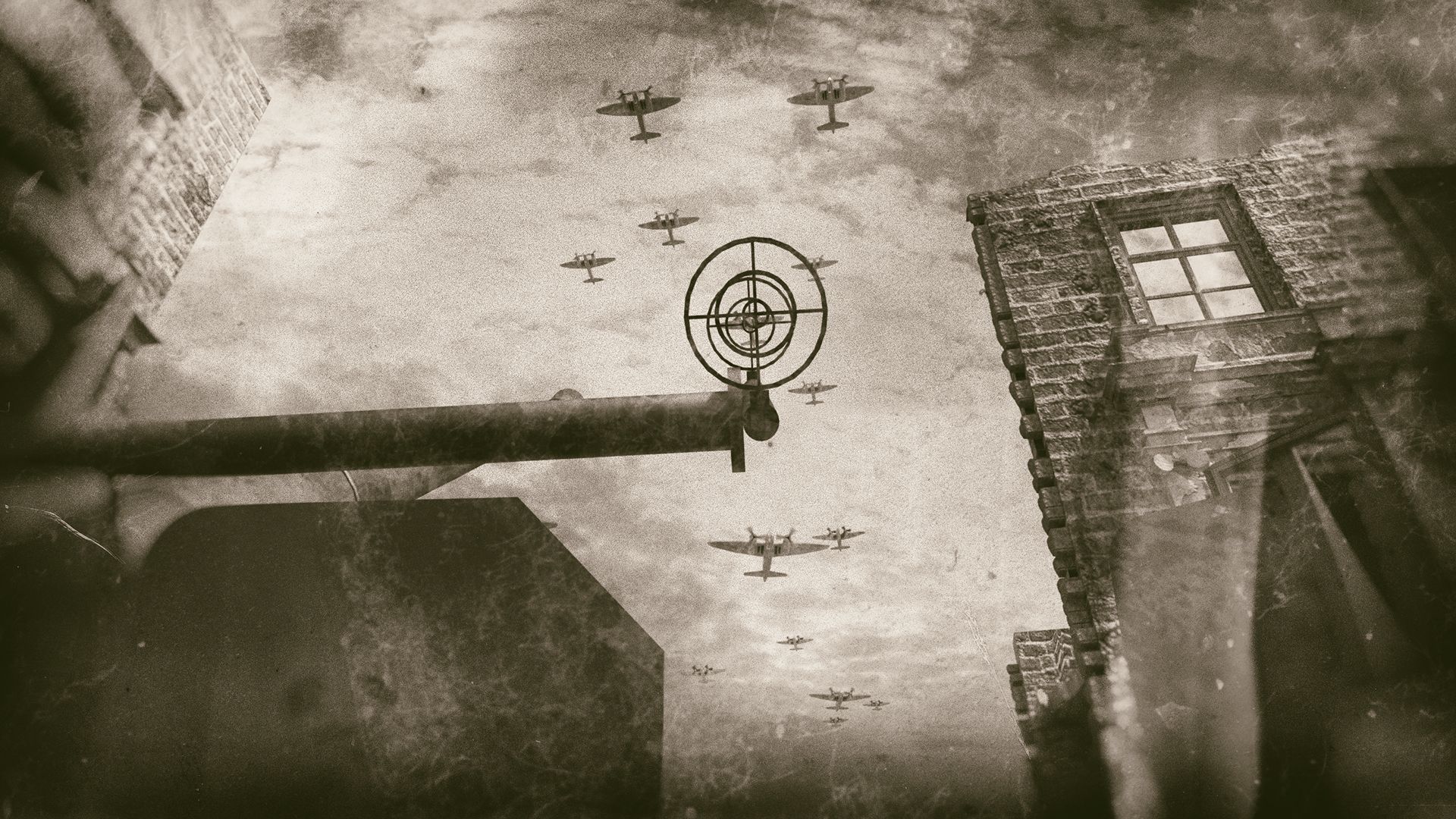
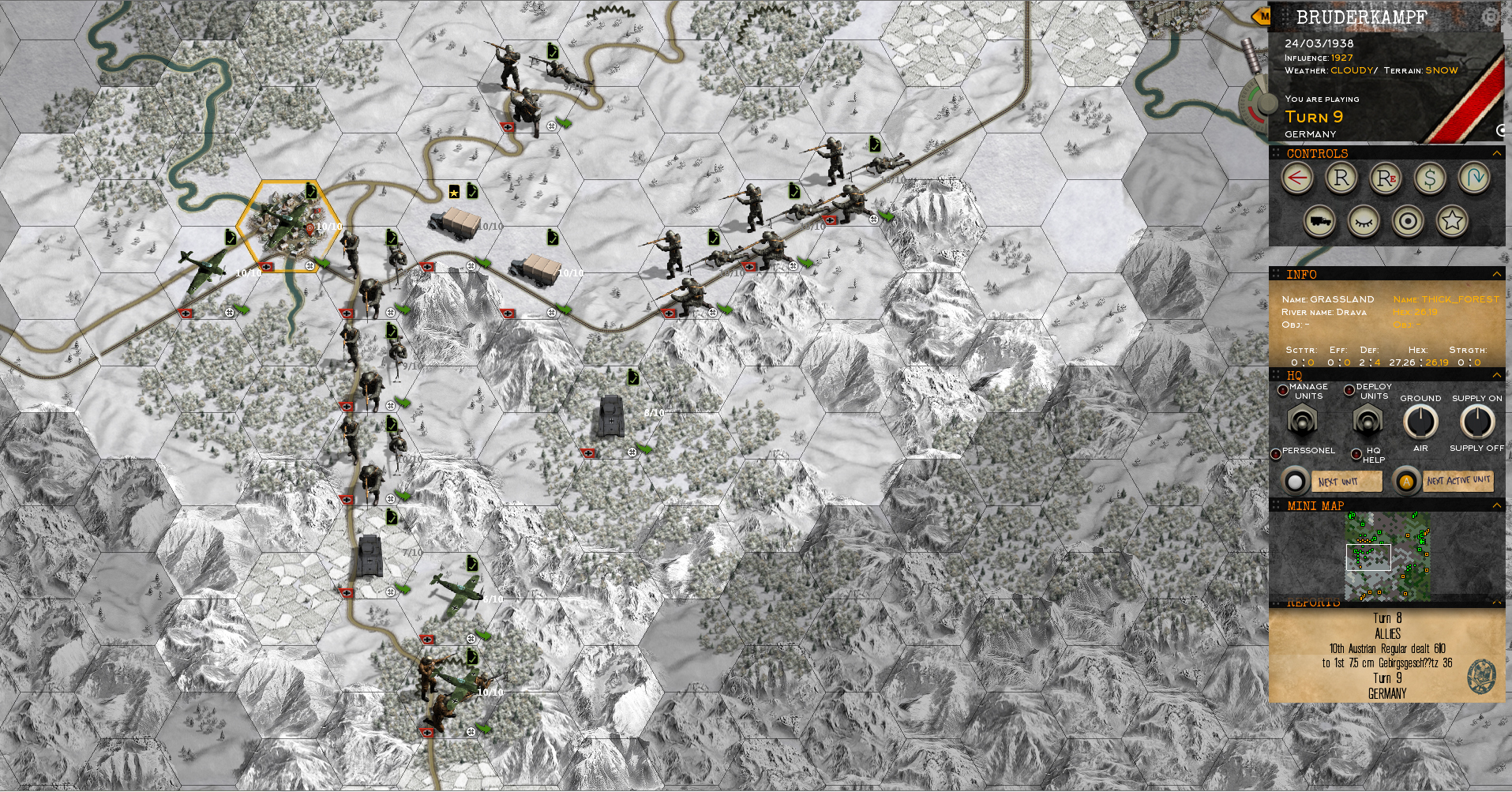
Please, enjoy the freezing wind and snowed mountain peaks while it is hot Summer outside! This is one of the screenshots for our Bruderkampf map. Here you can see more terrain and fewer units.
More Winter Terrain
History Blog #4
Welcome to the new chapter of our History Blog. The previous blog covered Joseph Stalin and the Soviet Union before the start of the WWII, as well as how costly it was for Ukraine and other countries to withstand the collectivization. In the new blog, we take a look at pre-war Britain and Winston Churchill.
Read the Blog at http://www.klotzenthegame.com/history-blog-4-winston-churchill-and-the-united-kingdom-before-ww2/
The latest interview with Zoran Stanic about Klotzen! Panzer Battles
Closing the series of interviews about Klotzen, for now, is the recent interview with KeenGamer. Read it to find out what drives a man to create a turn-based WW2 strategy in the age of microtransactions, MOBAs, and Battle Royales.
HISTORY BLOG 3. JOSEPH STALIN AND THE SOVIET UNION BEFORE WW2
Our next chapter in the History Blog series is out. While it may be a bit puzzling to see number 3 from the get-go, we are sure it is going to interest history lovers. Previous chapters are available on our website if you like the series.
Here's the link to the third blog - http://www.klotzenthegame.com/history-blog-3-joseph-stalin-and-the-soviet-union-before-ww2/
Interviews about Klotzen
This year has seen Zoran Stanic, the head of Maxim Games, giving interviews about Klottzen! Panzer Battles. Sadly, Not all of them have reached our Steam community. Starting today, we intend to change this.
Below is an interview Zoran did for Capsule Computers
It's in French, here is the Q&A in english. As you can see, it's a lot of text, so kudos to ZOG for translating.
1) The first question is usually not the hardest to answer: can you present yourselves and also present Klotzen?
Hi, my name is Zoran Stanic, head of Maxim Games. We are based in Zagreb but we all work remotely and mostly part-time so the team changes quickly. Klotzen is my brainchild, made out of despair 😊. Meaning I have played Panzer General so much I knew the unit layout most of the maps and I desperately wanted game with similar gameplay but with lots of different what-if scenarios and some gameplay changes. The idea was to make a fun and challenging game with lots of different strategy options to make each playthrough a fresh experience, so we have made a game with replayability in mind.
2) Since when is the game under development? Do you have other games as sources of inspiration?
I actually found an old project I made using C# and XNA in 2009 with tank icons, so the idea is quite old. But I only put the team together at the end of 2015. Klotzen is mostly a product of my thoughts on how to make Panzer General closer to how ww2 was actually fought, so PG has by far the greatest influence. Unity of command is another, with it’s state-of-the-art AI and fantastic capturing of the essence of the ww2 battles of maneuver.
3) What new features will you bring to the wargame genre? What are your ambitions and what could attract the strategy player into your game? Do you try to make some differentiation?
The idea behind Klotzen is to have approachable combat mechanics and merge it with some complex systems that could bring it close to the actual dynamics of ww2. When I started getting into how things worked in ww2 I was surprised how many important mechanics were left out from the existing wargames. So, idea for Klotzen was born from that. The whole idea about blitzkrieg was to achieve military goals through as little death as possible, to avoid repeating the meatgrinder battles of The Great War. So destroy enemy’s supply without destroying the enemy. In Klotzen we are introducing a complex supply system based on the railroad-supplied towns. Units taking action lose supply quickly, so in order to keep up the fight player must have the supply flowing. Cutting off the supply is possible either with land units anywhere on the supply railroad or with strategic bombing of supply towns and bombers usually cover most of the map. Which means it is almost impossible to defend everywhere. On the other hand, fighter have a much shorter range so attacking player must chose between attacking larger number of supplying towns with unescorted bombers or limit themselves to just a few targets but with protected bombers.
Another new mechanic is air interdiction – if enemy planes are above the ground units, moving the ground units will provoke an attack, and planes will get a huge attack bonus since units are caught in the open. So planes will not be very efficient against dug-in units, but they will paralyse enemy armies forcing them to leave the initiative to the side with the air supremacy.
In addition to this, it is also possible to bomb enemy airfields and achieve air superiority by surprise. This was used extensively in ww2 and is another mechanics I felt was missing from the genre.
All this combined should have the effect of bringing the overall flow of the battle much closer to what it really was, with air power adding new options to win the scenario.
On the campaign level, we have lots of events that will move the campaign in different directions – for example, there is a chance France will attack the Siegfried line while Germany is busy in Poland. I must admit I have increased the odds of this happening from almost 0 to some 30%, just because I think it makes for a very interesting historical scenario – strong but disorganized French army vs token garrison force defending the Siegfried line but backed by very experienced air crews.
In short, we will have a basic gameplay rules similar to the Panzer General, but with the much more dynamic experience created by a combination of both sides fighting to keep the supply lines open, unpredictable air attacks on towns, airfields and units, and the AI that will aggressively counterattack objectives in the rear.
Also, a lot of thought was put into increasing replayability, and I think players will appreciate it. Scenarios start with different starting conditions so replay value should be high. There are lots of minor differences that will make for a different wargaming experience – for example unit commanders and generals, each with unique skill sets, and other unique mechanics to explore and use. We will be making a series of gameplay videos explaining various systems so if you’re interested please visit our website and subscribe to the newsletter.
4) You attach a lot of importance to the alternate history. How did you create the scenarios? What kind of sources did you use to create them? Why is it so fun to play with History?
I think the alternative history is why we like playing these games. When learning about these battles, in lots of cases one would wonder what would have happened if history had gone in another direction.
For example, the craziest story I have ever encountered was that dive bomber squadron at Midway.
Where they were low on fuel, and ran into a lone destroyer. Squadron commander simply assumed it was sailing to meet the carriers, so instead of returning home they flew in that direction, ran into Japanese carriers and with seven bombs sank three fleet carriers.
So how would the war in the Pacific turn out if Japan had those carriers and pilots for a few more years? Not to mention that the remaining carrier launched one attack which sank a US carrier. What would have happened to US carriers if there were four carriers launching the attack? And almost each battle has a few stories like that.
I thought I had a pretty good picture of ww2 until I started digging. I was surprised how many things I got wrong, and important things I was not aware of. I think we all want tools to explore the alternative ways those operations could have played out, and this is probably why the genre is so popular.
I was mostly using forums and alt history reddit, but also some books, most importantly “If the Allies Had Fallen: Sixty Alternate Scenarios of World War II”. I was impressed by the amount of expertise and arguments people posting on those places show. I must say I was bending history in quite a few places by bending the odds in favour of a less likely scenario. This was to make for a more interesting campaign – for example Russians losing Khalkhin Gol, which leads to Stalin not attacking Poland, consequently Barbarossa starting within the striking distance of Moscow. Other interesting scenarios are Sealion and French attack on Siegfried line to name a few.
5) Will it be a French faction and French units? Is a scenario presenting a France holding the ground against Germany?
The campaign plays from German perspective, simply because you can’t have a campaign as a defender – the goal is to win, and stopping Germany in 1940. would simply end the war. You can play as French and attempt to hold ground in standalone scenarios, where you just play one battle. We have a total of six scenarios where a major defender/attacker is France: Two standard/OTL ones (Ardennes and France) and four counterfactual – The Siegfried line attack, Low countries (where Germany attacks through Belgium and not Ardennes), the Fall of France (in which France doesn’t surrender, German player must reach the Azure coast and France continues fighting from Morocco) and Felix (German attack on Gibraltar and Morocco). The Siegfried line attack should have been a 4 scenario mini campaign but then total scenario count was above 100 so it got axed, which is a shame.
As for the units, we have 31 French unit types – 4 air unit types, 6 sea and 21 land units types. Some of the units can be seen on the accompanying screenshot.
6) What are the scenarios you like and enjoy the most in the list of battles you created?
They are all counterfactual ones. I actually like the whole campaign branches the most, with a string of connected battles. For example going through Belgium, then fighting through the whole France to Azure coast, then choosing to delay Barbarossa and fight in Spain and Morocco, maybe taking Switzerland in between, then attacking Egypt and Palestina and joining the attack on Russia from the south of Caucasus. They are not tested yet so it’s hard to be sure, but I think Felix will be fun, with the assault on Gibraltar, fighting naval battle off Portugal, defending the flank against UK landings in northern Spain and then doing an amphibious attack on Morocco. There are others but with over 60 scenarios I’m afraid I don’t get carried away 😊.
7) Klotzen Panzer Battle will also have air and naval units. Will they have a major role or will they be only a kind of reinforcement in order to support the landing units?
We have spent a lot of time thinking and redesigning the air power in order to make it work as it was in ww2. I believe Klotzen has the best depiction of air power in the genre. The land units are still the most important, but properly using air power will be much more important in Klotzen. Suffice to say that with a few bombers and if left uncontested, you will be able to paralyse all of the enemy armies in a scenario. And patrolling planes will block any movement for the side with air inferiority. The war in Europe was mostly land war and the navy has much less influence then it had in the Pacific. So ships will be support units in most of the scenarios, apart from the few invasion ones, like Norway, Sealion or Crete.
8) Do you have a message for the French community and for French players which could possibly be interested by the fact of playing your game?
Most importantly, if you’re working in a factory six months from being attacked, streamline the production! It might help win the war and save quite a bit of time to some guys making a game about it 70 years later 😊. Meaning they would not need to model Hotchkiss H35, and H39, Renault FT and R35, Somua 35, Char B1 and D1. Although, it would probably not have made a difference, with 40 million French working 40 hours per week and 60 million Germans working 60 hour weeks…
Another thing is, although lots have been said about the disaster of French and UK armies in 1940. I have read a lot about it, and although most of the reasons are well known, I have a feeling one major factor gets overlooked: Unit experience. From what I have read, there is an enormous difference between an inexperienced solider and the one that has been shot at even once. Most of people freeze the first time, and can function much better the second time. Top Japanese fighter pilot Saburo Sakai described this in his autobiography, and many others. And Germany had their trail by fire in Poland, where they made up for experience by a sheer material superiority. Guderian mentions how funny German inexperienced troops behaved in first firefights. So I think this is a major contributing factor to what happened, and it was especially pronounced in air since quite a few of German pilots were veterans of Spanish Civil War, Poland and Norway. We are trying to model this in the game, with German troops starting the campaign with considerably more experience.
Also there is a fun trivia I learned only after I started researching ww2 in more detail, which I am sure lots of your readers are aware of but I was not: The Maginot line was the only part of the French army that did what it was meant to in 1940 (forcing Germany to bypass it and come through Belgium and buying time for the army to mobilize and wait for them in the narrow corridor). This came as a surprise to me as for a long time I believed the old established view that the Maginot line was made in order to win the war for the France.
If you are interested in Panzer General and similar games, and/or love ww2, I am looking forward to meeting you in our Steam community and discussing both the game and ww2 in general. Also, we will be looking for beta testers so please join our mailing list on our website to keep up to date with the game progress.
Thank you for your interest!
Wargamer.com interview
Joe Robinson asked some great questions and it was a real pleasure discussing both the game and ww2 in this Questions and Answers session.
http://www.wargamer.com/articles/interview-klotzen-panzer-battles-wargame/