Practice makes perfect, iterations move the project forward. It is extremely difficult to create a solid and stable game mechanic from the first attempt. Especially the combat system for a game with stealth focus. One experiments and polished the mechanic until players love it and bugs do not ruin the experience. Stages of polishing and adjusting are called iterations.
You start with quick creation of prototypes and testing them to understand in which direction to proceed. In early prototypes visual elements are often not added (unless they have a critical impact on the gameplay). At this stage you can test any concepts and ideas. Prototypes can be of any form and format. Sometimes a paper prototype is sufficient, sometimes real-world elements are used (recall that all the levels in the first Metal Gear Solid were originally built from LEGO), and sometimes the prototype is built in the engine. This article will focus on just what iterations of the combat system we considered during development and for what reasons we abandoned them over and over again.
General principles
At the initial stages, we formed three most important principles for the future combat system:
1. The player must be able to survive the combat encounter 2. The combat system should push the player into stealth 3. An open fight should be a tough experience
With these three principles in mind, we started working on the first iterations.
Iterations of combat system development
1. Punishing combat system
Our very first combat concept was the simplest and cheapest systems from the production point of view: discovery of the main character equals death and restart of the level. We immediately abandoned it because ,firstly, contradicts one of our principles, and secondly, creates a certain narrative problem. The fact is that the main character in our game is a military man, he is a strong person who knows how to protect himself. A situation in which he surrenders at the slightest threat would look ridiculous.
We moved to the second concept. In this case it was the so-called "punishing" combat system. We assumed that direct collision of the player with other enemies should lead to his death. This does not mean that the player dies as soon as they are discovered by the enemy. The main idea was that upon detection, the enemies tried to get to the character and if they succeeded, they would definitely kill him. In this case, the player has the opportunity to inflict damage to the enemies at a distance and then disappear from view. A Plague Tale: Innocence can be considered a direct analogue of this system.
This system, although it met our basic principles, was also labeled as unacceptable. We wanted to give the player the option to be aggressive if they felt confident enough, but this approach made direct confrontation ineffective for the player. We felt that we were cutting off some of the gameplay possibilities. Apart from this, the narrative question did not disappear anywhere. Yes, the character did not give up immediately, but in fact he could not offer any resistance even to a single target, which looked strange, given his military background.
This prototype did not go beyond the paper presentation, but it helped us to formulate a number of rules that we used in the future. At this point we wrapped up the first iteration.
2. The bots take up a perimeter around the character
The idea behind this prototype was quite simple. We wanted to push the player into stealth. In order to implement this, we had to show the player that open combat is not quite the right strategy if there are too many enemies or the player does not feel the game well enough. And how can you show the player that he is doing something wrong? Somehow to punish him and take away health. This is how the idea of a close combat system was born: enemies surrounded the player, outnumbered him and inflicted damage. At the same time, the concept took into account that it is possible to escape and hide from enemies.
This system worked in the following way:
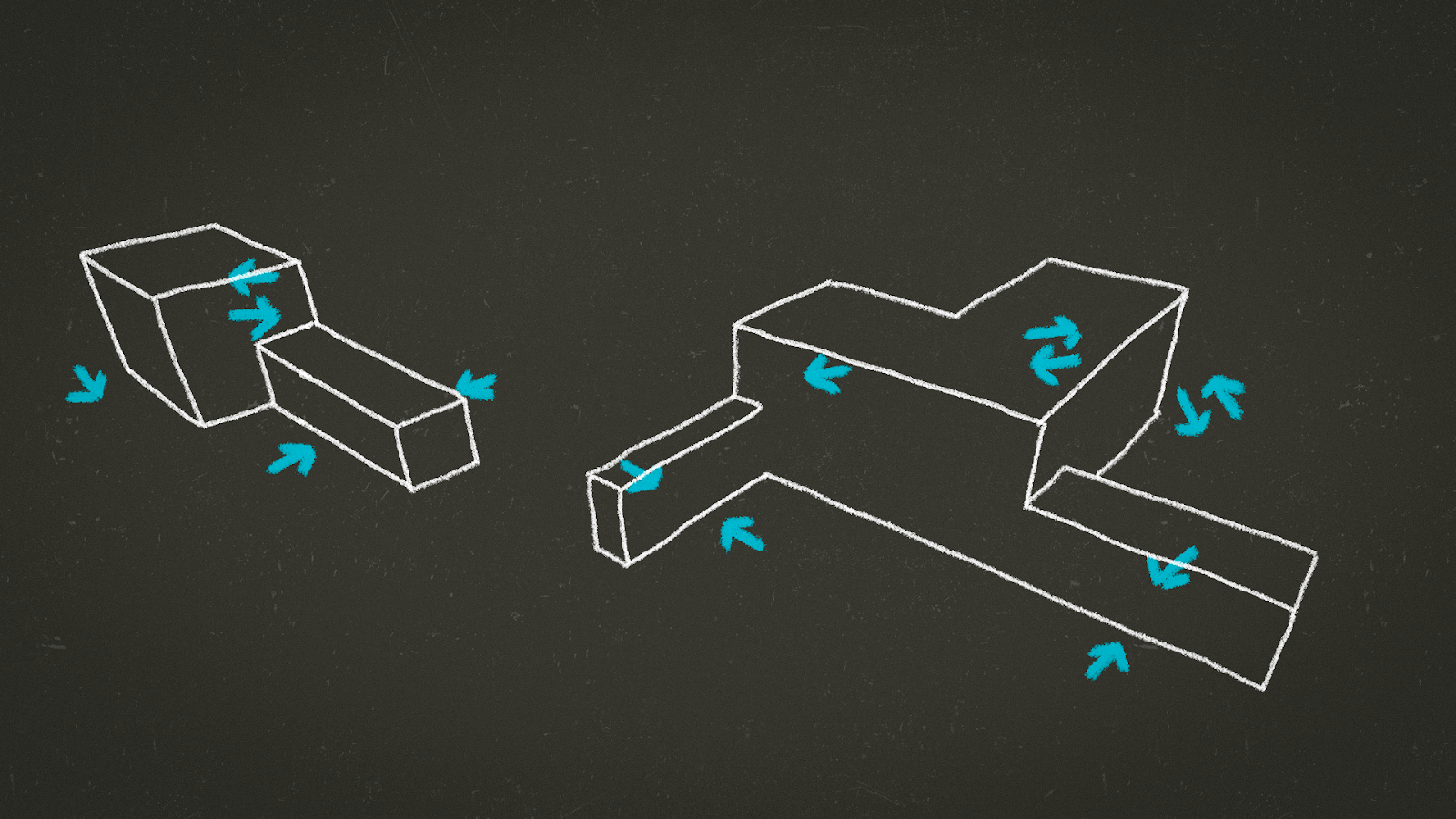
There are several positions around the main character. At the beginning of the battle, the enemies choose one of the free points, depending on their position. The position selection algorithm works in this way: if one position is already selected by some bot, then the other one will select the opposite position. Thus they surround the player.
After enemies have taken their positions, one of them can make an attack. The rest cannot engage the character at this moment, otherwise the player would not be able to dodge several attacks at once. After the attack is finished, the enemy again selects a position according to the algorithm already described.
However, this system also had one important flaw. We solved the narrative question and met all three principles, but the problem lay at a much more fundamental level.
If you try to remember games with a similar combat system, you will quickly realise that they are extremely rarely stealth or, even if they are, significantly different from the classic stealth representatives. The reason is that such a combat system assumes a fairly wide area for combat. Games such as Batman: Arkham Knight or Sleeping Dogs, having a similar combat system, offer quite extensive and free combat locations along with it. In our game, stealth, on the contrary, involves a large number of covers and obstacles behind which the player could take cover so as not to attract the attention of enemies. It was this spatial conflict that prevented this prototype from moving forward, since we abandoned it in the first tests of the enemy movement system. This was the second iteration of the combat system.
3. Role-playing game system
After the previous iteration, we had to formulate a combat system in which the enemies would feel comfortable in stealth locations. At the same time, we still wanted to show the player the unpleasantness of open melee through the character damage, and for this reason, we stuck to the concept in which the enemies should behave aggressively and force the player into stealth.
So, we shaped the following system:
The basic principle is that there are 3 roles in combat and each bot can take one of these roles. At the same time, it is not necessary that during a combat encounter all 3 roles work simultaneously. The scenario when only 2 or even 1 role are/is used is quite possible.
Role features:
1. Attack - bot simply runs to the position of the main character to attack him with a melee attack. This role performs a reconnaissance function and pushes the player into stealth. He constantly tries to reveal the position of the hero and communicates it to the rest of the bots.
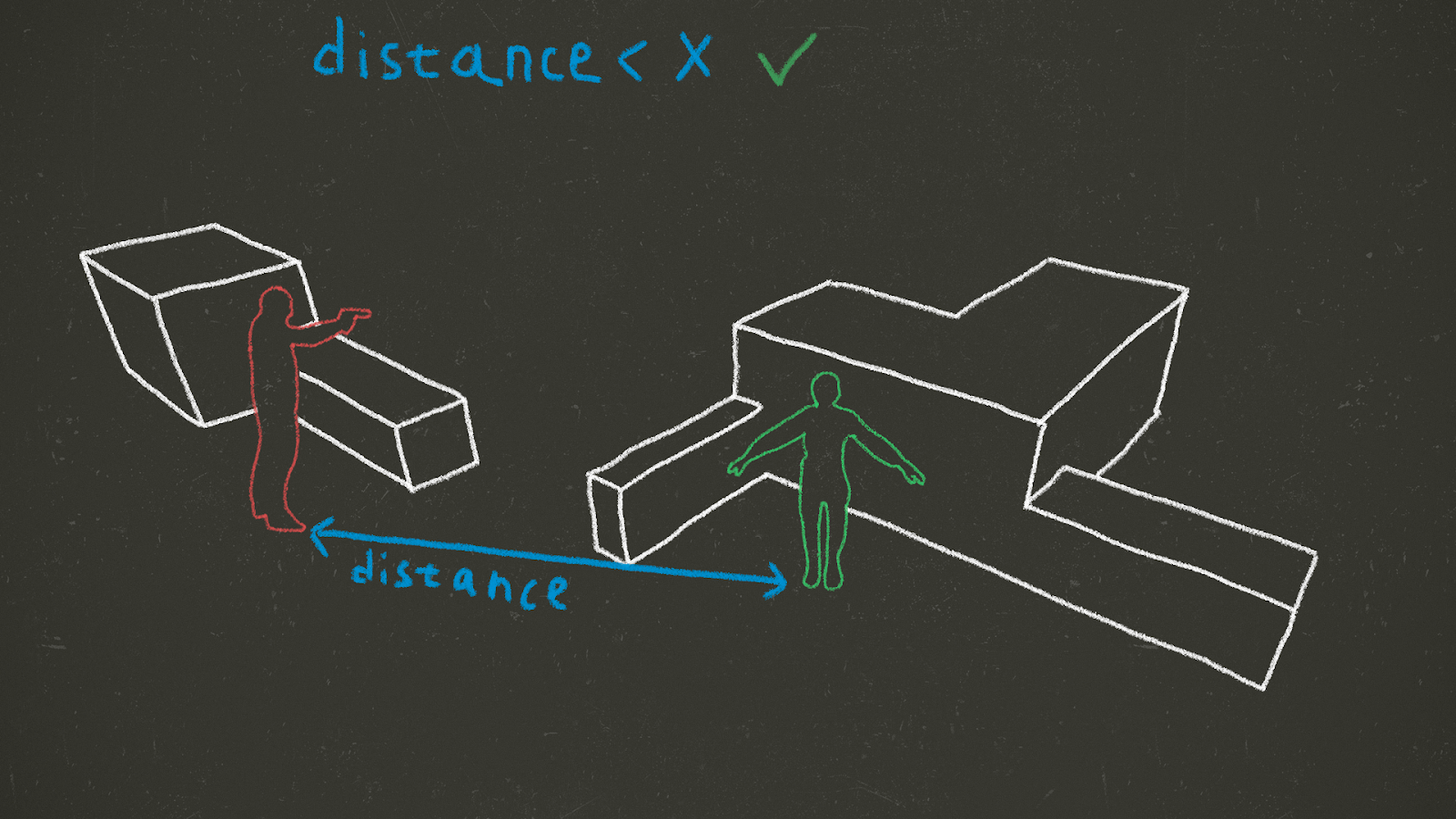
2. Control - does almost the same thing as the previous role, but the differences are that it will bring the distance closer to the value we define, and there will be direct visual contact.
In this case, the bot fires and the loop repeats until the hero is dead or hides.
3. Position - the most interesting and technically difficult role. There are a lot of points placed in advance on the arena, one of which can be occupied by a bot that has this role during the battle.
The point that the bot will take depends on several factors:
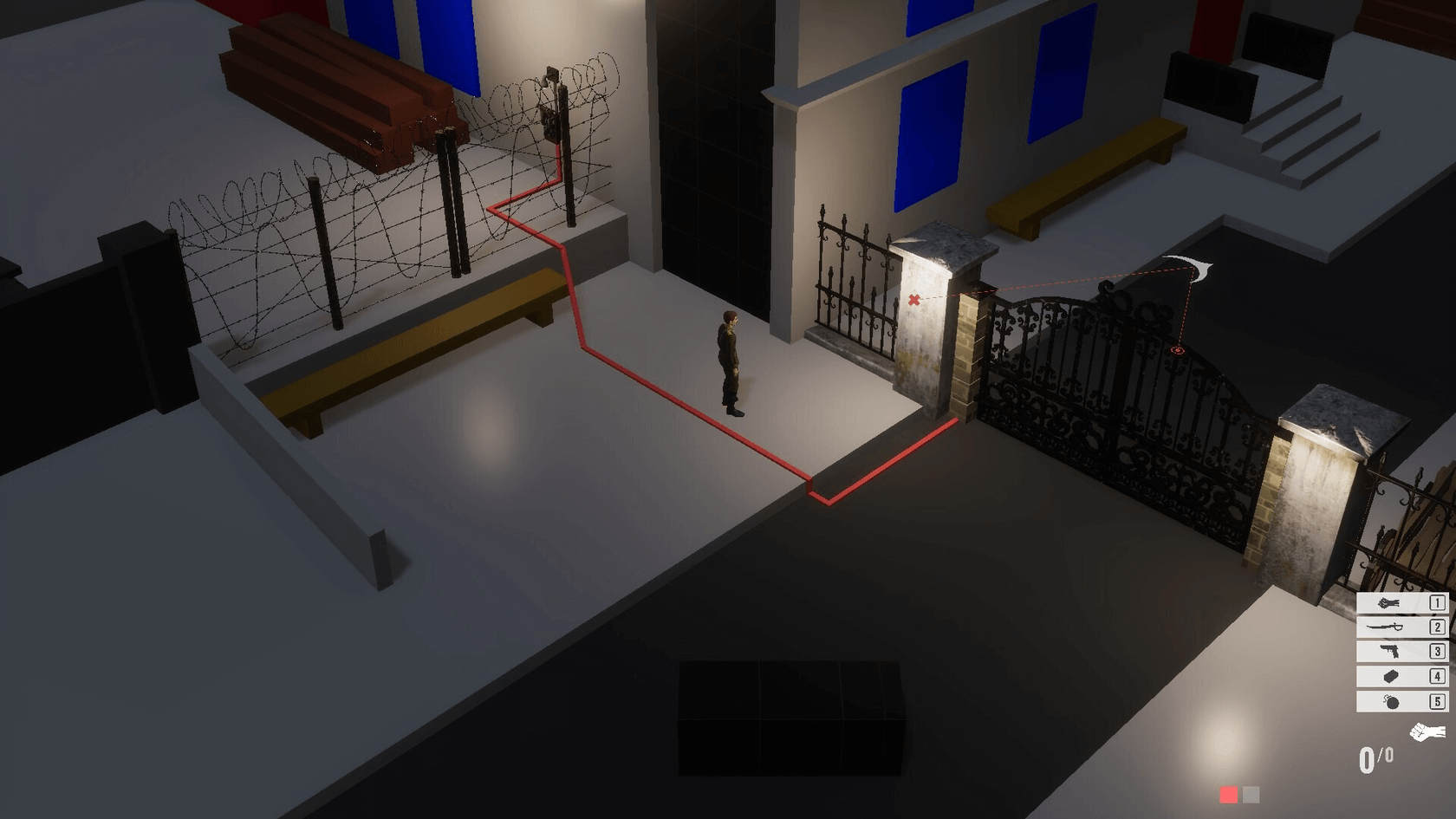
● The distance from the point to the character ● Distance from the point to the bot that wants to take it ● How far the point is turned towards the character
4. Distance - the distance from the point to the exit from the arena. Due to the fourth factor, bots can take position along the main character's path and block the path to the exit.
Each position gains a number of points in accordance with the factors. The enemy will choose the position that scores the most points. But the division by points happens all the time, and as soon as a new, more advantageous position appears, the bot switches to it.
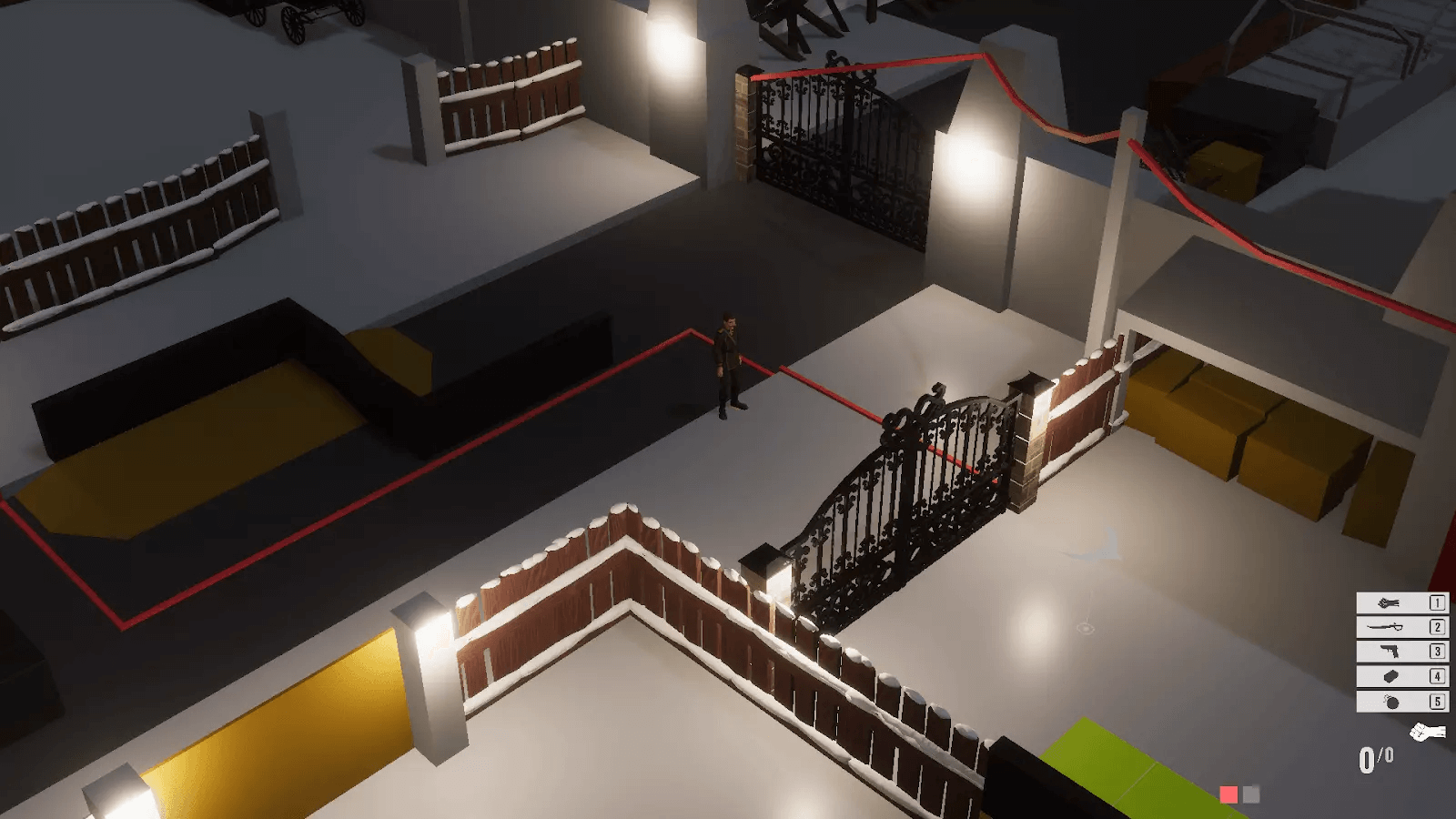
The system also assumes the priority of issuing roles.
Based on the screenshot above, we can conclude that first of all there should be a Control role and only then Position role, this means if only one bot is left alive, it will start to perform the Control role.
During the attack, bot can request the system to switch roles with another bot if its role does not suit it. This can happen when the main character runs close to the Position bot and then the game manager will decide to change roles.
This system had the most complete prototype and did a lot of the job it was supposed to do, but still had a number of problems: some bots were easy to lure out to make damage, or sometimes it was hard for the bots to catch the player as they constantly changed roles, etc.
And in fact, all this was possible to solve by setting up the system but there was another key issue. At the beginning of this part, we mentioned that we wanted to make the bots aggressive so that they would force players into stealth. But we have implemented this aspect too well. The bots were so stubborn that they chased the player constantly and literally did not let him escape. Instead of squeezing the player out, they forced open clashes, which of course was not part of our plan. Still it is the most successful iteration.
Conclusion
It may seem that we have wasted a lot of time doing all these prototypes. But in fact this is of course not the case. You can see that each prototype answered previous questions and asked new ones more and more to form the final look. The latest version of the combat system was already playing much better than its first iterations, and we were getting more and more precise about what exactly we wanted. Some systems require fewer iterations and some more, but only the ability to create and test concepts gives a clear idea of the final form of the system.
Prologue level design: Vol. 2
This is the second part of the article, where we want to talk about the basic principles of level design, techniques and problems that we encountered when creating the Prologue location, scenes from which you could already see in our teaser. You can find the first part of the article in our DevBlog.
Something new
Last time we ended up with the player going through multiple battle arenas. In level design, it is very important to understand the pace and rhythm, for this reason, tense moments should be replaced with calm ones. After completing the challenges, we give the player a little break from this type of gameplay, explore the location, replenish the missing supplies, find secrets. This approach is a great opportunity to introduce the player to new mechanics. After a short walk through the city courtyards, the player is blocked by a gate that opens with a lever. At this point, we deliberately place the gate and the lever side by side and connect them with wire. This helps the player to clearly understand how these mechanics work in the game.
By pulling the lever, the player opens the door. It is important that the player sees the result of his actions as soon as he uses the lever. As the game progresses, the player again encounters a closed gate, but this time we're making it a bit more difficult to open the gate. The lever is behind a partition, and you need to find a way to get there. It is important that the basic principle (lever - wire - gate) remains unchanged, since at the initial stages of interaction with the mechanics it is necessary to show the player the invariance of its work, to form a habit in the player. In the later stages of the game, it is possible to break the basic principle by deceiving the player's expectation and creating interesting game situations. However, this technique should not be abused, since the repeated use of such a technique will no longer cause such emotions.
Go Left, Go Right
After getting acquainted with the new mechanics, it becomes possible to climb onto the roof and an attentive player will notice that he has a choice between two paths:
The first is the main path, located on the right. It is the most obvious, as it is in the direction of the camera movement and the player has a ramp leading to it, and the objects that can be climbed take the form of stairs.
The second one, much less visible, is on the left and leads to a secret. This path should not be completely invisible to the player, but it should be less intuitive to navigate. It does not have the same obviousness as the first one, it does not encourage the player to go in the opposite direction from the one in which the player moved throughout the level, and the camera itself does not focus on it, as it keeps the first path in the center of the screen.
What’s this? Oh! A riddle!
Moving further in the level, the player is faced with a small chain of tasks that develop the mechanics of levers. The basic principle remains the same, but now the number of gates is increased. Also, when using the lever, the player does not see the result immediately, which adds an element of excitement. At its core, this is still the same mechanics, but with slightly changed conditions. This segment is a simple puzzle that does not exhaust the player but creates a pleasant sense of exploration and adds variety to the level.
They said it would be dangerous!
After solving the puzzle, the player advances through the level and enters the final arena. The player has already rested enough from combat clashes and is ready to test his strength again. The last arena slightly increases the difficulty level, but remains within the entry level.
At this point, we want to end our text about the principles of level design in the Prologue level, in order to give you the opportunity to get your own experience as you play through. This is just a small part of the whole level, and with this example we wanted to show you how the level design works in the game and what tricks we use. Much, of course, remained behind the scenes, since it is impossible to cover all aspects in a small text, but we will try to talk about them in the following articles.
Prologue level design: Vol 1
We recently published a teaser for our game Legacy 1917, where we showed the first gameplay footage of the "Prologue" level. In this article, we will talk about the basic principles of level design, techniques and tricks that were used to create this location.
Preparatory work
The starting point was the work on the general synopsis. At the first stage, the team and I created gameplay situations, connected them with the narrative and tried to achieve the desired gaming experience. This is how the first drafts of the location design document, level schemes, descriptions of gameplay situations appeared.
Board with references
The next step was extremely important to work with references. This often helps to form the general appearance of the location, to understand the topology of the area, its main features. We did not strive for historical authenticity, but we needed to convey the spirit of the city, its specific features.
Monotonous locations will quickly bore the player, and working with references helps to add variety and highlight those features that characterize the space.
Having prepared the design document and having come up with a sketch of the level, we proceeded to the long stage of creation. After many iterations, we finally came to the desired result, which we are ready to present to you.
Introductory scene
According to the synopsis, the first scene of the level is the station. This is traditionally the place from which the study of the city begins. Similar moments were, for example, in Half-Life 2 or Deus Ex: Mankind Divided. The player can get acquainted with the area at the same time as the main character and their emotions from what is happening will coincide. In our case, the Brestsky railway station was taken as the basis.
Opening scene
At the very beginning, the player enters a large area and sees a large number of people in front of the station. Here he has the opportunity to look around, communicate with people, form an idea of what is happening around him. The entire first part of the level is an acquaintance with the city that survived the revolution. The main character arrived here without a clear idea of what is happening, and our task is to bring him up to date. This part of the level does not contain any threats and the player is free to explore it, but already at the exit the soldier warns that it can be dangerous outside the station. This is how we prepare the player for the upcoming challenges.
Further Dive
Here is a section of the level where we go into more detail about what's going on. The player sees littered streets, abandoned wagons, trams, a broken power line, etc. The culmination here is the street, which is completely blocked by makeshift barricades. Throughout this section, we show the player that this place can still be dangerous and gradually escalate the situation. If the station created the impression of a peaceful location, then further down the level, the player more and more often stumbles upon traces of armed conflicts.
Blocked street
Here, the attentive player encounters a small branch, which he can explore to find resources and one of the first secrets (collectible item). It is important to note that almost always in our game the character moves diagonally from the bottom to the top corner, but here we deliberately shifted the movements to a horizontal plane. This makes it possible to place a visible passage into the building on the central part of the screen. Also in this place, the player can notice a ladder, which further motivates to explore this area.
Area for exploration
Even if the player ignores these signs, moving on, he will see a platform from which he can obviously jump down, and to the side he will notice the secret already familiar to him from the training level. This will stimulate him to still find a passage upstairs.
Another hint
First Blood
Of course, as part of the tutorial levels, the player encountered enemies. He has learned the basic mechanics: he knows how to sneak, stealthily kill, distract enemies with debris, hide in the bushes. But it is this level that presents the first real test for the player. However, we didn't want to make the player suffer too much. Our task was to create such a test, which was primarily interesting for the player. Here are some tricks that helped us with this.
The number of enemies. This is the most banal method of facilitating or complicating gameplay segments. It is used in almost all games that involve collision.
Structure of the arena. When your task is to sneak past a group of enemies, it is critical to know exactly where you need to go. The specifics of our camera does not imply that the player can see the exit from the arena, being at the very beginning of it. For this reason, we tried to keep the arena simple enough to make it easy for players to navigate at first. The main thing here is not to make it too simple, since creating an interesting landscape directly affects the quality of the gameplay.
The structure of the arena
Space for maneuvers. Even a small number of enemies can create problems for the player if the arena forces him to constantly be near them. This is a great way to increase the tension as the player gets the feeling that they are constantly on the verge of detection, but this only works if they have mastered the basics well enough. That is why the first arenas suggest that it is possible to maintain a comfortable distance from enemies.
A large number of high and wide shelters. The accumulation of boxes that closes Peter to his full height is instinctively perceived by him as a more reliable shelter than a small fence. In order to make the player feel more confident, we tried to use these covers more often.
Distance to enemies and covers
This segment has two arenas connected by a connector, in which the player can take a breather. Such elements allow you to connect several arenas together to create long-lasting stealth sections, with the opportunity for the player to take a short break. In addition, checkpoints are usually located in such places so that in case of death the player does not replay the entire segment, but continues where he had problems.
After the stealth section, you need to give the player a break from this type of gameplay, and as you know, the best rest is a change of activity. But more on that in the second part...
Legacy 1917 - stealth action game about surviving during revolution
Never thought it takes so much courage to announce your beloved project. We’ve postponed it many times, but, looking outside from the window and witnessing such volatile times, we decided that it’s time to come out of the shadows and talk about what we are working on. Introducing stealth action indie game—Legacy 1917.
How it all began…
The first concept of the game appeared in 2019. We understood that there were not so many games set during the revolution in the Russian Empire in 1917, but at the same time, many heard about this period. While working on the game scenario, we were inspired by these events. At the same time, we agreed on two key things: not to claim historical authenticity and to avoid episodes that have already been played out many times — starting with the murder of the Romanovs and the adventures of Rasputin, ending with the miraculous rescue of Princess Anastasia. The second was especially important for us, because we wanted the game to be not only entertaining, but also to contribute to the growth of interest in this tragic period. This is how the idea of the game and its own fictional story in the dark scenery of the beginning of the 20th century in the Empire were born.
The start of development was, to put it mildly, far from ideal, but within a few months we found people who liked the idea. This is how the Bear Smile team was born.
At this point, prototypes and concept art began popping out right out of the oven. Here are some super-early stage concepts and gameplay video:
Early concept art
Early concept art
Early concept art
Further development and new ideas led to a radical change in the gameplay and a deep reworking of the scenario. At some point, only the name of the protagonist and the setting remained. At the beginning of 2020, the final concept was aligned and we began to move step by step towards the release.
2022 and the box of chocolates
When we launched our project we knew that the setting is exotic — there are just a few successful and high-quality indie games in similar settings: Black Book, Kholat, Partisans 1941 and a couple more. And this created quite understandable challenges for project promotion. But we could not expect the hellstorm at the end of winter 2022.
Geopolitics hit us like a high-speed train a sleeping bird. But we pulled ourselves together and decided that it would not be the end. Our game is telling a story about the madness of revolution, about the choices of people to stay good even during the most nightmarish times, about the fact that one can always deny violence and not to succumb to the crowd’s brainwashing. And we intend to tell the world our story.
What is Legacy 1917 about?
Legacy 1917 is an action-adventure stealth game. The player will travel through a war-torn empire, where society is split and there is no unity. At the center of the story is a conflict between two brothers: the younger brother joins the anarchists and renounces his status and family while his older brother, Peter, serves as an officer in the Imperial Army. The revolution finds him in the trenches of the First World War. He still believes in a brighter future — even when his younger brother, succumbing to new trends, commits atrocities. Making his way through this new reality, which until recently seemed unimaginable, Peter is on a journey home trying to protect others from his brother’s madness.
Game Features
During development, we are inspired by such classic indie blockbusters as Plague Tale: Innocence, Death’s Door and Partisans 1941, but at the same time we create our own unique style and ideas:
Hide in multilevel environments, use items to distract and confuse enemies, solve puzzles by analyzing one’s surroundings.
Explore various locations and interact with NPCs who’s unique stories add to the immersive setting of the adventure.
This grim post-war environment of the revolution depicting real locations becomes a perfect platform to tell the story of the rivalling brothers and the people who were looking to rebuild their lives following a clash of epochs.
Distinct visuals with original art for each level that were inspired by classical and contemporary artists enhance the immersive effect the adventure’s emotional storytelling provides.
An original soundtrack inspired by classical music from the beginning of XXth century sends players off into the intense atmosphere of the revolution-torn country.
Current gameplay screenshot
Current gameplay screenshot
Current gameplay screenshot
Current gameplay screenshot
Current gameplay screenshot
Current gameplay screenshot
We believe that all these features will allow us to make an immersive and exciting game that will give everyone the opportunity to feel the ruthlessness of the revolution and the human drama.
We would really appreciate your feedback and support.
To be continued...
Legacy 1917 - survival stealth action game
Never thought it takes so much courage to announce your beloved project. We’ve postponed it many times, but, looking outside from the window and witnessing such volatile times, we decided that it’s time to come out of the shadows and talk about what we are working on. Introducing stealth action indie game—Legacy 1917.
How it all began…
The first concept of the game appeared in 2019. Our story takes place in a fictional Empire which is being destroyed by ongoing war with a neighbor and internal political conflict. The game differs from most war-themed video games by focusing on the stealth experience rather than conventional combat. Violence and chaos rules all over the dying Empire. While working on the game scenario, we were inspired by the historical events of the beginning of 20th Century. We decided to avoid direct historical references but we were definitely inspired by real events.
The start of development was, to put it mildly, far from ideal, but within a few months we found people who liked the idea. This is how the Bear Smile team was born.
At this point, prototypes and concept art began popping out right out of the oven. Here are some super-early stage concepts and gameplay video:
Early concept art
Early concept art
Early concept art
Further development and new ideas led to a radical change in the gameplay and a deep reworking of the scenario. At some point, only the name of the protagonist and the setting remained. At the beginning of 2020, the final concept was aligned and we began to move step by step towards the release.
2022 and the box of chocolates
When we launched our project we knew that the setting is exotic — there are just a few successful and high-quality indie games in similar setting. And this created quite understandable challenges for project promotion. But we could not expect the hellstorm at the end of winter 2022.
Geopolitics hit us like a high-speed train a sleeping bird. But we pulled ourselves together and decided that it would not be the end. Our game is telling a story about the madness of revolution, about the choices of people to stay good even during the most nightmarish times, about the fact that one can always deny violence and not to succumb to the crowd’s brainwashing. And we intend to tell the world our story.
What is Legacy 1917 about?
Legacy 1917 is an action-adventure stealth game. The player will travel through a war-torn empire, where society is split and there is no unity. At the center of the story is a conflict between two brothers: the younger brother joins the anarchists and renounces his status and family while his older brother, Peter, serves as an officer in the Imperial Army. The revolution finds him in the trenches of the First World War. He still believes in a brighter future — even when his younger brother, succumbing to new trends, commits atrocities. Making his way through this new reality, which until recently seemed unimaginable, Peter is on a journey home trying to protect others from his brother’s madness.
Game Features
During development, we are inspired by such classic indie blockbusters as Plague Tale: Innocence, Death’s Door and Commandos, but at the same time we create our own unique style and ideas:
Hide in multilevel environments, use items to distract and confuse enemies, solve puzzles by analyzing one’s surroundings.
Explore various locations and interact with NPCs who’s unique stories add to the immersive setting of the adventure.
This grim post-war environment depicting real locations becomes a perfect platform to tell the story of the rivalling brothers and the people who were looking to rebuild their lives following a clash of epochs.
Distinct visuals with original art for each level that were inspired by classical and contemporary artists enhance the immersive effect the adventure’s emotional storytelling provides.
An original soundtrack inspired by classical music from the beginning of XXth century sends players off into the intense atmosphere of the revolution-torn country.
Current gameplay screenshot
Current gameplay screenshot
Current gameplay screenshot
Current gameplay screenshot
Current gameplay screenshot
Current gameplay screenshot
We believe that all these features will allow us to make an immersive and exciting game that will give everyone the opportunity to feel the ruthlessness of the revolution and the human drama.
We would really appreciate your feedback and support.