Cody here, I hope you are doing well and you're all safe and sound during this troubling times!
I promised you guys a post about what's going on about the hard AI, so here it goes.
First thing first. I have been programming for more than 10 years now and I have a fair bit of experience but AI, is not my field of focus and before Lorenzo, all my knowledge on the matter was coming mostly from stuff I studied in my free time making AIs for personal projects, and from working close with people that were developing AIs for games I was somehow involved with. That said, I've always wanted to program an AI for a "real" game so when Lorenzo came about, I decided to not pass on the occasion and take care of the matter myself. Cocky I know. But, it made perfect sense budget wise, since hiring an external expert would have required a big slice of our budget and there is always the risk of not getting exactly what you want and reworks can get really expensive.
Now, bare in mind that this is not a technical dissertation so I will try to keep it simple and short, avoiding to go into too much detail.
The first thing to do when making an AI is to analyze the challenges the AI will be solving, in order to decide what kind, or pattern, of AI to implement. In our case the main goal of the AI is to find an optimal sequence of action in a pool of finite options. Lucky for us, there is an algorithm that it's pretty good at that. Monte Carlo Tree Search or MCTS for short. MCTS is usually the preferred method to write AIs for boardgames and card games (including Google's AlphaGO AI)
I won't go into the details of the MCTS but in a nutshell the principle behind it is really simple; from the point that we are in the game, we try (simulate) different sequences of actions over and over until we find the best one.
Ideally, with MCTS we would simulate a sequence of actions until we reach the end of the game so that we can evaluate the actions we undertook based on the output of the game. If an action led us to a win, we increase its value. At every simulation, we try different actions so that after a decent amount of simulations we can have an idea on which are the juicy actions to undertake and in what order.
Given that I couldn't simulate actions over actions till the end of the game without cheating or putting in place a really good heuristic for the randomness of the dices further down the line I had to limit the "depth" of the simulation to a single round and come up with a method to determine if a sequence of actions was good enough; in short I had to settle for a local maxima.
That presented a number of challenges and I had to try different approaches. I tried evaluating the final score as if the game would end after the sequence of actions I'm evaluating, the number of cards, resources and a lot of other combinations. Another parameter to take in account when evaluating the goodness of a sequence is its length aka how many family member I'm using to reach the result I'm evaluating? Is it better a sequence that gets me to 50 points and 3 cards with 4 family member or 30 pints, 1 card with only 2 family members? Sometimes the answer might not be so easy as it might appear. At the moment, I settled for the points per cards ratio, not taking in account the length of the sequence.
But it doesn't ends there, how do we factor for faith? This was and still is one of my biggest problems. Faith, if we don't want the AI to be excommunicated, needs to be collected in two separated rounds, and we can only simulate one. So, do we take all the faith we can now or we wait the next one? Do we really want to collect the faith or is better for us to concentrate on other cards? If I want to collect the faith which is the best way to do it? All these questions and many more nuances had to be taken in account when evaluating actions to take. I tried out different solutions and algorithms everyone with it's ups and down.
You might start to see why the development process took so long and why we don't have a hard AI yet. The more and more I went further in the development and try out of solutions, the more I run in particular situation that need to be accounted for. And every further evaluation the AI had to take in account, added time to its computation time, reducing the amount of tries/simulations I could run.
To make things worse, even by simulating only four family members actions at most, the amount of combinations it's pretty high if we consider that some cards offers options for payment or activations while other cards lets you acquire more cards, or privileges and each council privilege can be resolved in 5 different ways.
And then we have leaders. This was another big challenge because the advantage of activating a leader it's not something that it easy to put into numbers and it depends on a whole set of factors.
Put all that together and you can see for yourself that, blindly simulating stuff, with a limited number of simulations due to time limits wasn't not going to cut it.
So, I had to build on top of everything, a way to pre-select actions to try, based on a set of weighted parameters.
I decided to settle on the following approach:
At each round I would pick a good objective, either a card to obtain or an amount of resources to reach (for activating leaders mostly or avoiding being excommunicated) based on a series of weight that I called "strategical weights"
I would then weight the available actions on the base on how close they would get me to my objective; these are the "tactical weights"
Try out the best N actions and then pick the best based on the evaluation formula we talked before ( N being another parameter that I could vary )
I started with a few parameters to determine what a good objective would be and then I added more parameters to evaluate the goodness of a move in relation to the selected objective.
From there I kept adding more and more parameters, trying to fine tune the evaluation systems. I got to a point where the number of parameter got a bit out of control and keeping them balanced started to be a challenge. At one point I started using genetic algorithms to try to find the optimal values for the weights but it was a bust, especially because if I had to add a new weight after running the genetic algorithm, I had to potentially recalculate all the others weights and a genetic algorithm is not something fast at finding solutions.
Things started to getting crazy but I thought I was getting closer to having a hard AI.
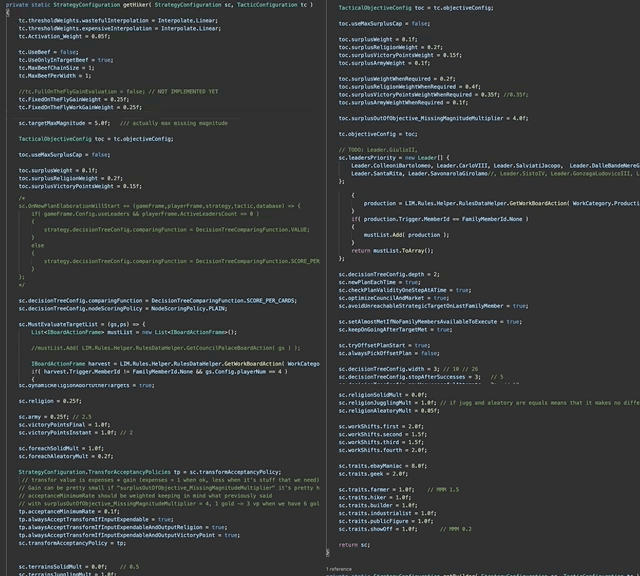
(here a gif showing the piece of code that populate all the parameters/weights of the AI)
( example of weights being calculated by the genetic algorithm )
Before continuing I have to explain how I test the an AI.
First I try it out in a batch of 50 games where they basically play alone. This is the optimal situation, no one is interfering with you and no one is going to steal your cards or actions on the board. If it's promising I then do the test again with 250 or 500 games, to be sure that is not a fluke.
( results of test #1 for the current medium AI - IDLER_CONSUL is a dumb AI that always plays the same action: council palace for religion )
If the results are good, I proceed with 50 games, 1 on 1 between the new AI and the current medium one. Again, if promising I re do the test increasing the number of games.
If that test passes too I try 50 games, 1 on 1 only with the new AI to see how it handles an opponent that it's reasoning in the same way and potentially steals your moves; aka I want to see how the AI adapts to a continuous change of plans. The idea is that the AI should be able to change it's strategy and adapt to the opponents moves.
The "last" test is with 4 players, against 3 current medium AI first and then against itself.
Having done all that and being satisfied with the results, I do it again but activating the leaders option, because leaders are such a hurdle that an AI that plays good without not necessarily plays good with them. This is mainly because when we play without, for each round the AI sets cards or harvest/production as objectives, while with leaders it has to targets specific amount of resources, which can be harder because you have way more options to get resources than to get a single card and as I said before, it's harder to weight the goodness of such plays ( for example, if I have to get 18 coins, I might want to go to the market, to the council and avoid spending coins; doing so I'm usually not getting any card or getting cards that don't have a real value in terms of strategy - situations like these are really hard to evaluate, considering that the advantage that the leader could give me is even harder to evaluate ).
During these test I sometimes obtain exceptionally good games or terribly bad ones; when that happens I save the random seed of the match (which is the only thing I need to reply the exact same match) and I add it to a pool of "critical matches". If the AI I'm working on is promising, somewhere between points 1 and 3, I test the AI in these critical matches, to see if it performs better or worse than it's predecessor.
( a really bad match )
Ok, now that I explained how I test an AI, back to developing process! As I was saying, things went crazy but I thought I was getting closer, until I got to the point where in test 1, I could hardly advance the median score over 100 points (as a matter of fact I got to a maximum median of a 105 so far, although the current medium AI shipped with the game has a median of 99 in test 1 ).
Eventually I had to take a step back, re-evaluate what I was doing and decided how to proceed.
As Elon Musk said a while back, during a Starship update event : "If a design is taking too long, the design is wrong"
I didn't actually want to start from scratch (sorry Elon, of course I still love you) mostly because I was and I still am, convinced that MCTS is the way to go. What I did is changing radically the evaluation functions. Where Google's AlphaGO uses a specifically trained neural network to evaluate the goodness of a move, I decided to rely on a series of statements, rules if you will more readable and simple then a big bunch of weights.
What that mean is that the basic approach is still the same, find and objective and build towards it but instead of having countless generic parameters to decide the objective I have now a dynamic set of logic rules. In a nutshell, what I did is giving every cards a starting value, and then define a set of rules to modify that value as the game progress. The idea is to reach a complex evaluation function by putting together simpler statements.
It might not look like a big change over the previous direction but it actually is for a few reason:
It simplify a lot the codebase and it's readability
Given the right tool, It makes it possible for non-programers people to create and test Ais
It's usually clearer to understand what and why the AI is choosing a particular move
It's basically like Lego, I just need to code the basic bricks and then try to put them together in a meaningful structure. Obviously there is no guarantee that this way is the right way, but it's a way and it's what I'm working on right now.
At the moment I already have a set of basic rules ready; a quick test with just a few rules set, resulted in a 76 points median on test 1 and 63 playing against the current medium AI (which scored a median of 74).
( current approach test#1 )
( current approach test#2 )
Here are a few screenshot with examples of how rules works:
( first we have a set of basic values for each card )
( then we have the actual rules - in this case for example, we have a rule that says that if we own the Forest, then Carpentry value increases by 25 points; at the same time, another rules says that if we have the Forest, the Guild Of Painters increases its value by 40 points too )
( here we have a rules that says that if we have 5 terrains then the value of the Farmer is increased by 50 points while the following rules says that if we have at least 4 terrains, the value of the Noble is increased by 100. We can also have more generic rules, like the last two ones that increases the value of all terrains by 50 if we have already five or less then or equal to 2 )
( another example of the rules available at the moment. The first one says that if at least two cards among Monastery, Stronghold and Gravel Quarry are in my possession ( O ) or available for purchase (A) then the value of those cards is increased by 35 points. Then we have a rule that says that the output of our harvest will produce 2 ore more stones, then the value of the Guild Of Sculptors is increased by 50. Last but not least, we have a rule that says that if we have 12 or more gold in our warehouse then the value of all characters is increased by 70 points )
So this is it. This is where we are now. The problem is that right now, the time I can dedicate to Lorenzo is extremely reduced; we are a small studio and the human resources we have are limited and constantly dancing between projects.
Luckily though, I'm close to finish the implementation of what I consider to be the minimum set of rules to build a reasonable AI so, hopefully soon enough, I'll be able to give other people in the studio a tool to proceed with the development and testing so that I will know if all this change in direction is a bust or the real deal.
I guess that's it for now.
Cheers! Cody
Enter Sir. Cody
Hi everyone!
This is my first time writing a post here so let me introduce myself real quick. I'm Cody, the code-writing-guy.
Now that you all know me, first things first: with this post comes a small patch aimed at fixing a few annoying bugs concerning the church various popups.
Second, I want to apologise for the radio silence since the last update. Thing is that I really wanted to include in this update what would have been the new hard AI but lately things got really crazy and the amount of time that I could dedicate to Lorenzo decreased significantly; meanwhile the amount of tickets reporting issues regarding the church popups increased and since I had that fix ready...here it is.
Since this is my first post here, I want to thank all the people that gave Lorenzo a shot so far and everyone that shared their opinion helping this game evolve and get better. There is still a lot of work to do and things that I (we) want to do and I'm going to do my best as long as I can to make it better.
Right now the main priority is the hard AI and about that, I'm planning to write a post explaining what's going on, why is taking so long, what I'm doing, what I've done and how I got to the point I am now...assuming I find the time to write such a post.
Please forgive all my grammatical mistakes, take care and stay Magnifico!
Cheers, Cody
Bugfix update #2386
Hey folks,
quick update to address a couple of issues arisen during these last few days:
Fixed new occurrences of FirstLevelValidationFail, which were caused by multiplayer-related actions managed uproperly;
Fixed new occurrences of NotEnoughResources related to work actions (Harvests and Productions);
Improved the UI layout of some windows (e.g. New Offline Game) which had graphic issues on some aspect ratios;
Added some shortcuts to better navigate through players boards/tables, as well as to open up the correct board in multiplayer matches;
Improved the automatic tracking system during multiplayer matches.
Overall, this should help making all multiplayer sessions more stable, or at least aid us figuring out what's going on.
As always, drop by and leave a message should you need further support! Take care
Patch 2372 is here
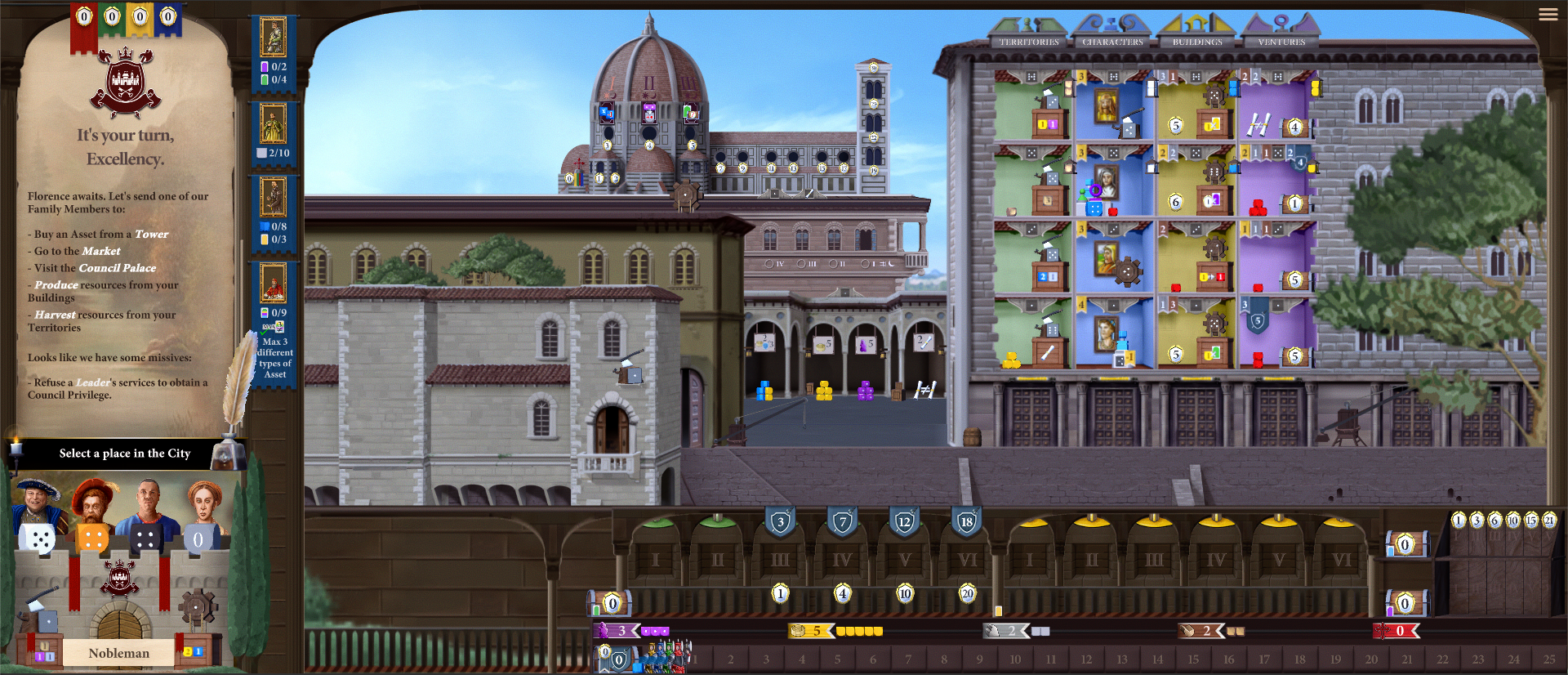
Hi everyone, we are finally here with a new bunch of fixes for our beloved Magnifico. Mostly and most important, we finished the bulk of the rework that was necessary to allow aspect ratios over 16:9 to work properly. This means, all of you who own an ultra-wide screen will be able to finally enjoy the gameplay in all its fullscreen grace.
After some initial tests, we opted to leave the majority of interaction within the central part of the screen, to avoid obnoxiously long movements to reach every action slot inside the city. This is how Florence should look on a 3440x1440 resolution:
Meanwhile, we obviously took the chance for some other bug fixing:
Tower slots still unoccupied, can now be interacted with even during opponents turn. This helps newcomers during multiplayer matches, who can now inspect available actions with their dedicated descriptions.
Characters and Quests previously purchased can now be clicked to properly open a detailed view in player's own board.
Military points abacus should now work properly, with no color mismatching nor ghostly soldiers.
Multiplayer invitations conveyed through the Steam overlay should now be properly received even if players are already inside the online section of the game.
Added an AI to substitute players in the event of a mid-game disconnection.
Minor fixes on texts, typos, and plain dumb wrong translations (duh).
There are some minor graphical issues we still have to fix, but that shouldn't take too much, so probably some minor hotfixes will follow in the next few days. If you see something that makes you turn up your nose, feel free to report it through the usual comm channels.
Before we forget...
Looks like some of you spotted the return of a FirstLevelValidationFail error, which can now happen during multiplayer matches. It seems sometimes, Leaders ready to be befriended may send their envelope during other players' turns - we'll be on it asap, but meanwhile, remember to NOT interact with those envelopes outside of your turn.
just a quick update amidst the other news, to dive into a resolution-related issue some players reported which we are currently working to fix. If you're not interested in the background stuff, jump to the conclusion for a quick fix while you wait for a patch. As for the others...
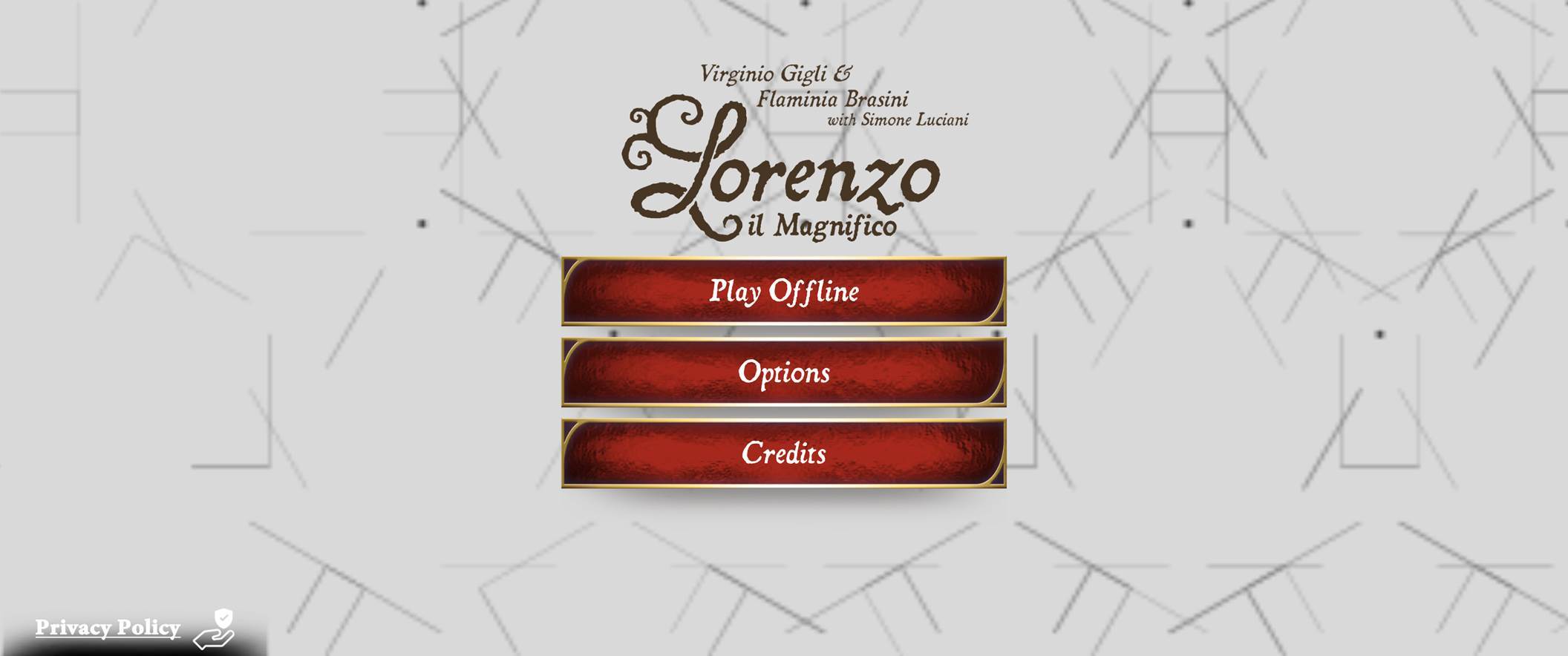
As some of you may already know, after we announced the latest multiplayer patch, someone was (legitimately) annoyed by the fact the menu did look like a cheap dentist website, and the option to play online was nowhere to be found:
Affected players were actually a very small number, but what seemed to connect all of them was the high resolution they were running the game. Well, to accommodate the many resolutions on all platforms, we relied on a third-party framework which could ease the placement of the many in-game items whithout needing the programmer to deal with it every single time, while simultaneously granting some consistency over the general composition of the scene. While the menu didn't necessarily *need* it, it was good to rely on it throughout the game in all its parts.
Turned out, since this framework was developed primarily for mobile interfaces, it lacks support for aspect ratios which are far superior to 16:9 - in this case, we are talking about ultra-wide monitors with resolutions along the lines of 3440x1440. So what happened was that the system just loaded a plain, shallow prototype version of the menu, one we did back in the days to test out the first iterations of gameplay.
But enough chitchat - here's how to fix it
While we are working to make things work no matter the resolution, which will take us some more days, you may wanna follow @VanHlebar from BGG workaround: in the starting popup of the game, activate "Windowed mode" and pick a lower resolution from the list, preferably one with aspect ratio of 16:9 or 16:10, such as
2048x1152 (16:9)
1920x1080 (16:9)
2560x1600 (16:10)
2048x1280 (16:10)
1280x800 (16:10)
...
Please note: this is a workaround while we fix it on our side, to allow you to try it out (and get access to the multiplayer) without having to wait for the next update. We are hoping we can release something soon enough to fully address this issues.
Special thanks go to VanHlebar from BGG and to Caxton - your reports have been invaluable!
Lorenzo Digital Roadmap: The update you were waiting for!
Greetings, people!
Today we'd like to share a little more insight of what's lying ahead on the (hopefully) last steps of this Early Access path. Our starting plan was to publish 10 major updates, from 0.1 being the first playable alpha to 1.0 being the update leaving Early Access, while obviously collecting some data (through gameplay sessions and user reports) to integrate as much feedback as possible from the community.
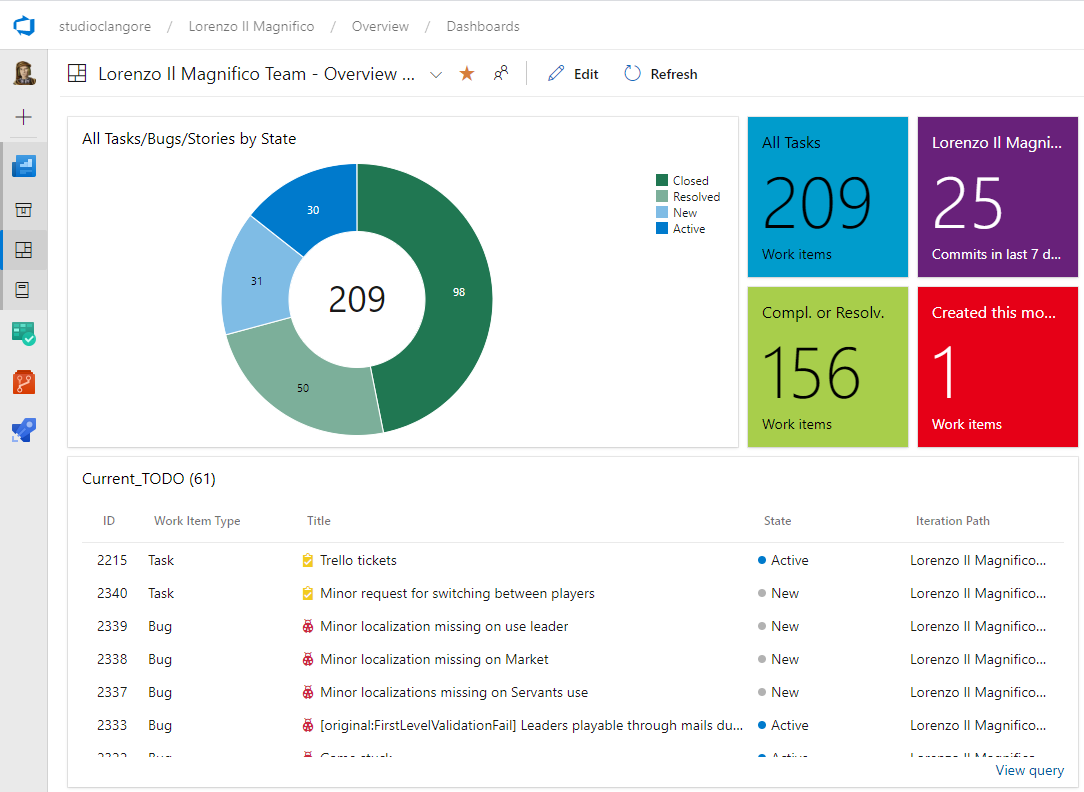
So before we move to what's left on the schedule, we felt like it was nice to share some little peek at the numbers, to figure out what we've been doing lately: As far as 2020 goes, we've been working on a total of 209 tasks, usually ranging from few hours to a couple of days long, which represent small bits of work we usually follow during our daily routine. Sometimes, one ticket on Trello equals to one task; most of the time, it's actually split into smaller tasks, which are closer to the game architecture (thus helping programmers figuring out how to do it).
But hey! I bet you are here to learn what was that secret stuff we were working on, right? Ah well, nobody cares about spreadsheets anyway, so...
> Version 0.9 will bring multiplayer in Florence
And finally! Playing online was one of the main features unlocked during the Kickstarter campaign, and we couldn't wait to put our dirty hands into it. :) As you can imagine, the game structure needed some slight fixing around to allow multiplayer to work (and some major testing overall), which is where most of our time went lately. We decided it was worth putting everything aside for a moment to provide this feature, as it was among the main requests both we and Cranio Creations receive everyday :3 We are planning to release the new multiplayer feature (which uses Steam, so no further authentication or subscription is required on your side) in the next few days, starting tomorrow.
> Version 1.0 will make everything stable and improve the AI
For those who like playing Lorenzo like Han from a galaxy far, far away, there is still work to do on the general AI performance in terms of sheer score, Leader management and general decisions. Now, those who have followed the development for a while may have noticed there has been a general, albeit small, improvement in the average score the hard AI gets every time. Our plan is to fiddle more with its behaviours to hopefully raise that average (well, median actually) around 80 or more, or at least to make it feel more competitive towards the same assets players usually prefer. The only issue with that, is we need more and more game data! So every completed match, either ours or yours, matters to this common goal. Now, as we work towards this, there will be time to deal with all other bugs and reports which were temporarily set aside, which we will discuss soon.
> And then? What's next?
After we hit the final release, surely there will still be some minor issues to fix around, so no worries: we won't disappear. We will update our Trello board to track all new requests and then figure out what goes where. And of course, we will leave our user report system inside the game, so you'll be able to reach out whenever you need.
Speaking of Trello...
While we were prepping up the multiplayer stuff, I took the chance to clean up our Trello board, to move the tickets to the next release, archive the outdated ones, and generally tidy up the place.
Here's a little more detail on each category on the left of the next release:
Working on - That's what we are focusing on at the moment, if it's not yet ready for the next release.
Bugs - Plain and simple, stuff that doesn't work. This usually has top priority as it may lead to unwanted crashes, soft locks, and whatnot. This list should be empty when 1.0 kicks in.
ToDo - Generally speaking, this is what we feel like it's necessary to bring Lorenzo to the quality standard we had invisioned when we started. Most of this will be dealt with when 1.0 is released, but something else may slip after the major update.
UserReport Issues - this is basically what was reported by you guys (at least, the most of it) which we haven't dealt with yet, either because it's too time consuming or because it wasn't reported by a consistent amount of people. We will have to consider the amount of resources we will have after the 1.0 release, then plan accordingly. Currently there is no estimated time for these, but things may change in the future.
Before we depart, one final thought: remember Studio Clangore is a small indie studio, and as such, we literaly depend on people's opinion and kindness. Because of this, we want to thank every single one of you who contributed (and still does!) by sending reports, sharing opinions, writing on BGG, or simply talking about the game with friends. This really means a lot, both to us and to the almighty Cranio Creations. <3
See you soon!
Back on track and the next few days
Howdy tabletop folks,
we hope you are all doing well in this time of trouble. <3 As things are slowly starting to go back to normal, we took the last week to do some under-the-hood improvements to the game to introduce a major feature hopefully soon. We are currently working on our internal branch to make sure we don't break anything around, but if everything goes well, we will be ready to release some updates (and spoiler the "Something secret" card on our Trello board) in a few days.
Speaking of which, we should be able the next week to share a cleaned-up version of the digital roadmap on Trello, to align it to our current schedule. So don't worry, we're still here and working hard, and we cannot wait to jump into what lies ahead ːsteamhappyː
Thank you for your ever-present patience!
Bugfix update #2219
Hey folks,
here's another small update with some new fixes for you:
Fixed error called CantHalfOddServantsBoost, which was related to not being able to add enough Servants while Excommunicated with the effect "You need two Servants to increase by 1 the value of your action;
Fixed instances of the AI taking too much to think (where "too much" meant from 5 minutes to positive infinity);
Machiavelli now works AND is displayed properly when his effects apply to harvests and productions. Say hi to Niccolò;
Some minor usability fixes around, including the missing "different" symbol from the board game when you're getting more than one Council Privilege.
As always, thank you for your patience and for your support! See you soon :)
Bugfix update #2207
Howdy, fellow players!
While we keep working on the AI performance in this unsettling world-wide scenario, here's a couple of hotfixes we were able to put our hands on:
Fixed many different instances of FirstLevelValidationFail caused by leader activations and during the score calculation at the end of the match;
Fixed weird animations overlaps caused by AIs at the beginning of new Eras, when AIs were first to play;
Resolution settings in the Options menu had some unpredictable behaviours that we should have now fixed. This, unfortunately, does not include support for 21:9 screens so far, but it should be easier for these players to switch to other supported resolutions while they wait;
Machiavelli had some issues in calculating the bonus score it gives; while there's still a minor issue in counting the bonus during Harvests and Productions that give score from multiple sources, the logic behind him has been fixed and we felt it was better to release it than not addressing the issue at all.
Many thanks to those who sent their bug reports on instances of FirstLevelValidationFail - your data was invaluable to fix it quickly and hopefully completely. See you soon!
Patch 2199 and Project Updates
Hey folks,
It's been a while! So long, actually, that I feel like I need to personally apologize for disappearing from the radars until today. The end of 2019 has been quite the challenging period on a personal level, and then, as soon as the new year went into full rampage, the COVID-19 emergency started. As some of you probably know, our studio is in the northern part of Italy, where the situation has been quite critical. Though we are now equipped to work remotely, we had some issue in pursuing our everyday work schedule these last few weeks, thus delaying even more our planned update.
Since some of you have raised concern over the current state of the project, let me reassure you: we have not abandoned Lorenzo il Magnifico. We will keep on working over it and be here for our community as much as possible.
Then, as soon as the emergency is over and we can go back to our usual development schedule, we will reschedule and share a better planning for the release of the missing content, provided 2020 stops trying to kill us.
But enough gobbledygook, here's what we have been working on so far:
Fixed a bunch of situations where the AI got stuck while thinking - most of which were reported by you. Many thanks!
Improved some evaluations related to the AI. There's still some work to do here; currently the "Medium" one settles its score around 65-70 points, which is still not enough. This is still where most of our effort is put at the moment.
It is now possible to resume a saved game; games are saved automatically when the game is closed.
Fixed a bug on Cards with on the fly effects (such as the Architect) related to some Excommunication effects.
Fixed a glitch where Excommunications taken by opponents were shown on the player's board instead.
Stay safe and take care, D. from Studio Clangore and Cranio Digital