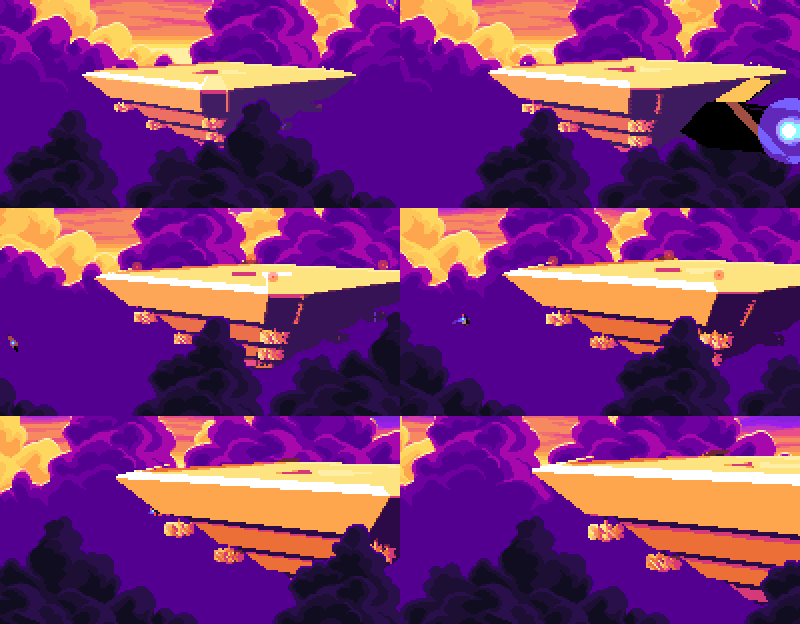
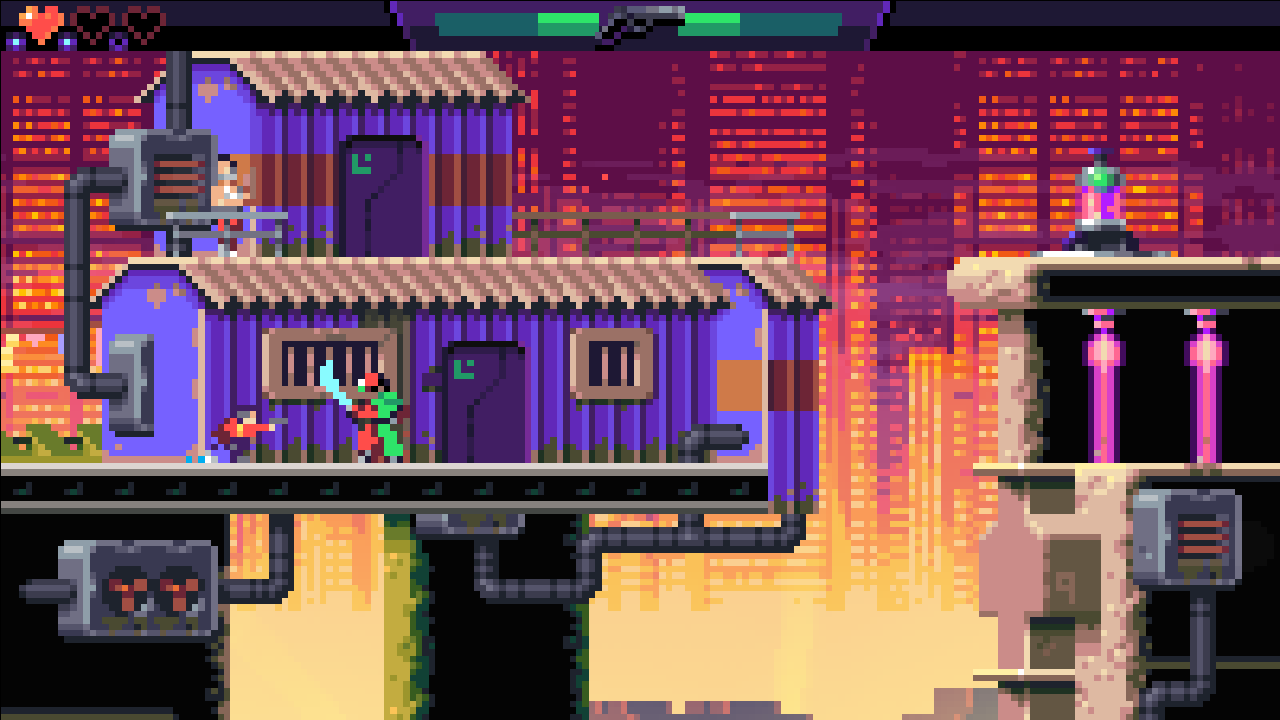
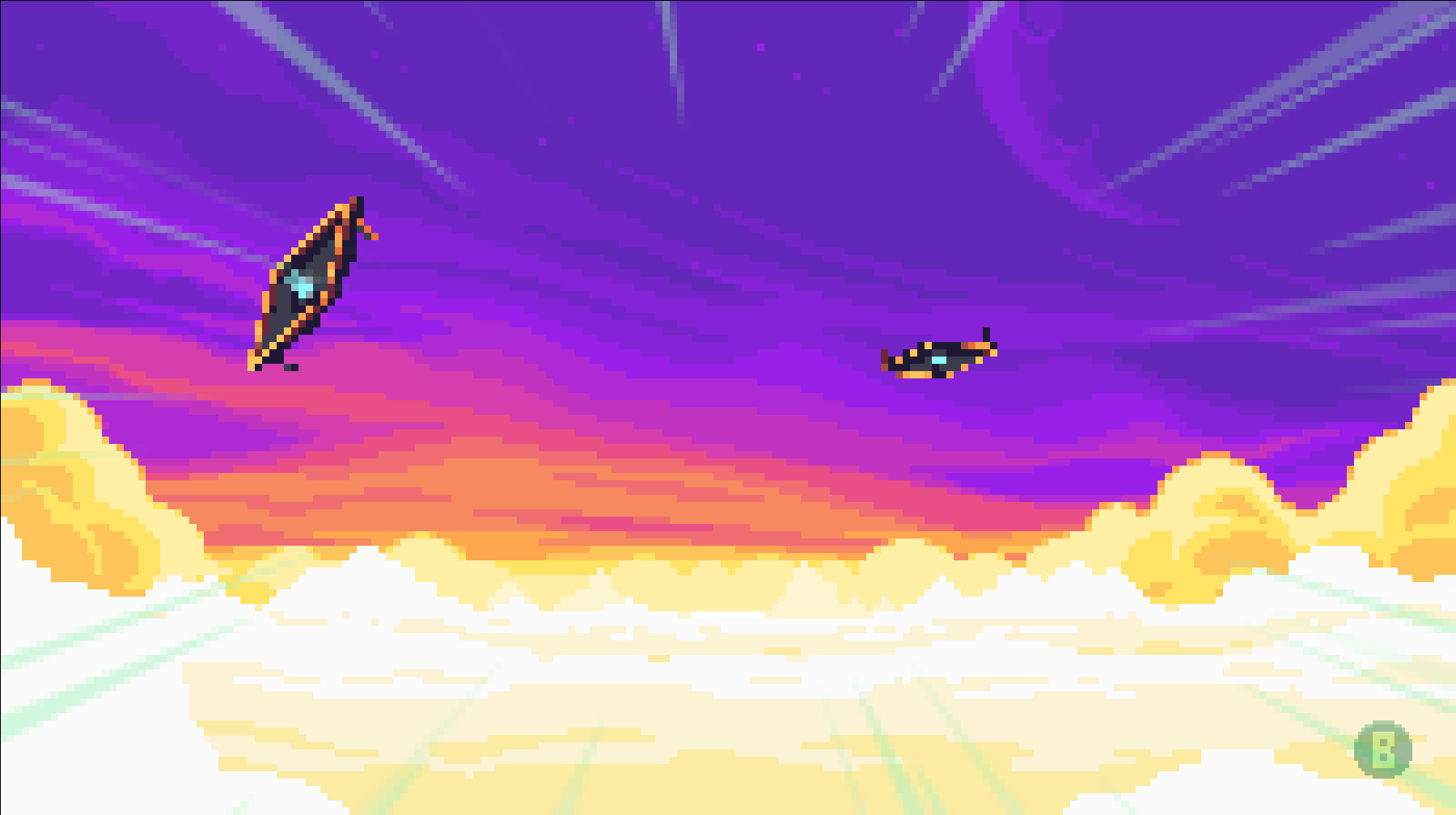
Following numerous adventures in the city and uninhabited regions of planet Albaryne in sci-fi cinematic platformer LUNARK, the protagonist, Leo, finds himself caught up in a situation far beyond his control. This results in a quick and unceremonious trip to the place used to deal with anyone deemed undesirable by LUNARK's totalitarian rulers: the flying penitentiary. Hovering high up in the sky, bathed in amber light and surrounded by purple clouds, this high-security prison provides great views but not-so-great accommodations.
Relieved of his weapon but not his wits, Leo ends up incarcerated alongside another prisoner of interest, and it doesn't take long for the two of them to formulate a plan to escape. After getting creative with the, ahem, facilities, the duo is able to lure a guard into their cell, then knock him senseless and make a break for freedom. After that, however, comes the tricky part: stealthily navigating the penitentiary's labyrinthine corridors and multiple levels of security. While your ally sneaks through the ventilation system en route to the prison control room, it's up to you to overcome the guards and get the color-coded keys that will enable you both to move forward.
It won't be an easy journey. The penitentiary is a circuitous maze of desolate metal hallways, wide chasms, and deep elevator shafts, all given life only by the pulsing glow of lights and electronic defense systems. Aside from the guards, the area is also protected by laser traps that, if they detect any movement, summon Aerostalker droids that pursue any escapees and explode once within range. On the plus side, the guards are careless and not very bright; as long as you stay out of sight and sneak up on them from behind, you can subdue them with your bare hands, and with a little luck, they'll even drop the keys that let you advance from one sector of the facility to the next.
After clobbering a few guards, dodging some lasers, repositioning a few elevators, and, of course, unlocking all the doors, you'll reach your cohort in the control room, but things only get more challenging after that! Following a certain event, the prison goes on high alert, and LUNARK's toughest, most advanced droids are brought forth in response, requiring some skillful evasion to survive unscathed. And if you make it past that, you'll have to carefully maneuver around the exterior of the penitentiary, where there's practically nothing between you and a multi-thousand-foot fall to the planet's surface below. We hope you aren't afraid of heights!
If all goes according to plan, Leo just might make it out of the penitentiary alive, but with the whole of LUNARK - and its ruling AI, NOAH - out to stop him, where can he go? We hope you've enjoyed checking out this unique level of LUNARK! You can also take a sneak peek at the city and underground stages of the game, and you'll be able to experience them for yourself when LUNARK hits Switch, PlayStation 4, PlayStation 5, Xbox, and PC via Steam on March 30, 2023.
Chris Hoffman - WayForward
LUNARK: Going Underground
In the upcoming cinematic platformer LUNARK, players will find themselves immersed in a sci-fi adventure as they step into the shoes of a young man named Leo who gets caught up in a rebellion against a totalitarian regime. You’ll battle enemies, solve puzzles, converse with numerous characters, and explore a variety of glorious pixel-art environments. These include a futuristic city, an alien forest, a flying penitentiary, and, yes, deep underground into mysterious ruins and a sweltering, lava-filled cavern.
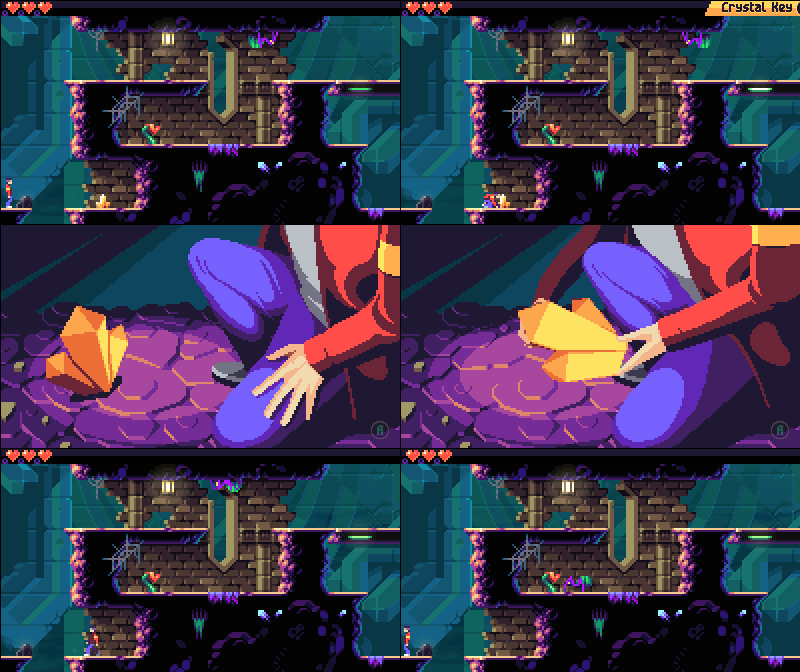
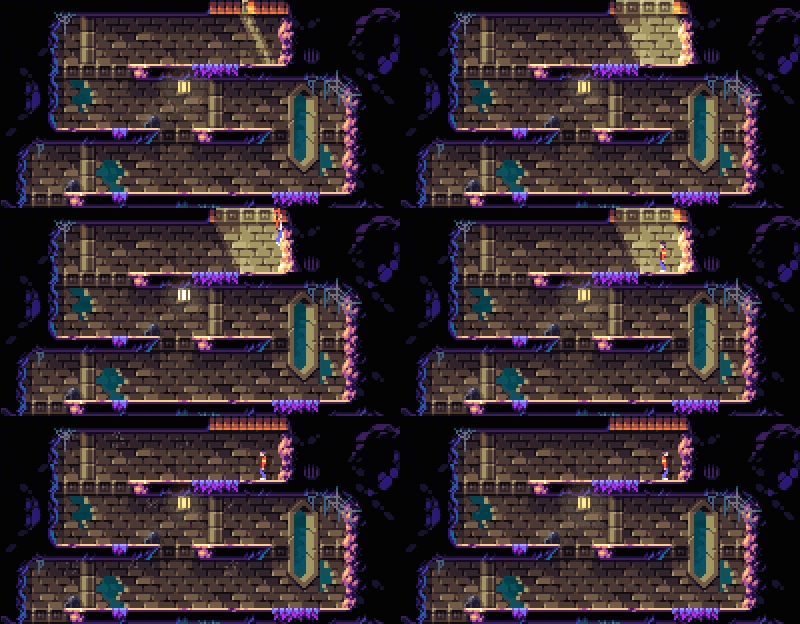
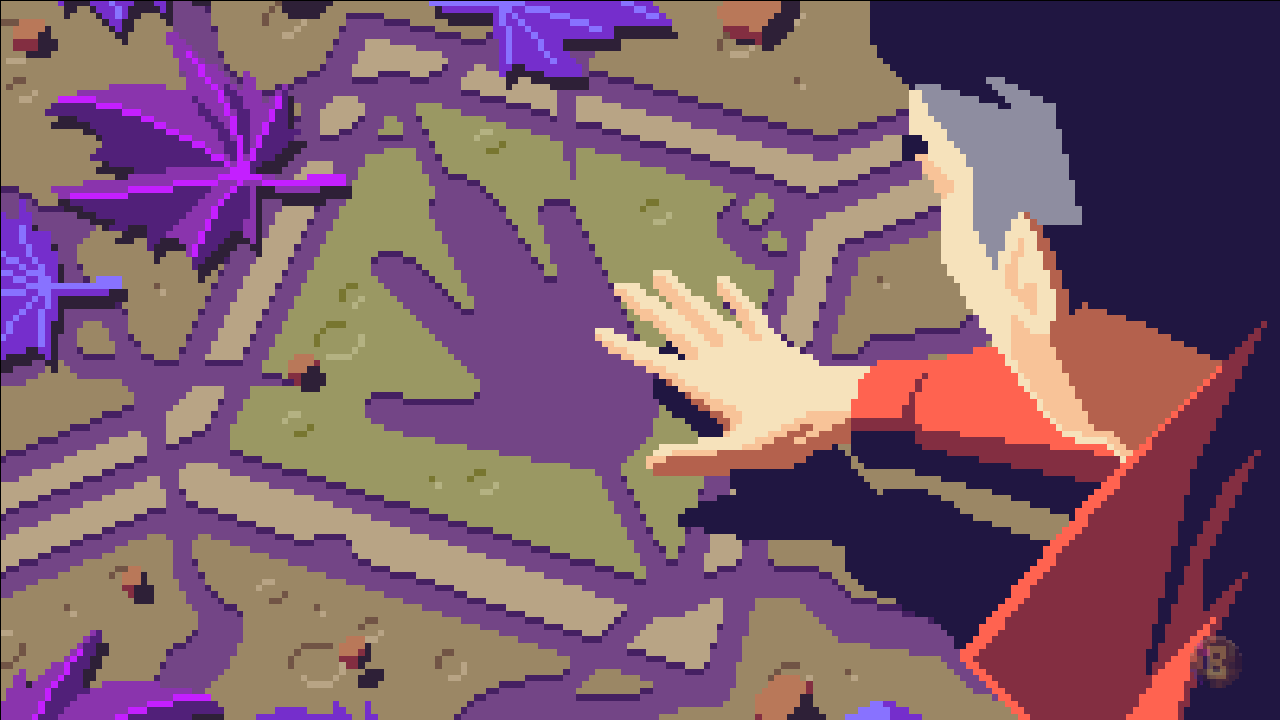
Shortly after the game begins, Leo ventures into the remote wilderness of planet Albaryne, where he discovers a hidden passage that leads to subterranean ancient ruins where dust hangs in the air, cobwebs adorn the ceiling, and fossils can be seen in the walls. Leo’s athletic abilities are put to the test, as he runs, jumps, and climbs to maneuver across numerous platforms, and rolls to get through narrow passages. Before long, Leo encounters the visage of an enormous stone statue, followed by a man-sized purple spider known as a Leaping Lurker – good thing he brought his blaster! And that’s not the only threat; vicious Shadowfang bats lurk in the shadows, their presence hinted at only by eyes glowing in the darkness. Dodge, duck, or blast them to avoid taking damage. And that’s to say nothing of the deadly pits – one misstep and you could be in for a fatally long fall.
A bit further in, you’ll find various colored, glowing crystals that can raise and lower large elevator-like platforms throughout the ruins. Often the crystals must be returned to their pedestals before they’ll function, but through thorough exploration, a little backtracking, and some careful thinking, you’ll be able to move the platforms into position and find a way forward.
Eventually, you’ll reach a large chamber where the crumbling bricks have given way, allowing it to become the home of a gigantic, house-sized spider – the Zirneklis Queen! If you take it out by blasting its weak points, you can go even deeper into the ruins, allowing you to reach a grand, if neglected, hall adorned with tapestries where an enigmatic object awaits.
Many twists, turns, and harrowing escapes later, Leo heads underground again – this time to a red-hued, lava-filled cavern. The dangerous Shadowfangs and Leaping Lurkers are back, even more aggressive than before, plus there are new threats, including steam vents lining the walls, floors, and ceilings, and bubbling, flesh-searing lava. Not only is the lava fatal if you fall in, but you must time your jumps carefully to avoid being scorched by bursting lava bubbles.
You’ll also have to master the art of “half turning,” which requires Leo to swing while hanging from a ledge, then turn in mid-fall, allowing him to safely drop down to a platform behind him. Some obstacles, though, will be impassable without a little assistance. If you come across a lava pool too vast to jump across, you may need to shoot at one of the large crystals hanging from the cavern’s ceiling. Blasting the crystal’s anchor point will cause it to fall into the lava pool below, allowing it to act as a makeshift platform. Unfortunately, navigating the cavern to break the crystal free is often easier said than done! If you make it past all the hazards, however, some of LUNARK’s most closely guarded secrets will be revealed.
The caves and ruins are but a couple of the locations you’ll explore in LUNARK, and things only get more challenging and complex from there. Please look forward to visiting them and numerous other places when LUNARK, developed by Canari Games and published by WayForward, arrives on March 30.
Chris Hoffman - WayForward
LUNARK: The Art of Movement
Realism has often been a key aspect in video games, from gameplay mechanics to visuals and physics. While certain game genres such as sports or racing have always seemed to align with this approach, others favored a more fantastical interpretation of reality. The platformer genre, for example, has long been associated with cartoonish physics. As time passed, however, the lines began to blur, leading to the emergence of new sub-genres of side-view 2D games such as action-adventures, puzzle-platformers, and, yes, cinematic platformers such as LUNARK.
One of the unspoken rules that defines the cinematic platformer genre is to stick to reality. To do so, the game will display detailed and realistic animations, and will use a high number of frames. The actions performed by the main character follow the laws of physics and if they don’t, the game’s context would justify it in order not to spoil the player’s immersion.
Comparing the controls of LUNARK to those of a game like Mario or Sonic, you will immediately notice these differences when holding the controller. For example, while it may be possible to turn around in mid-air or fall from an impressive height without damage in Mario, this isn’t the case in LUNARK.
Let’s go back to my discovery of the genre in 1991 with the first Prince of Persia, by Jordan Mechner. I don’t remember ever comparing this game with Mario or Sonic, which I also enjoyed very much. For me, it was a different experience, a different challenge. Indeed, since the character’s mobility was subject to stricter rules, we had to consider our surroundings in a more methodical and calculated way.
You couldn’t control the Prince as easily as Mario; on the contrary, you felt like you had to force him to execute his moves. You may imagine that this would make you feel disconnected from your character, but in fact the opposite was true; because of this control scheme, your character seemed more human than a cartoon character. Every action felt real and deliberate, and because of this inertia and momentum, you felt the weight of your character as if it were a real human being. This feeling, coupled with the realism of your character’s animations, is what distinguishes the cinematic platformer genre and, above all, what connects you to the character. The deliberateness of the controls – and some punishing consequences – gave the game experience a certain tension, a heightened level of stress, but also a much more intense satisfaction when you executed your actions without error. All these factors added up to an unparalleled immersion for the time. For me, jumping over rows of spikes in Sonic will never be as emotional, thrilling, or personal as in Prince of Persia. You were the Prince, or Conrad in Flashback, or Lester in Out of this World.
Of course, that was all 30 years ago, and creating an old-school cinematic platformer today brings a new challenge: managing the expectations of modern players. My design choices attempt to follow the winding road that separates nostalgia from today’s expectations.
Prince of Persia introduced most of the moveset: walking, running, turning around during a run, performing a short jump, jumping with momentum, grabbing a ledge if a jump is too tight, climbing up/down a ledge, ducking, interacting with an object, and sword fighting. To those, Flashback added the ability to automatically grab a ledge during a run, turn around while dropping, roll, throw certain objects, use a shield, and fight in close quarters, plus the sword was changed to a gun. Flashback was developed with the Sega Genesis in mind, but was also released on computers like the Amiga, whose joysticks were still often only one button, so the controls might have been influenced by this, resulting in using the D-pad to jump or roll during a run instead of using an action button.
Having a plethora of buttons on modern controllers, my first decision was to assign the forward jump and roll to dedicated ones. In my opinion, nowadays, complicated thumb movements may be acceptable for special moves in a fighting game, but not really for such basic actions.
So why press Up for climbing to a ledge above you, when it is technically a jump? Why didn’t I use the same button as the forward jump? Though indeed the two actions are technically jumps, they are completely different animations, unlike in a Mario or a Sonic game. This also posed some problems with level design: does the player want to jump forward or grab something overhead if the button is pressed while under a ledge (without adding yet another button)?
Another classic holdover is the contextual button to hang onto a ledge. In LUNARK, the player has to keep a button pressed (by default the right trigger) to hang from a ledge, and the moment they release it, Leo drops. I like that it’s analogous to the real world, since extra effort is required by Leo’s hands to continue hanging. It then made sense to hold the same button to run, since running and hanging are actions that can very often be linked together.
At the same time, I tried to make the controls more reactive, which is quite challenging in a cinematic platformer. In order to maintain the realism, an animation has to end before the next one begins. This sometimes creates a feeling of delay in the inputs.
So what are the parameters I used to make everything feel more snappy and modern? Here are some examples: Whereas Flashback or Prince of Persia require two tiles between each jump opportunity, there will only be one in LUNARK. Additionally, your character will automatically turn to face a ledge when you want to climb up or down, and the animations that make up these actions will flow very quickly. You will be able to shoot directly without having to previously draw your weapon, which will instantly re-holster as soon as you start walking or running, and when you’re rolling with your weapon and you hit a wall, there’s a good chance you’ll be chased by an enemy, so Leo will automatically turn around, ready to shoot. In the same vein, if you walk towards a cliff, Leo will stop and hesitate (once!) if the fall is going to be fatal. And let’s not forget that on top of that, you can remap your buttons to your liking (to some extent)!
I spent as much time as I could adding quality-of-life improvements to the cinematic platformer experience, and I hope that the result will satisfy both purists and new players who will discover the genre with LUNARK, which arrives on March 30.
Johan Vinet
LUNARK's demo updated!
If you have played the LUNARK demo already, you know that in the first level there is a section where you have to make a droid perform a certain number of moves - thus teaching you to control your own character.
Through many of your videos or your testimonies, you made me understand that it was difficult to remember all these controls once in the next level, leading to frustrating situations.
The game being already content-complete, I had to look for a solution that wouldn't bring any risk of game-breaking bug, and would be elegant enough to be still "compliant" with the minimalism expected by the "cinematic platformer" genre as I see it.
So from now on, you will find these small stones in strategic places, on which are engraved tips, left by a previous explorer.
That's it! It doesn't look like much, but I hope this kind of help will be greatly appreciated by players less familiar with the old school controls of LUNARK. Especially this early in the game.
LUNARK is coming Q1 2023 to Steam / Switch / PS4 PS5 / XBox. Stay tuned!
LUNARK: City Living
In the upcoming cinematic sci-fi platformer LUNARK, the protagonist, Leo, will visit a diverse array of environments, from underground caverns to a vibrant forest to a flying penitentiary. But one of the most important locations is the massive, futuristic city on the distant planet Albaryne. Since abandoning Earth some 300 years prior, humanity has made this unnamed city its primary new home, and as such, it’s unsurprisingly a place where Leo spends a lot of his time.
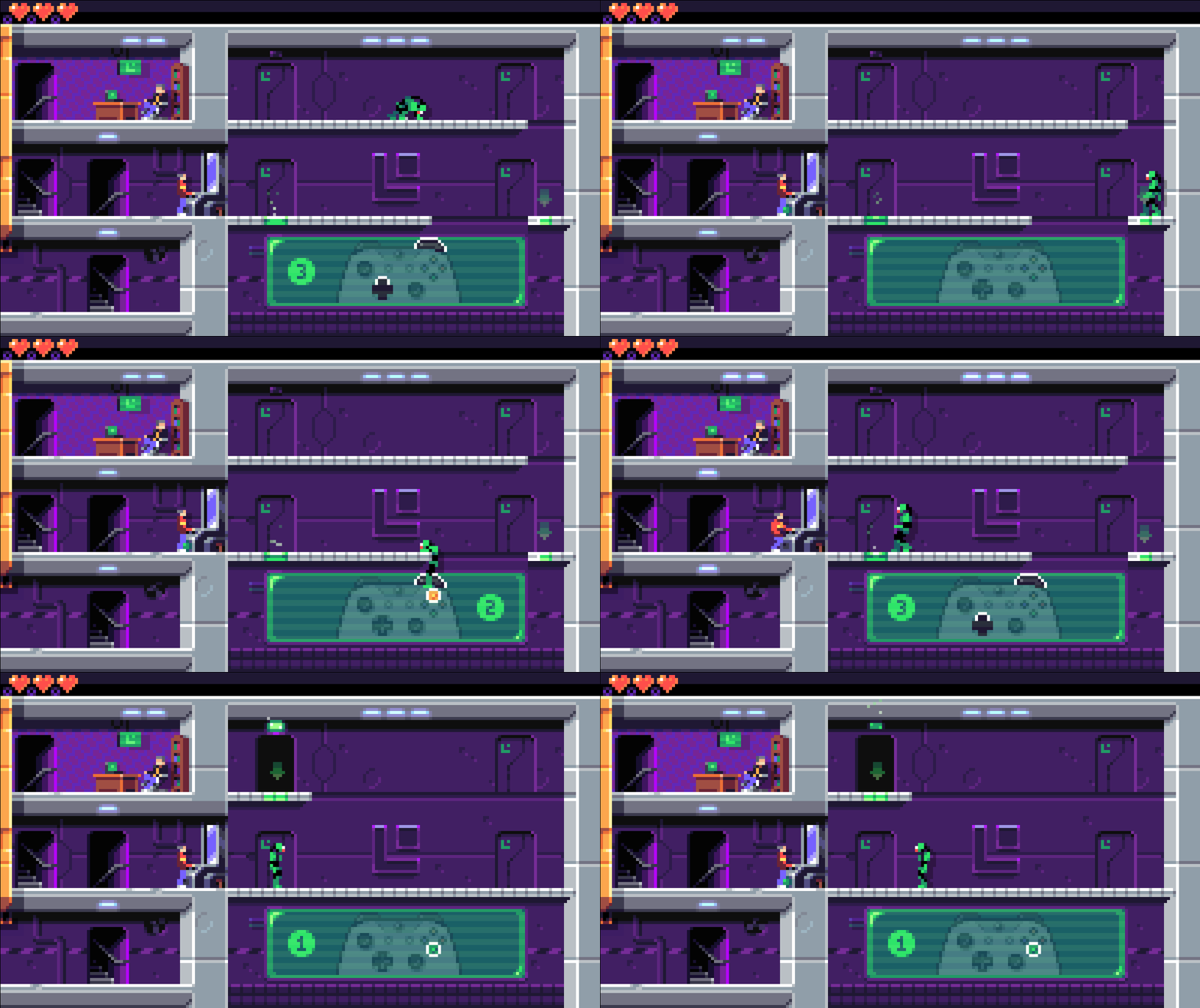
Housing, food, entertainment, industry – everything needed for human life can be found here. One of the key locations is the droid factory, where humans work tirelessly to create the robotic enforcers that, ironically, help keep mankind firmly under the rule of the totalitarian supercomputer NOAH. Nevertheless, the factory is managed by Leo’s friend and mentor, Gideon, so Leo visits often to receive advice and courier requests. Leo also enjoys using the droid QA interface found here, which allows him to master the basics of actions and movement.
As events progress, Leo finds the factory under lockdown, and he must use his acrobatic skills to help the workers escape by unlocking the emergency exit. To do so, he’ll journey deep into the recesses of the factory and deal with numerous security measures: he’ll have to reset alarms to prevent doors from auto-sealing, dodge moving laser beams, avoid explosive traps on both floors and ceilings, and even fight armed security robots and probe drones. On the plus side, if you keep an eye out, you just might find a way to upgrade Leo’s weapon.
Beyond the factory, however, there’s much, much more to the city. Divided into numerous zones, the sprawling metropolis reaches high into the sky with multitiered structures that provide home to people from all walks of life. In the relatively neglected Zone F, adults work towards a better tomorrow while children play ball and stray cats roam the alleys. Families make the best of their conditions in simple dwellings topped with corrugated metal roofs, while businesses such as a barber shop, a restaurant, and a club help provide life’s necessities. For those of drinking age, there’s a bar where Maggi the bartender is ready to lend a sympathetic ear.
Though mostly peaceful, the calm is often interrupted by blade-wielding tax-collection robots known as Swordroids. Unfortunately for the citizens, the Swordroids don’t take kindly to excuses and are quick to exact punishment for non-compliance, and their presence tends to deter anyone from conducting business. Life is easier in the comparatively opulent Zone A (where Gideon lives), but to get there, an average citizen would either need a very good government-approved reason, or they’d have to scale a 10-story-tall wall protected by disintegration beams, and no one’s crazy enough to try that!
We hope you’ve enjoyed this overview of LUNARK’s futuristic cityscape and are looking forward to exploring it for yourself in the months ahead. Developed by Canari Games and published by Wayforward, LUNARK arrives on Switch, PlayStation 4, PlayStation 5, Xbox, PC, and Mac in late 2022, and if not done already can be wishlisted here on Steam!
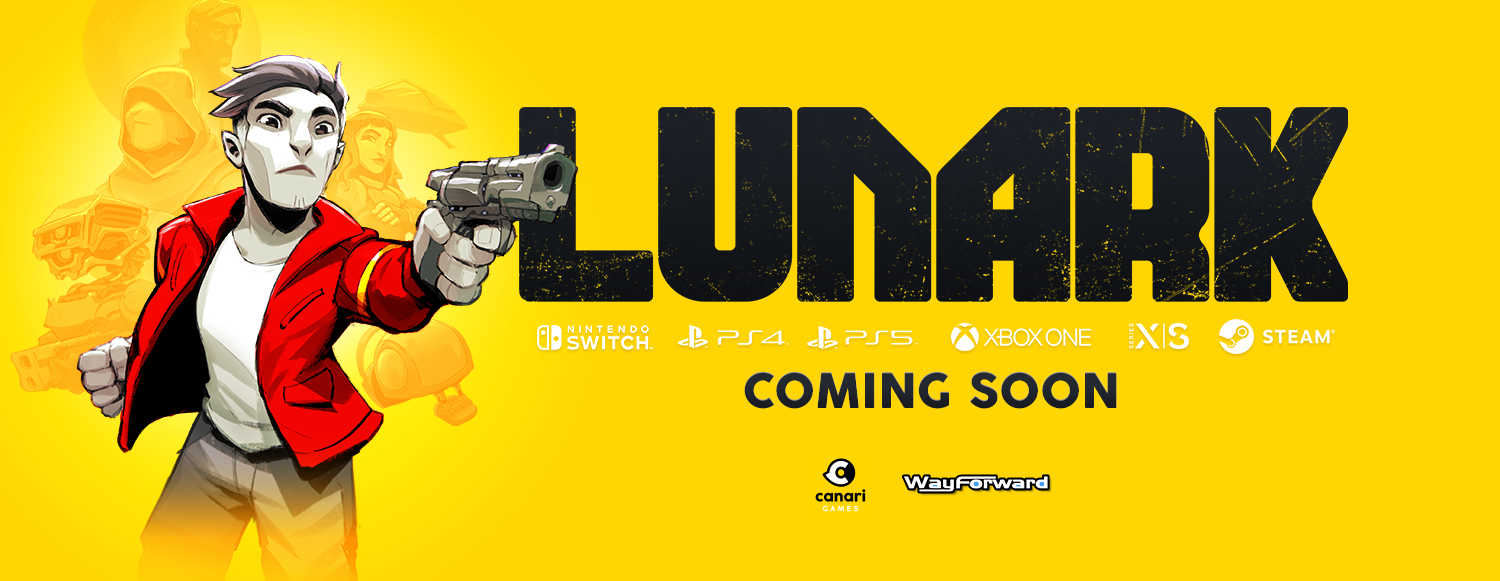
Hi! My name is Johan Vinet, a French game developer based in Canada. I’m the creator of LUNARK, a 2D cinematic platformer set in a future where Earth’s moon has been transformed into a vessel for humanity’s survival and a totalitarian regime reigns supreme. You play as Leo, a courier with unique abilities and a mysterious past, who unwittingly gets caught up in the rebellion against LUNARK’s iron fist.
But what is a “cinematic platformer”? The term first appeared in the late ’80s and early ’90s with the emergence of a new sub-genre of 2D action/platform games whose design philosophy was more oriented towards realism and borrowed some techniques previously used in movies!
Unlike more cartoony platformers like Mario or Sonic, gameplay tends to be fairly grounded in reality, with realistic character anatomy, extreme vulnerability, and interactive elements subject to the laws of physics (no coins or rings floating in the air!). The emphasis on realism also extends to character movement, with realistic jumping distances, the inability to survive long falls, and the impossibility of elements like double jumps or changing direction in mid-air. That doesn’t mean everything has to be realistic, but when it’s not, it’s usually justified by the scenario (such as an anti-gravity belt to slow down a fall, or – to name one from LUNARK – using humidity in the air to generate infinite ice ammunition.
As for the presentation, cinematic platformers tend to emphasize fluid animations with a greater number of frames, sometimes using a technique called rotoscoping, in which the pixel art is drawn over video footage of actual movements; it’s often considered the precursor to modern motion capture.
Other key presentation aspects may include minimalist user interface to preserve the player’s immersion, gameplay punctuated with contextual cutscenes (for example, picking up a key object will reward you with an animated close-up of the action), and sounds and music that support the actions in a contextual way, just like in a movie. Cinematic platformers also often feature a deep narrative, which had previously been the domain of point-‘n’-click adventures and RPGs.
These elements are on full display in the great cinematic platformers of the past, all of which contributed to my love of the genre and had a hand in shaping LUNARK.
Prince of Persia by Jordan Mechner (published by Brøderbund in 1989) is considered the pioneer of the genre; in addition to a relatively similar moveset, LUNARK is inspired by its single-screen/three-floors-per-screen structure, which gives enough room for either combat, platforming, or accessible puzzles.
Out of This World (also known as Another World) by Eric Chahi (published by Delphine Software in 1991) is even closer to a movie experience by offering impressive cinematics and more-integrated puzzle solving than Prince of Persia. It also directly influenced the contextual cutscenes in LUNARK when, for example, you pick up an object or activate a key mechanism.
Of course, no discussion of the genre would be complete without mentioning Flashback: The Quest for Identity by Paul Cuisset and his team (published by Delphine Software in 1992). In my humble opinion, it takes the best elements of Prince of Persia and Out of This World and builds upon that foundation to offer a deeper world and moveset, coupled with an ambitious and gripping scenario. Flashback is without a doubt the game that most influenced LUNARK’s creation.
With LUNARK, I wanted to honor these masterpieces while finding a sweet spot between classic gameplay and my expectations as a modern player. For example, although LUNARK is grid-based (like Flashback), I wanted the controls to feel more responsive and snappy. Although still faithful to the genre’s classics, the inputs — thanks to modern controllers — are a bit more intuitive. (And if not to your liking, they’re rebindable.) Additionally, I chose a screen resolution closer to that of a GBA than a SNES; this allowed me to save a significant amount of time when creating the visuals for the numerous rotoscoped cinematics. However, since I don’t have to worry about the constraints of putting the game on a cartridge or floppy disks, the cutscenes are more fluid, the levels are much larger, and there is more music than in the games I drew my inspiration from.
LUNARK is my tribute to a genre that opened my eyes to the possibilities of video games at a pivotal time in my life. My passion for this genre has allowed me to work with the same motivation every day and I hope it’ll show in the game. WayForward and I are very excited to be able to share the product of this dedication with you, humbly wishing that you will have a good time playing LUNARK.
The game is currently targeting a late 2022 release on all platforms (PC, Mac, Switch, PS4, PS5, and Xbox), and you can add it to your Steam wishlist right now!
Additional info on the history of cinematic platformerscan be found here. Thanks to Chris Hoffman for his help on this article.
Wayforward to publish Canari Games' LUNARK
WAYFORWARD TO PUBLISH LUNARK!
This is a very exciting day as I’m revealing my partnership with the independent game company Wayforward, developers of Shantae, River City Girls, DuckTales Remastered and so many more. They reached out to me and offered to handle the digital publishing duties for LUNARK. Wayforward being one of the first video game companies to give me a chance as a freelance 2D animator a decade ago, I didn't think long before accepting. Here is Wayforward's full statement.
What does that mean for you players?
-> MORE VERSIONS! Instead of only PC/Mac and Nintendo Switch, LUNARK is now heading to PS4/PS5 and the Xbox family of systems as well!
-> MORE LANGUAGES! LUNARK will be translated into more languages and distributed in more regions than I originally planned. Those are still to be determined and I’ll keep you posted about that.
-> A BETTER GAME! LUNARK will benefit from the expertise of their QA department. This means a more solid user experience!
THERE'S MORE?
I'm thrilled to announce that in addition to the digital version of LUNARK, a physical edition, published by Limited Run Games, is planned to be released on select platforms, including Nintendo Switch, PlayStation 4, and PlayStation 5.
Thank you all for your support!
Johan
LUNARK Live stream!
During this stream, Johan Vinet, the developer of LUNARK will be there to answer your questions while playing the demo.
LUNARK is a 2D cinematic platformer in the vein of the '90s classics, a pulp adventure set in the midst of a rebellion against a totalitarian regime. You'll run, jump, and shoot your way through gorgeous and mysterious locations!
Johan plays LUNARK!
Hi! My name is Johan Vinet. I'm working on LUNARK since its successful Kickstarter campaign in 2019.
During this event, I'll be there to answer any of your questions while I'll be playing the demo of the first couple of levels. See you there!
Johan
Johan plays LUNARK!
Hi! My name is Johan Vinet. I'm working on LUNARK since its successful Kickstarter campaign in 2019.
During this event, I'll be there to answer any of your questions while I'll be playing the demo of the first couple of levels. See you there!