Hello again everyone, I am excited to share with you today our first large expansion, Helvault Unsealed! This set is our horrifically terrifying take on the plane of Innistrad … and includes new cards themed around the Helvault Spectacle. Because Magic Spellslingers is set on the plane of Kylem, the residents there put on elaborate celebrations of notable events that have taken place throughout the multiverse; in this case, the unsealing of the Helvault. Join them to uncover the spooky, scary, and sometimes silly creatures, spells, and artifacts that make their home on Innistrad. You will not only find the Helvault itself, but also important characters such as Avacyn, Griselbrand, and Thalia. The set will release in early November, so read on for more details!
A Big Expansion
This set includes 160 new cards, making it over 3 times the size of D&D: Icons! We have an official term for expansions this size: big. There will be a cavalcade of new cards, combos, and other content for you to explore. It also includes the first ever flip cards, the first ever 20-cost card, and the first alternate win condition.
Similar to the previous expansion, these cards will be released into the same booster pack pool as all previously released cards.
Werewolves and Vampires, oh my
This set includes many werewolves, vampires, angels, and demons. But werewolves will have their own unique mechanic, called moonlight, and vampires will get tribal support for the first time to coincide with the release of a new Spellslinger, the vampire lord Sorin.
Miracles Abound
The set also introduces a new miracle mechanic that will cut across all 5 colors. Miracles will introduce some fun variance to the game. Put enough miracle cards in your deck, and your prayers are sure to be answered!
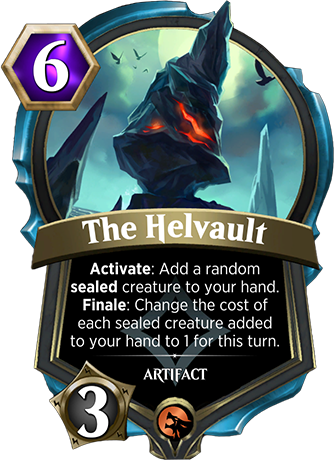
Hey what's this? A spoiler already? It IS a miracle!
I wonder what a sealed creature is? Hmm? Well, in the meantime, keep on slinging!
Picking Your Hero
Does this look more like a Chandra deck or a Ral deck? Do you think it matters? How did you arrive at your answers? Keep your answers in the back of your mind, and we’ll revisit this at the end!
Narrators
Continuing the deckbuilding-as-storytelling metaphor from this previous deckbuilding article, some Spellslingers lend themselves more to telling certain kinds of stories. Perhaps the most important deck-building choice you will make is which Spellslinger you choose to be your story’s “narrator.” A narrator can make or break a story; when listening to an audiobook, for example, a good narrator can bring you closer to the story. A bad one…well, you might not even finish. The importance of choosing the right narrator is at least two-fold, possibly more (but much like the number of times you can fold a piece of paper in half, probably no more than seven-fold).
1. Spellslinger Special Abilities
Your Spellslinger’s special ability is going to be available as a consideration in every game you play. Because those special abilities are the most naturally integrated part of a Spellslinger’s gameplan – moreso than any card in your deck – they are a good anchor to build the rest of your deck around. The incentives created by a Spellslinger’s special ability do a lot to inform how to build the best deck for that particular character.
For example, Chandra’s Torch is going to happen every game regardless of the cards she plays. That early damage is very appealing to an aggressive deck that is looking to win the game quickly before opponents can mount an adequate defense. If a player chose to play a control Chandra deck that was less interested in and less able to take advantage of the free early damage, that player would be giving up a lot of the impact of Torch.
2. Signature Cards
Each Spellslinger also comes with cards that only they can include in a deck. These cards play into the incentives provided by the Spellslinger’s special.
For example, Chandra’s signature cards all tie in to the damage theme that Torch introduces. Either they can deal damage directly to your opponent (Fire Elemental and Flame Shot) or they give you access to more damaging effects (Chandra’s Firecrafter).
Not only do signature cards help reinforce a Spellslinger’s theme, they also tend to be strong cards in their own right (as I’m sure anyone who has lost multiple creatures to a Flame Shot can attest). Similar to each character’s special, signature cards tend to offer a lot of power that would be unavailable to any other ’slinger’s deck.
Who Izzet?
Which Spellslinger did you think the deck at the beginning of the article was more likely to belong to: Chandra or Ral? Let’s break it down!
The deck looks to be focused on playing low-cost creatures and spells to attack opponents early and has direct damage such as Lava Axe to finish the game with if your creatures are unable to.
Chandra directs you to fast-paced, in-your-face aggression. On the other hand, Ral points you toward spamming spells. This list just does not have the spell density you want when looking to power up Storm Conduit and his signature cards.
Meanwhile, Chandra’s special ability, Torch, makes it easier to finish opponents off before they can stabilize. It is very close to getting a free Lava Axe at the beginning of the game! I’d slot in some signature cards, but the deck as is would be a good complement to what Torch is already doing.
In conclusion, the clear choice is Chandra!
The End…but Just the Beginning
The unique qualities of each Spellslinger gives you a direction when deckbuilding. Using that “narrator” to help build your deck’s “story” is a great place to start. Sometimes you want to tell a short, action-packed story with Chandra, but other times you may want to tell a not-so-nice bedtime story with Ashiok.
Whichever way you decide to go, I hope to see you and your awesome new decks in the arena, Spellslinger!
Duel via Code!
Greetings Spellslingers! Did you know that you could duel via code? This is a flexible way to find specific matches outside of your Team and League play. You can create your own codes and use them to match with anyone else in the game if they enter the same code.
How To
To get started, click on the Options menu!
From there, select "Duel Via Code" which brings up a new window.
Within that window, you can type in any code you want! Once you're ready, click "Duel!" and you will enter a special queue that will match you with anyone else who has also typed the exact same code. Capitalization matters, so "PLAY" is different from "Play" which is different from "play."
Keeping It "casual"
When you duel via code, your ranking on the ladder does not increase or decrease but you still make progress toward challenges. This makes it a perfect tool for when you want to try out new decks or play ones that are off-meta.
The community has come up with a common word to allow users to find games outside of the ranked ladder: casual (all lowercase). Use this code to kick back, relax, and match with others who are looking to just play for fun!
Play Your Way
Duel via Code is a powerful tool that allows you to play Spellslingers the way you want to. Here are some other ways you can use this feature:
Battle friends who are on other teams
Set up tournaments and use the code to find matches
Come up with other custom formats (you could promote a "highlander" code, for example, for players who want to only play with 1 copy of each card)
We hope you enjoy this feature, and until next time, keep on slinging!
Mythic Top 100 – September 2022
Congratulations to everyone who achieved the rank of Mythic this season. We want to recognize the crème de la crème, the top 100 players: [table][tr][td] Rank [/td][td] Prev [/td][td] Name [/td][td] Team [/td][td] Trophy Count [/td][/tr][tr][td] 1 [/td][td] (0) [/td][td] yukin* [/td][td] mtg-ss [/td][td] 4,729 [/td][/tr][tr][td] 2 [/td][td] (27) [/td][td] tonton [/td][td] mtg-ss [/td][td] 3,909 [/td][/tr][tr][td] 3 [/td][td] (6) [/td][td] Pakillo [/td][td] MTG-TOTAL [/td][td] 3,839 [/td][/tr][tr][td] 4 [/td][td] (9) [/td][td] Talaria [/td][td] mtg-ss [/td][td] 3,813 [/td][/tr][tr][td] 5 [/td][td] (13) [/td][td] OlleR [/td][td] Titans of War [/td][td] 3,747 [/td][/tr][tr][td] 6 [/td][td] (10) [/td][td] Raito [/td][td] Saunastone [/td][td] 3,683 [/td][/tr][tr][td] 7 [/td][td] (4) [/td][td] usao [/td][td] 飽きたらやめるぞ! [/td][td] 3,661 [/td][/tr][tr][td] 8 [/td][td] (6) [/td][td] Rei Sato [/td][td] さとれいサロン [/td][td] 3,647 [/td][/tr][tr][td] 9 [/td][td] (8) [/td][td] nacanoob [/td][td] MTGOSALSEO [/td][td] 3,393 [/td][/tr][tr][td] 10 [/td][td]
[/td][td] jueddsd [/td][td] Into The Arena! [/td][td] 2,374 [/td][/tr][/table]
Due to an incident that caused some players to get unearned losses during the last few hours of the month, we’re including 101-150. [table][tr][td] 101 [/td][td]
[/td][td] KING [/td][td] クロタンズSSS [/td][td] 2,373 [/td][/tr][tr][td] 102 [/td][td]
[/td][td] Kurtz [/td][td] -= ALL STARS =- ITA [/td][td] 2,373 [/td][/tr][tr][td] 103 [/td][td]
Building your own deck can be an intimidating task, especially for those who haven’t done so before. And for players that would rather avoid it, Magic Spellslingers tries to curate some reasonable options in the Deck Showcase. But for those that want to get busy in the deck builder and are unsure where to start, I wanted to give a basic breakdown of how you might approach building a new deck.
What's Your Story?
The first and arguably most important part of building a deck is making sure all your pieces are telling the same “story.” Ideally, your Spellslinger and cards should be working together toward a common goal or victory condition. Your opponent and the deck that they are bringing to the table will have its own story. Since your story and your opponent's story are mutually exclusive (you can’t both win the same game), those differences will be resolved by how your decks play out against each other to determine which story will win. You want to have a story that is not in conflict with itself because your opponents will be attempting to disrupt it as well. After all, it would be a bit jarring to get halfway through what you thought was a historical fiction book only to discover a plot twist that included fighting off space lizards bent on intergalactic conquest!
Plot Twists
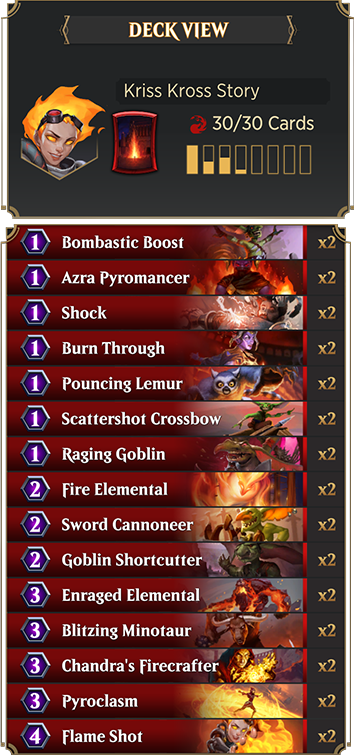
Let’s look at a deck that is close to having a consistent story, with a few exceptions:
Most of these cards are aggressive-minded and pushing in the same direction. There is also a bit of a self-damage package with Enraged Elemental, Scattershot Crossbow, and Pyroclasm. The problem is that those self-damage cards conflict with what the rest of the deck is trying to do.
Pyroclasm and Scattershot Crossbow tend to be most effective against decks with small creatures, and when played in a deck with relatively few creatures risk being destroyed by those cards. When you draw Pyroclasm alongside Raging Goblin and other small creatures that you’re trying to attack with, playing your cards can get awkward because these cards are trying to tell different stories.
Imagine a game where you get off to a good aggressive start with Raging Goblin and Pouncing Lemur, and then you draw a Pyroclasm on turn 3. The chance is relatively high that it sits in your hand for much of the game. Playing it would do more harm to your board than your opponent’s. If that Pyroclasm were instead another aggressive creature or a card that could be used to remove an enemy blocker, you would be able to use it to press your advantage on the board.
Alternatively, imagine drawing Pyroclasm in your opening hand. You might cleverly decide to slow-play your hand, not deploying your small creatures in the early turns in an attempt to get more value out of your Pyroclasm. But by slow-playing your hand to tilt the symmetry of Pyroclasm in your favor, you push yourself later into the game where cards like Raging Goblin and Fire Elemental (aggressive cards trying to end the game before more powerful high-cost cards can take over) become weaker relative to the higher-cost, higher-impact cards other strategies use.
By replacing the self-damage package with cards that are more aligned with what the rest of the deck is trying to accomplish (ending games quickly before your opponent can execute their own game plan), you end up with fewer awkward scenarios and conflicting stories in the cards that you draw.
Consistent Choices
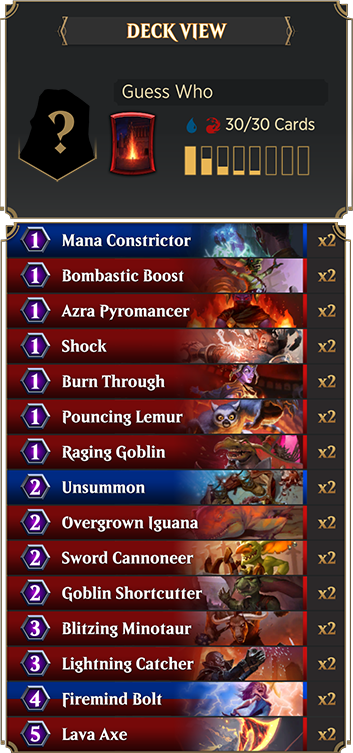
With just a few changes, we can change this deck's conflicted story into a consistent one. The Enraged Elementals, Scattershot Crossbows, and Pyroclasms have been replaced with cards that help the story instead of hurt it: Mana Constrictor (another low-cost creature to attack with), Unsummon (a way to exchange a card for short-term advantage on the board), and Firemind Bolt (a way to clear blockers out of the way or help deal the final points of damage on a board you can’t attack past). All the additions further support the story the rest of the cards are trying to tell.
The End . . . ?
The great thing about telling the story of your deck is that even though there may be some practical guidelines and common practices, ultimately it is up to you how you want to express the idea that drove you to build the deck in the first place. Not everyone will share your style, goals, or preferences.
As our lovely homunculus emcee, Vin, says: “Pick your hero, win your way!”
Mythic Top 100 – August 2022
Congratulations to everyone who achieved the rank of Mythic this season. We want to recognize the crème de la crème, the top 100 players:
Hi there, I’m Jiachen Tao, the lead designer on Magic Spellslingers first ever expansion, D&D Icons. What's D&D Icons? Read on to find out!
Your Adventure Begins
The D&D Icons expansion contains 41 cards based on the Forgotten Realms setting. It is filled to the brim with legendary heroes, monsters, and spells … as well as a few ordinary denizens. Cards will be available in all colors and all rarities, and will be released in both bundles and added to booster packs. As a brand-new expression of Magic: the Gathering, Spellslingers is naturally at home with crossover planes like Dungeons & Dragons, and we are excited to welcome new heroes and champions to the Valor's Reach arena! But that's not all. There’s one additional secret ingredient that takes it over the top while paying homage to role-players everywhere: class cards.
So You Want to be a Paladin?
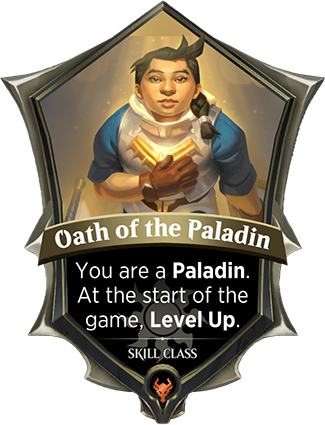
Class cards are chosen during deckbuilding, but instead of being shuffled into your deck, they are played automatically at beginning of the game. Each class card then resolves the new Level Up keyword ability: level up adds the next card in the sequence to the top 3 cards of your deck. You will level up a total of 3 times this way, culminating in a powerful class card that will reward you for playing to the class’s strengths. Let's take a look at one of the classes included in Icons, the Paladin!
With the Oath of the Paladin you will embark on a quest to transform yourself into a virtuous hero and a protector of the weak. The first step on your journey earns you the loyalty of an animal companion. The second step grants you a righteous smite against the forces of evil. Finally, your journey’s end will inspire your allies to boundless strength as long as you battle on.
Choose Your Class
D&D Icons will feature a total of 5 mono-colored class cards for you to choose from. While these cards follow the usual deckbuilding restrictions, there is one additional caveat: you can only include 1 class card, period. (Sorry, no multi-classing in Spellslingers!)
That’s all I have for today, but we’ll be releasing more spoilers over the next week. Thank you for your support, and I hope you’re as excited to play with the new cards as I am!
Crafting 101
Hello Spellslingers! Today we would like to break down the crafting system, which is the best way to acquire individual cards in the game!
Mox Shards
First off, let’s introduce the main building blocks of the system: mox shards.
There are 6 different colors of mox shards: white, blue, black, red, green, and prismatic. Prismatic shards are used for multicolor and colorless cards.
Cards of each color require a number of mox shards to craft based on their rarity: Common = 30 Rare = 120 Epic = 600 Mythic = 1200
You can get shards from league chests or buy them in the rotating singles store. But the main way to get mox shards is to collect cards; once you've collected all the playable copies of a card, the rest can be recycled for 40% of the card's crafting cost: Common = 12 Rare = 48 Epic = 240 Mythic = 480
To recycle, look for the recycling icon in the top right of your collection screen.
Once you have the necessary amount of shards, you can click on the craft button underneath a card to add a copy to your collection!
Anima & Essence
There’s also anima and essence: materials that can be used to reduce the mox shards required for a crafting. Each of these reduces the cost by 10 mox shards; anima reduced the cost of a creature while essence does the same for non-creatures. Just like mox shards, there's an anima and an essence for each color.
Let’s look at an example. If you want to craft Gladecover Warden, a green epic, you need 600 green mox shards. However, you currently have 15 green anima. This discounts the shards you need by 150, so now you only need 450 shards to craft the card!
One last thing; crafting a foil version of a card costs the same as crafting a regular version. However, only chromatic lotuses will reduce the cost to craft a foil card!
Sharing the Love
How do you get anima and essence? While you can collect them from a few challenges, the best way is to join a team and use the request feature!
While on a team, you can request donations from your teammates once every 8 hours. To donate, a teammate spends 3 mox shards and you receive 1 of the anima or essence you requested. That means for every 3 shards donated, 10 shards worth of material is created. And did we mention the gold? Whenever someone donates, they also get 25 gold. So join a team and start donating and requesting materials, it's a winning proposition!
We hoped you enjoyed this look at crafting. See you in the arena, Spellslingers!






 0)
0) 27)
27) 4)
4)