A month ago, Monomyth started its Open Backer Beta. A lot has happened since then. I have implemented plenty of bug fixes and reworked several areas that will be added to the game shortly. There is still much to do! I will improve the game's combat mechanics over the next few weeks. You can hear all about it in this month's video devlog!
As always you can find the video's transcript below!
It’s time for another update on Monomyth! Last month the Open Backer Beta started and players have reported many little issues for me to fix. At the moment, only the first two areas of the game are accessible, but this will soon change! So let’s take a look at it.
Over the last month, roughly 500 people have activated their test keys. That is roughly 50% of all backers, which is a pretty good participation rate for a pre-release testing phase. Many of these players have provided detailed feedback about their experience with the game and the bugs they have encountered. I have thoroughly recorded around 120 reports on minor and major issues, as well as suggestions for improvements. I have already worked through a fair bit of these, however, some matters will still require my attention in the future, among others, issues concerning itemization and balancing. Throughout the last month, I have not only fixed bugs, but also reworked and polished two major areas of the game. One of these areas, the mine, you may remember as the one that turned out a bit too big at first and had to be trimmed down. I talked about this in an update early last year. This area has been split up, reworked, and polished. It will be accessible in the next OBB patch. The main hub will also be accessible, as well as, three minor areas and the demo area. If the patch isn’t already out with the release of this video, it will be uploaded shortly. Content-wise, the game is now in the state I wanted it to be in for the early-access phase. Before that one can start, however, I need to rework a few game mechanics, combat being the most important one. From the player’s side combat needs an overhaul mostly regarding animations. On the side of the enemies, I must make sure that they can’t just be steamrolled by chaotically swinging the sword. So painstuns need to be reworked, as well as individual enemy actions. Enemies are theoretically capable of healing themselves, putting status effects on the player, and casting spells. That’s all in the AI. However, they are not doing it right now, because their individual sets of actions are limited to standard attacks. Basically, I need to overhaul enemy attacks so they can actually make use of their range of possibilities. In general, AI still requires fine-tuning, especially when it comes to estimating when to use which ability. All in all, enemies need to get tougher so combat is more fun. Hopefully, this won’t take much longer than a month, so I can also spend some time fixing bugs. After that, I will probably be ready to announce an early access release date with a prepared trailer.
Not to get ahead of myself, but during early access, there will be at least two content patches, each featuring one large area. There will also be smaller additions regarding backer content and minor features that couldn’t make it into the OBB. One last thing regarding GOG: I still owe you those mails to pick a GOG key. So, no worries - it didn’t go to the spam folder or anything - I still have to send those out. I will also remind you a couple times before release, so everyone gets the key they actually want. All in time.
And that is pretty much it for now. As I said, if the patch isn’t already up, it will be very soon. After that, it’s time to finally improve combat. I will keep you updated about all of it, and see you soon!
Monomyth - March Update
Hi, dungeon-crawling fans!
It's time for another update! Monomyth is finally entering its Open Backer Beta phase. You can hear all about it in the new devlog. As always you can find the transcript below!
Kickstarter backers of the 15-dollar tier and above will soon receive an e-mail with their Open Backer Beta key. Please remember that these keys are not final. They will be locked shortly before the game enters Early Access.
It’s time for a new update on the project! In this one, we’re looking at some very interesting stuff because Monomyth is about to start its Open Backer Beta phase. So let’s take a look at it!
I spent the last few weeks fixing more of the problems that were pointed out during Steam Next Fest. Monomyth received plenty of updates and hotfixes. Among other things its UI was improved, the inventory system was adjusted so items could be rotated, existing quests were tested and fixed, framerate options were added, a new enemy type was introduced, and so on. Some of these things were also added in the demo version. Meanwhile, for the closed beta, I have developed a mapping system that will probably please the Ultima Underworld fans among you. Now the project is finally approaching a state where it can be pushed into the next, and final, testing phase before early access.
I have talked about the Open Backer Beta many times in the past. It’s the phase in which all Kickstarter backers from the 15-dollar tier upwards are invited to test the game. This, of course, also includes encore backers. They can leave their feedback in the respective Rat Tower Discord channel or use the prepared feedback form, which is linked in the game’s system menu.
If you are a backer, you will soon receive a Steam key per mail. Don’t forget to check your spam folder. It’s important to know that this is not your final game key! This is only a testing key and it will be locked shortly before the early access release. You will then receive your final key, either for GoG or Steam. As far as the choice between those keys goes, I will soon send out a form with which you can request a GoG key - otherwise, you will be sent a Steam key.
Let’s quickly go over some comments on the OBB: Concerning content, the first phase of the Open Backer Beta will contain the new beginning, the heartlands, and a mini-dungeon. The second phase will then introduce plenty of content including several areas, big and small, as well as the game’s main hub.
It is in this constellation that the game will probably launch into early access. But before that happens I want to work over a few features - first and foremost combat and AI, but, of course, also the feedback given during the OBB.
During early access, there will probably be two major content updates. The first will introduce the last beta area, which still requires some polishing. Other than that it is pretty much ready, so I hope that it won’t take too long. After that I will start working on the last chapter of the game and, of course, also the backer content.
And that is already it for this month. As I mentioned, if you are a backer and you want to join the beta test, keep an eye out for that testing key. Look into your spam folder as well. You will receive an email from me shortly. I will keep you updated, and see you soon!
Monomyth - February Update
Hi, dungeon-crawling fans!
Another month, another update! This one is going to be a little shorter, but there are still some very important developments I would like to report. In this update we will be looking at the Steam Next Fest and how that worked out. We will also be looking at the overhauled UI and I have some very good news about GOG!
The next step in development is the Open Backer Beta. I still need to implement some feedback and work over the early areas of the game, but it's coming closer with big steps. I will announce it on relatively short notice. Something I forgot to mention in the video: We will probably go through the OBB in phases, i.e., like the regular closed beta, but with significantly shorter update cycles.
As always, you can find the video's transcript below!
A busy month is over and there is a lot to report! Between the Steam Next Fest and various patches, I also have some news about Monomyth on GOG. So let’s take a look at it!
During February I mostly focused on the release of the Steam Next Fest demo and various patches fixing the problems that people found in it. And there was no shortage of problems, the most notorious one being a bug that slowed down mouse movement. Luckily, this and other problems could be fixed relatively quickly. All in all, I received a lot of useful feedback. At this point, there are over a hundred posts in the respective thread of Monomyth’s Steam Community Hub. I am going through these posts one by one and I am trying to implement fixes for all issues. I am still updating the demo with hotfixes, so you can take a look at the latest changes at any time.
One major change I recently uploaded was a visual overhaul for the UI. Some people suggested adding some more contrast because bright writing on bright backgrounds was not ideal. So, I took some time and designed a new UI. I played around in Blender at first but then I decided to create the UI elements through procedural image editing. This way I could produce many different window sizes in a relatively short amount of time. What required some more work were the different UI icons. Various menu entries now have a visual representation, for example, all attributes have a small corresponding icon next to them. All of these were made in Blender. All in all the new UI is much more readable and coherent. The overhaul was purely visual - in the future, I will further improve the UI’s functionality as well.
The UI update was one of the bigger requests from the feedback list. The other big thing was a combat overhaul which is one of the next things on my to-do list. It might not make it for the open backer beta but I definitely want to patch combat before the early access phase.
Talking of which, with Steam Next Fest out of the way the OBB is the next step in development. I will work over the earlier areas in the game once more and then it should be ready.
In terms of numbers, Steam Next Fest was rather successful, despite the amount of reported issues early on. Monomyth received something between six and seven thousand wishlists. The rule of thumb is that a game should receive roughly between 3 and 4.5 times its wishlists of the first Steam Next Fest day. Monomyth received around two thousand wishlists on the first day, so the results are satisfactory.
As a last little surprise this month: I have signed a contract with GOG, who were kind enough to consider selling Monomyth in their store. So if you’re not into Steam you can request a GOG key instead. All pre-release test versions will still be distributed via Steam, however, once we go into the Early Access, I will provide you with a form to choose the platform of your liking. This also means, that all pre-release keys will be locked. So if you are currently in the closed beta or take part in the open backer beta, those keys will be automatically invalidated and you will have to unlock the game a second time with your final key.
So that’s all for now. I’ll keep uploading hotfixes and preparing the game for the OBB. Perhaps I can already implement a few fixes for the combat system. We will see. Either way, I’ll keep you updated, and see you soon!
Steam Next Fest Demo (February 2024)
Hi, dungeon-crawling fans!
Just a short update: The new demo is now live!
A few known issues:
* Atoning for sins is fairly expensive * There is a rare bug that will stop your stamina from recharging until you take damage * All characters currently have the standard voice * Getting off a ladder with a bow will make a water arrow visible on the bow * In some very rare cases Alvy will return to his spot in the doorway * Trying to emerge from the water at a certain angle will push you back down * Looting documents without reading them, and instead directly opening them in the notes menu, may freeze you in menu mode when you try closing your inventory
If you find any other issues, please feel free to share your feedback in the dedicated Steam forums thread:
I hope you will enjoy the demo and best wishes, Michael
Monomyth - January Update
Hi, dungeon-crawling fans!
We are already a month into the new year, so it is time for a new update! This time we will discuss the latest improvements and Monomyth's participation in the upcoming Steam Next Fest, starting on February the 5th, 2024.
It’s time for the first update in 2024! Today’s update took a little longer than usual because I am currently preparing a demo to take part in the February edition of the Steam Next Fest.
So let’s take a look at the latest changes and the new demo! Over the last month, I have, again, largely focused on polishing. In fact, I only implemented one very small but interesting new feature.
Players can now look through the keyholes of closed doors. To do so, they have to approach the door while crouching and then interact with the door handle, respectively, the keyhole.
This way you can see what’s going on in the room behind the door and whether or not it is safe to enter.
I also improved loading times significantly during the last month. Initially, the persistent objects of a large area had a massive loading time of around 45 seconds. I finally found the time to improve this and now the loading time for these objects is not even a tenth of what it was before. Now you probably wonder, how on earth can this be? How could this take so long to load, and the answer is actually quite interesting:
The main reason for these massive loading times was how a certain data structure, to be more specific maps, work in UE4. I used this data structure to create a nested registry for each persistent object, mapped against the ID of each persisted level. The problem with the nesting is, that in UE4’s framework the access methods for maps copy the mapped content. Apparently, you cannot access nested contents via reference - unlike in an array, where this is possible. So if you access a nested map a hundred times with the find method, the nested content is copied a hundred times. And in this case, the nested content was the entire persistent object registry of a certain level - and copying that a hundred times, let alone for every object in the level, is a bad idea. So, I decided to pre-cache the mapped registry of the last loaded level, which made the repeated access on the nested map unnecessary. This was a very simple solution once the problem was clear.
Another thing I did to improve the loading times was avoiding unnecessary calls between the persistent objects and the registry. So, during loading, I simply passed the persistent object registry via reference, and each object just looks up its own data. Also, a fairly simple problem, once you tracked it down.
Now to get back to less technical things, I also polished the Heartlands. Plenty of sections in this area were reworked and received new lighting. Sometimes I just changed the geometry a bit, sometimes I added new ways to traverse the level. This was specifically beneficial to stealth gameplay. There are now more ways to infiltrate certain locations and finish quests in a more sneaky manner.
I also added some more level mechanics that take advantage of enemy factions and their potential infighting. This provides some possibilities for creative problem solutions.
Further, I worked on gamepad support. The game itself can now be fully played with the gamepad. For the menus, so far, I only added gamepad-controlled mouse inputs. So your analog stick will control the mouse. The gamepad’s front buttons act as mouse buttons. This was a relatively quick solution for full gamepad support, but so far it works surprisingly well. It still has to be improved somewhat, for example by adding navigation hooks, so you can jump from UI element to UI element by pressing the shoulder buttons.
But now let's come to the demo: Right away, the demo area is still the Serpent’s Bastion, however, the area has been expanded and you will approach it in a different way. Some of you may remember, I mentioned in an earlier update that I had moved the Serpent’s Bastion from the beginning of the game to the middle. Correspondingly, you will start in a slightly different spot. There is a new quest, there are new sections, and also new enemies. Of course, the old demo was built on the old code base. So this demo will contain all the new features that I have spoken about in past updates, for example, the new spell system, free saving, combat improvements, and so on.
The demo will replace the old demo on Steam. It will be available at Steam Next Fest, which will start on February the 5th, 2024. The replacement is actually quite important, because I keep getting feedback for the old demo, and while I try responding to it all, it doesn’t really make any difference, because the current build of the game is already a different codebase. Patching the old demo would mean I would have to work on an old, abandoned codebase, which wouldn’t make much sense. Now, with the new demo and codebase in place, I can easily patch things that demo players suggested. I can even update the demo with the latest beta patches. Which also means, that I will try, yet again, to be more active on the Steam forums. During Steam Next Fest anyway, but also afterward.
So, as I said, Steam Next Fest, will start on the 5th. Be there, try the demo, and please wishlist the game. I will probably upload the build a little earlier. I’ll keep you updated about it all and I will see you soon!
Monomyth - November / December Update
Hi, dungeon-crawling fans!
It's time for the last update of this year, and there is plenty to report! Numerous things have been worked on during the last few weeks and you can hear all about it in this month's video devlog. One highlight is the new magic system, which should be interesting for everyone who likes combining runes in Ultima Underworld. But, please, see for yourselves:
I just uploaded the latest patch to the Closed Beta branch and I am now completely focused on polishing everything for the Open Backer Beta. I hope to have it ready very soon.
As always, you will find the transcription of the video below. You will hear from me in the new year. Thank you for your continued support and
Best wishes,
Michael
------------------------------------------
Hi dungeon-crawling fans!
Another month has passed! Time just flies by as the year comes to an end. What is also slowly coming to an end is the closed beta of Monomyth. There has been plenty of progress over the last few weeks and we are getting closer and closer to the Open Backer Beta. So let’s take a look at it.
This month I continued polishing mechanics. Last time I mostly did things related to melee combat, so I thought I could as well arrange these polishing phases around differrent playstyles. Generally speaking there is a distinct playstyle for warriors, mages and thieves.
So I started this month by making some last changes to the warrior’s playstyle.
To keep it short and simple: I removed the shield-bash and added kicking.
I tried keeping it as balanced as possible and it strongly depends on your available stamina. Unlike other attacks its stamina costs are set to a certain percentage. So you will always require, let’s say, a third of your stamina when you kick. When the kick lands, your enemy either falls down or is pushed back, depending on your stamina. Of course, kicks are only really useful against humanoids.
Most of this month's work was focused on the mage’s playstyle. I reworked casting mechanics, spell acquisition, spell mechanics and I also gave some spells a visual workover.
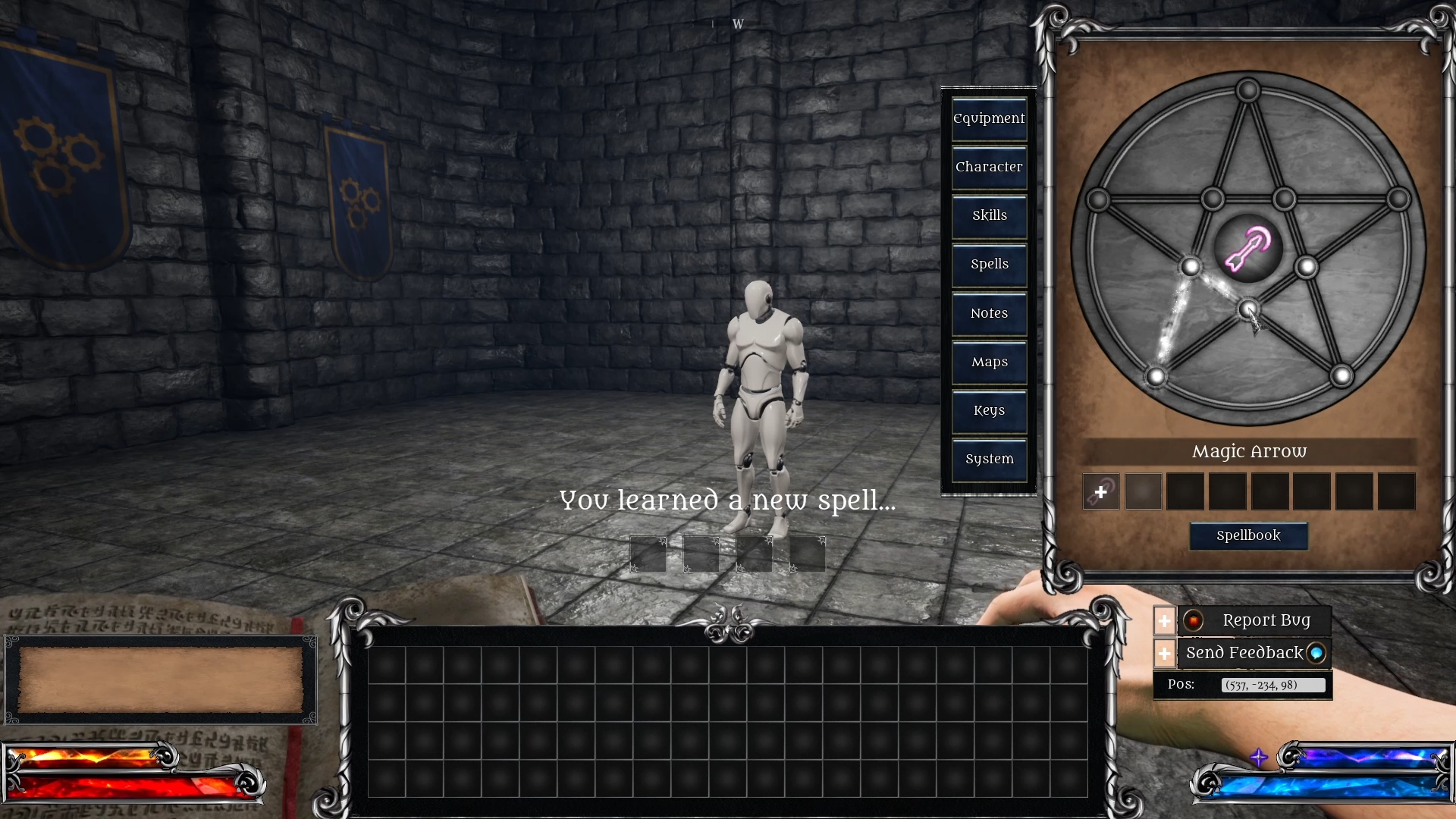
Originally the player could cast spells at any time. You would press the “C” key and start casting a previously memorized spell. This system has been changed. It is now necessary to equip a spellbook to your weapon slot. You can then cast any selected spell with a mouse click.
This is much more comfortable than the original system - especially while moving and aiming at the same time. Using the “C” key in such a situation always felt very awkward. You can still easily switch between a readied weapon and a spellbook mid-combat thanks to the secondary weapon slots.
One element I wanted to have for the mage’s playstyle was some form of explorative spell acquisition. As you may remember, in both Arx and Ultima Underworld you had to combine specific runes to cast a spell. Monomyth does something similar, but it moves into a slightly different direction with its execution.
In order to cast a spell you first need to memorize it. The number of memorized spells depends on your character stats. In order to memorize a spell you have to activate a spell pattern on a pentagram. To do so, you collect “Echo Stones”, magic artifacts of divine origin, each representing a god in the world of Ariath. The stones are fixed on the pentagram. If you wish to memorize a spell, you have to activate the correct order of Echo Stones. If your character is intelligent enough the resulting spell can be memorized in one of your spell slots.
You will still find scrolls throughout the game, but these will just contain the required pattern for the spell. You can always memorize a spell once you have the correct Echo Stones. Once you find the correct combination, it is automatically added to your spellbook.
Many of the spells also have different levels now. The magic arrow spell was completely reworked both mechanically and visually. Once the player acquires deeper knowledge of the related school of magic the spell will gain additional projectiles and eventually start homing in on a hostile target.
To slightly nudge mages towards using specific armor sets, I introduced a weight penalty on focus. Which reminds me, I haven’t talked about focus yet. Focus is for the mage, what is stamina for the warrior. The difference is, stamina decreases once an attack is performed, whereas focus decreases steadily, as long as a mage is casting a spell. Different spells require different levels of focus making the decrease slower or faster. Once all focus is gone the spell either automatically releases or fizzles, depending on whether or not it was fully cast at the time. If a mage carries all plate armor, his focus will decrease much faster, due to the aforementioned penalty.
The final part of this month’s work was focused on the Thief’s playstyle. First I fixed a lot of issues that still existed with archery. I properly implemented various mechanics that depend on the corresponding skill, like the sway while aiming, zooming onto a target and the range of a shot. I replaced the archery animations and while the new animation isn’t as realistic you have a much better view of your target now. I also changed a few things about arrows and how their damage is calculated.
Another improvement was made to the stealth mechanics. I entirely reworked how audio stimuli are registered. Enemy reactions are now more realistic and, most importantly, their ability to hear everything through five walls has been was drastically limited.
Just like with magic there is a weight penalty on sneaking. The heavier your equipment is, the louder your character will be.
Besides all of this I implemented various bug fixes and a text log for the player to take notes in. Now that I have finalized most of the mechanical polishing I will move on to the more general things and mostly polish content and some visuals. Once this is done the open backer beta will finally start. With the start of the open backer beta all backers will receive their keys. I still have to work out some of the details concerning the method of distribution but you will likely get a retrieval link, for example from humble bundle or a similar site.
Until then, I’ll keep you updated and see you soon!
Monomyth - October Update
Hi, dungeon-crawling fans!
A lot has happened during the last few weeks. We are now in the polishing phase and plenty of mechanics have been fixed or refined. Please, enjoy this month's video update:
The first month of polishing is over and there has been so much progress I can barely fit it all in one video. For anyone who doesn’t know: Monomyth is now in its fifth beta phase, which is mostly reserved for visual and mechanical improvements. Most of last month’s time went into the latter, especially with balancing and adjusting mechanics accordingly.
We will take a look at all of this, but first, let’s get the smaller stuff out of the way:
I started the polishing phase with a few simple tasks, the first of which was a quick rework of enemies. I gave rats some additional textures and a few better sound effects. Nothing too fancy.
I fixed a few things in the character state machine and some of the movement, especially crouching, which should now work much more smoothly.
I also fixed a few issues for NPCs. Some of them wouldn’t leave their staggered state. This should now work correctly as well.
Further, I added an item to mark the walls, for example, to denote where you’ve already been.
I made some changes to blacksmithing. All metallic objects should now heat up properly and it is no longer possible to repair leather armor or cloth on an anvil. Equipment durability is scaled by a fragility factor, which decreases throughout the game, meaning that with higher-quality equipment, its durability will be less of a concern. In contrast, during the early game equipment will break more easily and you will depend strongly on whatever you can take from enemies.
Now we are getting to the stuff that took a little more time: During the last beta phase, a lot of items didn’t have proper descriptions. A little while before the last patch I actually changed my approach to writing a bit. I used to write in English only. Now I also write in German and translate whatever I wrote. As a result, it’s much easier for me to quickly produce adequate texts. Ironically, sometimes it’s still easier for me to write in English and then translate it back to German. So the rule is basically, whatever works, as long as a proper text is the end result.
Anyway, I completed item descriptions and then added item names to the UI so you can actually see what you are interacting with. I thought that having a simple text on screen wasn’t all that aesthetically pleasing so I decided to implement a highlighting frame. You may have seen this before in games like Dark Messiah of Might and Magic or Deus Ex. I also added the frame to containers to quickly communicate whether these are empty or locked. You have to interact with the containers once before this is shown though.
One thing that was very important for the polishing phase was getting versioned builds to work. In previous versions, I kept having trouble with UE4’s versioned building process. I could build my projects and deploy them on Steam, however versioned builds that work with a single, compressed .pak file would constantly freeze the building process. I finally resolved that issue and the project size on the Steam servers went down to a third of what it originally was. Additionally, I can finally deploy smaller, iterative patches, so beta testers don’t have to download the full, uncompressed game after every patch.
And now let’s get to the balancing, the biggest part of last month’s work. This took quite a while and most of the time was spent writing spreadsheets and coming up with nice mathematical functions. But let’s start at the beginning:
The point of balancing is, to provide a smooth progression of numeric values throughout the game - everything from attributes to damage, defense, gained skill points, combat vs quest experience, and so on. All of these values need to be properly balanced, otherwise, you’ll get unnecessary spikes or dips in difficulty that will (overly) frustrate or, worse, bore the player. So how did I go about this?
As a very first step, I made a basic list containing the core essential facts of the game. I started out by writing down the number of areas. From that, I would determine how many character levels players would roughly gain per area. From that, I could then determine the maximum level. This was a bit of a back-and-forth, because when I say “area” I actually mean a series of connected zones that could roughly be grouped in the same “chapter” or “tier” story-wise. So with the max level, you can set maximum experience and come up with a nice level curve. I decided to go with a very simple polynomial curve.
With that set in stone, I started developing a table, which all other tables, be it armor, utility items, weapons or enemies would then refer to. This table included, categorized by area, the minimum and maximum attributes as well as the minimum and maximum derived values, meaning health, mana, and stamina. From that, I could develop everything else. I asked myself, how long I wanted the average combat encounter to be, so I could determine the damage ranges, healing factors, defense values, etc.
From this main table, I could develop multiple other tables that would reference the decided values. For example, I developed a table containing all weapons by referring to the damage in the main table and adding various modifiers. The individual weapon damage would then also be influenced by a balance variable that could be tweaked manually. The calculations were done in a way that everything stays nicely within the decided damage ranges.
I did something similar with the armor sets, except with the defense values.
The best part about all of this is, that the final tables can be exported from the spreadsheet editor and go directly into the unreal engine in the form of a CSV file. So if I need to make a change to, let’s say, the damage ranges in a certain area, I just go back to the main table, I tweak the necessary values and all other tables automatically update their respective values. All weapons update their damage, all armors update their defense. I can then just re-import the new tables in Unreal Engine and that’s it. If a formula turns out to be problematic I update it. All respective values update automatically - I re-import the tables and that’s it. No long-winded fiddling with UE4’s table editor, no manual entering of adjusted values, no recalculations necessary - it can all be done with a few clicks. This series of tables forms a balancing pipeline so to speak, which will save a lot of time with any future adjustments.
So let’s quickly go back to that weapon table I mentioned. As I said it refers to the main table for various basic values, but, building upon these, I created a flexible damage calculation. In Monomyth this calculation depends on both fixed and situational components.
The fixed components consist of the base damage (the value referring to the main table), the weapon quality, the corresponding weapon skill, and attribute modifiers.
Each weapon has three physical damage types that are calculated according to these fixed components. The physical damage types are slashing, bludgeoning, and piercing. You probably already know these from games like Dark Souls or King’s Field. However, these types were also present in Ultima Underworld. And much like in Ultima Underworld the type of attack you perform in Monomyth determines the type of damage you deal. There is a swinging motion that deals slashing damage, an overhead strike that deals bludgeoning damage, and a stabbing motion that deals piercing damage. Depending on the weapon the damage per damage type can be very different. A regular sword can be used for an overhead strike or a piercing attack, but its highest damage is dealt in the slashing motion. The equivalent is true for maces and fencing weapons with regard to bludgeoning, respectively piercing damage. Using a mace to “stab” an opponent is not very efficient, however, clubbing him over the head with it will get you very different results.
Likewise, certain armor pieces provide different types of protection. Chainmail armor provides excellent slashing damage protection but falls flat against bludgeoning attacks.
The situational components of damage calculation depend less on the character and weapon statistics and more on how and when an attack is performed. Situational components are whether or not the player has charged his strike, whether he has enough stamina to perform the attack, and whether or not he has a bit of luck, that may lead to a critical hit.
The latter is not entirely situational because the chances for a critical hit can be increased through the dexterity attribute. Likewise, an unaware enemy will always receive a critical hit. The critical hit modifier depends on the weapon type, with fencing weapons and archery providing the highest modifier and maces the lowest. Additionally, archery gains some extra damage by aiming at the head. This is supposed to benefit stealth-based gameplay approaches. As a result, the stealth archer is a viable option in Monomyth.
Talking about sneaking around, the stealth gameplay archetype is not fully polished yet, however, equipment weight is already having an effect. I won’t torture you with inventory weight, however, equipment weight will have an effect on movement speed. If you run around in full plate armor with nine points in strength this will significantly slow you down. Equipment weight will also lower your jumping height and make you a lot noisier whenever you are trying to move silently.
The weight of weapons also affects their attack speed, as does your stamina. If you are low on stamina, your attacks will be very slow and only deal a fraction of the damage.
Now all of these limitations can be broken with a little magic. Most attributes in Monomyth are soft-capped. In this case, this means, implicitly, the maximum amount of points spent on an attribute is limited by the maximum level, however, there is no real explicit limitation in place. This means that spells and potions can easily push you beyond the implicit limitations. Likewise, all derived limitations, such as carrying capacity, are lifted as well.
If I am a battlemage and I cannot for the life of me wear a certain piece of armor without it slowing me down, a proper blessing spell can do the trick.
Besides balancing I also made a major change to melee combat mechanics. Attack animations are now traced. This means, instead of a simple hitscan the swung weapon is checked frame-by-frame for any hit enemies. This also means you can hit multiple enemies with a single attack now. Together with some newly implemented hitstop effects, this makes combat a lot more responsive.
These were most of the changes I implemented during the last month. I hope I can finalize the basic mechanical polishing soon. Most of these changes were made with the melee gameplay approach in mind. I still need to rework magic and stealth approaches and do some more general polishing. Eventually, visual polishing and the open backer beta will conclude beta phase 5.
Until then, I will keep you updated, and see you soon!
Monomyth - September Update
Hi, dungeon-crawling fans! The new video devlog is here! Sorry for the delay!
In this update, I would also like to draw your attention to a promising little Kickstarter project that is launching its campaign shortly:
As always you can find the video transcript below. Best wishes, Michael
---------------------
Hi, dungeon-crawling fans! It's finally time for a new update on Monomyth. This one took a little longer because I wanted to make sure that the latest patch was in a proper state before moving on. Before we look at Beta Patch 4 however, I would like to draw your attention to a little project that is launching its Kickstarter very soon. Sorceress is an immersive, magic-focused, first-person action game that strongly draws inspiration from classic titles like Dark Messiah of Might and Magic. I had this game on my radar for a while now and I thought you might be interested in it as well. So if you like first-person melee combat, emergent gameplay, and nicely stylized environments you can find the link to the Kickstarter page in the description. With the latest patch, we are finally entering Beta 4, one of the last development stages of the project. This patch contains the last bit of main content that will be available in the first public version of the game. It also knits together the different areas in a cohesive main quest and gives the players a hub to return to during their adventures in the underground. So let’s take a detailed look at the content added in this patch. We already talked about the main hub in the last update. The inner fortress of Lysandria serves as sort of a base camp for the player but it also contains a few quests on its own. To have a little more space for these quests I attached a few separate areas to the hub, which are themselves again connected with other parts of the underground. This provides different entry points and makes the world even more interconnected. During the last update, I also mentioned a few mini-dungeons I made while testing a new set of modular geometry assets. I expanded one of these mini-dungeons into a new tutorial area. This tutorial area is now done and fully integrated into the game. Additionally, I integrated the other mini dungeons. I polished these up and scattered them throughout the game’s world. The mini-dungeons are very traditional in terms of design. That means a lot of swing blades, moving spikes, fire traps, and puzzles. They were a lot of fun to make and they are probably the areas that are closest to King’s Field in terms of level mechanics. As I already mentioned, the main quest is now also done. There is no separation in chapters since you can tackle the quest in a very freeform way, but to give you a rough overview it consists of about four major parts. Some of these parts are integrated with the general progression throughout the world, whereas others rely on you exploring different parts of the underground on your own. A fifth and final part of the main quest will be added during an early access phase together with the very last area. These will be more separate from the rest of the game. So, how are we going to continue from here on out? Beta Patch 4 is now done and it will be on Steam’s beta branch shortly. I am still playtesting the whole game, which is already going hand in hand with what’s to follow. For the next few updates, I will concentrate on polishing and reworking different aspects of the game. The polishing phase can be roughly separated into mechanics and visuals. First and foremost I will concentrate on combat as well as enemy mechanics. My goal is to generally make the game feel more smooth in its moment-to-moment interactions. This also overlaps with combat animations, as well as sound and visual effects. I am also planning to rework a few of the art assets. I will try to give some of the areas a more distinct visual identity and further improve performance. With all major areas integrated, the game urgently requires some rebalancing. The item progression has to be adapted, especially that of equipment. This of course also overlaps with encounter design, because ultimately, the usefulness of equipment is linked to the damage output of enemies. Correspondingly, your damage output is linked to defense values and the health of enemies. All of the involved numbers should ideally grow in a nice curve, so the rebalancing process will probably require another big table and a lot of careful planning. That and testing, testing, and more testing. Speaking of which, once the game is properly cleaned up, we will finally start the Open Backer Beta. At that point, Kickstarter backers will finallybe able to retrieve their key and test the game. During that beta phase, there will probably be several smaller patches, but I will try my best to keep your save files intact. I will inform you in time on how to retrieve your keys. After the Open Backer Beta, the game will enter an Early Access phase. As I mentioned before, during this phase backer content as well as the last part of the main quest will be added. So it’s still a good amount of work, but we are steadily progressing towards release. I am confident that we will soon be able to talk about the concluding steps in this project and likewise, you will hold the game’s key in your hands in a not-too-distant future. Until then I will keep you updated and see you soon!
Monomyth - July/August Update
Hi, dungeon-crawling fans!
It's time for another project update! This month's video is a little more technical since we are talking about performance improvements. There have been a few problems with the audio recording at the beginning - sorry for that! Anyway, please, enjoy:
As always you can find the transcript below.
Best wishes,
Michael
-------------------------
Hi, dungeon-crawling fans!
Another month, another update! There has been a lot of progress during the last few weeks, especially in terms of performance. As such this update will be a little more technical and I hope you don’t mind. I think it is worth documenting a few of these things and letting you get an impression of what the current workload looks like. Basically, I decided to pull some tasks from the polishing phase into beta update 4. Next time we will get back to level design, game systems, and similar. So let’s take a look at it.
The current problem with performance could be described as the legacy of prototyping. It’s not uncommon in this phase of development. Basically, I am trying to bring the environments into their final shape while cleaning up unnecessary and inefficient structures.
The main focus here is on draw calls and lightmap memory.
For draw calls, you need to understand that for every frame that’s shown on your screen, every visible element has to be “drawn” by the engine, or rather your hardware. More precisely, what is drawn is a so-called material - a material is simply a surface, consisting of different texture maps and shader functions.
So for example, if there is a mesh - a 3D object - with both a rocky and a metallic surface, split into two materials - that’s one object with two draw calls.
For lightmaps, you need to understand that a lot of lighting is statically baked into the environment. The result of this process is called a lightmap, that stores the lighting information that is applied to static surfaces. The more statically lit surfaces you have in a level the bigger that lightmap becomes. And the bigger that lightmap becomes, the more memory the level eats, the longer it needs to load, and so on.
So much for the basics. There are a few little oddities here and there but I’ll skip those for the sake of simplicity.
So why are lightmaps and draw calls an issue? If you have read some of my older project updates, you know that Monomyth’s level design is very strongly driven by modular pieces. This is nothing exactly novel. If you have ever opened Bethesda’s Creation Kit you are probably familiar with this technique. Basically, every part of a dungeon, like a wall, a door, a corner, and so on, is like a small building block you put together on a grid system - which is also very intuitive if you plan your levels on graph paper or in software that allows a similar approach.
So, Monomyth basically does the same thing, however, most building blocks are themselves constructed from smaller building blocks and unified in a so-called blueprint object, which, in this case, is simply a collection of different static meshes.
So far so good, however, those minor building blocks all require an individual series of draw calls. And here the problems start.
Now if you, let us say, construct a hallway, you take a simple plane for the floor and the ceiling and two walls - which are actually separator walls, but I will come back to that later. So those are four different minor building blocks unified in a blueprint object.
This has the advantage that you can very easily create a lot of different modular parts by re-using all kinds of building blocks, however, it also means - in the case of our hallway - at least four times the draw calls of what is necessary. So once you enter the polishing phase and you know how things are laid out, this is a primary target for performance optimization.
You need to merge those four meshes into one and replace the respective blueprint objects. Luckily Unreal Engine provides an actor merging tool and replacement mechanisms that can do all of that relatively quickly. It takes a while but it’s manageable and the results are pretty satisfying.
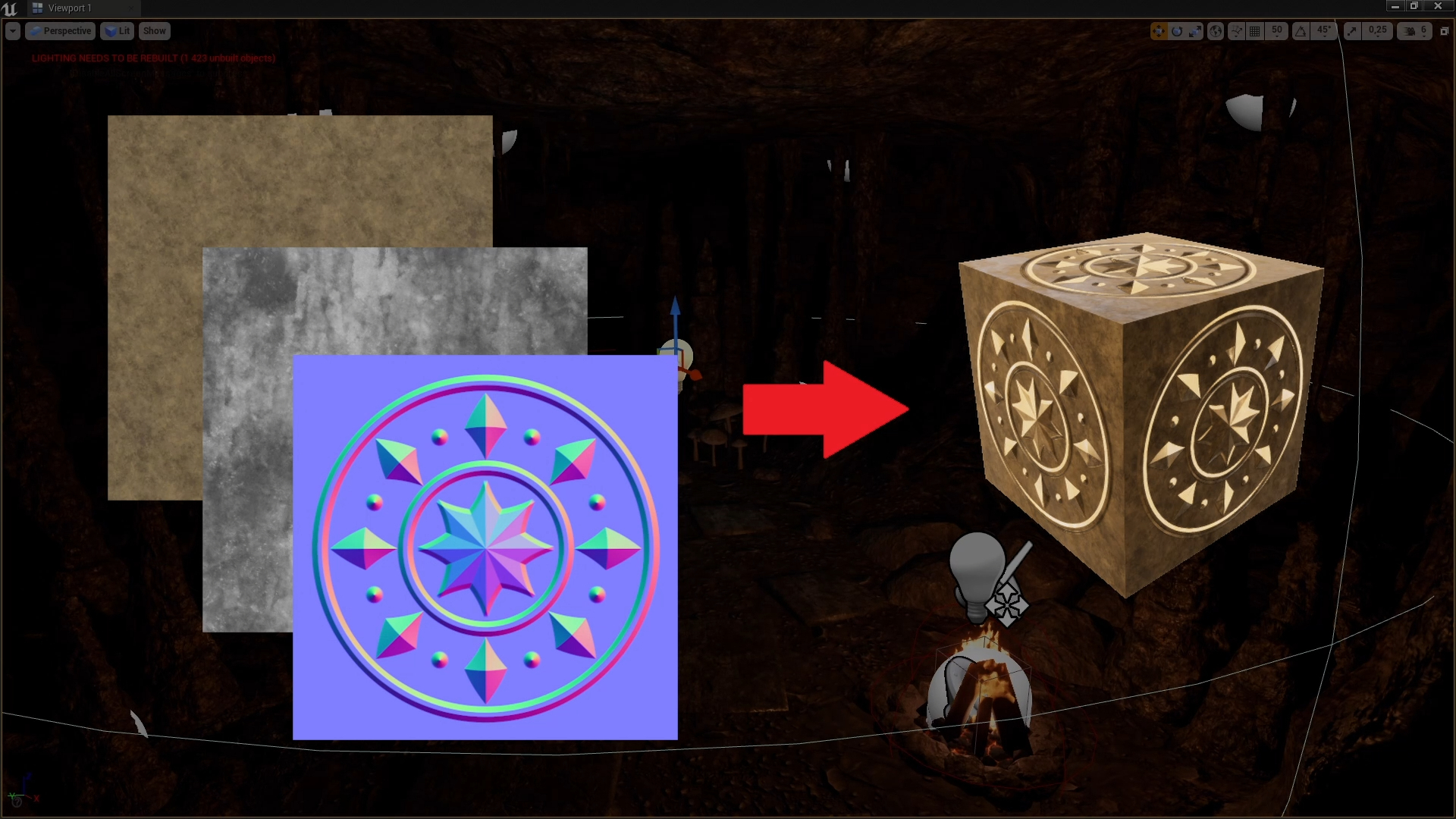
Now another way of optimization here is not only merging the meshes, but also merging the materials. I won’t go into much detail here, but a very simple and effective way to do this for static environments is vertex painting. Essentially, what you are doing here is applying a mask to the mesh, that tells the material on which surfaces to display which textures and how strongly to blend the two.
And now instead of having two draw calls for let’s say a ground material and a wall material, you only have one material including ground and wall textures, and as such one draw call. And that is quite significant because that’s at least half the draw calls for an object. You can expand on this technique by using RGB and alpha channels for vertex painting as well, giving you access to four different surfaces in a single material. So optimizing your materials and meshes in this way is like a gold mine in terms of draw call improvements.
Now, the other problem, the lightmap sizes, can largely be solved hand in hand with the aforementioned problem. I mentioned separator walls before: Most minor building blocks were built to be used on the edges of the grid system. So for example, most walls were not just one-sided objects, but actual two sides walls. This is great for prototyping, but not so great for performance. You have an easy time blocking out environments fast, but a lot of the walls’ surfaces will end up facing out-of-bounds areas.
That’s a waste of lightmap space. So not only would I replace multiple meshes with singular merged meshes, but I would also, wherever possible, remove these two-sided walls. Depending on the level this brings down the lightmap size significantly.
So far I have done this whole optimization procedure for the Heartlands and the results are showing. The average draw calls now sit at a convenient 2000 per frame, which is, if I remember correctly, roughly in line with what’s recommended in Unreal Engine’s documentation. I still need to optimize the later areas in the game but with the new meshes, a lot of work has already been done in this regard.
I also tested these new, optimized meshes by creating a few mini-dungeons. One of these was expanded into a new tutorial section, which will also be included as a starting area in the next patch.
This change went hand in hand with a minor restructuring of the general area progression that I wanted to do for a while. The demo area you know was moved to a later point in the game.
Besides these changes in level design and performance, I also made sure that most of the character voices are done by now. One thing that should maybe be highlighted here are the wastelander voices. These guys now have their own language, including a legitimate vocabulary, which can be, if you are attentive enough, translated throughout the game.
Some new music is also in the works and should be done before the next patch.
Originally I thought that Beta Update 4 would be a little smaller, since it’s technically just the main hub and the main quest, but I think that preponing some performance polishing tasks was a good idea, because it makes the beta testers' job easier as well. Otherwise, I would have started this process directly after Beta Update 4 so practically no harm done timewise. Performance polishing should actually happen continuously, so the sooner and more often the better.
Anyway, I’ll go back to finalizing this patch now. It shouldn’t take long anymore. Out of all patches, I’m probably the most excited about this one so far, because the full experience is now coming together really well and certain new elements, like the voices and combat music, really help immersing yourself in the setting.
So, I’ll keep you updated and see you soon!
Monomyth - June Update
Hi, dungeon-crawling fans!
The latest video devlog is finally ready! This month we are taking a look at the last beta area and we will be listening to a short snippet of the combat music. If you keep your eyes peeled, you can even catch a glimpse of the game's crime system and its (currently minimal) implementation. But we will get to that in another update. Please, enjoy:
As always you will find the transcript below!
Best wishes, Michael
--------------------------------
Hi, dungeon-crawling fans!
The development of Monomyth is steadily progressing! I am still working on beta patch 4, which should be ready within the next few weeks. As I told you last time, I already added a bit of beta 4’s content in a small interim patch, most importantly the new trading system. So let’s take a look at what happened since then.
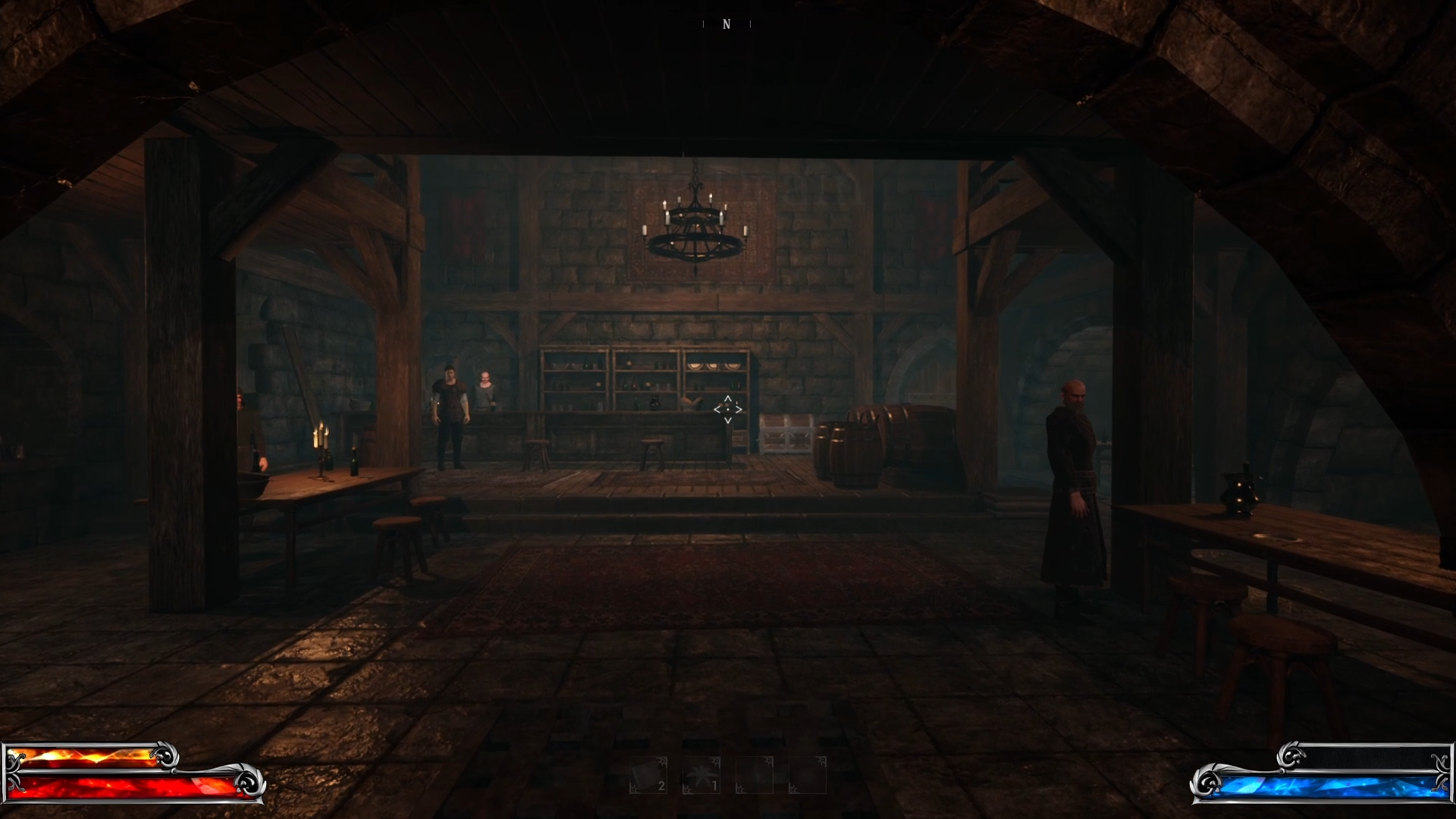
I spent a good amount of time on getting the game’s main hub done. The inner fortress of Lysandria will serve as a base for your dungeon-crawling adventures below. It will be filled with shops, taverns, regular dwellings, slums and places of worship. Guards patrol the streets, NPCs populate every corner - it’s a real little underground city. You can get a drink or you can get your armor fixed. I even thought about arena fighting in the lower city tavern, but I am afraid that’s currently beyond the scope of the project. All in all, I had more ideas than I could realize and in the interest of time, I cut things down to a manageable size here and there.
The geometry of the place is basically done, as well as detail passes for most dwellings. I try to integrate some optional secrets and challenges here and there. For example, you are not supposed to enter any of the high city dwellings. These are guarded and off-limits for outsiders, but that doesn’t mean you can’t try going there. Just watch out for the guards.
It’s details like this that make a regular hub to replenish your resources, into an actual immersive game environment and I am trying to focus on that as well.
Of course, there will also be quests, it’s a social hub after all. Consequently, you will see some opportunities to use your social skills. Particularly the speech skill, which also comes in handy while trading with NPCs. The inner fortress of Lysandria is populated by a variety of characters, each with their own problems. Since you are an outsider their trust is hard to earn, but the rewards will help you in your search for your brother and the divine gift.
Naturally, the inner fortress will also play a significant role in the game’s main quest. I implemented about two-thirds of the main quest’s logic by now. It still lacks a few steps, which I hope to finish in time for the open backer beta. Generally speaking, it will be playable right up until the last chapter, which will be added together with backer contents.
Besides working on the new area, I also worked a bit on AI. More specifically, I made sure that combat notifications work properly. On a technical level, this only means that the player logic is properly notified if it is recognized by a hostile character’s perception system. In practical terms, this means I could finally add some combat music plus victory and death jingles.
In the next few weeks, I will probably make some changes to the regular environment music as well. This will be part of a bigger polishing phase after beta patch 4.
Additionally, I started working on basic voiceovers. Of course, there won’t be fully voiced dialogues in Monomyth. That would be way too expensive. However, you will see, or rather hear, voice cues for greetings, trading, idling NPCs, perhaps combat taunts, and so on. I have instructed a few voice actors to speak some lines for the game and if they are used sparingly enough it will give some more distinctive character to the game’s NPCs. Generally, we are now entering a phase of development, where I can focus on giving things a little more edge so the game stands out more. I hope I can also improve a few things in terms of aesthetics.
So anyway, what’s still to do concerning beta patch 4 and where do we go directly after that? As I said, the area is mostly done, but there is still some work to do in terms of characters. I still have some writing tasks open as well as quest logic related to that. Apart from that the new area still requires proper item distribution and it needs a few shortcuts, for example, to another part of the game. The inner fortress is already properly connected to the fast-travel system, which makes it easier to return and stock up on items.
Once all of these things are done, the patch will be uploaded to the beta branch and beta testers will be able to play it shortly afterwards. With that, we will finally enter the polishing phase. I have a handful of topics I want to go through during that phase but most importantly there will be a quick rework of the first two areas, performance improvements, a combat update concerning mechanics and animation, and an encounter update concerning enemies and challenges in general. I believe I will release these improvements in a series of small patches with a significantly faster iteration time than the current beta patches.
Once polishing is done we will quickly start into the open backer beta and see what kind of bugs you guys can still find. After fixing those I will try to get the game ready for the general audience as soon as possible.
So anyway, lots of work done, still lots of work to do. I will get back to it and keep you updated! See you soon!