

Norland
Postponing the release
There are many reasons, but mostly the problem is the complexity of planning when creating new mechanics.
Good news: The current build is liked by the testers, the game seems to be fresh and interesting.
Regards,
Norland team
#10 Norland Devlog: Combat system
Hi all, lets talk about Norland combat system.
Have a good read!
In thinking about the design of the combat system, we considered the following circumstances:
1. On the one hand, each character is unique and has his own behavior. It's not just a unit in RTS that has a few parameters, a life bar, and is forever standing around waiting to be sent out to attack. This approach leads to a detailed management of weapons and armor of each character and their individual management.
2. On the other hand, we have a lot of units, and the battles are quite massive, so calls for unit management and a simplified weapons system.
3. Also, such a system with a large number of unique characters is quite difficult to balance.
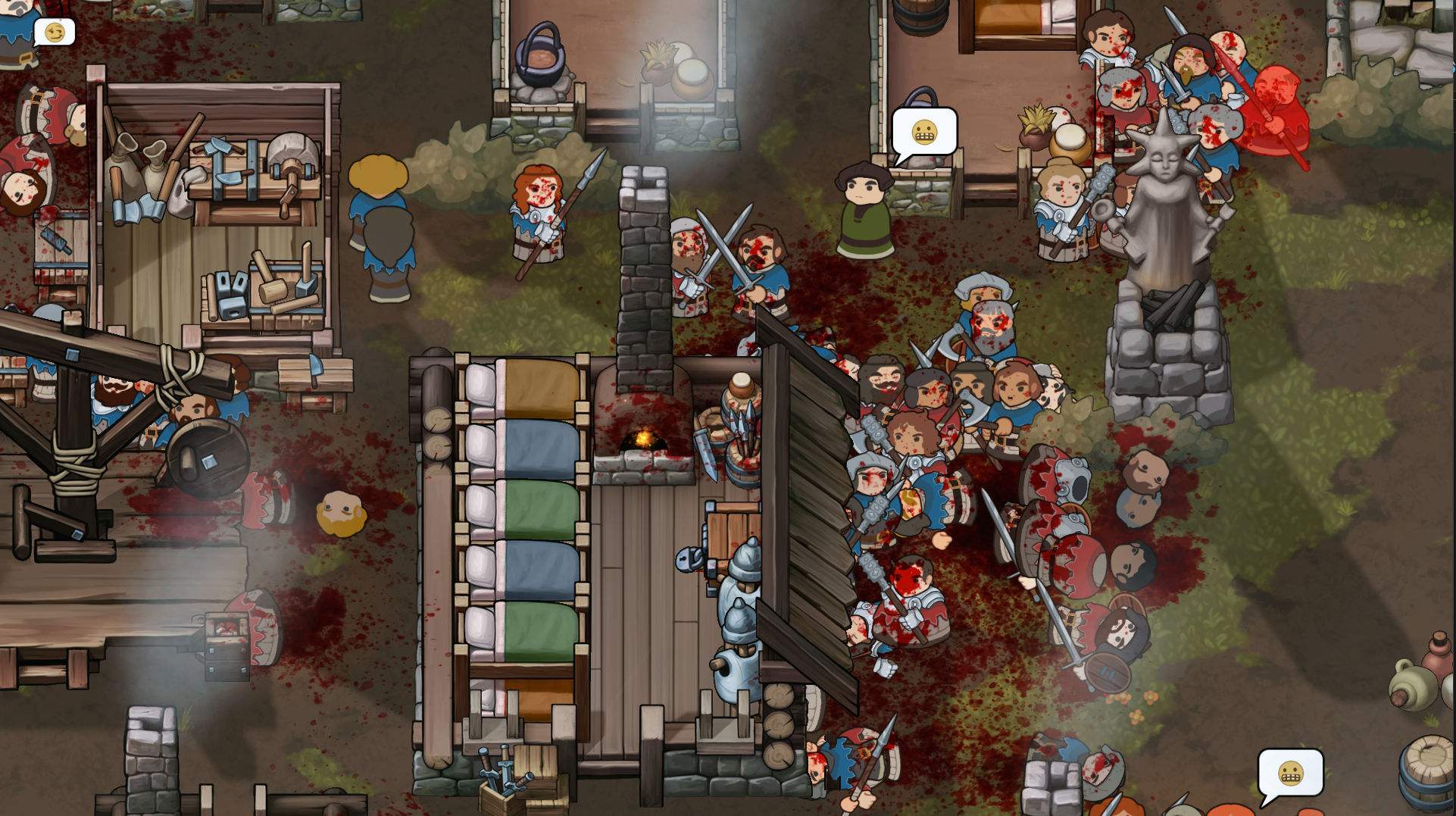
What have we come to after much experimentation and rework?
Weapons and armor have no parameters in the usual meaning of the word. It works the following way: each weapon has a set of injuries that it can inflict (bruise, bleeding wound, destruction of enemy armor, breakage, stun, and so on), and each injury has a number of "tickets" that are added to the virtual "bag" and are pulled from there at a hit. The more "tickets" an injury has, the more likely it is to pull out. At the same time, "hit reflected" tickets from the defender's armor, and "hit parried" tickets are added to the same bag (the number of the last depends on the difference in the fighters' combat skills).
In addition:
1. Basically, combat is turn-based. Characters choose an enemy to attack, and then exchange 1 to 3 hits one at a time. Each hit can be blocked by an opponent's weapon or armor, or just miss the target. If they attack an already fighting character, making up the numerical advantage against him, he can not actively block hits.
2. The game has 6 types of weapons plus the ability to fight with his hands, as well as two types of armor and shields. Weapons and armor are destroyed in the fight, but this does not eliminate their chances to win - the characters can take out daggers, hit with shields or go to the melee.
3. All characters have a pain level for a wound. If the pain level exceeds a character's mood, that character will try to run away.
4. Morale modifiers like death of the commander or the closest member of the squad, as well as the bleeding and knocking out system add variety.
5. You can hire mercenaries with a ready-made weapon (they can't change weapon types, in fact they have stable classes), or arm your unemployed peasants with weapons from your warehouses - in this case, you better train them before throwing them into battle.

6. Each weapon has special features. Spears are cheap and deadly, but they break easily. Maces are comparable in price, they are stronger and can knock out an opponent, but inflict more bruises than stabbing and slashing wounds. Axes destroy armor, and swords give extra protection when parrying.
7. Unfortunately, the implementation of complex units, such as horsemen or catapults, looks quite problematic in this system. This raises a lot of complex issues and potentially a lot of unnecessary micromanagement (When does the rider get on the horse? When does he dismount? What does the horse do in peacetime, and what if it's far away from the rider? What if the horse is killed but not the rider, or vice versa? What if there aren't enough horses for all the riders, and the squad moves slowly? Etc.)
8. We are thinking about unique weapons, which the lords can extract in quests on the global map, but have not yet reached this point.

As for balance, since the system is basically turn-based and synchronous (i.e., as I wrote earlier, hits and their blocking occur in conjunction, two fighting characters do not stand and just beat each other), this allowed us to make a model simulator in which we can conduct tens, hundreds or thousands of virtual fights between any combination of weapons, armor, combat skills and morale. This allowed us to balance equipment at a basic level, although as the tests show, this is only the beginning, since the model does not take into account group effects and combat duration.
In any case, we are happy with the current model and will continue to polish it.
Wishlist Norland and stay tuned!
#9 Norland Devlog: Economic model
Hello and welcome to our devlog in which we're talking more about Norland economic model.
Have a good read!
In Norland we have taken as our basis the stage of social evolution, when a tribal colony of 10-15 people transitions to a more populated (up to 200 people) and therefore more complex social structure - an independent city, which has not yet turned into a state. Thus, our economic basis is the city-builder model.
The model we have, it seems to me, corresponds pretty closely to the society in which mankind lived in the early Middle Ages:
- Residents have personal property and money. It is possible to take it away, but it causes resentment.
- The inhabitants also have needs that are met by the consumption of goods. The better they satisfy them, the greater their happiness.
- They are free to come in and out of the city, depending on their happiness and the availability of jobs.
- Unhappy residents can also become criminals and rob others
- The player pays them a set wage for their work.
- The city has an internal market, where residents buy a number of goods for their needs at a price set by the player.
- Every few days a caravan arrives that can be traded with. Also, residents can trade with it as well.
- Caravan can increase the price of goods in high demand.
- Experienced warriors can be hired only for money.
- Infrastructure is built by the player.
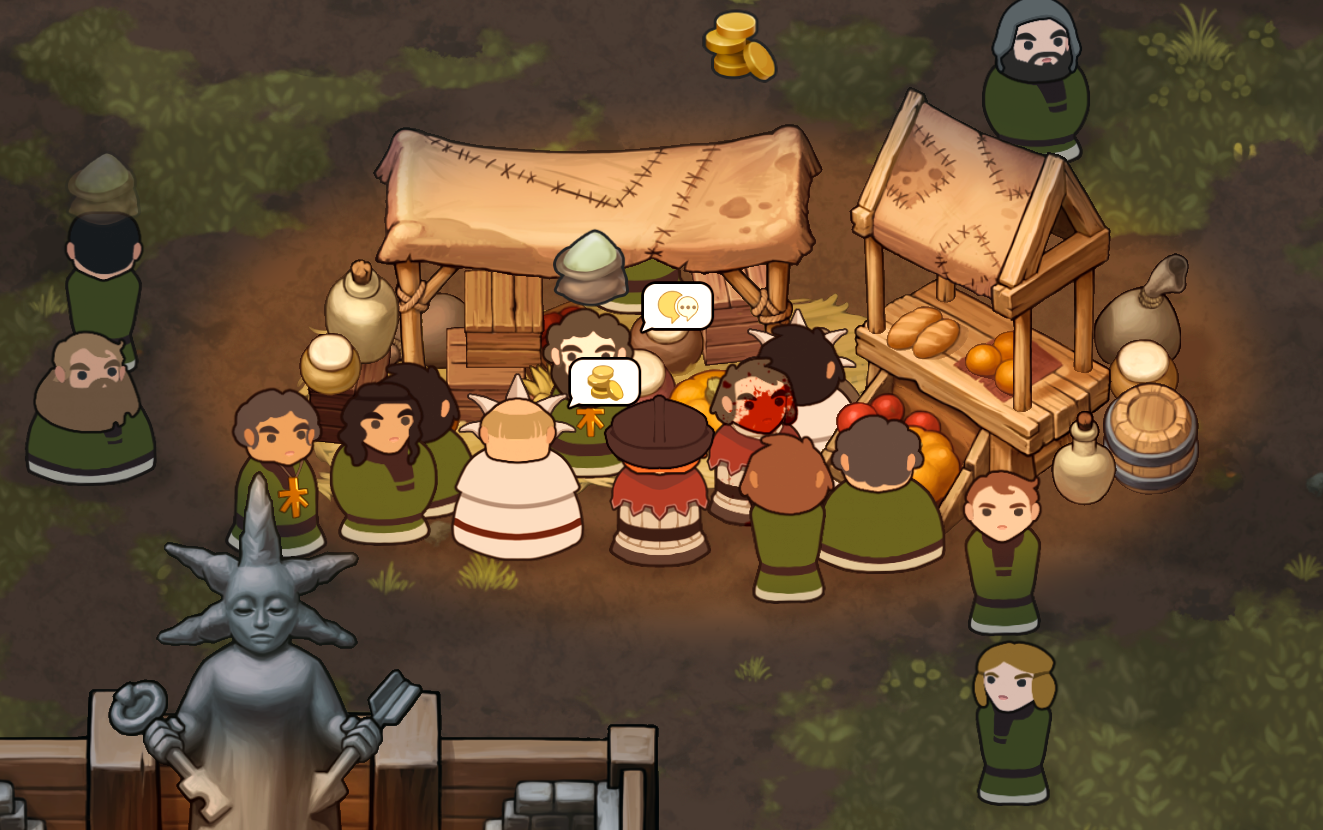
The source of money in this model is thus the caravan and immigration into the city (new residents bring with them savings), and the output is the emigration of unhappy residents and the constant hiring of warriors, who tend to die in frequent military conflicts. Residents also withdraw money as donations to the church, but that part is not very substantial.
That said:
- You can't raise the price of necessary goods, such as food, higher than the price from the caravan, otherwise the inhabitants start buying goods from the caravan and the money goes out of the economy.
- You need to get money out of the pockets of migrants coming in. To do this, taverns are organized where not only beer is sold, but also service - the residents socialize with each other and gamble. The price of beer can be higher than the market price of the caravan, because you can't buy the service of the tavern from the caravan.
- Taverns, like luxury, also work as agents of equalizing inequality - since it is not a necessity, only those with extra money go to them. This money can be invested in new industries.

The system evolves roughly along these lines:
- If money is constantly invested in new jobs, the flow of migrants increases, the economy grows. But one day, as a result of some cataclysm like a bad harvest, you will not be able to employ and feed the next wave of migrants. A lot of unemployed people form in the city, who soon become involved in crime. These are the kind of cancer cells that can destroy society.
From this point on, the city can begin to experience a crisis that is difficult to stop:
- Criminals rob the residents and they become miserable. The average level of happiness decreases, some leave the city, others become criminals themselves. There begins to be a shortage of workers, but the number of residents is still high - it's just more profitable for them to be criminals at this stage.
- At some point, fighting crime doesn't help, because it requires resources, and there aren't enough of them.
- The low number of goods produced and the high number of criminals continues to worsen the situation incrementally. Eventually the collapse comes.
How to deal with this?
- Option A is not to wait for the unemployed to become criminals, but to draft an army, hand them spears, and send them to their neighbors. Such an army won't do much war, but whatever it does, it will be profitable. And the former unemployed who were killed in battle are also not bad, less problems.
In essence, you become an aggressive barbaric society, constantly plundering your neighbors.
- There is option B - invest in knowledge and bureaucracy, increase the efficiency of production, and make a lot of money through intensive trade. But there is not enough money for all comers anyway, which means that it requires limiting the incoming migration flow, which creates migrants to go to the neighboring cities, acting on option A. This means that soon these cities will send the former migrants back to you, but already armed with spears. That is, this again leads to a war, but already defensive. It's good that you have money for good skilled mercenaries, but there are many more Type A cities, as their solution is easier.

It is almost a classic Malthusian trap: in this model, for all intents and purposes, society will inevitably go to war for purely socio-economic reasons. The only question is whether you will fight in foreign territories or in your own.
All this is based on another important condition - the pressure on the system comes from an external source of migrants, that is, somewhere out there they are constantly being born. In reality, they are born inside as well, but we neglect this conditionality in the framework of our model.
(P.S. Actually there is still slavery in our model, and in theory a slavery-oriented economy should lead to war even faster, but we have not yet tested that).