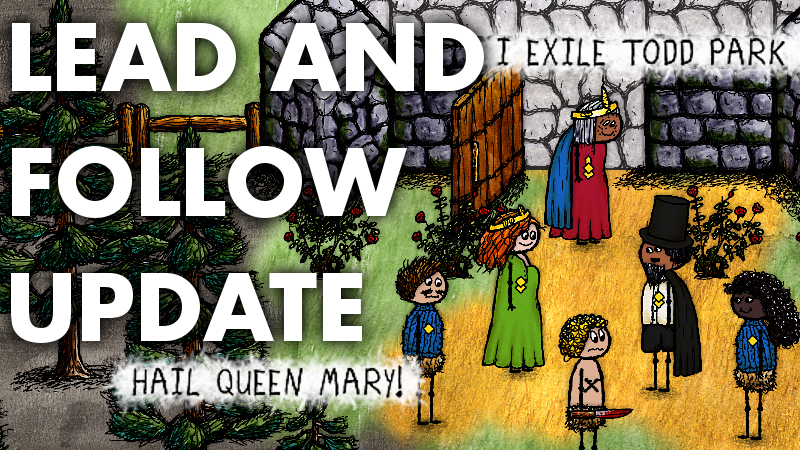
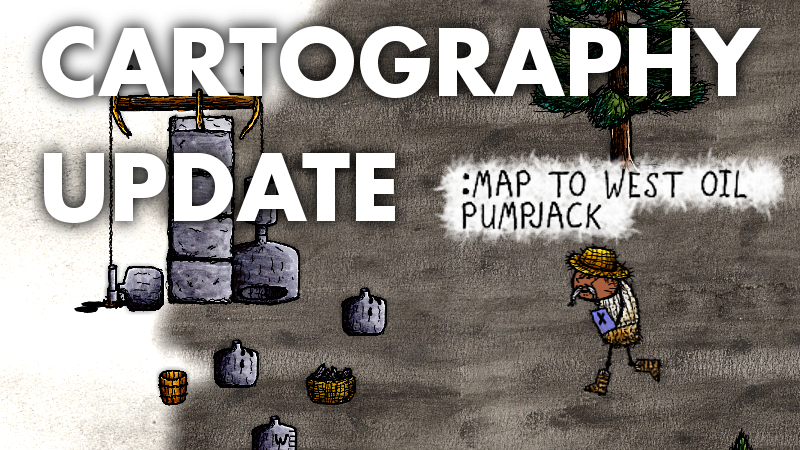
This week, we have an experiment in voluntary hierarchical leadership.
Each player can optionally pick one other player as their direct leader, by saying I FOLLOW SALLY SMITH, to follow them by name, or I FOLLOW YOU when standing near them. You can switch leaders at any time, and you can go back to having no leader by saying I FOLLOW MYSELF.
Following someone has absolutely no direct impact on gameplay, and is simply a source of information. People who have the same leader are marked as allies, and they wear the same color badges on their clothing. Leaders can follow other leaders, resulting in a dynamic hierarchy. Higher-order leaders have more elaborate badges and tiles, including Lord, Baron, Count, Duke, King, and several levels of Emperor. Your badge color is determined by the leader at the top of your tree.
Everyone can also exile other players at will by saying I EXILE SALLY SMITH, to exile them by name, or I EXILE YOU. This allows you to keep track of players that are causing trouble, and you will see a black X mark on their chests. I REDEEM SALLY SMITH, or I REDEEM YOU, allows you to bring someone back from exile.
The people exiled by leaders are seen as exiled by all of their followers further down in the hierarchy. Thus, information about troublemakers can be shared easily and efficiently. When a high-order leader exiles someone, a large group of people will all know about this person's status. Leaders can also be exiled, and any remaining followers are marked as dubious. An exiled person can appeal over the head of the person who exiled them, and higher-ups can override and redeem the exiles made by leaders beneath them.
When you're born, you inherit your mother's leader. You can change leaders when you are old enough to speak the necessary command.
When a leader dies, their followers are passed up to the leader above them, if any, and their list of exiles is passed downward to each of their immediate followers. In other words, the tree does the right thing automatically, behind the scenes, to preserve valuable information.
The inner workings of this system are a little complex, but on the ground, as one cog in the machine, you just need to make a single, very simple decision: who to follow, if anyone? And if you find yourself in a leadership position, you can also make decisions about who to exile. The tree will take care of the rest.
This system was inspired by forum-user Kinrany's post here:
In other news, the Bell directional arrow has been moved down from the top of the screen to a more visually pleasing location. Thanks to Twisted for pointing out that it was visually jarring up there.
UPDATE:
I just added an order system, where order messages get passed down through the leadership tree to followers. To issue an order, say something like ORDER, EVERYONE COME TO THE TOWN CENTER
Please note the comma in there. No comma, no order.
Your immediate followers will pick up the message whenever they get within 10 tiles of you, and their followers will get them message when they are in close proximity, and so on, until everyone in your tree has the message. As an example, you might be away at an outpost and then return to town. When you return, you will be automatically told the leader's most recent standing order. When you get an order message, it's accompanied by an explanation of which leader issued that order.
Exiled people do not see the message themselves, but do pass the message on to their non-exiled followers.
Also, in the original post, I forgot to mention the new verbal kill trigger feature. If you're holding a weapon and say I WILL KILL SAM JONES, you will enter the murder-mouth state against Sam Jones (or I WILL KILL YOU for the nearest person). There are a bunch of variations on this wording that work, too. The point is to allow you to start kill-chasing someone who is hard to click (maybe they just raced by on a horse), or to allow you resume a kill chase after dropping your weapon to eat. As another nice side effect: this kill state trigger is visible to everyone around you, so new players can learn how to do it (where shift-right-click is harder to learn).
Weekly Update #84
New this week, for a belated Thanksgiving: a feasting table, where you can serve yourself a whole plate of food. This takes advantage of the recently-added food overflow system, and is the first food source that offers +40 in one gulp, giving you a huge buffer of time before your next meal.
I spent the rest of the week making a dent in the very long list of issues that have piled up.
You now have a separate directional arrow, at the top of the screen, when you hear a distant bell tower ring. No more needing to dig up your home marker to follow the bell. A bug in lingering home markers from the last life has also been fixed. Some glitchiness in biome sickness have been fixed, along with an exploit that allowed you to plant biome-specific things outside of their target biome.
Eves were being spread out too far, because tutorial players and donkeytown players were advancing the next Eve position by accident, so that's been fixed. This should bring everyone a bit closer together. I Fixed a few confusing cases of tool learning (like when you're too hungry to use the axe, but learn it anyway).
There was a huge inaccuracy in the way that average lifespans were being computed as part of fitness score calculations. That has been fixed, which should dramatically reduce fitness score inflation, and all fitness scores have been reset back to 0.
There are still loads of issues left to fix, and I'll be focusing on those next week. Thanks to all of the people who spent so much time reporting them. Keep them coming. If I don't know about them, I can't fix them.
Please consider nominating my game for the Steam Awards this year.
Thanks!
--Jason
Weekly Update #83
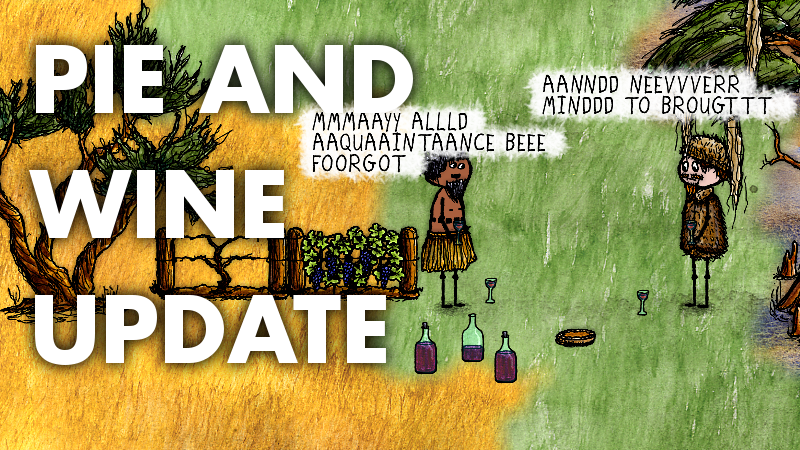
As a mini-update before I start my much-needed family vacation, I give you pumpkin pie and wine.
Have a great Thanksgiving, everyone!
Weekly Update #82
This week's update focuses on new ways to find each other, in light of the fact that you now need each other for long-term survival.
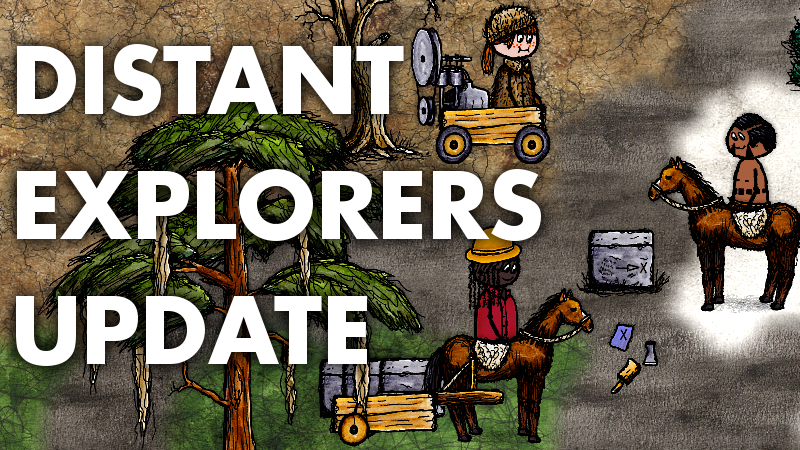
First, there's a new tool in place for sharing long-distance navigation, and for helping people find your village. Way stones were inspired by forum member SirCaio's suggestion. They act like permanent maps that anyone can use simply by touching them. If you're looking to interact with foreign explorers, you can make your village easier to find by planting way stones in a radius around it. Just like maps, way stones can have long titles, which means they also can function as informative sign posts. Way stones can also be used to duplicate maps, but they can also be used in village center to make sure that important destinations are known to future generations---no chance of the map getting lost if it's literally etched in stone.
And now, when you pick up a map or touch a way stone, your character speaks a distance estimate along with the title. No more wandering in a vague map direction and figuring out that it's actually too far away.
Next, rideable objects, like horses and cars, protect you from the effects of bad biomes. No more long, circuitous routes. If you're riding, you can plow right through.
Along with these exploration updates, there have also been huge improvements to wall-building.
First, pine walls now require a lot less resources, and pine floors are possible, making them viable for early-stage camps. Being indoors adds a huge reduction to your food consumption rate, so building a few primitive buildings might be worth considering as part of your bootstrapping.
Next, all walls now auto-orient, freeing you from the tedium of cycling through the various wall orientations when building. You can put walls down wherever, and your building will look nicely connected, guaranteed. Fences also auto-orient, even relative to walls.
Finally, springy doors now open automatically when you pass through, and they don't interfere with path-finding. Being indoors is no longer a navigation inconvenience.
Beyond those content changes, a bunch of bugs have been fixed, and an exploit in the fitness score system has been cleared up. Committing suicide when young no longer allows you to reap a score benefit from a long-lived mother. Your mother and grandmother still count toward your score, but only if you live longer than they do.
Even with this exploit removed, some rather high scores are possible, and such scores make the tool slot limitations irrelevant. I've updated the mapping formula to a sigmoid, as shown in the following graph:
No matter how high your genetic fitness score goes, you'll never have more than 19 tool slots.
The recent Steam sale brought in a lot of new players. I'm deeply grateful to the existing players for helping all of these new people to learn the ropes.
There will be one more content update on Monday, and then I'm on vacation for Thanksgiving.
Weekly Update #81
The specialty biomes, which spawn sporadically in the center of the topographic map rings, include the jungle, arctic, and desert. In this update, each of these biomes is assigned to one specialist family skin tone---they are the only people who are comfortable working there. The other families must depend on this specialist family for help in getting necessary resources from this otherwise inhospitable area. Fortunately, the resources found in these special biomes aren't needed until the later stages of a developing civilization. Thus, families can live and work in isolation for a while before they are eventually forced to find each other and cooperate through trade.
While there are only three specialty biomes, there are currently four family skin tones. The fourth skin tone has no biome specialty, but gains the polylingual ability to communicate with all the other families, so they can help with the coordination and trading efforts.
The general idea here is that as your village climbs the tech tree, you should face new and more complex challenges, including challenges that involve social interactions like negotiation and diplomacy. Transportation networks between towns will go from an entertaining diversion to a necessary component for group survival.
Specialists can also build roads and buildings in their biome to make it traversable and hospitable for other families, so trading posts and gathering areas are possible.
To go along with these changes, some new content has been added in these biomes, with a new biome-locking feature ensuring that you have to visit those biomes to interact with that content. For example, you have to visit the jungle in order to get a tattoo, and only a jungle specialist can perform the procedure for you.
The language learning system has been changed so that it always happens gradually over generations of cohabitation, at a fixed rate, and it can't be "forced" by spamming lots of training text to a baby. As long as a baby hears a single utterance in the foreign language, they learn 10% of the remaining unknown letter clusters. Even after many generations of living together, some interesting accents will linger.
A huge set of loading stability improvements have been implemented. What happens when the data files the client is expecting to find aren't present or are corrupted? It used to crash, now it doesn't.
The genetic fitness score has been overhauled to give you points based on how long you help your offspring survive beyond their own personal average. Thus, you don't get punished for having a novice baby who dies young, as long as you help them live a bit longer than they usually do. Genetic scores are much less impacted by luck in baby assignment now, but they are also unbounded in both the positive and negative direction (the scores used to naturally cap themselves between 0 and 60).
Boundless World
Thank you for your patience during the long-running Arc and Rift experiments, which have shed light on a number of important design issues and improved the core of the game immensely. The list of Rift-based discoveries is long, but to summarize, we have a better biome map layout, a more balanced birth placement algorithm, a tap-out system to ensure upper-end resource scarcity, a more powerful and intuitive cursing system, and a map system.
It's time to test out these improvements on an infinite map and in a perpetual world, shifting the focus away from community-wide story arcs and back to individual family arcs, happening in parallel. The full reasoning behind this change is described here:
Eves spawn into this boundless world whenever they are needed, when there are too few families or too many babies for the existing mothers to handle. These conditions occur rarely, so a new Eve will be a special event. The privilege of being Eve is granted to a player with a relatively high genetic fitness score. Eves are placed in a zigzag pattern spreading out to the west, which looks like this:
Thus, to find older villages, you can walk to the east, while walking west will take you to the frontier.
Each water well and oil strike taps out ground water and oil in a radius that matches this Eve placement pattern, meaning there can be roughly one water well and one oil well per Eve settlement, though distant resource outposts are possible.
The map has been set to never cull anything, except for during server updates, when areas that haven't been visited in a full seven days are cleared to conserve database space. Thus, in active areas, perpetual road networks are possible.
Things will obviously end up being more spread out than they were in the Rift, so the plane will become useful again. To make the plane more reliable, your destination can now be set by looking at a map immediately before taking off---you will land at the closest available landing strip to the map's destination.
With genetic fitness scores mattering more than ever before, the question becomes: how long can you keep your offspring alive, and what will you have to do in order to keep them alive? The resources in the immediate area surrounding a family's home base will run out. Survival beyond that will require quite a bit of planning and coordination.
The wastefulness of high-value food items has been reduced, because adults now have a large overflow store to accommodate the last food item that made them full. This overflow area starts small and grows along with your stomach size, so young children still have a tense eating game. This also helps to differentiate low-value food like berries from high-value foods like pies. Munching four berries is no longer equivalent to eating a piece of pie, because the pie can fill a larger portion of your overflow store. This graph shows the size of your overflow store, based on your stomach size:
Indoor areas have been buffed by applying a flat time-per-food-pip bonus while indoors. Being indoors makes you burn food much slower, no matter your heating or clothing situation. Mousing over your temperature meter now gives you information about your current food burn rate.
When a well or oil strike taps out neighboring areas, gradient markers are now left to the north and south as well as to the east and west, making finding the well easier.
The kill-spam bug has been fixed. In order to target (or re-target) someone, you must first drop your weapon.
Weekly Update #79
Off-screen speech is now shown on the bottom, left, and right of the screen, not just the top. When you are targeted by a killer or posse, you can tell that they're coming for you by the double-! for their off-screen sounds (posses coming for other people have single-! for their off-screen sounds). You now GASP when targeted, along with making the usual shocked face.
The kill-target swapping bug has been fixed, and the waiting time before landing a kill has been increased from 3 seconds to 6 seconds, giving your victim more warning.
Babies are now truly helpless for the first 12 seconds of life.
Springs and tarry spots are now on the same 40x40 grid of ley lines, so they're both plentiful and easy to find. Tarry spots now use a similar area-based tap-out mechanism. After tap-out, dried springs and tarry spots provide gradient directional pointers to help you find any well along that ley line.
The jumpiness of genetic scores has been reduced by around 4x. This makes it harder to climb to the top, but easier to stay there once you get there. After around 100 offspring have been factored in, your genetic score very closely approximates the average lifepan off you and all your offspring, and players of different offspring-preservation proficiency are cleanly differentiated by score (before, the scores were so jumpy that there was a lot of score overlap between players at different proficiency levels). Mothers and grandmothers now count toward your own genetic score, closing the matricide genetic score exploit.
Weekly Update #78
You now have between 8 and 16 tool learning slots in your lifetime, depending on your genetic fitness. Each tool that you learn consumes one of your slots. You can't learn everything, so you must chose carefully and coordinate your efforts with those around you.
A more complete explanation of this idea is described here:
One of the arcs last week was much closer to being the gripping, collective story that I'm trying to create. Someone built an Endtower near the center of the map and surrounded it with a maze full of locked doors. While some players tried to protect and rebuild the Endtower to usher in the apocalypse, others grouped together and used locksmithing techniques to chip their way into the center of the maze. I've always hoped that this kind of player-created quest would emerge.
But how do you find your way to this maze? Once you find it, how do you tell others how to get there? And how many interesting mechanics are available for a would-be maze builder?
The new map-making feature allows all kinds of interesting interactions. You make a map by standing in a target location and speaking a title while holding the map and a piece of charcoal. After that, whoever picks up the map will automatically adjust their current navigation point to that destination. Like any written piece of paper, maps can be stored in backpacks or locked away in chests. They can also be erased to be reused, or made permanent with the help of an elder.
I'm still working on that whole "oil eventually runs out" thing, and as I do, maps will be helpful to locate and exploit the remaining oil resources.
But in previous arcs, I realized that oil was never even necessary for long-term water pumping, because more low tech wells could be built when the first set of them ran out. Yes, spring heads are far apart, but not that far apart. They need to be somewhat close together to give you enough options in terms of settlement locations. But as a result, the rift has hundreds of them, which is just way too much water if they are all exploited with low-tech wells.
To solve this problem, building a well on a given spring head now permanently taps out neighboring spring heads in an 80-tile square radius. Think of a long straw drinking your neighbor's milkshake. Now instead of hundreds of exploitable spring heads, there are at most dozens. By tweaking this radius in the future, I can adjust the amount of low tech water available without reducing the number of viable settlement locations.
Hopefully, we're getting closer to low tech water actually running out, and thus dependence on oil for high tech water, and eventually oil itself running out. My goal for the game is that a village always needs to be on its collective toes.
You probably noticed that backpacks stopped decaying a while back. My general design philosophy here has changed a bit. Instead of an endless supply of resources that allow you to constantly re-make old and broken things, I'm more interested in forcing you to make difficult choices with a limited supply of resources. The non-consumable things that you decide to make can last forever. But did you make the right thing at the right time?
Backpacks were still hooked into a vestigial piece of the old, infinitely-regenerating resource system. After making one snare, you could catch an unlimited number of rabbits with no further resource inputs, and rabbits were respawning almost hourly. Rabbits also represented one of the last few infinitely regenerating and resource-free wild food sources.
As a result of this mismatch, in a recent arc, I personally visited a village that had 50 surplus backpacks stored away. Backpacks were so plentiful as to be worthless. Nothing in this game should be worthless. You should never make something without carefully weighing the costs and benefits. Backpacks had very little cost, so over time, many generations of villagers had made them until they collectively had amassed a whole pile of them.
Snaring rabbits now has a resource input, in the form of bait. This is is one way that people actually do it in real life, as I'll let this gentleman from Kentucky explain:
https://www.youtube.com/watch?v=Jk6FgpbQwck
Bait can be made either from a finite natural resource or a cultivated food resource that requires water to grow. So rabbits are now part of the water resource economy, as they should be.
There are also a bunch of little fixes. The posse speed-boost exploit has been fixed, and some glitches with the blue hint arrows have been cleared up. Framerates in cities with lots of floors has been improved on slower graphics cards.