Announcing Release 1.6 - In-situ base module manufacturing, and beyond
Crude base manufacturing
The Moon harbors ample metal, as well as in the fixed parts of landers, which some of you may have noticed tend to occupy a significant space over the years. Our next release, R1.6, will focus on metal manufacturing.
To source metal, Release 1.6 will introduce mining of asteroids on the Moon surface. Asteroids, predominantly composed of metal—especially iron—provide an easier metal source than lunar regolith. Another method will involve disassembling the fixed parts of landers in a specialized workshop equipped with dedicated tools. A beneficial side effect of this is decluttering the space around your base.
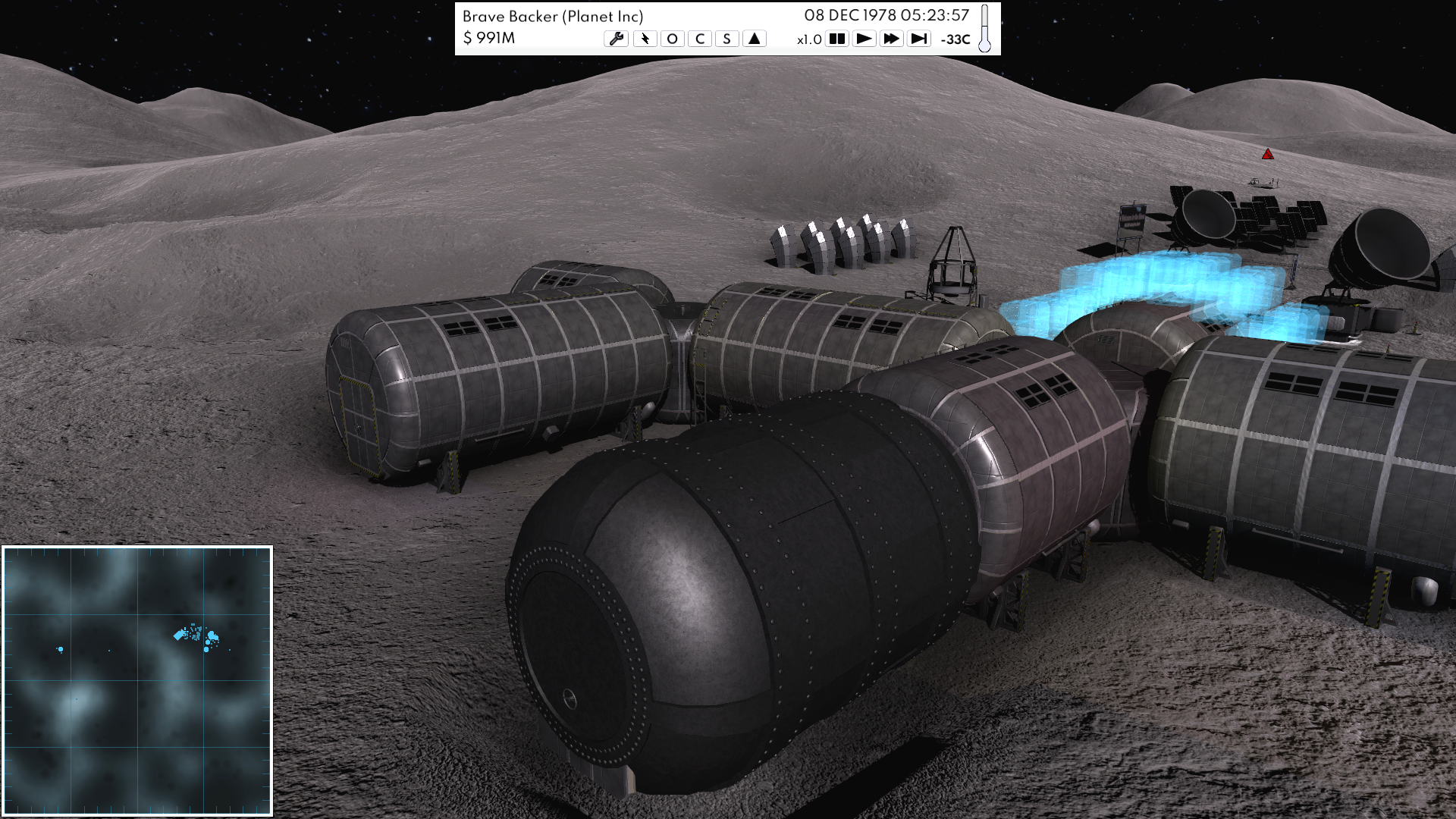
The retrieved metal will be processed in a basic smelter to produce small, molded parts, which can then be assembled using simple techniques such as riveting. My inspiration comes from late 19th-century metalwork used in submarines and steam engines. Manufacturing a structure capable of withstanding 1 bar of pressure is surprisingly feasible—considering the constant pressure environment. For context, the plumbing in your home handles much higher pressures and is often quite old. Fatigue issues in airliners mainly stem from the compression/decompression cycle. The new modules will adopt a steampunk aesthetic with visible rivets, and will be heavier to compensate for the material's inherent characteristics. The steampunk aesthetic of 19th-century steam engines in our in-space manufacturing isn't just for show. Initially, space manufacturing will have to contend with lower-quality materials and limited tooling—similar to the challenges faced by the pioneers of industrial metallurgy two centuries ago. Those modules will require a kit with all complex parts to be shipped from Earth, which will still be lighter than shipping entire modules.
These modules, being less secure than other base structures, will be designated primarily for hydroponics. They may need to be sealed off in the event of leaks, a factor to consider in your base layout.
Additionally, I plan to introduce frames for solar panels that can be locally manufactured. You'll only need to add a kit consisting of photovoltaic cells and a small engine to create functional solar panels. I'm also exploring the possibility of crude battery manufacturing by combining a light Earth-shipped kit with local materials.
R1.6, slated for release this summer, will not only focus on these innovations but also include bug fixes, quality of life enhancements, and graphical improvements. I eagerly await your feedback and suggestions to help prioritize and address the most crucial issues.
Long-term roadmap and how you can help
My goal is to develop Outer Space Shack as a long-term project. You can support this vision by purchasing the game now rather than later. If you've already bought the game, leaving a review on Steam would be immensely helpful, as reviews genuinely make a difference.
There's plenty to do in terms of adding new features, from technologies to game behaviors. I've outlined plans for local manufacturing of components as the next technological advancement. Initially, this will include basic modules for hydroponics and solar panel frames, but it will evolve in sophistication over time. This includes realistic limitations on what can be achieved without needing to transport a $100B factory from Earth. A significant focus will be on improving materials since most metals we use are complex alloys, and finding a source for plastics is crucial. I'm also exploring how a small-scale electronics component industry could be developed on the Moon, despite anticipating some limitations. Plans include adding aluminum and oxygen mining from regolith and uranium mining to ensure a steady energy supply. These enhancements should allow for base expansion without the high costs of Earth shipments.
As bases grow, gameplay will evolve to include societal dynamics, transitioning astronauts from short-term visitors to long-term inhabitants. One feature I've promised my children is the ability to have children born in space, which will require perfect radiation protection and dedicated children's areas. More social and leisure spaces, larger nature-infused areas to avoid feeling confined like in an airliner or submarine, and equipment with artificial gravity to keep astronauts in good shape for potential returns to Earth are also on the agenda.
Currently, the game includes scenarios on the Moon and Mars, with Mars particularly deserving attention due to its specific resources, such as iron and large-scale water ice mining. Carbon is also abundant on Mars.
Looking further ahead, I'm considering adding new locations. An ice planet like Ceres, with gameplay centered around asteroid mining, is next on the list. I'm also researching the feasibility of settling on Jupiter's moons and Titan, although I have reservations about the realism of settling in such environments. Other moons of Saturn might be viable alternatives. Expanding the playable terrain is also on the horizon; currently, about half a square mile is available, but I anticipate needing more space within a year. Another future extension could include multiple bases with inter-base trade, especially outside Earth's gravity well.
Expanding the game in this niche of easy-to-play, realistic space colonization is a significant commitment, and your support through game purchases and reviews is crucial. If you're considering buying the game, doing so sooner helps support future development. And if you're inclined, leaving a review would be greatly appreciated.
Release 1.5 is live
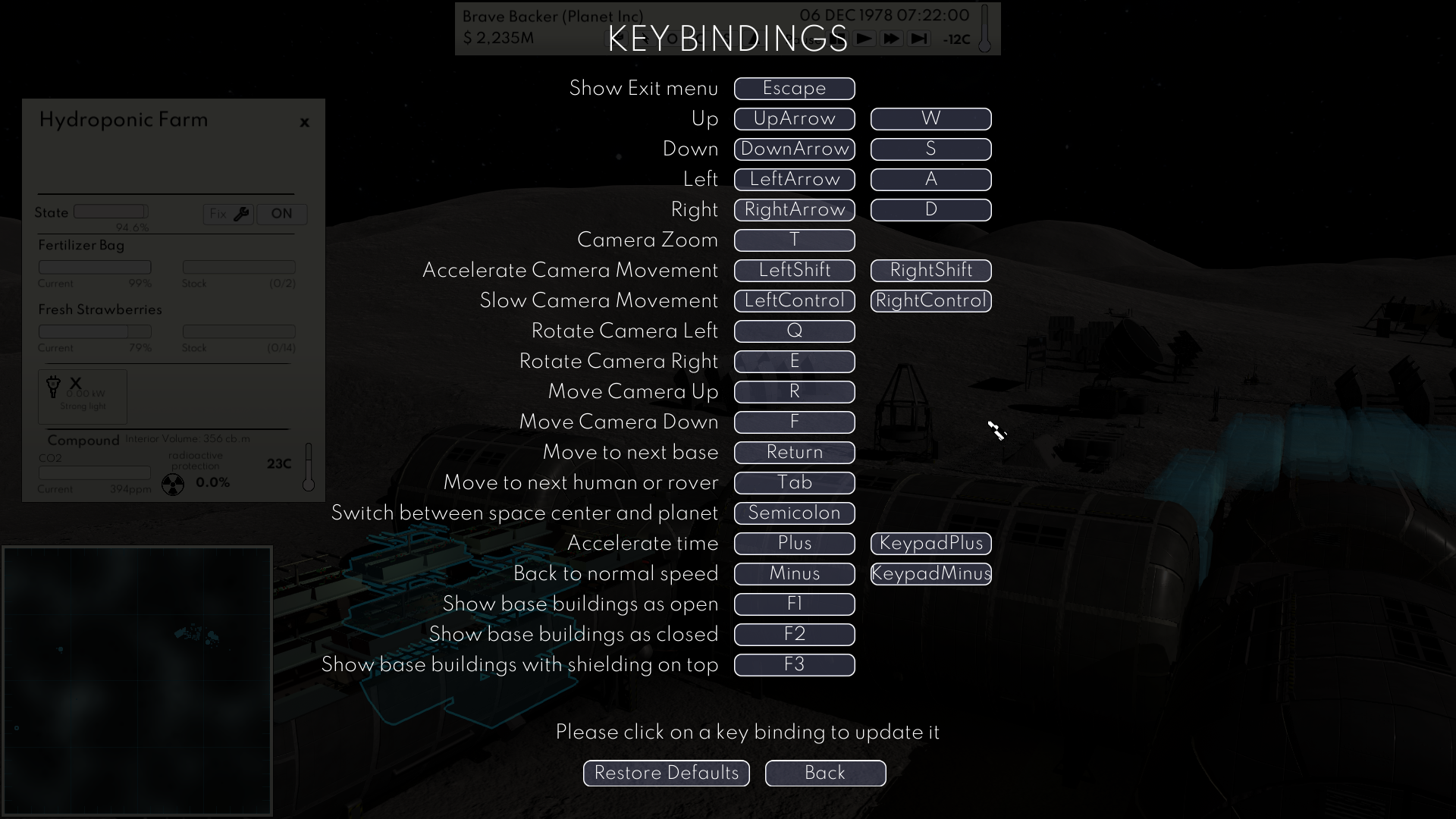
Release 1.5 focuses on enhancing quality of life and addressing feedback received. New key bindings allow players to customize keyboard shortcuts to their preference, which are saved and can be reset as needed.
Unfortunately, astronauts sometimes perish in the harshness of space. Now, deceased astronauts are commemorated in the Space Museum and promptly replaced by a rookie astronaut.
We've improved object selection visibility by replacing the previous rectangular UI with a clear silhouette outline of the selected objects.
Task management has been enhanced significantly. Players can now set astronauts to a non-working mode, where they will only perform self-care tasks. The task management screen has been updated to allow right-clicking to view or manually assign workers to tasks. While the automatic scheduler efficiently prioritizes tasks, manual control lets advanced players optimize operations and respond to urgent situations.
Additional updates include the elimination of the day-night flicker in the space center when the game is sped up, displaying the number of available seats on a lander, correcting save issues with astronaut temperature, introducing new navigation shortcuts in the space center, and removing false-positive speed-up warnings.
Release 1.4.1
This update addresses a bug that made it impossible to save a game a second time after loading a save file if a water sensor was installed and its associated prospection task had been completed. With the latest version, what appeared to be corrupted save files can now be successfully loaded, and further saving is enabled.
Release 1.4 is live
Release 1.4 of Outer Space Shack is officially live! This update introduces an innovative feature: paths constructed from regolith tiles, designed to significantly speed up the movement of landers and astronauts. Additionally, we're unveiling a new outdoor refuge, providing a secure haven for expeditions distant from the main base. An enhancement to the solar kiln now allows it to utilize surplus electricity and heat, ramping up the production of regolith tiles and blocks by up to threefold. Furthermore, we've bolstered stability and performance across the board with over 50 comprehensive fixes. Dive into these exciting new features and improvements for a smoother, faster space base-building experience.
Complete feature list:
Add Path element tile to solar kiln
Allow placement of path element only if slope is manageable
Allow placement of path element with slope
Add appliance outside shelter
Limit earth work element with tile to one element
Prevent player from adding different types of earth work elements to a single location
Make displacement faster when player or vehicle is on tile
Make path finding asynchronous
Have vehicles move to the middle of tiles
Ensure vehicles and humans slow down after exiting tile path
Improve departure from outside work position
Deploy Outside Refuge
Ensure Outside Refuge refills EVA suits and astronauts rest
Make astronaut exit outside refuge if another astronaut comes to refuge
Only start manufacturing big blocks after 2 tiles have been manufactured
Do not do asynchronous trips calculation if game speed is greater than 400x
Construction panel time small text should be on two lines when adding warning of efficiency
Fix issue with Charge Vehicle Task
Lander arrived is not displayed as a popup
Appliance screen does not show correctly in weird resolution (2500*1600)
Have astronauts get out of lander only at the end of the landing animation
Mission success on tourism does not show in Events
Scrolling speed is too fast for high performance computers
Add a message of each mission specifying what is missing and show it on mission screen in space center
Debug: Add counter for frames for minor and major
Have game start on 8th of January to have better light when landing first probe
Repair mission set base with renewable so that it works with renewable CO2 scrubber
Allow to switch off the airlock to force astronauts to stay inside
Fix overconsumption of evaCO2 scrubber
Fix the fact rocket lander does not take any sample back to earth after save
Solve Performance issue after a base is set
Ensure regolith same machineries do not break
Allow makeshift fix of machinery in all conditions
Ensure click is possible on full kitchen
Make tiled position prefered for path finding even when close to a machinery
Repair switch off button for building components
Ensure building component lighting follows own logic, not parent flexible building logic
Save the switched on / switched off state of a machinery
Ensure click is possible on opened Appolo Lander
During night saving, airlock may not work at time
Make minimap generation more efficient
Have more radiation during solar day
Add advanced solar kiln using spare heat and some electricity
Add research project for emergency outdoor rest area
Add minimal rover charging capability to the resting station
Add research project for advanced solar kiln
Sort rockets in reverse chronological order in rocket list
Correct error on space port with space base appliances appearing by mistake
Correct performance issue on Function Summmary display - causes jittering when scrolling. Refresh only when shown
Add display of requirements and production capacity of appliances and building components
Improve performance of path finding by having a loser grain when far away from buildings
Patch 1.3.1 is live
Patch 1.3.1 is finally live, and I sincerely apologize for the delay in releasing it. Part of the delay was me getting sick for a week, and another part was a technical issue to release the version, which was otherwise ready since Saturday 28th of December.
Patch 1.3.1 includes:
the possibility for all players to add the Christmas tree to the Moon or Mars base. It requires the solar kiln to be made available through a research project and then installed on the base. The Christmas tree is only available during the holidays season in the game time.
there is now a notification when a new research project is available
various stability fixes and performance improvements
Release 1.3 - Water Mining Now Available
Release 1.3 - Water Mining Now Available
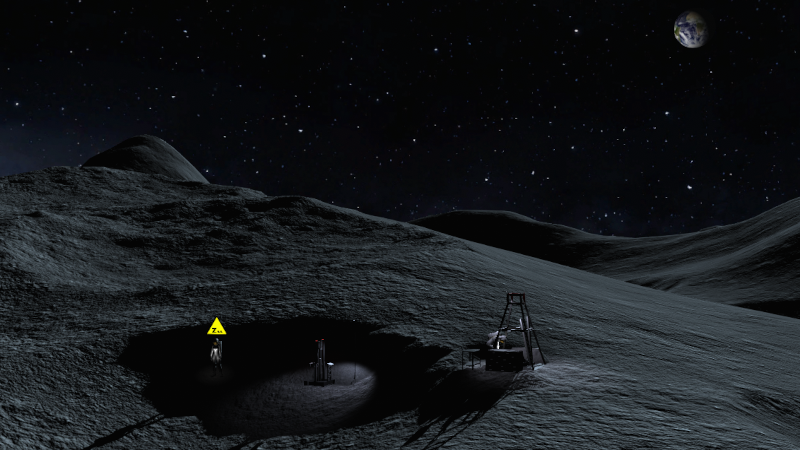
One of the primary challenges of prolonged lunar stays is managing the essential resource of water, particularly for cooling space suits. Water, a critical resource for extended missions, is scarce on the Moon. It rapidly evaporates during the lunar day and only persists in shaded, underground areas. Fortunately, the Outer Space Shack landing site is optimally positioned in high latitudes, offering opportunities to find water behind the northern faces of hills or in deep craters.
This update introduces two key pieces of equipment: a water mining sensor for subterranean detection, and a derrick to drill and extract lunar water. These tools, brought from Earth, are highly efficient, capable of extracting up to ten times their weight in water. The yield varies depending on the shade levels of each game tile.
Future updates will explore the disassembly and relocation of the derrick and water sensor to new extraction sites.
We've also enhanced the realism of the lunar water cycle. EVA suits now only use water cooling when temperatures are high. It's most efficient to mine water at night or dawn, as day-time extraction could consume nearly all the water for suit cooling.
Other improvements in this release include an enhanced time-lapse visualization with the fast-forward button, added lights for astronauts in shadowy areas, and new lighting for building construction tasks.
Stay tuned for upcoming releases with more improvements and features!
Release 1.2 is available
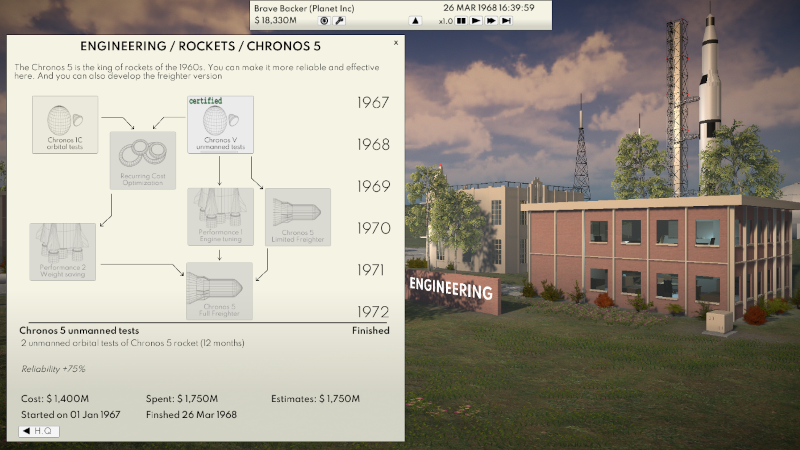
Release 1.2 has launched, representing my most extensive update for the game. Step into the world of space tourism: now you can host Richard, the over-the-top billionaire, on the Moon. While he's more about bragging than helping, his visits will be a lucrative addition. I've also integrated an enhanced Chronos 5 rocket, allowing for a trio of astronauts to enjoy a lunar week.
Rocket enthusiasts, take note: I've introduced two lightweight rockets. First up is the Akashgami, a modern-day wonder from India, paired with a lander echoing the Chandrayaan 3's historic lunar approach. Then there's the Neutron-K, a perfect counterpart to the robust N1-L3 Soviet rocket, equipped with a Luna lander that harkens back to 1970s Soviet missions.
For those yearning for the tension of the 1960 Moon race, you can now choose between US or Soviet Union scenarios. Each path locks in rockets specific to that nation, and your space center will adopt a unique aesthetic respective to your choice.
Beyond these major additions, I've made numerous refinements. Rockets, reflecting their real-world counterparts, may occasionally face setbacks depending on their reliability. Moon construction and jettison-related bugs have been addressed, and you'll find a comprehensive game message log for ease of tracking.
Release 1.2: Introducing Space Billionaire Tourists😎
I'm continuing to develop and refine Outer Space Shack. The upcoming Release 1.2, planned on October 8th, 2023, is set to bring some new game mechanisms and additional rockets to the mix, alongside various bug fixes and stability improvements to ensure a smoother gaming experience.
Space Billionaires: A Necessary Indulgence?
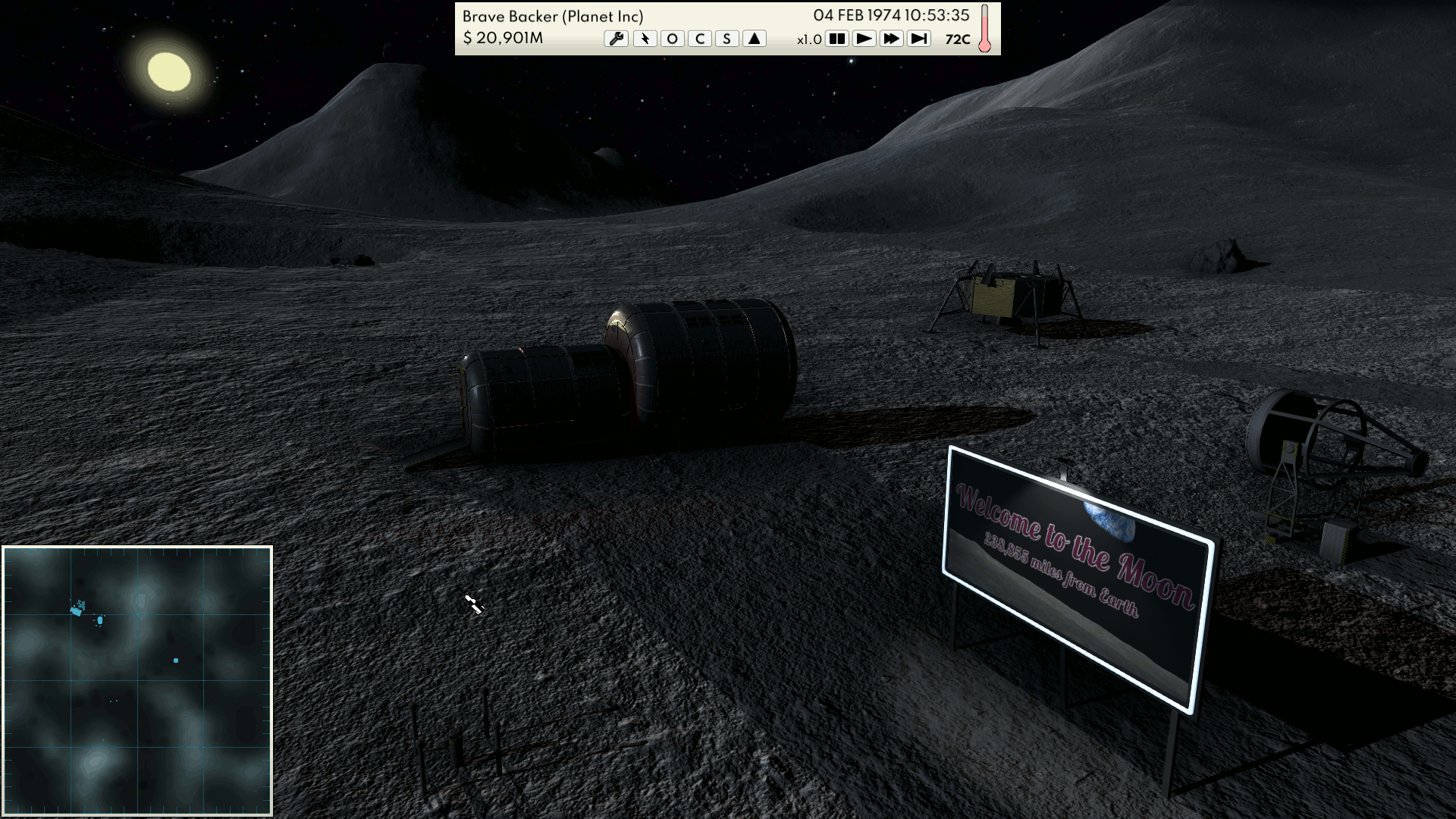
Maintaining a space base is financially draining, making the prospect of hosting eccentric billionaires quite a logical choice. It seems inevitable that they'd desire to flaunt their extra-terrestrial escapades—and rest assured, their infamous questionable taste has accompanied them into space. To accommodate tourist missions, the necessary first step is the establishment of a selfie spot on your base, outfitted with a billboard and the essential neon light.
With the selfie spot in place, the doors are open to space tourism missions, occurring sporadically throughout the year. Enter Richard, the iconic billionaire, sporting a golden space suit, a flamboyantly colored shirt, and perpetually shaded eyes. It’s important to note, Richard is on vacation while in space—don’t expect any assistance in equipment construction or supply transport from him.
To cater to the lengthy stays of our high-flying guests, an enhanced Chronos 5 passenger rocket has been introduced. This upgrade ensures the transportation of three individuals to the Moon and accommodates up to a 10-day sojourn, made possible by the advanced automation of the orbiter module. While the presence of these opulent tourists might clash with the serious, functional atmosphere of a space base, their financial contributions are an undeniable asset in maintaining the costly operations. Balancing functionality with flamboyance, it seems, is the new frontier in space exploration.
Introducing Lightweight Rockets and Probes: A Small Step for Big Achievements
In Outer Space Shack, lightweight rockets play a crucial role in delivering minor supplies to a space base. Historically, the responsibility fell on the shoulders of the Titan Horse, renowned for being the first rocket to utilize liquid hydrogen and oxygen.
This new release ushers in two additional rockets to bolster your space endeavors. The Akashgami rocket, a marvel from India with a formidable track record, makes its debut in the modern era. It is paired with a lander, reminiscent of the historic Chandrayaan 3 landing near the Moon's pole. Initially, it supports a 100kg payload to the Moon, with potential upgrades extending its capacity to 250kg.
Complementing the heavyweight N1-L3 Soviet rocket is the Neutron-K, capable of transporting impressive payloads up to 600kg to the Moon. It’s equipped with a Luna lander, mirroring Soviet missions from the 1970s. While these missions may not have received the limelight that the Apollo landings did, they achieved remarkable feats, including advanced automated sample return missions.
These lightweight additions, though overshadowed by their heavier counterparts, represent the unsung heroes of space exploration, achieving significant feats with less acclaim but equal importance. Whether it’s the precise landing near the Moon’s pole or pioneering automated sample returns, these innovations lay the foundation for future explorations and discoveries. Balancing public attention with technological advancement, these new introductions emphasize that in space, every contribution, big or small, counts toward the bigger picture of exploration.
Embodying Nations: The 1960s Scenario Redefined
In the original 1960s scenario, players could amalgamate a blend of Soviet and American rockets, a portrayal that starkly overlooked the palpable tension of the Cold War era. To enhance the game’s realism and historical fidelity, players will now need to align themselves with either the Soviet Union or the United States, each offering distinctive playstyles and strategic approaches.
Choosing Sides: Strategic Distinctions Players choosing to lead the Soviet Union will have to maneuver around the limitations of lower payloads for passenger rockets but can leverage the advantage of superior lunar payload capabilities. Conversely, opting for the United States provides a contrasting set of strengths and challenges, shaping the strategic framework players operate within.
Cultural Signatures: Themed Decorations Your allegiance also dictates the aesthetic fabric of your Space Center. Depending on your choice, themed decorations will adorn your Space Center, echoing the ideologies and narratives of the era. Whether it's a monument celebrating the tireless spirit of the workers or one echoing the manifest destiny of the United States, each piece is a visual representation of the underlying ideological currents.
A Divergent Journey: Crafting Your Path This redefined scenario offers not just a choice of technology, but a divergence in narrative, aesthetic, and strategy, allowing players to experience the intricate tapestry of the space race in the 1960s, shaped by the geopolitical landscapes of their chosen nation. Whether it's the struggle for ideological dominance or the pursuit of lunar exploration, every decision crafts a unique journey through the annals of space exploration history.
Enhanced Stability & Refined Mechanics
Release 1.2 brings a myriad of refinements and enhancements, addressing several bugs and introducing incremental improvements, enhancing the overall gaming experience and ensuring smoother gameplay. Here's a closer look at what’s coming: 1. Improved Payload Management: The mechanics of payload jettison have been refined, introducing a new indicator to illustrate whether the payload will be securely stored for future utilization or if items will simply be ejected into space, dislocated and irretrievable. This improvement ensures a more intuitive and informed gameplay experience. 2. Secure Moon Sample Return: Moon samples intended for return to Earth are now safeguarded from being jettisoned, as long as the rocket has sufficient payload capacity to accommodate them. This adjustment guarantees the secure and reliable return of valuable lunar samples. 3. Resolved Construction and Saving Glitches: Several underlying issues have been addressed, including the abrupt interruption of building construction tasks and the inability to save a game when a tag contains spaces, leading to a more seamless and frustration-free gaming experience. 4. Regolith Price Decay Preservation: The game now accurately retains the price decay of regolith, ensuring consistent gameplay and strategic planning around resource management.
Upcoming Features: Local Resource Utilization
Post Release 1.2, our development focus will shift towards the incorporation of local resource utilization features, such as water mining and the collection of meteorite samples. The introduction of water mining is set to revolutionize gameplay dynamics, allowing astronauts to achieve near-autonomy while operating the space base. This innovative feature opens up new strategic possibilities and gameplay depth, enabling players to explore and leverage resources in uncharted ways.
I am committed to continually enhancing Outer Space Shack, addressing concerns, refining mechanics, and introducing features that enrich the overall experience and immerse players deeper into the intricate world of space exploration and base building. Stay tuned for more updates and enhancements in the upcoming releases!
R1.1.2 is available for players
R1.1.2 patch has just been released to players. It includes the following fixes and improvements:
633: Fixed issue occurring during first consultation of the research tree.
634: Resolved major game crash during astronomy missions when simple appliances were installed.
635: Added warning message for rocket launches when remaining payload is less than 1%.
636: Updated rover to initiate charging task after a rover charging station has been installed.
637: Introduced progressively more expensive loan options.
638: Improved display interface for astronomy missions.
639: Fixed issue making it hard to click on the left part of the mission selection menu.
640: Changed end-of-mission display to indicate "Paid" if final payment is negative (e.g., due to a loan), rather than stating the player received a negative amount of money.
641: Implemented system to only display a new message if a previous message is still visible and lacks a 'Bring Me There' option. Messages with 'Bring Me There' option are considered more important and will not be overridden.
R1.11 is available
Release 1.11 is now available. It includes the following fixes:
623 Prevent issues when the user presses several times jettison: - when button is pressed for a true jettison while another mission exists, do not do anything - when fast jettison is pressed, supress the other jettison mission
626 Correct compulsory orientation of proper jettison module, make it face north (to avoid damage from solar radiations)
627 Improve display of jettison site screen
628 Improve display of finished engineering projects
629 Improve algorithm for engineering delay for projects. Ensure most projects arrive late, as they should (an engineering project is never on time)
631 Ensure marked objects are not late to the object movement
632 Correct cameras so that they settle more quickly