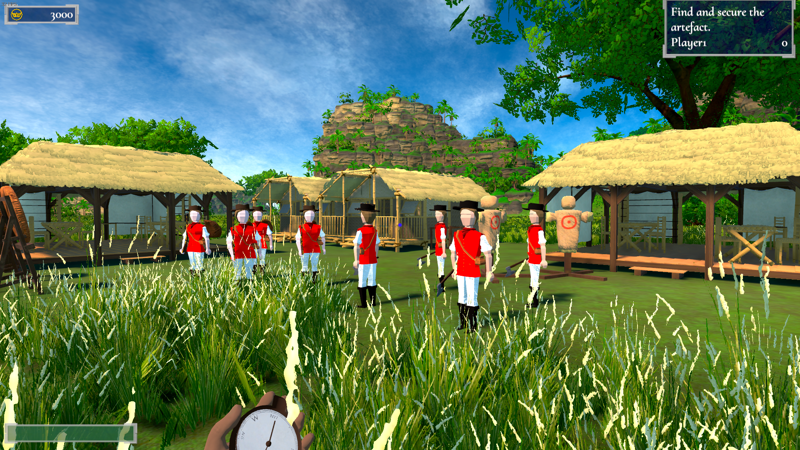
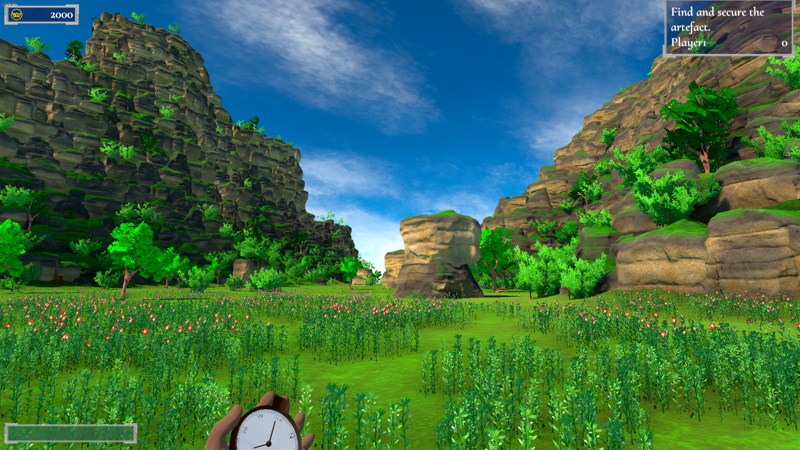
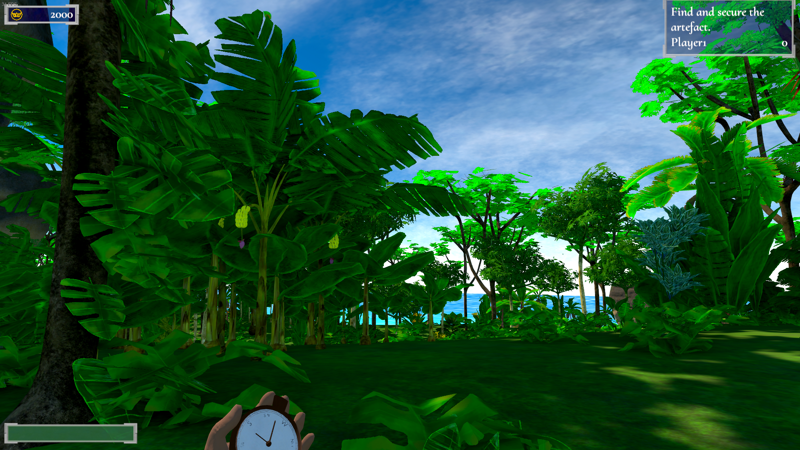
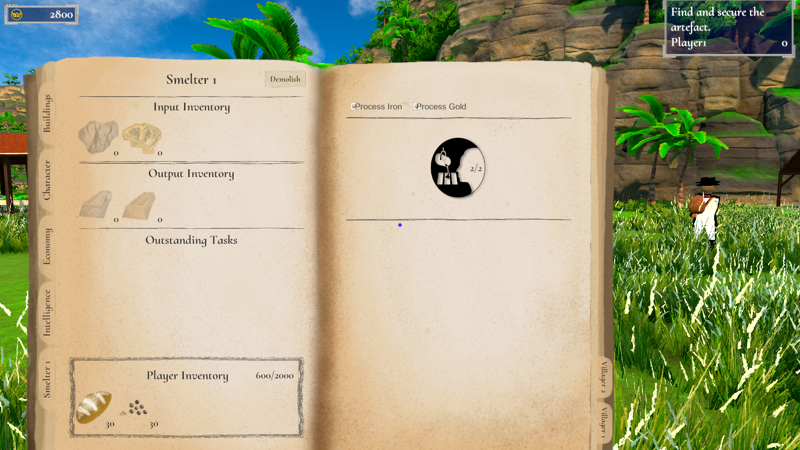
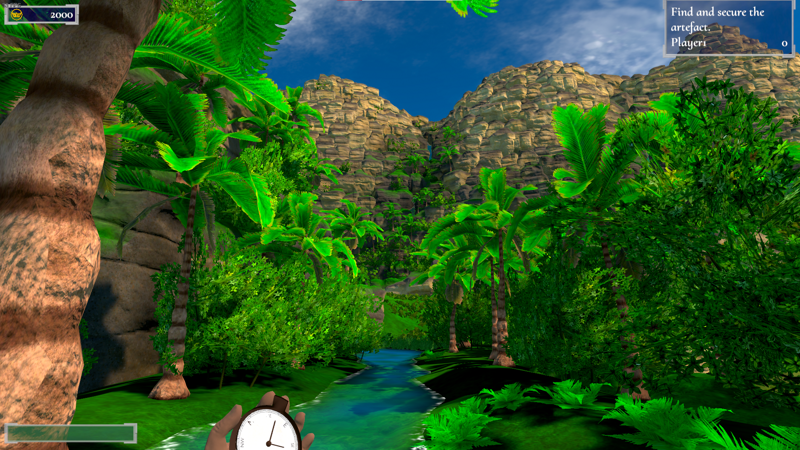
Weekly Update 177+178 - Research in v0.9, Parts 1 and 2
Hi everyone,
There was a little bit of a mixup last week, so I ended up not uploading a post I had already written - but as a result, you’ll get a double post on research today.
The first part is about research generally and what you will be able to research:
To start with, I think I have mentioned before that I wanted to introduce research with 0.9 in order to allow for more specialisation of coop partners, and to create multiple options for playstyle/strategies more generally. With research being needed to unlock buildings, processes, and military advantages, players will have to choose a lot more what they are currently prioritising, with the benefit to any particular route depending on how much that approach will actually be used.
As an example, a player who currently has only 1 tobacco field will still benefit from building a cigar factory. The cigar factory may not run at perfect efficiency, and be a little expensive at first, but the balance of the cigar factory cost to the increased price of cigars will still yield a profit after a short time. Of course I could reduce the price of cigars or increase the price of the factory, but both of those would change the profit ratio of cigars whether the player has lots of tobacco or not. Alternatively, the introduction of a one-off cost of researching cigar factories will mean that investment makes a lot more sense the more tobacco is available to the player, with more tobacco making the investment considerably cheaper with each additional factory that the player will build.
Of course this also works well with exploration rewards and the new materials system described in updates 172 and 173: If a player finds lots of tobacco plants in one valley, and lots of iron mines in another valley, the decision where to expand to may be drastically different depending on whether they have already researched the cigar factory (or efficient iron mining) or not. Likewise, a player who has not decided on which direction to expand into may be swayed by finding the blueprints for the cigar factory in a chest along the way…
Likewise, having research options for the military (e.g. more health for your soldiers, or more damage for ranged units, etc) that can be researched will give players more options for what to prioritise at a given time, and, as will be explained in the next part - what to invest!
The second part is about how you will be able to research:
In general, research will be done in a research building (name tbd). As with most games, the player will be able to select one of the available technologies from a research tree, and the selected technology will be researched by the villagers employed in the building. Similar to fewer games, each technology will require a different input related to the technology. Some will merely have a gold cost, while others might require wood, iron, food, or some combination of resources.
This opens up a variety of options for both development and for play-styles. To pick up my earlier example of investing into your military, military investment so far comes only in 2 forms, of either building more military buildings, or hiring more soldiers. One costs gold and construction resources, the other costs gold and a continuous food supply. Of course that is very limiting. Maybe you are playing a game in which you have not found a lot of food yet, or need a stronger military to get access to more food - all while you have found ample supplies of other resources.
With each technology requiring slightly different inputs, this gives the player more options: investing, e.g. copper and nitrate into the research could improve the efficiency of your few soldiers until they are strong enough to take the next valley over, which has all the food you need.
Another advantage will be that relating input with the technology allows for players to be rewarded for what they enjoy doing. If a player particularly enjoys exploration, they will be able to find resources that can’t be produced by their villagers (e.g. a rare flower), which they can use to upgrade their own health, weapons, or storage space. Likewise, a player who enjoys base building may be able to invest large amounts of goods created by their villagers into even better recipes for their buildings, which will improve their profitability and military strength in the long run.
Of course, balancing this will not be easy, as the research needs to work well with the new materials, new production chains, and probability of spawns, but I am pretty excited to get into the thick of it.
Until next week!
Weekly Update 176 - Intermission
Hi everyone,
I have been feeling a little under the weather last week, so it will just be a quick update today.
I have mostly finished the metal tier tower, and have been experimenting with some adjustments to the towers to address the changes I discussed yesterday. I will keep you updated.
Until next week!
Weekly Update 175 - The Two Towers
Hi everyone,
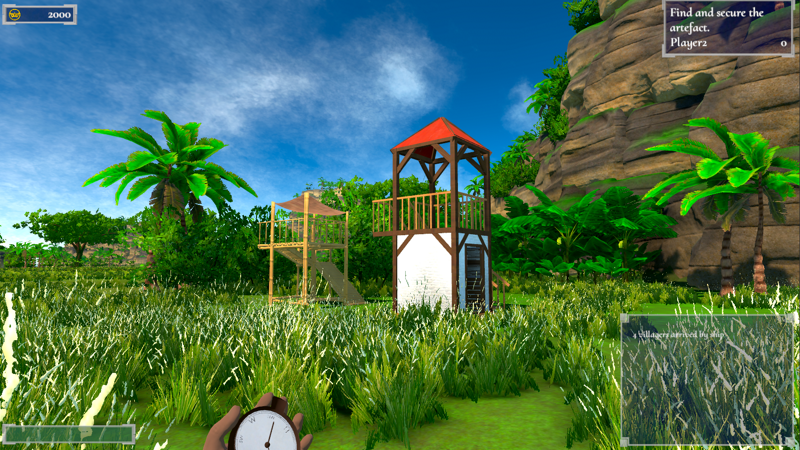
Despite there being two towers in today’s image, what I want to talk about are not the two tower models (they just happened to be finished right now), but instead the two options for how towers may work in the future.
When I first created towers, the game only had one military unit, the musketeer, which made it fairly balanced for the towers to just have one musketeer in them. Hostile musketeers that approached a tower could shoot the soldier in the tower as soon as that soldier could shoot them, and the automatic re-spawn of the tower soldier meant that the tower was a worthy investment for static defences. This “real soldier on an elevated platform” solution is what we still have at the moment, as defeating a tower generally requires killing its soldier first.
However, the introduction of the melee units slightly changed the equation. Melee units obviously can’t shoot back at the ranged tower units, and while it would be possible to create a system in which the melee units would run up into the tower to attack the ranged units, I feel like that would create more questions and problems than it would solve. Instead, I am thinking of creating a tower system in which the soldiers in the tower can’t be shot directly.
Under this new system, any unit (ranged or melee) will defeat a tower by walking up to it and destroying it like a regular building - throwing torches at it to take it down slowly. This will mean that towers will get destroyed more predictably, and with similar efficiency by melee and ranged units. It also means that it would be possible to allow different ranged units to shoot at different distances (e.g. the rifleman could shoot further than the musketeer), while keeping the lower level towers as a relevant defensive building. Lastly, it would allow easier balancing of the towers themselves, as they will get a straightforward healthpool and damage output, rather than varying ones based on what gets targeted at what point.
Making this change will not be particularly difficult, as tower soldiers are already identified as such by other units, and setting them to being invulnerable will not be a problem. As such, I am expecting to make this change together with the introduction of the three new tower models next week.
Until next week!
Weekly Update 174 - Fields and Watchtowers
Hi everyone,
I will just give a brief update on various little improvements today, with a longer update planned for the weekend.
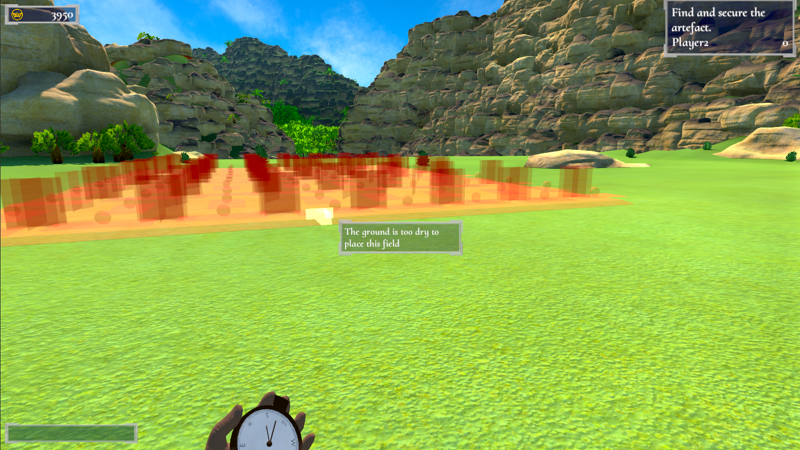
First of all, I have implemented the mechanic of fields only being placeable in certain areas. For now, this means that fields won't be placeable in the desert anymore (which seems fairly straightforward), but as I mentioned, there may be more restrictions (or bonuses) in the future.
Additionally, I have started to create models for the missing watchtowers. These will be fairly quick placeholders to be replaced in the future, but will fit in with the current models for gatherer’s hut, barracks, etc. I will be talking about the towers a little more this weekend.
Until then!
Weekly Update 173 - Materials and Farming for v0.9, Part 2
Hi everyone,
And welcome to the second part of the materials and farming explanation for 0.9.
Yesterday I mentioned that I will be changing the way players will get access to seeds, and that there will be more “natural” plants to be found in the wild. These plants will of course include the current “cash crops”, i.e. coffee, spices, tea, and tobacco, in addition to some new ones that will be created for 0.9. In yesterday’s post, I hinted that flax will be one of them. So far, the linen maker simply creates linen “out of nothing”, but that will be changed during 0.9. Flax will become a “naturally occurring” plant in the world, and can later be turned into seeds to be planted in farms. The linen maker will then take the harvested flax and turn that into linen.
With all of these plants, the player will need to continuously decide whether to use up the naturally harvested plants by turning them into a more valuable end product, or whether to save up a larger quantity of them in order to get a seed that will provide them with a more stable income. Of course, what you find may influence that decision. If you start with lots of banana groves, turning their fruit into a seed to increase your food production may be an easy decision - while it may be more useful to use up your bananas if you have started with relatively few of them, to prioritise expanding to somewhere with better resources.
In addition to this new system, one small change may also be relatively impactful: fields will only be placeable in certain locations. This will likely mean that certain plants will only be plantable in certain biomes (e.g. in the jungle where it is sufficiently wet), or will be more productive in certain biomes (e.g. flax fields in the plateau area). I have not fully decided on how to implement this yet, but certain things are already clear (e.g. no fields in the desert area).
The underlying mechanic for this was created a little while ago, but I had not yet implemented it. However, you may be able to look forward to a limited version of it with the next update, where fields will no longer be placeable in the desert. The full version of it will then come in with new plants and better balancing for 0.9.
Until next week!
Weekly Update 172 - Materials and Farming for v0.9, Part 1
Hi everyone,
I want to take today’s (late) post as well as tomorrow’s (on time) post to talk about the plans I have for materials and farming in 0.9.
As I mentioned in one of the previous posts, one of my goals for PtP’s economy and progression has been to make the path the player takes dependent on what they find in the world. For 0.8, this took the form of having the player progress from wood to stone to metal tiers as they expand across the island, but this is a very linear progression, and I am aiming to add more “branches” to that.
In order to do that, of course, there will need to be more materials and plants for farming available in the game, and the whether a player has access to them needs to be fairly randomised. As a result, I am not only planning on adding the mentioned additional material, but I am also planning on removing the current form of the seed market, which is mostly a remnant from the game being balanced for competitive play.
Considering this will mean that players won’t get access to agricultural seeds through the market anymore, seeds will have to be created by turning a certain quantity of the corresponding product into seeds - e.g. 500 flax into a flax seed. With this in place, there will be more naturally occurring plant groupings that will work similarly to the banana groves now - players will be able to find them throughout the island, and they will be harvestable through the gatherer’s hut. They will, of course, also be spawned randomly at the game start, meaning players may find a large grouping of them early on, or will need to expand to a different location to find them.
Overall, this change should mean that finding a good quantity of something close-by should make players consider going into the direction of growing more of that - or that expanding into a certain area over another will help the player specialise in a way they prefer at the time. I will give you a bit more information about the changes you can expect in part 2.
Until tomorrow!
Weekly Update 171 - UI Changes for 0.9
Hi everyone,
First of all, a happy new year. Secondly, I want to take this post to talk about upcoming UI changes that I have been planning for a little while, but that I have deferred to making in 0.9 for a few reasons.
As some of you may be able to tell, the majority of the current UI is essentially programmer art. Most of it was created to simply give me a button to press to enable some functionality, and while I have added some polish and tooltips, etc. where I could, a lot of it has evolved with the functionality (and is sometimes even lagging behind what the backend can do). As a result, some of it is not as intuitive as it could have been. Movement of goods between warehouses, setting up sales rules for goods, etc, are all “locked” behind having the UI explained to you in the tutorial (which is one of the reasons for why I had prioritised updating it before finishing 0.8), but anyone who has not played the tutorial will likely be lost as to what to do.
This is of course not ideal. Not everyone likes to play tutorials, especially one as long as the one of Path to Prosperity, and picking the game up after a few months of not playing means having to try to remember how to get things done. So, a proper redesign of the UI to be more intuitive is sorely needed.
The main reason why it hasn't happened yet, is that I am intending to add a few new functions in 0.9 which I will need to plan for. One of them is that processing buildings will get a choice of “recipes”. Until recently, I had not fully decided on how I wanted to do this: Would each person working in building work on a recipe chosen by the player? Would each building cycle through the recipes one by one (which is currently the case for things like the smelter)? Or would each building simply be set to one recipe at a time? There are many pros and cons for each of them, but I have more or less decided on the last. Being able to set one recipe per building will allow the player to decide how many villagers will be working on the recipe while being straightforward in terms of what needs to be shown (one set of inputs and outputs, one progress bar to see how far along the building is in making it), and it will give players a good reason to build more than one building of the same type (beyond raw output).
Of course there are other new functions I want to add to 0.9 (research, transport carts, village management) which all require new UIs that I still have to plan for - but rest assured that improvements are in the works.
Until next week!
Weekly Update 170 - Happy Holidays
Hi everyone,
First of all, I would like to wish everyone a great winter break, as far as you are able to have one. I am taking some of this time off, but will be doing some more foundational work for the game as well.
Now that 0.8 is essentially finished (with some bug fixing and polishing left), I am starting to very specifically plan out the details of 0.9 and which order to develop them in. I think the posts of the next few weeks will be a great opportunity to tell you more about my plans for the next version, so stay tuned for that.
Until next week!
Weekly Update 169 - Finished Tutorial and Chapters
Hi everyone,
My apologies for getting this post out a little late - between a computer (hardware) issue and feeling a little under the weather, I was struggling to get things done on time. However, I have uploaded all of the latest updates to the experimental branch by now.
This includes being able to select which chapter to start the tutorial on, as well as the updated fifth chapter, using the pioneer wagon for the outpost creation. There were a couple of bugs I noticed and fixed along the way as well, which should improve the experience overall (e.g. the strategic map not properly loading on the tutorial island).
At this point, essentially all of the functionality I want to be in 0.8 is finished and uploaded to the experimental branch. Considering the amount of bugs I was still able to find in the last week, I have decided to keep from releasing 0.8 fully for another few weeks to give players the chance to try it out, report on issues, and give some general feedback. I will also take that time to do more polishing of the features (minor changes that shouldn’t introduce new bugs), and to update some of the roadmaps and images.
Until next week!
Weekly Update 168 - Hunting “the Crash”
Hi everyone,
While I did manage to finish updating chapter 5 of the tutorial last week (to be uploaded to the experimental branch next week), the majority of my time last week was actually spent chasing an elusive game crashing bug.
The bug in question has been reported a couple of weeks ago, and I have also experienced it during some more elaborate testing, but so far, no-one had been able to narrow down what exactly caused it, or what context it occurred in. Together with the complete lack of any error messages and how infrequently it occurred, fixing it had been on a lower priority. However, in the process of creating chapter starts for the tutorial, I ended up creating a save point that would very consistently lead to the crash after approximately 10 minutes.
The time it took to crash was not perfectly consistent, though always in the same ballpark. Changing subtle parts of the game did not do much, nor did adding additional debug statements help me figure it out. Overall, I ended up changing various aspects about the game and then speedrunning to the crash a good 150-200 times to see if it would help me find the bug before I finally found it (leading to me simply referring to it as "the" crash after). To give you the short version, it was a bug in the healing hut, which needed very specific contexts to occur, and if the trigger conditions were met, would crash the game once it filled up its healing charges.
Assuming that the conditions were met, the number of villagers that were healed while it was building up its charges would then affect how long it would take to crash, making the timing less consistent and the bug more difficult to find. In good news, the issue has now been fixed, which means that the last game breaking bug I am aware of has been eliminated.
In the process of searching for the bug, I also got around to updating all major plug-ins the game is using, which fixed a number of lesser issues the game had and that I hadn’t fixed yet (e.g. the ground cover not being deleted when buildings were placed in the tutorial). I will finalise the tutorial chapter selection and upload all of the changes to the experimental branch during the week.