

Port Imagination
PI has become CMR
For those of you who have followed Port Imagination, I wanted to jump in and let you know a few things that have been happening over the last year.
First, the lore and world of Port Imagination has been expanding, especially in the Podcast sphere. Samite, a spin-off of the Weeping Cedars Podcast, has introduced the world to Virtue Vista Valley and its charms. Port Imagination, which main exists in the VVV world, requires some more learning on my part, both as a developer and as a 3D modeler to get it ready for Prime Time.
So, several of the ideas from PI have made their way into this new game in the Weeping Cedars world: Camp Muck-Rungler. Set in 1983, you play Melissa Day, a sick young woman whose father has bought her a computer to keep her mind off of her troubles.
CMR marks a big change in the style of game, as it is inspired by games like Stories Untold and Buddy Simulator 1984. It will be a four part puzzle game, with all four parts slated to come out over a year. The goal will be to price the first chapter at $5.99 and each subsequent chapter at around $2 or so, meaning that the full game should be about $12 when completed.
Chapters are targeted at around 2 hours of play each, and will involve dialing into BBS's, chatting with strangers, playing games, and solving the (rare) errors that your new computer throws at you.
Camp Muck-Rungler also marks a move from Unity to Unreal, and learning C++ for this took some time.
My goal is to return with Port Imagination a year after the fourth chapter of this game releases, so those of you who were looking forward to that will hopefully get something better than you would have if PI was coming out this year.
I hope to keep you updated as CMR advances.
April 14, Development Update
This week has been busy with a lot of writing and expanding several elements of the game, such as laying out the Journal and PI Facts Systems and clarifying how cutscenes will work.
Most of the art this week has gone into making the arcade, and it’s a lot of work. My philosophy for the arcade in PI is that there should be a couple of games inspired by machines that people generally familiar with 80s arcades will recognize. But the vast majority will be inspired by rare machines that I wish I had gotten to play back in the early 80s. Many of these machines you’ll see from the top down, so their inspirations will be laid out almost exclusively in their controls and control art. Some have unique shapes, and each will let Pots examine them and give a little hint about their inspirations.
Some other machines, the ones that have taken up the most time, are front facing. They are wholly original and involve some pixel-art animation as well. I’m probably spending too much time on these, but I’d hate myself if I had a chance to make some of these machines look fun and interesting, and I didn’t take the time.
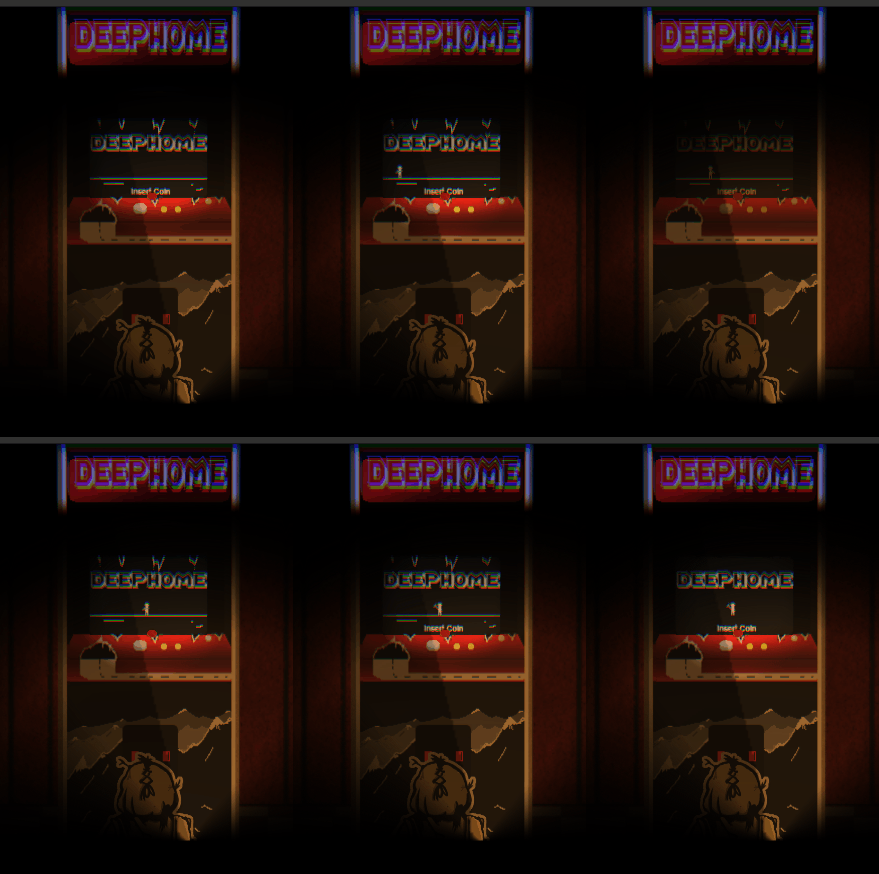
The arcade will both be a fun and sad place, I hope, like much of Port Imagination. A sad place lorded over by something terrible.
Much more of this week has been integrating the PI story with the show Weeping Cedars and starting to release PI story through the Weeping Cedars Patreon (patreon.com/WeepingCedars). Realizing that PI is a three-fold story that extends the Weeping Cedars universe has been given a major thrust toward writing both the game’s story and the larger story that surrounds it.
Over the next week I’m going to be placing all the major placeholder art for the rest of the game locations, and starting to build on that, with the intention of filling in detail art (furniture, pictures) for existing locations at one or two a day until each location is filled up.
Just because Port Imagination was never finished, doesn’t mean the world should feel empty.
April 7, Development Update!
Story
After some wrestling with the story, I've realized that Port Imagination is solidly within the Weeping Cedars universe. Weeping Cedars is a horror audio drama that I wrote over the last three and a half years, and one which has an extensive history with lots of unexplored shadows and mysteries. As I was delving into the Port Imagination story it began to just make sense that it would both explore some of the dark and hidden places of the WC universe, and introduce several new mysteries and horrors of its own.
To that end I've also started the Port Imagination Facts that will hopefully come out every Monday, Wednesday, and Friday on Twitter and on our Discord.
Oh, look here's one.
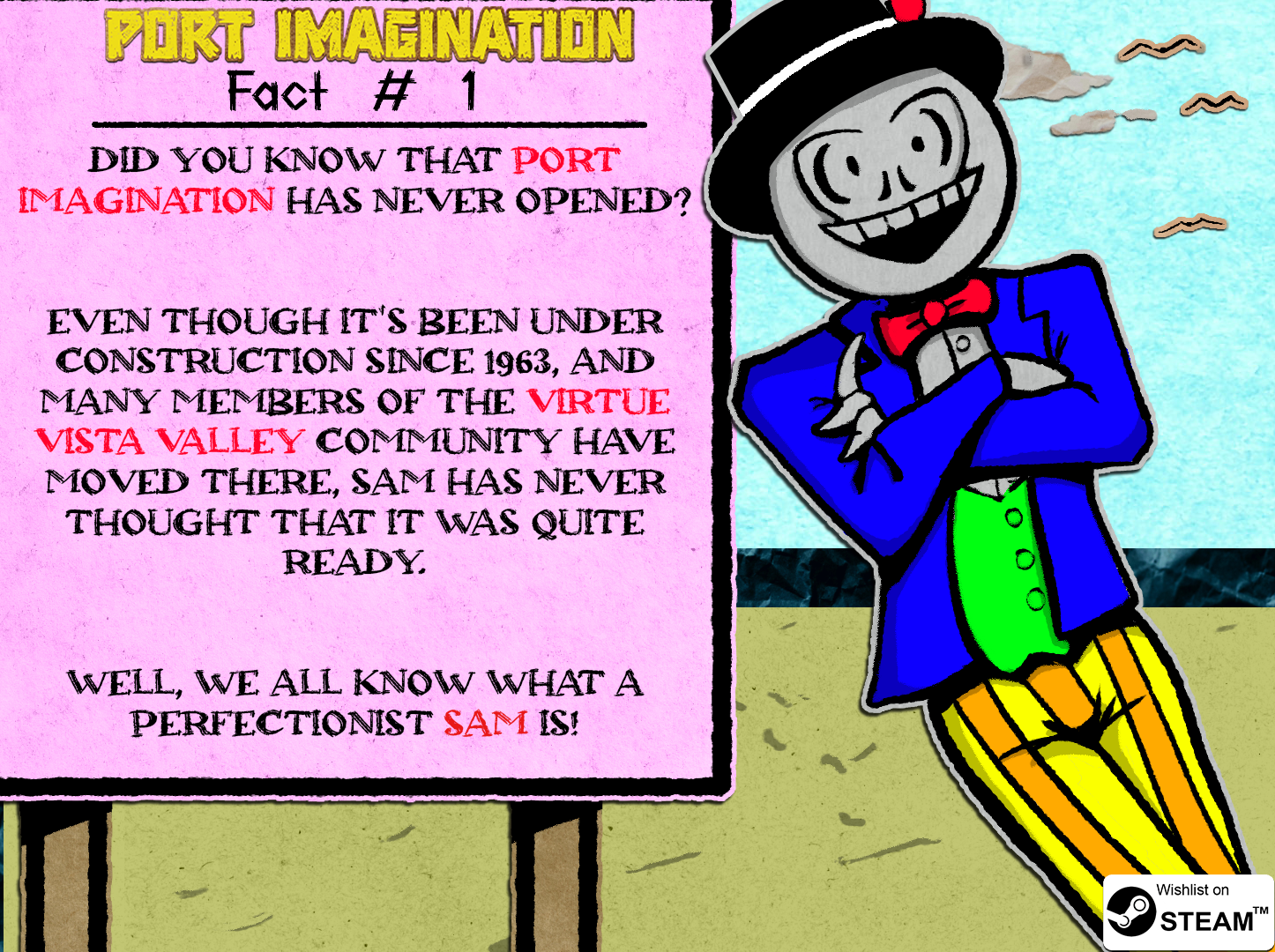
These will start to introduce you to the world of Port Imagination, and the show that it comes from, Virtue Vista Valley.
Development
From a technical side, the last two weeks have been a process of moving from the HDRP system in Unity to the URP system. This has been a trade off, and has, I hope, added more good than bad. The lighting system has changed the game from a story about terrible things in a sunny environment to a story about terrible things in a dark, rainy, run-down environment. I love what the lighting and darkness do for the game, but I also find the Unity 2D lighting system to be extremely under-baked. Not allowing developers to control the length of shadows, the strength of individual shadows, to control the shape of free-form lights from code, or which layers a light will affect from code makes the system far less powerful that it could be.
Wrestling with the lights has also meant creating sets of layers that will contain rooms that sit next to each other in order to prevent light from going where it shouldn’t. So that when Pots Jr. walks into a room he often enters a totally different set of sorting layers with a different light activated, so that his light doesn’t affect anything beyond the room’s walls.
As well, I’ve built the PI Helper Tool, which allows me to manage Dialogs, Variables, updated art assets and more from an external control panel. My understanding is that there are ways of creating custom dropdowns in Unity, but using readable ID’s for many of the objects in the game seems to be best done by creating Enums that have hard-coded values, which can also be used in drop-downs in the Unity Inspector. I’ve created a tool that lets me add new Enums to lists, save them, and automatically have Unity consume them to allow me to select them from dropdowns in the inspector. This means fewer bugs as there is no chance of a GUID being either wrongly written, or the wrong GUID going in undetected. Instead, I can pick a dialog option, and select the event I want to trigger from a dropdown, or select a variable from a dropdown in an event.
Art
And finally, getting the Hotel into shape is a long process. There’s a lot to draw and lay out. My guess is that getting the hotel into its rough shape will take the next few days. From there I will work on customizing each hotel room bit by bit as I work on each character that stays there. The hotel will be the largest indoor region in the game, which is good from a development time perspective. There’s a lot to draw and lay out and make sure that it all works. And while some things can be reused from room to room, there are things like the beds that I would like to look different for each character.
Conclusion
All right, that’s it for our first update. I hope that folks find the early stages of development interesting. I’m planning to keep the Port Imagination Facts and these updates rolling up to and beyond release.