Patch Notes for the Beta Release Update (V1.0 Build ID 2435796)
Hey guys,
We've just released our massive V1.0 update, which marks the point where we're officially leaving alpha and entering beta. That means we've finished all the gameplay features and it's unlikely we'll make any major gameplay changes from this point on. Instead we'll be focusing on smaller gameplay improvements and iterations, bug fixing, balance changes, and UI changes. We'll be asking for focused feedback on certain topics on the forum to help guide us through beta and on to final release.
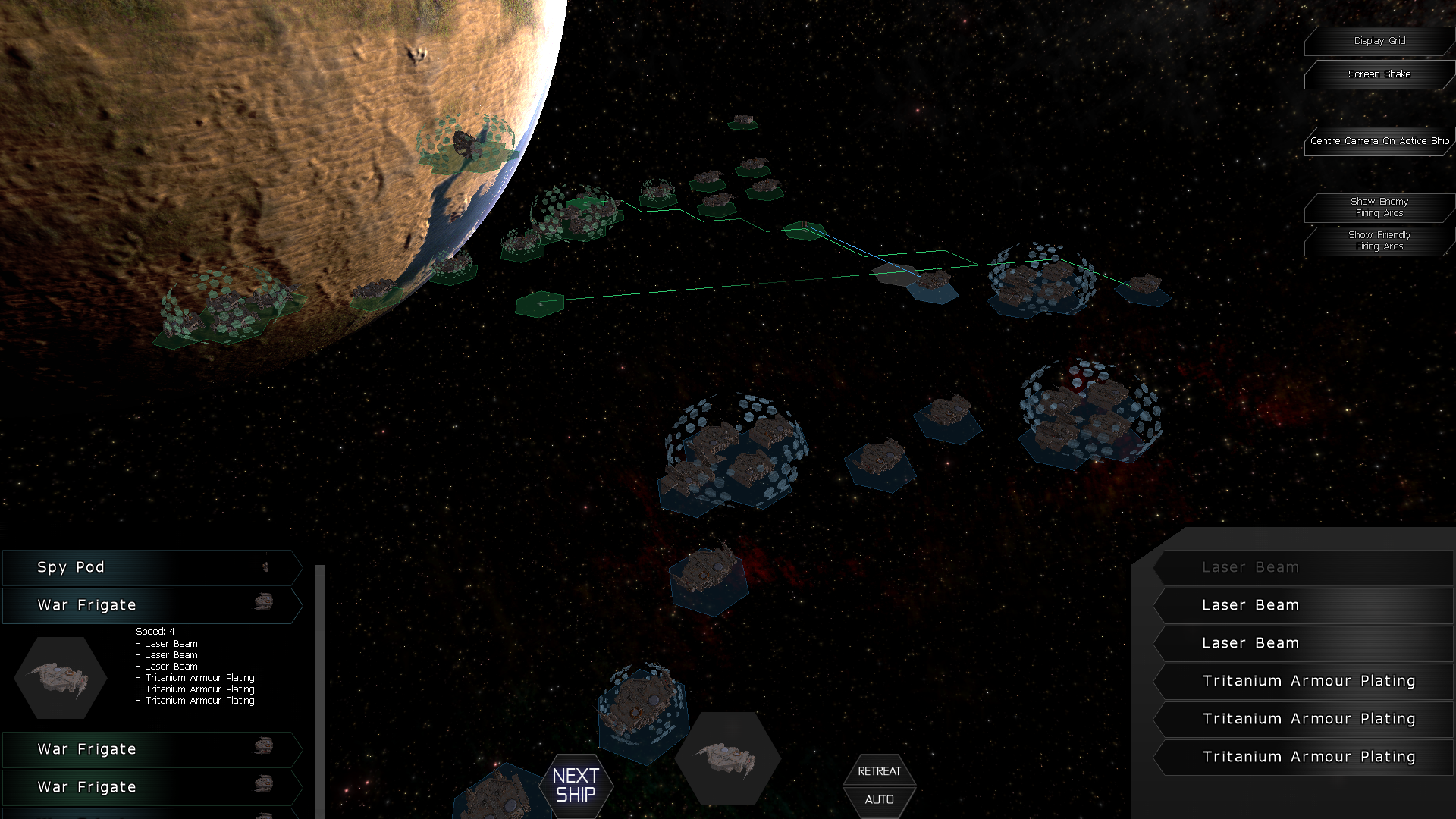
The headline features of this update include a complete engine overhaul (including switching from XNA 3.1 to Monogame), 64-bit support, massive optimisations, a near total overhaul of the Tactical Fleet Combat gameplay, our first Challenge Map, a score system for both singleplayer missions and sandbox games, and Fleet Combat in space (not at a planet). We've also added support for some new graphics options, smoother animations, better explosions, new nebulae in fleet combat, a bunch of new building models, and a ton of bug fixes.
A Dev Update article will be released on this update and our plans for the next step soon, and below are the patch notes:
Core Engine Overhauls:
We switched the underlying tech in the Predestination engine from XNA 3.1 to Monogame and .NET 3.5 to .NET 4.5.2. This was a massive job, but allowed us to add 64-bit compatibility and take advantage of some new memory management tools. At the same time, we overhauled large parts of the game engine to fix recurring bugs, clean up a lot of technical debt from all the features we've adding during alpha, and optimise performance and memory usage.
<*> Switched from a 32-bit executable to a 64-bit compatible one. Players on 32-bit operating systems should not notice any difference, while those on 64-bit operating systems will have more memory to work with. This will let us expand the game more in the future, and if we expand it to the point that it causes memory problems for 32-bit users we'll put in some low-memory options.
<*> Replaced the fragile old XNA spritebatch code with a new more fault-tolerant system. Instead of crashing when things happen out of order, the worst case is now a graphical glitch and most of the time there's no problem at all. This was pretty necessary in order to switch to MonoGame.
<*> Replaced all of the old graphics state code throughout the game with a robust new GraphicsState system. We've pre-defined a series of common renderstates, depth states, stencil buffer states etc and now switch between them before rendering each element. This was a massive task but required to switch from XNA 3.1 to MonoGame.
<*> Overhauled all screens to have multiple rendering layers: Pre-Rendering (rendertargets etc), Under UI Rendering, UI Rendering, and Overlay Rendering. This fixed a number of display bugs all throughout the game, and makes adding new UI a lot easier.
<*> Wrote a new texture loader that results in an overall smaller memory footprint.
<*> Wrote an entirely new runtime model loader for .X files that's compatible with Monogame and supports both pre-scaled models and our custom automatic scaling to optimise it for use in our 3D ship designer. Added scaling and rotation data to all of the Renegade and Kazzir ships, fixing a load of broken designs after the switch to Monogame.
<*> Removed FXAA code as it proved to be incompatible with the new setup, but we plan to add a new FXAA module at some point in future if we get the time.
<*> Removed the visible star from Fleet Combat as it was only seen if you happened to turn the board upside down, and there's no reason to do that. The code for the star and lens flare had some problems and it wasn't really worth fixing, so we removed it.
<*> Fixed incompatibility of planet continent heightmaps and other images with XNA 4.0 / Monogame.
<*> Overhauled all of the existing shaders in the game for compatibility with Monogame and Shader Model 4.0 specifications. Also used this opportunity to tweak some of the existing shaders and add new effects for each class of shield.
<*> Overhauled the System window's rendering code. The planet code was taking far too long to render and has been replaced with simpler textured spheres. The old star rendering code turned out to be a MASSIVE memory hog and performance killer, so we replaced the entire thing with a much more efficient one based on rotating fake cameras around a pre-generated nebula. Star size is now correctly shown on the system window and bebulae are more visible.
<*> Wrote a system for handling the dynamic loading and unloading of voice files while preventing memory fragmentation, and a system for playing voice files. The Diplomacy voices have been unavoidably delayed as the person who is processing them has been unavailable.
<*> Drastically reduced the runtime overhead of loading in some UI elements by checking whether each image has a separate mouseover component before loading rather than handling load errors.
<*> Improved memory management and resolved fragmentation of the Large Object Heap.
<*> Quad and QuadBatch rendering is now more efficient.
Fleet Combat Overhauls
<*> New State System: We added a whole new Fleet Combat State system with a built-in action queue and timer system. This was a lot of work, but has eliminated a ton of bugs and odd behaviours in Fleet Combat. The game now constructs actions such as movement and firing as separate state objects and adds them to a queue, and processes that queue in order. Certain actions such as Reactive Strikes can skip to the head of the queue in order to interrupt a player's move as expected, and impossible actions are now automatically pruned from the queue (such as moving a ship that has been destroyed by a reactive strike). Overall, Fleet Combat feels a lot more solid and polished since we made this change.
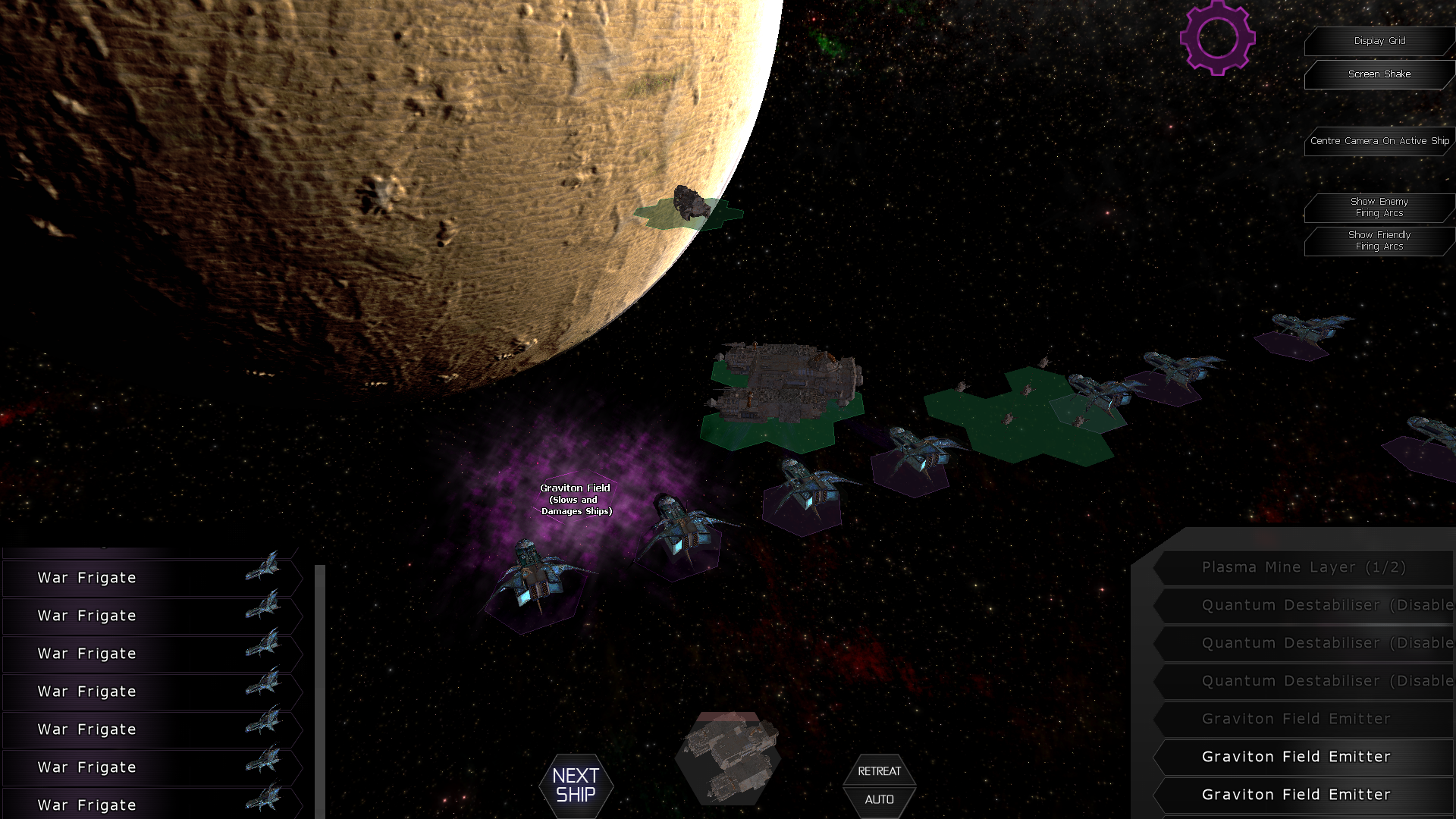
<*> Fleet Combat In Space: You can now intercept enemy fleets in a system outside orbit of your planets by clicking on the race icon in the Enemy Ships tab of the System Window. This lets you break blockades, destroy unwelcome enemy scouts that wander into your star systems, defend an ally in war whose planet is being sieged, and kill non-combat ships. Of course, if your enemy owns a planet in the system then you'll have to attack the planet and can't intercept the fleet in space.
<*> Ammo Rework: Previously, all bombs and missiles had limited ammo and had to be resupplied by visiting a starbase. This was frankly not fun and not a very big strategic element, so we've redesigned how ammo works. Missiles and Fighters now automatically re-fill at the start of Fleet Combat so you have 5 shots each battle, and Bombs now refill each turn so you can bomb a planet into the stone age over several turns without refueling. We may need to go back and look at bomb balance in a future update, but this ammo system feels much better.
<*> Larger Battlefields: The size of the fleet combat battlefields has been increased and ships now start slightly further apart. This will allow players to execute more strategies based on getting ships into position (e.g. hiding in nebulae) or firing missiles while running away into the corner. Ships also now start further apart to stop them getting stuck behind each other.
<*> Nebula and Explosion Optimisation: We used to have a serious problem with memory leakage caused by nebulae and explosions in Fleet Combat, and if too many explosions happened at the same time then your game could crash with an out of memory error. This has now been fixed as we now pre-generate a small set of nebulae and explosions and handle their positions and animations on the GPU.
<*> Nebula Overhaul: We've added a few new types of nebula to Fleet Combat and changed their bonuses, it now goes like this: Cloaking Field (ships inside count as cloaked), Ion Storm (damages ships inside each turn), Ice Cloud (Halves Missile and Projectile damage), Dust Cloud (Halves Beam and Fighter Damage), Graviton Field (Slows and damages ships each turn), and Hydrogen Plasma (doubles missile explosion and area-effect damage).
<*> Nebula Distribution: When fighting in a star system that's inside a nebula, there will now be pockets of nebular gas in the fleet combat. Blue nebulae have Ice Clouds and Ion Storms, Green have Cloaking Fields and Ice Clouds, Orange have Dust Clouds and Hydrogen Plasma Purple have Ion Storms and Gravity Wells, and Red have Hydrogen Plasma and Dust Clouds. This can be used very strategically if you colonise a planet inside a nebula.
<*> Smooth Animations: Ships now turn smoothly as they move rather than turning sharply in a single frame, and ship movement animation times are now based on the ship's size class and speed. Movement in general feels much smoother and more polished now.
<*> New Shield Graphics: Each class of shield (Electron, Magnetic, Graviton, and Temporal) now has its own unique corresponding model and shader, all of which are moddable. The Electron and Magnetic shields have a similar hex-based design to the previous shield model, while the Graviton and Temporal shields are more circular.
<*> Projectile Weapon Overhaul: Projectile shots now draw as bullets based on specified 2D images rather than all of them just firing a tiny asteroid at the enemy. Every projectile weapon now has its own moddable weapon texture and a specified Bullet Pattern that lets you make it appear to be rapid fire, single-shot, charge-up, etc.
<*> Beam Weapon Overhaul Beams now draw as lines based on input 2D images rather than simple coloured hardware lines. Every Beam weapon and beam-type Special weapon now has its own weapon texture in the files, and these can be modded too.
<*> Weapon Audio Overhaul: Every weapon now has its own moddable Audio File specified in the weapons data file. Weapons are also now timed by the audio, so you can have slow-firing weapons or weapons with long charge-up times if you want for effect.
<*> Missile and Fighter Pathing: Missiles and fighters no longer follow ship-like paths to their targets. They now pick a hex closer to the enemy and move straight there without passing through intervening hexes. They can still be shot down by reactive strikes on reaching their target and before firing, so the balance hasn't changed, but they will no longer accidentally generate crazy long paths to their targets and will no longer be blocked by targets in between.
<*> Missile Rebalance: Missiles have now been increased in speed to increase their utility. Nuclear Missiles are 1 speed faster than your fastest frigate, Fusion and Gravimetric are 2 faster, Anti-Matter Torpedo is 4 faster, and Quantum Torpedo is 6 faster. Missiles and fighters also now draw dotted lines toward their targets to give you an idea of where they are going.
<*> Fighter Rebalance: Removed the Ammo Regeneration from the Fighter Bay and Heavy Fighter Bay and gave both 2 Fighters total to launch during Fleet Combat instead. Fighters now fire 2 shots returning to the ship that launched them, and heavy fighters can fire 4 before returning. On returning, they are refueled and ready to be launched again.
<*> Dauntless Guidance: Missiles and Fighters now automatically pick new targets when their assigned targets are destroyed, so it's no longer a total waste to fire too many missiles at the same target.
<*> Engine Disabling: Shooting a ship in the rear now has a chance of disabling its engines for up to 3 turns as long as the damage penetrates the target's shields.
<*> Utility Improvements: The Anti-Missile Beam now has a 100% chance of destroying a missile on contact, increased from 50%. The chance-based nature of this just made it unsatisfying, even if it does only cost 15MW to fit. The Stasis Field, Tractor Beam, Transporters, and Graviton Field Emitter also all now have circular firing arcs. Previously they had extended arcs that made it difficult to use them strategically (e.g. to fly past an enemy ship and tractor it from behind).
<*> Plasma Field: The Plasma Field area-effect weapon has been re-added as we've solved the memory issues it was causing. Its power grid usage has been increased from 25MW to 50MW as it was a bit ridiculous against larger ships when tested.
<*> Orbital Minefield: The Orbital Minefield technology now automatically starts all enemy ships on 50% armour instead of spawning mines on the battlefield.
Score Screen:
<*> Added a new score screen that appears at the end of every sandbox game, singleplayer mission and challenge map. It gives you points for things like number of planets colonised, technologies researched, different victory types, eliminated races, etc. There are also bonus points for things like rifts investigated and peace treaties mediated, and a speed bonus depending on how quickly you win the game and what size the galaxy is.
<*> Singleplayer missions can now give points for each objective, and the score screen now shows how many Objective points and Bonus Objective options (from optional missions) you achieved.
<*> Singleplayer missions now have star ratings (Bronze, Silver, and Gold) depending on the points you gained during the mission. The rating thresholds and which points are available are determined by the individual mission. The maximum achieved medal is now saved to your game data directory.
Missions / Challenge Map:
The first Challenge Map has been implemented: The Time Trap, original design by kickstarter backer Lee Newsum. This mission takes place in an alternate ending to the main game, where scientists from the United Colonies have captured the Revenant homeworld and begun searching for technologies. The excavation team accidentally triggers a planetary security system that traps the star system in an energy bubble and begins spawning regular Temporal Rifts full of Revenant ships.
Cut off from the rest of the empire and most of your technology blueprints, all you have left is a selection of ship technologies, a few Ancient Ion Cannons found on the planet, and a powerful Ancient Starbase in orbit. You must use your limited resources to rebuild their fleet and fend off waves of Revenant ships that grow in intensity throughout the mission. You can research the ancient structures on the planet to improve their effectiveness, unlock powerful Revenant technologies, design new ships to try out unorthadox strategies, and maybe even capture a few Revenant ships.
<*> Added new galaxy map options for missions for if we want to move the race's homeworld to the Revenant planet and delete its original homeworld. This is used in the first challenge map.
<*> Added new galaxy map options to make Revenant fleets to escalate over time by a specified amount (in terms of military score). Without this option set, Revenant fleets will always be proportional to the military strength of the race being attacked.
<*> Missions can now select to either completely overwrite the default tech trees with new ones instead of merging the new ones into the old ones. This is used in the new Challenge Map to create completely custom tech trees with all-new techs and even new names, and this will be available to modders.
<*> Mission objectives can now be instructed to hide their progress from the player on the info dropdown. This is used in the new Challenge Map to provide a countdown to when the next Revenant Attack is going to happen without having it display a confusing Progress indicator.
<*> The mission info on the left hand side of the screen now draws on top of whatever screen you're on, and fades out on the Conversation screen.
Game Options Improvements:
<*> Added the ability to switch between bordered and borderless mode in the options. The device will automatically reset when you click the checkbox so there's no need to restart.
<*> The screen resolution is now set when you launch the game for the first time, but changes to the resolution in the ini files will be preserved, so you can finally change the resolution. There is not currently a dropdown for screen resolution in the options panel, though, and if you change screen resolution after first launching the game then you'll need to edit the ini file to change to your new resolution. We're working on getting a resolution selector into the game as soon as we can.
<*> Cut out and replaced the system that blurs behind the user interface with a much better system that now automatically catches UI elements and has far less rendering overhead. Everything is also now drawn to rendertargets before final rendering, opening up further potential for post-processing effects.
<*> Cleaned up a load of unused game options in the ini file.
<*> Renamed many of the game options in the ini file to make their purposes more clear (e.g. by adding PlanetScreen or GalaxyScreen before options that affect a particular screen).
<*> Added a new bakc-end system that allows me to specify whether an update should overwrite the existing ini file with default values the first time it runs. This is neccessary to prevent crashes when we make changes to the ini file other than just adding new options, and if we want to change the default options.
<*> Added an option slider for Voice Volume separate from Sound and Music volume.
Minor Features:
<*> Races and technologies can now have bonuses specifically to Ground Cannon damage in fleet combat in addition to bonuses to Beam weapons. This is used in the new challenge map.
<*> The game now keeps track of how many Temporal Rifts you investigate and how many Revenant Attacks you survive, for use in awarding bonus points or tracking during missions.
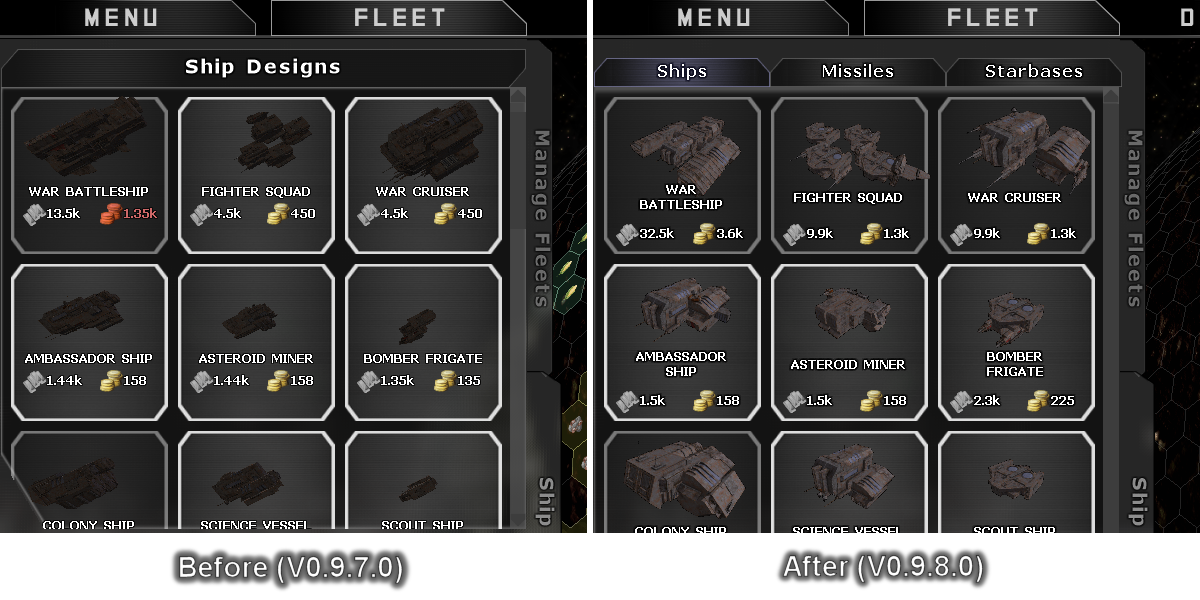
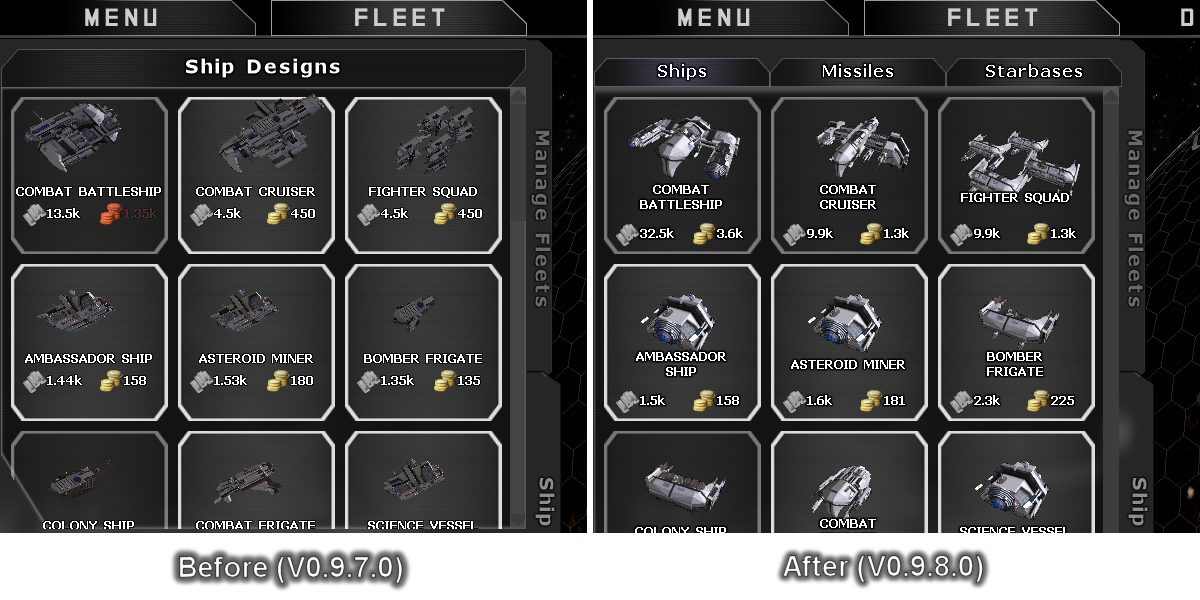
<*> Switched the main game font from Verdana to Xolonium.
<*> Added the ability to make the Volume sliders exponential rather than linear in the ini file.
<*> Added GroundCannonDamagePercentage and ShipyardBuildRate as Technology Stats, so we can now make generic stacking bonuses to those as technologies. Used in the new mission.
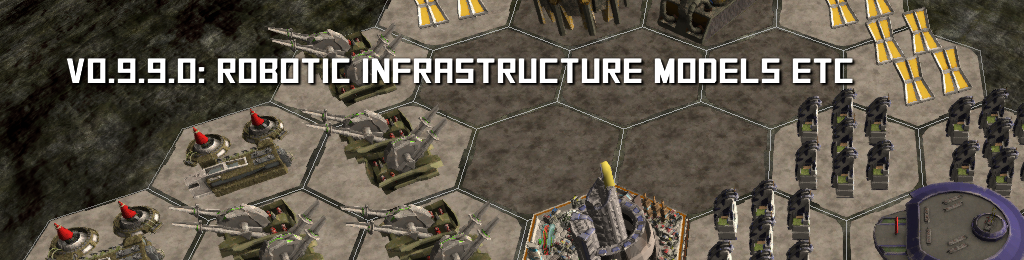
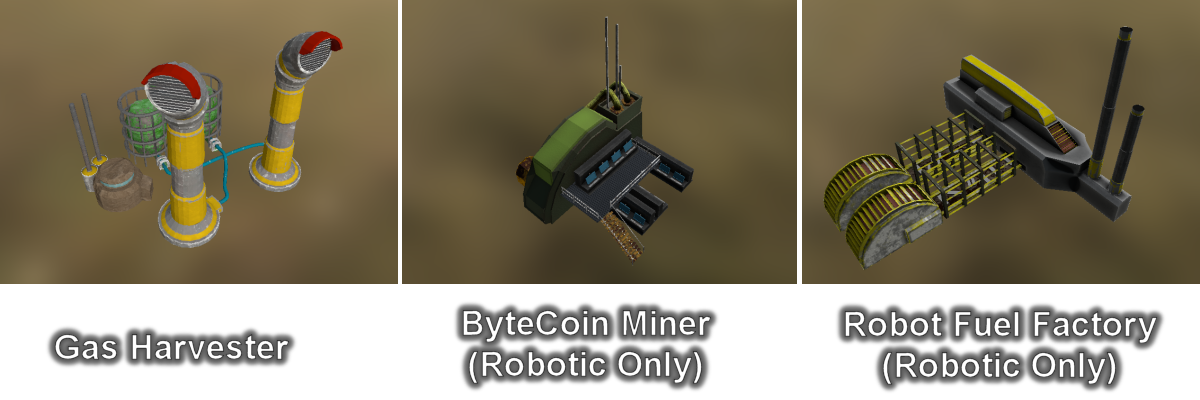
<*> Added models for Factory (Tier 1, 2, and 3), Research Lab (Tier 1, 2, and 3), Food Processor (Tier 1, 2, and 3), Industrial Market, Military Barracks, Reptilian City (Hatcheries), Robotic City (The Forge), Robot Fuel Factory
<*> Added model for Support Centre (robotic)
<*> Updated the tutorial to remove a few references to "upcoming" gameplay that is now in the game, and reflect the fact that we've entered beta.
<*> Optimised the tech tree loading process. Previously there was a lot of error handling happening that could cause the game to slow down when initialising the game or loading a mission.
<*> The explosion graphics have been modified to be a bit more rendering-friendly and visually appealing. They're now a bit more random, more spread out on the planet screen, and the game no longer omits explosions when there are too many already on screen as we fixed the memory issues it was causing.
<*> Added support for races having buildings that belong to another race, so we can have a Revenant space station in the first challenge map and it'll use Revenant technology (particle beams etc).
<*> When loading a Building, Weapon or Module that is already loaded (e.g. through mission files), the existing item in the pool is replaced instead of the game crashing.
<*> Total overhaul of animation code and transitions all throughout the game to use a more accurate delta time system. You should now notice smoother animation and transitions on slower computers.
<*> Overhauled the screenshake code to a more tightly controlled variant so it will no longer sometimes jerk way off-screen for a split second if you blow up a ship with a missile. Also took the opportunity to add rotation to the screen shake and extract some new screen shake options into the ini file.
<*> Added a half-size tooltip for some smaller items
<*> Improved the way the game fades to black and back out again when switching screens, saving, loading etc. This is now consistent across all screens and much smoother.
<*> Individual races may now use the ModelProcessOverride.txt file to specify that their ship part models have already been pre-scaled to the correct size. This is used now for the Renegades ships as they were designed before we came up with our new auto-scaling model loader.
Bug-fixes:
Dozens of minor bugs have been fixed as a result of the Fleet Combat overhaul and the engine changeover, but they haven't all been documented. Below are those that have been documented:
<*> Fixed a bug causing Revenant fleets to automatically attack the player if they don't find a military threat worth attacking.
<*> Fixed a bug causing the tutorial to sometimes not reset fully if you exited during the times where you have no popup on the screen to prevent you from quitting.
<*> Fixed a bug causing the map options to get stuck to weird defaults after you launch or load a singleplayetr mission or the tutorial. This now correctly only saves the options for your Sandbox games.
<*> Fixed a tutorial bug causing the game to sometimes skip over the check to see if you have a colony ship if your game was running slowly enough.
<*> Fixed a bug causing the music to get stuck on if you set the volume from full to zero inside one frame.
<*> Fixed a Fleet Combat bug causing the Plasma Mine Layer to lay mines off to the side of your ship instead of where the firing pattern shows it should be.
<*> Fixed a bug making Kazzir missiles invisible.
<*> Fixed the scale of asteroids in Temporal Rift investigations
<*> Fixed a missing United Colonies satellite model that could rarely cause a crash
<*> Fixed a text bug in the first Kazzir mission - It said to build a Scout ship but really you select what ship to build.
<*> Fixed a number of text mistakes in the technology files. All of the ship hull technologies were displaying the wrong amount of power grid.
<*> Fixed a number of new bugs with the tutorial that only started happening on our test rigs after we switched to Monogame. These bugs may have affected a number of other players, causing the tutorial to get stuck at various points.
<*> Fixed a certain tooltip staying open when you enter fleet combat.
<*> Fixed a scrolling defect on the Research panel.
<*> Fixed a major bug with the research panel that allowed tech trees to be held over from one game to the next, causing problems with missions like the new challenge map that have unique tech trees.
<*> Fixed several rendering bugs with the 3D ship designer and with 2D representations of ships on the UI.
<*> Ships now correctly re-cloak when starting a new fleet combat with a cloaking device active or ending turn inside a Cloaking Field.
<*> Bonuses from Planet Leaders that affect Fleet Combat now correctly apply during Fleet Combat. Previously, a few bonuses applied 100 times larger than they were supposed to or didn't apply at all.
<*> The game should no longer sometimes crash when a planet switches owners or is destroyed while the Planet Screen is open.
<*> Fixed the game accidentally designing some ships with multiple copies of "One Per Ship" technologies.
<*> Fixed several bugs with the totalling up and display of research points in the top right of the screen not matching the actual output of your empire.
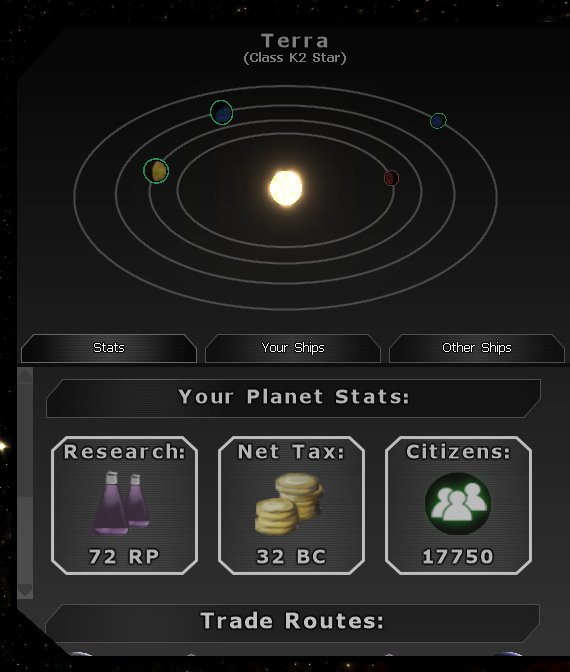
<*> Fixed the display of tax stats from planets sometimes not matching up with the amount of net tax being made.
<*> Fixed a bug in the ship designer when editing a starbase designt hat was in use elsewhere in the galaxy. It previously wouldn't work out the cost to upgrade all of them correctly.
<*> Fixed a few display bugs resulting from the font switch
<*> Fixed the lighting graphics on the Recycling Plant, Apartment Complex, Humanoid City, Energy Market, Industrial Market etc.
We'd like to give everyone a huge thank-you for waiting for this update! The patch was ready just before the holidays but we found a stubborn engine-level crash right as we intended to release it. It's taken us until now to get all the bugs resulting from that fixed and last night we completed a full test series that came back successful. As always, please let us know if you experience any problems with this update!
Note: This update will make all of your old saves no longer work, and will reset your game options the first time you start up. It will also go through the first time setup on Steam when you launch it to install new dependencies.
Cheers,
-- Brendan, Lead Developer
Quick update on V1.0
Hey guys,
Just posting to give everyone a quick update on the release schedule for the massive V1.0 update. The patch was finished in time for the Steam Christmas Sale, but the final release client is having unexpected video memory crashes on most of our test GPUs. These crashes are only happening on the release client and didn't show up in debugging, so we didn't know there was a problem until we went to deploy the update. We spent last night developing a fix and will now have to do a full test series to prove it works in release mode.
Brain and Nerd is due to take a short break for Christmas, so we'll be back with V1.0 as soon as possible after the 25th. We're extremely pleased with how this update has come along, especially the new challenge map and the score screen. Fleet Combat has never been as smooth and bug-free as it is now, and the new graphics and sound effects are a significant improvement.
We hope everyone has a great holiday, and enjoys the V1.0 patch when it releases next week (barring any more unexpected problems)!
Cheers,
-- Brendan, Lead Developer
Dev Update: Upgrade to MonoGame, Score Screen, Diplomacy Voice Recordings, Challenge Maps, Fleet Combat Overhaul, and more!
Recently we released the massive V0.9 update to Predestination, our second last major update before we hit V1.0 and officially enter our final beta phase, at which point we can start delivering all of the remaining content (singleplayer missions, kickstarter backer content etc) and heavily polishing the game up for full release. We’ve been busy working on V1.0 and on a few unannounced things since V0.9 went live, and in this Dev Update we’d like to share details of all of that with you along with an updated estimate on the impending release of V1.0.
The biggest change is that we’ve upgraded the Predestination engine from using parts of the old XNA 3.1 framework to using the newer MonoGame framework. This took considerable work but is now complete and will lead to performance improvements, 64-bit compatibility, memory problems solved, more scope for modders, and possibly even cross-platform support. We’ve also recorded voice lines to spice up the Diplomacy system, added a Score screen after each game to let you know how well you did, and we’re part way through developing the first Challenge Map. Also on the agenda for V1.0 are major improvements to fleet combat (both gameplay and graphics improvements), graphical improvements to weapons, new sound effects, notification improvements, building models, and AI improvements.
.
Upgrade to MonoGame: Predestination is made in our own custom game engine that was built on top of Microsoft’s XNA 3.1 framework, and unfortunately that has left us with a number of technical limitations that we’ve recently started to run up against. XNA 3.1 is 32-bit (which limits the amount of memory it can use), it doesn’t work with newer versions of the .NET framework that have some memory management tools we want to use, and our engine was limited to DirectX 9. This is why the game can crash with an “out of memory” error after a while even if your computer has plenty of memory left, a problem that will only get more common as we add more content such as new models, ship parts, sound effects, voice clips, and user interface elements to the game.
The latest Steam Hardware Survey shows that over 97% of gamers now use a 64 bit operating system, so we finally decided to upgrade from XNA 3.1 to Monogame, the open-source replacement for XNA 4.0 that has 64-bit support, Direct X 10+ support, etc. Switching frameworks like this is a huge undertaking as there are a lot of differences between the two versions, but we wouldn’t be doing it if it weren’t absolutely necessary. It took us a few weeks to make the switch but I’m happy to report that the game now runs properly on Monogame, all we have left to fix is a number of graphical problems and minor bugs that should take no more than another week of work, and then we can get back to finishing the update.
So what are the benefits to you of the new framework? The game should render faster and take up less memory when we’re done, and it will now be able to use more memory when it needs it, so we have the capacity to add new things like voice lines. It also opens the scope of the game for modding purposes as players can make very large mods without worrying about memory issues, and it fixes a number of stubborn crashes and graphical bugs some players currently experience. Monogame also has great cross-platform support so it should be easier for us to release Linux and Mac versions after the main release or even port the game to other platforms.
.
Score Screen: One small feature of 4X games that always helps increase replayability is a score system, which gives you points at the end of each game. As we continue to add challenge maps and singleplayer missions, you’ll also want some way of knowing how well you did in those. We’ve added a new score screen that pops up at the end of every sandbox mode game, singleplayer mission and challenge map with points for things like number of planets colonised and technologies researched. There are points for the type of victory, eliminated races, extra points for rifts investigated and peace treaties mediated, and also a speed bonus depending on how quickly you win the game and what size the galaxy is. Below is the score screen after winning a colossal galaxy sandbox game via technological superiority in 856 turns.
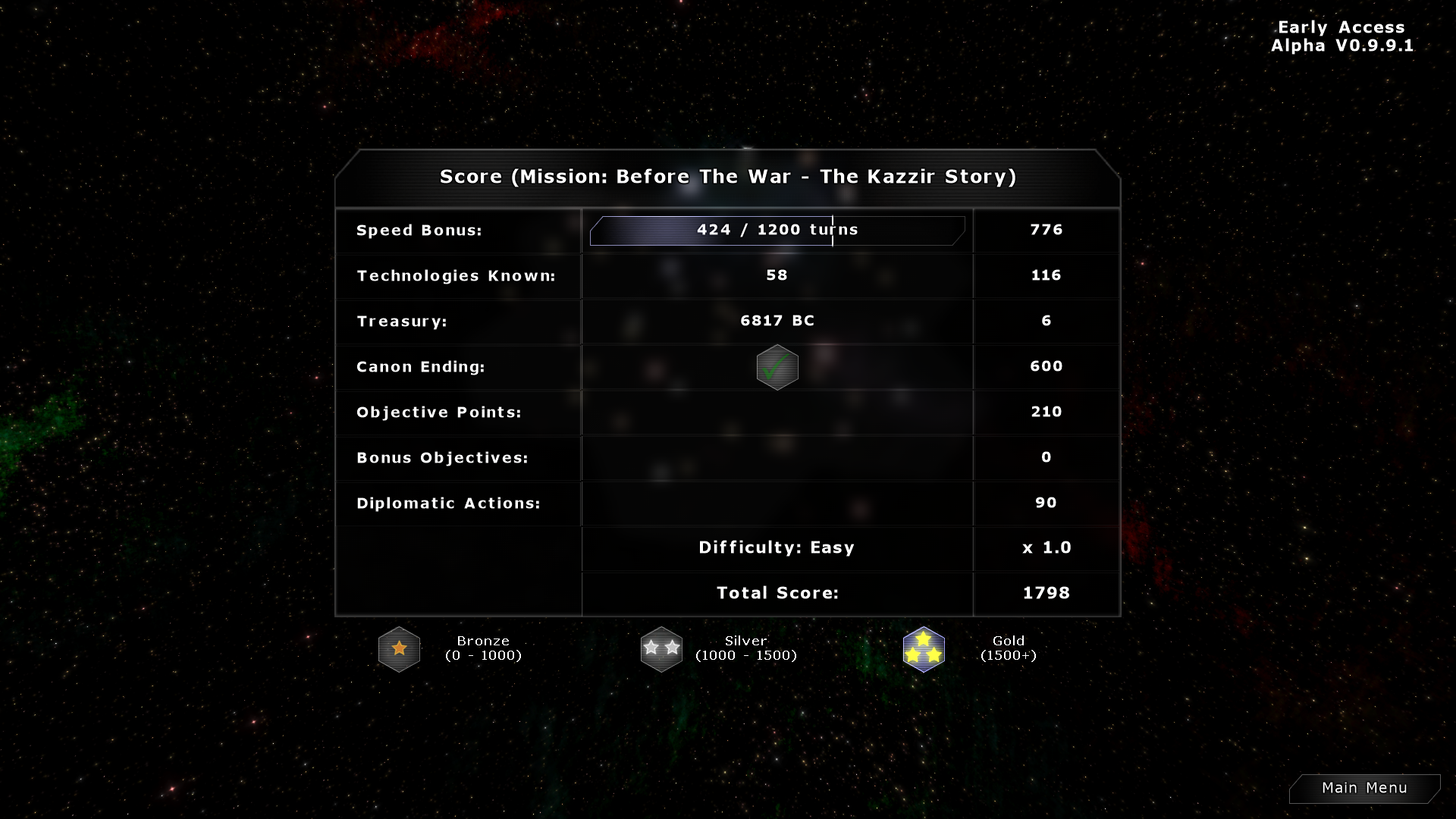
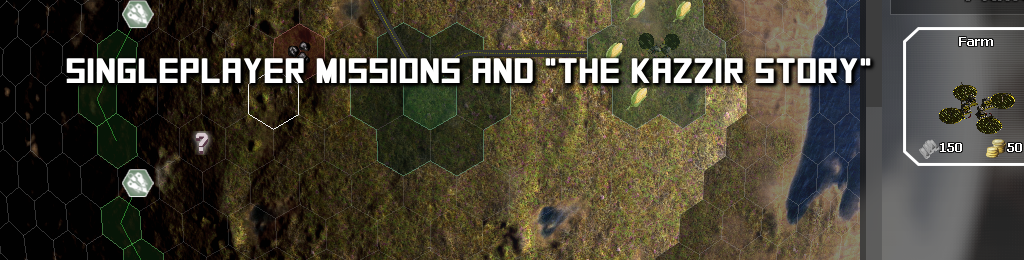
Singleplayer Scores & Modding: Below is the score screen following the completion of our first singleplayer mission, The Kazzir Story. Each objective you complete in a singleplayer mission can have points associated with it that will increase your final score, and extra points can be made available for hitting bonus objectives or hidden objectives. Each mission can also have hidden endings with bonus points or a bonus for reaching the storyline’s official canonical ending (as in the screenshot below). Each singleplayer mission will give you a star rating (bronze, silver, or gold) based on your performance so you may be incentivised to play it again to get the gold rating — something that is sure to be especially difficult in our challenge maps. All of these things are loaded straight from easily-readable text files so modders will have full access to this suite of tools for their own singleplayer levels and challenge maps.
.
Diplomacy Voice Recordings: In our original Kickstarter campaign, the final stretch goal we just about hit included a full singleplayer story campaign. We’ve already released one episode of the story and have 11 more episodes in development for full release, and we hope to add voiceovers to the entire story if possible before launch. This month we took a big step toward that by recording voiceovers for all of the diplomacy dialogue for the 6 core races that are currently in the game. This was Brain and Nerd’s first trip to a recording studio and it was a great experience, we’d like to thank Red Apple Audio for the use of its facilities. The audio will need to be processed and filtered and will then be added hopefully as part of the V1.0 update.
.
In addition to a singleplayer campaign mode, we’ve also promised to add unique challenge maps. These are small self-contained stories or challenges that aren’t tied to the main story, and the first of these will be going live in V1.0! This first challenge was designed by kickstarter level design backer Lee Newsum shortly after our campaign, his ideas have helped shape the tools we built for challenge maps and we’re super pleased with how it’s coming along.
Challenge #1 – The Time Trap: This mission takes place in an alternate ending to the main storyline, and you play as the United Colonies after they’ve captured the Revenant homeworld and are ransacking it for technologies. One of your scientists accidentally activates an unknown piece of Revenant technology, trapping the star system in a time dilation field and attracting temporal rifts every few turns. Time passes much faster inside the bubble so your empire outside the field can only send in a slow trickle of ships and supplies. You have to use limited resources to rebuild your fleet and fend off waves of Revenant fleets that grow in intensity, and your goal is simply to survive until your scientists can figure out how to shut off the device or help can reach you from the outside. Every ship that gets through your defences will do considerable damage to the planet’s ancient infrastructure, and once it’s gone you can’t replace it.
.
Fleet Combat in Space: Right now you can only attack other races by attacking their planets, but you can’t attack a fleet in space. If an enemy sends a fleet to blockade a star system, you can send your own ships to the system to end the blockade but can’t attack the enemy fleet. You also can’t attack an enemy fleet in an ally’s star system to help them out during a war. We’ll be fixing all of that with a new button on the System window that lets you attack enemy fleets, nice and simple.
Weapon Graphics Overhaul: If you’ve played the fleet combat in Predestination enough, it can’t have escaped you that all the weapons look and sound the same, all the projectiles fire a little rock and all the beam weapons fire a straight line in your race’s colour. That’s boring, so in this update we’ll be taking a little time to add new graphics to all the weapons and also new models for the different classes of shields so you can tell when your enemy has got some new tech.
Nebula Improvements: You’ve encountered some nebulae if you’ve ever sent ships to investigate a temporal rift, and now we’re going to add them to the fleet combat at planets too providing that the planet is inside a nebula. Green nebulas will create pockets of sensor-blocking green gas and laser-dampening dust clouds, blue nebulas will will missile-dampening ice clouds and damaging ion storms, orange nebulae will have dust clouds and explosive plasma pockets that destroy projectiles, and purple nebulae will have plasma and ion storms. This should make the choice of galaxy age in the game options a bit more interesting too, as a primordial galaxy will have nebulas in a lot of star systems.
Missile/Fighter Improvements: Missiles and Fighters currently fly in hex-based paths the same as ships, and sometimes it means they go very odd routes in order to catch up with an enemy. We’ll be changing them to a more freeform system where they always head straight toward their targets, and we’ll see if that improves missile and fighter gameplay.
Bigger Battlefields: Currently larger ships like cruisers and battleships can easily get stuck behind each other. To mitigate this problem, the Fleet Combat area generated by the game will be increased in size significantly and ships will start off further apart from each other. Ships will also always be positioned so that the fastest ships are in front, so the back row of ships shouldn’t get to move until the front row has at least had the opportunity to get out of their way.
Misc Improvements: Minefields will be changed to simply start the enemy ships off damaged instead of spawning mines, as the spawned mines often blew up on your own ships and caused other bugs. We’ll also be adding a chance of immobilising an enemy ship if you hit it in the rear when its shields are down, and fixing some bugs like the missing Plasma Field weapon (this was removed intentionally due to a bug it caused with explosions, which is now fixed). We’re also considering completely removing the ammo system for bombs and missiles as it turned out to be just not very fun to have to constantly go back home to re-load ammo, and will rebalance those weapons accordingly.
Bugfixes and Iteration: Fleet Combat has a number of strange bugs and inconsistent behaviours, and it has some pretty big memory leakage over time in long games. We hope to do a quick iteration on the Fleet Combat gameplay either in V1.0 or shortly after, starting by fixing all of the memory leaks and adding a new State system under the hood to combat most of the existing bugs and crashes. We then hope to replace the user interface panels with ones that fit in better with the rest of the game.
.
AI Trade Routes: One thing that always strikes me about the screenshots that come in with your crash reports is that a lot of you are using the Trade Route system pretty extensively, setting up separate shipyards, food planets and energy harvesting worlds exactly as we intended! We’ll be upgrading the AI to form its own trade routes to make the AI empires more efficient so that it’s a fair fight, which will also provide you with the opportunity to blockade their star systems and cause some economic havok. This may not make it into V1.0 depending on time, as it’s low-priority and we really want to get this patch into your hands ASAP.
Declare War on Race: The new diplomacy coercion system is working beautifully, and we want to expand on it with the addition of a new coercion: Declare War on Race. It’ll be extremely difficult to convince another race to agree with this, though they’ll be more likely to agree if you’re in a military alliance with them. As part of this change, the AI will also sometimes ask all of its military allies to join in on wars it’s pursuing and will threaten to cancel the alliance if you refuse.
Star Claim Improvements: You’ve probably noticed that the AI now periodically sends you territorial claims for star systems, but this system could use some improvement. Claims should last for a lot longer than 50 turns (possibly indefinitely), and Homeworld systems should be automatically claimed. We’ll be adding some kind of visual indicator of who claims a particular star system so you know in advance that you’re about to cause a Diplomatic incident by colonising a planet. You’ll also be able to lay claim to star systems you already have a colony in, which can be handy if you spy a colony ship en route to one of your systems and want to convince them to turn around.
.
Notification Improvements: Every type of window that pops up in the taskbar will be getting its own unique icon and sound effect so you can quickly tell the difference between a ship exploring a new star system and a survey mission completing. At the same time, we’ll be adding a small checkbox on every notification window (and in the main menu) that lets you disable that type of notification so you never hear about it. We’ll also be looking into adding a copy of each taskbar notification icon onto the galaxy map so you can see exactly where the notification is coming from.
Optimisations: When converting the game over from XNA 3.1 to Monogame, we identified several big targets for optimisation that we’ll be tackling when we have time. When the patch deploys, you’ll notice that the star graphics have changed; The technique used to render the star in the system window dates back to the very start of Predestination’s development and it was ridiculously inefficient, so we’ve fixed that with a much more efficient one that we think still looks good. There are a few other places we can save memory and some places we can make the game render faster, and we want to explore some of these before releasing V1.0 and test the game on lower-spec computers.
Buildings: With the memory limitations caused by XNA 3.1 no longer limiting us, we’re free to start adding more content without worrying about increasing crashes. The Factory (tier 1, 2, and 3), Research Lab (tier 1, 2, and 3), Food processor (Tier 1, 2, and 3), Industrial Market, The Forge (Robotic city), The hatchery (Reptilian city), Robot Fuel Factory, Support Centre, Military Barracks, and a few others have been added to the game and are now just getting final tweaks.
Sound effects: We’re looking into adding new unique sound effects for each weapons, things hitting shields, explosions, and user interface elements.
.
Thanks for reading another massive dev update, and thanks again to everyone patiently waiting on the V1.0 update. We’d usually be releasing a patch on Steam about now, but this one is taking extra time due to the switch over to Monogame so there are still a few features left to complete. With such a big change, we also need to make sure we test it thoroughly on the Steam internal build with a variety of computer systems. We’re aiming to get V1.0 fully complete, tested, and in your hands within the next 2-3 weeks. We’ll do another dev update when that patch lands, summarising how development of this portion went and looking at the next step for Predestination V1.1 and beyond.
The next wave of Early Access invites is going out this weekend, so if you’ve sent us a request in the past month you’ll be getting a key in the next day or so. If you’re a Kickstarter backer and you’d like a key as part of this wave, as usual please just send us an email to earlyaccessrequest@brainandnerd.com with the email address you used on Kickstarter and we’ll send you a code right over. Once we hit V1.0 and we’re happy it’s stable, we’ll also send everyone out their codes via email and Kickstarter messages even if they haven’t requested one yet.
Cheers,
— Brendan, Lead Developer
Dev Update: Threats & Coercions, Star Claims, AI Memory, Spontaneous AI Offers, Spying Overhaul, Main Menu overhaul, and more!
We’ve just released the enormous V0.9.9.0 update, the last update before we hit the big V1.0 release and enter the iteration and refinement phase. This update includes a massive overhaul of the Diplomacy gameplay with an all-new favour system, new diplomatic advisors, several new technologies, the Threats and Coercions system, a new Star Claim feature, and significant improvements to the AI diplomacy algorithms. The Spying gameplay has been improved with a simpler deployment system (including Send Spy shortcut buttons), changes to the spy missions themselves, new technologies, and Spying being finally tied into the Diplomacy AI.
This update also completely revamps the main menu screen with new visuals and highly requested features such as a load game panel, finishes off the New Game screen with the ability to pick your race colour and crashed ship types, and completes the dropdown menu interface with the final Fleets menu to let you see all of your ships at a glance. We’ve also improved the galaxy generation algorithm, tweaked the Aquatic race balance, added our second-last set of building and infrastructure models, filled the remaining gaps in the diplomacy text, and more.
Read on for a full progress report on everything in the V0.9.9.0 update. This update is so big that we’ll be releasing information on what’s coming next in the big V1.0 release and beyond in a further update article soon!
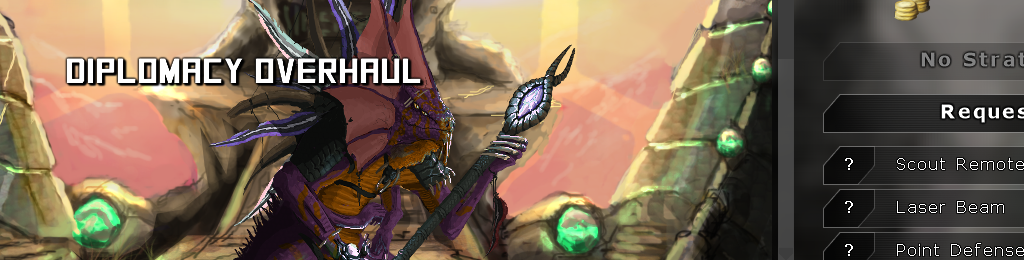
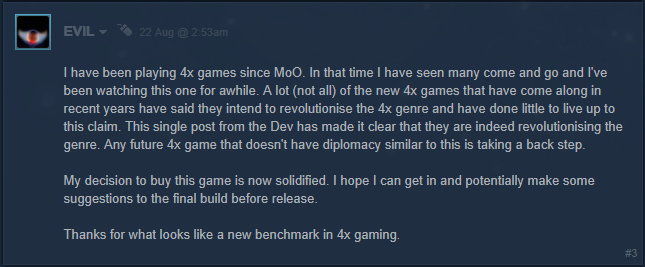
The biggest change in this update by far is a massive iteration on the Diplomacy gameplay. Many of these new features and improvements were things we were planning to do after V1.0 or even drop from the game entirely to get it out the door quicker, but when developing the Diplomacy AI’s Memory system we decided to push ahead with them. You only get one shot to release a game and this was one of our biggest opportunities to do something new and exciting in the 4X genre, so we’re very glad we took it. We posted an update on this to the Steam forum that was positively received, and in particular we were absolutely blown away by follower EVIL’s incredibly kind words below. We hope it lives up to your expectations!
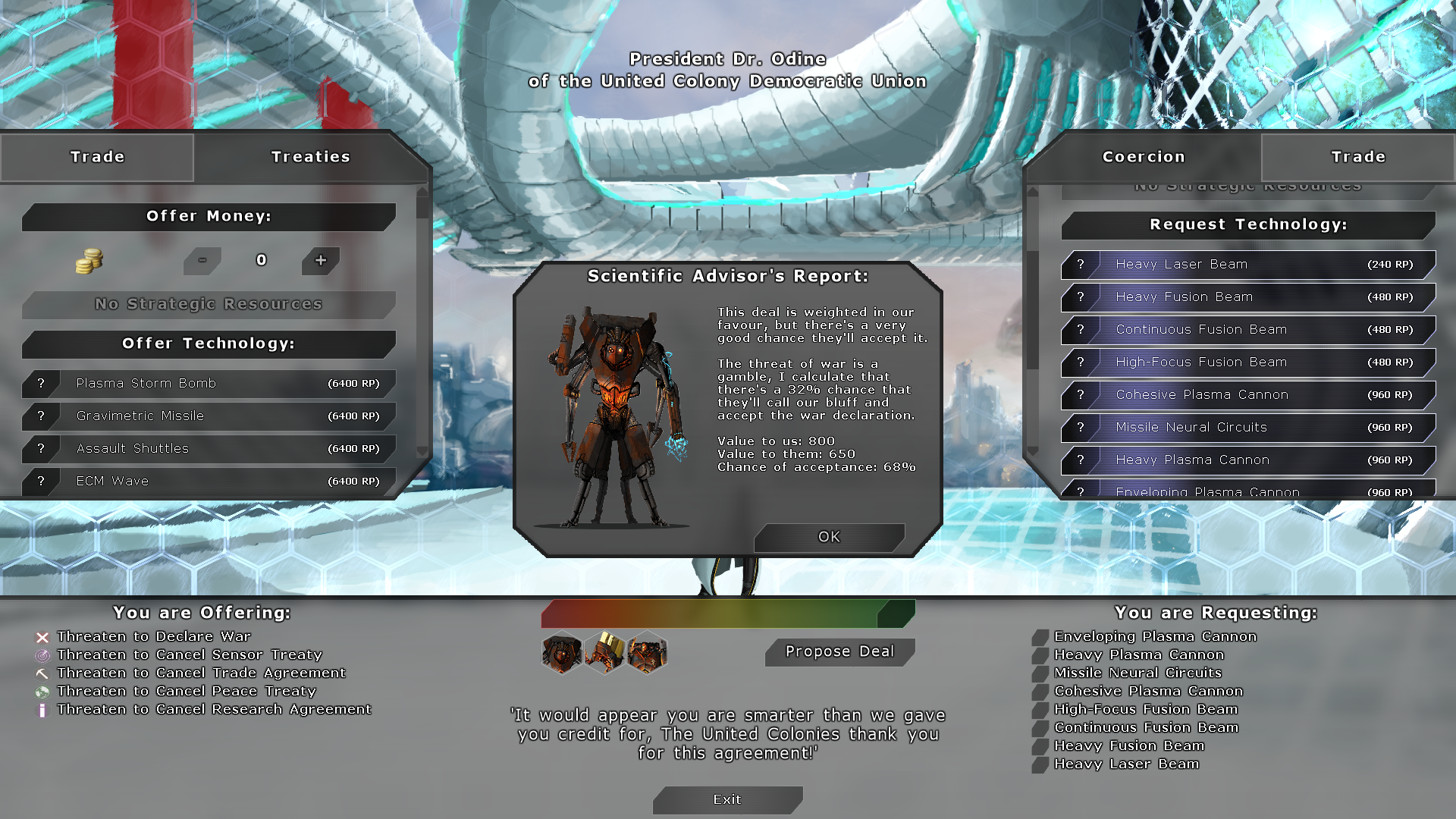
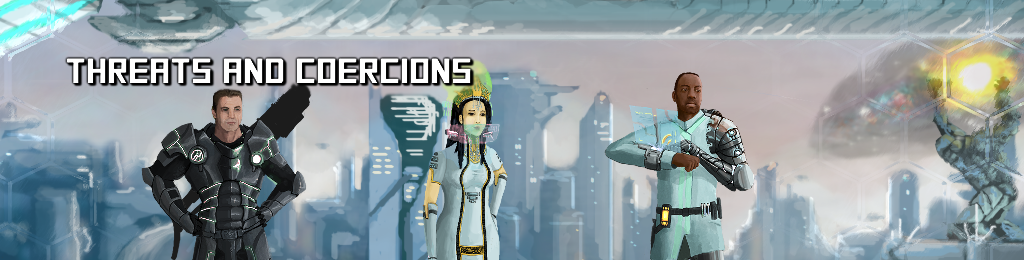
This was the final major piece of the diplomacy puzzle for us. It’s taken us some time to get here, but I hope you’ll agree that it was worth the wait! The Coercion panel in the Diplomacy screen is now active and you can use it to add diplomatic threats and demands to your deals that really take diplomacy to the next level. Races will also remember your recent threats and coercions in all future negotiations and will react accordingly. The weightings of threats may be tweaked as we balance test this gameplay, and we’d love to hear your thoughts on it.
Threats: Threats are a way to strong-arm another race into accepting a deal that would otherwise be in your favour. They add weight to a diplomatic offer and increase the chance the enemy race will accept, but will cause a -10% diplomatic penalty with that race for the next 100 turns and a minor penalty with the other races. Each threat can only be issued once every 50 turns, so you better make sure you get something useful in exchange.
Coercions: Coercions are demands you can make other than just money and technologies, and are a great way to manipulate the other races. You can diplomatically isolate a race by convincing everyone to break their treaties with them, for example, or convince a warmongering race to lay off an ally of yours they’re at war with.
Star Claims: Every fully uninhabited star system you’ve been to that has planets will show up in the Threats & Coercions tab, where you can issue a demand that the other race respect your territorial claim to it.
.
AI Memory / New Favour System:
The old diplomatic favour system had a point scale running from 0% to 100% representing how much each race likes you, and events such as wars or giving them gifts would permanently increase or decrease this rating. In practice, this meant you could just give an enemy race a bunch of gift technologies and they would like you forever unless you did something to decrease your rating again later, and they would never consider going to war with you.
In the new favour system, everyone starts with 50% favour to each other and this is modified based on your recent diplomatic history with the other race. Every time you do something that could change to your favour rating with another race, such as launching a surprise attack or giving them a technology gift, it’s recorded in that race’s list of AI Memory events. The value of each event decays slowly over around 100 to 200 turns, so you can’t just give them a gift once and coast on that goodwill forever. Decay also solves a problem in some other 4X games where empires can hold ancient grudges for the entire game even when it no longer makes sense.
Spontaneous Diplomacy AI Offers:
The Diplomacy AI now periodically checks if the other empires in the game have something they want and constructs a diplomatic offer to try and get it. It will now trade for key technologies, barter any strategic resources it has for something worthwhile, and offer treaties when it’s advantageous to its empire. The AI will seek peace treaties and eventually alliances with empires that have powerful militaries, sensor treaties if it will help them expand their empire, and research and trade treaties with large enough friendly empires.
This new part of the diplomacy AI is influenced by the empire’s overarching strategic goal (Expand, Consolidate, Diplomacy, Defend, or Conquer), the randomly selected leader’s personality type, and your diplomatic history with the target race (e.g. if you have a reputation for breaking treaties). This means a race’s diplomatic strategy can naturally vary from game to game and depending on its situation. We’ve also implemented a new twist in the form of hidden pre-existing diplomatic motivations.
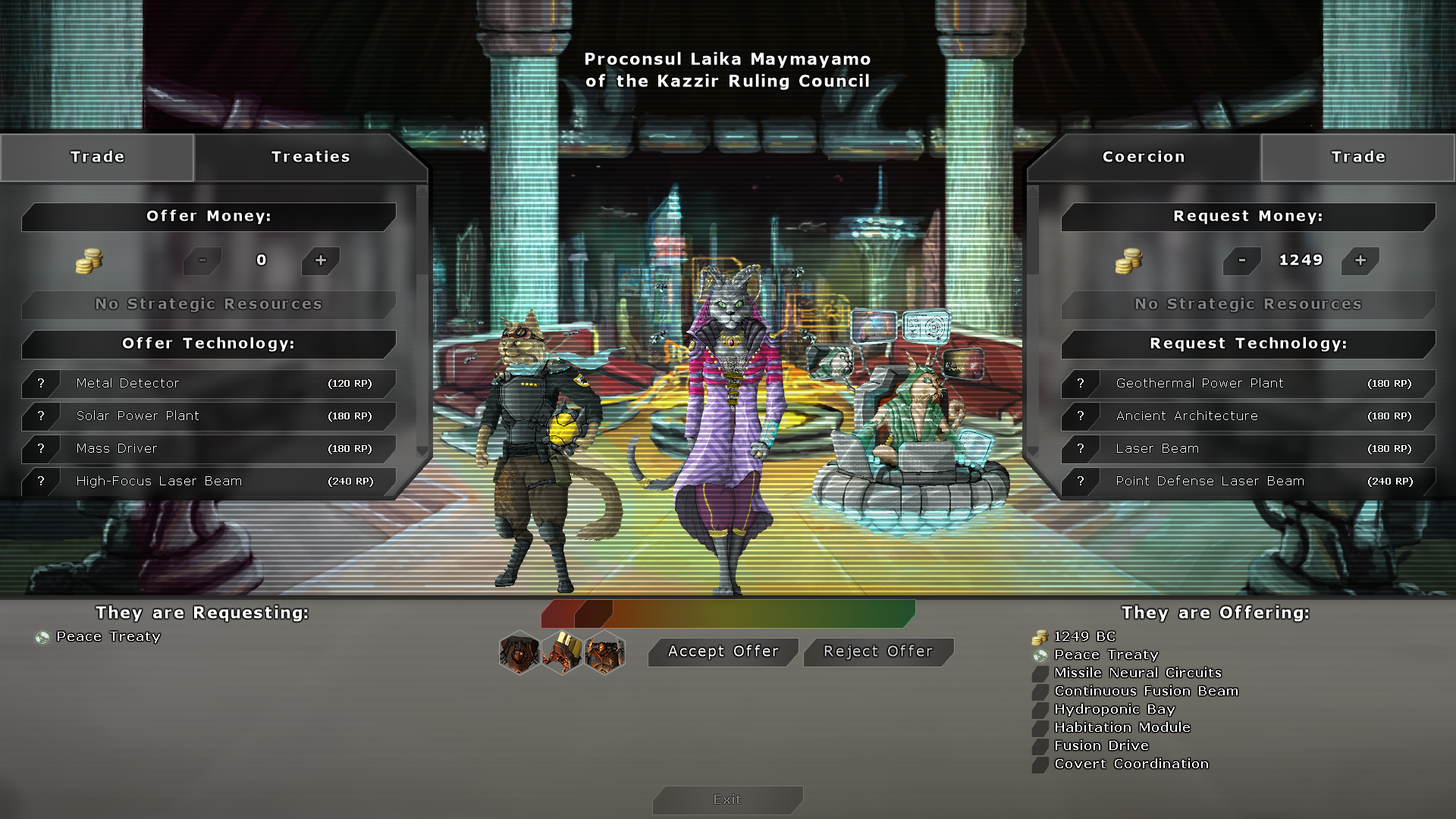
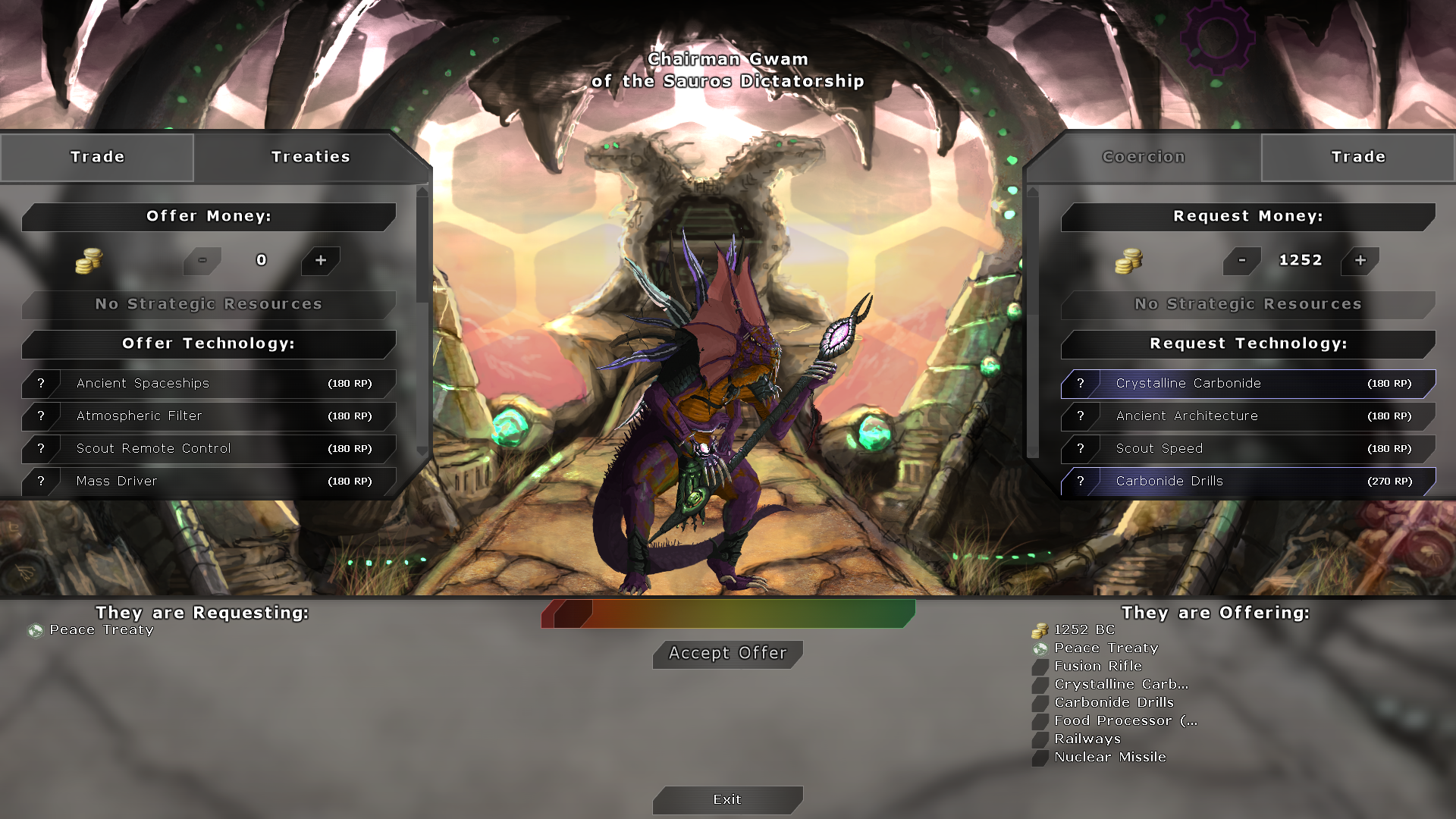
Two races can start the game already predisposed to liking each other or hating each other, which will modify the weight and duration of postitive and negative AI memory events and leads to some interesting gameplay. They can also really beg for peace when you’re kicking their ass, as below:
.
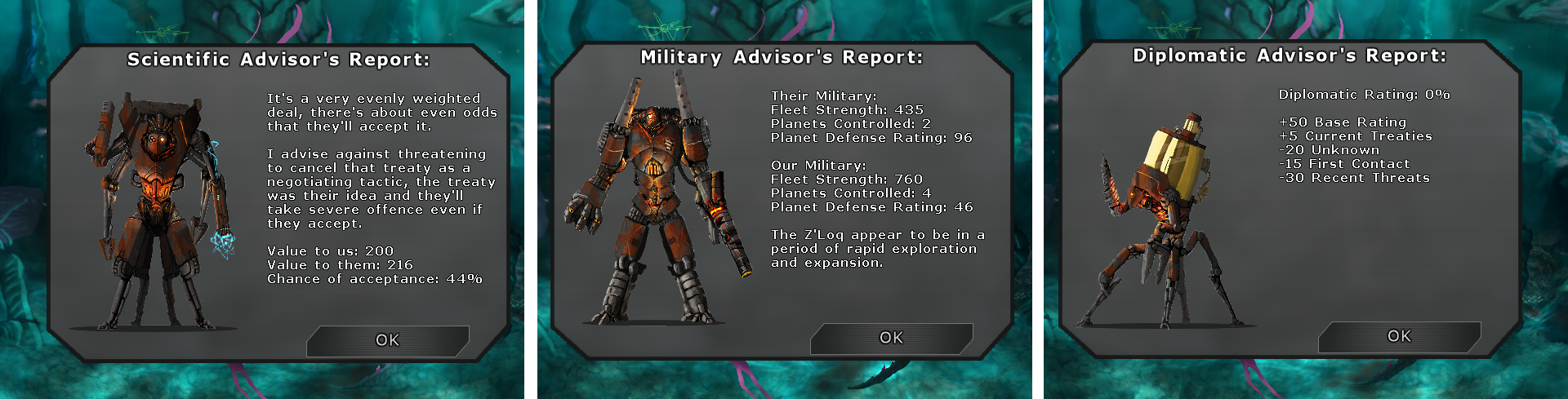
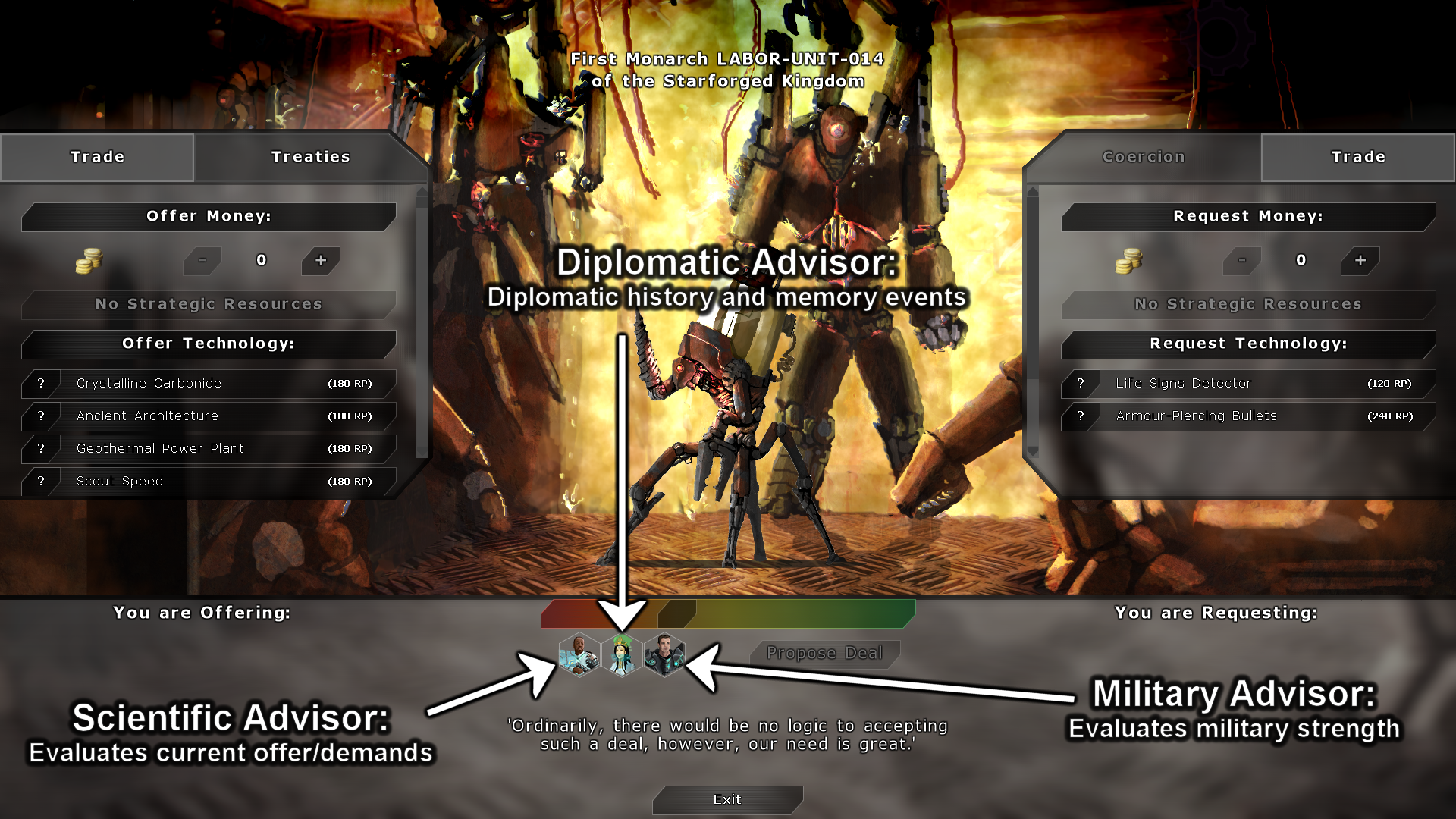
Predestination’s AI is pretty complex, basing decisions on a huge range of factors including military strength, scientific progress, colonisation progress, and recent diplomatic dealings. One thing we realised while playing test games to evaluate the AI’s responses to diplomacy was that it was very helpful to be able to see some of this information and gauge whether the AI will accept an offer and what its motivations are. That’s where the three new diplomatic advisors come in:
.
While testing out the new diplomacy coercion options such as demanding that the enemy stop spying on you, we remembered that the AI doesn’t actually engage in spying. We also spotted some ways that the spying gameplay could be simplified and improved for both the AI and the player, so we took a little time to implement the spying AI system and iterate on the spying gameplay itself:
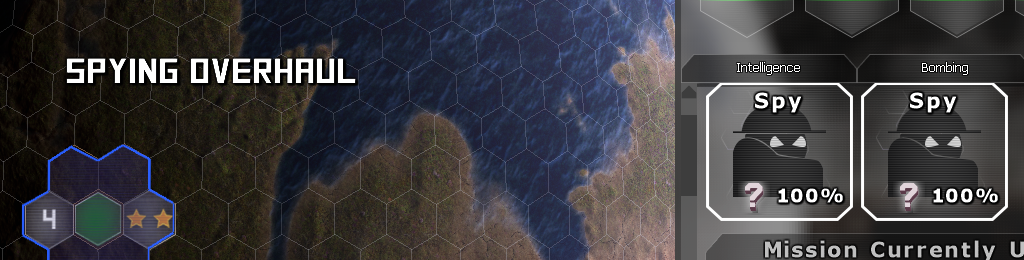
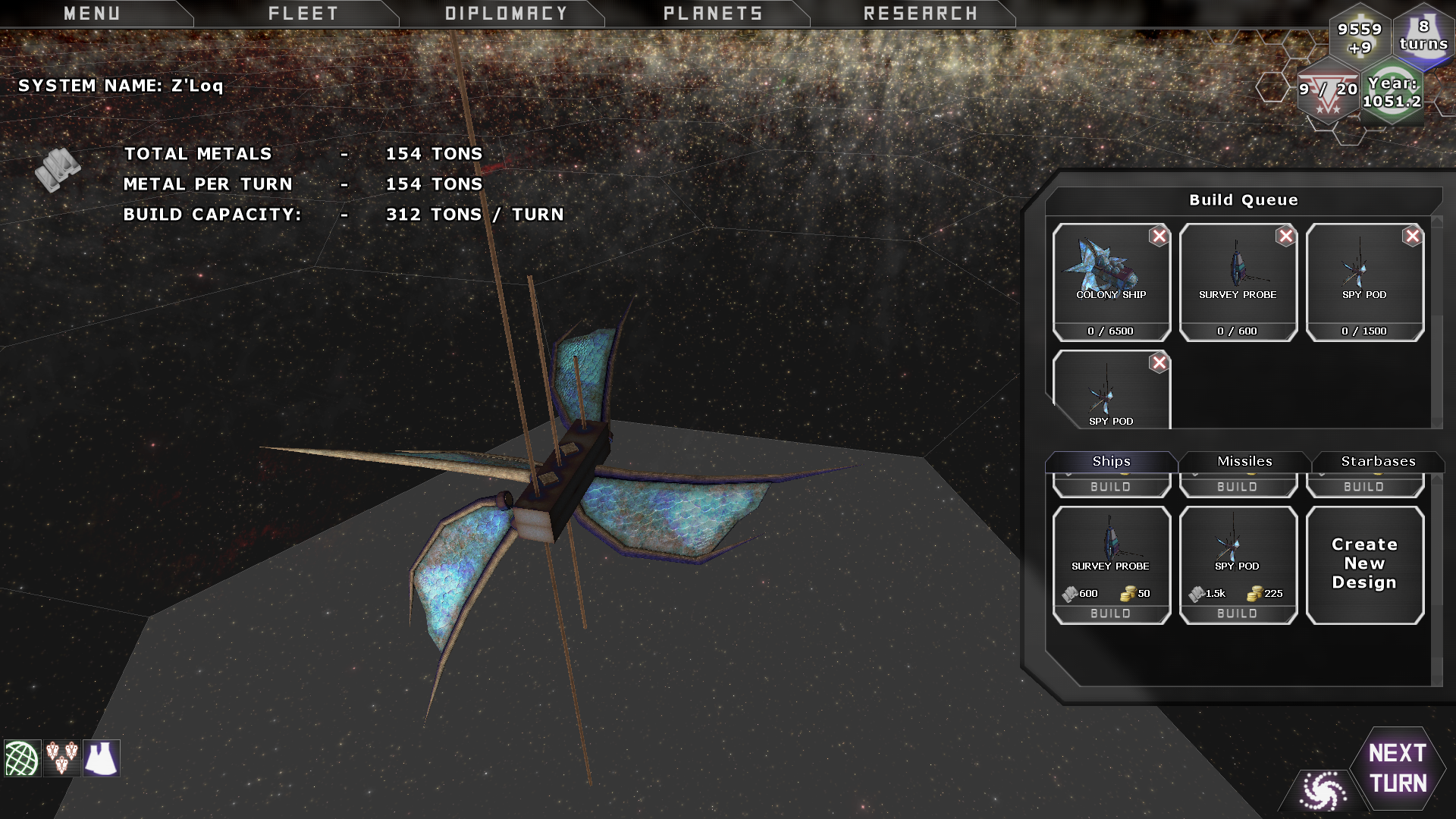
New Deployment System: To install a spy in an enemy planet, you previously had to build a ship with at least one Spy Pod module, fly it to the enemy system, pay 100 BC to install the spy, and then fly the ship home to refill it with new spies. The new system is much simpler and more consistent with the rest of the game. Now you just build single-use Spy Pod probes that work a lot like survey probes, fly them to the enemy system, and install the spy for free. The probe shows up as a Survey Probe on enemy sensors so they don’t know it’s a spy, and you may find it very suspicious if an enemy race starts sending survey probes into your systems.
Spying AI: The enemy races now build spy probes once they are able, pick out ideal target planets to install spies in, and send spies to infiltrate them. When spies arrive, the AI gets them to hide for a while to get their infiltration ratings up and then switches them to another mission. The AI picks which mission to use based on factors like how much they like the other race, how much research and other activity is happening on the planet, and whether they’re at war. If you threaten the AI to stop spying on you, they’ll put all of their spies on your planets into hiding until the threat expires.
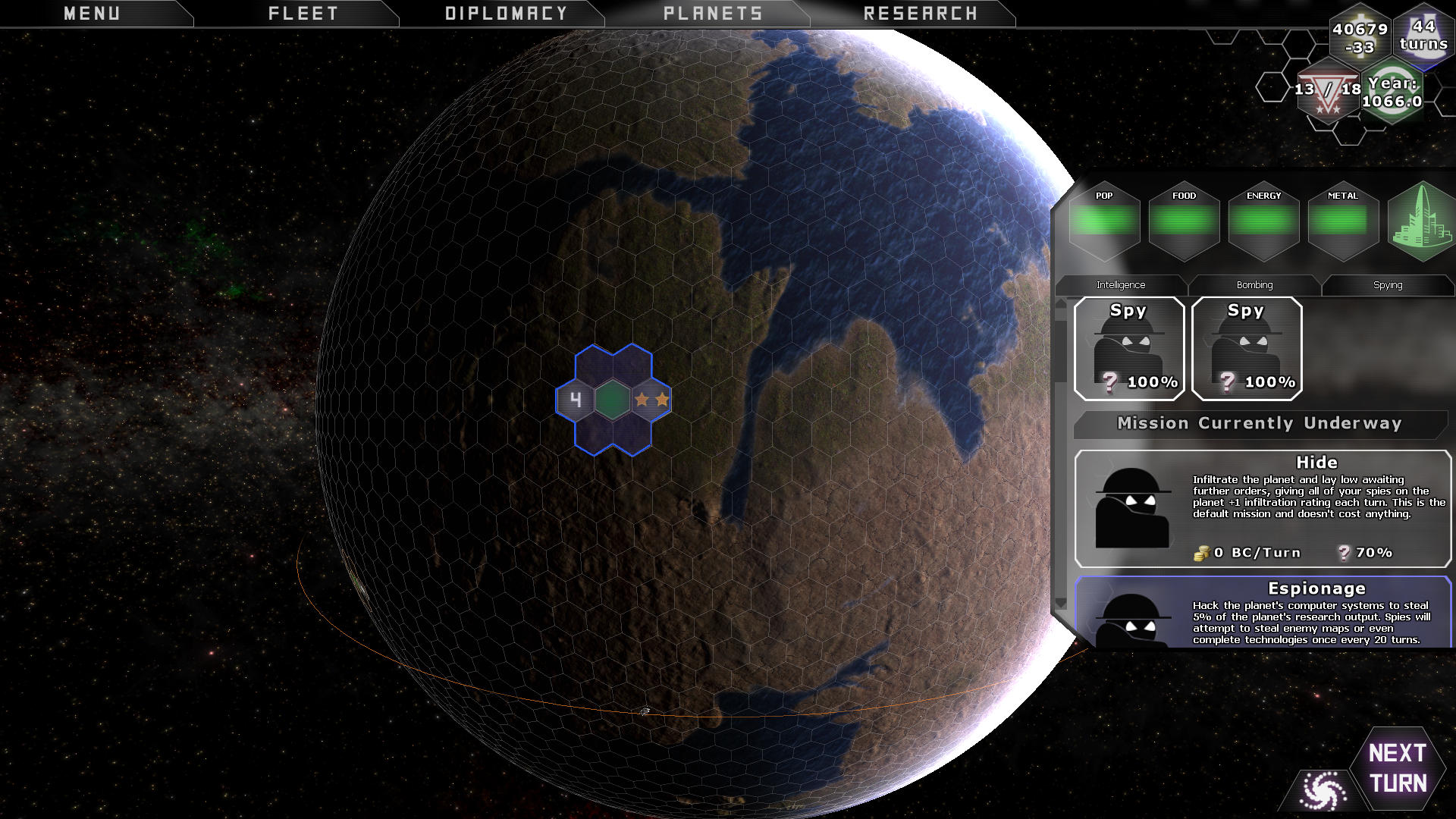
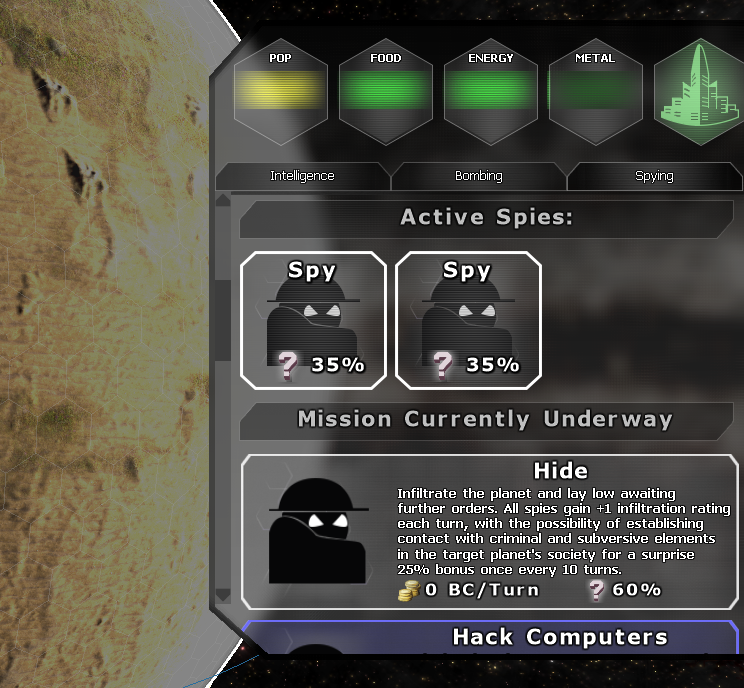
Spy Mission Changes: There was a bit of a lack of consistency with the spy missions, as some had ongoing effects and some had no effect until they roll for success every 20 turns or so. We updated all the missions so that now each one has a passive effect that happens while the mission is ongoing and an active effect that rolls every 20 turns or so. You also now get a popup when a mission is successful and the AI will condemn you when they catch one of your spies. The updated missions are below:
New Spy Technologies: While implementing the new spy missions, we split the Troop Pods and Spy Pods back into two separate technologies and added several new ones to the Sociology tree. We’re planning to add a few more in the next update, so we’d love to hear any ideas you have for new spying technologies!
.
Up until now, the main menu screen has been a simple background image with a few buttons on it. It wasn’t very visually appealing, you couldn’t edit any of the game options from it, and the only way to load a game was to use the Continue button that loaded your latest save game. There was also no way to select the singleplayer mission you wanted to play, which will be important as we add further chapters to the story. I’m happy to say that we’ve now totally revamped the main menu to solve all of these issues, and the new screen very closely resembles the mock-ups from the previous dev update.
.
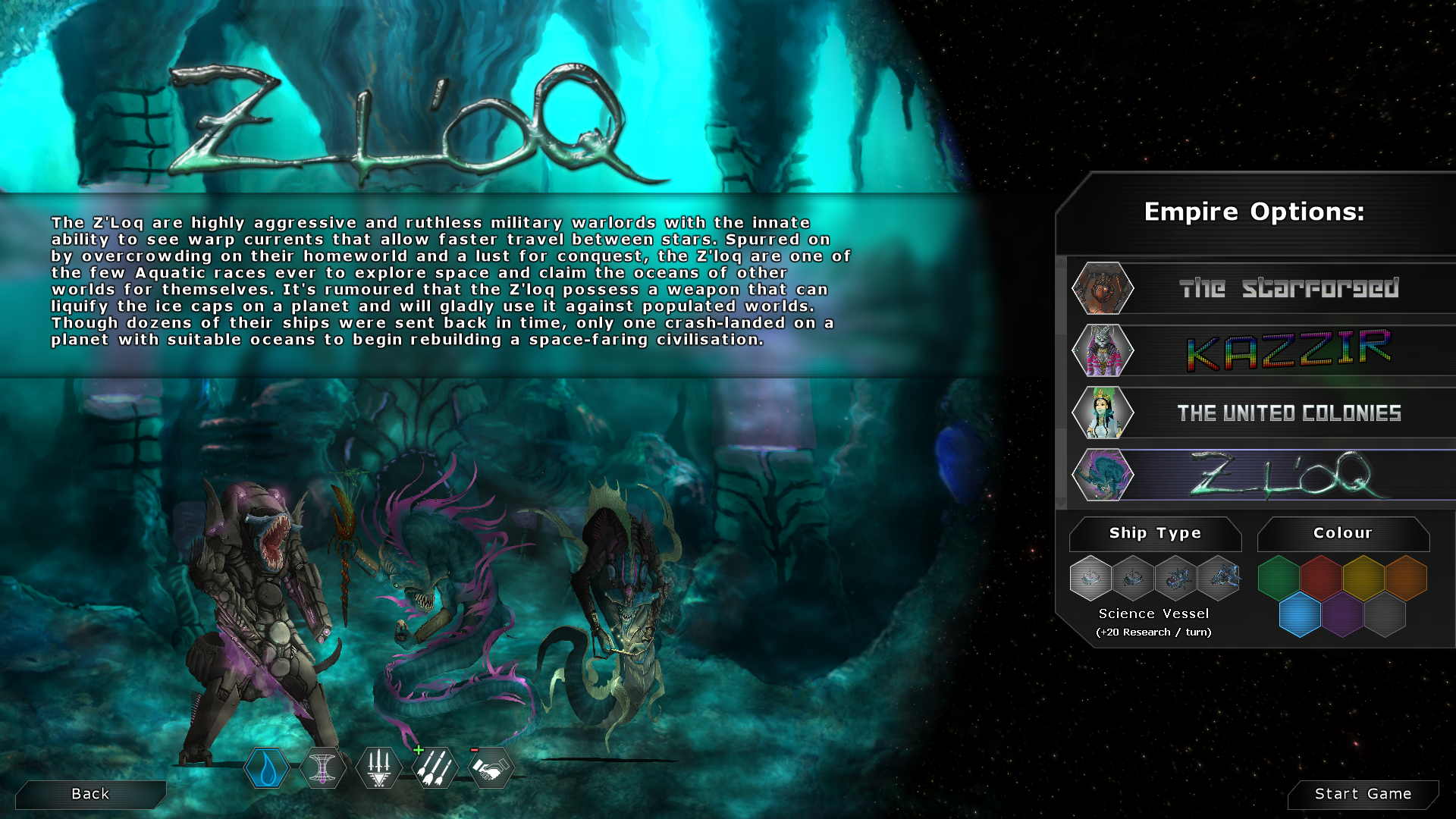
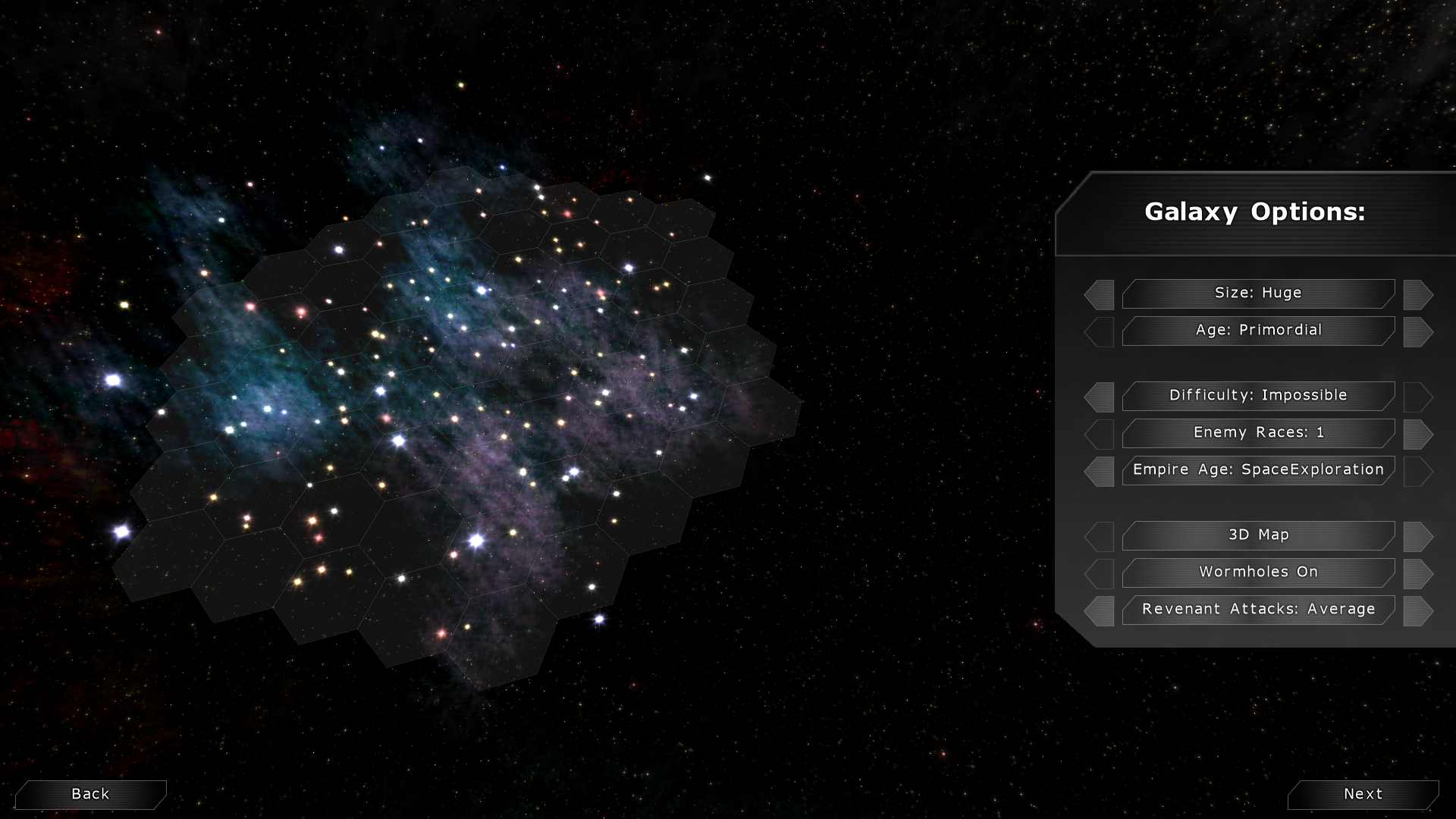
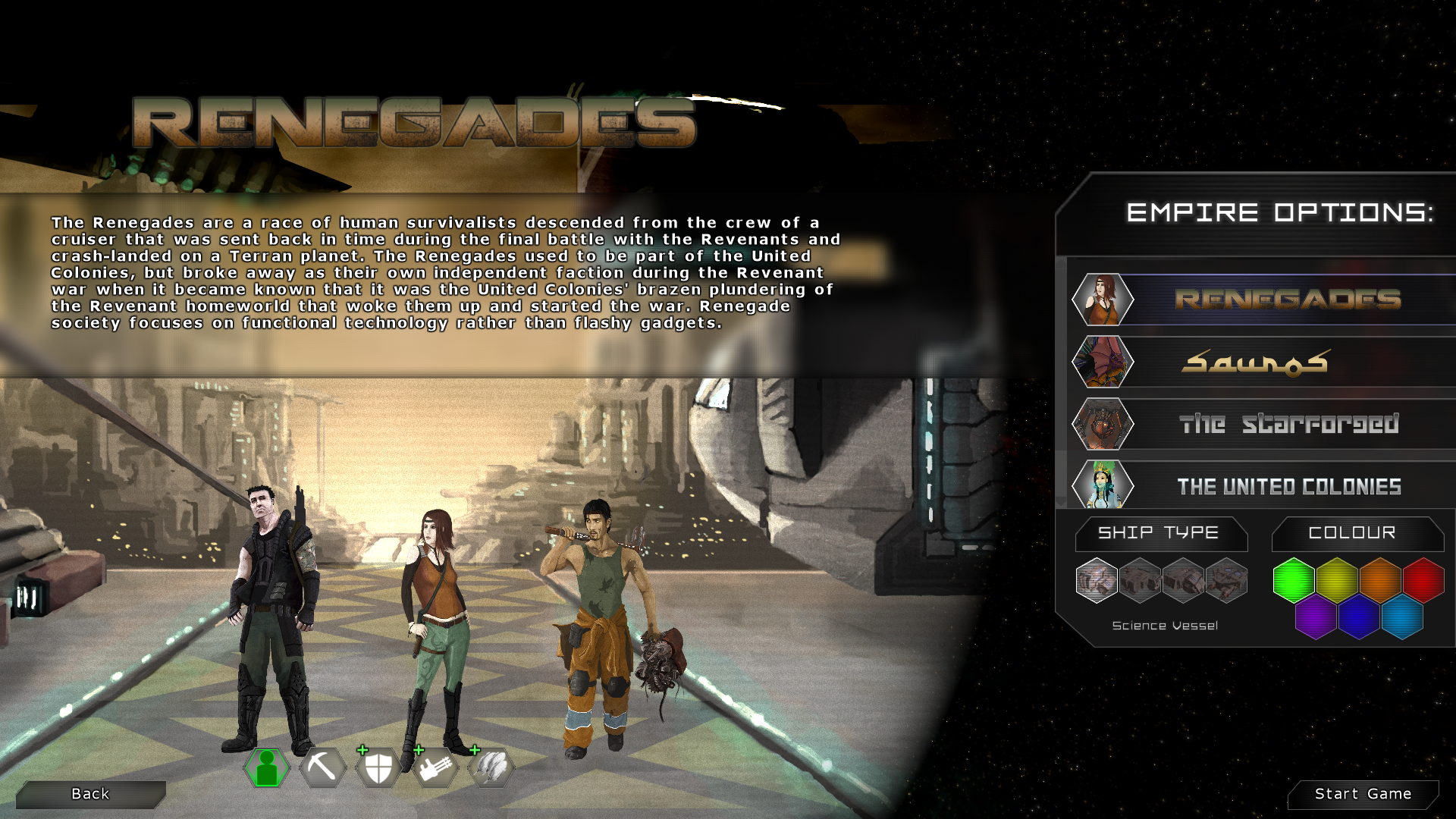
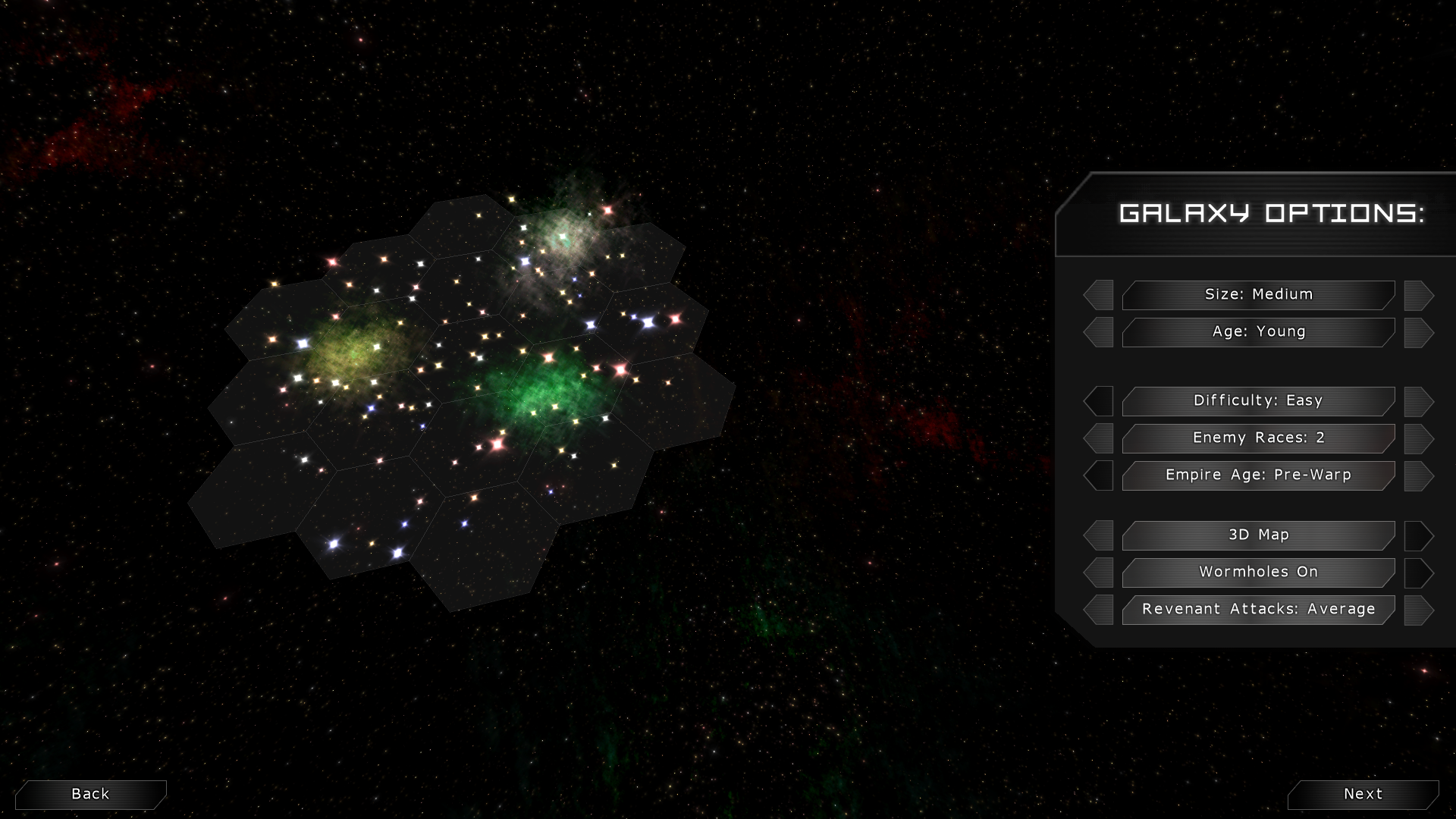
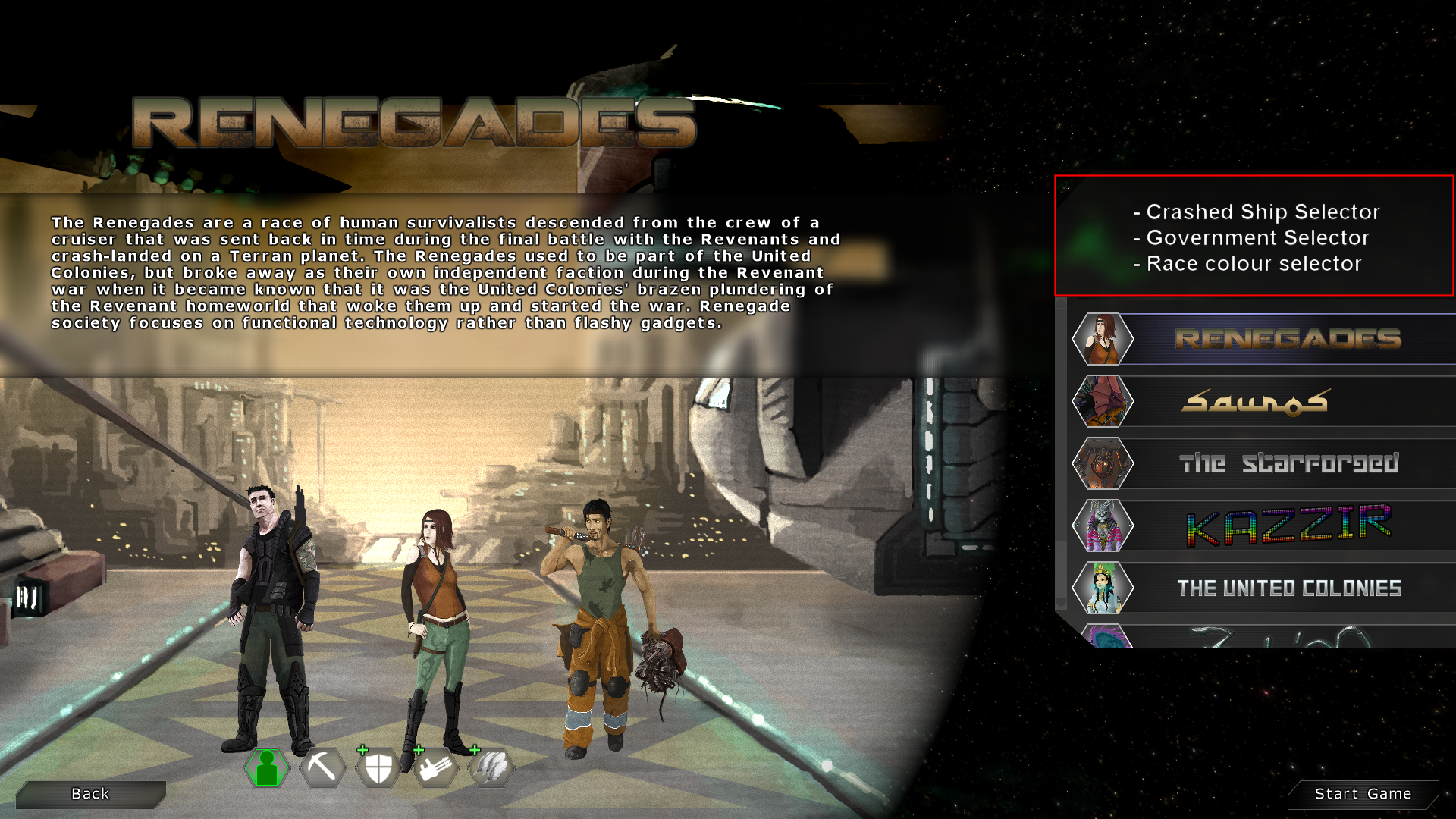
We’ve now finished off the New Game Screen, which was missing some of the options players could select when creating a new sandbox mode game. The load time when clicking the Sandbox Mode button on the main screen has been eliminated, we’ve made some small UI improvements to the galaxy selection page, and all galaxy options are now saved to your Predestination.ini file and will be remembered the next time you load the game. The race selection page has also been renamed to Empire Options and now allows you to select your race’s colour and which crashed ship you want to start the game with:
.
Galaxy Distribution: We’ve made some changes to the galaxy and nebula generation algorithm again, making stars a bit closer together and re-balancing the number of stars on each size level (32 for Tiny, 48 for Small, 64 for Medium, 96 for Large, 128 for Huge, and 180 for the new Colossal size). A few tweaks have been made to ensure every race has a certain minimum start quality, so races such as the Starforged and the Zloq who are highly sensitive to finding the right type of planet nearby should no longer get screwed over by map generation. You’ll still have to go exploring to find the ideal planets, but there’s now guaranteed to be a decent one nearby.
Nebula Tweaks: The nebula graphics have been tweaked a bit and should now look a bit better with more variation. Stars will also now more accurately detect that they’re inside a nebula and show that visually in the system window correctly, which will be a bigger deal as we add further gameplay differences for stars inside nebulae such as gas pockets during fleet combat. The Primordial galaxy age also now makes nebulae sprawl out across multiple stars for a more unique look, and Ancient galaxy age has more distinct nebulae.
Aquatic Race Tweaks: Someone pointed out that the Zloq can be kind of overpowered when it comes to producing metal as their Metallic Coral Reefs are massive and can harvest ore deposits on nearby land, so we’ve re-balanced reefs a little. They can still harvest ore on land, but pure Ocean worlds now start with less ore and Aquatic races can no longer research Carbonide Drills so their ore deposits are only worth +2 metal/turn. To compensate, the Metallic Coral Reef now automatically plants 4 additional coral deposits in ocean hexes in their area when built or 9 new deposits with the Pre-Seeded Reefs technology. This also applies to Fishing coral Reefs, which now start with additional fish deposits so you will no longer have to wait as long for fish growth.
Standalone Ship Designer: As part of the 3D Ship Designer Kickstarter campaign, we offered a standalone version of the 3D ship designer that let you save your designs to files. We deployed the first version of this last month and will be deploying an updated version soon and sending everyone out emails with the link.
Building Models: We’ve now added the models for the Coral Spire, Fishing Coral Reef, Metallic Coral Reef, Gas Harvester, ByteCoin Miner, Antivirus Tower, The Forge, and Heat Sink infrastructure / buildings. Several are still remaining to be completed, including the Factory, Research Lab, Food Processor, and Factory. We’ve also now added the models for biospheres, making it a lot easier to see which cities and infrastructure have biospheres and thus cost an extra +1 BC/turn to run.
More Diplomacy Text: As part of this update, we had to add new diplomatic responses for each race to cover new circumstances that can occur. The races all now have responses for when you accept a counter-offer they make, when you accept a deal they spontaneously suggested, when you reject a deal they spontaneously suggested, when you reject a demand they make of you, and when they catch your spy on their planets. We’ve also taken the opportunity to fix a number of text errors in the diplomacy text files.
.
I’d like to thank everyone for reading through another colossal dev update article, I didn’t quite realise how much was in this patch until writing this up! A special thanks also to those providing feedback and bug reports during Early Access. As always, if you’re a Kickstarter backer and you’d like an early access key for Steam or to check out the latest DRM-free non-steam edition of the game, send us an email to earlyaccessrequest@brainandnerd.com with the email address you used on Kickstarter. The next wave of keys will be going out in the next day or two.
We’re eagre to get feedback on all of the new things in this update, so please do share your thoughts here, on the Steam forum, or directly via email to brendan@brainandnerd.com if you’d like to keep your thoughts and ideas private. Are the new threat and coercion options too heavily weighted or does the AI still drive a hard bargain? We’re also interested in any ideas you might have for new spying technologies and potentially for new endgame technologies and weapons in the Physics and Biology tech trees. The next major update will be the big V1.0 release, when we change gears from feature development to iteration and balancing. More information on what you can expect in V1.0 will be released in a further dev preview article soon!
Cheers,
— Brendan, Lead Developer
Patch Notes for V0.9.9.0 (Build ID: 2088062)
This Colossal update started out as a month-long incremental update to overhaul the main menu and fill in some missing Diplomacy gameplay. We took the opportunity to add some huge diplomacy features, revamp the diplomacy AI, Spying, and more. Please note that all of your older save game files will be broken in this new version and won't load. This is unfortunately necessary as the galaxy and race data just isn't compatible with the new format.
Main Menu
We've completely overhauled the main menu screen, replacing the boring background image with a new animated scene of a rotating galaxy and a planet on the right hand side, all rendered using the in-game tech. The new screen now seamlessly switches to the New Game screen and also includes a panel in the middle of the screen that pops up to be used for everything from options to picking a save game to load.
<*> Implemented Options menu. When the Options button is active, the panel in the middle of the screen now shows a series of toggleable checkboxes and sliders pulled directly from the Menu dropdown in the main game.
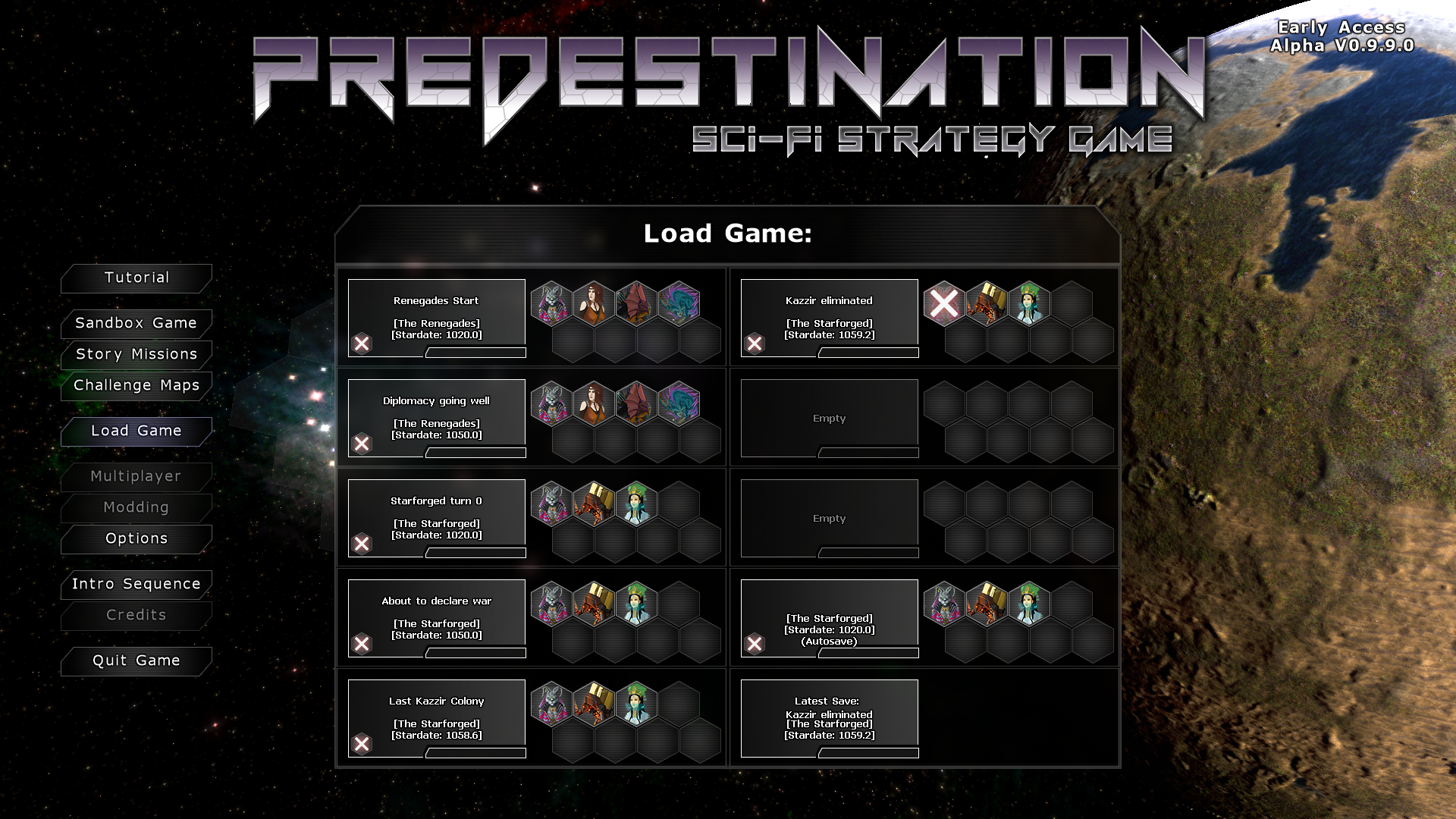
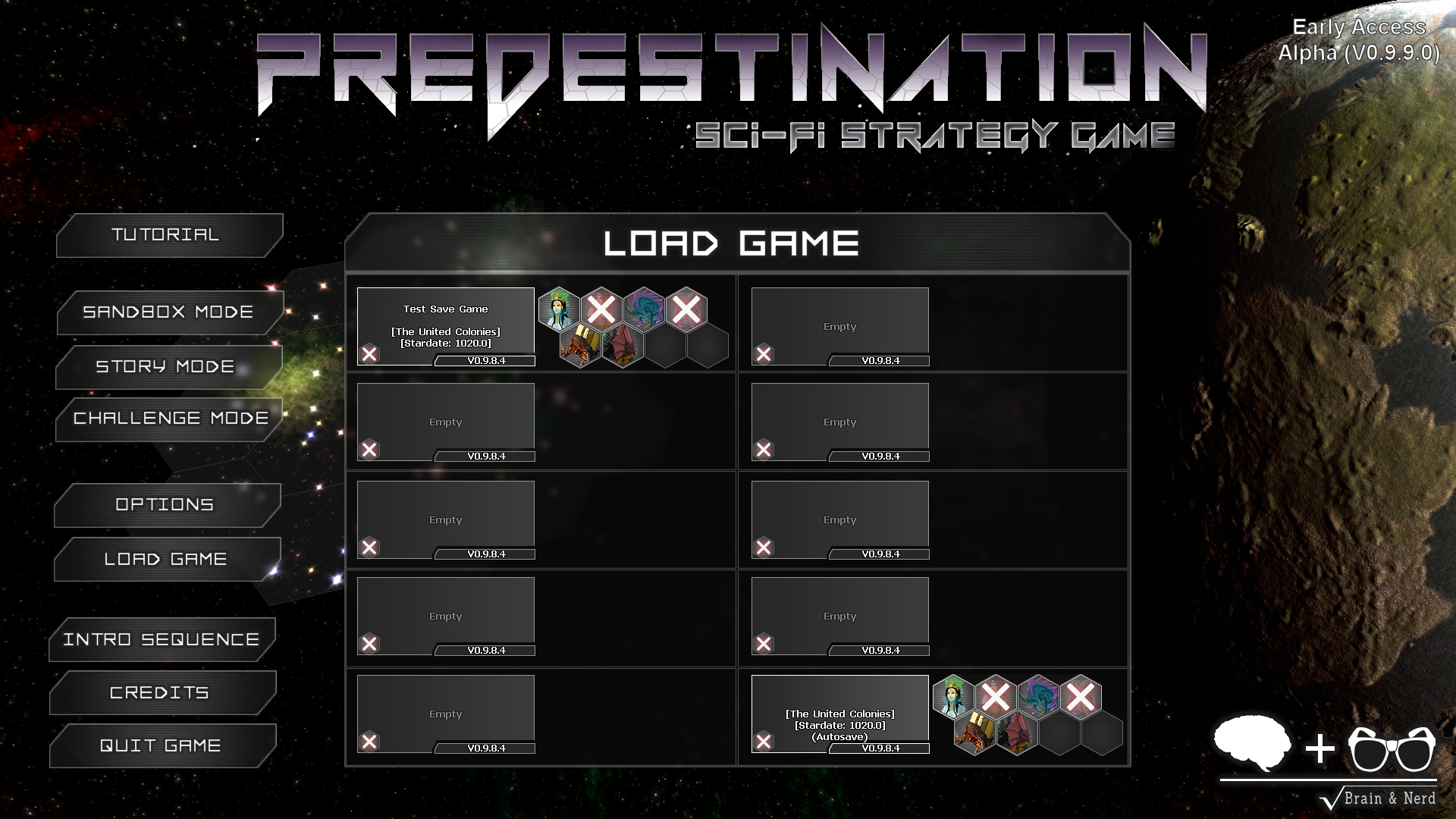
<*> Implemented Load Game menu. When the Load Game button is active, the panel in the middle of the screen now shows all eight of the save game slots, the autosave and a shortcut to the most recent save game. The races present in that save are drawn in little hexes next to each save.
<*> The Save Game directory now contains information on each race in the game and whether it has been eliminated. Older save game files may display this incorrectly, but new saves made after the patch will be fine.
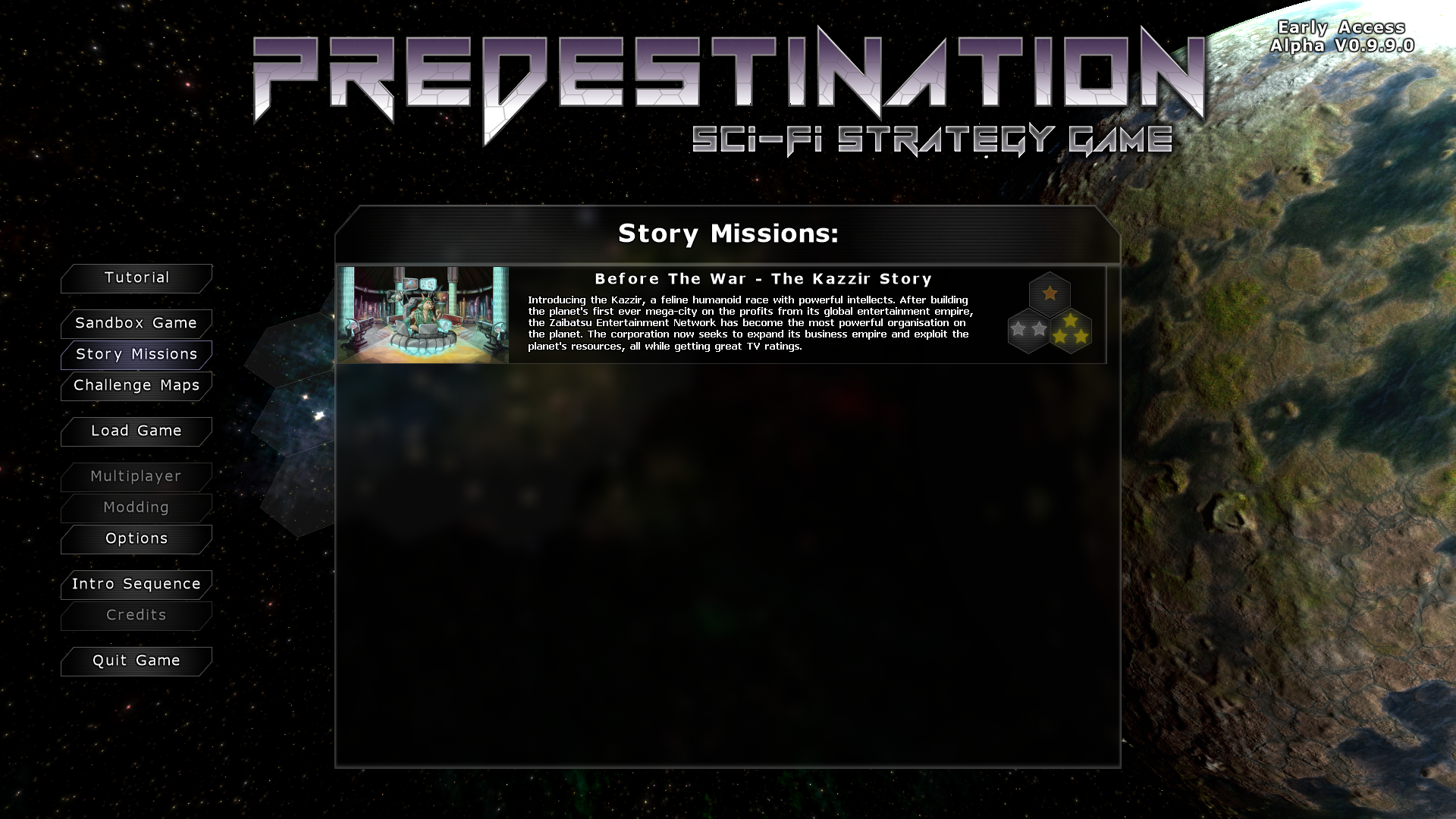
<*> Implemented the Story Mode and Challenge Maps menus. When each button is active, the panel in the middle of the screen now shows a list of playable missions and indicates whether they are locked and whether you've achieved the bronze, silver, or gold rating.
<*> The UI for selecting Galaxy options when you create a new Sandbox game has been improved with new buttons and a header image.
<*> The Galaxy options you select when starting a new Sandbox game are now saved to the Predestination.ini file and remembered next time you start the game.
<*> The Race Select screen when creating a new Sandbox game has been renamed to Empire options and now has a header image
<*> You can now select what colour you want your empire to be on the Empire Options screen.
<*> You can now select which crashed ship type you want to start with on the Empire Options screen. The choices are Science Vessel, Asteroid Miner, Colony Ship, and War Cruiser.
AI Memory System
<*> Added a positive AI Memory event for when you give the enemy a gift.
<*> Added a positive AI Memory event for when you make a fair deal in the enemy's favour.
<*> Added a positive AI Memory event for every time you accept a deal that they've proposed to you.
<*> Added a negative AI Memory event for Mistreating Citizens when you use violence to quell a riot random event on one of your planets. There's also a -10% Mistreating Citizens penalty if you have researched the Medical Testing technology and the other race hasn't.
<*> Added a negative AI Memory event for launching a surprise attack on a planet without declaring war first. This penalty is larger if you are violating a peace treaty at the same time.
<*> Added a negative AI Memory event for using a superweapon on a planet that has been banned by the Galactic Council, such as the Genesis Device or Stellar Converter.
<*> Added a negative AI Memory event for firing biological weapons at an enemy city that kills their population and troops.
<*> Added a negative AI Memory event for when your spy is caught on attempting the active part of its mission.
<*> Added a negative AI Memory event for when the enemy rejects a proposal weighted in your favour.
<*> Added a negative AI Memory event for when the enemy accepts a proposal even though it's weighted in your favour. This punishes you a bit for constantly making deals in your favour by making the enemy less receptive to your future offers.
<*> Added a negative AI Memory event for breaking a treaty. The penalty is increased if the treaty was that race's idea in the first place.
<*> Added a negative AI Memory event for any time you make a diplomatic threat using the new Threats and Coercions system. This forces you to use threats selectively as the enemy will be a bit less receptive for 100 turns.
<*> Added a negative AI Memory event for every time you reject a deal that they proposed to you.
<*> Added a negative AI Memory event for violating a star claim you've previously agreed to.
<*> Added a -50 diplomacy favour penalty for being at war. With enough positive counter-points, it's possible to have a positive rating with a race and still be at war, which will make them more likely to make peace.
<*> When you end a war by securing a peace treaty, the "Historic War" memory event is triggered, replacing the diplomacy favour penalty for being at war with a new -50 penalty that tapers off over the next 100 turns.
<*> Added an AI Memory event for First Contact that can be either positive or negative
<*> Implemented a new friendship / rivalry system to the Diplomacy AI. Races can now start the game with a predisposition toward liking or hating another empire in the game, decided at random during map generation. This modifies the value and duration of positive and negative memory events, having far reaching effects throughout the game.
<*> Factored game difficulty setting into the friendship / rivalry system to make Hard and Impossible mode harder.
<*> Factored game difficulty setting into the value of memory events to make the game naturally harder in Hard and Impossible mode, and promote more natural wars in those difficulty levels.
<*> Added a diplomacy favour bonus for each treaty based on the treaty's length, so that long-standing friendships are more valuable.
Threats and Coercions:
Threats are a way to strong-arm another race into accepting a deal that would otherwise be in your favour. They add weight to a diplomatic offer, but if the enemy rejects your proposal then the threat is carried out automatically. Coercions are a way to manipulate another race into doing your bidding, but you have to add a lot of value to the deal to get them to accept it.
<*> Activated the Coercions panel in the Diplomacy screen to contain all threats and coercions.
<*> Added Threaten Declare War feature. If the deal is rejected, war is automatically declared.
<*> Added Threaten Cancel Treaty feature. All existing treaties you have with the enemy race show up here.
<*> Added Demand Break Treaty feature. All treaties the enemy race has with other races show up here, and you can demand that they break them.
<*> Added Demand Make Peace feature. All wars the enemy is involved in will appear here and you can demand that they make peace. If they accept, they'll construct a peace offering.
<*> Added Demand Stop Spying feature. If the enemy is spying on any of your planets, you can demand that they stop. This will make them all switch from their active mission to the Hide mission for the duration of the coercion (50 turns).
<*> Added Star Claim feature. All uninhabited star systems within range of both empires will show up here, and you can demand they leave the system alone. The AI will respect your star claims for 50 turns.
<*> Implemented peace mediation mechanic. When both races in a war have been convinced to make peace, the peace agreement is automatically accepted.
<*> Implemented Peace Mediator technology, giving a +10% global diplomacy bonus every time you mediate a successful peace treaty between two other races.
<*> Implemented Star Claim AI: Whenever an AI race picks a valuable planet to send a colony ship or survey ship to, they will often contact any nearby races and inform them that the star is claimed by them.
<*> Modified the Threat Psychology technology. It now adds +50% to the value of threats and coercions in diplomatic deals.
Spying Gameplay:
<*> Implemented the Covert Coordination technology. Allows you to add an extra spy to each enemy planet.
<*> Implemented the Deep Cover technology. All spies gain an additional +1 infiltration rating per turn when in Hide mode. When installing a second spy on a planet, it inherits the current spy's infiltration rating.
<*> Changed the spy bonus and chance roll algorithms. The first spy adds 50% of its infiltration rating to its offensive spy score and each additional spy adds 10% of its infiltration rating.
<*> Split the Drop Pods technology into two separate technologies: Spy Pod and Troop Pod. Also re-organised the Sociology tree to add the new spying technologies as a small sub-tree.
<*> Implemented Spying AI. This builds spy pods when the technology is available, selects enemy planets that would be ideal to spy on, and sends spies to infiltrate those planets. The spy hides until it has a high infiltration rating and then switches to an active mission depending on what mission would be best on that planet.
<*> Spies now cost 0 to install. Instead, you now build single use stealth probes to carry spies to enemy planets that work like survey probes.
<*> The Send Spy button when you right click on an enemy planet in the system window is now fully functional. It will light up if you have any idle spy pods in your empire, and clicking it will dispatch one to that planet. The same button can be found on the Planets menu's Exploration panel next to enemy planets.
<*> The Spy Satellite now costs 500 metal and 100 BC and the description has been fixed so it now correctly says it gives a +50 spying bonus for 100 turns.
<*> The Spy Pod now fits only on a probe hull and is limited to one per ship. It costs 1000 metal and 200 BC, which replaces the cost of installing spies.
<*> Renamed Hack Computers mission to Espionage and added a passive component that steals 5% of the planet's research each turn.
<*> Renamed Sabotage Computers mission to Sabotage.
<*> Renamed Plant Bombs mission to Terrorism and added a passive component that kills 50 population each turn.
<*> Renamed Incite Civil Unrest mission to Rebellion.
<*> Tweaked the difficulty and success chance of all of the missions and changed the success chance algorithm. Each mission now has a base chance, onto which all positive and negative bonuses are applied to reach the final odds. Total bonuses are +0 to +110 defensive and +0 to +110 offensive
<*> Modified the chance of being caught when executing a diplomatic mission. There's now a 25% chance of being caught on failure and a 10% chance of being caught anyway if you were going to be successful. This means there's no guarantee you won't be caught even if you have a massive spying bonus.
Diplomacy AI & Improvement:
<*> Added new Diplomacy text for when spies are caught or you reject an offer they've made to you
<*> The AI race leaders can now sometimes take an immediate liking or disliking to another empire that will affect the weighting they give to positive and negative interactions. If a race decides they don't like you then you may have to work harder to avoid war, and if they like you then you can expect more favourable diplomatic deals.
<*> Implemented Spontaneous Offer AI. The Diplomacy AI now periodically checks if the other empires in the game have something they want and constructs a diplomatic offer to try and get it. It will now trade for key technologies, barter any strategic resources it has for something worthwhile, and offer treaties when it's advantageous to its empire.
<*> Implemented complex Spontaneous diplomacy AI that constructs realistic diplomatic offers and demands depending on a wide range of factors.
<*> Added modifiers to the Diplomacy AI to account for the race's overarching strategic goal (Expand, Consolidate, Diplomacy, Defend, or Conquer)
<*> Added modifiers to account for the AI's randomly selected leader personality type and your diplomatic history with the target race.
<*> Added a special warning if you are caught spying on another race and have previously agreed not to spy on them. This causes a larger diplomatic hit than a standard caught spy.
<*> Added a new Reject Deal button and moved the UI around to accomodate it. This button appears when the AI contacts you to make an offer.
<*> Implemented new Scientific Advisor report: Evaluates the current diplomatic offer on the table and give you the estimated value of each side, a percentage chance that the other race will accept the deal, and a recommendation.
<*> Implemented new Diplomatic Advisor: Gives you a breakdown of your current favour rating with the other race, showing the total contribution from each type of memory event and other factors such as legendary commanders and racial bonuses or penalties.
<*> Implemented new Military Advisor: Gives you the estimated military strength of both races' fleets and planets, and tells you the race's current strategic goal (Expand, Consolidate, Diplomacy, Defend or Conquer).
Buildings / Infrastructure:
<*> Added model for the Coral Spire, the central Aquatic city building.
<*> Added model for The Forge, the central Robotic city building.
<*> Added model for the Heat Sink, a piece of Robotic infrastructure.
<*> Added model for the Gas Harvester, a piece of infrastructure for all races.
<*> Added model for the Metallic Coral Reef, a piece of Aquatic infrastructure.
<*> Added model for the Fishing Coral Reef, a piece of Aquatic infrastructure.
<*> Added model for the infrastructure and city biospheres. It should now be clear whenever something is surrounded by a biosphere, which costs an additional 1 BC/turn to run.
<*> Added models for the Barren, Molten and Toxic biospheres with different colours of glass (Barren:Gray, Molten: Red, Toxic: Purple).
<*> Added model for the ByteCoin Miner, a piece of Robotic infrastructure.
<*> Added model for the Antivirus Tower, a Robotic building.
<*> Increased the Damaged Mining Barge's metal output from 20/turn to 25/turn.
<*> Increased the power output of the Fossil Fuel Power Plant from 50/turn to 75/turn so that the start of the game is less restricted.
<*> Increased the power output of the Nuclear Power Plant from 200/turn to 250/turn to make it more effective.
<*> Increased the power output of the Biofuel Reactor from 100/turn to 150/turn
<*> Changed the Heat Sink building from a city building to a piece of planetary infrastructure. It now provides +10% research and metal production across the planet but takes up an infrastructure slot and must be built in an Ice environment.
<*> Coral reefs now automatically plant 4 free deposits of the resource they grow (Coral for the Metallic Coral Reef and Fish for the Fishing Coral Reef) in empty hexes of the right environment. This is in addition to the deposits already there. The bonus is increased to 9 additional deposits with the Pre-Seeded Reefs technology.
<*> The Auxiliary Hatchery reptilian building has been changed to increase population growth rate by 5% at the cost of 250 food per turn.
<*> Removed the Auxiliary Forge robotic building has been removed as it kind of went against the design of the Robotic races by providing population growth.
Misc Features / Changes:
<*> Implemented the Fleets dropdown menu. This new dropdown shows all of your current fleets and provides shortcuts to open them. Moving ships have their destinations shown and stationary ships are labled as "Standing Fleet" with the system of origin displayed.
<*> Ocean and Swamp planets no longer start with poorer mineral rolls. Instead, they generate part of their minerals as ore on land and part as coral in the oceans. This makes these planet types more viable for Aquatic races and less for other races.
<*> Strategic resources such as Neodymium, Helium-3, and Coffee Beans will now always be found surrounded by other resources of the same type (e.g. Neodymium in an ore deposit and Coffee in a fertile soil deposit) rather than sitting out on their own.
<*> Added the new Robotic technology "Upgrade: Cooling Vents" that increases research on all Ice type planets by 10%.
<*> Renamed "Fuel Pellet Conservation" robotic technology to "Upgrade: Insulation" and increased its bonus from +25% fuel pellet production to +50%!
<*> Improved the Biogenic Research technology. It now provides +25% research on all Toxic planets and no longer requires that you are researching the Biology & Geology field.
<*> Temporal Rifts now have 10-14 turns before they open rather than 8-12, so it should be easier to reach them in time.
<*> Adjusted Galaxy Size parameters to provide more options: Tiny is still 32 stars, Small is 48 (down from 64), Medium is 64 (down from 96), Large is 96 (down from 128), Huge is 128 (down from 180), and a new Colossal size is 180.
<*> Adjusted Galaxy nebula generation algorithm to allow much larger nebulae without letting them overlap. Also improved the nebula detection algorithm so stars will now much more accurately determine whether they are inside one or not.
<*> Adjusted the nebula graphics a bit, they should now be more visually appealing and there's a bigger difference between each Galaxy Age option. Ancient now looks round and washed out, while Primordial now sprawls across multiple star systems.
<*> Improved the load speed on the Main Game screen's galaxy generation process.
<*> Galaxies should now be more compact, with fewer stars lying far from the main body and less chance of getting stuck in a corner without anywhere good to expand to.
<*> The Robotic race Forge option to construct new citizens now builds in smaller batches, allowing you to build 250 at a time rather than forcing you to build chunks of 1,000.
<*> Added a new taskbar notification for when a Revenant fleet appears from a temporal rift but is going after another race.
<*> The sensor sphere graphics now draw spheres for all of your planets and those belonging to races you have a sensor treaty with, so it should now be more obvious where you can travel.
<*> Aquatic races no longer have access to the Carbonide Drills technology, so they only get a maximum of +2/turn from each Ore deposit. This helps even off the disparity between the Ore Refinery and Metallic Coral Reef.
<*> Removed the Diplomatic Computer technology from the Robotic research tree as we've since
<*> The Genetic Enhancement: Happy technology has been increased from +5% empire-wide morale to +10%, and the description has been corrected on the research screen.
<*> The Research dropdown menu now draws the building, infrastructure or ship part in a technology in the bottom left panel when you mouse over the technology.
<*> Added biosphere graphics to the Research dropdown menu when you mouseover those technologies.
<*> The Diplomacy dropdown menu now displays a dotted line for Peace Treaty, Alliance Treaty, or War next to the line denoting how much two races like each other, so it no longer covers it up.
Bugfixes:
<*> Exploring a conquered enemy homeworld should no longer allow you to find free cargo and escape pods. This is intended to be something a race finds as it explores its homeworld in the Pre-Warp era.
<*> Fixed bugs causing a number of Robotic technologies to be labled as non-racial.
<*> Fixed a bug allowing the AI to trade away the endgame technologies that lead up to the scientific victory. These technologies must be researched by the player.
<*> Fixed a number of text errors in the Research trees and diplomacy text
<*> Fixed several Strategic Resource popups that had their text cut off because it was too long.
<*> Added some automatic memory recovery to the Fleet Combat explosion code so that it should no longer crash with an Out Of Memory error and will instead stall for a few seconds when it runs out of memory. This is a temporary fix, and more rigorous solution is in the works for a future update.
<*> Fixed a bug causing Ship Captains and Planet Leaders to be stuck at level 9 and never make it to level 10.
<*> Fixed a bug causing Ship Captains and Planet Leaders with diplomacy bonuses to provide massively over-inflated bonuses.
<*> Fixed some galaxy generation bugs causing too many stars to generate on Tiny maps and the gaps between stars to be too large on the Large and Huge maps.
<*> Fixed a bug causing ship designs to not be deleted from the save game files when you save over an old slot. In rare cases, this could cause an obscure crash.
<*> Fixed an incredibly unlikely crash that could happen if you rapidly clicked on the Music volume slider a whole bunch of times. Seriously.
<*> Fixed a bug with the sliders in the options menu that caused the notch to be drawn in the wrong place if you used the scrollwheel to change the slider rather than clicking.
<*> Fixed a serious Planet AI bug that could cause the AI to build too much of one thing or another when there's a lack of staff to run all the infrastructure on a planet or buildings haven't finished building. The AI now examines the planet as if everything is built and working before making its move. This results in more consistent behaviour, and planets should no longer fail to become established due to overproduction of food or energy.
<*> Fixed a bug causing the completion status of your singleplayer missions to not be saved. This wasn't noticeable because we didn't have any way to see the completion status, but now we've added the Bronze / Silver / Gold icons on the main game screen.
<*> Fixed a bug with the system window's scrollbar being the wrong height for the number of ships in the system sometimes.
<*> Fixed a display bug where some menus would disappear while opening and closing the System window.
<*> Fixed a bug where starbases wouldn't build ships that cost 0 command points when at the command point limit, and wouldn't build ships that use 1 point when they have 1 left.
<*> Fixed a display bug on the Planet Screen in the city stats window where you can see the infrastructure attached to a city. Shipyards were accidentally drawing 100 times larger on this panel than they should have.
<*> Fixed a bug where you could see the cloaked Revenant planet using the Planet dropdown menu's Exploration tab before it decloaked and revealed itself.
<*> Fixed a bug in the United Colonies diplomacy text where it never replaced %latestweapontech% with the name of their latest weapons technology.
<*> Fixed a bug where the coloured segments for colonised star systems could become misaligned because it was measuring them as non-bold text but displaying them as bold text.
<*> The System window should now correctly update when you hit End Turn and a new ship is built. Previously it didn't update until closed and opened again
<*> Attempted a fix for the problem where the AI fires weapons that are on cooldown in Fleet Combat. Didn't seem to work, more testing required.
<*> Fixed a bug where the Auto button in Fleet Combat could start switched on if the previous combat ended with it switched on.
<*> Fixed a bug where tooltips could draw on the First Contact diplomacy screen and wouldn't disappear until you left the screen.
<*> When the Diplomacy AI fails to form a counter-proposal after rejecting one of your proposals, the offer is now properly reset back to a blank deal. Previously the AI would add elements to the offer to attempt to form a counter-offer and then reject your deal if it wasn't good enough, but the added elements remained on-screen.
<*> The Diplomacy AI now correctly decides to cut off contact due to you repeatedly contacting them with poor deals. Previously it would decide to cut off contact but not actually end the current diplomatic session until you clicked on the Treaties tab.
<*> Fixed a bug causing mouse clicks to go through the popup dialog box with the new mouse handler.
<*> The Soldier Hatchery now correctly provides +10 security (enough for 2000 population) rather than +2.
<*> Fixed a bug with some missing diplomacy text for the Z'loq
<*> Fixed the robotic technology Bytanium Battle Armour being put in the wrong place in the research trees.
<*> Fixed a number of file exceptions when loading images that don't have any corresponding mouseover image. This should speed up some of the screen loading.
As always, these are as complete patch notes as it's possible for us to make but there may be some small things missing from them. Please continue to send in your crash and bug reports as you play V0.9.9.0 and we'll release follow-up patches to fix any major errors. Check out the latest Dev Update in the News section (to be posted shortly following this) for a clear breakdown of everything in this update.
Cheers,
-- Brendan, Lead Developer
Dev Update: Dropdown menu tools, custom starbase designs, UI updates and graphical improvements live! More to come!
Following the recent implementation of the singleplayer mission system and robotic race overhaul, we successfully deployed V0.9.8.0 earlier this month. We’ve since released a number of fixes for reported bugs and completely replaced the mouse handling and keyboard code with a much more robust system, and the game is now running smoothly as V0.9.8.4.
This update adds all but one of the dropdown menu interfaces that help players organise their growing empires a lot more effectively, keeping track of planets you’ve discovered and alerting you to problems in your colonies. We also took the opportunity to implement custom player-designed starbases, improve starbase technologies, and improve the 3D ship designer user interface to make it easier to find the ship parts you want and modify existing designs.
Read on for a full breakdown and progress report on everything in V0.9.8.0 and details of what’s to come in V0.9.9.0.
Up until now, players have had to choose from a selection of pre-designed starbases and couldn’t change the weapons and modules attached to them. It took some pretty big changes under the hood (as Starbases used to be Infrastructures) but we finally made player-designed starbases possible in this update, completing one of the big stretch goal features from the 3D ship designer Kickstarter campaign.
When you open the ship design screen, you’ll now see a new Starbase hull size option that lets you create a custom starbase, which starts with a 450MW power core (half a battleship’s worth or one and a half cruiser’s worth). These designs will then show up on the planet screen for you to build just like any other starbase. We’ve also made the following changes to Starbase technologies and mechanics:
.
While developing Custom Starbase Designs, we took the opportunity to redesign the UI for the 3D Ship Designer. We’ve added separate tabs for cosmetic parts, modules, and weapons, and items within each tab are split into sections (e.g. Beam Weapons, Projectile Weapons etc) so it’ll be a lot easier to find what you’re looking for.
We’ve also added the “Attached” tab containing a list of all parts currently fitted to the ship design so you can quickly find, select, and delete parts when updating a ship design’s weapons or defensive modules. The next step for this UI is to add tooltips to all of the ship parts and possibly an Info button in the top left of each button to manually open the tooltip.
.
We noticed that the ship graphics in the Ship Designs dropdown menu often looked dull and off-centre, and on investigating the problem we discovered that the lighting and orientation of ships and buildings drawn to the UI was changing depending on where it was drawn on the screen. In order to solve this, we completely overhauled the system for drawing ships and buildings on the UI to a new one using a rendertarget and standardised lighting setup. The result looks much better and is now standardised all across the UI, and it works better with varying screen resolutions.
Building UI Improvements:
After improving the way buildings are drawn to the UI, we also took the opportunity to replace the building UI when zoomed into a city with a new one using square elements similar to the Infrastructure list to make it consistent with the rest of the game’s UI. City-based buildings are also now divided into three categories to make it clearer how they are used:
.
With the new method in place for drawing buildings and ships on the UI, we spent a little time to add them to the Research dropdown panel when you mouseover a technology that contains a ship module, ship weapon, building, or infrastructure. It just adds a bit of polish to the research system. The next step for this panel is to add images for the technologies that don’t have ship parts or buildings, and possibly more information like power grid usage and other stats on weapons.
.
We’ve now added the Exploration panel on the Planets dropdown menu, which shows information on all planets in star systems you’ve visited to help you find good targets for colonisation. It’s divided into 8 tabs and the list can be re-ordered by clicking the tabs:
.
We’ve now added the Your Planets panel in the Planets dropdown menu, which gives an at-a-glance overview of all planets in your empire. This panel helps you quickly spot any problems on your planets and stay organised while your expire expands, and lets you quickly find excess resource production that you might want to send to another planet via a trade route. We kept this consistent with the rest of the game’s UI by pulling in the resource hexes from the Planet Screen.
.
Fleet / Ship Designs: This panel displays a small box with a scrollable list of all of your ship designs and allows you to edit them and create a new design. We extended the box to cover the entire panel in this patch and separated designs out into individual tabs for Ships, Missiles, and Starbases to keep things simple.
Fleet / Ship Captains: This panel now displays a list of all ship captains you have currently hired, along with details of their bonuses, levels and salaries. There’s no limit to the number of captains you can hire at one time, but the costs of their salaries will quickly add up, so this menu can be useful for seeing which captains are bleeding money from your treasury and dismissing them. It can also be handy to see what bonuses your captains have so that you can design specialised flagships around them for your fleets.
Planets / Planet Leaders: As with the Ship Captains panel, we used this panel to show all Planet Leaders you have currently hired, their current stats, and what planet they are currently assigned to.
.
We’re now working on V0.9.9.0, the last major update before our big V1.0 release, when all features and user interfaces are in and we’ll officially transition into full beta state. At that point, we’ll begin more heavily iterating using your feedback, adding in promised user content and additional story missions, and polishing up the game for final release. Plans for the V0.9.9.0 update include:
Spontaneous Diplomacy Offers: The Spontaneous Diplomacy AI currently lets the enemy empires engage in simulated diplomacy with each other, but it doesn’t construct offers to the player’s empire and doesn’t form treaties. The previous update to this added a War AI that spontaneously declares war on opportune targets and can construct peace offerings. This final update will make it construct diplomatic offers based on what it needs and what the other races have, and suggest treaties to races that are on good terms with them. It’ll do this to the other AI and the player.
AI Memory: The Memory system currently records a wide variety of events, from broken treaties, using bioweapons and launching surprise attacks to giving generous gifts, forming long-lasting treaties, or mistreating your citizens. These memories each last for a certain number of turns but don’t impact the diplomacy AI’s decision-making algorithm yet. This final update will incorporate Memory events in the Diplomacy AI algorithm.
Advisors: Diplomacy memory events aren’t currently displayed anywhere, so we’ll be adding a summary of these to the Diplomatic Advisor popup along with a list of any other factors affecting diplomacy such as the presence of an Ambassador or bonuses from commanders. The Scientific Advisor will become the advisor who evaluates the current deal on the table and how likely the AI is to accept, and the Military Advisor will give an estimate of the enemy’s military strength and your own empire’s for comparison. The advisors will be available right away rather than locked behind a technology, and in their place we’ll add some new diplomacy technologies.
.
Main Menu screen: We discussed the need for a main menu overhaul in the previous dev update, but the feature itself has been moved into 0.9.9.0. The screen will be getting a visual overhaul with animated galaxy graphics rather than a static background, and smooth transitions into the New Game screen. A new multi-purpose panel will appear in the middle of the screen when you click certain buttons to let you select a singleplayer mission from a list, pick which save game to load, and edit game settings from the main menu. We’ve designed the new menu screen and are already part of the way through developing it, so this should be something we can add as a point release before the main V0.9.9.0 update. Below is our design goal mock-up for the new screen (with the galaxy and possibly the planet being animated).
New Game screen: This screen will seamlessly blend into the New Game screen that appears when you click Sandbox Mode, which will let us get rid of the short “Loading” screen when you click that button. The New Game screen is being slightly improved graphically as you can see below, but the main change is the addition of new empire options that let you pick which Crashed Ship to start with and which colour your empire should be. Lastly, all of the selected options will be saved to your Predestination settings file and remembered the next time you create a new game. We’re eagre to get any feedback you have on this screen as we’re about to start implementing it.
.
Below are a few examples of the new industrial infrastructure models, which have been complete for several months but haven’t yet been added to the game while we’ve been focusing on remaining gameplay features. Adding the models is a purely cosmetic change but we’ll be adding a number of them either in V0.9.9.0 or in point releases ahead of the main update, including the race-specific infrastructure models such as the two robotic models below:
.
Thanks to everyone for reading through another massive dev update article, and a special thanks to those providing feedback and bug reports during Early Access! Please let us know if you have any questions, comments, or suggestions about this update in the comments!
Cheers,
— Brendan, Lead Developer
Patch Notes for V0.9.8.1 (Build ID: 1867189)
Patch V0.9.8.0 has just been released, completing all but one of the remaining dropdown menu tabs and implementing custom player-designed starbases. This update also overhauls some of the graphics and existing user interfaces, adds several new technologies and minor features, and fixes a ton of bugs. A full fleshed-out breakdown of the update (with screenshots) will be posted very soon along with details of the next major patch and what's still to come in Predestination as we close in on the big V 1.0 release. Thank you to everyone who has supported Predestination and helped to test the game so far, and a special thanks everyone who has sent in bug reports or crash reports and provided feedback. Below is the patch notes for this update:
Major Feature: New Dropdown Menus:
<*> Implemented the Your Empire panel on the Planets dropdown menu. This shows details on all the core stats of all planets in your empire (population, food, energy, metal, net tax, research, and morale/health/security). This will let you know if anything is wrong in our empire and let you quickly find out things like which planets are producing the most metal or which ones have excess food etc.
<*> Implemented the Exploration panel on the Planets dropdown menu. This shows details on all planets in systems you've visited, and will help you explore the galaxy and select targets for colonisation etc. It shows important stats such as organic rating (affects food bonus deposits), mineral density, ancient artifacts, etc, and you can arrange the list by any stat if you want to find something specific. This panel also has shortcuts to send survey ships and colony ships to planets if available.
<*> Implemented the Planet Leader panel on the Planets dropdown menu. This displays stats on all of the Planet Leaders you've hired and allow you to dismiss them.
<*> Implemented the Ship Captain panel on the Fleets dropdown menu. This displays stats on all of the Ship Captains you've hired and allow you to dismiss them.
<*> Added code to update the new Planet Leader, Ship Captain, Planet Empire and Planet Explore tabs any time certain actions take place such as visiting a star system or colonising a planet. This ensures that the menu doesn't have to update every time you open it, so it should be nice and fast.
Major Feature: Custom Starbases:
<*> Implemented player-designed shipyards using the new Starbase hull, and added that hull to the 3D Ship Designer
<*> Added a new Starbase hull type and modified all Starbases to use it instead of Frigate Hull
<*> Rebalanced Starbase power grid.
<*> Starbase designs are now generated with 60% power used for weapons. 70% for races with a Military leader, and 50% for races with a Balanced / Agricultural leader.
<*> Implemented mechanics for updating built starbases across your empire by editing the design.
<*> Implemented mechanics for switching starbases across your empire back to standard designs when you delete its special design.
<*> The War Room is now called Battlestations and simply adds +1 command point. The module now uses power grid rather than providing additional power grid.
<*> The Command Module is now called Command Processor and adds +1 command point and 50% damage to all fleet members. The module now uses power grid rather than providing additional power grid.
<*> The Auxilliary Power Core module now works on starbases. It still increases the cost of the starbase.
Feature: 3D Ship Designer UI Improvements
<*> Added separate tabs in the Ship Designer part window for Weapons, Modules, and Cosmetic parts
<*> Ship Parts in each tab are now displayed in lists e.g. Beam Weapons, Projectile Weapons etc.
<*> Added a new Attached tab that shows a list of all parts used in the current design. This allows you to highlight and select individual parts and is useful for removing all weapons and modules from a ship to upgrade the design.
Feature: Enhanced Graphics:
<*> Overhauled the method used to draw ships in 2D on the UI. It now draws using a rendertarget and always draws from the same angle and with the same lighting regardless of position on the screen. This has significantly improved the quality of the ship graphics on the UI and eliminated the strange orientation and lighting bugs they suffered.
<*> Overhauled the method used to draw buildings and infrastructure in 2D on the UI to use a rendertarget just like the new ship drawing method. This has greatly improved the quality of the building graphics on the UI.
<*> The Research Panel now shows a preview of Ship parts and buildings in the technology in the bottom left part of the screen. This screen will be improved a bit in a later patch, we'll move the lock icon somewhere else and possibly add some more details of the ship part / building.
<*> Improved the FXAA implementation to also work on smaller scale textures such as the rendertargets for 2d ships and buildings. The ships and buildings drawn to the UI should now look a little better with FXAA turned on.
<*> The lighting on planets is now tinted more heavily based on the parent star and distance of the planet to the star.
<*> The lighting used for buildings and infrastructure now more closely matches the lighting used for the terrain.
<*> The lighting used for buildings and infrastructure now has an additional component based on the atmosphere of the planet (e.g. purple on a toxic planet) so buildings and infrastructure look better in-place.
<*> Switching to the ShipyardScreen now causes a momentary black fade-in effect to make it consistent with other screens in the game.
Misc Changes:
<*> Structural Mount now also increases weapon ammo by 100%
<*> Re-arranged several Sociology technologies.
<*> Added the Peacekeeping Navy technology in the Sociology tree that provides a flat +5 command points and the Ministry of War that gives +10
<*> Xeno Psychology now improves the value of diplomatic and scientific offers by 50%
<*> Subvertive Psychology now improves the value of military offers by 50%
<*> Strategic Resources are now smaller on the diplomacy screen
<*> Implemented new half height tooltip popup (used for some things on the new planet dropdowns)
<*> Changed the Orbital Cannon Bay to a new infrastructure that creates two cannons in orbit.
<*> Buildings can now spawn more than one ship in Fleet Combat
(used for the new Orbital Cannon infrastructure)
<*> Implemented new shortcut option to send a spy to a planet
<*> Revenant attacks now have a 10% chance to attack player #3 in military order in addition to the 25% chance to hit #2
<*> The Habitation Module is now a Starbase only module and provides 2000 population, 4 money per turn, and 20 morale. If destroyed, all planets throughout your empire suffer a 20% morale penalty instantly.
<*> Elite Ship Crew now automatically start at level 3 (300% XP) instead of 150% and can reach a maximum level of 10
<*> The Shipyard Efficiency technology now decreases both metal and money cost of ships by 10%
<*> Re-designed the Building list when zoomed into a city. It now uses the same square icon and style as the Infrastructure buttons.
<*> Split the Building list into three categories: Core Buildings for large tiered buildings, Service Buildings for buildings you can only build one of per city/planet/system, and Small Buildings for everything else.
<*> Added "No Captain On-board" text to the Ship Captain button on the ship info panel when the ship belongs to another race and has no captain.
<*> Moved Power Usage, Metal Cost and Money Cost from ship part data files to the modules and weapons data files.
<*> Modified hull parts to still contribute Power Usage, Metal Cost and Money Cost
Bug-fixes:
<*> Fixed a bug where dismissed ship captains wouldn't be removed from their assigned ship
<*> Fixed a bug where dismissing a ship captain wouldn't update the ship info window
<*> Fixed a bug where dismissing a planet leader wouldn't update the planet screen if it's open
<*> Text now draws with a smaller border on smaller resolutions than 1920 x 1080
<*> Text that is resized to fit a smaller resolution can now reach a smaller minimum, though this realistically only affects people playing on tiny resolutions like 1024x768
<*> Fixed a bug where ships captured while immobilised wouldn't reset their immobilisation status and would continue to be immobilised in future combat.
<*> Captured ships now also capture the ship captain on the ship
<*> Implemented the Survival Pod mechanics. Destroyed ships now kill the ship captain unless you have one.
<*> Implemented the Neural Interface ship module's double captain bonus.
<*> Fixed a bug where you could delete a starbase and open it in the ShipyardScreen using the same mouse click if there was an overlap between the model and the delete button
<*> Fixed a bug with the radial menus on the PlanetScreen not closing when you zoom into or out of a city.
<*> Fixed the zoom distance for zooming into cities on different terrain heights and in different screen resolutions, particularly on Tiny planets.
<*> Fixed a crash that could happen if the Revenants are dispatched to attack a planet and that colony has been destroyed before it gets there.
<*> Fixed a bug on the DiplomacyScreen when a council vote is happening with two races involved. The placement of the race images and tick icons didn't agree.
<*> Fixed a bug with diplomacy where races would respond with the "Gift" response when accepting any deal.
<*> Fixed a bug where the ship designer mistook the Command Processor for the Starbase Sensor Array
<*> Fixed a bug with the Planet AI where it could crash when there are more orbitals than shipyards
<*> Fixed a bug where bombs that kill population show the "Immune to Bio-Toxin" message when the race is immune to biological warfare. This now correctly shows when using biological weapons that kill troops rather than population.
<*> Fixed dozens of UI scaling bugs with ships and building graphics all over the UI
<*> Fixed a camera bug on the Victory popup when auto-resolving combat.
<*> Fixed various scaling bugs with combat rating icons on various parts of the UI.
<*> Fixed several instances of the wrong combat rating icon being used for captains and crew
<*> Fixed spacing issues on several tooltips
<*> Fixed scaling and spacing issues in the Tax window
<*> Fixed text position of the Long Range Scans information on small screen resolutions
<*> Fixed the size of the clickable area around planets on the system window not resizing based on UI scale.
<*> You can no longer assign a ship captain to a warp missile.
<*> Fixed a few scaling issues with scroll bars on parts of the UI
<*> Fixed a scaling issue with the Race headers on the New Game screen.
<*> Fixed a bug where starting a new game after exiting to the main menu wouldn't reset some Level variables
<*> Fixed a bug where the Galactic Council, fleet list, and some other things didn't reset if you exited the game and started a new singleplayer mission
<*> Fixed a bug causing AI fleets in an enemy star system to attack a planet twice in the same round
<*> Fixed a bug where races could end up over 100 favour or under 0 after a diplomatic exchange
<*> Fixed a major bug with the screenshake in Fleet Combat that could cause the camera to go far offscreen and never stop shaking.
<*> Default ship designs are now correctly priced. Previously they didn't charge for the cost of the modules and weapons attached.
<*> Fixed all structure based ships to include a Structural Mount when updating their stats.
<*> Fixed several bugs and crashes with the ship design panel
<*> Fixed popup windows drawing wrong when the dropdown menus are open
<*> Fixed multiple weapons and modules not being available on the right type of ship hulls (part of starbase changes)
<*> Fixed a bug with tooltips not opening and closing correctly
<*> Fixed bug with ship designer where you could copy a ship part to bypass the one per ship limit
<*> Fixed display bug with the green area on the resource window on the planet screen. It should now be easier to see
<*> Fixed bug with popup boxes where the Yes button could get stuck grayed out
<*> Fixed display bugs in the ShipyardScreen with the hex grid
<*> Fixed ship designer bug when attaching parts with the stats not updating
<*> Fixed shipyard screen crash when you deleted a ship design and had the last one in the list selected
<*> Fixed a bug causing Planet Leaders with Energy Percentage bonuses to add 100 times the bonus (whoops!)
<*> Fixed a bug causing the Planet Leader ground weapon bonus to not apply
<*> Fixed a bug causing the AI to underestimate the damage of ground cannons when you have Phasors
<*> Fixed a bug with planetary shields in planets with multiple cities with shields and planets with no city shields but that have cannons.
<*> Fixed a bug with the planetary shield efficiency bonus
<*> Fixed a bug causing the scroll bar on the Ship Captain dropdown panel to be too small
<*> Disabled the Solar Flare disaster as it crashes the game
A full detailed breakdown of everything in this update with screenshots will be posted very soon, along with details of what you can expect from the next major update (0.9.9.0). As always, we'll be monitoring the Bug Report thread and crash reports sent using the in-game crash report tool and will be deploying minor bugfix patches as quickly as we can. We'll also be deploying a series of small patches before 0.9.9.0 to add new content that didn't quite make it into this update such as new sound effects and some of the missing buildings. Any feedback on this update would be greatly appreciated!
Cheers,
-- Brendan, Lead Developer
Dev Update: Singleplayer Mission Update is now live, User Interface and Content update in development!
We’ve just released V0.9.7.0 and activated the first Singleplayer Mission in the Predestination storyline. You can play this mission after updating your game to 0.9.7.0 by pressing the Singleplayer Mission button on the main menu. In this dev update, we’ll be talking about the Singleplayer Mission system and getting an in-depth look at the mission editing and modding toolset that we’ve built as part of our mission framework. We’ll also discuss the significant improvements to the Robotic race gameplay in this patch, small UI improvements, the Morale/Health/Security V2.0 overhaul, and a slew of other gameplay improvements. Finally, we discuss plans for the next update, which will finish off the remaining dropdown menus, completely overhaul the main menu, add more content throughout the game, and make some much-needed UI improvements.
While the core game mode in Predestination is of course the sandbox mode in which you play the survivors of a ship that was sent back in time and crash-landed on a habitable planet and there are multiple victory conditions, we’re also developing a set of difficult pre-made challenge maps and a full storyline campaign. The entire campaign has been designed and roughly written up, and is split into main two story arcs:
The Kazzir Story: The mission you can play right now is the first mission in the pre-disaster story arc, named The Kazzir Story. It follows the story of the powerful Zaibatsu Entertainment Network corporation using its wealth to explore and industrialise the Kazzir homeworld, the formation of the Kazzir Corporate Directorship, the Kazzir race to space, and their first contact with an alien civilisation. If the Kazzir aren’t your favourite race in Predestination, remember that both story arcs will get one mission for each race so there are more to come after V1.0. This mission is designed to be a simple introduction to the pre-warp gameplay without being as intrusive as the tutorial. It guides the player slowly through the pre-warp phase and uses story to tie all of the gameplay elements together rather than telling you exactly what to do. There’s no failure condition in this mission, but without spoiling anything I can say that your choices toward the end will affect the gameplay in future missions to a degree.
We’re eager to hear any feedback on the mission system or The Kazzir Story. We’ve set up a special thread on the Steam forum for mission feedback or please feel free to leave a comment here or contact me directly via email to brendan@brainandnerd.com with your feedback.
.
Hopefully the Kazzir mission will give you an idea of the kinds of things we can do with our mission system, but it’s really only scratched the surface of what’s possible. The whole mission toolkit has been designed to load information from human-readable flat files where possible so that it’s fully and easily moddable, and we can do some pretty awesome stuff with it. Below is a detailed breakdown of all of the tools we have at our disposal when designing missions, and that will be available to modders:
Objectives can be set up as optional so that you don’t fail the mission if you fail that objective, and they can have special rewards like free technologies and points. You can even make objectives hidden in order to hide secret technologies and bonuses in your mission. They can optionally be given deadlines of a certain number of turns to trigger the condition or you fail the mission, or can also be set up as “survival” objectives where you have to last for a certain number of turns without triggering the condition. We’ve also set up a special class in the game code called GameStatistics that we pull information from, so we can do more complicated things.
Still to come for Missions:
We’ll be using this system after release to develop both episodic mission arcs discussed above and some special challenge maps. In addition to this, there are a few features that we’ll be adding in the near future that you’ll be glad to know we haven’t forgotten about:
.
In the previous update, we improved the Robotic race gameplay with the addition of some new technologies and game mechanics, but the Robotic tech trees still had several organic-based technologies and some options such as the Forge Services turned out to be extremely micromanagement-heavy. This patch solved these issues by overhauling how the forge services work and adding new options linked to new technologies. There are now three construction options (Construct Citizens, Deconstruct Citizens, and Construct Seed Ship) that can be activated manually, and four toggleable Forge Patches (Virus Scanner, Spy Scanner, Distributed Computing, and Bytecoin Mining) that consume energy per turn to run (only one can be active at a time). We’ve also added some new endgame technologies for the Robotic races, such as a powerful new power plant and food source that requires Toxic planets.
.
The previous patch overhauled the Health, Security, Morale and Loyalty stats to be more like resources, but feedback on it wasn’t very positive. Players pointed out that it felt quite random and often difficult to manage, and that even a small loss such as -4% health per turn would quickly lead to a low health rating and catastrophic disease outbreaks. We went back and took a long hard look at this system and decided that the previous implementation was better, but that it still needed improvements. We’ve now gone back to the pre-0.9.6.0 version and iterated on that to produce our new system:
Related gameplay changes:
.
The next major update will be 0.9.8.0, which has the accurate but not-very-sexy working title of “UI and Content Update.” It will fill out the dropdown menus, add the missing building models (including all the new ones added in the robotic updates etc), and completely redesign the Main Menu screen. We expect this update to be a lot faster than previous patches (possibly 2 weeks) since it’s mostly user interface work and won’t require many new game mechanics or challenging problem-solving. Highlights of the update will be:
Fleets menu:
Planets Menu:
Main Menu:
New Game Screen Improvement: We made some graphical improvements to the New Game screen in 0.9.7.0 (see image below), but we aren’t finished with this screen. The top portion of the race selection window will be updated to let you pick a race colour, change your race’s government type, set your leader name, and select what type of Crashed Ship you want to start the game with. Races such as the Starforged might want to start off with the research boost from the Science Vessel and benefit from the faster orbital scans of the free ship in the space exploration stage, while the slow-to-grow Z’loq might benefit from the injection of metal that the Mining Barge provides, and the Renegades may like the free pre-warp population and free second planet from the Colony Ship. Your choice also determines which technologies you get for free on breaking the warp barrier, and will let you tailor your start to the race you’ve picked and the strategy you intend to employ.
Small UI Improvements: Parts of the UI have been implemented using ugly text and gray bar images in order to develop them quickly, such as info on the the City Stats tab of the Planet Screen. In 0.9.7.0, we replaced the info in the stats tab with a much more visually pleasing system using icons and square button graphics (see below). We’d like to go back and change more of the UI to use this kind of visual system if there’s time in this update.
Additional Tooltips: Some areas of the gameplay have been changed or added since we first started adding tooltips to the game, and as a result there are parts of the UI that really could do with some new tooltips. For example, we’d like to be able to add tooltips to the Morale / Security / Health graphs that display a breakdown of exactly where each stat is coming from. This will help you spot when your empire is being disrupted by nearby propaganda transmitters and enemy spies, or when you’ve just forgotten to build something.
Building Models: The large buildings such as Research Lab have been complete for a long time, but we haven’t added them as they aren’t textured yet and we want to add all of the remaining building models in one final pass. We’ve also been adding new buildings to the Robotic race archetype such as heat sinks, bytecoin miners, etc as part of our ongoing overhaul of the Robotic race gameplay. Now that this overhaul is finished, we’ll be texturing up those models and adding them to the game at the same time. This will hopefully be finished in time to put it in 0.9.8.0.
Extra Content: This includes adding new Disaster events, positive random events, more ship captains and planet leaders, possibly more temporal rift events, more ship weapons and modules, and possibly additional synergies in the Synergies tech tree. Since the Singleplayer Mission system is implemented, we may even be able to release our first difficult Challenge Map (admittedly with no points screen).
.
Thanks once again for reading through this colossal dev update, and a special thanks to those of you testing the game and providing feedback for us during Early Access and sending in bug and crash reports. The next wave of Early Access keys has been delivered to anyone who requested one recently and the latest DRM-free edition of the game has been sent to those who requested it. If you’re a Kickstarter backer and you’d like an early access key for Steam or to check out the latest DRM-free non-steam edition of the game, send us an email to earlyaccessrequest@brainandnerd.com with the email address you used on Kickstarter and we’ll send one over as soon as we can!
A full dev update blog with screenshots and in-depth details on everything in this update will be released hopefully tomorrow, along with plans for the final steps to get Predestination feature-complete and finish off the UI as quickly as possible.
Singleplayer Missions:
The vast majority of development time on this update has been spent on implementing the Singleplayer Mission system, a robust and highly moddable framework for creating story content within Predestination that we'll be using to deliver episodic story missions and interesting challenge maps in regular free updates after release.
The first mission (which is now live) tells the story of the Kazzir space race and functions partly as a hands-off tutorial by guiding the player through the Pre-Warp era of the game. For more detailed information on the mission framework and the Kazzir mission, or to give your feedback on either, please head over to The Official Singleplayer Mission Feedback Thread.
<*> Implemented Singleplayer Missions. Each mission contains a set of mission Stages, each of which contains a list of objectives to complete to trigger the stage's completion.
<*> Implemented Objectives code. This uses reflection to look up a variable within the game and checks it against the supplied value. Objectives can be optional or mandatory, and a failed mandatory objective will trigger the stage's failure condition.
<*> Implemented Stage Triggers. On failure or success of a stage, it can then trigger either another mission stage, a victory or loss sequence, or a Conversation. This allows you to have brnaching storyline missions where failure of a stage can lead you to different dialogue and missions rather than just failing the whole mission.
<*> Implemented Conversations. These are animated sequences featuring characters from any race in the mission (can be your own) or even just images loaded from the mission folder. The characters talk about something, and the player can at certain points be offered a choice between multiple alternative responses. The selected response can branch the conversation off into a different direction, cause a stat boost or penalty, grant a free technology from a special mission technologies file, or trigger a particular mission stage.
<*> Implemented special mission technologies. This is a separate list of special mission-exclusive technologies that don't appear in the tech list, but can be granted to you by mission Conversations. These can be used as rewards for picking a certain dialogue option or mission objective. For example, a mission could ask you to pick your governmental policy for the next ten years and give you three options that give different stat boosts.
<*> Implemented mission tech tree overrides. Each mission is loaded from its own specific folder. Singleplayer missions can detect technology files in their mission directory and load them instead of the standard technologies. This allows full customisation of the tech trees for each mission.
<*> Implemented mission sequences. Each mission begins with a slideshow-type sequence just like the intro or victory sequences, with optional music and voice narration. This then gives way to the mission, which can start either with the first Stage active or by jumping into a Conversation. This is a pretty versatile system, for example the Kazzir mission's start sequence is simply a black screen saying "Loading Mission..." and it jumps straight into the first conversation to get the story started.
<*> Implemented GalaxySetupData.txt. This allows you to specify the exact galaxy setup you want this mission to use. You can specify all of the galaxy parameters, whether to use a static or random seed, timers for temporal rifts / revenant attacks / legendary leaders (more info below), whether to make the map 2D or 3D, whether to start in the Pre-Warp or Space Exploration stage, whether to add the Revenant planet, whether to disable wormholes or not, and how many AI are in the game with you (including 0 if you want none).
<*> Implemented new race setup system. GalaxySetupData.txt allows you to specify which races are in the mission, but also allows you to make changes to those races and their homeworlds through a new race setup system. You can specify the government type, leader name, which damaged ship to start with (or none if you want to remove it), how many cargo containers and crash survivors are scattered around your planet to be found, how many of a specific resource are on the planet, and how many of a specific resource are within 6 hexes of your starting city. For example, the Kazzir mission has no damaged ship, no crashed ships, and no survivors on the planet as it's a pre-temporal-disaster story.
<*> Implemented MissionData.txt. This is where all of the mission stages and objectives are defined,
<*> Implemented hidden objectives. Objectives can be marked as hidden to hide them from the player, which has multiple uses. You can have multiple stages active at a time and only trigger the win condition when all are complete by having a hidden control variable that checks if the other missions are complete too. You could have a hidden bonus with additional points awarded for completing a secret objective. Or you could make the story suddenly take a twist by having a conversation pop up in response to something you did, for example building a nuclear power plant after being threatened by another race not to build one.
<*> Implemented timed objectives. Some objectives can have turn limits, after which if you haven't completed the objective then the stage's failure mechanism is triggered. They can also be set up as Survival objectives where you have to last for the specified number of turns without fulfilling the condition, for example surviving for 100 turns without losing more than 10 ships.
<*> Implemented mission UI. This dropdown style UI displays information on all active mission stages and objectives. Each stage and objective can be expanded for further info and to track your progress, and there are tick boxes to show successful objectives or failed optional objectives. A failed mandatory objective will cause the stage's failure condition to trigger and deactivate the mission stage.
<*> Implemented mission saving/loading. Singleplayer mission status and progress is now saved to the save game file and picks up where you left off upon loading.
<*> Implemented GameStatistics class. This records a variety of stats and gives access to various useful objects such as the player's homeworld, and is intended to be used with the Singleplayer Mission Objective code, which uses reflection to look up variables to see if you've met the objective.
<*> Temporal Rifts, Legendary Commanders, and Revenant Attacks can each be switched off in the singleplayer mission parameters file by deleting the relevant commands or commenting them out.
<*> Added the ability for a singleplayer mission to disable the default ship designs so you have to build from the designs it gives you or create your own.
<*> Implemented the ability to load custom ship designs for a singleplayer mission straight from the mission directory.
<*> Implemented the ability to load custom tech trees for missions, including custom starting techs, ancient techs, synergies, and race-specific tech overrides.
<*> Implemented the ability to load custom buildings, infrastructure, ship modules, and ship weapons for missions.
<*> Implemented a new system for defining race-specific technologies that replace certain techs in the tech tree. This is used to replace the Kazzir's Entertainment Centre with a new Broadcast Tower infrastructure.
<*> Implemented the Memory Events system that can remember key choices you make throughout your singleplayer campaign so they can be used in future missions. This is used at the end of the Kazzir mission.
<*> Implemented a special mission-only technology list that can be given out to the player depending on which options they select in the mission conversation dialogues. This allows us to attach special rewards and bonuses to your choices and unlock specific ship techs and designs with certain choices.
<*> Mission completion status is now saved in a file in the user's save directory. Right now we just display a tick next to the Singleplayer Mission button to indicate that the mission has been completed, but this will be used in the Main menu overhaul to provide more info on each mission that has been completed or unlocked.
<*> Implemented the ability to load custom shaders for singleplayer missions for the conversation system. This is used in the Kazzir mission to show the distorted United Colonies signal.
<*> Improved the Conversation system to be able to trigger a victory screen or end the mission at any time. This allows us to do branching storylines with different endings rather than having all story threads meet up at the same ending.
<*> Added the ability to add some extra text to the Conversation screen when displaying your dialogue choices. We use this in the Kazzir mission to let the user know when his choices will be remembered in a future mission.
<*> Added the dialogue text from our writer to The Kazzir Story mission and trimmed it to fit within the screen.
<*> Added the ability to have gold deposits on the homeworld as a racial trait, and used it in the Kazzir mission.
Morale/Health/Security V2.0
Feedback from the recent Health/Security/Morale system update has been mixed, and players pointed out that it felt quite random and often difficult to manage. We went back and took a long hard look at this system and decided that the previous implementation was better, so we've gone back to the pre-0.9.6.0 version and then iterated on that with some changes and improvements. The short version is that Health and Security now show what percentage of your population is covered by those services and Morale is now a flat percentage, and planets can now acquire permanent bonuses to Health, Security and Morale through random events. A series of escalating disasters will hit you if you let Health or Security drop below 75% or morale drop below 50%, and some spy missions etc disrupt those stats.
<*> Morale has been changed back to the way it was before 0.9.6.0. It's now a flat planet-wide value between 0% and 100%, decreasing based on your tax rate and increasing from Entertainment Centres and various technologies.
<*> Health rating has been changed back to the way it was before 0.9.6.0, but with some tweaks. The rating is now a percentage between 0% and 100% indicating how much of the planet's population has medical cover. Each Hospital increases medical cover by 2,000 population, and various technologies increase it further.
<*> Security rating has been changed back to the way it was before 0.9.6.0, but with similar tweaks to the health system. The rating is now a percentage between 0% and 100% indicating how much of the planet's population has security cover. Each Police Station increases security cover by 2,000 population, and various technologies increase it further.
<*> The Loyalty stat has been completely removed from the game. Its role is now played by Morale, if you let it hit 0.
<*> The Entertainment Centre is now a piece of planetary infrastructure rather than a building inside the city, and has been buffed from +10% morale to +20%. This makes more sense as morale is a planet-wide stat and different sizes of planet have different numbers of cities.
<*> Morale below 100% now reduces the combat rating of the cities on the planet in response to enemy ground troops by (100-morale). E.g. morale of 75% will give -25 combat rating. This is a significant enough penalty that players should want to avoid more than -10 to -30% when at war, and will want to use Propaganda Transmitters.
<*> Health coverage below 100% now reduces the population growth rate of the planet by (100-health)%. E.g. A 75% health rating will reduce population growth by 25% (40/turn would become 30/turn). This isn't a huge problem, but health disasters of escalating severity begin to be triggered below 75%, 50%, and 25%.
<*> Security coverage below 100% now reduces the planet's economy by (100-security)%. E.g. A 75% security rating will reduce a GDP of 100BC/turn by 25% to 75BC/turn. As with health, disasters of escalating severity begin below 75%, 50%, and 25% security.
<*> Added a new system of permanent planetary bonuses or penalties to Morale, Security, and Health. The homeworld starts off with +10 to each and all planets start off with +2000 health and Security coverage so your first city is safe, and further bonuses or penalties can be accrued through random events.
<*> Redesigned all of the Disasters that trigger on low morale/health/security to provide options that may permanently raise or lower the planet's stat by 10 points.
<*> Captured planets now suffer from a flat -40% morale penalty that you have to deal with, either by building entertainment centres or dropping your global tax rate.
<*> Added the Mind Control technology, which eliminates the -40% morale penalty for conquered planets and allows the Psionic Flux Phaser to be used in planetary bombardment. When used to bomb a city, the Psionic Flux Phaser immediately mind controls the population with no resistance regardless of any ground troops. This is a very powerful endgame technology in the Galactic Domination stage of the Sociology tree.
<*> Added a new Morale disaster for when morale hits 0 in which the planet attempts to leave your empire. Options include allowing them to leave, pacify by force, and granting a civilian government. This new civilian government option cuts the planet's tax and productivity and puts an AI in control of it, but allows it to remain in your empire.
<*> Added new disasters for conquered planets with morale below 50%, where Rebels can plant bombs to obliterate farms, ore refineries, or a whole city.
<*> Added a new disaster for captured planets in which a freedom fighter re-captures one of the cities.
<*> The Tax Office has been re-branded as the Housing Office. It still increases taxable economic wealth by 25% in the city, but now reduces the combat rating of that city by -20 rather than changing planetary morale. This seems more sensible as morale is a planet-wide stat.
<*> Warlords such as the Z'loq now get -5 Morale for each city on the planet without a military barracks.
<*> Nuclear power plants now reduce the planet's health coverage by 2,000 population.
<*> Crimewatch tech now provides +5 morale for each city with a police station
<*> The Sabotage Computers spy mission now reduces Security coverage by 8,000 citizens while active, and periodically attempts to shut down farms, refineries, or research labs for 10 turns. The security hit makes this mission's success rate higher than usual if the planets' security is low enough that it drops below 100% security coverage.
<*> The Incite Civil Unrest mission now reduces Morale on the planet by 40%. The mission will be augmented in a future update to periodically cause a riot disaster, which can cost the enemy money to handle or even permanently reduce planetary morale. At the moment, this is only achieved if the planet's morale drops below 50%.
<*> Adjusted the warning section of the planetary resource graphs etc to give more information. It now also explains the penalties for low health, security, and morale.
<*> Propaganda transmitters no longer affect races you have an Alliance with. They still affect those you have a Peace treaty with as it's considered a covert action and the enemy race cannot discern where it's coming from.
<*> The Tax window now gives an orange warning if any planets will have below 100% morale with the selected tax rate, and red warning if any will be below 50% morale.
<*> Adjusted all technologies and Galactic Council resolutions involving Morale, Security, and Health to provide +10, +20, and +30 bonuses rather than +1/2/3 per turn.
Robotic Race Overhaul:
The Robotic race archetype still had several organic-based technologies in its tech trees and some options such as the Forge Services turned out to be extremely micromanagement-heavy. We've solved this by adding new Robotic-only technologies that unlock Forge Services, and overhauling how the forge services work. There are now three construction options (Construct Citizens, Deconstruct Citizens, and Construct Seed Ship), and four toggleable Forge Patches (Virus Scanner, Spy Scanner, Distributed Computing, and Bytecoin Mining) which consume energy per turn to run. We've also added some new endgame technologies for the Robotic races, such as a powerful new power plant and food source that requires Toxic planets.
<*> Added a new Forge Construction: Seed Ship technology that adds the ability to construct a seed ship to the forge build options. This turns 2,000 population and 5,000 metal into a special colony ship with no warp drive.
<*> Removed the Forge Patch options that were activated manually and replaced them with four new options, only one of which can be toggled on at a time and all of which are unlocked by technologies:
<*> Forge Patch - Virus Scan: +50 security when toggled on. Costs 50 energy/turn to run this program.
<*> Forge Patch - Spy Scan: +50 spy defense when toggled on. Costs 50 energy/turn to run this program.
<*> Forge Patch - Mine ByteCoin: +1 BC per 2,000 population when toggled on. Costs 100 energy/turn to run this program.
<*> Forge Patch - Distributed Computing: +1 RP per 2,000 population when toggled on. Costs 100 energy/turn to run this program.
<*> Robotic races are now affected by morale bonuses and penalties (e.g. Propaganda transmitters), but cannot be taxed or research the Entertainment Centre. They instead get -10% morale for each city with no Support Center to encourage you to expand slowly on new planets.
<*> Robotic AI will now correctly build the Support Center in every city once they have it. This is optional for players as Robotic races can function fine with negative morale down to -50, but morale penalties now decrease combat rating and propaganda can cause it to dip below 50%.
<*> When on the planet screen as a Robotic race, the economy stats displayed no longer include Citizen tax and now include Bytecoin Mining.
<*> Renamed all Design Enhancement technologies to Upgrade instead, as it's shorter and makes more sense.
<*> Replaced Bio-Engineered Crops technology for Robotic races with Radiogenic Power Plant, a new power plant that consists of a modified Gas Harvester which draws in radiogenic particles from the atmosphere of Toxic planets and generates 200MW of power
<*> Replaced Cybernetics technology for robotic races with Radiogenic Fuel Pellets. Unlocks the Radiogenic Fuel Pellet Factory infrastructure, which produces 4000 fuel pellets per turn and can only be built on toxic worlds inhabited by a robotic race.
<*> Replaced Android Citizens technology for Robotic races with The Cloud, which allows your citizens to exist within a virtual data cloud and control multiple robotic bodies as needed. This doubles the number of citizens that can be built on all planets across your empire.
Misc Features and Changes:
<*> Temporal Rifts, Legendary Commanders, and Revenant Attacks now all happen on timer systems so that they happen regularly throughout the game rather than just being random. Revenant Attacks can also be switched off for sandbox games using the galaxy creation menu as below.
<*> Added a new "Revenant Attack" slider to the New Game galaxy creation screen that varies the strength and frequency of revenant attacks. Options are: Small, Average, Large, Insane, and Off. (Small produces a 50% strength revenant attack every 90-110 turns, Average produces a 100% strength attack every 115-135 turns, Large produces a 200% strength attack every 140-160 turns, and Insane produces a 200% strength attack every 40-60 turns.)
<*> The planet interface now remembers which tab was selected when you zoom in and out of the planet, and remembers where each of the tabs' scroll bars were.
<*> Improved the tooltips for all the race stats on the Race Select screen
<*> Improved the graphics on the Race Select screen by using the race logos instead of text and changing the bar image
<*> Added capability to have ships with no FTL drives. These have red text saying "No FTL" on the system window and are left behind if you try to move them from one system to another.
<*> Replaced the combat type damaged ship with a new more powerful ship with shields, armour plating, lasers, and mass drivers but no FTL drive. This should help it stay useful later into the game.
<*> Increased the Fleet Combat field size when a large fleet is involved, and placed them further apart.
<*> Temporal Rifts can now spawn on maps with no AI races. This could not happen in a standard game but could in singleplayer missions with no AI.
<*> Updated the Planet AI to take into account the need to build Entertainment Center infrastructures to keep the tax rate comfortably at ~40%.
<*> Homeworlds can now generate with additional deposits of resources specifically near the first city or elsewhere on the planet. This can be from either a racial trait or a singleplayer map generation parameter.
<*> Planets now generate fewer ore deposits, but the deposits that are generated are larger and less random (2-4 times mineral roll, plus 1 times mineral roll in deep core deposits).
<*> Toxic planets now generate more gas deposits and fewer ore deposits.
<*> Coal now generates in small groups deposits on any planet that has it, rather than isolated single deposits. Planets with lots of coal may have it split over more than one deposit.
<*> Cleanup: Removed old code for disease outbreaks, rioting and radiation on planets. We've re-built these things as Disaster events with immediate consequences.
<*> Cities now get +1 ground troop per 1000 population, or +1 per 500 population for Warlords. This is worked out using an even distribution of population proportionally across all cities.
<*> Added new Ship Module passive effects to increase Security, Tax income, and max population to a planet.
<*> Galaxies now generate 1 nebula per size category, regardless of galaxy age (1 for Tiny, 2 for Small, 3 in Medium, 4 in Large, and 5 in Huge). The size of the galaxies on larger maps have been slightly reduced to compensate, and Nebulae can now contain homeworlds. A fix was previously put in to prevent homeworlds in nebulae from being re-generated and accidentally annihilating a race at the start of the game.
<*> Shipyards will now pause if there is no metal available due to colonies upgrading blueprints. Colonies are now always prioritised over the shipyard.
<*> Shipyards will now pause if there aren't enough command points remaining to build the ship.
<*> Replaced the ugly stat list on the System window's Stats tab with shiny icons
<*> The City Stats window when zoomed into a city now draws starbases or other pieces of infrastructure with orbital ships attached by drawing the ship rather than the building. No more giant orbital tether sprawling across the screen!
<*> Improved the diplomatic advisor reports to be more specific about how much a deal is in your favour or the enemy's, and separately to judge whether they'll accept it. For example, if a deal is clearly weighted toward you but you have positive favour with the race, they may accept it anyway.
<*> The Homing Beacon Initiative now provides only a 33% increase in legendary leader spawn rate, down from 50%. This now stacks with the Charismatic trait (not currently used by any race yet).
<*> When exiting the Shipyard Screen, if you were previously on the Planet Screen then the game will open the planet again rather than the Galaxy screen.
<*> Cleaned up all of the Level creation code and split it into generation and cleanup methods that can be invoked separately. This allows me to create levels via other means (e.g. singleplayer missions) and then perform all of the Level creation cleanup manually.
<*> AI races are now slightly more inclined to annoy each other and declare war on each other if they think they have the advantage. This will need to be looked at a little more closely as I implement the Diplomatic Demand AI.
<*> Added new ini options tooltipAnimationFramesClose and tooltipAnimationFramesOpen so now they open faster than the tutorial windows.
<*> All Disaster events now provide a short immunity to further disasters happening in your empire and a longer immunity to that specific type of disaster happening again. This should make them less frequent and annoying while maintaining them as punishments for running a poor empire.
<*> The Habitation Module is now a non-combat starbase module that provides living space for 2,000 population, +4 BC/turn and +20 planetary morale. If it ever gets destroyed, the planet it was stationed on will suffer a permanent -20% morale penalty. Unlocks the Starbase (City) design.
<*> Technologies can now contain a variety of Stat bonuses rather than just enabling pre-defined boolean flag that causes the stat increase. E.G. The +10 ground combat increase from Combat Boosters could now be done directly by specifying "Stat = GroundCombat, 10". This is used primarily for special singleplayer mission techs.
<*> Added a copy of the Renegades ship parts under the Kazzir race files. This will slightly increase the loading times, but solves a wide variety of bugs and needs to be done before we can add the final Kazzir ship parts anyway.
<*> Added the Ship Module ability to generate a flat amount of money per turn. Previously this multiplied for every planet in the system, which was wrong.
<*> Reduced the impact of diplomacy actions on a race's favour, both for positive and negative reactions. Positive reactions reduced from 25% of net score to 10%, and negative reduced from 6% when extremely offended and 2% when offended to 5% and 1% respectively.
<*> Damaged Colony Ship now gives +10 Health and Security so that it can handle the extra 2,000 population it stores without causing difficulty.
<*> When exiting the Shipyard Screen, the game now remembers if you were at a planet or on the galaxy screen and re-opens the last screen you were on.
Bug-fixes:
<*> Fixed a bug causing tooltips to get stuck in a loop of rapidly opening and closing sometimes.
<*> Fixed a bug preventing the Upgrade button from appearing on tiered buildings when zoomed into the city.
<*> Fixed a bug with tutorial popups sometimes getting stuck on the diplomacy screen
<*> Fixed a bug causing planet mineral deposits to be re-rolled differently depending on when you first open the planet. It was accidentally using the global random number generator rather than the planet seed.
<*> Fixed a related bug causing extra Fertile Soil and Fish deposits to be generated on a planet using the global number generator rather than the planet seed.
<*> Fixed a bug causing Gas Harvesters to get research points from gas other than Xenon.
<*> Fixed a bug with the food bonuses from technologies not always applying if you have a racial bonus (e.g. Renegades)
<*> Fixed a bug causing the planet's stats to not update immediately when you demolished a building.
<*> Modified the nebular graphics to prevent a strange washed out effect that could sometimes be seen in the middle of some of them.
<*> Fixed a bug causing ship weapons with ammo to magically refill on entering fleet combat or performing any action that refreshed its stats such as saving and loading. Ammo status is now maintained across weapon refreshes.
<*> Fixed a bug where certain galaxy parameters were being set on a temporary galaxy during map creation rather than the actual galaxy being generated. This didn't cause any noticeable effects on gameplay, but was spotted when it caused problems for singleplayer missions using non-default options for some galaxy parameters.
<*> Stars that visibly appear to be inside a nebula should now correctly recognise that they are in a nebula. This mostly affected Primordial age maps with their giant nebulae.
<*> Fixed a number of instances of text misalignment in dialog boxes.
<*> Fixed a rare bug that could happen after the Victory sequence played that caused the screen to just go black rather than quitting back to the main menu.
<*> Fixed a small bug with the height of the Trade Route window, which would make it so you couldn't scroll down the whole list in the System Window for a star system with a large number of trade routes.
<*> Fixed a crash if you attempted to sve a new ship design with the Save button instead of Save As. The Save button should be grayed out, but sometimes was not.
<*> The AI will no longer attack your planets if the attack fleet was in transit when a peace agreement was reached.
<*> Fixed a small bug causing the Revenant ships to sometimes get stuck in a star system because something happened to the planet they were on their way to attack.
<*> Fixed a bug causing the Food starbase to use the Energy starbase design.
<*> Fixed robotic AI accidentally setting a tax rate
<*> Race-specific technologies are no longer considered equivalent to a technology which is functionally identical but belongs to another race. E.G. All races have a tech that gives +10 Spy Bonus but for Robotic races it's called Predictive Algorithms and for organic races it's called Psionics. Previously the game thought these were the same tech and allowed you to trade Predictive Algorithms to a humanoid race, grant them Psionics. This is no longer possible.
<*> Fixed bug preventing the plural demonym of races from being loaded. Functionally, this made no difference as it wasn't used anywhere until now.
<*> Fixed a bug causing some technologies to be incorrectly classified as race-locked techs just because they had been moved around in the race's tech override files.
<*> Fixed a number of small mistakes in the tutorials, and updated a few of the tutorial text files with new information.
<*> Fixed a bug in the Robotic tech trees where Bytanium Battle Armour didn't link to one of the techs it was supposed to.
<*> Fixed one of the premade frigate ship designs having Asteroid Miners attached instead of fake cosmetic ones.
<*> Fixed a bug where tooltips would display for elements that are currently invisible. Sprites drawn with an alpha of over 0 were being drawn even if the supplied colour had an alpha of 0, which caused the game to think they were still visible and pop up tooltips on mouseover.
<*> Fixed a crash that could happen if a singleplayer mission limited the tech eras to pre-warp only.
<*> Fixed a bug where clicks could go through the Diplomacy screen and into the Galaxy screen behind it in rare circumstances, allowing you to hit the End Turn button accidentally.
<*> Fixed a strange bug that could allow the diplomacy event queue to persist through load game calls and even new level creation, leading to some strange effects and even crashes. This was extremely rare, and I'd be surprised if anyone encountered this bug in the wild.
<*> Fixed bug where the AI wouldn't evaluate all races until the 2nd turn after creating or loading the game.
<*> Fixed bug causing the game to only attempt to save or load the game once. Now it retries a few times if something goes wrong rather than just crashing immediately.
Dev Update: Spying, War AI, Advanced Weapons, Planet Tweaks and more deployed. Singleplayer missions & UI update next!
For the past few months we’ve been working on some big features and AI upgrades for Predestination, which have now been deployed as Update V0.9.6.0. This update includes the Spying gameplay and its associated technologies, advanced new weapons designed by some of our Kickstarter backers, planetary resource distribution improvements, and a brand new War AI system that intelligently selects targets and wages war against enemy nations. Also included in this update is a revised version of the morale, security and health systems, robotic race improvements, Galaxy AI improvements, and a huge number of bug-fixes and other changes.
This update paves the way for us to start work on the final major features for the game before we are feature-complete: The first episodic storyline mission, mission-modding capabilities, and the unfinished Fleets and Planets dropdown menus. We’re working hard on getting these features complete as quickly as possible and will be deploying them as V0.9.7.0, and after that all we should have left before we’re at the main version 1.0 release is content such as additional races of ship models, more random events and disasters, some new technologies, Kickstarter backer content, and UI improvements. At the same time, we can focus on polishing and iterating based on your feedback and get ready for the main launch and to get started on free post-release updates.
In this dev update, I’ll go into detail on everything in version 0.9.6.0 and talk a little about what’s coming in 0.9.7.0.
We discussed the spying gameplay in detail back in July, when we decided to move it from the planned features list into the main game release due to popular demand. The Spying gameplay is now live in 0.9.6.0 and is mostly the same as what was previously announced, with a few mechanics changing from the previous plan. The old system required you to send spies on individual missions, which turned out to be very micromanagement-heavy and easy to lose track of and had to be re-designed to be more passive.
In the final implementation, you still pay 100 BC to insert a spy from a spy ship into a city, and you still pick which mission you want the spies on that planet to attempt. Each mission now costs a certain amount of money per turn instead of a lump sum, and your spies continually attempt that mission until you switch missions or they are caught. To support this, we’ve combined several of the missions together to make the choice more logical:
Above is the user interface for spying, showing two infiltrated spies and some of the missions available, along with their costs per turn and estimated chances of success. The spy will attempt his mission every 10-25 turns and a failed mission has a 25% chance to result in your spy being caught and killed by the enemy security forces. A caught spy will cause a diplomatic incident, costing you favour with the enemy race, treaties to be cancelled, and even war to be declared if your favour is low enough. We’ve also added some new spying technologies as part of this update:
.
This patch included an overhaul of terraforming weapons and several new ship weapons and modules designed by our Kickstarter backers, plus a few changes to existing weapons. The Plasma Mine Layer was a little bit rubbish as the AI just avoids them, so we improved it to deploy a small field of mines instead of just one at a time so you can surround a ship in mines or use them to block off an area.
We’ve added the Titan ship hull to the game, which is now the largest ship hull in the game with 1350 base armour, 2100 base power output. A larger Dreadnought ship hull size was originally planned but it didn’t fit the current technology progression and wasn’t very practical to build or control in Fleet Combat, so we removed it and buffed the Titan instead. Below is information on all of the new ship weapons and modules:
Terraforming weapon overhaul:
.
Every part of Predestination’s gameplay has an accompanying artificial intelligence module that makes decisions using the same kinds of criteria that a player would use, and the interplay between these AI modules often leads to unexpected emergent results. When we implemented the War AI system we found that the AI sometimes made some odd decisions such as asking for peace with a race shortly after declaring war on them, or two races both invading each other’s planets rather than defending what they’ve already got.
Complex AI is tricky to debug, but after spending some time setting up in-game scenarios to test the AI’s reactions, we managed to figure out what was causing most of these odd quirks and solved them with a new AI Goal system that operates in distinct phases. All races start with the goal of expanding their empire rapidly and then later switch to other goals depending on the circumstances that they find themselves in. The AI continually re-assesses its military strength, diplomatic relationships, and empire metrics compared to the other races in the game and makes its decision on what goal it should pursue based on that. The five goals it can use are:
Giving the AI these overarching goals that influence its behaviour in all aspects of the game was enough to make their gameplay a lot more cohesive and player-like, and we also took the opportunity while working on this to refine some of the rules the AI uses to make its decisions. The AI now has added incentive to colonise planets with strategic resources, specials such as crashed alien ships or ancient civilisations, and star systems with wormhole connections. They also now build ships in up to 3 shipyards simultaneously rather than just building in their best shipyard and leaving the others empty, and we’ve improved how the AI values Peace and Alliance treaties. Below is a screenshot of the new AI goals and debug panel, a new tool that helps me to figure out bugs in the AI by showing some of the stats it uses in the decision-making process.
.
War Declaration: The AI races now periodically assess whether they should declare war on another race using parameters such as fleet strength, strategic weaknesses in the enemy planets, their current favour level, the difficulty setting, and the personality type of the race’s randomly generated leader. The AI also now automatically declares war if you bomb their planets or attack their fleets.
Strategic Analysis: When in a war, the Strategic Analysis AI will periodically analyse the enemy planets for strategic weaknesses and compare the strength of its own fleets to the strength of your fleets and planetary defences, also taking into account all the ships that could reach the target system in time to defend against attack. It will put together fleets it thinks can defeat a target planet or fleet and dispatches them to attack.
Bombardment and Capture: The AI is now capable of bombing enemy planets and launching troops to capture them. After a successful attack on a planet, the AI will then continually bomb it until it runs out of ammo, destroys/captures the planet, has to return home to defend another planet, or is repelled by enemy forces. This can lead to long sieges and blockades if you have city shields, and the AI may dispatch additional ships or find a weaker target.
Defensive Deployment: The Defensive Deployment section of the War AI deploys an empire’s ships based on an assessment of nearby threats. It works out how many enemy ships could reach each star system, assesses the threat they pose (modified by whether they are at war or have a peace treaty or alliance) and sends enough ships to defend. This naturally tends to deploy ships around the race’s borders and concentrates them near other races they are at war with. This part of the AI was already implemented, and has now been refactored and absorbed into the War AI code.
Bid For Peace: The War AI continually re-assesses how its current wars are going and can decide to bid for peace with the enemy race. It will generate an offer that it thinks the enemy will accept, which may contain technologies and money to sweeten the deal. If the race is losing the war and it’s absolutely hopeless and they think they’re never going to be able to secure a peace treaty, they can sometimes even surrender to another race. All assets and planets are transferred over to the new race on surrendering, and a special diplomacy event announces it.
.
We’ve made some improvements to how planets generate resources in response to recent feedback from the Steam discussion forums. It was pointed out that planets with higher mineral ratings had more deposits of Ore but that there was no guarantee that they would be closely grouped together so you could end up with a lot of ore refineries with 4 or fewer deposits in them. There were enough deposits to run several full-scale industrial cities, but if you ran a specialised setup with just 1-2 industrial cities those cities wouldn’t be any better than those on other worlds.
To solve this problem, we re-designed the resource distribution mechanics to group deposits together into larger clumps, so now veins of ore on mineral dense planets can now extend over a large portion of a continent. We’ve also applied this new strategy to other resources, so coal can now generate in small clusters and organic-rich planets will now roll patches of fertile soil, fish for Ocean/Swamp planets, and Land Animals for Terran planets. This will let you get more out of a planet and will also help you decide where to place cities as the resources are less spread out over a planet’s surface.
.
The Morale, Security, and Health systems have been overhauled as part of implementing the Spying gameplay and War AI. In the old system, planets had flat values for each of these stats based on factors such as tax rate and buildings on the planet, and the only way to change them was to change those factors. In the new system, Morale, Security and Health are now resources that can be increased or decreased over time or reduced in chunks by special events or weapons. We’ve been following the feedback on this feature since the patch went live and are eager to hear any thoughts you have on the system after playing with it. Does it make sense, is it too chaotic, is the tax system fair, does the UI need tooltips to give a breakdown of the stats, etc?
Tax Rate: Population tax rate now decreases the morale per turn in each city by -1% per 10% tax rate. This means planets with more cities will be affected more by tax, but building one extra entertainment center per city will allow you to raise tax rates by 10%. We hope that this system is easier to work with than the previous one, but we’re open to discussion on it if it’s confusing.
Technology Changes: All technologies and buildings that affect Morale, Security and Health now have been modified to provide bonuses per turn rather than flat values. A full list of the changes can be found in the patch notes for this update on the Steam forum.
Disaster/Weapon Changes: As part of the overhaul, we’ve added new disasters that can be triggered at the 75%, 50%, and 25% levels for Morale, Security, and Health ratings. For example, minor virus outbreaks can occur at 75% health rating, widescale disease outbreaks can happen at 50%, and an epidemic can trigger when below 25%. This update also opens the door to allow tactical weapons and spy missions to cause damage directly to the Morale, Security, and Health ratings of a planet.
Planet Defections: The Loyalty stat works just the same as before, increasing by +1 per turn for each of the stats (Morale, Security and Health) above 50% and reducing by -1 per turn for each of the stats below 50%. If a planet’s Loyalty stat ever drops to 0, the planet will defect to another empire in the game.
.
While developing this update, we noticed that Starforged performed quite poorly when controlled by the Galaxy AI, so we took some time out to improve the Robotic race gameplay and add some new technologies for them. Robotic races can now build new population using only metal (no more coal/food required), and a bug preventing them from building new population when near the planetary maximum has been fixed. Robotic race AI also now use their lack of farming and residential city requirements to their advantage — building more Defense cities.
A new Robot Deconstruction technology allows you to salvage 1,000 population and get back half the metal used in their construction. We’ve also added a number of new Forge Patch technologies, which are abilities that can be activated from a planet’s Services panel and cost energy from the planet’s reserves. The “Forge Patch: Antivirus” technology increases security on the planet by a flat 20 points, and the “Forge Patch: Spy Scan” will reveal enemy spies and has a 25% chance to kill one spy.
.
As part of our original Kickstarter campaign’s stretch goals, we promised to add an episodic singleplayer campaign mode and some interesting challenge maps to the game. We hope to include the very first singleplayer mission in the next major update (V0.9.7.0). We’ve already broadly designed how we’re going to implement singleplayer missions and written the first draft of the storyline, and now we’re implementing all of the mechanics along with support for modding and the remaining two dropdown menus:
Singleplayer Missions: Each singleplayer mission will be broken down into a series of Stages, each of which has a number of goals you have to achieve to progress to the next stage. Some goals will be optional but give you more victory points at the end of the mission, and others will be mandatory so you’ll fail the mission if you don’t complete them. Each stage will be prefaced with some storyline exposition or discussion with another alien race that advances the story, and we’re hoping to be able to voice act all of these either in this patch or a future release. As we discussed in the previous dev update, the story we have planned is broken down into two main story arcs — The first follows the story of each race before the Revenant war and has a mission for each race, while the second follows what happens to each of the races after being sent back in time and will contain the canonical ending for the game.
Mission-Modding: The mission system is going to load all of the relevant information for a mission from flat files within a directory in the game files. This will allow players to modify the missions or add their own easily. Mission modding will include the ability to override the game’s standard technology trees, planet leaders, ship captains, weapons, modules, etc. Mission modders will also be able to decide the spawn rules for the map, mission objectives, dialogue, and graphics.
Dropdown menus: The Planets and Fleet dropdown menu still need to be implemented, and we’re hoping to get that done for this update if possible. These dropdown menus will provide at-a-glance overviews of your planets, ships, and shipyards, and will act as shortcuts to help you navigate a sprawling empire as it grows. This feature may not be completed in V0.9.7.0, but if we make good time on the singleplayer then there may be time to implement it.
.
Thanks for reading this dev update, and for your support of Predestination’s development. As always, we welcome any and all feedback on the contents of the update or the game via our Steam forum, Kickstarter/blog comments, or via email to brendan@brainandnerd.com if you’d like to keep your feedback private. We’ll be sending out the next wave of invites to Kickstarter backers who have recently requested them today. If you’re a Kickstarter backer and haven’t received your copy of the game yet but would like to get it now, send an email to earlyaccessrequest@brainandnerd.com with the email address you used on Kickstarer and we’ll send you either a Steam code or a link to the latest non-Steam DRM-free version, whichever you prefer.