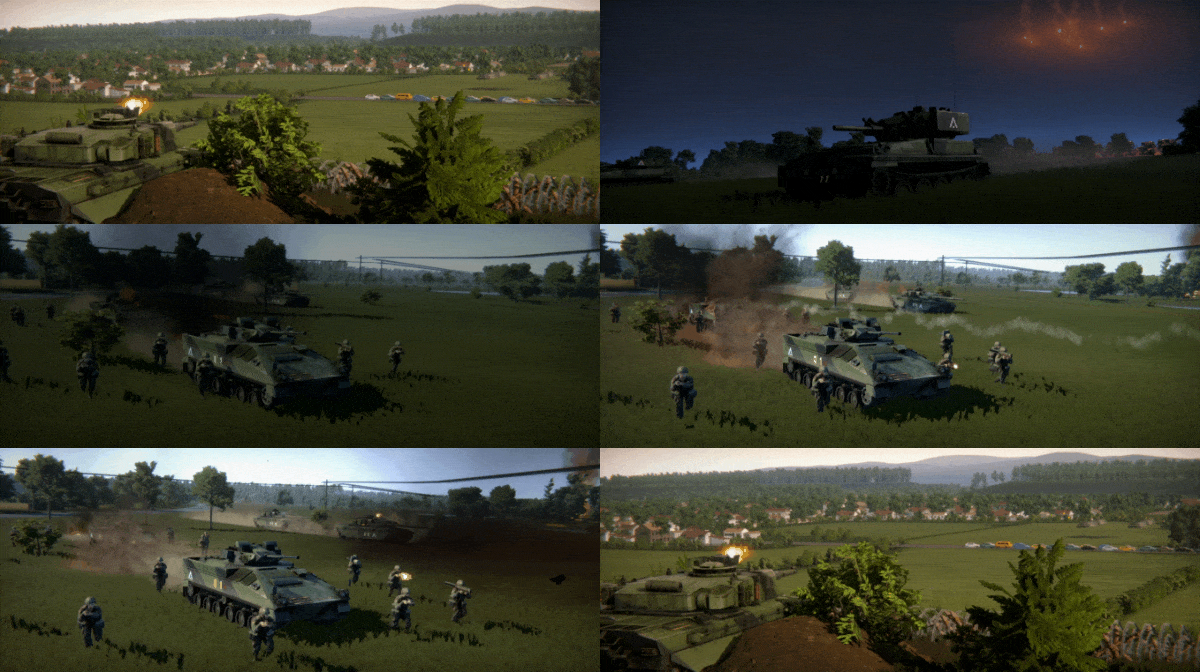
While the recent events have been very disruptive to the workflow, the development goes on. The current progress allows us to specify the release date to the third quarter of 2022 (1 July – 30 September). The precise day would be announced during that period.
We're still planning to accompany the release with the demo. It will integrate all the up-to-date features and will be somewhat similar to the playtest in scope - a small taste of Operations and skirmish modes. Speaking of the playtest...
Playtest Shutdown - May 16th
It's time. We've deliberated on this for a while and eventually felt that disabling the playtest would be the correct way to handle things on the pre-release trajectory. Hopefully, the past several months should've been enough to try it out ;) Let me reiterate a huge thanks to everyone who've participated in the playtest - your feedback has been invaluable!
For those who have been postponing it - or those who want to refresh their memories - one more full week and two weekends should provide ample time to do so.
Features and gameplay tweaks
Operations receive the lion's share of attention right now. Four main Operations and several smaller Interludes will tell a story of the escalating conflict from multiple sides and points of view. Tremendous tank clashes, cautious recce maneuvers, bold attacks, and desperate defenses - we strive to add unique challenges and unforgettable events to each Operation.
But besides the Ops, there's a variety of additions, new units, and new features that have been implemented in the 'main' branch of the game since the last playtest update. Let's review the key ones.
The number of optional rules has been expanded - and, where applicable, they can now be used for Operations and Skirmish both.
High Lethality rule introduces a lot of small tweaks and changes the way damage calculations are done. It is designed to address the common request for a less-forgiving combat
Bad Luck makes Operations more difficult and unpredictable by adding a random negative event every two phases. For those of you who already became adept at beating 'Firebird' on Master difficulty
Fog of War complicates spotting and identification. Getting an accurate read on the enemy's precise position and type will be much harder
Several Global Modifiers are exposed. Want to increase the ranges globally or slow down the unit movement speed? Fine-tune the gameplay to your liking. Accuracy, range, speed, direct and indirect damage, suppression - each is adjustable individually within reasonable limits.
R-145BM Chaika command vehicle
Fast Move command will now correctly path around the engineering obstacles - cutting down the micro required.
To better model the challenges of engineering operations, units conducting the breach are now more vulnerable to incoming fire. Using smoke for cover or thoroughly suppressing the defenders is even more of a good idea now.
Phases in operations are not always limited to 20 minutes. Where applicable, you can gain additional time by capturing nodes or wiping out enemy platoons.
Buying TacAid points in Operations was, most of the time, a very suboptimal way to spend the precious Operational Authority. Instead of direct purchases, you can now upgrade the TacAid Support level. A higher support level increases the passive TA point gain and reduces the cooldown period.
Enemy garrisons in Operations are no longer fully restored and re-rolled each phase. They are now persistent and will receive a limited amount of reinforcements per phase.
Warsaw Pact heavy weapons
Infantry weapons can be previewed in the Regipedia. From small arms to heavy support weapons, their stats are no longer a mystery. Speaking of new weapons, M136 anti-tank launchers have been distributed among some US infantry squads.
Cluster bomb airstrikes expand the arsenal of available Tactical Aid options.
Skirmish modes were updated with the new Operations features. Mobile Defense mode has a fully-functional pre-battle deployment mode. In Attack, you will now encounter enemy engineering obstacles, in addition to the usual entrenched defenders.
Stealth values received an overhaul. Units in cover are harder to spot and won't be revealed almost immediately when firing. Ambushes and recon are more viable now.
Allied and fully-identified enemy units can be selected to get a more detailed read on their current state in the bottom info panel.
M728 Combat Engineering Vehicle
The list of possible Events in Operations continues to grow:
Weather Warning slows down the movement and plays tricks with visibility by adding several areas of thick fog.
Blitz provides a temporary boost of deployment points but shortens the phase length by 5 minutes.
Extended Operations lengthen the phase by 5 minutes instead
Interdiction will prevent the deployment of random platoons from your army list
A neutral wildcard event may randomly add or remove a certain amount of deployment points from your pool for a single phase
A few more narrative events were added too, some of which have truly strategic consequences...
Mi-24K reconnaissance variant - the unit was already present and now got the correct model
That's all for now. Consider (re)visiting the playtest before the 16th of May and thanks for your attention!
Regiments Developer Update - Art & Assets
Hi!
The playtest received its final update and we've switched back to developing the remaining key elements of the game before the eventual release. The work proceeds at a steady pace: the focus is now on getting all the remaining Operations ready. Some nice features are implemented along the way too - like Fast Move command avoiding engineering obstacles automatically.
Meanwhile, it seems like a great moment to take a look at the art of Regiments. In late 2020, after a publishing deal with MicroProse was signed, a team of artists was assigned to help make Regiments better. That included replacing older assets and creating new ones to support extra nations, like Belgium, the UK, and a few others that will be revealed at due time. As the game release is closing in, we are here to tell you about the way Regiments art assets are created, and what is the logic behind some of the decisions.
Preliminary Work
Research is always the first step. We try to find as much information as we can: archive documents, books on the subject, articles, and photos. Sometimes, we can get advice from experts on the subject matter. The community has been really helpful too, pointing out inaccuracies like the livery on Alpha Jet or an incorrect anti-air machine gun used - the last one was spotted on a 640x480 VHS-style screenshot of T-55, which makes it even more impressive. All T-55s in-game now sport correct DShKM machine guns instead of NSVT which were fitted only to a small part of Soviet-modernized tanks.
An important part of the research is to make a correct list of vehicles for each nation and regiment included. It’s always an interesting balancing act between authenticity, gameplay functionality, and workload. While emulating an on-paper order of battle is rarely a goal - the formations are supposed to represent combat formations with ad-hoc attachments and/or combat attrition - we still want formations to 'feel' correct.
An interesting example of this is the ubiquitous and well-known T-72. It’s a strong contender for the title of The Most Iconic Soviet Tank Ever - and thus seems like a no-brainer choice for the soviet unit line-up. However, if we look a little deeper, we’ll find out that Soviet T-72s were only deployed in limited numbers in the Central Group of Forces (CGF) in Czechoslovakia. Regiments focuses on the soviet formations in the Group of Soviet Forces in Germany (GSFG), which was equipped with T-64s & T-80s. T-64BV - the workhorse of the Soviet Forces in Germany
Thus, we’re modeling only the export T-72M & T-72M1 in service with Warsaw Pact allies - the soviet versions will have to wait for some sort of southern expansion that’ll include forces of CGF.
Gameplay is always a consideration too. Some vehicles that were not realistically present are included, BMP-3 being the primary example. It’s not too far-fetched to see a limited number rapidly redeployed prior to hostilities and it brings a lot of unique flavor to the several Task Forces. BTR-60/70/80 are an inverse of this consideration. While all modifications were in service at the relevant time and place, they present no meaningful differences in in-game stats and are thus all ‘compressed’ into BTR-70.
Vehicles
Now that we have decided on the list of vehicles and stocked up on references, let us briefly show the process of making the models themselves.
We start with creating a highly detailed model, also called high-poly. It usually consists of millions of polygons and has all the bits and pieces you could find on a real vehicle, down to the last rivet. A high-poly model of an FV433 Abbot - 105mm British self-propelled artillery
Of course, the high poly model is far too detailed to be used directly in an RTS hoping to achieve a reasonable performance level. So the next step is building a low-poly model around it, the one that would be actually included in the game. A low-poly model
Then we unfold the model, projecting 3D shapes onto 2D. During a process called "baking", we transfer all the details from the high-poly into a set of specialized textures. Normal map, ambient occlusion map, and the like help create the illusion that all the details are still in place, despite no longer using distinct geometry to show them. This is the low poly with baked maps applied. Oh, shiny! This material setup also helps to spot and fix smoothing artifacts.
After that, it’s time to paint the vehicle. The industry standard for texturing is Substance Painter, which allows us to paint directly on the model in 3D. With well over a hundred vehicles and aircraft, it is important to make sure the art style stays cohesive. This is why we start with applying a Smart Material preset and then adjust the wear and weathering manually. Some texturing tricks are inspired by the coloring techniques of the scale models. Although this goes against physically-based rendering axioms, this makes vehicles look better both up close and from distance. Most Regiments vehicles use a complex shader and texture setup that allows changing vehicle camouflage patterns, insignias, tactical numbers, and symbols on the fly. FV433 Abbot with final textures - outside the game... ...and inside the game.
Our models have fairly low polycount by modern standards, about 10K tris for most vehicles, and a single 1024x1024 or a 2048x2048 texture – this is probably about the same level of limits as you would get in an FPS shooter in 2006. But with hundreds of vehicles that can be on the screen, optimization is key, and we’ve strived to make it look as good as possible within those limits. Notice the rough anti-slip pattern on the surface of this M1A1 - and the gaps in it on the blow-out panels. Those holes are leftovers from an ammo reloading system that was trialed in the late 80s but wasn't accepted. The plugs (called by the crews as "sleeping bag mines" as they ruined a nice flat spot on the turret) were eventually eliminated, but the "crop circles" stayed. So-called „Nadboi“ anti-radiation lining on Soviet tanks not only offered protection from Reagan’s neutron bombs but also provided extra insulation for the tank equipment and crew.
Characters
Even if the vehicles play the most prominent role on the 1980s mechanized battlefield, the regular grunt remains an indispensable element of any army.
The process here is largely the same, with a few extra bits. Instead of using hard-surface modeling, we use digital sculpting of a high-poly model. In addition to the texturing, we paint the so-called ‘skin weights’ which tell what parts of the model should deform during movement. Animations themselves are pre-baked into optimized data structures which allow to offload the whole animation system off to GPU.
We’ve included a lot of details even while working against harsher technical limits - it’s entirely possible to have over a hundred soldiers in a single frame. We have meticulously researched uniforms and equipment, so be assured, those 3 pixels of infantry on the screen would be pretty close to their real-world prototypes! Territorial Army and Regular British soldiers. You can still feel the WW2-era influences in the character on the left, with his old-school DMS boots, comfy lightweight pants, Pattern 58 webbing, and Mk 5 Steel Helmet with scrim. The character on the right, however, is much better protected with his brand-new CBA body armor and a Mk 6 ballistic nylon helmet.
All nations have several types of infantry available to them. In some cases, a certain amount of artistic license is taken to further differentiate the types of infantry: like the VDV wearing berets in combat or Belgian recce infantry using the 1990's camo uniform.
Weapons
You could probably ask, why would one even care about handheld weapons in an RTS? Well, we asked our Senior Weapons artist that question too. He didn’t listen and did stuff down to serial numbers on them. Since it’s extremely optimized with each weapon being just a few hundred triangles and using a 256x256 texture we let it slide. Some of the infantry weapons available in-game
Environment
And last but not least, the environment. Regiments is using a custom system for creating maps. Standard Unity terrain was too unwieldy and memory-hungry for the strategy of this scale. In our system, the map is first defined as a set of simple vector shapes and points. After the markup process is done, an automatic generation tool is launched. Using the splines as an input, it will produce terrain meshes, place objects and deconflict the overlapping areas. While the system was quite complicated to develop, it provides a great deal of flexibility and supports quick iteration times. As the map is defined only by the markup and a bunch of configuration files, updating an old map with new assets and even new generation logic is reasonably easy too.
Urban areas require a finer approach. We can’t just scatter the objects randomly, but we would rather avoid having to place each bench in the park manually too! Individual objects are assembled into blocks, usually organized around a single building with a variety of props around it. Then we place the blocks themselves. During the generation step, blocks are further randomized by choosing random prop variations, which helps remove repetitive patterns. A prefab of a small industrial area. The same block in the game.
And now we've looked at all the key aspects of the Regiments art process. Even a surface-level overview resulted in quite a devlog post!
That's all for now, thanks for reading, and stay tuned for further updates!
Regiments - Operations Playtest
[previewyoutube="xJjjdgIgx2E;full"]
Operations:
Previously, Regiments only featured skirmish modes - which are separate battles with no consequences beyond the immediate game session.
In Operations, you will lead your regiment through days of grueling combat over several maps, making tough decisions and experiencing the full weight of their consequences.
Operations feature a high level of persistence. All the losses are recorded, the deployed platoons retain their positions, the engineering obstacles stay where they were emplaced. Even the wrecks and the scarred terrain remain between battles on the same map. Each phase of combat advances the time of day - eventually, you'll have to fight at night, relying on night vision equipment or Illumination artillery rounds.
Between and during the battles, you have to ration several types of resources, the key one being Operational Points. It can be used to replenish losses in the depleted companies, to order more supplies or engineering support, or request new Task Forces or upgrade existing ones with better equipment.
The enemy will not sit idly and will ferociously counter-attack your hard-earned gains. A wide variety of war events is represented by the Events system. Some are beneficial, like extra air support or an allied battlegroup. Some are negative - supplies failing to reach you in time or an enemy electronic jammer interfering with the communications and radars.
How to Join:
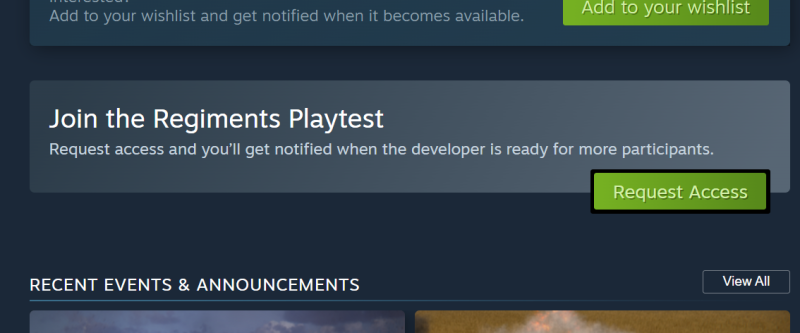
Join it by clicking this button on the Regiments steam page. This will add a separate app "Regiments Playtest" to your Steam library. Download and launch.
Playtest will be available for a while - the entirety of January is assured.
If you don't want to dive in blindly and test how intuitive are the Operations mechanics - this should be a useful read before the playtest. https://steamcdn-a.akamaihd.net/steam/apps/1109680/manuals/Regiments_-_Operations_Guide.pdf
What to be aware of:
Regiments is in the beta state. The core functionality is present, but not all extra features are implemented and not everything is polished to the same standard. A sound upgrade is a major planned milestone. While performance has improved over the previous demos, it's still a big point of work. A review of the GPU-related slowdowns just began and not all lag spikes are addressed yet.
Tutorials are somewhat outdated, especially when it comes to new mechanics, but still worth checking out. The Operation presented can be tough diving in blindly. It is recommended to refer to the online manual and read the Regipedia articles too.
Hotfixes may introduce breaking changes to the active campaign saves. I'll try to avoid it as much as possible, but it's a possibility.
If you use AZERTY keyboard - note that the default Stop hotkey is Z and the controls tab doesn't notify you about the conflicts yet. You'll probably have to rebind the Stop hotkey along with the camera controls.
AVAST/AVG users - we're resolving the issue with the .exe being flagged as false positive. For now, you can whitelist it manually.
Hotfix 2
Some of you have already tested it out and provided valuable feedback - big thanks to those brave souls that fought against the unwinnable odds around the Kircchain AFB. The feedback has been integrated into the first hotfix, with the second one also in the pipes.
Regiments - Delay & Playtest
Greetings everyone.
Delay
Despite the rapid pace of development and the promises made, I will be moving the Regiments release date to 2022. The key features are in place and playable, but the game needs to be polished further to ensure a high-quality release. While on-the-run development is a thing in modern times, I think it would be better for everyone involved to have a solid game right away. And, as many of you have noticed, the last good release window in 2021 is almost closed, so 2022 remains the only reasonable option.
Playtest
On the positive side, you won't have to spend Christmas and winter holidays without Regiments. In December, we will be running an open Playtest for the new Operations mode.
Operations add enough new mechanics to make it a very different experience to the skirmish. I'm interested in feedback on the pacing, balancing, and difficulty - things that are hard to get right without a lot of player input.
Key points:
A separate dev-log will cover the basics of the Operations mode. Soon™.
The exact dates of the playtest start will be announced at a later point.
The playtest itself will be open to everyone and not limited by player count.
After running its course, the Playtest will be converted into a permanent demo. The third and final demo will stay available throughout the project's lifetime - try it out whenever is most convenient.
And some things I feel will be asked anyway:
What's taking so long?
Optimization requires a very thorough and meticulous approach. All the 'Dumb slow code' was quickly optimized away. Now it's about optimizing perfectly reasonable code that ends up too slow with hundreds of vehicles and infantry squads on the battlefield. Thankfully, the Jobs system and Burst compiler in Unity allow to gain massive - sometimes x10-x20 - performance improvements, if used right. But the "use right" part takes time and iterations, far more time than initially estimated.
Other than that, it's mostly "small things". Bug hunting, ironing out AI bad habits, ensuring the UI is intuitive and responsive.
Why the change of opinion on demos? No more demos were planned initially.
Operations ended up conveniently demo-able, due to their length and structure. I was looking at the build I've made for internal testing and realized it's almost a ready-made demo.
Plus more reading/research on the topic of demos themselves. They're making a big comeback these days. Turns out, a lot of "demo hurts sales" articles were based on a 2013 AAA-related research that's hardly applicable now.
That's all for now, thanks for reading!
Regiments Developer Update - Lights in the Sky
Situation on the Fronts
August and the first half of September have been very productive. Let's recap some of the August reveals and additional gameplay features.
UK Task Forces
As outlined in the previous dev update, several UK task forces will be available as reinforcements for Belgian forces - representing the 33rd Armored Brigade that was supporting I BE Corps in reality. Challengers and Warriors can anchor the battle line, allowing the more mobile Belgian forces the freedom of maneuver.
The full might of the British Army of the Rhine will come later during the game's life cycle.
Night & Illumination
In the campaign, nighttime directly affects the gameplay - highlighting the difference between NATO and the Warsaw Pact in terms of night-vision equipment. We now differentiate between no NV, basic NV, advanced NV, and thermal imaging equipment, adjusting the vision at night accordingly.
To level the playing field a bit, forces will be able to call upon artillery illumination missions that help offset the darkness for a limited time.
It is possible the feature will be backported to the Skirmish game modes as an optional setting. [previewyoutube="u1Yn2rzG2rM;full"]
Maps
We've finished the core set of 15 maps. Open fields, rolling hills, river valleys, quaint farms and expansive towns, airfields and powerplants - there is tremendous variety in the battlefields you'll fight over. Each map offers a wide range of avenues of advance, giving ample opportunity to execute daring maneuvers.
Most of the maps will support all three Skirmish modes - in some cases, with several different patterns of objectives and spawn points for extra replayability.
Stacks & Supplies
Skirmish game modes are all about attaining the objectives in a limited time frame. Casualties are accounted for in the victory calculations, but you never actually run out of units.
In the campaign, casualties matter a lot more. There is a limited amount of units available per platoon 'stack' (in essence, representing a company or a battery). Too many units lost will eventually force you to deploy understrength platoons or lose access to a certain company altogether - along with any remaining experience it had accumulated.
While it's possible to replenish the companies during the campaign, it uses up the ever-important Operation Points that have a variety of other, more productive uses.
Supply platoons are no longer an infinite cornucopia of ammo & repairs. First of all, they no longer restore wiped-out units in a platoon - only repair the damaged ones, restore ammo and replenish infantry squads. To restore the platoon to full fighting strength, you'll need to re-deploy it. Secondly, supply platoons have limited capacity. They will eventually run out of ammo & spare parts, preventing further refit operations. In the skirmish, that means you'll have to retreat them and wait for the new one to arrive. In the campaign, you can move them back to one of the core nodes with a Supply Hub, where supply platoons will grab new supplies from the global pool.
Overall, supply platoons move from being a linchpin of the combat force to their actual role as support. I'm also trying out a tube artillery rebalance: limiting them by supplies rather than artificially inflated reload times.
I'm not delving deep into the actual campaign mechanics yet. The progress there is very rapid and promising - and I would really like to present the whole gameplay loop at once.