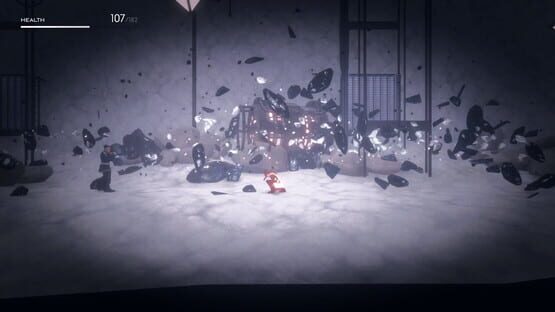
On September 11 we received the final asset for Reina & Jericho: a redesign of the 3d mesh for the last boss fight in the game. Less than 24 hours later, on September 12, we received news that Unity, the provider of the engine that Reina is built in, was making significant changes to their revenue model. There has been plenty written about the Unity issues online, and Unity has walked back some of their changes, but I’ll focus on the result of it all here.
One of the main challenges has been that the online discourse centered largely around an installation fee, which was a pain, but not the main impediment to smaller developers. I don’t want to get into a long conversation about the specifics, but the ultimate result is that free projects are largely unaffected, but smaller projects designed to be sold (like Reina & Jericho) aren’t super viable over the medium or long term. Now that the dust has settled, we are at a point where we can’t release Reina for business reasons (we will lose more money than we gain in the long term).
From the outside you might think “But the game is practically done, isn’t it?” and the answer would be “Yes.”
You might ask “Why not just release it? I have patiently waited and now I want to play it.” Fair point, but releasing a game is not a small task, and it comes with tremendous risk, responsibility, long-term obligations, and as of the last month or two, potentially long-term financial liability due to changes in the Unity’s licensing system. If you are wondering why games that look great get cancelled this is one of the main reasons why: once the game comes out the developer is on the hook for quite a bit, but if the game isn’t out, then there are no liabilities. This aspect is what makes Unity’s business model change incredibly challenging to work with. Yes, it is less punitive than it originally seemed, but that is an incredibly low bar, and for point of comparison, our fees with Unreal Engine would only go above $0 if we became millionaires.
Where does this leave Reina & Jericho? Well, we have a few things working in our favor and a few cards left to play:
We still own the IP and everything within the game, and this effectively saves the game. We don’t lose the game to a publisher if we pull back on this deadline. It hurts us, and it hurts the people who wanted to play the game, and it hurts the people who artistically contributed to it, but we still own the game.
We never had a publisher. Every penny was self-funded. This means we can go get one if we want, and we can get the funding we need. And we will need it, because we don't have enough money to build the game again in a new engine or withstand the long term liabilities within the current engine. We are in a good place for getting a publisher if we want one though. The fact is, we have a pretty good prototype – it’s pretty much an entire game, and that makes for a good demo.
Our core mechanics and components aren’t dependent on anything. In other words: we have room to pivot, scale up, change engines… whatever. We have a huge amount of freedom while still maintaining everything that made Reina unique.
So… for now, Reina is not cancelled, but it is on hold. We are going to wrap up our other ongoing projects and then we will circle back and work on a scaled-up incarnation – we are sitting on a goldmine of assets that we still own, and that’s a wonderful thing. Porting and expanding Reina is not next on the to-do list, however. We have a larger team we could dedicate to this in the future, higher standards, and more expertise, and so that is what we plan on doing, but we have to wrap up our existing game projects first.
All of this is very “glass half full” and is full of promise for the future, but the truth is ever since the announcement it’s been an unpleasant process trying to figure out what we can do. We’ve had a lot of support from people throughout the development process that we don’t take for granted, and it’s very disappointing to be in this situation. I’d rather take the long road than the one that leads to a bad game, though, so in a way there is only one decision that can be made.
Before and After
We’ve spent a lot of time and effort working on the environment art for the various areas within the world of Reina & Jericho. Although some of the areas were in decent enough shape for the simplified aesthetic we wanted to create, there were others that were barely more than white-box layouts of the game world, and they need work quite badly.
Reina & Jericho has 3d art but is still a side-scrolling game, so we wanted to keep the middle-plane of the environment relatively clean so Reina, the enemies she is fighting, and the platforming obstacles she interacts with would all read clearly. That said we still wanted to make the world simply look and feel better, and we wanted to help differentiate different areas from one another.
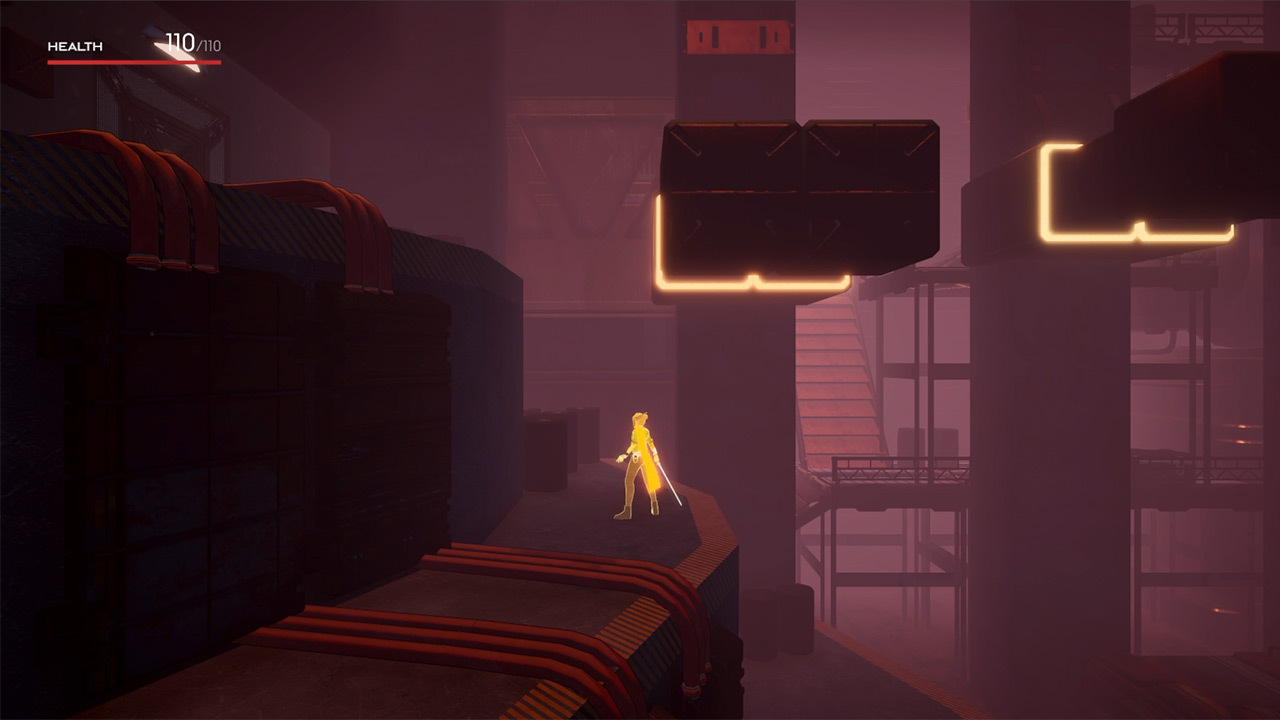
Check out this screenshot near the beginning of the Machine Shop biome:
Reina has been given a strong rim-light to help her pop against the background (and a small flash as her dash ability recharges as well). We have used fog, a mix of baked and real-time lighting, and color grading to help make this area chromatically distinct from others, and we have placed some pipe elements in the foreground and opened up the elements in the background (previously a flat wall) to create a bit more variety at the various planes of depth.
With that in mind as reference, let’s look at some before and after screenshots.
The Laboratory - Section 1
Before:
This is probably the most extreme example of a simple room that was placed in the game world. The room is barely more than a slope leading to a door given how plain the decorations are. This isn’t necessarily a huge problem – if a room only exists for you to fight a group of enemies and move on then there is no need to distract the player – major decorative landmarks in such a room might actually make things harder for the player, because we typically try to place those in places where we want the player to remember a location quite clearly (such as an important intersection).
All that said, more can be done.
After:
Yes, this is technically a different room, but it shows the changes that can be made nicely. We’ve opened up the back wall to make the environment feel larger, we’ve added minor foreground elements to add some visual variety and also help the main plane the gameplay takes place on more distinct, we’ve used fog and lighting to create a sense of scale and depth, and overall, there is simply more visual variety. The player is still able to parse this area as a “blue, sci-fi area” in their memory. If the player ever left (maybe they travelled to a golden-colored area) and later returned to an area that was blue and sci fi looking, they would be able to tell that they were backtracking or revisiting familiar territory.
We try to balance having visual details to improve the appeal of the environment with keeping the shapes simple and easy to read, and not adding too much visual noise to distract from the central plane the action of the game takes place on. I think we’ve got a good balance here. It’s just enough to look interesting as you dash through this platforming room, but you can still read the environment as it whips by.
Caverns Underneath the Treeline Area
Before:
We have a cave biome (there are a few in this game). Where there should be organic patterns we have hard corners, and aside from different textures being placed and a different level of fog and post-processing this area is not all that distinct from the “before” image from the Laboratory. What can be done to help it without breaking the budget?
After:
Quite a bit! Next door we have a room with a similar layout that’s already been decorated that gives us a nice point of comparison. This area is near the surface, so we have cracks of light, and root systems that now give some flavor to the chosen color palette. Use of large, medium, and small rocks helps communicate a more organic type of environment rather than the regular hard angles of man-made construction. On the gameplay-plane where Reina is running around the player can still see a clear solid edge so there is no doubt where the platform begins, but it is a bit more blended into the environment. Some baked lighting and visual effects help aim the players eyes in the right direction, although it Is still a little dark overall.
This area is supposed to be quite close to the surface, and that platform Reina is running on still seems a bit flat and artificial. Could we make it seem that some light from outside is creeping in a bit and somehow blend in something that could help tie the artificially flat surface into the aesthetic a bit more?
Even More After:
Perfect. A little framing to make it seem like these shapes are being created deliberately by whoever dug out this cave (and placed the door on the right), the lines they create reinforce the plane of action and the direction the player can move, there’s a little bit more light, and we still have a nice claustrophobic cave that is visually distinct from the many other subterranean areas of the game.
Gotta Decorate Them All!
With roughly 400 rooms in the game, and many of them being large, outdoor areas that stretch the definition of “room” to the breaking point, there is a lot of environmental decoration to be done. We don’t have a huge team or a huge budget, but we are doing tiny things to add personality, aid the player’s efforts to navigate the game world, and meaningfully improve the overall aesthetic of the game. I hope you like some of what you’ve seen!
Loading the Game World
It takes time to load a video game. Whether it happens all at once in one big loading event that gets it all done up front or it is broken up into smaller pieces and loaded in smaller chunks (or even streamed in while the game is running), the game data needs to end up in memory somehow. On top of this, players don't all have the same preference of one solution compared to another.
Our original strategy was to load the entire game world in one shot so the game would have no loading screens at any other point. Unfortunately some players didn’t like the idea of having to wait for 30-45 seconds right at the start, especially if they didn’t know in advance that they wouldn’t be exposed to any more loading delays until they closed the game. So… it was time to rewrite some code to allow the game to be loaded in smaller chunks. Unfortunately this changed one of the core assumptions about how the game was architected: not everything in the game was available.
In our original paradigm where the entire game world was loaded, if we needed to move an NPC for a cutscene we would know with 100% certainty that they were out there somewhere, they could be located, and they could be moved. With the game data loading in chunks, there is a decent chance that what you are looking for might not have been loaded yet. The conversation with the computer now goes something like this:
Cutscene Engine: “Go get that NPC and move them to this room for a cutscene.” Game World: “That NPC doesn’t exist. The part of the game they are in hasn’t been loaded yet.” Cutscene Engine: “Well go find them.” Game World: “I don’t know where to look. The part of the game they are in hasn’t been loaded yet.”
It makes a good point, therefore we need a way to tell the game where things are supposed to be before they are loaded. And when an object gets loaded it also needs to ask if there is some save data that needs to be applied, because we can’t assume that it existed when all of that game data was being applied (as a matter of fact, it probably didn’t). And an object needs to save and track its own default state just in case it gets loaded one way but then has to get reset to a different state that isn’t explicitly marked in the save data. And… and there are just a lot of things that need to be considered. Especially in a game with save data as complicated as Reina & Jericho, because every time you find a new save point a new timeline is saved in whatever state it is in at that specific moment, so there are dozens of timelines recording dozens of potential world states.
And that has been an interesting and fairly complicated problem.
In the next updates we'll focus on something a bit less technical, and we’ll have some nice visual before and after comparisons soon, but for the past week or two the story has been the pains of loading data asynchronously in a game about asynchronous timelines.
Back to Work
After a few months with Reina & Jericho on the backburner while we assisted another studio and made the money we needed to continue, we’re finally starting to ramp up work on Reina again (although our attention will be divided for a while). This does mean the release date will be bumped to 2023, but we finally have the resources to give the environment art an extra pass and tidy up a few other things we’ve decided we want to tidy up. If the feedback from the public on recent game releases has reinforced one thing, it’s that it’s worth taking the time to squash a few extra bugs rather than release a game before it is ready.
A side benefit of this whole affair has been the clarity that comes with time. When you work on a game (or any other project) every day you become familiar with it, and you don’t see it with the same degree of objectivity that a stranger would. In short, the more you become the designer/developer the less you see the game like a player. Taking a few months away does wonders for letting you see all the little issues you’ve become acclimated to.
There are definitely a few things we want to polish up on Reina & Jericho. Without getting into spoiler territory, some aspects of the final encounter need a little bit of work, along with the level design in a few rooms and some routing edge cases. As far as the final encounter goes, it has already been redone once but I think we can tidy up two key components in it and it will be much better off for it.
On a personal note, while refreshing the critical eye is important in evaluating the game it’s also worth noting one other important discovery that has been affirmed yet again: I love this game. I love the way it feels to play, I love the speed of it, I love the art style, I love the music, I love the story… Some of that is to be expected, and your mileage may vary. Other people will have other opinions on how games should be done, but it’s good to know that I succeeded in one of the goals from the start: make a game I would enjoy.
Double Crunch Time!
Most of the time we talk about game development things in these posts, but in this case it’s about the business side of things. Reina & Jericho is very close to completion, but we had one dilemma which is that since we were near the end of the development cycle, we were also low on money. We mostly use money to buy things like electricity, food, and software licenses. It’s helpful stuff.
Our bank account was low enough that, despite crunching, we weren’t on pace to be able to stay afloat financially after release. There is a two- or three-month lag between when a game goes on sale and when the revenue finally reaches the publisher (in this case: us) and more than one good studio has been forced to shut down despite finishing their game, releasing, and having strong sales figures.
You may think to yourself “If their game was selling well couldn’t they just find a _____ to lend them money?” and the answer is complicated. A lot of the people willing to lend money to a game studio are also the same people that are interested in buying game studios on the cheap, and there is no better time for this then after a release when financial resources are low. It’s still important to just not run out of cash in the first place. Even if a Good Samaritan money lender comes along you still want to have more leverage than “We’re broke if you don’t lend to us.”
So, we went to get more money. We have pumped the breaks on development on Reina & Jericho for the last couple of weeks to do some sub-contracting with another studio. The development on Reina & Jericho is in no way endangered -- on the contrary, we have been able to make some arrangements to bring additional resources to help us finish the game, and we will be able to finish it at a higher level of quality than we originally expected. This is something that we as a studio have been trying to make happen for quite a while, and it’s exciting to have it finally fall into place. The tradeoff is that we do need to spend a few weeks diverting our resources to help close out a different game.
And so, we’ve gone from crunching on Reina & Jericho to crunching on another project. The bad news is that the hours are still quite long, but the good news is that the other project has a solid deadline, we are generating revenue as a studio, and we have some strong business opportunities and professional connections that have been made that will allow us to increase the final quality on Reina & Jericho substantially.
The release date is still not far away, but we regret that we’ve had to slow development for the last month and will be doing so for the next month as well. The fact of the matter is that this remains a significant step towards solving a problem that has plagued us (and our environment art) for quite some time and we are very excited to finally have access to the help we will need to bump it up a notch. But the tradeoff is that we do need to spend the time gathering resources before we can move ahead with that final step.
It's difficult that we have to put it off with the game so close to completion, but one of the advantages we have is that we don't have a publisher or anyone else forcing deadlines on us. We don't need to roll out our game in an incomplete state (a practice that is becoming increasingly common across the industry).
Reina & Jericho was started with the intention of creating a good game that was also a work of art. If it were a product we could release it right now, but we actually have a statement we want to make with the game and a quality level we want to hit because it isn't a product to us, it's art. As art it isn't finished quite yet, and so we are making a compromise on the timeline side of things so that we can get the people we need to give it a little bit more love.
And it will be worth it.
The Beginning, the Middle, and the End
Last week I finished working on a very special part of the game. Here is a small part of a screenshot from it:
That’s not just any regular “The End” – we have multiple endings after all. That’s “The End” from the last ending. They are all done. Since the game is (mostly) coded chronologically that also means the game is mostly done, and that led me to an unusual experience that I hadn’t had in a while: I wasn’t working on anything on the game anymore.
There’s no shortage of tickets with various bugs and tasks or pieces of paper covered in notes regarding things I need to do lying around, but an entire chain of work starting from the beginning of development and lasting for years has reached its conclusion. It’s exciting stuff. That doesn’t mean we’re done quite yet though. This past week has been focused on getting a cutscene-centric version of the game world built to help smooth out the Spanish localization process. It’s also been a good check to see how resilient the game code is (great about 95% of the time, catastrophic bugs the other 5%).
Still: We have a game that you can start and play through all the way to any of the endings and have a (reasonably) complete experience. There are some empty hallways that need some visual updates and enemies added and we need to get Reina & Jericho running on all our supported consoles, but the finish line is beginning to be visible.
Voice Acting
The plan from the start for Reina & Jericho was to have the game fully voiced. Somewhere along the way we gave up on that as a cost-saving measure, but we had the opportunity to work with some voice actors from Funimation to handle the various vocalizations. When a character gets hit and lets out a grunt of pain, well, someone needs to make the grunting sound. We had a great group of professional voice actors to work with to record those sounds, so we did. And in theory that was going to be the end of it for the time being.
Then we needed to make a trailer for PAX. Which we did. And it worked well enough without any voice over, but it worked better with Reina’s voice actor recording a few lines, so we had a quick recording session and that was it. I told the voice actors that we would investigate recording voiceover for a future release of the game, but we didn’t have the time or the money to put it in the initial release of the game. I had taken some of the recorded lines and plopped them in the game and it was neat but it they also stuck out in a weird way, so I didn’t feel too bad about removing voice acting for the time being.
Eventually three discoveries would occur that led to the reversal of that decision and going back to the original plan.
First, a game only releases for the first time once. Yes, sometimes there are special launch events for major updates, and if a game has a poor launch a “second launch” may be attempted from a marketing point of view, but for each person that plays a game we can only make a first impression one time. It’s important to hold nothing back in that moment.
Second, after we released the demo of Reina & Jericho for Steam Next Fest and later an updated version of it for PAX, players started streaming themselves playing the game. When the cutscenes came along, the streamers just did their own voice acting. That was a pretty good sign that it should have been in there from the start. The game was getting voice acting in it one way or the other, so we might as well go with the professional voice actors recording in proper audio booths, with direction, with knowledge of their character’s motivations and backstories.
Lastly, as I mentioned already, the voiced lines I put in the game seemed a little out of place, but I hadn’t considered the obvious reason why. If a cutscene is 90% unvoiced and then, out of nowhere, a few random lines that happened to get recorded for a trailer are spoken, of course they don’t fit in. Lines in isolation don’t work, they are part of conversations between characters and when there isn’t the back and forth of proper dialogue it just doesn’t work. Once we started the process of recording the lines for the game and I began placing them into cutscenes they were completely transformed by the recorded dialogue.
All of this is to get to the final point of this update: for the last two weeks or so we’ve been wrapping up the final cutscenes in the game (with dialogue) and are now starting to go back through previous cutscenes and add the voiceover work. The results have been spectacular. We have a great story and we have an incredible cast of voice actors bringing it life.