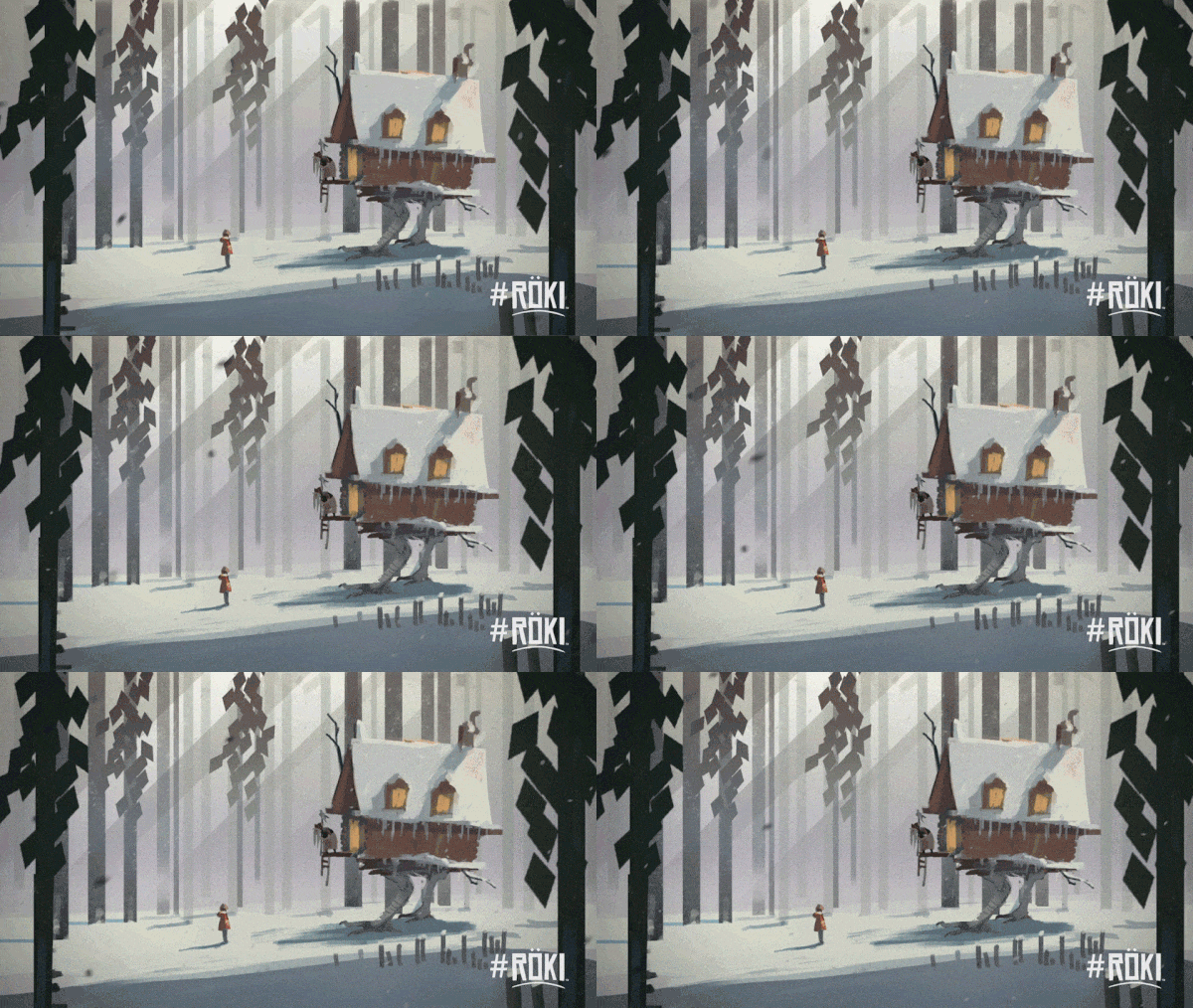
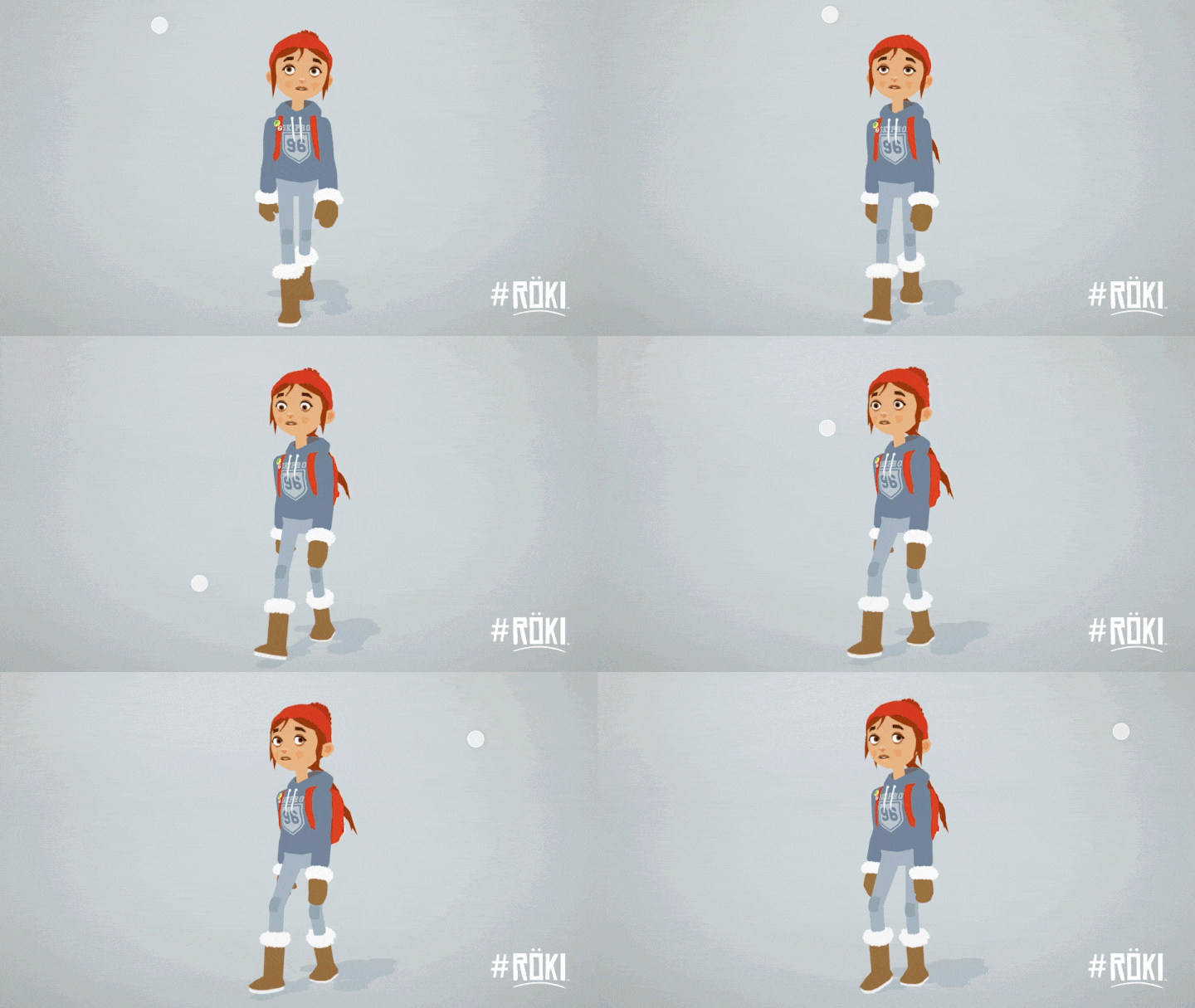
In this Dev Blog I’m going to get waaay back to the beginnings of Röki. Taking a walk down on a memory lane works refreshing! So, today I’ll talk a bit about concept art, specifically how and why we do it. Let’s start with the 'Why' first:
1. Establishing a style
When we first started work on Röki we knew we wanted to create something rich and beautiful, with its own distinct style. Whilst we had a few ideas and reference points, it wasn’t until we started putting digital pen to digital paper that the look of the game began to take shape. Initially we looked at something very stylised and minimalistic, but ultimately felt that over simplification of shapes left the world feeling too quirky and without the grounding we needed to tell our dark fairy tale. Proving this out through 2d tests was a far quicker way for us to iterate and essentially fail fast.
In any creative process failing, or deciding what you don’t want or like can be as important as doing something you do like. In fact, it’s often a good starting point to create a mood board of reference images you don’t want the game to be like, in order to focus you better on elements you do want.
Anyway, I digress. The point is quick iteration can be very liberating. It stops you from becoming too attached to ideas, and keeps Monster Time firmly under the bed (nothing kills creativity more than stressing about deadlines). 2d images are also far better at communicating ideas as well - a picture says 1000 words and all that!
Early tests for Röki exploring use of flat colour and simplified shape language.
Super quick snowy tree and rock studies.
2. Designing an area
Ok, so the scene is set, you’re going to be creating a long forgotten church, covered in snow, in the middle of an old forest. Simple huh? Well no actually. There’s a question of the church’s architecture, the materials used, the colour palette for the scene, the opening composition.... I could go on. These are all hard things to create from nothing in 3D. Sure, sometimes you can find some killer reference and your imagination can do the rest, but other times I like to use 2d to help me solve the problems. Either through photo bashing, rough scribbling, or more considered paints - whatever the method, it can be a great way of getting your ideas quickly into some form to see how they hold up.
3. Marketing
Everyone likes looking at pretty pictures don’t they? Whilst these can always be in the form of screenshots from the actual game, concept art is also a great form of marketing - particularly if the in game art isn’t actually finished! It can also be easier to orchestrate a scene to look good in 2d when you’re not having to rely on in-game characters and cameras to behave themselves. Instead, you’re working with one image that can be consistently manipulated and tweaked until it looks awesome.
To help push Röki on social media we’ve released a number of time lapse videos showing the creation of some of the game’s concept art. As well as showing people some process (more of that in the next blog) they also do a great job of showing off our vision for the game, without showing explicitly what’s in it (so not too many spoilers!).
[previewyoutube="1fnMDoOafVE;full"]
4. Events
This one kind of falls under marketing as well, but I think it’s important enough to be in its own category. Currently most events are happening online. BUT, if you’ve ever been to a live game event like EGX or E3, you’ll notice all the games have kickass backdrops to showcase some key art. The bigger the game/budget, the bigger the backdrop. In a lot of cases the key art is created specifically for these shows, but that’s a lot of work. Instead, it’s often worth going the extra mile and working up a piece of concept art for the game instead.
There are 2 crucial aspects to this. The first one is overflow on the image - basically an extension of the image beyond the original size. This allows it to then be used in different configurations - wide and narrow, tall and thin, square - you get the idea. The 2nd key point to remember is resolution. Images used in shows, or posters & t-shirts (basically anything printed) will need to be a high resolution to look sharp. Fundamentally, you can’t add pixels, so you need to make sure it’s developed at a high resolution in the first place. In our case, we actually took the time to take a game scene and then convert it into a vector image so that we can make it whatever size we want.
T-Shirts designs for Röki based off of our key art.
Very cool.
Right, that's your lot for this blog - tune in next week for part 2 where I look at The How'.
:TreeStar: This year was challenging, but also crazy in a good way. Contests, awards, releases, announcements, trailers, and much more!
But we did it!
:TreeStar: We released a bunch of trailers, published the demo, we were streaming live and answering your questions.
Finally, we were able to release our game for a couple of platforms and were more than happy to see that you simply loved it.
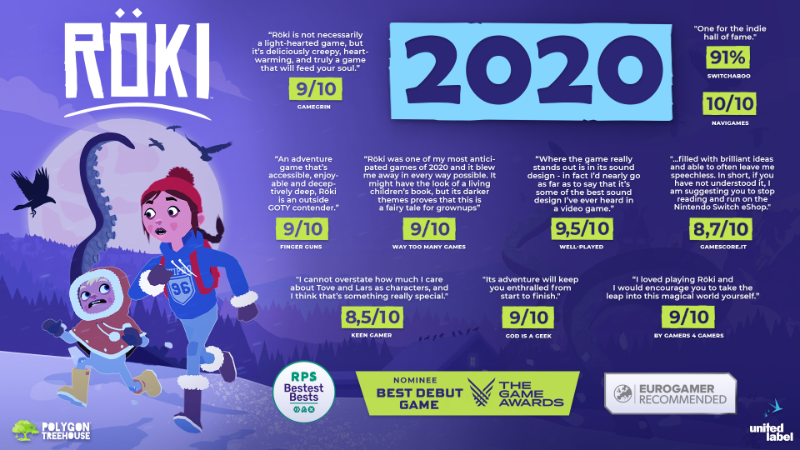
So with all this love, we were eager to take a part in a couple of contests, and were nominated to Pixel Awards Europe 2020 edition, Best Debut category at The Games Awards 2020, or had a chance to participate in Steam Awards in Outstanding Visual category, we also snagged one of the three top spots in I Beat it First podcast and won in the Best Indie category at DevGamm. And much more!
Phew... That was a lot!
Especially during the year like that, which was, well, pretty demanding to all of us... So now it's time to relax for a few days.
We all deserved it!
Thank you so much for your relentless support and concern. :cyanheart:We love you with all our heart.:cyanheart:
It’s been a while… but don’t worry, we haven’t forgotten about you just yet! With this update, we’re bringing some few adjustments and improvements, listed below.
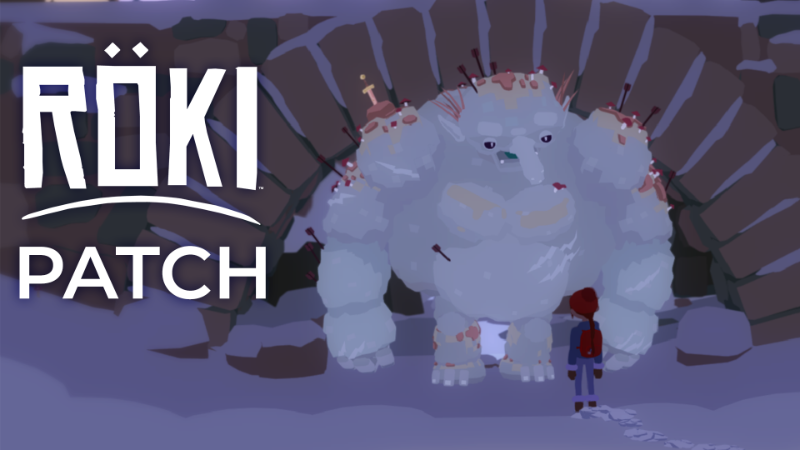
Fixes & Improvements: ❄️ Act restart - You can now restart the Act in which you are playing at any time, by choosing the option in the pause menu ❄️ Fixed an issue that could occur during cutscenes in Act 2 ❄️ Fixed an issue that could prevent progression during a scene transition in Act 3
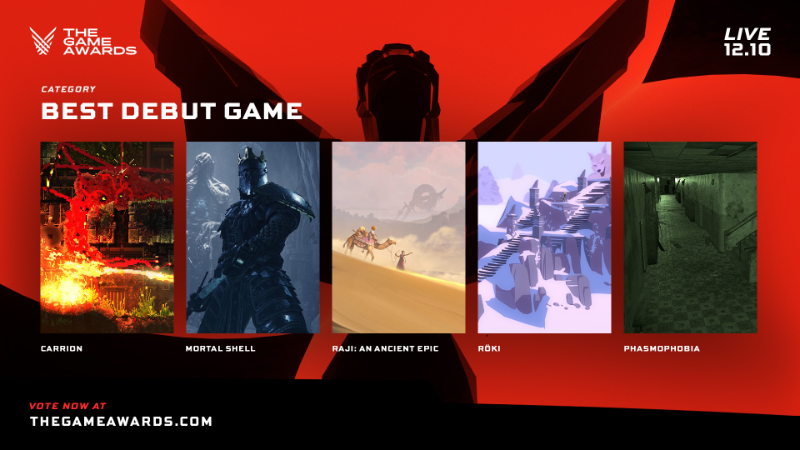
We’re also very proud to have been nominated for The Game Awards, in the “Best Debut Game” category! You can support us by voting for Röki, it would mean the world to us! Vote HERE.
Please don’t hesitate to keep sending us comments on the Steam forum, or messages at support@unitedlabelgames.com.
Festive season is fast approaching. Christmas songs are coming from the radio, chocolate Santa Clauses are standing on the shelves. BUT we’re not slowing down! We'd like to invite you for yet another, great event! Poland & Friends.
Our publisher, United Label, originally comes from Poland, we love Polish people (and artists, for example, Zdzisław Beksiński!) and Röki was present at few events there, so we consider ourselves as friends of this country 😉
What is waiting for you?
❄️ First of all, a BIG sale! Hold on tight… drums please… Röki is NOW available with a 50% discount! ❄️ Second, you can watch a special stream in which we are going to show you Röki and share some stories about our adventure game. ❄️ Third, don’t forget to visit our close friends from Fallen Flag Studio (they admire Toruń gingerbreads and pierogi as much as developing great games) and try the demo of their game, Eldest Souls. It will be available only during the event!
That’s all for now! Take care and thank you for supporting us and being part of this adventure!
Trzymajcie się i miłego dnia! Polygon Treehouse Team
Nominate Röki for the Outstanding Visual Style category!
Hello Scandinavian wilderness dwelvers!
The Steam Awards are coming! Celebrate this time and take part in voting, where YOU decide about the nominations... Okay, let’s cut to the chase. We’d be very, very, very, very, very grateful if you would like to cast a vote for Röki! 💙
Especially, we hope you’ll nominate us for the OUTSTANDING VISUAL STYLE category. Cast your vote for Röki if you couldn’t look away from the game’s graphic ❄️
Thank you so much for your continued support for Röki! We wouldn’t achieve all of that without you!
Last week we started to look at ‘The Anatomy of a Walk Cycle‘ and some of the important aspects to consider when animating locomotion. If you missed the first part no need to fret, you can read it here. This week we’ll dig in a little further.
Step Impact/Taking the weight
The moment when a character shifts to take the weight on a new footstep is a big moment in the walk cycle. It is essentially the point at which all the weight of the body is transferred from one foot to the other and it should have a large impact in the animation. Examine Henrik’s animation below, there is a great deal happening when the step impacts and the weight is transferred from foot-to-foot. As well as being evident in the hip side-to-side motion (as the center of gravity moves over the new standing foot) and impact ‘roll‘ rotation (covered last week) the hips also descend as the weight is taken. This produces the up/down motion of a walk.
The impact of this up/down hip motion is also felt elsewhere on the body.
You notice in the animation below that the step impact is the point at which Henrick has a head nod. This is a slightly delayed 'follow on' motion to the hips descending vertically suddenly as the weight is taken. You can also see the 'step impact' in the motion of his chest, mustache and even belly! When the weight is taken and the hips descend suddenly to take the weight, all these areas 'feel' the impact, and should respond to it in their animation.
Which all in fact brings us onto another important point, offsetting motion, but more on that later!
Foot Squish
Another neat thing you can do in your walk cycle to sell the impact of a leg/foot taking the weight is ‘foot squish‘. If you examine the far right version of Henrick above and take a close look at his feet you’ll see they ‘spread‘ or ‘squish‘ under the impact of his body weight when the weight is transferred over to them.
This was something I learned doing an Animation Mentor course whilst at Sony. We were animating lions and were examining how their paws spread when they take the weight of their bodies. This is also evident in humans (and most other creatures with feet TBH). Don’t believe me? As an artist it’s always good to examine the real world and have some reference. Here is a lovely before-and-after shot of my delicate (definitely non hobbit-like foot) before and after taking the weight of my body.
Apologies if you're foot squeamish or eating breakfast
You can hopefully see clearly the foot spread in the above images.
Now this does take a bit of consideration when setting up your character’s skeleton and rig but adds a really nice subtle cue to show when the weight is taken.
Transfer of Weight and Character Design
So we’ve looked above about some of the impacts on the body’s motion when the weight is transferred. However, this is not a uniform impact for all characters!
Some characters are heavier and bulkier, consider the differences in size and body shape in Tove and Henrik below.
When characters are heavier this transfer or weight and its impact on the body will be more pronounced. This is one of the things that makes heavier characters appear heavy! If you examine Tove and Henrik you can see that the transfer of weight when he walks and the impact on his body is much more pronounced than on the much slighter Tove.
It’s important to reinforce your character design in animation. You should make sure that your characters don’t just look heavy, they also ‘animate heavy‘.
Offset Stuff!
We looked last week at some of the key poses in a walk cycle that are used as the foundation when blocking out your walk animation (we’ve included them again below for reference).
However, one of the key things when it comes to the later stages of animating your walk cycle is to offset some of the elements in the above poses.
Without any offset the both arms and legs (left and right) will be hitting these key poses at exactly the same point in time. This can look unnatural and a little robotic. To combat this, you can try offsetting or delaying some of their motion in time so the body parts are no longer hitting their key pose at exactly the same time.
It doesn’t take much, an offset of a frame or two is often enough to get away from the robotic feel of all the elements being perfectly aligned.
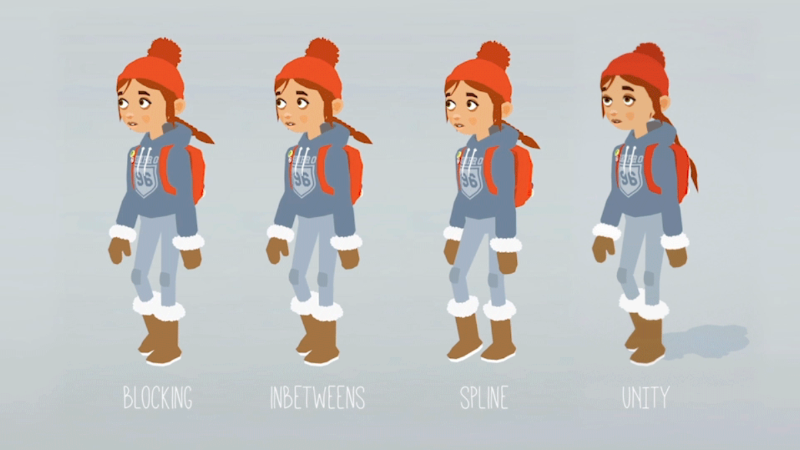
If you look at the breakdown of Tove’s walk cycle below it feels quite natural, this is partly due to offsetting elements of her key poses.
A clear example of offsetting animation can be seen in her forearms. Offsetting the lower arm’s motion from the upper arm is what is producing the natural drag feel. The arm is not a solid unit and in this case the lower arm is being dragged around by the upper arm, lagging being its parent motion.
Last time we posted a whole devblog about Footprints. And from here we are pretty close to the subject of the character's movement. To be specific - to a walk cycle. So, sit, let your legs rest and read a long (but I hope also fascinating) text… about walking ;)
A walk cycle is a nice animation task to examine because:
❄️ You see it a lot, over and over again in fact, so it’s a good thing to lavish attention on; ❄️ It’s a nice contained animation (time duration wise) to examine body mechanics; ❄️ It’s often one of the first things people attempt when starting out, certainly it was for me.
So we’ll step through some of the key aspects (as far as I’m concerned) today and on the next week. It’s not going to be exhaustive, but an overview. I’m sure there are some things I’ll miss but hey, nobody’s perfect right! Today, we’re mostly gonna be looking at the key poses and the role of the hips.
Key Poses (Contact Poses & Passing Poses)
At the top level there are four key poses in a walk cycle. There are as follows:
❄️ Left Foot Contact Pose - Left foot forward & right foot back. Right arm forward & left arm back (opposing legs); ❄️ Right Foot Passing Pose - Right foot passes the standing left foot as it moves forward; ❄️ Right Foot Contact Pose - Left foot forward & right foot back. Right arm forward & left arm back (opposing legs); ❄️ Left Foot Passing Pose - Right foot passes the standing left foot as it moves forward.
You can see these base poses below in Tove’s walk cycle.
Transferal of Weight
When a human walks they are constantly falling forward but are catching themselves with each step. With each step the weight of the body transfers from one foot to the other. This frees the other foot to move forward, unencumbered by the need to bear the body’s weight. The ‘free‘ foot will then make contact with the floor as the next step is made and the weight of the body will begin to transfer to this foot subsequently freeing the other foot from supporting the body so it can make its step forward.
This transferal of weight is critical to creating a convincing walk cycle.
How does this transfer of weight make itself know in the key poses? Well there are two key elements, both concern the hips of the character.
The Hips’s Side-To-Side motion & Center of Gravity
When the weight of the body is on a particular foot the hips will move over to that side to balance the body’s center of gravity. Without this movement you’d simply fall over. It’s something we do without thinking, try standing on one leg and see what happens to your hips. They move over to the standing leg right, that’s what we’re talking about.
This side-to-side motion produces the ‘sway‘ you see when people walk.
The side-to-side movement of the hips from the center line
Hip Rotation
One common mistake when people attempt their first walk cycles is to ignore the rotation of the hips. There are two important hip rotations to be aware of:
❄️ Yaw rotation of the hips ❄️ Roll rotation of the hips
For the hip’s yaw rotation the important consideration is that your legs do not flip-flap on the end of static hips they are a unit! If you stand up and approximate a contact key pose (one leg forward, the other back) you will notice that your hips are not straight, they will have twisted to extend your stride and the reach of your foot. Not utilising the yaw rotation of the hips means your character will be taking tiny steps (as their stride will be reduced) and it will look very mechanical, as the legs and hips are not working together as a unit.
The hip’s YAW rotation
The hip’s roll rotation also plays an important role in the walk cycle, specifically to do with the transfer of weight.
When standing on a single leg the hips/pelvis will roll up on that side as the full weight of the body is taken. Animation wise this is a great way to sell the transfer of weight in your animations and give a clear indication when the weight is passes and the hips roll one way and then the other.
It’s also important to note that this hip movement can be adjusted for the weight of your characters. If your character is heavier (like Henrik) then this transfer might be more sudden and less smooth then for a lighter character. In fact this motion is a great way to sell a heavier character.
Phew, this is a lot of stuff! I had to divide this devblog on two parts to not torment you to death. Next part on the next week!
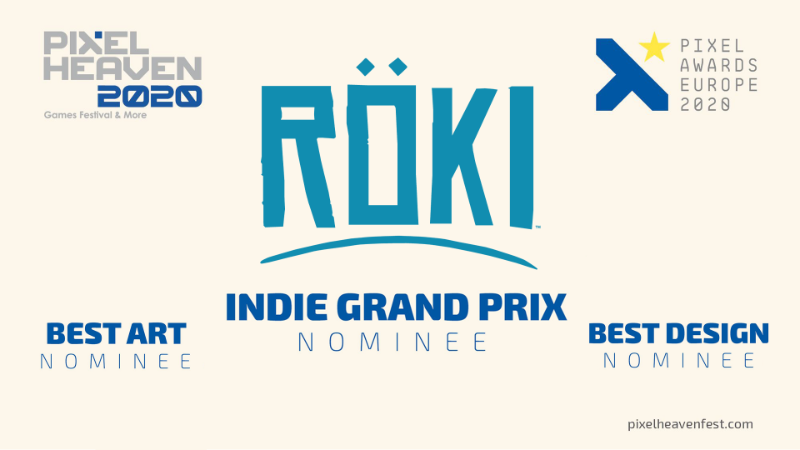
Röki with three nominations for Pixel Awards Europe 2020!
Hi, folks!
We’re excited to announce that Röki is nominated in three (!) categories for Pixel Awards Europe 2020!
❄️ Indie Grand Prix ❄️ Best Art ❄️ Best Design
Pixel Awards are given as part of the Pixel Heaven games festival. It’s the 8th edition of Poland’s largest indie gamedev competition. The winners will be announced on December 5.
Congratulations to the other nominees 🙂 You can see the full list of them HERE.