And happy Cosmonautics Day to everyone!) Sorry for being a day late.
We decided to cut a video from old pieces of gameplay and remind everyone that we are still working on the game. Not as fast and cheerful as before, but we will do it) Wait for new announcements by the summer, we will definitely share what is happening and what is happening)
"Poekhaly" (c) ;)
Devlog #31
Hello everyone!
The S.O.S. project team is on the line! The most steadfast, dedicated fighters, loyal to their crazy and courageous cause.
It's been a while since we last shared news from our workshop on the edge of the galaxy, Hekata. However, there has been plenty of news, and it has been diverse. Let's take the last diary we released a year ago as a starting point. It was published for issue number 30. Since that day, we have:
- Shrunk to six people and four to five permanent "orbit" helpers.
- Built a new ship sub-level on which an entire space expedition disappeared. It was later captured by pirates and turned into a junkyard, a warehouse of plundered junk and a home for outcasts, all in the best traditions of space criminals, like those in The Stainless Steel Rat.
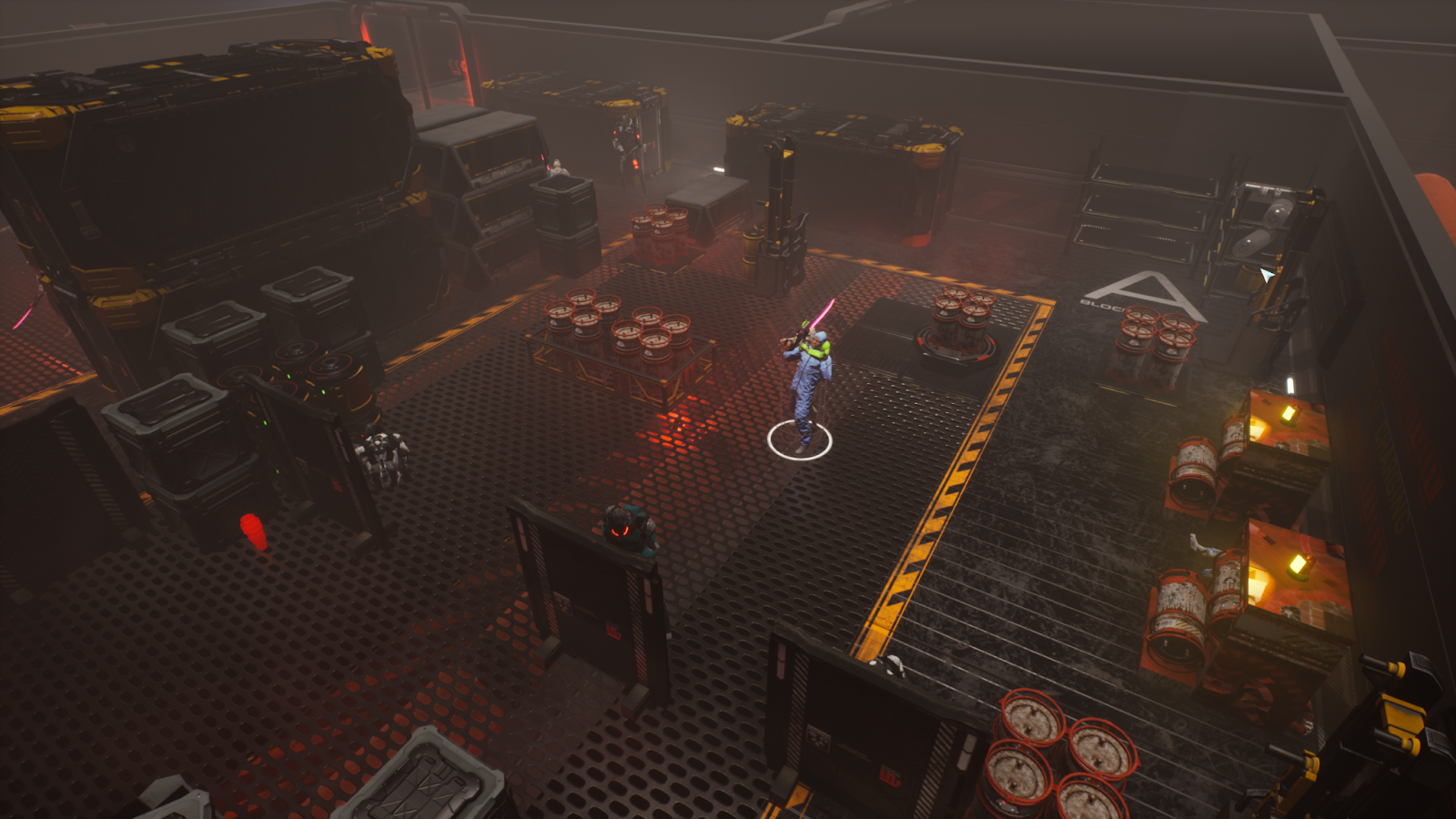
- Rebuilt the battle system from tile-based to free. That is, our soldiers run around freely like in Gears Tactics. In the screenshot below, you can see the floor divided into cells, but it's just markings to which objects are not attached. However, units are happy to stick to cover and walls.
- Successfully implemented the system of remote skills, path calculation, and base AI. - Rethought and redesigned the rescue game mechanics and transformed it into a turn-based system. Without false modesty, we can say that nobody has seen or done anything like it before. Someone might say to me, "Well, no one did it because you came up with nonsense." Maybe so, but we believe in this system! Oh, if only we had the strength to lift it up. - Applied for a grant from the Institute for Internet Development. We even adapted our lore to their agenda. We'll write about the results a bit below.
- Made our own 3D models based on our own concepts. Well, as best we could, as they say.
- What else... what else... there was definitely something else... let's see... We decided not to take Unreal 5, it's too simple for us, we want hardcore and pain. So... well, the logs were erased, memory clusters crumbled, and some working files were written over them. Access is closed.
If something else happened, it's not important. We'll keep fighting by participating in any local contests that remain and not lose hope of creating an MVP version.
"So, if you've done so much, why don't you show us this miracle?" you might ask. And we'd answer: "The implementation of our game is only at the concept and prototype phase. We still have a long way to go before a demonstration version, even as far as walking from Berlin to Beijing."
Why did we write this diary? Just to show that we're still alive and want to make an awesome turn-based strategy game! We didn't win the IRI contest: instead, Peter & Wolf, The Three Bogatyrs and Vasilisa with Baba Yaga surpassed us.
On the one hand, we're upset that S.O.S. wasn't rated highly enough to give us money for development. On the other hand... whatever.
As long as there is a core team of developers and as long as we don't give up, there's a chance that we'll finally crack this wall with our heads and produce a cool game. On our own dime or on money raised, but we promise to show it to you someday. It's a shame we can't show our development progress more often since it has slowed down even more than last year. We often have nothing to write about. But we promise that if there's something significant, like losing a contest at IRI, we'll definitely whine about it and remind you of ourselves)))
Stay tuned. Thank you for your attention.
We'll try not to disappoint all the fans of turn-based tactics and release this long-awaited game someday. In the meantime, support us with a like or add the game to your wishlist. It would be very helpful!
Seriously, add the game to your wishlist so you don't forget about it.
Devlog #30
One of our core development principles is “from small things to big ones”! This is how we put Diary #30 together. First, we will analyze the local issues, for example, whom the S.O.S. team is actively looking for, and then we will move on to the more general problems in the gaming industry. This release should be not only interesting, but also informative, especially for the beginners. Off we go 😀
Let's move on to the actual issues of the development team: what kind of specialists are needed for S.O.S. today?
Igor: Programmers and game designers in the first place. And after that the art lead, concept artists, level designers. It would be nice to have additional people for each direction.
In some projects, it is normal practice for the lead game designer to assemble the first level of the game which goes through focus groups or is presented to an investor. Such people are of great value.
Ilya: And we could use an experienced producer mentor. The one who worked in this genre and knows how to do such a project correctly. In our project, for example, the programmer or the game designer confirms the work on art. And ideally, in the absence of an art lead, to have such a person who could suggest or give an expert assessment of any aspect of the game. Most importantly, s/he will be able to explain how to build the development process correctly. But it is not possible to get such people for free, unfortunately.
Igor: A significant advantage would be the presence of a person with experience in a foreign market. Now we may fail to understand what is good and what is bad for promotion, say, in America. A very revealing story from the development is of STALKER. THQ Publisher sent a producer Dean Sharp to GSC to make sure the development team was on schedule. Before he joined GSC, there were floating plans for another 10 years of development. The THQ management did not like that the development team was scattered on a large number of features and did not have a clear plan.
Therefore, it would be great to have a person who, on the one hand, understands how the business works, and on the other hand, understands development and understands how everything is interconnected.
Nikita: The guys said everything correctly. From my side, it remains only to add that we no longer need juniors in the team. Previously, we could invite a person under the pretext of “let's learn something together,” but now we cannot afford this due to lack of time. We need the people who know exactly what and how to do, that is, at least middles.
As for specific areas and professions, these are definitely level designers and programmers. And well, we won’t refuse a marketer-enthusiast who could take the team to a new level.
What is missing for the team for the project realization?
All of us: time.
Igor: If everyone had a financial “airbag” for 3-4 years in advance to be creative, then work on the game would be more active.
Nikita: I'm talking about experience again 😁. If each of us had 3-5 years of experience working on a similar released project, that would be a significant plus.
It's cool to have the experience of launching a project: you know how to do it right or how not to do it wrong; having seen how works what your team has been doing for many months. And we have to build almost every process from scratch. The exception was the onboarding system, and task administration.
Dmitry: There is not enough quality expertise and time.
Advice for novice developers.
Dmitry: there are a lot of books and other educational content now, so I would like to give advice on how to approach the matter. If you take up the game and sincerely believe in it, then never give up. Learn from your own experience and learn from the experience of others, compare it.
In terms of narrative, I can advise you to train “watchfulness”, read more, understand how it works and often ask the question “why is it invented this way?” Think about how this scenario was built. It's the same with game design. For example, to save time, I watch various walkthroughs of the same game on YouTube in order to track the possible paths of various players from the outside.
Nikita: I would agree with the above. The most important thing is not to be afraid. If you don’t know what to do, you will understand in the process; there is always something to prove yourself and where to learn something, just start with something if the standard “first understand who you want to be in game development”, “learn the whole list of professions” for some reason do not suit you.
Ilya: I would advise to behave reasonably and practically. If you don’t have enough money for food, you probably shouldn’t throw all your strength into a creative project, hoping for its success in the near future.
Igor: The most important thing is to start doing something. And if you spend a lot of time on preliminary preparation, documentation and planning, then in fact you can not move anywhere in the development. You can stew an idea in your head for years, and sketching on paper is already a good first step. The second step is the prototype.
Nikita: At the very beginning of the path, you can only throw in a brief vision, concept, and only the first steps. At first, you can try to recreate something simple according to the existing equivalent.
Ilya: I would even advise to start with something very small if you have never had any experience in game development. So you can understand whether it is your path or not. The most important thing is to finish the game. Take a template, remake 5 elements from it and feel if you are really gettinging involved into it.
If you are already doing something more or less big, I would advise you to be realistic and keep your ambitions. See what is really important and have only that, only in that case you can finish the project and get satisfaction from the work done.
Igor: Writing down a lot of ideas is not harmful, it's still better than not having them at all. When there are a lot of them, it is easier to refuse the ones which do not work. Again, I repeat, it’s harmful to be engaged in a thorough detailing of everything, especially in the indie development, the time will be only wasted. For me, the most appropriate pre-production process is the following:
Brainstorm;
Fixing ideas in a concept document, without detailing. Document is your draft;
Prototyping;
Testing;
Repeating the points above, making changes to the documentation.
The game jam experience is useful (the game jam calendar is here, you can track the beginning of each game jam in it). Here you can find different themes, engines info etc. Such a development format is useful in the sense that a game needs to be done in a relatively short period of time, but this will put you in a stressful situation. Especially when you have a team with the same skinny experience as you. One way or another, it unites, after the game jams permanent teams with working projects are formed.
Did the current development help someone get into the industry?
Nikita: When we started S.O.S., one of the goals was to “get into the real gamedev”. This means, of course, full-time employment, which brings you some kind of income and satisfaction.
Almost every incoming employee whom we hired replied that they wanted to get a successful case in order to develop further in the industry. The exception was those who already worked in this field and came to us out of interest.
The most interesting case was with Sasha Voynich, who joined us as an animator, created around 15 animations, after which he was hired by one large-scope game studio. There was Andrey Ermeev. Although he already had his own studio at the time of our cooperation, and was not our art director for long, that was a very useful cooperation. Now he is preparing to launch his project on a well-known Russian franchise. Yuliya Corn became a producer in an outsourcing company, she joined the team to as a game designer and narrator. Maks Avdiev went to Poland for a major project and works on 3d modeling there, thanks in part to our project. Aleksei Skobtsov, one of our first marketers, is now coaching guys in the League of Legends. In fact, the list of the revealed talents is worthy, this is only a small part of people whose fate was influenced by S.O.S.
What are the soft-skills and meta-skills that help in the development process?
Nikita: in any type of work it is enough to be a responsible employee, this is enough.
Ilya: If you took a task or promised something, do it. You need to communicate normally, in the game development it is not customary to be rude and look from the “above”. Try to be as punctual as possible. No less important is personal interest and motivation, the desire to immerse yourself in the project.
Nikita: There must be a certain passion for the matter you are involved into. Non-toxicity is a very important skill, as well as honesty and responsibility. If you don’t have time to complete the task, you shouldn't come up with “why?” fake reasons. You should not be shy about communication: if something didn’t work out, then tell us why; if you are late, then let us know. A sense of responsibility should work not only towards the team, but also towards yourself.
Igor: What is especially pronounced in the indie dev is that it is very difficult to work with people without initiative; there is no feedback, no desire to do something. Some people cannot even ask if there are actual tasks. You have to be distracted to once again ask something, learn about the problems, clarify the status of the task etc. So it's very difficult to work. Among other things, the initiative can help with a lack of expertise: you don’t know how something is done, you start the discussion, and now you are already together finding options for solving the problem.
Nikita: In general, the indie gamedev is an initiative bordering on responsibility and passion. These qualities help a person to create within a team. You should be willing to contribute to the project yourself, and not wait for someone to tell you something.
Be able to play games not as a player, but as a developer. Analytics, the ability to decompose and observation are included into this quality. This is exactly the skill that is developed in the process. If you are an artist, you notice some good solutions, if you are a designer -- mechanics, and so on.
There is another quality, let's call it adaptability. Come to the team, see how everything works, and synchronize with the rest.
What are your development plans?
Igor: we are working on the “vertical slice”, and this is a very large amount of work. There will be a build with new mechanics and a reworked combat system, as well as new levels. We took into account the experience of the past showcases, so we concentrate on small parts of the game, saturating them with details as much as possible.
Summarizing the abovesaid
We can say that nothing is impossible if you approach the matter confidently, proactively and without fear of mistakes. What other soft skills and character traits, as you think, are important for the game development industry?
We also remind you that S.O.S. needs new fighters! You can help the Space as a permanent part of the team, as well as a temporary volunteer! We are in active search of:
level designers
developers
game designers
If you are (or consider yourself) one of them, then do not hesitate to write to our project lead in Telegram: @Nikita_Proskurin
Devlog #29
Hello everyone! Here we are again! 😀
Our last issue was about who and what started their journey with in the industry. Our colleagues shared their working experience, problems, and how they came to game development.
In this issue, we will partially continue this topic, and our developers will also share some life hack on how to make your game 100% interesting for the audience of festivals and exhibitions.
So, let's get it started!
What are the successes and failures of the team in the process of creating a game?
Dmitry: during the development process, we encountered a wide variety of misfaults in our industry. For example, attempts to do a large amount of work of a decent level in a short time. At the planning level, the roadmap looks feasible, but in reality it turns out that in addition to projects “for the soul”, everyone has full-time work, which eats up a lot of time. And then the deadlines pass, everything shifts.
There were problems with "slobs": because of our approach “if a person does at least something for free, then this is already good”, the team faced the fact that some not only scored and did nothing at all, but did not even report that they “abandoned" the idea. We quickly learned to understand that if a person keeps silent and does not get in touch, it is better to part with him.
We can't help mentioning our "heroic" deeds and successes. Despite the planning errors, we are working on the project quite a lot. And usually, after a series of re-plannings and taking into account all the circumstances, we manage to meet the deadlines: hand over the build for the event, provide the team with tools, raise morale when necessary, and the like. In general, the work is structured.
Ilya: I can attribute the process of preparing for STEAM FEST or DevGAMM to our feats. I remember working non-stop for the sake of the final result. And we eventually achieved it.
Regarding the mistakes, I agree with what Dima said above. Well, often the focus is not on those things: having done a lot of unnecessary work that no one saw or understood. For example, for the game build presented at DevGAMM, we made 4 levels, but in fact no one went beyond the second one. We had to concentrate on making level 1 as high quality and rich as possible, but we blurred the focus and did the wrong thing…
In addition, thanks to the trial and error method, we realized that it is better for the whole team to deal with only one level, paramount to perform only the most urgent tasks. For example, a modeler was creating a robot that would not appear anywhere for the next six months. Although, to be honest, there were plans for it, they just cut it out of the final script.
It seems that the team tried their best and worked, but their contribution to the new build is zero. The situation is similar with the narrative, much of which was written to be saved for the future. A lot of unnecessary modeling and concepts at this stage. You can't say if it's a failure or a success, just an interesting experience gained from the workflow.
Igor: I agree with Ilya. For the artists, the amount of work and the time allotted to it is very often unstable. Therefore, they are happy when they get closer to the actual task and go in the same timeline with the whole team. But the main thing is still a balance between what a person wants and what needs to be done. For example, to make interesting art, which, perhaps, will remain an idea without implementation, or to do something that is not so interesting, but will definitely appear in the final product? Based on our experience, the best performers are achieved by the artists who work on something that will definitely make it into the build. And this should be remembered at every art meeting call.
What is happening now? What difficulties are you currently facing?
Igor: Lack of time.
Dmitry: Yes, lack of time, as well as good professional staff. Now programmers and level designers are in great need, not necessarily even very experienced, it will be enough at least responsible and diligent, those who want to work on the project together.
Ilya: There is one more point due to the peculiarity of free development which is “bottleneck”. For example, there is an insignificant task that slows down the entire project, but it is impossible to do it quickly or in some kind of priority mode, since everyone works when they can. And until they can, there is no point in going further, since the future user experience is not clear.
And there are also problems with concept artists: a new person draws a concept, and we understand that it can not only be put for the future usage, but abandoned, because before that, some identical finished work was presented by a specialist before them. Although, you have to redraw when the previous version does not suit you with something. But it is not always possible to surpass the quality of the previous version, one of the works in any case will be thrown out. This must be soberly understood and be prepared to waste some time. However, this is normal for the concept creation process.
Igor: Now one of the main problems is the lack of funding. Investing in the project would help it to shoot through the involvement of new experienced professionals and the full-time employment of the current team.
As an afterword, let us remind you that getting on the path of game development is much easier than it seems! But holding on to it is another story.
What, if not testing, is the best option to start? It is enough to send us an e-mail to get a build and join the wonderful game dev sphere: mark.sosproject@gmail.com.
And we say goodbye until the next Dev Diary 😉
Devlog #28
Rummy Games is back in touch! In the new Dev Diary #28, let us remember how it all began. This was long before Saturated Outer Space.
Still think that development, even in game development sphere, is not about creativity?
The stories of our three colleagues can not only convince you of the opposite, but motivate you to do new stuff!
How did it start? Spontaneously. How did you gain experience? It was a relatively long, getting a lot of “bumps” process, and, moreover, far from being only in the one “outer space”.
We will talk about the pitfalls, working on other gamedev projects, and our first steps at the beginning of this journey.
Dmitry (Lead Screenwriter and Game Designer):
I started programming solely because I wanted to create games. I wrote my first game when I was in the 8th grade thanks to school courses. I was very inspired by the process of working out the design of the game, writing the script and other things.
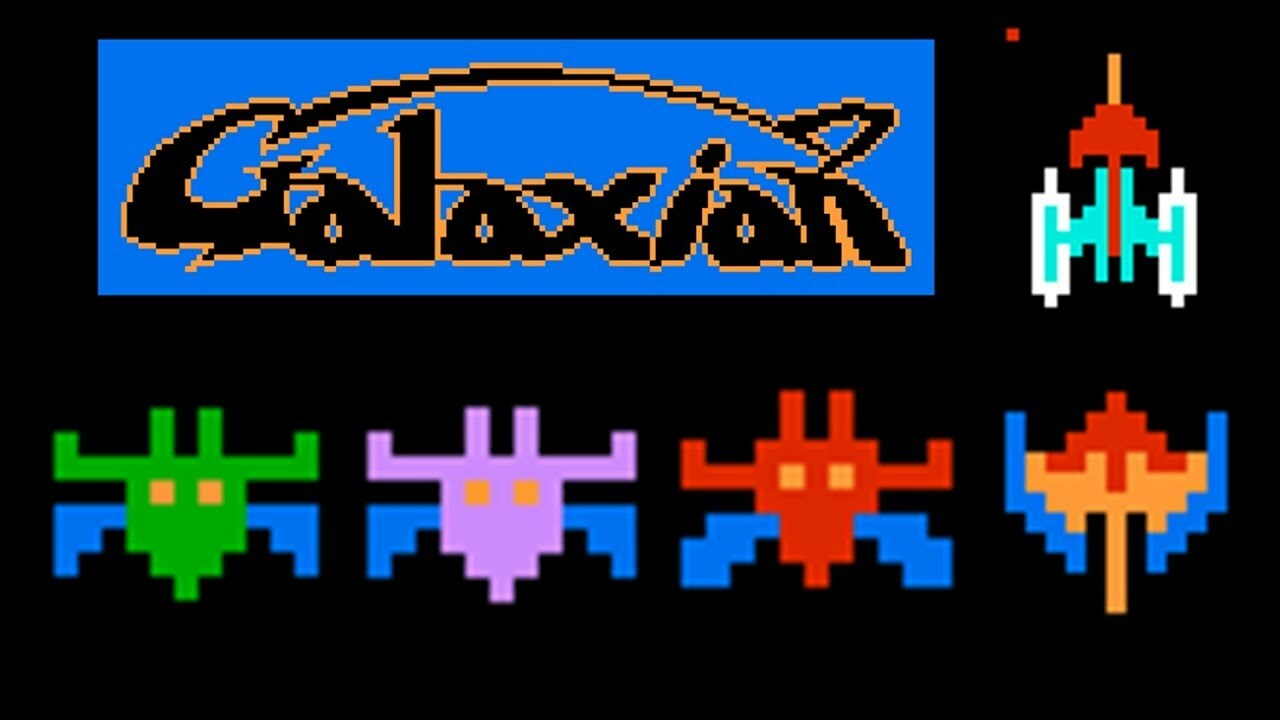
There is such a game “Space Invaders”, in which the camera is placed on the top, and the field is divided into two parts: from the player’s side there is the ship moving left and right, and enemies approaching in parallel, which must be destroyed by this ship. There are many clones, you may have heard of one of the most popular: "Galaxian" for NES.
I also made another analogue, in which there are three levels with a huge number of cutscenes. I really wanted to make an awesome script 😀. All this was done in QBasic. And it was the biggest “code sheet” in my life. Of course, there was also a “beautiful” interface. This was my first creation at a local competition and I won 3rd place.
Then there was experience with Visual Studio. I made the Tangram game: a puzzle, in fact. Then there was a long break, during which there were some projects, but none of them reached the game stage.
One of my favorite games that I am still very proud of is “Fart Fly”.
This was my first “serious” project where I tried to maintain the documentation and the backlog. In terms of the number of ideas and the result obtained, it was good, but the team not only met the deadline, but also managed to change some elements of the mechanics.
I was doing “Fart Fly” already when I worked on “Saturated Outer Space”. And I didn’t do it alone, but also with the guys from “S.O.S.”: Igor did the programming part, Aleksander Folomkin (already left the team) helped to set up the balance, Ivan Malykh (also left the team) drew and made the sound. It was basically a small side project within the Saturated Outer Space project. There were even thoughts of embedding it as a mini-game 😁.
Ilya (UI/UX Designer):
It was not that interesting for my side. I was also taking part in Game Jam and made several games.
One of them is called “HandJob”: at the construction site, bricks are thrown up, and the “builder” player must arrange them according to the level. I was actively involved in game design, suggested mechanics, and I can also be considered responsible for the name of the project and partly for level design. The entire level design was created “by hand” on the GameMaker engine. What is remarkable: although it was a hyper-casual game, it was impassable at the same time: it had well-developed physics, and the gameplay becomes more complicated with each level. By the way, it is available for download on itch.io.
The second game is much easier (called Mars Base). I made this hyper-casual game with my friend, the idea of which was to assemble a space station in orbit of the rocket.
During the Pokémon GO boom, my friend and me wanted to make our own one in 2017. It was playable, but the process of working on it was remembered by others. Thanks to him, I got my first experience of writing documentation. Before that, we did not conduct it, all issues were resolved on phone calls. Without documentation, the work was carried out “in a stream”: we sat down as a team and played the game for 5-6 hours in a row.
After 2020, I came to “Saturated Outer Space” and I am working only on it up to this day. There are plans for other projects, but the implementation is not yet started.
Igor (Game Designer, Lead Developer):
I have had many different attempts to create games since the university time, but all this was at the level of experiments. All the projects were made for “members only” and were not of a commercial nature. The mechanics of the games were very simple. For example, a text quest, in which the scenario, although it was “branchy”, was not very complicated. It was a JavaScript browser game, made just for myself.
In 2019, I got to DevGAMM, thanks to which I learned that there are game developers in Russia. It was strange for me, because before that I did not consider myself as a possible game creator, and all the ideas about game developers in Russia ended with games like Vangers, Space Rangers, Allods and Paragraph 78.
An interesting fact: Nikita (the head of the “S.O.S.” project) and Dmitry (the lead screenwriter) were also in the hall at the time of the awards ceremony. We all had yet to get acquainted with Igor.
In 2019-2020, started to actively take courses, create the first prototypes. The developments did not go beyond prototypes, but at the same time they looked good in my resume. There were many pen trials in Unreal Engine, GameMaker and Unity.
Fart Fly, which Dmitry mentioned, was developed jointly. And below are examples of other surviving prototypes.
1. Prototype of Top-Down shooter (reference - Hotline Miami):
3. Narrative slasher (Dark Souls + The Stanley Parable), you can download and play:
At the moment, I highlight 2 technical areas that are most interesting to me:
Artificial intelligence (AI). Design and programming of NPC behavior.
User interface (UI). Design and layout of interfaces in the engine.
Another developer colleague:
In the gaming industry, I only made visual novels on the Ren'Py engine, but I didn't really finish them. Actively engaged in directing, was an actor, worked in the theater for 4 years. The first directing experience was very difficult, because at the age of 21 it is very difficult to hold such a position: you yourself have not yet been formed as a person, plus you constantly have to “fight” with your subordinates in the theater. The pain of the first experiments is when you do a general run and you already see that your studio does not like what you have done. The opposition between the “author's” vision and the commercial one began: people want to have fun, not everyone is ready to delve into complex thoughts and ideas.
Since then, even when I write something for work, the thought is always in my head: “Don’t write like that, they won’t understand, don’t, you need to communicate in the same language with your “viewer””.
But my soft skills and ability to smooth out conflicts often saved me, although there were still unpleasant situations that forced me to just accept.
As you can see, many members of our team got into the project in different ways, but it cannot be said that it was by chance. Therefore, instead of a summary, it would be more logical to say that each of you can make a significant contribution to the development of the game too! "Saturated Outer Space" is looking for testers. If you are passionate about games and are a fan of the RPG genre, then write us an email: mark.sosproject@gmail.com, or leave a request on the game website. Your work will be greatly appreciated.
Devlog #26
Hey, hello everyone. This is Dev Diary # 26. Rummy Games is again here with you, and this time it will be something extraordinary: the marketing department has got their voices. Before that, we, as the quiet fighters of the invisible space front, were communicating with you in order to impartially and objectively convey the difficulties and successes in the game development. But not this time: the marketing department will start talking today! The first one to get in touch is our SMM specialist Tatiana. Tanya, you have the floor.
Disclaimer: as an SMM specialist I experience professional deformation, namely, I almost always use in my speech and text a minimum of "officialdom", a maximum of humor, and maybe even provocation. However, I will try to avoid the last point, for obvious reasons :)
About myself
Hi, my name is Tanya, and there are too many cities that I can call my home, so just generalizing let's say that I come from the south of Russia.
Starting from school I used to write essays well and loved literature very much, but for some reason I went to study as a programmer (and it was a very difficult and interesting experience!). Honestly, although I have not worked even a day according to my major, some knowledge from the frontend development and website administration has come in handy in my life and work more than once. I love memes, coffee, Naruto anime, the "King and the Fool" musc band, writing texts at night and building my own totalitarianism in the Tropico game.
My relationship with marketing began as a SEO copywriter while still at the institute, then somehow it came to an SMM specialist. From that time on, I began to understand contextual and targeted advertising. For all the time, I managed to collaborate as a broad-based marketer for the hotel business, bar, quiz franchise and personal brand, it is worth mentioning separately the areas of taxi companies, wholesale and training music courses. From my rich freeelance experience, one can gather a beautiful patch of hilarious expressions by customers and perform with them on a stand-up tour around the country. (P.S. from I.M.: “If this diary gets 20 likes on Steam, then the 30th diary will be about funny stories from work).
And I also worked for two whole years in the office of an IT organization that worked very closely with the state.
By the way, then I made 2 big discoveries for myself: sometimes beautiful and interesting in terms of design sites sold worse than those assembled “according to the template”, which is why I often had to refuse the former. And also people do not like when it is difficult. And this applies to absolutely everything: communication, design, approach etc. And in general, there is no greatness where there is no simplicity, goodness and truth, as one famous "graphomaniac" liked to say.
Despite this seeming diversity, most of my time I work with numbers and hackneyed scary acronyms that tell you about the number of people and their reaction to advertising, as well as about the money spent :)
I got to S.O.S. absolutely spontaneously. I helped other friends of mine who had just started their own indie studio. I started looking for information, courses, videos, tried to delve into the topic. So I stumbled upon a broadcast of the "Want to be in gamedev" contest, where Vyacheslav Utochkin who said that anyone who wants to can get experience in gamedev. And for me, some new knowledge and opportunities have always been a priority, so I thought: "Why not?"
So, Twitter was given under my responsibility, and I sometimes try to help in other small things.
What were the tasks?
The studio has discussed running your own Twitter for a long time, but there were no free resources. And I feel my competence in this matter, because I have been using this social network for a long time and I know its features :) But since we decided to focus on the English-speaking audience, I got an “Achilles heel” in the form of a weak level of the language, although I try to overcome it.
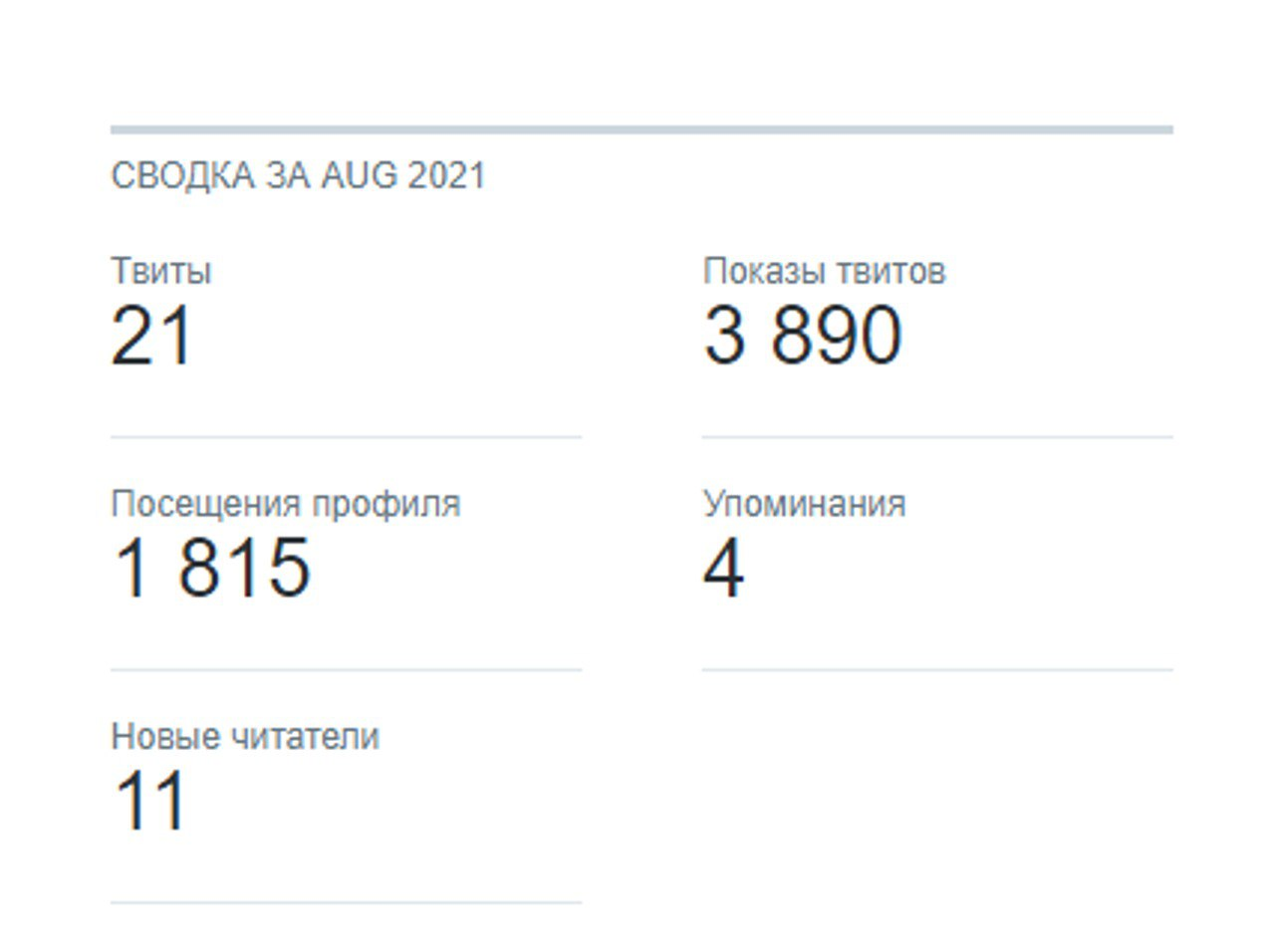
The initial task was to start an account from 0 and try to "promote" it. Our marketing department thinks I'm doing well. In less than half a year, we managed to gain more than 1,500 subscribers, and the total monthly account reach is over 10,000 impressions, and the numbers only go up.
What are the tools?
In general, SMM manager has few of them: graphic editors and a delayed posting service. Everything else, whether it is studying competitors, collecting statistics and thinking over means to increase coverage, is done manually. True, when it comes to advertising, it becomes more interesting, but that's a completely different story...
How was it implemented?
According to the usual formula: interesting content + communication. Before that, I had no experience of promoting a “branded” Twitter account, but I tried to evaluate from the user's side: what interests me, what I like, what I subscribe to?
I tried to study the competing studios, but everywhere I fell on the dignity and curse of Twitter at the same time: personal blog and positioning on behalf of the developer / CEO. Or just one copy-paste of links from other sources and the complete absence of any content.
Also, a lot of discussions were caused by the question of the target audience of the account, for which audience should the profile be kept: English or Russian? Or combine? For a number of reasons, we decided to focus on foreign countries.
Many thanks to the team that helps with the translation of the posts. Hopefully, I will still be able to raise my level soon, and my work on Twitter will take less time.
There are a couple more ideas that I would like to implement. Hopefully in the near future I will have a little more productive resources than I do now. :)
What are the final results?
The coverage is growing, although there are challenges. The basis of the effectiveness of my work is a systematic approach, to attract the attention of not only ordinary Twitter users, but also gamers interested in buying S.O.S., as well as representatives of publishers. However, the intermediate results are good news.
Future plans, edits and P.S.
In fact, I discovered a lot of new and interesting things for myself in this area and professionally as well. We can immediately say that in terms of the specifics of the work and the algorithms for promoting indie gamedev, this is an absolutely unusual unique path that differs from all other topics and directions :)
And I also want to work with other websites that can serve as a source of traffic, to study the principles of promotion within Steam, although I am already more or less familiar with the database, and in general to get more experience in this area.
Devlog #25
1. About myself
Hey! My name is Yana Voronkova, I am from Minsk, Belarus.
Starting from elementary school I loved to play games, in middle school I got acquainted with technology, and in high school I decided to become a psychologist. Having crossed all this, I came to my current specialty, that is an engineering psychologist, if say it literally in Russian. (Games) User Experience Researcher - if in English.
This is me studying the influence of music on human productivity at the Labor Psychology and Ergonomics class :)
I research the user or player experience within something that engineers and designers have created, usually within the interfaces. I evaluate how clear it is for a person what s/he sees and how comfortable it is to solve the arising issues. In the games I also necessarily investigate the "fun" they bring.
I also often research the target audience of products: what the potential users like, what do not like and why, what problems they have, their pains, values, unresolved needs, experience with competitors, and so on.
I worked at Wargaming for a couple of years, then I entered the free market. But the free floating in the CIS, unfortunately, can provide a very few game projects that want to conduct research. Usually my customers are enterprise products or services. So I started looking for some kind of an indie studio to work with games for pleasure. So, while listening to the podcast “Want to be in gamedev”, in which Vyacheslav Utochkin regularly advertises the opportunity to work with novice studios for free, I wrote to him and eventually got into S.O.S. Well, first I had to really explain what kind of specialist I am and how I can be useful in general :)
2. What were the tasks?
I don't have a lot of tasks on the project yet, because there are still no players on whom I could conduct research. And external research costs money. Therefore, it is necessary to find opportunities to draw something in the conditions of the given constraints.
While there were tasks for collecting and analyzing feedback from those who, on occasion, managed to play the build, and I also conducted a usability audit or, in other words, an expert assessment of the game's interfaces.
3. What were the instruments?
If we talk about software and hardware, then everything is free! :) Since specialized tools like an eye-tracker (a device for tracking an eye) or collecting telemetry (game data) are not yet available to us, we use any available office packages that allow to collect and record information. For example, Google Forms for creating questionnaires, Google Docs for writing reports.
If we talk about the tools of the researcher — methods, I used questionnaires, heuristic assessment and cognitive test (or scenario test). I'll tell you about them further.
4. How was it implemented?
When DevGamm Moscow took place, we collected feedback from the participants of the conference (you can read about this in the last issue). To do this, the guys attracted visitors to the stand to play the build, and then the players filled out the feedback form that I prepared. There, in a structured way, we found out what the players liked / disliked, where there were difficulties, and also asked to compare S.O.S. with reference games.
A usability audit task does not need players, so this method can be used just when it is not possible to conduct research on live users. To do this, you only need an expert who, based on their knowledge, experience and observation, can point out weaknesses in the interfaces and give recommendations for their improvement.
It happens like this: I master the game based on the player's experience who sees all this for the first time. I did this as soon as I came to the project, so the view of it was very up to date.
In the process of research, I take the marks for myself on what looks or feels incomprehensible, confusing, or inconsistent with some design heuristic (sort of like a set of rules for design) or game idea.
An extract from the usability audit report
Then I describe all this for the team with explanations why this is a problem and how it can be solved. At this moment, a lot of analytical work takes place, since it is not enough to simply locally point out problems such as “incomprehensible icon”, “too fast transition” or “the problem for the level is poorly described”. It is necessary to look at everything in a complex and try to identify deeper and more serious problems. For example, “the game has problems with navigation” or “there is the lack of goal-setting for the player”. To solve such problems, it will not be enough to repaint or change the wording. Here you may need to revise the logic of game mechanics or information architecture, for example.
5. What are the final results?
It is still difficult with the questionnaire. You may have seen in the last blog our few responses after polling on DevGamm. Difficulties arise with the collection: a) feedback from relevant potential audience, not industry experts; b) a sufficient amount of this feedback. It's hard to get feedback without reward or self-interest from people.
The usability audit results included a list of minor and global issues. Some of them coincided with what the team was already working on before I came. Some were new for the guys. They intuitively felt something, and my report simply helped them to “sort it out”.
The most popular flaw is insufficient informing the player about the status of the system. It is important that the player always understands what is happening with him/her and with the game. This includes informing about whose move it is now, which hero is chosen, why s/he cannot walk, how s/he can perform this or that action, what is generally required of him/her now, etc. When you work on a game for a long time, to you, as a developer, some things seem obvious and self-evident. But this may not be the case for the person who first looks at the game.
The team is currently working on fixes and improvements.
6. Plans for the future, edits, P.S.
I really want to fully test the game with the players and give the guys feedback. From time to time we discuss some ways of where to get the audience, for example, via some article.
So, if you consider yourself a fan of tactical games and space setting - write to us in the comments! :)
Devlog #24
Good day to everyone! Welcome to Rummy Games and the new Dev Diary! Today we want to share with you our impressions of visiting DevGAMM 2021 September.
Preparation.
This is not our first participation in such an event, have a look at Diary №4, this time we managed to prepare better, because got to know about participation in advance :)
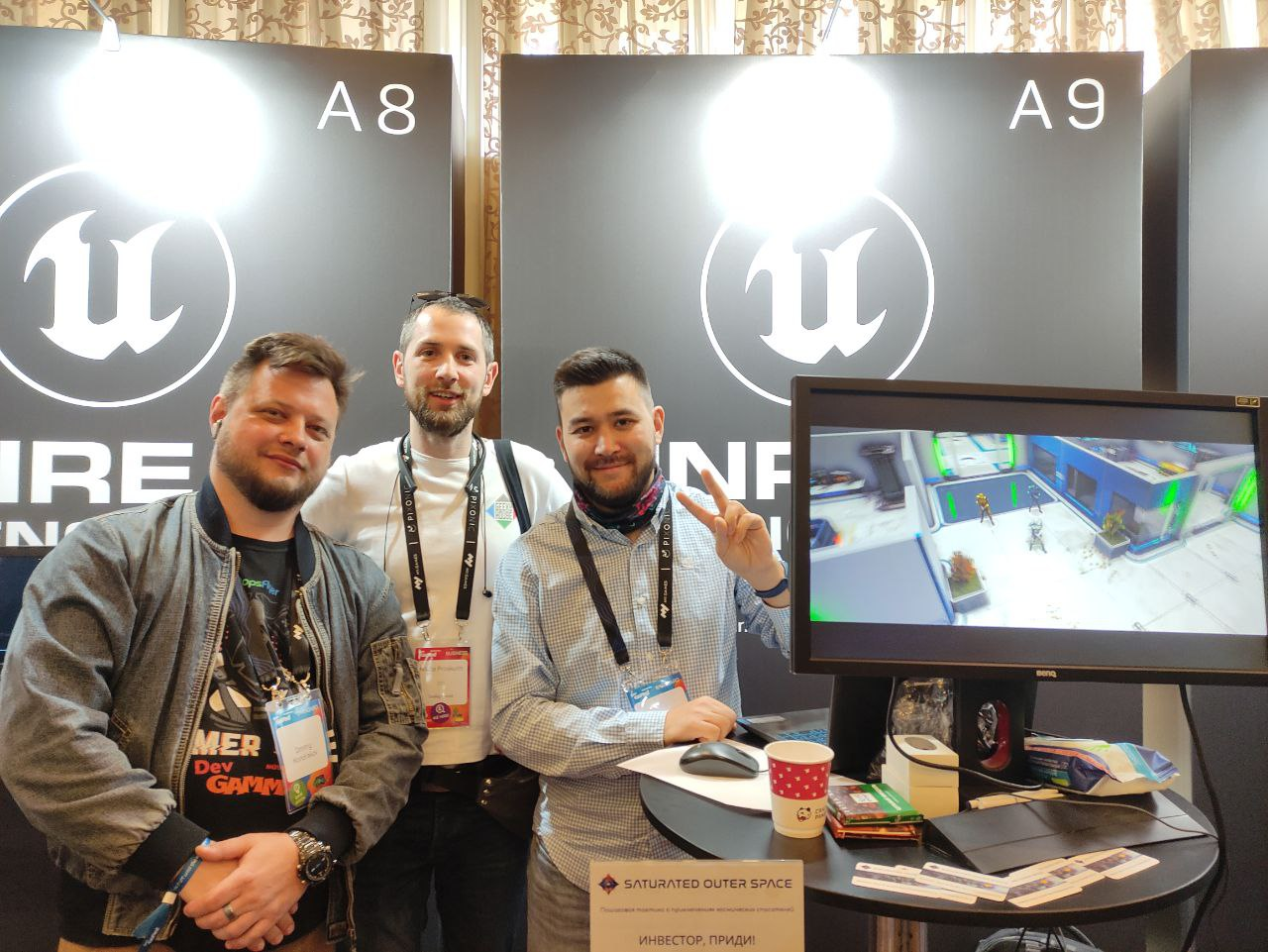
Our project was represented by Nikita Proskurin (Project Manager), Dmitry Kondrakov (Lead Game Designer), Ilya Ninomiya (UX/UI Designer)
On the first day we took part in a showcase, demonstrating the game at the booth. We brought the laptop so that players could test our game and give feedback, as well as the monitor to demonstrate the gameplay to the entire audience who could be interested in the project (during the breaks between the game sessions, a trailer was played for the visitors).
This time we did not prepare a special build, because it would take a lot of time, which is better to invest into development. Therefore, we used the latest stable build 0.6.7 version, which was in the summer stimfest.
We set ourselves several goals:
search for investors,
collecting feedback about the game,
point search for new members of our team.
Total expenses for participation in the exhibition:
Laptop rent, 2,800RUB.
Chocolates for visitors leaving reviews, 2,300RUB.
Table sign with vacancies and QR code of the questionnaire, 400RUB.
Disposable ear pads and wet wipes, 1,200RUB.
Business cards with the delivery included, 1,500RUB.
Total: 8,200RUB.
We were very lucky with the stand which we got for free. Often, to reduce the threshold of attendance among game developers at such events, the Unreal Engine representatives organize free places. So, expenses in this part were avoided.
1st day
Visitors started coming up right after we set up our booth. Among them there were: the representatives of Ravencat studios, General Arcade, GFA Games and many others. They played the build, gave feedback on the game design and the feel of the game. According to our calculations, about 30 people managed to test the game at the booth.
Live demonstration of the gameplay.
The guys from Will and Reason also visitd us (it is an indie 4X strategy developed on sheer enthusiasm. Just like ours! We talked and agreed to meet at their booth the next day.
Friends from The Frosted, on the right is Julia, our narrative designer. We managed to attend several lectures and talk to the speakers.
On the second day, we mainly talked with other participants of the event, went to yesterday's visitors to our booth and joined several lectures.
We visited the Tiny Island booth: a nice VR project in which one plays as Khasi god (aka the “Chopsticks” god) and help grains of rice to acquire Zen.
Tiny island The wall of vacancies.
Fascinating lectures. We got a boost of cheerfulness at the lecture of Albert Zhiltsov. : D (Actually, it was a cool lecture) The people voice at DEVGAmm :) Games roasting at the end of the conference is already a tradition, there were successful punches!
The general impressions of the conference are extremely positive. The organization was at a high level. The atmosphere, communication, reports, performances: such events are a must for inspiration, desire to move on and networking.
Along with this, we got the understanding that it is necessary to come with a more prepared build, so our next participation in the event will be after we bring the project to a new level.
Finally, some statistics. We managed to collect some feedback, thanks to all participants!
Devlog #23
Hello everyone! Rummy Games team here with a new Devlog. We keep sharing stories from our developers with you. Our topic once again is the so-called 'creative block', or a 'blank sheet anxiety'. Previously, our head artist Alexey Avduevsky shared his thoughts on overcoming creative anxiety. We hope these tips might be useful both for those who make games, and those who don't.
I. A Difficult Case
Mr Feng’s method can be extremely effective when you are dealing with a task that is more or less straightforward. It works very well when you have a clear goal and don’t really have to invent everything from scratch.
But what if you actually have to invent? What if there are no reference images or ideas to build your asset upon? Many artists come across such cases, for example, when an asset is being worked on and during the work its concept changes dramatically. Or, for some reason, there was no concept at all. These are cases when all your creativity needs to be unleashed. Time to open your box.
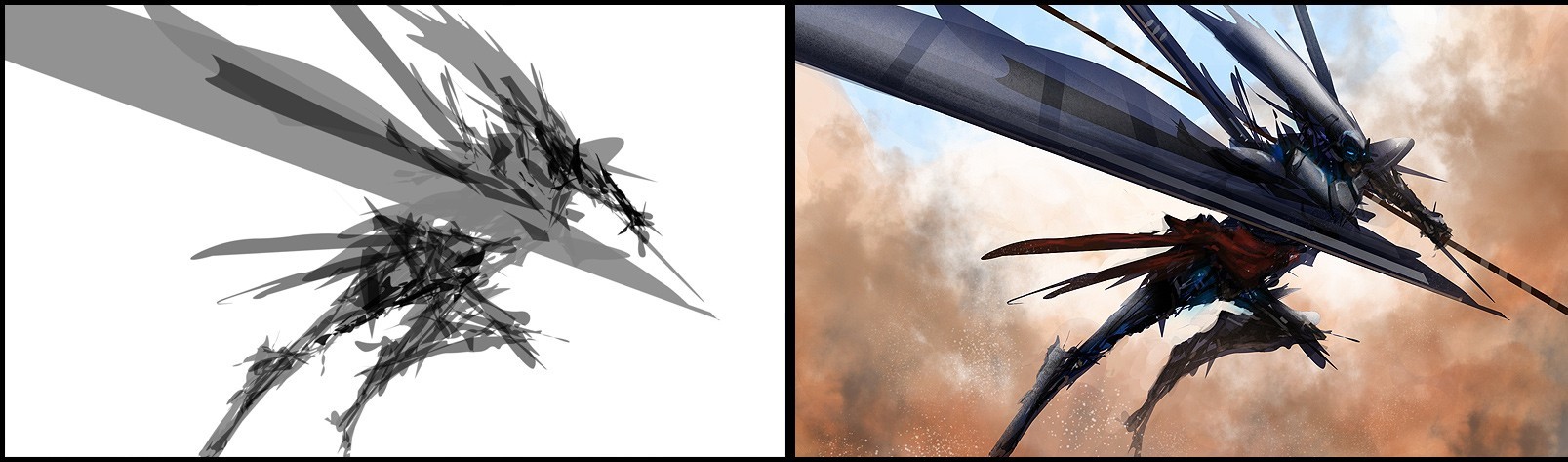
II. Alchemy No, it’s not about making a magic potion. The thing is that every visual image starts with a shape. Alchemy is a tool for creating shapes. So try creating some shapes, any shapes you like. Don’t worry about details at this stage, just let your unconscious do the job. In fact, it’s quite similar to gazing at clouds in the sky and ‘reading’ their shapes: this one resembles a T-rex, that one looks like a fish.
The key to the shape-making phase is not to criticise your work instantly. Give yourself some time, let your creative spark ignite and turn into a flame. You can set a purpose when drawing shapes or just do that freely, both ways are perfectly viable.
After some time, having selected shapes you like best, you can start thinking about passing to the next stage and fill your shape with details. By this time, your creative thinking will already have ‘switched on’, the inner engine will be ignited and warmed up properly, and you’ll be ready to take off into the creative journey of making an asset.
III. Building Blocks Building blocks are a huge thing when facing a creative block. Again, the anxiety stems from the idea that you have to come up with everything at once, with a perfect image of what you’re trying to create. This is never the case.
Building blocks is like cooking a salad. You get your ingredients and start mixing them in various ways. And by doing that, new ideas come to your mind. Just like with shapes, using building blocks helps you soothe the anxiety and warm up your creative mind bit by bit, degree by degree. This is "~bashing" in its true sense, but it can also be divided into separate parts: kitbashing, sketchbashing, 3D-bashing and others.
To understand how sketchbashing works, it's best to watch Nick Carver's performance as part of "Trojan Horse was a Unicorn". He starts by drawing a few houses which he later uses as building blocks for a bigger one.
Like playing LEGO, this allows you to relax. Again, no need to come up with your asset immediately. Combining pieces in various ways, working on the perspective, building a nice shape — all these things can be done step by step, and bigger results can be achieved with less effort.
To get a better grasp of the idea, and to enjoy some English humour, I highly recommend checking out the Bill Making Stuff channel . Bill makes some really cool robots from garbage.
IV. Some Cheating (Or Not)? Okay, this one is a bit controversial. Some consider it cheating, others think we should make use of anything that actually can be of use. Anyway, neural networks can help a lot with boosting your creativity by lending you some.
There are two NNs aimed at generating images: first is Nvidia Canvas (requires the RTX card), the second is Artbreeder.
NN can be a last resort when nothing else works. For example, Artbreeder can create such nice landscapes and character portraits, that it’s quite scary to think where it will be in, like, five years. As for me, when I am totally overwhelmed by nothingness, both on my sheet and in my box, I use it as a kind of magic pill. After taking a look on what it’s got for me, my brain, again, starts warming up and finishing the scene in my head: what could be happening here, or there, or what I would change, what I would fix.
V. So, What's In The Box?
Okay, seems like I have to end with an instructive thought. Many people would say that practice makes perfect, but let’s be honest, humdrum never really helped anyone. Sure, your skills develop over time, but the anxiety is always there.
Every artist is afraid that it just won’t happen. No exceptions. Everyone is afraid that today will be that very day when things just won’t work out. The creative part of the brain will stop functioning, they won’t be able to make even a single sketch, and so on. Nothingness will prevail. Well, is there something we can do about that fear? Yes.
Remember that the main weapon against nothingness is the box? Your experience, all the things you have seen, or heard, or read about, or ever imagined.
This is the key. All your ideas come from your box. So, it is quite clear: fill the box with the things you like, with the things that will inspire you and those around you. Live through exciting experiences, watch beautiful things, read delightful books, listen to enchanting pieces of music.
Good luck!
Devlog #22
Hello everyone! Rummy Games team here with a new Devlog. We keep sharing stories from our developers with you. Our topic this time is the so-called 'creative block', or a 'blank sheet anxiety'. Our head artist Alexey Avduevsky is sharing some thoughts on overcoming it for maximizing creative powers. We hope these tips might be useful both for those who make games, and those who don't.
I. A Bit Of Philosophy
We’ve all been there. You run your text or graphics editor and here it is. A blank page laughing in your face. A page with nothing at all on it. No, not just “nothing”. Rather, there is absolute nothingness, or nihil God is told to have created everything from. You wish you could do the same, come up with an idea, get things moving. But you just can’t, that damn nothingness is totally overwhelming.
Nothing is the opposite of everything. And what is everything? Well, let’s imagine a box. You stuff it with all things you have seen, or heard, or read throughout your life. It’s a container where all your previous experience is stored. And it’s your only weapon against the scary nothingness.
So how does one actually overcome the creative block and unleash their powers? Is there a way to pull things out of the box when needed? As a concept artist, I have to find my ways to do that all the time. And I figured out a few solutions which may be useful and provide a considerable creativity boost.
II. Warming Up The Power
In my opinion, the process of creating something new is pretty similar to starting an engine. When you turn your key, it takes a couple of seconds for the ignition to actually turn on. More than that, if it’s freezing cold outside (i.e. you’re struggling with your Absolute Nothingness), it takes even more time to warm up the engine properly before you can actually go.
Likewise, your brain needs the first impulse to start generating ideas. That impulse won’t just spark from nowhere. It is often triggered by following a certain routine. Back to the car engine metaphor again, you open your car door, get in, buckle up, turn the key, let the engine warm up a bit. Then you’re ready to go. Finding your own warm-up routine to stick to is the first essential step on overcoming the creativity block.
III. Ready to Go
For many artists, sketching is the biggest trouble. I mean, that painful phase you have to draw something but the idea hasn’t yet shown up in your mind. Many artists, both beginners and veterans are likely to struggle with this phase. So let’s discuss a couple of tricks to actually start producing something new.
IIIa. Mr Feng’s Solution, or Reference-Based Approach
You are probably aware of Feng Zhu, an experienced concept artist from Singapore. He hosts the YouTube channel FZD School, named after his school. His method can be summarized as follows:
get as many references as you can so that you have a solid foundation to build your ideas upon;
define the main function;
shape details according to the main function;
add light, animation, sounds;
polish it up.
Mr Feng’s idea is that basically, having a solid reference base provides you with 90% of your future concept. All that remains is to customize it and make it fit the necessary background. Let’s take a look on how it works:
See the cool house on the picture? Try drawing something alike, and then draw yet another house based on another reference picture. Perhaps you want to connect your houses with an arch or something? Or add a river and a watermill by their side? And here's a reference again!
After the general concept of our building is more or less complete, you decide what its main function is going to be. Is it a forge or a tavern? Or maybe someone’s home? You create its inner structure accordingly, and then, according to the inner structure, furniture, and other details, create the light, shadows and reflections. By this time, your job is mostly done. Up to you now is to think of the materials your stuff is made of, create some points of interest, additional sound and animations. Perhaps you want a cat sitting here, and a curtain fluttering there? Almost everything is possible now! Keep personalizing it, and you will get a completely unique work of art based entirely on someone else’s references.
Yet another tip for those interested in Mr. Feng’s method is basically about minimizing pressure and maximizing output. Try coming up with a basic idea and make some sketches based on reference images as early as possible. By doing that, for instance, on Monday, you get rid of the pressure caused by ‘blank sheet anxiety’ for the remaining week. That’s definitely going to feel rewarding and boost your self-confidence. All you have to do from that point on is just polishing up the idea that is already there.