Good afternoon everyone! Welcome to the new Dev Diary, and today we will talk about how we develop the alpha version of the inventory in Saturated Outer Space.
After the first playtests done during our participation in various exhibitions, as well as after we were hosted by the “After the credits” podcast, it became obvious to us that the UI requires the deepest work.
https://www.youtube.com/watch?v=L70hsrzIPAg
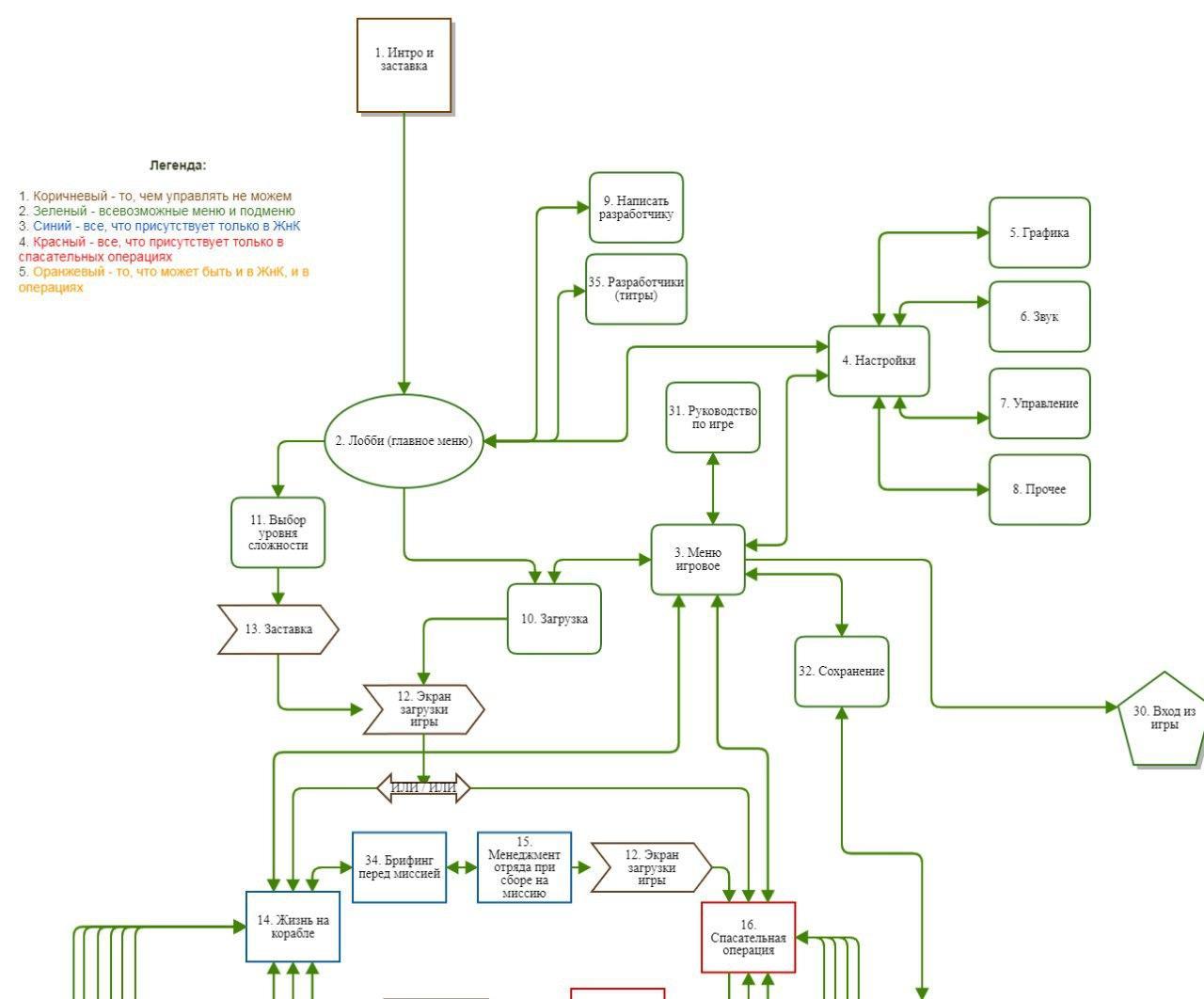
First of all, we had to organize it, write a general design document for the UI and create a screens map (a schematic representation of the logic of moving between screens in the game). The map was supposed to include all the gameplay elements, parts of the main menu, settings and convey the interaction of all these elements.
One of the main and most difficult elements to develop was the inventory and equipment screen. We will try to describe how we design it further on.
The fact is that the game has several factors that need to be considered when designing:
How will the inventory and equipment be displayed together? To simplify the “dressing up” of the squad members during the mission.
How will the system of transferring items from one unit to another be implemented, taking into account the fact that there can be from 1 to 4 members in the squad? The soldiers of the squad can be far from each other and the transfer of items will be impossible between them. Or they can be nearby and then the transfer of objects should be simplified as much as possible.
How will the inventories be displayed if there are 4 soldiers in the squad and they open the chest? That is, where is the place for the "chest inventory" and how items will move in the inventories of the team members?
How do the “take all” and “destroy” buttons work?
What stats of the characters display when the inventory is open?
How can we use the inventory mechanics to support the resource saving system and the tactical combat system using AP?
How to prevent the appearance of the placeholders and empty items?
Ultimately, before getting to grips with UI design, we decided to think about how it works, how it responds to our gameplay mechanics and the overall game goals.
That's why we attracted participation of Ilya and the specialists from the HappyFox Studio in the project. Altogether they took on the UI / UX design work and are primarily trying to answer the above questions.
Ilya, tell us about the development of the inventory screens and how you solved the tasks?
Ilya: It is important to understand from the very beginning that the screens that we developed are screens for playtests, without design. The design will be done by the HappyFox team. The release interface will be different. But we already have something to tell you about.
The task was to develop three options for the inventory screen. The first one is the team screen, which displays at least 3 characters at the same time. These characters have a slot in which to place an item. Also on the screen there are a character’s model, weapons, quick access cells, a character portrait, etc. The screen mockup looked like this:
Then the 2nd screen was developed, exchanging with the object. That is what the player sees when he opens any "chest": it can be a box, a shelf, a cabinet, a corpse - any object in which we find loot that can be used by the player. Its sketch:
The 3rd screen is the screen of the inventory and "equipment" of the main character, in which we see: one character who is fully dressed, the cells, the character’s model, skills, characteristics of the item, and so on. In the first version, it all looked like this:
Prior to the development of the inventory, I was presented with a trial prototype, which was made on blueprints, a kind of early version of the game. It was very simple, schematic, very primitive. However, it did a good job of demonstrating the capabilities and functionality of the inventory.
The task that we faced after the first inventory project was to remove all unnecessary screens and rework everything needed. It turned out that it is more convenient for us for the player to see the inventory of all the characters at once. And there can be from 1 up to 4 of them. So that when the characters “loots” something, s/he has the statically fixed inventories of all the characters united in the squad. Moreover, if the player simply opens the inventory, without approaching the chest, then the picture should be the same for ease of perception.
Elements must be located in accordance with the screen size and resolution. They should be functional, but at the same time convenient and logically placed.
Accordingly, in the next version, which is the "inventory geography", the attributes are displayed as items: from 1 to 8.
Many of the details that we planned to show initially were discarded: starting from the character's model, the stats and other things, in favor of the functionality of the inventory and equipment.
There are also controversial points. In picture #4 there are two slots, and on the right side of them there are cartridges that are not marked in any way. We could not figure out whether we needed cartridges or not. The other day we had a discussion with an expert from the HappyFox team, who suggested to us that this solution was intuitively correct. Since the game will have different ammunition, it is necessary that the player can see which one s/he is using at the moment. We will improve this in the new version of the interface.
The UI / UX work is difficult and quite interesting. Not only me, as the UI Designer and the specialists from HappyFox, are involved in the process, but also the Narrative Designer and the Project Manager. Without a collaborative effort, it is nearly impossible to accomplish the task of creating an intuitive, simple UI that guides the narrative of the game.
Our first priority is the player’s convenience, so during the discussion we came to the conclusion that it is most convenient to "manage" the team's inventory on one screen.
Where does the path to convenience begin? It is needed to remove all the things which are unnecessary and not often used.
In particular, at this stage, our project does not provide for changing the appearance of the character depending on what the clothes are, so there is no need to display the "character’s model" of the inventory.
For maximum convenience in transferring the items from one to another, we decided to make one common inventory screen for the whole team, this was facilitated by several other factors:
A small amount of loot on the map as a whole which allows to allocate not too much space specifically for the cells of the characters' inventory.
Convenience of transferring objects between the characters by simply dragging and dropping, which is intuitive and clear.
There is no need to display the detailed character stats in the inventory, for this we will have a separate screen of the characteristics, it is enough to display the vital parameters: health and armor.
In the process of working out this idea, it was decided to make the team's inventory static, which changes only partially in different game situations, for example:
Opening "chests", new cells are added at the bottom of the basic inventory, with the contents of the "chest" displayed. This solution gives the player the opportunity to choose: s/he can "take all" by pressing the corresponding button, in this case the items are transferred to the inventory of the first character in order, or he can decide which character to transfer a particular item to. This can be convenient when one of the squad members specializes in medicine: all the first-aid kits from the "chests" must go to him, the player will be able to immediately distribute the loot according to this principle.
Division of the squad, when it will not be possible to transfer the items from one to another, the inventories of the characters out of the squad are removed from the screen, while the structure itself is preserved.
This is only the second step of the first stage of development, then we have the following tasks:
How can we use the inventory mechanics to support the resource saving system and the tactical combat system using AP?
How to prevent the appearance of the placeholders and empty items?
So far we have presented you the sketches and diagrams of the future alpha version of the UI. In the working version, we will present it with the very first build, which we will definitely test on the players during the next exhibitions and conferences. So, if you feel interested in the progress of the game, follow our news and add the game to the Steam Wishlist:
P.S. We used several games as references for the UI, in particular: Mutant Year Zero, Phoenix Point, and XCOM. The work is done in Adobe Illustrator, Figma, and I also want to master InVision Studio for interactive prototyping tasks.
Interview with Rummy Games team
Good afternoon, everyone! We decided to talk to the team and share our experience in the genre of turn-based strategies with you. We asked the developers of the Rummy Games team:
1) What is their personal experience regarding turn-based games? 2) What elements from these games would each of them like to see in the current or next project of the team?
Nikita Proskurin, Project Manager
1) Regarding the first question, my experience with this is quite lengthy. I got acquainted with this genre in my childhood, at the age of twelve, when discovered Heroes of Might & Magic II. It was difficult and sometimes incomprehensible for me, but I really liked to build cities and hire warriors. I did it in quite a poor way and with no system, loosing in the game all the time, and I didn’t really like the concept of the "turn-based" battle. Therefore, the game did not hold me back at that young age. I liked more "realtime" products that time.
But this experience did not make me turn my back on from the genre. Then, as me and my brain grew older, I discovered the following parts of the Heroes - that is 3d, 4th and 5th parts. I played Disciples, Robin Hood, Banner Saga and, of course, all the parts of XCOM, with all possible variations, as well as a replica from 1C - the UFO (all the 3 parts). Of the modern ones, this is the new X-COM; Civilization; Mutant Year Zero; Phoenix Point, which I, frankly speaking, hate; Attack of the Earthlings; both parts of the Thea and some others. There were many more, but now I don’t remember all my TBS.
2) Speaking about the elements that I especially liked. Firstly, this is the combination of turn-based and real-time mode in the MYZ. This was a pure revelation for me from the category of “wow... such can happen ?!". Although I am familiar with such a project as “Paradise Cracked”, the MYZ has become the benchmark for me in this regard! I would really like to see this mechanics in our game now, since in my opinion it can serve a narrative very well, with its help exploration of the map turns into a walk, and not into small runs with a step-by-step managed system.
And also, someday I would like to create a game with such animations as in the modern XCOM or in the Gears Tactics. Their quality and attention to the details in animation in the turn-based strategy make the game not just a tactic, but a spectacular action game with explosions and dynamics. It is precisely this dynamics that I often miss in turn-based strategies. I want an action movie.
Alexey Skolotin, Developer
1) The experience of turn-based games is limited. Sega MD2: Shining Force, 1st and 2nd parts, PC: Mutant Year Zero, Stoneshard, Darkest Dungeon. For the most part, these elements already exist: various “equips” (objects), formation of the squad and separation of roles, “stealth”.
2) As an option, it is possible to make the locked basement location like in the game Pillars of Eternity. On the floors - different kinds of tasks, enemies and bosses. Among the rewards - weapons, "equips", upgrade, maybe, class "perks", and "achievements".
Vlad Malkov, Founder, Developer
1) I have quite a lot of experience in turn-based games. Even in childhood with my brother I played games such as the UFO, Alpha: Antiterror, Civilization, etc.
Already at a conscious age I continued to play Civilization and XCOM, tried to play Mutant Year Zero, Corruption and Gears Tactics and Age of Age of Wonders 3. Those which I like include XCOM 2, Gears Tactics, Civilization and Age of Wonders 3.
2) I would like our current project and future projects to be different from other games and provide the players with the new experience and copy other games as little as possible.
Ivan Malykh, Music Designer
1) Unfortunately, I did not play turn-based games so much. From what I can recall is Mutant Year Zero, Heroes of Might and Magic, Disciples 2 and, oddly enough, the chess. The latter I like the most, because the chess contains minimal mechanics of tactical combat, which can be superimposed by other mechanics, including the mechanics of heroes, stealth and the narrative filing.
2) I won’t single out any separate mechanics, except that I would concentrate the player’s attention on the key one. In my opinion, this should be an understanding of the enemy’s behavior pattern, actually AI. It is possible to realize the behavior of enemies using one of the optimization methods, for example, the ant colony optimization algorithm.
Alexander Folomkin, Developer
1) Among computer games I like to play Fallout 1 and 2. Also I love Backgammon, Preferans, Poker if choosing among the tactical table games.
2) The Universe. The Plot. It is hard to say. All together.
Maria Kravtsova, Project Manager
1) I like the tactical game on Nintendo Switch, which is Mario + Rabbits Kingdom Battle
2) It would be cool to introduce the movement mechanics, smooth and understandable. Animations and the movement of the camera automatically adjusted to the player.
Egor Ershov, Marketing Lead
1) I would say I have profound experience in turn-based games: chess, checkers, XCOM’s, Civilization, Heroes of Might and Magic, Alpha Antiterror, Space Hulk, Into the Breach and many other widely known franchises. This genre allows me to spend time in a relaxed atmosphere.
2) A cunning / clever AI that every turn makes a puzzle for the player.
Julia Korn, Game Designer, Localizer
1) I played XCOM, Mutant Year Zero, Spaceland. Among these games, I like XCOM 2 the most.
2) We learned a lot of good things from these games. Most of all that would be good to see in our game the interactions with objects at the level, and much more interactivity (star maps, computers, etc).
Maxim Aitiev, 3D-artist
1) As for my experience in turn-based games... the first game of this kind was South Park: The Stick of Truth, laughed at the game in a good way, only in this game I could see a giant human germ with swastika on the shoulder and the voice of the Fuhrer. Also, the MYZ storyline was completed; the game made me intrigued primarily by its trailer. Although the trailer did not show the gameplay, that was enough to launch the game and immerse in it from head to toe.
2) An interesting system of "formation" of the characters, with their visual (art) and numeric display of stats. And of course, the good level design which would immerse us into the game world.
Dmitry Kondrakov, Game Designer, Narrative Designer
1) The first and unforgettable game for me is Gorky 17. The cool story and atmosphere, and the mechanics for those years were very much suitable. Well and, of course, XCOM 2. But I mainly play RPG. Here I can say about Fallout 2, there is also a turn-based battle in it.
2) From XCOM I would borrow the battle dynamics and its causativity. There generally do not need to think much. From Gorky and Fallout it is possible to borrow the narrative components; locations, objects, characters.
Probably, one could also take advantage of the experience:
The mechanics of using various objects that have a dual purpose. It can be both a tool and a weapon.
Manually assembled levels with tricks and easter eggs. To make it interesting to go through them several times, finding new options.
Dialogues and communication between the squad members.
Ilya Alenchikov, Level Designer
1) Played Gears Tactics, XCOM, Mutant Year Zero, Divinity Original Sin. I like all of the above, but I would especially focus on Gears Tactics, I will further explain why.
2) Most likely this is such a basic element that fundamentally changes the dynamics of the game, so this is not even what I would like to see, but would fantasize a little bit. I mean Gears Tactics and how the distribution of points for performing an action is arranged. That is, they did it for a greater variety of what one hero can do, one, two or several actions at the same time (we do not take movement as an example). This adds to the greater variability of actions and freedom for the player. I can’t say for sure that this mechanics can be safely used on our project, since I am quite new in the team, I still don’t know much, but definitely dreaming is no harm, huh. Gears Tactics, indeed, in my personal opinion, compared to old turn-based games, has a lot of great innovations. So, I think something can be borrowed from it. The same tricks, for example, with the locust nests, from where the monsters appear until you close it with a grenade.
Ivan Klochkov, Leading 3D-modeler
Recently, I don't have time for games, I am very passionate about modeling characters in the project. I don’t play turn-based games at all. But I watched the Mutant Year Zero, XCOM and Phoenix Point let's plays.
Alexander Griboedov, Developer
Divinity Original Sin 1&2
King's Bounty (from The Legend series)
Heroes Of Might and Magic 3&5
Invisible Inc.
Fallout 2
Darkest Dungeon
GhostControl Inc.
Swords & Crossbones
Dungeons of Dredmor
Sproggiwood
Dragon Fin Soup
I like all of the above. I would also mention another game Transistor. Besides it's not turn-based but it has tactics mechanics which are well implemented. First 4 titles in the list are full featured strategies I'd say (Worms as well too).
What I would add to the current project is:
Action Points and Initiative Factor from Divinity caught my eye. It makes you think how to match up your equipment.
Alternatively, an ability to attack first as in Darkest Dungeon and South Park the Stick of Truth allows you to catch enemy napping. Different states of characters while in battle in Divinity attracted me either.
I find it interesting when one of your characters is not involved in battle so he/she acts from stealth and can't be attacked while not being spotted. Commonly, you are able to win using the environment in various ways.
As for future projects we will begin with main story-line and key art-style that would give us an opportunity to add new features and modify its game-play. If that is in space again then we will create a bigger world (like in Mass Effect may be) and, for example, play as bad guys with global and ridiculous ambitions.
Saturated Outer Space - Developer Stream & FAQ session
Greetings! We decided spontaneously to stream our game during the Game Festival. We will show you how the demo was intended to play and hold FAQ session.
This Sunday (today) at 7:00 PM UTC or 11:00 AM PDT join us on our Youtube-channel!
Play Saturated Outer Space demo for a limited time as part of The Game Festival!
Greetings, everyone!
Saturated Outer Space is participating in The Steam Game Festival: Summer Edition! From 6/16 to 6/22, you can play demo version of our game.
Don't forget to add to your wishlist!
Devlog #12
Hi everyone! This is the new issue of Developers' Diary No. 12, and today we are talking to our programmer, Igor Konyaev, about the various difficulties that we encountered while creating the weapon system in terms of the game design.
What do you start with when working on weapons mechanics?
Igor: When one starts the work on creating some kind of mechanics or mechanics system, the game designer faces the question: “How to do this?” And only after that it follows: “How has this been implemented by others?” Every time you need to examine competitors and decompose game systems into individual mechanics in order to identify the advantage of one or another mechanic. After collecting enough material, you need to first think about two things:
What mechanics can be easily borrowed from the competitors? These are usually fundamental mechanics that have a low entry threshold for your target audience. For example, all RPG fans know that in your game there will be the character upgrade system and resource management. And many expect to see these mechanics in the ordinary performance. This point also includes filtering mechanics which destroy the gaming experience, developers are often mistaken and it also needs to be taken into account. For the latter, it is useful to study the gaming forums of competitors;
How can mechanics be combined and modified to create a new gaming experience? The most difficult thing is to find a balance between the familiar and the completely new. Any breakthrough idea may be unnecessary to anyone due to the fact that it is ahead of time or interacts poorly with other game systems.
Only the simplest calculations and prototyping can help with these two points in the first stages.
How do you work with the ranged weapons?
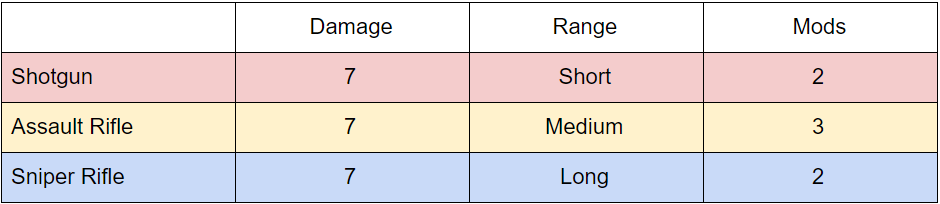
Igor: To make it simple, we will work with the several types of the ranged weapons that have a damage parameter (Damage), an effective range (Range) and the number of the supported modifications (Mods):
From the table you can see that the damage for all the guns is the same. It would be different if there were no external conditions that are laid in the creation of weapons. In this example, the effective range parameter equalizes all types of weapons and makes them effective only in their category, without losing in damage.
The graph of the effectiveness of assault rifles at a distance from 0 to 32 tiles
Modifications make major changes to the balance of weapons. For example, if you put the sight on an assault rifle (Assault Rifle), then in terms of effective range, it will come a little closer to a sniper rifle (Sniper Rifle), but lose accuracy at close range. This problem can be solved by putting a more expensive combined sight, which does not affect the firing accuracy at short distances. It is also worth considering that there is no way to put a sight or silencer on a shotgun (Shotgun), just as you can not put a combined sight or stabilizer on a sniper rifle, which reduces the spread of damage. In simple terms, the balance is achieved by advantage in some situations and lack of advantage in others.
We also take into account different types of enemies against which different types of weapons and different types of ammunition will be effective. For example, incendiary ammunition will work against humans, but not against machines, because the first can burn, and the latter can not. Against large masses of opponents, it will be more effective to use weak weapons that can save ammo, and fighting the bosses it is easier to use strong long-range weapons to reduce the risks of taking large damage at close range (works not with all bosses). And the last point: different weapons can be used by different characters due to their physical abilities and skills (we will speak about them in other issues). As such, there will be no rigid class system in relation to the weapons used in the game. The differences are only in the thing which of the characters can use heavy or precision weapons, and which can not.
What about melee weapons?
Igor: In addition to ranged weapons, we are implementing a unique melee weapon that will deal damage at close range. For example, an energy whip can inflict damage on several tiles around, this introduces an imbalance, so we create a counterbalance unexpected for the player in the form of an enemy who has a similar type of attack.
What can you tell about more technical details when balancing the weapon?
Igor: We are currently working on creation of a universal rating calculation system for weapons. In simple terms, the average is calculated for all weapons parameters. Based on this average, we calculate the price of a weapon in a store, its chance of appearing from the enemies (its rarity), and see how it will work in different external conditions against different enemies. Based on the calculations, the system will help to balance the economic part of the weapon and the economy of the game as a whole.
In the following diaries, we will continue to explore the topic of difficulty of balancing weapons. In the meantime, subscribe in the social networks and wishlist our game in Steam. See you soon!
Devlog #11
Good day to everyone! This is Rummy Games, and this is our 11th issue of the Developers Diary. Today we will talk with our level designers Sergey and Mustafa about the creation of the level 5.1. for Saturated Outer Space, as well as about all the difficulties associated with its development. But first, a little bit of the location story.
Elysium is a space station once owned by Improved Nature Corporation. It is located in the orbit of Arga, the moon of the gas giant Gatos. The corporation planned to build an elite residence and provide its employees with work.
The building was to be the first object for the subsequent colonization of Arga. But this was not destined to come true: financing was frozen. It was expensive to dismantle the station, so it was abandoned. Noone knew what was happening there or whether there was anyone at the moment.
Elena, the AI of the S.O.S. squad spaceship
How was the prototype of the game level created?
Mustafa: I joined the project at the time when sector 5.1 was being created. In the game, each level should be divided into several sectors, which are separate locations. By the time I found myself in the project, the basic constants, sizes and emphasis of the levels had already been determined, the main lore and the narrative were determined. My first task was to design a 5.1 sector diagram based on the narrative component, I had to think through all the paths, corridors, branches and events at the level.
Based on the plot and missions, it was necessary to create the first 3D prototype. That is, so that it can be exported to the game engine and run characters on it, and nothing more.
I needed to design the so-called “gray box” - a prototype of the level, a draft version. After approval by the game designer, it is transferred to another (technical) level designer who is engaged in level painting and arranging assets by means of the engine.
How were the walls risen in the game level and what problems did you encounter?
Mustafa:At the very first stage of designing sector 5.1, we faced the problem of geometry, namely the problem of “placing rectangular walls along the diagonal”.
(Gray Box is a level prototype assembled from square walls without unnecessary textures. It is needed to see the basic geometry of the level.)
The most important thing is to take into account that all the geometry should suit a tile grid measuring 1x1 meter.
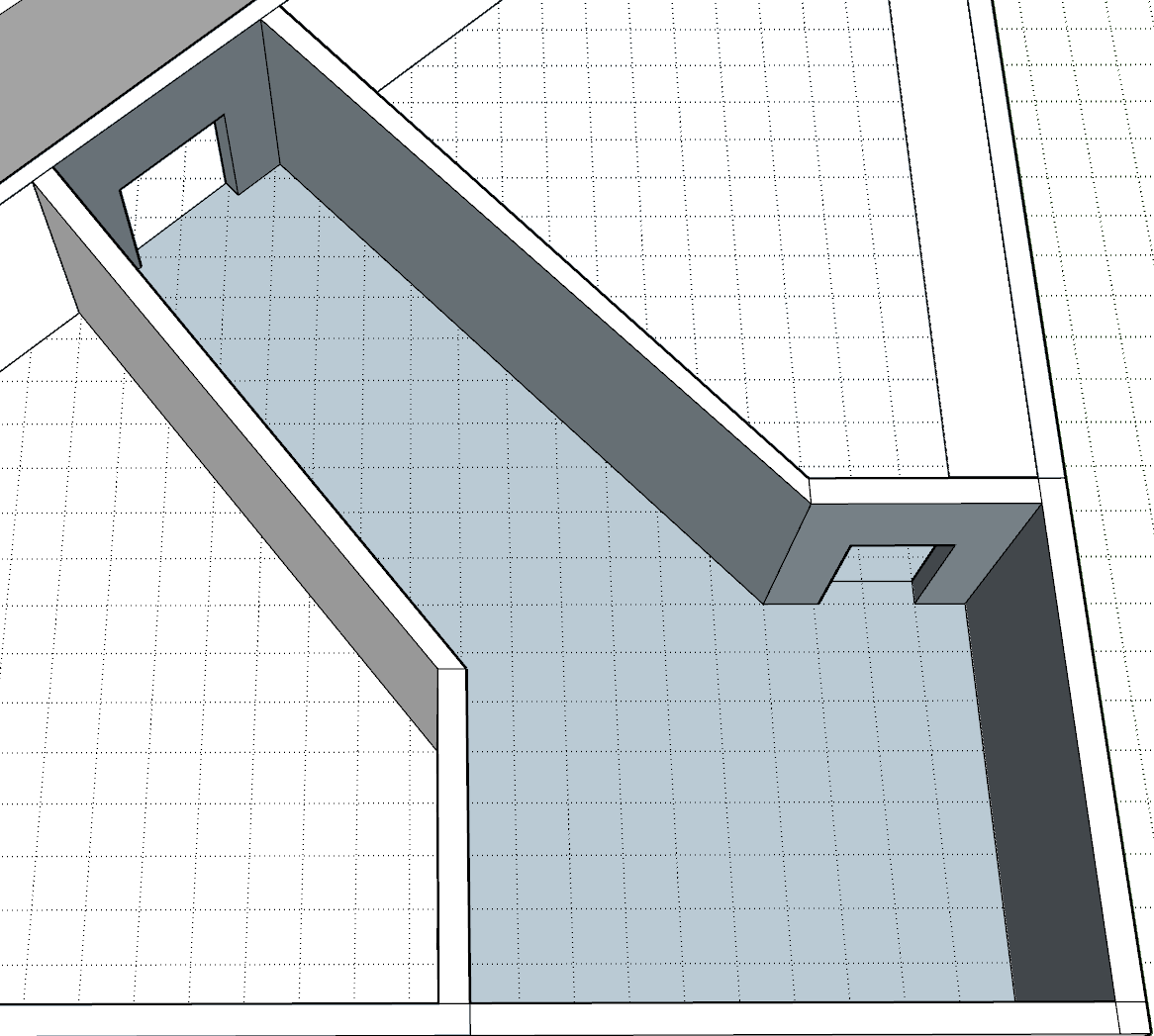
The problem which we encountered, on the picture below: Some walls are located diagonally on the grid.
As you can see in the picture, some elements are located not on the X, or Y faces inside the cells, but diagonally.
The problem is the implementation of the movement of characters on the tile grid at the level. The character will not be able to stand on half of the cell (tile grid). Based on this, the team decided to leave the idea of using the diagonals throughout the game when designing the level.
All objects should be placed on the grid cells, vertically or horizontally, as is done, for example, in X-COM... but not in any way diagonally.
The solution can be the following: all the objects are on the edges and precisely located in the center of the cells.
After solving the problem with the diagonals, I had to remake the level to the exact characteristics, as it is on the picture above. A new level was designed from scratch while maintaining the concept.
How was the transfer of all the geometry to the game engine?
Mustafa:After designing the “gray box” level, the game designer approves it, or sends it back for some alteration. Then the level is transferred to another level designer (Sergey), who paints the objects, arranges assets and makes all the alterations and improvements already in the engine.
First, the level is exported through the already built-in plug-in to the Unreal Engine called Datasmith.
Previously, before new versions of the engine, that was a separate plug-in for importing / exporting landscape geometry from various other modeling programs. Now this plug-in is built into the engine and does not require third-party downloads.
The plug-in allows you to import a level with all components and properties of objects (light sources, cameras, materials and geometry).
Sergey: (architectural visualization specialist): I was the first to offer use these features of the engine to build our levels. Because now we are working on the closed space levels, that is, where actions take place inside any premises.
And creating the correct architectural geometry is still easier in third-party programs, we use 3DsMax and SketchUp. But thanks to Datasmith, we easily import our geometry into Unreal Engine. And already inside the engine we can change, add and modify in every possible way the created geometry based on the gameplay.
In addition to the wireframe and rendering of the level, when creating it, it is necessary to take into account UX design, logic setup, and the arrangement of enemies, but we'll talk about it some other time.
Meanwhile, our team continues to develop the game. Subscribe and add the game to wishlist to follow the latest news about the development stage. In the meantime, that's all and see you in the vast areas of the Saturated Space!
Devlog #10
Have a good day, everyone! Rummy Games are back again, and this is our new issue of the Developers Diary. They say that the Space is devoid of matter, therefore there is no sound. But in the Saturated Space of ours there is sound, and today we would like to talk about its magic with the sound designer, Ivan Malykh.
Tell us what inspires you in the process of creating music for the game.
Ivan Malykh: I would separate the creative and technical part of creating the music. The technical part implies answering the question what mood or what action the game creators want to convey to the player. For example, the track called “The Show” is needed to evoke in the player the feeling of some kind of a TV show.
The player grasps it subconsciously due to the fast pace, pronounced percussion and claps. Almost every piece of music has the main instrument, in “The Show” the main instrument is claps, which creates the effect of the presence of the audience.
In “S.O.S.” which is the title track, the main instrument, or rather, the instruments are copper pipes, of which the horn is most clearly heard.
The horn conveys a warlike character and reflects the idea of the protagonist of the game, the copper pipes surrounding it make the horn sound powerful, just like the protagonist's squad.
The creative part is about how the music is made. It is just about inspiration and references. The selection of references is done jointly with the development team. We are inspired by the soundtracks from "X-COM", "Mass Effect", "Endless Space", "Halo".
In the context of the foregoing, I can say about the following game examples in which I especially like the soundtracks implementation: from the technical point of you: “Botanicula”, “Doom”, “Witcher”, “Hotline Miami” and “The Elder Scrolls”; from the creative point of view: “Silent Hill”, “Diablo” and “Portal”.
What challenges did you encounter within the process of development? What was important to highlight, to emphasize when creating music?
Ivan Malykh: The main challenge is to find the balance between the variety of tracks and their general style. While working on the soundtracks for Saturated Outer Space, I emphasize the word “Saturated” for myself and this is just about the variety. As an example of such a variety, “The Show” track, is written in the style of retrowave, “The Home” track is something between Folk and Electro-Pop.
In order for the tracks to sound like “one game music”, I use such techniques as: the same tempo (calculated from the animation of the units running), one tonality, the instruments same or similar in timbre (almost every track itself has the sounds of vintage synthesizers, e.g. Juno-60), repeating the melody from the main track.
Can you name some particular tracks which you especially proud of?
Ivan Malykh: I would not name such tracks, I would divide the answer into two parts instead as I did previously:
First of all, some tracks will be redone. Due to the fact that I am constantly in the development process, I can rewrite something, focusing on the current atmosphere in the game. Most often, the composer appears at the last stage of the game, but I was lucky to take part in the “Saturated Outer Space” development process from almost the very beginning.
Secondly, just to get a little bit philosophical, I would consider pride as a synonym for "I have reached everything, I can stop here." Therefore, I would prefer not to stop.
The game development continues at full speed. If you are interested in the project, feel free to add it to your Steam wishlist and be the first to know all the updates on the game development. In the meantime, see you soon!
Devlog #9
Hi everyone! This is Diary No. 9 in which we continue to share with you the development news on Saturated Outer Space project. On March 14, the project team participated in the DatFest event at which presented the game prototype.
Due to the current situation, the event was visited by three times fewer participants, but that did not interfere with the friendly atmosphere of developers, cosplayers and role-players. We showed the prototype of the game to our potential audience and fellow developers. As a result of the event, the project received a lot of feedback on the gameplay and the user interface system. All the comments will be surely taken into account.
And the most important thing that we wanted to share is the vision of the future of the project, based on the presentation made by Nikita, Project Manager:
Saturated Outer Space
Saturated Outer Space (SOS) is a turn-based tactics with emphasis on the plot and setting. Game modes include rescue operations (tactics) like X-COM, Mutant Year Zero; Life on the Ship (reflexion time) like the hub in StarCraft 2. We have set 3 ways to achieve the goal: The gameplay is built around the plot. In our case, the setting and the genre are means for conveying the story. Therefore, the entire game design is built around the logic of what is happening in the designed Universe.
The plot is mainly inspired by science fiction of the 80s of the last century: novels by Alastair Reynolds, the book “The Three-Body Problem” by Liu Cixin and the movies: Star Trek and Pandorum.
In general, SOS is a game telling us the story of the captain of the space rescue service and his squad. The player will have to complete tasks to evacuate the pilots whose ships crashed, scientists in distress, stuck astro miners and other hostages under difficult circumstances.
Each mechanic should be organically integrated into the gameplay, for example, the game bestiary. This is not just a text presenting the enemies that the player will encounter. It will contain instructions on how to deal with these enemies. That is, this is a useful section that will help to play the game.
Balance and level design are the main means of revealing the narrative. We want not to stick to the principle of conveying history through the so-called “walls of text”. There will be the "walls", but only for those who want to dive more into the setting and the Universe of the game.
As narrative tools, we bring the balance and content of the levels that will tell the story with their elements and device. For example, there will be a crumbling space station with a bunch of traps such as dips in the floor, structures that can fall over the head, blockages, and even isolated airless rooms.
The plot is in everything
The story about the space rescuers is the icing on the cake. Those who are interested in it will discover a lot:
get to know the story of the main antagonist,
grasp the complex system of social relations and the cause of the underlying conflict in the society,
find out where those groups and factions that we create come from,
detect the threat hovering over the universe of the game, not just the intermediate goals which the protagonist and his team aim at,
deal with the unique currency of the game Universe. By the way, these are not credits, but the "likes system" as it is in the social services.
The multilayer of the game is that those who do not want to thoroughly explore the world, will not lose touch with the game and will be able just to enjoy the gameplay and the basic logic of what is going on.
The main character and his quest
It happened that Stan Goodwin, the protagonist of the game, became a member of the rescue service. However, he does what he does not only because of his inborn altruism, but also to break into the upper strata of the society. Everything that Stan does will help him or hamper realizing this goal. And it is up to the player what exactly will happen. Each member of the team has a unique personality. Like Stan, every member of the team his or her own set of skills and goals. And each in the team of space rescuers self-nterests. If the player manages not to lose them during the missions, then the story of each will develop and lead to its own finale.
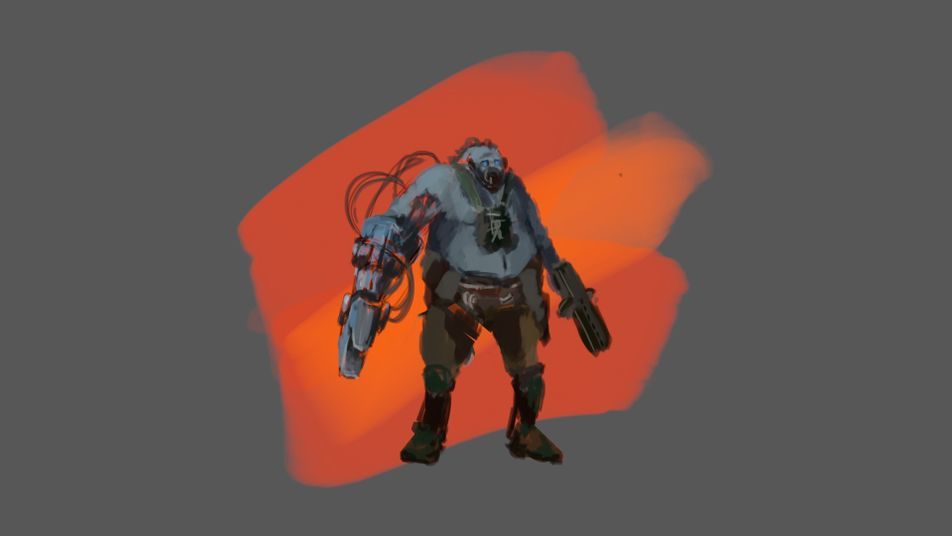
The team is represented by heterogeneous marginals who do not look like professional special forces, but rather, like a bunch of mercenaries. Each has its own set of equipment and skills, which allows them to deal effectively within the rescue missions. The team will include a pig mutant, a medical robot, a religious engineer, and some other members with a dubious past.
The player will not only have to figure out how to get to the victims, but also how to get them out of the rubble, lead them through the fire, and protect them from the forced fighting. But if the player does not care about maintaining the morale level of the victims, there is a risk of getting the string of bursts into the back if they start panicking. All this will be seasoned with a moral choice: that is, it will not be possible to save everyone, the player will have to choose: whether he is saving a group of children or the favorite goldfish of the millionaire who promises to generously pay for its evacuation. Or surrender the victim to the enemy and get out without loss or fight the way through, risking oneself and the victim.
Multiple endings
The whole election system will affect the outcome of the story. In the end, the player will find him/herself at the level that emerged from the consequences of his choices throughout the game.
A minimum of the text during the main activity, but a lot of the text in the mode, which will be discussed later.
That is, being on missions, the squad members will be exchanging phrases, but the written part is optional: we will not take control of the player at the moment of the dialogue, the dialogues do not directly affect the realization of the main quest. However, they may contain clues on possibilities of winning the level or revealing the loot location.
Balance and level design
Narrative through the balance and level design Enemies are stronger, but have less technological skills, and the squad members are precisely the rescuers, not the Rambo killers. They need to save the victims got into troubles. Exactly for this the player will be awarded. The victims can be sacrificed and killed, but this will cost you more ammunition, and may fail to bring one closer to the goal. Yes, ammo will be limited and there will be equipment that can be clogged with items for battle or salvation operations.
Interacting with the environment, one can influence the enemy units, but only if your squad members are capable to do it. Levels are designed so that you can win them with the help of hacking skills, parsing debris, fighting fires, etc. (skills require upgrade). You can also block the enemy in a separate room and put poisonous gas into it. Accordingly, in order to get out of the level, it will be necessary to neutralize its elements so that the victims do not burn out on the way, do not explode in a mine, or are not destroyed by enemies.
Current status of the project The project goes from the prototype stage to the alpha version. Now we need those who are interested in the project and who are ready to participate in the following tasks:
Programming;
Animating models;
Marketing;
2D art and 3D Modeling.
Events such as DatFest are important to our studio and its participants. They help us better understand the audience needs, as well as rally the team. The diary issue has come to the end, but we continue to work on our project. See you soon in the Saturated Space!
Devlog #8
Hi everyone, In today's issue, we will tell you more about some of the inhabitants of our game, that are cannibals. We will touch upon the source of inspiration, then move on to the features of these characters and try to explain what place they occupy in the Saturated Space.
This is what our Game Designer and Narrative Screenwriter, Dmitry Kondrakov, says: “One of the prototypes of cannibals who are the characters of our game were similar “skunks” from the TV-show “The Firefly”. But I was confused by their inconsistency and unsystematic behavior. Attacking by the crowd; it is unclear what kind of weapon they attack with, and the like. In “The Firefly” there is quite a lot of illogical things, although the TV-show did not claim to be the “icon” of science fiction.
The main references for me were the stories of cannibals from the real life. I start feeling uncomfortable at the thought that they perceive people as a walking piece of meat. And when they are asked in an interview what motivates them to commit a crime, they often answer simply: hunger. The real cannibals are no less terrible than the characters created for the game.”
In 306, from the moment of the exodus, mankind first encountered Lissa fever. It received its name in honor of the ancient Greek god of madness Liss. Among the Star Trash, the fever has another name: “psychosis of emptiness. ”
“The first symptoms of the fever are indistinguishable from those of a cold or flu, it is distinguished by the speed of its distribution. Even isolated rooms and biosecurity suits are not effective to be protected. ” Inc Moses CEO IN corp (improved nature)
“After a few days, the psychosis of emptiness begins to manifest itself at its best. People start going crazy, losing their minds - call it whatever you like, but the result is always the same: those who are sick lose any connection with the reality and no longer control their actions. ” Dr. Sydney Lin
“A sick person can become apathetic and fail to react to any external stimuli, can kill himself or, for example, take off his skin like clothes. It always happens in a different way. But the truly terrible progressions of psychosis is the “reset” of the collectively unconscious in several people at once. Their worldview and moral attitudes will change forever.
Imagine that a whole group of sick people at once decided that they should now eat human flesh. At the same time, they clearly distinguish between their "friends" and "foes" and retain all the skills that they have acquired over their lives. But they no longer associate theemselves with ordinary people. ” Inc Moses CEO IN corp (Improved Nature)
Lissa fever can destroy an average colony in a week. Someone go crazy and kill themselves, those who are not infected die at the hands of those whose consciousness has changed forever.
After 200 years, the fever pandemic subsided, but no effective medicine was designed. It is believed that the inhabitants of the peripheral worlds, i.e. Star Trash are most vulnerable.
One of the striking examples of the fever consequences are the events on the asteroid named NF-103G in the Hecate sector. A team of the “navvy” was sent to the unstable asteroid: miners, geologists and engineers, totally about 300 people. The task was to disassemble the asteroid into useful elements as soon as possible.
A week after the landing, the first cases appeared among the team members, a few days later the connection with the team was lost. Due to bureaucratic delays, a detachment of the Federal forces represented by the Infinity Corps arrived on the asteroid only a few weeks later. There, it was attacked by survivors who called themselves the “Babba clan”. Almost half of the team of “navvy” became cannibals, they killed and ate the rest.
According to the protocol, the Infinity Corps destroyed all life on the asteroid NF-103G. But it is known that several ships of the Babba clan managed to escape and hide in the Ker nebula.
Finding the space scavengers ship on the edge of the nebula with half-eaten crew remains is not uncommon. We hope you manage to survive the meeting with this crazy bunch. Catch you later!
Devlog #7
Say hello to the whole Saturated Space!
During the DevGAMM 2019 conference, we got a lot of constructive feedback on our game from the game industry professionals. Having analyzed everything, we realized that the game has a lot to be fulfilled and there was no need to talk about all the changes in the technical part which have been done up to this date. Since the last diary was published, we have been working on the code refactoring, creating the new architecture of the project, solving game design issues, and searching for our own unique formula.
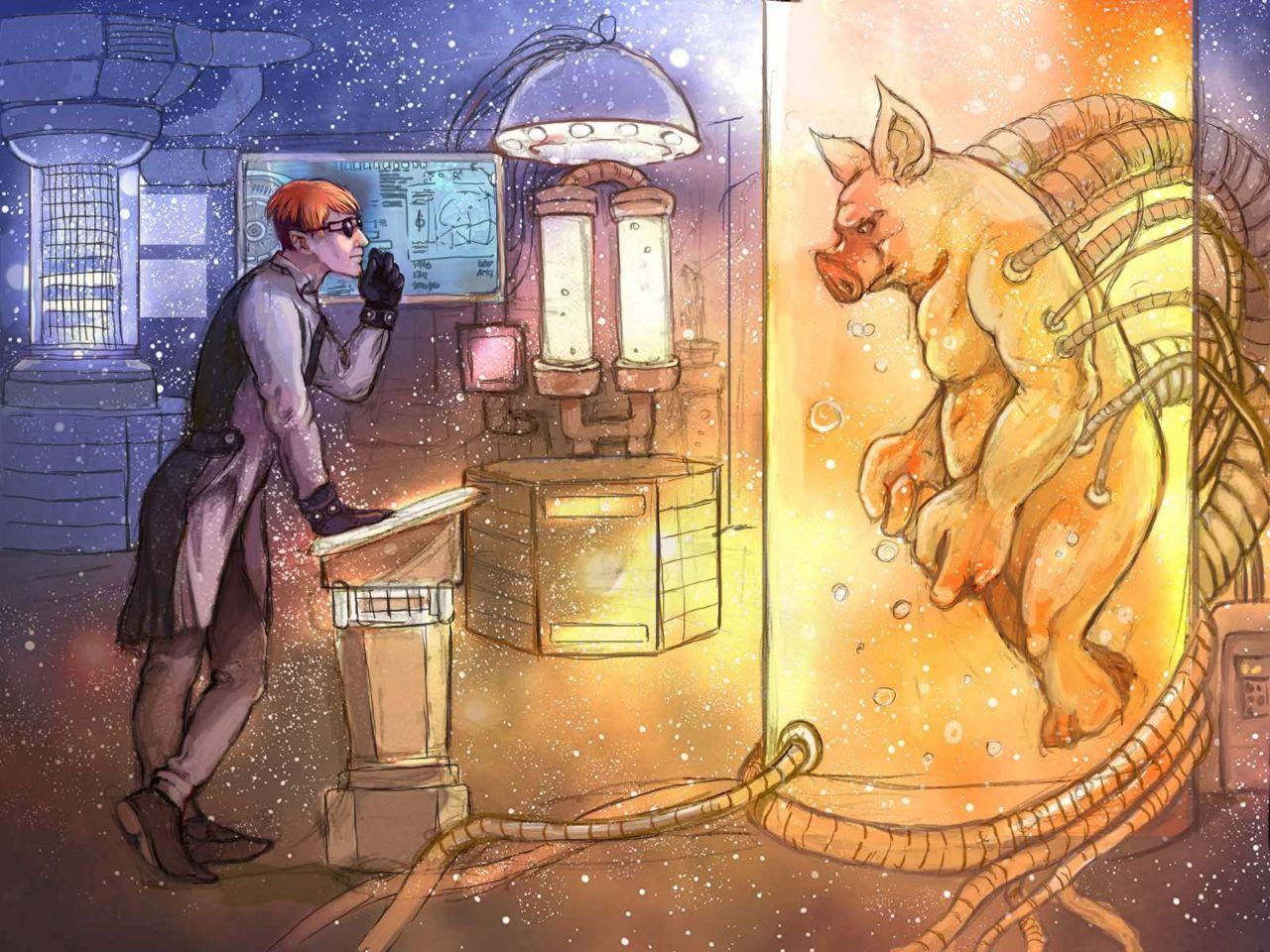
From this day we again start sharing with you the development news and the process of creation of our game universe. Today we are going to tell you about Moon Pigs, inhabitants of the Outer Space with a tough fate and bad temper.
The year 538 from the moment of Exodus (the Beginning of a large expansion from the Earth), Dr. Richter Stern, the luminary of the scientific world and the recognized genius of our time, brought forth a new biological species. What was previously considered impossible was born thanks to his genius.
The first batches of Moon Pigs had high stamina, as well as immunity to any disease. By force they exceeded man by at least 5 times. But there was problem in their cognitive abilities. The best indicators that scientists achieved at that time were the level of intelligence of a twelve-year-old child. Moreover, after demonstration of the first results of the project, the Federation Parliament demanded that the Pigs be deprived of their reproductive function.
Thus began the era of fairly cheap labor. Pigs were sent to work on extraction of resources on unstable asteroids, to prepare planets for terraformation and to the farthest parts of the explored space. Of course, they needed constant supervision, but still it was more profitable than hiring people.
Ten years later (in 548), Dr. Stern secretly from the Federation Parliament released several special individuals with a working reproductive system. As soon as the Federation’s intelligence learned about this, the entire production and research complex and the scientist himself were destroyed in one day.
“It is important to remember that the Moon Pigs have no moral values: they tend to cannibalism and other animal manifestations. When the weak or poor ones appear, they are eaten by their own brothers and sisters. ” Elena, SOS Squad's Ship AI
In 558 there the first open encounter between the forces of the Federation and the rioting Pigs took place, it was called “Porcine Rabies”. From that moment on, all Moon Pigs were banned in the Federation and it is allowed to open fire on them. In some sectors, good rewards are paid for the killed Pigs.
It is true that in the far parts of the inhabited universe, outside the territories of the Federation, Pigs live peacefully with people. They are quite common in the sectors such as Hecate, in which we will be operating.
Captain, during the rescue operations, you will meet these creatures more than once. Be extremely careful!