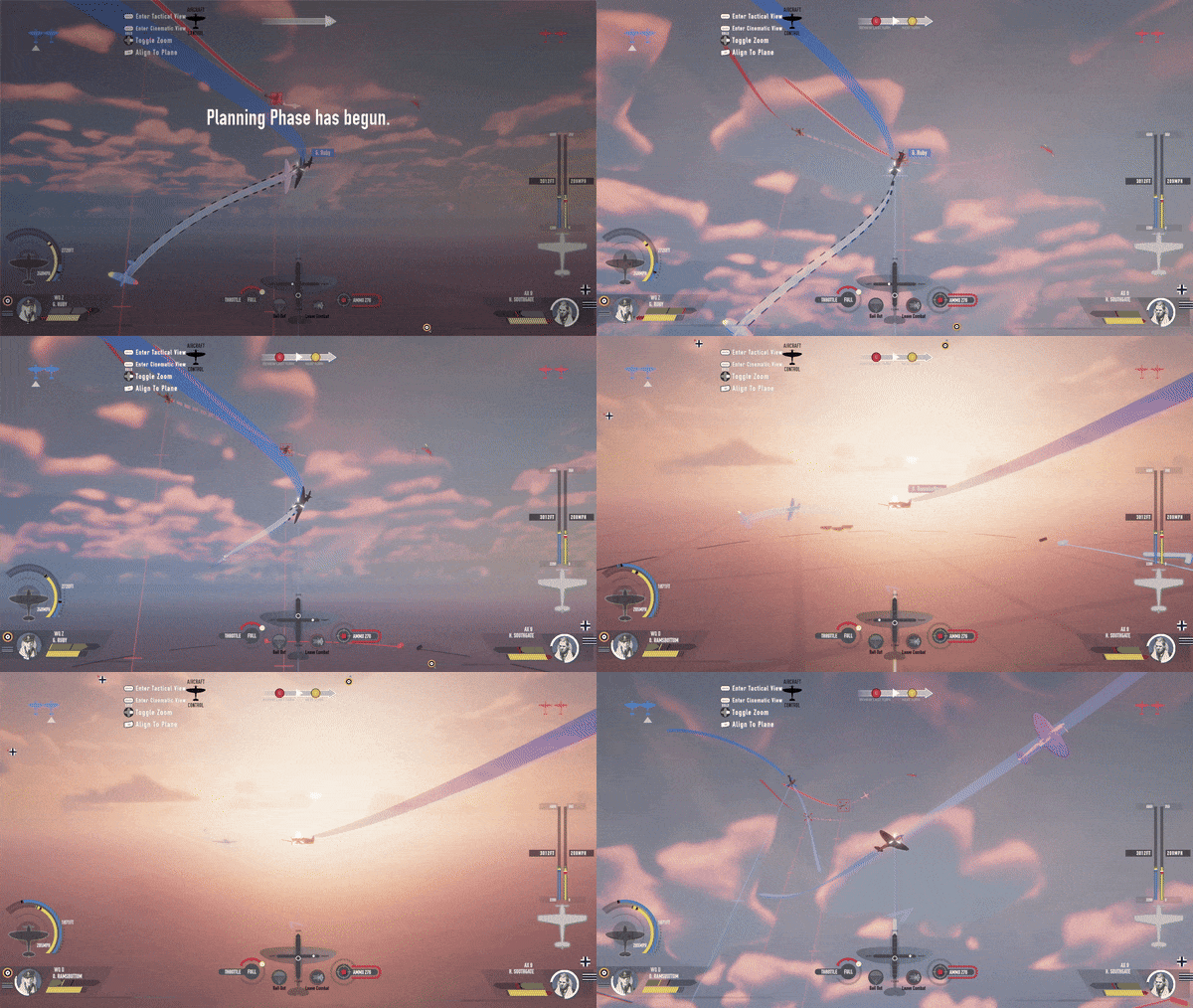
The demo version of Scramble: Battle of Britain was launched during Steam Next Fest.
Although the event ended two weeks ago, the demo has remained available on our Steam page. We are proud to see how many skilled pilots have taken to our planes and joined the battle in the demo version of Scramble: Battle of Britain.
We extend our heartfelt thanks to all our demo players for their valuable feedback.
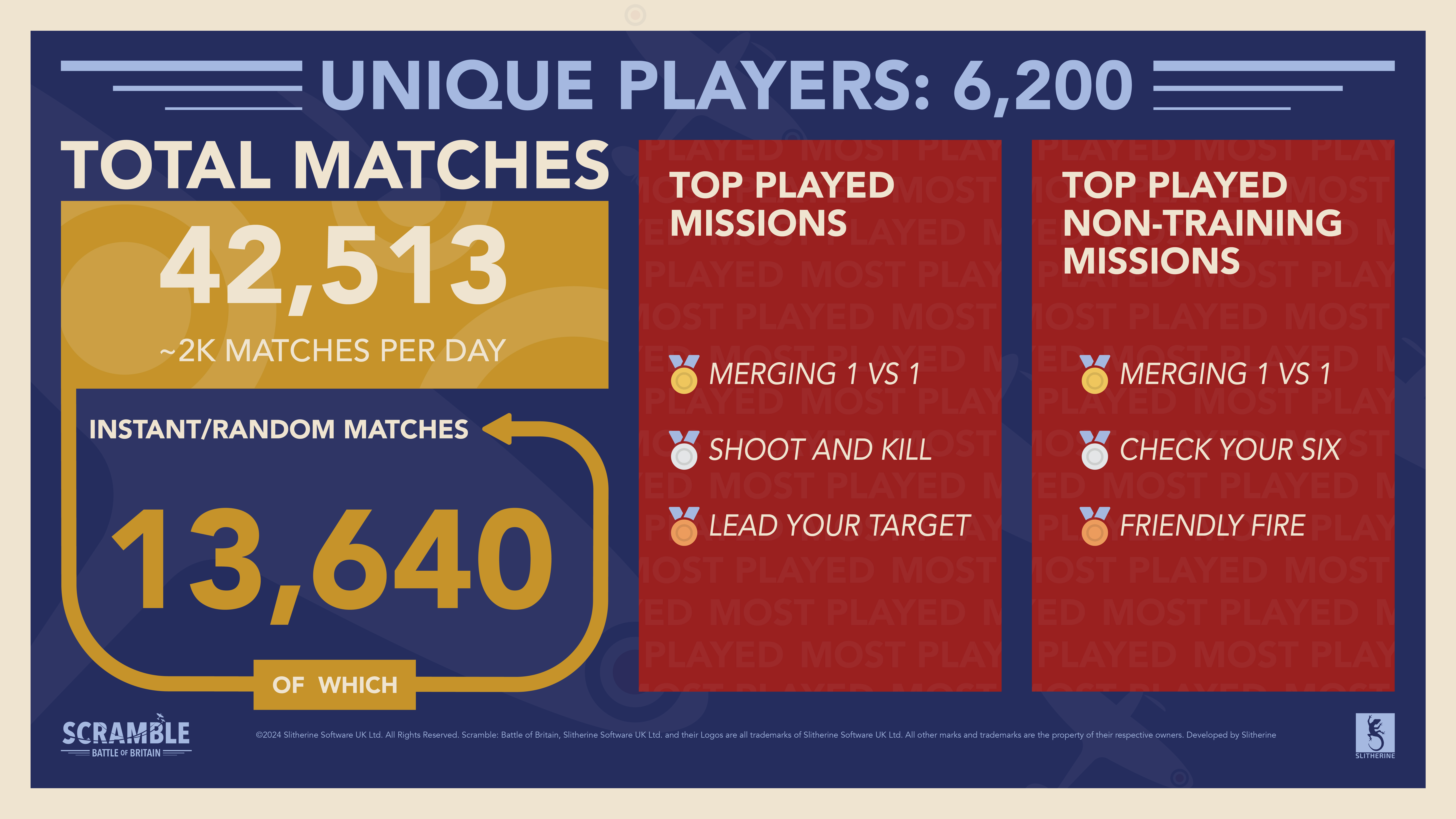
Here is some information we have collected during these first weeks of the demo:
*updated: July 2nd
As a "thank you" and to continue showcasing Scramble at its best, we plan to patch the demo with bug fixes, performance improvements, and feature enhancements in the coming weeks. Fasten your harnesses and stay tuned for news on the future release of Scramble.
In the meantime, you can continue enjoying the demo on our Steam page until we open a new closed beta to test the exciting new features we are developing.
Scramble: Battle of Britain - Demo out for Steam Next Fest
Attention, pilots and flight captains!
Prepare for takeoff with Scramble: Battle of Britain. We're thrilled to announce that a demo of our exhilarating aerial combat game will be available during the Steam Next Fest from June 10th to 17th. This is your chance to experience intense dogfights and intricate mechanics firsthand.
Here's what you can look forward to in the demo:
Missions
An Instant Action Skirmish Generator
Single-player missions featuring Spitfires, 109s, and Stuka bombers
Simulation
A dynamic 3D airspace with Six Degree-of-Freedom dogfighting simulation
Turn-based match structure transitioning from planning, through simulation, to turn review
Realistic damage modeling with leaks, explosions, smoke, and lost components
Aircraft aerodynamics that replicate the unique performance and failure modes of each airframe
Pilot physiology modeling blackouts and injuries
Control
State-of-the-art Turn/Climb Flight Assist for intuitive, analog piloting
Mechanics for escaping and bailing to salvage pilot lives and aircraft
Cinematic Tools
Tools for directing camera movement, reference points, and target tracking
Hideable UI layers suitable for content creation
Saveable match replays for capturing and sharing video and still images
Don't miss out on this thrilling opportunity to immerse yourself in the skies of WWII. Get ready to Scramble.
Scramble: Battle of Britain - Flight School, Episode #5
Welcome back to Flight School.
In episode #5, we'll be discussing maneuvers. Hold thight, watch the video and read the full article below.
https://youtu.be/l0TJBNIXH7M
Maneuvering & Aerobatics
Aerobatics is the piloting of aircraft through maneuvers not typical of steady, stable flight. Most dogfighting, even the short and simple bounce out of the sun, involves aggressive maneuvering that falls into the category of aerobatics. Loops, rolls, and stalls, all aerobatic maneuvers themselves, are the building blocks of more complex aerobatics like the Immelman or the Split-S.
A Scramble turn simulates for roughly two and a half seconds. In aerobatic terms, with World War II aircraft, this converts to roughly a quarter of a loop, or a third of a roll. Players will chain these partial maneuvers naturally from turn to turn so every dogfight in Scramble resembles the fanciest airshow routines.
Scramble's Turn/Climb Assist couples roll and yaw control surface inputs, so one of the easiest maneuvers in Scramble is the barrel roll. With a little "climb" input and a little "turn" input players can initiate barrel rolls to re-engage a target or enter a rolling scissors with a pursuing enemy.
Scramble aerodynamics model sideslip-induced rolls, so yawing in the same direction of roll input will increase roll rate. The coupling of yaw and roll inputs in the Turn/Climb Assist assures all basic rolls in Scramble experience this boosted roll rate. Players using Traditional Aircraft Control, with access to all three axes independently, can command full yaw and roll inputs to one side to induce a maximum roll rate, and coupling these inputs with a heavy pitch input will flip an aircraft in a twist resembling a weak snap roll.
Aerobatic maneuvering in a dogfight is ultimately a means to an end, and graceful loops that wow crowds at airshow routines may not be the optimal tactics with an enemy in pursuit. But when thinking three-moves-ahead and flying clean, efficient aerobatics a player can execute a quarter loop, followed by a vertical climb, with a rudder turn at the apex to hammerhead their guns onto the unsuspecting enemy flailing to line up their shot in the climb.
Stay tuned for more Flight School episodes and exciting news coming soon!
Scramble: Battle of Britain - Flight School, Episode #4
Aircraft in Scramble simulate in 3D space with six degrees of freedom: three degrees for XYZ position, and three degrees for rotation about the XYZ axes. Simulation is the foundation of Scramble gameplay depth, and analog control of the airplanes allows players to replicate most of the maneuvers they are familiar with from real-world aerobatics and dogfighting, but controlling airplanes is a hard problem to begin with, and designing a control scheme for the turn-based environment of Scramble proved one of the longest lasting challenges our team faced.
In Flight School Lesson 4 we will introduce you to the Turn/Climb Assist – our default Scramble control scheme – and we will explain how it couples some traditional aircraft control inputs to provide an intuitive piloting experience for all players, regardless of their familiarity with piloting airplanes.
Traditional Aircraft Control
Most aircraft orient their movement through 3D space with control surfaces aligned to three primary axes of rotation:
Elevators control aircraft pitch, an angle defined relative to the wing axis, from level flight the angle of the nose up and down relative to the horizon.
Ailerons control aircraft roll, an angle defined relative to the fuselage axis, from level flight this is the angle of the wings tilted relative to the horizon.
Rudders control aircraft yaw, an angle defined relative to a vertical axis going up from the belly through the canopy of the airplane, from level flight this is the angle of the nose pointed left to right along the horizon.
Our goal in Scramble is to provide a dogfighting experience that is more approachable than most real-time flight games offer, and three-axis aircraft control is a hard skill to teach. This difficulty is compounded by the turn-based nature of Scramble, where inputs remain fixed for the duration of our two-second turns, so the change to a straightforward control input like “roll” at the beginning of a turn may interpolate to an off-axis orientation when coupled with pitch and yaw inputs for multiple seconds.
Turn/Climb Assist
Most players expect to sit at a keyboard or pick up a controller and point the nose of their aircraft left or right and up or down, so Scramble: Battle of Britain comes packaged with a Turn/Climb controls assist to let them play exactly this way.
The Turn/Climb assist consolidates aircraft control down to two axes:
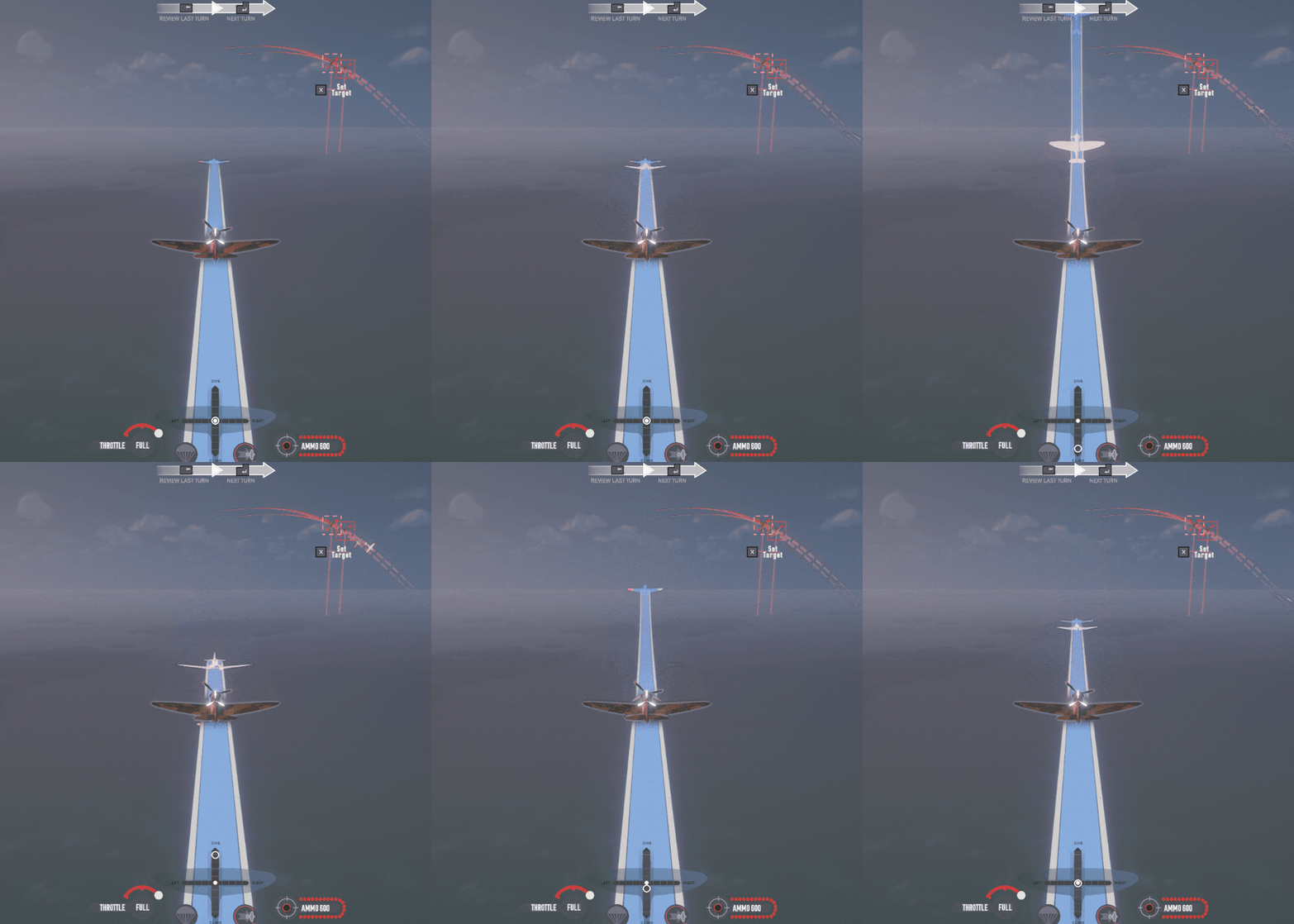
The Climb Axis operates similarly to the traditional elevator axis, pointing the nose of the aircraft up (to climb) or down (to dive) relative to its initial orientation.
The Turn Axis couples the traditional roll and yaw aircraft inputs into a single Turn command, and it will generally turn an aircraft left or right. With small inputs, the turn command will operate primarily in yaw. Large Turn inputs will both yaw and roll an aircraft, coordinating turns and generally resulting in a piloting experience that is still aggressive but stable and predictable.
Play How You Want
Scramble will launch with the Turn/Climb Assist enabled by default, but players will have the option of reverting to traditional 3-axis aircraft control whenever they want (even for a single turn).
Piloting aircraft almost always requires coordination of all three control axes, and the Turn/Climb assist will satisfy the majority of aircraft control needs. But for special cases where a player desires additional roll or yaw authority, or for players who authentically prefer traditional aircraft control in Scramble, the Traditional scheme is a single click away.
Prepare to experience the thrill of intense dogfights like never before. Unlike traditional dogfighting games, Scramble offers a unique simultaneous turn-based gameplay style that minimizes time and reflex demands while preserving the intricate details of aerodynamics and physics-based simulation. In this dynamic 3D airspace, each dogfight is broken down into short, thrilling bursts of action, making it perfect for players on the go. You will be able to plan your aircraft's maneuvers strategically during simultaneous turns and witness the outcomes unfold in real-time.
Join our server on Discord to stay updated on the latest news and events.
Hi, everyone, this is Jon, the nerdy guy from the whiteboard drawings in the Scramble Flight School videos. I sat down to compose this dev log several times over the past couple weeks and have struggled to find a level of detail that both satisfies my engineering sensibilities but is also digestible for anyone without an aerospace background. I settled on a post that I hope explains and excites the bulk of you, but one I certainly wouldn’t share with my old professors; I’ll let the aerodynamicists in our audience take it up with me on the Scramble Discord server; I hope you enjoy :)
The Scramble engine simulates aerial combat in six degrees of freedom with analog flight physics, projectile dynamics, and subsystem damage modeling. Though Scramble gameplay is turn-based, its physics integrate in real-time, broken into two-second chunks, and its axis-based control inputs allow players to pilot aircraft with a precision and fidelity not previously offered in turn-based dogfighting games.
Aerodynamics Forces
Scramble considers five main forces acting on each aircraft:
Thrust is provided by engines and propellers, and is generally oriented axially out the nose of the aircraft. Thrust is generally a function of engine throttle and airspeed. In steady, level flight thrust balances drag.
Lift is defined as the force operating perpendicular to aircraft velocity in the plane made by the aircraft velocity and canopy, and it generally acts in a direction upward, through the canopy, relative to the aircraft wings. Lift is generally a function of angle of attack - the pitch of the aircraft body relative to its velocity - and airspeed. In steady, level flight lift balances gravity.
Side force is defined as the force operating perpendicular to aircraft velocity in the plane made by the aircraft velocity and the aircraft wing axis, and side force generally acts laterally (to the side) of the aircraft body, roughly in the direction of the left or right wing of the aircraft. Side force is generally a function of angle of sideslip - the yaw of the aircraft body relative to its velocity - and airspeed. In steady, level flight side force is nullified to zero.
Drag is defined as the force opposing an aircraft’s travel through the air, and is applied in opposition to the aircraft velocity. Drag is a complex force, a catch-all definition for any forces slowing the aircraft down, but is generally a dominated by angle of attack, angle of slideslip, and airspeed. In steady, level flight drag balances thrust.
Gravity acts in a constant direction and with a constant acceleration, pulling the aircraft toward the center of the Earth. In steady, level flight gravity balances lift.
Equations of Motion
Equations of Motion are the physics equations that define the movement and rotation of a body through space - in the case of Scramble, through three-dimensional space.
The standard Newtonian equations of motion are driven by Newton’s Second Law of Physics, that the force acting on a body is equal to the mass of the body times the resulting acceleration: F = mA. In Scramble I am very interested in Accelerations: integrating Acceleration over a Timestep yields the change in Velocity of a body, and integrating the Velocity of a body over a Timestep yields the change in Position of that body.
If I know the Accelerations on an aircraft I can move it through space, and I made a decision early in Scramble development to make the simplifying assumption that I could define Scramble physics in terms of accelerations rather than in terms of forces. This decision allowed me to ignore aircraft mass, which for any individual aircraft remains essentially constant throughout a dogfight, and it allowed me to directly compare the performance of two aircraft without performing any math: an aircraft capable of 7Gs of acceleration (7 times the force of gravity) can turn more tightly than an aircraft capable of 5Gs of acceleration.
Scramble Aerodynamics Coefficients
Aircrafts in Scramble have elevators, rudders, ailerons and throttles, all of which actuate through a full axis of control and which drive the aircraft angles of attack and sideslip, roll rate, and thrust acceleration. Aircraft aerodynamics in Scramble are built from coefficients that vary with airspeed and the control inputs previously mentioned.
The Aerodynamics Coefficients are defined as one-dimensional curves, and multiple coefficients may contribute to the computation of each of the major Accelerations, for example:
Lift is broken into coefficients for Pitch and Airspeed. Drag is broken into coefficients for Pitch, Yaw, and Airspeed.
Accelerations are integrated to determine aircraft Velocity, and body Orientation is calculated as a function of Velocity and a tracked Roll angle. Scramble makes the assumption that aircraft control inputs drive Pitch and Yaw angles relative to the aircraft velocity (angles of attack and sideslip, respectively), but Roll angle is tracked independently, and Roll Rate is calculated from a coefficient broken into Roll Input and Yaw Input terms.
Aircraft Definitions & Performance
Every Scramble aircraft is defined as a table of aerodynamics coefficients curves. This table determines the nominal performance envelope of an aircraft and it allows me to compare rough accelerations, level airspeed, and roll rates between different aircraft.
Scramble is a game that prioritizes the essence of performance differences between airplanes rather than raw numerical differences, so the assumptions I have made in our physics modeling simplify the gameplay balance process in a way that keeps me focused on applied performance of aircraft: turn rates, roll rates, turn radii, dive accelerations, climb performance, etc.
Another benefit is that when I want to model new flight phenomena, like stalling, I am inherently defining the impact those phenomena have on the acceleration and rotation rates directly; this point might get lost in the weeds of this pretty dense physics article, but hopefully it garners some sympathy from those of you who have worked yourselves with forces and moments and mass properties and the delicate balance required to move objects of that fidelity through space.
The final benefit to the Scramble aerodynamics coefficients system is that it has allowed me to create simple coefficient-based definitions for the aerodynamics impacts of subcomponent damage like lost control surfaces, leaking fuel systems, or broken wings. I’m excited to elaborate on Scramble damage modeling in a future dev log.
Godspeed.
Join our Discord server and don't miss any upcoming news on the game.
Welcome back to Flight School, our dev diary series unveiling the details of Scramble: Battle of Britain.
The third episode will introduce you to the flight physics that are involved in the game development to fully simulate all the airplanes, bullets and damage.
You can expect part 2 to be released next week, along with the full dev diary article helping you to learn more about the physics in Scramble: Battle of Britain.
Join our Discord server and don't miss any upcoming news on the game.
Scramble: Battle of Britain - Flight School, Episode #2
Dogfights are by their very nature chaotic and unpredictable. Pilots are competing for advantage with their lives at stake. They must execute complex maneuvers with split-second timing to gain a tactical advantage over deadly opponents. Aircraft fly at high speed in close proximity and an understanding of the entire airpace is essential - one wrong move could be fatal.
Scramble simplifies the chaos of a dogfight into short, digestible chunks of action. Maneuvers that can be disorienting in a real-time flight game progress at a pace you can understand. The turn-based design of Scramble ensures you will never lose sight of a target and that you always have a chance to check your six. Scramble helps with the Observe and Orient steps of the OODA loop, and aces will be made of the tacticians who Decide and Act with the most proficiency.
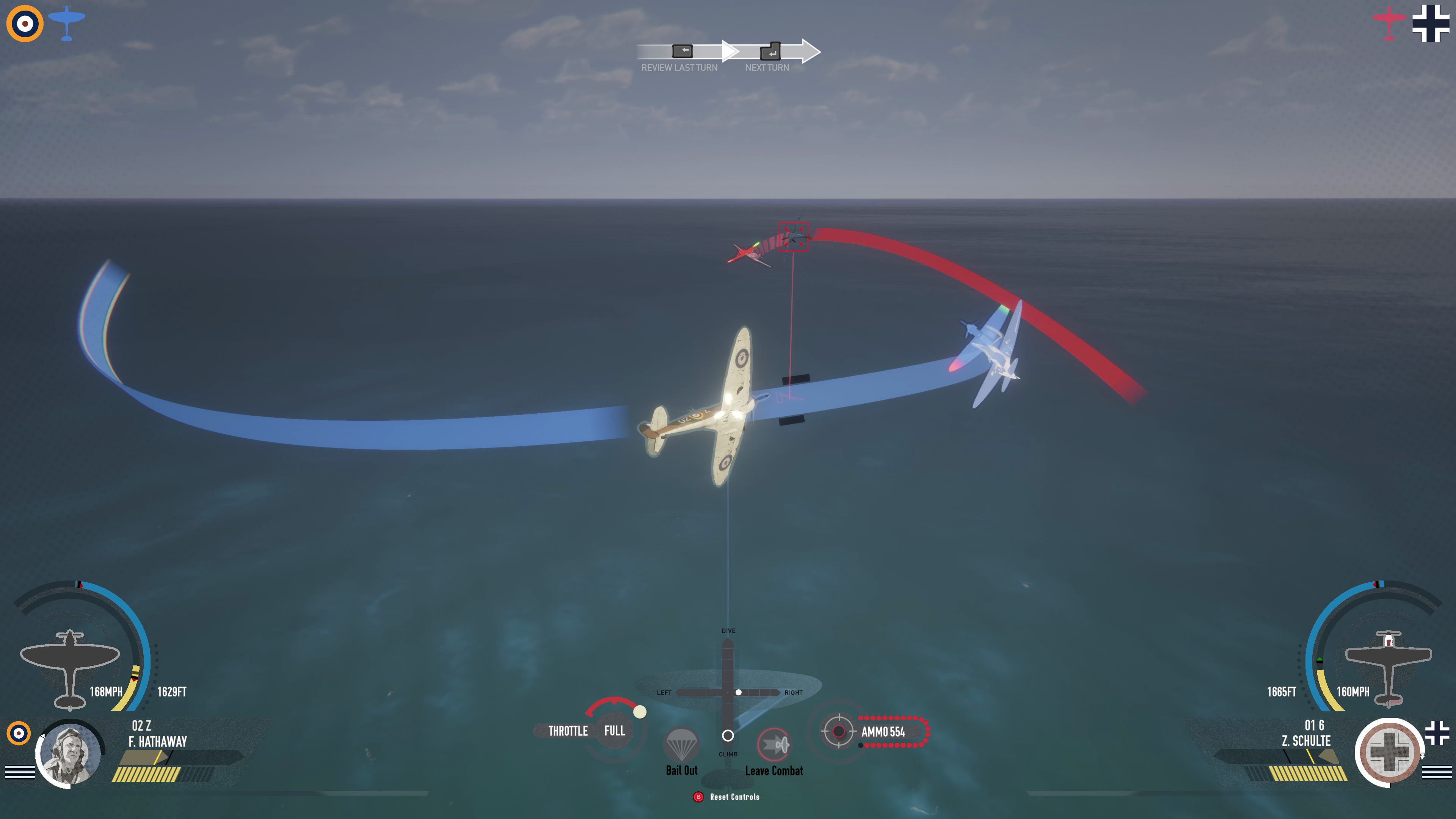
The Scramble planning phase gives you all the tools you need to analyze and plan maneuvers for every aircraft under your control. The flight path of each aircraft is predicted with a 3D ribbon, and uncertainty in enemy action is rendered as dashed graphics. Scramble provides firing aids for lining up shots, a targeting feature for querying the strengths and vulnerabilities of each enemy aircraft, a diorama-style tactical mode for assessing the whole sky at a glance, and graphics to warn of potential stresses to your pilot and aircraft.
Players set the precise controls for each individual aircraft under their control, and special defensive actions like escaping the dogfight and bailing from a plane can be commanded to salvage machine or pilot.
In the Simulation phase we strip away the UI and let you position your camera however you want to see your tactics resolve at full speed in our detailed physics engine. The Scramble simulation plays through in real-time and major events like system failures and kills are logged to ensure you never miss an important moment.
Scramble turns can progress one after another from Planning to Simulation and back to Planning, but players can also access Review phase on demand to scrub forward and backwards, frame by frame, through any turn of a Scramble match.
The Scramble Review phase presents an event log to help you find key moments, it allows you to loop and pause turn replays at will to analyze your performance, and it grants you access to our suite of cinematic tools for capturing and sharing stills, gifs, and videos of your favorite moments.


 *updated: July 2nd