I have a feeling I've only been writing about breakthroughs so far but bear with me - August has brought another groundbreaking milestone. After all these years Selenwald finally has a first trailer. In case you haven't seen it yet, head over to the game's store page and watch!
Before that, Selenwald has been hiding in the darkness, obscured, waiting to be discovered only by those who dare venturing into the deepest chasms of Steam. Now everything changed forever. There has been a lot of traffic since the trailer's release. The video on YouTube alone has just surpassed 10,000 views. A lot of sites have written about Selenwald as well. More people have discovered the game during the past 2 weeks than during the entire year prior. All of it fills me with joy! But enough of this - although I was crazy busy with the trailer last month, it isn't the only thing I made. Let's get to the actual content of this diary entry, shall we?
New tools in the belt
This time around I'd like to show you the process behind the creation of environmental props in Selenwald. However, that process has very recently changed and this transformation is something I'd like to describe in depth.
A revolution is happening in front of our eyes. Machine learning technologies have been in heavy development for the past couple of years and we're just witnessing their boom. As you might have guessed, I'm mentioning this because I've incorporated some of these tools into my workflow. The ones I've tried are plask and the wildly popular Midjourney. I'll show you the process first and then express my thoughts on the ethics of using AI image generators - a topic that has raised heated debates over the internet.
The Vat
Selenwald is a university and a proper university doesn't mean just dusty libraries and lecture halls. There's a wide variety of interesting areas you could visit but the one I'm going to focus on today is a laboratory and more specifically a type of a scientific device that can be found within it.
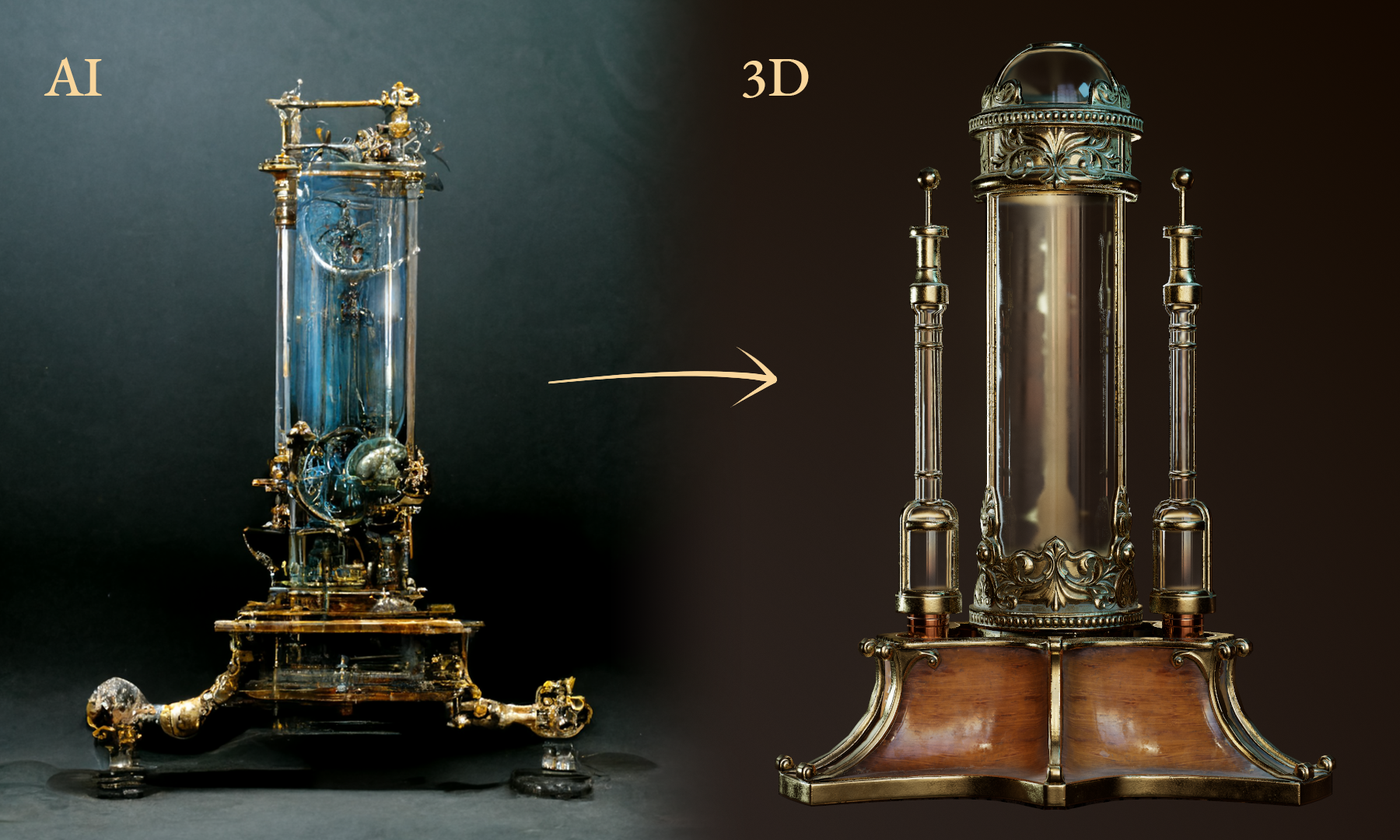
Let me show you how the model went from the chaotic concept on the left hand side to a finished and optimized, game-ready model on the right hand side.
The first thing every 3D artist does when preparing to create some art is gathering a pool of references. Images of real world objects are essential to understanding how the things work. That isn't just important if you're recreating a real object one to one. It also applies to stylized art or making imaginary non existing objects in general. References enable us to make our work believable which is the secret ingredient of art used to build great fictional worlds and is something entirely different than realism, which is just an aesthetic choice. However, creating completely fictional objects may prove very time consuming in the early stage because there may be very few good references out there that actually help with your vision, leaving giant gaps for you to fill entirely with imagination. This may be a time consuming process of finding appealing forms and shapes. A process driven mostly by trial and error.
Have you ever heard of an idea of "the creative juices flowing"? That's the state of mind that heavily leans on the subconscious and lets you quickly draft out ideas. Throughout history people have been tapping into that mysterious power with the help of various stimuli - from mere sightseeing, through listening to music, to the intake of hallucinogenic substances. I think this is the part in which AI image generators shine the most and ironically most people find them addictive. That being said, I prompted the AI to generate me some additional imagery for more inspiration.
What I like about these images the most is that they represent a wide variety of visually pleasing forms and compositions while also being very chaotic and nonsensical. They made my head explode with ideas and at the same time I still had to go through the creative, mental exercise of filling the gaps actually creating something that makes sense. But that's already the second stage of the process.
Drafting
Once you have references and a solid idea of what you're doing it's time to prepare a very rough version of the object in 3D. This is known by many names. I call it a draft but many people refer to it as a blockout or whiteboxing. However, these terms more often refer to prototyping an entire level or scene rather than a single prop. Also, you don't need to stop at primitive shapes when drafting.
Why is this step essential? It lets you achieve several goals but most importantly:
getting the target form (even with some detail) extremely quickly without caring about the technical correctness at all - you will redo every element later anyway and it will be a breeze if you have the draft model underneath
getting the scale right by being able to quickly verify it in the game's engine - this will ensure you won't need to make any dramatic changes to the overall form very late in the process when it's most difficult and will help you make better decisions on how to approach detail.
Ultimately I've diverged from the primary AI generated image quite a lot. I had my own vision and it matured as the process advanced. After all these images were there to help me, not restrict me. As you can also see, the final design is much different from the original one. In the beginning I went wild with kitbashing ornaments everywhere and the form became extremely undefined and "noisy", which was especially visible in the game engine at the isometric camera perspective. I ended up cleaning up the design and making it much more sleek, ending up with something much more readable and believable.
One more highlight I'd like to make here is how useful it is to be able to get lots of variants of the same thing using AI. I've had a general idea for the side tubes but seeing many different options has let me to draft out ideas extremely quickly and arrive at a design that was the most in sync with what I had in mind.
Full on detail
Now it's time to proceed to making the dense, high-poly version of the model. It is still not the model that will end up in the actual game though. This model is what will be the basis to make the final textures that will make a simplified model appear very detailed. Some parts of the high poly can be easily derived from the geometry that has already been made in the drafting process and some will be made from scratch.
Like on every other stage, it is important to use any tools that can make the process quicker, easier, more enjoyable or let you arrive at better results. One such example here is the ornaments. It is a common practice to kitbash such elements using libraries of premade models. It is especially useful in the case of Selenwald because the camera is so far away you can't even see these ornaments clearly unless you're playing at resolution 4k or higher. Instead of reinventing the wheel and spending unnecessary amounts of time on tiny, insignificant parts, you can put the extra time to polish the more important features of the model (or start another one quicker). The libraries I usually use are Ornament Kitbash Vol. 1 by Jonas Ronnegard and Decorative Ornamental Kit by Noya.
This model is made of 1,430,587 vertices. Quite a lot!
The actual in-game model
Once you have the high definition version of the object ready, you can proceed to making the optimized version of it. Most of this is usually made from scratch because the difference in geometry density between the two version is so big there is no point in trying to reach the goal by reduction. It's easier to just place new geometry that is simple to begin with. My general rule of thumb for the target density of Selenwald models is that their silhouettes should still look smooth and curvy in the game's view when played at the 4k resolution but that's the limit of the generosity.
The next step is to unwrap the model into a [typically] square UV space for texturing purposes. Here you can see two spaces - one for the body and one for the glass. That's because glass will use a different material in the engine anyway.
If you're observant you might have noticed that there is much less geometry on the UV space than you can see on the model. That's because of an optimization trick. The model actually has very few unique elements - most of them are mirrored and/or arrayed. This way some parts of the textures will be shared between 3 or even 6 locations. This way, even though this prop isn't small, the texture resolution can as low as 512x512 even when the game plays in 4k and all the detail remains sharp and visible. Pretty neat, huh?
Shiny!
Finally, arguably the most enjoyable part of the process - texturing. Quite frankly, also the shortest one because texturing in programs like Substance Painter is a breeze. This post has gotten extremely long already so I won't get into much detail here but if you've never done any 3D work, here's a super short summary of what happens next.
First you go through a process called texture map baking. All the information about this intricate detail that you've created gets transferred to the UV space of the corresponding low-poly version in a form of many different textures - normal map, ambient occlusion, curvature, etc. Some of these textures won't end up in the final texture set because their primary role is to inform the texturing program on how to apply generative effects on the actual textures like dust on top, dirt in crevices, wear and damage on edges, etc.
Then to use a couple of generators, procedural materials, filters and brushstrokes and there you have it - a finished, textured model, ready to be put in the game.
One final thing left to do would be to prepare a shader for a liquid that could be put inside those tubes but that's a topic for whole other entry.
So what's the fuss around Midjourney?
AI image generators have grown controversial so I'd like to make a statement on what are my thoughts on this so far. Lots of people criticize these tools and I saw several sentiments being brought up frequently:
The machine learning algorithms are being trained on images found all over the internet. This includes copyrighted work made by artists who have spent years or decades perfecting their skills. It is a parasitic relationship and all these artists should be credited and/or compensated for the use of their work in the ML training process.
Everyone can now make beautiful artworks with no effort and no artistic background. The entry point suddenly lowered from years of practice to seconds spent typing a prompt in an AI application.
"AI art" isn't art because it has no soul - doesn't express any intent. All these images are created by a machine, not by a person.
AI generated images are only empowering people who had no artistic abilities in the first place. For actual artists using AI means becoming restricted by what the AI comes up with.
Artists will lose their jobs because it is now much cheaper and faster to just generate images using AI.
People will soon get bored of it, seeing how soulless and repetitive it is and we'll come back to where we were before.
I have to admit, when I first saw what Midjourney is capable of, I got a bit worried and had similar thoughts. However, I quickly realized that most of them are unjustified and I'm now fully positive about the effects this technology will have on humanity. I've also talked to a bunch of people and here are my thoughts on all of this:
Yes, the AI trains on the collective legacy of art including pieces by modern creator. And guess what? Humans do to. Always have. This is how art works. We learn from people who came before as and the idols that surround us today. And honestly I never see anybody crediting all artists that inspired them. When you gather 20 photos and images to use as references, do you actually credit all the photographers, illustrators and 3D artists that created them? You don't even know their names because you quickly grabbed the images from Google, ArtStation or Pinterest. All the stuff we create is influenced by more uncredited artists than we even realize and that's simply how art works. And AI is no different.
Yes, people with no skill can now make more beautiful art. And that frustrates me too as an artist because I know the world is full of opportunists without any talent who will gladly take these tools, use them in malicious ways and make us question all the time we've spent learning art now seeing them earn more money than we do and impress more people than we do. But ultimately this is.. good. People were always like that and we can't just stop progress and gatekeep our professions. And if you're like me and you care about art for the sake of it, you shouldn't be bothered by meaningless stuff that people will make just to get rich.
AI art not being art? That's arguable and I neither agree nor disagree. While it is absolutely true that the art was ultimately mostly created by the AI, there was a clear intent by the person who iterated over the prompt to get the result they had in mind. While the proces itself is very much automated, the resulting image is an expression of the user's intent. The only true exception to this is when people just prompt random things and pick images they like the most without any clear goal in mind.
I don't agree with the sentiment that AI doesn't add value for actual artists. For me it is empowering. Using this prop as an example, not only did it speed up the concepting stage, but also likely helped me reach an overall better result that I would have reached without MJ. It is a great source of inspiration and a way to get the creative juices flowing.
Absolutely, many artists will lose their jobs. And that's a natural course of action. The history repeats itself. Remember when workers lost their jobs when conveyor belts were invented? Remember when portrait painters lost their jobs when cameras were invented? Of course not - we weren't around. Sounds very familiar though. Surprisingly though, there is still market for hand made clothes and there is still market for hand painted portraits. It's just not as big. Another important remark is that you're not actually doomed to lose your job. Every artist is still leagues ahead of ordinary people who just type random prompts in Midjourney. Artists will benefit from AI much more than people with no artistic background. The only thing it takes is a paradigm shift. Art has become something different now and artists should also add AI to their tool belts because that's what software like Midjourney is - a tool. Still, if some people are going to lose their jobs - so be it. This is the price we need to pay from time to time in order to let the entirety of human race progress. And if those people are truly into art, they won't have a slightest problem in switching to a slightly different domain of art.
No, we won't go back. Quite the opposite - a lot of different AI tools are being developed and they evolve at a crazy tempo. Many creative jobs will transform soon, including 3D art. And I'm eager to see where it takes us.
That was a long one. I'm amazed you survived to reach the very end and I hope you learned something if you happen to be an aspiring 3D artist or are simply curious about how games are made.
Thank you for reading, Wiktor
Diary Page #3: The Paradigm Shift
Dear Scholars,
I have a feeling I've only been writing about breakthroughs so far but bear with me - August has brought another groundbreaking milestone. After all these years Selenwald finally has a first trailer. In case you haven't seen it yet, head over to the game's store page and watch!
Before that, Selenwald has been hiding in the darkness, obscured, waiting to be discovered only by those who dare venturing into the deepest chasms of Steam. Now everything changed forever. There has been a lot of traffic since the trailer's release. The video on YouTube alone has just surpassed 10,000 views. A lot of sites have written about Selenwald as well. More people have discovered the game during the past 2 weeks than during the entire year prior. All of it fills me with joy! But enough of this - although I was crazy busy with the trailer last month, it isn't the only thing I made. Let's get to the actual content of this diary entry, shall we?
New tools in the belt
This time around I'd like to show you the process behind the creation of environmental props in Selenwald. However, that process has very recently changed and this transformation is something I'd like to describe in depth.
A revolution is happening in front of our eyes. Machine learning technologies have been in heavy development for the past couple of years and we're just witnessing their boom. As you might have guessed, I'm mentioning this because I've incorporated some of these tools into my workflow. The ones I've tried are plask and the wildly popular Midjourney. I'll show you the process first and then express my thoughts on the ethics of using AI image generators - a topic that has raised heated debates over the internet.
The Vat
Selenwald is a university and a proper university doesn't mean just dusty libraries and lecture halls. There's a wide variety of interesting areas you could visit but the one I'm going to focus on today is a laboratory and more specifically a type of a scientific device that can be found within it.
Let me show you how the model went from the chaotic concept on the left hand side to a finished and optimized, game-ready model on the right hand side.
The first thing every 3D artist does when preparing to create some art is gathering a pool of references. Images of real world objects are essential to understanding how the things work. That isn't just important if you're recreating a real object one to one. It also applies to stylized art or making imaginary non existing objects in general. References enable us to make our work believable which is the secret ingredient of art used to build great fictional worlds and is something entirely different than realism, which is just an aesthetic choice. However, creating completely fictional objects may prove very time consuming in the early stage because there may be very few good references out there that actually help with your vision, leaving giant gaps for you to fill entirely with imagination. This may be a time consuming process of finding appealing forms and shapes. A process driven mostly by trial and error.
Have you ever heard of an idea of "the creative juices flowing"? That's the state of mind that heavily leans on the subconscious and lets you quickly draft out ideas. Throughout history people have been tapping into that mysterious power with the help of various stimuli - from mere sightseeing, through listening to music, to the intake of hallucinogenic substances. I think this is the part in which AI image generators shine the most and ironically most people find them addictive. That being said, I prompted the AI to generate me some additional imagery for more inspiration.
What I like about these images the most is that they represent a wide variety of visually pleasing forms and compositions while also being very chaotic and nonsensical. They made my head explode with ideas and at the same time I still had to go through the creative, mental exercise of filling the gaps actually creating something that makes sense. But that's already the second stage of the process.
Drafting
Once you have references and a solid idea of what you're doing it's time to prepare a very rough version of the object in 3D. This is known by many names. I call it a draft but many people refer to it as a blockout or whiteboxing. However, these terms more often refer to prototyping an entire level or scene rather than a single prop. Also, you don't need to stop at primitive shapes when drafting.
Why is this step essential? It lets you achieve several goals but most importantly:
getting the target form (even with some detail) extremely quickly without caring about the technical correctness at all - you will redo every element later anyway and it will be a breeze if you have the draft model underneath
getting the scale right by being able to quickly verify it in the game's engine - this will ensure you won't need to make any dramatic changes to the overall form very late in the process when it's most difficult and will help you make better decisions on how to approach detail.
Ultimately I've diverged from the primary AI generated image quite a lot. I had my own vision and it matured as the process advanced. After all these images were there to help me, not restrict me. As you can also see, the final design is much different from the original one. In the beginning I went wild with kitbashing ornaments everywhere and the form became extremely undefined and "noisy", which was especially visible in the game engine at the isometric camera perspective. I ended up cleaning up the design and making it much more sleek, ending up with something much more readable and believable.
One more highlight I'd like to make here is how useful it is to be able to get lots of variants of the same thing using AI. I've had a general idea for the side tubes but seeing many different options has let me to draft out ideas extremely quickly and arrive at a design that was the most in sync with what I had in mind.
Full on detail
Now it's time to proceed to making the dense, high-poly version of the model. It is still not the model that will end up in the actual game though. This model is what will be the basis to make the final textures that will make a simplified model appear very detailed. Some parts of the high poly can be easily derived from the geometry that has already been made in the drafting process and some will be made from scratch.
Like on every other stage, it is important to use any tools that can make the process quicker, easier, more enjoyable or let you arrive at better results. One such example here is the ornaments. It is a common practice to kitbash such elements using libraries of premade models. It is especially useful in the case of Selenwald because the camera is so far away you can't even see these ornaments clearly unless you're playing at resolution 4k or higher. Instead of reinventing the wheel and spending unnecessary amounts of time on tiny, insignificant parts, you can put the extra time to polish the more important features of the model (or start another one quicker). The libraries I usually use are Ornament Kitbash Vol. 1 by Jonas Ronnegard and Decorative Ornamental Kit by Noya.
This model is made of 1,430,587 vertices. Quite a lot!
The actual in-game model
Once you have the high definition version of the object ready, you can proceed to making the optimized version of it. Most of this is usually made from scratch because the difference in geometry density between the two version is so big there is no point in trying to reach the goal by reduction. It's easier to just place new geometry that is simple to begin with. My general rule of thumb for the target density of Selenwald models is that their silhouettes should still look smooth and curvy in the game's view when played at the 4k resolution but that's the limit of the generosity.
The next step is to unwrap the model into a [typically] square UV space for texturing purposes. Here you can see two spaces - one for the body and one for the glass. That's because glass will use a different material in the engine anyway.
If you're observant you might have noticed that there is much less geometry on the UV space than you can see on the model. That's because of an optimization trick. The model actually has very few unique elements - most of them are mirrored and/or arrayed. This way some parts of the textures will be shared between 3 or even 6 locations. This way, even though this prop isn't small, the texture resolution can as low as 512x512 even when the game plays in 4k and all the detail remains sharp and visible. Pretty neat, huh?
Shiny!
Finally, arguably the most enjoyable part of the process - texturing. Quite frankly, also the shortest one because texturing in programs like Substance Painter is a breeze. This post has gotten extremely long already so I won't get into much detail here but if you've never done any 3D work, here's a super short summary of what happens next.
First you go through a process called texture map baking. All the information about this intricate detail that you've created gets transferred to the UV space of the corresponding low-poly version in a form of many different textures - normal map, ambient occlusion, curvature, etc. Some of these textures won't end up in the final texture set because their primary role is to inform the texturing program on how to apply generative effects on the actual textures like dust on top, dirt in crevices, wear and damage on edges, etc.
Then to use a couple of generators, procedural materials, filters and brushstrokes and there you have it - a finished, textured model, ready to be put in the game.
One final thing left to do would be to prepare a shader for a liquid that could be put inside those tubes but that's a topic for whole other entry.
So what's the fuss around Midjourney?
AI image generators have grown controversial so I'd like to make a statement on what are my thoughts on this so far. Lots of people criticize these tools and I saw several sentiments being brought up frequently:
The machine learning algorithms are being trained on images found all over the internet. This includes copyrighted work made by artists who have spent years or decades perfecting their skills. It is a parasitic relationship and all these artists should be credited and/or compensated for the use of their work in the ML training process.
Everyone can now make beautiful artworks with no effort and no artistic background. The entry point suddenly lowered from years of practice to seconds spent typing a prompt in an AI application.
"AI art" isn't art because it has no soul - doesn't express any intent. All these images are created by a machine, not by a person.
AI generated images are only empowering people who had no artistic abilities in the first place. For actual artists using AI means becoming restricted by what the AI comes up with.
Artists will lose their jobs because it is now much cheaper and faster to just generate images using AI.
People will soon get bored of it, seeing how soulless and repetitive it is and we'll come back to where we were before.
I have to admit, when I first saw what Midjourney is capable of, I got a bit worried and had similar thoughts. However, I quickly realized that most of them are unjustified and I'm now fully positive about the effects this technology will have on humanity. I've also talked to a bunch of people and here are my thoughts on all of this:
Yes, the AI trains on the collective legacy of art including pieces by modern creator. And guess what? Humans do to. Always have. This is how art works. We learn from people who came before as and the idols that surround us today. And honestly I never see anybody crediting all artists that inspired them. When you gather 20 photos and images to use as references, do you actually credit all the photographers, illustrators and 3D artists that created them? You don't even know their names because you quickly grabbed the images from Google, ArtStation or Pinterest. All the stuff we create is influenced by more uncredited artists than we even realize and that's simply how art works. And AI is no different.
Yes, people with no skill can now make more beautiful art. And that frustrates me too as an artist because I know the world is full of opportunists without any talent who will gladly take these tools, use them in malicious ways and make us question all the time we've spent learning art now seeing them earn more money than we do and impress more people than we do. But ultimately this is.. good. People were always like that and we can't just stop progress and gatekeep our professions. And if you're like me and you care about art for the sake of it, you shouldn't be bothered by meaningless stuff that people will make just to get rich.
AI art not being art? That's arguable and I neither agree nor disagree. While it is absolutely true that the art was ultimately mostly created by the AI, there was a clear intent by the person who iterated over the prompt to get the result they had in mind. While the proces itself is very much automated, the resulting image is an expression of the user's intent. The only true exception to this is when people just prompt random things and pick images they like the most without any clear goal in mind.
I don't agree with the sentiment that AI doesn't add value for actual artists. For me it is empowering. Using this prop as an example, not only did it speed up the concepting stage, but also likely helped me reach an overall better result that I would have reached without MJ. It is a great source of inspiration and a way to get the creative juices flowing.
Absolutely, many artists will lose their jobs. And that's a natural course of action. The history repeats itself. Remember when workers lost their jobs when conveyor belts were invented? Remember when portrait painters lost their jobs when cameras were invented? Of course not - we weren't around. Sounds very familiar though. Surprisingly though, there is still market for hand made clothes and there is still market for hand painted portraits. It's just not as big. Another important remark is that you're not actually doomed to lose your job. Every artist is still leagues ahead of ordinary people who just type random prompts in Midjourney. Artists will benefit from AI much more than people with no artistic background. The only thing it takes is a paradigm shift. Art has become something different now and artists should also add AI to their tool belts because that's what software like Midjourney is - a tool. Still, if some people are going to lose their jobs - so be it. This is the price we need to pay from time to time in order to let the entirety of human race progress. And if those people are truly into art, they won't have a slightest problem in switching to a slightly different domain of art.
No, we won't go back. Quite the opposite - a lot of different AI tools are being developed and they evolve at a crazy tempo. Many creative jobs will transform soon, including 3D art. And I'm eager to see where it takes us.
That was a long one. I'm amazed you survived to reach the very end and I hope you learned something if you happen to be an aspiring 3D artist or are simply curious about how games are made.
Thank you for reading, Wiktor
Dev Diary #2: July 2022
Dear Scholars,
In the last entry I gave you a rough timeline of the first several years of Selenwald development. I showed you an early proof of concept dated back to 2013 and described the gradual build-up that started when I made first prototypes in 2016. The long journey of mostly solo development that has suffered a plethora of interruptions driven by the constant need to do side work in order to be able to pay the bills has finally led to an important milestone in 2020.
Today I would like to tell you the rest of the story that has brought the game to where it is now.
The unnamable
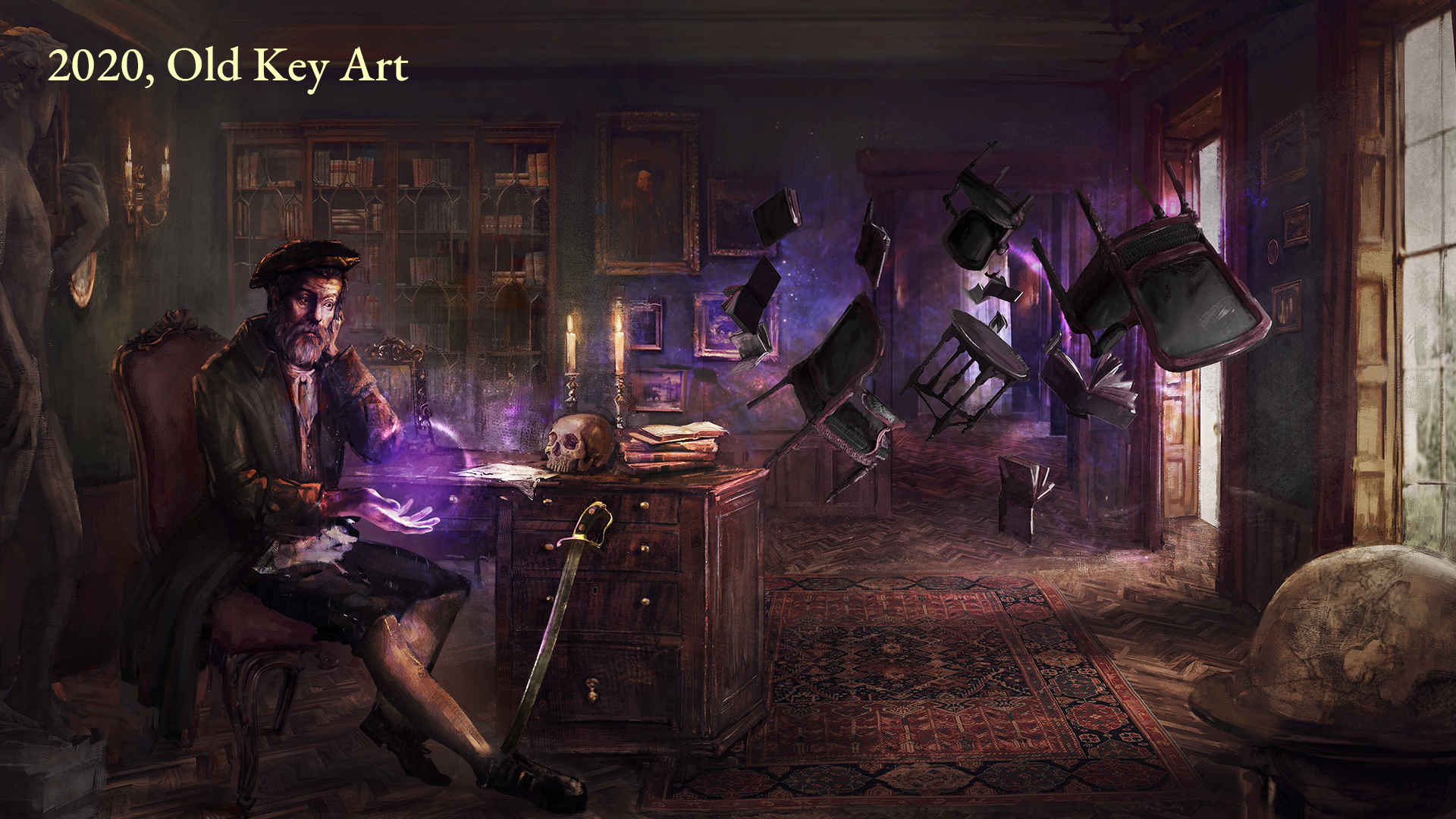
In April 2020 I decided to officially establish a studio as I knew some opportunities to accelerate the development were impossible without a registered business. Thus Unnamable Arts was born. Not much time has passed and I used some of my humble savings to hire first freelancers to help me create some things I'm not particularly good at myself. A first human character and a first boss were designed, drawn and finally made in 3D. A first key art (which is no longer in use) was also created.
First external funding
One of the goals behind founding a business was to unlock the possibility to apply for government funds. There is an attractive government fund program in Poland called Development of Creative Sectors ("Rozwój Sektorów Kreatywnych") that is designated to - among others - help small gamedev studios finish or further develop their prototypes. I managed to have my application accepted and several months later in May 2021, an absolutely wild period began. Although the funding wasn't enormous and it seems very insignificant compared to a typical budget of a video game it was enough for me to get many freelancers involved over the course of several months and vastly accelerate the process of getting the game closer to the playable and polished state. A total of 12 people were hired during that period until the end of 2021. Most would only be tasked with less than a month worth of work but some were involved for longer. The list contains:
2 environment artists
game designer
character artist
animator
music composer
audio designer
UX designer
writer
VFX artist
2 illustrators / concept artists
A wide range of content was designed and created last year. The game's story foundations and artistic direction got set in stone. Combat and other mechanics slowly started to work well together. First two original music tracks were composed. A terrifying monster enemy known as the Blind Hunter was created from scratch to roam the halls of Selenwald looking for prey, marking its presence with a shrill, blood-chilling breathing noise. The new key art that now proudly decorates the Selenwald's Steam page and social media was also done with the help of the funding. And that's just a tip of the mountain.
However, government funds also have their caveats and this one was no exception. I was required to provide my own financial contribution and I was not able to use any of the government money to pay my own bills so I was forced to keep doing paid work the entire time. This means that even though a lot of things got done by others, the implementation side has been gradually falling behind as I tried to find scraps of time to do programming work while also managing a group of people (which by itself is almost a full time job) and working on the side for money to sustain myself.
The goal was to get to a playable, representative demo that could help achieving several goals:
creating a trailer
start going to expos and show the game to you
present the demo to publishers and investors in hope to raise funds needed for finishing the game
While all the required components were in place, the demo still wasn't playable by the end of 2021 and that was bad news because I was barely holding on financially at that point and desperately needed to do paid work to get back on feet and not fall into serious debts. The pressure was even stronger because one of the previously involved freelancers - Aleksander, a 3D artist - was now a full time employee and I was paying him a monthly salary that obviously was much higher than what I paid myself. It was my plan all along to have a 3D artist become the first permanent team member but unfortunate circumstances have forced us take up paid work sooner than planned for it to work.
2022
Alas, despite feeling like it was in its climax, Selenwald's development suddenly slowed down tremendously during the first 3.5 months of 2022 because our survival has become a priority as my balance started to enter negative numbers. It was incredibly frustrating because we were on the verge of having the playable build that so many people have worked hard on last year.
However, nothing lasts forever and the crisis was successfully averted. I resumed working on Selenwald in April, while Aleksander was still finishing up the last contract we had been doing for a client. An incredible progress has been made since. The playable demo now exists and it's getting really fun! The aforementioned goals are also all now becoming a reality but more on that in future announcements.
Aleksander has departed a month ago for the time being. However, he declared he would still love to stay involved in Selenwald and will happily accept smaller commissions in the future. That being said, I'm developing the game solo again but things are going very well and I am looking forward to the upcoming weeks.
Also, one of the fans over at our little Discord community has turned out to be a 3D artist who volunteered to contribute to the project and make some art for Selenwald. What a pleasant surprise!
This concludes the brief summary of what the journey behind Selenwald looked like throughout years. In the future entries I will focus on details regarding the ongoing development process, highlighting newly introduced systems, mechanics and art.
Thank you for reading, Wiktor
Dev Diary #1: June 2022
Dear Scholars,
Welcome to the very first development update! In this periodic series of posts we'll be highlighting some of the features and content we've been recently working on. Sit down, relax and read the first part of the story behind a quest to bring back the long lost essence of fantasy RPGs and introduce the most intriguing take on the roguelike genre you've seen in a long time - a game that's ambitious, deep, challenging and unlike anything you've seen in past years. A game that's already almost 6 years in the making. "Why so long?" - you may ask. Let us continue and find out.
Prehistory
In order to start from the very beginning, we need to go back a whopping 9 years. Let me put plurals aside for now since there was no "us" back in the day. It was just me - Wiktor - and I had already decided that when I start my own studio, a roguelike would be my debut game. Not just any roguelike - one that would combine modern action with strategic and tactical gameplay known from cRPGs and traditional roguelikes. Moreover, I wanted to make a game that would had that serious, ominous tone to it - something I miss deeply from the oldschool cRPG classics.
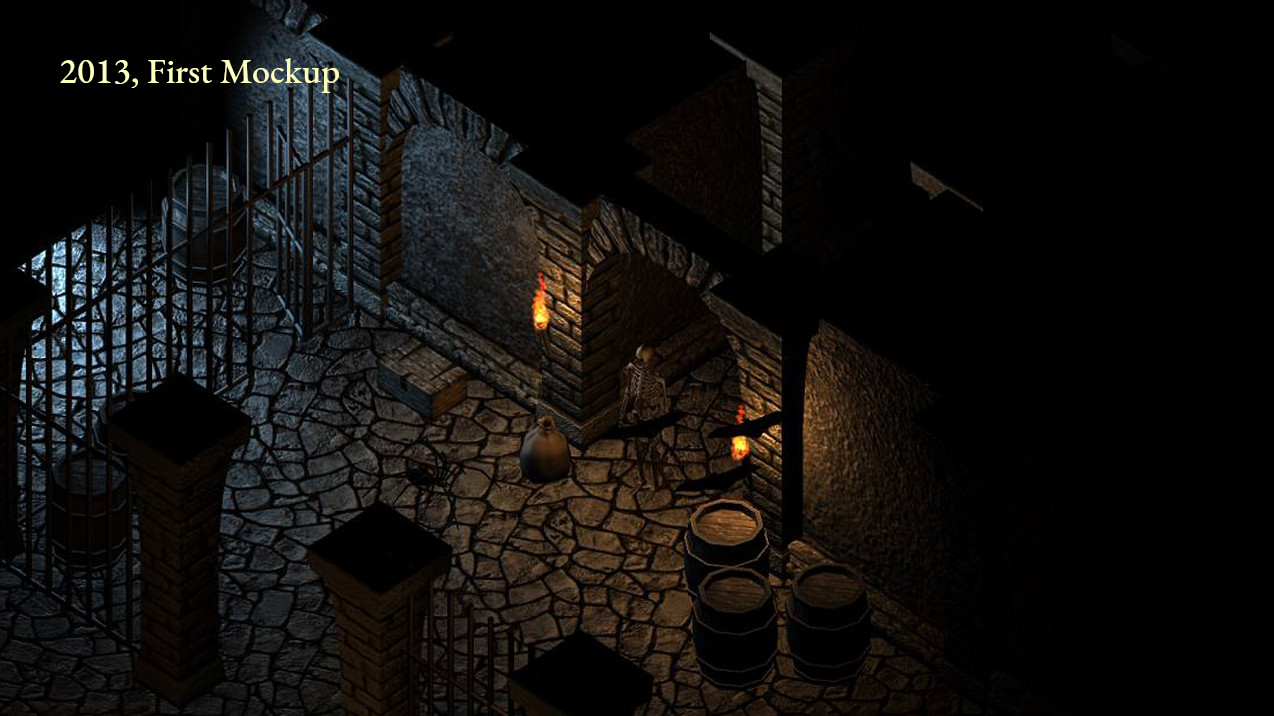
So I made some spreadsheets, wrote down some basic gameplay ideas, made a couple of rough 3D models and quickly realized I wasn't experienced enough to take up the ambitious project I had dreamt of just yet. In fact, I was just entering my 20s and was about to find my first gamedev gig.
That little 3D mockup of a dungeon I had made bacame one of my portfolio pieces that landed me my first 3D art job. Thus, my project has been put into a long slumber that lasted over 3 years.
The child's birth
At some point I felt it's finally time to go indie and start a project for real. I told my friend Squallu about my plans and we started brainstorming on things we could create. We wrote down some initial ideas regarding a sci-fi game we had in mind but shortly after I started feeling like I'm not actually very excited about it and that I still want to make that dark fantasy isometric action roguelike. I pitched my vision to Squallu and he immediately got filled with enthusiasm about gameplay I described. Soon after we laid down first ideas for the game's story.
On August 11th 2016 I officially started the development of Project Anxiety - a game that would later become Selenwald. I saved enough money to survive the time needed to make a quality demo that would enable me to fund the rest of the development. Or so I thought..
Turned out a couple of months wasn't even close to being enough for me to make something good enough to dare show it to publishers or to you - the players (eg. via Kickstarter). The project was still in its infancy and I needed to get a job back to sustain myself. I was naive but at least I knew hiring all the people I needed to finish the game in reasonable time without sacrificing quality and retaining cohesion of my vision would cost a lot of money and nobody would give it to me based on what I had at the time. It's not entirely that I still lacked the skills (though of course I wish I was as experienced back then as I am now) but the sheer amount of work required to make a quality demo of an AA game is overwhelming for one person. Things didn't look optimistic but I would never give up. Instead, a slow climb up the mountain began - one that took a couple of years.
Another question that might have popped up in your heads by now is "Why alone? Why didn't you seek like-minded people that would join you as partners, not employees? And what happened to your colleague Squallu?"
Well, I didn't seek to build a team for several reasons, actually.
Going solo
First of all, that's much more difficult than it sounds. I know it sometimes happens in indie gamedev but I heard of much more examples of when it didn't pan out. Sadly, I've been personally disappointed by people more times than I can count. Some people are just lazy. Some get quickly discouraged when something doesn't go as originally planned. Some just don't have the motivation to pursue a goal that is years away.
Most importantly though, people have lives - things happen, priorities change, hearts get broken. Very few people are willing to sacrifice their financial stability and put relations with their partners, families and friends at risk for several years. That was the reason Squallu didn't end up commiting after all (though he was the only person I was willing to co-found the studio with at the time). He had a lot of other responsibilities in life, as well as two jobs that he didn't feel he was ready to abandon in the sake of a project he had no way of knowing would succeed. After helping lay down the story foundation, he stepped down to only serve as a helpful hand in times of need. After getting experience in the industry as a producer, he decided he would happily stay in the project as an executive producer, which means a person who isn't directly involved in the project, but steps in once in a while to consult stuff like budgeting, milestones, business negotiations, etc. And that's great too!
Secondly, splitting decision-making between people equally is always a huge risk that the game stops being coherent and true to the original vision. In practice there's rarely more than one vision-holding person who knows precisely what fits the game and what doesn't. I really wanted to created something exceptional and I didn't want to let it get compromised.
Lastly, I have a solid vision on what direction I want Unnamable Arts (the studio) to head in once Selenwald gets released. As you've probably learned to expect, those plans are very ambitious. And as we all know by now, ambitious plans are costly. No matter how successful Selenwald becomes, I want to put the vast majority of the revenue into the production of more games that are even bigger and better. This is more important to me than personal wealth. Again, that's not something I would be in a position to expect from others if the studio's ownership (and revenue from the game) was split between several people. In practice, my ability to take the studio to where I want could become crippled.
About to get big
That period from 2016 to 2020 was a slow but gradual build-up. One of my goals was to make solid foundations in preparation to finally get some other people to work on the game with me. 2020 marked the beginning of a new era for the project. Project Anxiety, from that point known as Prime Delusion was about to accelerate with a lot of new people getting involved but that also came with a whole host of perils. Make sure to read the next entry of this diary next month to learn the rest of the story so far.