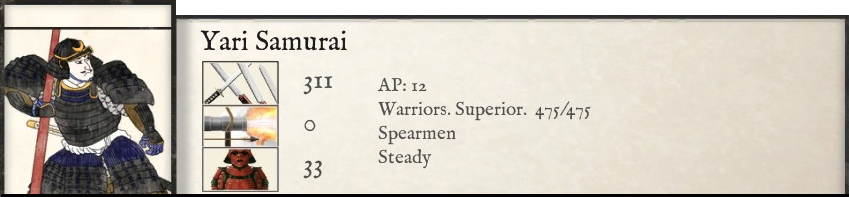
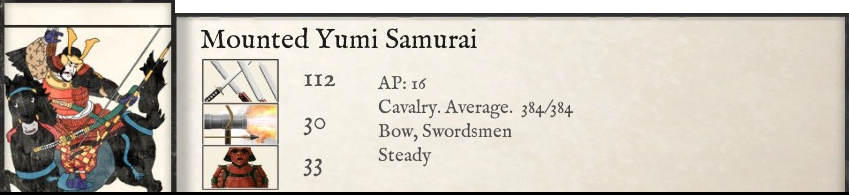
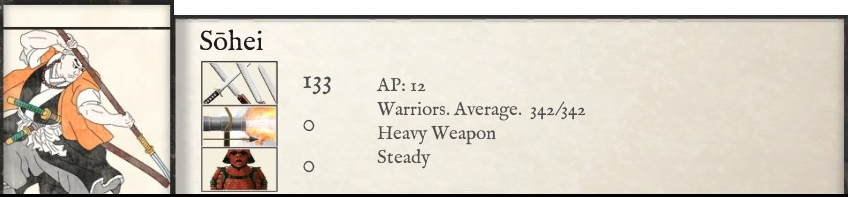
This will be our last faction preview for Sengoku Jidai: Shadow of the Shogun. This time we'll speak briefly of the Manchu, the Mongols and the Wokou pirates. As a bonus, we'll also speak of how banners and flags are represented in game.
Sengoku Jidai: Shadow of the Shogun will be available on PC tomorrow, Thursday May 19, both in standard and in a Collector's Edition containing unique content. And don't miss the release twitch stream tomorrow evening at CEST 8 PM / UTC 6 PM / EDT 2 PM on our official twitch channel!
Manchu
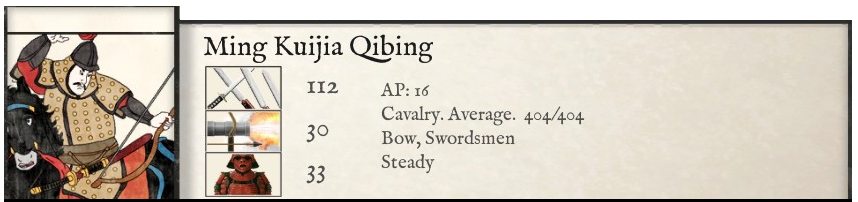
The Manchus originated from the Jurchen tribes who settled in present-day Manchuria. During the 16th century, the tribes were unified under the leadership of Nurhaci and were organised into the Eight Banners. The Jurchen banner armies fought in a similar manner to other steppe armies like the Mongols. They fielded mounted archers, some armoured, some unarmoured.
By 1622, the Jurchen had a substantial population of assimilated Han Chinese. These formed the core of the Jurchen foot units which utilised the same equipment and tactics as the Ming. A contingent of Ming artillerymen surrendered to the Jurchen during the fall of Yongping in 1629. These guns were influential in the subsequent battles against the Ming.
Hong Taiji succeeded Nurhachi and changed the name of the Jurchen to Manchu in 1635. In 1636, Hong Taiji proclaimed the creation of the Qing Dynasty. The Qing differentiated Han bannermen from ordinary Han subjects and created the Green Standard Army in 1644. The Green Standard Army would subsequently see much of the fighting against the remnants of the Ming. The original Banner Armies were now considered royal guards.
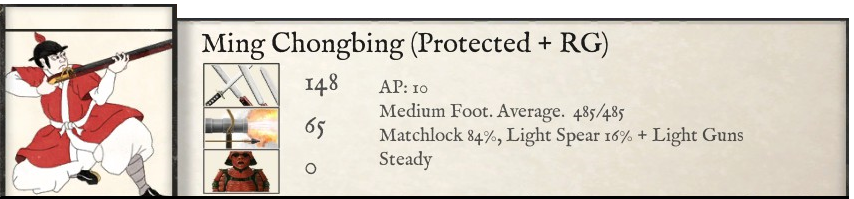
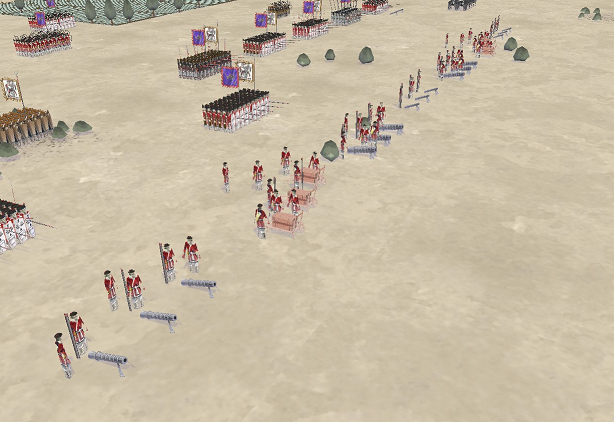
Manchu armies during the Qing period fought in a similar way to the Ming. They formed mixed battalions of protected missile troops and utilised a large amount of artillery. Close combat units of swordsmen with large rattan shields were commonly fielded. Cavalry remained an important component of the army and were still composed of the traditional horse archers.
Mongols
The Mongols were split into two major groups during the 1600s, the Oirats of western Mongolia and the Khalkha of eastern Mongolia. The Khalkha were often referred to as the Northern Yuan, paying homage to the former rulers of China, the Yuan Dynasty.
Mongol armies were composed of mounted archers. Higher quality units would wear lamellar or brigandine armour. Standard steppe hit and run tactics were prevalent.
Wokou
Wokou pirates raided the Chinese and Korean coasts from the 13th to the 16th centuries. They used Japanese-style weaponry like the yari, katana, and yumi. They were also enthusiastic users of Portuguese matchlocks. Due to their sea-faring nature, they did not wear heavy armour and most would usually be unarmoured. They were organised into several bands of warriors with mixed weaponry.
Banners and Flags
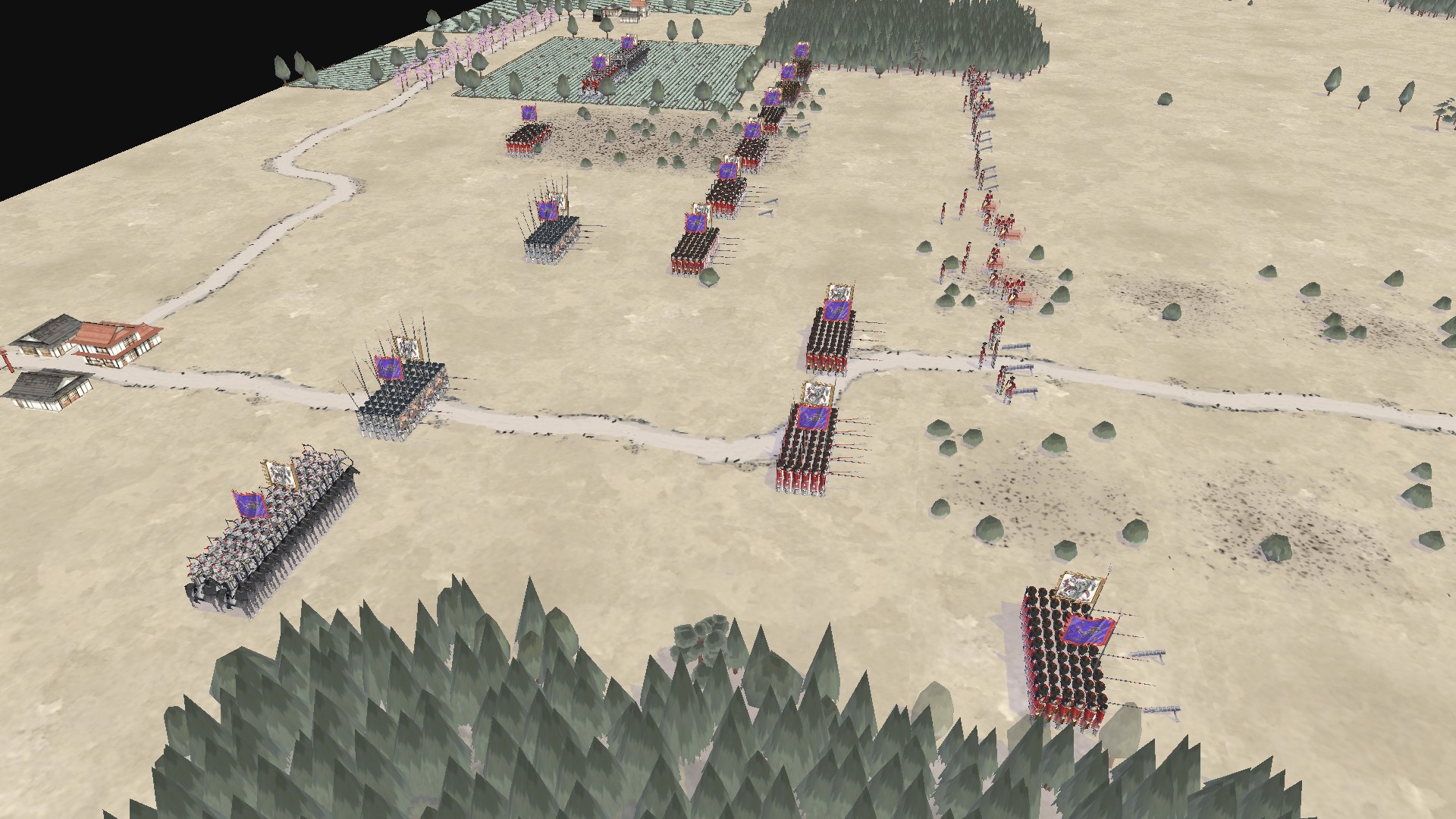
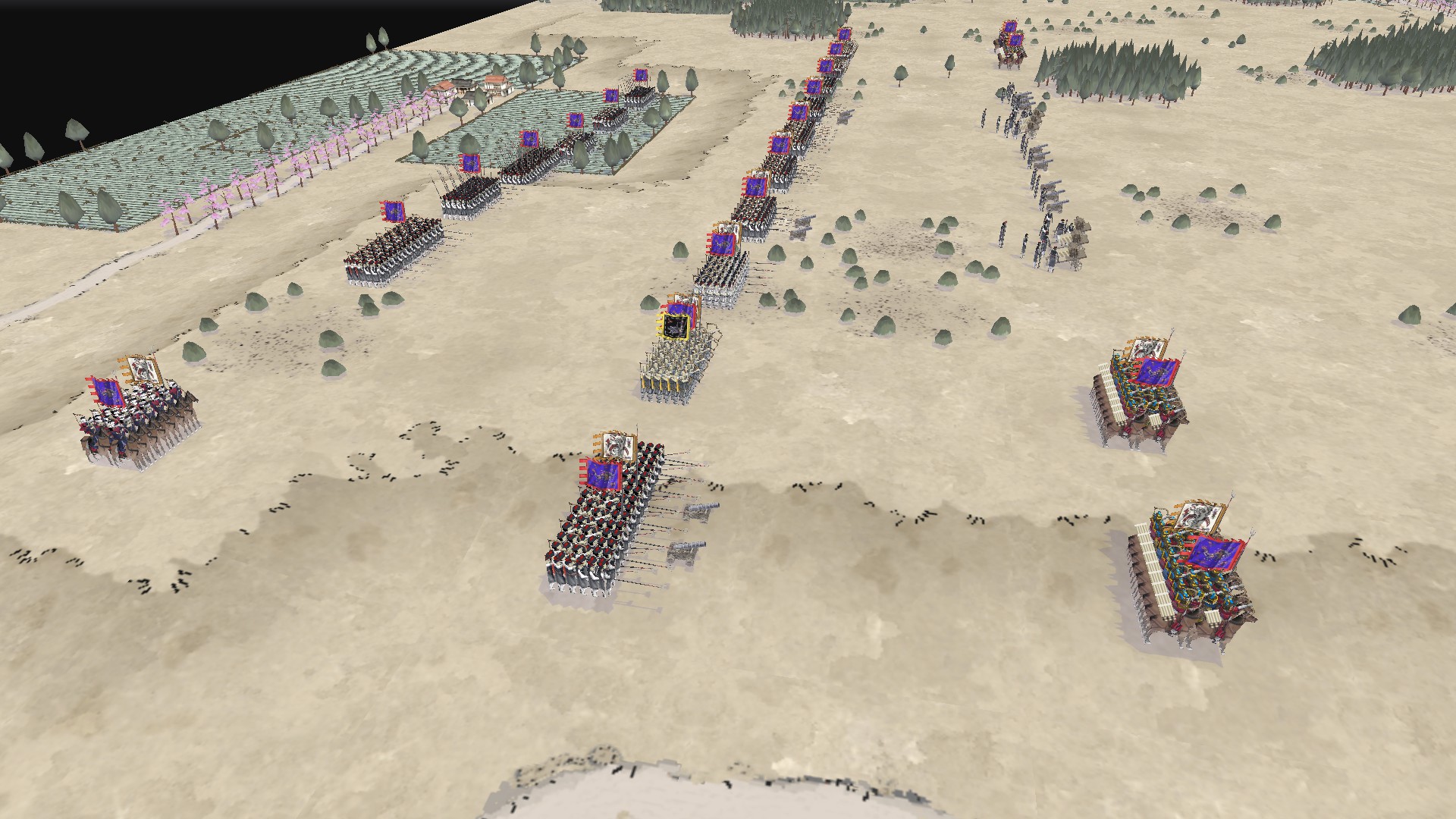
Each faction in game has unique banners matching those actually used in history. Note that icon banners will deteriorate as a unit takes losses, so damaged regiments are rather easy to spot on the battlefield.
Japanese Banners
Japanese troops may be pretty hard to distinguish when fighting against fellow Japanese. That is because a common uniform for a unit was rare despite popular depictions. No clan would wear something unique to their clan. Sengoku era armours were predominantly lacquered black or brown with different colour lacing. Some samurai wore red armour. Some samurai wore bulkier and more colourfully laced classical armour of an older era. The lack of a military uniform gave rise to several means of identification.
Sode Jirushi were small emblems attached to the shoulders and arms, only useful to distinguish friend from foe in close combat.
Sashimono were banners worn on the backs of the soldiers. These are probably the most unique and iconic of all Sengoku flags, but we did not use them in the game as they are not appropriate for the scale of the unit blocks.
Hata Jirushi were tall narrow unit banners hung from a cross bar. These flags fell out of favour during the Sengoku Jidai, but in the game you will see them used in the Honjin.
Nobori were tall stiffened flags used to identify units with a similar construction to the sashimono. These were the most prominent flags on Sengoku battlefields and are the ones used for identification and depicting unit quality.
As in real life, the player needs to familiarise himself with the nobori being used by his clan and the opponent as there are no real clan uniforms. Historically, prominent generals had their own flag designs but we don't go that far in the game.
Another tip for those playing Japanese: missile foot units (yumi and teppo) wear brown armour, close-fighting foot units black or red.
Ming and Joseon Banners
Ming Chinese and Joseon Koreans have similar banners (although the Korean flags have longer tails) because the Joseon civilisation adopted several aspects of Chinese culture. What we see in the game are three of the Four (actually Five) Guardian Creatures of Direction.
English Name / Chinese Name / Korean Name / Japanese Name Azure Dragon / Qing Long / Cheong-ryong / Seiryuu (East)
White Tiger / Bai Hu / Baek-ho / Byakko (West)
Black Turtle / Xuan Wu / Hyeon-mu / Genbu (North)
Vermilion Bird / Zhu Que / Ju-jak / Suzaku (South) [not in game]
Yellow Dragon /Huang Long / Hwang-ryong / Kouruu (Centre) [not in game]
Their use was most probably to show positions in a formation (left wing, right wing, centre, etc.), but we don’t go that far in the game.
Jurchen / Manchu / Qing Flags
The Jurchen tribes later called themselves Manchu and became the Qing Dynasty, the last dynasty of China. They went by the Eight Banners system.
These banners were used for both administrative and military purposes. The banner system organised Manchu society from fragmented tribes into unified armies. Membership of a banner did not go by ethnicity, Chinese and Mongols were also accepted. Before and during the Manchu invasion of the Ming, Chinese defectors were incorporated into the banners. When the numbers became too large, the "Old Han Army" created their own eight banners. The subjugated Mongols too had their own banners. But eventually, the growth of the banners stopped. They formed the core and the most elite of the Qing dynasty army, while the rest were relegated to the Green Standard Army. The Green Standard Army eventually saw more fighting than bannermen.
The game only shows the plain Yellow Banner which was considered one of the most elite "upper" banners. The skirmish army lists have banner armies, mixed armies, and pure Green Standard armies.
Mongol Banners
The Mongols used a combination of flags and tugs. Average Mongol units carry two flags, while Superior Mongol units carry two flags and a tug. A tug is a standard made of horse or yak hair. A white tug is used during peace time and a black tug during war. Skirmishers don't carry flags, but we gave the Superior skirmisher units a tug.
New Sengoku Jidai screenshots!
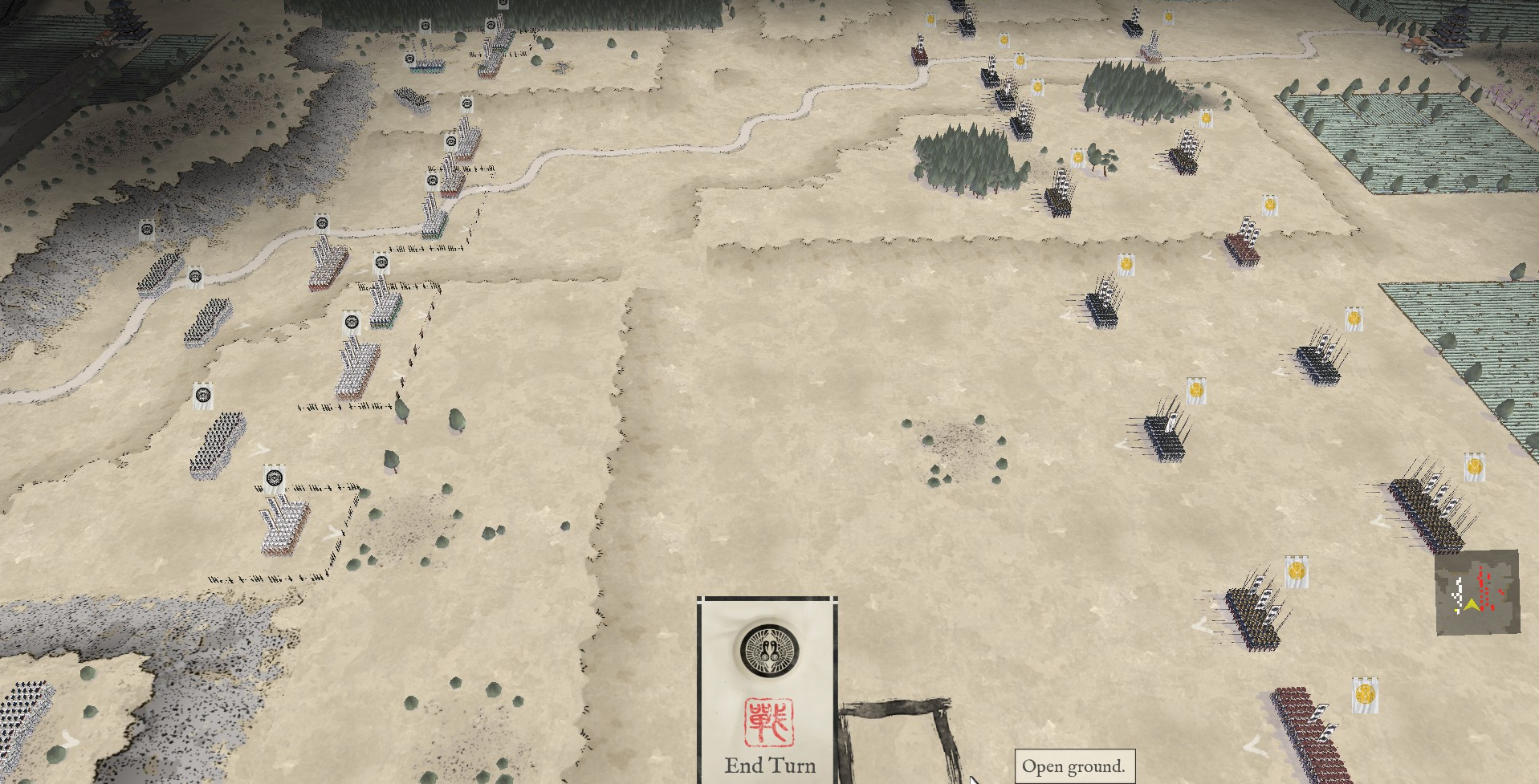
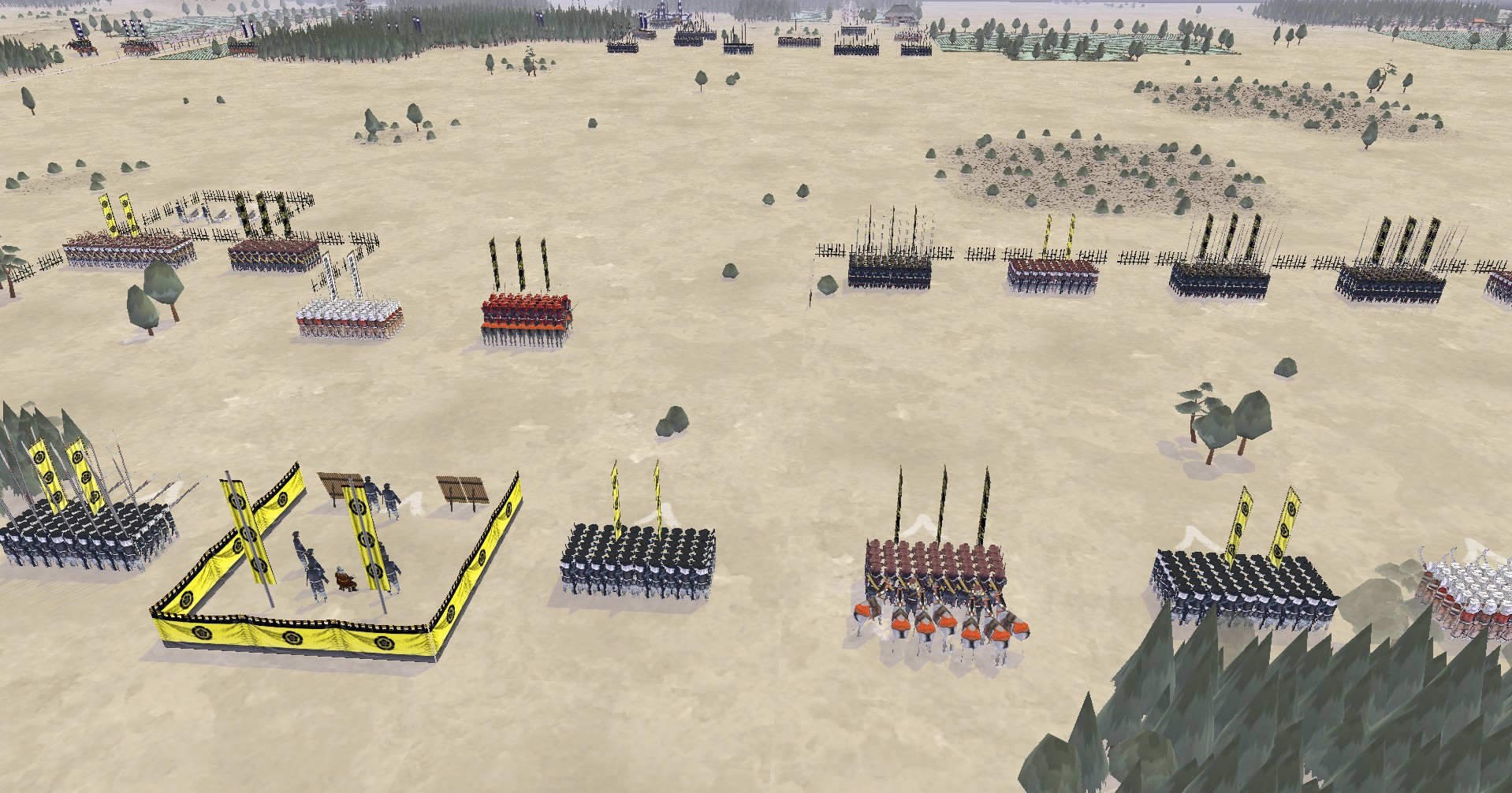
While you’re waiting for Sengoku Jidai: Shadow of the Shogun, you can have a taste of the game by looking at the five new screenshots we just released.
The game is going to be released on Thursday May 19 on PC. It will also be available in a Collector's Edition, containing additional content for the ultimate Sengoku Jidai experience!
http://store.steampowered.com/app/397190/
A Collector’s Edition and a new video for Sengoku Jidai!
Sengoku Jidai: Shadow of the Shogun’s release date is approaching. The game will be released on the 19th of May and you’ll finally be able to fully experience warfare in East Asia in the 16th and 17th centuries.
But we have a special treat for you: a Collector’s Edition will be available, adding extra content to an already extremely rich game!
Here is a breakdown of what is contained in the Collector’s Edition of Sengoku Jidai:
Byeongja Horan Campaign: 1637, the Manchu have invaded Korea, and the Joseon stand alone against the Qing. Will you play as the Joseon and try to expel the invaders? Or will you side with the Qing and complete the conquest of the peninsula?
Genko Campaign: 1282, with the conquest of China almost complete, Kublai Khan turns his glance towards the land of the Rising Sun and demands it bend the knee and pay tribute to his empire. The Japanese refuse, and it leads to war. Historically, a great storm stopped the invading fleet, the “Divine Wind”. But what if there was no storm? Fight the war for Japanese independence in this what-if campaign!
Genko Skirmishes: 4 new army lists are added to the Skirmish mode of Sengoku Jidai, introducing a Yuan army list (Mongol Invasion) and 3 Japanese ones (Hojo and two generic clans called Aoi and Akai). This skirmish module allows you to experience the very different tactics of late 13th century Japanese warfare both against the Mongol invaders and against other Japanese clans.
Field of Glory Renaissance Core Rules E-Book: Do battle with friends and enemies alike with Field of Glory: Renaissance, the miniatures tabletop wargaming rules on which Sengoku Jidai and Pike and Shot were based. Bring history to life as you engage in ferocious combat with the finest armies of the Renaissance world. The Field of Glory: Renaissance rulebook contains all the information you need to play your first epic battle with figurines, terrain, tape measures and dice.
Empires of the Dragon Army E-Book: The 11th companion book for Field of Glory: Ancient and Medieval reveals the secrets of the armies of Asia, from the earliest times until the end of the 15th century, from the samurai of Japan and the forces of the Qin to the elephant hordes of India and Thailand.
Colonies and Conquest Army E-Book: Following in the footsteps of Marco Polo, Colonies and Conquest, the 4th Field of Glory Renaissance Companion, presents the armies and allies of the great civilizations of Asia in the 16th and 17th centuries, as well as the European forces that began to colonize the fringes of Asia.
And that’s not all! We’ve just published a trailer tackling the specifics of the Asian military concepts of the period. The local peculiarities are reflected on the digital battlefields of Sengoku Jidai and understanding them will be crucial to repelling the enemy!
https://youtu.be/Sz8BwSOuZVA
Sengoku Jidai: Shadow of the Shogun will be available for PC on 19th May: are you ready for the clash of spears and swords, the roaring thunder of the teppo guns and the hiss of a thousand arrows?
http://store.steampowered.com/app/397190/
Tale of the Oda Generals - A Sengoku Jidai AAR
As the release date draws near (19th May) Jayson NG, co-developer of the game, has written a beautiful AAR covering a whole campaign!
You can read it here: http://www.slitherine.com/forum/viewtopic.php?f=421&t=72187
Sengoku Jidai - Faction Preview II - China and Korea
Ming Chinese
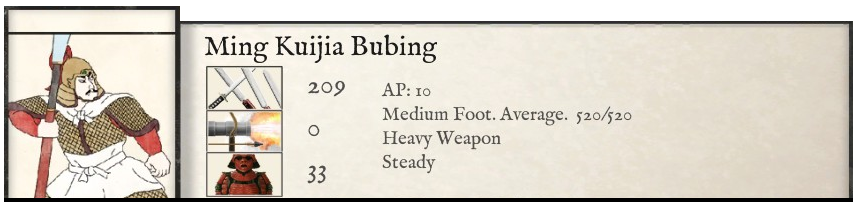
Ming Chinese armies were formed around the Wei-suo tradition where military service was an inherited profession. This ensured the availability of a standing army accessible by the Empire at all times, but as Chinese society embraced Confucian values that shunned wars, soldiers were seen as second class citizens. Training camps and military campaigns were run by civilian bureaucrats (scholars) instead of experienced generals. This led to mismanagement of military resources and low morale. Despite all this, the Ming army was still a viable fighting force and was active in quelling rebellions, protecting the borders and fighting pirates with varying degrees of success.
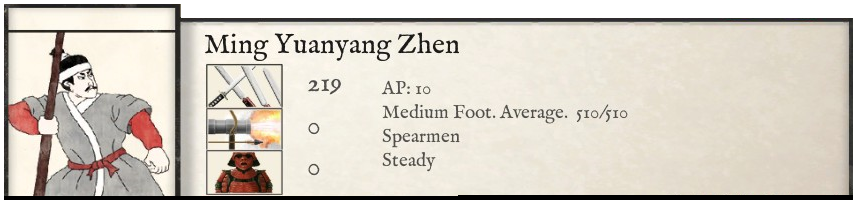
The Chinese employed combined arms tactics. Even at the smallest scale, squads were composed of a mixture of missile and melee troops. This ensured tactical flexibility to suit the ever-changing battlefield situation. These mixed battalions are indicated as “protected” in the game.
The Ming was basically a shooting army and was best suited to fighting their cavalry-based northern rivals like the Mongols and Jurchen. In addition to bows and crossbows, gunpowder weapons were extensively used. These weapons ranged from crude handguns to large artillery pieces. The simplest of all firearms were the antiquated fire lances and handguns. These had poor accuracy and were difficult to reload. Despite these disadvantages, however, they were still used extensively by Northern Ming armies even after the advent of the matchlock. Matchlocks, on the other hand, were more common among Southern Ming armies due to more contact with Western merchants.
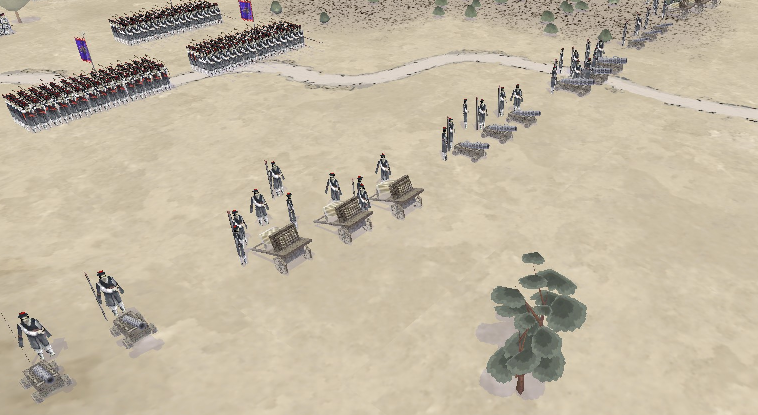
The Ming had a staggering arsenal of artillery pieces of both indigenous and Western design. They also employed rocket arrow launchers. These cannons have evocative names Hu Dun Pao (Crouching Tiger Cannon), Wudi Da Jiang Jun Pao (Invincible General Cannon) or Hong Yi Pao (Red Barbarian Cannon).
Cavalry was important, though Northern Ming armies had more mounted troops than Southern Ming armies. These horsemen were mostly armed with bows and melee weapons.
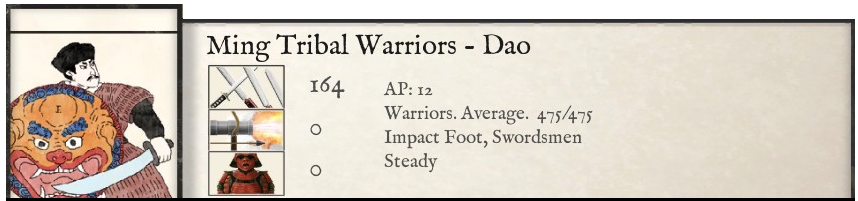
Tribal warriors were often employed in campaigns and were recognised for their fierce charges.
As for personal protection, elite soldiers wore lamellar, scale, and brigandine armour while the regular troops wore padded cloth or no armour at all. Southern troops wore light but sturdy amour made of rattan. In the game, non-elite Ming troops are unarmoured.
Joseon Korean
Joseon Korea also followed Confucian ideals and had a caste system. The population was divided into the yangban (scholarly aristocrats), sangmin (commoners) and cheonmin (lower class and slaves). The yangban held most of the wealth and took on government and military posts. The sangmin were labourers and were subject to conscription.
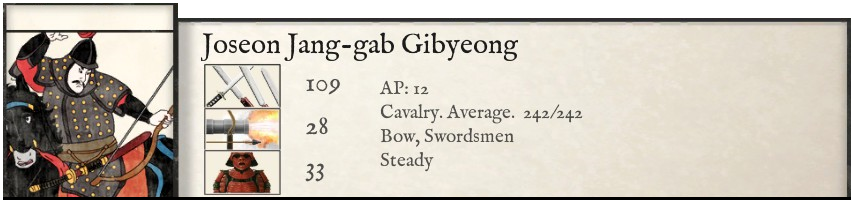
The Koreans had a long tradition of archery and made use of powerful composite reflex bows. A majority of the population practiced archery, especially the yangban and the sangmin who were aspiring to gain status. But a long period of peace degraded the military’s efficiency and it was considered as a mere rabble when the Japanese invaded in 1592. The best troops were the Northern Cavalry (horse archers) which defended the borders against the Jurchen. Much of the cavalry arm was destroyed by the Japanese during the battles of Chungju and Imjin River. The Sogo system was introduced in 1593 so that the Koreans could build a new professional standing army.
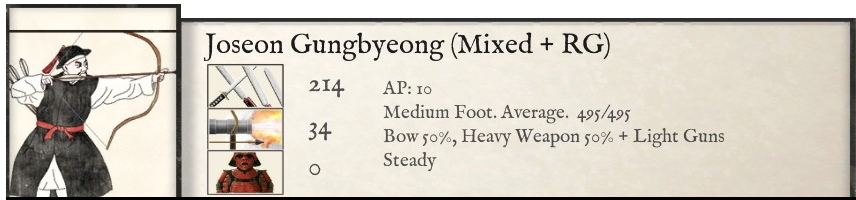
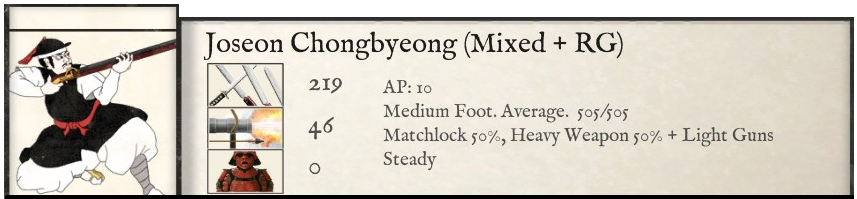
The Korean army was organized into battalions of mixed ranged and melee weapons. The most prominent missile weapon was the gakgung (composite reflex bow). Prior to the invasion, the Koreans did not bother adopting firearms because of the accuracy and speed of their bows. But bows proved to be inadequate against Japanese armour and tactics. They soon learned that the matchlock, though individually slow and inaccurate, could be quite devastating when fired en masse.
The Sogo reform recognised the importance of firearms. In close combat, the Joseon used a variety of polearms in the form of spears and tridents. These are classified as Heavy Weapon in the game.
Like the Chinese, the Koreans possessed several forms of artillery including the famous Hwacha rocket arrow launcher. Artillery was an important factor that contributed to the success of the Korean navy.
Korean soldiers were largely unarmoured except for the heavy mounted troops and generals, who wore brigandine armour.
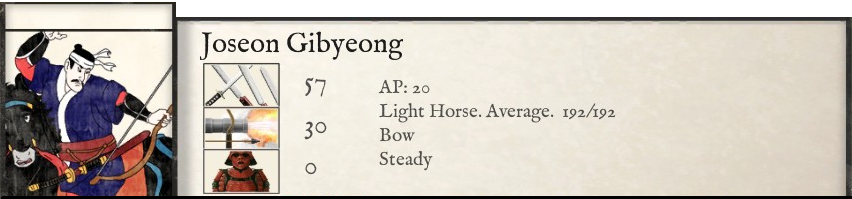
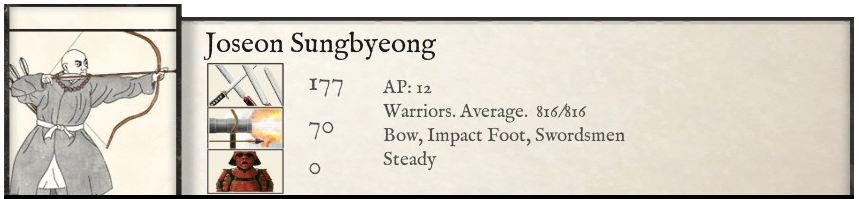
During the Imjin War, resistance fighters called the uibyeong (righteous army) performed guerrilla raids and provided support during battles. They wielded various ranged and close combat weaponry and were sometimes thought to be better than the regular Joseon troops. Buddhist monks called the sungbyeong also joined the fight against the Japanese and gained a reputation for ferocity and bravery on the battlefield.
Sengoku Jidai Art of Command video!
We have just published a new video to show you gameplay footage one of the most interesting features of Sengoku Jidai: generals.
Generals influence the gameplay greatly by having an effect on all units under their command, they can be attached to units and even take part to personal combat against enemy commanders!
If you want to know more, just watch the video:
https://www.youtube.com/watch?v=hAFdScxwFyM
Sengoku Jidai: Shadow of the Shogun is due to release on PC on May 19th. Stay tuned for more news!
The Battle of the Two Hills - A Sengoku Jidai AAR
Greetings everyone and welcome to this AAR of Sengoku Jidai: Shadow of the Shogun, the new game in development by Byzantine Games and due to release on 19th May on PC.
Today we’ll fight a Skirmish Defend field battle on a Woody terrain. Skirmish battles are fought on randomly generated maps between two different army lists which can be selected or randomized. The map generator in Skirmish mode is impressive: it creates realistic battlefields with geographical features which have to be exploited to gain tactical advantages.
We’ll lead the Ikko-Ikki, an anti-feudal militant movement composed of zealots, monks, rebellious peasants and some landless samurai. Our army reflects that social composition. We have many peasants, nothing more than armed rabble in truth, and we can’t really rely on them on open field. Then we have a few battalions of warrior-monks, wielding bows, “teppo” matchlock rifles and polearms; they are highly trained, and some of them even wear armor. Our army numbers 13,000 men, roughly.
We are facing a strong Tokugawa army. They brought many professional armored troops carrying long spears (the yari) and fighting in thick formation, as well as regiments of archers and gunners and some cavalry. They also brought some battalions of Samurai and Ashigaru warriors wielding katanas: they fight like in the old times, man-to-man. Our scouts estimate that the Tokugawa army is around 11,500 strong, so we’ll have the advantage of the number. That doesn’t mean much though: the soldiers we are facing are better equipped and better trained than most of our army. We’ll have to make the best out of this terrain, then.
Terrain in Sengoku Jidai: Shadow of the Shogun is extremely important. Battles are won and lost by making the right placement of troops. We have taken up a strong defensive position: our left flank is covered by a thick forest, our right flank is protected by a steep hill, and we have erected a long line of field fortifications to defend our center, which is crossed by a long valley and a road. Should we be overrun we can fall back to the hills behind us as last measure.
The outcome of this battle will be decided at three different spots:
1) The forest, to our left. We can’t allow the enemy to advance through it, as they might just march past our lines and occupy the hills behind our backs. Therefore the control of the woods will be of mandatory importance. We have deployed a large group of warriors and gunners on the nearby hill, ready to intervene and intercept any move by the enemy. Possibly, they might attempt to cross the forest themselves to attack the enemy army on the flank. They are led by general Harunobu.
2) The center. It’s protected by field fortifications, which unfortunately have some narrow gaps in them. We can expect the enemy to try and penetrate these gaps, therefore we are placing our best warriors there, our highly trained warrior-monks. They will close any gap, and allow our gunners to unleash hell from behind the fences on the advancing ranks of the Tokugawa. It will be vital to decimate the enemy before it draws too near. The center is commanded by general Tsuneoki.
3) The steep hill to our right flank. It is a highly defensible position, and our peasants could be of use there as they might be able to stand their ground. Some of them are armed with matchlocks, and could fire constantly on the enemy, taking advantage of their high position. The right is held by general Kunitatsu.
We keep a reserve behind our center: peasants, and a battalion of monks armed with teppo rifles. There, the commander in chief of the whole army, general Toshisato, oversees over the whole battlefield from an elevated position.
The enemy is organized in a checkered formation, and its advance is orderly and precise. Soon they’ll be on us. They have deployed their best armored troops at the center and to our left flank, and most likely they’ve considered the tall hill to our right a tough nut to crack, but they are bringing their archers there: with their longer reach they outrange our gunners and could possibly fire a rain of arrows on our heads, forcing our peasants to abandon their position.
But that’s not the main concern of Toshisato. It seems in fact that a large concentration of Tokugawa soldiers is approaching the woods while the bulk of the enemy army is marching towards the center! Even worse the enemy might try to pass around the forest with its cavalry, as there is a narrow clear path directly leading to our back!
There is no time to waste. Orders are dispatched, and the reserve is deployed. The gunners are sent in the woods where they will engage and slow down the enemy advance, while a large group of peasants is sent to the hills at the rear flank of the Ikko Ikki army. Toshisato doesn’t think they can really repel the enemy cavalry, but they will surely slow them down and buy time.
But it’s the center where the first blood is spilt. The Tokugawa general, Nobumori, wastes no time, and orders a full assault on the whole line of Ikko Ikki’s defence. The rebels answer by unleashing fire on the enemy, opening large gaps in the tight formation of spearmen.
The Tokugawa advance is relentless, nonetheless, and the battle is fierce. Thousands of spears clash on the Ikko-Ikki ranks, with teppo fire causing great damage on both sides. The Tokugawa try to penetrate the line of defence by focusing their attack on the gaps between the fortifications, something which, if successful, might bring them through and past our lines. It’s a real danger, considering that most of the Ikko Ikki reserve has been deployed to the forest and there wouldn’t be enough troops to stop a breakthrough.
The Tokugawa don’t seem to be able to pierce the defence line, however. Their morale suffers a huge blow when the general commanding their right flank, Kuninosuke, is killed while trying to conquer a hill nearby the forest.
The battle rages on. The Ikko Ikki gunners reach the outskirts of the forest and open fire on the Tokugawa reinforcements, but they are charged. Bitter fighting ensues, and the gunners are forced to fall back, but they still delay the enemy advance.
To our right, the enemy continues to rain arrows on our forces and makes an attempt to attack us there and conquer the hill, but they are pushed back.
The Tokugawa seem unable to make any progress near the road, and keep attacking stubbornly, always being repelled and leaving many dead on the ground. In the meanwhile, their cavalry seems to have reached our peasants protecting our rear flank. They are held for they are attacking uphill, but for how long can our peasants stand this furious attack?
By turn 8, things change for the worse for the Ikko Ikki: at great cost, the Tokugawa finally manage to break through the rebel defence line to the right of the road, with more battalions quickly entering through the gap, while to the left our gunners have been forced to retreat. We are losing the forest and there is a breakthrough in the center!
It was a bloodbath, though. The Tokugawa paid dearly for any step forward, and they are exhausted. The whole center of the Tokugawa collapses as a group of heroic monk-warriors leads a frontal charge and sets the enemy on a route, and general Tokugawa Nobumori is felled by a polearm.
In the meanwhile, our gunners and archers have retreated to the hills and are unleashing hell on the feudal forces in the woods and the ones they have managed to breakthrough, who now find themselves cut off from the rest of the army!
Two Tokugawa units, including the cavalry which rode around the woods, have managed to get past our force but they are in no condition to do great harm to us as the rest of the enemy army has been routed.
We turn to face them and intercept them, and they wisely decide to retreat. The Tokugawa assault has been repelled and the Ikko Ikki won the day, killing, wounding or capturing nearly half of the enemy army!
In Sengoku Jidai: Shadow of the Shogun battles are always a close call. Good maneuvering, correct placement of troops and right choice of terrain as well as simple luck sometime can turn the tide and reverse the fate of a doomed situation. You can never feel too confident of victory, as the AI will exploit any sign of weakness. This time we managed to defeat the highly competent AI, but we had a really good starting tactical position.
Despite this advantage, the AI still managed to give the human player a run for their money.
Sengoku Jidai - Faction Preview I - Japan
Sengoku Jidai: Shadow of the Shogun offers the opportunity to lead armies from very diverse regions and countries: Japan, Korea, China, Manchuria and Mongolia.
We’ll cover each region in weekly previews, describing the available army lists, talking about their evolution and the weapons and tactics they employ.
Japan and its clans
Japan in the 16th century was a politically fractured reality: the Sengoku Jidai period (Warring States Era) was a period of civil war in Japan from 1467 to 1600. During that time, the Emperor of Japan was only a religious and ceremonial figure who delegated power to the Shōgun, the military governor of Japan. The era began with the Ōnin War (1467-1477) where a dispute between potential heirs to the Ashikaga Shogunate led to a civil war involving several daimyō and the destruction of Kyoto. Since then, the authority of the Shogunate had diminished while the daimyo increased their authority over their fiefs and fought against each other to expand their realms.
The era brought about the rise and fall of several prominent clans. Old families like the Imagawa and Hōjō would be eliminated. Some families would break away from their old masters and forge a path of their own, like the Tokugawa. The Takeda family, hailing from an agriculturally poor province, dominated central Japan through exploitation of their gold mines, and employed cunning military and political strategies against their neighbours. Peasants could become lords and make a name for themselves, like the Toyotomi.
A late Oda army defending behind field fortifications against the Aoi
The armies of the Sengoku Jidai were manifestations of the feudal social structure of Japan, which revolved around kinsmen and vassals. The head of the clan and its army was the daimyō, literally translated as “great name”. He was supported by the kashindan. These were a group of blood relatives and retainers associated by family ties, marriage, filial oaths, and hereditary vassalage.
A standing army was uncommon but was popularised during the later years of the Sengoku Jidai. For the majority of the period, armies were composed of farmers who needed to stand down during the planting and harvesting seasons.
Typically, when a call to arms was issued, each landowning samurai was required to muster a pre-determined quantity of troops and equipment based on his wealth. Troops from all around the province would then converge at a designated place where they would be reorganised into battalions wielding similar weaponry and start practicing drills. The daimyō determined the chain of command for the campaign. The prominent retainers would act as bushō (general). A taishō (field marshal, commander-in-chief) would be appointed if the daimyō did not intend to take the role himself.
Each general commanded a division comprised of specialised battalions of cavalry, missile and melee troops mustered from their fiefs. These troops were only loyal to their direct lord and the daimyo, not the taishō or other generals. To reflect this, Japanese commanders who are not assigned as the Commander-in-Chief are classified as Ally-Generals. Their units cannot receive any command effects from other generals except the C-in-C.
The Japanese wielded a variety of weapons, the prominent ones being the katana (sword), yari (spear), naginata (polearm), yumi (bow) and teppō (matchlock). Contrary to popular depictions, the katana was just a sidearm and the yari was the weapon of choice due to its range and versatility. All classes of soldier, from the lowly ashigaru to the elite samurai, wore armour of lamellar construction.
Before 1530, mounted samurai would primarily use bows, similar to other East Asian cavalry. The switch to the yari and shock tactics happened around the 1530s, pioneered by the Takeda clan.
The main fighting force was foot samurai, augmented by ashigaru. Due to the rugged terrain, the Japanese utilised loose formations and fighting was done man-to-man, as depicted in martial arts and samurai films. Hence they are classified as Warriors.
In 1543, Portuguese merchants introduced matchlock firearms (teppō) to the Japanese. Teppō ashigaru infantry were deployed, but there weren’t enough firearms available to equip large units. These small units are classified as Light Foot and are primarily used as skirmish troops.
By 1551, as battles grew larger, more and more ashigaru infantry were being mustered, as a result of which the proportion of foot samurai in the army was somewhat reduced. The Battle of Nagashino in 1575 showed the Japanese that massed volley fire from firearms behind field defences could defeat samurai cavalry. From then on, teppō ashigaru formations were larger and did not engage in mere skirmishing tactics.
By 1577, samurai cavalry had lost its appeal due to changes in battlefield technology and tactics. And by 1592, ashigaru infantry tactics evolved into fighting in close formation. They would receive better training and form the backbone of the Late Sengoku Era army. Ashigaru infantry, including yumi and teppō armed units, are now classified as Medium Foot. A century of fighting also depleted the numbers of available samurai. Just like their mounted counterparts, foot samurai, who still fought man-to-man, were finding it harder to dominate the battlefield against organized peasant foot troops. The 1590s also introduced some other elements of modern warfare such as light artillery, but these were not used as extensively as on the Asian mainland.
Warrior-monks
Buddhist monks of various temples also trained for combat. They had to take up arms in order to protect their temples from rival sects. These warrior monks were called sōhei. During the Gempei War (1180-1185), the sōhei eventually became embroiled in secular politics as they joined the lords that supported their temple. This was repeated during the Sengoku Jidai and the daimyō were able to gain the support of sōhei from their local temples.
The monks’ weapon of choice was the naginata, a long-bladed polearm. They also used bows and matchlocks. Occasionally, they can be seen wearing armour underneath their robes but the majority were unarmoured.
Ikkō-ikki
Alongside the various japanese clans, you can also lead a different type of army which finds its origin in feudal Japan: the Ikkō-ikki. It was a militant movement which followed the beliefs of the Jōdo Shinshū (True Pure Land) sect of Buddhism which taught that all believers are equally saved by Amida Buddha's grace.
The Ikkō-ikki revolution gave some sōhei a new purpose. Instead of fighting for their temples and patrons, they fought under an ideology of equality and independence from the daimyō. Ikkō-ikki rebel armies were mostly made up of sōhei and supported by armed peasant mobs. Samurai who shared their ideals also joined but did not form separate units. The samurai fought alongside the monks and peasants and provided leadership as well as training.
Sengoku Jidai: Shadow of the Shogun - Teaser & Release date!
Japan, in the second half of the 16th century.
For two hundred years the central power of the Ashikaga Shogunate has been progressively eroded by rebellious local daimyo. Decades of struggles among the warlords have divided the country and now they verge upon open war.
With the succession to the shogunate in doubt and a nation in economic distress, it is a time of reckoning for the noble families and their retainers, the Samurai.
This is the time of great and ambitious lords, a time of honour and betrayal. This is the time of the nation at war.
This is the Sengoku Jidai!
https://www.youtube.com/watch?v=dWNpq4NU208
Sengoku Jidai: Shadow of the Shogun is a turn-based tactical and strategic game set during this turbulent age. Developed in collaboration between Jayson Ng, an active member of the community, and Richard Bodley Scott, the mastermind behind Field of Glory and Pike & Shot, this title is a breath of fresh air in wargaming. The game’s intent is to reproduce with high fidelity the Japanese Way-of-War of that time, thanks to an efficient UI and deep gameplay. It builds on the highly successful predecessor Pike & Shot: Campaigns, adding some new features such as battlefield generals, interesting twists to the strategic campaigns system, fifteen historical battles from the Sengoku Jidai and the Imjin War, three historical campaigns, one sandbox campaign, and skirmish army lists from Japan, Korea, China, Manchuria and Mongolia covering the 16th and 17th centuries!
The game is coming out on Steam on May 19th, and is currently on beta.