Ever wondered what it's like commanding a tank platoon and troops from inside a Sherman tank? Well, buckle up, because we're about to take you on an exclusive tour!
Your Command Center
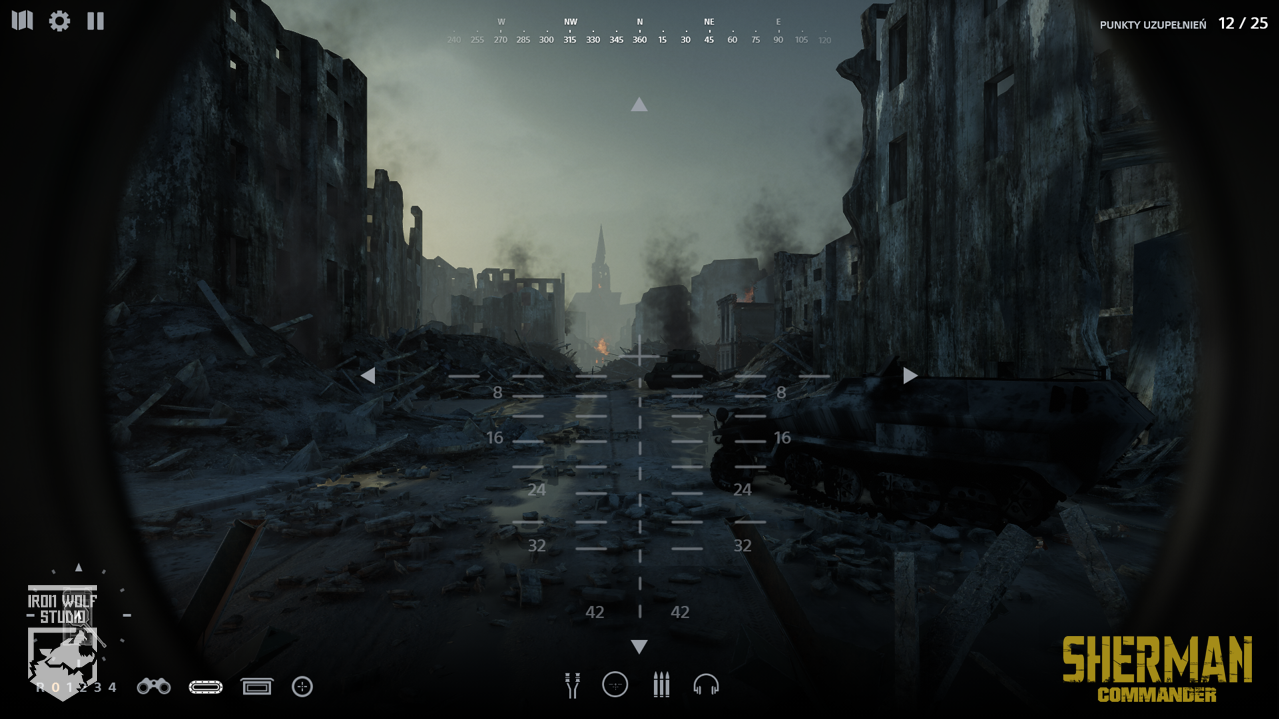
Picture this: you're seated in the commander's seat, surrounded by the hum of the engine and the anticipation of battle. Look up, and you'll find yourself greeted by the panoramic view of the battlefield through our 360-degree periscope. No more guesswork, you've got eyes on every angle.
But that's not all. Take a peek through our fixed viewports, strategically positioned to give you six unique vantage points. Need to lock onto a target? No sweat. Our weapon sights are synced up with turret movement, ensuring your aim is always on point, whether you're engaging with the main gun or the trusty coaxial.
Giving Orders
As the commander, you're the maestro of this metal orchestra, directing your crew's every move with finesse. Want to roll out? Just give the order, and your driver will get you moving. Need to pivot on a dime? Tell your crew to "Clock" it or "March on" to your next target. And when it's time to unleash hell, coordinate your gunner's fire with precision, whether you want it on your mark or on their own.
And let's not forget about your loader and bow gunner. They're your right-hand crewmates, ready to load up whatever ammo you need, from high-explosive rounds to armor-piercing shells. And that 30-caliber machine gun? It's your secret weapon, packing a punch from the hull.
Navigating the Chaos
In the chaos of battle, navigation is key. Luckily, we've got you covered. Keep your bearings with our dynamic compass, guiding you through the fray with ease. And don't forget about our trusty map (currently a work in progress), your bird's-eye view of the battlefield.
With clear markers for friendlies, hostiles, and key objectives, you'll never lose your way.
Ready for Action?
So, are you ready to command the battlefield from inside the Sherman tank? Get ready for an adrenaline-fueled experience. Strap in, lock and load, and prepare to dominate the opposition. Victory is within your grasp!
It's time to show you some of the real deal! So far, you've had the chance to learn a bit about infantry (Creating Realistic Soldier Character Models), see the streets of Aachen (Battle-Ready Urban Jungle), or the open fields of Normandy (Exploring the Open Fields of Normandy) where epic battles will take place. Today, let's talk about the heart and soul of any tank game: the vehicles, or how they move, to be precise! But, let's remember that everything you see is still a work in progress.
As you probably already know, Sherman Commander will feature many vehicles from the World War II era, including, of course, the titular Sherman (M4A3E8). On the battlefield, you'll also encounter units such as the American Sherman M4A3, M10 Wolverine, M8 Greyhound, M3 Halftrack, Willys Jeep, and from the German side - PzKpfw IV Ausf. G, Panzer V Panther, Panzer VI Tiger, Panzer III J, Panzer III M, Panzer II C, StugIII G, Sdkfz 251, Kubelwagen, and Opel Blitz.
Each vehicle naturally has different parameters, affecting its speed, maneuverability, or the ability to overcome obstacles. Certainly, how a vehicle behaves on a given terrain will be also influenced by whether the vehicle has wheels, tracks, or both. 🙂
We'd also like to draw your attention to how vehicles behave when overcoming obstacles, specifically the work of wheels and tracks. They react to every unevenness encountered, adding realism to the visual side of the game and making overcoming them just look cool!
Let's go back to the obstacles for a moment, as we'll encounter them quite often, and they'll often have strategic applications and a clear impact on the course of battle. While most vehicles will be able to handle bomb craters or small hills, then again, hedges, walls, or larger elevations will only be passable by tracked vehicles.
We'll be coming back to both vehicles and obstacles in future posts. Let us know in the comments how you like what we've shown you so far!
Dev Diary #9: Exploring the Open Fields of Normandy
Hey, Tank Commanders!
In our previous peek, we delved into the urban chaos of Aachen. Now, let's venture into the challenging landscapes of Normandy. It's not just pretty scenery, it's where strategic warfare takes center stage.
Normandy, rich in history, is a place where Allied forces faced a maze of obstacles, both natural and man-made. From hills and tree lines, through rivers and ponds, all the way to fences, stone walls and the famous hedgerows which posed some of the most serious tactical challenges for the attackers in this phase of the war. Not only did these barriers limit visibility, but also channeled the attackers into killing zones, where German defenders were dug in, with concealed anti-tank guns trained on the most probable vectors of approach. Overcoming these challenges often required innovation, such as tank-mounted "salad forks", allowing tanks to break through the hedgerows and open new pathways for the infantry.
Thick forests may impede movement, offering opportunities for ambushes. Destructible fences and walls allow for creating new pathways, and capturing crucial bridges and fords will often be key to victory. While small bridges accommodate only infantry, larger ones will allow tanks to cross, thus becoming pivotal points that demand careful consideration. Rivers, though beautiful, might prove insurmountable obstacles, potentially altering the course of the battle.
Normandy's rural charm unfolds with scattered villages, rustic houses, and barns dotting the picturesque countryside. As peaceful as it might seem, the environment is a maze of death traps, illustrating the scope of predicament that the Allies faced during the Normandy breakout. In this challenging theater of operations, only commanders with a keen eye and tactical acumen will gain the upper hand over the enemy.
So, gear up, Commanders, as we embark on a journey where the fields of Normandy become the battlegrounds of strategic brilliance.
All best, Sherman Team 🔗 https://linktr.ee/ironwolfstudio 🗨️ https://discord.gg/qcDF2ZZ
We're back on the battlefield again, and it's not necessarily the last time we talk about locations and environments. Recently, we've been working intensively on the scenery for the battles, and we want to share the progress with you. If you missed our previous post regarding environment, no worries, you can find it here and read later.
In the immersive world of Sherman Commander, the battlegrounds are as diverse as the challenges they present. From dense urban environments to more open fields, players find themselves navigating a variety of terrains, each demanding a unique strategic approach. This diversity requires players to adapt their tactics dynamically, keeping them on their toes and ensuring no two battles are alike.
As the commander, one must consider every inch of the battlefield, utilizing cover provided by urban structures, employing flanking maneuvers in open fields, and strategically positioning units to gain the upper hand.
The significance of barricades cannot be overstated. These makeshift barriers not only influence the flow of battle but also serve as crucial elements for both offense and defense. Smart commanders will leverage barricades to their advantage.
One of the standout features is the dynamic destructibility of the environment, including barricades, of course. As the battle rages on, structures crumble, leaving behind ruins that serve as a testament to the intensity of the conflict. This not only adds a layer of realism but also introduces a dynamic element to the battlefield, forcing players to adapt their strategies on the fly.
Day and night cycles further intensify the experience. The transition from daylight to darkness not only impacts visibility but also alters the overall atmosphere. Night battles bring an added layer of tension, emphasizing the importance of reconnaissance and awareness.
In Sherman Commander, every battlefield tells a story, and every engagement becomes a chapter in the larger narrative. As we delve into the intricacies of various combat scenarios, we invite players to join us in this journey, where adaptability is key, challenges are diverse, and victory is the sweet reward of tactical prowess.
As this is the last post of the year, the entire Iron Wolf Studio team wishes you all the best in 2024, many great games, and, of course, good health! ːsteamhappyː
Today, we're pulling back the curtain to give you a behind-the-scenes look at the incredible world of motion capture… or mocap for short.
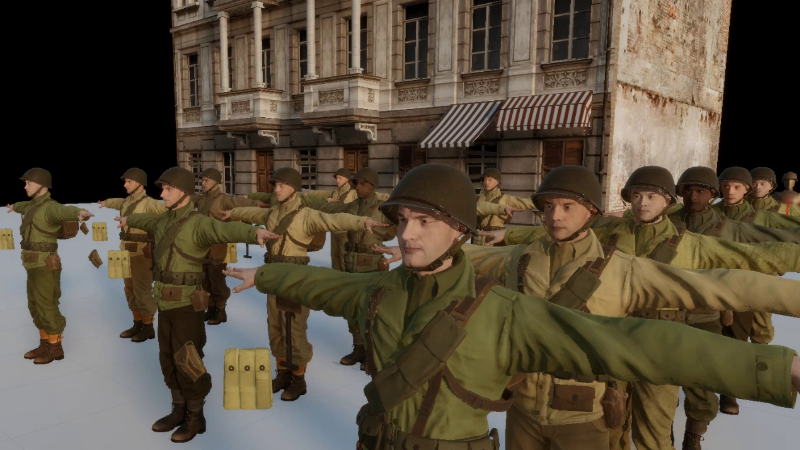
Mocap is the technique of capturing real-world movements and translating them into lifelike animations for our game. It's like magic, bringing our characters to life with stunning realism. These mocap sessions are a crucial part of Sherman Commander's development, ensuring that every enemy seen on screen won't move like a robot.
To achieve this, we decked out the most athletic among us, the seasoned veteran of countless paintball skirmishes - Bartek, the CEO of Iron Wolf Studio, in a one-of-a-kind suit, and... we had him run, roll, and do many other things, until he finally got tired. Feast your eyes on the outcomes below!
And that's all for today. Stay tuned for more updates!
All best, Sherman Team https://linktr.ee/ironwolfstudio
Dev Diary #6: Introduction to Sherman Commander… Better late than never!
Hey, Tank Commanders!
Let's kick things off at square one, shall we? This is where we outline the main premise behind Sherman Commander, as it seems that many folks are still in the dark about what our game is going to be. So, consider this your SC101, as we're about to shed some light on what the game actually is about.
In the virtual realm we're crafting, you're not just a player; you're a Sherman tank commander, cast into the heart of the intense battles of 1944, right after the Normandy landings. Now, here's the catch: Sherman Commander is not your run-of-the-mill war game. It's a dynamic blend of real-time armored command and tactical warfare.
Your Role as a Commander In Sherman Commander, you take charge of a Sherman tank, the M4A3E8(76), and issue commands to your crew plus four additional Sherman tanks (M4A3(75)W), as well as infantry squads. You'll also have the power to request off-map support and deploy additional units.
As the commander of your tank, you'll take charge of your crew and communicate with them exactly as a real commander would on the battlefield. It is nowhere near the simplified approach where you operate the whole tank. Instead, this time you are the titular COMMANDER, and thus you order the driver, the gunner, the loader, and the bow gunner so that they can perform their tasks as a well-coordinated fighting unit. It is a steadier, more realistic take on armored warfare where everything happens a little more slowly and more in accordance with how a crew composed of five human beings would work together.
On top of that, you will have contact with various allied units over the radio, including your platoon’s tanks, as well as multiple infantry squads, allowing you to make pivotal decisions across the battlefield. This fusion of command styles is crucial as you guide your forces through historically significant locations like the battlefields of France and Germany in 1944.
And this is the crux of it all: the mixture of genres and command styles. On the one hand, you'll experience the action firsthand from within the bowels of the Sherman tank itself. You'll govern the tank by peering through periscopes and the open hatch while barking orders at your crew members. On the other hand, you will coordinate your tank platoon, the nearby infantry units, AND off-map support in order to make the most of the combined arms entrusted to you. It is like merging a historical milsim with a tactical RTS to deliver ultimate immersion and unprecedented control over the battlespace.
Leading Your Troops Therefore, Sherman Commander presents an exciting mix of simulation and real-time command on the tactical level. Your battleground spans two interconnected domains: the Sherman Tank’s commander’s cupola and the Tactical 2D Map.
You'll oversee up to 15 infantry squads alongside your five-tank platoon (composed of your tank plus four remaining ones). On the 2D Map, you'll build your strategies and coordinate an assault on enemy positions. This entails positioning units, issuing directives, and summoning off-map support.
Therefore, as you can see, our goal is to create something more than a mere simulator. We are aiming for total immersion in a dynamic, thriving battlefield where what happens inside the metal beast is just one side of the coin, and the evolving situation in the theater of war is another.
Stay tuned for more! In the next updates we'll deliver more details on game modes, mechanics and all the good stuff making Sherman Commander worth waiting for.
All best, Sherman Team https://linktr.ee/ironwolfstudio
Get ready to storm the virtual streets of history in Sherman Commander! Our team has dedicated many hours, pouring sweat and blood into recreating authentic city architecture straight from the World War II era. This ain't no ordinary cityscape – we've gone the extra mile to make it historically accurate.
When it comes to developing historical games, it is crucial for the environment to accurately depict the reality of the time period, including its architecture, of course. That's why we delved into historical archives, unearthing footage of cities such as Aachen during World War II, carefully examining the photos and paying attention to everything that was characteristic of the time period. And not only was it worth it because we learned a lot about the architecture of that era, but we were also able to incorporate tons of small details into Sherman Commander.
That being said, we decided not to compromise to make the streets look real. It's not a matter of simply recreating the architecture. The devil is in the details. One remarkable example is our recreation of advertising signs that added character to those cities instead of being mere distractions like they are today. We couldn't simply overlook them. Instead, we invested efforts in capturing their essence.
We couldn't forget about the advertising poles that can still be found on many streets today.
And we also didn't forget about the roads, which are largely covered with the characteristic cobblestone of that time period…
And of course, we have the pigeon lofts, too!
That's not all! These constructions and other obstacles, like street lamps or wooden wagons, are not indestructible, and are also a great hideout for the enemy! You’ll never know if they are hiding inside a building, waiting for the right moment to rain fire from the windows. Fortunately, you've got the power to take those structures down, just like you would be in real life. It's going to be quite a battlefield. We will definitely come back to the subject of destroying the environment and enemies, cause there’s a lot more to tell.
So, gear up and get ready to face the urban jungle like never before. Dive into the gritty streets of history, as we bring the WWII city streets to life in Sherman Commander!
If you've been following our blog, you may remember our previous post on creating realistic soldier character models. If you haven't had a chance to read it yet, we highly recommend giving it a look - LINK.
In our quest for historical accuracy and immersive gameplay, the Sherman Commander team leaves no stone unturned when it comes to the authentic portrayal of German uniforms. Today, we delve deeper into the intricate details that bring these uniforms to life, capturing the essence of World War II.
When comparing German and American soldiers, one notable distinction lies in the diversity of their uniforms. German battledress exhibits a rich variety of styles and colors, presenting a unique challenge and an enjoyable creative endeavor for our team.
Both garrison units (wearing standardized issue uniforms) and frontline and elite troops (with a mixture of different uniform elements) contribute to this diversity. This variety allows us to create a historically accurate visual representation of German soldiers, combining elements from different units that fought in different theaters of operation.
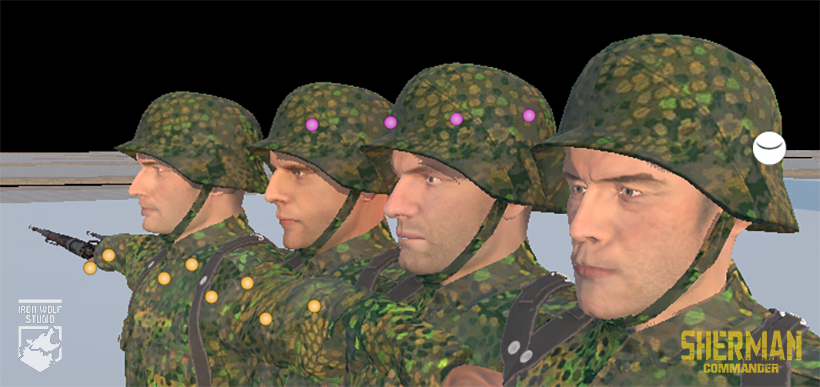
As mentioned in our previous post, our custom shader system takes uniform customization to the next level. For example, by adjustments in hues and saturations, we can infuse each uniform with its own distinct character. This is particularly true when it comes to German soldiers, as the diversity of their uniforms is often greater than that of other forces, such as the Americans. The varying conditions they faced on the battlefield, from fighting in the scorching sun to the muddy and rainy environments, left a lasting impact on the color palette of their uniforms. This unique aspect adds another layer of authenticity to our portrayal of German soldiers in Sherman Commander.
To capture the diversity of facial features among our character models, we have developed a series of base head designs, onto which we apply various textures. This ingenious technique allows us to create a wide array of unique faces, capturing the distinctiveness of German soldiers. From different facial structures to varying hair colors and styles, our soldiers embody the diversity found within the German military.
Sherman Commander features a variety of German military units, including the panzergrenadiers, tank crews, as well as the remnants of the Wehrmacht, elite Fallschirmjäger (paratroopers), and a mix of various SS units. These diverse forces represent the different facets of the German military during World War II, each bringing their unique skills and experiences to the battlefield. The uniforms worn by these soldiers epitomize the historical accuracy we strive for, representing the appropriate uniform for their respective units.
Drawing upon original references, such as color swatches for uniforms, caps, or trousers, we ensure our designs align with the historical accuracy of World War II-era German uniform. It is important to note that while we aim to represent German uniforms faithfully, we have consciously chosen not to depict SS insignia, recognizing the sensitivity surrounding such symbols.
As we progress in the development of Sherman Commander, we are excited to share more insights and behind-the-scenes details about the creation of Sherman Commander. Stay tuned to our blog for future updates!
Dev Diary #3 - Creating Realistic Soldier Character Models
In Sherman Commander, we take every detail of our game seriously, so occasionally we’ll be veering from tanks in our blog posts. But hey, there’s a lot going on behind the scenes, especially on the character creation front. One of the key aspects we are working on is the diversity of faces. We believe that representation matters, so we have prepared a wide range of facial features and skin tones for the soldiers representing the United States. We want our soldiers to reflect the real-world diversity of the military.
In addition to diverse faces, custom shaders will play a vital role in creating realistic models. These shaders allow us to achieve natural lighting, shading, and material properties that enhance the visual fidelity of our soldiers. From realistic fabric textures to metal reflections and skin subsurface scattering, our custom shaders will add that extra touch of realism to our characters.
Now, about those uniform sets and accessories. We have designed different sets of uniforms and accessories for our soldiers to ensure authenticity and attention to detail. While players won't be able to customize the appearance of their soldiers in-game, our team of talented programmers and artists have worked tirelessly to create a wide variety of combinations.
We have also created different head meshes to add further diversity and uniqueness to our soldier characters.
Creating realistic models is a meticulous process that requires a keen eye for detail and a commitment to accuracy. We believe that these realistic characters will enhance the overall appeal of our game.
We hope you enjoyed the above glimpse into our development process. We will do our best to keep you updated on our progress as we continue to strive for authenticity in every aspect of our game. Please stay tuned for more exciting updates!
Work on the realistic reconstruction of vehicle models is still ongoing. This time we want to present German armored vehicles:
Panzer IIIJ
StuG III
Panther A
Our goal is to recreate, in an as realistic way as possible, the combat conditions that commanders of Sherman tanks had to face.
We have implemented a 24-hour cycle and a dynamic change of lighting, which affects the range of observation and recognition of the battlefield.
The ability to destroy any object that is within the Sherman's armament range is one of the most important elements in the game.
Some passages are blocked by high walls or fences. There’s nothing that can stop you from destroying them and opening the way for infantry units:
The number of shells in the tank is limited and not every target requires a cannon. We can use the HMG mounted in the hull or the turret to destroy infantry units and smaller obstacles:
Thank you for your unwavering support - we are eager to share our continued growth and achievements with you!