As the first wave of bug reports and feedback rolls in, I've got the first patch to ready to roll out to address it.
Change Log
Fixed bug where first person camera was too high.
Fixed a bug that was causing a massive drop in FPS when looking at the cyberdeck
Adjusted spawn height and added a delay between spawning the players and generating the node to help prevent players from falling through the floor.
Fixed a bug causing the System Log window to show up in every node.
Adjust the spawn location of IC in the Low Security Datastore node.
Increased the range that players can lock onto IC, making it easier to Analyze them before combat begins.
Fixed a bug that caused the mouse cursor to disappear when using escape to close the Hardware tutorial.
Added simple cinematics for lying down and getting up from the diving chair.
Added the 'Log' command to all starting programs (requires a new game). This briefly displays the actual code of the program when the program is ran.
Changed out the font for the program descriptions, when in the library, or hoverin gover the hotbar item, to something that is easier to read.
New Build Update - Test Branch
New Build Update – Test Branch
Hello again Hackers. After what feels like forever with my nose to the grindstone, I'm back with another MAJOR update. However, this update is going to be living in the testbranch for a little while. After what I'm sure will be a flurry of bugfixes, balance changes, tweaks and adjustments, this new build will be moved to the main branch and become the default game version. I don't foresee this being much longer than a week, unless this update is a real trainwreck.
However, I think the update launch will be relatively smooth. My girlfriend has been playtesting for me as I chugged along, which has helped catch a lot of bugs and oversights early on. She's had a lot of helpful feedback, saying things like “The game seems really fun, but it's too much reading for me”, “Uh oh, I broke it and I don't know how”, “I miss the old Passbreaker mini-game”, and “There I played your stupid game, now go wash the dishes.”
I have been working on game development fulltime since last summer, and I finally have the new build to a place where I'm comfortable releasing it for public consumption. I really wanted to release a larger, more substantial update, because smaller, more frequent updates tend to keep me in support-mode, and forward progress seems to stall.
I want to thank everyone for their patience, and apologize for my silence. Communication is not one of my strengths. I rarely even use social media except for cat videos and my D&D groupchat (well it's Starfinder these days). Once I hit the big time, I think the first employee I hire will have to be a someone to handle all the talking-to-people for me.
For those of you who have already tried the new build in the test branch, this update is going to have significant changes and improvement.
If you haven't joined the testbranch and would like to take this latest version for a spin, simply right-click on System.Hack in your library and left-click on Properties. Click on the BETAS heading in the pop-up window and select 'testbranch' from the dropdown window.
Change Log
Increased number of contract types from 1 to 13. There are now several contracts that have multiple steps or require legwork to figure out contract info. The most complex types of contracts will be added in a future update.
Redesigned and rebuilt the contract generator. There is still some tweaks and upgrades I wish to do, especially with Title and Description generation for added variety, but it's functional.
Increased number of IC types from 1 to 4. There's now 1 Barrier IC, 1 Gate IC, 1 Sentry IC, and 1 Killer IC. More IC varieties, and Black IC will come out in a future update.
Increased the number of system types from 3 to 16. These run all the way from simple Datastores, all the way up to Corporate HQ systems. There are a few more system types to be added in a future update, but this will be the bulk of them. Unfortunately, all the the systems use the same basic node styles, but a greater variation, including more complex nodes, will come out in a future update.
Increased the number of Subroutines from 5 to 33. Barring special subroutines, this will be all the subroutines you will find in the final game.
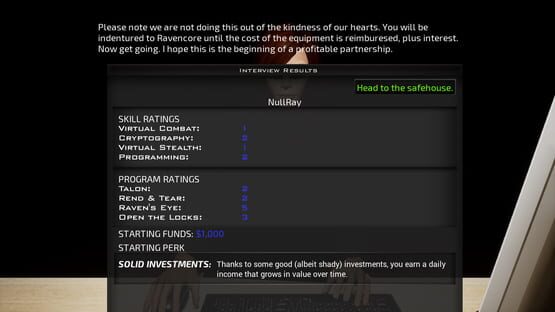
Added a simple character creation. You can now choose between a masculine and femanine model for the 'real world', one of three different avatars for cyberspace, your real world name, your cyberspace handle, and one of four starting perks.
Added a new starting safe house; a coffin room at the local Raven Motel. It has low rent, poor bandwidth, and not benefits.
Updated the large safehouse, which can now be rented for an upfront fee and a much higher daily cost. This safehouse passively generates motivation and dopamine, while hiving high bandwidth.
Add the hardware vendor to the city where you will now buy all of your hardware from (no longer from the hardware UI directly).
You can now acquire Mods which will increase the funtionality of your cyberdeck.
Added sound effects and music to the game.
Added Graphics and Audio options to the game. Key rebinding will be added in a future update.
Added a small 'getting started' story arc, including a splash screen with some backstory, and a few tasks. I plan on replacing the splash screen with another intro cut scene in a future update.
Wrote more tutorials and added the 'Knowledge Base' back to the pause menu, where the tutorials can be reviewed. I'm sure there are a ton of items I forgot to address in the tutorials, and look forward to some feedback so I can round them out.
Added 3 Perks (other than the 4 starting perks you can choose during character creation). At least 10 more will be added in future updates.
Updated the desktop Icon for System.Hack, as well as the splashscreen when the game is loading.
Probably 100 other small things I forgot to make note of.
I don't have a fancy Road Map hammered out for you, but I can share my plans. I have four major updates planned before the Launch. If everything goes well (and I don't get mired in support-mode), we could be looking at a Launch before summer!
The following is a list of the Updates. Although my personal 'to-do list' doesn't look nearly as concise or pretty, this should give you an idea what to expect. I should mention there will, of course, be smaller updates sprinkled throughout addressing any bugs or gameplay issues.
In order to avoid more of the dreaded feature creep and pushing the Launch window back indefinetly, I plan on sticking to this as much as possible. However, I'm leaving some wiggle room to squeeze-in some changes based on your feedback, and I do plan on supporting the game post-launch with free updates. That's when I can let feature creep run rampant =).
Content Update 1: Add more IC to the game, including Black IC. Add more Node Designs.
Content Update 2: Add more 4 more NPC Contacts, 10 new Perks, and complex contracts.
Feature Expansion: (Re)add Overwatch and Ravencore, and Company gameplay elements. Update Contract Generator.
Story: Add the Story Missions, Cinematics, more NPCs, new story-specific systems, and Epic Challenges.
Chief among the post-launch updates will be the ability to strap your cyberdeck to your back and hack devices in the real-world, as well as access certain systems directly from the Local Access Ports, and even meet your Overwatch team. I really wanted to squeeze this into the core game, but it's a clear example of feature creep that could take months to implement properly.
Dev Log
Hey everyone, I'm back again with another update with what's happening behind the scenes here. I should have broken this up over a few Dev Logs, but instead I'm going to dump a bunch in your lap at once. I have six points to touch on. And note that this is all stuff that is currently done, not stuff I still need to do. It doesn't looks like much is happening with all this radio silence, but I'm making great strides on my side of things. I have included some screenshots throughout, but please note these are rough shots.
User Interface The UI has been rebuild with a better layout, new art and design work, and better functionality.
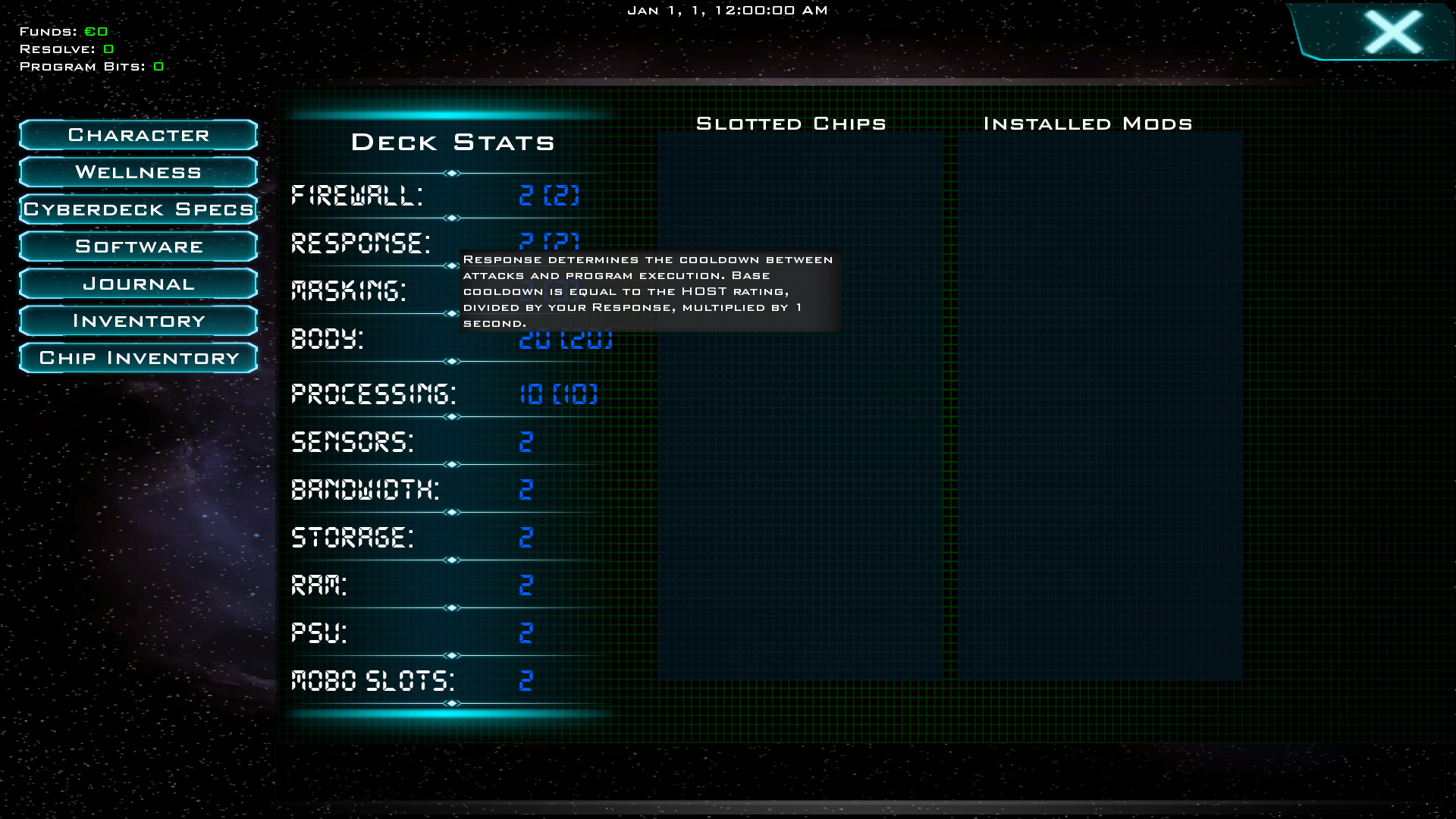
I have added a pop-up when hovering over any stat (skills, attributes, hardware parameters, mods, etc.) This briefly explains the mechanics behind the item. For example, hovering the mouse over your Response stat on your Rig says: “Response determines the cooldown between attacks and program execution. Base cooldown is equal to the HOST rating, divided by your Response, multiplied by 1 second.”
Stealth and System Security The way the game deals with system security, stealth, and IC has been reworked.
Masking tests are no longer RNG, and they no longer trigger in response to actions you take, such as executing a program. Instead the HOST sweeps the system every 3 seconds. During these sweeps, if the System Heat + (HOST rating x 2) exceed your Masking + Cyber Stealth, you will gain one Tracking Tag. After a Sweep, the System Heat drops by an amount equal to the HOST rating. Tracking Tags no longer decrease your Masking, they simply represent the HOST narrowing in on your location.
With the new mechanics, systems with have three alert levels: No Alert, Passive Alert, and Active Alert.
No Alert means the nodes are locked with User Verification Protocols as normal, but there are no IC trying to mess with you. This is the default state.
Passive Alert means the HOST has detected suspicious activity, but have not identified or located the threat. This is caused after you gain your first tracking tag. In this state, the HOST spawns Barrier, Code Gates, and Sentry IC in the nodes to thwart you. The lack of overtly hostile IC as long you as remain stealthy allows hackers to focus on a stealth build without worry of always running into an IC trying to crash them.
Active Alert means the HOST has located you. This occurs after you have accumulated Tracking Tags equal to your Masking hardware rating. In addition to the passive IC above the HOST will spawn Killer and Black IC against the Hacker. There is a 20 second cooldown after an active IC is defeated before the HOST can spawn another, but they can spawn an infinite amount. Note in the previous iteration, the hacker was simply kicked out of the system when they gained enough tracking tags. This way hackers can choose to focus on a combat build and just smash their way through systems if they want.
Intrusion Countermeasures IC now come in 5 distinct classes: Barriers, Gates, Sentry, Killer, and Black.
Barrier IC are spawned during a Passive Alert, and “lock down” nodes. They don't fight back, but need to be smashed down before the node is accessible.
Gate IC are spawned during a Passive Alert. They are used as additional checks so authorized users can still access nodes during passive alerts. There are a variety of Gate IC that can do everything from spawning additional IC, spiking System Heat, or damaging Avatars when unauthorized users try and pass through. These are an evolution of the Checkpoints in the previous iteration.
Sentry IC are spawned during a Passive Alert. They are used by the HOST to help detect and deter hackers. Sentry IC are usually armed with a variety of subroutines that can add Tracking Tags, dump the hacker from the system, or debuff the hacker.
Killer IC is the default class of IC spawned during an Active Alert. These guys focus on crashing your Avatar with a variety of methods, employing Nukes, Viruses, or just smashing them repeatedly with Hammer programs. Most Killer IC is mobile, and will chase you down until you leave the node, although turret-type variants exist.
Black IC are the real deal. Outside of causing some dumpshock, most IC can't hurt you outside of cyberspace. Not so with Black IC. By creating deadly biofeedback through your connection, your body in realspace suffers injuries as your Avatar is damaged in cyberspace. Many a would-be-hacker has been flat-lined by Black IC.
Cyber Combat One of the biggest changes with combat is that you are no longer stuck in place. While most IC are immobile, you are not. You can run away or engage as you please. Some IC, notable versions of Killer and Black IC will actively chase you down and attack once you get within range.
The flow of combat is very similar to before. Although you can move freely, your Response determines how often you can take an action or attack with a Hammer program. My first draft had your in-combat move speed affected by your Response as well, but that was more annoying that fun.
When you launch a subroutine against an IC, it is generally resisted by their Firewall rating, like armour. Usually the rating of the subroutine + your Cyber Combat skill has to exceed their Firewall to have any effect. Sometimes the effect is reduced by the Firewall, other times it's all or nothing, depending on the subroutine.
IC and Avatars have the equivalent of Hit Points called Cohesion equal to 10x their Body attribute. Cohesion can be reduced to 0 using Disruption attacks from Nukes, Viruses, Hammers, which will crash the IC.
Disruption subroutines are the basic, universal way of dealing with IC. They affect all IC equally. However there are subroutines specialized in dealing with specific IC types. These subroutines decrease the IC Body rating directly, lowering both current and maximum Cohesion. These subroutines are potent, but are useless against other IC types. For example: The Battering Ram subroutine can make short work of Barrier IC, but will have no effect on Sentry IC.
Finally the last big change with combat is the addition of Hammer subroutines. Hammers are weapon constructs that you can use to attack IC. There are currently two types if Hammers, a literal hammer and a katana. They are cosmetic representations only. Hammer subroutines don't have any functionality on their own. Instead when you strike an IC it triggers any “OnStrike” functions of programs currently running. They allow you to repeatedly trigger a program function without having to execute the program every time. The downside is that both the Hammer subroutine and the other program need to be running in active memory, which uses RAM.
Avatars There are now four different Avatars to choose from, allowing players to further customize their game play. Each has custom animations, so it doesn't feel like you're playing a re-skin of the same character.
Now this part is undecided, and feel free to weigh in, in the comments. I was planning on everyone just start with the basic Avatar, and have the option to purchase additional Avatars with your hard earned creds. Alternatively I could have them all unlocked right away, which allows customization out of the hop, but takes away some progression.
Along those lines, I now have a male and female main character that players can choose during character creation.
In the future, I'm hoping to add more options for Avatars and real-world character options, but it's sort of on the low-priority side of things right now.
The Net This is probably the biggest and most impactful change.
In the previous iteration of System.Hack, the systems were randomly generated and discarded after use, with a few exceptions.
In the new version once a system is generated, it becomes part of the game Net and can be hacked in the future. When contracts are generated there is a 50/50 chance they will use an existing system or generated a new one.
The other big change has to do with the people in the world. Before they were basically just the name on the file, generated when the file was generated. There was no depth.
Now each person you see has 14 hidden parameters: Real Name, Gender, Phone Number, Person Private System Address, Bank Account Number, Email Username, MACid, Work System Address, System Admin (True or False), Messages, Subscriptions, Corporate Affiliation, Company Tier, Employee Rank, and Citizen ID Number.
These are all important for a number of reason, but the idea boils down to trying to simulate as much of the world as possible to promote emergent game play. Every citizen is going to be connected to at least five different systems, which are all connected to other citizens in a sort of web.
With the new mechanic, contracts can get a lot more complicated. The basic contracts will remain unchanged: “Get provided with a system address, go there and do something”. More complex contracts will be the available in the mid and late game. Players will be provided with a few breadcrumbs to get started, and it will be up to them to figure out how to get the job done. More importantly, they will have the tools to try and get the job done multiple ways.
For example: The players are told “I need a file. The name of the file is unknown, and I don't know who currently has it. What I do know is that it was emailed by an Eleanor Dodson to an unknown recipient Saturday afternoon.” That's it. Now the player's only lead is a Real Name and that it was emailed. So the player's can run a search on Eleanor Dodson in an attempt to gather some of her basic info. Generally this is only Company Affiliation, but may include Employee Rank (worker, manager, executive). Now the player knows she is a manager employed by Monarch International. So they hack the Monarch email system. Using the name Eleanor Dodson, they uncover her username. Which they then spoof the password and get access to her Messages. From here they look at see the username of who she sent the file to on Saturday. Then they hack that person's profile, and track them down through a variety of means, eventually finding an downloading the file.
Some systems are going to be very difficult to simply muscle your way through. Which means you will have to put in some extra legwork to make the hack easier, such as gaining extra credentials, figuring out what IC you may face and arm yourself accordingly, or pre-hack the system and install a Backdoor.
Backdoors allow you to “jump” to the node you installed it in, bypassing a bunch of security that could wear away at your resources. Backdoors last until you trigger an active alert, and are saved with the system data. Because the systems are now persistent, and future contracts can send you back to existing systems, they can be very helpful.
By keeping the systems and the people persistent, it allows for some interesting things other than just Backdoors. For example if the player's know Eleanor Dodson is a manager for Monarch, they can decide to poke around after their current contract is done. They eventually gain access to her Personal Private System (PPS), copy her credentials, and checking her system log, find the address where she is employed. Now armed with valid credentials and admin privileges, they hack Eleanor Dodson's work system and swipe a bunch of pay data. Maybe install a Backdoor for next time. Now if they don't trigger an alert, those credentials won't be voided, which means if the players catch a contract to hack that system in the future, it will make their job much easier.
In case you are wondering how the nuts and bolts work: When a system is generated, it also generates 20 employees, assigning their Company Affiliation, Employee Rank, and Company Tier. The rest is basically randomized. Their bank account starting value is based off their Company Tier and Employee Rank.
Systems that have a “Subscribers” or “Client Information” node will populate that list from existing citizens.
I think I have touched on it in a previous post or two, but I have decided to go along the veins of old school Shadowrun, and focus on Nodes, and not the space between. This will allow me to make each Node a micro level instead of a simple cube or sphere at the end of a hallway. The upsides mean the levels are easier to generate, but more importantly I can focus on making the nodes as interesting as I like.
When navigating systems, hackers will need to unlock each node to access the nodes behind them. The following is a sample system that is unexplored. You will note that the only node that isn't a generic cube is the one in the bottom middle. This is the System Access Node (SAN), and is the only node you can enter when you first connect to a system.
After working your way through the system, it will look something like this.
And as a bonus, this is a screenshot of the interior of a basic node.
Well I think that's everything for now! Before I release this new iteration I still need to check a couple things off the list. Namely to finish porting over the hardware mechanics, rebuilding the mechanic behind swapping chips from the ground up to finally squash the the-bug-that-won't-be-named, and to finish the contract generator.
Once those two things are done, we should have a playable game. Then it's just a matter of fleshing out content, plugging in a couple more features (like Overwatch).
Wow 2100 words. I really did write an essay. Please comment with any questions, concerns, or whatever. I love the feedback!
Dev Log: The New Programming Mechanics
Hey everyone, I'm just checking in with a progress update.
First and foremost, the update is still a little bit away. I'm planning on dropping the update as soon as I get the core gameplay loop finished. The core mechanics are 'mostly' done, but need to be reassembled and smoothed out.
Oracle and custom programming is now complete. This was probably the biggest step in this entire rebuild, because it also involved basically reworking how programs work completely, which is sort of the core of the game. Now that it's done, it seems like a good time to explain those fun changes.
First I'll explain how the programs work.
All programs are now built from multiple lines of letters and numbers, called the Script. When a program is ran, the game now reads the script line by line and behaves appropriately. This means when you create a program, you will be writing out these lines of code. But fret not, the code is complex enough to be very powerful and immersive, but basic enough that you can do it without a programming background. There will be tutorials and example code to make things easier on players until they learn the few simple syntax rules.
For example, to build a simple Nuke program that runs a rating 4 Disruption subroutine, the code would look like this:
OnExecute, [Disruption](4); Terminate;
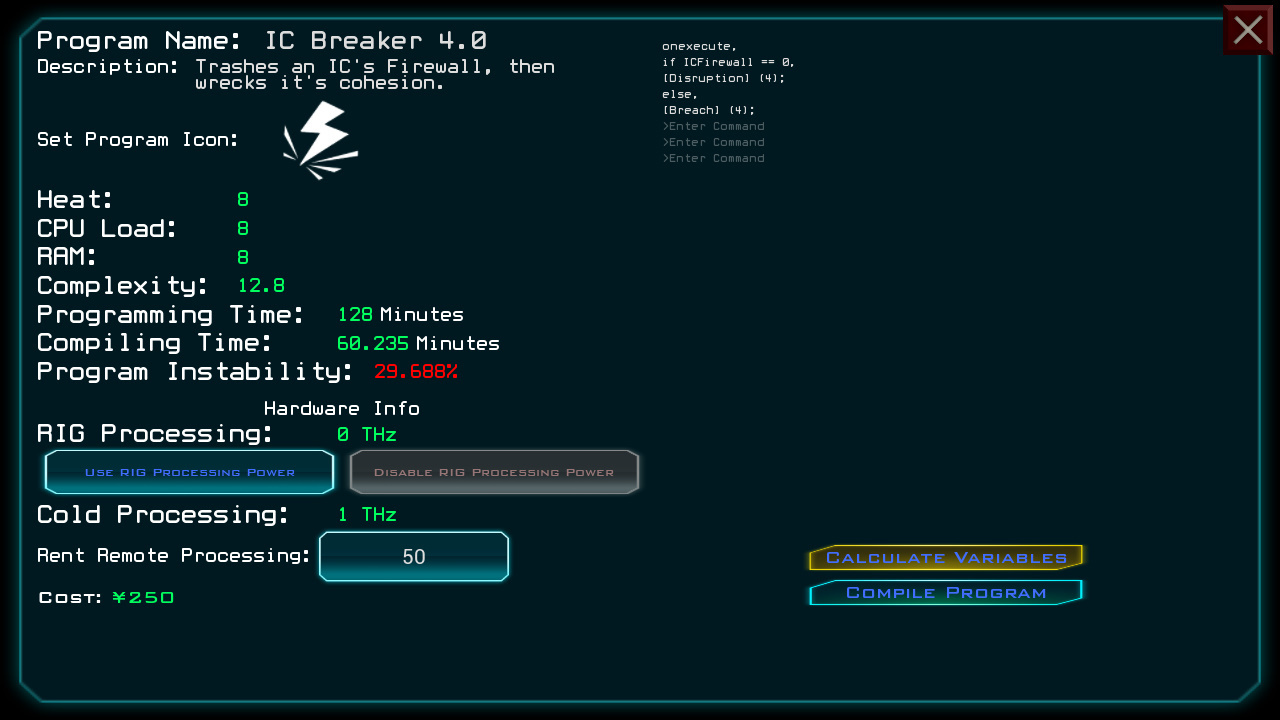
If you only wanted to fire a Disruption subroutine if the IC's Firewall was down, and otherwise fire a Breach to tear down that Firewall, you could write a program that looks like this:
OnExecute, If ICFirewall == (0), [Disruption](4); Else, [Breach](4); Terminate;
Here's what that actually looks like in the new Oracle software.
Running the program is functionally identical to the old version. Click the hotkey, and it fires the program from the hotbar. You do not need to do any typing like with Root Access. You just click and let the program work.
Now as for Oracle, as you can see from the image above, there are a few new parameters that are shown. Namely: RAM, Programing Time, Compiling Time, Program Instability, Rig Processing Power, Cold Processing Power, and rented Processing Power.
-RAM is how much of your active memory to taken up by this program until it's terminated. RAM is also a new type of chip. Players can design programs that are loaded into active memory to create buffs, debuffs, traps, weapons, and more. This value is of no concern for one-shot programs, like the Nuke examples above. Although you could write a program that does what those programs do, but instead of being triggered on execute, it's triggers whenever the player's Firewall is damaged. In which case RAM would be an important parameter.
-Programming Time is exactly what it sounds like. This is how long it takes you character to actually get this program ready for the oven. It's determined by the Program Complexity and your Programming skill. Time will fast forward until this is done.
-Compiling Time is how long the program takes to actually finish cooking after you are done programming it. You are free to do other things while you wait. The time is determined by the Program Complexity, and how much Processing Power you are able to throw at it.
-Program Instability is how likely there are to be bugs in your program. If the instability is above 30% it won't let you try and compile it. At less than 30% it will always compile but you may run into bugs when using it, such as Heat Spikes, longer execution times, random crashes, etc. This is determined by the Program Complexity and your Programming Skill.
-Rig Processing Power is how much power you are assigning the compiler from your RIG. This is all or nothing. When you are using your RIG's power to cut compiling time, your processing power is treated as 1 when hacking. If you choose not to use your RIG processing power, you can hack without penalty while the new program cooks.
-Cold Processing Power is from Processor Banks you can purchase for your safehouse. This cuts compiling time, but has no effect on your RIG in cyberspace.
-Rented Processing Power is the only financial cost associated with building programs now. Basically it allows you to boost your processing power to compile the program faster, but you pay for the service. In the new economy, time isn't "free", and complex programs can take a long time to compile. I expect this to be used regularly, but frugal players now have the option to abstain.
Now with that all being said. This might not be for everyone. My original version of Oracle also used a very basic pseudo-code and the player base was split on whether it was annoying or it was amazing. This time around, players with no interest in all this coding stuff will be able to buy pre-built programs and effectively ignore the feature all-together by spending some creds.
One of the things that excites me the most about this new programming mechanic, is the incredible power and versatility. I am able to add new variables that can be referenced by actors in the world, and new subroutines or other commands to interact with them. For example; I could tie the brightness of some lights to a variable, and then have the players be able to access that variable with a line of code in a program. Maybe this could be a program used to kill the lights in the street? Or maybe the program won't run if the lights are too bright or too dark?
The goal of this new program system is emergent gameplay. I will keep adding on new subroutines and variables that can be checked and modified, and enjoy watching the wild programs that players come up with.
There's a lot to still talk about, but this post is already getting too long. If you have any question, feel free to ask!
State of The System Address
State Of the System Address “Once upon a time there was a would-be designer who created the wildly popular mod for Shadowrun Returns called “Shadowrun Unlimited”. After hundreds of hours, the would-be designer grew frustrated with the limitations of the editing tools and decided to hand the mod off to the community and strive to create his own game. The ultimate goal was to create a modern homage to Shadowrun for the Sega Genesis. However the would-be designer knew that a game of that scope was beyond his current skills and resources. Instead he decided to start with a sub-strata of that game, the hacking aspect, and flesh an entire game out around it. The plan was to use the resources drummed up from that hacking game, along with the groundwork already in place, to build the more expansive game in the future.
The now indie-developer thought he had some pretty slick programming skills, and when the hacking game was released into Early Access, it was met with very positive reviews. But alas, the bugs were abounding. With every new feature that was added, existing frameworks had to be adjusted and tweaked to make it work, which generally lead to more bugs. The developer figured out that just because he could make something worked, didn't mean his skills were all that good. In the years that followed, the developer spent more of his time just fixing bugs than rolling out new content. And then one day the developer had a couple realizations.
Somewhere along the way his skills had increased significantly. One day he was tinkering and built a complex mechanic in a hour that once would have taken him days (and lot of trial and error) to build. Now he simply envisioned the mechanic and knew exactly how to make it work and how to build it efficiently. He felt like he had ascended to some new level as a game designer.
Secondly, armed with his ascended skills, he realized the foundation for his hacking game was rotten. It would never work as a basis for that dream game. It was built by some modder-turned-developer, fumbling around, just trying to make the next thing work. The features and functions were great on paper, but were built poorly and with little regard for other mechanics.
The designer stepped back and looked at his creation and saw it for what it really was: A rickety house, built on quicksand and held together with patches. Any attempt to expand or improve the house would require way more effort than it worth. So he decided to tear it down and built it back up from scratch, salvaging what he could, and throwing the rest in a nearby dumpster fire.”
I hope you enjoyed my short story. The first draft had a dragon, and a bunch of explosions, but it didn't really fit with the narrative, so here we are. As you may have surmised, I have decided to rebuild System.Hack, mostly. A lot of mechanics work good (mainly the stuff I've build in the last few major updates), and can be ported over with ease. All the assets are obviously still good to go, but all the other stuff has to be rebuilt.
As many of you know, I'm a team of just one guy, with a full-time job and a dream of building games for a living. A lot of the games I want to build are going to share a lot of the same features, so I figured “why re-invent the wheel every time”. With that in mind, I have built what you could call a universal Sim-RPG framework. And that's what the new System.Hack is being rebuilt on.
By now I'm sure some of you are concerned that this means the Early Access is starting over, or the release date has be catapulted farther into the future, but that's not true at all. Yes, there's a lot of work to do. But it also means the way forward is clear, and the work is flowing much, much faster. From my perspective, it feels like we were driving through a bog, but now we've backed up and are flying down the highway.
A basic feature-list for the new update (and what I've got so far) is below. Remember we are working off of a universal framework here so there may be some mechanics under-utilized for System.Hack (such as freezing or getting shot).
A survival mechanic. Now you poor hackers will have to worry about getting enough to eat and drink, and making sure to keep warm... but not too warm. I'm not trying to create a proper survival game here, so food and drink will be plentiful, assuming you got the creds. The systems for freezing or overheating are in place, but are unlikely to have a real affect. Neural Stress has been replaced with a exhaustion mechanic, which accumulates not only from hacking, but any action that drains Stamina while in meatspace.
Added real-world injuries. Now Black IC can genuinely mess you up.
In addition to getting a brain bleed from Bio-Feedback, running against nasty IC can do some serious damage to your rig. You can always pay to get it repaired, or try to fix it yourself. Added the Hardware skill.
Redesigned and rebuilt cyberspace combat mechanics. The cyberspace combat is very similar to the old style, with more action elements instead of jamming buttons. No longer will you be stuck in place, mindlessly hitting buttons. You can now maneuver around in combat, and even engage multiple IC at once. There are Hammer subroutines that will conjure a weapon into existence that you will attack with until you run another program (like drawing a digital sword). If you prefer to keep your distance, you can run programs loaded with Nuke and Virus subroutines. Killer IC will try and run you down, engaging with their own Hammer, Nuke, or Virus programs. Sentry IC will stay at their posts running their utility programs against you, attacking if you get too close. Barrier IC are just as passive as ever, but are now physical obstacles that appear in cyberspace, barring access or progress until smashed down. And Black IC. Well that just tries to melt your brain.
Redesigned and rebuilt the way programs are handled. You won't notice on your end, but now it's simple, clean, and infinitely expandable, making it easy to roll out new subroutines in the future.
I have decided to pivot away from mini-games. The problem was two-fold. The Passbreaker game was fun... but only the first hundred times you do it. I will re-purpose the mini-game elsewhere. Secondly, the workload required to create a reasonable number of quality mini-games, without getting too 'arcade-like' is fairly substantial. In the new version there are currently four different UVP's: Password, Code Gates, MAC Authentication, and Location Verification. Each requires their own program, while some may require additional hardware. I have made Brute Force Attack it's own subroutine now, which will work against all UVP's, but will immediately set off alerts.
I have decided to change up the node UI. Nodes will no longer have a list of files and devices. Instead the nodes will be interacted with using the Root Access. I weighed the pros and cons and ultimately I felt that having the players looking at a list of files trying to find the right one wasn't exactly “fun”. Especially considering that in the real-world we have search functions, so why wouldn't a whiz hacker? Going forward, players will use the Search and Access commands to bring files and devices into 'focus', and then interact with them with additional Root Access commands.
Redesigned and rebuilt the way Root Access functions. Now there are effectively ten commands; Install [Program]: Install followed by the program name. Edit [File]: Change details about any file type. Targets the current file in focus. Search [file name]: Find the file in a datastore and bring it into focus. Download: Copy the file in focus to your storage. Upload: Copy a file from your storage into the current datastore. Shutdown [Device]: Shut off the device in focus and immediately gain a tracking tag. Access [Device]: Bring the target device into focus. [Context Sensitive]: Manipulate the device in focus. These are generally a job-specific command, such as “Set Heat 100” when accessing the Boiler Device in an HVAC node. Reboot System: Crash the entire system, disconnecting all users and resetting all devices. Crash [Construct]: Destroys the target construct (after gaining proper access to it's code).
Redesigned systems completely. I learned long ago as a Dungeon Master, having players roleplay wandering down hallways was boring. Why not just montage to the next place where something interesting happens? So I decided to apply that logic here. Systems will now have an overview map of nodes. To travel to a node, all you have to do is click on it (assuming you have already unlocked the adjacent node). Hackers will have to work their way through the system node by node. By shifting the focus to the 'rooms' instead of the 'hallways', I have made nodes much more interesting. A low-level datastore node may look like a simple white room filled with filing cabinets, while a Financials node could look like the inside of a bank, complete with guards (Blaster IC), and cameras (Sentry IC).
Built new animations and new effects when executing programs. It really helps sell the idea you are an avatar running around in cyberspace.
Laid the groundwork for players to purchase new 'avatar skins', effectively changing what you look like in cyberspace. I plan on having these be things you character can purchase for a small sum, or earn as rewards. Thanks to the new way of handling animation calls, I could slot it any model for the player character, dynamically and with ease.
Built an inventory system so hackers can carry gear, supplies, and holster weapons in the real world. And there's guns now. Just to be safe. And katanas of course.
Rebuilt the bunker and added the first draft of the city area. The bunker is a fair bit smaller, but you aren't locked in. It's more of a 'safehouse' than a proper bunker. The city area is a poor, semi-industrial part of town with a large criminal element and very little police presence. You can still order some junk to your door, but certain shady vendors won't deliver. You'll have to slap on your coat and head out into the real world.
Built a whole new UI for both cyberspace and meatspace.
We will be retaining most, if not all of the features of the first iteration, although I will probably re-introduce them as separate updates down the road.
There is still plenty to do to bring the new version to release. I don't have a clear time lines, what with the holidays. But I can tell you it seems to be going quickly. In the last month, I have done what feels like a year's worth of work. More importantly, it's being built clean with a unified structure and all features in mind every step of the way. On a personal note, it's exciting and fun to work on this project again. It's becoming a game I'm really looking forward to playing.
Making Chips and Cleaning Bunkers
This update adds two new features, more content, and improves some existing mechanics. The two big features: Stealing and printing your own chips, and upgrading your bunker.
At first glance the 'stealing and printing chips' thing seemed like an easy task. Turns out it involved rebuilding half the functions and variables related to the evolving hardware mechanics and system travel. Now it's finally up and running!
To steal a Blueprint you will have to wait until the company makes an announcement about an upcoming chip release. You will then have 7 days to enter the megacorp's Grid, hack the Active Research node within the R&D system, and download the data file housing the blueprint. The data file looks like any other file, except they are quite a bit larger (so make sure you slot some storage chips). With the data file on storage, use the new Decryptor app on your desktop to crack it open and get a shiny new chip blueprint.
The blueprint doesn't do much on it's own, however, with the use of a special 3D printer, you can start printing your own knock-off versions for a fraction of the cost. Which brings us to the other new feature: bunker upgrades.
Admittedly, the number of bunker features currently implemented is pretty bare bones, however there are a few more almost ready I couldn't squeeze in time for the summer sale deadline. Currently you can purchase a 3D printer, and pay to have your bunker cleaned. Coming soon will be a variety of furniture and decorations. Some (such as the new bed) will be functional, while others will simply be decorative.
The major content updates are the new system styles, and megacorp sub-grids and systems. (See change log for more details).
The next week or so will invariably focus on bug fixes and tweaking based on feedback, and rolling out several more bunker upgrades. When that's out of they way, the next major update is going to focus on the Alpha Story update. Along the way, expect smaller updates with bug fixes and minor content additions. The Alpha Story update should take a lot less work to complete; the story is written and many pieces are already in place, including models, levels, dialogue drafts, etc. As stated elsewhere, the Alpha Story isn't "Chapter 1" of the story, it a complete, albeit stripped down story, different from the story that will appear in the final version of the game.
Change Log
You can now hack into a Megacorp's R&D System and steal the blueprints for chips that they have announced for release. You will need to purchase a 3D printer if you want to produce knock-off chips of your own. A new desktop app, simply called Decryptor is used to crack-open the stolen data files and turn them into a functional blueprint.
Introduced Sub-Grids, a special type of "system" built of several related systems. Currently they are only utilized for Megacorp systems. Each of the 20 Megacorps now has their own sub-grid. You can now acquire Sub-Grid addresses for the Megacorps from the system vendor in Haven.
Added a new system style, used in lower security systems, such as datastores, webstores, & private businesses about 50% of the time. This Island system layout features a base ring with access to teleporters that transport you directly to whatever section is required, instead of walking through them in order.
Removed the Combat Hud option from the primary menu, and added the Chip Inventory and Blueprint Inventory tabs.
Changed the Checkpoint difficulty to increase in difficulty based on the System Security level it's defending.
Opening the chip inventory, now hides the rig upgrade widget behind to create a cleaner look.
Evolving Hardware Patch #2
Mostly some bug fixes, and tweaked features.
Change Log
Fixed a bug causing the first Email from Echo, and the email from Virtuous Trust when you quit Ravencore to show up blank.
Fixed a bug with the contract completion email from Mr Johnson showing up blank with no sender.
Fixed a bug with the contract completion email from Spook showing up blank with no sender.
Fixed a bug causing Patrol IC to wander out of their designated zones and head to the System Access.
Fixed a bug with the salary pop-up text not displaying the proper value if you possess the "Negotiator" perk.
Fixed a bug causing programs to be added to the queue instead of activating if you previously disconnected while executing a program.
Tweaked the hardware evolution formula to guarantee chips gain a minimum +1 Rating when their generation increases.
Re-Scaled the way difficulty for Operations are calculated. Previously, the difficulty was increased by the type of system being hacked (Bank systems added +8 difficulty). This increase still applies to normal systems, however Operation difficulty is a flat, based on your current Ravencore rank.
Purge Subroutines now remove tags equal to their rating.
Updated the job description for crash contracts to say 45 seconds instead of the orginal 20 seconds.
Fixed a bug with the Camera Footage Node which could cause the target camera's folder to appear blank.
Added chip-type to the information panel when hovering over chips.
Overwatch missions will now start at 11:00 if you are in the system before 11:00.
Fixed an exploit making it possible to transfer files instantly if you didn't slot bandwidth chip.
Fixed a bug with the door indicating there is a delivery, when there isn't.
The next proper update introducing the ability to steal chip blueprints, and a new system style will be coming out shortly.
Evolving Hardware Patch #1
The ability to hack into 'corp R&D facilities to steal upcoming chip blueprints has been delayed, as I'm trying to make sure it works with the future Net upgrade. Which of course means I had to lay some groundwork for that update. In the mean time this patch contains some bug fixes and quality of life improvements.
Change Log
Added a pop-up when hovering over chips slotted into your rig, displaying that chip's info.
Added the ability to select several 16:9 resolutions in the video settings. More resolutions and ratios will be added in future updates.
IC Patrol now properly check for User or Admin privileges based on where they are encountered in the system.
Fixed a bug with the contract difficulty not being correct, including the Aptitude Test being much more difficult than intended.
Fixed a bug preventing chips from showing up in the store on a new game, until the game was closed and re-opened.
Fixed a bug causing the tutorial chat to pop-up on subsequent missions of the Aptitude Test was skipped.
Fixed an issue that could cause the UI to appear and disappear when loading into the Net.
Fixed a bug with the Shadow.Net window being too wide, filling the screen.
Fixed a bug with some starting chips overlapping slots.
Fixed a bug/exploit with the autosave after resting. Previously the players neural stress would be reduced, the game would save, and the clock would be updated. Players could then reload their game, their neural stress would be at the reduced level but no time will have passed. Now the game saves before the resting function begins.
Cleaned up the way the game updates the passage of time to help prevent the time from resetting to April 26 2049, during a laggy save/load sequence.
There are a couple outstanding bugs still on my list. They should be resolved soon.
Evolving Hardware
The next step in open-ended character growth, and an more immersive world is here! With the last major update, we introduced sixty chips which when combined in a motherboard, determine your RIG's attributes.
With this update, the megacorps will be churning out new tech on a daily basis. Everyday, one of the corporations will announce an upcoming chip, which you can read about in the new Shadow.Net news feed on your desktop. One week later the chip will be released and become available for purchase. Older versions of the chips will stay on the market.
These chips are dynamically generated, with no upper limits. Currently there are 3 chip evolutions: Generation Increase, Overclocking, or Nano.
Generation Increase leaves the size and power drain of the chip the same, while increasing the base rating for that series of chips. This accumulates over time. For example : Monarch's Excalibur would become Excalibur Mk2, with a rating jump from 80 Thz to 104 Thz. The next Generation Increase would see be the Excalibur Mk3 sporting 128 Thz of processing power.
Overclocking doesn't increase the current generation, but will instead increase the current rating by 50%, while doubling the power drain. For example, the Excalibur Mk2-OC would have a rating of 156 Thz, but a steep power drain.
Nano doesn't change affect the generation, drain, or rating, but decreases the size of the chip by 1 space. For example the Twitch Nano would only take a single slot instead of 1x2.
The Shadow.Net news feed currently only serves as a medium for chip announcements, but will be utilized to a greater degree in future updates to display the repercussions of certain actions, quests, or story events.
This update was originally supposed to include the ability to raid 'corp systems, pilfer blueprints for upcoming chips, and get knock-off's printed for cheap. However I was delayed, and didn't want to rush it. That aspect will be rolling out later in the week.
New Intro and Tutorial Patch #4
Optimizing level load times, increasing performance and killing bugs.
Change Log
<*>Drastically cut down the load time of the intro scene. <*>Cut down the bunker level load times. <*>Fixed a bug with the level streaming that could cause the bunker level to not load, creating an endless "hang". <*>Fixed a bug with Aptitude test preventing the checkpoint from activating after learning to spoof accounts.