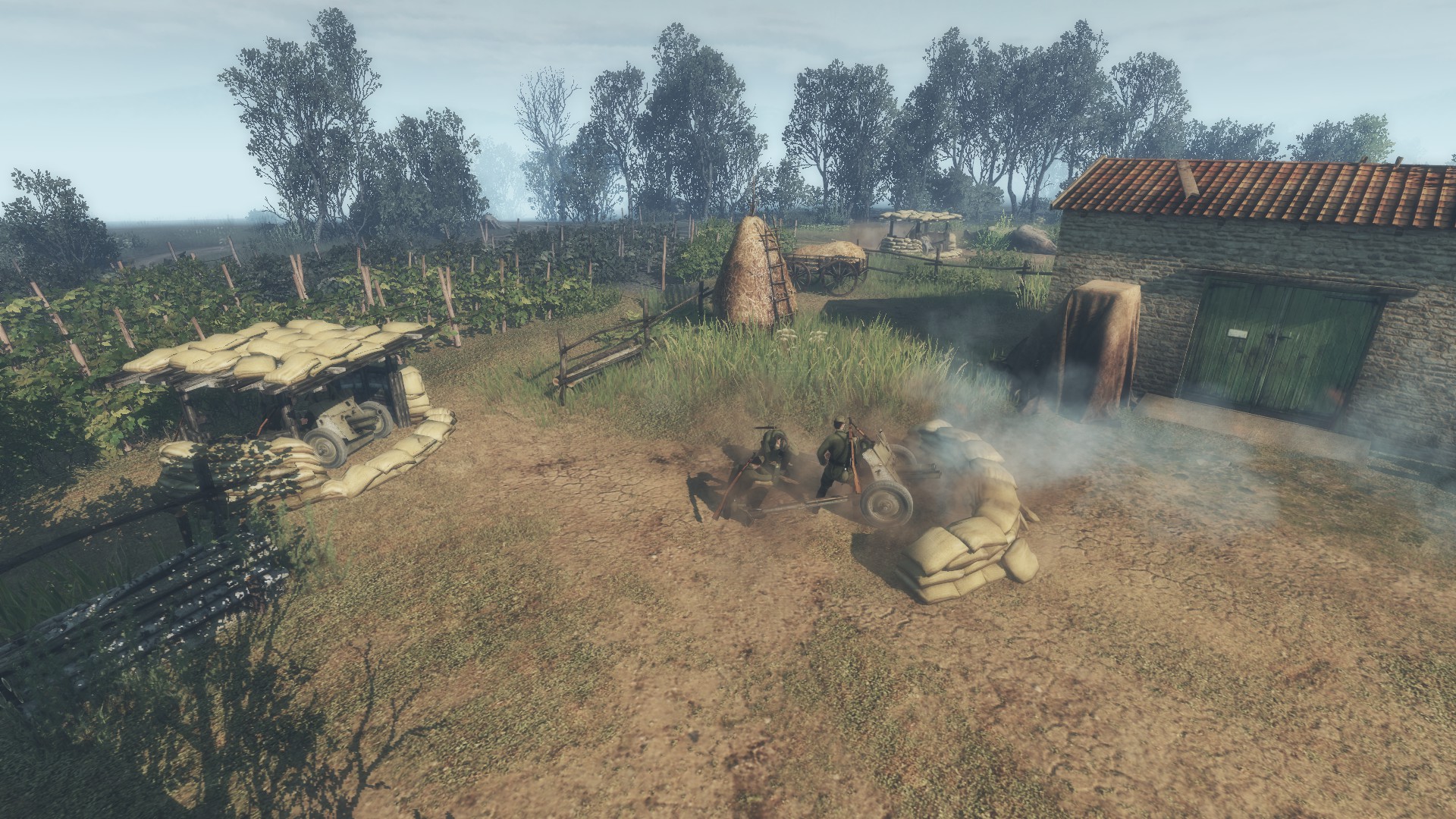
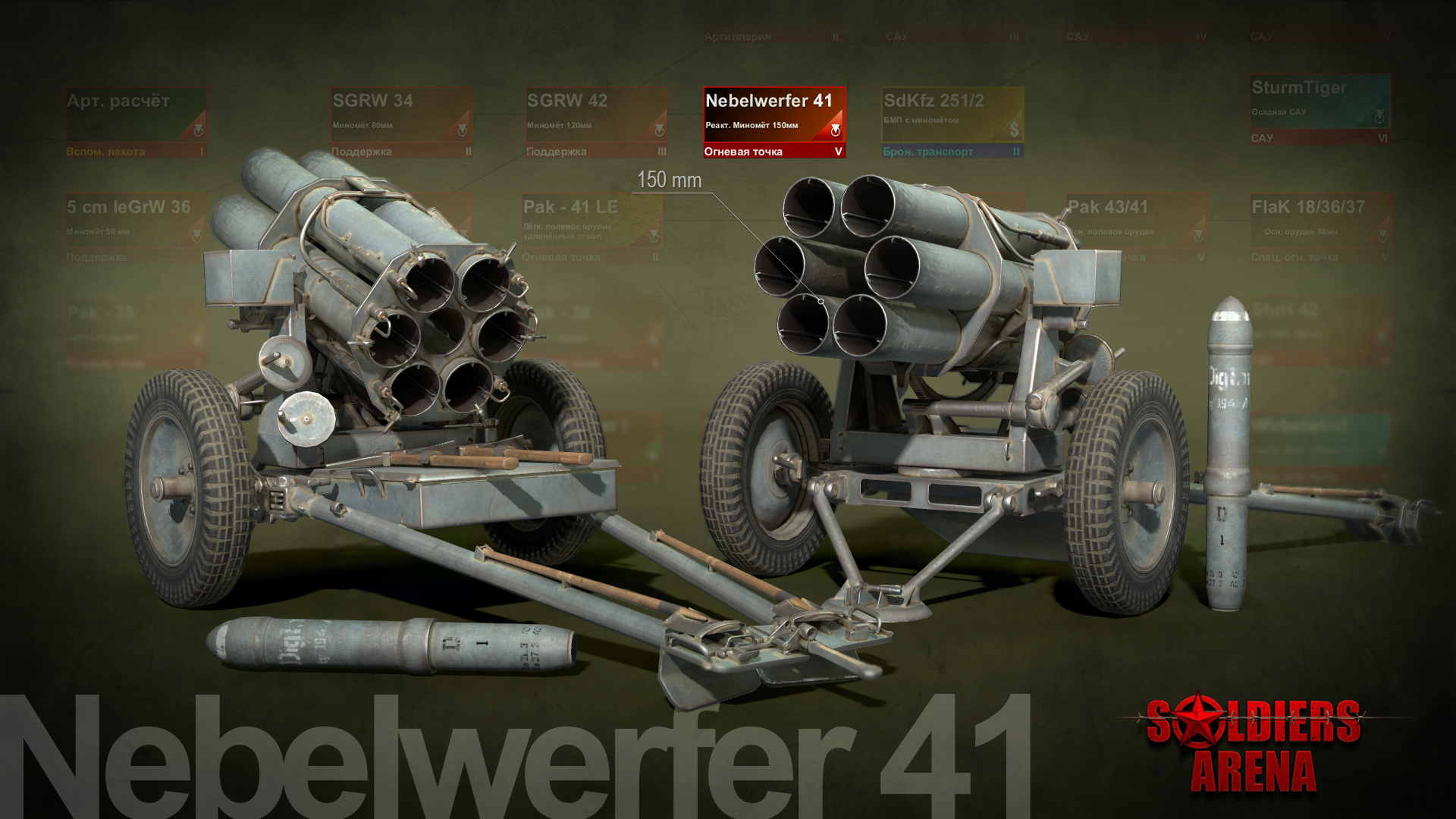
DevDiaries #47: All you want to know about infantry but are afraid to ask
Hi, friends.
We noticed that much more often we write about changes in artillery and tank gameplay, but much less often about infantry. Which is quite strange, because in battle it’s the infantry who suffers most but still does most acts of bravery. So in our games, it has always kept an honorable place, and Soldiers: Arena is no exception.
Teamwork is essential, it gives them someone else to shoot at.
We also often write that we want to reflect in the game the real behavior and cooperations of the armies in real combat. Maybe even too often. But what to do, if it is an idee fixe for our team? If someone could look at falling asleep game designers, he would see how their lips moved, repeating: troops behavior, teamplay, competitiveness, skill-oriented, variability. And all of the above we are trying to reflect in the infantry gameplay.
That’s how, for example, the Infantry tactical manual of the Red Army (1942 edition) describes the main tasks of the infantry:
- in offensive combat, - skillfully combining fire and movement, approach the enemy, attack it, destroy it in hand-to-hand combat or capture, and secure the captured territory;
- in a defensive combat - by powerful and accurate fire and resolute counterattacks to repel attacks by enemy infantry and tanks, inflict heavy losses on him and retain the defended terrain.
In the game, the infantry commander performs all the above tasks and some others, considering that in his submission there are still sabotage, reconnaissance, engineering detachments, etc. The infantry have a lot to do, because it is applicable to ANY task in the game. The main thing is to choose the right squad for the right task. The statement ‘the land is not considered liberated or conquered until the infantryman set his foot there’, in Soldiers: Arena is literally reflected. Infantry is the best for occupying territories, but as for the fortifications, buildings, trenches and previously freed from enemies, cannons and vehicles - it is exclusively infantry that can do that. However, it would be strange to control a cannon sitting in a tank ... In defense, the task of the infantry is to strengthen and entrench, to stop the enemy's attack, and in the worst case to hold out until the relief comes from allied artillery and tank units.
Infantry commanders are the most demanding of microcontrol and the gaming skill due to the greater number of units and their reduced survivability. We, of course, are working to improve AI and try to make the infantry smart, saving the player from unnecessary clicks as much as possible, but it won’t be able to win by itself. Infantry is always the first to take a blow, it is not protected by armor and is often in sight of the enemy. Its survival depends on you. Most likely the gap between a novice and an seasoned player will be most noticeable among the infantry commanders. Only your reaction, microcontrol skills and ability to read the game will determine whether your units will turn into ‘meat’ enemy troops, or become ‘meat’ themselves. Probably, it will be little bit of this and that.
A ‘sucking chest wound’ is nature's way of telling you to slow down.
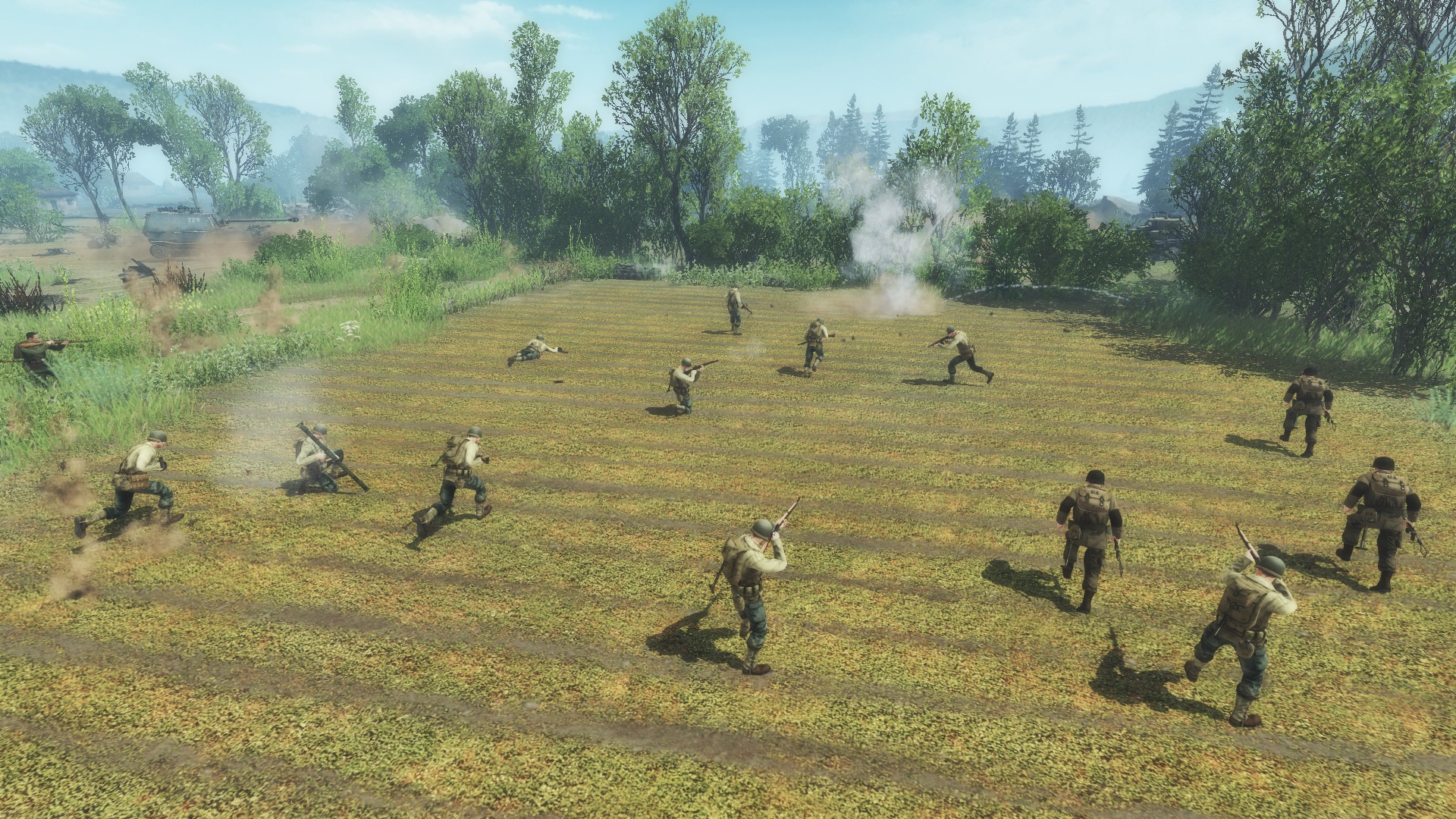
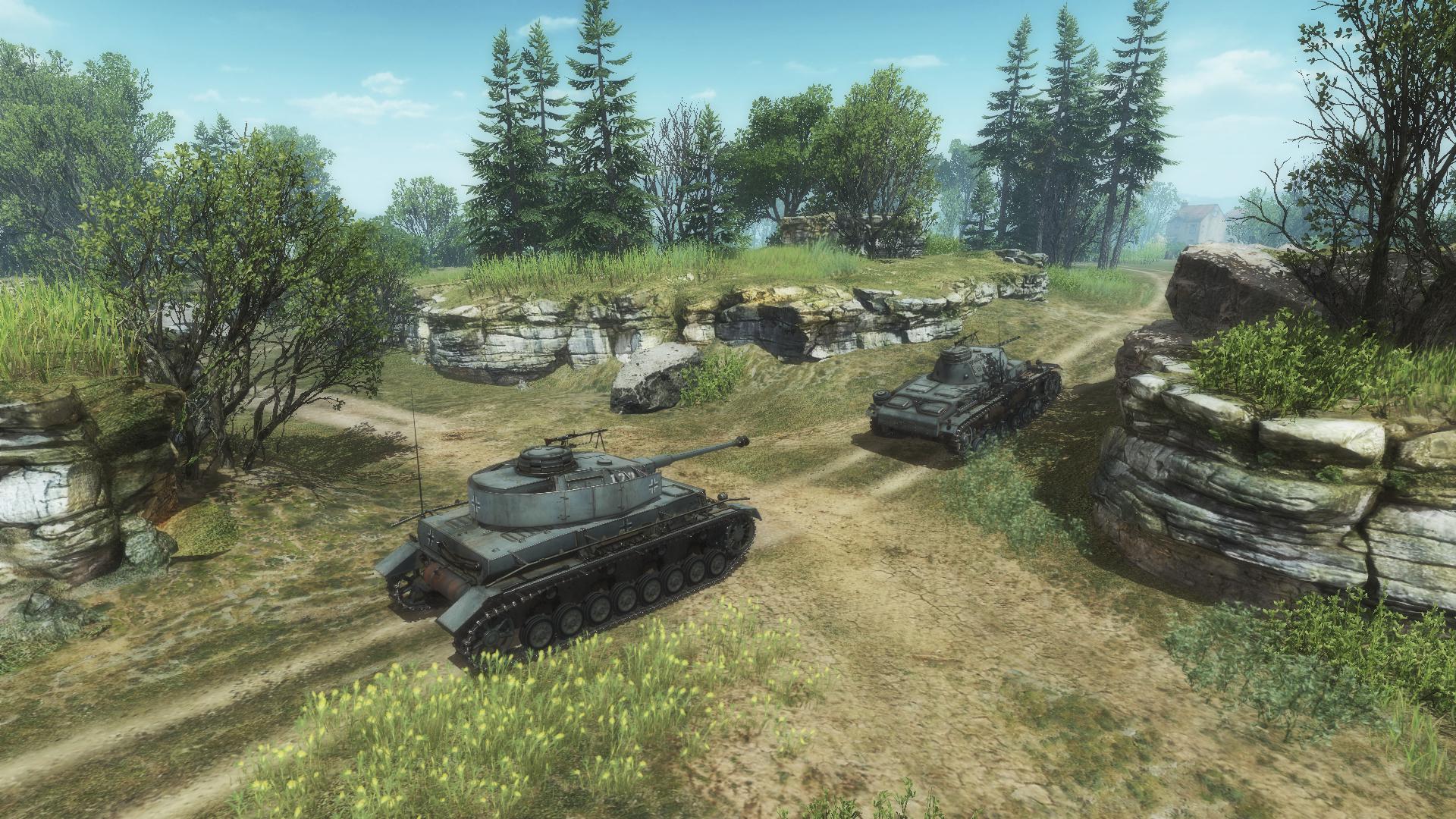
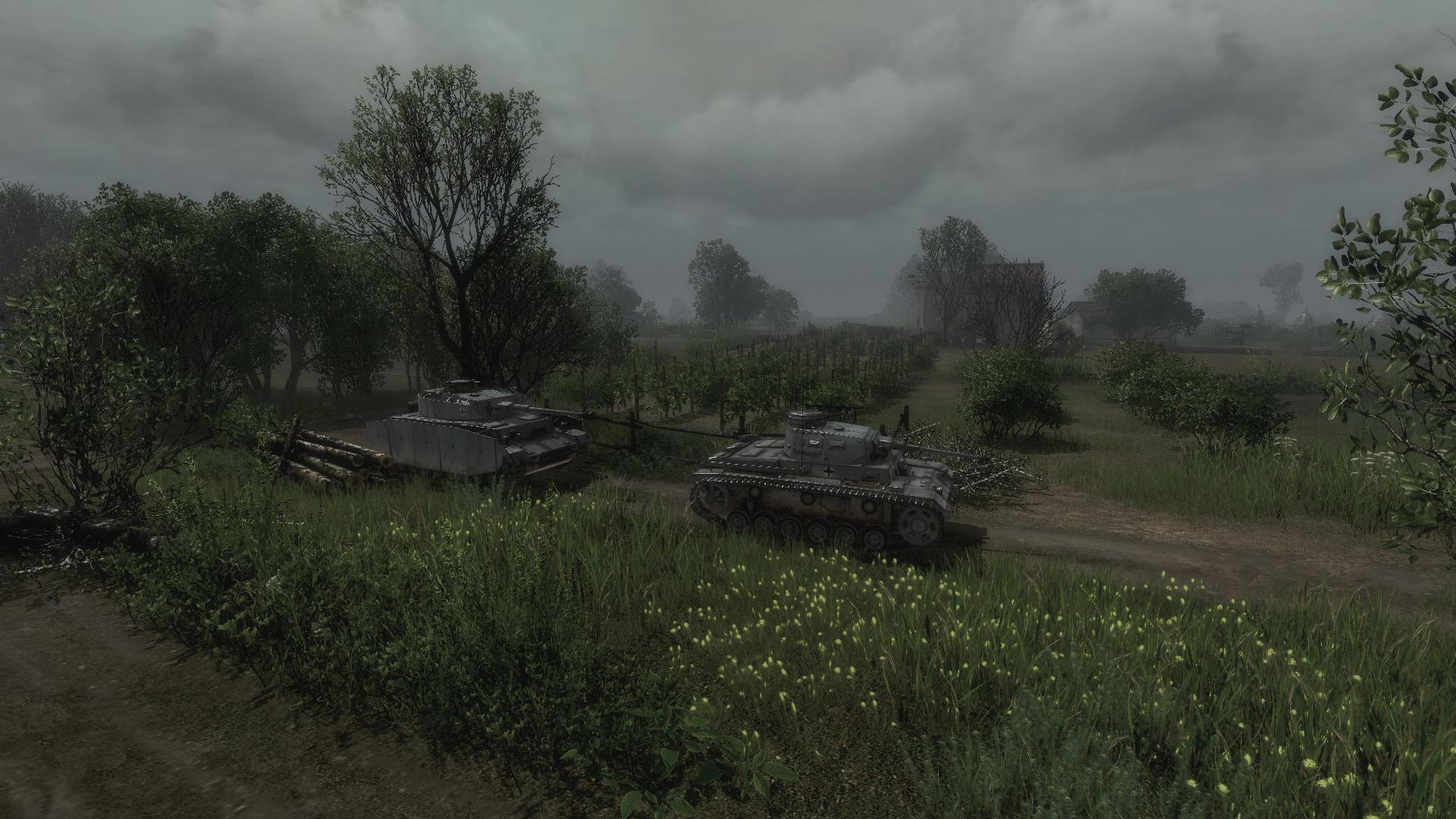
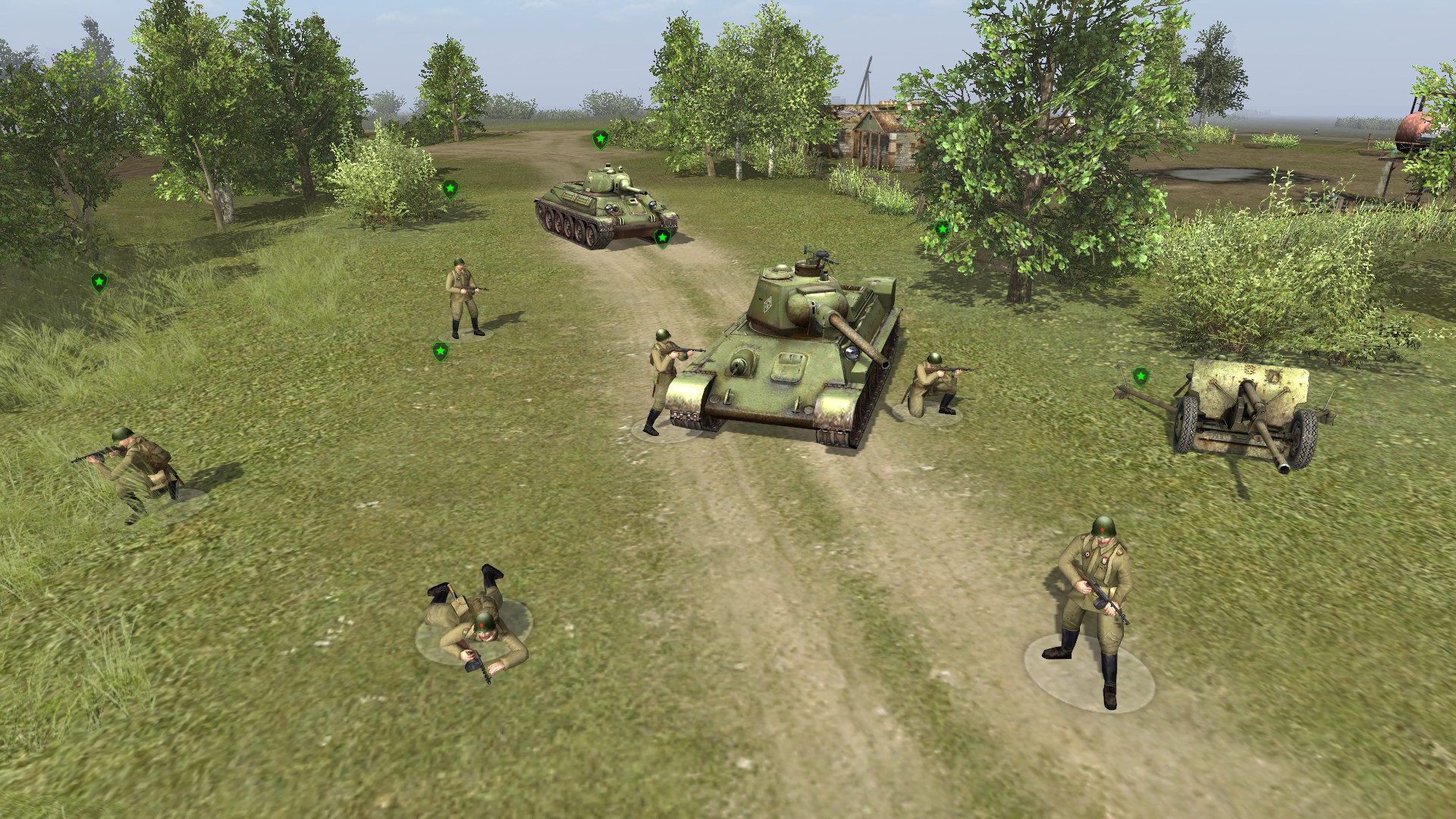
Now we have the basic, stormtrooper, motorized infantry, engineering and sabotage-reconnaissance infantry battalions in the game and each of them can force the enemy to ‘slow down’. At their disposal are four types of infantry: the base one (riflemen and submachine gunners), the support (miners, medics, engineers), special (spotters, scouts, saboteurs) and heavy (flamethrowers, grenade thrower, stormtroopers). Of course, in addition to infantry, commanders have a number of slots for support cannons and armored vehicles. Each of the commanders is strong in its own way and has different priorities in the battle. But also some restrictions on the types and the number of units in submission. Choosing a commander, you actually choose what type of infantry he will have more of, and which of the ‘elite’ units he can use.
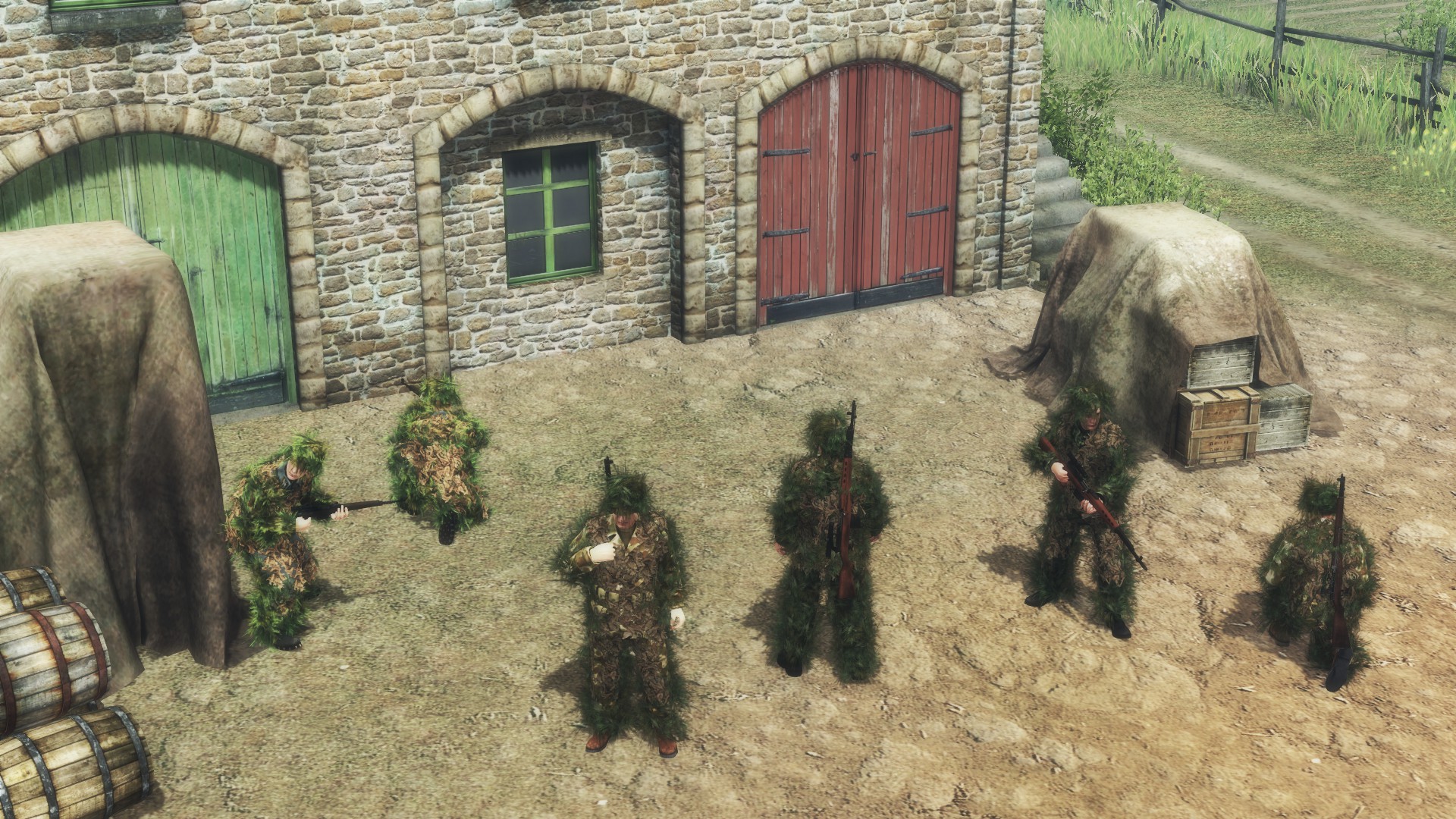
For example, a basic commander is needed in order to give you a feel for the infantry gameplay before choosing a specialization. He does not have some actual accents in the development, but a little of everything. The engineering battalion has a defensive specialization, so he has the most slots for support infantry. He can create a deeply echeloned defense faster than others, and in the future will receive mechanized engineering units capable of evacuating damaged and unmanned vehicles in the rear. But with a clear advantage in defense, such a commander will be very inferior in attacking, especially in comparison to the stormtrooper and motorized infantry battalions. In turn, the motorized infantry commander has very few special units, less base infantry and absolutely no support cannons, but he compensates these shortcomings with his mobility and the availability of specialized armored cars that are inaccessible to other battalions. A fire-flame armored vehicle is worth a lot! The reconnaissance-sabotage battalion spends most of the time behind the enemy lines, therefore, it hardly has heavy infantry. But it has elite snipers, scouts and saboteurs, which are kept stealthy until the unit penetrates half of the line of sight distance. And, most importantly, the opportunity to drop the paratroopers to any point on the map and create a zone of increased unrest there.
The enemy diversion you have been ignoring will be the main attack.
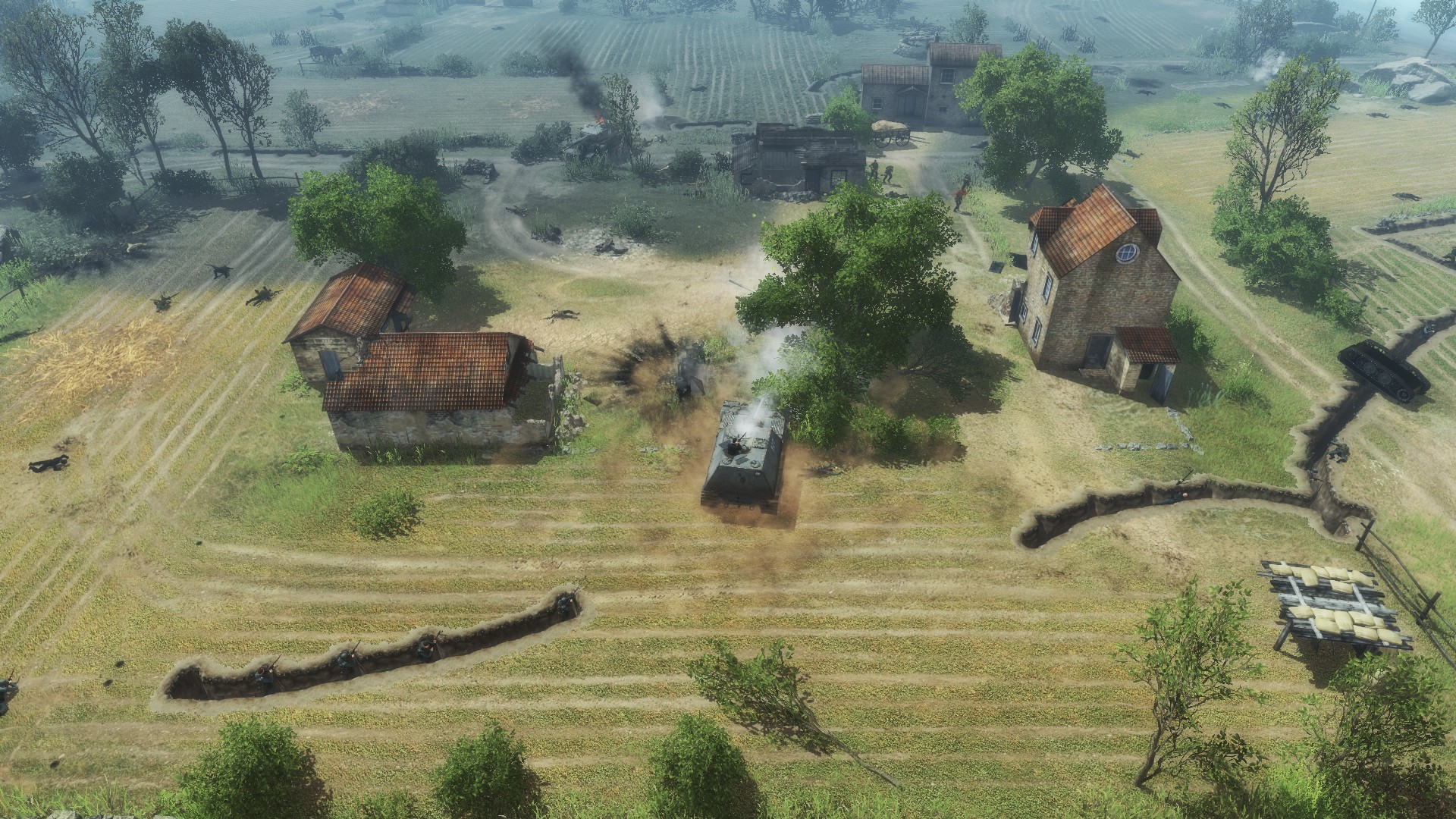
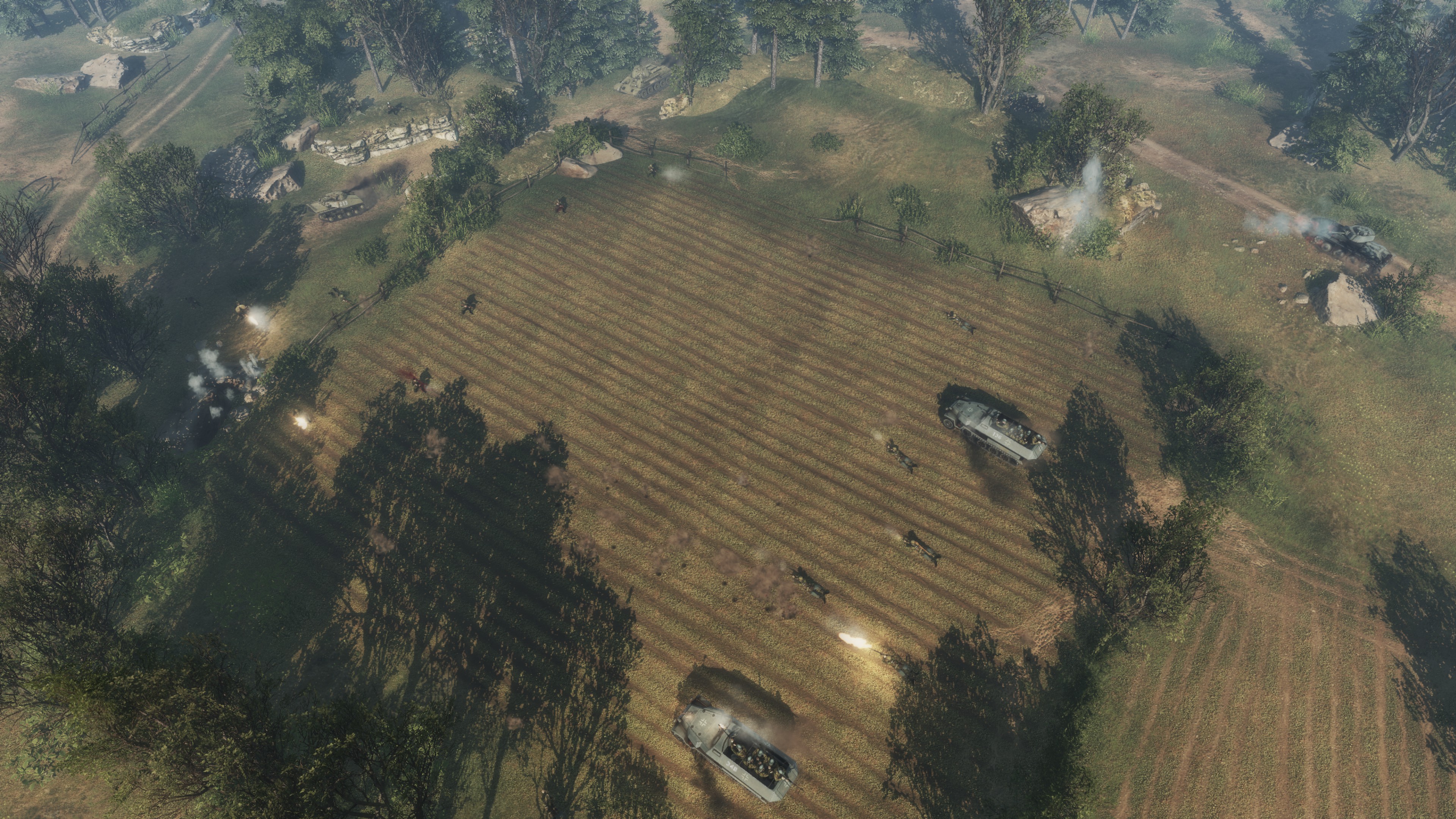
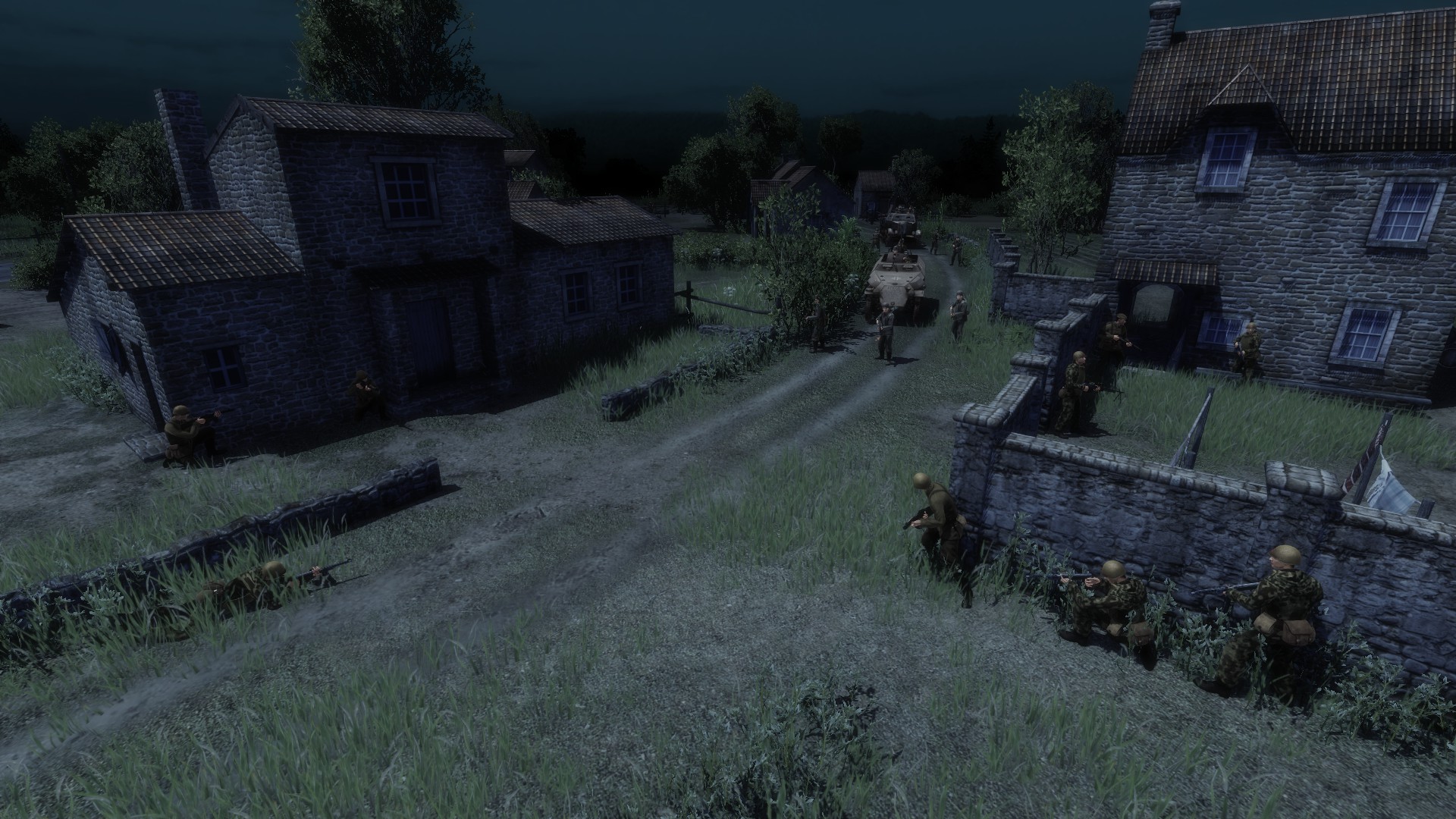
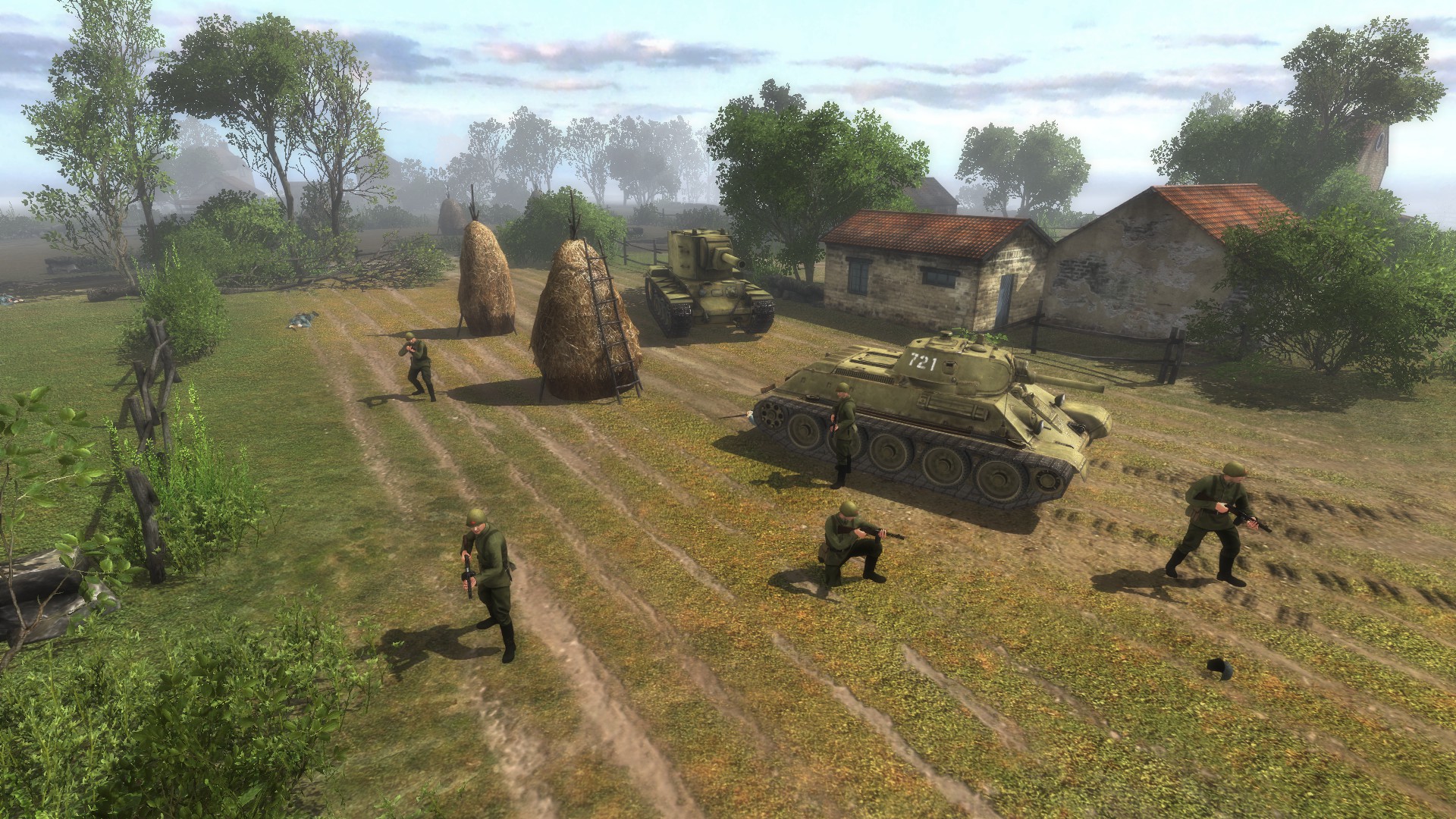
Despite the fact that the main purpose of infantry is to fight for territory, there are lots of tactics and ways to achieve this purpose. To be effective in combat, you need to consider which commanders are playing against you, which ones in your team; which front line breakthrough you need to react and which one to ignore; where the enemy attacks, and where it tests you for strength. You can, while playing for a basic or engineering commander, try to ensure the presence of your team at the maximum length of the front line and control every building and dig out every possible trench, react to each appearance of the light enemy vehicles and saboteurs, stopping them and defending allied artillery. Or you can organize small detachments along the front lines, lead enemy light tanks into ambushes and do everything to exhaust the opponent. You can play through fast rushes with motorized infantry or assault battalions. Break through the sectors of the front that are least defended, trying to move as far as possible to pull the enemy's forces into this area and later retreat when further efforts will lead to unbearable losses. Or you can fill the armored car with submachine gunners and AT-gunners, to go as deep as possible into the enemy territory, to occupy the buildings there and hold ground until the last fighter, showing the position of enemy cannons, distracting the foe from the place of the main attack and keeping the opponent in constant tension. And how many more tactics will you have to invent, my friend, to emphasize your unique style?
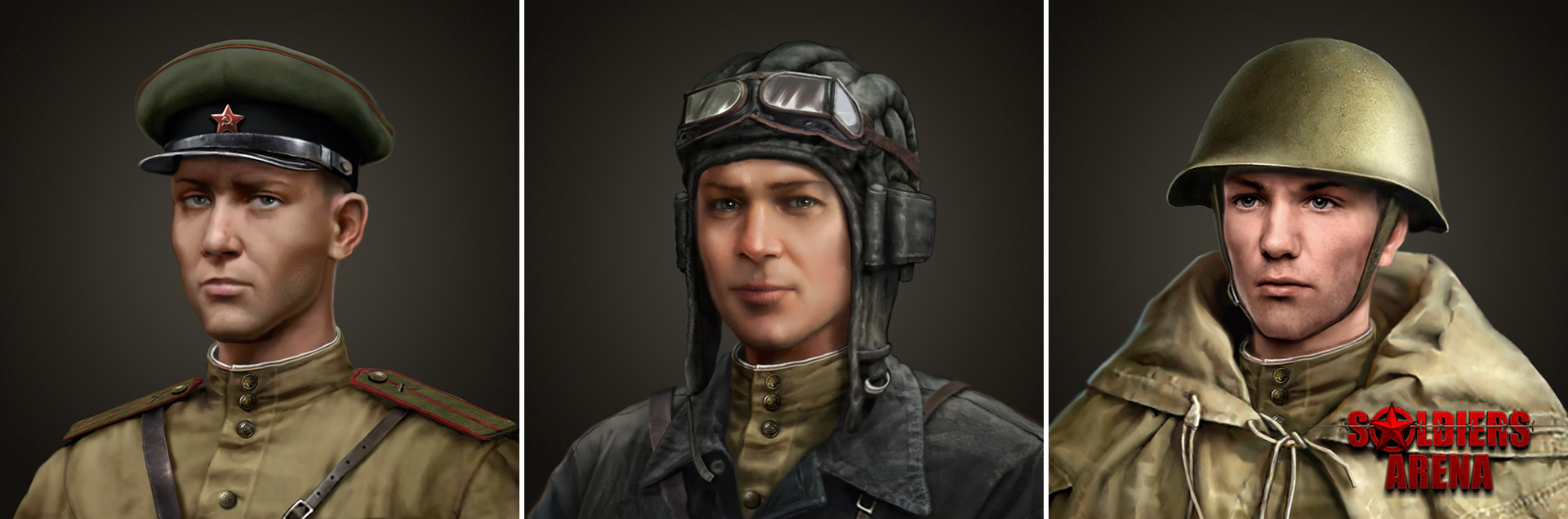
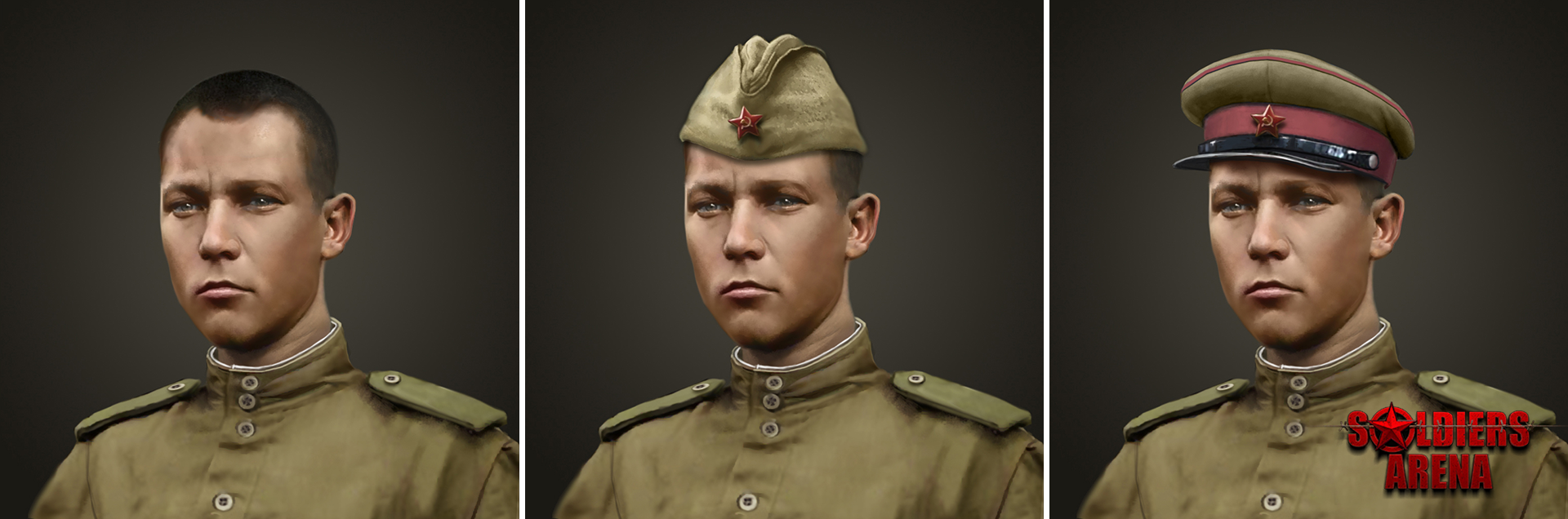
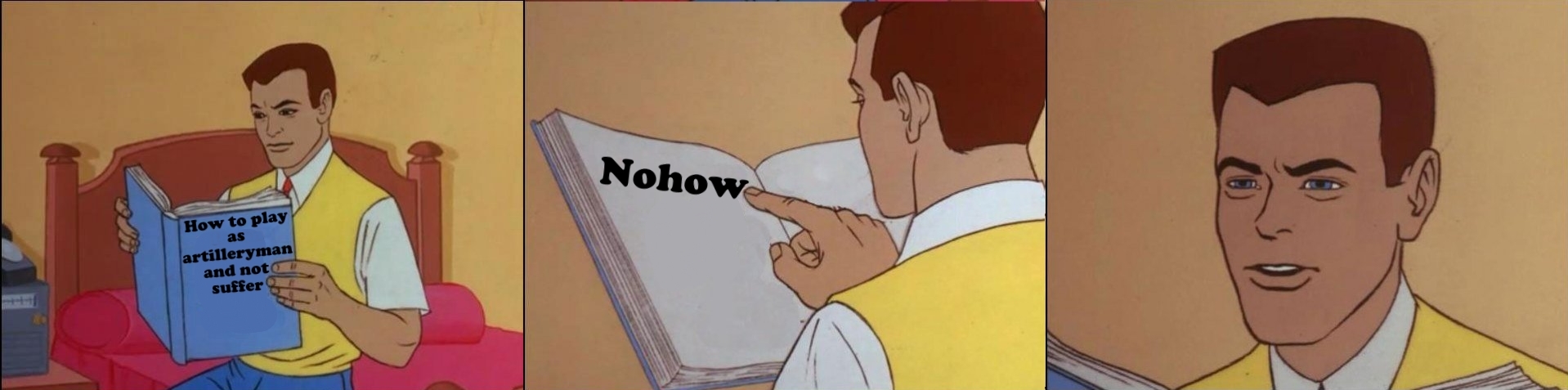
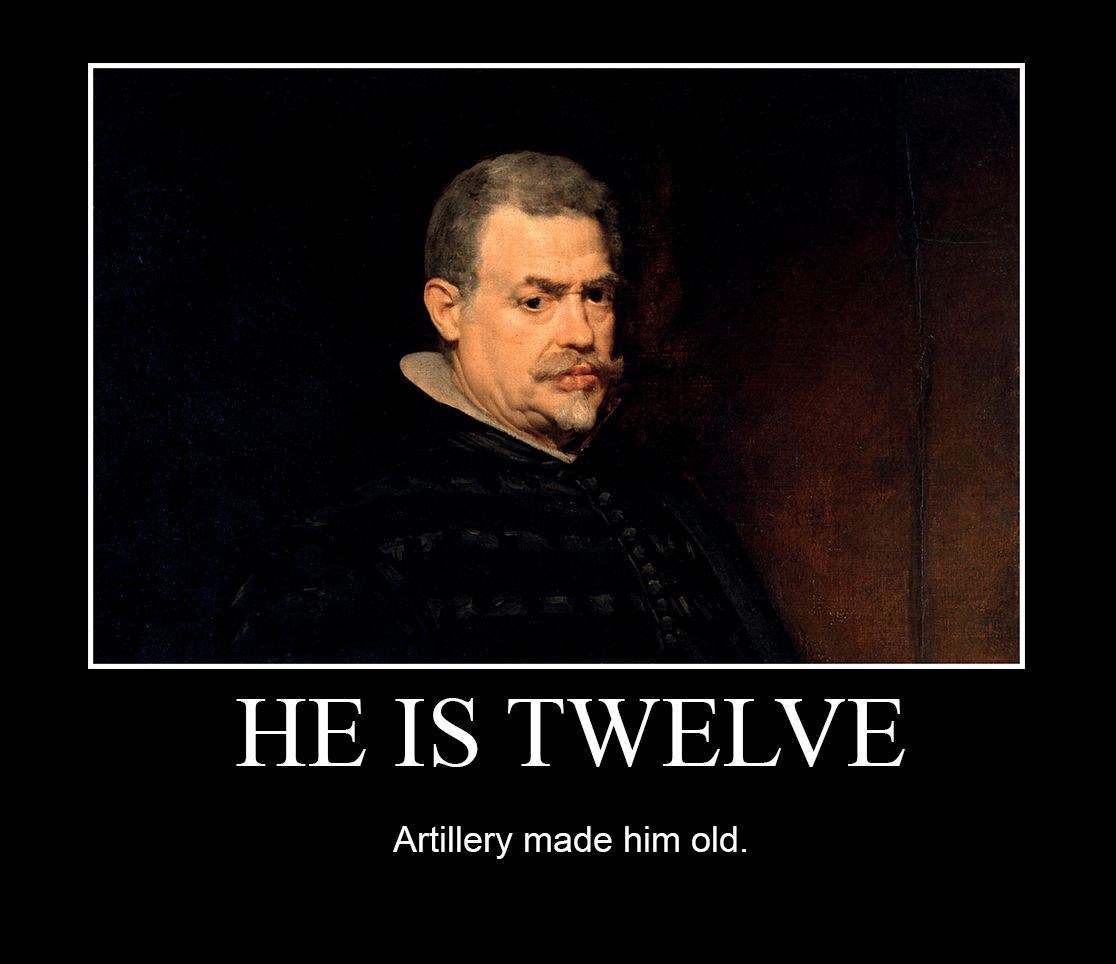
By the way, how do you feel about commander portraits? Did you notice the utter sad sight shining through the artilleryman? This is a strange coincidence, because the artist was not aware of suffering memes. If this post gets at least modest 150 likes - it will be a sign that you are interested in seeing portraits of a sapper, a sniper and a medic. And we will post them without delay. As usual, we wish you the best!
DevDiaries #46: independent infantry units
Hello, friends.
When you compare the state of the game mechanics in their first mention in the Diaries with how they currently are, you realize how much time and effort has been invested in the game and how far Soldiers: Arena has advanced. Just remember the trenches. We could write a medium-sized epos about how they were created and how many times they have changed. But we are not tired and we are not going to stop. And today we will tell you about a new type of infantry squad, on which we recently started to work. It’s Difficult and promising. Just as we love it.
What are these squads?
As it was written earlier, in Soldiers: Arena we want to strengthen the role-playing component and make the gameplay unique for each army type. But whoever you play, you can not forget about the infantry. Tanks need intelligence, and artillery constantly needs defense from saboteurs and everybody needs someone to capture and hold their rightful territory. Your team is unlikely to go into battle without an infantry commander, but the allies help those who help themselves. Friends may not have time to help, may not have have free troops or they might simply be engaged in something they deem more important than protecting your positions. If you don’t want to be helpless in a game, it's worthwhile to take not only big guns, but also a couple of infantry squads to cover positions, conduct reconnaissance or assault relatively safe sectors of the front.
Tank and artillery gameplay is very different from the infantry one and have different focuses of attention, goals, requirements for micro-control and the game tempo. The player constantly has to switch focus of interest, which makes the gameplay uneven and complicates the immersion and playing the role. In addition, in Soldiers: Arena the skirmishes go all along the entire front line and often the player needs to be present simultaneously in several places, placing his infantry to protect one sector of the front and attacking in the other, while still using direct control sometimes. So we developed the independent infantry units that can partially relieve you of the hectic affairs and allow you to settle your sight on your centre of interest. The squad leader will command the soldiers and direct their attack, leading the bitter fighting that will relieve the player of constant attention gaps in the front.
What do I need them for?
Independent platoons, companies are used to perform special tasks and do not directly obey the command of the military unit in which they operate. So in the game you can take them to the "deck", spawn in battle, and give the basic order. How to complete the orders is better for the squad leader to consider. Such detachments are more numerous and cheaper than the usual ones, but they have some limitations. You will not be able to select a specific target for them to attack, only a general direction. Such a squad can not be divided or controlled with DC. They carry out only basic orders. Now they are ‘Attack’, ‘Retreat’ and ‘Charge’. For example, receiving the order ‘Attack’, the squad will advance in the given direction until it meets serious resistance of the enemy and begins to incur losses. In this case, the advance will stop, and may turn into a retreat if the losses are too big. If you give the Charge order, then it will advance in spite of the losses, until it completes the task, or falls entirely. In the future, we plan to add orders like Capture the territory / building / trench and Strengthen, according to which the infantry will begin to dig trenches and prepare for the defense. Independent infantry units consist of the same units as the regular ones (recruits, regular army soldiers and vets) and will be both homogeneous (submachine gunners, riflemen) and combined. The inability to fully control them can be both their strength and weakness, depending on your micro-control skills. If you do not have time to be on all sectors of the front at the same time, call such a squad and switch your attention to something else. Yes, most likely they will not capture the Reichstag by themselves, but it will try from all its artificially intelligent capabilities!
How will they help me dominate?
For the first time we tried this mechanics on the orders of sappers and engineers. The player only gives them an order to place mines or dig trenches (put hedgehogs, barricades from bags and so on) and indicate the place, after which the squad spawns, executes the order and fall back all by itself. In the case of independent infantry units, we had to refine the logic of their behavior and prescribe a lot of dependencies on the situation on the battlefield, but we are sure that it's worth it. After all, now you can balance your battalion based on your own capabilities, wishes and chosen tactics even more precisely. And there are enough options for using them in combat. For example, you can give an order to attack and switch to direct control with your tank. Did you see your squad stopped moving? Help them kill the enemy and move on. Do you like to crush with quantity? Send a few independent infantry units forward and, hiding high-level infantry among them, you will get a chance for the direct assault even on well-fortified positions. Do you want to concentrate on the game with artillery, but you are afraid of saboteurs? Summon a pair of such squads and give orders to strengthen your positions. Of course, it is not necessary to use independent infantry units, and if you have enough time for everything and can skip on them - that’s great. However, you still can’t fill all slots with such units, because the number of them will be limited. There is no chance to sin in Soldiers: Arena while watching it with popcorn.
This is all for today. We are grateful for your activity in the comments and we hope that this will continue. What do you think about the new infantry squads? Do you have any questions? We are ready to respond.
DevDiaries #45: You know, what we did this summer
Hi, friends.
This is one of those diaries in which we report on the work done over the last couple of months. What kind of balance changes were made, what was added newly and how we are working on the game, which is worth waiting for. Read below about all these and some more.
We think of you. On these serene summer nights ...
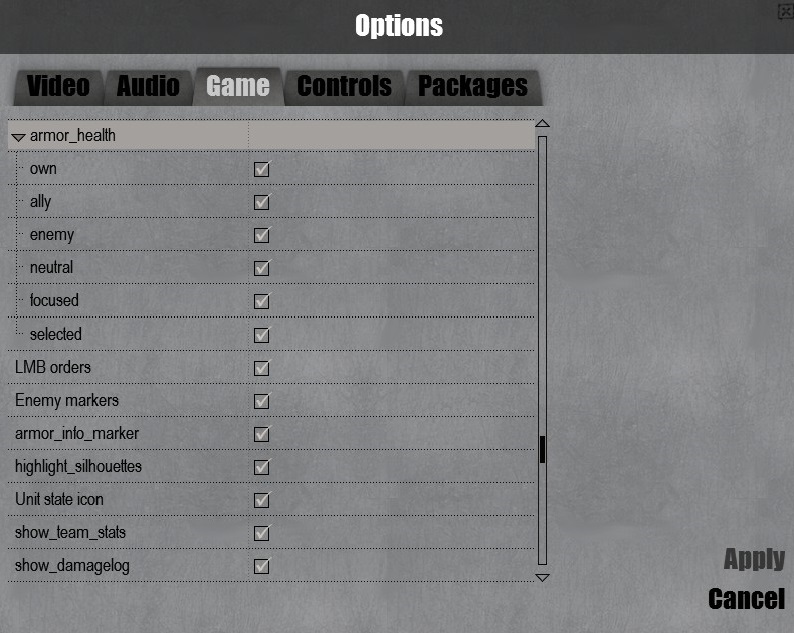
Community required the option to hide healthbars and we are ready to provide it. Now in the game settings you can remove them over your, allied and enemy vehicles, permanently or until selection or aiming. And highlights, markers and almost all the elements of the interface also. So it's more difficult to understand what is happening, but we know that a truly hardcore player with a gentle soul might be scared of healthbars much more than the 1st of September :)
Worked with the trenches, so you could bent them and choose the distance between the shooting cells while building. We taught the infantry to use and treat them as a friend, because at first, units build their way avoiding trenches, preferring to die with proud head and clean boots. After visiting the lecture "Trench - my winding way into a happy tomorrow", the infantry learned to shoot, move, throw grenades, fight hand to hand, but not leave the shelter without unnecessary need. In case when enemy infiltrate the trench, the infantryman knows what to do without player’s orders. If enemy armored vehicles are approaching the trenches, a unit with a AT-rifle will stand for shooting. Same unit that didn’t stick out when his comrades fought with the infantry. Unfortunately, you can’t hide in the foxhole from all the sorrows of the world. The trenches can now be destroyed by drifting on them with your armored monsters, or in the old manner, - sending a land mine. We made a separate seismic wave so that we could set up the damage to the trenches for each projectile. Yeah, yeah, we made this for you!
’Some of this and that and everything else’.
We continue to work on the "Front Line" gamemode to make the fight more interesting, added several factors that affect the victory. Twice during the session there is an order for each team to attack on a certain section of the front line. For the breakthrough and seizure of this territory, the attacking party receives additional points, thereby bringing his victory nearer. Now the victory is also affected by killing enemy units. Even if you have little infantry and have nothing to capture the territory, you can stop the breakthroughs, blow up tanks, put mines. Sometimes it’s more useful to stop the enemy than to mindlessly attack. And we did some more…
Set up machine guns, increasing their rate of fire to real indicators, but slightly reducing the damage and suppressing effect to keep their effectiveness at the same level and the infantry did not feel helpless.
Changed the rules of armor piercing, so that shells with a caliber much larger than the thickness of the armor have more chances to pierce and less to ricochet.
Set up the shell normalization, so now armor piercing projectile change it’s trajectory for 4.5 degrees.
Did nonlinear aiming. At close ranges, cannon aiming is at the maximum value after the first shot. At longer ranges, the number of shots to aim and the minimum radius reduction both grow.
We set up the noise mechanics, which we talked about earlier for snipers, and the aiming with time for riflemen, so that at long distances they have a clear advantage against the submachine gunners.
We created a test polygon in which you can shoot from everything, and a marker that allows you to see the armor rate under the cursor. That helped a lot with finding bugs in models.
Added new commanders with their unique style gameplay: light mechanized brigade and reconnaissance-sabotage battalion.
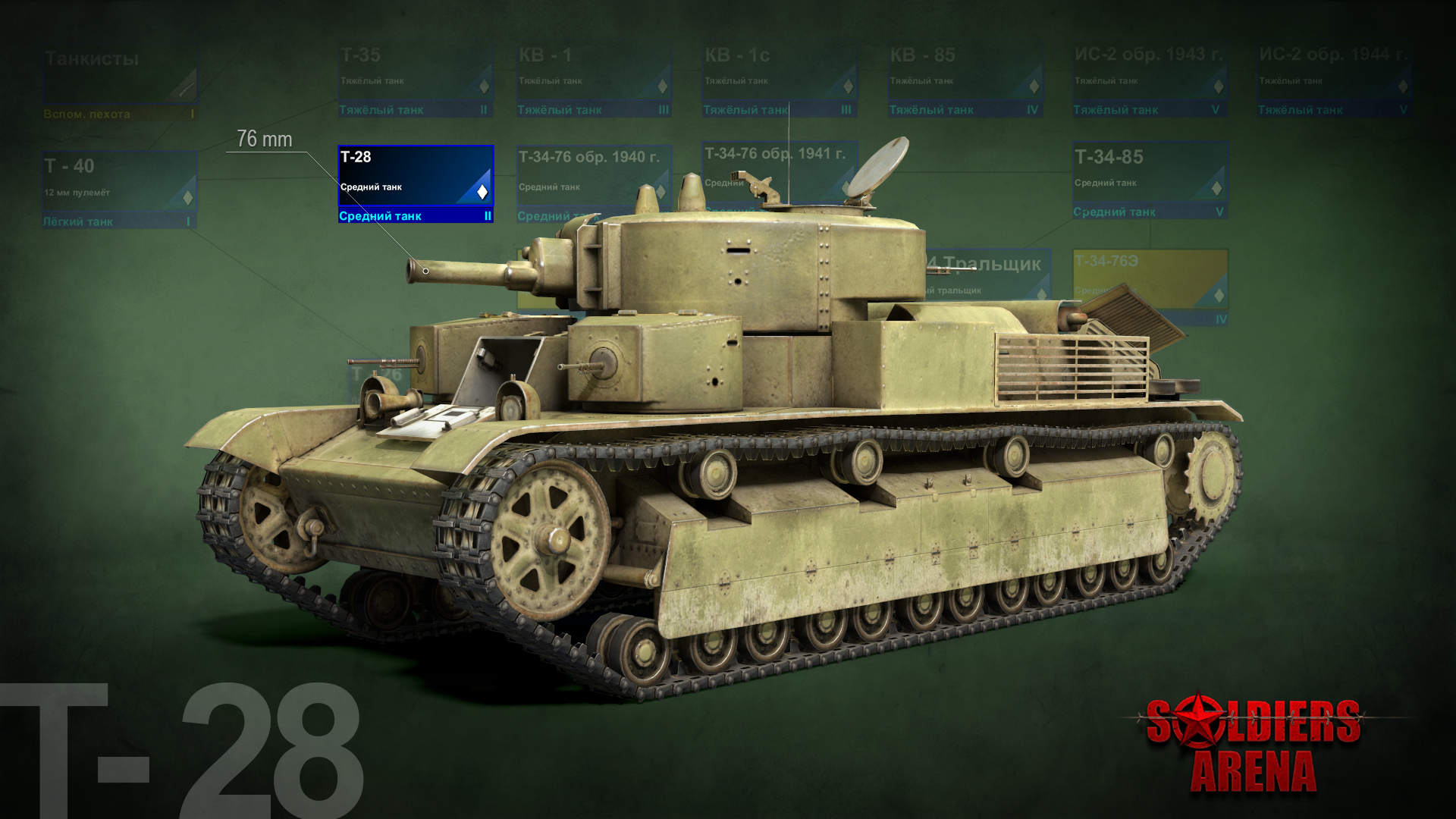
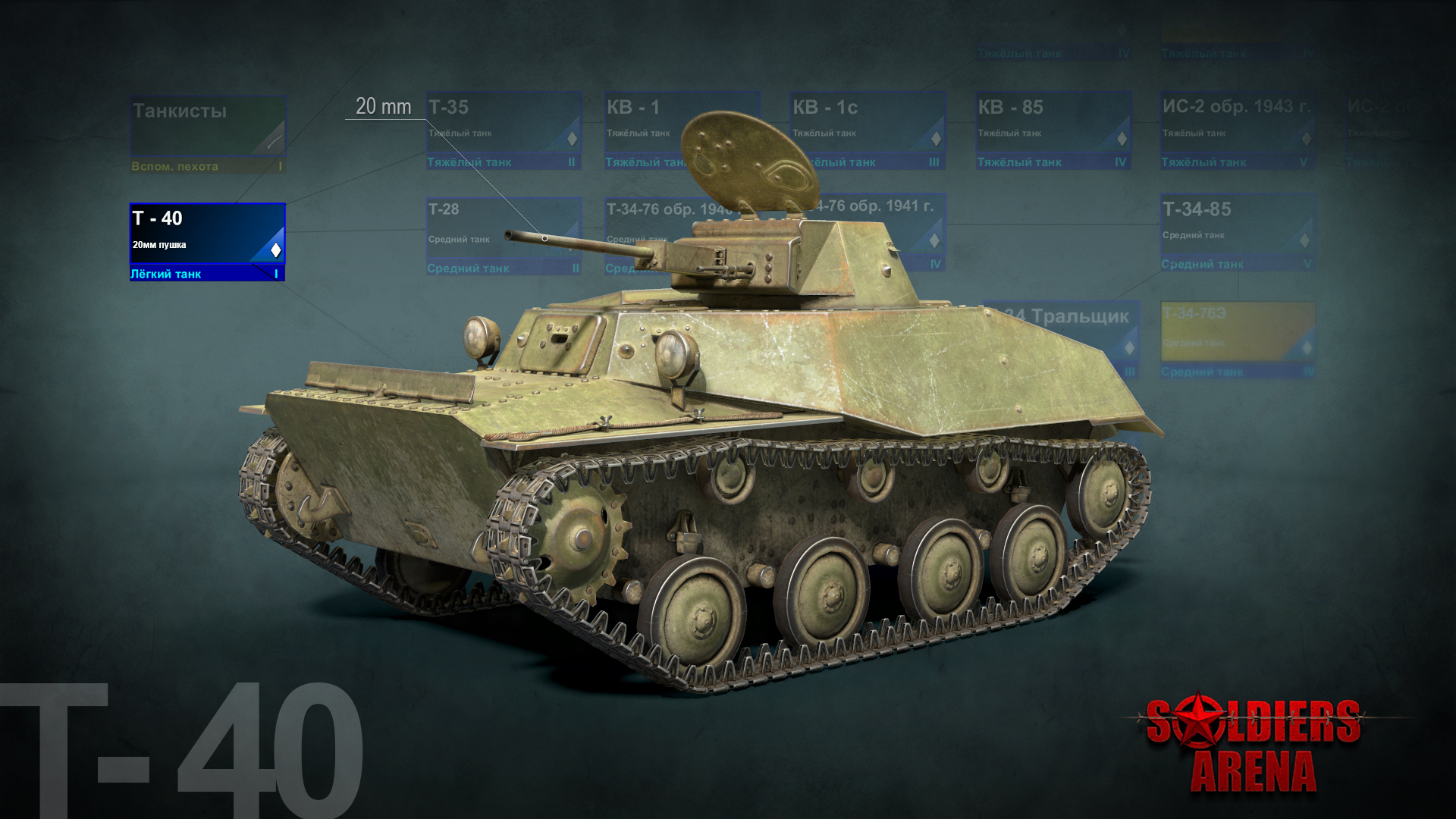
Entered into the game new units, such as T-28 from the cover image, lend-lease Valentine to the USSR tree, elite snipers for each of the factions with self-loading rifles and camouflage, and others.
So good that I'm not afraid of death.
As always, fixed bugs, one of which we want to share with you, because it’s ... pretty creepy. We started work on creating bots for coop gamemodes. And we wanted the bot to win not by cheating, but by unpredictability, so that they went through many revisions and iterations, refinements, improvements, and sometimes worsening, disputes, anger and cats hecatombs, until one day the chosen ones rose up, that didn’t want to die. Well, you know that what is dead, may never die. We tested a new adaptive spawn system that adjusts to the situation on the battlefield and calls the units based on what is missing. At the time of the explosion of the gun, the crew sometimes flies up from the blast wave and the health of the infantrymen goes into minus, but they are dead only when they fall to the ground. As you may have guessed, the bot spawned these lucky ones with minus health, so that they took their places by the cannon. Hell, even death did not relieve the artillerymen from suffering! Over time, it turned out one more detail, complementing the picture of the zombie apocalypse - they could be killed only by snap-shooting on the head or by fire, as these actions cause the script to "die" regardless of the amount of current health. So even if you actually were not going to make a game about zombies, you still have no choice!
This is all for today. Maybe a couple of questions more. Do you need other tasks like attack orders in the session? If so, which ones? Wish you the best!
DevDiaries #44: Indirect fire
Hello friends.
Today's diary continues the topic of the past one, so we shall tell you about some of the changes in the artillery gameplay. If you ever had to throw apples over a fence in the hope of hitting the neighbor's dog - you already know something about plunging fire. This diary deepens your knowledge.
Type of shells in Soldiers: Arena
In the future we are going to introduce all the main types of shells into the game, but now the units use only armor-piercing and high-explosive fragmentation (HEF) shells. Today we will focus on the work we done to enhance the HEF shells and their mechanics. The main objective of the fragmentation projectiles is to defeat the enemy's manpower and unarmored light engineering vehicles, while the high-explosive shell is used for the destruction of fortified assets and other protective structures. Now we use HEF shells as a universal weapon for hitting more targets and we still doubt whether it makes sense to divide it into high-explosive and fragmentation ones. We think this add some difficulties into the gameplay and only a few tactical features.
When calculating the damage, the explosive and fragmentation damage capabilities are calculating separately. For example, 37-45 mm caliber projectiles have a very weak high explosive effect, and fragmentation one, comparable to the explosion of anti-personnel grenade. Using the HEF shell with your Pak 35/36, you can destroy the enemy artillery crew or infantry "in the field", but it’s no sense in shooting trenches in the hope of their collapse. Shells with a caliber of 75 mm do not yet have enough explosive to create a powerful shock wave, so you can’t destroy buildings with merely a few shots. But the fragmentation action of such shells is already serious and capable of sweeping enemy infantry in a substantial radius. The explosive action of shells from 100 mm represents a serious danger for a landscape of any type. So any infantry and armored vehicles caught in the general direction of the epicenter of mentioned explosions isn’t very good for your health!
Firing positions
In Soldiers: Arena units can shoot both with direct (when the target is visible) and indirect fire (when the target is out of line of sight from the firing position). In Soldiers: Arena we want to reflect the individual characteristics of each unit as fully as possible, therefore, when setting them up we take into account not only the caliber, but also the weight of the gun, the speed and trajectory of the projectile, the noise created by the muzzle brake, the rate of fire and, of course, the angle of the horizontal and vertical aiming. Let’s take for comparison two guns with an almost identical caliber, but completely different tasks on the battlefield.
LeIG 18 is a 75 mm infantry support gun with a 3.5 km max range of fire in reality and a good vertical aiming angle from -10 to +75. This cannon is lightweight, which allows it to be moved quickly by the crew. And the speed of the projectile is quite low, which makes it possible to use indirect fire while near the target. But because of the low speed of the projectile it has a weak armor-piercing and low accuracy at long distances. A large range of angles of vertical aiming makes it ideal for plunging fire, and its priority targets are infantry in the field (with less success infantry in shelters because of the small explosive action of the shell), enemy’s cannon crews and unarmored vehicles.
ZIS-3 - a divisional gun of 76.2 mm caliber with a maximum range of 13 km, and less flexibility of vertical aiming angles compared to LeIG18 (from -5 to +35 degrees). The greater weight of the powder charge and the high speed of the shell make it possible for the ZIS-3 to hit light and medium tanks without problems, but makes the flight trajectory of the projectile more sloping, which, in combination with a small maximum vertical angle, makes it impossible to infiltrate close targets with indirect fire. In addition, her muzzle brake raises lots of dust when shooting and gives away the position with ease. ZIS-3 will prove its maximum potential when shooting direct fire on armored targets and destroying other cannons in the field of its visibility. An attempt to destroy the mortar hidden behind the building is a thoughtless waste of this weapon’s potential, because first you will need to flatten the building itself.
Plunging fire
Trying to reflect in the game the advantages of units on a real battlefield, we ran into the problem of howitzers. In Soldiers: Arena cannons have no limits on the range, but the chance to hit still falls with distance. But what in that case to do with howitzers? After all, they are created to hit hard from the rear, clearing the bridgehead for the attack and to be sufficiently accurate, because in the melee they do not really shine. Also howitzers shoot shells of large calibers that can destroy almost any target. You can not argue the fact that it is difficult to ignore the direct hit of a 203 mm projectile fired from the B-4 no matter how tough your armor is. In addition, artillery is invisible now! All signs of the imbalanced class are present. But in the war howitzers using the indirect fire, aiming on the location rather than a specific target. It's not so easy to hit into a moving tank from a distance of more than 10 kilometers, and even beyond the line of sight. We decided to develop thought in this direction.
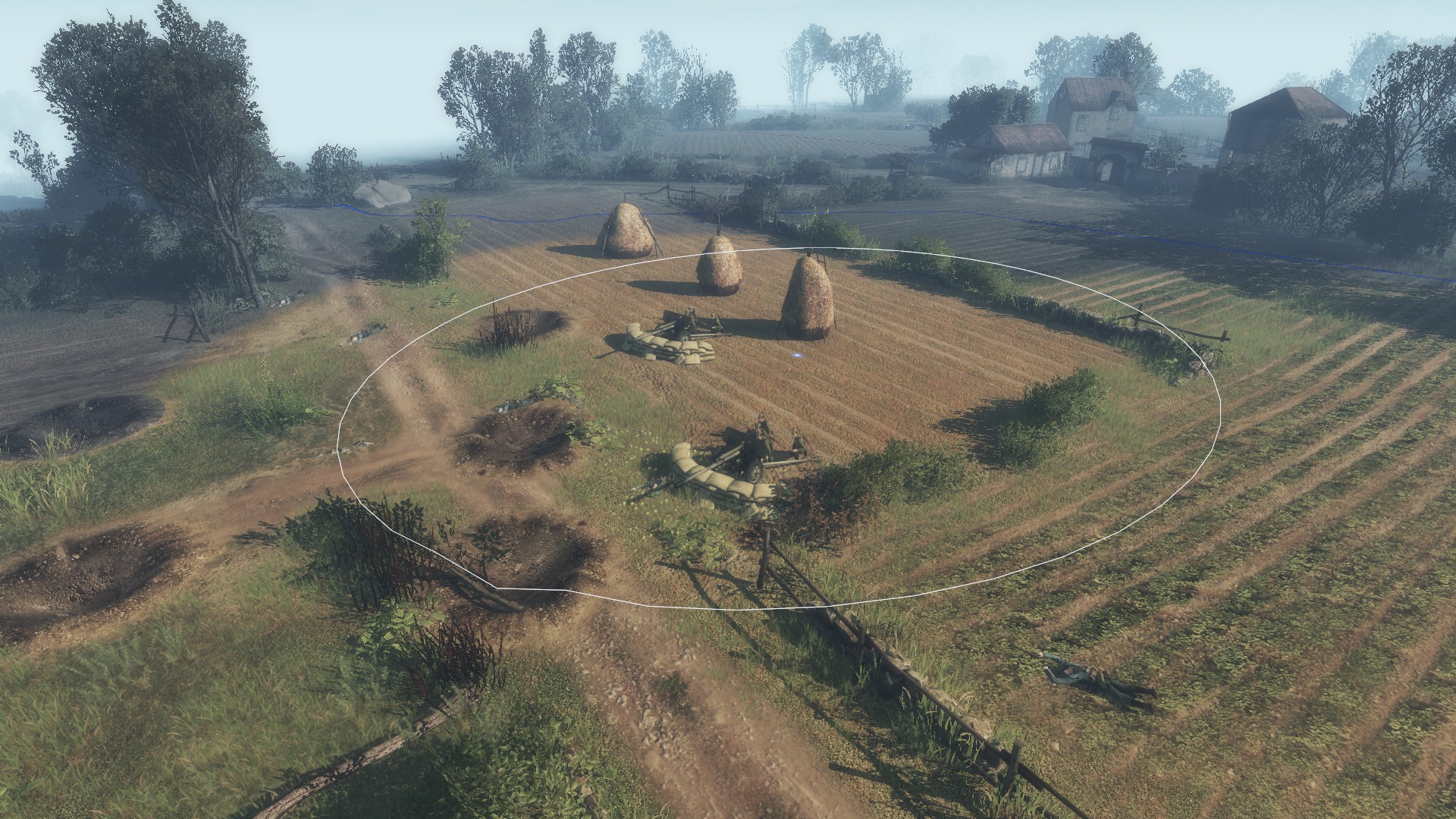
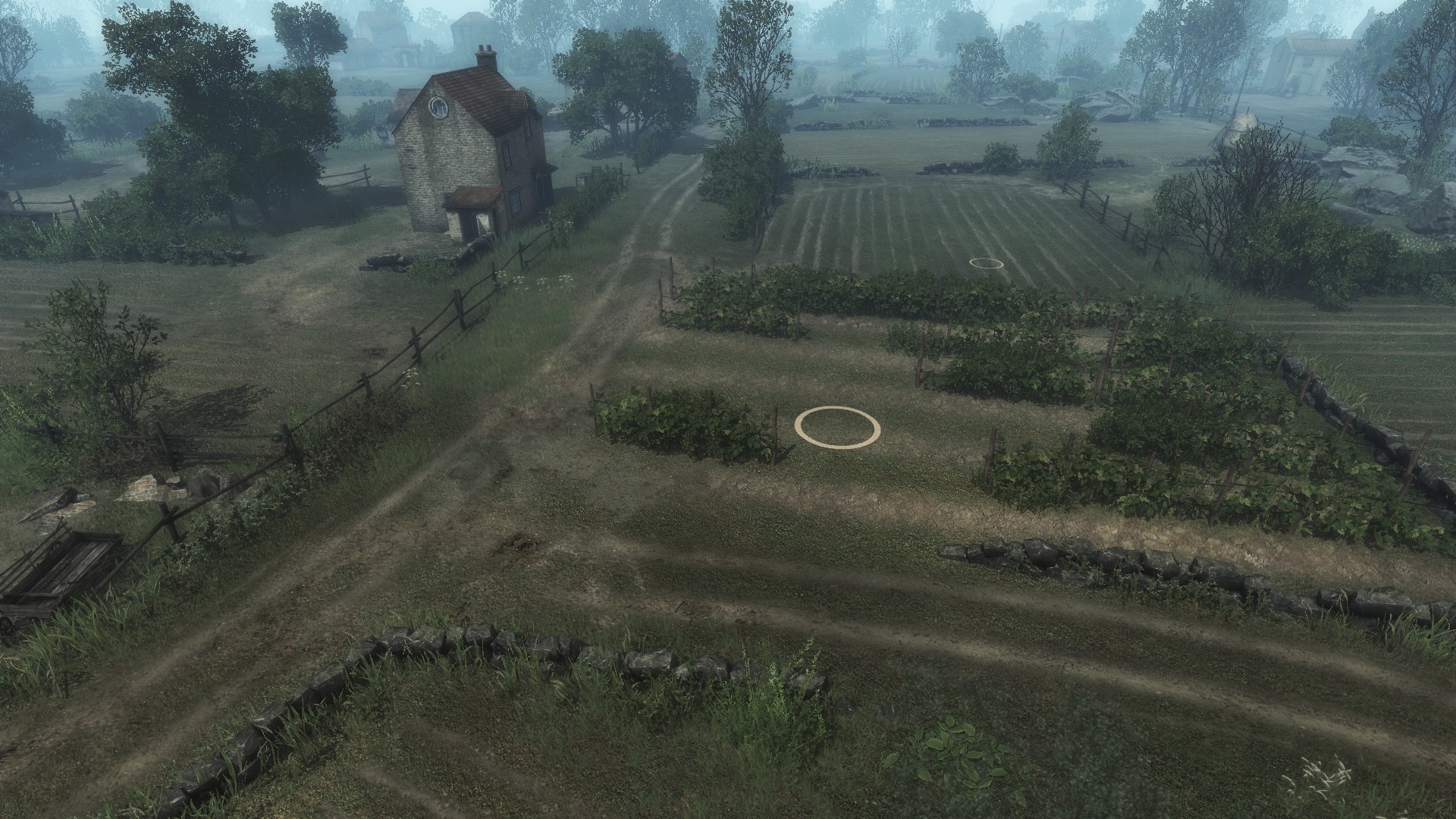
So we enhanced the trajectories of shells for howitzers and later all cannons that are able for plunging fire got it. Now the artillery does not hit the target, but the location. In the screenshot above, you can see the aiming circle that displays the location in which the projectile can fall. When you select the zone for fire, the cannon will begin to aim, which will cause the circle to decrease. This gives you the opportunity to choose: to shoot now, hoping for luck, or to wait and increase your chances of hitting the target. In addition, with each new shot in the same zone, the circle decreases until it reaches its minimum size, which is still much larger than a lone target. The minimum aiming zone is not a constant and increases with increasing distance to the target. When choosing a new location for the fire, the circle will begin to grow, cause your artillerymen needs to zero-in again on the target. You should concentrate on static targets that can be destroyed by a blast wave and do not try to catch up the fleeing car with a direct hit, because your accuracy drops with the changing of the firing zone, and even with the maximum aim rate, you still may need several shots to get to a specific point.
The mechanics described above solve several problems at once. The howitzers strike painfully and fairly accurately, but not too much to hit the open hatch of the moving tank from the other side of the map, and cause a high-explosive effect in the epicenter of the explosion and powerful fragmentation damage in a large radius. The fragmentation damage of howitzers is huge and even the entrenched infantry is likely to die, and at best it will be stunned and withdrawn from the battle for a time. Heavy fragments easily penetrate bulletproof armored personnel carriers and thin anti-ballistic armor of light and medium tanks at the case of close blasts. It's still possible to shoot a direct approaching tank with a direct fire, and a 40kg shell is unlikely to go unnoticed for even the heaviest of them, but here it is worth to evaluate the risks twice, because if the gun fires from close range, it will be immediately unmasked to the enemy. Who knows, maybe this is what the enemy is waiting for? In addition, there are no more flights over the edge of the map due to direct fire. The projectile is guaranteed to fall within the aiming circle. And most importantly, guns with a plunging trajectory of shooting have their own role, unique gameplay and their tasks in combat.
This is all for today. Friends, do you think it makes sense to introduce additional types of ammunition into the game and if so, which ones? Don’t be shy to write your comments. And, as usual, we wish you the best!
DevDiaries #43: Artilleryman for life
Hi, friends.
Today’s diary is about how we see the artillery gameplay and why we are sure that each type of forces should have its own unique gameplay. And do not forget, our dear reader, that this gameplay should be not just another different one, but also interesting in it’s own. If you leave the art in its previous form and bring it to a separate class, then you should admit that it will be a rather boring class. In addition, the big problem of artillery was its "one-off" style of usage. Spawn-shoot-backoff. And when you have more units to play besides artillery, this state of affairs is tolerable. But what to do when it's a whole class and most of the troops in your battalion are just like that? Leave everything as is and put up with the fact that the game for the third part of the units in Soldiers: Arena boils down to a wait-and-see sitting in the bushes? Damn it, no!
We have written many times that we want to strengthen the role-playing component of the game. We can say that we adhered to the classic Warrior-Wizard-Rogue scheme. Tank battalion is obviously a warrior with the best armor and powerful blows. Infantry shall be wizard with a spell/grenade for each enemy, who with due skill, can create real magic on the battlefield. And the rogue is, of course, artillery. So, we gave him invisibility. An attentive reader could have guessed this from a diary about an artillery commander. And no, this is not that invisibility. The artillerymen does not throw smoke bombs under his feet, so that in a moment he shall be vanished with the howitzer in their hands to appear behind the enemy's rear in a moment's notice.
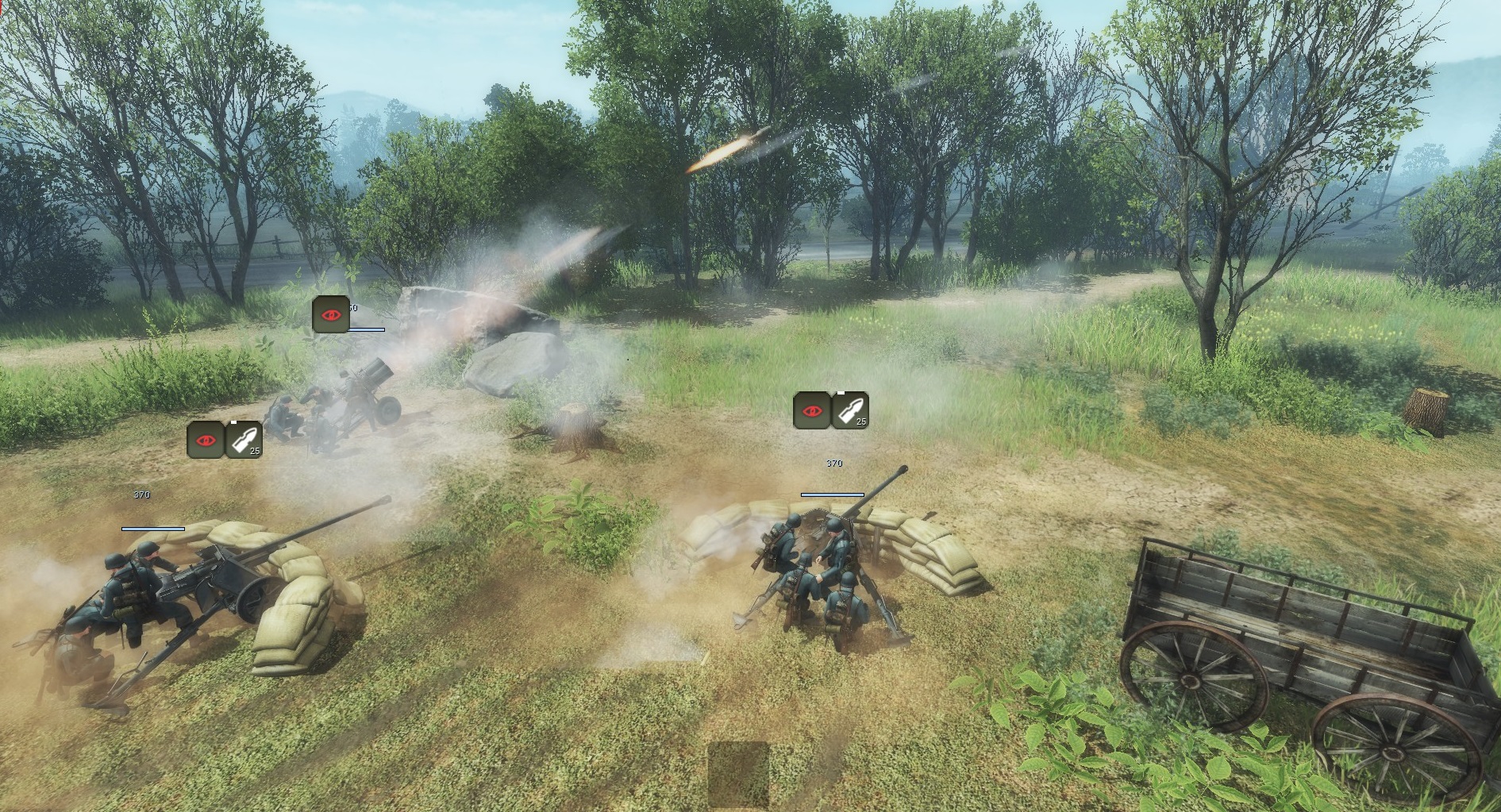
Each weapon that does not fall into enemy viewports is considered hidden, but when fired, creates a noise zone, with the maximum value of noise in the center and smallest - with distance from it. The radius of the noise zone is now ten gaming meters. The noise level increases with each shot, decreases with time and depends on the type and caliber of gun (for example, howitzers and SPGs create more noise, and the handsome one from the cover or Katyusha becomes unmasked for one volley). Each shooting gun adds noise, and the closer to each other they are, the faster they become visible. Moreover, the noise zone is remembered and decays for a long time, so if you do not relocate, then the guns start to give out their position more quickly. The noise level begins to drop right after the shot and decreases from maximum to zero in thirty seconds. We are testing this mechanic and modifying it, so that the interface pieces and icons associated with it are in their "working" form.
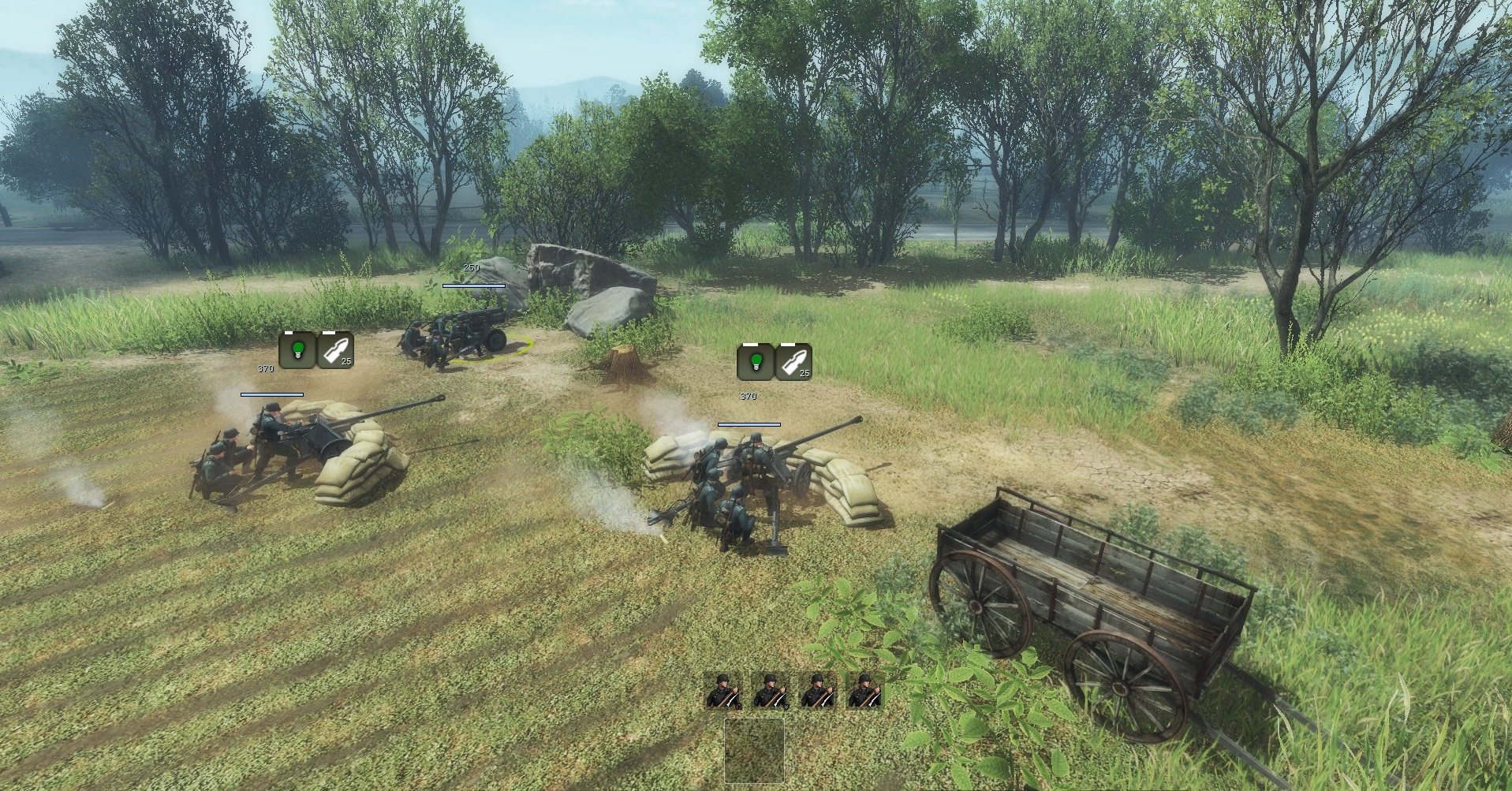
The green lamp - the gun starts to pick up noise, but remains invisible to the enemy.
When the lamp changes to red, the cannons will remain invisible for enemy, but the circles-markers will start to spawn, giving an idea of the approximate location of the ‘gods of war’ picnic.
Da Vinci said that "The eye, the window of the soul, is the chief means whereby the understanding can most fully and abundantly appreciate the infinite works of Nature". But if you are appreciating THIS kind of eye, be aware, cause probably your artillerymen already has appreciated their own and their windows of the soul will soon open to pass on to another life unless you act quickly. The gun is unmasked and displayed both on the opponent’s screen and minimap.
What does this give me as a player?
We knew that you would ask! This makes the game for artillery and against it more interesting, but does not make it unbalanced. Counter-battery fights, search raids in the enemy rear and so on. Artillerymen now need to constantly change the position and outsmart the enemy. Appear, destroy and go again into silence mode. No more boring vigils over a pair of guns in anticipation of a worthy goal. Now you need to connect both hands to successfully manage your cannons.
We try to display in the behavior of the units their advantages and disadvantages on the real battlefield. Shooting from the “hidden positions” fully meets this goal. And here are some more:
Artillery guns are a bit more accurate and significantly quicker in comparison with similar tank ones.
Artillery has become mobile and now each cannon can be called attached to a car if the appropriate perk was earned.
If you have taken a position, then make it impregnable! AT-hedgehogs, barbed wire, mines and trenches. A good artilleryman always has something to do.
The right choice of targets. Howitzers and mortars are good for destroying the enemy's manpower and its fortifications, but a wide spread of plunging fire makes the destruction of mobile units a tough task. Using such weapons, you need to knock the ground out from under the enemy's feet, and not try to knock the helmet off his head.
Battery fire. If you are playing with artillery, then play it right! Selecting, for example, AT-artillery you must do what it is really supposed to do - destroy tanks. So why don’t combine the three guns into a battery? And instead of making three shots from one gun, do one from three and go into silence to enjoy the shredded ruins and look for a new victim.
Artillery went through a lot of suffering to be reborn, and in one diary we can’t tell about it properly. In the next diary we will tell you about shooting modes, types of shells, the correct choice of targets and how to play plunging fire guns. But we need to say that the next diary will be in three weeks too. Do not be angry, friends, it will not become a tradition :) After it we will return to the normal regime.
And btw we began to make short training videos for each of the units, which you can watch without leaving the game, to learn its main characteristics, pros and cons. This video is more like a test and will not go "to print." It has a bit more action than we need in the training video, but sometimes one should hold oneself to the good bits :) Wish you all the best!
Hi, friends.
In connection with the lots of works planned, did not have time to prepare a diary for this week :( So we apologize for that.
Feel free to use the opportunity and put pressure on us to made us write the next diary about what you want :) But no gameplay videos. All the best for you!
DevDiaries #42: The Ultimate Question of Life, the Universe, and Everything
Hi, friends.
Today's diary is quite important one. I bet that you will not need 10 million years to understand what kind of question we are talking about. We will also talk about how and when playtests are going, about holy wars and memes of the Alpha and how they help us to find the right solution amongst a lot of wrong ones. Here's a working version of the portrait of an infantry commander to stretch your eyes before reading.
Played, understood nothing, but I will play again
Twice a week we gather alpha testers for playtests to get feedback from them about the innovations in the game. Further down we’ll include the best quotes from these reviews. These are our first critics and we appreciate their help immensely. Among them there are both seasoned players and baby seals. There are those who without regret cast their lives on the altar of the game-god, and there are those who play for a couple of hours a week.
To someone, the game seems too fast, to someone else, on the contrary, too slow. Often this opinion is the result of the player's temperament multiplied by the chosen commander. ’He plays the slowest commander. A fast combat in this case is possible only if you misclicked and accidentally picked up something lighter than IS-3’ - about one fan of heavy tanks. Artillery for fans of infantry combat: ’Played this stuff, too calm for me. Lazy clicking all the game’.
Someone hates the building assaults, because ’Have you seen how the buildings are being stormed? Crushing with tanks! TANKS, Carl!’. For others, storming is not a problem in the presence of high-explosive AT-grenades, flamethrowers, or simply ’take ten to fifteen submachine gunners and arrange an exterminatus for the whole area.’
Someone tries to avoid the fights in the field, while someone with tears in his eyes remembers the infantrymen who were thrown into the meat grinder of city battles ’I remember one fight where 50 people were killed in one f***ing house".’
One thinks that the infantry is too strong, the other that ’if the enemy gives you the opportunity to kick his ass with infantry only- it's his own fault’, and only one thing is important for the third one - ’artillerymen must suffer!’.
While artillerymen suffer for themselves, someone suffers from suppression, trenches, storming buildings, slow-moving guns or too mobile tanks. Some suffer from health bars, but they no longer sharpen their pitchforks, cause ’health bars aren’t so terrible as they look like’.
We collect user reviews in special albums, decorate them with stickers and reread them in rare moments of rest.
‘I like that the game gives a big set of roles: an anti-tankman, an artilleryman, an infantryman, a heavy-tankman, a defensive guy and attacking guy, and at the same time is aimed precisely at the teamplay’.
‘Well, I ran into the house with 15 submachine gunners - but f***ing calliope rolled out from the corner and blew up everyone. That’s how cooperation works’.
‘I like: bots, that fight better than the personal guard of Ivan the Terrible; lot’s of units already at the stage of closed alpha; the artillerymen sufferings.
I dislike: healthbars of the tanks and cannons, artillerymen as a class’.
Feel free to speak in defense (or vice versa) of artillerymen and share your pics on our facebook page.
...it has the words Don’t Panic inscribed in large friendly letters on its cover
The described disputes and contradictions are the essence of the development process. Do not think that the alpha test is an opportunity to play before everyone else. No, friends, this is work, and quite nervous work in fact. But this is an opportunity also to participate in the development of the game and to influence the final result. Many features have been changed under the pressure of the alpha testers, and some of them appeared only thanks to them. Now we see that the main gameplay is formed and the game gives different opportunities to different players within the same session. Everyone can find his place and his tempo in the game. The same combat mission can be performed in a variety of ways, depending on the nature of the player, his preferences in units, the chosen commander, team-mates, etc. And most importantly, it requires cooperation. This means that the game becomes that which we envisaged in our dreams.
Earlier, we said that as soon as we determine the date of early access - you will know it first. Our spouses and children are still unaware waiting with the hope of the release date, as a happy time when their loved ones will be freed from night hours and festive bail-outs. Do not tell them that after the release even more work will appear... Please.
We plan to enter early access in the first quarter of 2018. If someone seems to think that the development of the game has been going on for a very long time and the key to it should have been at your email yesterday or even earlier - here's a small thesis on why unicorns do not exist:
We are a small team working without a publisher.
It takes a lot of time and effort to create a game in which the user will spend a lot of time with pleasure and enthusiasm, instead of simply plunging into his pillow and pray to Apollo to have his eyes mercifully shed with divine arrows after the first game to never see such a sickness ever again.
We burn ourselves on games with early access and believe that at this stage the game should give joy from something more than finding a bug.
The exact date of early access start, we can say 2-3 months before its release. Do not get lost, everything will only become more interesting. Wish you all the best!
DevDiaries #41: Hello lagger, my old friend
Hi, friends.
What have we done for you lately? Hey-hey, everything is written right here, in the diary. Read, please.
We worked on the performance of Soldiers: Arena. We switched to 64-bit client, for example. Steam says that as of May 2017, about 7% of users are playing with 32-bit OS, but their number is constantly falling. Friends, are there any of us who need the 32-bit version of the client?
We optimized the transfer of information between units in combat, which saves resources and is especially felt in mass battles.
Changed the server rules when one of the players lags. Previously, the server, guided by the musketeer’s principle, forced all to wait for one, or slowed the game, allowing the laggers to catch up the rest. In the first case, we "enjoyed" the pause in the culmination moment, in the second we watched another Wachowski film (same spectacular and slow mo). Now the server does not stop the game because of one lagger, because "the needs of the many outweigh the needs of the few”. The game for the others goes on as usual, like a caravan of tanks, aspiring to a cloudless and happy future.
The game for the lagging guy is recovering as much as possible, trying to catch up what’s lost and find what’s gone. Rushing at a gallop and moving to the trot only when catch up the server. Lagger at this time alone in his lagging sad world, like a caravan of desperate tanks, lost among the dull country roads.
Playing God, do not overdo all settings
We configured Soldiers: Arena. Changed the calculation of damage for armor-piercing shells. Now both the muzzle and potential energy of the projectile are taken into account. For example ZIS-2 has excellent armor penetration, but ZIS-3 deals more damage.
Drew markers for fast messages. Now each of the contextual messages has its own visualization, which helps to quickly understand what the ally wants from you, without distracting yourself by looking at the chat.
We fought with strange bugs. There was a time when machine-guns have mythical durability and could withstand a direct hit of 75-mm (and even more) landmines. In those harsh times even glass in the windows were tougher than the chains of Fenrir. The rifles of the defending infantry could not even scratch it. But the tanks jumped on the mines joyfully and high, like mongrels at the sight of meat. Especially lucky ones even could finish the jumping streak with a gymnastic stand on the tank tower.
Want to see beauty,
Burning my life in the game,
Beauty I need. Now!
We filled the map with objects. It’s configuration should provide opportunities for the use of all kinds of troops: open areas for tanks and artillery, areas with dense buildings for mortars, light vehicles and infantry, hideouts and locations for maneuver battles, etc. Based on these criteria, the model of the next soviet village map was also created.
Added a new type of surface - "deep snow", which slows down the movement and makes mobile units even more useful. So we made winter versions of maps for tests.
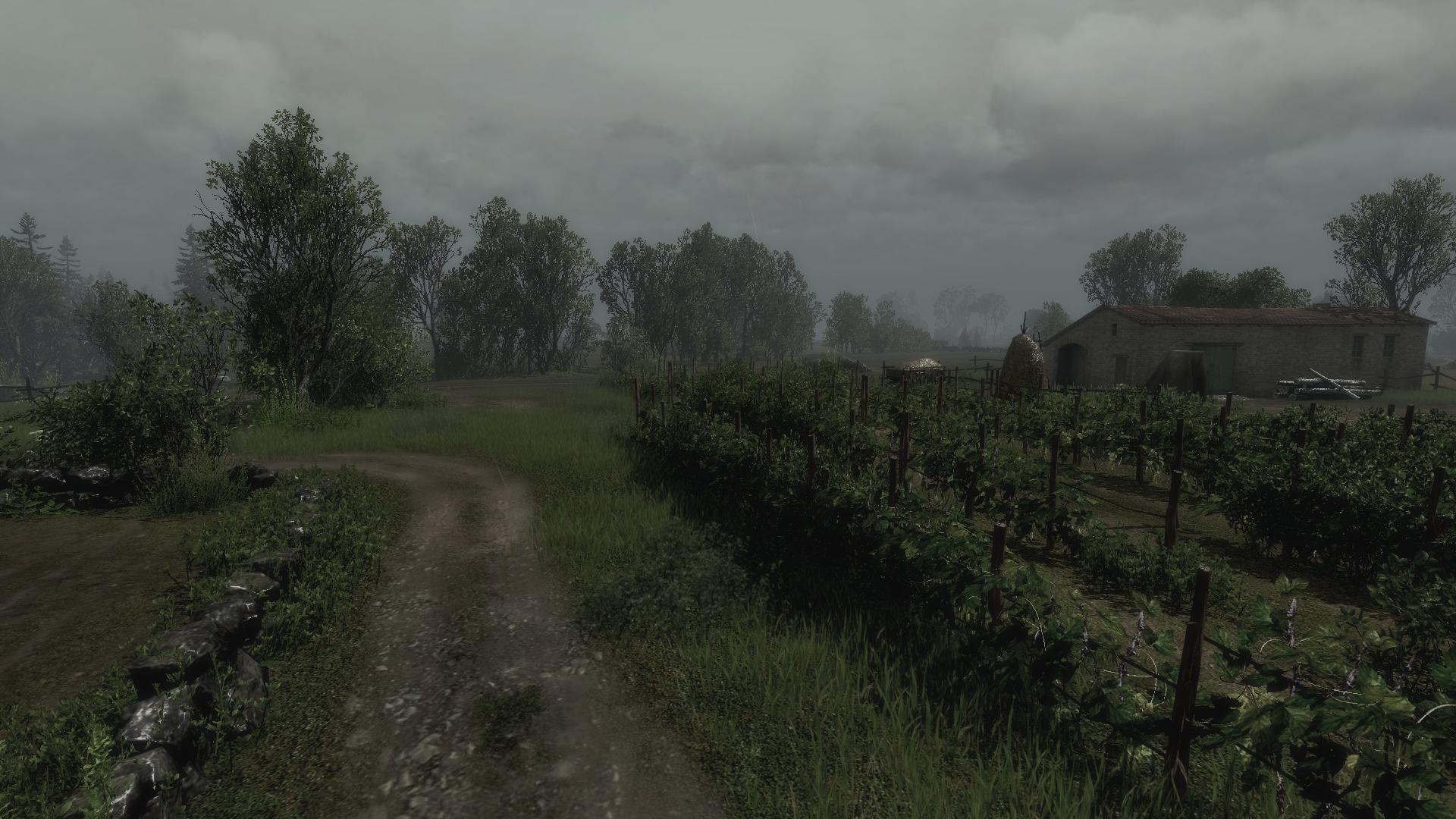
Configured environments. We want the player to remember with joy the hours spent in the battles on each map, so that one would like to admire them as cherry blossoms and write haiku. Note how the mood of the “Village” map changes with the using of different environment.
Can’t you hear the third set of roosters, looking at this farmland morning?
Do you feel how the sun scorches the landscape on this summer day?
How does your back ache in the evening after hiking for mushrooms?
Maybe you want to make tea and read A.E.Poe, looking at this rainy weather?
If you feel something like this it’s ok. It's nice. But don’t forget these desires must not dislodge your passion to show your skills in the battlefield. Cherish this feeling. This fighter’s enthusiasm will be in need.
And finally we have a couple of questions. How do you feel about bots? Where are they good, and where are they not? To train skills only, or do you need them to replace disconnected players, for example? Would it be interesting to test your skill in cooperative battles against AI in the "hardcore and his brother INSANITY" mode? Blurt out your plain truth below! Wish you all the best!
DevDiaries #40: GEM2 - myths and reality
GEM2 is dead, long live GEM2.
Come closer to the fire, my friends. I'll tell you a story. A story of struggle, death and rebirth of one brave game engine. In the comments, you can often read that you can’t look onto the annoying second GEM and suffering from the need to see the third one, and, preferably, better soon that sorrow. For how long will you release and remake these things on this engine when you can potentially work on something else. Stop using the dead GEM2. For how long will we need to wait! We need to do something! It's time to take a stand!
Friends, do not rush to take protest posters in your hands. Most likely it's a banal misunderstanding. This whole thing with the engines is not as simple as it seems. Some people think that the engine is something that "renders great models with cool shaders and so on." Others that it completely determines what kind of game will be. The third ones think that GEM3 is better than GEM2 because ? you know… It’s obvious! The third is always better.
Apparently some moments need to be clarified. Wikipedia tells us that "A game engine is a software framework designed for the creation and development of video games. The core functionality typically provided by a game engine..." So the main part here is “core” one. And this core can be quite flexible. This is easy to understand if you just compare the games that developed using the same engine. Hardly anyone would say that Lineage II and Star Wars: Republic Commando are very similar. Tyranny and Fallout Shelter can’t be called twins too. And even now Men of War…
… differs from Soldiers:Arena.
GEM2 is alive!
The engine determines the basic rules, and greatly simplifies the work on creating the game, because you do not need to do everything from scratch. But do not forget that this is a tool and quite changeable tool in skilled hands. Most of what we write about in the diaries is the editing of the engine. All these trenches, medics, fortifications, interface, the new gamemodes and so on - that what had to be added. By the number of changes that we made, it has long ceased to be the GEM2 that you remember. A year ago we talked about version 2.3 and even then it was rather conditional label. Since then, it has changed many times and will change more to match the goals set for Soldiers: Arena and it is not so important what number you can add after the name. If it helps you get the answers you need, you can call it even GEM42.
And we talked mainly about the gameplay functionality earlier. In addition, there is a huge piece of work, which is not so interesting to read (and write, too btw). Partly because such topics are very difficult to normally describe in an understandable language, without using a mass of terms and abbreviations. Yes, yes, jokes about the "programmer's answer" here would be ok. And these invisible, but important works go on constantly. GEM2 learned a lot.
Carefully support partial and complete localization. At the moment almost everything except right-to-left languages.
To inform the player about his success in the session, ratings, available commanders and their experience.
To work with memory according to C ++ 11 standards. The selection, release, counting of the number of references to objects now passes better using the new stuff.
Improved the system of quantizing units. And what has we say earlier? Terms in da house. This makes it possible to set a more realistic rate of fire for machine guns, cannons etc. And AI began to think faster.
To recognize a highly detailed map of heights in the right places. Specially made this one to make possible to shoot an apple from the infantryman's head sitting in the trench using your Pak40.
To understand Rim shading, Ambient bounced, HDR, LUT, gamma-correction and stuff.
Gathered the tools to create games against bots, both single and multiplayer.
Learned to be tolerant to different platforms. At the last test, our coders finally managed to play in the general session using the Linux and no longer feel hurt.
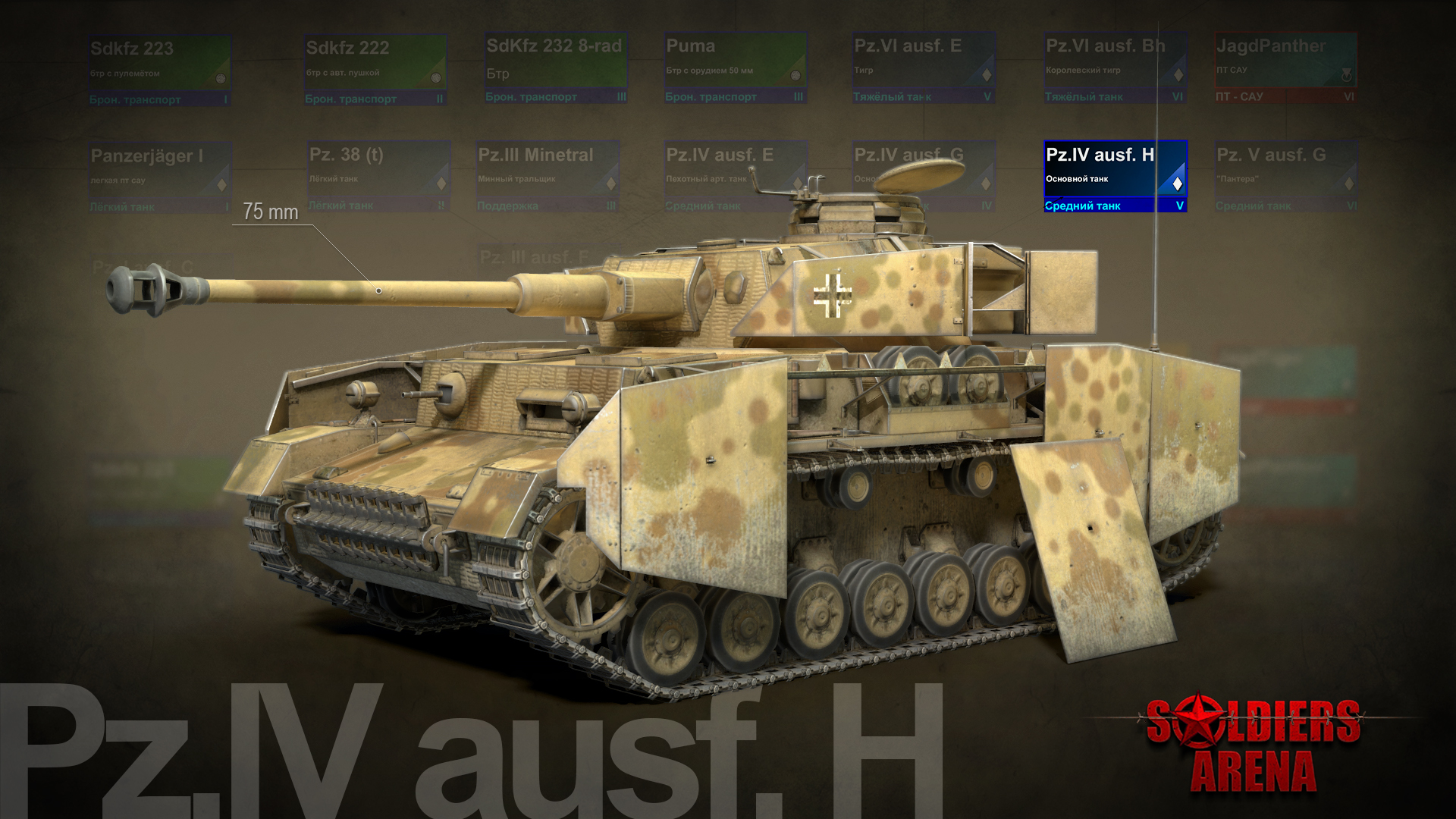
This list will continue to grow and GEM2 will absorb everything Soldiers: Arena needs. Guys, most of the problems that came from previous games of the series are not unsolvable. Complicated and resource-consuming, but not unbearable. The infantry already taught to themselves the complex science of not asking philosophical question before throwing a grenade. Do you remember? - they learned how to jump over fences. We know about the old problems and we try to fix them as much as possible. We realize that it is strange for the game not to have support for 64-bit processors and new graphics processing technologies in 2017 . But now gameplay features have the higher priority. And as soon as most of the functionality is ready - we will start the optimization and cosmetic works. In the meantime, we ask you to remember that GEM2 is our bro and it makes its five sets every day to become even more powerful :) Wish you all the best and we attach PZ.IV.
DevDiaries #39: Regimental guns
Hello friends.
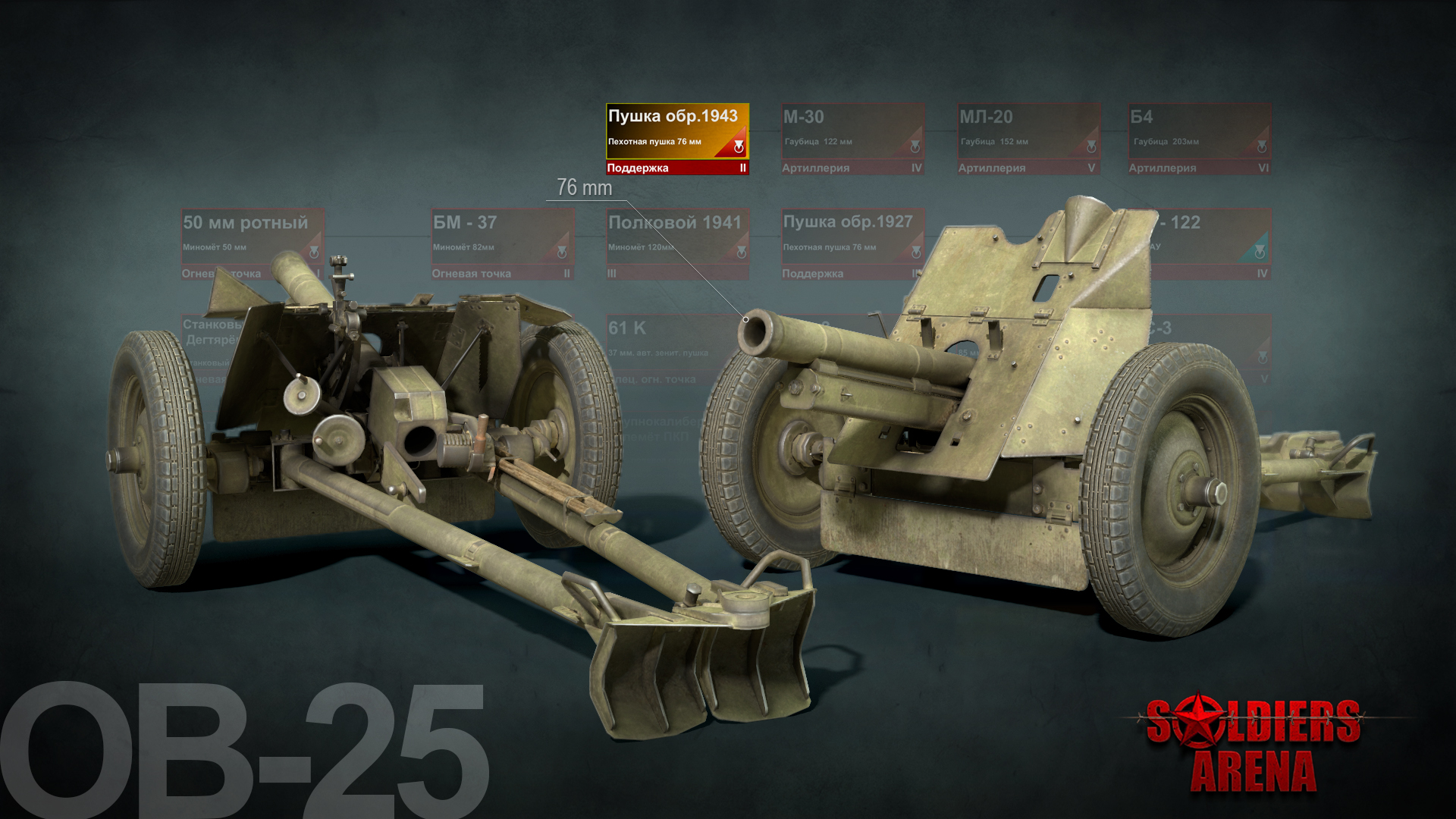
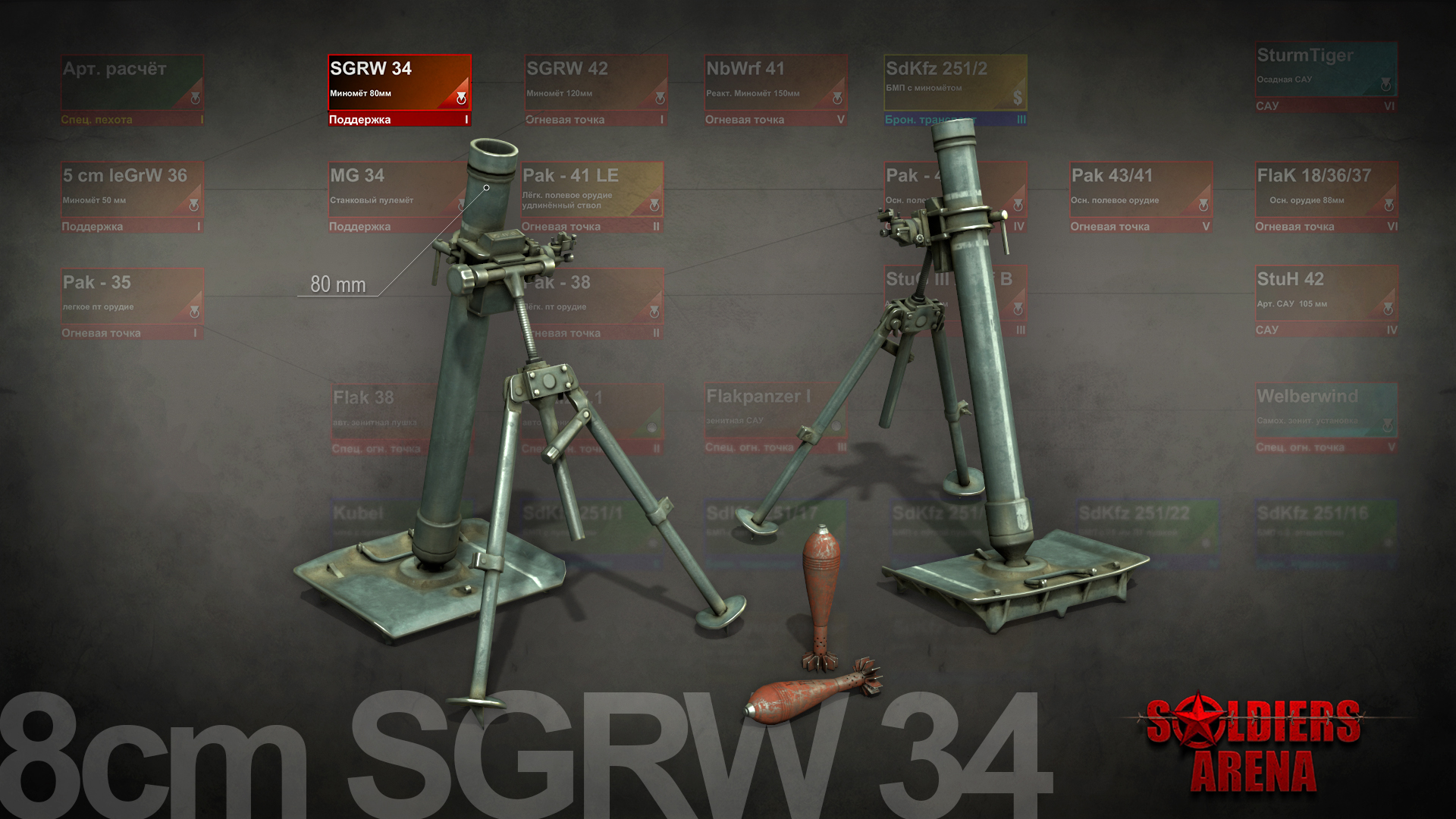
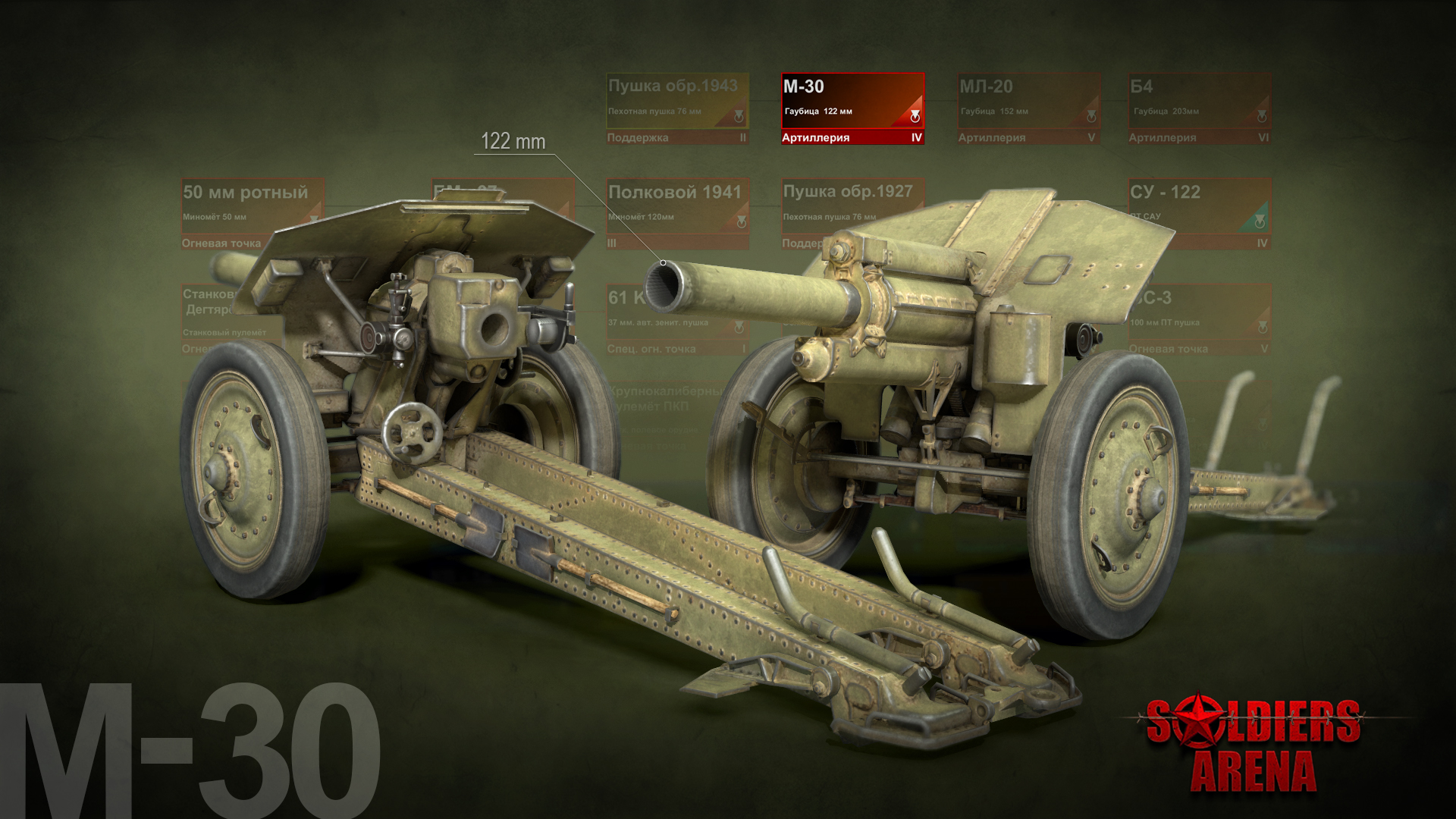
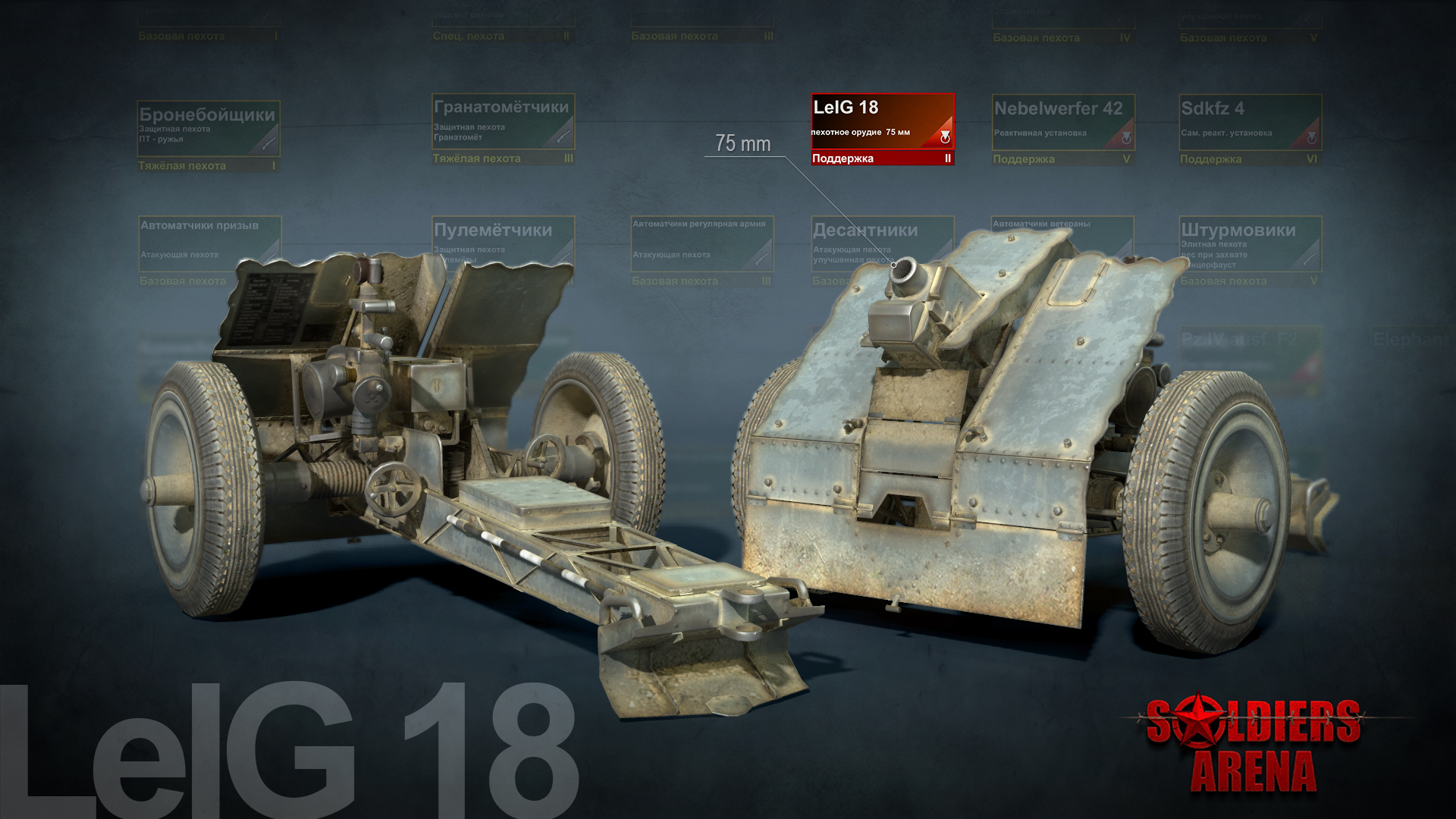
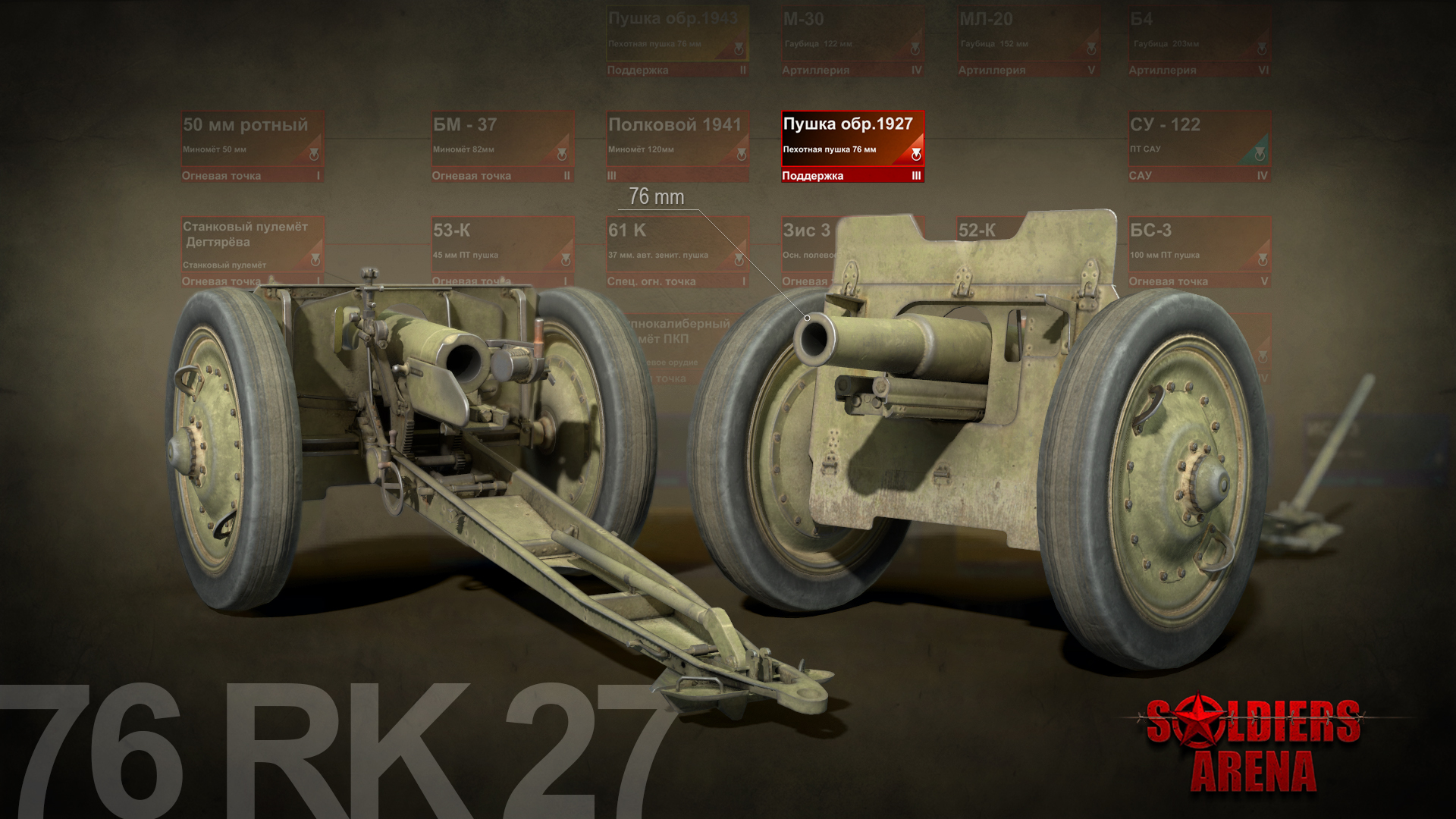
In today's diary, we will talk about the tasks and advantages of regimental cannons in Soldiers: Arena. There will be some text (yeah, sometimes we can write short diary) and three renders: the legendary M-30 howitzer and two regimental guns. So do not rush to wear your "reading glasses". Let your eyes rest. Admire the curves and angles of the cannons our modellers have been working on.
Regimental cannons in reality and in the game.
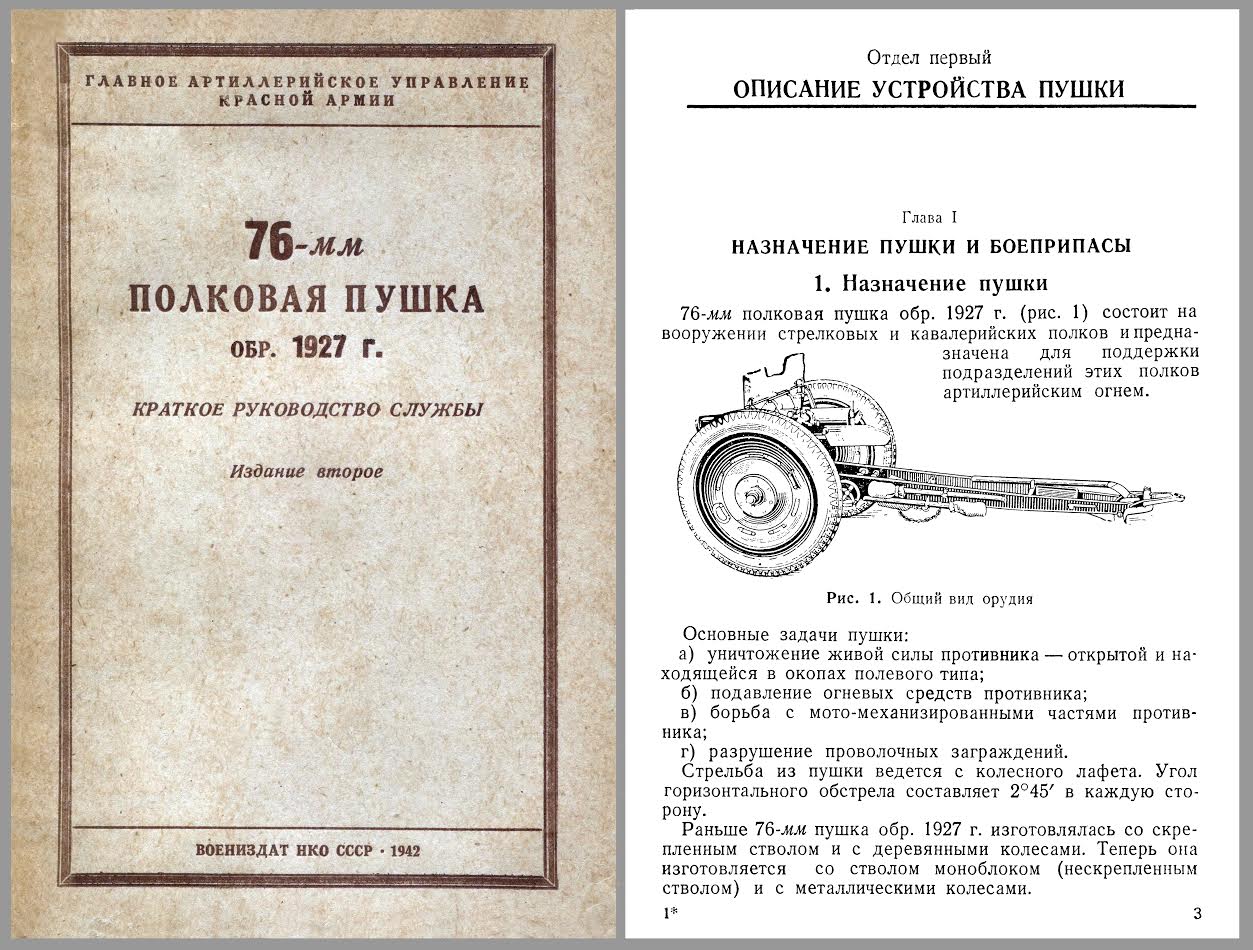
Earlier we already wrote that we want the Soldiers: Arena units to fulfill their roles as close as possible to the real ones. The regimental cannons, originally intended to support infantry with “fire and wheels”. For example, "Quick Service Guide" for the 76 mm regimental gun M1927 tells us that it was intended for such purposes:
the destruction of the enemy's manpower - in open field and in trenches;
suppression of enemy firearms;
fighting with mechanized enemy corps;
destruction of wire barriers
You can see our proofs below. Unfortunately there are no English variant of this brochure, so your only option is to believe us :)
In Soldiers: Arena, they fulfill the same goals, the main one is still primarily infantry support. The artilleryman can take them to the deck too, but in the hands of an infantryman, limited by a small selection of cannons, they are simply irreplaceable: in supporting the offensive actions, suppressing the attacking infantry, destroying the enemy's artillery (at relatively close distances). Considering their mobility, rate of fire and flexibility of usage, regimental cannons will be useful at any stage of the game.
Is the enemy trying to drag you into an infantry shootout? Don’t play his game spamming more infantry, it's better to call the gun instead.
Was your attack stopped because of the enemy's stronghold and your comrades are in no hurry to help you? Take your soldiers to the rear and summon a "battery" of regimental cannons that will clear your way. And after that, occupy the territory with infantry.
Are the enemy's mortars covering your positions? Make the artillerymen suffer!
A few facts about the cannons shown.
Although the serial production of the M-30 was completed in 1955 (a total of 19266 guns were manufactured), the howitzer is still produced in China under the designation of the 122mm howitzer Type 54 and in the self-propelled modification Type 54-1.
Le IG 18 had a mountain modification (7.5 cm le.GebIG 18), which could be divided into 6-10 parts, the heaviest of which weighed 74.9 kg, which made it possible not only for horses but also for humans to carry it.
76 mm regimental gun M1927 in the soldier's vocabulary called "polkovushka" or emotionally "bobik" (which means mutt dog) Why “bobik”? Who knows... Maybe because the gunfire was sharp, resembling a dog's bark, maybe because the cannon jumped upon shooting, like a dog on a chain, or maybe - resembling it’s short barrel, from a chopped "nose" - just like the bobik's from the yard. But we loved it for no less, and even more than the same "Zosia", or "Farewell, Motherland". Vyacheslav Ivanovich Chaliy, commander of regimental cannons battery explained the appearance of the nickname. (С) Svirin M.N. "Bobik". Pages of life.
On this sentimental note, we say goodbye. Wish you the best!